

- Market Size (2026)
- USD 805.8 Mn
- Forecast (2036)
- USD 5031.0 Mn
- CAGR (2026 to 2036)
- 20.1%
How big is the Automotive 48V eFuse ICs Market in 2026?
The Automotive 48V eFuse ICs Market is estimated at USD 805.8 Million in 2026 and is projected to reach USD 5,031.0 Million by 2036, growing at a CAGR of 20.1% during the forecast period.
The market is estimated at USD 805.8 Million in 2026, up from USD 670.9 Million in 2025. Revenue is forecast to reach USD 5,031.0 Million by 2036 at a 20.1% CAGR. Demand depends on the number of vehicle platforms adopting 48V distribution and the protected circuits used on each platform. Electronic protection allows a faulty branch to be disconnected and reset. Current monitoring and fault outputs give the vehicle controller information for diagnosis. [2] [3]
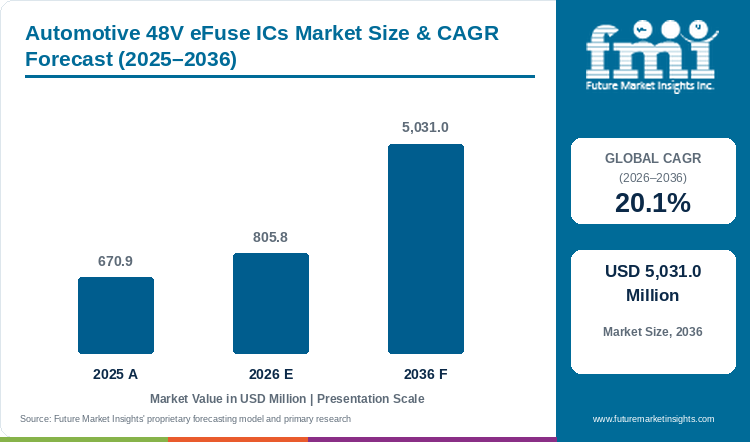
Automotive 48V eFuse ICs Market Size & CAGR Forecast (2025-2036)
| Year | Basis | Market value (USD million) |
|---|---|---|
| 2025 | Actual | 670.9 |
| 2026 | Estimate | 805.8 |
| 2036 | Forecast | 5,031.0 |
| CAGR, 2026 to 2036 | 20.1% | |
Source: Future Market Insights proprietary forecasting model and primary research.
Power distribution is moving closer to individual vehicle loads as manufacturers develop zonal architectures. NXP’s CoreRide Z248 reference system combines mixed 48V and 12V power management with data routing and diagnostics. The system is listed as preproduction. [4] This approach creates opportunities for protection components that fit the current requirements and software behavior of each circuit.
The 48V eFuse market is accelerating from concept to commercialization, with three in ten stakeholders already in bench or vehicle validation and nearly half expecting programmable protection with networked diagnostics to penetrate 60-79% of new 48V circuits by 2033. Engineering preferences reveal a clear architecture direction: external-MOSFET controllers lead as the favored topology, driven by the need to manage power-stage heat and packaging constraints, the single largest barrier to multi-branch deployment. Value creation is shifting decisively toward intelligence rather than component cost reduction, with fault-location reporting ranking as the strongest adoption driver and a commanding 94% of stakeholders willing to pay up to 10% in cost premiums for improved diagnostics. Yet the path to production remains gated by rigorous safety and fault-state validation requirements, which now represent the primary approval bottleneck, while automotive-grade reliability qualification, not price, carries the most weight in supplier selection.
The window for market entry is narrowing to a 2030-2032 inflection point when programmable eFuses are expected to become the default choice, demanding that semiconductor suppliers achieve production scale by 2028-2030. Early commercial traction will likely concentrate in zonal body electronics rather than powertrain applications, offering a lower-criticality proving ground before mission-critical deployment. For ecosystem players, the data signals clear investment priorities: thermal management solutions, safety validation tooling, and software ecosystems that streamline ISO 26262 compliance will capture disproportionate value. OEMs and Tier-1s that resolve validation bottlenecks and architect their 48V platforms around diagnostic-centric protection strategies will secure first-mover advantages as the industry transitions from electromechanical fuses to intelligent, network-connected protection within the next eight years.
Key Takeaways
- External-MOSFET eFuse controllers are expected to account for 58.0% of Product Architecture revenue in 2026. Separate power devices give engineers flexibility in current handling and thermal design.
- OEM and tier-one design-in is projected to account for 92.0% of Sales Channel revenue in 2026. Protection settings are established during vehicle development.
- Surge tolerance and thermal performance influence component selection. Fault response must be evaluated with the intended wiring and load.
- China has the highest profiled forecast CAGR at 21.1% from 2026 to 2036. New 48V vehicle platforms underpin the growth outlook.
Analyst Perspective
“The strongest design-in proposition is a protection function that the vehicle maker can calibrate and diagnose. Chip price matters after the supplier has demonstrated a credible route through fault handling and platform qualification.”
- Nikhil Kaitwade, Principal Consultant, Future Market Insights
How is the Automotive 48V eFuse ICs Market segmented?
The market is segmented by Product Architecture, Vehicle Type, Sales Channel and Region.
Product Architecture separates controllers using external MOSFETs from ICs with integrated power switches. Vehicle Type covers passenger vehicles alongside light and heavy commercial vehicles. Sales Channel distinguishes OEM and tier-one design-in from aftermarket and development applications. Regional coverage includes North America and Latin America with Europe and East Asia. South Asia and Pacific and Middle East and Africa complete the geographic scope.
Why does the External-MOSFET eFuse controllers segment lead demand by product architecture?
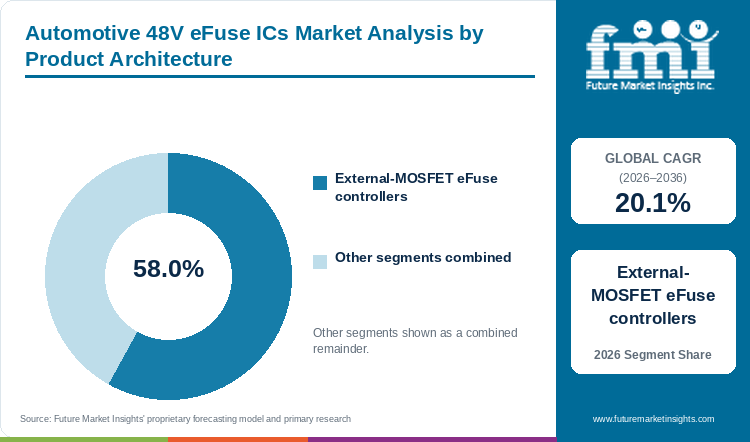
External-MOSFET eFuse controllers lead Product Architecture with an estimated 58.0% share in 2026.
| Product Architecture | Share (2026) |
|---|---|
| External-MOSFET eFuse controllers | 58.0% |
| Other segments combined | 42.0%* |
| Total | 100.0% |
| Metric | Value |
|---|---|
| Global CAGR (2026-2036) | 20.1% |
| Leading segment | External-MOSFET eFuse controllers |
External-MOSFET controllers let engineers select the power devices separately for each circuit. This supports different current requirements without redesigning the controller function. Thermal performance still depends on the selected devices and their installation. TI’s TPS4811-Q1 uses external MOSFETs and adjustable protection thresholds. [3] Conventional automotive relays and fuses remain relevant on circuits suited to established protection methods.
- External-MOSFET eFuse controllers are expected to account for 58.0% of Product Architecture revenue in 2026.
- Engineers compare current sensing and gate control alongside voltage tolerance when selecting a controller.
Why does the Passenger vehicles segment lead demand by vehicle type?
Passenger vehicles lead Vehicle Type with an estimated 74.0% share in 2026.
Passenger vehicles contain electrical loads serving seats and windows alongside other cabin functions. NXP’s reference design includes body-control power distribution using 12V and 48V eFuses. [7] Locating protection near these loads creates packaging requirements around automotive interior components. Engineers need space for switching devices and connectors while preserving access for assembly and servicing.
- Passenger vehicles are expected to account for 74.0% of Vehicle Type revenue in 2026.
- Wiring layouts and installation space influence where local protection can be placed.
Why does the OEM and tier-one design-in segment lead demand by sales channel?
OEM and tier-one design-in is expected to lead the Sales Channel segment with a 92.0% market share in 2026.
OEMs and tier-one suppliers select protection components while developing the electrical architecture. Current limits and recovery behavior need to match the intended load. Engineers then test the circuit before series production. Diagnostic outputs are integrated with the vehicle controller so software can respond to a fault. These dependencies favor selection during the original platform design.
- OEM and tier-one design-in is expected to account for 92.0% of Sales Channel revenue in 2026.
- Fault detection and diagnostic interfaces must support the vehicle’s protection and recovery requirements.
What are the drivers, restraints and opportunities in the Automotive 48V eFuse ICs Market?
48V zonal distribution supports demand. Circuit qualification and heat management constrain adoption while better integration with vehicle diagnostics creates opportunities.
- Driver: Zonal distribution creates local protection points near groups of vehicle functions. Each branch needs a current limit and recovery policy suited to its load.
- Application opportunity: An automotive door latch with electrical actuation needs power components that fit local packaging and diagnostic requirements. Installation space affects the placement of its protection circuit.
- Restraint: Protection must accommodate normal startup current while responding to overloads. The switching stage and its thermal performance influence this balance. [3]
- System integration: Automotive control cables transfer motion within closure mechanisms. Electrical protection must support the operating sequence of the actuator that drives the installed mechanism.
Which country CAGRs are profiled in the Automotive 48V eFuse ICs Market?
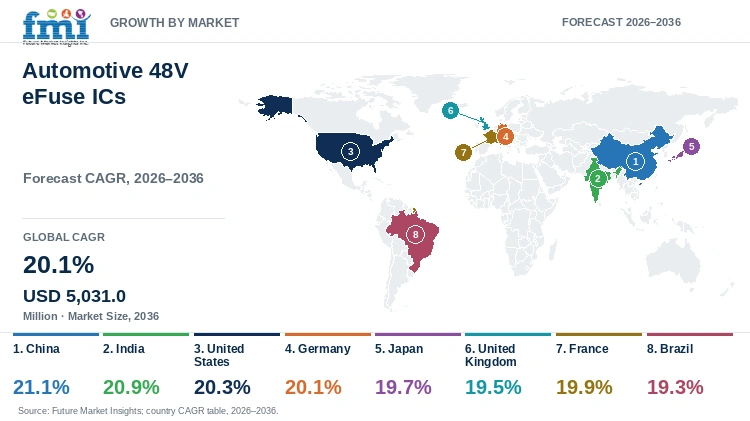
| Country | CAGR (2026-2036) |
|---|---|
| China | 21.1% |
| India | 20.9% |
| United States | 20.3% |
| Germany | 20.1% |
| Japan | 19.7% |
| United Kingdom | 19.5% |
| France | 19.9% |
| Brazil | 19.3% |
Country-wise Analysis
- China: Demand is forecast to grow at a 21.1% CAGR from 2026 to 2036. The outlook reflects new vehicle platforms adopting zonal electrical systems. Local protection can serve individual 48V branches as those architectures expand. Programmable settings give suppliers scope to address circuits with different loads. Design opportunities depend on successful integration with the platform’s fault-management software and production requirements.
- India: Demand is projected to grow at a 20.9% CAGR from 2026 to 2036. Adoption can begin with selected circuits that justify electronic protection through their power requirements or diagnostic needs. Controllers usable across several vehicle models offer a route to wider use. Suppliers need to balance component cost with the external switching stage and the engineering work required for each application.
- United States: Demand is forecast to grow at a 20.3% CAGR from 2026 to 2036. Vehicles with higher electrical loads provide potential applications for 48V distribution. Diagnosing a protected branch can help service teams identify where an electrical fault occurred. Component selection depends on the load and wiring as well as the information available to the vehicle controller. Durable supply and technical support remain relevant over the platform’s production life.
- Germany: Demand is projected to grow at a 20.1% CAGR from 2026 to 2036. The outlook centers on qualification for new vehicle electrical architectures. Thermal behavior and fault response influence the selection of protection controllers and external power devices. Suppliers need to support circuit development through to series production. A design that meets the intended operating conditions can remain part of the platform throughout its production cycle.
- Japan: Demand is forecast to grow at a 19.7% CAGR from 2026 to 2036. Reliable operation during normal startup and overload conditions is central to electronic protection. Manufacturers need repeatable fault response before introducing a controller into an established circuit. The forecast reflects adoption within qualified applications. Product consistency and continued availability support use across successive vehicle programs.
- United Kingdom: Demand is projected to grow at a 19.5% CAGR from 2026 to 2036. Specialist vehicle programs and development applications provide potential entry points for programmable protection. Prototype work allows engineers to test settings against the intended load before production decisions are made. Suppliers serving these programs benefit from accessible evaluation hardware and support for the external power stage.
- France: Demand is forecast to grow at a 19.9% CAGR from 2026 to 2036. Distributed body electronics create applications for protection closer to individual loads. Fault reporting must fit the wider control network so the vehicle can respond and support servicing. The choice of controller therefore combines electrical protection with system integration. Qualified circuits on new vehicle platforms determine the pace of adoption.
- Brazil: Demand is projected to grow at a 19.3% CAGR from 2026 to 2036. Local production based on platforms already using 48V protection offers a route to adoption. Suppliers need component availability and technical support that suit the vehicle’s service life. Reuse of established circuits can reduce development effort when platforms enter local production. Demand then depends on the protection content and production volume of those models.
Who are the notable companies in the Automotive 48V eFuse ICs Market?
Notable companies in the Automotive 48V eFuse ICs Market include Infineon Technologies, Texas Instruments and NXP Semiconductors.
Infineon Technologies and Texas Instruments supply protection and switching components. NXP Semiconductors provides a reference system for integrating power management with the wider zonal architecture. Their products address different levels of the vehicle electrical system.
- Infineon Technologies: Supplies gate drivers for automotive power distribution alongside protected 48V smart switches. [5] [6]
- Texas Instruments: Supplies the TPS4811-Q1 controller for protection using external MOSFETs. [3]
- NXP Semiconductors: Provides the CoreRide Z248 zonal reference system for mixed 48V and 12V architectures. [4]
Competitive Landscape
Protection suppliers compete on current sensing and fault response alongside compatibility with the switching stage. External-MOSFET controllers allow the power stage to be sized for a circuit. Integrated devices combine switching and protection within the component. Engineers need to match the available functions to the intended load and wiring. Supplier support during this work influences selection.
Components are usually selected during platform development and retained through production. A change in the external MOSFET may still require circuit checks even when the controller remains the same. Long-term component availability and support for fault analysis help suppliers maintain these relationships. The commercial opportunity follows qualified circuits entering production and their component requirements over time.
Competitive Benchmarking
| Company | Application Role | Product Offering |
|---|---|---|
| Infineon Technologies | Protection and switching components | Automotive gate drivers and protected 48V smart-switch families. [5] [6] |
| Texas Instruments | External-MOSFET protection controller | TPS4811-Q1 with adjustable protection and diagnostic outputs. [3] |
| NXP Semiconductors | Zonal integration platform | CoreRide Z248 reference system for mixed 48V and 12V power management; preproduction. [4] |
Key Developments
- Infineon’s automotive power-distribution portfolio includes gate drivers for 48V applications and protected smart switches. The families provide different options for selecting the controller and power stage. [5] [6]
- NXP’s May 27, 2026 CoreRide Z248 fact sheet describes mixed 48V and 12V distribution with eFuse functions and data interfaces. The reference system supports development of zonal vehicle architectures. [7]
Key Players
- Infineon Technologies
- Texas Instruments
- NXP Semiconductors
Automotive 48V eFuse ICs Market - Report Scope
| Attribute | Coverage |
|---|---|
| Market Definition | Automotive-qualified protection ICs and controllers used for resettable electronic fault protection in 48V vehicle electrical systems. |
| Revenue Boundary | Includes revenue from automotive 48V eFuse ICs and controllers. Excludes complete zonal ECUs, external discrete MOSFETs and conventional 12V fuse products. |
| Base and Forecast Years | 2025 estimated market size, 2026 base year and forecast period from 2026 to 2036. |
| Units | USD Million for market revenue and percentage for growth rates and segment shares. |
| Growth Outlook | Forecast CAGR of 20.1% from 2026 to 2036. |
| Segmentation | Product Architecture, Vehicle Type, Sales Channel and Region. |
| Countries Profiled | China, India, United States, Germany, Japan, United Kingdom, France and Brazil. |
| Geographical Reach | Global coverage with country forecasts across major automotive manufacturing regions. |
| Forecast Basis | Revenue estimates cover the defined IC and controller scope. The forecast reflects assumptions about 48V adoption and protection content per vehicle. |
Automotive 48V eFuse ICs Market - Research Methodology
| Method | Approach |
|---|---|
| Primary Research | The stakeholder research framework covers OEM electrical engineers and tier-one developers alongside semiconductor application specialists. Topics include protection requirements and qualification criteria. The framework considers how purchasing decisions relate to fault management and vehicle development. |
| Desk Research | Published category benchmarks provide sizing context. [1] Semiconductor documentation describes protection functions and product applications. Manufacturer sources support analysis of both individual components and zonal integration. |
| Market Sizing and Forecasting | Sizing adapts a published category benchmark to the IC and controller revenue boundary and the 2026 to 2036 horizon. [1] Estimates reflect assumptions about 48V adoption and protected circuits per vehicle. Complete zonal ECUs and external MOSFET revenue are excluded. |
| Data Validation | Technical specifications are checked against manufacturer documentation. Revenue boundaries separate protection ICs from complete control units and external power devices. Forecast values and segmentation use consistent units and periods. |
Automotive 48V eFuse ICs Market by Segments
Product Architecture
- External-MOSFET eFuse controllers
- Integrated power-switch eFuse ICs
Vehicle Type
- Passenger vehicles
- Light commercial vehicles
- Heavy commercial vehicles
Sales Channel
- OEM and tier-one design-in
- Aftermarket and development channels
Region
- North America
- United States
- Canada
- Latin America
- Brazil
- Mexico
- Rest of Latin America
- Europe
- Germany
- United Kingdom
- France
- Italy
- Rest of Europe
- East Asia
- China
- Japan
- South Korea
- South Asia and Pacific
- India
- Australia
- Rest of South Asia and Pacific
- Middle East and Africa
- GCC Countries
- South Africa
- Rest of Middle East and Africa
- Israel
Research Sources and Bibliography
- [1] Global Info Research (2026, August 17). Global Automotive 48V eFuse Supply, Demand and Key Producers, 2026-2032. MarketResearch.com report listing.
- [2] Infineon Technologies (n.d.). Automotive eFuses. Accessed October 8, 2026.
- [3] Texas Instruments (2026, April). TPS4811-Q1 Automotive High-Side Driver With Protection and Diagnostics. Datasheet revision E.
- [4] NXP Semiconductors (n.d.). NXP CoreRide Z248 Zonal Reference System. Accessed October 8, 2026.
- [5] Infineon Technologies (n.d.). 48 V high-side switches. Accessed October 8, 2026.
- [6] Infineon Technologies (n.d.). Gate driver ICs for automotive power distribution. Accessed October 8, 2026.
- [7] NXP Semiconductors (2026, May 27). CoreRide Z248 Zonal Reference System. Fact sheet Z248CRFSA4 revision 3.
- [8] Texas Instruments (n.d.). TPS4811-Q1 product information. Accessed October 8, 2026.
This bibliography is provided for reader reference and is not exhaustive. The full report contains the complete reference list and detailed citations.
This Report Answers
- What is the estimated 2026 revenue opportunity for Automotive 48V eFuse ICs?
- What market value is forecast for 2036?
- What is the projected global CAGR from 2026 to 2036?
- Why does the External-MOSFET eFuse controllers segment lead the product architecture mix?
- How does the Passenger vehicles segment influence purchasing priorities?
- Which fault-handling requirements influence protection-controller design-in?
- How do growth forecasts differ across the eight profiled countries?
- Which supplier capabilities matter when selecting protection components?
Frequently Asked Questions
What is the size of the Automotive 48V eFuse ICs Market in 2026?
The market is estimated at USD 805.8 Million in 2026.
What is the projected value of the Automotive 48V eFuse ICs Market in 2036?
The market is forecast to reach USD 5,031.0 Million by 2036.
What is the projected CAGR of the Automotive 48V eFuse ICs Market?
The projected CAGR is 20.1% from 2026 to 2036.
Which product architecture segment leads the Automotive 48V eFuse ICs Market?
External-MOSFET eFuse controllers lead with an estimated 58.0% share of Product Architecture revenue in 2026.
Why are external-MOSFET eFuse controllers used in automotive systems?
External-MOSFET controllers let engineers select the power devices separately for each circuit’s current requirement. TI’s TPS4811-Q1 is one example. [8]
What is the main adoption constraint in the Automotive 48V eFuse ICs Market?
Automotive qualification remains a key constraint. Manufacturers must test fault response with the intended wiring and electrical load before approving the component for use.
Preview the report firsthand - request a free sample
Get SampleGet the brochure for pricing and purchase details.
Get PDFTable of Content
- How big is the Automotive 48V eFuse ICs Market in 2026?
- Key Takeaways
- Analyst Perspective
- How is the Automotive 48V eFuse ICs Market segmented?
- Why does the External-MOSFET eFuse controllers segment lead demand by product architecture?
- Why does the Passenger vehicles segment lead demand by vehicle type?
- Why does the OEM and tier-one design-in segment lead demand by sales channel?
- What are the drivers, restraints and opportunities in the Automotive 48V eFuse ICs Market?
- Which country CAGRs are profiled in the Automotive 48V eFuse ICs Market?
- Country-wise Analysis
- Who are the notable companies in the Automotive 48V eFuse ICs Market?
- Competitive Landscape
- Competitive Benchmarking
- Key Developments
- Automotive 48V eFuse ICs Market - Report Scope
- Automotive 48V eFuse ICs Market by Segments
- Product Architecture
- Vehicle Type
- Sales Channel
- Research Sources and Bibliography
- Automotive 48V eFuse ICs Market - Research Methodology
- This Report Answers
- Frequently Asked Questions
- Competitive Landscape


