

- Market Size (2026)
- USD 6.3 Bn
- Forecast (2036)
- USD 11.5 Bn
- CAGR (2026 to 2036)
- 6.2%
How Big is the Automotive Differential Disconnect Units Market in 2026?
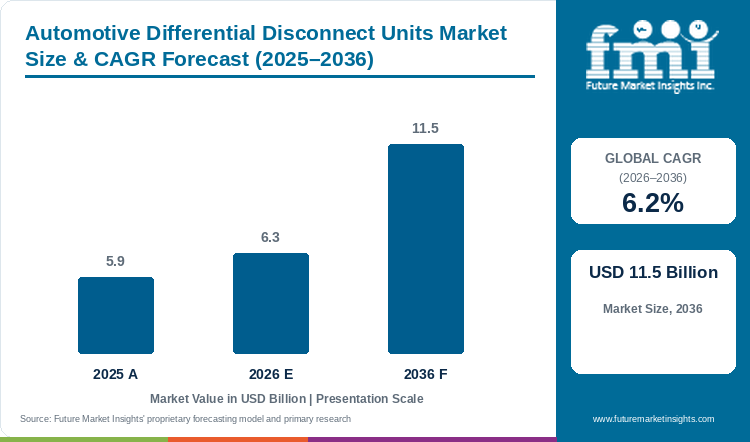
Disconnect unit revenue will reach USD 6.3 Billion in 2026, up from USD 5.9 Billion in 2025, and is projected at USD 11.5 Billion by 2036 on a 6.2% CAGR built on drag reduction across AWD fleets.
Sales of automotive differential disconnect units are estimated to grow at 6.2% CAGR from 2026 to 2036, as per FMI. Market valuation increases from USD 5.9 Billion in 2025 to USD 6.3 Billion in 2026 and is projected to reach USD 11.5 Billion by 2036, adding USD 5.2 Billion over the forecast decade. Sales of disconnect units are highest in SUVs/crossovers, set to hold 34% of demand by vehicle type in 2026, and OEM direct sourcing is expected to handle 52% of sales. Increasing use of part-time 4WD on pickups and AWD on demand across utility platforms is supporting the demand for disconnect units, as OEMs are looking for lower driveline drag on every trim.
Suppliers of disconnect units are also finding growth in adjacent driveline categories, at both slower and faster rates. Sales in the automotive differential actuators market are projected to increase from USD 3.6 Billion in 2026 to USD 6.4 Billion by 2036 at 5.8% CAGR, adding USD 2.8 Billion at a pace slightly below disconnect units. Revenue from driveline disconnect actuators is estimated to rise from USD 940.6 Million to USD 2,186.2 Million at 8.8% CAGR. The automotive e-axle disconnect actuator market is expected to grow fastest at 10.8%, from USD 53.4 Million to USD 148.9 Million, owing to dual-motor electric platforms adding secondary axles.
Consolidation among driveline suppliers is changing the next round of OEM sourcing. Dauch Corporation completed the Dowlais Group acquisition on February 3, 2026, placing GKN Automotive and the former AAM driveline business under one brand [1]. Dana finished the USD 2.7 billion Off-Highway sale on January 2, 2026 and now presents the company as dedicated to light- and commercial-vehicle customers with traditional and electrified systems [2]. Due to this, fewer and larger driveline groups will bid for each AWD platform, and OEM buyers are expected to place more volume with suppliers offering mechanism, actuator and software in one package. As per FMI's outlook, tighter AWD efficiency targets and secondary e-axles on more electric models will keep sales of disconnect units rising through 2036.
Key Takeaways
- Based on unit type, front axle disconnect units are projected to account for 31% in 2026, owing to lower drag during 2WD cruising, and part-time 4WD is estimated to hold 36% by drivetrain.
- By actuation, electric actuators are expected to account for 42% in 2026, owing to engagement commanded from the vehicle ECU, and SUVs/crossovers are estimated at 34% by vehicle type and OEM direct sourcing at 52% by sales channel.
- Notable companies in the automotive differential disconnect units market include Magna International, BorgWarner, Dana, GKN Automotive, American Axle & Manufacturing, Schaeffler, ZF Friedrichshafen and JTEKT.
- Mexico is projected at 7.1% CAGR through 2036, followed by South Korea at 6.8%, as export platforms need locally engineered disconnects, and Japan is expected to grow slowest at 4.9% as compact platforms limit added driveline hardware.
Analyst Perspective
“Shared electric actuation and control packages for front axle, transfer case and secondary e-axle formats will become the largest revenue opportunity in disconnect units through 2036. Tier-1 groups proving low open-state drag and quiet re-engagement on the first validation loop, with mechanism, actuator and software in one housing, will gain the most at each new sourcing round.”
- Nikhil Kaitwade, Principal Consultant, Future Market Insights
How is the Automotive Differential Disconnect Units Market Segmented?
The automotive differential disconnect units market is segmented into unit type, actuation, vehicle type, drivetrain, sales channel and region.
As per FMI, the market is segmented by unit type into front axle disconnect units, rear axle disconnect units, transfer case disconnects, e-axle disconnect modules and integrated AWD disconnects. By actuation, the market is segmented into electric actuators, vacuum actuators, hydraulic actuators and electro-mechanical modules. By vehicle type, the market is segmented into SUVs/crossovers, pickup trucks, off-road vehicles, electric AWD vehicles and light commercial vehicles. By drivetrain, the market is segmented into part-time 4WD, AWD, hybrid AWD and e-axle AWD. By sales channel, the market is segmented into OEM direct, Tier-1 driveline systems, aftermarket replacement and service parts. The regional analysis covers seven regions and more than 30 countries.
Why Do Front Axle Disconnect Units Lead the Automotive Differential Disconnect Units Market by Unit Type?
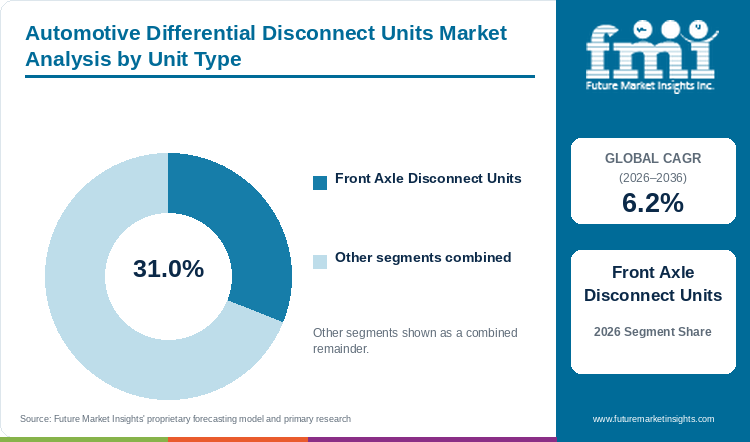
In 2026, front axle disconnect units will account for 31% of market share by unit type.
Increasing production of part-time 4WD pickups and body-on-frame SUVs is supporting the demand for front axle disconnect units. Drivers spend most trips in two-wheel mode, yet the forward propshaft and differential keep spinning and waste fuel through drag, owing to which OEMs specify a front-mounted disconnect on large 4WD platforms. Integrated AWD disconnects are bought in smaller numbers, as each design calls for joint engineering with one carmaker on one model. E-axle disconnect modules gain volume only as dual-motor electric models reach scale. Rear axle disconnect units mostly go into crossovers built on front-drive layouts with lighter torque loads. Transfer case disconnects are growing at a slower pace, as wheels continue to back-drive the forward shaft and gears, a layout also covered in the AWD transfer case couplings market. However, measured drag in the open state and noise approval will determine which supplier holds pricing power on the next part-time pickup award.
- Front axle disconnect units are projected to account for 31% of demand by unit type in 2026, owing to part-time 4WD drivetrains switching between 2WD cruising and 4WD traction.
- The U.S. Environmental Protection Agency reported in February 2026 that 66% of model year 2024 U.S. vehicle production fell within the truck regulatory class [3].
Why Do Electric Actuators Lead the Automotive Differential Disconnect Units Market by Actuation?
By actuation, electric actuators will account for 42% of market share in 2026.
Growing adoption of hybrid and battery-electric platforms with distributed vehicle controls is supporting the demand for electric actuators in disconnect units. Calibration teams want each coupling event timed to traction software and confirmed by a position sensor, owing to which ECU-commanded electric actuation is preferred on new driveline programs. Electro-mechanical modules sell in lower numbers, as the combined motor, gearing and sensor package is bulkier and more expensive. Hydraulic actuators need pumps and fluid lines that small disconnect programs cannot justify on cost. Vacuum actuators are losing volume, as hybrid and battery-electric vehicles no longer supply engine vacuum. However, the fail-state plan each OEM approves will decide which electric actuator design reaches series production.
- Electric actuators are expected to hold 42% of demand by actuation in 2026, supported by repeatable response and diagnostics at the controller level.
- Germany's federal energy ministry reported in January 2026 that battery-electric vehicles reached 19.1% of 2025 new car registrations [4].
Why Do SUVs/Crossovers Lead the Automotive Differential Disconnect Units Market by Vehicle Type?
Based on vehicle type, SUVs/crossovers will account for 34% of market share in 2026.
SUVs/crossovers are widely used for daily commuting, and families still want all-wheel traction on call for snow, rain and gravel. These heavy vehicles cover long highway distances with no torque going to the second axle, owing to which OEMs fit the most disconnect units on SUV and crossover platforms, a trade-off also shaping the AWD coupling system market. Electric AWD vehicles add units as twin-motor designs scale up. Light commercial vehicles offer AWD only on a few trims and buy fewer units. Off-road vehicles are a specialist segment built in low numbers. Pickup trucks account for fewer units, as many truck models use part-time 4WD hardware locked by mechanical means. Quiet re-engagement during abrupt grip changes is a concern covered in the low-noise driveline system components market. However, noise and vibration at re-engagement will shape supplier selection on future SUV programs.
- SUVs/crossovers are estimated to account for 34% of demand by vehicle type in 2026, owing to AWD availability being concentrated on utility platforms.
- BorgWarner reported in October 2025 a Chery award for a cross wheel drive system on SUV models, with production slated for 2027 [5].
What are the Drivers, Restraints, and Opportunities in the Automotive Differential Disconnect Units Market?
Secondary e-axles will open the largest new revenue pool through 2036, as per FMI's analysis, with AWD efficiency targets increasing demand and platform validation slowing adoption.
- Driver: OEMs are cutting parasitic driveline losses without giving up AWD and 4WD traction, due to which disconnect units are finding application on more utility platforms.
- Restraint: Each disconnect needs durability, NVH, controls and packaging validation before series approval, and long qualification is slowing adoption on smaller programs.
- Opportunity: Electrified AWD is creating demand for compact disconnect units on the secondary e-axles of dual-motor vehicles.
Utility-vehicle mix is keeping AWD hardware on the build sheet, as the U.S. EPA reported in February 2026 that truck SUVs alone represented half of model year 2024 U.S. new-vehicle production [3]. OEMs are paying for a disconnect when measured savings offset component cost without changing traction response. Qualification remains the key challenge, as each unit pairs mechanical engagement with control software and functional-safety work. Due to this, smaller programs will struggle to justify the effort when fuel or range gains are modest.
Secondary e-axles are giving the clearest expansion path, since a dual-motor vehicle carries a second motor running only part of the time. Hybrid registrations in Canada rose 36.1% in 2025, according to Statistics Canada [6]. South Korea committed KRW 382.7 billion in 2026 to R&D for autonomous, electric and hydrogen vehicles, supporting the demand for electrified platforms in a key export base [7]. Plug-in hybrid formats are tracked in the hybrid vehicle rear axle disconnect systems market, and suppliers reusing one design across several e-axle torque classes are expected to scale revenue fastest.
Which Country CAGRs are Profiled in the Automotive Differential Disconnect Units Market?
| Country | CAGR, 2026 to 2036 |
|---|---|
| Mexico | 7.1% |
| South Korea | 6.8% |
| Brazil | 6.5% |
| USA | 6.2% |
| Canada | 5.8% |
| Germany | 5.5% |
| Japan | 4.9% |
How do Country-level CAGRs Compare in the Automotive Differential Disconnect Units Market?
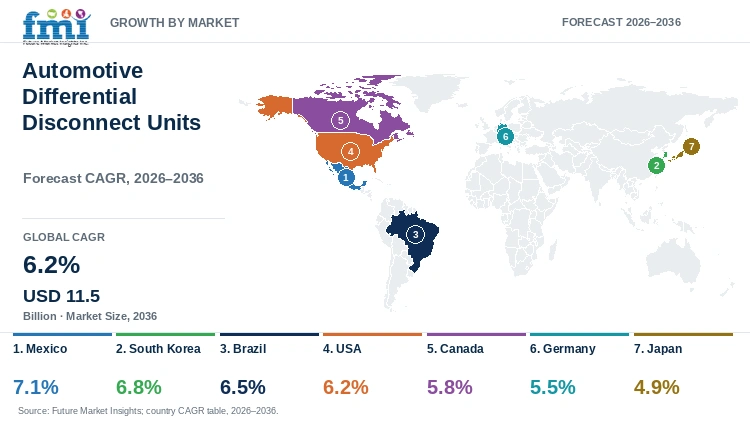
Mexico is projected to lead the seven profiled countries at 7.1% CAGR, and Japan is expected to grow slowest at 4.9%, according to FMI's country model. Production scale, AWD penetration and platform launch timing are setting the value of each supplier program. As a result, slower markets with large truck output will continue to carry sizable revenue pools through 2036.
- Mexico at 7.1% and South Korea at 6.8% will reward localized engineering for export platforms.
- Efficiency rules and utility-vehicle volume will carry Brazil to 6.5% growth and the USA to 6.2%.
- Canada at 5.8% and Germany at 5.5% will track hybrid and battery-electric AWD adoption.
- Japan grows slowest at 4.9%, with compact packaging setting the terms of supplier entry.
The full report extends the CAGR view past these seven profiles to more than 30 countries grouped into seven regions.
Country Outlook
- Light trucks dominate Mexican output, and INEGI reported on January 9, 2026 that Mexico produced 3,953,494 light vehicles in 2025, with light trucks at 77.2% of the total [8]. Export-oriented plants will need disconnects qualified against global platform rules at a local cost, supporting the fastest CAGR among profiled countries at 7.1%.
- Demand for disconnect units in the USA is projected at 6.2% CAGR, owing to validation speed across towing, road and off-road duty cycles, as truck SUVs alone made up half of model year 2024 new-vehicle production [3]. Serviceable high-torque designs are expected to clear warranty reviews faster on these high-volume programs.
- Japan is projected at 4.9% CAGR, the lowest of the seven profiled, as mature vehicle architectures leave limited space for added driveline hardware. Suppliers offering compact mounting, low drag and quiet electromechanical engagement will find the clearest route into crossover SUV platforms.
- Electrification is reshaping the German opportunity, as the Federal Ministry for Economic Affairs and Energy reported on January 27, 2026 that battery-electric vehicles reached 19.1% of 2025 new car registrations [4]. Demand for disconnect units in Germany will rise at 5.5% CAGR, led by e-axle-compatible designs with documented energy-loss data for premium AWD platforms.
- Canadian growth of 5.8% a year will build on multipurpose vehicles, which took 63.2% of new registrations in 2025, according to Statistics Canada in March 2026 [6]. With a small domestic production base, Canadian buyers will rely on systems engineered for wider North American platforms and on service parts availability.
- Brazil's MDIC updated the MOVER program on July 6, 2026 and confirmed mandatory new-vehicle requirements that include well-to-wheel energy efficiency from June 2025 [9]. Sales in Brazil will rise at a 6.5% CAGR, with localized sourcing, simple actuation and hybrid-compatible designs carrying the most volume at local cost points.
- Export-led engineering sets the pace in South Korea, and MOTIR announced on February 6, 2026 that KRW 382.7 billion would fund core automotive R&D for autonomous, electric and hydrogen technologies [7]. Modular e-axle disconnects with software-ready actuation will support a 6.8% CAGR, since a fast development cadence leaves little room for bespoke validation.
Who are the Notable Companies in the Automotive Differential Disconnect Units Market?
A tiered, qualification-led field is headed by Magna International, BorgWarner, Dana, GKN Automotive, American Axle & Manufacturing and Schaeffler, which FMI benchmarks on disconnect mechanisms, control integration and driveline modules.
A small group of Tier-1 driveline integrators is receiving most platform awards for differential disconnect units, and actuation specialists are supplying sub-systems to these integrators. OEMs judge bids on platform qualification, open-state drag, re-engagement quality and controls integration, due to which a supplier is rarely changed once NVH, durability and calibration are signed off. New entrants find bidding difficult, as each offer needs mechanism, actuation and controls validated together on the target vehicle. The top tier is also becoming smaller, as Dauch Corporation brought GKN Automotive and the former AAM business under one brand in February 2026 [1]. Dana sold the Off-Highway business to focus on light- and commercial-vehicle systems [2]. Owing to this, OEM purchasing teams hold pricing power during the sourcing round, and the incumbent gains that power after program launch. However, secondary e-axle programs are expected to bring Schaeffler and ZF Friedrichshafen into more contests through 2036, and each new sourcing round will become more competitive.
- Integrated AWD and Disconnect System Integrators: Magna International, BorgWarner, Dana and American Axle & Manufacturing pair axle or AWD system engineering with disconnect controls.
- Electrified Axle Disconnect Specialists: GKN Automotive, Schaeffler and ZF Friedrichshafen focus on secondary e-axle decoupling and electrified driveline modules.
- Actuation and Precision Driveline Platforms: JTEKT supplies electromagnetic actuation, and Mubea and Linamar bring precision powertrain and e-axle capability.
Competitive Benchmarking
| Company | Disconnect Mechanism Breadth | Disconnect Control Integration | Driveline Module Integration | Geographic Reach |
|---|---|---|---|---|
| Magna International | High | High | High | North America, Europe, and Asia |
| BorgWarner | High | High | High | North America, Europe, and Asia |
| Dana | High | High | High | North America, Europe, and Asia-Pacific |
| GKN Automotive | Medium | High | High | Europe, Asia, and North America |
| American Axle & Manufacturing | High | High | High | North America, Europe, Asia, and Latin America |
| Schaeffler | Medium | High | Medium | Europe, Asia, and North America |
| JTEKT | Medium | High | Medium | Japan, North America, Europe, and Asia |
| ZF Friedrichshafen | Medium | High | High | Europe, North America, and Asia |
| Mubea | Low | Low | Medium | Global automotive manufacturing footprint |
| Linamar | Low | Low | Medium | North America with global automotive programs |
Scoring basis: Disconnect Mechanism Breadth counts documented front axle, PTU or transfer case, rear axle and e-axle disconnect formats. Disconnect Control Integration scores actuation or control capability tied to driveline separation. Driveline Module Integration scores placement inside a larger axle, AWD or e-drive assembly. A High score reflects broad and documented capability on the criterion, Medium reflects a narrower range, and Low reflects thin public evidence.
Key Developments
- In October 2025, BorgWarner reported two all-wheel drive awards from Chery, covering on-demand transfer cases with mechanical lock for pickup trucks and a cross wheel drive system for SUV models, with production slated to begin in 2027 [5].
- In January 2026, Dana completed the USD 2.7 billion sale of the Off-Highway business to Allison Transmission, leaving the company focused on light- and commercial-vehicle customers with traditional and electrified systems [2].
- In February 2026, Dauch Corporation completed the acquisition of Dowlais Group plc, bringing GKN Automotive and GKN Powder Metallurgy under the Dauch brand alongside the former AAM business [1].
Key Players
Integrated AWD and Disconnect System Integrators
- Magna International
- BorgWarner
- Dana
- American Axle & Manufacturing
Electrified Axle Disconnect Specialists
- GKN Automotive
- Schaeffler
- ZF Friedrichshafen
Actuation and Precision Driveline Platforms
- JTEKT
- Mubea
- Linamar
Report Scope and Methodology
| Coverage field | Report scope |
|---|---|
| Market breakdown | 6 categories: Unit Type (Front Axle Disconnect Units, Rear Axle Disconnect Units, Transfer Case Disconnects, E-axle Disconnect Modules, Integrated AWD Disconnects), Actuation (Electric Actuator, Vacuum Actuator, Hydraulic Actuator, Electro-mechanical Module), Vehicle Type (SUVs/Crossovers, Pickup Trucks, Off-road Vehicles, Electric AWD Vehicles, Light Commercial Vehicles), Drivetrain (Part-time 4WD, AWD, Hybrid AWD, E-axle AWD), Sales Channel (OEM Direct, Tier-1 Driveline Systems, Aftermarket Replacement, Service Parts), and Region |
| Quantitative units | USD Billion |
| Market definition | Revenue from automotive differential disconnect units and integrated disconnect-bearing submodules that selectively decouple and re-engage a front axle, rear axle, transfer case or secondary e-axle, as segmented in this study. Complete vehicles, non-disconnect differentials, unrelated torque-vectoring hardware, adjacent substitute products and downstream finished-product revenue fall outside the scope. |
| Regions covered | North America, Latin America, Western Europe, Eastern Europe, East Asia, South Asia and Pacific, Middle East and Africa |
| Countries covered | More than 30 countries, including Mexico, the USA, Japan, Germany, Canada, Brazil, and South Korea |
| Key companies profiled | Magna International, BorgWarner, Dana, GKN Automotive, American Axle & Manufacturing, Schaeffler, JTEKT, ZF Friedrichshafen, Mubea, and Linamar, drawn from a wider pool of driveline and actuation suppliers in the study |
| Forecast period | 2026 to 2036 |
| Approach | Disconnect revenue is sized by FMI from the bottom up through supplier product revenue and from the top down through demand for vehicle platforms, then reconciled with drivetrain architecture penetration and country-level automotive indicators. |
Research Methodology
| Method | Approach |
|---|---|
| Primary research | Structured discussions with driveline manufacturers, OEM engineering and purchasing teams, Tier-1 system integrators, service-channel participants and technical specialists test architecture selection, qualification criteria, pricing logic, channel behavior and demand for replacement units. |
| Desk research | The review covers government vehicle statistics, regulatory programs, company filings and newsrooms, engineering journals and technical product documentation. The study retains material that supports the defined revenue boundary or a documented market mechanism. |
| Market sizing and forecasting | Sizing reconciles component and module revenue with vehicle production, AWD and 4WD architecture penetration, actuation choices, electrified axle adoption and demand for replacement units. Forecasts consider platform launches, vehicle mix, regulation and supplier localization. |
| Data validation | Findings are cross-checked across supplier evidence, vehicle-platform disclosures, country indicators and the defined segmentation. Double counting, finished-vehicle revenue, non-disconnect differential content and e-drive content not attributable to the disconnect function are excluded. |
Automotive Differential Disconnect Units Market by Segments
Automotive Differential Disconnect Units Market Segmented by Unit Type
- Front Axle Disconnect Units
- Rear Axle Disconnect Units
- Transfer Case Disconnects
- E-axle Disconnect Modules
- Integrated AWD Disconnects
Automotive Differential Disconnect Units Market Segmented by Actuation
- Electric Actuator
- Vacuum Actuator
- Hydraulic Actuator
- Electro-mechanical Module
Automotive Differential Disconnect Units Market Segmented by Vehicle Type
- SUVs/Crossovers
- Pickup Trucks
- Off-road Vehicles
- Electric AWD Vehicles
- Light Commercial Vehicles
Automotive Differential Disconnect Units Market Segmented by Drivetrain
- Part-time 4WD
- AWD
- Hybrid AWD
- E-axle AWD
Automotive Differential Disconnect Units Market Segmented by Sales Channel
- OEM Direct
- Tier-1 Driveline Systems
- Aftermarket Replacement
- Service Parts
Automotive Differential Disconnect Units Market Segmented by Region
- North America
- Latin America
- Western Europe
- Eastern Europe
- East Asia
- South Asia and Pacific
- Middle East and Africa
Research Sources and Bibliography
- [1] Dauch Corporation (2026, February 3). Dauch Corporation Completes Acquisition of Dowlais Group plc.
- [2] Dana Incorporated (2026, January 2). Dana Incorporated Completes Sale of Off-Highway Business.
- [3] U.S. Environmental Protection Agency (2026, February). The 2025 EPA Automotive Trends Report: Fuel Economy and Technology since 1975.
- [4] Federal Ministry for Economic Affairs and Energy (2026, January 27). Great prospects for electric mobility.
- [5] BorgWarner Inc. (2025, October 30). BorgWarner Reports Strong Third Quarter 2025 Results.
- [6] Statistics Canada (2026, March 12). New motor vehicle registrations, fourth quarter 2025.
- [7] Ministry of Trade, Industry and Resources, Republic of Korea (2026, February 6). MOTIR to Invest KRW 464.5 Billion in Korea's Automotive Industry in 2026.
- [8] Instituto Nacional de Estadística y Geografía (2026, January 9). Registro administrativo de la industria automotriz de vehículos ligeros. Diciembre de 2025.
- [9] Ministry of Development, Industry, Commerce and Services of Brazil (2026, July 6). Programa MOVER.
This bibliography is provided for reader reference and is not exhaustive. The full report contains the complete reference list and detailed citations.
This Report Answers
- What revenue will automotive differential disconnect units generate in 2026, and to what level will demand for drag reduction increase that total by 2036?
- Which efficiency losses and AWD traction needs will keep OEMs specifying disconnect units on new platforms?
- Why will front axle disconnect units stay ahead of rear axle, transfer case and e-axle formats in 2026?
- What role will electric actuators play in control integration and disconnect sourcing decisions?
- Why will SUVs/crossovers lead the Vehicle Type category over the forecast period?
- Which of Mexico, South Korea, Brazil, the USA, Canada, Germany and Japan will expand fastest till 2036, and by what margin?
- What effect will ownership consolidation among driveline suppliers have on OEM sourcing choices?
- Which qualification, NVH, durability and integration demands will slow adoption?
- What will OEM driveline and purchasing teams need to check before sourcing a disconnect unit?
Frequently Asked Questions
How Big Is the Automotive Differential Disconnect Units Market Expected to Be in 2026?
Compared with USD 5.9 Billion in 2025, sales of automotive differential disconnect units will rise to USD 6.3 Billion in 2026 in FMI's estimate. Drag reduction on AWD and 4WD vehicles will increase the total to USD 11.5 Billion by 2036, with traction capability left intact.
What Is the CAGR of the Automotive Differential Disconnect Units Market from 2026 to 2036?
Compared with the 5.8% pace of the adjacent differential actuators market, disconnect unit sales will compound at a 6.2% CAGR over 2026 to 2036. Platform validation will set that pace, since each unit will need to clear NVH, durability and controls testing before series production.
Which Unit Type Holds the Largest Share of the Automotive Differential Disconnect Units Market?
Front axle disconnect units will lead with 31% of market share by unit type in 2026. Direct compatibility with part-time 4WD pickups and off-road vehicles will keep the format ahead.
Which Actuation Type Leads the Automotive Differential Disconnect Units Market?
Electric actuators will account for 42% of market share by actuation in 2026. ECU-commanded engagement with position feedback will keep the format ahead on hybrid and electric platforms.
Which Country Is Expected to Grow Fastest in the Automotive Differential Disconnect Units Market?
Ahead of every other profiled country, Mexico will expand at a 7.1% CAGR till 2036, and South Korea will hold second place at 6.8%. Japan will post the slowest pace of the seven at 4.9%, reflecting limited room for extra driveline hardware.
What Notable Restraint Affects the Automotive Differential Disconnect Units Market?
Key challenges will include platform qualification and mechatronic cost. Each unit will need to satisfy torque, durability, NVH, controls and packaging requirements, and small fuel or range benefits will struggle to justify validation spend.
Which Are the Key Companies in the Automotive Differential Disconnect Units Market?
Compared with the wider supplier base, ten companies receive full profiles from FMI, namely Magna International, BorgWarner, Dana, GKN Automotive, American Axle & Manufacturing, Schaeffler, JTEKT, ZF Friedrichshafen, Mubea, and Linamar. The profiles fall into three strategy groups, from full AWD system integrators to actuation and precision driveline platforms.
Preview the report firsthand - request a free sample
Get SampleGet the brochure for pricing and purchase details.
Get PDFTable of Content
- Key Takeaways
- Market Size and CAGR
- Top Growth Driver
- Fastest Growing Segment
- Leading Region
- Key Companies
- Emerging Opportunities
- Executive Summary
- Global Market Outlook
- Demand-side Trends
- Supply-side Trends
- Technology Roadmap Analysis
- Analysis and Recommendations
- Analyst Perspective (What is happening? Why now? What should investors know?)
- Key Questions Answered
- How large is the market?
- What is the CAGR?
- What are key trends?
- Which region dominates?
- Who are the leaders?
- Market Overview
- Market Coverage / Taxonomy
- Market Definition / Scope / Limitations
- Research Methodology
- Chapter Orientation
- Analytical Lens and Working Hypotheses
- Market Structure, Signals, and Trend Drivers
- Benchmarking and Cross-market Comparability
- Market Sizing, Forecasting, and Opportunity Mapping
- Research Design and Evidence Framework
- Desk Research Programme (Secondary Evidence)
- Expert Input and Fieldwork (Primary Evidence)
- Tooling, Models, and Reference Databases
- Data Engineering and Model Build
- Quality Assurance and Audit Trail
- Market Background
- Market Dynamics (Drivers, Restraints, Opportunity, Trends)
- Scenario Forecast (Optimistic, Likely, Conservative)
- Impact Analysis
- AI Impact
- Sustainability Impact
- Regulatory Impact
- Technology Impact
- Consumer / Buyer Analysis
- Purchase Drivers
- Adoption Barriers
- Buyer Journey
- Opportunity Map Analysis
- Product Life Cycle Analysis
- Supply Chain Analysis
- Investment Feasibility Matrix
- Value Chain Analysis
- PESTLE and Porter's Analysis
- Regulatory Landscape
- Regional Parent Market Outlook
- Production and Consumption Statistics
- Import and Export Statistics
- Global Market Analysis and Forecast, 2021 to 2036
- Historical Market Size Value (USD Billion) Analysis, 2021 to 2025
- Current and Future Market Size Value (USD Billion) Projections, 2026 to 2036
- Y-o-Y Growth Trend Analysis
- Absolute $ Opportunity Analysis
- Global Market Pricing Analysis, 2021 to 2036
- Global Market Analysis and Forecast, By Unit Type, 2021 to 2036
- Introduction / Key Findings
- Historical Market Size Value (USD Billion) Analysis By Unit Type, 2021 to 2025
- Current and Future Market Size Value (USD Billion) Analysis and Forecast By Unit Type, 2026 to 2036
- Front Axle Disconnect Units
- Rear Axle Disconnect Units
- Transfer Case Disconnects
- E-axle Disconnect Modules
- Integrated AWD Disconnects
- Y-o-Y Growth Trend Analysis By Unit Type, 2021 to 2025
- Absolute $ Opportunity Analysis By Unit Type, 2026 to 2036
- Global Market Analysis and Forecast, By Actuation, 2021 to 2036
- Introduction / Key Findings
- Historical Market Size Value (USD Billion) Analysis By Actuation, 2021 to 2025
- Current and Future Market Size Value (USD Billion) Analysis and Forecast By Actuation, 2026 to 2036
- Electric Actuator
- Vacuum Actuator
- Hydraulic Actuator
- Electro-mechanical Module
- Y-o-Y Growth Trend Analysis By Actuation, 2021 to 2025
- Absolute $ Opportunity Analysis By Actuation, 2026 to 2036
- Global Market Analysis and Forecast, By Vehicle Type, 2021 to 2036
- Introduction / Key Findings
- Historical Market Size Value (USD Billion) Analysis By Vehicle Type, 2021 to 2025
- Current and Future Market Size Value (USD Billion) Analysis and Forecast By Vehicle Type, 2026 to 2036
- SUVs/Crossovers
- Pickup Trucks
- Off-road Vehicles
- Electric AWD Vehicles
- Light Commercial Vehicles
- Y-o-Y Growth Trend Analysis By Vehicle Type, 2021 to 2025
- Absolute $ Opportunity Analysis By Vehicle Type, 2026 to 2036
- Global Market Analysis and Forecast, By Drivetrain, 2021 to 2036
- Introduction / Key Findings
- Historical Market Size Value (USD Billion) Analysis By Drivetrain, 2021 to 2025
- Current and Future Market Size Value (USD Billion) Analysis and Forecast By Drivetrain, 2026 to 2036
- Part-time 4WD
- AWD
- Hybrid AWD
- E-axle AWD
- Y-o-Y Growth Trend Analysis By Drivetrain, 2021 to 2025
- Absolute $ Opportunity Analysis By Drivetrain, 2026 to 2036
- Global Market Analysis and Forecast, By Sales Channel, 2021 to 2036
- Introduction / Key Findings
- Historical Market Size Value (USD Billion) Analysis By Sales Channel, 2021 to 2025
- Current and Future Market Size Value (USD Billion) Analysis and Forecast By Sales Channel, 2026 to 2036
- OEM Direct
- Tier-1 Driveline Systems
- Aftermarket Replacement
- Service Parts
- Y-o-Y Growth Trend Analysis By Sales Channel, 2021 to 2025
- Absolute $ Opportunity Analysis By Sales Channel, 2026 to 2036
- Global Market Analysis and Forecast, By Region, 2021 to 2036
- Introduction
- Historical Market Size Value (USD Billion) Analysis By Region, 2021 to 2025
- Current Market Size Value (USD Billion) Analysis and Forecast By Region, 2026 to 2036
- North America
- Latin America
- Western Europe
- Eastern Europe
- East Asia
- South Asia and Pacific
- Middle East and Africa
- Market Attractiveness Analysis By Region
- North America Market Analysis and Forecast, By Country, 2021 to 2036
- Historical Market Size Value (USD Billion) Trend Analysis By Market Taxonomy, 2021 to 2025
- Market Size Value (USD Billion) Forecast By Market Taxonomy, 2026 to 2036
- By Country
- By Unit Type
- By Actuation
- By Vehicle Type
- By Drivetrain
- By Sales Channel
- Market Attractiveness Analysis
- By Country
- By Unit Type
- By Actuation
- By Vehicle Type
- By Drivetrain
- By Sales Channel
- Key Takeaways
- Latin America Market Analysis and Forecast, By Country
- Historical Market Size Value (USD Billion) Trend Analysis By Market Taxonomy, 2021 to 2025
- Market Size Value (USD Billion) Forecast By Market Taxonomy, 2026 to 2036
- By Country
- By Unit Type
- By Actuation
- By Vehicle Type
- By Drivetrain
- By Sales Channel
- Market Attractiveness Analysis
- By Country
- By Unit Type
- By Actuation
- By Vehicle Type
- By Drivetrain
- By Sales Channel
- Key Takeaways
- Western Europe Market Analysis and Forecast, By Country
- Historical Market Size Value (USD Billion) Trend Analysis By Market Taxonomy, 2021 to 2025
- Market Size Value (USD Billion) Forecast By Market Taxonomy, 2026 to 2036
- By Country
- By Unit Type
- By Actuation
- By Vehicle Type
- By Drivetrain
- By Sales Channel
- Market Attractiveness Analysis
- By Country
- By Unit Type
- By Actuation
- By Vehicle Type
- By Drivetrain
- By Sales Channel
- Key Takeaways
- Eastern Europe Market Analysis and Forecast, By Country
- Historical Market Size Value (USD Billion) Trend Analysis By Market Taxonomy, 2021 to 2025
- Market Size Value (USD Billion) Forecast By Market Taxonomy, 2026 to 2036
- By Country
- By Unit Type
- By Actuation
- By Vehicle Type
- By Drivetrain
- By Sales Channel
- Market Attractiveness Analysis
- By Country
- By Unit Type
- By Actuation
- By Vehicle Type
- By Drivetrain
- By Sales Channel
- Key Takeaways
- East Asia Market Analysis and Forecast, By Country
- Historical Market Size Value (USD Billion) Trend Analysis By Market Taxonomy, 2021 to 2025
- Market Size Value (USD Billion) Forecast By Market Taxonomy, 2026 to 2036
- By Country
- By Unit Type
- By Actuation
- By Vehicle Type
- By Drivetrain
- By Sales Channel
- Market Attractiveness Analysis
- By Country
- By Unit Type
- By Actuation
- By Vehicle Type
- By Drivetrain
- By Sales Channel
- Key Takeaways
- South Asia and Pacific Market Analysis and Forecast, By Country
- Historical Market Size Value (USD Billion) Trend Analysis By Market Taxonomy, 2021 to 2025
- Market Size Value (USD Billion) Forecast By Market Taxonomy, 2026 to 2036
- By Country
- By Unit Type
- By Actuation
- By Vehicle Type
- By Drivetrain
- By Sales Channel
- Market Attractiveness Analysis
- By Country
- By Unit Type
- By Actuation
- By Vehicle Type
- By Drivetrain
- By Sales Channel
- Key Takeaways
- Middle East and Africa Market Analysis and Forecast, By Country
- Historical Market Size Value (USD Billion) Trend Analysis By Market Taxonomy, 2021 to 2025
- Market Size Value (USD Billion) Forecast By Market Taxonomy, 2026 to 2036
- By Country
- By Unit Type
- By Actuation
- By Vehicle Type
- By Drivetrain
- By Sales Channel
- Market Attractiveness Analysis
- By Country
- By Unit Type
- By Actuation
- By Vehicle Type
- By Drivetrain
- By Sales Channel
- Key Takeaways
- Key Countries Market Analysis
- Mexico
- Pricing Analysis
- Market Share Analysis, 2025
- By Unit Type
- By Actuation
- By Vehicle Type
- By Drivetrain
- By Sales Channel
- South Korea
- Pricing Analysis
- Market Share Analysis, 2025
- By Unit Type
- By Actuation
- By Vehicle Type
- By Drivetrain
- By Sales Channel
- Brazil
- Pricing Analysis
- Market Share Analysis, 2025
- By Unit Type
- By Actuation
- By Vehicle Type
- By Drivetrain
- By Sales Channel
- USA
- Pricing Analysis
- Market Share Analysis, 2025
- By Unit Type
- By Actuation
- By Vehicle Type
- By Drivetrain
- By Sales Channel
- Canada
- Pricing Analysis
- Market Share Analysis, 2025
- By Unit Type
- By Actuation
- By Vehicle Type
- By Drivetrain
- By Sales Channel
- Germany
- Pricing Analysis
- Market Share Analysis, 2025
- By Unit Type
- By Actuation
- By Vehicle Type
- By Drivetrain
- By Sales Channel
- Japan
- Pricing Analysis
- Market Share Analysis, 2025
- By Unit Type
- By Actuation
- By Vehicle Type
- By Drivetrain
- By Sales Channel
- Mexico
- Market Structure Analysis
- Competition Dashboard
- Competition Benchmarking
- Market Share Analysis of Top Players
- By Regional
- By Unit Type
- By Actuation
- By Vehicle Type
- By Drivetrain
- By Sales Channel
- Emerging Startups
- Innovation Benchmarking
- Competition Analysis
- Competition Deep Dive
- Magna International
- Overview
- Product Portfolio
- Profitability by Market Segments
- Sales Footprint
- Strategy Overview
- Marketing Strategy
- Product Strategy
- Channel Strategy
- BorgWarner
- Dana
- GKN Automotive
- American Axle & Manufacturing
- Schaeffler
- JTEKT
- ZF Friedrichshafen
- Mubea
- Linamar
- Magna International
- Case Studies
- Success Stories
- Recent Developments
- Competition Deep Dive
- Assumptions & Acronyms Used


