

- Market Size (2026)
- USD 7.7 Bn
- Forecast (2036)
- USD 14.0 Bn
- CAGR (2026 to 2036)
- 6.2%
How Big is the Automotive Torque Management Modules Market in 2026?
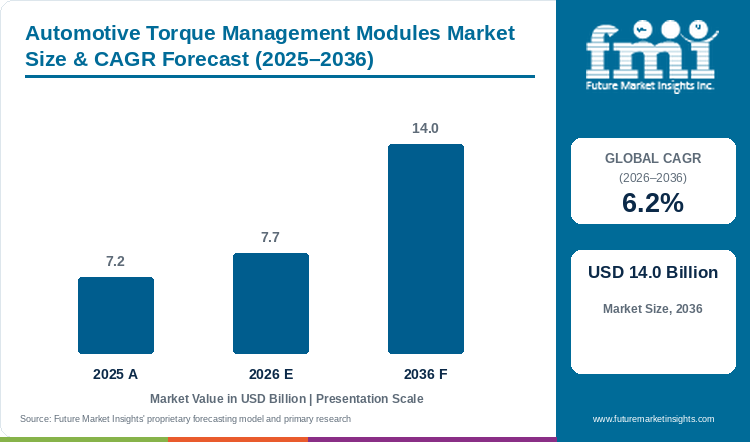
Torque management module revenue stands at an estimated USD 7.7 Billion for 2026, above USD 7.2 Billion in 2025, with a 6.2% CAGR carrying spend to USD 14.0 Billion by 2036.
Adoption of automotive torque management modules is expected to increase at 6.2% CAGR through 2036, as per FMI. Market size is estimated to rise from USD 7.2 Billion in 2025 to USD 7.7 Billion in 2026 and to reach USD 14.0 Billion by 2036, opening USD 6.3 Billion of new revenue over the forecast period. Increasing addition of electric and all-wheel-drive variants to high-volume platforms is supporting the demand for these modules among carmakers. Electric car sales grew 20% to exceed 20 million units in 2025 and reached one-quarter of new car sales, the International Energy Agency reported [1]. As a result, each new platform generation is carrying more electronically controlled torque paths.
Growth across adjacent driveline markets is uneven through 2036, due to which module suppliers have several sales routes. Sales of multi-motor e-axle torque vectoring systems are projected to grow fastest at 12.6% CAGR, rising from USD 1.8 Billion in 2026 to USD 5.9 Billion by 2036. Demand for automotive torque vectoring systems is estimated to increase at 7.1% from USD 3.9 Billion to USD 7.7 Billion. The electronic differential control module market is expected to rise from USD 2.1 Billion to USD 4.1 Billion at 6.9% CAGR, an opportunity of USD 2.0 Billion. AWD transfer case couplings are expected to grow slowest at 3.3% a year, from USD 1.8 Billion in 2026 to USD 2.5 Billion by 2036, as mechanical hardware gives up value to electronic control.
Opportunity worth USD 6.3 Billion will come mainly from AWD torque modules at 28% of demand by module type, SUV and crossover platforms at 31% by vehicle type and OEM direct programs at 55% by sales channel. The control ECU is projected to hold 29% of component revenue in 2026, and each new electrified platform is expected to add further ECU orders. However, long validation cycles remain the key challenge, as a late change of Tier-1 supplier restarts AWD calibration for the carmaker.
Lower-cost electrified models adding active torque control are widening the buyer base for torque management modules over the next ten years. BorgWarner secured a first 48V electric cross differential program with a Chinese OEM in February 2026, with the eXD controlling torque distribution between the wheels [2]. FMI predicts that OEM buyers will pay a premium for control software and calibration support through 2036, due to which suppliers owning the control code will keep platform revenue for the full production life.
Key Takeaways
- Based on module type, AWD torque modules are projected to account for 28% in 2026, owing to active coupling programs on high-volume utility platforms.
- SUVs/crossovers are estimated at 31% by vehicle type in 2026, and AWD is expected to hold 34% by drivetrain, as one secondary-drive design serves combustion, hybrid and electric variants.
- Notable companies in the automotive torque management modules market include BorgWarner, GKN Automotive, Magna International, ZF Friedrichshafen, Bosch, Continental, JTEKT and Mando.
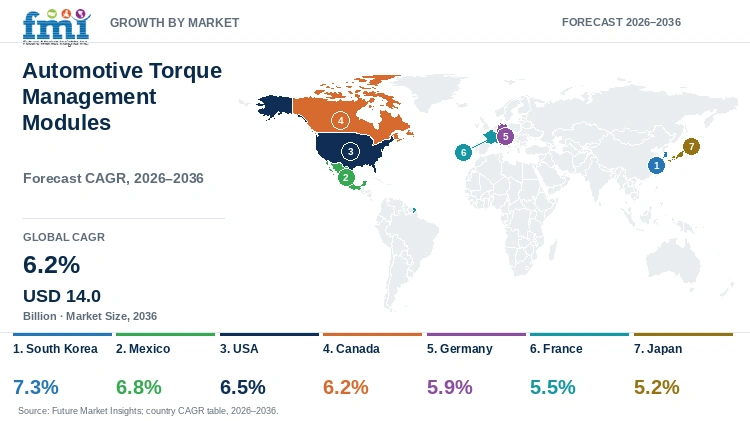
- South Korea is projected at 7.3% CAGR through 2036, followed by Mexico at 6.8%, as electrified sales and export assembly expand, and Japan is expected to post the lowest pace among profiled countries at 5.2%.
Analyst Perspective
“Tier-1 suppliers carrying one validated torque control platform across AWD, hybrid and dual-motor electric programs will gain the largest share of new revenue through 2036. OEMs building software-defined vehicles will place orders with module makers shipping ECU logic, actuator interfaces and calibration tooling as one package, and 48V cross differentials will open a second volume pool, starting with Chinese programs.”
- Nikhil Kaitwade, Principal Consultant, Future Market Insights
How is the Automotive Torque Management Modules Market Segmented?
The automotive torque management modules market is segmented into module type, vehicle type, drivetrain, component, sales channel and region.
As per FMI, the market is segmented by module type into AWD torque modules, e-axle torque modules, torque vectoring controllers, transfer case control modules and hybrid torque management modules. By vehicle type, the market is segmented into SUVs/crossovers, performance cars, battery electric vehicles, hybrid vehicles and pickup trucks. By drivetrain, the market is segmented into AWD, 4WD, hybrid AWD, dual-motor EV and performance RWD/FWD. By component, the market is segmented into control ECU, software/calibration, actuator interface, sensor interface and power electronics. By sales channel, the market is segmented into OEM direct, Tier-1 driveline systems, software co-development and service/diagnostics. The regional analysis covers seven regions and more than 30 countries.
Why Do AWD Torque Modules Lead the Automotive Torque Management Modules Market by Module Type?
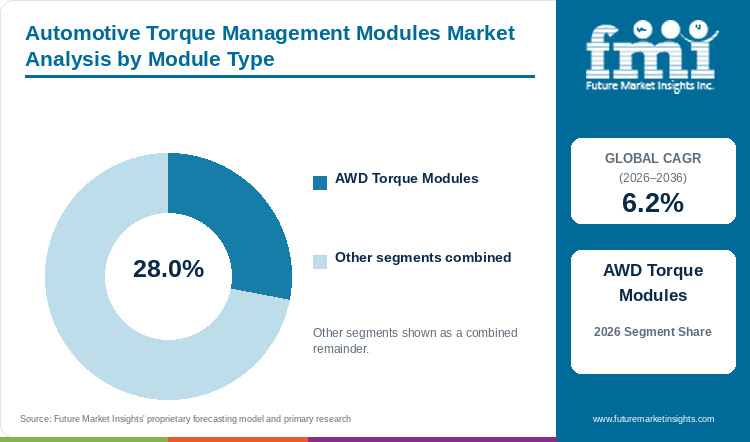
In 2026, AWD torque modules will account for 28% of market share by module type.
Utility vehicle makers are buying more on-demand AWD systems, which is supporting the demand for AWD torque modules. Drivers expect traction in poor conditions with no fuel or range loss on the highway, due to which AWD torque modules take the biggest order volume on mass-market SUVs and crossovers. Torque vectoring controllers bring more value per unit on performance and premium trims, a trend also seen in the active torque vectoring rear axle systems market. In February 2026, BorgWarner secured a first 48V eXD award with a Chinese OEM, moving vectoring toward lower-voltage systems [2]. Transfer case control modules are mostly fitted on body-on-frame 4WD models. Electrified programs are adding e-axle torque modules and hybrid torque management modules, though each one is matched to a single e-drive and calibration file. However, the tuning work needed on each platform will decide the speed of 48V vectoring in series production.
- AWD torque modules are expected to account for 28% of demand by module type in 2026, supported by active coupling programs running across high-volume utility platforms.
- In February 2026, BorgWarner took active torque control into 48V architectures with a first eXD award [2].
Why Do SUVs/Crossovers Lead the Automotive Torque Management Modules Market by Vehicle Type?
Based on vehicle type, SUVs/crossovers will account for 31% of market share in 2026.
Rising sales of utility vehicles sold under several nameplates on one architecture are supporting the demand for torque management modules in SUVs/crossovers. Engineers can reuse one AWD calibration across these badges, owing to which OEMs order repeat module volume for each new SUV or crossover variant. Hybrid and battery electric vehicles are gaining extra torque paths at speed, though many such programs share utility body shells. Pickup trucks mostly need simple 4WD shift control with lower module value. Performance cars specify richer vectoring hardware, though build runs are far smaller. Utility platforms are expected to hold the largest order book for module suppliers through 2036. However, the engineering hours spent tuning each new derivative will set supplier margins on repeat utility volume.
- SUVs/crossovers are estimated to hold 31% of demand by vehicle type in 2026, owing to the many AWD and electrified variants built on each utility platform.
- Truck SUVs accounted for half of new U.S. vehicle production in model year 2024, according to February 2026 figures from the U.S. Environmental Protection Agency [3].
Why Does AWD Lead the Automotive Torque Management Modules Market by Drivetrain?
By drivetrain, AWD will account for 34% of market share in 2026.
Automakers offer AWD on gasoline, hybrid and battery versions of one model line, and this spread is supporting the demand for torque management modules in AWD drivetrains. A single clutch-type secondary drive carried over to every powertrain cuts validation spending per model, due to which OEMs keep choosing AWD on new programs. Performance RWD/FWD buys torque management chiefly for limited-slip and launch functions, with smaller content per car. Hybrid AWD and dual-motor EV designs start from smaller bases, and control value in these designs is moving toward the automotive e-axle disconnect actuator market. The 4WD drivetrain is growing at a slower pace, as pickups and ladder-frame SUVs use mostly mechanical hardware, and AWD transfer case couplings are expected to advance at 3.3% a year. However, the speed at which twin-motor EVs spread will shape the control value retained by AWD couplings.
- AWD is projected to account for 34% of demand by drivetrain in 2026, supported by a single secondary-drive design shared across combustion, hybrid and electric variants.
- In October 2025, GKN Automotive presented AWD and electronic torque management systems at a Detroit showcase [4].
Why Does the Control ECU Lead the Automotive Torque Management Modules Market by Component?
In 2026, the control ECU will account for 29% of market share by component.
Increasing software content in vehicle-motion control is supporting the demand for the control ECU in torque management modules. Each torque request has to pass one approved controller handling arbitration, fault checks and fail-safe behavior, owing to which carmakers spend the most on this electronic unit. Power electronics are counted toward torque management only on electrified layouts with built-in motor control. Actuator and sensor interfaces are standard parts and add less to module price. Spending on software/calibration is rising fast, though carmakers often purchase tuning work packaged with the controller hardware. ZF launched cubiX Tuner in July 2025 to automate parameter relationships across drive, brake, steering and damping actuators [5]. However, standalone prices for calibration code will set the portion of module revenue retained by the ECU.
- The control ECU is expected to hold 29% of demand by component in 2026, supported by real-time arbitration and safety logic combined in one electronic unit.
- In July 2025, ZF introduced cubiX Tuner for vehicles governed by several thousand interacting parameters [5].
Why Does OEM Direct Lead the Automotive Torque Management Modules Market by Sales Channel?
Based on sales channel, OEM direct will account for 55% of market share in 2026.
Growing OEM control over E/E architecture and software release is supporting the demand for torque management modules through OEM direct sourcing. Carmakers tune torque logic on the full vehicle long before series builds begin, owing to which module suppliers are signed directly during platform development. Service/diagnostics earns income from cars on the road through reflashing and fault diagnosis. Software co-development is restricted to carmakers that write vehicle-motion code in-house. Tier-1 driveline systems pass modules to OEMs inside full axle or e-drive packages and keep a smaller slice of control value. However, wider in-house motion software at large carmakers will determine the control value purchased from module suppliers.
- OEM direct is projected to account for 55% of demand by sales channel in 2026, owing to OEM control over E/E interfaces and software release.
- BorgWarner stated in February 2026 that the first 48V eXD program would integrate with the customer's E/E architecture [2].
What are the Drivers, Restraints, and Opportunities in the Automotive Torque Management Modules Market?
As per FMI, electrified and active drivetrains will widen demand for torque control through 2036, vehicle-level validation will slow program awards, and software-defined architectures will open room for reusable control platforms.
- Driver: Electrification and continued AWD sales on utility vehicles are adding electronically controllable torque paths on every new platform generation.
- Restraint: Functional safety, cybersecurity and software-update governance are raising qualification cost, and vehicle-specific calibration adds time to every award.
- Opportunity: Centralized vehicle-motion software can separate control logic from specific hardware and increase reuse across platforms and derivatives.
Increasing count of dual-motor vehicles, e-axles and hybrid secondary drives needing coordinated torque commands is the key driver of the market. Electric car sales grew 20% in 2025 to over 20 million units worldwide, and conventional AWD on SUVs will keep a large share of programs [1].
Key challenges center on the vehicle-level engineering required before a module enters production. UN Regulations 155 and 156 place cybersecurity and software-update obligations across the vehicle lifecycle, due to which supplier lists are narrowing to companies with proven integration capacity.
Japan's METI and MLIT updated the Mobility DX Strategy in June 2025 with emphasis on software-defined vehicle requirements and digital development processes [6]. Portable torque applications with standardized interfaces are expected to gain from this direction, and the electric vehicle e-axle market will widen the hardware base for these applications.
Which Country CAGRs are Profiled in the Automotive Torque Management Modules Market?
| Country | CAGR, 2026 to 2036 |
|---|---|
| South Korea | 7.3% |
| Mexico | 6.8% |
| USA | 6.5% |
| Canada | 6.2% |
| Germany | 5.9% |
| France | 5.5% |
| Japan | 5.2% |
How do Country-level CAGRs Compare in the Automotive Torque Management Modules Market?
South Korea at 7.3% and Japan at 5.2% form the two ends of the profiled range, as FMI finds, and Mexico, the USA and Canada are grouped in a North American band. Large mature markets such as Germany will continue to add sizable torque module revenue at a lower growth rate through 2036.
- South Korea leads at 7.3%, and eco-friendly vehicles reached 52% of domestic auto sales in May 2025 [7].
- Mexico follows at 6.8%, with export-oriented assembly favoring modules localized for North American programs.
- The USA at 6.5% and Canada at 6.2% will track the global rate on shared regional platforms.
- Germany, France and Japan form a slower band between 5.2% and 5.9%, with integration depth setting supplier share.
Growth rates for over 30 countries in seven regions appear in the full report, extending the comparison past the seven profiled markets.
Country Outlook
- Eco-friendly vehicles outsold combustion cars in South Korea for the first time in May 2025, compressing development schedules for module suppliers. MOTIE reported eco-friendly vehicles at 52% of domestic auto sales that month, with EV sales up 58.8% year over year [7]. Demand for torque modules in South Korea is projected at 7.3% CAGR between 2026 and 2036, as local AWD calibration teams are keeping launches on schedule.
- Demand for torque modules in the USA is projected at 6.5% CAGR through 2036, owing to utility-vehicle volume across AWD, hybrid and pickup programs. Truck SUVs accounted for half of new vehicle production in model year 2024, as EPA data released in February 2026 showed [3]. Platform diversity will reward hardware and software sets reusable across several programs.
- Japanese OEMs are adopting new torque control architectures slowly, owing to long product cycles and deep interface qualification. The June 2025 Mobility DX Strategy update kept a target for Japanese-affiliated manufacturers to reach a 30% share of global software-defined vehicle sales in 2030 and 2035 [6]. Japan is projected at 5.2% CAGR to 2036, the lowest among profiled countries, and documented portable software is expected to open Japanese programs.
- The Federal Ministry for Economic Affairs and Energy reported that 545,142 battery-electric cars were newly registered in Germany in 2025, up 43.2% and equal to 19.1% of new car registrations [8]. German torque module sales are set for a 5.9% CAGR till 2036, with torque functions competing against other electrification content for platform budget. Suppliers proving measurable vehicle benefit at lower calibration effort will gain German share.
- Export assembly for North American programs gives Mexico a 6.8% CAGR through 2036, second among profiled countries. Mexico's 2026 national quality infrastructure program stated that 100,353 electric and hybrid vehicles were sold from January to September 2025, up 17% year over year [9]. Localized engineering support aligned with regional OEM standards will convert more programs.
- Shifting incentive rules and powertrain economics keep reshaping the French program mix and raising the value of modular torque software. SDES reported in April 2026 that 332,000 electric cars were sold in 2025, equal to 19.8% of new-car registrations [10]. A 5.5% CAGR from 2026 to 2036 will favor torque software able to serve BEV and hybrid derivatives alike.
- Demand for torque modules in Canada follows North American platforms, and a wide operating climate is adding validation work for traction control. Statistics Canada reported that 43,113 new zero-emission vehicles were registered in the first quarter of 2026, equal to 10.8% of new registrations and up 15.8% year over year [11]. Canadian revenue is projected to track the global rate with a 6.2% CAGR.
Who are the Notable Companies in the Automotive Torque Management Modules Market?
BorgWarner, GKN Automotive, Magna International, ZF Friedrichshafen, Continental, Bosch, Dana, Schaeffler, JTEKT, and Mando compete in three tiers, and FMI finds calibration ownership and switching cost deciding most program awards.
Ten Tier-1 groups account for most supply of automotive torque management modules, and these groups are divided across hardware, motion-control software and electrified driveline integration. Each award needs vehicle-level validation and calibration teams, due to which smaller vendors find entry difficult. Hardware specialists holding share in the automotive differential market are carrying an installed coupling base into control module awards, and ZF moved competition toward calibration tooling with the July 2025 cubiX Tuner launch [5]. OEMs are paying more for suppliers packaging actuator command, slip logic and calibration in one validated unit, as a late change of supplier requires fresh calibration and validation. OEM direct buying is expected to hold 55% of sales channel revenue in 2026, and the switching cost built into platform sourcing keeps supplier positions fixed for a full production cycle. However, hardware makers are moving into 48V architectures and software groups are adding tooling, and competition between these groups is expected to increase through 2036. Acquisitions are likely to target calibration software and controller engineering teams.
- Active Torque-Distribution Hardware Suppliers: BorgWarner, GKN Automotive, Magna International and JTEKT compete on clutch, differential and secondary-drive actuation.
- Vehicle-Motion Control and Cross-Domain ECU Suppliers: ZF Friedrichshafen, Continental, Bosch and Mando coordinate torque with braking, steering and chassis functions.
- Electrified Driveline Integration Suppliers: Dana and Schaeffler package torque control with e-drives, power electronics and supervisory control.
Competitive Benchmarking
| Company | Active Torque Distribution | Vehicle-Motion Software | Electrified Driveline Integration | Geographic Reach |
|---|---|---|---|---|
| BorgWarner | High | High | High | Global automotive programs |
| GKN Automotive | High | Medium | High | Europe, Americas, and Asia |
| Magna International | High | Medium | High | North America, Europe, and Asia |
| JTEKT | High | Medium | Medium | Asia, North America, and Europe |
| ZF Friedrichshafen | Medium | High | High | Global automotive programs |
| Continental | Low | High | Medium | Global automotive programs |
| Bosch | Medium | High | High | Global automotive programs |
| Mando | Low | High | Medium | Asia, North America, and Europe |
| Dana | Medium | Medium | High | Americas, Europe, and Asia |
| Schaeffler | Low | Medium | High | Europe, Americas, and Asia |
Scoring basis: Active Torque Distribution measures documented capability in electronically controlled couplings, differentials and torque-vectoring hardware. Vehicle-Motion Software measures documented coordination of propulsion torque with other actuators through ECU or centralized control logic. Electrified Driveline Integration measures documented integration across e-drives, power electronics and supervisory control. A High score signals broad documented capability, Medium reflects partial coverage, and Low reflects thin public documentation.
Key Developments
- In July 2025, ZF Friedrichshafen introduced cubiX Tuner, a development tool that automates parameter relationships across drive, brake, steering and damping systems and configures an ECU around manufacturer-specific driving behavior [5].
- In September 2025, GKN Automotive India hosted a technology showcase for Mahindra & Mahindra at Mahindra Research Valley in Chennai, presenting the Electronic Torque Manager and limited slip differential technologies [12].
- In October 2025, GKN Automotive hosted leading OEMs at M1 Concourse in Detroit, showing all-wheel drive PTUs and RDUs, electronic torque management systems and sideshafts for hybrid, electric and combustion vehicles [4].
- In February 2026, BorgWarner secured a first 48V electric cross differential program with a leading Chinese OEM, with the eXD controlling torque distribution between the wheels inside a 48V electrical and electronic architecture [2].
Key Players
Active Torque-Distribution Hardware Suppliers
- BorgWarner
- GKN Automotive
- Magna International
- JTEKT
Vehicle-Motion Control and Cross-Domain ECU Suppliers
- ZF Friedrichshafen
- Continental
- Bosch
- Mando
Electrified Driveline Integration Suppliers
- Dana
- Schaeffler
Report Scope and Methodology
| Coverage field | Report scope |
|---|---|
| Market breakdown | 5 categories plus region: Module Type (AWD Torque Modules, E-axle Torque Modules, Torque Vectoring Controllers, Transfer Case Control Modules, Hybrid Torque Management Modules), Vehicle Type (SUVs/Crossovers, Performance Cars, Battery Electric Vehicles, Hybrid Vehicles, Pickup Trucks), Drivetrain (AWD, 4WD, Hybrid AWD, Dual-motor EV, Performance RWD/FWD), Component (Control ECU, Software/Calibration, Actuator Interface, Sensor Interface, Power Electronics), Sales Channel (OEM Direct, Tier-1 Driveline Systems, Software Co-development, Service/Diagnostics), and Region |
| Quantitative units | USD Billion |
| Market definition | Revenue from automotive torque management modules across the stated segments, covering module-level control electronics, software and calibration, actuator and sensor interfaces, and power-electronics content attributable to torque-management functions. The definition excludes finished-vehicle revenue, passive or adjacent components sold outside the module boundary, and substitute systems that do not perform the defined torque-management function. |
| Regions covered | North America, Latin America, Western Europe, Eastern Europe, East Asia, South Asia and Pacific, Middle East and Africa |
| Countries covered | More than 30 countries, including South Korea, Mexico, the USA, Canada, Germany, France, and Japan |
| Key companies profiled | BorgWarner, GKN Automotive, Magna International, ZF Friedrichshafen, Continental, Bosch, Dana, Schaeffler, JTEKT, and Mando, drawn from a wider pool of torque module suppliers tracked in the study |
| Forecast period | 2026 to 2036 |
| Approach | Bottom-up program economics and top-down vehicle and drivetrain indicators are reconciled in the FMI framework against channel structure, company disclosures and demand conditions at country level, and adjacent revenue is excluded. |
Research Methodology
| Method | Approach |
|---|---|
| Primary research | Structured discussions with OEM sourcing and engineering teams, Tier-1 driveline suppliers, calibration specialists, service-channel participants and domain specialists test purchase criteria, program timing, integration effort, pricing logic and adoption barriers. |
| Desk research | The analysis reviews official vehicle statistics, government policy material, regulatory and standards documents, company filings, first-party technical literature, product releases and public program information. Evidence is retained only when tied to the defined torque-management revenue boundary or a clearly identified market mechanism. |
| Market sizing and forecasting | Sizing starts from module-level program economics and relevant vehicle or drivetrain volumes, then reconciles results with supplier portfolios, channel structure, regional production patterns and technology adoption. Forecast assumptions address electrification, AWD architecture, software centralization, platform timing and qualification cycles. |
| Data validation | Results are cross-checked across independent official evidence and first-party company material. The process removes double counting between hardware and embedded software, excludes downstream vehicle revenue, separates passive driveline content from active torque-management functions and rejects unsupported claims. |
Automotive Torque Management Modules Market by Segments
Automotive Torque Management Modules Market Segmented by Module Type
- AWD Torque Modules
- E-axle Torque Modules
- Torque Vectoring Controllers
- Transfer Case Control Modules
- Hybrid Torque Management Modules
Automotive Torque Management Modules Market Segmented by Vehicle Type
- SUVs/Crossovers
- Performance Cars
- Battery Electric Vehicles
- Hybrid Vehicles
- Pickup Trucks
Automotive Torque Management Modules Market Segmented by Drivetrain
- AWD
- 4WD
- Hybrid AWD
- Dual-motor EV
- Performance RWD/FWD
Automotive Torque Management Modules Market Segmented by Component
- Control ECU
- Software/Calibration
- Actuator Interface
- Sensor Interface
- Power Electronics
Automotive Torque Management Modules Market Segmented by Sales Channel
- OEM Direct
- Tier-1 Driveline Systems
- Software Co-development
- Service/Diagnostics
Automotive Torque Management Modules Market Segmented by Region
- North America
- Latin America
- Western Europe
- Eastern Europe
- East Asia
- South Asia and Pacific
- Middle East and Africa
Research Sources and Bibliography
- [1] International Energy Agency (2026, May 20). Global EV Outlook 2026.
- [2] BorgWarner (2026, February 11). BorgWarner Secures Its First 48V Electric Cross Differential Program.
- [3] U.S. Environmental Protection Agency (2026, February). The 2025 EPA Automotive Trends Report.
- [4] GKN Automotive (2025, October 22). GKN Automotive hosts leading OEMs at showcase event.
- [5] ZF Friedrichshafen (2025, July 10). Thousands of Parameters, One Smart Solution: ZF's cubiX Tuner Revolutionizes Chassis Calibration.
- [6] Ministry of Economy, Trade and Industry, Japan (2025, June 9). Mobility Digital Transformation (DX) Strategy Updated.
- [7] Ministry of Trade, Industry and Energy, Republic of Korea (2025, June 17). Eco-friendly auto sales surpass conventional cars in May.
- [8] Federal Ministry for Economic Affairs and Energy, Germany (2026, January 27). Great prospects for electric mobility.
- [9] Diario Oficial de la Federación, Mexico (2026, February 24). Programa Nacional de Infraestructura de la Calidad 2026.
- [10] Service des données et études statistiques, France (2026, April 16). L'activité de transport augmente au quatrième trimestre 2025, note de conjoncture.
- [11] Statistics Canada (2026, June 11). New motor vehicle registrations, first quarter 2026.
- [12] GKN Automotive (2025, September 10). GKN Automotive India hosts a Technology Showcase for Mahindra & Mahindra.
This bibliography is provided for reader reference and is not exhaustive. The full report contains the complete reference list and detailed citations.
This Report Answers
- What will the Automotive Torque Management Modules Market be worth in 2026, and what value will the market reach by 2036?
- Which electrification and software-defined vehicle pressures will keep adding demand for torque management modules?
- Why will AWD torque modules stay ahead of other Module Type segments in 2026?
- What role will SUVs and crossovers play in demand for torque management modules across the Vehicle Type category?
- Why will AWD remain the leading Drivetrain segment through 2036?
- Which of South Korea, Mexico, the USA, Canada, Germany, France, and Japan will expand fastest till 2036, and what spread will separate country rates?
- What competitive strategies will hardware, vehicle-motion software and electrified driveline suppliers use to secure OEM programs?
- Which validation, cybersecurity and calibration frictions will slow program awards?
- What will OEM engineering and sourcing teams need to check before awarding a torque management module program?
Frequently Asked Questions
How Big Is the Automotive Torque Management Modules Market Expected to Be in 2026?
Automotive torque management modules will generate USD 7.7 Billion in 2026, compared with USD 7.2 Billion in 2025, in the FMI base case. Electrified and AWD platforms adding electronically controlled torque paths will increase revenue to USD 14.0 Billion by 2036.
What Is the CAGR of the Automotive Torque Management Modules Market from 2026 to 2036?
Torque management modules will post 6.2% compound annual growth between 2026 and 2036. Vehicle-level validation will govern the pace, because OEMs release awards only after calibration, safety and cybersecurity checks clear on the target platform.
Which Module Type Holds the Largest Share of the Automotive Torque Management Modules Market?
AWD torque modules will lead with 28% of market share by module type in 2026. Active front-rear and axle-level torque distribution will remain the core use case on utility and electrified platforms.
Which Vehicle Type Leads the Automotive Torque Management Modules Market?
SUVs and crossovers will account for 31% of market share by vehicle type in 2026. High production volume and frequent AWD or electrified variants will keep demand for configurable torque control steady.
Which Country Is Expected to Grow Fastest in the Automotive Torque Management Modules Market?
Demand for torque modules in South Korea will rise fastest, at a 7.3% CAGR till 2036, ahead of Mexico at 6.8%. Japan will record the slowest pace of the seven profiled countries, at 5.2%.
What Notable Restraint Affects the Automotive Torque Management Modules Market?
Vehicle-level qualification and AWD calibration effort will act as the main restraints. Functional-safety, cybersecurity and software-update work will extend development schedules, and repeated validation will make late supplier changes expensive for OEM programs.
Which Are the Key Companies in the Automotive Torque Management Modules Market?
Tier-1 suppliers BorgWarner, GKN Automotive, Magna International, ZF Friedrichshafen, Continental, Bosch, Dana, Schaeffler, JTEKT, and Mando appear in the FMI company coverage for this market. Each company belongs to one of three groups covering torque-distribution hardware, vehicle-motion software, or electrified driveline integration.
Preview the report firsthand - request a free sample
Get SampleGet the brochure for pricing and purchase details.
Get PDFTable of Content
- Key Takeaways
- Market Size and CAGR
- Top Growth Driver
- Fastest Growing Segment
- Leading Region
- Key Companies
- Emerging Opportunities
- Executive Summary
- Global Market Outlook
- Demand-side Trends
- Supply-side Trends
- Technology Roadmap Analysis
- Analysis and Recommendations
- Analyst Perspective (What is happening? Why now? What should investors know?)
- Key Questions Answered
- How large is the market?
- What is the CAGR?
- What are key trends?
- Which region dominates?
- Who are the leaders?
- Market Overview
- Market Coverage / Taxonomy
- Market Definition / Scope / Limitations
- Research Methodology
- Chapter Orientation
- Analytical Lens and Working Hypotheses
- Market Structure, Signals, and Trend Drivers
- Benchmarking and Cross-market Comparability
- Market Sizing, Forecasting, and Opportunity Mapping
- Research Design and Evidence Framework
- Desk Research Programme (Secondary Evidence)
- Expert Input and Fieldwork (Primary Evidence)
- Tooling, Models, and Reference Databases
- Data Engineering and Model Build
- Quality Assurance and Audit Trail
- Market Background
- Market Dynamics (Drivers, Restraints, Opportunity, Trends)
- Scenario Forecast (Optimistic, Likely, Conservative)
- Impact Analysis
- AI Impact
- Sustainability Impact
- Regulatory Impact
- Technology Impact
- Consumer / Buyer Analysis
- Purchase Drivers
- Adoption Barriers
- Buyer Journey
- Opportunity Map Analysis
- Product Life Cycle Analysis
- Supply Chain Analysis
- Investment Feasibility Matrix
- Value Chain Analysis
- PESTLE and Porter's Analysis
- Regulatory Landscape
- Regional Parent Market Outlook
- Production and Consumption Statistics
- Import and Export Statistics
- Global Market Analysis and Forecast, 2021 to 2036
- Historical Market Size Value (USD Billion) Analysis, 2021 to 2025
- Current and Future Market Size Value (USD Billion) Projections, 2026 to 2036
- Y-o-Y Growth Trend Analysis
- Absolute $ Opportunity Analysis
- Global Market Pricing Analysis, 2021 to 2036
- Global Market Analysis and Forecast, By Module Type, 2021 to 2036
- Introduction / Key Findings
- Historical Market Size Value (USD Billion) Analysis By Module Type, 2021 to 2025
- Current and Future Market Size Value (USD Billion) Analysis and Forecast By Module Type, 2026 to 2036
- AWD Torque Modules
- E-axle Torque Modules
- Torque Vectoring Controllers
- Transfer Case Control Modules
- Hybrid Torque Management Modules
- Y-o-Y Growth Trend Analysis By Module Type, 2021 to 2025
- Absolute $ Opportunity Analysis By Module Type, 2026 to 2036
- Global Market Analysis and Forecast, By Vehicle Type, 2021 to 2036
- Introduction / Key Findings
- Historical Market Size Value (USD Billion) Analysis By Vehicle Type, 2021 to 2025
- Current and Future Market Size Value (USD Billion) Analysis and Forecast By Vehicle Type, 2026 to 2036
- SUVs/Crossovers
- Performance Cars
- Battery Electric Vehicles
- Hybrid Vehicles
- Pickup Trucks
- Y-o-Y Growth Trend Analysis By Vehicle Type, 2021 to 2025
- Absolute $ Opportunity Analysis By Vehicle Type, 2026 to 2036
- Global Market Analysis and Forecast, By Drivetrain, 2021 to 2036
- Introduction / Key Findings
- Historical Market Size Value (USD Billion) Analysis By Drivetrain, 2021 to 2025
- Current and Future Market Size Value (USD Billion) Analysis and Forecast By Drivetrain, 2026 to 2036
- AWD
- 4WD
- Hybrid AWD
- Dual-motor EV
- Performance RWD/FWD
- Y-o-Y Growth Trend Analysis By Drivetrain, 2021 to 2025
- Absolute $ Opportunity Analysis By Drivetrain, 2026 to 2036
- Global Market Analysis and Forecast, By Component, 2021 to 2036
- Introduction / Key Findings
- Historical Market Size Value (USD Billion) Analysis By Component, 2021 to 2025
- Current and Future Market Size Value (USD Billion) Analysis and Forecast By Component, 2026 to 2036
- Control ECU
- Software/Calibration
- Actuator Interface
- Sensor Interface
- Power Electronics
- Y-o-Y Growth Trend Analysis By Component, 2021 to 2025
- Absolute $ Opportunity Analysis By Component, 2026 to 2036
- Global Market Analysis and Forecast, By Sales Channel, 2021 to 2036
- Introduction / Key Findings
- Historical Market Size Value (USD Billion) Analysis By Sales Channel, 2021 to 2025
- Current and Future Market Size Value (USD Billion) Analysis and Forecast By Sales Channel, 2026 to 2036
- OEM Direct
- Tier-1 Driveline Systems
- Software Co-development
- Service/Diagnostics
- Y-o-Y Growth Trend Analysis By Sales Channel, 2021 to 2025
- Absolute $ Opportunity Analysis By Sales Channel, 2026 to 2036
- Global Market Analysis and Forecast, By Region, 2021 to 2036
- Introduction
- Historical Market Size Value (USD Billion) Analysis By Region, 2021 to 2025
- Current Market Size Value (USD Billion) Analysis and Forecast By Region, 2026 to 2036
- North America
- Latin America
- Western Europe
- Eastern Europe
- East Asia
- South Asia and Pacific
- Middle East and Africa
- Market Attractiveness Analysis By Region
- North America Market Analysis and Forecast, By Country, 2021 to 2036
- Historical Market Size Value (USD Billion) Trend Analysis By Market Taxonomy, 2021 to 2025
- Market Size Value (USD Billion) Forecast By Market Taxonomy, 2026 to 2036
- By Country
- By Module Type
- By Vehicle Type
- By Drivetrain
- By Component
- By Sales Channel
- Market Attractiveness Analysis
- By Country
- By Module Type
- By Vehicle Type
- By Drivetrain
- By Component
- By Sales Channel
- Key Takeaways
- Latin America Market Analysis and Forecast, By Country
- Historical Market Size Value (USD Billion) Trend Analysis By Market Taxonomy, 2021 to 2025
- Market Size Value (USD Billion) Forecast By Market Taxonomy, 2026 to 2036
- By Country
- By Module Type
- By Vehicle Type
- By Drivetrain
- By Component
- By Sales Channel
- Market Attractiveness Analysis
- By Country
- By Module Type
- By Vehicle Type
- By Drivetrain
- By Component
- By Sales Channel
- Key Takeaways
- Western Europe Market Analysis and Forecast, By Country
- Historical Market Size Value (USD Billion) Trend Analysis By Market Taxonomy, 2021 to 2025
- Market Size Value (USD Billion) Forecast By Market Taxonomy, 2026 to 2036
- By Country
- By Module Type
- By Vehicle Type
- By Drivetrain
- By Component
- By Sales Channel
- Market Attractiveness Analysis
- By Country
- By Module Type
- By Vehicle Type
- By Drivetrain
- By Component
- By Sales Channel
- Key Takeaways
- Eastern Europe Market Analysis and Forecast, By Country
- Historical Market Size Value (USD Billion) Trend Analysis By Market Taxonomy, 2021 to 2025
- Market Size Value (USD Billion) Forecast By Market Taxonomy, 2026 to 2036
- By Country
- By Module Type
- By Vehicle Type
- By Drivetrain
- By Component
- By Sales Channel
- Market Attractiveness Analysis
- By Country
- By Module Type
- By Vehicle Type
- By Drivetrain
- By Component
- By Sales Channel
- Key Takeaways
- East Asia Market Analysis and Forecast, By Country
- Historical Market Size Value (USD Billion) Trend Analysis By Market Taxonomy, 2021 to 2025
- Market Size Value (USD Billion) Forecast By Market Taxonomy, 2026 to 2036
- By Country
- By Module Type
- By Vehicle Type
- By Drivetrain
- By Component
- By Sales Channel
- Market Attractiveness Analysis
- By Country
- By Module Type
- By Vehicle Type
- By Drivetrain
- By Component
- By Sales Channel
- Key Takeaways
- South Asia and Pacific Market Analysis and Forecast, By Country
- Historical Market Size Value (USD Billion) Trend Analysis By Market Taxonomy, 2021 to 2025
- Market Size Value (USD Billion) Forecast By Market Taxonomy, 2026 to 2036
- By Country
- By Module Type
- By Vehicle Type
- By Drivetrain
- By Component
- By Sales Channel
- Market Attractiveness Analysis
- By Country
- By Module Type
- By Vehicle Type
- By Drivetrain
- By Component
- By Sales Channel
- Key Takeaways
- Middle East and Africa Market Analysis and Forecast, By Country
- Historical Market Size Value (USD Billion) Trend Analysis By Market Taxonomy, 2021 to 2025
- Market Size Value (USD Billion) Forecast By Market Taxonomy, 2026 to 2036
- By Country
- By Module Type
- By Vehicle Type
- By Drivetrain
- By Component
- By Sales Channel
- Market Attractiveness Analysis
- By Country
- By Module Type
- By Vehicle Type
- By Drivetrain
- By Component
- By Sales Channel
- Key Takeaways
- Key Countries Market Analysis
- South Korea
- Pricing Analysis
- Market Share Analysis, 2025
- By Module Type
- By Vehicle Type
- By Drivetrain
- By Component
- By Sales Channel
- Mexico
- Pricing Analysis
- Market Share Analysis, 2025
- By Module Type
- By Vehicle Type
- By Drivetrain
- By Component
- By Sales Channel
- USA
- Pricing Analysis
- Market Share Analysis, 2025
- By Module Type
- By Vehicle Type
- By Drivetrain
- By Component
- By Sales Channel
- Canada
- Pricing Analysis
- Market Share Analysis, 2025
- By Module Type
- By Vehicle Type
- By Drivetrain
- By Component
- By Sales Channel
- Germany
- Pricing Analysis
- Market Share Analysis, 2025
- By Module Type
- By Vehicle Type
- By Drivetrain
- By Component
- By Sales Channel
- France
- Pricing Analysis
- Market Share Analysis, 2025
- By Module Type
- By Vehicle Type
- By Drivetrain
- By Component
- By Sales Channel
- Japan
- Pricing Analysis
- Market Share Analysis, 2025
- By Module Type
- By Vehicle Type
- By Drivetrain
- By Component
- By Sales Channel
- South Korea
- Market Structure Analysis
- Competition Dashboard
- Competition Benchmarking
- Market Share Analysis of Top Players
- By Regional
- By Module Type
- By Vehicle Type
- By Drivetrain
- By Component
- By Sales Channel
- Emerging Startups
- Innovation Benchmarking
- Competition Analysis
- Competition Deep Dive
- BorgWarner
- Overview
- Product Portfolio
- Profitability by Market Segments
- Sales Footprint
- Strategy Overview
- Marketing Strategy
- Product Strategy
- Channel Strategy
- GKN Automotive
- Magna International
- JTEKT
- ZF Friedrichshafen
- Continental
- Bosch
- Mando
- Dana
- Schaeffler
- BorgWarner
- Case Studies
- Success Stories
- Recent Developments
- Competition Deep Dive
- Assumptions & Acronyms Used


