

- Market Size (2026)
- USD 2.9 Bn
- Forecast (2036)
- USD 4.6 Bn
- CAGR (2026 to 2036)
- 4.6%
How big is Automotive Torque Converter Dampers Market in 2026?
USD 2.9 billion in 2026 and USD 4.6 billion by 2036 at a 4.6% CAGR.
Demand for automotive torque converter dampers is projected to expand at 4.6% CAGR between 2026 and 2036, increasing valuation from USD 2.9 billion in 2026 to USD 4.6 billion by 2036. OEMs extend lock-up into lower engine-speed zones that leave less fluid isolation for torsional excitation. The USA EPA stated in February 2026 that lock-up torque converters can improve efficiency under suitable driving conditions. Damper suppliers therefore calibrate spring rate and angular travel with clutch control over the drive cycle.
Transmission mix determines how much damper validation can be reused between vehicle programs. INEGI documented in January 2026 that light trucks represented 77.2% of Mexico's 2025 light-vehicle output. Truck-heavy production raises durability requirements. Japan's hybrid car base raises restart-refinement needs. Western European programs lose converter volume faster as BEVs spread. Proven spring packages save engineering time only for comparable torque classes and propulsion architectures.
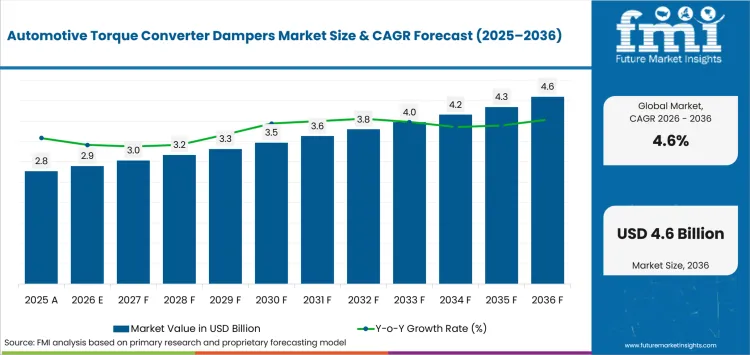
Key Takeaways
- Earlier lock-up and hybrid automatic programs increase the value of torsional isolation at low engine speed and during torque handoffs.
- By damper type single-stage dampers are estimated to hold 31.0% in 2026, attributable to familiar calibration paths and compact packaging.
- In 2026 automatic transmissions are expected to lead transmission type with 51.0% share, driven by the installed base of torque-converter-equipped stepped automatics.
- Passenger cars are projected to hold 39.0% share in 2026, supported by high-volume programs with strict low-speed NVH targets.
- Torque-converter-free drivetrains and platform-specific validation limit the addressable pool and raise engineering cost before production release.
- Some of the key players in this market include Schaeffler, EXEDY, Valeo, ZF Friedrichshafen, BorgWarner, AISIN, FCC, LuK / Schaeffler, Hyundai Transys, and Motherson Yutaka Giken Co. Limited.
Analyst Perspective
"Wider lock-up and hybrid restart expose the spring package to clutch behavior and vehicle-level NVH during calibration. Proven spring architectures still need local launch support on programs with tight transmission and vehicle validation schedules."
- Nikhil Kaitwade, Principal Consultant, Future Market Insights
How is the automotive torque converter dampers market segmented?
The automotive torque converter dampers market is segmented by damper type, transmission type, vehicle type, sales channel, function, and region.
Damper type covers single-stage dampers, dual-stage dampers, centrifugal pendulum absorbers, lock-up clutch dampers, and hybrid transmission dampers. Transmission type includes automatic, hybrid automatic, CVT, and heavy-duty transmissions. Vehicle type covers passenger cars, SUVs - crossovers, light commercial vehicles, and heavy-duty vehicles. Sales channel covers OEM direct, transmission Tier-1s, aftermarket - remanufacturing, and service kits. Function includes torsional vibration damping, lock-up smoothness, NVH reduction, and fuel-efficiency support. Region follows the standard FMI taxonomy.
What makes single-stage dampers central to the damper type category?
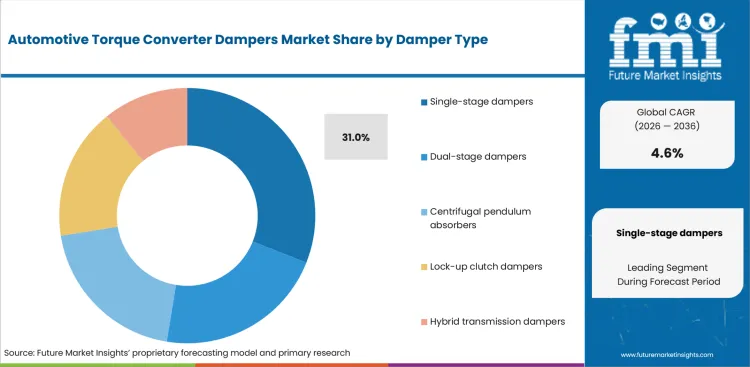
Single-stage layouts fit high-volume torque converter systems where one spring stage can meet dominant engine-order targets without extra hardware. They reduce package and calibration work on established lock-up systems.
- By damper type single-stage dampers are estimated to hold 31.0% in 2026, owing to familiar tooling and lower integration complexity.
- Schaeffler's May 2026 Q1 Factbook lists dampers and torque converters in one powertrain portfolio. OEM release still requires the damper tune to pass converter-clutch validation.
Why do automatic transmissions lead the transmission type category?
Torque converters remain central to many stepped automotive transmission platforms. Lock-up shifts torsional isolation from the fluid coupling to the damper and expands the calibrated operating map at low speed.
- Automatic transmissions are set to lead transmission type with 51.0% share in 2026, driven by broad use of torque-converter-equipped stepped automatics.
- In March 2026 ZF launched PowerLine on the Freightliner M2 106 Plus. The USA program keeps stepped-automatic production active where converter lock-up still determines damper duty.
How do passenger cars shape the vehicle type category?
Passenger-car programs balance low-speed refinement against packaging and cost. Cabin boom during lock-up puts mechanical damping beside automotive NVH materials in vehicle-level refinement work where both paths are evaluated before final release.
- Passenger cars are projected to hold 39.0% share in 2026, supported by large production programs and tight low-speed NVH requirements.
- VDA recorded 2.86 million German passenger-car registrations in 2025. Program scale can justify platform-specific damper tooling where the automatic transmission retains a torque converter.
What supports OEM direct as the leading sales channel?
Damper stiffness and angular travel are fixed during powertrain validation. OEM-direct sourcing keeps engineering teams close to programs where clutch control and packaging changes must be resolved before release.
- In 2026 OEM direct is expected to lead the sales channel category with 55.0% share, attributable to platform-specific qualification and change control.
- PHC Valeo's 2025 company report lists torque-converter production in Korea and Mexico plus China and Japan. It also names global OEM and transmission customers. OEM-direct programs therefore need engineering support close to release.
What drives torsional vibration damping within the function category?
Lock-up removes much of the fluid isolation available with an open converter. The damper must then attenuate cyclic engine torque before it reaches shafts and gears inside automatic torque converters or the passenger compartment.
- By function torsional vibration damping is forecast to represent 38.0% in 2026, driven by its direct role after lock-up engagement.
- BorgWarner's 2025 Form 10-K lists torque converter clutches and torsional vibration dampers within its transmission portfolio. The filing confirms that torsional-control content remains part of current automatic-transmission supply.
What are the drivers, restraints and opportunities in the Automotive Torque Converter Dampers Market?
Wider lock-up operation raises damping requirements, architecture substitution limits conventional content, and hybrid automatic systems preserve higher-value integrated damping content.
- Driver: Low-speed lock-up and hybrid torque handoffs increase operating points that need controlled torsional isolation.
- Restraint: BEV substitution and program-specific tuning narrow the addressable pool and lengthen qualification work.
- Opportunity: Hybrid automatic modules let damper suppliers enter compact integrated powertrain programs.
Wider Lock-Up Raises the Value of Calibrated Damping
Fuel-economy programs extend lock-up time because each avoided slip interval reduces converter losses. MOTIR reported in January 2026 that South Korean hybrid-vehicle exports rose 30% during 2025. A larger hybrid production base increases the number of hybrid vehicle programs where restart and low-speed lock-up need torsional control. Suppliers earn content only after vehicle-level NVH tests confirm the intended lock-up map.
Architecture Substitution Narrows Conventional Programs
Torque-converter dampers cannot follow electrification into every drivetrain. EXEDY told investors in May 2025 that its torque-converter business in Japan and China would shrink rapidly as the BEV shift progressed. Remaining programs still carry calibration and durability cost. Tooling recovery weakens if a major customer changes architecture before planned production ends.
Hybrid Automatic Modules Preserve Higher-Value Content
Hybrid automatics retain a mechanical isolation problem even as engine operating time falls. Hyundai Transys documented in its 2025 Sustainability Report that e²AT was in mass production with a built-in damper. Suppliers tied to vehicle electrification programs can compete on compact damping that works with motor torque and engine restart events. Qualification must cover the assembled module instead of spring performance alone.
Which country CAGRs are profiled in the Automotive Torque Converter Dampers Market?
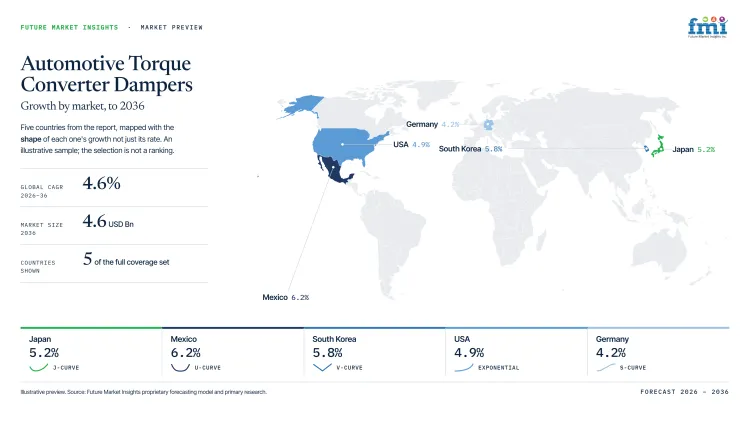
| Country | CAGR |
|---|---|
| Mexico | 6.2% |
| South Korea | 5.8% |
| Brazil | 5.5% |
| Japan | 5.2% |
| USA | 4.9% |
| France | 4.5% |
| Germany | 4.2% |
How do country-level CAGRs compare in the Automotive Torque Converter Dampers Market?
The 2.0-point spread separates two export-led upper markets from a lower European pair undergoing faster battery-electric substitution. Mexico and South Korea turn vehicle production into damper work through different routes. Brazil and Japan form the middle under cost and ownership constraints.
- Mexico's export plants link damper demand to overseas vehicle-program production cycles.
- Korean hybrid exports tie damper requirements to the timing of overseas launches.
- Brazil's export recovery is broadening locally built automatic-transmission vehicle programs.
- Japan's preference for HEVs preserves hybrid programs that still use torque converters.
- The USA eight-speed fleet spreads damper calibration work across many vehicle programs.
- France's shrinking car market puts more pressure on dedicated tooling economics.
- Germany's production scale keeps damper qualification volumes commercially meaningful for suppliers.
Similar CAGRs mask different engineering and architecture constraints. The full report provides country-level CAGR analysis across North America, Latin America, Western Europe, Eastern Europe, East Asia, South Asia and Pacific, and the Middle East and Africa.
Country-wise Analysis
- Mexico's export plants are weighted toward pickups and light trucks that place high torque through stepped automatics. Automotive torque converter damper demand in Mexico is forecast to rise at 6.2% CAGR over the forecast period, driven by export production and local powertrain capacity. INEGI reported in July 2026 that light trucks represented 79.6% of first-half light-vehicle output. The truck-heavy mix raises durability requirements for gear-shift systems and converter lock-up hardware. North American model schedules can move launch timing quickly and alter component nomination windows. Local regional engineering support is most useful where suppliers can validate high-torque damping close to transmission and vehicle assembly.
- Domestic OEMs develop hybrid transmissions close to their vehicle launch teams and expect process stability before release. MOTIR documented in July 2026 that eco-friendly vehicles represented 59% of domestic vehicle sales in June. South Korea's automotive torque converter dampers outlook is anticipated to advance at 5.8% CAGR over the assessment period, attributable to continued hybrid production and local powertrain integration. Hybrid programs retain damper content when the engine remains mechanically linked to the transmission. Rapid architecture changes can alter package space and clutch interfaces. Launch access goes first to teams that can co-develop the hybrid module and hold process quality at release.
- Brazilian vehicle programs put durability and serviceability under acquisition-cost pressure. Automotive torque converter damper sales in Brazil are forecast to expand at 5.5% CAGR by 2036, supported by a recovering domestic production base. ANFAVEA reported in January 2026 that 2025 vehicle production reached 2.644 million units after rising 3.5%. High interest rates restrain truck replacement and premium content decisions across Brazil’s vehicle market. Service networks that coordinate damper work with transmission fluid requirements can lower lifecycle disruption for commercial automatic fleets. Remanufacturing keeps repair economics relevant after warranty coverage ends for older automatic-transmission vehicles. Extra damping complexity has to earn its cost under local duty cycles.
- Japanese passenger-car programs place high weight on quiet operation and compact packaging because owners keep vehicles for long periods. JAMA reported in April 2026 that the previous passenger car was owned for 7.2 years on average. Adoption of automotive torque converter dampers in Japan is estimated to expand at 5.2% CAGR through 2036, driven by continued preference for hybrid passenger cars. Long validation cycles slow supplier changes because approved damper calibrations are difficult to replace. Hybrid-compatible dampers must preserve low-speed isolation without extra package volume. Local test support for automatic transmission systems is more useful than applying one global calibration unchanged.
- USA demand spans passenger cars and high-torque SUVs plus pickups that use several stepped automatic transmission families. The USA is estimated to post 4.9% CAGR over the forecast period, driven by automatic trucks and rising hybrid share. Alliance for Automotive Innovation found that hybrid market share increased 3.7 percentage points during full-year 2025. BEV growth removes torque converters from part of the fleet and fragments the remaining base. Local validation must cover current light-duty and commercial torque classes. Direct work on hybrid drivetrain programs gives engineering teams earlier access to OEM transmission calibration during release.
- French passenger-car demand now divides between hybrid and battery-electric powertrains. PFA data for January through October 2025 put battery-electric and plug-in hybrid vehicles at about one quarter of passenger-car registrations. Pure electric models reduce the converter-equipped base and narrow the programs worth qualifying. Automotive torque converter damper demand in France is forecast to rise at 4.5% CAGR over the forecast period, supported by hybrid platforms that retain a compatible automatic transmission. Engineering resources therefore belong on hybrid architectures that still use a torque converter. A broad electrification strategy would overstate the addressable damper pool.
- German programs pair premium NVH targets with fast battery-electric adoption. Automotive torque converter damper demand in Germany is forecast to rise at 4.2% CAGR over the forecast period, owing to PHEV and premium automatic programs that retain converter content. Battery-electric growth is the main local friction because those models remove the torque converter. VDA reported in February 2026 that electric vehicles represented 33.2% of January registrations and PHEV registrations rose 23% year on year. Suppliers need proof that the damper improves low-speed refinement on a retained automatic architecture. Platform scale alone does not justify entry into converter-free drivetrains.
Who are the notable companies in the Automotive Torque Converter Dampers Market?
Schaeffler, EXEDY, Valeo, ZF Friedrichshafen, BorgWarner, AISIN, FCC, LuK / Schaeffler, Hyundai Transys, and Motherson Yutaka Giken Co. Limited are the notable companies profiled in this market.
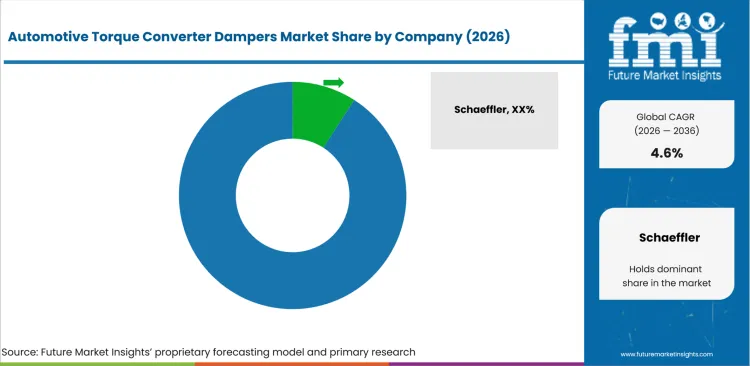
Damper tuning is tied to torque-converter and lock-up clutch calibration. Entry depends on OEM qualification. Converter manufacturers and transmission integrators hold the deepest direct exposure. Clutch specialists compete at the torsional-control interface.
- Schaeffler and EXEDY handle direct torque-converter and damper engineering. Valeo and LuK / Schaeffler share this role with Motherson Yutaka Giken Co. Limited.
- ZF Friedrichshafen and AISIN integrate damping into automatic and hybrid transmissions. Hyundai Transys covers direct hybrid-system integration.
- BorgWarner and FCC compete at clutch and torsional-control interfaces in automatic transmissions.
Competitive Benchmarking: Automotive Torque Converter Dampers Market
| Company | Exact-Market Integration | Hybrid Program Exposure | OEM Qualification Footprint | Geographic Reach |
|---|---|---|---|---|
| Schaeffler | High | High | High | Global |
| EXEDY | High | Medium | High | Asia and North America |
| Valeo | High | Medium | High | Asia, Europe and North America |
| ZF Friedrichshafen | High | High | High | Global |
| BorgWarner | Medium | Medium | High | Global |
| AISIN | Medium | High | High | Global |
| FCC | Medium | Medium | High | Asia and North America |
| LuK / Schaeffler | High | High | High | Global |
| Hyundai Transys | High | High | High | Asia and North America |
| Motherson Yutaka Giken Co. Limited | High | Medium | High | Asia and North America |
Scoring basis: High exact-market integration requires direct torque-converter or damper-system supply. Medium covers adjacent clutch or automatic-transmission content. Low marks one interface. High hybrid exposure requires current series evidence and Medium one program. High qualification footprint requires multi-region OEM programs and Medium one region. Low marks one customer route.
Key Developments in the Automotive Torque Converter Dampers Market
- In July 2026, Motherson Yutaka Giken Co. Limited joined Motherson after completion of the Yutaka Giken acquisition. The company retained dedicated torque-converter manufacturing.
- In May 2026, ZF Friedrichshafen said Capacity Trucks selected the PowerLine 8-speed automatic transmission for its TJ Series terminal tractor. The program extends stepped automatics into a high-torque commercial platform.
- In December 2025, EXEDY liquidated EXEDY America and moved torque-converter production out of the United States. Production shifted to Japan and China plus Mexico as USA demand weakened.
Key Players in the Automotive Torque Converter Dampers Market
Integrated Torque-Converter and Damper Programs
- Schaeffler
- EXEDY
- Valeo
- LuK / Schaeffler
- Motherson Yutaka Giken Co. Limited
Transmission and Hybrid-System Integrators
- ZF Friedrichshafen
- AISIN
- Hyundai Transys
Clutch and Torsional-Control Specialists
- BorgWarner
- FCC
Automotive Torque Converter Dampers Market - Report Scope
| Coverage field | Report scope |
|---|---|
| Market breakdown | By damper type, transmission type, vehicle type, sales channel, function, and region. |
| Quantitative Units | USD billion. |
| Market Definition | Revenue includes automotive torque converter damper assemblies and damper-integrated lock-up components for light- and heavy-vehicle automatic transmission programs. |
| Regions Covered | North America, Latin America, Western Europe, Eastern Europe, East Asia, South Asia and Pacific, and Middle East and Africa. |
| Countries Covered | Mexico, South Korea, Brazil, Japan, USA, France, Germany, and 30+ countries included in the full report. |
| Key Companies Profiled | Schaeffler, EXEDY, Valeo, ZF Friedrichshafen, BorgWarner, AISIN, FCC, LuK / Schaeffler, Hyundai Transys, and Motherson Yutaka Giken Co. Limited. |
| Forecast Period | 2026 to 2036. |
| Approach | Primary and secondary research with market triangulation. |
Automotive Torque Converter Dampers Market - Research Methodology
| Method | Approach |
|---|---|
| Primary Research | FMI analysts gathered input from manufacturers, service providers, technology developers, distributors, end users, procurement teams, and subject-matter experts. Interviews examined purchasing decisions, product or service evaluation, adoption barriers, approval requirements, pricing considerations, and expectations for technical or commercial support. Respondents were also asked what evidence is required before a trial, pilot, or initial order develops into regular purchasing. |
| Desk Research | Desk research covered government statistics, regulatory publications, trade data, industry associations, technical literature, standards, company filings, product information, and official corporate announcements. Sources were reviewed for relevance, publication date, geographic coverage, and consistency with the defined market scope. Claims relating to performance, applications, approvals, capacity, investment, and commercial activity were retained only when supported by credible public evidence. |
| Market Sizing and Forecasting | The market model combined the baseline value with historical performance, segment structure, pricing and volume indicators, adoption levels, company participation, and country-level demand conditions. Forecast assumptions considered economic activity, investment trends, regulatory developments, technology adoption, purchasing cycles, supply availability, and barriers to wider market use. Segment and regional estimates were reconciled before the final market total was calculated. |
| Data Validation | Estimates were checked against multiple independent indicators, including public data, company activity, trade patterns, industry developments, and findings from primary interviews. Validation also tested whether products, services, applications, and company revenues fell within the defined market boundaries. Adjacent categories, unsupported claims, overlapping revenues, and activities without direct market relevance were excluded to reduce double counting and maintain consistency across segments and countries. |
Automotive Torque Converter Dampers Market by Segments
Automotive Torque Converter Dampers Market segmented by Damper Type:
- Single-stage dampers
- Dual-stage dampers
- Centrifugal pendulum absorbers
- Lock-up clutch dampers
- Hybrid transmission dampers
Automotive Torque Converter Dampers Market segmented by Transmission Type:
- Automatic transmissions
- Hybrid automatic transmissions
- CVTs
- Heavy-duty transmissions
Automotive Torque Converter Dampers Market segmented by Vehicle Type:
- Passenger cars
- SUVs - crossovers
- Light commercial vehicles
- Heavy-duty vehicles
Automotive Torque Converter Dampers Market segmented by Sales Channel:
- OEM direct
- Transmission Tier-1s
- Aftermarket - remanufacturing
- Service kits
Automotive Torque Converter Dampers Market segmented by Function:
- Torsional vibration damping
- Lock-up smoothness
- NVH reduction
- Fuel-efficiency support
Automotive Torque Converter Dampers Market by Region:
- North America
- United States
- Canada
- Mexico
- Latin America
- Brazil
- Chile
- Rest of Latin America
- Western Europe
- Germany
- United Kingdom
- Italy
- Spain
- France
- Nordics
- Benelux
- Rest of Western Europe
- Eastern Europe
- Russia
- Poland
- Hungary
- Balkan and Baltic States
- Rest of Eastern Europe
- East Asia
- China
- Japan
- South Korea
- South Asia and Pacific
- India
- ASEAN
- Australia and New Zealand
- Rest of South Asia and Pacific
- Middle East and Africa
- Kingdom of Saudi Arabia
- Other GCC Countries
- Türkiye
- South Africa
- Other African Union Countries
- Rest of Middle East and Africa
Research Sources and Bibliography
- USA Environmental Protection Agency. (2026, February 19). The 2025 EPA Automotive Trends Report: Fuel Economy and Technology since 1975.
- Instituto Nacional de Estadística y Geografía. (2026, January). Registro Administrativo de la Industria Automotriz de Vehículos Ligeros, December 2025.
- Schaeffler AG. (2026, May). Schaeffler AG Q1 2026 Factbook.
- ZF Friedrichshafen AG. (2026, March 10). ZF 8-speed PowerLine Transmission Launches on Freightliner M2 106 Plus at Work Truck Week.
- German Association of the Automotive Industry. (2026, January 6). Passenger car production in 2025 slightly above previous year's level.
- PHC Valeo. (2025). 2025 company report.
- BorgWarner Inc. (2026, February 11). Annual Report on Form 10-K for the year ended December 31, 2025.
- Ministry of Trade, Industry and Resources. (2026, January 15). Automobile Exports Hit Record High of $72 Billion in 2025.
- EXEDY Corporation. (2025, May 9). Financial Results Meeting for Institutional Investors and Analysts Held.
- Hyundai Transys. (2025). Sustainability Report 2025.
- Instituto Nacional de Estadística y Geografía. (2026, July 7). Registro Administrativo de la Industria Automotriz de Vehículos Ligeros, June 2026.
- Ministry of Trade, Industry and Resources. (2026, July 16). Automobile Exports Reach $6.71 Billion in June 2026.
- Associação Nacional dos Fabricantes de Veículos Automotores. (2026, January 15). Produção e venda de autoveículos crescem em 2025 e Anfavea projeta nova alta em 2026.
- Japan Automobile Manufacturers Association. (2026, April 14). 2025年度乗用車市場動向調査について.
- Alliance for Automotive Innovation. (2026). New USA Electric Vehicle Data: 2025 Q4 Get Connected Report.
- Plateforme automobile. (2025, November 1). Dossier de presse PFA.
- German Association of the Automotive Industry. (2026, February 4). Production and market in January 2026.
- F.C.C. Co., Ltd. (n.d.). Corporate Profile. Retrieved September 8, 2026.
- AISIN Corporation. (2025, April 24). AISIN Begins Contract Production of Hybrid Units for Guangzhou Automobile Group.
- Schaeffler AG. (2026, April 27). Not just a bridging technology: Schaeffler offers extensive range from components to systems for all hybrid powertrains.
- ZF Friedrichshafen AG. (2026, May 4). ZF 8-speed PowerLine Transmission Selected for Capacity Trucks Terminal Tractor Platform.
- EXEDY Corporation. (2025, December 23). Actions to achieve cost of capital and stock price conscious management (Update).
- Motherson Group. (2026, July 22). Welcome Yutaka to the Motherson Family.
- Motherson Yutaka Giken Co. Limited. (n.d.). Overseas Sites. Retrieved September 8, 2026.
- ZF Friedrichshafen AG. (2026, August 12). 采埃孚8挡混动变速器在中国正式量产.
- AISIN Corporation. (2026, April 21). AISIN Begins Contract Manufacturing Mazda's Six-speed Automatic Transmission in the United States - Promoting Local Production that Meets Customer Needs Globally -.
- F.C.C. Co., Ltd. (2026, May 21). Exhibiting at Automotive Engineering Exposition 2026 Yokohama
- BorgWarner. (2026, May 6). BorgWarner Wins Two Conquest Awards in Asia for Combustion and Hybrid Powertrain Programs
This bibliography is provided for reader reference and is not exhaustive. The full report contains the complete reference list and detailed citations
This Report Answers
- How large is the automotive torque converter dampers market in 2026 and 2036?
- Why does wider lock-up raise torsional damping requirements?
- Which damper type leads in 2026?
- Why do automatic transmissions lead by transmission type?
- Why do passenger cars require stricter NVH calibration?
- What limits damper demand as BEV production expands?
- Which profiled countries have the highest CAGRs?
- How do local vehicle mixes change entry conditions?
Frequently Asked Questions
How big is the automotive torque converter dampers market in 2026?
The automotive torque converter dampers market is valued at USD 2.9 billion in 2026 and is projected to reach USD 4.6 billion by 2036. Wider lock-up and hybrid automatic programs support expansion.
What is the CAGR of the automotive torque converter dampers market from 2026 to 2036?
The automotive torque converter dampers market is projected to grow at a CAGR of 4.6% between 2026 and 2036. Longer lock-up operation increases torsional-control requirements.
Which damper type leads the automotive torque converter dampers market?
The single-stage damper segment is expected to hold 31.0% of the automotive torque converter dampers market in 2026, attributable to familiar calibration paths and compact packaging. Multi-stage layouts handle harder low-speed isolation targets.
Which transmission type leads the automotive torque converter dampers market?
The automatic transmission segment is expected to hold 51.0% of the automotive torque converter dampers market in 2026, driven by torque-converter-equipped stepped automatics. Hybrid automatics keep damper content during engine restart and lock-up transitions.
Which countries are projected to record the highest growth in the automotive torque converter dampers market?
Mexico is projected to grow at 6.2% CAGR followed by South Korea at 5.8% and Brazil at 5.5% through 2036. Vehicle production and hybrid or high-torque automatic programs explain the rates.
Which companies are active in the automotive torque converter dampers market?
Key companies operating in the market include Schaeffler, EXEDY, Valeo, ZF Friedrichshafen, BorgWarner, AISIN, FCC, LuK / Schaeffler, Hyundai Transys, and Motherson Yutaka Giken Co. Limited. Their positions differ by converter engineering plus transmission integration and OEM qualification coverage.
Preview the report firsthand - request a free sample
Get SampleGet the brochure for pricing and purchase details.
Get PDFTable of Content
- Key Takeaways
- Market Size and CAGR
- Top Growth Driver
- Fastest Growing Segment
- Leading Region
- Key Companies
- Emerging Opportunities
- Executive Summary
- Global Market Outlook
- Demand-side Trends
- Supply-side Trends
- Technology Roadmap Analysis
- Analysis and Recommendations
- Analyst Perspective (What is happening? Why now? What should investors know?)
- Key Questions Answered
- How large is the market?
- What is the CAGR?
- What are key trends?
- Which region dominates?
- Who are the leaders?
- Market Overview
- Market Coverage / Taxonomy
- Market Definition / Scope / Limitations
- Research Methodology
- Chapter Orientation
- Analytical Lens and Working Hypotheses
- Market Structure, Signals, and Trend Drivers
- Benchmarking and Cross-market Comparability
- Market Sizing, Forecasting, and Opportunity Mapping
- Research Design and Evidence Framework
- Desk Research Programme (Secondary Evidence)
- Expert Input and Fieldwork (Primary Evidence)
- Tooling, Models, and Reference Databases
- Data Engineering and Model Build
- Quality Assurance and Audit Trail
- Market Background
- Market Dynamics (Drivers, Restraints, Opportunity, Trends)
- Scenario Forecast (Optimistic, Likely, Conservative)
- Impact Analysis
- AI Impact
- Sustainability Impact
- Regulatory Impact
- Technology Impact
- Consumer / Buyer Analysis
- Purchase Drivers
- Adoption Barriers
- Buyer Journey
- Opportunity Map Analysis
- Product Life Cycle Analysis
- Supply Chain Analysis
- Investment Feasibility Matrix
- Value Chain Analysis
- PESTLE and Porter's Analysis
- Regulatory Landscape
- Regional Parent Market Outlook
- Production and Consumption Statistics
- Import and Export Statistics
- Global Market Analysis and Forecast, 2021 to 2036
- Historical Market Size Value (USD Billion) Analysis, 2021 to 2025
- Current and Future Market Size Value (USD Billion) Projections, 2026 to 2036
- Y-o-Y Growth Trend Analysis
- Absolute $ Opportunity Analysis
- Global Market Pricing Analysis, 2021 to 2036
- Global Market Analysis and Forecast, By Damper Type, 2021 to 2036
- Introduction / Key Findings
- Historical Market Size Value (USD Billion) Analysis By Damper Type, 2021 to 2025
- Current and Future Market Size Value (USD Billion) Analysis and Forecast By Damper Type, 2026 to 2036
- Single-stage dampers
- Dual-stage dampers
- Centrifugal pendulum absorbers
- Lock-up clutch dampers
- Hybrid transmission dampers
- Single-stage dampers
- Y-o-Y Growth Trend Analysis By Damper Type, 2021 to 2025
- Absolute $ Opportunity Analysis By Damper Type, 2026 to 2036
- Global Market Analysis and Forecast, By Transmission Type, 2021 to 2036
- Introduction / Key Findings
- Historical Market Size Value (USD Billion) Analysis By Transmission Type, 2021 to 2025
- Current and Future Market Size Value (USD Billion) Analysis and Forecast By Transmission Type, 2026 to 2036
- Automatic transmissions
- Hybrid automatic transmissions
- CVTs
- Heavy-duty transmissions
- Automatic transmissions
- Y-o-Y Growth Trend Analysis By Transmission Type, 2021 to 2025
- Absolute $ Opportunity Analysis By Transmission Type, 2026 to 2036
- Global Market Analysis and Forecast, By Vehicle Type, 2021 to 2036
- Introduction / Key Findings
- Historical Market Size Value (USD Billion) Analysis By Vehicle Type, 2021 to 2025
- Current and Future Market Size Value (USD Billion) Analysis and Forecast By Vehicle Type, 2026 to 2036
- Passenger cars
- SUVs/crossovers
- Light commercial vehicles
- Heavy-duty vehicles
- Passenger cars
- Y-o-Y Growth Trend Analysis By Vehicle Type, 2021 to 2025
- Absolute $ Opportunity Analysis By Vehicle Type, 2026 to 2036
- Global Market Analysis and Forecast, By Sales Channel, 2021 to 2036
- Introduction / Key Findings
- Historical Market Size Value (USD Billion) Analysis By Sales Channel, 2021 to 2025
- Current and Future Market Size Value (USD Billion) Analysis and Forecast By Sales Channel, 2026 to 2036
- OEM direct
- Transmission Tier-1s
- Aftermarket/remanufacturing
- Service kits
- OEM direct
- Y-o-Y Growth Trend Analysis By Sales Channel, 2021 to 2025
- Absolute $ Opportunity Analysis By Sales Channel, 2026 to 2036
- Global Market Analysis and Forecast, By Function, 2021 to 2036
- Introduction / Key Findings
- Historical Market Size Value (USD Billion) Analysis By Function, 2021 to 2025
- Current and Future Market Size Value (USD Billion) Analysis and Forecast By Function, 2026 to 2036
- Torsional vibration damping
- Lock-up smoothness
- NVH reduction
- Fuel-efficiency support
- Torsional vibration damping
- Y-o-Y Growth Trend Analysis By Function, 2021 to 2025
- Absolute $ Opportunity Analysis By Function, 2026 to 2036
- Global Market Analysis and Forecast, By Region, 2021 to 2036
- Introduction
- Historical Market Size Value (USD Billion) Analysis By Region, 2021 to 2025
- Current Market Size Value (USD Billion) Analysis and Forecast By Region, 2026 to 2036
- North America
- Latin America
- Western Europe
- Eastern Europe
- East Asia
- South Asia and Pacific
- Middle East & Africa
- Market Attractiveness Analysis By Region
- North America Market Analysis and Forecast, By Country, 2021 to 2036
- Historical Market Size Value (USD Billion) Trend Analysis By Market Taxonomy, 2021 to 2025
- Market Size Value (USD Billion) Forecast By Market Taxonomy, 2026 to 2036
- By Country
- USA
- Canada
- By Damper Type
- By Transmission Type
- By Vehicle Type
- By Sales Channel
- By Function
- By Country
- Market Attractiveness Analysis
- By Country
- By Damper Type
- By Transmission Type
- By Vehicle Type
- By Sales Channel
- By Function
- Key Takeaways
- Latin America Market Analysis and Forecast, By Country
- Historical Market Size Value (USD Billion) Trend Analysis By Market Taxonomy, 2021 to 2025
- Market Size Value (USD Billion) Forecast By Market Taxonomy, 2026 to 2036
- By Country
- Brazil
- Mexico
- Chile
- Rest of Latin America
- By Damper Type
- By Transmission Type
- By Vehicle Type
- By Sales Channel
- By Function
- By Country
- Market Attractiveness Analysis
- By Country
- By Damper Type
- By Transmission Type
- By Vehicle Type
- By Sales Channel
- By Function
- Key Takeaways
- Western Europe Market Analysis and Forecast, By Country
- Historical Market Size Value (USD Billion) Trend Analysis By Market Taxonomy, 2021 to 2025
- Market Size Value (USD Billion) Forecast By Market Taxonomy, 2026 to 2036
- By Country
- Germany
- UK
- Italy
- Spain
- France
- Nordic
- BENELUX
- Rest of Western Europe
- By Damper Type
- By Transmission Type
- By Vehicle Type
- By Sales Channel
- By Function
- By Country
- Market Attractiveness Analysis
- By Country
- By Damper Type
- By Transmission Type
- By Vehicle Type
- By Sales Channel
- By Function
- Key Takeaways
- Eastern Europe Market Analysis and Forecast, By Country
- Historical Market Size Value (USD Billion) Trend Analysis By Market Taxonomy, 2021 to 2025
- Market Size Value (USD Billion) Forecast By Market Taxonomy, 2026 to 2036
- By Country
- Russia
- Poland
- Hungary
- Balkan & Baltic
- Rest of Eastern Europe
- By Damper Type
- By Transmission Type
- By Vehicle Type
- By Sales Channel
- By Function
- By Country
- Market Attractiveness Analysis
- By Country
- By Damper Type
- By Transmission Type
- By Vehicle Type
- By Sales Channel
- By Function
- Key Takeaways
- East Asia Market Analysis and Forecast, By Country
- Historical Market Size Value (USD Billion) Trend Analysis By Market Taxonomy, 2021 to 2025
- Market Size Value (USD Billion) Forecast By Market Taxonomy, 2026 to 2036
- By Country
- China
- Japan
- South Korea
- By Damper Type
- By Transmission Type
- By Vehicle Type
- By Sales Channel
- By Function
- By Country
- Market Attractiveness Analysis
- By Country
- By Damper Type
- By Transmission Type
- By Vehicle Type
- By Sales Channel
- By Function
- Key Takeaways
- South Asia and Pacific Market Analysis and Forecast, By Country
- Historical Market Size Value (USD Billion) Trend Analysis By Market Taxonomy, 2021 to 2025
- Market Size Value (USD Billion) Forecast By Market Taxonomy, 2026 to 2036
- By Country
- India
- ASEAN
- Australia & New Zealand
- Rest of South Asia and Pacific
- By Damper Type
- By Transmission Type
- By Vehicle Type
- By Sales Channel
- By Function
- By Country
- Market Attractiveness Analysis
- By Country
- By Damper Type
- By Transmission Type
- By Vehicle Type
- By Sales Channel
- By Function
- Key Takeaways
- Middle East & Africa Market Analysis and Forecast, By Country
- Historical Market Size Value (USD Billion) Trend Analysis By Market Taxonomy, 2021 to 2025
- Market Size Value (USD Billion) Forecast By Market Taxonomy, 2026 to 2036
- By Country
- Kingdom of Saudi Arabia
- Other GCC Countries
- Türkiye
- South Africa
- Other African Union
- Rest of Middle East & Africa
- By Damper Type
- By Transmission Type
- By Vehicle Type
- By Sales Channel
- By Function
- By Country
- Market Attractiveness Analysis
- By Country
- By Damper Type
- By Transmission Type
- By Vehicle Type
- By Sales Channel
- By Function
- Key Takeaways
- Key Countries Market Analysis
- USA
- Pricing Analysis
- Market Share Analysis, 2025
- By Damper Type
- By Transmission Type
- By Vehicle Type
- By Sales Channel
- By Function
- Canada
- Pricing Analysis
- Market Share Analysis, 2025
- By Damper Type
- By Transmission Type
- By Vehicle Type
- By Sales Channel
- By Function
- Mexico
- Pricing Analysis
- Market Share Analysis, 2025
- By Damper Type
- By Transmission Type
- By Vehicle Type
- By Sales Channel
- By Function
- Brazil
- Pricing Analysis
- Market Share Analysis, 2025
- By Damper Type
- By Transmission Type
- By Vehicle Type
- By Sales Channel
- By Function
- Chile
- Pricing Analysis
- Market Share Analysis, 2025
- By Damper Type
- By Transmission Type
- By Vehicle Type
- By Sales Channel
- By Function
- Germany
- Pricing Analysis
- Market Share Analysis, 2025
- By Damper Type
- By Transmission Type
- By Vehicle Type
- By Sales Channel
- By Function
- UK
- Pricing Analysis
- Market Share Analysis, 2025
- By Damper Type
- By Transmission Type
- By Vehicle Type
- By Sales Channel
- By Function
- Italy
- Pricing Analysis
- Market Share Analysis, 2025
- By Damper Type
- By Transmission Type
- By Vehicle Type
- By Sales Channel
- By Function
- Spain
- Pricing Analysis
- Market Share Analysis, 2025
- By Damper Type
- By Transmission Type
- By Vehicle Type
- By Sales Channel
- By Function
- France
- Pricing Analysis
- Market Share Analysis, 2025
- By Damper Type
- By Transmission Type
- By Vehicle Type
- By Sales Channel
- By Function
- India
- Pricing Analysis
- Market Share Analysis, 2025
- By Damper Type
- By Transmission Type
- By Vehicle Type
- By Sales Channel
- By Function
- ASEAN
- Pricing Analysis
- Market Share Analysis, 2025
- By Damper Type
- By Transmission Type
- By Vehicle Type
- By Sales Channel
- By Function
- Australia & New Zealand
- Pricing Analysis
- Market Share Analysis, 2025
- By Damper Type
- By Transmission Type
- By Vehicle Type
- By Sales Channel
- By Function
- China
- Pricing Analysis
- Market Share Analysis, 2025
- By Damper Type
- By Transmission Type
- By Vehicle Type
- By Sales Channel
- By Function
- Japan
- Pricing Analysis
- Market Share Analysis, 2025
- By Damper Type
- By Transmission Type
- By Vehicle Type
- By Sales Channel
- By Function
- South Korea
- Pricing Analysis
- Market Share Analysis, 2025
- By Damper Type
- By Transmission Type
- By Vehicle Type
- By Sales Channel
- By Function
- Russia
- Pricing Analysis
- Market Share Analysis, 2025
- By Damper Type
- By Transmission Type
- By Vehicle Type
- By Sales Channel
- By Function
- Poland
- Pricing Analysis
- Market Share Analysis, 2025
- By Damper Type
- By Transmission Type
- By Vehicle Type
- By Sales Channel
- By Function
- Hungary
- Pricing Analysis
- Market Share Analysis, 2025
- By Damper Type
- By Transmission Type
- By Vehicle Type
- By Sales Channel
- By Function
- Kingdom of Saudi Arabia
- Pricing Analysis
- Market Share Analysis, 2025
- By Damper Type
- By Transmission Type
- By Vehicle Type
- By Sales Channel
- By Function
- Türkiye
- Pricing Analysis
- Market Share Analysis, 2025
- By Damper Type
- By Transmission Type
- By Vehicle Type
- By Sales Channel
- By Function
- South Africa
- Pricing Analysis
- Market Share Analysis, 2025
- By Damper Type
- By Transmission Type
- By Vehicle Type
- By Sales Channel
- By Function
- USA
- Market Structure Analysis
- Competition Dashboard
- Competition Benchmarking
- Market Share Analysis of Top Players
- By Regional
- By Damper Type
- By Transmission Type
- By Vehicle Type
- By Sales Channel
- By Function
- Emerging Startups
- Innovation Benchmarking
- Competition Analysis
- Competition Deep Dive
- Schaeffler
- Overview
- Product Portfolio
- Profitability by Market Segments
- Sales Footprint
- Strategy Overview
- Marketing Strategy
- Product Strategy
- Channel Strategy
- EXEDY
- Valeo
- ZF Friedrichshafen
- BorgWarner
- Aisin
- FCC
- LuK / Schaeffler
- Hyundai Transys
- Yutaka Giken
- Schaeffler
- Case Studies
- Success Stories
- Recent Developments
- Competition Deep Dive
- Assumptions & Acronyms Used


