

- Market Size (2026)
- USD 3.9 Bn
- Forecast (2036)
- USD 7.7 Bn
- CAGR (2026 to 2036)
- 7.1%
How big is Automotive Torque Vectoring Systems Market in 2026?
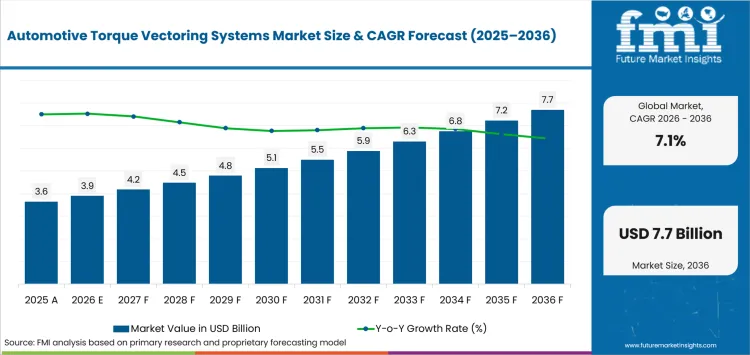
USD 3.9 billion in 2026 and USD 7.7 billion by 2036 at a 7.1% CAGR.
Sales in the automotive torque vectoring systems market is projected to rise from USD 3.9 billion in 2026 to USD 7.7 billion by 2036 at 7.1% CAGR. Electrification broadens the addressable control set because electric motors can change axle torque faster than conventional driveline hardware. The International Energy Agency reported in May 2025 that electric cars exceeded 17 million global sales during 2024 and represented more than 20% of new-car sales. The larger electrified fleet gives OEM engineers more production platforms for wheel-torque control without requiring a separate propulsion architecture.
Country demand follows local platform turnover and propulsion mix instead of the global electrification curve alone. The International Energy Agency documented Korean electric-car sales rising about 65% during 2025 after several years near 130,000 units. Korea's faster renewal cycle gives torque-control companies more EV programs for software and electrified axle development. Japan retains a hybrid-heavy model mix and a slower battery-electric platform renewal cycle than Korea. OEM awards therefore depend on local propulsion economics and validation timing rather than one universal vehicle architecture.
Key Takeaways
- Electrified drivetrains increase controllable torque paths because electric motors respond quickly to wheel-slip and vehicle-motion commands during acceleration and cornering.
- By system type, brake-based torque vectoring is estimated to hold 27.0% in 2026 owing to existing brake actuators that can generate corrective yaw without dedicated twin-clutch hardware.
- In 2026, passenger cars are expected to lead vehicle type with 30.0% share because the category spans mainstream stability programs and higher-content performance chassis packages.
- ICE vehicles are projected to hold 34.0% share in 2026 owing to mechanical differentials and stability controls already validated on established combustion-engine platforms.
- Calibration workload and thermal durability restrain higher-content architectures because each torque request must remain predictable beside braking, steering, propulsion, and safety controls.
- Some of the key players in this market include BorgWarner, GKN Automotive, Eaton, Magna International, Schaeffler, ZF Friedrichshafen, AUMOVIO, and Bosch.
Analyst Perspective
"OEMs should compare useful yaw correction inside brake, steering, and propulsion limits before paying for a higher-content torque-vectoring architecture. Commercial value comes from repeatable vehicle behavior with manageable heat and calibration work because a stronger actuator does not automatically improve the complete chassis."
- Nikhil Kaitwade, Principal Consultant, Future Market Insights
How is the Automotive Torque Vectoring Systems Market segmented?
The automotive torque vectoring systems market is segmented by system type, vehicle type, propulsion, component, sales channel, and region.
System type includes brake-based torque vectoring, active differential systems, e-axle torque vectoring, twin-clutch vectoring, and software-defined torque control. Vehicle type covers passenger cars, SUVs and crossovers, electric vehicles, performance cars, and commercial vehicles. Propulsion includes ICE vehicles, battery electric vehicles, hybrid vehicles, and plug-in hybrids. Components include differentials, control software, ECUs, actuators, and sensors. Sales channels cover OEM direct supply, Tier-1 integrated systems, performance aftermarket, and software licensing.
What drives OEM direct supply in the Sales channel category?
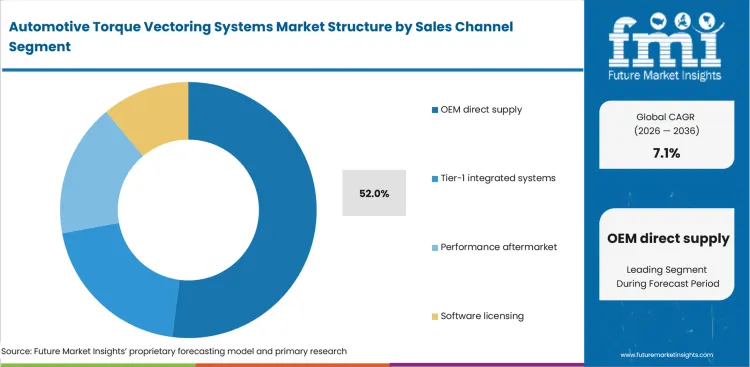
Direct sourcing starts during platform development because braking and propulsion controls must agree on the same vehicle-motion target before production release. Magna secured a 250 kW 800-volt electric-drive program with Chery in July 2026 and tied production to its Wuhu facility. The award places drivetrain content inside a direct vehicle program before serial production begins.
- By sales channel, OEM direct supply is forecast to represent 52.0% in 2026 driven by vehicle-program control over packaging and production release for integrated torque-control systems.
- Long award cycles raise engineering exposure before launch. Direct programs provide the clearest route to serial revenue once the vehicle enters production at scale.
What makes Brake-based torque vectoring central to the System type category?
Brake-based control uses selective wheel braking to produce a corrective yaw moment without a separate wheel-to-wheel torque device. This route uses hardware already present for stability control and avoids another mechanical torque-transfer path. brake intervention remains useful as chassis commands move toward software-coordinated control.
- By system type, brake-based torque vectoring is estimated to hold 27.0% in 2026 owing to compatibility with braking hardware already engineered into most vehicle stability systems.
- AUMOVIO described a July 2025 corner module that integrates drive and braking with steering and suspension at wheel level. Adoption still depends on heat capacity because repeated brake intervention trades tire-force control against energy loss during sustained performance use.
Why do Passenger cars lead the Vehicle type category?
Passenger-car platforms give manufacturers the widest price range for transferring torque-control functions from premium trims into broader vehicle programs. In September 2025, GKN Automotive presented electronic torque management and limited-slip differential technologies to Mahindra engineers evaluating future model launches. The event places torque-control hardware inside platform engineering discussions before final sourcing decisions.
- In 2026, passenger cars are expected to lead vehicle type with 30.0% share because one vehicle class spans mainstream stability functions and higher-content handling packages.
- Platform reuse lowers engineering duplication across related models. Each actuator package still requires calibration against tire behavior and propulsion limits for the intended vehicle derivative.
How do ICE vehicles retain the leading position in the Propulsion category?
Combustion platforms retain a large installed base of mechanical differentials, prop shafts, clutch systems, and brake-based stability controls that already divide or correct axle torque. These validated layouts lower redesign work on existing vehicle programs and preserve demand for mechanical torque-transfer content.
- ICE vehicles are projected to hold 34.0% share in 2026 owing to validated driveline layouts that already transfer torque between axles or wheels.
- GKN Automotive hosted major US OEMs in October 2025 and demonstrated electronic torque management beside combustion and electrified technologies. Manufacturers can retain familiar packaging on current platforms until independent motor torque justifies the cost of a different architecture.
What are the drivers, restraints and opportunities in the Automotive Torque Vectoring Systems Market?
Electrified torque paths raise control authority, vehicle-level calibration slows release, and portable motion-control software extends revenue beyond a single differential architecture.
- Driver: Electric motors let vehicle controllers vary axle torque quickly enough to coordinate propulsion with braking during traction and yaw-control events.
- Restraint: Calibration and functional-safety work raise engineering cost because torque requests interact with tire grip and steering response beside thermal limits and fail-safe behavior.
- Opportunity: Portable motion software can carry torque-control logic between vehicle programs after actuator interfaces are documented and validated for production use.
Electrified Torque Paths Increase Control Authority
Motorized axles give chassis controllers propulsion torque they can vary before a mechanical clutch builds pressure. The International Energy Agency reported in May 2026 that global electric-car sales exceeded 20 million during 2025 and reached one-quarter of new-car sales. More electrified platforms expand the program base where torque-vectoring logic can shape traction through propulsion instead of dedicated clutch hardware.
Calibration Work Limits Program Economics
Every torque request must stay predictable after braking and steering limits enter the central vehicle controller during calibration. ZF introduced cubiX Tuner in July 2025 to automate calibration involving multiple chassis actuators and drivetrain configurations. Engineering time becomes the restraint because a technically capable architecture can miss production release if calibration exceeds the OEM schedule.
Portable Motion Software Extends the Revenue Route
Portable motion software lets one torque-control function operate with different actuator sets after interfaces are standardized and validated. Schaeffler stated in September 2025 that its software-defined vehicle portfolio included master and zone controllers beside modular electric axle drives. A common controller layer gives automakers a route to reuse torque logic between platforms without binding revenue to one differential design.
Which country CAGRs are profiled in the Automotive Torque Vectoring Systems Market?
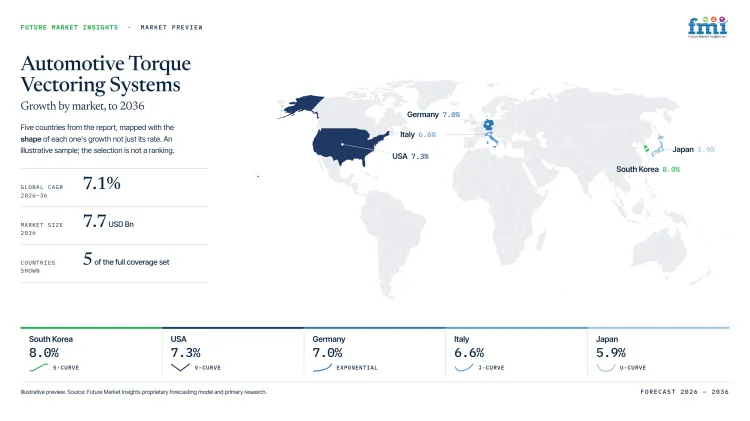
| Country | CAGR |
|---|---|
| South Korea | 8.0% |
| USA | 7.3% |
| Germany | 7.0% |
| Italy | 6.6% |
| Japan | 5.9% |
How do country-level CAGRs compare in the Automotive Torque Vectoring Systems Market?
The forecasts span 2.1 percentage points, from South Korea at 8.0% to Japan at 5.9%. South Korea and the USA form the upper growth group, followed by Germany and Italy, while Japan represents the slower-growth case. The spread reflects differences in expected commercialization pace and does not indicate current revenue size.
- South Korea concentrates vehicle engineering around major domestic OEM programs and performance-EV development centers, supporting faster adoption.
- USA requires torque-control packages that serve both performance applications and high-volume pickups without extensive hardware redesign.
- Germany places calibration teams close to prototype development, as premium OEMs prioritize brand-specific chassis response during release engineering.
- Italy benefits from specialist performance-vehicle programs and engineering-led applications where drivetrain calibration and torque management remain important.
- Japan's hybrid-heavy vehicle portfolio keeps mechanical torque paths commercially relevant, while the slower transition toward battery-electric platforms moderates growth.
Comparable CAGRs can produce different revenue conditions because platform scale and qualification routes differ. The full report provides country-level CAGR analysis by the defined regional taxonomy.
Country-wise Analysis
- South Korean automakers use electrified performance programs to make controlled torque distribution part of the vehicle character instead of a separate option. The South Korean automotive torque vectoring systems outlook is anticipated to advance at 8.0% CAGR over the assessment period, tied to faster adoption of electrified drivetrains. KAMA reported on July 28 2026 that June vehicle production reached 394,331 units. Local engineering depth keeps calibration work close to vehicle programs. Performance-grade actuators remain expensive for volume trims and limit how far high-content hardware can spread. Companies entering Korea need modular control logic that preserves a visible handling benefit after hardware content is reduced for mainstream platforms.
- US vehicle programs span large pickups and SUVs beside premium EVs, producing unusually wide torque-capacity and thermal requirements within one national market. EPA's February 2026 report found four-wheel drive in 63% of model-year 2024 production. High four-wheel-drive penetration gives torque-control companies several design-win routes through traction and handling packages. Range and cost penalties remain visible on electrified programs. The USA is estimated to post 7.3% CAGR over the forecast period, helped by broad platform variety and persistent four-wheel-drive use. Companies that reuse control software and resize mechanical content can transfer validated functions between performance packages and higher-volume vehicle lines.
- German premium engineering integrates torque allocation with steering and braking targets early in platform development and leaves little room for a stand-alone component pitch. Adoption of automotive torque vectoring systems in Germany is estimated to expand at 7.0% CAGR through 2036, propelled by rising electric-vehicle production and dense chassis engineering expertise. VDA reported in February 2026 that electric vehicles represented 40% of German passenger-car production during 2025. OEM co-engineering gives control companies direct access to prototype and release work. Brand-specific handling targets can lengthen calibration for every derivative. New entrants therefore compete on tunability and release support as much as the mechanical torque capacity of the device itself.
- Italy's performance-oriented automotive sector integrates torque allocation with vehicle dynamics, handling, and braking targets, particularly across premium, sports, and specialist vehicle programs. Adoption of automotive torque vectoring systems in Italy is estimated to expand at 6.6% CAGR through 2036, supported by continued electrification and Italy's established expertise in performance vehicle engineering and chassis development. OEM and specialist-vehicle co-engineering gives control-system suppliers opportunities to participate in prototype and release programs. Brand-specific handling requirements can extend calibration cycles across multiple derivatives.
- Japanese OEMs prioritize smooth intervention and long service reliability, so torque-control hardware faces demanding refinement work before platform approval. JAMA reported on April 14 2026 that 46% of surveyed consumers intended to consider an electrified vehicle for their next purchase. In Japan, automotive torque vectoring systems demand is predicted to advance at 5.9% CAGR through 2036, given a slower shift toward battery-electric vehicles and continued hybrid strength. Familiar hybrid architectures support incremental adoption. Unfamiliar actuators still need to justify cost and refinement before platform approval. Compact hardware with quiet control has a stronger route into programs where intervention quality outweighs peak track-performance output.
Who are the notable companies in the Automotive Torque Vectoring Systems Market?
BorgWarner, GKN Automotive, Eaton, Magna International, Schaeffler, ZF Friedrichshafen, AUMOVIO, and Bosch are the notable companies serving this market.
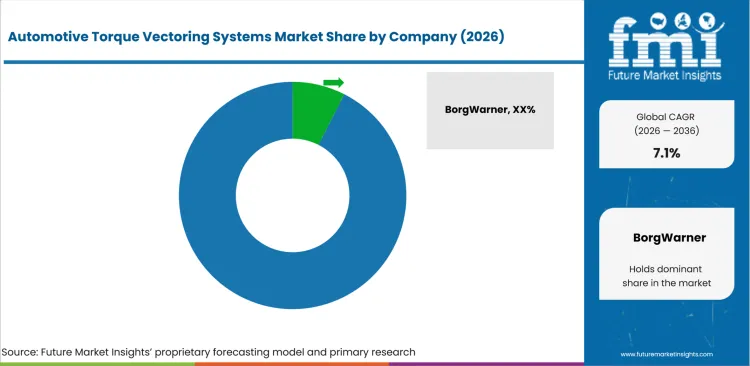
Competition divides among mechanical torque-transfer specialists, integrated eDrive companies, and software-led chassis-control providers. Serial-production validation sets the entry barrier because OEM engineers must trust the hardware limit and the control response before a vehicle program is released.
- BorgWarner, GKN Automotive, and Eaton concentrate on differentials and electronic torque management with long-running driveline engineering for wheel-to-wheel torque transfer.
- Magna International, Schaeffler, and ZF Friedrichshafen extend torque management through eDrive integration and by-wire actuators for electrified vehicle platforms.
- AUMOVIO and Bosch focus on centralized motion software that coordinates braking and propulsion beside other chassis actuators.
Competitive Benchmarking: Automotive Torque Vectoring Systems Market
| Company | Wheel-Torque Hardware | Electrified Axle Integration | Vehicle Motion Software | Geographic Reach |
|---|---|---|---|---|
| BorgWarner | High | High | Medium | North America, Europe, Asia |
| GKN Automotive | High | High | Medium | Europe, North America, Asia-Pacific |
| Eaton | High | Medium | Medium | North America, Europe, Asia |
| Magna International | High | High | High | North America, Europe, Asia-Pacific |
| Schaeffler | Medium | High | Medium | Europe, North America, Asia |
| ZF Friedrichshafen | Medium | High | High | Europe, North America, Asia |
| AUMOVIO | Medium | Medium | High | Europe, North America, Asia |
| Bosch | Medium | Medium | High | Europe, North America, Asia |
Scoring basis: High wheel-torque hardware requires multiple documented torque-transfer routes. Medium identifies one current verified route and Low identifies a narrow documented offering. High electrified-axle integration requires serial eDrive integration with torque-management content. Medium covers one verified electrified route and Low covers a limited documented integration role. High vehicle-motion software requires cross-domain control of several actuator classes. Medium covers narrower actuator coordination and Low identifies a limited documented control role. Geographic reach describes current operating coverage and does not represent a reputation ranking. Source basis: ratings use official company announcements and filings listed in the bibliography.
Key Developments in the Automotive Torque Vectoring Systems Market
- In July 2025, BorgWarner secured a new electric cross-differential program with a leading Chinese OEM for electric vehicles. The eXD dynamically controls power between the wheels to improve handling and traction during vehicle-dynamics events.
- In April 2025, Eaton launched its EV Truetrac differential for electric vehicles with revised lubrication behavior and gear geometry for instant motor torque. The differential targets pickup and SUV programs in North America and Asia with instant electric-motor torque loads.
- In January 2025, ZF secured a global OEM brake-by-wire business covering nearly five million light vehicles over the contract period. The award expands the production actuator base available for software-coordinated vehicle motion and integrated chassis control.
Key Players in the Automotive Torque Vectoring Systems Market
Torque-Management Hardware and Differential Specialists
- BorgWarner
- GKN Automotive
- Eaton
Integrated eDrive and Chassis System Suppliers
- Magna International
- Schaeffler
- ZF Friedrichshafen
Software-Defined Motion and Brake-Control Providers
- AUMOVIO
- Bosch
Automotive Torque Vectoring Systems Market - Report Scope
| Coverage field | Report scope |
|---|---|
| Market breakdown | By system type, vehicle type, propulsion, component, sales channel, and region. |
| Quantitative Units | USD Billion. |
| Market Definition | Revenue includes torque-vectoring systems, components, and licensed control functions supplied as distinct vehicle content within the defined market boundary. |
| Regions Covered | North America, Latin America, Western Europe, Eastern Europe, East Asia, South Asia and Pacific, and Middle East and Africa. |
| Countries Covered | South Korea, Mexico, USA, Germany, Japan, and 25+ countries included in the full report. |
| Key Companies Profiled | BorgWarner, GKN Automotive, Eaton, Magna International, Schaeffler, ZF Friedrichshafen, AUMOVIO, Bosch. |
| Forecast Period | 2026 to 2036. |
| Approach | Primary and secondary research with market triangulation. |
Automotive Torque Vectoring Systems Market - Research Methodology
| Method | Approach |
|---|---|
| Primary Research | FMI analysts gathered input from manufacturers, service providers, technology developers, distributors, end users, procurement teams, and subject-matter experts. Interviews examined purchasing decisions, product or service evaluation, adoption barriers, approval requirements, pricing considerations, and expectations for technical or commercial support. Respondents were also asked what evidence is required before a trial, pilot, or initial order develops into regular purchasing. |
| Desk Research | Desk research covered government statistics, regulatory publications, trade data, industry associations, technical literature, standards, company filings, product information, and official corporate announcements. Sources were reviewed for relevance, publication date, geographic coverage, and consistency with the defined market scope. Claims relating to performance, applications, approvals, capacity, investment, and commercial activity were retained only when supported by credible public evidence. |
| Market Sizing and Forecasting | The market model combined the baseline value with historical performance, segment structure, pricing and volume indicators, adoption levels, company participation, and country-level demand conditions. Forecast assumptions considered economic activity, investment trends, regulatory developments, technology adoption, purchasing cycles, supply availability, and barriers to wider market use. Segment and regional estimates were reconciled before the final market total was calculated. |
| Data Validation | Estimates were checked against multiple independent indicators, including public data, company activity, trade patterns, industry developments, and findings from primary interviews. Validation also tested whether products, services, applications, and company revenues fell within the defined market boundaries. Adjacent categories, unsupported claims, overlapping revenues, and activities without direct market relevance were excluded to reduce double counting and maintain consistency across segments and countries. |
Automotive Torque Vectoring Systems Market by Segments
Automotive Torque Vectoring Systems Market segmented by system type:
- Brake-based torque vectoring
- Active differential systems
- E-axle torque vectoring
- Twin-clutch vectoring
- Software-defined torque control
Automotive Torque Vectoring Systems Market segmented by vehicle type:
- Passenger cars
- SUVs/crossovers
- Electric vehicles
- Performance cars
- Commercial vehicles
Automotive Torque Vectoring Systems Market segmented by propulsion:
- ICE vehicles
- Battery electric vehicles
- Hybrid vehicles
- Plug-in hybrids
Automotive Torque Vectoring Systems Market segmented by component:
- Differentials
- Control software
- ECUs
- Actuators
- Sensors
Automotive Torque Vectoring Systems Market segmented by sales channel:
- OEM direct supply
- Tier-1 integrated systems
- Performance aftermarket
- Software licensing
Automotive Torque Vectoring Systems Market by Region:
- North America
- United States
- Canada
- Latin America
- Brazil
- Mexico
- Argentina
- Chile
- Western Europe
- Germany
- France
- United Kingdom
- Italy
- Spain
- Benelux
- Nordics
- Eastern Europe
- Poland
- Czech Republic
- Romania
- Hungary
- East Asia
- China
- Japan
- South Korea
- South Asia and Pacific
- India
- ASEAN
- Australia and New Zealand
- Middle East and Africa
- GCC Countries
- South Africa
- Türkiye
- Israel
Research Sources and Bibliography
- International Energy Agency. (2025, May 14). Global EV Outlook 2025.
- International Energy Agency. (2026, May 20). Global EV Outlook 2026: Trends in electric cars.
- Instituto Nacional de Estadística y Geografía. (2026, August 7). Administrative record of the light vehicle automotive industry.
- USA Environmental Protection Agency. (2026, February). The 2025 EPA Automotive Trends Report: Fuel Economy and Technology since 1975.
- Korea Automobile & Mobility Association. (2026, July 28). 2026년 6월 자동차산업 동향(확정).
- German Association of the Automotive Industry. (2026, February 3). Production and market in January 2026.
- Japan Automobile Manufacturers Association. (2026, April 14). 2025年度乗用車市場動向調査について.
- BorgWarner. (2025, July 31). BorgWarner secures new electric cross differential project for electric vehicles in China.
- BorgWarner. (2025, May 6). BorgWarner to supply eMotor to major North American OEM.
- Eaton. (2025, April 17). Eaton introduces new EV Truetrac differential designed for electric vehicles at Auto Shanghai 2025.
- Eaton. (2026, June 11). Eaton advances 2030 growth strategy with announcement to combine Mobility Group with Dana Incorporated.
- ZF Friedrichshafen AG. (2025, January 6). ZF secures substantial brake-by-wire technology business for light vehicles.
- ZF Friedrichshafen AG. (2025, June 3). SELECT platform gives car manufacturers a choice: ZF introduces more flexible concept for e-drives.
- ZF Friedrichshafen AG. (2025, July 10). Thousands of Parameters, One Smart Solution: ZF’s cubiX Tuner Revolutionizes Chassis Calibration.
- GKN Automotive. (2025, September 10). GKN Automotive India hosts a Technology Showcase for Mahindra & Mahindra.
- GKN Automotive. (2025, October 22). GKN Automotive hosts leading OEMs at showcase event.
- Magna International. (2026, July 28). Magna secures 800V eDrive program award with Chery.
- Bosch. (2025, September 8). IAA Mobility 2025: Bosch is shaping the new vehicle world with intelligent hardware and software solutions.
- Continental AG. (2025, July 31). Group Sector Automotive introduces itself as AUMOVIO with technologies for future mobility.
- Continental AG. (2025, September 18). Spin-off Automotive Group Sector.
- Schaeffler AG. (2025, September 3). Shaping the future of mobility with electric axle drives, hybrid solutions, steer-by-wire technologies, and software.
- Schaeffler AG. (2025, July 9). Rear-wheel steering: Successful production launch for German OEM and new volume production orders.
- Dauch Corporation. (2026, February 3). Dauch Corporation (formerly AAM) and Dowlais Group (GKN) combination complete.
- Magna International. (2025, February 11). Magna expands long-term innovation partnership with Mercedes-Benz.
- GKN Automotive. (2025, September 8). GKN Automotive achieves ISO 21434 certification.
- Eaton. (2026, February 10). Eaton introduces next-generation vehicle control solutions for on- and off-highway applications.
- AUMOVIO. (2026, January 6). AUMOVIO presents the latest version of its central high-performance computer with NXP’s newest vehicle processor
This Report Answers
- What is the size of the automotive torque vectoring systems market in 2026 and what value is forecast for 2036?
- Which drivetrain changes increase demand for automotive torque vectoring systems during the forecast period?
- Why does brake-based torque vectoring hold the leading system type share in 2026?
- How does passenger-car leadership affect torque-vectoring system design and platform reuse?
- Why do ICE vehicles retain the leading propulsion share during the transition toward electrified drivetrains?
- How do growth rates differ among South Korea, Mexico, USA, Germany, and Japan?
- Which integration and calibration constraints slow adoption of higher-content torque-vectoring architectures?
- Which companies compete through torque-transfer hardware, electrified axles, and vehicle-motion software?
- What should OEM engineering teams evaluate before selecting a torque-vectoring architecture?
Frequently Asked Questions
How big is the automotive torque vectoring systems market in 2026?
The automotive torque vectoring systems market is valued at USD 3.9 billion in 2026 and is projected to reach USD 7.7 billion by 2036. Electrified drivetrains increase the number of controllable wheel and axle torque paths available to vehicle engineers.
What is the CAGR of the automotive torque vectoring systems market from 2026 to 2036?
The automotive torque vectoring systems market is projected to grow at a CAGR of 7.1% between 2026 and 2036. Expansion follows wider electrified torque control plus software coordination between propulsion, braking, and other vehicle-motion actuators.
Which system type leads the automotive torque vectoring systems market?
The brake-based torque vectoring segment is expected to hold 27.0% of the automotive torque vectoring systems market in 2026, driven by compatibility with existing brake actuators. The approach improves yaw control without requiring a dedicated twin-clutch torque-transfer unit.
Which propulsion segment holds a leading share of the automotive torque vectoring systems market?
The ICE vehicles segment is expected to hold 34.0% of the automotive torque vectoring systems market in 2026, attributable to validated mechanical differentials and stability controls. Conventional vehicle programs still carry large serial volumes as electrified architectures expand their share of new platforms.
Which companies are active in the automotive torque vectoring systems market?
Key companies operating in the market include BorgWarner, GKN Automotive, Eaton, Magna International, Schaeffler, ZF Friedrichshafen, AUMOVIO, and Bosch. These companies compete through differentials, electrified axle integration, chassis controls, and vehicle-motion software.
Preview the report firsthand - request a free sample
Get SampleGet the brochure for pricing and purchase details.
Get PDFTable of Content
- Key Takeaways
- Market Size and CAGR
- Top Growth Driver
- Fastest Growing Segment
- Leading Region
- Key Companies
- Emerging Opportunities
- Executive Summary
- Global Market Outlook
- Demand-side Trends
- Supply-side Trends
- Technology Roadmap Analysis
- Analysis and Recommendations
- Analyst Perspective (What is happening? Why now? What should investors know?)
- Key Questions Answered
- How large is the market?
- What is the CAGR?
- What are key trends?
- Which region dominates?
- Who are the leaders?
- Market Overview
- Market Coverage / Taxonomy
- Market Definition / Scope / Limitations
- Research Methodology
- Chapter Orientation
- Analytical Lens and Working Hypotheses
- Market Structure, Signals, and Trend Drivers
- Benchmarking and Cross-market Comparability
- Market Sizing, Forecasting, and Opportunity Mapping
- Research Design and Evidence Framework
- Desk Research Programme (Secondary Evidence)
- Expert Input and Fieldwork (Primary Evidence)
- Tooling, Models, and Reference Databases
- Data Engineering and Model Build
- Quality Assurance and Audit Trail
- Market Background
- Market Dynamics (Drivers, Restraints, Opportunity, Trends)
- Scenario Forecast (Optimistic, Likely, Conservative)
- Impact Analysis
- AI Impact
- Sustainability Impact
- Regulatory Impact
- Technology Impact
- Consumer / Buyer Analysis
- Purchase Drivers
- Adoption Barriers
- Buyer Journey
- Opportunity Map Analysis
- Product Life Cycle Analysis
- Supply Chain Analysis
- Investment Feasibility Matrix
- Value Chain Analysis
- PESTLE and Porter's Analysis
- Regulatory Landscape
- Regional Parent Market Outlook
- Production and Consumption Statistics
- Import and Export Statistics
- Global Market Analysis and Forecast, 2021 to 2036
- Historical Market Size Value (USD Billion) Analysis, 2021 to 2025
- Current and Future Market Size Value (USD Billion) Projections, 2026 to 2036
- Y-o-Y Growth Trend Analysis
- Absolute $ Opportunity Analysis
- Global Market Pricing Analysis, 2021 to 2036
- Global Market Analysis and Forecast, By System Type, 2021 to 2036
- Introduction / Key Findings
- Historical Market Size Value (USD Billion) Analysis By System Type, 2021 to 2025
- Current and Future Market Size Value (USD Billion) Analysis and Forecast By System Type, 2026 to 2036
- Brake-based torque vectoring
- Active differential systems
- E-axle torque vectoring
- Twin-clutch vectoring
- Software-defined torque control
- Brake-based torque vectoring
- Y-o-Y Growth Trend Analysis By System Type, 2021 to 2025
- Absolute $ Opportunity Analysis By System Type, 2026 to 2036
- Global Market Analysis and Forecast, By Vehicle Type, 2021 to 2036
- Introduction / Key Findings
- Historical Market Size Value (USD Billion) Analysis By Vehicle Type, 2021 to 2025
- Current and Future Market Size Value (USD Billion) Analysis and Forecast By Vehicle Type, 2026 to 2036
- Passenger cars
- SUVs/crossovers
- Electric vehicles
- Performance cars
- Commercial vehicles
- Passenger cars
- Y-o-Y Growth Trend Analysis By Vehicle Type, 2021 to 2025
- Absolute $ Opportunity Analysis By Vehicle Type, 2026 to 2036
- Global Market Analysis and Forecast, By Propulsion, 2021 to 2036
- Introduction / Key Findings
- Historical Market Size Value (USD Billion) Analysis By Propulsion, 2021 to 2025
- Current and Future Market Size Value (USD Billion) Analysis and Forecast By Propulsion, 2026 to 2036
- ICE vehicles
- Battery electric vehicles
- Hybrid vehicles
- Plug-in hybrids
- ICE vehicles
- Y-o-Y Growth Trend Analysis By Propulsion, 2021 to 2025
- Absolute $ Opportunity Analysis By Propulsion, 2026 to 2036
- Global Market Analysis and Forecast, By Component, 2021 to 2036
- Introduction / Key Findings
- Historical Market Size Value (USD Billion) Analysis By Component, 2021 to 2025
- Current and Future Market Size Value (USD Billion) Analysis and Forecast By Component, 2026 to 2036
- Differentials
- Control software
- ECUs
- Actuators
- Sensors
- Differentials
- Y-o-Y Growth Trend Analysis By Component, 2021 to 2025
- Absolute $ Opportunity Analysis By Component, 2026 to 2036
- Global Market Analysis and Forecast, By Sales Channel, 2021 to 2036
- Introduction / Key Findings
- Historical Market Size Value (USD Billion) Analysis By Sales Channel, 2021 to 2025
- Current and Future Market Size Value (USD Billion) Analysis and Forecast By Sales Channel, 2026 to 2036
- OEM direct supply
- Tier-1 integrated systems
- Performance aftermarket
- Software licensing
- OEM direct supply
- Y-o-Y Growth Trend Analysis By Sales Channel, 2021 to 2025
- Absolute $ Opportunity Analysis By Sales Channel, 2026 to 2036
- Global Market Analysis and Forecast, By Region, 2021 to 2036
- Introduction
- Historical Market Size Value (USD Billion) Analysis By Region, 2021 to 2025
- Current Market Size Value (USD Billion) Analysis and Forecast By Region, 2026 to 2036
- North America
- Latin America
- Western Europe
- Eastern Europe
- East Asia
- South Asia and Pacific
- Middle East & Africa
- Market Attractiveness Analysis By Region
- North America Market Analysis and Forecast, By Country, 2021 to 2036
- Historical Market Size Value (USD Billion) Trend Analysis By Market Taxonomy, 2021 to 2025
- Market Size Value (USD Billion) Forecast By Market Taxonomy, 2026 to 2036
- By Country
- USA
- Canada
- By System Type
- By Vehicle Type
- By Propulsion
- By Component
- By Sales Channel
- By Country
- Market Attractiveness Analysis
- By Country
- By System Type
- By Vehicle Type
- By Propulsion
- By Component
- By Sales Channel
- Key Takeaways
- Latin America Market Analysis and Forecast, By Country
- Historical Market Size Value (USD Billion) Trend Analysis By Market Taxonomy, 2021 to 2025
- Market Size Value (USD Billion) Forecast By Market Taxonomy, 2026 to 2036
- By Country
- Brazil
- Mexico
- Chile
- Rest of Latin America
- By System Type
- By Vehicle Type
- By Propulsion
- By Component
- By Sales Channel
- By Country
- Market Attractiveness Analysis
- By Country
- By System Type
- By Vehicle Type
- By Propulsion
- By Component
- By Sales Channel
- Key Takeaways
- Western Europe Market Analysis and Forecast, By Country
- Historical Market Size Value (USD Billion) Trend Analysis By Market Taxonomy, 2021 to 2025
- Market Size Value (USD Billion) Forecast By Market Taxonomy, 2026 to 2036
- By Country
- Germany
- UK
- Italy
- Spain
- France
- Nordic
- BENELUX
- Rest of Western Europe
- By System Type
- By Vehicle Type
- By Propulsion
- By Component
- By Sales Channel
- By Country
- Market Attractiveness Analysis
- By Country
- By System Type
- By Vehicle Type
- By Propulsion
- By Component
- By Sales Channel
- Key Takeaways
- Eastern Europe Market Analysis and Forecast, By Country
- Historical Market Size Value (USD Billion) Trend Analysis By Market Taxonomy, 2021 to 2025
- Market Size Value (USD Billion) Forecast By Market Taxonomy, 2026 to 2036
- By Country
- Russia
- Poland
- Hungary
- Balkan & Baltic
- Rest of Eastern Europe
- By System Type
- By Vehicle Type
- By Propulsion
- By Component
- By Sales Channel
- By Country
- Market Attractiveness Analysis
- By Country
- By System Type
- By Vehicle Type
- By Propulsion
- By Component
- By Sales Channel
- Key Takeaways
- East Asia Market Analysis and Forecast, By Country
- Historical Market Size Value (USD Billion) Trend Analysis By Market Taxonomy, 2021 to 2025
- Market Size Value (USD Billion) Forecast By Market Taxonomy, 2026 to 2036
- By Country
- China
- Japan
- South Korea
- By System Type
- By Vehicle Type
- By Propulsion
- By Component
- By Sales Channel
- By Country
- Market Attractiveness Analysis
- By Country
- By System Type
- By Vehicle Type
- By Propulsion
- By Component
- By Sales Channel
- Key Takeaways
- South Asia and Pacific Market Analysis and Forecast, By Country
- Historical Market Size Value (USD Billion) Trend Analysis By Market Taxonomy, 2021 to 2025
- Market Size Value (USD Billion) Forecast By Market Taxonomy, 2026 to 2036
- By Country
- India
- ASEAN
- Australia & New Zealand
- Rest of South Asia and Pacific
- By System Type
- By Vehicle Type
- By Propulsion
- By Component
- By Sales Channel
- By Country
- Market Attractiveness Analysis
- By Country
- By System Type
- By Vehicle Type
- By Propulsion
- By Component
- By Sales Channel
- Key Takeaways
- Middle East & Africa Market Analysis and Forecast, By Country
- Historical Market Size Value (USD Billion) Trend Analysis By Market Taxonomy, 2021 to 2025
- Market Size Value (USD Billion) Forecast By Market Taxonomy, 2026 to 2036
- By Country
- Kingdom of Saudi Arabia
- Other GCC Countries
- Türkiye
- South Africa
- Other African Union
- Rest of Middle East & Africa
- By System Type
- By Vehicle Type
- By Propulsion
- By Component
- By Sales Channel
- By Country
- Market Attractiveness Analysis
- By Country
- By System Type
- By Vehicle Type
- By Propulsion
- By Component
- By Sales Channel
- Key Takeaways
- Key Countries Market Analysis
- USA
- Pricing Analysis
- Market Share Analysis, 2025
- By System Type
- By Vehicle Type
- By Propulsion
- By Component
- By Sales Channel
- Canada
- Pricing Analysis
- Market Share Analysis, 2025
- By System Type
- By Vehicle Type
- By Propulsion
- By Component
- By Sales Channel
- Mexico
- Pricing Analysis
- Market Share Analysis, 2025
- By System Type
- By Vehicle Type
- By Propulsion
- By Component
- By Sales Channel
- Brazil
- Pricing Analysis
- Market Share Analysis, 2025
- By System Type
- By Vehicle Type
- By Propulsion
- By Component
- By Sales Channel
- Chile
- Pricing Analysis
- Market Share Analysis, 2025
- By System Type
- By Vehicle Type
- By Propulsion
- By Component
- By Sales Channel
- Germany
- Pricing Analysis
- Market Share Analysis, 2025
- By System Type
- By Vehicle Type
- By Propulsion
- By Component
- By Sales Channel
- UK
- Pricing Analysis
- Market Share Analysis, 2025
- By System Type
- By Vehicle Type
- By Propulsion
- By Component
- By Sales Channel
- Italy
- Pricing Analysis
- Market Share Analysis, 2025
- By System Type
- By Vehicle Type
- By Propulsion
- By Component
- By Sales Channel
- Spain
- Pricing Analysis
- Market Share Analysis, 2025
- By System Type
- By Vehicle Type
- By Propulsion
- By Component
- By Sales Channel
- France
- Pricing Analysis
- Market Share Analysis, 2025
- By System Type
- By Vehicle Type
- By Propulsion
- By Component
- By Sales Channel
- India
- Pricing Analysis
- Market Share Analysis, 2025
- By System Type
- By Vehicle Type
- By Propulsion
- By Component
- By Sales Channel
- ASEAN
- Pricing Analysis
- Market Share Analysis, 2025
- By System Type
- By Vehicle Type
- By Propulsion
- By Component
- By Sales Channel
- Australia & New Zealand
- Pricing Analysis
- Market Share Analysis, 2025
- By System Type
- By Vehicle Type
- By Propulsion
- By Component
- By Sales Channel
- China
- Pricing Analysis
- Market Share Analysis, 2025
- By System Type
- By Vehicle Type
- By Propulsion
- By Component
- By Sales Channel
- Japan
- Pricing Analysis
- Market Share Analysis, 2025
- By System Type
- By Vehicle Type
- By Propulsion
- By Component
- By Sales Channel
- South Korea
- Pricing Analysis
- Market Share Analysis, 2025
- By System Type
- By Vehicle Type
- By Propulsion
- By Component
- By Sales Channel
- Russia
- Pricing Analysis
- Market Share Analysis, 2025
- By System Type
- By Vehicle Type
- By Propulsion
- By Component
- By Sales Channel
- Poland
- Pricing Analysis
- Market Share Analysis, 2025
- By System Type
- By Vehicle Type
- By Propulsion
- By Component
- By Sales Channel
- Hungary
- Pricing Analysis
- Market Share Analysis, 2025
- By System Type
- By Vehicle Type
- By Propulsion
- By Component
- By Sales Channel
- Kingdom of Saudi Arabia
- Pricing Analysis
- Market Share Analysis, 2025
- By System Type
- By Vehicle Type
- By Propulsion
- By Component
- By Sales Channel
- Türkiye
- Pricing Analysis
- Market Share Analysis, 2025
- By System Type
- By Vehicle Type
- By Propulsion
- By Component
- By Sales Channel
- South Africa
- Pricing Analysis
- Market Share Analysis, 2025
- By System Type
- By Vehicle Type
- By Propulsion
- By Component
- By Sales Channel
- USA
- Market Structure Analysis
- Competition Dashboard
- Competition Benchmarking
- Market Share Analysis of Top Players
- By Regional
- By System Type
- By Vehicle Type
- By Propulsion
- By Component
- By Sales Channel
- Emerging Startups
- Innovation Benchmarking
- Competition Analysis
- Competition Deep Dive
- BorgWarner
- Overview
- Product Portfolio
- Profitability by Market Segments
- Sales Footprint
- Strategy Overview
- Marketing Strategy
- Product Strategy
- Channel Strategy
- GKN Automotive
- ZF Friedrichshafen
- Magna International
- Continental
- Bosch
- Dana
- JTEKT
- Schaeffler
- Eaton
- BorgWarner
- Case Studies
- Success Stories
- Recent Developments
- Competition Deep Dive
- Assumptions & Acronyms Used


