

- Market Size (2026)
- USD 1321.4 Mn
- Forecast (2036)
- USD 2673.2 Mn
- CAGR (2026 to 2036)
- 7.3%
How big is Automotive Rotor Retention Sleeves Market in 2026?
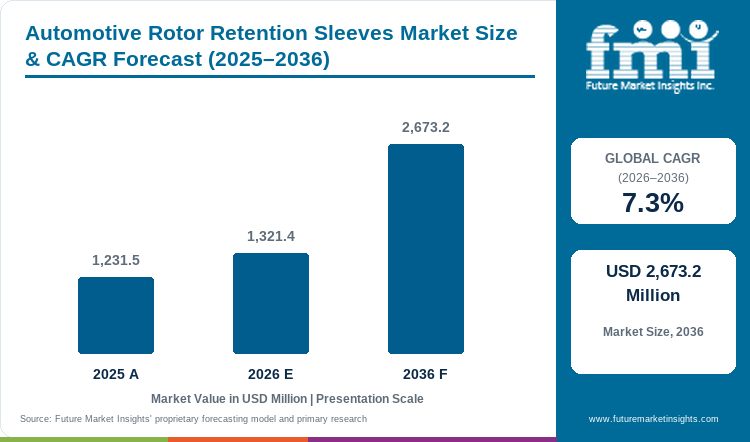
USD 1,321.4 million in 2026 and USD 2,673.2 million by 2036 at a 7.3% CAGR.
Sales of automotive rotor retention sleeves are estimated to grow at 7.3% from USD 1,321.4 million in 2026 to USD 2,673.2 million by 2036. The market stood at USD 1,231.5 million in 2025. Demand increases when traction-motor designers push rotor speed and power density high enough that magnets and other rotating parts need extra mechanical support. More than 20 million electric cars were sold globally in 2025, with battery electric vehicles representing 65% of sales. As that production base expands, more motor programs reach the point where rotor containment becomes part of the core design.
The growth pattern is not the same in every country. Compact permanent-magnet rotors create a clearer need for dedicated sleeves than designs that rely more heavily on laminations or other rotor structures. High-speed motors also leave less room for excess mass, thickness or imbalance. That makes rotor sleeves closely tied to the electric vehicle e-axle market, where packaging, speed and system integration are decided early in the development cycle.
Key Takeaways
- Rising EV motor speed and power density increase the need for positive rotor containment where centrifugal loading exceeds the capability of the underlying magnet or rotor structure.
- Carbon fiber sleeves are estimated to lead Sleeve Material demand with 46.0% share in 2026 because high specific hoop strength limits added rotor mass.
- Permanent magnet motors account for 37.0% of Motor Type demand in 2026, reflecting the containment requirements of surface-mounted and other high-speed magnet configurations.
- Rotor-specific qualification remains a commercial restraint because winding tension, cure, preload, balance and overspeed performance must remain stable on the finished rotor.
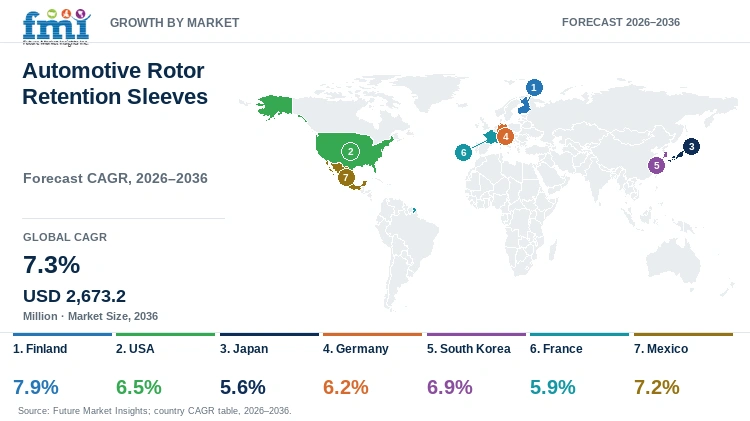
- Finland is forecast to record the highest profiled country CAGR at 7.9%, followed by Mexico at 7.2% and South Korea at 6.9%.
- Notable companies include Toray Industries, SGL Carbon, Mitsubishi Chemical Group, Hexcel, Teijin, Solvay, Cevotec, Marubeni Aerospace, Schaeffler and Nidec.
Analyst Perspective
"Rotor retention sleeve value is created at the point where material performance becomes a repeatable rotor-level process. Suppliers that can control fiber orientation, winding tension, preload, cure and dimensional finishing while preserving overspeed margin are better positioned to remain embedded in an approved motor platform."
- Nikhil Kaitwade, Principal Consultant, Future Market Insights
How is the automotive rotor retention sleeves market segmented?
Sleeve Material, Motor Type, Rotor Speed, Vehicle Type, Sales Channel and Region
The automotive rotor retention sleeves market is segmented by Sleeve Material, Motor Type, Rotor Speed, Vehicle Type, Sales Channel and Region. Sleeve Material includes Carbon fiber sleeves, Glass fiber sleeves, Inconel/metallic sleeves, Aramid composite sleeves and Hybrid composite sleeves. Motor Type includes Permanent magnet motors, High-speed traction motors, Axial flux motors, E-axle motors and Performance EV motors. Rotor Speed covers 15,000-25,000 rpm, Below 15,000 rpm, 25,000-40,000 rpm and Above 40,000 rpm. Vehicle Type includes Battery electric cars, Premium EVs, Electric commercial vehicles and Motorsport EVs. Sales Channel includes EV motor OEMs, Composite sleeve suppliers, Tier-1 e-drive suppliers and Specialty motor engineering.
Why do Carbon fiber sleeves lead demand within the Sleeve Material category?
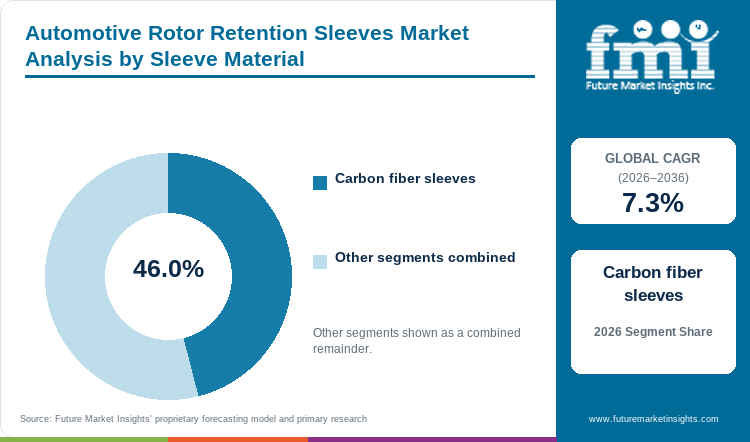
Carbon fiber sleeves are well suited to rotors that need high containment strength without adding much weight or radial thickness. Their strength-to-weight advantage helps designers keep the air gap tight while managing the hoop loads created at high speed. Material choice also affects electrical losses, so the sleeve has to work with both the mechanical and electromagnetic design of the motor. That makes carbon fiber a more specialized requirement here than in the wider automotive composites market, where lightweighting can be spread across many vehicle parts.
- Carbon fiber sleeves are estimated to hold 46.0% of Sleeve Material demand in 2026.
- Glass fiber, metallic, aramid and hybrid systems remain relevant where cost, temperature, electromagnetic behavior or process compatibility outweigh the lowest possible rotor mass.
Why do Permanent magnet motors lead demand within the Motor Type category?
Permanent magnet motors often need added retention because magnets positioned close to the rotor surface face strong centrifugal forces at speed. A sleeve keeps those magnets under compression while helping the rotor stay within its required diameter. The requirement varies by topology because some buried-magnet designs depend more on the rotor laminations for support. As a result, sleeve suppliers have to work around the exact magnet layout, rotor speed and thermal behavior of each motor. That is why the opportunity is closely connected to the broader permanent magnet motor market.
- Permanent magnet motors are estimated to account for 37.0% of Motor Type demand in 2026.
- Sleeve thickness and preload are established alongside magnet placement, thermal behavior and maximum rotor speed, limiting late-stage material substitution.
Why does 15,000-25,000 rpm lead demand within the Rotor Speed category?
The 15,000-25,000 rpm range sits in a commercially important middle ground. Centrifugal loads are high enough to make rotor retention a serious design issue, but production can still be managed with automotive-scale winding, curing and finishing processes. Below this range, some motors can use simpler or heavier containment solutions. Above it, balancing, tolerances and overspeed validation become more demanding. The leading speed band therefore offers a practical balance between performance gains and manufacturing cost.
- The 15,000-25,000 rpm segment is estimated to hold 38.0% of Rotor Speed demand in 2026.
- Higher speed increases the commercial value of consistent winding tension, concentricity and finished-sleeve balance because small deviations generate larger mechanical consequences.
Why do Battery electric cars lead demand within the Vehicle Type category?
Battery electric cars create the largest recurring base of traction-motor programs because electric motors provide the primary propulsion function. Vehicle manufacturers also continue to look for smaller, lighter motors that can deliver more power without taking up additional space. Premium EVs and motorsport platforms may place even greater demands on rotor speed, but their production volumes are lower. Electric commercial vehicles bring different duty-cycle requirements. Passenger BEVs therefore combine scale, frequent platform updates and sustained pressure on motor power density.
- Battery electric cars are estimated to hold 44.0% of Vehicle Type demand in 2026.
- Sleeve opportunity depends on the chosen rotor architecture, so growth in BEV production does not translate uniformly into retention-sleeve content.
Why do EV motor OEMs lead demand within the Sales Channel category?
EV motor OEMs lead because the sleeve is designed together with the rotor rather than selected as a standard component at the end of development. The motor designer sets magnet geometry, maximum speed, air-gap tolerance, thermal limits, balance requirements and overspeed margin. Those decisions determine the sleeve material, thickness and fit. Composite suppliers may provide fibers, prepregs or winding capability, but the motor owner usually controls the final validation and any later engineering changes. The same structure can be seen across the electric vehicle motor market, where component choices are increasingly made as part of an integrated propulsion system.
- EV motor OEMs are estimated to account for 41.0% of Sales Channel demand in 2026.
- Tier-1 e-drive suppliers gain similar influence when the complete drive unit, rather than the stand-alone motor, is the customer-qualified assembly.
What are the drivers, restraints and opportunities in the Automotive Rotor Retention Sleeves Market?
Higher rotor speeds create stronger containment requirements, rotor-specific qualification slows supplier substitution, and automated composite processing expands the route to repeatable serial production.
- Driver: Higher rotor speed and power density increase centrifugal loading on magnets and other rotating elements.
- Restraint: Sleeve performance depends on rotor-specific winding, preload, thermal cycling, balance and overspeed validation.
- Opportunity: Automated winding and fiber-placement systems can improve repeatability while reducing manual process variation.
The main driver is the push to extract more power from a smaller motor package. Higher rotational speed increases the forces acting on magnets and other rotor parts, which raises the need for a strong but lightweight containment layer. Composite sleeves can meet that need without the mass penalty of thicker metal parts. This links demand directly to the wider carbon fiber composites market, especially where high specific strength matters more than raw material cost.
Qualification slows down supplier changes because the sleeve cannot be assessed on material properties alone. Fiber angle, resin content, cure conditions, winding tension and interference all affect how the finished rotor behaves. A lower-cost material brings little benefit if the change requires fresh overspeed testing or creates additional machining and balancing work. Once a sleeve system is approved, switching becomes a technical as well as a commercial decision.
Automation offers a clearer path to higher-volume production. Cevotec expanded its Fiber Patch Placement platform in 2025 and commissioned its first Fiber Patch Placement system in Japan. For sleeve producers, the commercial value lies in controlling fiber placement more consistently, reducing manual variation and shortening production cycles. Those gains matter because automotive programs reward repeatability and yield, not simply stronger raw material.
Which country CAGRs are profiled in the Automotive Rotor Retention Sleeves Market?
| Country | CAGR |
|---|---|
| Finland | 7.9% |
| USA | 6.5% |
| Japan | 5.6% |
| Germany | 6.2% |
| South Korea | 6.9% |
| France | 5.9% |
| Mexico | 7.2% |
How do country-level CAGRs compare in the Automotive Rotor Retention Sleeves Market?
Finland has the highest profiled growth rate at 7.9%, followed by Mexico at 7.2% and South Korea at 6.9%. The USA at 6.5% and Germany at 6.2% sit in the middle of the group, supported by large automotive ecosystems but also shaped by mature approval and sourcing processes. France at 5.9% and Japan at 5.6% continue to grow, although motor architecture and the pace of BEV adoption affect how much of that growth turns into sleeve demand.
- Finland exceeds Mexico by 0.7 percentage points, with growth supported by specialist high-voltage motor engineering and export-oriented technical programs.
- Mexico combines a 7.2% CAGR with rapidly expanding EV activity, increasing the value of regional finishing, traceability and plant-side quality support.
- South Korea's 6.9% CAGR reflects concentrated automotive ecosystems in which material and motor suppliers can move through co-development programs with major vehicle groups.
- The USA, Germany, France and Japan range from 6.5% to 5.6%, making motor topology and platform scale more commercially important than small differences in forecast growth.
Country-wise Analysis
- Finland: Demand for Automotive Rotor Retention Sleeves in Finland is forecast to expand at 7.9% CAGR from 2026 to 2036. Danfoss announced a new 8,200-square-meter Lappeenranta facility in March 2025 incorporating high-voltage production, pre-serial development and testing activities. Finland's opportunity therefore leans toward engineering-intensive orders where sleeves must move with motor prototypes into export programs. Flexible batch sizes and fast design iteration matter more than very large domestic vehicle volumes.
- USA: Sales of Automotive Rotor Retention Sleeves in the USA are forecast to rise at 6.5% CAGR from 2026 to 2036. US electric car sales reached about 1.5 million units in 2025, but the year also showed pronounced quarterly volatility. That makes capacity planning important for sleeve suppliers because vehicle-platform ramps may not move in a straight line. A broad base of automakers, Tier-1 suppliers and engineering companies creates opportunity, but each account can maintain its own rotor validation path.
- Japan: Adoption of Automotive Rotor Retention Sleeves in Japan is estimated to expand at 5.6% CAGR from 2026 to 2036. Japan retains deep motor, materials and precision-manufacturing capability, yet its passenger-vehicle market continues to carry a strong hybrid mix. Sleeve demand therefore depends less on general electrification and more on the rate at which higher-speed permanent-magnet traction designs gain program share. Long qualification cycles favor suppliers able to maintain stable process records across successive production lots.
- Germany: Demand for Automotive Rotor Retention Sleeves in Germany is forecast to rise at 6.2% CAGR from 2026 to 2036. German electric car sales reached about 850,000 units in 2025 following a strong annual increase. The commercial challenge is not a lack of e-drive engineering activity but the combination of formal automotive approval processes and sustained price pressure. Sleeve suppliers need to demonstrate that winding, interference and finishing remain controlled as programs move from engineering builds into serial production.
- South Korea: Sales of Automotive Rotor Retention Sleeves in South Korea are forecast to expand at 6.9% CAGR from 2026 to 2036. Electric car sales increased sharply in 2025, supporting new motor and drivetrain programs. South Korea's concentrated vehicle ecosystem favors suppliers that can enter co-development early enough to influence rotor material and process selection. Once the motor architecture is frozen, switching to another sleeve system becomes materially harder.
- France: Adoption of Automotive Rotor Retention Sleeves in France is forecast to expand at 5.9% CAGR from 2026 to 2036. The 5.9% CAGR places France below Germany and the USA but above Japan among the profiled mature automotive markets. Commercial demand will depend on the share of high-speed traction-motor programs that require dedicated rotor containment rather than on electrified vehicle production alone.
- Mexico: Demand for Automotive Rotor Retention Sleeves in Mexico is forecast to rise at 7.2% CAGR from 2026 to 2036. Electric car sales tripled in 2025, while much of the country's manufacturing base remains closely tied to North American vehicle programs. The opportunity for sleeve suppliers lies in shortening the distance between composite conversion, finishing and vehicle-plant quality support. Local traceability and rapid response become more valuable as new EV programs move from imported components toward regionalized supply.
Who are the notable companies in the Automotive Rotor Retention Sleeves Market?
Toray Industries, SGL Carbon, Mitsubishi Chemical Group, Hexcel, Teijin, Solvay, Cevotec, Marubeni Aerospace, Schaeffler and Nidec are notable companies across advanced materials, composite processing and e-drive integration.
Competition is spread across three parts of the value chain. Toray Industries, SGL Carbon, Mitsubishi Chemical Group, Hexcel, Teijin and Solvay compete through carbon fibers, prepregs, resins and related composite systems. Cevotec brings automated placement technology, while Marubeni Aerospace gives advanced-material suppliers a route into Japanese customers. Schaeffler and Nidec operate closer to the motor and e-drive design process, where component specifications are set. The strongest positions come from combining material capability with repeatable processing and access to the teams that approve the motor platform.
- Advanced Reinforcement and Matrix Suppliers: Toray Industries, SGL Carbon, Mitsubishi Chemical Group, Hexcel, Teijin and Solvay compete through fiber strength, resin compatibility, prepreg or towpreg formats, conversion support and material consistency.
- Composite Automation and Channel Enablers: Cevotec and Marubeni Aerospace compete through programmable manufacturing technology and customer access for advanced composite materials.
- E-Drive System Integrators and Qualification Anchors: Schaeffler and Nidec influence sleeve requirements through motor design, integrated e-drive engineering and platform-level component approval.
Competitive Benchmarking: Automotive Rotor Retention Sleeves Market
| Company | High-Strength Sleeve Material Depth | Serial Composite Process Support | E-Drive Integration Access | Geographic Reach |
|---|---|---|---|---|
| Toray Industries | High | High | High | Japan, South Korea, Europe and North America |
| SGL Carbon | High | High | Medium | Europe, North America and Asia |
| Mitsubishi Chemical Group | High | High | Medium | Japan, North America and Europe |
| Hexcel | High | Medium | Medium | North America, Europe and Asia-Pacific |
| Teijin | High | High | Medium | Japan, Europe and North America |
| Solvay | Medium | High | Medium | Europe, North America and Asia |
| Cevotec | Unscored | High | Medium | Europe, Japan and North America through partners |
| Marubeni Aerospace | Unscored | Medium | Medium | Japan with international materials channels |
| Schaeffler | Unscored | Unscored | High | Europe, Americas, Greater China and Asia-Pacific |
| Nidec | Unscored | Unscored | High | Asia, Europe and North America |
High-Strength Sleeve Material Depth shows how broadly a company participates in carbon fiber, prepreg, resin and related materials that can be used in heavily loaded composite structures. Serial Composite Process Support reflects its ability to help convert those materials consistently at production scale. E-Drive Integration Access captures direct involvement in motors, e-axles or automotive system development. High indicates a broad capability, while Medium indicates a more focused but still relevant position.
Key Developments in the Automotive Rotor Retention Sleeves Market
- In December 2025, Mitsubishi Chemical Group announced phased high-performance carbon-fiber capacity enhancements in Japan and the USA through 2027, with the plan expected to approximately double existing high-performance carbon-fiber capacity. Greater fiber availability can support high-strength rotor-sleeve programs that need consistent reinforcement across serial production.
- In February 2025, Cevotec reported the commissioning of its first SAMBA Pro-PV Fiber Patch Placement system in Japan, with the system launch scheduled for March. The development extends programmable composite placement into another advanced-manufacturing environment where repeatability and fiber orientation are central to production economics.
- In 2025, Nidec continued development of increasingly integrated E-Axle architectures, including higher-generation systems designed to combine propulsion functions in a smaller package. Continued e-drive integration raises the importance of early rotor-component specification because sleeve geometry must be reconciled with the motor's speed, thermal and packaging targets.
Key Players in the Automotive Rotor Retention Sleeves Market
Advanced Reinforcement and Matrix Suppliers
- Toray Industries
- SGL Carbon
- Mitsubishi Chemical Group
- Hexcel
- Teijin
- Solvay
Composite Automation and Channel Enablers
- Cevotec
- Marubeni Aerospace
E-Drive System Integrators and Qualification Anchors
- Schaeffler
- Nidec
Automotive Rotor Retention Sleeves Market - Report Scope
| Coverage field | Report scope |
|---|---|
| Market breakdown | Sleeve Material; Motor Type; Rotor Speed; Vehicle Type; Sales Channel; and Region |
| Quantitative Units | USD Million |
| Market Definition | Revenue from automotive rotor retention sleeves and direct-wound rotor bandages used in the stated vehicle and motor segmentation. Complete motors, e-axles, vehicles, general composite materials, non-automotive sleeves and substitute containment products are outside the market value. |
| Regions Covered | North America; Latin America; Western Europe; Eastern Europe; East Asia; South Asia and Pacific; Middle East and Africa |
| Countries Covered | Finland, USA, Japan, Germany, South Korea, France, Mexico and more than twenty-five additional countries |
| Key Companies Profiled | Toray Industries, SGL Carbon, Mitsubishi Chemical Group, Hexcel, Teijin, Solvay, Cevotec, Marubeni Aerospace, Schaeffler and Nidec |
| Forecast Period | 2026 to 2036 |
| Approach | Market sizing combines motor-platform activity, sleeve adoption by rotor architecture, material and speed mix, channel structure and sleeve-level pricing. |
Automotive Rotor Retention Sleeves Market - Research Methodology
| Method | Approach |
|---|---|
| Primary Research | Primary research covers motor manufacturers, composite-material companies, e-drive integrators, engineering teams and procurement participants. Discussion areas include rotor specification, qualification practice, commercial sourcing, pricing and serial-production requirements. |
| Desk Research | Desk research covers government and intergovernmental publications, technical literature, standards, company filings, corporate announcements and product documentation relevant to motor architecture, composite processing and automotive manufacturing. |
| Market Sizing and Forecasting | Market estimates combine motor-platform volumes with sleeve adoption by rotor design, material selection, speed range, vehicle program, regional production and channel participation. Forecast assumptions reflect platform ramps, manufacturing economics and component pricing. |
| Data Validation | Market totals, segment structure and country conditions are reviewed across technical, commercial and regional perspectives before the final forecast is established. |
Automotive Rotor Retention Sleeves Market by Segments
Automotive Rotor Retention Sleeves Market segmented by Sleeve Material:
- Carbon fiber sleeves
- Glass fiber sleeves
- Inconel/metallic sleeves
- Aramid composite sleeves
- Hybrid composite sleeves
Automotive Rotor Retention Sleeves Market segmented by Motor Type:
- Permanent magnet motors
- High-speed traction motors
- Axial flux motors
- E-axle motors
- Performance EV motors
Automotive Rotor Retention Sleeves Market segmented by Rotor Speed:
- 15,000-25,000 rpm
- Below 15,000 rpm
- 25,000-40,000 rpm
- Above 40,000 rpm
Automotive Rotor Retention Sleeves Market segmented by Vehicle Type:
- Battery electric cars
- Premium EVs
- Electric commercial vehicles
- Motorsport EVs
Automotive Rotor Retention Sleeves Market segmented by Sales Channel:
- EV motor OEMs
- Composite sleeve suppliers
- Tier-1 e-drive suppliers
- Specialty motor engineering
Automotive Rotor Retention Sleeves Market by Region:
- North America
- United States
- Canada
- Latin America
- Brazil
- Mexico
- Argentina
- Chile
- Western Europe
- Germany
- France
- United Kingdom
- Italy
- Spain
- Benelux
- Nordics
- Eastern Europe
- Poland
- Czech Republic
- Romania
- Hungary
- East Asia
- China
- Japan
- South Korea
- South Asia and Pacific
- India
- ASEAN
- Australia and New Zealand
- Middle East and Africa
- GCC Countries
- South Africa
- Türkiye
- Israel
Research Sources and Bibliography
- International Energy Agency (2026, May 20). Global EV Outlook 2026.
- Lianshan Lin, Himel Barua, Vandana P. Rallabandi, Burak Ozpineci, and Steve E. Bullock (2023, October 29). Mechanical Analysis of Carbon Fiber Retaining Sleeve for A High-speed Outer Rotor SPM Electric Motor Design.
- Xun Zhang, Yingna Wu, Weiguang Huang, and Chuang Gao (2023, June 22). Research on Rotor Sleeve Winding Techniques for High-Speed Permanent Magnet Motors via NOL Ring Testing.
- Danfoss (2025, March 19). Danfoss Editron and Lappeenrannan Yritystila Agree on the Construction of a New Production Facility in Lappeenranta.
- Ministry of Economy, Trade and Industry of Japan (2023, October 18). Guidelines for Promoting the Development of EV Charging Infrastructure Compiled.
- Nidec Corporation (2023, June 5). Nidec and Renesas Collaborate on Semiconductor Solutions for Next-Generation E-Axle for EVs.
- Hyundai Motor Group (2024, April 18). Hyundai Motor Group, Toray Group Team Up to Shape New Era of Mobility through Material Innovation.
- Schaeffler AG (2024, October 1). Merger of Vitesco Technologies Group AG into Schaeffler AG Successfully Completed.
- Renault Group (2022, July 5). Renault Group Inaugurates a New Production Line for Electric Motors at the Cléon Plant and Further Accelerates Its Electric Transformation.
- BMW Group (2024, May 3). Construction of High-Voltage Battery Assembly Gets Underway at BMW Group Plant San Luis Potosí.
- Mitsubishi Chemical Group Corporation (2025, December 15). Strengthening Carbon Fiber Manufacturing Capacity for High-End Applications in Japan and the United States.
- Hexcel Corporation (2024, February 20). Hexcel Showcases Aerospace and Industrial Innovations at JEC World 2024.
- Solvay (2022, May 2). Solvay Expands SolvaLite Portfolio with Prepregs for Automotive Body Panels and Invests in Xencor LFT Production Facilities.
- Cevotec (2025, February 26). Cevotec Expands Fiber Patch Placement Technology for Composite Tanks and Aerostructures.
- Toray Industries (2024, February 14). Toray Group to Exhibit at JEC World 2024 in France.
This bibliography is provided for reader reference and is not exhaustive. The full report contains the complete reference list and detailed citations.
This Report Answers
- What are the Automotive Rotor Retention Sleeves Market values in 2025, 2026 and 2036?
- Why do Carbon fiber sleeves lead the Sleeve Material category?
- How do Permanent magnet motors create demand for rotor retention sleeves?
- Why does the 15,000-25,000 rpm segment lead Rotor Speed demand?
- How do Battery electric cars and EV motor OEMs influence commercial demand?
- How do growth rates differ across Finland, USA, Japan, Germany, South Korea, France and Mexico?
- Which companies participate through advanced materials, composite automation or e-drive integration?
- What technical and commercial factors determine whether a rotor retention sleeve reaches serial production?
Frequently Asked Questions
What is driving growth in the Automotive Rotor Retention Sleeves Market?
Growth is coming from traction-motor programs that need more power from a smaller package. Higher speed raises the forces acting on magnets and other rotor parts, which creates demand for lightweight sleeves that can hold those parts securely without increasing rotor size or mass too much.
Who are the key players in the Automotive Rotor Retention Sleeves Market?
Key participants include Toray Industries, SGL Carbon, Mitsubishi Chemical Group, Hexcel, Teijin, Solvay, Cevotec, Marubeni Aerospace, Schaeffler and Nidec. Their roles differ across advanced materials, composite manufacturing, distribution and e-drive system design.
What notable restraint affects the Automotive Rotor Retention Sleeves Market?
The main restraint is rotor-specific qualification. A sleeve has to maintain strength, preload and dimensional stability after winding or installation, thermal cycling, finishing and overspeed testing. That makes supplier replacement more difficult than switching a standard material.
Why should executives track the Automotive Rotor Retention Sleeves Market?
The sleeve can affect how fast a motor can run, how tightly its air gap can be controlled and how much structural margin remains at peak speed. A poor sleeve decision can force costly rotor redesign, making the engineering impact much larger than the component's purchase price.
What business problem does the Automotive Rotor Retention Sleeves Market address?
The market addresses the need to keep magnets and other rotor parts securely contained at high rotational speed. A suitable sleeve carries circumferential load while keeping additional mass and thickness under control.
What limits return on investment in the Automotive Rotor Retention Sleeves Market?
Returns can be reduced by long qualification cycles, slow composite-processing steps, machining losses, scrap and inconsistent winding or curing. Better economics come from improving yield and cycle time without reducing the rotor's overspeed margin.
Preview the report firsthand - request a free sample
Get SampleGet the brochure for pricing and purchase details.
Get PDFTable of Content
- Key Takeaways
- Market Size and CAGR
- Top Growth Driver
- Fastest Growing Segment
- Leading Region
- Key Companies
- Emerging Opportunities
- Executive Summary
- Global Market Outlook
- Demand-side Trends
- Supply-side Trends
- Technology Roadmap Analysis
- Analysis and Recommendations
- Analyst Perspective (What is happening? Why now? What should investors know?)
- Key Questions Answered
- How large is the market?
- What is the CAGR?
- What are key trends?
- Which region dominates?
- Who are the leaders?
- Market Overview
- Market Coverage / Taxonomy
- Market Definition / Scope / Limitations
- Research Methodology
- Chapter Orientation
- Analytical Lens and Working Hypotheses
- Market Structure, Signals, and Trend Drivers
- Benchmarking and Cross-market Comparability
- Market Sizing, Forecasting, and Opportunity Mapping
- Research Design and Evidence Framework
- Desk Research Programme (Secondary Evidence)
- Expert Input and Fieldwork (Primary Evidence)
- Tooling, Models, and Reference Databases
- Data Engineering and Model Build
- Quality Assurance and Audit Trail
- Market Background
- Market Dynamics (Drivers, Restraints, Opportunity, Trends)
- Scenario Forecast (Optimistic, Likely, Conservative)
- Impact Analysis
- AI Impact
- Sustainability Impact
- Regulatory Impact
- Technology Impact
- Consumer / Buyer Analysis
- Purchase Drivers
- Adoption Barriers
- Buyer Journey
- Opportunity Map Analysis
- Product Life Cycle Analysis
- Supply Chain Analysis
- Investment Feasibility Matrix
- Value Chain Analysis
- PESTLE and Porter's Analysis
- Regulatory Landscape
- Regional Parent Market Outlook
- Production and Consumption Statistics
- Import and Export Statistics
- Global Market Analysis and Forecast, 2021 to 2036
- Historical Market Size Value (USD Million) Analysis, 2021 to 2025
- Current and Future Market Size Value (USD Million) Projections, 2026 to 2036
- Y-o-Y Growth Trend Analysis
- Absolute $ Opportunity Analysis
- Global Market Pricing Analysis, 2021 to 2036
- Global Market Analysis and Forecast, By Sleeve Material, 2021 to 2036
- Introduction / Key Findings
- Historical Market Size Value (USD Million) Analysis By Sleeve Material, 2021 to 2025
- Current and Future Market Size Value (USD Million) Analysis and Forecast By Sleeve Material, 2026 to 2036
- Carbon fiber sleeves
- Glass fiber sleeves
- Inconel/metallic sleeves
- Aramid composite sleeves
- Hybrid composite sleeves
- Y-o-Y Growth Trend Analysis By Sleeve Material, 2021 to 2025
- Absolute $ Opportunity Analysis By Sleeve Material, 2026 to 2036
- Global Market Analysis and Forecast, By Motor Type, 2021 to 2036
- Introduction / Key Findings
- Historical Market Size Value (USD Million) Analysis By Motor Type, 2021 to 2025
- Current and Future Market Size Value (USD Million) Analysis and Forecast By Motor Type, 2026 to 2036
- Permanent magnet motors
- High-speed traction motors
- Axial flux motors
- E-axle motors
- Performance EV motors
- Y-o-Y Growth Trend Analysis By Motor Type, 2021 to 2025
- Absolute $ Opportunity Analysis By Motor Type, 2026 to 2036
- Global Market Analysis and Forecast, By Rotor Speed, 2021 to 2036
- Introduction / Key Findings
- Historical Market Size Value (USD Million) Analysis By Rotor Speed, 2021 to 2025
- Current and Future Market Size Value (USD Million) Analysis and Forecast By Rotor Speed, 2026 to 2036
- 15,000-25,000 rpm
- Below 15,000 rpm
- 25,000-40,000 rpm
- Above 40,000 rpm
- Y-o-Y Growth Trend Analysis By Rotor Speed, 2021 to 2025
- Absolute $ Opportunity Analysis By Rotor Speed, 2026 to 2036
- Global Market Analysis and Forecast, By Vehicle Type, 2021 to 2036
- Introduction / Key Findings
- Historical Market Size Value (USD Million) Analysis By Vehicle Type, 2021 to 2025
- Current and Future Market Size Value (USD Million) Analysis and Forecast By Vehicle Type, 2026 to 2036
- Battery electric cars
- Premium EVs
- Electric commercial vehicles
- Motorsport EVs
- Y-o-Y Growth Trend Analysis By Vehicle Type, 2021 to 2025
- Absolute $ Opportunity Analysis By Vehicle Type, 2026 to 2036
- Global Market Analysis and Forecast, By Sales Channel, 2021 to 2036
- Introduction / Key Findings
- Historical Market Size Value (USD Million) Analysis By Sales Channel, 2021 to 2025
- Current and Future Market Size Value (USD Million) Analysis and Forecast By Sales Channel, 2026 to 2036
- EV motor OEMs
- Composite sleeve suppliers
- Tier-1 e-drive suppliers
- Specialty motor engineering
- Y-o-Y Growth Trend Analysis By Sales Channel, 2021 to 2025
- Absolute $ Opportunity Analysis By Sales Channel, 2026 to 2036
- Global Market Analysis and Forecast, By Region, 2021 to 2036
- Introduction
- Historical Market Size Value (USD Million) Analysis By Region, 2021 to 2025
- Current Market Size Value (USD Million) Analysis and Forecast By Region, 2026 to 2036
- North America
- Latin America
- Western Europe
- Eastern Europe
- East Asia
- South Asia and Pacific
- Middle East and Africa
- Market Attractiveness Analysis By Region
- North America Market Analysis and Forecast, By Country, 2021 to 2036
- Historical Market Size Value (USD Million) Trend Analysis By Market Taxonomy, 2021 to 2025
- Market Size Value (USD Million) Forecast By Market Taxonomy, 2026 to 2036
- By Country
- United States
- Canada
- By Sleeve Material
- By Motor Type
- By Rotor Speed
- By Vehicle Type
- By Sales Channel
- By Country
- Market Attractiveness Analysis
- By Country
- By Sleeve Material
- By Motor Type
- By Rotor Speed
- By Vehicle Type
- By Sales Channel
- Key Takeaways
- Latin America Market Analysis and Forecast, By Country
- Historical Market Size Value (USD Million) Trend Analysis By Market Taxonomy, 2021 to 2025
- Market Size Value (USD Million) Forecast By Market Taxonomy, 2026 to 2036
- By Country
- Brazil
- Mexico
- Argentina
- Chile
- By Sleeve Material
- By Motor Type
- By Rotor Speed
- By Vehicle Type
- By Sales Channel
- By Country
- Market Attractiveness Analysis
- By Country
- By Sleeve Material
- By Motor Type
- By Rotor Speed
- By Vehicle Type
- By Sales Channel
- Key Takeaways
- Western Europe Market Analysis and Forecast, By Country
- Historical Market Size Value (USD Million) Trend Analysis By Market Taxonomy, 2021 to 2025
- Market Size Value (USD Million) Forecast By Market Taxonomy, 2026 to 2036
- By Country
- Germany
- France
- United Kingdom
- Italy
- Spain
- Benelux
- Nordics
- By Sleeve Material
- By Motor Type
- By Rotor Speed
- By Vehicle Type
- By Sales Channel
- By Country
- Market Attractiveness Analysis
- By Country
- By Sleeve Material
- By Motor Type
- By Rotor Speed
- By Vehicle Type
- By Sales Channel
- Key Takeaways
- Eastern Europe Market Analysis and Forecast, By Country
- Historical Market Size Value (USD Million) Trend Analysis By Market Taxonomy, 2021 to 2025
- Market Size Value (USD Million) Forecast By Market Taxonomy, 2026 to 2036
- By Country
- Poland
- Czech Republic
- Romania
- Hungary
- By Sleeve Material
- By Motor Type
- By Rotor Speed
- By Vehicle Type
- By Sales Channel
- By Country
- Market Attractiveness Analysis
- By Country
- By Sleeve Material
- By Motor Type
- By Rotor Speed
- By Vehicle Type
- By Sales Channel
- Key Takeaways
- East Asia Market Analysis and Forecast, By Country
- Historical Market Size Value (USD Million) Trend Analysis By Market Taxonomy, 2021 to 2025
- Market Size Value (USD Million) Forecast By Market Taxonomy, 2026 to 2036
- By Country
- China
- Japan
- South Korea
- By Sleeve Material
- By Motor Type
- By Rotor Speed
- By Vehicle Type
- By Sales Channel
- By Country
- Market Attractiveness Analysis
- By Country
- By Sleeve Material
- By Motor Type
- By Rotor Speed
- By Vehicle Type
- By Sales Channel
- Key Takeaways
- South Asia and Pacific Market Analysis and Forecast, By Country
- Historical Market Size Value (USD Million) Trend Analysis By Market Taxonomy, 2021 to 2025
- Market Size Value (USD Million) Forecast By Market Taxonomy, 2026 to 2036
- By Country
- India
- ASEAN
- Australia and New Zealand
- By Sleeve Material
- By Motor Type
- By Rotor Speed
- By Vehicle Type
- By Sales Channel
- By Country
- Market Attractiveness Analysis
- By Country
- By Sleeve Material
- By Motor Type
- By Rotor Speed
- By Vehicle Type
- By Sales Channel
- Key Takeaways
- Middle East and Africa Market Analysis and Forecast, By Country
- Historical Market Size Value (USD Million) Trend Analysis By Market Taxonomy, 2021 to 2025
- Market Size Value (USD Million) Forecast By Market Taxonomy, 2026 to 2036
- By Country
- GCC Countries
- South Africa
- Türkiye
- Israel
- By Sleeve Material
- By Motor Type
- By Rotor Speed
- By Vehicle Type
- By Sales Channel
- By Country
- Market Attractiveness Analysis
- By Country
- By Sleeve Material
- By Motor Type
- By Rotor Speed
- By Vehicle Type
- By Sales Channel
- Key Takeaways
- Key Countries Market Analysis
- United States
- Pricing Analysis
- Market Share Analysis, 2025
- By Sleeve Material
- By Motor Type
- By Rotor Speed
- By Vehicle Type
- By Sales Channel
- Canada
- Pricing Analysis
- Market Share Analysis, 2025
- By Sleeve Material
- By Motor Type
- By Rotor Speed
- By Vehicle Type
- By Sales Channel
- Mexico
- Pricing Analysis
- Market Share Analysis, 2025
- By Sleeve Material
- By Motor Type
- By Rotor Speed
- By Vehicle Type
- By Sales Channel
- Brazil
- Pricing Analysis
- Market Share Analysis, 2025
- By Sleeve Material
- By Motor Type
- By Rotor Speed
- By Vehicle Type
- By Sales Channel
- Chile
- Pricing Analysis
- Market Share Analysis, 2025
- By Sleeve Material
- By Motor Type
- By Rotor Speed
- By Vehicle Type
- By Sales Channel
- Germany
- Pricing Analysis
- Market Share Analysis, 2025
- By Sleeve Material
- By Motor Type
- By Rotor Speed
- By Vehicle Type
- By Sales Channel
- United Kingdom
- Pricing Analysis
- Market Share Analysis, 2025
- By Sleeve Material
- By Motor Type
- By Rotor Speed
- By Vehicle Type
- By Sales Channel
- Italy
- Pricing Analysis
- Market Share Analysis, 2025
- By Sleeve Material
- By Motor Type
- By Rotor Speed
- By Vehicle Type
- By Sales Channel
- Spain
- Pricing Analysis
- Market Share Analysis, 2025
- By Sleeve Material
- By Motor Type
- By Rotor Speed
- By Vehicle Type
- By Sales Channel
- France
- Pricing Analysis
- Market Share Analysis, 2025
- By Sleeve Material
- By Motor Type
- By Rotor Speed
- By Vehicle Type
- By Sales Channel
- India
- Pricing Analysis
- Market Share Analysis, 2025
- By Sleeve Material
- By Motor Type
- By Rotor Speed
- By Vehicle Type
- By Sales Channel
- ASEAN
- Pricing Analysis
- Market Share Analysis, 2025
- By Sleeve Material
- By Motor Type
- By Rotor Speed
- By Vehicle Type
- By Sales Channel
- Australia and New Zealand
- Pricing Analysis
- Market Share Analysis, 2025
- By Sleeve Material
- By Motor Type
- By Rotor Speed
- By Vehicle Type
- By Sales Channel
- China
- Pricing Analysis
- Market Share Analysis, 2025
- By Sleeve Material
- By Motor Type
- By Rotor Speed
- By Vehicle Type
- By Sales Channel
- Japan
- Pricing Analysis
- Market Share Analysis, 2025
- By Sleeve Material
- By Motor Type
- By Rotor Speed
- By Vehicle Type
- By Sales Channel
- South Korea
- Pricing Analysis
- Market Share Analysis, 2025
- By Sleeve Material
- By Motor Type
- By Rotor Speed
- By Vehicle Type
- By Sales Channel
- Poland
- Pricing Analysis
- Market Share Analysis, 2025
- By Sleeve Material
- By Motor Type
- By Rotor Speed
- By Vehicle Type
- By Sales Channel
- Hungary
- Pricing Analysis
- Market Share Analysis, 2025
- By Sleeve Material
- By Motor Type
- By Rotor Speed
- By Vehicle Type
- By Sales Channel
- Türkiye
- Pricing Analysis
- Market Share Analysis, 2025
- By Sleeve Material
- By Motor Type
- By Rotor Speed
- By Vehicle Type
- By Sales Channel
- South Africa
- Pricing Analysis
- Market Share Analysis, 2025
- By Sleeve Material
- By Motor Type
- By Rotor Speed
- By Vehicle Type
- By Sales Channel
- Finland
- Pricing Analysis
- Market Share Analysis, 2025
- By Sleeve Material
- By Motor Type
- By Rotor Speed
- By Vehicle Type
- By Sales Channel
- United States
- Market Structure Analysis
- Competition Dashboard
- Competition Benchmarking
- Market Share Analysis of Top Players
- By Regional
- By Sleeve Material
- By Motor Type
- By Rotor Speed
- By Vehicle Type
- By Sales Channel
- Emerging Startups
- Innovation Benchmarking
- Competition Analysis
- Competition Deep Dive
- Toray Industries
- Overview
- Product Portfolio
- Profitability by Market Segments
- Sales Footprint
- Strategy Overview
- Marketing Strategy
- Product Strategy
- Channel Strategy
- SGL Carbon
- Mitsubishi Chemical Group
- Hexcel
- Teijin
- Solvay
- Cevotec
- Marubeni Aerospace
- Schaeffler
- Nidec
- Toray Industries
- Case Studies
- Success Stories
- Recent Developments
- Competition Deep Dive
- Assumptions & Acronyms Used


