

- Market Size (2026)
- USD 2.5 Bn
- Forecast (2036)
- USD 4.5 Bn
- CAGR (2026 to 2036)
- 6.1%
How big is Automotive Windshield Washer Fluid Market in 2026?
USD 2.5 billion in 2026 and USD 4.5 billion by 2036 at a 6.1% CAGR.
Demand for automotive windshield washer fluid is projected to expand at 6.1% CAGR between 2026 and 2036, increasing valuation from USD 2.5 billion in 2026 to USD 4.5 billion by 2036. The commercial base comes from repeated reservoir refills across vehicles already in operation rather than one-time factory fitment. Cleaning frequency changes with road film, insects and seasonal weather, while pack format influences whether the refill occurs through retail, a workshop or a fleet process.
Large vehicle populations create recurring refill occasions across mature and developing automotive markets. The USA Federal Highway Administration reported 297,525,836 registered motor vehicles for 2024, while China’s National Bureau of Statistics reported 366.11 million civilian motor vehicles at the end of 2025. These installed bases support repeat demand, but the required washer-fluid chemistry differs by temperature, contamination load and local formulation rules.
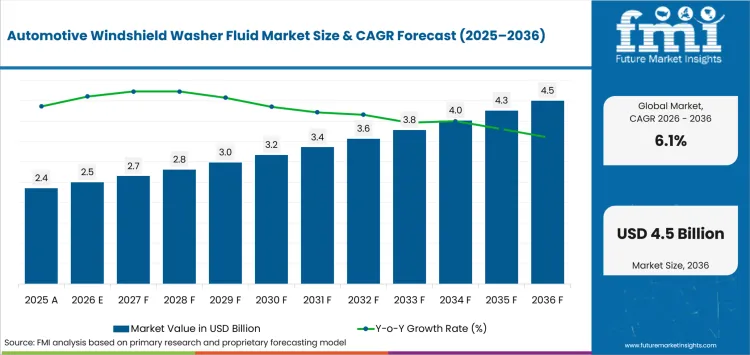
Key Takeaways of Automotive Windshield Washer Fluid Market
- Recurring visibility maintenance supports washer-fluid demand across vehicles regardless of powertrain, with climate exposure and refill workflow determining the formulation purchased.
- General Purpose is projected at 47.0% share in 2026 because routine cleaning covers a broad range of refill occasions.
- Ready-to-use is estimated at 68.0% of form demand in 2026 because it removes dilution decisions at the point of refill.
- Passenger Cars are forecast at 69.0% by vehicle type in 2026 because private-car ownership creates frequent consumer and service-channel top-ups.
- Methanol restrictions in the European Union and the need for dependable freeze-point claims narrow formulation choices across markets.
- Highline Warren LLC, Recochem Inc., Prestone Products Corporation, SONAX GmbH, Würth Group, SPLASH Products Inc., Tetrosyl Group Limited, Camco Manufacturing, LLC, James Austin Company and ITW Global Brands are profiled across branded car-care, automotive-fluid, workshop, aftermarket or historically documented positions.
Analyst Perspective
"Washer-fluid demand follows installed vehicle use, climate exposure and refill convenience. Suppliers should match freeze-point claims and pack format to each channel, then use concentrates or bulk formats where dilution can be controlled consistently."
- Nikhil Kaitwade, Principal Consultant, Future Market Insights
How is the Automotive Windshield Washer Fluid Market segmented?
The automotive windshield washer fluid market is segmented by product type, form, vehicle type, sales channel, climate grade and region.
Product Type separates general-purpose fluid from de-icing, bug-removing and specialty formulations. Form distinguishes ready-to-use liquid from concentrate. Vehicle Type covers passenger cars, LCVs, HCVs and other vehicles. Sales Channel captures retail, service, dealer, e-commerce and fleet procurement. Climate Grade separates all-season products from winter and summer-focused formulations.
Why does All-season lead the climate grade category?
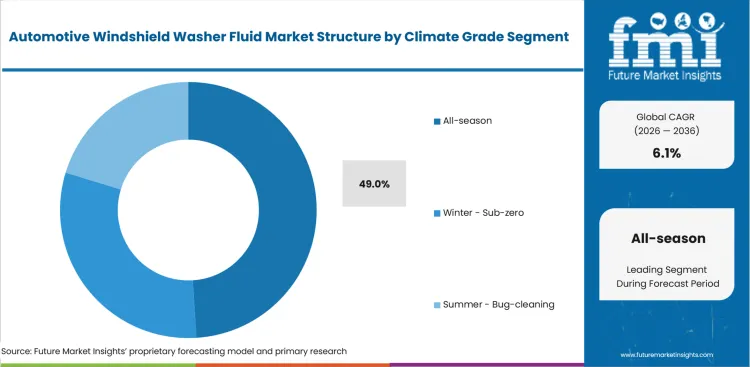
All-season formulations reduce the need to switch products whenever conditions move between ordinary rain, road film and moderate cold. Winter grades remain necessary where freeze protection becomes a primary requirement, while summer and bug-cleaning grades target warm-weather contamination. Buyers still need to check stated temperature protection because all-season products are not interchangeable with sub-zero formulations.
- All-season is projected to account for 49.0% of climate grade demand in 2026 because broad usability reduces seasonal product changes in moderate conditions.
- SPLASH offers washer fluids across multiple temperature ratings, while SONAX separates summer concentrates from antifreeze windscreen products for winter use.
Why does General Purpose lead the product type category?
General Purpose fluid addresses the routine task of clearing road film and restoring visibility between vehicle washes. It does not require the buyer to anticipate severe frost or a narrow seasonal contamination problem, which supports year-round shelf presence and repeat replenishment. Specialty formulations remain relevant where sub-zero protection, insect removal or water-repellent performance changes the purchase requirement.
- Based on product type, General Purpose is projected to account for 47.0% in 2026 because its cleaning function applies across routine refill occasions.
- Rain-X maintains separate all-season, bug-remover and de-icer washer-fluid products, showing how general cleaning can sit beside climate-specific or contamination-specific variants.
Why does Ready-to-use lead the form category?
Ready-to-use fluid removes dilution from the refill process. Consumers and service staff can pour the product directly into the reservoir without calculating a mix ratio or checking whether added water changes freeze protection. Concentrates can reduce storage and transported water for professional users, but their economics depend on accurate mixing and controlled handling.
- In 2026, Ready-to-use is expected to account for 68.0% of form demand because direct filling reduces handling steps at retail and service locations.
- Würth UK documents both pour-and-go screenwash products and high-strength concentrates, while its 2025 pack strategy extends into larger professional formats.
Why do Passenger Cars lead the vehicle type category?
Passenger cars create a dispersed base of individually operated washer systems across retail, dealer and workshop channels. Owners refill during routine maintenance or when a low-fluid condition becomes visible, while workshops can include top-ups within scheduled service. Commercial vehicles also create repeat use, but their purchasing is more concentrated in fleet and workshop procurement.
- Passenger Cars are projected to account for 69.0% of vehicle type demand in 2026 because private-car use creates frequent reservoir replenishment across several channels.
- The UK Department for Transport reported 42.3 million licensed vehicles at the end of 2025, illustrating the scale of recurring maintenance demand in one mature vehicle market.
Why do Retail Stores lead the sales channel category?
Washer fluid is a low-complexity maintenance product that drivers can purchase and add without specialist equipment. Retail stores can therefore serve an immediate refill need during an ordinary shopping trip and can adjust shelf mix by season. Workshops, dealers and fleet channels remain important where fluid is added during service or purchased in larger packs.
- Retail Stores are projected to account for 35.0% of sales channel demand in 2026 because self-service replenishment fits automotive retail and mass-market purchasing behavior.
- Highline Warren announced a planned $170 million logistics and operations center in McDonough, Georgia in July 2026, reinforcing the role of distribution depth across aftermarket channels.
What are the drivers, restraints and opportunities in the Automotive Windshield Washer Fluid Market?
Recurring vehicle maintenance supports demand while formulation requirements add compliance work and professional concentrate formats create a route to lower transport and storage cost.
- Driver: A large active vehicle parc creates repeat reservoir refills across consumer, workshop and fleet use.
- Restraint: Chemical restrictions and freeze-point requirements limit formulation choices and increase labeling or handling discipline.
- Opportunity: Concentrates and bulk dispensing can reduce packaging and transported water where professional users can control dilution.
The core demand driver is repeated visibility maintenance across vehicles already in operation. Washer fluid is consumed during use and must be replaced, so road spray, insects and service visits create recurring purchase occasions. The USA Federal Highway Administration reported 297,525,836 registered motor vehicles for 2024. That installed base does not define global market size, but it shows why mature markets can sustain repeat washer-fluid demand across conventional, hybrid and battery-electric vehicles.
The restraint lies in formulation compliance and temperature performance. Commission Regulation (EU) 2018/589 restricts windscreen washing or defrosting fluids placed on the market to the general public when methanol is present at 0.6% by weight or more. Suppliers therefore need region-specific chemistry, clear temperature claims and handling instructions rather than assuming one formulation can move unchanged across major markets.
The opportunity is more visible in workshops and fleets that consume predictable volumes. Concentrates move less water and can lower storage requirements per usable fill, while drums or bulk formats reduce small-container handling. SPLASH markets windshield-wash concentrate in 16-ounce and 55-gallon formats, and Würth UK's professional range extends to 25-liter and 205-liter containers for workshop and fleet users. The commercial benefit depends on accurate dilution and controlled storage.
Which country CAGRs are profiled in the Automotive Windshield Washer Fluid Market?
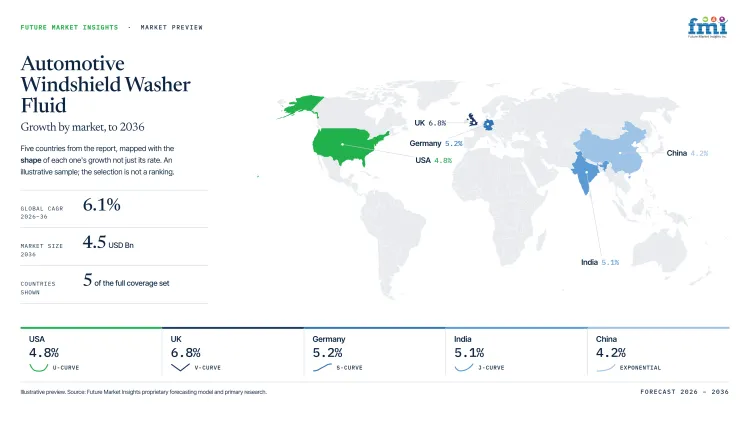
| Country | CAGR |
|---|---|
| Brazil | 8.0% |
| UK | 6.8% |
| Germany | 5.2% |
| India | 5.1% |
| Japan | 4.9% |
| USA | 4.8% |
| China | 4.2% |
How do country-level CAGRs compare in the Automotive Windshield Washer Fluid Market?
The seven country CAGRs span 3.8 percentage points between 2026 and 2036. The spacing reflects different vehicle-stock conditions, channel development, climate exposure and formulation requirements rather than current revenue size. Commercial entry therefore depends on how each country converts recurring reservoir use into purpose-formulated washer-fluid purchases.
- Brazil combines a broad vehicle base with warm-weather cleaning demand, while colder southern areas require a more selective seasonal assortment.
- The UK combines mature vehicle ownership with dense workshop and retail routes, creating separate use cases for ready-to-use packs and professional concentrates.
- Germany places greater weight on winter performance and chemical compliance, so formulation discipline shapes supplier access alongside aftermarket reach.
- India offers a large installed vehicle base, but value sensitivity and informal refill practices can slow conversion toward purpose-formulated washer fluid.
- Japan depends on dependable compatibility and precise labeling across a mature vehicle parc with different regional climate requirements.
- The USA requires broad retail coverage and climate-specific assortment because warm-weather, bug-removing and sub-zero needs vary widely by region.
- China combines a large vehicle population with wide geographic variation, making local distribution and climate-grade planning central to execution.
Comparable CAGRs can lead to different market entry conditions. The full report provides country-level analysis across North America, Latin America, Western Europe, Eastern Europe, East Asia, South Asia and Pacific, and the Middle East and Africa.
Country-wise Analysis
- Brazilian washer-fluid demand is projected to expand at 8.0% CAGR from 2026 to 2036 as aftermarket distribution develops around a large vehicle population. SENATRAN recorded about 129.1 million vehicles in December 2025, with automobiles accounting for about 64.6 million. Much of the country favors general-purpose and warm-weather cleaning, while southern areas create selective demand for lower-temperature protection. Suppliers need broad channel availability without carrying an unnecessarily complex climate-grade mix across every state.
- United Kingdom demand is projected to advance at 6.8% CAGR from 2026 to 2036 across a mature fleet and established service network. The Department for Transport reported 42.3 million licensed vehicles at the end of 2025. Consumer top-ups favor ready-to-use packs, while workshops can evaluate concentrate on cost per service fill. Suppliers therefore need channel-specific pack sizes with clear dilution and winter-performance guidance.
- German demand is projected to expand at 5.2% CAGR from 2026 to 2036 as recurring service needs combine with cold-weather formulation requirements. Kraftfahrt-Bundesamt reported about 61.1 million registered motor vehicles on January 1, 2025. EU methanol restrictions raise the importance of compliant alcohol systems and credible freeze-point claims. Workshop and retail formats must meet the same visibility function through different handling practices.
- Indian demand is projected to rise at 5.1% CAGR from 2026 to 2036 as vehicle ownership expands and formal maintenance channels broaden. India’s Ministry of Heavy Industries cited the e-Vahan portal in February 2025 and reported 3,897.71 lakh registered vehicles. Conversion depends on convincing buyers to use purpose-formulated fluid instead of low-cost substitutes. Affordable general-purpose products with simple dilution guidance can support adoption beyond premium automotive outlets.
- Japanese demand is projected to expand at 4.9% CAGR from 2026 to 2036, with recurring refill needs tied to a mature installed vehicle base. The Automobile Inspection & Registration Information Association reported about 82.9 million vehicles at the end of April 2026. Suppliers need dependable washer-system compatibility and climate-grade choices that account for colder northern operation without over-specifying products for milder areas.
- USA demand is projected to expand at 4.8% CAGR from 2026 to 2036 across do-it-yourself retail, professional service and fleet channels. The Federal Highway Administration reported 297,525,836 registered motor vehicles for 2024. The operating challenge is regional variation because a warm-state general-purpose product does not meet the same winter requirement as a sub-zero formulation. Distribution depth and accurate temperature claims determine whether assortment fits local use.
- Chinese demand is projected to expand at 4.2% CAGR from 2026 to 2036 across a large and geographically varied vehicle base. The National Bureau of Statistics reported 366.11 million civilian motor vehicles at the end of 2025. Suppliers need distribution that can serve different winter severities while avoiding excessive SKU complexity. Localized climate-grade planning and dependable availability are central to recurring aftermarket purchase.
Who are the notable companies in the Automotive Windshield Washer Fluid Market?
Highline Warren LLC, Recochem Inc., Prestone Products Corporation, SONAX GmbH, Würth Group, SPLASH Products Inc., Tetrosyl Group Limited, Camco Manufacturing, LLC, James Austin Company and ITW Global Brands are the companies and brands profiled in the automotive windshield washer fluid competitive set.
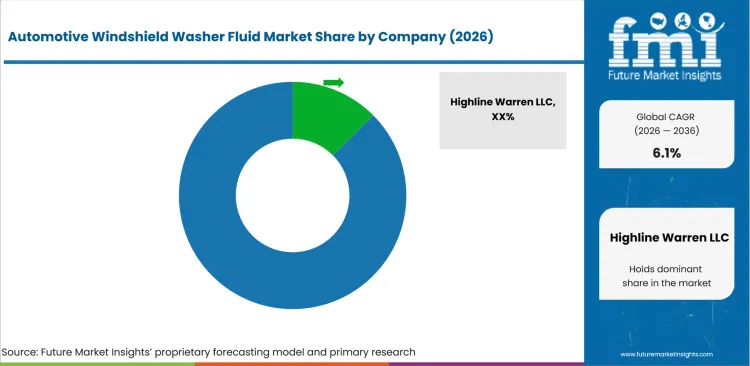
Competition spans automotive-fluid manufacturers, branded car-care companies and professional workshop suppliers. Market position depends on climate-grade range, ready-to-use versus concentrate coverage and access to the channel where the reservoir is replenished. Public evidence is stronger for some companies than others, so capability claims should follow documented products and transactions rather than inferred corporate scale.
- Highline Warren LLC, Recochem Inc. and Prestone Products Corporation combine automotive-fluid manufacturing with aftermarket distribution and branded product portfolios.
- SONAX GmbH, Würth Group, Tetrosyl Group Limited and ITW Global Brands serve washer-fluid demand through car-care or professional maintenance channels.
- SPLASH Products Inc., Camco Manufacturing, LLC and James Austin Company represent regional, specialty or historically documented automotive-chemical positions with different levels of current public washer-fluid detail.
Competitive Benchmarking: Automotive Windshield Washer Fluid Market
| Company | Climate-Grade Breadth | RTU / Concentrate Flexibility | Fleet / Workshop Supply | Geographic Reach |
|---|---|---|---|---|
| Highline Warren LLC | Medium | Medium | High | North America; integrated USA production and distribution |
| Recochem Inc. | High | High | High | North America, Europe, Australia and Asia-Pacific |
| Prestone Products Corporation | High | Medium | Medium | North America with international markets through Recochem |
| SONAX GmbH | High | High | Medium | Europe with international car-care distribution |
| Würth Group | High | High | High | Europe, UK, USA and wider professional trade channels |
| SPLASH Products Inc. | High | High | High | Primarily North America with retail and fleet-oriented formats |
| Tetrosyl Group Limited | Medium | Unscored | Medium | UK and European base with wider export activity |
| Camco Manufacturing, LLC | Unscored | Unscored | Unscored | Current washer-fluid reach is less visible after the Liquids division sale |
| James Austin Company | Unscored | Unscored | Unscored | Current market-specific reach is not sufficiently documented publicly |
| ITW Global Brands | High | High | Medium | USA retail base with international branded car-care presence |
Key Developments in the Automotive Windshield Washer Fluid Market
- In July 2026, Highline Warren LLC announced a $170 million investment in a new 1.1 million-square-foot logistics and operations center in McDonough, Georgia. The facility is expected to begin operations in late 2026 and strengthen East Coast logistics, which can support seasonal inventory placement across automotive maintenance products.
- In January 2025, Würth UK detailed a screenwash pack strategy covering service bottles and 5-liter containers, with 25-liter drums and 200-liter barrels planned during 2025. The format range creates separate purchasing routes for vehicle servicing, small fleets and larger professional users.
- In June 2024, Recochem acquired KIK Consumer Products’ Auto Care business, including Prestone in North America and Holts in the UK. The transaction brought additional automotive-fluid brands into Recochem and expanded its ability to serve branded, private-label and professional aftermarket demand.
Key Players in the Automotive Windshield Washer Fluid Market
Automotive-Fluid Manufacturing and Distribution Platforms
- Highline Warren LLC
- Recochem Inc.
- Prestone Products Corporation
Branded Car-Care and Professional-Channel Suppliers
- SONAX GmbH
- Würth Group
- Tetrosyl Group Limited
- ITW Global Brands
Regional and Specialty Suppliers
- SPLASH Products Inc.
- Camco Manufacturing, LLC
- James Austin Company
Automotive Windshield Washer Fluid Market - Report Scope
| Coverage field | Report scope |
|---|---|
| Market breakdown | By product type, form, vehicle type, sales channel, climate grade and region. |
| Quantitative Units | Revenue in USD billion and CAGR in %. |
| Market Definition | Automotive windshield washer fluid sold as ready-to-use liquid or concentrate within the stated product, form, vehicle, channel and climate-grade universe. Wiper blades, washer hardware, raw solvents, engine coolant, direct-to-glass cleaners not intended for washer reservoirs and downstream vehicle or service revenue are excluded. |
| Regions Covered | North America, Latin America, Western Europe, Eastern Europe, East Asia, South Asia and Pacific, and Middle East and Africa. |
| Countries Covered | Brazil, UK, Germany, India, Japan, USA, China and 25+ countries included in the full report. |
| Key Companies Profiled | Highline Warren LLC, Recochem Inc., Prestone Products Corporation, SONAX GmbH, Würth Group, SPLASH Products Inc., Tetrosyl Group Limited, Camco Manufacturing, LLC, James Austin Company and ITW Global Brands. |
| Forecast Period | 2026 to 2036. |
| Approach | Primary and secondary research with market triangulation. |
Automotive Windshield Washer Fluid Market - Research Methodology
| Method | Approach |
|---|---|
| Primary Research | FMI analysts gathered input from manufacturers, distributors, retailers, workshop operators, fleet procurement teams and subject-matter specialists. Interviews examined purchase triggers, channel economics, formulation requirements, packaging choices, approval needs and barriers to regular replenishment. |
| Desk Research | Desk research covered official vehicle-registration statistics, chemical regulations, company announcements, product documentation, industry standards and public corporate material. Sources were reviewed for relevance, publication date, geographic coverage and consistency with the defined market boundary. |
| Market Sizing and Forecasting | The market model combined the baseline value with vehicle-stock indicators, segment structure, pricing and volume signals, channel activity and country-level operating conditions. Forecast assumptions considered recurring refill demand, formulation compliance, climate exposure, distribution development and mix shifts between ready-to-use and concentrate. |
| Data Validation | Estimates were checked against independent indicators including public statistics, company activity and primary-research findings. Validation excluded unsupported claims, duplicate revenue, factory or service value outside the fluid sale and substitute products that do not belong in the washer reservoir market. |
Automotive Windshield Washer Fluid Market by Segments
Automotive Windshield Washer Fluid Market segmented by Product Type:
- General Purpose
- De-icing / Antifreeze
- Bug-removing
- Water-repellent / Specialty
Automotive Windshield Washer Fluid Market segmented by Form:
- Ready-to-use
- Concentrate
Automotive Windshield Washer Fluid Market segmented by Vehicle Type:
- Passenger Cars
- LCVs
- HCVs
- Other Vehicles
Automotive Windshield Washer Fluid Market segmented by Sales Channel:
- Retail Stores
- Service Stations / Workshops
- OEM / Dealer
- E-commerce
- Fleet / Institutional
Automotive Windshield Washer Fluid Market segmented by Climate Grade:
- All-season
- Winter / Sub-zero
- Summer / Bug-cleaning
Automotive Windshield Washer Fluid Market by Region:
- North America
- United States
- Canada
- Latin America
- Brazil
- Mexico
- Argentina
- Chile
- Western Europe
- Germany
- France
- United Kingdom
- Italy
- Spain
- Benelux
- Nordics
- Eastern Europe
- Poland
- Czech Republic
- Romania
- Hungary
- East Asia
- China
- Japan
- South Korea
- South Asia and Pacific
- India
- ASEAN
- Australia and New Zealand
- Middle East and Africa
- GCC Countries
- South Africa
- Türkiye
- Israel
Research Sources and Bibliography
- Federal Highway Administration. (2026, February 23). Table MV-1 - Highway Statistics 2024.
- National Bureau of Statistics of China. (2026, February 28). Statistical Communiqué of the People’s Republic of China on the 2025 National Economic and Social Development.
- Press Information Bureau, Government of India. (2025, February 11). Electrical Vehicles in Rural and Semi-Urban Areas.
- Kraftfahrt-Bundesamt. (2025, March 4). Der Fahrzeugbestand am 1. Januar 2025.
- UK Department for Transport. (2026, April 29). Vehicle licensing statistics, United Kingdom: 2025.
- Automobile Inspection & Registration Information Association. (2026, July 10). Automobile ownership at the end of April 2026.
- Ministry of Transport of Brazil / SENATRAN. (2026, March 30). Fleet by State and Vehicle Type - December 2025.
- European Commission. (2018, April 18). Commission Regulation (EU) 2018/589 as regards methanol.
- Highline Warren LLC. (2026, July 14). Highline Warren Announces Planned Acquisition of a New Distribution Hub.
- KIK Consumer Products. (2024, June 18). Recochem Acquires Auto Care Business from KIK Consumer Products.
- Highline Aftermarket. (2019, November 11). Highline Aftermarket Announces Acquisition of Camco’s Liquids Division, Expanding Manufacturing Capabilities.
- Würth UK Ltd. (2026; accessed August 12, 2026). Screenwash product range — 5 L, 25 L and 205 L formats.
- Rain-X / ITW Global Brands. (2026). Windshield Washer Fluid product range.
- SPLASH Products Inc. (2026; accessed August 12, 2026). Windshield Wash product range.
- SONAX GmbH. (2026; accessed August 12, 2026). Windscreen Wash ready-to-use, concentrate and antifreeze product range.
This bibliography is provided for reader reference and is not exhaustive. The full report contains the complete reference list and detailed citations
This Report Answers
- What does the Automotive Windshield Washer Fluid Market cover across product, form and channel decisions?
- Which vehicle-maintenance conditions support recurring washer-fluid demand?
- How do general-purpose and climate-specific formulations shape purchase decisions?
- How does ready-to-use versus concentrate affect refill workflow and logistics?
- Which formulation and handling constraints influence commercial adoption?
- How do country growth conditions affect market entry and assortment planning?
- Which companies serve consumer, workshop and fleet replenishment routes?
- What should procurement teams evaluate before selecting washer-fluid products?
Frequently Asked Questions
How big is the Automotive Windshield Washer Fluid Market in 2026?
USD 2.5 billion represents the automotive windshield washer fluid market value in 2026 across ready-to-use and concentrate formats sold through consumer and professional channels. Recurring refill demand and climate-specific formulations support expansion toward USD 4.5 billion by 2036.
What is the CAGR of the Automotive Windshield Washer Fluid Market from 2026 to 2036?
A 6.1% CAGR is projected for the automotive windshield washer fluid market between 2026 and 2036. Vehicle-stock maintenance supports repeat purchasing, while formulation rules, climate-grade demand and channel economics influence how suppliers convert that recurring need into revenue.
Which product type segment is projected to account for 47.0% of the Automotive Windshield Washer Fluid Market?
General Purpose is projected to account for 47.0% of product type demand in 2026. Routine road-film cleaning creates a broad use case, while de-icing, bug-removing and specialty products address narrower seasonal or performance requirements.
How much will the Automotive Windshield Washer Fluid Market add between 2026 and 2036?
USD 2.0 billion is expected to be added to the automotive windshield washer fluid market between 2026 and 2036. The increase depends on recurring replenishment across active vehicles, broader formal aftermarket access and product mixes suited to local climate conditions.
Which companies are profiled in the Automotive Windshield Washer Fluid Market?
The report profiles Highline Warren LLC, Recochem Inc., Prestone Products Corporation, SONAX GmbH, Würth Group, SPLASH Products Inc., Tetrosyl Group Limited, Camco Manufacturing, LLC, James Austin Company and ITW Global Brands. Their documented roles span current automotive-fluid manufacturing and branded car-care channels as well as historically documented washer-fluid capabilities.
Preview the report firsthand - request a free sample
Get SampleGet the brochure for pricing and purchase details.
Get PDFTable of Content
- Key Takeaways
- Market Size and CAGR
- Top Growth Driver
- Fastest Growing Segment
- Leading Region
- Key Companies
- Emerging Opportunities
- Executive Summary
- Global Market Outlook
- Demand-side Trends
- Supply-side Trends
- Technology Roadmap Analysis
- Analysis and Recommendations
- Analyst Perspective (What is happening? Why now? What should investors know?)
- Key Questions Answered
- How large is the market?
- What is the CAGR?
- What are key trends?
- Which region dominates?
- Who are the leaders?
- Market Overview
- Market Coverage / Taxonomy
- Market Definition / Scope / Limitations
- Research Methodology
- Chapter Orientation
- Analytical Lens and Working Hypotheses
- Market Structure, Signals, and Trend Drivers
- Benchmarking and Cross-market Comparability
- Market Sizing, Forecasting, and Opportunity Mapping
- Research Design and Evidence Framework
- Desk Research Programme (Secondary Evidence)
- Expert Input and Fieldwork (Primary Evidence)
- Tooling, Models, and Reference Databases
- Data Engineering and Model Build
- Quality Assurance and Audit Trail
- Market Background
- Market Dynamics (Drivers, Restraints, Opportunity, Trends)
- Scenario Forecast (Optimistic, Likely, Conservative)
- Impact Analysis
- AI Impact
- Sustainability Impact
- Regulatory Impact
- Technology Impact
- Consumer / Buyer Analysis
- Purchase Drivers
- Adoption Barriers
- Buyer Journey
- Opportunity Map Analysis
- Product Life Cycle Analysis
- Supply Chain Analysis
- Investment Feasibility Matrix
- Value Chain Analysis
- PESTLE and Porter's Analysis
- Regulatory Landscape
- Regional Parent Market Outlook
- Production and Consumption Statistics
- Import and Export Statistics
- Global Market Analysis and Forecast, 2021 to 2036
- Historical Market Size Value (USD Billion) Analysis, 2021 to 2025
- Current and Future Market Size Value (USD Billion) Projections, 2026 to 2036
- Y-o-Y Growth Trend Analysis
- Absolute $ Opportunity Analysis
- Global Market Pricing Analysis, 2021 to 2036
- Global Market Analysis and Forecast, By Product Type, 2021 to 2036
- Introduction / Key Findings
- Historical Market Size Value (USD Billion) Analysis By Product Type, 2021 to 2025
- Current and Future Market Size Value (USD Billion) Analysis and Forecast By Product Type, 2026 to 2036
- General Purpose
- De-icing - Antifreeze
- Bug-removing
- Water-repellent - Specialty
- General Purpose
- Y-o-Y Growth Trend Analysis By Product Type, 2021 to 2025
- Absolute $ Opportunity Analysis By Product Type, 2026 to 2036
- Global Market Analysis and Forecast, By Form, 2021 to 2036
- Introduction / Key Findings
- Historical Market Size Value (USD Billion) Analysis By Form, 2021 to 2025
- Current and Future Market Size Value (USD Billion) Analysis and Forecast By Form, 2026 to 2036
- Ready-to-use
- Concentrate
- Ready-to-use
- Y-o-Y Growth Trend Analysis By Form, 2021 to 2025
- Absolute $ Opportunity Analysis By Form, 2026 to 2036
- Global Market Analysis and Forecast, By Vehicle Type, 2021 to 2036
- Introduction / Key Findings
- Historical Market Size Value (USD Billion) Analysis By Vehicle Type, 2021 to 2025
- Current and Future Market Size Value (USD Billion) Analysis and Forecast By Vehicle Type, 2026 to 2036
- Passenger Cars
- LCVs
- HCVs
- Other Vehicles
- Passenger Cars
- Y-o-Y Growth Trend Analysis By Vehicle Type, 2021 to 2025
- Absolute $ Opportunity Analysis By Vehicle Type, 2026 to 2036
- Global Market Analysis and Forecast, By Sales Channel, 2021 to 2036
- Introduction / Key Findings
- Historical Market Size Value (USD Billion) Analysis By Sales Channel, 2021 to 2025
- Current and Future Market Size Value (USD Billion) Analysis and Forecast By Sales Channel, 2026 to 2036
- Retail Stores
- Service Stations - Workshops
- OEM - Dealer
- E-commerce
- Fleet - Institutional
- Retail Stores
- Y-o-Y Growth Trend Analysis By Sales Channel, 2021 to 2025
- Absolute $ Opportunity Analysis By Sales Channel, 2026 to 2036
- Global Market Analysis and Forecast, By Climate Grade, 2021 to 2036
- Introduction / Key Findings
- Historical Market Size Value (USD Billion) Analysis By Climate Grade, 2021 to 2025
- Current and Future Market Size Value (USD Billion) Analysis and Forecast By Climate Grade, 2026 to 2036
- All-season
- Winter - Sub-zero
- Summer - Bug-cleaning
- All-season
- Y-o-Y Growth Trend Analysis By Climate Grade, 2021 to 2025
- Absolute $ Opportunity Analysis By Climate Grade, 2026 to 2036
- Global Market Analysis and Forecast, By Region, 2021 to 2036
- Introduction
- Historical Market Size Value (USD Billion) Analysis By Region, 2021 to 2025
- Current Market Size Value (USD Billion) Analysis and Forecast By Region, 2026 to 2036
- North America
- Latin America
- Western Europe
- Eastern Europe
- East Asia
- South Asia and Pacific
- Middle East & Africa
- Market Attractiveness Analysis By Region
- North America Market Analysis and Forecast, By Country, 2021 to 2036
- Historical Market Size Value (USD Billion) Trend Analysis By Market Taxonomy, 2021 to 2025
- Market Size Value (USD Billion) Forecast By Market Taxonomy, 2026 to 2036
- By Country
- USA
- Canada
- By Product Type
- By Form
- By Vehicle Type
- By Sales Channel
- By Climate Grade
- By Country
- Market Attractiveness Analysis
- By Country
- By Product Type
- By Form
- By Vehicle Type
- By Sales Channel
- By Climate Grade
- Key Takeaways
- Latin America Market Analysis and Forecast, By Country
- Historical Market Size Value (USD Billion) Trend Analysis By Market Taxonomy, 2021 to 2025
- Market Size Value (USD Billion) Forecast By Market Taxonomy, 2026 to 2036
- By Country
- Brazil
- Mexico
- Chile
- Rest of Latin America
- By Product Type
- By Form
- By Vehicle Type
- By Sales Channel
- By Climate Grade
- By Country
- Market Attractiveness Analysis
- By Country
- By Product Type
- By Form
- By Vehicle Type
- By Sales Channel
- By Climate Grade
- Key Takeaways
- Western Europe Market Analysis and Forecast, By Country
- Historical Market Size Value (USD Billion) Trend Analysis By Market Taxonomy, 2021 to 2025
- Market Size Value (USD Billion) Forecast By Market Taxonomy, 2026 to 2036
- By Country
- Germany
- UK
- Italy
- Spain
- France
- Nordic
- BENELUX
- Rest of Western Europe
- By Product Type
- By Form
- By Vehicle Type
- By Sales Channel
- By Climate Grade
- By Country
- Market Attractiveness Analysis
- By Country
- By Product Type
- By Form
- By Vehicle Type
- By Sales Channel
- By Climate Grade
- Key Takeaways
- Eastern Europe Market Analysis and Forecast, By Country
- Historical Market Size Value (USD Billion) Trend Analysis By Market Taxonomy, 2021 to 2025
- Market Size Value (USD Billion) Forecast By Market Taxonomy, 2026 to 2036
- By Country
- Russia
- Poland
- Hungary
- Balkan & Baltic
- Rest of Eastern Europe
- By Product Type
- By Form
- By Vehicle Type
- By Sales Channel
- By Climate Grade
- By Country
- Market Attractiveness Analysis
- By Country
- By Product Type
- By Form
- By Vehicle Type
- By Sales Channel
- By Climate Grade
- Key Takeaways
- East Asia Market Analysis and Forecast, By Country
- Historical Market Size Value (USD Billion) Trend Analysis By Market Taxonomy, 2021 to 2025
- Market Size Value (USD Billion) Forecast By Market Taxonomy, 2026 to 2036
- By Country
- China
- Japan
- South Korea
- By Product Type
- By Form
- By Vehicle Type
- By Sales Channel
- By Climate Grade
- By Country
- Market Attractiveness Analysis
- By Country
- By Product Type
- By Form
- By Vehicle Type
- By Sales Channel
- By Climate Grade
- Key Takeaways
- South Asia and Pacific Market Analysis and Forecast, By Country
- Historical Market Size Value (USD Billion) Trend Analysis By Market Taxonomy, 2021 to 2025
- Market Size Value (USD Billion) Forecast By Market Taxonomy, 2026 to 2036
- By Country
- India
- ASEAN
- Australia & New Zealand
- Rest of South Asia and Pacific
- By Product Type
- By Form
- By Vehicle Type
- By Sales Channel
- By Climate Grade
- By Country
- Market Attractiveness Analysis
- By Country
- By Product Type
- By Form
- By Vehicle Type
- By Sales Channel
- By Climate Grade
- Key Takeaways
- Middle East & Africa Market Analysis and Forecast, By Country
- Historical Market Size Value (USD Billion) Trend Analysis By Market Taxonomy, 2021 to 2025
- Market Size Value (USD Billion) Forecast By Market Taxonomy, 2026 to 2036
- By Country
- Kingdom of Saudi Arabia
- Other GCC Countries
- Türkiye
- South Africa
- Other African Union
- Rest of Middle East & Africa
- By Product Type
- By Form
- By Vehicle Type
- By Sales Channel
- By Climate Grade
- By Country
- Market Attractiveness Analysis
- By Country
- By Product Type
- By Form
- By Vehicle Type
- By Sales Channel
- By Climate Grade
- Key Takeaways
- Key Countries Market Analysis
- USA
- Pricing Analysis
- Market Share Analysis, 2025
- By Product Type
- By Form
- By Vehicle Type
- By Sales Channel
- By Climate Grade
- Canada
- Pricing Analysis
- Market Share Analysis, 2025
- By Product Type
- By Form
- By Vehicle Type
- By Sales Channel
- By Climate Grade
- Mexico
- Pricing Analysis
- Market Share Analysis, 2025
- By Product Type
- By Form
- By Vehicle Type
- By Sales Channel
- By Climate Grade
- Brazil
- Pricing Analysis
- Market Share Analysis, 2025
- By Product Type
- By Form
- By Vehicle Type
- By Sales Channel
- By Climate Grade
- Chile
- Pricing Analysis
- Market Share Analysis, 2025
- By Product Type
- By Form
- By Vehicle Type
- By Sales Channel
- By Climate Grade
- Germany
- Pricing Analysis
- Market Share Analysis, 2025
- By Product Type
- By Form
- By Vehicle Type
- By Sales Channel
- By Climate Grade
- UK
- Pricing Analysis
- Market Share Analysis, 2025
- By Product Type
- By Form
- By Vehicle Type
- By Sales Channel
- By Climate Grade
- Italy
- Pricing Analysis
- Market Share Analysis, 2025
- By Product Type
- By Form
- By Vehicle Type
- By Sales Channel
- By Climate Grade
- Spain
- Pricing Analysis
- Market Share Analysis, 2025
- By Product Type
- By Form
- By Vehicle Type
- By Sales Channel
- By Climate Grade
- France
- Pricing Analysis
- Market Share Analysis, 2025
- By Product Type
- By Form
- By Vehicle Type
- By Sales Channel
- By Climate Grade
- India
- Pricing Analysis
- Market Share Analysis, 2025
- By Product Type
- By Form
- By Vehicle Type
- By Sales Channel
- By Climate Grade
- ASEAN
- Pricing Analysis
- Market Share Analysis, 2025
- By Product Type
- By Form
- By Vehicle Type
- By Sales Channel
- By Climate Grade
- Australia & New Zealand
- Pricing Analysis
- Market Share Analysis, 2025
- By Product Type
- By Form
- By Vehicle Type
- By Sales Channel
- By Climate Grade
- China
- Pricing Analysis
- Market Share Analysis, 2025
- By Product Type
- By Form
- By Vehicle Type
- By Sales Channel
- By Climate Grade
- Japan
- Pricing Analysis
- Market Share Analysis, 2025
- By Product Type
- By Form
- By Vehicle Type
- By Sales Channel
- By Climate Grade
- South Korea
- Pricing Analysis
- Market Share Analysis, 2025
- By Product Type
- By Form
- By Vehicle Type
- By Sales Channel
- By Climate Grade
- Russia
- Pricing Analysis
- Market Share Analysis, 2025
- By Product Type
- By Form
- By Vehicle Type
- By Sales Channel
- By Climate Grade
- Poland
- Pricing Analysis
- Market Share Analysis, 2025
- By Product Type
- By Form
- By Vehicle Type
- By Sales Channel
- By Climate Grade
- Hungary
- Pricing Analysis
- Market Share Analysis, 2025
- By Product Type
- By Form
- By Vehicle Type
- By Sales Channel
- By Climate Grade
- Kingdom of Saudi Arabia
- Pricing Analysis
- Market Share Analysis, 2025
- By Product Type
- By Form
- By Vehicle Type
- By Sales Channel
- By Climate Grade
- Türkiye
- Pricing Analysis
- Market Share Analysis, 2025
- By Product Type
- By Form
- By Vehicle Type
- By Sales Channel
- By Climate Grade
- South Africa
- Pricing Analysis
- Market Share Analysis, 2025
- By Product Type
- By Form
- By Vehicle Type
- By Sales Channel
- By Climate Grade
- USA
- Market Structure Analysis
- Competition Dashboard
- Competition Benchmarking
- Market Share Analysis of Top Players
- By Regional
- By Product Type
- By Form
- By Vehicle Type
- By Sales Channel
- By Climate Grade
- Emerging Startups
- Innovation Benchmarking
- Competition Analysis
- Competition Deep Dive
- Highline Warren LLC
- Overview
- Product Portfolio
- Profitability by Market Segments
- Sales Footprint
- Strategy Overview
- Marketing Strategy
- Product Strategy
- Channel Strategy
- Recochem Inc.
- Prestone Products Corporation
- SONAX GmbH
- Würth Group
- SPLASH Products Inc.
- Tetrosyl Group Limited
- Camco Manufacturing, LLC
- James Austin Company
- ITW Global Brands
- Highline Warren LLC
- Case Studies
- Success Stories
- Recent Developments
- Competition Deep Dive
- Assumptions & Acronyms Used


