

- Market Size (2026)
- USD 772.4 Mn
- Forecast (2036)
- USD 2213.0 Mn
- CAGR (2026 to 2036)
- 11.1%
How big is Babka Market in 2026?
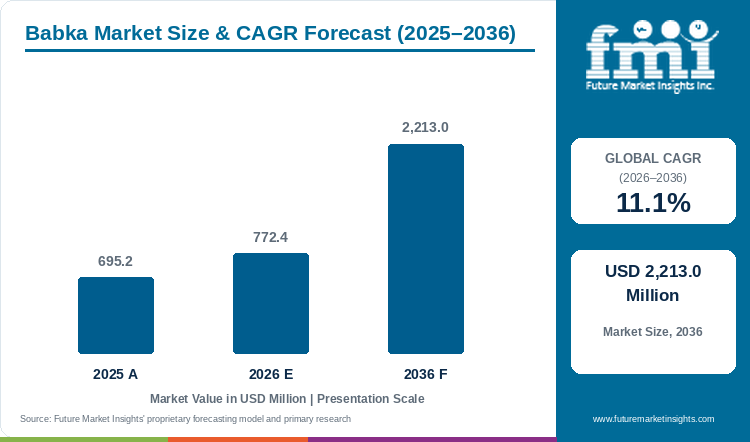
The babka market demonstrated steady progress from USD 695.2 million in 2025 to USD 772.4 million in 2026, building toward a targeted valuation of USD 2,213.0 million by 2036 at a CAGR of 11.1%.
Supermarket perimeter bakeries and specialty coffee chains are increasing their orders for factory-braided babka loaves and pre-sliced packs because store-level baker shortages make daily hand twisting too costly to sustain. Global babka demand reached USD 695.2 million in 2025 and is estimated at USD 772.4 million in 2026 before climbing to USD 2,213.0 million by 2036 at an 11.1% CAGR. Individually wrapped slices and thaw-and-serve cases are turning weekend loaves into weekday coffee-break purchases. Within the product type segment, classic / original is projected to hold a 33.0% share in 2026 and help the category expand faster than par-baked bread at a 6.4% CAGR as shoppers pick up chocolate and cinnamon swirls as an affordable café treat. Data released by the U.S. Department of Agriculture Economic Research Service (USDA ERS) in June 2026 show that out-of-home dining accounted for 56.3% of total United States food expenditure in 2025, which encouraged convenience wholesaler Country Choice to roll out pre-portioned chocolate and caramel babka cases in May 2026[1]. Even with rising café adoption, moisture moving from sweet cocoa fillings into yeasted dough during shelf display and strict allergen labeling rules still restrain wider ambient grocery distribution.
Key Market Trends & Insights
- By product type: Classic / original is expected to hold a 33.0% share in 2026 because familiar chocolate fudge and cinnamon ribbons encourage repeat household and café purchases.
- By claim / nature: Conventional is estimated to account for a 56.0% share in 2026 as butter-rich wheat doughs keep braided layers soft and reduce ingredient qualification costs.
- By format: Fresh is projected to capture a 40.0% share in 2026 owing to warm oven aroma and visible chocolate swirls at supermarket and bakery counters.
- By packaging format: Multipack is predicted to record a 29.0% share in 2026 supported by individually wrapped slice bundles that stop exposed cocoa fillings from drying out.
- By sales channel: Supermarkets & hypermarkets are forecast to represent a 31.0% share in 2026 enabled by routine weekly grocery traffic and in-store bakery tables.
Regional Highlights
- Top national expansion: The UAE is projected to lead country growth at a 12.2% CAGR through 2036 owing to specialty café slice menus and luxury hotel pastry demand.
- Broader country progression: Saudi Arabia is forecast to expand at an 11.9% CAGR ahead of South Korea at 11.6% and the USA at 11.2%, while Japan advances at a 10.0% CAGR.
Market Size & Forecast
Table 1: Market Size and Forecast for the Babka Market (USD million and CAGR percentage), 2025 to 2036
| Metric | Value |
|---|---|
| 2025 Market Size | USD 695.2 million |
| Estimated Market Size in 2026 | USD 772.4 million |
| Projected Market Size by 2036 | USD 2,213.0 million |
| CAGR, 2026 to 2036 | 11.1% |
| Added Revenue, 2026 to 2036 | USD 1,440.6 million |
Supermarket perimeter bakeries and multi-site coffee chains face persistent pastry-labor shortages when trying to sheet and hand-braid filled yeast dough in store. Open-air display cases also dry out exposed chocolate and cinnamon layers within hours and raise end-of-day store waste. Shelf-life trials from the University of Pisa published in Foods in December 2025 showed that pairing modified-atmosphere packaging with natural plant extracts kept artisanal bread fresh for 41 days compared with 6 days in open air[2]. As a result, commercial bakery buyers are shifting orders toward gas-flushed multipacks and frozen proofed loaves that sit beside brioche loaves on retail bakery tables.
Bakery-Outlet and Loaf-Volume Sizing
Table 2: Bakery-Outlet and Loaf-Volume Sizing for the Babka Market (USD million and operational ranges), 2025 to 2036
| Metric | 2025 | 2026 | 2036 |
|---|---|---|---|
| Market size (USD million) | 695.2 | 772.4 | 2,213.0 |
| Commercial babka units sold (million loaves/equivalents) | 98.0 to 108.0 | 107.0 to 118.0 | 265.0 to 295.0 |
| Enriched dough & filling volume processed (thousand tonnes) | 44.0 to 49.0 | 48.0 to 53.0 | 119.0 to 132.0 |
| Average wholesale realization per 450g loaf equivalent (USD) | 6.4 to 7.1 | 6.5 to 7.2 | 7.5 to 8.3 |
Operational note: Loaf-equivalent ranges reconcile 450-gram whole braided loaves and two-slice foodservice packs against commercial chocolate and cinnamon paste inclusion ratios of 35% to 42% by finished baked weight across covered retail and foodservice channels.
Centralized commissary bakeries require stable filling textures so cocoa and nut spreads do not boil out of braided seams during tunnel-oven baking. Wholesale sweet-bread plants balance filling moisture levels with bake-stable chocolate fillings to keep the bread crumb soft over 14-to-45-day retail shelf windows.
Per Outlet & Commercial Bakery Sizing
Table 3: Per Outlet and Household Spending Indicators for the Babka Market (USD and percentages), 2025 to 2036
| Metric | 2025 | 2026 | 2036 |
|---|---|---|---|
| Urban specialty-bakery consuming households (million) | 410.0 | 420.0 | 510.0 |
| Spend per 1,000 consuming households (USD) | 1,695.6 | 1,839.0 | 4,339.2 |
| Annual wholesale babka spend per stocked outlet (USD) | 3,150.0 to 3,600.0 | 3,350.0 to 3,850.0 | 6,200.0 to 7,100.0 |
| Thaw-and-serve & pre-sliced contract share (%) | 46.0% to 50.0% | 48.0% to 52.0% | 61.0% to 65.0% |
Table 4: Retail & Foodservice Bakery Indicators for the Babka Market (USD and percentages), 2026
| Metric | Value | Institutional Reference Basis |
|---|---|---|
| Market size, 2026 | USD 772.4 million | 2026 global wholesale and retail baseline |
| Stocking bakery, café & grocery outlets globally | 215,000 outlets | Global in-store bakery & specialty café registry |
| Average annual babka turnover per stocked outlet | USD 3,592.6 | Annualized outlet procurement baseline |
| Supermarkets & hypermarkets channel value, 2026 | USD 239.4 million | 31.0% sales channel segment allocation |
Wider distribution beyond neighborhood bakeries requires protective trays and films that keep sugar-syrup glazes and exposed chocolate layers intact during palletized grocery shipping. Retail category managers pair braided sweet loaves with european viennoiserie assortments to raise average basket size across perimeter bakery fixtures.
Analyst Perspective
"Retail in-store bakeries and coffee chains only convert initial babka trial into standing weekly reorders when the braided crumb stays moist across a full multi-day merchandising window. Manufacturers that pair high-fat cocoa and cinnamon fillings with enzyme-stabilized thaw-and-serve loaves will secure national grocery and foodservice contracts."
- Nandini Roy Choudhury, Principal Analyst at Future Market Insights
How is the babka market segmented?
The babka market is segmented by product type, claim / nature, format, packaging format, and sales channel. In 2026, classic / original is projected at 33.0%, conventional at 56.0%, fresh at 40.0%, multipack at 29.0%, and supermarkets & hypermarkets at 31.0%.
By product type: Classic / original, whole grain & seeded, flavored & filled, mini & snacking formats, and premium / artisan.
By claim / nature: Conventional, clean label, organic, gluten-free, and high-protein / fortified.
By format: Fresh, frozen, ambient packaged, chilled, and par-baked / thaw-and-serve.
By packaging format: Multipack, single-serve, family / loaf pack, and bulk foodservice.
By sales channel: Supermarkets & hypermarkets, artisan & specialty bakeries, convenience & forecourt, online & DTC, and foodservice distributors.
Why does Classic / original remain the core Product Type?
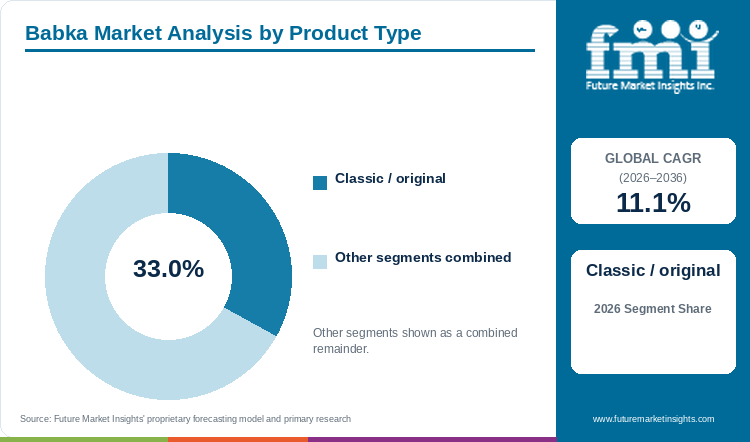
Classic / original is expected to hold a 33.0% share of the product type segment in 2026, driven by recognizable chocolate and cinnamon swirl profiles.
Table 5: Product Type Share for the Babka Market (percentage share), 2026
| Product Type | Share (2026) |
|---|---|
| Classic / original | 33.0% |
| Other Segments Combined* | 67.0% |
| Total | 100.0% |
*Calculated as the balance remaining after deducting the leading segment's reported share from 100.0%.
Table 6: Product Type Leadership and Market Growth for the Babka Market (segment and CAGR percentage), 2026 to 2036
| Metric | Value |
|---|---|
| Global CAGR (2026 to 2036) | 11.1% |
| Leading Segment | Classic / original |
First-time supermarket shoppers and café buyers look for dark cocoa fudge and cinnamon ribbons as the visual benchmark for braided sweet bread. Retail bakeries stock classic loaves to build steady daily sales before testing seasonal pistachio or spiced options with kouign-amann pastries.
- Classic / original is estimated to hold a 33.0% share of the product type segment in 2026 owing to familiar flavor profiles and standardized cocoa-paste filling lines.
- In October 2025, the Baking Industry Awards in the UK named Patisserie Mark Bennett's Dirty Chai and Chocolate Pistachio Babka as New Bakery Product of the Year 2025, showing how artisan bakers build spiced twists on a classic chocolate base[3].
What keeps Conventional ahead within Claim / Nature?
Conventional formulations are projected to account for a 56.0% share of the claim / nature segment in 2026, supported by enriched butter-and-egg dough functionality.
Lamination of yeasted sweet dough around heavy chocolate fillings requires elastic wheat gluten and whole eggs so braided loaves do not tear during proofing. Commercial bakeries rely on conventional wheat flour and dairy butter to reach target loaf height while adding enzyme blends from bakery ingredients to keep the crumb soft.
- Conventional is predicted to record a 56.0% share of the claim / nature segment in 2026 attributable to lower flour and butter costs and reliable oven spring.
- A December 2025 baking study in Food Chemistry X from Marwadi University confirmed that adding microbial lipase enzymes raises wheat loaf volume by 15% to 35% and slows crumb hardening by 10% to 25% across conventional runs[4].
Why does Fresh lead the babka Format mix?
Fresh format sales are anticipated to capture a 40.0% share of the format segment in 2026, reinforced by counter aroma and soft crumb texture.
Warm sugar-syrup glaze and visible chocolate layers command higher retail prices when sold fresh at specialty bakeries and department-store food halls. Store operators balance fresh counter appeal against evening waste by pairing daily baked loaves with ready-to-finish bakery products that bake off in small batches.
- Fresh is forecast to register a 40.0% share of the format segment in 2026 linked to warm counter presentation and impulse coffee-shop orders.
- In February 2026, Galeries Lafayette Le Gourmet featured Babka Zana's freshly baked braided loaves and Levantine sweet breads in its Paris food hall, which drew strong shopper traffic to fresh counters[5].
Why are Multipacks important in Packaging Format?
Multipack configurations are expected to hold a 29.0% share of the packaging format segment in 2026, enabled by portion control and moisture protection.
Any cut across a whole braided loaf exposes sugar-rich filling seams to dry air as soon as a household opens the outer bag. Two-pack loaf boxes and individually wrapped slice multipacks prevent post-opening drying while fitting weekday lunchbox and afternoon snacking routines.
- Multipack is estimated to hold a 29.0% share of the packaging format segment in 2026 resulting from reduced slice drying and gift-ready shipping boxes.
- In August 2025, the Baking Industry Awards finalist review in the UK noted that bakeries price babka at GBP 2.75 per individual slice compared with GBP 20 for a whole loaf or twin-pack food-to-go box[6].
Why do Supermarkets & hypermarkets lead Sales Channel?
Supermarkets & hypermarkets are projected to account for a 31.0% share of the sales channel segment in 2026, driven by routine grocery basket integration.
National supermarket chains turn babka from an occasional bakery-shop treat into a weekly household breakfast and dessert purchase through prominent perimeter table displays. Grocery category buyers require barcoded allergen labels and verified 14-to-45-day shelf life before granting permanent shelf space.
- Supermarkets & hypermarkets are predicted to record a 31.0% share of the sales channel segment in 2026 associated with high weekly shopper traffic and private-label bakery tables.
- A December 2025 preservation study from the University of Pisa in Foods showed that pairing 4-degree-Celsius chilled storage with modified atmosphere extended fermented bakery shelf life from 16 days to 54 days[7].
What are the drivers, restraints, and opportunities in the babka market?
In the babka market, thaw-and-serve convenience slice programs and café flavor rotations drive demand, whereas swirl moisture migration and allergen labeling compliance restrain scale, and freeze-thaw-stable dough systems create foodservice expansion opportunities.
- Driver: Expansion of pre-sliced café programs and thaw-and-serve convenience bakery cases turns specialty braided sweet bread into a daily coffee-pairing purchase.
- Restraint: Moisture transfer between sweet fillings and yeasted crumb speeds up staling while multi-allergen label rules raise packaging compliance costs.
- Opportunity: Freeze-stable dough recipes and plant-based laminating fats allow wholesale bakers to supply multi-unit coffee chains and airport travel retail.
Growth Analysis and Future Potential: Qualitative Demand Catalysts
Coffee-shop chains and supermarket in-store bakeries are widening their morning pastry menus beyond plain croissants by adding pre-sliced chocolate and cinnamon babka. Because hand-braiding filled dough requires skilled bakers and long proofing times, multi-site chains buy frozen pre-proofed loaves or thaw-and-serve slices from central commissaries. Future Market Insights notes that cold-chain delivery networks built for frozen pastries let regional bakeries ship braided loaves nationwide without losing swirl definition. In August 2026, a study in Food Chemistry showed that adding 2% to 4% wheat glutenin protein protects frozen dough structure and prevents ice crystals from damaging yeast loaves during freeze-thaw storage[8]. Foodservice buyers therefore sign multi-quarter supply contracts with manufacturers that guarantee even loaf volume and intact chocolate layers after thawing. Standardized case counts and pre-scored slice guides further help coffee-shop staff serve uniform morning portions without back-of-house knife waste.
Risk Assessment of the Babka Market: Operational and Formulation Friction
Moisture moving between sugar-rich cocoa or fruit fillings and the surrounding yeast bread remains the main technical hurdle limiting ambient shelf life. Over several days on retail shelves, water shifts from the bread crumb into the cinnamon-sugar or chocolate layers while cocoa butter blooms across cut surfaces and leaves the loaf dry. In January 2026, baking research from the Technical University of Cluj-Napoca published in Foods showed that enriched bread loaves lose softness quickly during storage as starch and protein structures firm up to 15.92 Newtons of hardness[9]. In addition, traditional babka recipes contain wheat and dairy proteins along with egg and tree-nut ingredients, which requires strict line cleaning and prepacked-for-direct-sale allergen label checks. When wholesale bakeries compare braided loaves against simpler flat croissants, higher scrap rates from burst seams and unsold fresh loaves limit aggressive grocery price promotions. Bakery plant engineers address this hurdle by controlling dough proofing humidity and using high-fat cocoa fillings with lower free water content.
Commercial Opportunity Analysis: Formulation Differentiation and Value-Add Formats
Specialty baking-fat blends and single-serve travel-retail packs provide the strongest margin growth avenues for commercial babka producers through 2036. Partial replacement of dairy butter in layered sweet doughs with plant-oil fat blends lowers saturated fat and keeps the pastry soft after blast freezing. In January 2026, a study in Food Research International confirmed that fast-frozen specialty fats modified with sucrose esters replaced 50% of dairy butter in laminated pastries while keeping the baked crumb tender[10]. At the same time, individually wrapped 70-to-90-gram babka slices compete directly with packaged muffins across convenience stores and hotel breakfast buffets without knife slicing or counter mess. Producers that pair enzyme crumb softeners with nitrogen-flushed flow wraps are winning recurring private-label listings across North America and Western Europe. Retail category buyers also reward suppliers that offer seasonal half-loaf gift boxes and twin-slice grab-and-go packs designed for commuter railway stations and urban convenience stores.
Babka Market by Country (2026 to 2036)
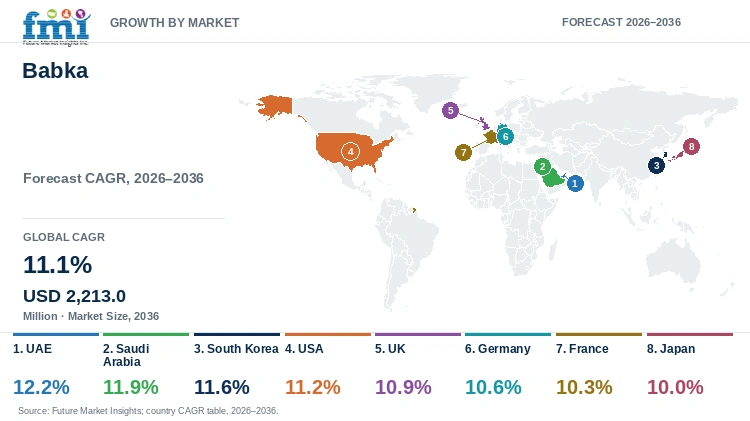
As per FMI, the UAE is projected to lead babka market expansion at a 12.2% CAGR from 2026 to 2036, whereas Japan is forecast to advance at a 10.0% CAGR. Growth variations across Gulf hospitality hubs and Western grocery channels reflect differences in cold-chain bakery distribution and municipal expiry-date enforcement.
Table 7: Country CAGR and Primary Growth Levers for the Babka Market (CAGR percentage and operational drivers), 2026 to 2036
| Country | CAGR (2026 to 2036) | Primary Growth Lever |
|---|---|---|
| UAE | 12.2% | Specialty café single-slice programs and hotel commissary pastry procurement |
| Saudi Arabia | 11.9% | Digital café delivery aggregators and bilingual SFDA.FD/GSO 9 packaged bakery expansion |
| South Korea | 11.6% | Premium dessert-café flavour rotation and MFDS allergen-compliant wrapped slices |
| USA | 11.2% | Supermarket perimeter bakery tables and nationwide DTC two-pack gift shipping |
| UK | 10.9% | Thaw-and-serve food-to-go convenience cases and PPDS allergen-labeled bakery counters |
| Germany | 10.6% | Craft bakery consolidation driving centralized frozen sweet-loaf procurement |
| France | 10.3% | Department-store food hall concessions and Levantine-inspired artisan patisserie |
| Japan | 10.0% | Dedicated specialty-store launches in Kyoto and airport souvenir pop-up counters |
Source: Future Market Insights analysis
UAE Babka Market Outlook (2026 to 2036)
Demand in the UAE is projected to expand at a 12.2% CAGR from 2026 to 2036, positioning the country as the fastest-growing covered market in this study. Unlike European grocery markets centered on whole family loaves, the UAE commercial model revolves around single-serve chocolate-hazelnut slices sold through specialty coffee bars and luxury hotel lounges in Dubai and Abu Dhabi. In February 2025, Dubai Municipality introduced its Montaji+ digital food-product registration platform covering over 1.7 million products and 461,875 container inspections while cutting permit approvals by 75%[11]. High summer ambient temperatures require chilled delivery vans so chocolate swirls do not bloom before reaching commercial café and hotel display cases.
Key takeaway: In the UAE, specialty coffee-shop slice programs and five-star hotel pastry procurement are projected to drive 12.2% CAGR expansion under digital municipal import clearance.
Saudi Arabia Babka Market Outlook (2026 to 2036)
Unlike traditional neighborhood bakeries in Europe, Saudi Arabia routes a high share of premium sweet-bread discovery through rapid-delivery café apps and mall dessert lounges across Riyadh and Jeddah. The market in Saudi Arabia is forecast to register an 11.9% CAGR between 2026 and 2036 on the back of specialty coffee-chain expansion and hospitality catering. In October 2025, researchers at King Faisal University published findings in Food Chemistry X showing that adding date-palm seed oil and press-cake fiber to baked cakes reduced 21-day microbial counts by 30% to 35% and slowed fat oxidation by 94%[12]. Mandatory bilingual Arabic labeling and imported shelf-life verification still govern foreign brands.
Key takeaway: In Saudi Arabia, rapid café-delivery ordering and locally adapted date-and-chocolate formulations are forecast to support an 11.9% CAGR through 2036.
South Korea Babka Market Outlook (2026 to 2036)
What sets South Korea apart from Western bread markets is the speed at which independent dessert cafés and convenience chains rotate layered pastries for young urban shoppers. In November 2025, food scientists in Scientific Reports showed that spray-dried cinnamon extract capsules reached 96.98% solubility and 2.41% low moisture, keeping bread crumb soft and preserving spice aroma at a 2.5% addition level[13]. The South Korea babka market is anticipated to grow at an 11.6% CAGR from 2026 to 2036, supported by wrapped single-slice convenience launches. Even so, strict Ministry of Food and Drug Safety allergen disclosures for wheat and dairy as well as eggs and walnuts require dedicated packaging runs.
Key takeaway: In South Korea, high-velocity café menu rotation and individually wrapped convenience slices are anticipated to sustain an 11.6% CAGR through 2036.
USA Babka Market Outlook (2026 to 2036)
The USA differs from single-channel import markets because mainstream supermarket perimeter tables operate in parallel with high-margin direct-to-consumer two-pack gift shipping from New York and regional artisan bakeries. According to the USDA Economic Research Service in June 2026, retail cereal and bakery prices in the USA increased by 1.0% in 2025 whereas retail egg prices averaged 21.9% higher than in 2024 due to avian influenza supply shocks[14]. Elevated liquid-egg input costs push commercial commissaries to lock in contracted pasteurized egg supplies and enzyme dough conditioners that protect margin on 16-ounce grocery loaves. Across the USA, the babka market is estimated to advance at an 11.2% CAGR through 2036.
Key takeaway: In the USA, supermarket in-store bakery tables and national direct-to-consumer gift packs are estimated to drive an 11.2% CAGR despite egg-cost volatility.
UK Babka Market Outlook (2026 to 2036)
Expansion in the UK is predicted to record a 10.9% CAGR from 2026 to 2036, propelled by wholesale thaw-and-serve cases entering convenience forecourts and coffee-shop counters. Whereas artisanal London bakeries popularized freshly braided loaves, national volume growth depends on food-to-go suppliers delivering pre-portioned chocolate and caramel babka that requires zero on-site proofing skill. In July 2026, the UK Department for Environment, Food and Rural Affairs reported in its Food Statistics Pocketbook that consumer expenditure on food and drink reached GBP 303,300 million in 2025 while food prices rose 2.2% over the 12 months to May 2026[15]. Mandatory Natasha's Law prepacked-for-direct-sale allergen labeling remains a strict store-level compliance gate.
Key takeaway: In the UK, thaw-and-serve food-to-go distribution and convenience forecourt bakery upgrades are predicted to support a 10.9% CAGR through 2036.
Germany Babka Market Outlook (2026 to 2036)
Germany has one of Europe's densest craft bakery networks, yet rising energy tariffs and baker apprentice shortages are pushing regional chains to replace manual morning braiding with pre-proofed frozen sweet loaves. The Germany babka market is slated to progress at a 10.6% CAGR between 2026 and 2036 across multi-branch bakery chains and supermarket bake-off stations. In August 2025, wheat-breeding researchers at the University of Hohenheim in Stuttgart published a multi-environment study in Scientific Reports across 282 Central European bread wheat cultivars confirming strong genetic baking-quality gains for high-volume dough lines[16]. Wholesale suppliers therefore use high-stability wheat flours milled in Germany to deliver sliceable half-loaves that hit accessible grocery price points.
Key takeaway: In Germany, craft-bakery branch consolidation and bake-off labor savings are slated to sustain a 10.6% CAGR through 2036.
France Babka Market Outlook (2026 to 2036)
Whereas grocers in the UK and Germany emphasize thaw-and-serve convenience, demand in France is anchored by specialist Levantine patisseries and gourmet department-store concessions in Paris and Lyon. In May 2026, researchers at the University of Picardy Jules Verne and the University of Lille reported in Science of the Total Environment that microbial bio-inputs sustained wheat grain protein and baking quality in France under 20% reduced nitrogen fertilization[17]. Shoppers in France evaluate babka directly against artisanal pain au chocolat and pure-butter brioche, which forces producers to pair consistent domestic pastry flour with AOC-grade butter and pistachio pralines. Supported by food-hall concessions and premium grocery listings, the France babka market is projected to register a 10.3% CAGR from 2026 to 2036.
Key takeaway: In France, gourmet department-store counters and pure-butter Levantine patisserie concepts are projected to drive a 10.3% CAGR through 2036.
Japan Babka Market Outlook (2026 to 2036)
Japan is a high-precision specialty market where babka is sold as a rich, giftable sweet Danish pastry instead of an everyday table loaf. In September 2025, Ribbon Foods opened Japan's first dedicated babka specialty shop BABKA cadabra in Kyoto with a pop-up at Haneda Airport running from October 2025 through January 2026 across six flavors[18]. Because domestic consumers favor compact, neatly wrapped portions over heavy whole loaves, operators sell half-size boxes and chilled single slices in chocolate and lemon profiles. With specialty department-store pop-ups and railway-station gifting expanding buyer trial, the Japan babka market is forecast to advance at a 10.0% CAGR from 2026 to 2036.
Key takeaway: In Japan, dedicated specialty boutiques in Kyoto and airport souvenir pop-ups are forecast to anchor a 10.0% CAGR through 2036.
Full report country CAGRs cover: North America; Latin America; Western Europe; Eastern Europe; East Asia; South Asia and Pacific; Middle East and Africa.
Who are the notable companies in the babka market?
Rich Products, Sara Lee Frozen Bakery, Dessert Holdings, Mademoiselle Desserts, Finsbury Food Group, Premier Foods, McKee Foods, Hostess Brands, Bauli, and Dr. Oetker are the notable companies covered in the babka market.
FMI analysis indicates that commercial competition spans dedicated artisan babka bakeries and large frozen or packaged sweet-goods manufacturers. Specialist urban bakeries and wholesale food-to-go suppliers lead direct SKU launches in braided chocolate and cinnamon loaves. Multinational frozen and ambient bakery groups provide the cold-chain distribution and tunnel-oven lamination capacity required to scale sweet yeast breads across retail and hospitality channels.
- Artisan & Specialty Babka Leaders: Finsbury Food Group and Mademoiselle Desserts operate premium specialty bakery and food-hall supply networks across Europe and direct-to-consumer gifting channels.
- Frozen & Thaw-and-Serve Bakery Specialists: Rich Products and Sara Lee Frozen Bakery join Dessert Holdings in supplying blast-frozen and thaw-and-serve sweet bakery lines to supermarket in-store bakeries and cafés.
- Packaged Sweet-Goods & Distribution Platforms: Premier Foods and McKee Foods join Hostess Brands as well as Bauli and Dr. Oetker in scaling ambient multipacks and professional pastry fillings.
Competitive Benchmarking: Babka Market
Table 8: Competitive Benchmarking for the Babka Market (qualitative capability ratings), 2026
| Company | Enriched Sweet-Dough Fit | Frozen / Thaw-and-Serve Depth | Retail & Foodservice Access | Geographic Reach |
|---|---|---|---|---|
| Rich Products | High | High | High | USA and global foodservice bakery network |
| Sara Lee Frozen Bakery | High | High | High | USA and Canada retail and foodservice |
| Dessert Holdings | Medium | High | High | North America retail and foodservice |
| Mademoiselle Desserts | High | High | Medium | France, the UK, and European foodservice |
| Finsbury Food Group | High | Medium | High | The UK and European grocery and DTC channels |
| Premier Foods | Medium | Medium | High | The UK and international branded grocery |
| McKee Foods | Medium | Medium | High | USA packaged sweet-bakery distribution |
| Hostess Brands | Medium | Medium | High | USA and Canada convenience and grocery |
| Bauli | High | Medium | High | Italy and international sweet-dough retail |
| Dr. Oetker | Medium | Medium | High | Germany and international professional channels |
Scoring basis: Capability tiers evaluate documented sweet-yeast dough and laminated pastry manufacturing, frozen thaw-and-serve cold-chain logistics, and supermarket in-store bakery or foodservice distribution reach.
Key Developments in the Babka Market
- In May 2026, UK food-to-go wholesaler Country Choice added thaw-and-serve chocolate and caramel babka cases to its Swan Bakery range for convenience and forecourt retailers[19].
- In October 2026, Ribbon Foods Co., Ltd. celebrated the first anniversary of its Kyoto specialty store BABKA cadabra by expanding seasonal braided pastry assortments and department-store pop-up distribution in Japan[20].
- In August 2025, Finsbury Food Group acquired a 70% majority stake in Lola's Cupcakes in the UK, integrating e-commerce ordering and 45 high-footfall collection kiosks and lockers into its specialty bakery platform[21].
Key Players in the Babka Market
Artisan & Specialty Babka Leaders
- Finsbury Food Group
- Mademoiselle Desserts
Frozen & Thaw-and-Serve Bakery Specialists
- Rich Products
- Sara Lee Frozen Bakery
- Dessert Holdings
Packaged Sweet-Goods & Distribution Platforms
- Premier Foods
- McKee Foods
- Hostess Brands
- Bauli
- Dr. Oetker
Babka Market - Report Scope
Table 9: Report Scope for the Babka Market (coverage fields and definitions), 2026 to 2036
| Coverage field | Report scope |
|---|---|
| Market breakdown | Product Type; Claim / Nature; Format; Packaging Format; Sales Channel |
| Quantitative Units | USD Million |
| Market Definition | Includes commercial wholesale and retail supplier revenue from finished babka loaves, pre-sliced multipacks, two-pack gift bundles, and single-serve portions sold across fresh, frozen, chilled, ambient, and par-baked or thaw-and-serve formats through supermarkets, specialty bakeries, convenience stores, online channels, and foodservice distributors. Excludes unbaked dry flour mixes, standalone chocolate or cinnamon spreads sold separately as raw ingredients, and ordinary brioche loaves, panettone, or sponge cakes that are not braided and marketed as babka. |
| Regions Covered | North America; Latin America; Western Europe; Eastern Europe; East Asia; South Asia and Pacific; Middle East and Africa |
| Countries Covered | UAE, Saudi Arabia, South Korea, USA, UK, Germany, France, Japan, and additional countries in the full report |
| Key Companies Covered | Rich Products, Sara Lee Frozen Bakery, Dessert Holdings, Mademoiselle Desserts, Finsbury Food Group, Premier Foods, McKee Foods, Hostess Brands, Bauli, Dr. Oetker |
| Forecast Period | 2026 to 2036 |
| Approach | Primary interviews with commercial bakery buyers and ingredient R&D managers combined with secondary government and trade statistical series and bottom-up volume triangulation from 2025 to 2036. |
Babka Market - Research Methodology
Table 10: Research Methodology for the Babka Market (research methods and approach), 2026 edition
| Method | Approach |
|---|---|
| Primary Research | Structured interviews with supermarket in-store bakery category buyers, wholesale frozen-dough technical directors, specialty coffee-chain procurement managers, and commercial food-to-go distributors across North America, Europe, Asia-Pacific, and the Gulf. Discussions validated weekly loaf and slice velocity, freezer-to-ambient thaw shrink rates, modified-atmosphere packaging costs, and delivered case pricing across retail and foodservice accounts. |
| Secondary Research | Analysis of USDA Economic Research Service food-expenditure and retail food-price releases, DEFRA UK Food Statistics Pocketbook series, Dubai Municipality Montaji+ digital food-safety inspection records, peer-reviewed yeast-dough preservation and freeze-thaw studies indexed in PubMed, and audited corporate bakery annual reports and M&A disclosures. |
| Market Sizing and Forecasting | Top-down sweet-bakery category allocations are reconciled against bottom-up stocking outlet counts and annual loaf-equivalent throughput per store from 2025 to 2036. Analysts cross-check wholesale case realizations against retail perimeter table space and café pastry counter turn rates across covered regions. |
| Country Forecasting Model | Econometric country projections weight away-from-home coffee-shop expansion and perimeter grocery bakery penetration across eight covered countries. The model also accounts for cold-chain thaw-and-serve distribution capacity and national allergen-labeling enforcement in each domestic retail market. |
| Operational Benchmark Traceability | Outlet-level and loaf-volume indicators in Tables 2, 3, and 4 trace directly to USDA ERS away-from-home food expenditure series and DEFRA UK food statistics. Operational ranges are further checked against peer-reviewed modified-atmosphere bread preservation trials and commercial wholesale case weights. |
| Data Triangulation and Validation | Demand estimates are cross-checked against wholesale foodservice case launches and specialty bakery store counts across North America, Europe, and Asia-Pacific. Analysts audit packaged grocery SKU listings and exclude ordinary brioche, cinnamon rolls, and non-babka sweet breads to prevent double counting. |
Babka Market by Segments
Babka Market segmented by Product Type:
- Classic / original
- Whole grain & seeded
- Flavored & filled
- Mini & snacking formats
- Premium / artisan
Babka Market segmented by Claim / Nature:
- Conventional
- Clean label
- Organic
- Gluten-free
- High-protein / fortified
Babka Market segmented by Format:
- Fresh
- Frozen
- Ambient packaged
- Chilled
- Par-baked / thaw-and-serve
Babka Market segmented by Packaging Format:
- Multipack
- Single-serve
- Family / loaf pack
- Bulk foodservice
Babka Market segmented by Sales Channel:
- Supermarkets & hypermarkets
- Artisan & specialty bakeries
- Convenience & forecourt
- Online & DTC
- Foodservice distributors
Babka Market by Region
- North America
- United States
- Canada
- Latin America
- Brazil
- Mexico
- Argentina
- Chile
- Western Europe
- Germany
- France
- United Kingdom
- Italy
- Spain
- Benelux
- Nordics
- Eastern Europe
- Poland
- Czech Republic
- Romania
- Hungary
- East Asia
- China
- Japan
- South Korea
- South Asia and Pacific
- India
- ASEAN
- Australia and New Zealand
- Middle East and Africa
- GCC Countries
- South Africa
- Türkiye
- Israel
Research Sources and Bibliography
- [1] U.S. Department of Agriculture, Economic Research Service. (2026, June 11). Total U.S. food spending reached $2.51 trillion in 2025. USDA Economic Research Service Charts of Note.
- [2] University of Pisa Interdepartmental Research Centre Nutraceuticals and Food for Health. (2025, December 25). Technological Strategies for the Shelf Life of PDO Tuscan Bread Through Modified Atmosphere Packaging and Aromatic Headspace Extracts. Foods, 15(1), 65 (PubMed PMID 41517131).
- [3] British Baker. (2025, October 23). Flavourful babka bags the win in New Bakery Product of the Year 2025. British Baker Baking Industry Awards.
- [4] Marwadi University Department of Microbiology. (2025, December 28). Improving functional and nutritional properties of wheat-based bakery products using microbial lipases. Food Chemistry X, 25, 103435 (PubMed PMID 41551819).
- [5] Galeries Lafayette Le Gourmet. (2026, February 24). Babka Zana les meilleures douceurs orientales de Paris. Galeries Lafayette Paris Haussmann.
- [6] British Baker. (2025, August 8). Finalists for New Bakery Product of the Year 2025 revealed. British Baker Baking Industry Awards.
- [7] University of Pisa Interdepartmental Research Center. (2025, December 10). A Machine Learning Model to Reframe the Concept of Shelf-Life in Bakery Products and PDO Sourdough Preservation. Foods, 14(24), 4236 (PubMed PMID 41464943).
- [8] Food Chemistry Freeze-Thaw Dough Research Group. (2026, August 3). Improved freeze-thaw stability of whole wheat dough via glutenin supplementation and restrained water mobility. Food Chemistry, 525(Pt 4), 150658 (PubMed PMID 42556237).
- [9] Technical University of Cluj-Napoca Department of Chemistry-Biology. (2026, January 23). FTIR-Based Study of Starch Retrogradation and Protein Structure in Chickpea-Enriched Gluten-Free Bread During Storage. Foods, 15(3), 412 (PubMed PMID 41683000).
- [10] Food Research International Laminated Fat Group. (2026, January 12). Structuring monoglyceride oleogel crystallization by eutectic and crystal nucleation disturbance in frozen specialty fat for croissants. Food Research International, 228, 118357 (PubMed PMID 41703828).
- [11] Dubai Municipality. (2025, February 17). Latest digital food safety services presented at Gulfood 2025 with Montaji+ and Unified Permit System. Government of Dubai Media Center.
- [12] King Faisal University Food and Nutrition Science Department. (2025, October 17). Valorization of date palm by-products in cake fortification for nutritional enrichment and shelf-life extension. Food Chemistry X, 31, 103184 (PubMed PMID 41158148).
- [13] University of Hormozgan Department of Agriculture. (2025, November 28). Production of microencapsulated cinnamon extract using spray drying and evaluation of its effects on bread quality. Scientific Reports, 15(1), 45642 (PubMed PMID 41315776).
- [14] U.S. Department of Agriculture, Economic Research Service. (2026, June 1). Food Prices and Spending in Ag and Food Statistics Charting the Essentials. USDA Economic Research Service.
- [15] United Kingdom Department for Environment, Food and Rural Affairs. (2026, July 29). Food statistics in your pocket on food chain and consumer expenditure. GOV.UK Official Statistics.
- [16] University of Hohenheim State Plant Breeding Institute. (2025, August 28). Historic findings and future potential in wheat elaborated using a diverse cultivars collection and extended phenotyping. Scientific Reports, 15(1), 31674 (PubMed PMID 40866442).
- [17] University of Picardy Jules Verne and University of Lille. (2026, May 28). Reduced nitrogen fertilization combined with microbial bio-inputs restores soil bacterial functional profiles and sustains wheat performance. Science of the Total Environment, 1040, 181886 (PubMed PMID 42208480).
- [18] Ribbon Foods Co., Ltd. (2025, September 10). Japan's first specialty babka store BABKA cadabra grand opening in Kyoto and Haneda Airport pop-up announcement. PR TIMES Corporate Release.
- [19] Riley, D. (2026, May 8). Buns, babka, and branded muffins among latest Country Choice NPD. British Baker.
- [20] Ribbon Foods Co., Ltd. (2026, October 2). Kyoto-origin specialty store BABKA cadabra marks first anniversary with expanded sweet Danish babka lineup. PR TIMES Corporate Release.
- [21] Finsbury Food Group. (2025, August 15). Finsbury Food Group Acquires Majority Stake in Lola's. Finsbury Food Group Corporate Release.
- [22] Dessert Holdings. (2025, July 14). Dessert Holdings Acquires Willamette Valley Pie Company. Dessert Holdings Corporate Announcement.
- [23] Vandemoortele NV. (2026, March 30). Vandemoortele releases 2025 Annual Integrated Report with EUR 1,500 million Bakery Products revenue. Vandemoortele Annual Integrated Report.
This bibliography is provided for reader reference and is not exhaustive. The full report contains the complete reference list and detailed citations.
This Report Answers
- How large is the babka market in 2026 and what is forecast for 2036?
- Which food-to-go and café purchasing mechanisms support demand for babka?
- Why does Classic / original lead the product type segment?
- Why does Conventional lead the claim / nature segment globally?
- How do growth rates differ across the UAE and Saudi Arabia as well as South Korea and the USA?
- Which notable companies supply enriched sweet-dough and thaw-and-serve bakery channels?
- What limits shelf life or supplier qualification in the babka market?
- What should grocery and café buyers test before listing a commercial babka SKU?
Frequently Asked Questions
How big is the babka market in 2026, and what is forecast for 2036?
According to FMI, the global babka market is estimated to reach USD 772.4 million in 2026 from USD 695.2 million in 2025. Market value is forecast to reach USD 2,213.0 million by 2036 as supermarkets and coffee chains expand thaw-and-serve loaves and individually wrapped slices for daily morning coffee breaks.
What is the CAGR for the babka market from 2026 to 2036?
Future Market Insights projects an 11.1% compound annual growth rate between 2026 and 2036, generating USD 1,440.6 million in incremental market value across retail and foodservice channels. Growth is supported by pre-sliced convenience cases and frozen pre-proofed loaves that eliminate scratch braiding in store kitchens.
Which product type segment leads the babka market?
Classic / original is expected to hold a 33.0% share of the product type segment in 2026 because recognizable chocolate and cinnamon swirls lower consumer trial risk and anchor repeat household purchases. Retail category managers use classic chocolate and cinnamon loaves as core everyday items before rotating seasonal flavor extensions.
Which claim / nature segment leads the babka market?
Conventional is estimated to hold a 56.0% share of the claim / nature segment in 2026 as butter-and-egg dough systems provide reliable gluten extensibility and oven spring without specialty certification costs. Enriched wheat flour and dairy butter also keep the braided crumb soft around heavy cocoa fudge fillings during multi-day display.
Which country has a notable growth outlook during the assessment period?
The UAE leads national expansion at a 12.2% CAGR from 2026 to 2036, followed by Saudi Arabia at 11.9% and South Korea at 11.6% due to specialty coffee-shop slice programs and digital pastry delivery. Luxury hotel lounges and rapid-delivery café apps across Dubai and Riyadh as well as Seoul drive recurring orders for single-serve chocolate and pistachio babka slices.
Who are the key players in the market?
Rich Products and Sara Lee Frozen Bakery lead wholesale frozen supply with Dessert Holdings and Mademoiselle Desserts across supermarket in-store bakeries and cafés. Finsbury Food Group and Premier Foods join McKee Foods and Hostess Brands as well as Bauli and Dr. Oetker across packaged retail multipacks and professional baking channels.
Preview the report firsthand - request a free sample
Get SampleGet the brochure for pricing and purchase details.
Get PDFTable of Content
- Key Takeaways
- Market Size and CAGR
- Top Growth Driver
- Fastest Growing Segment
- Leading Region
- Key Companies
- Emerging Opportunities
- Executive Summary
- Global Market Outlook
- Demand-side Trends
- Supply-side Trends
- Technology Roadmap Analysis
- Analysis and Recommendations
- Analyst Perspective (What is happening? Why now? What should investors know?)
- Key Questions Answered
- How large is the market?
- What is the CAGR?
- What are key trends?
- Which region dominates?
- Who are the leaders?
- Market Overview
- Market Coverage / Taxonomy
- Market Definition / Scope / Limitations
- Research Methodology
- Chapter Orientation
- Analytical Lens and Working Hypotheses
- Market Structure, Signals, and Trend Drivers
- Benchmarking and Cross-market Comparability
- Market Sizing, Forecasting, and Opportunity Mapping
- Research Design and Evidence Framework
- Desk Research Programme (Secondary Evidence)
- Expert Input and Fieldwork (Primary Evidence)
- Tooling, Models, and Reference Databases
- Data Engineering and Model Build
- Quality Assurance and Audit Trail
- Market Background
- Market Dynamics (Drivers, Restraints, Opportunity, Trends)
- Scenario Forecast (Optimistic, Likely, Conservative)
- Impact Analysis
- AI Impact
- Sustainability Impact
- Regulatory Impact
- Technology Impact
- Consumer / Buyer Analysis
- Purchase Drivers
- Adoption Barriers
- Buyer Journey
- Opportunity Map Analysis
- Product Life Cycle Analysis
- Supply Chain Analysis
- Investment Feasibility Matrix
- Value Chain Analysis
- PESTLE and Porter's Analysis
- Regulatory Landscape
- Regional Parent Market Outlook
- Production and Consumption Statistics
- Import and Export Statistics
- Global Market Analysis and Forecast, 2021 to 2036
- Historical Market Size Value (USD Million) Analysis, 2021 to 2025
- Current and Future Market Size Value (USD Million) Projections, 2026 to 2036
- Y-o-Y Growth Trend Analysis
- Absolute $ Opportunity Analysis
- Global Market Pricing Analysis, 2021 to 2036
- Global Market Analysis and Forecast, By Product Type, 2021 to 2036
- Introduction / Key Findings
- Historical Market Size Value (USD Million) Analysis By Product Type, 2021 to 2025
- Current and Future Market Size Value (USD Million) Analysis and Forecast By Product Type, 2026 to 2036
- Classic / original
- Whole grain & seeded
- Flavored & filled
- Mini & snacking formats
- Premium / artisan
- Y-o-Y Growth Trend Analysis By Product Type, 2021 to 2025
- Absolute $ Opportunity Analysis By Product Type, 2026 to 2036
- Global Market Analysis and Forecast, By Claim / Nature, 2021 to 2036
- Introduction / Key Findings
- Historical Market Size Value (USD Million) Analysis By Claim / Nature, 2021 to 2025
- Current and Future Market Size Value (USD Million) Analysis and Forecast By Claim / Nature, 2026 to 2036
- Conventional
- Clean label
- Organic
- Gluten-free
- High-protein / fortified
- Y-o-Y Growth Trend Analysis By Claim / Nature, 2021 to 2025
- Absolute $ Opportunity Analysis By Claim / Nature, 2026 to 2036
- Global Market Analysis and Forecast, By Format, 2021 to 2036
- Introduction / Key Findings
- Historical Market Size Value (USD Million) Analysis By Format, 2021 to 2025
- Current and Future Market Size Value (USD Million) Analysis and Forecast By Format, 2026 to 2036
- Fresh
- Frozen
- Ambient packaged
- Chilled
- Par-baked / thaw-and-serve
- Y-o-Y Growth Trend Analysis By Format, 2021 to 2025
- Absolute $ Opportunity Analysis By Format, 2026 to 2036
- Global Market Analysis and Forecast, By Packaging Format, 2021 to 2036
- Introduction / Key Findings
- Historical Market Size Value (USD Million) Analysis By Packaging Format, 2021 to 2025
- Current and Future Market Size Value (USD Million) Analysis and Forecast By Packaging Format, 2026 to 2036
- Multipack
- Single-serve
- Family / loaf pack
- Bulk foodservice
- Y-o-Y Growth Trend Analysis By Packaging Format, 2021 to 2025
- Absolute $ Opportunity Analysis By Packaging Format, 2026 to 2036
- Global Market Analysis and Forecast, By Sales Channel, 2021 to 2036
- Introduction / Key Findings
- Historical Market Size Value (USD Million) Analysis By Sales Channel, 2021 to 2025
- Current and Future Market Size Value (USD Million) Analysis and Forecast By Sales Channel, 2026 to 2036
- Supermarkets & hypermarkets
- Artisan & specialty bakeries
- Convenience & forecourt
- Online & DTC
- Foodservice distributors
- Y-o-Y Growth Trend Analysis By Sales Channel, 2021 to 2025
- Absolute $ Opportunity Analysis By Sales Channel, 2026 to 2036
- Global Market Analysis and Forecast, By Region, 2021 to 2036
- Introduction
- Historical Market Size Value (USD Million) Analysis By Region, 2021 to 2025
- Current Market Size Value (USD Million) Analysis and Forecast By Region, 2026 to 2036
- North America
- Latin America
- Western Europe
- Eastern Europe
- East Asia
- South Asia and Pacific
- Middle East and Africa
- Market Attractiveness Analysis By Region
- North America Market Analysis and Forecast, By Country, 2021 to 2036
- Historical Market Size Value (USD Million) Trend Analysis By Market Taxonomy, 2021 to 2025
- Market Size Value (USD Million) Forecast By Market Taxonomy, 2026 to 2036
- By Country
- United States
- Canada
- By Product Type
- By Claim / Nature
- By Format
- By Packaging Format
- By Sales Channel
- By Country
- Market Attractiveness Analysis
- By Country
- By Product Type
- By Claim / Nature
- By Format
- By Packaging Format
- By Sales Channel
- Key Takeaways
- Latin America Market Analysis and Forecast, By Country
- Historical Market Size Value (USD Million) Trend Analysis By Market Taxonomy, 2021 to 2025
- Market Size Value (USD Million) Forecast By Market Taxonomy, 2026 to 2036
- By Country
- Brazil
- Mexico
- Argentina
- Chile
- By Product Type
- By Claim / Nature
- By Format
- By Packaging Format
- By Sales Channel
- By Country
- Market Attractiveness Analysis
- By Country
- By Product Type
- By Claim / Nature
- By Format
- By Packaging Format
- By Sales Channel
- Key Takeaways
- Western Europe Market Analysis and Forecast, By Country
- Historical Market Size Value (USD Million) Trend Analysis By Market Taxonomy, 2021 to 2025
- Market Size Value (USD Million) Forecast By Market Taxonomy, 2026 to 2036
- By Country
- Germany
- France
- United Kingdom
- Italy
- Spain
- Benelux
- Nordics
- By Product Type
- By Claim / Nature
- By Format
- By Packaging Format
- By Sales Channel
- By Country
- Market Attractiveness Analysis
- By Country
- By Product Type
- By Claim / Nature
- By Format
- By Packaging Format
- By Sales Channel
- Key Takeaways
- Eastern Europe Market Analysis and Forecast, By Country
- Historical Market Size Value (USD Million) Trend Analysis By Market Taxonomy, 2021 to 2025
- Market Size Value (USD Million) Forecast By Market Taxonomy, 2026 to 2036
- By Country
- Poland
- Czech Republic
- Romania
- Hungary
- By Product Type
- By Claim / Nature
- By Format
- By Packaging Format
- By Sales Channel
- By Country
- Market Attractiveness Analysis
- By Country
- By Product Type
- By Claim / Nature
- By Format
- By Packaging Format
- By Sales Channel
- Key Takeaways
- East Asia Market Analysis and Forecast, By Country
- Historical Market Size Value (USD Million) Trend Analysis By Market Taxonomy, 2021 to 2025
- Market Size Value (USD Million) Forecast By Market Taxonomy, 2026 to 2036
- By Country
- China
- Japan
- South Korea
- By Product Type
- By Claim / Nature
- By Format
- By Packaging Format
- By Sales Channel
- By Country
- Market Attractiveness Analysis
- By Country
- By Product Type
- By Claim / Nature
- By Format
- By Packaging Format
- By Sales Channel
- Key Takeaways
- South Asia and Pacific Market Analysis and Forecast, By Country
- Historical Market Size Value (USD Million) Trend Analysis By Market Taxonomy, 2021 to 2025
- Market Size Value (USD Million) Forecast By Market Taxonomy, 2026 to 2036
- By Country
- India
- ASEAN
- Australia and New Zealand
- By Product Type
- By Claim / Nature
- By Format
- By Packaging Format
- By Sales Channel
- By Country
- Market Attractiveness Analysis
- By Country
- By Product Type
- By Claim / Nature
- By Format
- By Packaging Format
- By Sales Channel
- Key Takeaways
- Middle East and Africa Market Analysis and Forecast, By Country
- Historical Market Size Value (USD Million) Trend Analysis By Market Taxonomy, 2021 to 2025
- Market Size Value (USD Million) Forecast By Market Taxonomy, 2026 to 2036
- By Country
- GCC Countries
- South Africa
- Türkiye
- Israel
- By Product Type
- By Claim / Nature
- By Format
- By Packaging Format
- By Sales Channel
- By Country
- Market Attractiveness Analysis
- By Country
- By Product Type
- By Claim / Nature
- By Format
- By Packaging Format
- By Sales Channel
- Key Takeaways
- Key Countries Market Analysis
- United States
- Pricing Analysis
- Market Share Analysis, 2025
- By Product Type
- By Claim / Nature
- By Format
- By Packaging Format
- By Sales Channel
- Canada
- Pricing Analysis
- Market Share Analysis, 2025
- By Product Type
- By Claim / Nature
- By Format
- By Packaging Format
- By Sales Channel
- Mexico
- Pricing Analysis
- Market Share Analysis, 2025
- By Product Type
- By Claim / Nature
- By Format
- By Packaging Format
- By Sales Channel
- Brazil
- Pricing Analysis
- Market Share Analysis, 2025
- By Product Type
- By Claim / Nature
- By Format
- By Packaging Format
- By Sales Channel
- Chile
- Pricing Analysis
- Market Share Analysis, 2025
- By Product Type
- By Claim / Nature
- By Format
- By Packaging Format
- By Sales Channel
- Germany
- Pricing Analysis
- Market Share Analysis, 2025
- By Product Type
- By Claim / Nature
- By Format
- By Packaging Format
- By Sales Channel
- United Kingdom
- Pricing Analysis
- Market Share Analysis, 2025
- By Product Type
- By Claim / Nature
- By Format
- By Packaging Format
- By Sales Channel
- Italy
- Pricing Analysis
- Market Share Analysis, 2025
- By Product Type
- By Claim / Nature
- By Format
- By Packaging Format
- By Sales Channel
- Spain
- Pricing Analysis
- Market Share Analysis, 2025
- By Product Type
- By Claim / Nature
- By Format
- By Packaging Format
- By Sales Channel
- France
- Pricing Analysis
- Market Share Analysis, 2025
- By Product Type
- By Claim / Nature
- By Format
- By Packaging Format
- By Sales Channel
- India
- Pricing Analysis
- Market Share Analysis, 2025
- By Product Type
- By Claim / Nature
- By Format
- By Packaging Format
- By Sales Channel
- ASEAN
- Pricing Analysis
- Market Share Analysis, 2025
- By Product Type
- By Claim / Nature
- By Format
- By Packaging Format
- By Sales Channel
- Australia and New Zealand
- Pricing Analysis
- Market Share Analysis, 2025
- By Product Type
- By Claim / Nature
- By Format
- By Packaging Format
- By Sales Channel
- China
- Pricing Analysis
- Market Share Analysis, 2025
- By Product Type
- By Claim / Nature
- By Format
- By Packaging Format
- By Sales Channel
- Japan
- Pricing Analysis
- Market Share Analysis, 2025
- By Product Type
- By Claim / Nature
- By Format
- By Packaging Format
- By Sales Channel
- South Korea
- Pricing Analysis
- Market Share Analysis, 2025
- By Product Type
- By Claim / Nature
- By Format
- By Packaging Format
- By Sales Channel
- Poland
- Pricing Analysis
- Market Share Analysis, 2025
- By Product Type
- By Claim / Nature
- By Format
- By Packaging Format
- By Sales Channel
- Hungary
- Pricing Analysis
- Market Share Analysis, 2025
- By Product Type
- By Claim / Nature
- By Format
- By Packaging Format
- By Sales Channel
- Türkiye
- Pricing Analysis
- Market Share Analysis, 2025
- By Product Type
- By Claim / Nature
- By Format
- By Packaging Format
- By Sales Channel
- South Africa
- Pricing Analysis
- Market Share Analysis, 2025
- By Product Type
- By Claim / Nature
- By Format
- By Packaging Format
- By Sales Channel
- UAE
- Pricing Analysis
- Market Share Analysis, 2025
- By Product Type
- By Claim / Nature
- By Format
- By Packaging Format
- By Sales Channel
- Saudi Arabia
- Pricing Analysis
- Market Share Analysis, 2025
- By Product Type
- By Claim / Nature
- By Format
- By Packaging Format
- By Sales Channel
- United States
- Market Structure Analysis
- Competition Dashboard
- Competition Benchmarking
- Market Share Analysis of Top Players
- By Regional
- By Product Type
- By Claim / Nature
- By Format
- By Packaging Format
- By Sales Channel
- Emerging Startups
- Innovation Benchmarking
- Competition Analysis
- Competition Deep Dive
- Rich Products
- Overview
- Product Portfolio
- Profitability by Market Segments
- Sales Footprint
- Strategy Overview
- Marketing Strategy
- Product Strategy
- Channel Strategy
- Sara Lee Frozen Bakery
- Dessert Holdings
- Mademoiselle Desserts
- Finsbury Food Group
- Premier Foods
- McKee Foods
- Hostess Brands
- Bauli
- Dr. Oetker
- Rich Products
- Case Studies
- Success Stories
- Recent Developments
- Competition Deep Dive
- Assumptions & Acronyms Used


