

- Market Size (2026)
- USD 263.6 Mn
- Forecast (2036)
- USD 683.7 Mn
- CAGR (2026 to 2036)
- 10.0%
How big is Europe Viennoiserie Market in 2026?
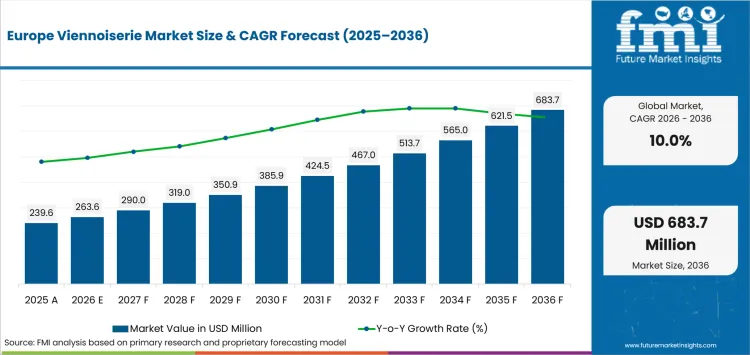
USD 263.6 million in 2026 and USD 683.7 million by 2036 at a 10.0% CAGR.
Demand for viennoiserie in Europe is projected to expand at 10.0% CAGR between 2026 and 2036, increasing valuation from USD 263.6 million to USD 683.7 million. The main commercial route is frequent breakfast and snacking demand that works in grocery and foodservice. DEFRA documented a 5.9% real increase in UK eating-out expenditure in FYE 2024. That recovery makes frozen bakery formats more useful to outlets that want a pastry range without scratch lamination at every site.
Country conversion differs even inside the tight forecast band, with France projected at 10.5% CAGR versus Spain at 9.6%. French specialty bakery activity gives daily pastry service a stronger route. INSEE recorded a 4.8% volume increase for bakery-patisserie activity in France during 2025. That channel base favors frequent replenishment of frozen pastries in France, while Spain places more weight on retail throughput and case economics.
Key Takeaways
- Breakfast and snacking occasions support repeat pastry purchasing in grocery, bakery and foodservice accounts that need predictable finished quality.
- Based on product type, classic / original is projected to account for 40.0% in 2026 due to familiar croissants and Danish styles that lower assortment risk.
- By claim / nature, conventional is estimated to hold 52.0% in 2026 owing to broad ingredient flexibility and accessible price points.
- Fresh is set to lead the format category with 30.0% share in 2026 due to bakery traffic and immediate sensory quality that sustain same-day presentation.
- Ingredient, labor, energy and cold-chain costs can narrow the acceptable cost per sellable serving and delay premium assortment expansion.
- Some of the key players in this market include Bridor, Delifrance, Lantmannen Unibake, Vandemoortele, Aryzta, Cerelia, Europastry, and La Lorraine Bakery Group.
Analyst Perspective
"European viennoiserie margins are won or lost between frozen storage, finishing and the sales counter. Repeat orders follow when case size, finishing time and expected sell-through fit daily outlet traffic without sacrificing lamination quality."
- Nandini Roy Choudhury, Principal Consultant, Future Market Insights
How is the europe viennoiserie market segmented?
The europe viennoiserie market is segmented by product type, claim / nature, format, packaging format, sales channel and region.
Market taxonomy covers product type, claim / nature, format, packaging format, sales channel and region. Product type spans classic / original, seeded, filled, mini and premium variants used in retail and foodservice ranges. Claim / nature includes conventional, clean label, organic, gluten-free and fortified products with different sourcing requirements. Format covers fresh, frozen, ambient packaged, chilled and par-baked / thaw-and-serve operating models for storage and finishing. Packaging format and sales channel distinguish household packs from grocery, bakery, convenience, online and foodservice routes.
Why does conventional lead the claim / nature category?
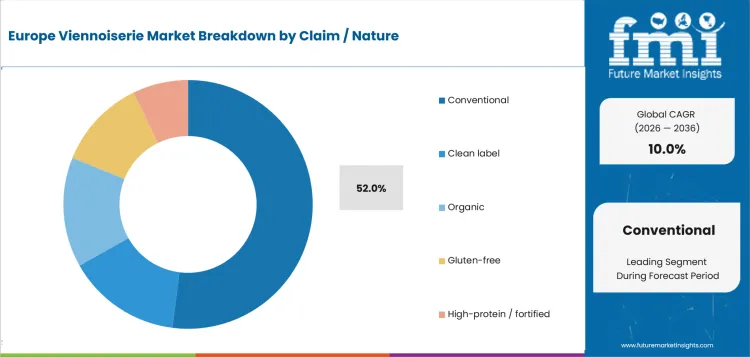
Conventional recipes let manufacturers balance butter, flour, fillings and processing aids against price and line stability. Certified variants serve narrower programs with extra sourcing, certification or documentation requirements for defined customer groups. The decision starts with target cost and line stability before claim differentiation enters the range. Similar cost and formulation trade-offs shape bakery ingredients purchasing for industrial pastry production.
- Conventional is projected to hold 52.0% share in 2026 owing to broader formulation freedom and sourcing options that fit mainstream retail and foodservice price tiers.
- Lantmannen Unibake stated in June 2025 that it joined a manifesto targeting a 30% wheat and flour emissions reduction by 2030. The program shows the added sourcing requirements attached to differentiated environmental claims.
Why does classic / original lead the product type category?
Classic / original gives retailers and foodservice operators a stable base of croissants and familiar Danish profiles. Buyers can add filled variants after the core range proves sell-through without forcing a new preparation routine. The same recognition logic appears in the adjacent Danish pastries category for professional foodservice buyers.
- The product type category is forecast to be led by classic / original at 40.0% share in 2026 due to broad recognition in breakfast and snacking ranges.
- At ANUGA in October 2025, Lantmannen Unibake presented fully baked Danish pastries ready after thawing. The launch moves a familiar pastry into lower-preparation service without changing its core identity.
Why does fresh lead the format category?
Fresh viennoiserie works where daily bakery traffic can absorb short selling windows and protect crispness, aroma and visible finish. Frozen inputs may support production, but shoppers still judge the pastry at the counter. Similar throughput economics shape the wider bakery products category in store-based retail.
- By format, fresh is forecast to represent 30.0% in 2026 driven by immediate-consumption occasions that reward bakery-style presentation at the point of sale.
- The French bakery confederation stated in January 2025 that nearly 12 million consumers visit a bakery each day. That daily shop traffic gives fresh-finished pastry a workable selling window despite shorter shelf life.
Why do supermarkets & hypermarkets lead the sales channel category?
Supermarkets can sell packaged multipacks beside in-store bakery products, giving one account several price points and preparation models. The channel supports promotions and private label at scale under one replenishment system. It also provides a direct route for adjacent flat croissants and laminated formats.
- In 2026, supermarkets & hypermarkets are expected to lead sales channel with 34.0% share because one retailer can carry fresh, frozen and packaged presentations.
- Spain's agriculture ministry reported in July 2026 that supermarkets accounted for 68.2% of food purchases in 2025. That concentration makes assortment productivity, replenishment and pack economics practical listing conditions.
What are the drivers, restraints and opportunities in the Europe Viennoiserie Market?
Frequent breakfast and snacking purchases support demand, while labor and waste pressure limit margins and lower-preparation formats offer a route to wider foodservice use.
- Driver: Retailers and foodservice operators protect familiar breakfast and snacking choices because these products fit frequent, repeat purchase occasions.
- Restraint: Rising labor costs and the waste risk on short-life laminated pastries can erase the margin gained from premium ingredients or higher menu prices.
- Opportunity: Frozen, fully baked and thaw-and-serve formats can move preparation away from small outlets while preserving a bakery-style finish near the customer.
Breakfast demand becomes commercially stronger once a site can serve pastry without adding a specialist lamination station. ONS reported in June 2026 that real household spending on restaurants and hotels rose 6% in FYE 2025. That increase supports industrial bakery mixes and finished pastry supply for cafes and hotels seeking predictable preparation within existing staffing.
The restraint is cost per sellable piece, not ingredient cost in isolation. Destatis reported in April 2026 that German labor costs per hour increased 3.6% in 2025. Laminated pastries also carry handling and waste exposure, so operators need reliable yield before premium bakery fat or claim costs can be passed to customers.
Lower-preparation formats work best when frozen supply reaches smaller outlets often enough to support short finishing windows. In June 2026, Aryzta acquired a French distribution business serving the Bordeaux area. The purchase shortens the route to local accounts, while bread improvers and plant controls remain upstream tools for consistent bake-off output.
Which country CAGRs are profiled in the Europe Viennoiserie Market?
| Country | CAGR |
|---|---|
| Germany | 10.8% |
| France | 10.5% |
| Italy | 10.2% |
| UK | 9.9% |
| Spain | 9.6% |
How do country-level CAGRs compare in the Europe Viennoiserie Market?
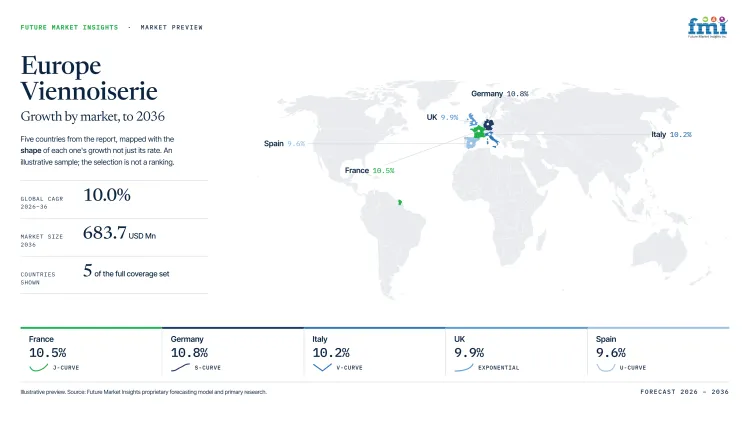
The five profiled countries form a compact growth band, with Germany and France above the group and Spain at the lower edge. Italy and the UK occupy the middle, so the 1.2-point spread shifts attention toward channel structure, service costs and preparation models that shape repeat orders for bakery manufacturers.
- Germany's bakery chains reward case consistency and branch-level finishing standards over novelty.
- France's hotel breakfasts give frozen pastry a route beyond artisan bakery counters.
- Italy's seasonal hospitality trade rewards flexible case sizes for variable breakfast demand.
- UK grocers scale multipacks nationally, making shelf productivity decisive for new listings.
- Spain's frozen-bakery base rewards efficient replenishment between warehouses and national grocery accounts.
Comparable CAGRs still produce different entry costs because each market rewards distinct execution.
Country CAGR coverage spans North America, Latin America, Western Europe, Eastern Europe, East Asia, South Asia and Pacific, and Middle East and Africa.
Country-wise Analysis
- France's artisan bakery density keeps fresh-finished pastry close to consumers, although regional delivery routes make frequent service costly beyond large cities. France's europe viennoiserie outlook is anticipated to advance at 10.5% CAGR over the assessment period, owing to daily bakery traffic and established breakfast habits. In January 2026, the French bakery confederation counted 34,000 artisan bakers nationwide, giving frozen-viennoiserie producers a large outlet base for local finishing. Premium ranges still need case sizes matched to neighborhood throughput before distributors commit to frequent delivery. Excess assortment raises waste before a distributor can recover the extra handling and delivery cost, so local service discipline matters more than a broad national SKU list.
- Germany's craft bakery system is consolidating into fewer businesses with many selling points, so multi-site operators value repeatable bake-off performance and centralized delivery. The labor pipeline improved in 2025: the German bakers association recorded 4,593 apprentices, up 12.1% from the prior year even as wages and energy costs stayed material. Germany is projected to grow at 10.8% CAGR by 2036 because larger bakery groups can apply common frozen-pastry handling standards among several branches. Standardization lowers training variation, yet each case must protect yield and preparation minutes. Local distributors also need freezer capacity and delivery frequency suited to branch-level demand instead of national averages.
- Italian households buy viennoiserie beside a deep local pastry offer, which keeps portion value and recognizable formats central to supermarket and bakery selection. ISMEA documented a 5.2% year-on-year rise in household food spending during the first half of 2025, giving retailers more room for bakery purchases without removing price comparison. Europe viennoiserie demand in Italy is forecast to rise at 10.2% CAGR over the forecast period, tied to habitual bakery consumption and broad grocery access. Premium claims face a tougher test because familiar local products provide an immediate benchmark for price and freshness. Manufacturers gain repeat orders by matching pack sizes to channel turnover instead of relying on one premium position for every account.
- UK grocery chains give packaged viennoiserie national reach, while hotels, cafes and convenience sites require formats that fit tighter kitchen staffing. DEFRA data published in July 2026 show real spending on food and drink eaten out rose 2.3% in 2025 from 2024. Europe viennoiserie sales in the UK are forecast to expand at 9.9% CAGR by 2036, aided by retail multipacks and lower-preparation foodservice cases. Value sensitivity remains a practical limit: every SKU must justify freezer or shelf space through sell-through, not category breadth alone. National listings favor manufacturers that separate retail pack economics from foodservice case design instead of forcing one offer into both routes.
- Spanish supermarkets concentrate food purchasing into centrally managed listings, giving national distributors leverage but making weak shelf productivity visible quickly. INE reported in June 2026 that average household spending on restaurants and accommodation fell 2.7% in 2025, a caution for pastry formats tied heavily to out-of-home demand. Spain is estimated to post 9.6% CAGR over the forecast period, attributable to frequent grocery access and established frozen-bakery distribution. The lower profiled rate leaves less room for slow-moving variants, so launch ranges need tighter case sizes and faster replenishment decisions. Producers with disciplined supermarket execution can outperform broader assortments that depend on hospitality recovery to absorb excess variety.
Who are the notable companies in the Europe Viennoiserie Market?
Bridor, Delifrance, Lantmannen Unibake, Vandemoortele, Aryzta, Cerelia, Europastry and La Lorraine Bakery Group are the notable companies serving this market.
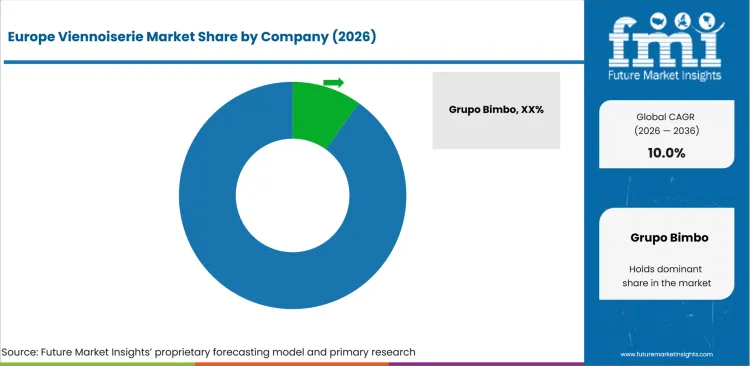
Competition splits between professional frozen-viennoiserie specialists, international bake-off groups and ready-to-bake dough platforms. Bridor, Delifrance and Vandemoortele emphasize professional pastry breadth for retail, artisan bakery and foodservice accounts. Lantmannen Unibake, Aryzta and La Lorraine Bakery Group bring multi-country bake-off scale, while Cerelia and Europastry cover dough or frozen-pastry routes. The adjacent baking ingredients market reinforces formulation discipline, but position here depends on finished range, finishing support and channel reach.
- Professional frozen-viennoiserie specialists: Bridor, Delifrance and Vandemoortele serve retail, artisan bakery and foodservice with frozen pastry portfolios.
- International bake-off bakery groups: Lantmannen Unibake, Aryzta and La Lorraine Bakery Group provide multi-country production and operator-oriented preparation models.
- Dough and frozen-pastry platforms: Cerelia and Europastry address ready-to-bake or frozen formats for retailer and private-label programs.
Competitive Benchmarking: Europe Viennoiserie Market
| Company | Viennoiserie Range Depth | Bake-Off & Operator Support | Retail Packaged Access | Geographic Reach |
|---|---|---|---|---|
| Bridor | High | High | Medium | Europe and 100-country customer network |
| Delifrance | High | High | High | Europe, Asia and international distribution |
| Lantmannen Unibake | Medium | High | High | Europe and 60+ markets |
| Vandemoortele | High | High | High | Europe, United States and international exports |
| Aryzta | Medium | High | High | Europe, Asia, Australia and New Zealand |
| Cerelia | Medium | Medium | High | Europe, Asia and North America |
| Europastry | High | High | High | Europe, North America and international sales |
| La Lorraine Bakery Group | Medium | High | High | Europe, Türkiye and Middle East distribution |
Scoring basis: High range depth requires several documented laminated-pastry families, while Medium covers a narrower exact-market range and Low one documented route. High operator support requires frozen or ready-to-bake formats plus documented finishing guidance for professional accounts. Medium covers one preparation model, while Low indicates a narrower packaged route with limited operator support. High retail access requires multi-market retail and foodservice reach, while Medium covers narrower channels or geography and Low one primary route.
Key Developments in the Europe Viennoiserie Market
- In March 2026, Bridor signed an agreement to acquire Panamar Bakery Group in Spain, subject to regulatory conditions, adding integrated frozen-bakery production and distribution with viennoiserie in its portfolio.
- In June 2025, Cerelia expanded Jus-Rol puff pastry into Target stores nationwide after producing more than 10.5 million US units, extending ready-to-bake pastry through national grocery distribution.
- In February 2025, Vandemoortele acquired Lizzi in Italy, adding four northern Italian frozen-bakery plants and a sweet and savory pastry portfolio serving HoReCa and large-scale retail.
Key Players in the Europe Viennoiserie Market
Professional Frozen Viennoiserie Specialists
- Bridor
- Delifrance
International Frozen and Bake-Off Bakery Groups
- Lantmannen Unibake
- Vandemoortele
- Aryzta
Dough and Broad Frozen-Bakery Platforms
- Cerelia
- Europastry
- La Lorraine Bakery Group
Europe Viennoiserie Market - Report Scope
| Coverage field | Report scope |
|---|---|
| Market breakdown | By product type, claim / nature, format, packaging format, sales channel and region. |
| Quantitative Units | USD million. |
| Market Definition | Commercial viennoiserie products sold in Europe through fresh, frozen, ambient packaged, chilled and par-baked / thaw-and-serve formats. |
| Regions Covered | North America, Latin America, Western Europe, Eastern Europe, East Asia, South Asia and Pacific, and Middle East and Africa. |
| Countries Covered | Germany, France, Italy, UK, Spain, and 20+ countries included in the full report. |
| Key Companies Profiled | Bridor, Delifrance, Lantmannen Unibake, Vandemoortele, Aryzta, Cerelia, Europastry, La Lorraine Bakery Group. |
| Forecast Period | 2026 to 2036. |
| Approach | Primary and secondary research with market triangulation. |
Europe Viennoiserie Market - Research Methodology
| Method | Approach |
|---|---|
| Primary Research | FMI analysts gathered input from manufacturers, service providers, technology developers, distributors, end users, procurement teams, and subject-matter experts. Interviews examined purchasing decisions, product or service evaluation, adoption barriers, approval requirements, pricing considerations, and expectations for technical or commercial support. Respondents were also asked what evidence is required before a trial, pilot, or initial order develops into regular purchasing. |
| Desk Research | Desk research covered government statistics, regulatory publications, trade data, industry associations, technical literature, standards, company filings, product information, and official corporate announcements. Sources were reviewed for relevance, publication date, geographic coverage, and consistency with the defined market scope. Claims relating to performance, applications, approvals, capacity, investment, and commercial activity were retained only when supported by credible public evidence. |
| Market Sizing and Forecasting | The market model combined the baseline value with historical performance, segment structure, pricing and volume indicators, adoption levels, company participation, and country-level demand conditions. Forecast assumptions considered economic activity, investment trends, regulatory developments, technology adoption, purchasing cycles, supply availability, and barriers to wider market use. Segment and regional estimates were reconciled before the final market total was calculated. |
| Data Validation | Estimates were checked against multiple independent indicators, including public data, company activity, trade patterns, industry developments, and findings from primary interviews. Validation also tested whether products, services, applications, and company revenues fell within the defined market boundaries. Adjacent categories, unsupported claims, overlapping revenues, and activities without direct market relevance were excluded to reduce double counting and maintain consistency across segments and countries. |
Europe Viennoiserie Market by Segments
Europe Viennoiserie Market segmented by Product Type:
- Classic / original
- Whole grain & seeded
- Flavored & filled
- Mini & snacking formats
- Premium / artisan
Europe Viennoiserie Market segmented by Claim / Nature:
- Conventional
- Clean label
- Organic
- Gluten-free
- High-protein / fortified
Europe Viennoiserie Market segmented by Format:
- Fresh
- Frozen
- Ambient packaged
- Chilled
- Par-baked / thaw-and-serve
Europe Viennoiserie Market segmented by Packaging Format:
- Multipack
- Single-serve
- Family / loaf pack
- Bulk foodservice
Europe Viennoiserie Market segmented by Sales Channel:
- Supermarkets & hypermarkets
- Artisan & specialty bakeries
- Convenience & forecourt
- Online & DTC
- Foodservice distributors
Europe Viennoiserie Market by Region:
- Western Europe
- Germany
- France
- United Kingdom
- Italy
- Spain
- Benelux
- Nordics
- Eastern Europe
- Poland
- Czech Republic
- Romania
- Hungary
Research Sources and Bibliography
- Department for Environment, Food & Rural Affairs. (2025, November 6). Family Food FYE 2024.
- INSEE. (2026, June 18). Le compte du commerce en 2025.
- Lantmännen Unibake. (2025, October 4). ANUGA 2025.
- Lantmännen Unibake. (2025, June 4). Lantmännen Unibake highlights commitment to Sustainable Wheat at SWIE Symposium.
- Confédération Nationale de la Boulangerie-Pâtisserie Française. (2025, January 8). Cérémonie des vœux au Palais de l'Elysée.
- Ministerio de Agricultura, Pesca y Alimentación. (2026, July 30). El consumo alimentario crece por primera vez en cinco años y roza los 30.800 millones de kilos.
- Office for National Statistics. (2026, June 11). Family spending in the UK: April 2024 to March 2025.
- Statistisches Bundesamt. (2026, April 29). Eine Arbeitsstunde kostete im Jahr 2025 durchschnittlich 45,00 Euro.
- ARYZTA AG. (2026, June 23). ARYZTA acquires French distribution business.
- Confédération Nationale de la Boulangerie-Pâtisserie Française. (2026, January 8). Cérémonie des vœux de la profession au Palais de l'Elysée.
- Zentralverband des Deutschen Bäckerhandwerks. (2026, April 30). Gute Nachricht zum Tag des Deutschen Brotes: Zahl der Azubis im Bäckerhandwerk steigt erneut.
- ISMEA. (2025, November 14). I consumi alimentari delle famiglie - Le dinamiche nel primo semestre 2025.
- Department for Environment, Food & Rural Affairs. (2026, July 29). Chapter 14: The food chain.
- Instituto Nacional de Estadística. (2026, June 25). Household Budget Survey (HBS). Year 2025. Final results.
- Groupe Le Duff. (2026, March 23). Bridor strengthens its position as a global player in the premium bakery-viennese pastry sector with the acquisition of the Panamar Bakery Group (Spain).
- Cérélia. (2025, June 20). Jus-Rol hit a major milestone!
- Vandemoortele. (2025, February 14). Vandemoortele acquires Lizzi in Italy, a specialty player in frozen bakery.
- Bridor. (n.d.). Our International Presence. Retrieved September 1, 2026.
- Délifrance. (n.d.). Who We Are. Retrieved September 1, 2026.
- Lantmännen Unibake. (n.d.). Lantmännen Unibake. Retrieved September 1, 2026.
- Vandemoortele. (2026, March 30). Annual Integrated Report 2025.
- ARYZTA AG. (2026, March 2). ARYZTA AG 2025 annual results.
- Cérélia. (n.d.). Home. Retrieved September 1, 2026.
- Europastry. (2025, October). 2024 annual memorandum.
- La Lorraine Bakery Group. (2026, April 27). Solid financial performance for La Lorraine Bakery Group in 2025, further strengthening its foundations for future growth.
- Danish Competition and Consumer Authority. (2025, July 8). Godkendelse på baggrund af en forenklet sagsbehandling af Cérélia Participation Holding SAS' erhvervelse af enekontrol over Humlum A/S.
- La Lorraine Bakery Group. (2026, May 5). Investment Move in Türkiye from La Lorraine Türkiye in Its 10th Year.
- ARYZTA AG. (2026, August 26). New Perth bakery officially opened.
- Lantmännen Unibake. (2025, December 23). Lantmännen Unibake signs agreement to expand in Italy.
- Lantmännen Unibake. (2025, September 1). Lantmännen Unibake expands in savoury with acquisition of Boboli Benelux B.V.
- Groupe Le Duff. (2025, April 24). LE DUFF Group is accelerating its global growth.
- European Commission, Directorate-General for Competition. (2025, December 18). 2025 merger decisions: Vandemoortele acquires Delifrance.
- Lantmännen Unibake. (2025, June 3). Lantmännen makes strategic and long-term investment in new production facility for bread.
- Vandemoortele. (2026, August 3). Vandemoortele USA completes final phase of acquisition of New Jersey-based Banneton Bakery.
- ARYZTA AG. (2026, January 22). Full year 2025 targets achieved; Revenue growth & improved performance expected in 2026; New €40m bun bakery in Portugal.
- Cérélia. (2025, June 18). Croustipate innovates with its PINSA.
- Blue Yonder. (2025, January 15). Europastry and Blue Yonder Team Up To Strategically Drive Efficiency, Sustainability and Customer Satisfaction.
- Bureau Veritas Certification Polska. (2026, March 20). BRCGS Food Safety 9 certificate - La Lorraine Polska Sp. z o.o.
This bibliography is provided for reader reference and is not exhaustive. The full report contains the complete reference list and detailed citations
This Report Answers
- How large is the europe viennoiserie market in 2026 and what value is forecast for 2036?
- Which operating conditions support viennoiserie purchasing in grocery and foodservice programs?
- Why does classic / original hold the leading position within product type?
- Why does conventional account for the largest share within claim / nature?
- Why does fresh remain the leading format while frozen production supports store finishing?
- How do country growth rates differ among Germany, France, Italy, UK and Spain?
- How much value is expected to be added between 2026 and 2036?
- Which companies serve frozen viennoiserie, bake-off and ready-to-bake routes?
- Which cost and operating conditions can limit margin expansion?
Frequently Asked Questions
How big is the europe viennoiserie market in 2026?
The europe viennoiserie market is valued at USD 263.6 million in 2026 and is projected to reach USD 683.7 million by 2036. Growth follows frequent breakfast and snacking purchases in grocery, bakery and foodservice channels.
What is the CAGR of the europe viennoiserie market from 2026 to 2036?
The europe viennoiserie market is projected to grow at a CAGR of 10.0% between 2026 and 2036. Expansion is supported by familiar pastry demand and wider use of frozen or ready-to-serve operating models.
Which product type leads the europe viennoiserie market?
The classic / original segment is expected to hold 40.0% of the europe viennoiserie market in 2026, driven by familiar croissant and Danish profiles. Retailers can use the core range before adding filled, seasonal or premium variants.
Which claim / nature segment holds the largest share of the europe viennoiserie market?
The conventional segment is estimated to hold 52.0% of the europe viennoiserie market by claim / nature in 2026, attributable to broad formulation freedom. Specialty claims address narrower sourcing, certification or nutrition requirements that increase formulation and documentation work.
How much value will the europe viennoiserie market add between 2026 and 2036?
The europe viennoiserie market is expected to add USD 420.1 million in value between 2026 and 2036. The increase follows broader distribution of familiar pastries and operating models that reduce preparation work at smaller outlets.
Which countries are projected to record the highest growth in the europe viennoiserie market?
Germany is projected to grow at 10.8% CAGR, followed by France at 10.5% and Italy at 10.2% through 2036. Their outlooks differ because bakery density, retail structure and operating costs convert demand into orders differently.
Which companies are active in the europe viennoiserie market?
Key companies operating in the market include Bridor, Delifrance, Lantmannen Unibake, Vandemoortele, Aryzta, Cerelia, Europastry, and La Lorraine Bakery Group. Their positions differ by frozen pastry breadth, bake-off support, retailer access and multi-country production.
Preview the report firsthand - request a free sample
Get SampleGet the brochure for pricing and purchase details.
Get PDFTable of Content
- Key Takeaways
- Market Size and CAGR
- Top Growth Driver
- Fastest Growing Segment
- Leading Region
- Key Companies
- Emerging Opportunities
- Executive Summary
- Europe Market Outlook
- Demand-side Trends
- Supply-side Trends
- Technology Roadmap Analysis
- Analysis and Recommendations
- Analyst Perspective (What is happening? Why now? What should investors know?)
- Key Questions Answered
- How large is the market?
- What is the CAGR?
- What are key trends?
- Which region dominates?
- Who are the leaders?
- Market Overview
- Market Coverage / Taxonomy
- Market Definition / Scope / Limitations
- Research Methodology
- Chapter Orientation
- Analytical Lens and Working Hypotheses
- Market Structure, Signals, and Trend Drivers
- Benchmarking and Cross-market Comparability
- Market Sizing, Forecasting, and Opportunity Mapping
- Research Design and Evidence Framework
- Desk Research Programme (Secondary Evidence)
- Expert Input and Fieldwork (Primary Evidence)
- Tooling, Models, and Reference Databases
- Data Engineering and Model Build
- Quality Assurance and Audit Trail
- Market Background
- Market Dynamics (Drivers, Restraints, Opportunity, Trends)
- Scenario Forecast (Optimistic, Likely, Conservative)
- Impact Analysis
- AI Impact
- Sustainability Impact
- Regulatory Impact
- Technology Impact
- Consumer / Buyer Analysis
- Purchase Drivers
- Adoption Barriers
- Buyer Journey
- Opportunity Map Analysis
- Product Life Cycle Analysis
- Supply Chain Analysis
- Investment Feasibility Matrix
- Value Chain Analysis
- PESTLE and Porter's Analysis
- Regulatory Landscape
- Regional Parent Market Outlook
- Production and Consumption Statistics
- Import and Export Statistics
- Europe Market Analysis and Forecast, 2021 to 2036
- Historical Market Size Value (USD Million) Analysis, 2021 to 2025
- Current and Future Market Size Value (USD Million) Projections, 2026 to 2036
- Y-o-Y Growth Trend Analysis
- Absolute $ Opportunity Analysis
- Europe Market Pricing Analysis, 2021 to 2036
- Europe Market Analysis and Forecast, By Product Type, 2021 to 2036
- Introduction / Key Findings
- Historical Market Size Value (USD Million) Analysis By Product Type, 2021 to 2025
- Current and Future Market Size Value (USD Million) Analysis and Forecast By Product Type, 2026 to 2036
- Classic / original
- Whole grain & seeded
- Flavored & filled
- Mini & snacking formats
- Premium / artisan
- Classic / original
- Y-o-Y Growth Trend Analysis By Product Type, 2021 to 2025
- Absolute $ Opportunity Analysis By Product Type, 2026 to 2036
- Europe Market Analysis and Forecast, By Claim / Nature, 2021 to 2036
- Introduction / Key Findings
- Historical Market Size Value (USD Million) Analysis By Claim / Nature, 2021 to 2025
- Current and Future Market Size Value (USD Million) Analysis and Forecast By Claim / Nature, 2026 to 2036
- Conventional
- Clean label
- Organic
- Gluten-free
- High-protein / fortified
- Conventional
- Y-o-Y Growth Trend Analysis By Claim / Nature, 2021 to 2025
- Absolute $ Opportunity Analysis By Claim / Nature, 2026 to 2036
- Europe Market Analysis and Forecast, By Format, 2021 to 2036
- Introduction / Key Findings
- Historical Market Size Value (USD Million) Analysis By Format, 2021 to 2025
- Current and Future Market Size Value (USD Million) Analysis and Forecast By Format, 2026 to 2036
- Fresh
- Frozen
- Ambient packaged
- Chilled
- Par-baked / thaw-and-serve
- Fresh
- Y-o-Y Growth Trend Analysis By Format, 2021 to 2025
- Absolute $ Opportunity Analysis By Format, 2026 to 2036
- Europe Market Analysis and Forecast, By Packaging Format, 2021 to 2036
- Introduction / Key Findings
- Historical Market Size Value (USD Million) Analysis By Packaging Format, 2021 to 2025
- Current and Future Market Size Value (USD Million) Analysis and Forecast By Packaging Format, 2026 to 2036
- Multipack
- Single-serve
- Family / loaf pack
- Bulk foodservice
- Multipack
- Y-o-Y Growth Trend Analysis By Packaging Format, 2021 to 2025
- Absolute $ Opportunity Analysis By Packaging Format, 2026 to 2036
- Europe Market Analysis and Forecast, By Sales Channel, 2021 to 2036
- Introduction / Key Findings
- Historical Market Size Value (USD Million) Analysis By Sales Channel, 2021 to 2025
- Current and Future Market Size Value (USD Million) Analysis and Forecast By Sales Channel, 2026 to 2036
- Supermarkets & hypermarkets
- Artisan & specialty bakeries
- Convenience & forecourt
- Online & DTC
- Foodservice distributors
- Supermarkets & hypermarkets
- Y-o-Y Growth Trend Analysis By Sales Channel, 2021 to 2025
- Absolute $ Opportunity Analysis By Sales Channel, 2026 to 2036
- Europe Market Analysis and Forecast, By Region, 2021 to 2036
- Introduction
- Historical Market Size Value (USD Million) Analysis By Region, 2021 to 2025
- Current Market Size Value (USD Million) Analysis and Forecast By Region, 2026 to 2036
- Europe
- Market Attractiveness Analysis By Region
- Europe Market Analysis and Forecast, By Country, 2021 to 2036
- Historical Market Size Value (USD Million) Trend Analysis By Market Taxonomy, 2021 to 2025
- Market Size Value (USD Million) Forecast By Market Taxonomy, 2026 to 2036
- By Country
- Germany
- UK
- Italy
- Spain
- France
- Nordic
- BENELUX
- Poland
- Hungary
- Balkan & Baltic
- By Product Type
- By Claim / Nature
- By Format
- By Packaging Format
- By Sales Channel
- By Country
- Market Attractiveness Analysis
- By Country
- By Product Type
- By Claim / Nature
- By Format
- By Packaging Format
- By Sales Channel
- Key Takeaways
- Key Countries Market Analysis
- Germany
- Pricing Analysis
- Market Share Analysis, 2025
- By Product Type
- By Claim / Nature
- By Format
- By Packaging Format
- By Sales Channel
- UK
- Pricing Analysis
- Market Share Analysis, 2025
- By Product Type
- By Claim / Nature
- By Format
- By Packaging Format
- By Sales Channel
- Italy
- Pricing Analysis
- Market Share Analysis, 2025
- By Product Type
- By Claim / Nature
- By Format
- By Packaging Format
- By Sales Channel
- Spain
- Pricing Analysis
- Market Share Analysis, 2025
- By Product Type
- By Claim / Nature
- By Format
- By Packaging Format
- By Sales Channel
- France
- Pricing Analysis
- Market Share Analysis, 2025
- By Product Type
- By Claim / Nature
- By Format
- By Packaging Format
- By Sales Channel
- Nordic
- Pricing Analysis
- Market Share Analysis, 2025
- By Product Type
- By Claim / Nature
- By Format
- By Packaging Format
- By Sales Channel
- BENELUX
- Pricing Analysis
- Market Share Analysis, 2025
- By Product Type
- By Claim / Nature
- By Format
- By Packaging Format
- By Sales Channel
- Poland
- Pricing Analysis
- Market Share Analysis, 2025
- By Product Type
- By Claim / Nature
- By Format
- By Packaging Format
- By Sales Channel
- Hungary
- Pricing Analysis
- Market Share Analysis, 2025
- By Product Type
- By Claim / Nature
- By Format
- By Packaging Format
- By Sales Channel
- Balkan & Baltic
- Pricing Analysis
- Market Share Analysis, 2025
- By Product Type
- By Claim / Nature
- By Format
- By Packaging Format
- By Sales Channel
- Germany
- Market Structure Analysis
- Competition Dashboard
- Competition Benchmarking
- Market Share Analysis of Top Players
- By Regional
- By Product Type
- By Claim / Nature
- By Format
- By Packaging Format
- By Sales Channel
- Emerging Startups
- Innovation Benchmarking
- Competition Analysis
- Competition Deep Dive
- Grupo Bimbo
- Overview
- Product Portfolio
- Profitability by Market Segments
- Sales Footprint
- Strategy Overview
- Marketing Strategy
- Product Strategy
- Channel Strategy
- Bridor
- Aryzta
- Lantmannen Unibake
- Vandemoortele
- Groupe Le Duff
- Cerelia
- Delifrance
- Europastry
- St Pierre Groupe
- Grupo Bimbo
- Case Studies
- Success Stories
- Recent Developments
- Competition Deep Dive
- Assumptions & Acronyms Used


