

- Industry Size (2026)
- USD 2.5 Bn
- Forecast (2036)
- USD 9.3 Bn
- CAGR (2026 to 2036)
- 14.0%
Battery Swap Hardware Market Forecast and Outlook 2026 to 2036
Global demand for battery swap hardware is forecast to rise from USD 2.5 billion in 2026 to USD 9.3 billion by 2036, expanding at a CAGR of 14.0%. Adoption is concentrated in two- and three-wheelers, shared mobility fleets, last-mile delivery, and taxi operations, where frequent daily utilization makes charging downtime economically inefficient. Hardware demand is therefore tightly linked to fleet density, standardized battery formats, and repeatable swap cycles rather than consumer-led EV sales. Growth quality depends on how consistently swap stations can be utilized across locations, as underused infrastructure quickly weakens project economics.
Robotic swap mechanisms and automated handling systems dominate capital spend, making reliability and maintenance intervals critical purchasing factors. Market momentum is strongest where battery form factors are standardized and supported by ecosystem partnerships among OEMs, energy providers, and fleet operators. Conversely, fragmented vehicle platforms and inconsistent utilization introduce volatility in hardware orders. As a result, revenue stability is shaped less by headline EV penetration and more by application concentration, fleet scale, and long-term infrastructure operating discipline.
Quick Stats for Battery Swap Hardware Market
- Battery Swap Hardware Market Value (2026): USD 2.5 Billion
- Battery Swap Hardware Market Forecast Value (2036): USD 9.3 Billion
- Battery Swap Hardware Market Forecast CAGR (2026 to 2036): 14.0%
- Leading Station Type in Battery Swap Hardware Market: Robotic Auto-Swap Stations (48% share)
- Key Growth Regions in Battery Swap Hardware Market: Asia Pacific, Europe, North America, Latin America, Middle East & Africa
- Top Key Players in Battery Swap Hardware Market: NIO Power, Gogoro, SUN Mobility, Ample, Aulton, CATL EVOGO (hardware), KYMCO Ionex, BAIC BluePark, Hero-Ather Operators (HW), Hyundai-Kia pilots
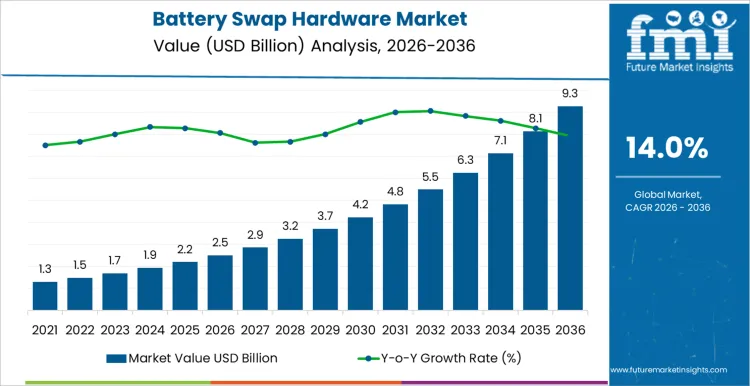
Battery Swap Hardware Market Key Takeaways
| Metric | Value |
|---|---|
| Battery Swap Hardware Market Value (2026) | USD 2.5 Billion |
| Battery Swap Hardware Market Forecast Value (2036) | USD 9.3 Billion |
| Battery Swap Hardware Market Forecast CAGR (2026 to 2036) | 14.0% |
How are Fleet Uptime Requirements and Infrastructure Standardization Driving the Battery Swap Hardware Market?
The battery swap hardware market is expanding as EV operators prioritize maximum vehicle uptime and predictable energy replenishment over charging dwell time. Two-wheelers, three-wheelers, taxis, and commercial delivery fleets are adopting battery swapping to eliminate charging downtime and decouple vehicle utilization from grid constraints. For hardware manufacturers, demand is increasingly driven by automated swap stations, robotic handling systems, and modular battery racks that support high-throughput, round-the-clock operation.
Standardization and interoperability are shaping procurement decisions. Fleet operators and mobility platforms favor swap hardware that supports standardized battery form factors, automated authentication, and seamless integration with fleet management and billing systems. This is pushing suppliers to design hardware platforms that can scale across vehicle models and geographies while maintaining safety, alignment accuracy, and fast mechanical exchange. Vendors that can align hardware design with battery management systems and software platforms are gaining preferred status in multi-city deployments.
Deployment economics and site scalability are further accelerating market growth. Swap stations are being evaluated on installation footprint, throughput capacity, maintenance requirements, and total cost per swap. Energy companies and infrastructure investors are partnering with hardware suppliers to roll out dense swap networks, particularly in urban Asia and emerging markets. For manufacturers and system integrators, competitive advantage increasingly depends on reliability, modular expansion capability, and the ability to support large-scale deployments positioning battery swap hardware as a critical enabler of high-utilization EV mobility ecosystems.
How Is the Battery Swap Hardware Market Structured By Station Type and Hardware Scope?
The battery swap hardware market is segmented by station type and hardware scope, reflecting how automation level, swap speed, and operational scale shape infrastructure design. By station type, robotic auto-swap stations lead adoption, driven by demand for fast, standardized battery exchange with minimal human intervention. Other station types include manual or assisted swap bays and battery cabinets for two- and three-wheelers, which address lower-capacity and space-constrained deployments. By hardware scope, swap mechanism and robotics represent the largest component group, while battery storage and BMS racks, power electronics and chargers, and site infrastructure support safe operation, energy management, and system integration.
Why Do Robotic Auto-Swap Stations Lead Station Type Adoption in the Battery Swap Hardware Market?
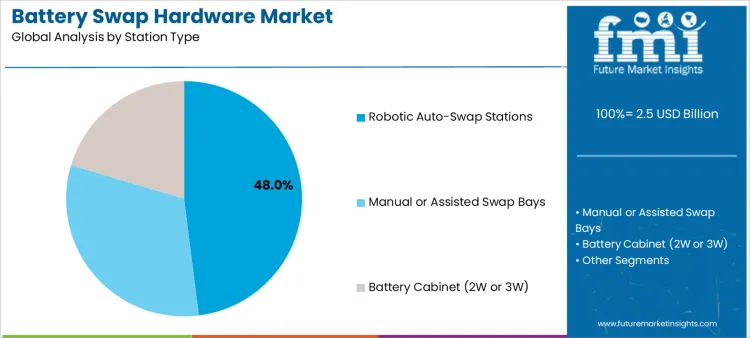
Robotic auto-swap stations account for 48% share of the battery swap hardware market because they enable rapid, repeatable battery exchange with high positional accuracy. Automated systems reduce swap time to a few minutes, improving vehicle uptime for fleets and high-utilization users. Robotics eliminate manual handling risks and ensure consistent alignment, locking, and electrical connection across standardized battery packs. Operators value automation for scalability, as stations can handle higher throughput without proportional labor increases. Integration with software platforms supports authentication, diagnostics, and inventory control. These speed, reliability, and scalability advantages explain why robotic auto-swap stations dominate station type adoption.
Why Do Swap Mechanism And Robotics Dominate The Hardware Scope Segment?
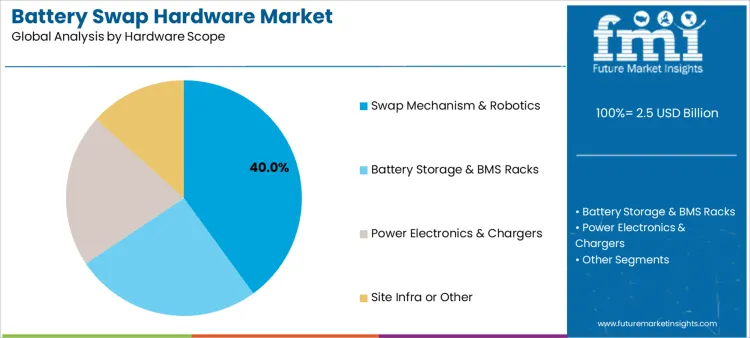
Swap mechanism and robotics hold 40% share of the battery swap hardware market because they form the functional core of automated swapping operations. Precision actuators, robotic arms, alignment systems, and locking mechanisms directly determine swap speed, safety, and reliability. These components must withstand frequent cycles, varying battery weights, and outdoor operating conditions. For outdoor stations, suppliers increasingly specify battery pack sealants that protect enclosures and interfaces against ingress and washdown exposure. OEMs and operators prioritize robust mechanical design to minimize downtime and maintenance. Hardware customization is often required for different vehicle platforms, increasing engineering value within this scope. For suppliers, swap mechanisms represent high-value components with recurring upgrade and replacement demand, explaining their dominance within hardware scope.
What Are The Key Dynamics Of The Battery Swap Hardware Market?
The battery swap hardware market is driven by the need for rapid energy replenishment systems that overcome long charging times associated with conventional battery electric vehicles (EVs) and e-mobility fleets. Battery swapping stations and modular hardware enable users to exchange depleted battery packs for fully charged units in minutes, supporting high utilization rates for shared mobility, taxis, delivery fleets, and two- and three-wheelers. For hardware OEMs and system integrators, standardized pack interfaces, mechanical alignment accuracy, robust thermal and safety features, and integration with swap automation and fleet management platforms are core factors that influence adoption and long-term partnerships with ecosystem operators.
How Are Technology And Operational Trends Shaping This Market?
Technology and operational trends are shaping the battery swap hardware market through automated handling systems, modular battery designs, and real-time diagnostics. Automated robotic systems, guided vehicles, and precision kinematics streamline battery insertion and removal, reducing turnaround times and minimizing wear on packs. Standardized mechanical and electrical interfaces across vehicle and battery OEMs enhance interoperability and reduce complexity for fleet operators. Integration of sensors and digital control systems enables remote monitoring of swap station performance, battery condition, and safety parameters. For hardware suppliers, offering flexible station architectures that support different vehicle classes and scalable layouts improves relevance across varied mobility segments.
Why Do Standardization, Infrastructure, And Cost Challenges Restrain Market Growth?
Standardization, infrastructure, and cost challenges restrain growth in the battery swap hardware market due to ecosystem dependencies and high upfront investment requirements. Lack of universal battery pack standards across OEMs requires customized hardware solutions, increasing design and qualification effort for swap stations and limiting network interoperability. Building and deploying swap stations especially in urban and high-density areas requires significant capital expenditure for land, electrical infrastructure, automated systems, and safety systems. Operational costs associated with battery inventory management, safety compliance, and maintenance also affect return-on-investment timelines for fleet operators. These factors can slow network rollout and constrain adoption outside targeted commercial segments.
What Is The Country-Wise Growth Outlook For The Battery Swap Hardware Market?
The battery swap hardware market is expanding rapidly as mobility providers, OEMs, and fleet operators explore alternatives to conventional charging to reduce vehicle downtime and improve utilization. Battery swap systems enable fast energy replenishment by mechanically exchanging depleted battery packs with charged units, supported by robotic handling, standardized pack interfaces, and automated control software. Growth varies by country based on EV fleet density, standardization efforts, urban mobility models, and investment in swapping infrastructure. High-growth markets are driven by two- and three-wheeler electrification and fleet-based applications, while mature automotive regions focus on pilot deployments and platform compatibility.
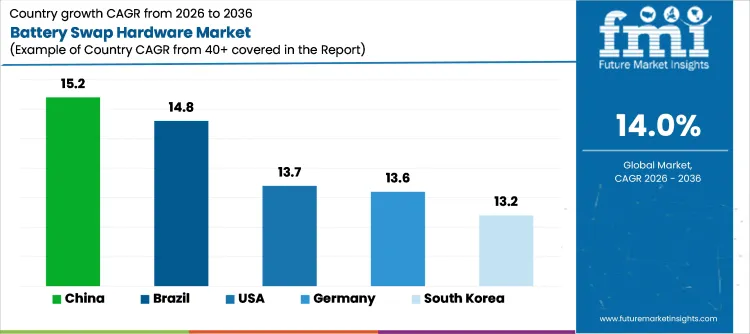
| Country | CAGR (%) |
|---|---|
| China | 15.2 |
| Brazil | 14.8 |
| United States | 13.7 |
| Germany | 13.6 |
| South Korea | 13.2 |
Why Is China Dominating The Battery Swap Hardware Market?
Demand for battery swap hardware in China is expanding at a CAGR of 15.2% during 2026 to 2036, driven by large-scale deployment of battery swapping across two-wheelers, taxis, commercial fleets, and selected passenger EV platforms. China leads in standardization of battery pack formats and integration of automated swapping stations into dense urban mobility networks. Hardware demand is centered on robotic swapping mechanisms, alignment systems, lifting platforms, and safety interlocks designed for high-throughput, round-the-clock operation. Buyers prioritize mechanical reliability, fast cycle times, and compatibility with standardized battery architectures. Adoption is strongly supported by fleet operators seeking to maximize vehicle uptime and reduce charging bottlenecks. Procurement decisions favor suppliers with proven field performance, scalable manufacturing capacity, and close alignment with vehicle OEMs and energy operators.
Why Is Brazil Emerging As A High-Growth Market For Battery Swap Hardware?
Sale of battery swap hardware in Brazil is growing at a CAGR of 14.8% during 2026 to 2036, supported by rapid electrification of two- and three-wheelers, delivery fleets, and urban mobility services. Battery swapping is gaining traction as a practical solution to address charging infrastructure gaps and reduce vehicle downtime in dense cities. Hardware demand focuses on modular swap cabinets, automated locking systems, and robust handling mechanisms suited for high-frequency use. Buyers emphasize affordability, durability, and ease of installation in constrained urban environments. Adoption is largely fleet-driven, with logistics and last-mile delivery operators leading early deployments. Procurement decisions are influenced by total cost of ownership, local service availability, and adaptability to mixed vehicle platforms. Brazil represents an emerging growth market where success depends on scalable hardware designs, localized manufacturing or assembly, and strong partnerships with fleet operators and mobility service providers.
How Is The United States Advancing Battery Swap Hardware Adoption?
The United States battery swap hardware market is expanding at a CAGR of 13.7% during 2026 to 2036, driven by growing interest in fleet electrification and operational efficiency. Battery swapping is being explored primarily for commercial fleets, autonomous vehicles, and shared mobility applications where uptime is critical. Hardware demand centers on high-precision robotic systems, advanced alignment sensors, and safety-certified mechanical components. Buyers prioritize reliability, integration with vehicle platforms, and compliance with stringent safety and automation standards. Adoption is largely pilot-led, with deployments focused on controlled fleet environments rather than mass consumer use. Procurement decisions favor suppliers with strong engineering capabilities, testing expertise, and ability to customize hardware for specific vehicle platforms. The USA represents a technology-driven market where supplier success depends on engineering sophistication, regulatory alignment, and early involvement in next-generation mobility programs.
How Is Germany Integrating Battery Swap Hardware Into Structured EV Ecosystems?
Sale of battery swap hardware in Germany is growing at a CAGR of 13.6% during 2026 to 2036, shaped by methodical adoption within premium automotive and industrial fleet segments. German stakeholders emphasize engineering precision, safety compliance, and seamless integration with vehicle platforms. Hardware demand focuses on high-accuracy robotic systems, durable mechanical interfaces, and advanced diagnostics to ensure repeatable swap performance. Adoption is cautious and often limited to pilot programs for fleets and shared mobility services. Procurement decisions involve extensive validation, simulation, and certification processes. Market value is driven by high-specification hardware deployments and long development cycles rather than rapid rollout. Germany represents a quality-driven market where supplier success depends on engineering credibility, documentation strength, and ability to meet exacting performance and safety standards.
Why Is South Korea Accelerating Battery Swap Hardware Development?
South Korea’s battery swap hardware market is expanding at a CAGR of 13.2% during 2026 to 2036, supported by strong integration between EV manufacturers, battery producers, and robotics technology providers. Battery swapping is being explored for commercial fleets and urban mobility solutions where efficiency and compact design are critical. Hardware demand emphasizes precision mechanisms, compact footprints, and compatibility with high-energy battery packs. Buyers prioritize automation reliability, cycle durability, and seamless software-hardware integration. Adoption is driven by export-oriented mobility platforms and technology demonstration projects. Procurement decisions favor suppliers with advanced manufacturing automation and materials expertise. South Korea represents a performance-focused market where success depends on precision engineering, innovation capability, and close collaboration with battery and vehicle OEMs.
How Are Hardware Providers Competing in the Battery Swap Hardware Market?
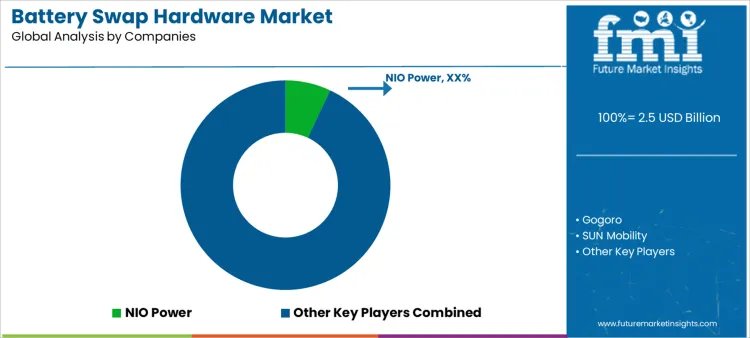
Competition in the battery swap hardware market is shaped by swap speed, mechanical reliability, standardization depth, and integration with vehicle platforms and energy networks. NIO Power leads the premium passenger EV segment with fully automated swap stations engineered for high throughput and minimal human intervention. Its hardware strategy emphasizes precise robotic alignment, thermal management during swaps, and seamless integration with vehicle control systems, enabling sub-5-minute battery exchanges at scale. Gogoro dominates the two-wheeler segment through compact, modular swap cabinets designed for dense urban deployment, with hardware optimized for high daily swap cycles and standardized battery form factors.
Emerging market players compete on adaptability and cost-efficient hardware design. SUN Mobility positions its swap stations around modular, vehicle-agnostic hardware that supports mixed fleets of two- and three-wheelers. Ample differentiates through flexible, drop-in swap hardware designed to retrofit existing EV platforms without redesigning vehicles, focusing on rapid installation and grid-friendly operation. Aulton competes in commercial fleets with heavy-duty swap hardware engineered for taxis and logistics vehicles, emphasizing durability and high utilization rates.
OEM-backed ecosystems strengthen competitive positioning through vertical integration. CATL EVOGO anchors its hardware strategy on standardized “choco-SEB” battery blocks and compatible swap stations designed to scale across multiple OEMs. KYMCO (Ionex) and BAIC BluePark deploy proprietary swap hardware aligned with in-house vehicle platforms. Pilot initiatives from Hero MotoCorp, Ather Energy, and Hyundai Motor Group explore hardware viability for broader vehicle classes. Across the market, competitive advantage is defined by hardware reliability, standardization scalability, and ecosystem integration rather than standalone station cost.
Key Players in Battery Swap Hardware Market
- NIO Power
- Gogoro
- SUN Mobility
- Ample
- Aulton
- CATL EVOGO (hardware)
- KYMCO Ionex
- BAIC BluePark
- Hero‑Ather Operators (HW)
- Hyundai‑Kia pilots
Scope of Report
| Attribute | Details |
|---|---|
| Market Size Unit | USD Billion |
| Station Type Covered | Robotic Auto-Swap Stations, Manual or Assisted Swap Bays, Battery Cabinet Systems for Two-Wheelers and Three-Wheelers |
| Hardware Scope Covered | Swap Mechanism & Robotics, Battery Storage & BMS Racks, Power Electronics & Chargers, Site Infrastructure & Auxiliary Hardware |
| Countries Covered | China, Japan, South Korea, India, Australia & New Zealand, ASEAN, Rest of Asia Pacific, Germany, United Kingdom, France, Italy, Spain, Nordic, BENELUX, Rest of Europe, United States, Canada, Mexico, Brazil, Chile, Rest of Latin America, Kingdom of Saudi Arabia, Other GCC Countries, Turkey, South Africa, Other African Union, Rest of Middle East & Africa |
| Regions Covered | Asia Pacific, Europe, North America, Latin America, Middle East & Africa |
| Key Companies Profiled | NIO Power, Gogoro, SUN Mobility, Ample, Aulton, CATL EVOGO (hardware), KYMCO Ionex, BAIC BluePark, Hero-Ather Operators, Hyundai-Kia Pilot Programs |
| Additional Attributes | Dollar sales by station type and hardware scope are analyzed across two-wheeler, passenger EV, and fleet applications. The scope evaluates automation intensity, swap cycle time, hardware interoperability, grid connectivity, and energy management. Country-level assessment reflects urban EV density, fleet electrification programs, and rollout of battery-as-a-service infrastructure. |
Battery Swap Hardware Market by Key Segments
Station Type:
- Robotic Auto‑Swap Stations
- Manual or Assisted Swap Bays
- Battery Cabinet (2W or 3W)
Hardware Scope:
- Swap Mechanism & Robotics
- Battery Storage & BMS Racks
- Power Electronics & Chargers
- Site Infra or Other
Region:
- Asia Pacific
- China
- Japan
- South Korea
- India
- Australia & New Zealand
- ASEAN
- Rest of Asia Pacific
- Europe
- Germany
- United Kingdom
- France
- Italy
- Spain
- Nordic
- BENELUX
- Rest of Europe
- North America
- United States
- Canada
- Mexico
- Latin America
- Brazil
- Chile
- Rest of Latin America
- Middle East & Africa
- Kingdom of Saudi Arabia
- Other GCC Countries
- Turkey
- South Africa
- Other African Union
- Rest of Middle East & Africa
Bibiliography
- International Energy Agency. (2023). Trends in charging infrastructure - Global EV Outlook 2023. International Energy Agency.
- International Electrotechnical Commission. (2025). Electric vehicle battery swap system - Part 2: Safety requirements (IEC 62840-2:2025).
- International Electrotechnical Commission. (2025). Electric vehicle battery swap system - Part 1: General and guidance (IEC 62840-1:2025).
- Press Information Bureau, Government of India. (2025, August 5). E-Mobility: Standards & Battery Swapping Recommendations.
- World Bank. (2024). E-Mobility Transition in Vietnam: Challenges and Opportunities for Sustainable Transport.
Frequently Asked Questions
How big is the battery swap hardware market in 2026?
The global battery swap hardware market is estimated to be valued at USD 2.5 billion in 2026.
What will be the size of battery swap hardware market in 2036?
The market size for the battery swap hardware market is projected to reach USD 9.3 billion by 2036.
How much will be the battery swap hardware market growth between 2026 and 2036?
The battery swap hardware market is expected to grow at a 14.0% CAGR between 2026 and 2036.
What are the key product types in the battery swap hardware market?
The key product types in battery swap hardware market are robotic auto‑swap stations, manual or assisted swap bays and battery cabinet (2w or 3w).
Which hardware scope segment to contribute significant share in the battery swap hardware market in 2026?
In terms of hardware scope, swap mechanism & robotics segment to command 40.0% share in the battery swap hardware market in 2026.
Preview the report firsthand - request a free sample
Get SampleGet the brochure for pricing and purchase details.
Get PDFTable of Content
- Executive Summary
- Global Market Outlook
- Demand-side Trends
- Supply-side Trends
- Technology Roadmap Analysis
- Analysis and Recommendations
- Market Overview
- Market Coverage / Taxonomy
- Market Definition / Scope / Limitations
- Market Background
- Market Dynamics
- Drivers
- Restraints
- Opportunity
- Trends
- Scenario Forecast
- Demand in Optimistic Scenario
- Demand in Likely Scenario
- Demand in Conservative Scenario
- Opportunity Map Analysis
- Product Life Cycle Analysis
- Supply Chain Analysis
- Investment Feasibility Matrix
- Value Chain Analysis
- PESTLE and Porter’s Analysis
- Regulatory Landscape
- Regional Parent Market Outlook
- Production and Consumption Statistics
- Import and Export Statistics
- Market Dynamics
- Global Market Analysis 2021 to 2025 and Forecast, 2026 to 2036
- Historical Market Size Value (USD Million) Analysis, 2021 to 2025
- Current and Future Market Size Value (USD Million) Projections, 2026 to 2036
- Y-o-Y Growth Trend Analysis
- Absolute $ Opportunity Analysis
- Global Market Pricing Analysis 2021 to 2025 and Forecast 2026 to 2036
- Global Market Analysis 2021 to 2025 and Forecast 2026 to 2036, By Station Type
- Introduction / Key Findings
- Historical Market Size Value (USD Million) Analysis By Station Type , 2021 to 2025
- Current and Future Market Size Value (USD Million) Analysis and Forecast By Station Type , 2026 to 2036
- Robotic Auto‑Swap Stations
- Manual or Assisted Swap Bays
- Battery Cabinet (2W or 3W)
- Robotic Auto‑Swap Stations
- Y-o-Y Growth Trend Analysis By Station Type , 2021 to 2025
- Absolute $ Opportunity Analysis By Station Type , 2026 to 2036
- Global Market Analysis 2021 to 2025 and Forecast 2026 to 2036, By Hardware Scope
- Introduction / Key Findings
- Historical Market Size Value (USD Million) Analysis By Hardware Scope, 2021 to 2025
- Current and Future Market Size Value (USD Million) Analysis and Forecast By Hardware Scope, 2026 to 2036
- Swap Mechanism & Robotics
- Battery Storage & BMS Racks
- Power Electronics & Chargers
- Site Infra or Other
- Swap Mechanism & Robotics
- Y-o-Y Growth Trend Analysis By Hardware Scope, 2021 to 2025
- Absolute $ Opportunity Analysis By Hardware Scope, 2026 to 2036
- Global Market Analysis 2021 to 2025 and Forecast 2026 to 2036, By Region
- Introduction
- Historical Market Size Value (USD Million) Analysis By Region, 2021 to 2025
- Current Market Size Value (USD Million) Analysis and Forecast By Region, 2026 to 2036
- North America
- Latin America
- Western Europe
- Eastern Europe
- East Asia
- South Asia and Pacific
- Middle East & Africa
- Market Attractiveness Analysis By Region
- North America Market Analysis 2021 to 2025 and Forecast 2026 to 2036, By Country
- Historical Market Size Value (USD Million) Trend Analysis By Market Taxonomy, 2021 to 2025
- Market Size Value (USD Million) Forecast By Market Taxonomy, 2026 to 2036
- By Country
- USA
- Canada
- Mexico
- By Station Type
- By Hardware Scope
- By Country
- Market Attractiveness Analysis
- By Country
- By Station Type
- By Hardware Scope
- Key Takeaways
- Latin America Market Analysis 2021 to 2025 and Forecast 2026 to 2036, By Country
- Historical Market Size Value (USD Million) Trend Analysis By Market Taxonomy, 2021 to 2025
- Market Size Value (USD Million) Forecast By Market Taxonomy, 2026 to 2036
- By Country
- Brazil
- Chile
- Rest of Latin America
- By Station Type
- By Hardware Scope
- By Country
- Market Attractiveness Analysis
- By Country
- By Station Type
- By Hardware Scope
- Key Takeaways
- Western Europe Market Analysis 2021 to 2025 and Forecast 2026 to 2036, By Country
- Historical Market Size Value (USD Million) Trend Analysis By Market Taxonomy, 2021 to 2025
- Market Size Value (USD Million) Forecast By Market Taxonomy, 2026 to 2036
- By Country
- Germany
- UK
- Italy
- Spain
- France
- Nordic
- BENELUX
- Rest of Western Europe
- By Station Type
- By Hardware Scope
- By Country
- Market Attractiveness Analysis
- By Country
- By Station Type
- By Hardware Scope
- Key Takeaways
- Eastern Europe Market Analysis 2021 to 2025 and Forecast 2026 to 2036, By Country
- Historical Market Size Value (USD Million) Trend Analysis By Market Taxonomy, 2021 to 2025
- Market Size Value (USD Million) Forecast By Market Taxonomy, 2026 to 2036
- By Country
- Russia
- Poland
- Hungary
- Balkan & Baltic
- Rest of Eastern Europe
- By Station Type
- By Hardware Scope
- By Country
- Market Attractiveness Analysis
- By Country
- By Station Type
- By Hardware Scope
- Key Takeaways
- East Asia Market Analysis 2021 to 2025 and Forecast 2026 to 2036, By Country
- Historical Market Size Value (USD Million) Trend Analysis By Market Taxonomy, 2021 to 2025
- Market Size Value (USD Million) Forecast By Market Taxonomy, 2026 to 2036
- By Country
- China
- Japan
- South Korea
- By Station Type
- By Hardware Scope
- By Country
- Market Attractiveness Analysis
- By Country
- By Station Type
- By Hardware Scope
- Key Takeaways
- South Asia and Pacific Market Analysis 2021 to 2025 and Forecast 2026 to 2036, By Country
- Historical Market Size Value (USD Million) Trend Analysis By Market Taxonomy, 2021 to 2025
- Market Size Value (USD Million) Forecast By Market Taxonomy, 2026 to 2036
- By Country
- India
- ASEAN
- Australia & New Zealand
- Rest of South Asia and Pacific
- By Station Type
- By Hardware Scope
- By Country
- Market Attractiveness Analysis
- By Country
- By Station Type
- By Hardware Scope
- Key Takeaways
- Middle East & Africa Market Analysis 2021 to 2025 and Forecast 2026 to 2036, By Country
- Historical Market Size Value (USD Million) Trend Analysis By Market Taxonomy, 2021 to 2025
- Market Size Value (USD Million) Forecast By Market Taxonomy, 2026 to 2036
- By Country
- Kingdom of Saudi Arabia
- Other GCC Countries
- Turkiye
- South Africa
- Other African Union
- Rest of Middle East & Africa
- By Station Type
- By Hardware Scope
- By Country
- Market Attractiveness Analysis
- By Country
- By Station Type
- By Hardware Scope
- Key Takeaways
- Key Countries Market Analysis
- USA
- Pricing Analysis
- Market Share Analysis, 2025
- By Station Type
- By Hardware Scope
- Canada
- Pricing Analysis
- Market Share Analysis, 2025
- By Station Type
- By Hardware Scope
- Mexico
- Pricing Analysis
- Market Share Analysis, 2025
- By Station Type
- By Hardware Scope
- Brazil
- Pricing Analysis
- Market Share Analysis, 2025
- By Station Type
- By Hardware Scope
- Chile
- Pricing Analysis
- Market Share Analysis, 2025
- By Station Type
- By Hardware Scope
- Germany
- Pricing Analysis
- Market Share Analysis, 2025
- By Station Type
- By Hardware Scope
- UK
- Pricing Analysis
- Market Share Analysis, 2025
- By Station Type
- By Hardware Scope
- Italy
- Pricing Analysis
- Market Share Analysis, 2025
- By Station Type
- By Hardware Scope
- Spain
- Pricing Analysis
- Market Share Analysis, 2025
- By Station Type
- By Hardware Scope
- France
- Pricing Analysis
- Market Share Analysis, 2025
- By Station Type
- By Hardware Scope
- India
- Pricing Analysis
- Market Share Analysis, 2025
- By Station Type
- By Hardware Scope
- ASEAN
- Pricing Analysis
- Market Share Analysis, 2025
- By Station Type
- By Hardware Scope
- Australia & New Zealand
- Pricing Analysis
- Market Share Analysis, 2025
- By Station Type
- By Hardware Scope
- China
- Pricing Analysis
- Market Share Analysis, 2025
- By Station Type
- By Hardware Scope
- Japan
- Pricing Analysis
- Market Share Analysis, 2025
- By Station Type
- By Hardware Scope
- South Korea
- Pricing Analysis
- Market Share Analysis, 2025
- By Station Type
- By Hardware Scope
- Russia
- Pricing Analysis
- Market Share Analysis, 2025
- By Station Type
- By Hardware Scope
- Poland
- Pricing Analysis
- Market Share Analysis, 2025
- By Station Type
- By Hardware Scope
- Hungary
- Pricing Analysis
- Market Share Analysis, 2025
- By Station Type
- By Hardware Scope
- Kingdom of Saudi Arabia
- Pricing Analysis
- Market Share Analysis, 2025
- By Station Type
- By Hardware Scope
- Turkiye
- Pricing Analysis
- Market Share Analysis, 2025
- By Station Type
- By Hardware Scope
- South Africa
- Pricing Analysis
- Market Share Analysis, 2025
- By Station Type
- By Hardware Scope
- USA
- Market Structure Analysis
- Competition Dashboard
- Competition Benchmarking
- Market Share Analysis of Top Players
- By Regional
- By Station Type
- By Hardware Scope
- Competition Analysis
- Competition Deep Dive
- NIO Power
- Overview
- Product Portfolio
- Profitability by Market Segments (Product/Age /Sales Channel/Region)
- Sales Footprint
- Strategy Overview
- Marketing Strategy
- Product Strategy
- Channel Strategy
- Gogoro
- SUN Mobility
- Ample
- Aulton
- CATL EVOGO (hardware)
- KYMCO Ionex
- BAIC BluePark
- Hero‑Ather Operators (HW)
- Hyundai‑Kia pilots
- NIO Power
- Competition Deep Dive
- Assumptions & Acronyms Used
- Research Methodology


