

- Industry Size (2026)
- USD 103.81 Mn
- Forecast (2036)
- USD 200.42 Mn
- CAGR (2026 to 2036)
- 6.8%
Betanin Food Color Market Size, Market Forecast and Outlook By FMI
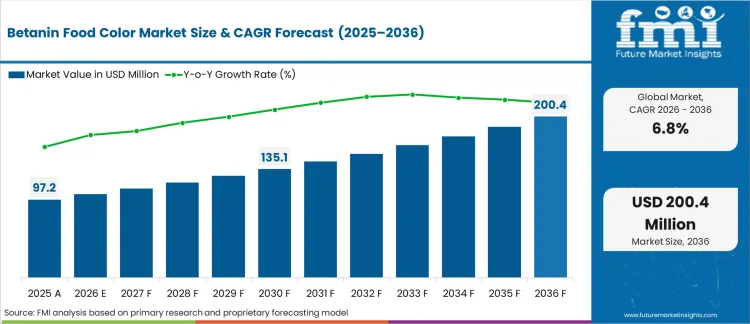
In 2025, the Betanin Food Color market was valued at USD 97.20 million. Based on Future Market Insights' analysis, demand is estimated to grow to USD 103.81 million in 2026 and USD 200.42 million by 2036. FMI projects a CAGR of 6.8% during the forecast period.
The absolute dollar expansion from 2026 to 2036 amounts to approximately USD 96.61 million. Growth is structurally driven by the global clean-label movement and regulatory pressure to replace artificial food dyes with natural colorant alternatives across food and beverage manufacturing. The European Union's stringent requirements for artificial food color warning labelling under Regulation (EC) No 1333/2008 and growing consumer demand for natural ingredient declarations are accelerating betanin adoption in beverage, bakery, confectionery, and dairy product formulations. Growth constraints include betanin's thermal and pH sensitivity, which limits its application stability in high-temperature processed and high-acid food and beverage products without encapsulation or stabilisation technology, and the higher cost of natural betanin relative to synthetic red colorant alternatives.
Summary of Betanin Food Color Market
- Betanin Food Color Market Definition
- Market players are focusing on investing in R&D to develop functional ingredients with enhanced health benefits and sensory properties. They are diversifying product portfolios to meet diverse consumer needs and making strategic partnerships with companies, to leverage expertise and accelerate innovation.
- Demand Drivers in the Market
- Rising demand for betanin food color across food processing and industrial applications accelerates procurement volumes among large-scale manufacturers targeting cost efficiency.
- Expanding powder adoption within United States and adjacent high-growth economies drives volume commitments that justify dedicated supply chain investments.
- Regulatory and sustainability mandates compel formulation teams to source certified betanin food color inputs, shifting purchasing decisions toward verified, compliant suppliers.
- Key Segments Analyzed in the FMI Report
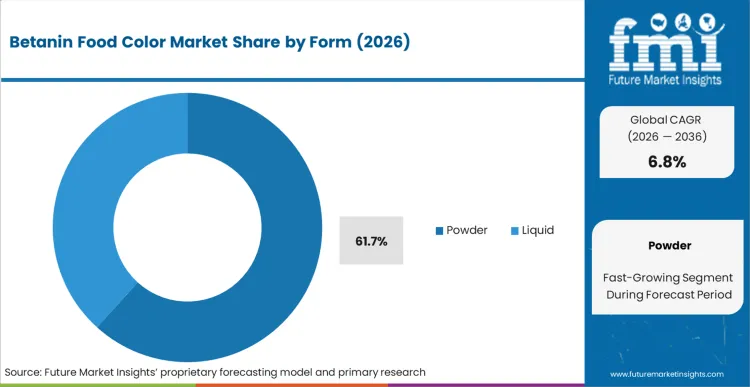
- Powder: 61.7% share in 2026, representing the dominant category as buyers prioritize established powder configurations that align with existing processing and formulation infrastructure.
- Beverage: 28.4% share in 2026, driven by end-use applications where beverage characteristics deliver measurable performance advantages over alternative product forms.
- United States: 4.6% compound growth anchored by expanding manufacturing capacity and government-supported industrial development programs targeting betanin food color production and processing.
- Analyst Opinion at FMI
- Nandini Roy Choudhury, Principal Consultant for Food & Beverage opines: 'In my analysis of the Betanin Food Color Market, I observe that the central procurement challenge is not product availability but supplier qualification and traceability. Buyers consolidating volumes around powder face concentration risk when Tier-1 suppliers cannot demonstrate regulatory compliance documentation at scale. United States and comparable high-growth markets at 4.6% CAGR signal structural demand expansion, yet the absence of standardized procurement frameworks creates margin compression for distributors operating without certified channel agreements. Executives who delay formalizing supplier diversification strategies will find their cost structures exposed once regulatory enforcement cycles intensify across major importing economies.'
- Strategic Implications / Executive Takeaways
- Suppliers must establish verified certification pathways for betanin food color to qualify for procurement tenders issued by large food, health, and industrial buyers.
- Investment priorities should target capacity expansion in high-CAGR geographies to capture incremental demand before supply concentration shifts pricing power.
- Product development teams should align betanin food color formulations with evolving regulatory thresholds in the European Union, United States, and Asia Pacific to maintain market access.
- Methodology
- Primary Research: FMI conducted detailed technical interviews with procurement directors, formulation specialists, and supply chain engineers across 40 countries to validate adoption timelines and demand assumptions.
- Desk Research: Analysts aggregated public regulatory filings, trade association publications, government statistical releases, and company annual reports to establish verifiable baseline data.
- Market-Sizing and Forecasting: Forecasting models apply a bottom-up methodology starting with verified production capacity and consumption volume data, applying region-specific growth assumptions to project adoption trajectories.
- Data Validation and Update Cycle: Segment forecasts undergo cross-validation against publicly reported revenue volumes from leading industry participants and are updated on a rolling quarterly basis.
FMI analysts observe that the beverage application segment is the leading end use for betanin food color as beverage manufacturers replace synthetic red colorants in fruit drinks, flavored waters, energy drinks, and plant-based beverages where consumer demand for natural ingredient declarations is highest. Oterra's FruitMax beetroot-derived colorant range and Sensient Technologies' beetroot extract products supply betanin colorants to beverage manufacturers across Europe and North America seeking clean-label natural red color solutions.
Betanin Food Color Market Key Takeaways
| Metric | Details |
|---|---|
| Industry Size (2026) | USD 103.81 million |
| Industry Value (2036) | USD 200.42 million |
| CAGR (2026-2036) | 6.8% |
Betanin Food Color Market Definition
Betanin Food Color is a natural red-to-purple food colorant extracted from the root of Beta vulgaris (beetroot) that belongs to the betalain pigment class and provides vibrant red and purple hue in food and beverage applications. It is commercially supplied in powder and liquid formats for use as a clean-label natural alternative to synthetic red colorants such as Red 40 and carmine, offering additional antioxidant properties alongside its colorant function, and is applied across beverage, bakery, confectionery, dairy, meat, and sauce manufacturing applications where red, pink, and purple color effects are required.
Betanin Food Color Market Inclusions
The report covers global and regional market sizes for betanin food color across all form and end use application categories, forecast data from 2026 to 2036, and country-level CAGR analysis for USA, Germany, China, Japan, and India, with additional regional coverage across more than 40 countries.
Betanin Food Color Market Exclusions
The scope excludes other betalain pigments extracted from beetroot including betaxanthin yellow colorants where betanin is not the primary commercial colorant product, synthetic red and pink food dye products including Red 40 and carmine that compete as alternative colorant options, and complete beetroot extract and beetroot powder products sold as nutritional supplements or food ingredients for nutritional rather than colorant applications.
Betanin Food Color Market Research Methodology
- Primary Research: Analysts engaged with food colorant procurement managers at food and beverage manufacturers, natural colorant technical specialists at Oterra and Sensient Technologies, regulatory affairs specialists monitoring EU and FDA food additive regulations, and food product development teams across the USA, Germany, China, Japan, and India to validate demand volumes and reformulation trend assumptions.
- Desk Research: Data collection phases aggregated European Commission food additive regulation documentation under Regulation (EC) No 1333/2008, FDA color additive petition and approval records, beetroot agricultural production statistics from FAO, and company annual reports from Oterra, Sensient Technologies, and Archer Daniels Midland covering natural colorant segment reporting.
- Market-Sizing and Forecasting: Baseline values derive from a bottom-up aggregation of natural food colorant demand across key application segments, applying clean-label reformulation adoption rates and betanin market penetration assumptions by country and application to project forward market values across the 2026 to 2036 forecast period.
- Data Validation and Update Cycle: Projections are validated against publicly reported natural food ingredient market data from trade association publications, European Commission food additive usage monitoring reports, and company-level natural colorant revenue disclosures from Sensient Technologies annual reports.
Key Industry Highlights
Growing Demand for Natural Ingredients
More and more consumers want food products that are natural and free from artificial ingredients. This is also called as "clean label" movement. Consumers are becoming more aware of what they eat and prefer items that use simple, known ingredients. Due to this, natural colorants like betanin, which comes from beetroots, are becoming popular. Unlike synthetic colors, betanin is known as a healthier alternative. This growing demand for natural ingredients is boosting the use of betanin in many food products.
Innovative Uses of Betanin in Food Products
Food producers are getting innovative by using betanin in many different types of products. They are experimenting with this natural color to make beverages, snacks, and even desserts more appealing. For instance, betanin is added in smoothies for a bright color or in candies to give a fun look. This innovation helps companies in producing new products that catch the attention of consumers. Due to this, more unique and colorful food choices are available for consumers.
Improving Plant-Based Products with Betanin
The popularity of plant-based and vegan foods is growing as more individuals choose healthier diets. Many of these products avoid the use of artificial ingredients, which makes natural colorants like betanin a preferred choice. Food manufacturers are using betanin in plant-based products like meat alternatives, snacks, and dairy-free products. This not only meets consumer demand for natural ingredients but also enhances the appearance of plant-based foods, making them more attractive to consumers.
2020 to 2024 Global Betanin Food Color Sales Analysis Compared to Demand Forecasts for 2026 to 2036
Global Betanin Food Color sales increased at a CAGR of 5.0% from 2020 to 2024. For the next ten years (2026 to 2036), projections are that expenditure on Betanin Food Color will rise at 6.8% CAGR
Many countries are introducing stringent regulations about food additives to ensure safety and health for consumers. These regulations often limit or ban the use of synthetic colors, which can raise concerns among consumers. Due to this, food manufacturers are looking for natural options to meet these new standards.
Betanin is becoming a popular alternative because it is safe and effective. This shift towards natural ingredients not only helps companies meet up with regulations but also attracts health-conscious consumers, boosting the demand for betanin in the market.
The European Union has implemented regulations regarding food additives, particularly concerning artificial colors. For instance, the use of certain synthetic dyes, like Red 40 and Yellow 5, has faced increased investigation due to health concerns. As a result, many food manufacturers in the Europe have started replacing these artificial colors with natural alternatives like betanin.
Brands are using social media and influencer marketing to promote products that contain natural ingredients like betanin. By partnering with famous influencers, companies are reaching to a larger audience and conveying the benefits of using natural colorants.
These influencers usually product reviews, and tips, helping to educate consumers about the advantages of choosing natural options over artificial ones. This increased visibility not only increases awareness but also promotes consumers to try products including betanin. As more consumers are learning about its benefits, the demand for betanin in food products continues to grow.
Betanin Food Color Market Drivers, Restraints, and Opportunities
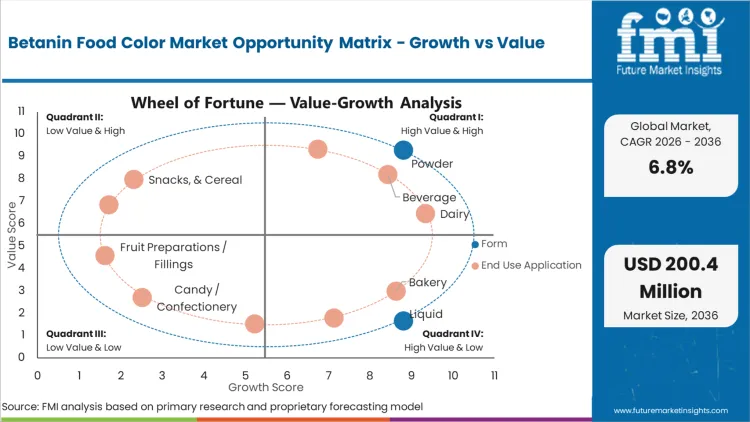
Future Market Insights analysis of the Betanin Food Color market shows the sector is in an accelerating-adoption phase driven by the convergence of clean-label consumer demand, regulatory restrictions on synthetic food colorants, and food manufacturer reformulation programmes targeting natural ingredient declarations across major product categories.
FMI analysts observe that beverage application represents the highest-value end use segment for betanin food color as the industry's most active clean-label reformulation sector, with Oterra's launch of FruitMax Red 116 WS specifically designed to address beverage colour stability challenges representing the category's most targeted product innovation. Sensient Technologies supplies customised betanin colorant formulations with improved heat and pH stability for expanded application across beverage and dairy processing conditions.
- Clean-Label Regulatory and Consumer Demand Accelerating Synthetic Colorant Replacement: The global clean-label movement and regulatory restrictions on synthetic red food dyes are creating mandatory and voluntary reformulation demand for natural betanin colorants across food and beverage manufacturing. The European Commission's Regulation (EC) No 1333/2008 requires warning labels on foods containing certain synthetic colorants, creating economic incentive for manufacturers to replace these dyes with natural alternatives including betanin. Oterra and Sensient Technologies supply EU-compliant natural beetroot-derived betanin colorants to European food manufacturers reformulating products to remove synthetic colorant warning label requirements, with Archer Daniels Midland supplying betanin color solutions to North American manufacturers responding to retailer clean-label requirements and state-level synthetic dye restriction measures.
- Beverage Sector Natural Colorant Adoption Driving Primary Betanin Demand: The food and beverage industry's beverage segment is the largest and most active adopter of natural betanin colorants as manufacturers replace synthetic Red 40 and carmine in fruit drinks, flavored sparkling waters, plant-based beverages, energy drinks, and sports drinks with clean-label natural red color solutions. Oterra's FruitMax beetroot-derived colorant range, including FruitMax Red 116 WS specifically developed for beverage applications, addresses the color stability challenges of betanin in high-acid carbonated beverage matrices. Kalsec and IFF supply betanin and betalain colorant solutions to multinational beverage manufacturers including those supplying private label and branded fruit drink products requiring natural color certification for retail listing in European and North American grocery channels.
- Plant-Based and Clean-Label Food Product Expansion Creating New Betanin Application Opportunities: The rapid growth of plant-based meat, dairy alternative, and clean-label packaged food product categories is creating new betanin food color application opportunities as manufacturers of plant-based burger patties, dairy-free yoghurts, and natural confectionery seek natural red and pink colorants that align with their clean-label and plant-derived ingredient positioning. BioconColors and Chemvera supply betanin colorants to plant-based food manufacturers requiring natural red color for plant-based meat products, fruit preparations, and confectionery formulations. The growing consumer preference for natural and recognisable ingredient declarations in packaged food products is creating retail buyer pressure across multiple food categories to replace synthetic colorants with natural alternatives, expanding the addressable application market for betanin beyond its established beverage sector base.
Regional Analysis
The Betanin Food Color market is analysed across North America, Europe, Asia Pacific, Latin America, and Middle East and Africa. FMI's analysis is based on proprietary forecasting model and primary research.
.webp "Top Country Growth Comparison Betanin Food Color Market Cagr (2026 2036)")
| Country / Region | CAGR (2026-2036) |
|---|---|
| India | 6.0% |
| Japan | 5.7% |
| China | 5.2% |
| Germany | 5.0% |
| United States | 4.6% |
Source: Future Market Insights (FMI) analysis, based on proprietary forecasting model and primary research
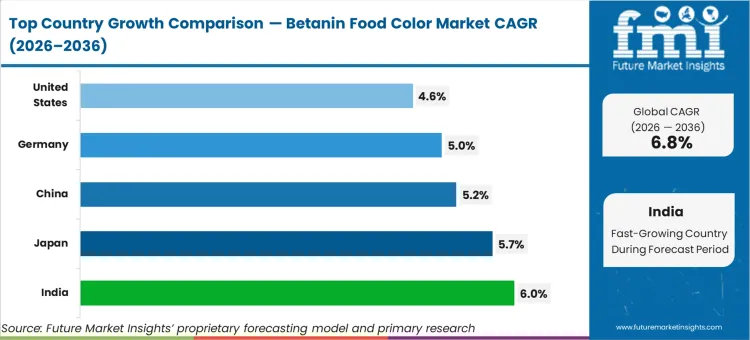
India leads country-level growth at 6.0% CAGR through 2036, driven by the growing domestic food and beverage manufacturing sector's adoption of natural colorants under FSSAI regulatory guidelines encouraging natural food additive use, and the expanding export-oriented food manufacturing sector requiring natural colorant certification for European and North American market compliance. Japan follows at 5.7% CAGR, with its established culture of natural ingredient preference in food manufacturing driving Kalsec and Kingherbs Limited to supply betanin colorants to Japanese beverage and confectionery manufacturers.
China advances at 5.2% CAGR, with Archer Daniels Midland Company and IFF supplying betanin food color to Chinese food manufacturers increasingly adopting natural colorants for domestic and export product formulations. Germany grows at 5.0% CAGR, driven by its strict European Commission food additive compliance requirements and strong consumer preference for natural ingredient declarations across the German food and beverage manufacturing sector. The United States advances at 4.6% CAGR, with Sensient Technologies and Oterra supplying betanin colorants to North American beverage and food manufacturers reformulating away from synthetic dyes in response to consumer clean-label demand and state-level synthetic dye restriction legislation.
Category-Wise Insights
Powder Form: Providing Convenience and Consistency in Food Coloring
| Segment | Powder (Form) |
|---|---|
| Value Share (2026) | 61.7% |
Powder form of betanin food color is gaining popularity because of its ease to use. Companies and home cooks find it convenient to measure and mix into different food products. The liquid form allows for accurate control over how bright or deep the color is, which makes it simple to get the desired look.
Additionally, liquid betanin dissolves quickly and evenly in food mixtures, which ensures that the color is consistent throughout the product. This is especially important for items like sauces and beverages, where uniform coloring is very important.
Moreover, liquid betanin has good shelf stability, which means it can last for a long time without losing its color quality. This makes it suitable for various food products that need a longer shelf life, such as packaged snacks and sauces.
Making Food Irresistible: Betanin's Contribution to Improving Appearance of Snacks and Bakery
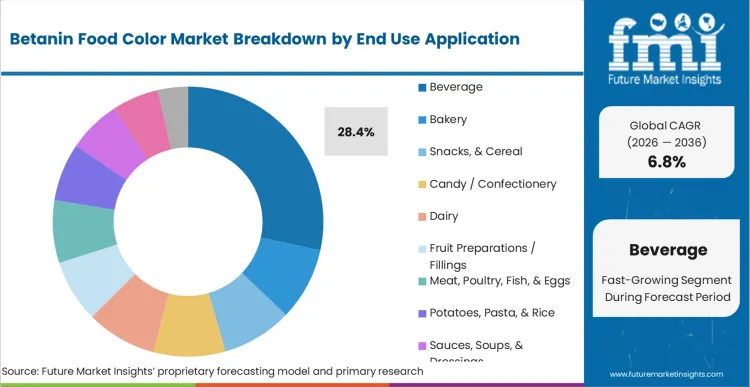
| Segment | Bakery, Snacks, & Cereal (End Use Application) |
|---|---|
| Value Share (2026) | 28.4% |
In the bakery and snack retail space, how the food looks is very important for attracting customers. Bright and appealing colors can make products stand out on store shelves and catch the eye of consumers. Betanin improves the appearance of baked goods, candies, and snacks. When products look good, they are more likely to be chosen by consumers. This target on appearance helps brands increase sales and attract more customers.
Competitive Aligners for Market Players
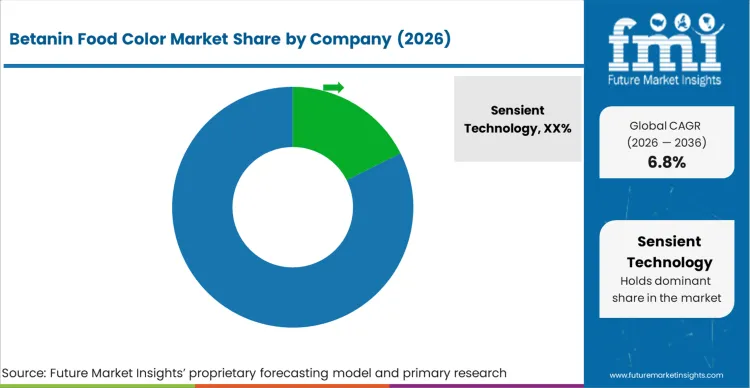
The Betanin Food Color market is moderately concentrated, with Oterra (formerly Chr. Hansen), Sensient Technologies, and Archer Daniels Midland holding leading global positions based on their natural colorant ingredient manufacturing capabilities, regulatory compliance documentation, and global food ingredient distribution networks. Kalsec and IFF compete as significant market participants with differentiated natural color product portfolios.
As per FMI, natural colorant producers with proprietary beetroot extraction, purification, and stabilisation technology platforms hold structural product differentiation advantages in the betanin market. Oterra's FruitMax platform and Sensient Technologies' customised stability solutions represent proprietary technologies that address betanin's natural sensitivity limitations and command premium ingredient pricing relative to commodity betanin extract products.
Buyer leverage among multinational food and beverage manufacturers is moderate, with reformulation decisions driven by regulatory compliance requirements and consumer research on clean-label ingredient acceptance rather than primarily by colorant ingredient cost. This dynamic supports natural colorant supplier pricing stability when regulatory drivers create mandatory or near-mandatory reformulation demand.
Recent Developments
- Oterra: launched FruitMax Red 116 WS, a water-soluble beetroot-derived betanin colorant product specifically formulated to address the color stability challenges of betanin in carbonated and high-acid beverage applications, at the Food Ingredients Europe trade show in November 2023, targeting European and North American beverage manufacturers reformulating away from synthetic red dyes.
- Sensient Technologies: introduced an expanded range of encapsulated betanin colorant products with improved heat processing stability for bakery and dairy application segments in January 2024, targeting food manufacturers requiring natural red colorants that maintain color integrity through high-temperature baking, pasteurisation, and retort processing conditions.
Key Players in Betanin Food Color Market
- Sensient Technologies
- Oterra (formerly Chr. Hansen Holding A/S)
- Archer Daniels Midland Company
- Kalsec Inc.
- IFF
- Mane
- BioconColors
- Chemvera
- Kingherbs Limited
Scope of the Report
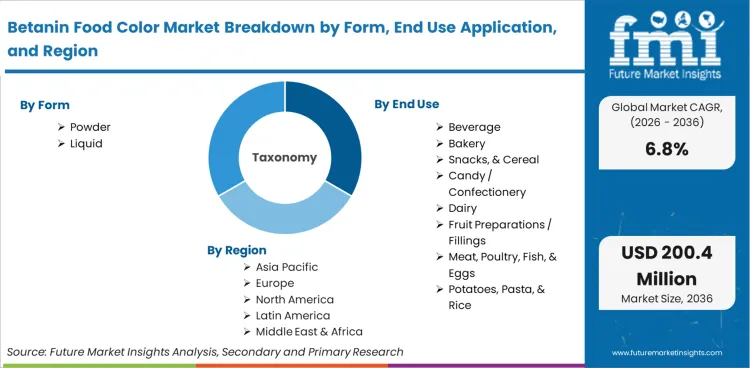
| Metric | Value |
|---|---|
| Quantitative Units | USD 103.81 million to USD 200.42 million, at a CAGR of 6.8% |
| Market Definition | Betanin Food Color is a natural red-to-purple food colorant extracted from the root of Beta vulgaris (beetroot) that belongs to the betalain pigment class and provides vibrant red and purple hue in fo... |
| Form Segmentation | Powder, Liquid |
| End Use Application Segmentation | Beverage, Bakery/Snacks/Cereal, Candy/Confectionery, Dairy, Fruit Preparations/Fillings, Meat/Poultry/Fish/Eggs, Sauces/Soups/Dressings, Seasonings, Pet Food |
| Regions Covered | North America, Latin America, Europe, East Asia, South Asia, Oceania, Middle East and Africa |
| Countries Covered | USA, Germany, China, Japan, India, and 40 plus countries |
| Forecast Period | 2026 to 2036 |
| Approach | Bottom-up methodology with country-specific demand curves validated against primary research |
| Key Companies Profiled | Sensient Technologies, Oterra (formerly Chr. Hansen Holding A/S), Archer Daniels Midland Company, Kalsec Inc., IFF, Mane, BioconColors, Chemvera, Kingherbs Limited |
Betanin Food Color Market Analysis by Segments
- Form Segmentation: Powder, Liquid
- End Use Application Segmentation: Beverage, Bakery/Snacks/Cereal, Candy/Confectionery, Dairy, Fruit Preparations/Fillings, Meat/Poultry/Fish/Eggs, Sauces/Soups/Dressings, Seasonings, Pet Food
- Regions Covered: North America, Latin America, Europe, East Asia, South Asia, Oceania, Middle East and Africa
- Countries Covered: USA, Germany, China, Japan, India, and 40 plus countries
Bibliography
- 1. Oterra A/S. (2024, January). FruitMax natural color portfolio: Product specifications and regulatory compliance documentation 2024. Oterra. https://www.oterra.com/
- 2. Sensient Technologies Corporation. (2024, February). Annual report 2023: Natural color and flavor ingredients segment revenue. Sensient Technologies.
- 3. European Commission. (2023, October). Regulation (EC) No 1333/2008 on food additives: Consolidated text including 2023 amendments. Official Journal of the European Union.
- 4. United States Food and Drug Administration (FDA). (2024, January). Color additives: Approved color additives and petitions status 2024. FDA.
- 5. Food and Agriculture Organization (FAO) and World Health Organization (WHO). (2023, July). JECFA evaluation: Betanin and beet red specifications and toxicology. FAO and WHO.
- 6. Archer Daniels Midland Company (ADM). (2024, February). Annual report 2023: Specialty ingredients and natural color products segment. ADM.
This Report Addresses
- Market sizing and quantitative forecast metrics covering global betanin food color industry value from USD 103.81 million in 2026 to USD 200.42 million by 2036 at 6.8% CAGR.
- Segmentation analysis mapping Powder form at 61.7% share and Beverage end use application at 28.4% share in 2026, with detailed end use coverage across bakery, confectionery, dairy, meat, and sauce manufacturing applications.
- Clean-label regulatory intelligence covering European Commission Regulation (EC) No 1333/2008 synthetic colorant warning label requirements driving manufacturer reformulation to natural betanin alternatives across food and beverage categories.
- Beverage application analysis covering the most active clean-label synthetic red colorant replacement segment, with Oterra's FruitMax Red 116 WS product specifically addressing betanin stability challenges in carbonated and high-acid beverage matrices.
- Plant-based food application intelligence covering betanin adoption in plant-based meat, dairy-free yoghurt, and natural confectionery formulations where natural red and pink colorant positioning aligns with clean-label ingredient declarations.
- Country-level CAGR analysis for India (6.0%), Japan (5.7%), China (5.2%), Germany (5.0%), and United States (4.6%), with regulatory and demand driver mapping by country.
- Competitive assessment tracking Oterra, Sensient Technologies, and ADM natural colorant manufacturing positions alongside specialty betanin suppliers BioconColors and Chemvera.
- Custom data delivery formats encompassing interactive dashboards, raw Excel datasets, and comprehensive PDF narrative reports.
Frequently Asked Questions
How large is the Betanin Food Color market in 2026?
The Betanin Food Color market is estimated to be valued at USD 103.81 million in 2026.
What will the Betanin Food Color market size be by 2036?
The Betanin Food Color market is projected to reach USD 200.42 million by 2036.
What is the expected CAGR for Betanin Food Color between 2026 and 2036?
The Betanin Food Color market is expected to grow at a CAGR of 6.8% between 2026 and 2036.
Which form leads the Betanin Food Color market in 2026?
Powder accounts for approximately 61.7% share in 2026, driven by its ease of handling, extended shelf life, and versatility across dry food and beverage mixing applications where manufacturers prefer powder colorant formats for production line efficiency and storage logistics.
Which end use application leads the Betanin Food Color market in 2026?
Beverage accounts for approximately 28.4% end use application share in 2026, reflecting the food and beverage industry's most active clean-label synthetic colorant replacement segment where fruit drink, flavored water, and plant-based beverage manufacturers are reformulating to natural red color solutions.
Which country leads growth in the Betanin Food Color market?
India leads country-level growth at 6.0% CAGR through 2036, driven by growing domestic food manufacturing sector adoption of natural colorants under FSSAI guidelines and expanding export-oriented food production requiring natural colorant certification for European and North American market compliance.
Which regulatory framework is most influential in driving betanin adoption?
The European Commission's Regulation (EC) No 1333/2008 requiring consumer warning labels on foods containing certain synthetic colorants is the primary regulatory driver creating economic incentive for European food and beverage manufacturers to replace synthetic red dyes with natural betanin colorants.
Preview the report firsthand - request a free sample
Get SampleGet the brochure for pricing and purchase details.
Get PDFTable of Content
- Executive Summary
- Global Market Outlook
- Demand-side Trends
- Supply-side Trends
- Technology Roadmap Analysis
- Analysis and Recommendations
- Market Overview
- Market Coverage / Taxonomy
- Market Definition / Scope / Limitations
- Research Methodology
- Chapter Orientation
- Analytical Lens and Working Hypotheses
- Market Structure, Signals, and Trend Drivers
- Benchmarking and Cross-market Comparability
- Market Sizing, Forecasting, and Opportunity Mapping
- Company Annual and Sustainability Reports
- Peer-reviewed Journals and Academic Literature
- Corporate Websites, Product Literature, and Technical Notes
- Earnings Decks and Investor Briefings
- Statutory Filings and Regulatory Disclosures
- Technical White Papers and Standards Notes
- Trade Journals, Industry Magazines, and Analyst Briefs
- Conference Proceedings, Webinars, and Seminar Materials
- Government Statistics Portals and Public Data Releases
- Press Releases and Reputable Media Coverage
- Specialist Newsletters and Curated Briefings
- Sector Databases and Reference Repositories
- FMI Internal Proprietary Databases and Historical Market Datasets
- Subscription Datasets and Paid Sources
- Social Channels, Communities, and Digital Listening Inputs
- Additional Desk Sources
- Expert Input and Fieldwork (Primary Evidence)
- Primary Modes
- Qualitative Interviews and Expert Elicitation
- Quantitative Surveys and Structured Data Capture
- Blended Approach
- Why Primary Evidence is Used
- Field Techniques
- Interviews
- Surveys
- Focus Groups
- Observational and In-context Research
- Social and Community Interactions
- Stakeholder Universe Engaged
- C-suite Leaders
- Board Members
- Presidents and Vice Presidents
- R&D and Innovation Heads
- Technical Specialists
- Domain Subject-matter Experts
- Scientists
- Physicians and Other Healthcare Professionals
- Governance, Ethics, and Data Stewardship
- Research Ethics
- Data Integrity and Handling
- Primary Modes
- Tooling, Models, and Reference Databases
- Data Engineering and Model Build
- Data Acquisition and Ingestion
- Cleaning, Normalisation, and Verification
- Synthesis, Triangulation, and Analysis
- Quality Assurance and Audit Trail
- Market Background
- Market Dynamics
- Drivers
- Restraints
- Opportunity
- Trends
- Scenario Forecast
- Demand in Optimistic Scenario
- Demand in Likely Scenario
- Demand in Conservative Scenario
- Opportunity Map Analysis
- Product Life Cycle Analysis
- Supply Chain Analysis
- Investment Feasibility Matrix
- Value Chain Analysis
- PESTLE and Porter’s Analysis
- Regulatory Landscape
- Regional Parent Market Outlook
- Production and Consumption Statistics
- Import and Export Statistics
- Market Dynamics
- Global Market Analysis 2021 to 2025 and Forecast, 2026 to 2036
- Historical Market Size Value (USD Million) Analysis, 2021 to 2025
- Current and Future Market Size Value (USD Million) Projections, 2026 to 2036
- Y-o-Y Growth Trend Analysis
- Absolute $ Opportunity Analysis
- Global Market Pricing Analysis 2021 to 2025 and Forecast 2026 to 2036
- Global Market Analysis 2021 to 2025 and Forecast 2026 to 2036, By Form
- Introduction / Key Findings
- Historical Market Size Value (USD Million) Analysis By Form , 2021 to 2025
- Current and Future Market Size Value (USD Million) Analysis and Forecast By Form , 2026 to 2036
- Powder
- Liquid
- Powder
- Y-o-Y Growth Trend Analysis By Form , 2021 to 2025
- Absolute $ Opportunity Analysis By Form , 2026 to 2036
- Global Market Analysis 2021 to 2025 and Forecast 2026 to 2036, By End Use Application
- Introduction / Key Findings
- Historical Market Size Value (USD Million) Analysis By End Use Application, 2021 to 2025
- Current and Future Market Size Value (USD Million) Analysis and Forecast By End Use Application, 2026 to 2036
- Beverage
- Bakery
- Snacks, & Cereal
- Candy / Confectionery
- Dairy
- Fruit Preparations / Fillings
- Meat, Poultry, Fish, & Eggs
- Potatoes, Pasta, & Rice
- Sauces, Soups, & Dressings
- Seasonings
- Pet Food
- Beverage
- Y-o-Y Growth Trend Analysis By End Use Application, 2021 to 2025
- Absolute $ Opportunity Analysis By End Use Application, 2026 to 2036
- Global Market Analysis 2021 to 2025 and Forecast 2026 to 2036, By Region
- Introduction
- Historical Market Size Value (USD Million) Analysis By Region, 2021 to 2025
- Current Market Size Value (USD Million) Analysis and Forecast By Region, 2026 to 2036
- North America
- Latin America
- Western Europe
- Eastern Europe
- East Asia
- South Asia and Pacific
- Middle East & Africa
- Market Attractiveness Analysis By Region
- North America Market Analysis 2021 to 2025 and Forecast 2026 to 2036, By Country
- Historical Market Size Value (USD Million) Trend Analysis By Market Taxonomy, 2021 to 2025
- Market Size Value (USD Million) Forecast By Market Taxonomy, 2026 to 2036
- By Country
- USA
- Canada
- Mexico
- By Form
- By End Use Application
- By Country
- Market Attractiveness Analysis
- By Country
- By Form
- By End Use Application
- Key Takeaways
- Latin America Market Analysis 2021 to 2025 and Forecast 2026 to 2036, By Country
- Historical Market Size Value (USD Million) Trend Analysis By Market Taxonomy, 2021 to 2025
- Market Size Value (USD Million) Forecast By Market Taxonomy, 2026 to 2036
- By Country
- Brazil
- Chile
- Rest of Latin America
- By Form
- By End Use Application
- By Country
- Market Attractiveness Analysis
- By Country
- By Form
- By End Use Application
- Key Takeaways
- Western Europe Market Analysis 2021 to 2025 and Forecast 2026 to 2036, By Country
- Historical Market Size Value (USD Million) Trend Analysis By Market Taxonomy, 2021 to 2025
- Market Size Value (USD Million) Forecast By Market Taxonomy, 2026 to 2036
- By Country
- Germany
- UK
- Italy
- Spain
- France
- Nordic
- BENELUX
- Rest of Western Europe
- By Form
- By End Use Application
- By Country
- Market Attractiveness Analysis
- By Country
- By Form
- By End Use Application
- Key Takeaways
- Eastern Europe Market Analysis 2021 to 2025 and Forecast 2026 to 2036, By Country
- Historical Market Size Value (USD Million) Trend Analysis By Market Taxonomy, 2021 to 2025
- Market Size Value (USD Million) Forecast By Market Taxonomy, 2026 to 2036
- By Country
- Russia
- Poland
- Hungary
- Balkan & Baltic
- Rest of Eastern Europe
- By Form
- By End Use Application
- By Country
- Market Attractiveness Analysis
- By Country
- By Form
- By End Use Application
- Key Takeaways
- East Asia Market Analysis 2021 to 2025 and Forecast 2026 to 2036, By Country
- Historical Market Size Value (USD Million) Trend Analysis By Market Taxonomy, 2021 to 2025
- Market Size Value (USD Million) Forecast By Market Taxonomy, 2026 to 2036
- By Country
- China
- Japan
- South Korea
- By Form
- By End Use Application
- By Country
- Market Attractiveness Analysis
- By Country
- By Form
- By End Use Application
- Key Takeaways
- South Asia and Pacific Market Analysis 2021 to 2025 and Forecast 2026 to 2036, By Country
- Historical Market Size Value (USD Million) Trend Analysis By Market Taxonomy, 2021 to 2025
- Market Size Value (USD Million) Forecast By Market Taxonomy, 2026 to 2036
- By Country
- India
- ASEAN
- Australia & New Zealand
- Rest of South Asia and Pacific
- By Form
- By End Use Application
- By Country
- Market Attractiveness Analysis
- By Country
- By Form
- By End Use Application
- Key Takeaways
- Middle East & Africa Market Analysis 2021 to 2025 and Forecast 2026 to 2036, By Country
- Historical Market Size Value (USD Million) Trend Analysis By Market Taxonomy, 2021 to 2025
- Market Size Value (USD Million) Forecast By Market Taxonomy, 2026 to 2036
- By Country
- Kingdom of Saudi Arabia
- Other GCC Countries
- Turkiye
- South Africa
- Other African Union
- Rest of Middle East & Africa
- By Form
- By End Use Application
- By Country
- Market Attractiveness Analysis
- By Country
- By Form
- By End Use Application
- Key Takeaways
- Key Countries Market Analysis
- USA
- Pricing Analysis
- Market Share Analysis, 2025
- By Form
- By End Use Application
- Canada
- Pricing Analysis
- Market Share Analysis, 2025
- By Form
- By End Use Application
- Mexico
- Pricing Analysis
- Market Share Analysis, 2025
- By Form
- By End Use Application
- Brazil
- Pricing Analysis
- Market Share Analysis, 2025
- By Form
- By End Use Application
- Chile
- Pricing Analysis
- Market Share Analysis, 2025
- By Form
- By End Use Application
- Germany
- Pricing Analysis
- Market Share Analysis, 2025
- By Form
- By End Use Application
- UK
- Pricing Analysis
- Market Share Analysis, 2025
- By Form
- By End Use Application
- Italy
- Pricing Analysis
- Market Share Analysis, 2025
- By Form
- By End Use Application
- Spain
- Pricing Analysis
- Market Share Analysis, 2025
- By Form
- By End Use Application
- France
- Pricing Analysis
- Market Share Analysis, 2025
- By Form
- By End Use Application
- India
- Pricing Analysis
- Market Share Analysis, 2025
- By Form
- By End Use Application
- ASEAN
- Pricing Analysis
- Market Share Analysis, 2025
- By Form
- By End Use Application
- Australia & New Zealand
- Pricing Analysis
- Market Share Analysis, 2025
- By Form
- By End Use Application
- China
- Pricing Analysis
- Market Share Analysis, 2025
- By Form
- By End Use Application
- Japan
- Pricing Analysis
- Market Share Analysis, 2025
- By Form
- By End Use Application
- South Korea
- Pricing Analysis
- Market Share Analysis, 2025
- By Form
- By End Use Application
- Russia
- Pricing Analysis
- Market Share Analysis, 2025
- By Form
- By End Use Application
- Poland
- Pricing Analysis
- Market Share Analysis, 2025
- By Form
- By End Use Application
- Hungary
- Pricing Analysis
- Market Share Analysis, 2025
- By Form
- By End Use Application
- Kingdom of Saudi Arabia
- Pricing Analysis
- Market Share Analysis, 2025
- By Form
- By End Use Application
- Turkiye
- Pricing Analysis
- Market Share Analysis, 2025
- By Form
- By End Use Application
- South Africa
- Pricing Analysis
- Market Share Analysis, 2025
- By Form
- By End Use Application
- USA
- Market Structure Analysis
- Competition Dashboard
- Competition Benchmarking
- Market Share Analysis of Top Players
- By Regional
- By Form
- By End Use Application
- Competition Analysis
- Competition Deep Dive
- Sensient Technology
- Overview
- Product Portfolio
- Profitability by Market Segments (Product/Age /Sales Channel/Region)
- Sales Footprint
- Strategy Overview
- Marketing Strategy
- Product Strategy
- Channel Strategy
- Oterra (Earlier Chr. Hansen Holding A/S)
- Archer Daniels Midland Company
- Kalsec Inc.
- IFF
- Mane koncor
- BioconColors
- Chemvera
- Biocon Colors
- Kingherbs Limited
- Others
- Sensient Technology
- Competition Deep Dive
- Assumptions & Acronyms Used


