

- Industry Size (2026)
- USD 4.73 Bn
- Forecast (2036)
- USD 15.49 Bn
- CAGR (2026 to 2036)
- 12.6%
Betulinic Acid Market Size, Market Forecast and Outlook By FMI
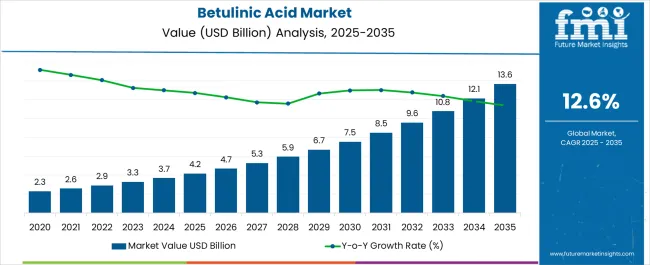
The betulinic acid market was valued at USD 4.20 billion in 2025, projected to reach USD 4.73 billion in 2026, and is forecast to expand to USD 15.49 billion by 2036 at a 12.6% CAGR. Growing clinical evidence supporting betulinic acid's anti-inflammatory and anti-viral properties is accelerating pharmaceutical research pipeline investment. FMI analysts note that the shift toward plant derived bioactive compounds in oncology drug discovery and cosmetic formulation is creating sustained demand from both pharmaceutical companies and cosmetic manufacturers seeking naturally sourced active ingredients.
Summary of Betulinic Acid Market
- Market Overview
- The market is valued at USD 4.20 billion in 2025 and is projected to reach USD 15.49 billion by 2036.
- The industry is expected to grow at a 12.6% CAGR from 2026 to 2036, creating an incremental opportunity of USD 10.76 billion.
- The market is a specialty bioactive compounds category where extraction purity, synthetic reproducibility, and regulatory registration status define competitive positioning across pharmaceutical and cosmetic procurement channels.
- Demand and Growth Drivers
- Demand is rising as pharmaceutical research pipelines expand clinical evaluation of betulinic acid for anti-inflammatory and anti-tumor applications.
- Cosmetic formulation trends favoring plant derived bioactive ingredients are creating sustained procurement volume from cosmetic manufacturers.
- Nutraceutical industry growth in standardized botanical supplement products is adding a third demand pillar beyond pharmaceutical and cosmetic consumption.
- Among countries, China (17% CAGR), India (15.8% CAGR), Germany (14.5% CAGR), Brazil (13.2% CAGR), USA (12% CAGR), UK (10.7% CAGR), Japan (9.5% CAGR).
- Product and Segment View
- The market includes betulinic acid is a pentacyclic triterpenoid compound derived primarily from the bark of birch trees (betula species) and other botanical sources.
- Natural Betulinic Acid leads by Product Type with 57.2% share in 2026.
- Pharmaceuticals leads by Application with 40.5% share in 2026.
- Online Retail leads by Distribution Channel with 36.8% share in 2026.
- Pharmaceutical Companies leads by End-User with 38.6% share in 2026.
- Geography and Competitive Outlook
- China and India are the fastest growing markets, while mature economies sustain demand through equipment replacement and specification upgrade cycles.
- Competition is shaped by product specification breadth, supply chain reliability, and integration with downstream buyer procurement systems.
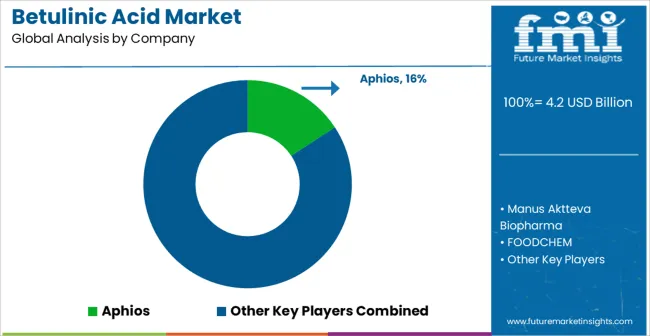
- Key players include Aphios, Manus Aktteva Biopharma, FOODCHEM, Hangzhou Dayangchem, Wilshire Technologies, Simagchem Corporation, Capot Chemical.
- Analyst Opinion at FMI
- Nikhil Kaitwade, Principal Consultant for Specialty Chemicals, opines: 'In my analysis, I have observed that betulinic acid is transitioning from a niche research compound to a scaled pharmaceutical and cosmetic ingredient. Extraction facility operators who cannot guarantee consistent purity grades above 98% are being displaced from pharmaceutical supply chains where batch to batch variability directly impacts clinical trial material qualification timelines.'
- Strategic Implications / Executive Takeaways
- Extraction facility operators must invest in purification technology to deliver pharmaceutical grade betulinic acid at consistent purity levels above 98% to qualify for drug discovery supply chains.
- Cosmetic ingredient procurement directors should establish dual source agreements for natural betulinic acid to mitigate seasonal birch bark supply variability that disrupts production schedules.
- Pharmaceutical research teams need to evaluate synthetic betulinic acid pathways as scalable alternatives to botanical extraction for clinical trial material production where supply continuity is contractually required.
The incremental opportunity of USD 10.76 billion between 2026 and 2036 reflects accelerating pharmaceutical pipeline adoption and expanding cosmetic ingredient integration. Natural betulinic acid sourcing from birch bark remains the primary production pathway, but synthetic routes are gaining traction where supply continuity and purity consistency are contractual requirements. Pricing dynamics favor natural variants for cosmetic applications where botanical origin claims carry consumer premium, while synthetic grades are preferred in pharmaceutical research where batch reproducibility is mandatory.
All major regional markets reflect differentiated growth trajectories. China leads with a 17% CAGR, India follows at 15.8%, Germany follows at 14.5%, Brazil follows at 13.2%, USA follows at 12%, UK follows at 10.7%, and Japan registers 9.5% growth. China's lead position reflects its concentration of botanical extraction facilities and pharmaceutical intermediates manufacturing capacity. India's growth is driven by expanding Ayurvedic and nutraceutical industries that are integrating betulinic acid into standardized formulations. Germany's pace is anchored to its pharmaceutical research ecosystem and cosmetic ingredient innovation pipeline.
Betulinic Acid Market Key Takeaways
| Metric | Details |
|---|---|
| Industry Size (2026) | USD 4.73 Billion |
| Industry Value (2036) | USD 15.49 Billion |
| CAGR (2026 to 2036) | 12.6% |
Source: Future Market Insights, 2026
Betulinic Acid Market Definition
Betulinic acid is a pentacyclic triterpenoid compound derived primarily from the bark of birch trees (Betula species) and other botanical sources. It is available in natural and synthetic forms and is used as an active ingredient in pharmaceutical research, cosmetic formulations, and nutraceutical products. The compound is recognized for its anti-inflammatory, anti-viral, and anti-tumor properties, making it a focus of drug discovery programs and functional ingredient sourcing.
Betulinic Acid Market Inclusions
Market scope includes natural and synthetic betulinic acid sold for pharmaceutical, cosmetic, nutraceutical, and research applications. Global and regional market sizes, product type, application, distribution channel, and end-user segment breakdowns, and forecast projections from 2026 to 2036 are covered.
Betulinic Acid Market Exclusions
The scope excludes crude birch bark extracts not processed into purified betulinic acid, finished pharmaceutical dosage forms containing betulinic acid as a minor excipient, and betulin (the precursor compound) sold for non-acid conversion purposes.
Betulinic Acid Market Research Methodology
- Primary Research: Analysts engaged with botanical extraction facility managers, pharmaceutical raw material procurement directors, and cosmetic ingredient specification leads to map sourcing decisions and purity grade requirements.
- Desk Research: Data collection aggregated published clinical research databases, botanical extraction yield studies, cosmetic ingredient regulatory filings, and nutraceutical product registration records.
- Market Sizing and Forecasting: Baseline values derive from a bottom up aggregation of betulinic acid shipment volumes by product type and application, applying region specific pricing indices and purity grade premiums to project demand growth.
- Data Validation and Update Cycle: Projections are tested against published botanical raw material trade volumes, pharmaceutical intermediates import records, and company revenue disclosures from primary extraction and synthesis operations.
Why is the Betulinic Acid Market Growing?
The Betulinic Acid market is gaining momentum as demand rises across pharmaceuticals, nutraceuticals, and cosmetics industries due to its strong pharmacological profile. Known for its antiviral, anti-inflammatory, and anticancer properties, Betulinic Acid is emerging as a valuable compound in the development of novel therapeutics. Increasing research investments in oncology and antiviral drug pipelines are fueling interest in this compound, particularly in addressing unmet clinical needs.
Natural product demand trends are also shaping the market, as consumers and manufacturers prefer plant-derived actives over synthetic alternatives for safety and sustainability. Expanding applications in skincare formulations, dietary supplements, and functional foods are further contributing to growth. Regulatory approvals and scientific validations are enhancing its acceptance, particularly in pharmaceutical-grade formulations.
Growing awareness of plant-based bioactives and advances in extraction technologies are improving scalability and cost efficiency, making Betulinic Acid more accessible As global healthcare systems focus on innovation and preventive healthcare, the market is positioned to expand steadily, driven by both scientific discovery and consumer preference for natural therapeutic options.
Segmental Analysis
The betulinic acid market is segmented by product type, application, distribution channel, end-user, and geographic regions. By product type, betulinic acid market is divided into Natural Betulinic Acid and Synthetic Betulinic Acid. In terms of application, betulinic acid market is classified into Pharmaceuticals, Cosmetics, Nutraceuticals, and Others. Based on distribution channel, betulinic acid market is segmented into Online Retail, Pharmacies, Specialty Stores, and Others. By end-user, betulinic acid market is segmented into Pharmaceutical Companies, Cosmetic Manufacturers, Nutraceutical Companies, and Others. Regionally, the betulinic acid industry is classified into North America, Latin America, Western Europe, Eastern Europe, Balkan & Baltic Countries, Russia & Belarus, Central Asia, East Asia, South Asia & Pacific, and the Middle East & Africa.
Insights into the Natural Betulinic Acid Product Type Segment
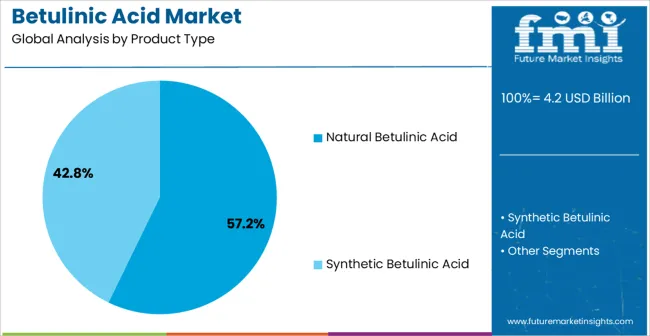
The natural Betulinic Acid segment is expected to hold 57.2% of the market revenue share in 2026, positioning it as the leading product type. Growth in this segment is being driven by rising preference for naturally derived compounds due to safety, efficacy, and sustainability considerations. Consumers and pharmaceutical manufacturers are increasingly turning toward bio-based actives, which aligns with global trends favoring clean-label and plant-based ingredients.
Natural Betulinic Acid extracted from birch bark and other botanicals is considered more biocompatible, which is enhancing its use in pharmaceutical formulations targeting cancer, HIV, and inflammatory disorders. Advancements in extraction and purification technologies are improving yield and quality, making large-scale production feasible. The appeal of natural origin also resonates strongly in nutraceuticals and skincare industries, where consumer trust and perception of safety are critical.
Cost competitiveness compared to synthetic alternatives, along with strong clinical potential, further reinforces its position As demand for natural and sustainable compounds grows across healthcare and consumer markets, this segment is expected to retain dominance and expand steadily in the coming years.
Insights into the Pharmaceuticals Application Segment
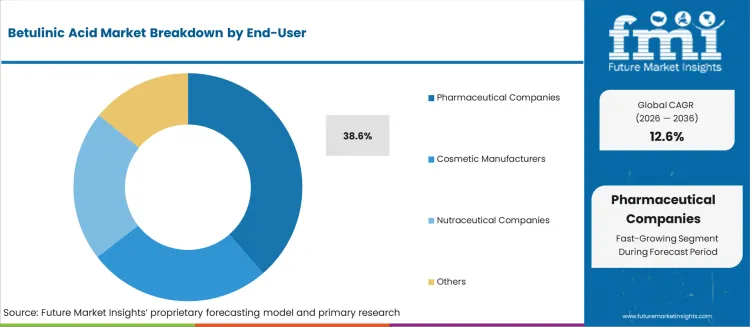
The pharmaceuticals application segment is anticipated to account for 38.6% of the market revenue share in 2026, making it the leading application area. Growth is being driven by extensive research and development efforts evaluating Betulinic Acid’s potential in cancer therapies, antiviral drugs, and anti-inflammatory formulations. The compound’s ability to induce apoptosis in tumor cells while demonstrating selective toxicity has positioned it as a promising candidate in oncology drug pipelines.
Its antiviral activity against HIV and other infectious diseases is further supporting pharmaceutical interest. Clinical studies validating efficacy and safety are strengthening its adoption in mainstream medicine. The pharmaceutical industry is increasingly focused on integrating natural compounds into novel drug development, and Betulinic Acid aligns with this shift.
Partnerships between biotech firms and research institutions are accelerating trials, while regulatory advancements are expected to support commercialization With growing global demand for innovative and effective therapeutics, the pharmaceuticals segment is set to maintain its leadership, underscored by scientific validation and ongoing clinical innovation.
Insights into the Online Retail Distribution Channel Segment
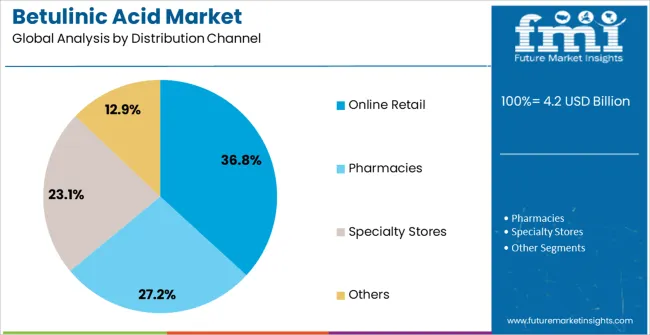
The online retail segment is projected to hold 36.8% of the market revenue share in 2026, emerging as the leading distribution channel. Growth in this segment is being fueled by increasing consumer reliance on e-commerce platforms for accessing natural health supplements, skincare products, and nutraceuticals containing Betulinic Acid. The digital retail environment offers wider product visibility, competitive pricing, and doorstep delivery, which are driving adoption across developed and emerging economies.
Manufacturers and distributors are leveraging online platforms to reach a global consumer base, supported by digital marketing and subscription models. The availability of detailed product information, customer reviews, and transparent labeling on e-commerce sites enhances consumer trust and purchasing decisions.
Online retail also provides opportunities for niche players to penetrate international markets without significant investment in physical distribution networks As consumer behavior shifts toward digital shopping and direct-to-consumer models, the online retail segment is expected to strengthen its dominance, offering scalability, convenience, and broader access to Betulinic Acid-based products worldwide.
Market Overview
Betulinic Acid Market Overview
Betulinic acid is a natural product with a range of biological effects. In addition, betulinic acid is found in the bark of several species of plants such as white birch, rosemary and ber tree among others. It is found from the bark of white tree in the form of betuline. Betulinic acid is a new perspective to overcome some forms of drug resistance.
The major drivers for this market are increasing various types of disease such as cancer and aids among others among population, increasing demand of betulinic acid in pharmaceuticals and cosmetics product. In addition, the health benefit of betulinic acid is in colorectal cancer, anti inflammatory effects, anti cancer, ovarian cancer, anti-fibrotic effects and antifungal metabolites among others. Betulinic acid has an effect on Cytokine production in human blood cell culture.
The medical uses of betulinic acid in the pharmaceutical industry is limited due to its poor solubility in blood and water serum, which poses a challenge in the preparation of injectable formulations for biological assays and reduces its bioavailability in the organism which act as restraint for the betulinic market globally.
Betulinic acid market is segmented by application which includes pharmaceuticals, perfumes, food supplements, cosmetics and agrochemical products. There is a high demand for betulinic acid as pharmaceutical ingredient in molecular lead compound for drug development, cosmetics, and pharmaceutical products among others.
Betulinic acid market is segmented by raw material which includes z-VAD-FMK (a highly specific and irreversible inhibitor of caspases-1, -3, -4, and -7), SB203580 (a highly specific and potent inhibitor of p38 MAPK), SP600125 (a selective and potent inhibitor of JNK) and Indofine Chemicals. Betulinic acid is being used in anti cancer, anti inflammatory effects and colorectal cancer among others.
The global betulinic acid market is expected to see robust growth in the near future. Several leading companies are taking decision to launch new products and establishing the partnerships between buyers and manufacturers are expected to remain the success factors for betulinic acid market in the forecast period. The largest market share in terms of revenue is Asia Pacific followed by Europe.
Asia-Pacific is the most attractive region for betulinic acid market. Asia Pacific is expected to witness high growth in the forecast period in terms of revenue owing increasing various types of cancer among population in China and Singapore among others. The significant increase in application of betulinic acid in medical applications and drug analysis in Asia-pacific region is driving the market for betulinic acid. In addition, increasing various types of cancer is driving the betulinic acid market in the region.
Moreover increases in use of betulinic acid in pharmaceutical, biotechnological companies are the prime drivers of the market in Asia Pacific region. Europe market for betulinic acid is expected to grow at a steady pace over the forecast period. Europe is the second largest market for betulinic acid followed by North America and Rest of the World.
The increasing demand for betulinic acid is attracting the global players to include betulinic acid in their product offerings. Leading industries are focusing on expansion of businesses across region and setting up new plants for increasing their production capacity.
Some of the key players operating in the Inulin market are Cayman Chemical, Derex Labs Pvt Ltd, Hunan World Well-Being Bio-Tech Co., Ltd., Shaanxi Green Bio-Engineering Co., Ltd. and Toronto Research ChemicalS Inc. among others.
The research report presents a comprehensive assessment of the market and contains thoughtful insights, facts, historical data, and statistically supported and industry-validated market data. It also contains projections using a suitable set of assumptions and methodologies. The research report provides analysis and information according to market segments such as geographies, application, and industry.
Analysis of Betulinic Acid Market By Key Countries
.webp "Top Country Growth Comparison Betulinic Acid Market Cagr (2026 2036)")
| Country | CAGR |
|---|---|
| China | 17.0% |
| India | 15.8% |
| Germany | 14.5% |
| Brazil | 13.2% |
| USA | 12.0% |
| UK | 10.7% |
| Japan | 9.5% |
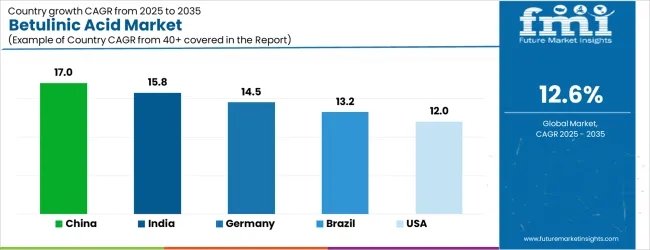
The Betulinic Acid Market is expected to register a CAGR of 12.6% during the forecast period, exhibiting varied country level momentum. China leads with the highest CAGR of 17.0%, followed by India at 15.8%. Developed markets such as Germany, France, and the UK continue to expand steadily, while the USA is likely to grow at consistent rates. Japan posts the lowest CAGR at 9.5%, yet still underscores a broadly positive trajectory for the global Betulinic Acid Market. In 2025, Germany held a dominant revenue in the Western Europe market and is expected to grow with a CAGR of 14.5%. The USA Betulinic Acid Market is estimated to be valued at USD 1.5 billion in 2026 and is anticipated to reach a valuation of USD 1.5 billion by 2036. Sales are projected to rise at a CAGR of 12.0% over the forecast period between 2026 and 2036. While Japan and South Korea markets are estimated to be valued at USD 221.0 million and USD 119.2 million respectively in 2026.
Key Players in the Betulinic Acid Market
- Aphios
- Manus Aktteva Biopharma
- FOODCHEM
- Hangzhou Dayangchem
- Wilshire Technologies
- Simagchem Corporation
- Capot Chemical
- Xi'an Taicheng Chem
- Hangzhou Meite Chemical
Scope of the Report
| Metric | Value |
|---|---|
| Quantitative Units | USD 4.73 Billion to USD 15.49 Billion, at a CAGR of 12.6% |
| Market Definition | Betulinic acid is a pentacyclic triterpenoid compound derived primarily from the bark of birch trees (Betula species) and other botanical sources. It is available in natural and synthetic forms and is... |
| Segmentation | Product Type: Natural Betulinic Acid, Synthetic Betulinic Acid; Application: Pharmaceuticals, Cosmetics, Nutraceuticals, Others; Distribution Channel: Online Retail, Pharmacies, Specialty Stores, Others; End-User: Pharmaceutical Companies, Cosmetic Manufacturers, Nutraceutical Companies, Others |
| Regions Covered | North America, Latin America, Europe, East Asia, South Asia, Oceania, Middle East & Africa |
| Countries Covered | China, India, Germany, Brazil, USA, UK, Japan, and 40 plus countries |
| Key Companies Profiled | Aphios, Manus Aktteva Biopharma, FOODCHEM, Hangzhou Dayangchem, Wilshire Technologies, Simagchem Corporation, Capot Chemical, Xi'an Taicheng Chem, Hangzhou Meite Chemical |
| Forecast Period | 2026 to 2036 |
| Approach | Hybrid bottom up methodology combining primary research, supply chain analysis, and proprietary forecasting models. |
Betulinic Acid Market by Segments
Product Type:
- Natural Betulinic Acid
- Synthetic Betulinic Acid
Application:
- Pharmaceuticals
- Cosmetics
- Nutraceuticals
- Others
Distribution Channel:
- Online Retail
- Pharmacies
- Specialty Stores
- Others
End-User:
- Pharmaceutical Companies
- Cosmetic Manufacturers
- Nutraceutical Companies
- Others
Region:
- North America
- USA
- Canada
- Mexico
- Latin America
- Brazil
- Chile
- Rest of Latin America
- Western Europe
- Germany
- UK
- Italy
- Spain
- France
- Nordic
- BENELUX
- Rest of Western Europe
- Eastern Europe
- Russia
- Poland
- Hungary
- Balkan & Baltic
- Rest of Eastern Europe
- East Asia
- China
- Japan
- South Korea
- South Asia and Pacific
- India
- ASEAN
- Australia & New Zealand
- Rest of South Asia and Pacific
- Middle East & Africa
- Kingdom of Saudi Arabia
- Other GCC Countries
- Turkiye
- South Africa
- Other African Union
- Rest of Middle East & Africa
Bibliography
- 1. European Medicines Agency. (2024). Herbal medicinal products: Regulatory framework for botanical active substances. EMA.
- 2. USA Food and Drug Administration. (2024). Botanical drug development guidance for industry. FDA.
- 3. World Health Organization. (2024). Monographs on selected medicinal plants, Volume 5. WHO.
- 4. Organisation for Economic Co-operation and Development. (2024). Series on testing and assessment: Natural product characterization. OECD.
- 5. European Commission. (2024). Cosmetic Ingredients Database (CosIng): Betulinic acid entry. European Commission.
- 6. National Institutes of Health. (2024). ClinicalTrials.gov: Active betulinic acid studies registry. NIH.
This bibliography is provided for reader reference. The full Future Market Insights report contains the complete reference list with primary research documentation.
Frequently Asked Questions
How large is the demand for Betulinic Acid in the global market in 2026?
Demand for Betulinic Acid in the global market is estimated to be valued at USD 4.73 billion in 2026.
What will be the market size of Betulinic Acid in the global market by 2036?
Market size for Betulinic Acid is projected to reach USD 15.49 billion by 2036.
What is the expected demand growth for Betulinic Acid in the global market between 2026 and 2036?
Demand for Betulinic Acid is expected to grow at a CAGR of 12.6% between 2026 and 2036.
Which Product Type is poised to lead global sales by 2026?
Natural Betulinic Acid accounts for 57.2% in 2026.
How significant is the role of Pharmaceuticals in driving Betulinic Acid adoption in 2026?
Pharmaceuticals represents 40.5% of segment share in 2026.
What is driving demand in China?
China leads with a 17% CAGR through 2036.
What is Betulinic Acid and what is it mainly used for?
Betulinic acid is a pentacyclic triterpenoid compound derived primarily from the bark of birch trees (Betula species) and other botanical sources. It is available in natural and synthetic forms and is.
What is included in the scope of this Betulinic Acid report?
Market scope includes natural and synthetic betulinic acid sold for pharmaceutical, cosmetic, nutraceutical, and research applications. Global and regional market sizes, product type, application, distribution channel, and end-user segment breakdowns, and forecast projections from 2026 to 2036 are covered.
Preview the report firsthand - request a free sample
Get SampleGet the brochure for pricing and purchase details.
Get PDFTable of Content
- Executive Summary
- Global Market Outlook
- Demand-side Trends
- Supply-side Trends
- Technology Roadmap Analysis
- Analysis and Recommendations
- Market Overview
- Market Coverage / Taxonomy
- Market Definition / Scope / Limitations
- Research Methodology
- Chapter Orientation
- Analytical Lens and Working Hypotheses
- Market Structure, Signals, and Trend Drivers
- Benchmarking and Cross-market Comparability
- Market Sizing, Forecasting, and Opportunity Mapping
- Research Design and Evidence Framework
- Desk Research Programme (Secondary Evidence)
- Company Annual and Sustainability Reports
- Peer-reviewed Journals and Academic Literature
- Corporate Websites, Product Literature, and Technical Notes
- Earnings Decks and Investor Briefings
- Statutory Filings and Regulatory Disclosures
- Technical White Papers and Standards Notes
- Trade Journals, Industry Magazines, and Analyst Briefs
- Conference Proceedings, Webinars, and Seminar Materials
- Government Statistics Portals and Public Data Releases
- Press Releases and Reputable Media Coverage
- Specialist Newsletters and Curated Briefings
- Sector Databases and Reference Repositories
- FMI Internal Proprietary Databases and Historical Market Datasets
- Subscription Datasets and Paid Sources
- Social Channels, Communities, and Digital Listening Inputs
- Additional Desk Sources
- Expert Input and Fieldwork (Primary Evidence)
- Primary Modes
- Qualitative Interviews and Expert Elicitation
- Quantitative Surveys and Structured Data Capture
- Blended Approach
- Why Primary Evidence is Used
- Field Techniques
- Interviews
- Surveys
- Focus Groups
- Observational and In-context Research
- Social and Community Interactions
- Stakeholder Universe Engaged
- C-suite Leaders
- Board Members
- Presidents and Vice Presidents
- R&D and Innovation Heads
- Technical Specialists
- Domain Subject-matter Experts
- Scientists
- Physicians and Other Healthcare Professionals
- Governance, Ethics, and Data Stewardship
- Research Ethics
- Data Integrity and Handling
- Primary Modes
- Tooling, Models, and Reference Databases
- Desk Research Programme (Secondary Evidence)
- Data Engineering and Model Build
- Data Acquisition and Ingestion
- Cleaning, Normalisation, and Verification
- Synthesis, Triangulation, and Analysis
- Quality Assurance and Audit Trail
- Market Background
- Market Dynamics
- Drivers
- Restraints
- Opportunity
- Trends
- Scenario Forecast
- Demand in Optimistic Scenario
- Demand in Likely Scenario
- Demand in Conservative Scenario
- Opportunity Map Analysis
- Product Life Cycle Analysis
- Supply Chain Analysis
- Investment Feasibility Matrix
- Value Chain Analysis
- PESTLE and Porter’s Analysis
- Regulatory Landscape
- Regional Parent Market Outlook
- Production and Consumption Statistics
- Import and Export Statistics
- Market Dynamics
- Global Market Analysis 2021 to 2025 and Forecast, 2026 to 2036
- Historical Market Size Value (USD Million) Analysis, 2021 to 2025
- Current and Future Market Size Value (USD Million) Projections, 2026 to 2036
- Y-o-Y Growth Trend Analysis
- Absolute $ Opportunity Analysis
- Global Market Pricing Analysis 2021 to 2025 and Forecast 2026 to 2036
- Global Market Analysis 2021 to 2025 and Forecast 2026 to 2036, By Product Type
- Introduction / Key Findings
- Historical Market Size Value (USD Million) Analysis By Product Type , 2021 to 2025
- Current and Future Market Size Value (USD Million) Analysis and Forecast By Product Type , 2026 to 2036
- Natural Betulinic Acid
- Synthetic Betulinic Acid
- Natural Betulinic Acid
- Y-o-Y Growth Trend Analysis By Product Type , 2021 to 2025
- Absolute $ Opportunity Analysis By Product Type , 2026 to 2036
- Global Market Analysis 2021 to 2025 and Forecast 2026 to 2036, By Application:
- Introduction / Key Findings
- Historical Market Size Value (USD Million) Analysis By Application:, 2021 to 2025
- Current and Future Market Size Value (USD Million) Analysis and Forecast By Application:, 2026 to 2036
- Pharmaceuticals
- Cosmetics
- Nutraceuticals
- Others
- Pharmaceuticals
- Y-o-Y Growth Trend Analysis By Application:, 2021 to 2025
- Absolute $ Opportunity Analysis By Application:, 2026 to 2036
- Global Market Analysis 2021 to 2025 and Forecast 2026 to 2036, By Distribution Channel
- Introduction / Key Findings
- Historical Market Size Value (USD Million) Analysis By Distribution Channel, 2021 to 2025
- Current and Future Market Size Value (USD Million) Analysis and Forecast By Distribution Channel, 2026 to 2036
- Online Retail
- Pharmacies
- Specialty Stores
- Others
- Online Retail
- Y-o-Y Growth Trend Analysis By Distribution Channel, 2021 to 2025
- Absolute $ Opportunity Analysis By Distribution Channel, 2026 to 2036
- Global Market Analysis 2021 to 2025 and Forecast 2026 to 2036, By End-User
- Introduction / Key Findings
- Historical Market Size Value (USD Million) Analysis By End-User, 2021 to 2025
- Current and Future Market Size Value (USD Million) Analysis and Forecast By End-User, 2026 to 2036
- Pharmaceutical Companies
- Cosmetic Manufacturers
- Nutraceutical Companies
- Others
- Pharmaceutical Companies
- Y-o-Y Growth Trend Analysis By End-User, 2021 to 2025
- Absolute $ Opportunity Analysis By End-User, 2026 to 2036
- Global Market Analysis 2021 to 2025 and Forecast 2026 to 2036, By Region
- Introduction
- Historical Market Size Value (USD Million) Analysis By Region, 2021 to 2025
- Current Market Size Value (USD Million) Analysis and Forecast By Region, 2026 to 2036
- North America
- Latin America
- Western Europe
- Eastern Europe
- East Asia
- South Asia and Pacific
- Middle East & Africa
- Market Attractiveness Analysis By Region
- North America Market Analysis 2021 to 2025 and Forecast 2026 to 2036, By Country
- Historical Market Size Value (USD Million) Trend Analysis By Market Taxonomy, 2021 to 2025
- Market Size Value (USD Million) Forecast By Market Taxonomy, 2026 to 2036
- By Country
- USA
- Canada
- Mexico
- By Product Type
- By Application:
- By Distribution Channel
- By End-User
- By Country
- Market Attractiveness Analysis
- By Country
- By Product Type
- By Application:
- By Distribution Channel
- By End-User
- Key Takeaways
- Latin America Market Analysis 2021 to 2025 and Forecast 2026 to 2036, By Country
- Historical Market Size Value (USD Million) Trend Analysis By Market Taxonomy, 2021 to 2025
- Market Size Value (USD Million) Forecast By Market Taxonomy, 2026 to 2036
- By Country
- Brazil
- Chile
- Rest of Latin America
- By Product Type
- By Application:
- By Distribution Channel
- By End-User
- By Country
- Market Attractiveness Analysis
- By Country
- By Product Type
- By Application:
- By Distribution Channel
- By End-User
- Key Takeaways
- Western Europe Market Analysis 2021 to 2025 and Forecast 2026 to 2036, By Country
- Historical Market Size Value (USD Million) Trend Analysis By Market Taxonomy, 2021 to 2025
- Market Size Value (USD Million) Forecast By Market Taxonomy, 2026 to 2036
- By Country
- Germany
- UK
- Italy
- Spain
- France
- Nordic
- BENELUX
- Rest of Western Europe
- By Product Type
- By Application:
- By Distribution Channel
- By End-User
- By Country
- Market Attractiveness Analysis
- By Country
- By Product Type
- By Application:
- By Distribution Channel
- By End-User
- Key Takeaways
- Eastern Europe Market Analysis 2021 to 2025 and Forecast 2026 to 2036, By Country
- Historical Market Size Value (USD Million) Trend Analysis By Market Taxonomy, 2021 to 2025
- Market Size Value (USD Million) Forecast By Market Taxonomy, 2026 to 2036
- By Country
- Russia
- Poland
- Hungary
- Balkan & Baltic
- Rest of Eastern Europe
- By Product Type
- By Application:
- By Distribution Channel
- By End-User
- By Country
- Market Attractiveness Analysis
- By Country
- By Product Type
- By Application:
- By Distribution Channel
- By End-User
- Key Takeaways
- East Asia Market Analysis 2021 to 2025 and Forecast 2026 to 2036, By Country
- Historical Market Size Value (USD Million) Trend Analysis By Market Taxonomy, 2021 to 2025
- Market Size Value (USD Million) Forecast By Market Taxonomy, 2026 to 2036
- By Country
- China
- Japan
- South Korea
- By Product Type
- By Application:
- By Distribution Channel
- By End-User
- By Country
- Market Attractiveness Analysis
- By Country
- By Product Type
- By Application:
- By Distribution Channel
- By End-User
- Key Takeaways
- South Asia and Pacific Market Analysis 2021 to 2025 and Forecast 2026 to 2036, By Country
- Historical Market Size Value (USD Million) Trend Analysis By Market Taxonomy, 2021 to 2025
- Market Size Value (USD Million) Forecast By Market Taxonomy, 2026 to 2036
- By Country
- India
- ASEAN
- Australia & New Zealand
- Rest of South Asia and Pacific
- By Product Type
- By Application:
- By Distribution Channel
- By End-User
- By Country
- Market Attractiveness Analysis
- By Country
- By Product Type
- By Application:
- By Distribution Channel
- By End-User
- Key Takeaways
- Middle East & Africa Market Analysis 2021 to 2025 and Forecast 2026 to 2036, By Country
- Historical Market Size Value (USD Million) Trend Analysis By Market Taxonomy, 2021 to 2025
- Market Size Value (USD Million) Forecast By Market Taxonomy, 2026 to 2036
- By Country
- Kingdom of Saudi Arabia
- Other GCC Countries
- Turkiye
- South Africa
- Other African Union
- Rest of Middle East & Africa
- By Product Type
- By Application:
- By Distribution Channel
- By End-User
- By Country
- Market Attractiveness Analysis
- By Country
- By Product Type
- By Application:
- By Distribution Channel
- By End-User
- Key Takeaways
- Key Countries Market Analysis
- USA
- Pricing Analysis
- Market Share Analysis, 2025
- By Product Type
- By Application:
- By Distribution Channel
- By End-User
- Canada
- Pricing Analysis
- Market Share Analysis, 2025
- By Product Type
- By Application:
- By Distribution Channel
- By End-User
- Mexico
- Pricing Analysis
- Market Share Analysis, 2025
- By Product Type
- By Application:
- By Distribution Channel
- By End-User
- Brazil
- Pricing Analysis
- Market Share Analysis, 2025
- By Product Type
- By Application:
- By Distribution Channel
- By End-User
- Chile
- Pricing Analysis
- Market Share Analysis, 2025
- By Product Type
- By Application:
- By Distribution Channel
- By End-User
- Germany
- Pricing Analysis
- Market Share Analysis, 2025
- By Product Type
- By Application:
- By Distribution Channel
- By End-User
- UK
- Pricing Analysis
- Market Share Analysis, 2025
- By Product Type
- By Application:
- By Distribution Channel
- By End-User
- Italy
- Pricing Analysis
- Market Share Analysis, 2025
- By Product Type
- By Application:
- By Distribution Channel
- By End-User
- Spain
- Pricing Analysis
- Market Share Analysis, 2025
- By Product Type
- By Application:
- By Distribution Channel
- By End-User
- France
- Pricing Analysis
- Market Share Analysis, 2025
- By Product Type
- By Application:
- By Distribution Channel
- By End-User
- India
- Pricing Analysis
- Market Share Analysis, 2025
- By Product Type
- By Application:
- By Distribution Channel
- By End-User
- ASEAN
- Pricing Analysis
- Market Share Analysis, 2025
- By Product Type
- By Application:
- By Distribution Channel
- By End-User
- Australia & New Zealand
- Pricing Analysis
- Market Share Analysis, 2025
- By Product Type
- By Application:
- By Distribution Channel
- By End-User
- China
- Pricing Analysis
- Market Share Analysis, 2025
- By Product Type
- By Application:
- By Distribution Channel
- By End-User
- Japan
- Pricing Analysis
- Market Share Analysis, 2025
- By Product Type
- By Application:
- By Distribution Channel
- By End-User
- South Korea
- Pricing Analysis
- Market Share Analysis, 2025
- By Product Type
- By Application:
- By Distribution Channel
- By End-User
- Russia
- Pricing Analysis
- Market Share Analysis, 2025
- By Product Type
- By Application:
- By Distribution Channel
- By End-User
- Poland
- Pricing Analysis
- Market Share Analysis, 2025
- By Product Type
- By Application:
- By Distribution Channel
- By End-User
- Hungary
- Pricing Analysis
- Market Share Analysis, 2025
- By Product Type
- By Application:
- By Distribution Channel
- By End-User
- Kingdom of Saudi Arabia
- Pricing Analysis
- Market Share Analysis, 2025
- By Product Type
- By Application:
- By Distribution Channel
- By End-User
- Turkiye
- Pricing Analysis
- Market Share Analysis, 2025
- By Product Type
- By Application:
- By Distribution Channel
- By End-User
- South Africa
- Pricing Analysis
- Market Share Analysis, 2025
- By Product Type
- By Application:
- By Distribution Channel
- By End-User
- USA
- Market Structure Analysis
- Competition Dashboard
- Competition Benchmarking
- Market Share Analysis of Top Players
- By Regional
- By Product Type
- By Application:
- By Distribution Channel
- By End-User
- Competition Analysis
- Competition Deep Dive
- Aphios
- Overview
- Product Portfolio
- Profitability by Market Segments (Product/Age /Sales Channel/Region)
- Sales Footprint
- Strategy Overview
- Marketing Strategy
- Product Strategy
- Channel Strategy
- Manus Aktteva Biopharma
- FOODCHEM
- Hangzhou Dayangchem
- Wilshire Technologies
- Simagchem Corporation
- Capot Chemical
- Xi'an Taicheng Chem
- Hangzhou Meite Chemical
- Aphios
- Competition Deep Dive
- Assumptions & Acronyms Used


