

- Market Size (2026)
- USD 35.0 Mn
- Forecast (2036)
- USD 95.0 Mn
- CAGR (2026 to 2036)
- 10.5%
How big is the biodegradable chelating water treatment agents market in 2026?
USD 35.0 million in 2026 and USD 95.0 million by 2036 at a 10.5% CAGR.
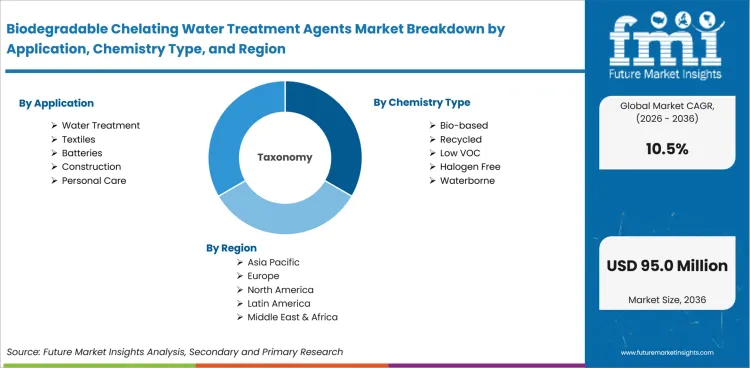
The biodegradable chelating water treatment agents industry value is forecast to grow from USD 31.7 million in 2025 to USD 95.0 million by 2036 at a 10.5% CAGR as municipal utilities, textile processors, industrial cleaners, and process-water users replace persistent chelants in targeted applications. Water treatment is forecast to represent 46.0% share in 2026 as chelant use centers on hardness control, metal-ion binding, and scale reduction. Bio-based chemistry is expected to secure 42.0% share in 2026, led by GLDA, IDS, HIDS, and gluconate systems with clearer biodegradation documentation.
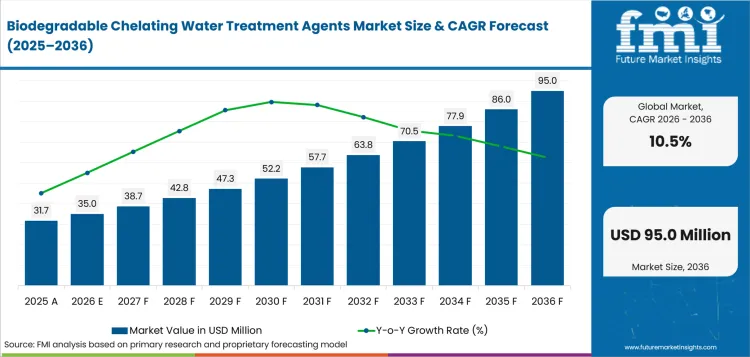
Biodegradable Chelating Water Treatment Agents Market Overview: Size and Forecast
- 2026 Market Size: USD 35.0 million
- 2036 Market Size: USD 95.0 million
- Forecast CAGR: 10.5% from 2026 to 2036
- Leading Application: Water Treatment
- Water Treatment Share in 2026: 46.0%
- Leading Chemistry Type: Bio-based
- Bio-based Chemistry Share in 2026: 42.0%
- Fastest-growing Country: India
- India CAGR: 12.4% by 2036
Summary of the Biodegradable Chelating Water Treatment Agents MarketDemand and Growth Drivers
- Demand and Growth Drivers
- Municipal wastewater upgrades are expected to increase trials for biodegradable chelants in scale-control and metal-capture programs.
- Industrial sites are expected to specify safer additives where discharge permits and customer audits review chemical fate.
- Textile and cleaning formulators are moving toward GLDA, IDS, HIDS, and gluconate systems where hard-water performance remains essential.
- Product and Segment View
- Water treatment is expected to represent 46.0% share in 2026 as municipal and industrial buyers use chelants for scale prevention, hardness control, and metal-ion stabilization.
- Bio-based chemistry is projected to hold 42.0% share in 2026 as GLDA, IDS, HIDS, and gluconate suppliers compete through biodegradation files and renewable-carbon positioning.
- Additive function is anticipated to secure 38.0% share in 2026 because chelants are mostly dosed inside treatment blends rather than sold as stand-alone process chemicals.
- Geography and Competitive Outlook
- India is forecast to expand at 12.4% CAGR by 2036 as sewage-treatment capacity additions and textile clusters support faster substitution.
- China is projected to grow at 11.6% CAGR by 2036 as reuse policy, industrial parks, and water-scarce cities support greener treatment chemistry.
- BASF, Nouryon, LANXESS, and Nippon Shokubai compete through chelant chemistry depth, technical documentation, and application support.
- Aquapharm Chemical Limited, Jungbunzlauer, Roquette, and Innospec compete where regional supply, fermentation-derived chemistry, and formulation support shape buyer choice.
- Analyst Opinion
- Nikhil Kaitwade, Principal Consultant for Chemicals and Materials at FMI, observes, “Biodegradable chelating water treatment agents are moving from sustainability claims into specification files. Buyers will not replace EDTA or phosphonate systems only for a cleaner label. They will approve alternatives when suppliers prove biodegradation method, water-hardness control, pH tolerance, metal-binding strength, and dosing economics together. The strongest suppliers will be those that combine application testing with reliable regional supply.”
The biodegradable chelating water treatment agents market is expected to witness steady expansion through 2036, driven by municipal wastewater upgrades, industrial effluent scrutiny, and safer-chemistry substitution across water-sensitive operations.Outlook is supported by wastewater investment, safer-chemistry screening, and stricter treatment policy. UN-Water reported in August 2024 that 42.0% of household wastewater was not safely treated before discharge in 2022, creating a wider case for chemicals with lower persistence.
EPA announced USD 3.6 billion in new water infrastructure funding in October 2024, widening upgrade points where treatment chemicals can be reviewed. The revised EU Urban Wastewater Treatment Directive entered into force on January 1, 2025, extending rules to smaller agglomerations from 1,000 inhabitants and requiring more monitoring for micropollutants, microplastics, PFAS, and public-health parameters.
Which factors support expansion in the biodegradable chelating water treatment agents market?
Finished biodegradable chelant revenue and validated treatment performance support market value across regulated municipal and industrial accounts.
- Market value is supported by recurring chemical sales into water treatment, industrial cleaning, textile processing, and process-water applications.
- Supplier pricing reflects active concentration, biodegradation proof, calcium-binding efficiency, and compatibility with existing dosing systems.
- Revenue improves as municipal utilities and industrial buyers replace persistent chelants only where performance risk is controlled.
- Retail-style claims are less important than technical files showing degradation results, metal-control performance, and application-specific dosing guidance.
Why is the biodegradable chelating water treatment agents market growing?
Water-treatment buyers are moving toward biodegradable chelants as discharge review expands beyond pH, suspended solids, and basic compliance checks.
Growth outlook is becoming more structured as wastewater upgrades and safer-chemistry screens influence purchasing. EPA’s Safer Chemical Ingredients List was updated on September 30, 2025, and it arranges evaluated ingredients by functional-use class, helping formulators identify safer alternatives against traditional chemistries. This matters for biodegradable chelants because buyers compare them with older sequestrants, scale inhibitors, and hardness-control agents. GLDA, IDS, HIDS, and gluconate systems gain value when the supplier can show chelation performance and environmental fate together. This supports adjacent demand across the chelating agents market and water and wastewater treatment chemicals market as sustainability rules influence chemical selection.
How is the biodegradable chelating water treatment agents market segmented?
The biodegradable chelating water treatment agents industry is segmented by application, chemistry type, function, end-use industry, and region.
- Water treatment is projected to secure 46.0% share in 2026, led by municipal utilities and industrial users evaluating scale-control additives with clearer biodegradation evidence.
- Bio-based chemistry is expected to account for 42.0% share in 2026 as GLDA, IDS, HIDS, and gluconate systems gain specification space against persistent chelants.
- Additive function is anticipated to represent 38.0% share in 2026 because hardness binding and metal-ion control are usually delivered through treatment blends.
- Industrial manufacturing is forecast to hold 36.0% share in 2026, supported by factories needing stable process-water chemistry and tighter effluent discipline.
- Europe is projected to account for 33.0% share in 2026 as wastewater policy and chemical documentation create early demand for greener substitution.
Which application leads the biodegradable chelating water treatment agents market?
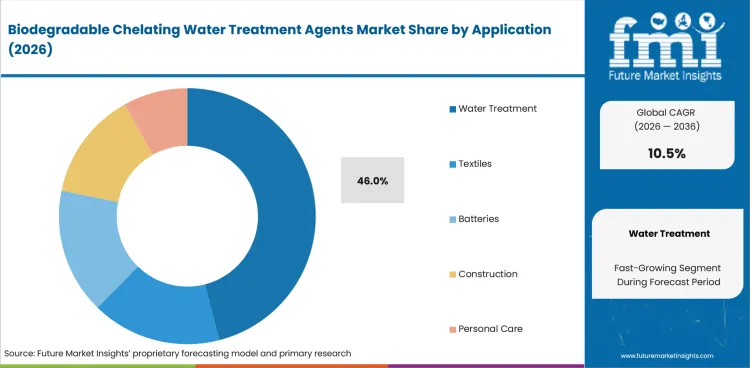
- Water treatment is projected to account for 46.0% share in 2026, influenced by scale-control needs, metal-ion capture, and wastewater operators seeking additives with lower persistence risk.
- Textiles gain specification interest as wet-processing plants need hardness control and metal-stain prevention while meeting export-linked wastewater expectations.
Which chemistry type leads the biodegradable chelating water treatment agents market?
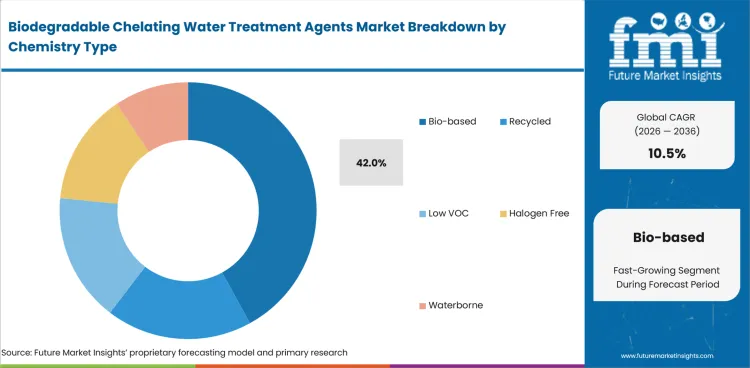
- Bio-based chemistry is expected to hold 42.0% share in 2026 through GLDA, IDS, HIDS, and gluconate routes that support renewable-carbon or fermentation-based positioning.
- Recycled chemistry grows selectively where buyers value circular material claims, yet technical acceptance remains dependent on chelation strength and quality consistency.
Which function leads the biodegradable chelating water treatment agents market?
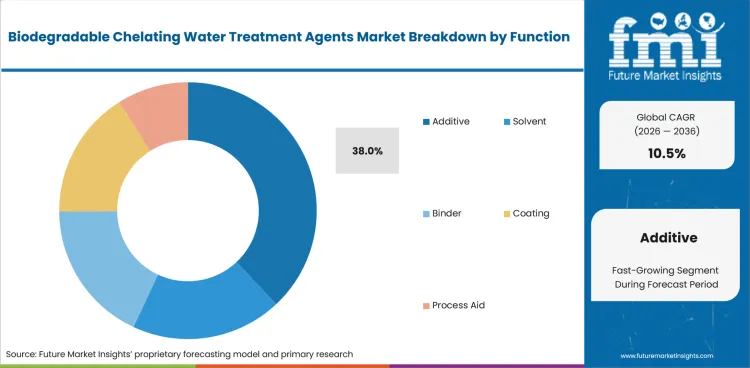
- Additive function is anticipated to secure 38.0% share in 2026, supported by chelants being dosed into treatment blends for hardness binding and formulation stability.
- Solvent function has narrower use because water-treatment buyers mostly approve chelants by performance role rather than by broad formulation category.
Which end-use industry leads the biodegradable chelating water treatment agents market?
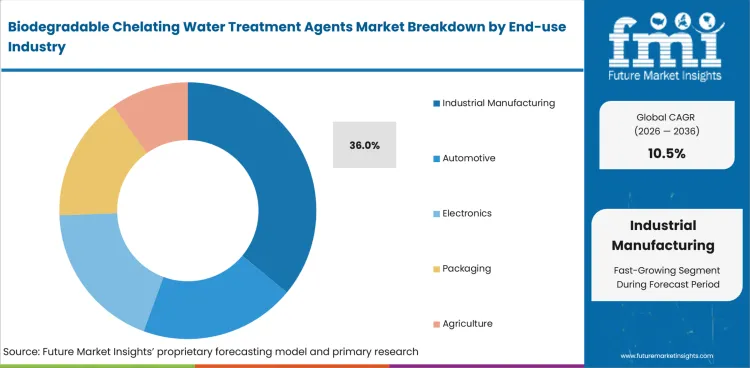
- Industrial manufacturing is forecast to represent 36.0% share in 2026, shaped by recurring process-water needs in plants managing hardness, metals, and discharge risk.
- Electronics demand grows cautiously because high-purity water systems require strong residue control before any biodegradable chelant is approved for repeat use.
Which region leads the biodegradable chelating water treatment agents market?
- Europe is projected to hold 33.0% share in 2026, reflected by wastewater regulation, supplier documentation culture, and early acceptance of safer specialty chemicals.
- South Asia grows faster from a smaller base as sewage-treatment projects and industrial effluent management create new trial points for biodegradable additives.
What are the driver, restraints, and opportunities in the biodegradable chelating water treatment agents market?
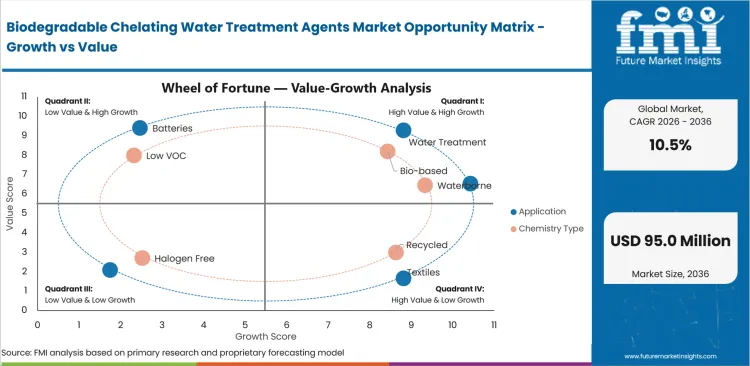
Wastewater discharge review and safer chemical screening support substitution, while cost and validation requirements limit rapid replacement.
- Driver: Municipal and industrial buyers are shifting chelant selection toward molecules with clearer biodegradation evidence and lower persistence risk.
- Restraint: Premium molecule cost can delay replacement where legacy chelants already meet current discharge limits and plant operators avoid reformulation risk.
- Opportunity: Suppliers can win specification share by bundling biodegradable chelants with water-treatment polymers, antiscalants, and dosing support.
Discharge-Permit Chemistry Replacement
Water-treatment buyers are rethinking chelant selection when discharge permits, industrial customer audits, and utility upgrades make chemical fate part of approval. The United States EPA announced USD 6.2 billion in fiscal year 2025 clean water and drinking water investments when state allocations were combined in October 2024. This does not directly purchase biodegradable chelants, but it creates upgrade windows where safer treatment chemistry can be evaluated alongside equipment, dosing, and compliance risk. Supplier interest also overlaps with the industrial wastewater treatment chemicals market when factories reassess water additives during compliance upgrades.
Molecule Cost and Trial Burden
Cost remains a practical restraint because biodegradable chelants must prove comparable hardness control before replacing older products. OECD ready-biodegradability guidance uses pass levels of 70.0% dissolved organic carbon removal or 60.0% theoretical oxygen demand or carbon dioxide production for respirometric methods. Buyers therefore ask for laboratory evidence before moving from trial drums to recurring plant dosing, which increases documentation cost for smaller suppliers.
Integrated Dosing and Safer Chemistry Opportunity
Opportunity is strongest where suppliers combine chelants with integrated water-treatment programs. The European Commission stated in December 2024 that the revised urban wastewater rules are expected to deliver financial benefits of about EUR 6.6 billion per year by 2040, while applying new monitoring requirements and broader treatment obligations. That policy environment supports suppliers that can show how biodegradable chelants reduce scaling, stabilize formulations, and fit upgraded treatment programs linked to water treatment polymers market demand.
Which countries are growing fastest in the biodegradable chelating water treatment agents market?
India 12.4% CAGR, China 11.6% CAGR, South Korea 10.9% CAGR, Germany 10.7% CAGR, France 10.4% CAGR, United States 10.2% CAGR, United Kingdom 9.8% CAGR, and Japan 9.5% CAGR through 2036.
.webp "Top Country Growth Comparison Biodegradable Chelating Water Treatment Agents Market Cagr (2026 2036)")
| Country | CAGR |
|---|---|
| India | 12.4% |
| China | 11.6% |
| South Korea | 10.9% |
| Germany | 10.7% |
| France | 10.4% |
| United States | 10.2% |
| United Kingdom | 9.8% |
| Japan | 9.5% |
Source: Future Market Insights, 2026.
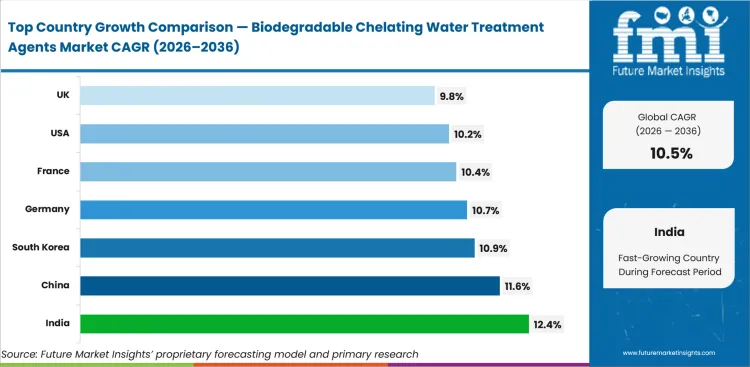
How do country-level CAGRs compare in the biodegradable chelating water treatment agents market?
India leads selected country growth, while Japan records the most selective replacement outlook among profiled markets.
- India is forecast to record 12.4% CAGR by 2036 as sewage projects and textile effluent treatment support faster substitution.
- China is expected to expand at 11.6% CAGR from 2026 to 2036 due to industrial-park demand and water-reuse planning.
- South Korea is projected to grow at 10.9% CAGR through 2036 as electronics, chemicals, and reuse programs need high-spec process-water chemistry.
- Germany is estimated to rise at 10.7% CAGR by 2036 with chemical supplier depth and wastewater policy shaping buyer specifications.
- France is expected to advance at 10.4% CAGR over the forecast period as utility-service models and EU rules guide selective replacement.
- United States is forecast to grow at 10.2% CAGR through 2036 as EPA funding and safer-chemistry screens support documented substitution.
- United Kingdom is projected to post 9.8% CAGR by 2036 as regulated water-company investment improves treatment review cycles.
- Japan is estimated to expand at 9.5% CAGR through 2036 as mature infrastructure supports selective upgrades rather than broad chemical switching.
How fast is the biodegradable chelating water treatment agents market growing in India?
A 12.4% CAGR through 2036 reflects sewage-treatment capacity additions, textile effluent needs, and local biodegradable chelant supply.
Country Market Snapshot Table
| Parameter | Value |
|---|---|
| Market Size in 2025 (Value) | USD 2.5 million |
| Market Size in 2026 (Value) | USD 2.8 million |
| Market Forecast in 2036 (Value) | USD 9.0 million |
| CAGR (2026 to 2036) | 12.4% |
| Years Considered | 2021 to 2036 |
| Base Year | 2025 |
| Forecast Period | 2026 to 2036 |
| Units Considered | Value (USD million) |
| Leading Sub-Region | Ganga basin industrial and textile corridors |
India Biodegradable Chelating Water Treatment Agents Market Outlook
- India demand is shaped by sewage-treatment expansion, textile wet-processing clusters, and local specialty chemical supply. Biodegradable chelants fit plant trials where hard-water control and discharge discipline are both important.
- Industrial users remain price sensitive, so suppliers must show dosing efficiency before broader replacement. Local support from specialty formulators can help buyers move from trial batches to repeat procurement.
Key Growth Drivers
- Sewage-treatment projects create tender and EPC-led chemical evaluation points. India approved projects worth INR 920 crore in August 2024 to add 145 MLD of sewage-treatment capacity.
- City-level sewer-network additions create demand for treatment chemicals used in new facilities. The Munger project includes a 175 km sewerage network and a 30 MLD STP.
- Textile wet-processing clusters need chelants for hard-water control, metal-stain prevention, and export-linked effluent compliance.
- Local biodegradable chelant supply supports faster trial access when buyers need GLDA, IDS, and HEIDA options with plant-level support.
Key Restraints
- Small effluent-treatment plants are highly price sensitive and may delay premium substitutions unless discharge pressure is immediate.
- Advanced treatment designs need accurate dosing support, since the Bareilly sewage-treatment project uses Advanced Sequencing Batch Reactor technology across 63 MLD capacity.
- Field support gaps can reduce correct dosing in distributed industrial clusters where technical service coverage is uneven.
What makes India unique
India is unique due to local biodegradable chelant supply, fast sewage-treatment capacity additions, and export-linked industrial effluent pressure.
Key Companies
- Aquapharm Chemical Limited
- LANXESS India Private Limited
- BASF India Limited
- Nouryon Chemicals India Private Limited
- Innospec India Private Limited
- Thermax Limited
- Ion Exchange India Limited
Sales & Marketing Channels
- EPC contractors for sewage projects
- Industrial chemical distributors
- Direct sales to textile clusters
- Effluent-treatment plant operators
- Municipal tender channels
- Dealer networks for specialty chemicals
Country Segment Breakdown Table
| Segment | Sub-Segments |
|---|---|
| By Application | Water Treatment · Textiles · Batteries · Construction · Personal Care |
| By Chemistry Type | Bio-based · Recycled · Low VOC · Halogen Free · Waterborne |
| By Function | Additive · Solvent · Binder · Coating · Process Aid |
| By End-use Industry | Industrial Manufacturing · Automotive · Electronics · Packaging · Agriculture |
| By Region | North America · Europe · East Asia · South Asia · Latin America |
| Key Sub-Regions Covered, Industrial and Municipal Corridors | Gujarat · Maharashtra · Tamil Nadu · Uttar Pradesh · Bihar · Delhi NCR |
Frequently Asked Questions
How fast is India biodegradable chelating water treatment agents market growing?
Sales in India are expected to grow at 12.4% from 2026 to 2036, shaped by local wastewater and industrial process-water demand.
Who leads India biodegradable chelating water treatment agents market?
Aquapharm Chemical Limited, LANXESS India Private Limited, BASF India Limited, and other verified suppliers compete based on documentation, technical support, and channel access.
What is driving adoption in India biodegradable chelating water treatment agents market?
Wastewater treatment needs, process-water control, and documented biodegradable chemistry are moving India buyers toward selective chelant substitution.
What is the biodegradable chelating water treatment agents market outlook in China?
An 11.6% CAGR through 2036 is supported by wastewater reuse, industrial parks, and water-scarce city demand.
Country Market Snapshot Table
| Parameter | Value |
|---|---|
| Market Size in 2025 (Value) | USD 5.5 million |
| Market Size in 2026 (Value) | USD 6.1 million |
| Market Forecast in 2036 (Value) | USD 18.3 million |
| CAGR (2026 to 2036) | 11.6% |
| Years Considered | 2021 to 2036 |
| Base Year | 2025 |
| Forecast Period | 2026 to 2036 |
| Units Considered | Value (USD million) |
| Leading Sub-Region | Eastern industrial parks and coastal manufacturing corridors |
China Biodegradable Chelating Water Treatment Agents Market Outlook
- China demand is driven by industrial parks, water-reuse needs, and large-scale treatment infrastructure. Biodegradable chelants gain trial opportunities where shared facilities need repeatable metal and hardness control.
- Price competition remains strong because conventional chelants and phosphonate systems are widely available. Suppliers need local technical support and cost evidence to expand beyond premium accounts.
Key Growth Drivers
- Wastewater infrastructure expansion creates openings for chelant blends in reuse-oriented systems. China planned to increase sewage-treatment capacity by 20 million cubic meters per day between 2021 and 2025.
- Sewer-network expansion supports chemical use in new treatment systems. China also planned to build or renovate 80,000 km of sewage collection pipelines.
- Textile, electronics, and metal-finishing clusters need consistent hardness and metal control in process-water loops.
- Industrial-park operators can standardize treatment chemistry across tenant facilities when suppliers prove cost and supply fit.
Key Restraints
- Lower-cost conventional chelants remain difficult to displace in applications without immediate permit pressure.
- Water scarcity increases technical expectations, since China holds about 6.0% of global freshwater while accounting for a much larger population base.
- Distributor quality can vary across provinces, creating inconsistent product handling and trial support for specialty chelants.
What makes China unique
China is unique because industrial parks can scale proven treatment formulations quickly once cost, supply, and performance requirements are met.
Key Companies
- BASF China
- Nouryon China
- LANXESS China
- Nippon Shokubai China
- Local water-treatment chemical distributors
- Industrial-park service providers
- Specialty chelant formulators
Sales & Marketing Channels
- Industrial-park service providers
- Local chemical distributors
- Direct sales to textile plants
- Electronics wastewater contractors
- Municipal engineering firms
- Formulation toll manufacturers
Country Segment Breakdown Table
| Segment | Sub-Segments |
|---|---|
| By Application | Water Treatment · Textiles · Batteries · Construction · Personal Care |
| By Chemistry Type | Bio-based · Recycled · Low VOC · Halogen Free · Waterborne |
| By Function | Additive · Solvent · Binder · Coating · Process Aid |
| By End-use Industry | Industrial Manufacturing · Automotive · Electronics · Packaging · Agriculture |
| By Region | North America · Europe · East Asia · South Asia · Latin America |
| Key Sub-Regions Covered, Industrial and Municipal Corridors | Yangtze River Delta · Pearl River Delta · Bohai Rim · Sichuan · Hubei · Guangdong |
Frequently Asked Questions
How fast is China biodegradable chelating water treatment agents market growing?
Sales in China are expected to grow at 11.6% from 2026 to 2036, shaped by local wastewater and industrial process-water demand.
Who leads China biodegradable chelating water treatment agents market?
BASF China, Nouryon China, LANXESS China, and other verified suppliers compete based on documentation, technical support, and channel access.
What is driving adoption in China biodegradable chelating water treatment agents market?
Wastewater treatment needs, process-water control, and documented biodegradable chemistry are moving China buyers toward selective chelant substitution.
How is the biodegradable chelating water treatment agents market performing in South Korea?
A 10.9% CAGR through 2036 reflects high-spec manufacturing, reuse projects, and contractor-led treatment qualification.
Country Market Snapshot Table
| Parameter | Value |
|---|---|
| Market Size in 2025 (Value) | USD 1.8 million |
| Market Size in 2026 (Value) | USD 2.0 million |
| Market Forecast in 2036 (Value) | USD 5.6 million |
| CAGR (2026 to 2036) | 10.9% |
| Years Considered | 2021 to 2036 |
| Base Year | 2025 |
| Forecast Period | 2026 to 2036 |
| Units Considered | Value (USD million) |
| Leading Sub-Region | Seoul-Incheon and electronics manufacturing corridors |
South Korea Biodegradable Chelating Water Treatment Agents Market Outlook
- South Korea has a compact but technically demanding treatment environment. Biodegradable chelants fit reuse and process-water programs where electronics and chemical plants need predictable residue control.
- Supplier entry can be difficult without local field evidence. Buyers often rely on environmental contractors and qualified distributors before approving specialty chelants.
Key Growth Drivers
- Reuse and treatment quality programs support demand for additives managing scaling and metal carryover. K-eco reported 8.3 billion tons per year of water resources treated within standards.
- Process-water reliability is important because K-eco reported 97.7% of sewage and wastewater treated within legal water quality criteria.
- Electronics manufacturing needs low-residue chemistry and stable chelation in high-spec production environments.
- Environmental contractors help buyers compare biodegradable chelants inside broader treatment packages.
Key Restraints
- Local qualification requirements slow new supplier entry when field references are limited.
- Technical buyers can reject premium molecules unless residue or discharge risk reduction is measurable.
- K-eco’s 33 public sewage facility damage-response locations show why operational resilience remains a priority before chemistry changes.
What makes South Korea unique
South Korea is unique because high-spec manufacturing and reuse policy make quality assurance more important than broad product availability.
Key Companies
- BASF Korea
- Nouryon Korea
- LANXESS Korea
- Nippon Shokubai Korea
- Local environmental engineering contractors
- Specialty chemical distributors
- Electronics wastewater service firms
Sales & Marketing Channels
- Environmental engineering contractors
- Direct sales to electronics manufacturers
- Specialty chemical distributors
- Municipal treatment operators
- Pilot projects through reuse programs
- Industrial service firms
Country Segment Breakdown Table
| Segment | Sub-Segments |
|---|---|
| By Application | Water Treatment · Textiles · Batteries · Construction · Personal Care |
| By Chemistry Type | Bio-based · Recycled · Low VOC · Halogen Free · Waterborne |
| By Function | Additive · Solvent · Binder · Coating · Process Aid |
| By End-use Industry | Industrial Manufacturing · Automotive · Electronics · Packaging · Agriculture |
| By Region | North America · Europe · East Asia · South Asia · Latin America |
| Key Sub-Regions Covered, Industrial and Municipal Corridors | Seoul · Incheon · Gyeonggi · Ulsan · Busan · Daejeon |
Frequently Asked Questions
How fast is South Korea biodegradable chelating water treatment agents market growing?
Sales in South Korea are expected to grow at 10.9% from 2026 to 2036, shaped by local wastewater and industrial process-water demand.
Who leads South Korea biodegradable chelating water treatment agents market?
BASF Korea, Nouryon Korea, LANXESS Korea, and other verified suppliers compete based on documentation, technical support, and channel access.
What is driving adoption in South Korea biodegradable chelating water treatment agents market?
Wastewater treatment needs, process-water control, and documented biodegradable chemistry are moving South Korea buyers toward selective chelant substitution.
What is the biodegradable chelating water treatment agents market forecast for Germany?
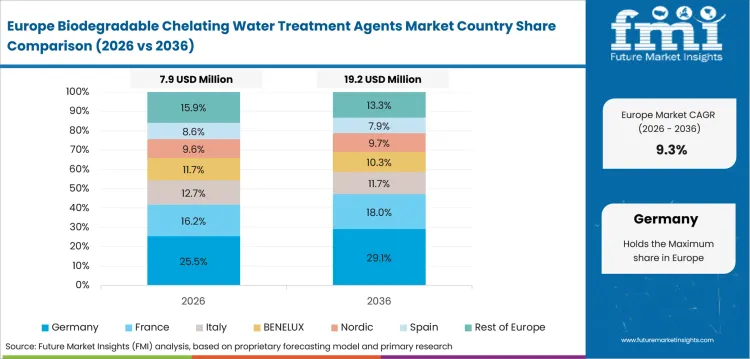
A 10.7% CAGR through 2036 reflects supplier depth, wastewater regulation, and strong chemical documentation standards.
Country Market Snapshot Table
| Parameter | Value |
|---|---|
| Market Size in 2025 (Value) | USD 4.5 million |
| Market Size in 2026 (Value) | USD 5.0 million |
| Market Forecast in 2036 (Value) | USD 13.8 million |
| CAGR (2026 to 2036) | 10.7% |
| Years Considered | 2021 to 2036 |
| Base Year | 2025 |
| Forecast Period | 2026 to 2036 |
| Units Considered | Value (USD million) |
| Leading Sub-Region | North Rhine-Westphalia and Rhine chemical corridors |
Germany Biodegradable Chelating Water Treatment Agents Market Outlook
- Germany demand is shaped by supplier strength, wastewater regulation, and technically demanding industrial buyers. Biodegradable chelant substitution is reviewed through performance data and environmental fate documentation.
- Local chemical expertise supports early testing, yet buyers remain cautious in hard-water and metal-control applications. Product validation often matters before price negotiation begins.
Key Growth Drivers
- EU wastewater rules strengthen demand for treatment chemicals with better fate profiles because large plants above 150,000 population equivalent face quaternary treatment obligations.
- German treatment systems handle substantial residue streams, with Destatis reporting 1,629,897 tonnes of sewage sludge dry matter from public wastewater disposal in 2023.
- BASF and LANXESS provide local supplier credibility for biodegradable chelant trials and technical files.
- Industrial manufacturers need reliable metal control in process-water, cleaning, and textile auxiliary applications.
Key Restraints
- Industrial buyers require extensive validation before replacing established chelant recipes in demanding water conditions.
- Premium product pricing can slow adoption in low-margin textile and surface-treatment operations.
- Germany’s thermal treatment of sewage sludge exceeded 656,000 tonnes dry matter in 2023, showing why downstream residue handling remains a technical review point.
What makes Germany unique
Germany is unique because supplier headquarters, industrial demand, and strict chemical review combine in one high-documentation market.
Key Companies
- BASF SE
- LANXESS AG
- Nouryon Germany
- Jungbunzlauer Germany
- Innospec Germany
- Water-treatment service contractors
- Specialty chemical distributors
Sales & Marketing Channels
- Direct sales to industrial manufacturers
- Chemical distributor networks
- Utility and municipal tender routes
- Technical service trials at plant sites
- Formulator partnerships
- Process-water chemical trade events
Country Segment Breakdown Table
| Segment | Sub-Segments |
|---|---|
| By Application | Water Treatment · Textiles · Batteries · Construction · Personal Care |
| By Chemistry Type | Bio-based · Recycled · Low VOC · Halogen Free · Waterborne |
| By Function | Additive · Solvent · Binder · Coating · Process Aid |
| By End-use Industry | Industrial Manufacturing · Automotive · Electronics · Packaging · Agriculture |
| By Region | North America · Europe · East Asia · South Asia · Latin America |
| Key Sub-Regions Covered, Industrial and Municipal Corridors | North Rhine-Westphalia · Bavaria · Baden-Württemberg · Hesse · Hamburg · Saxony |
Frequently Asked Questions
How fast is Germany biodegradable chelating water treatment agents market growing?
Sales in Germany are expected to grow at 10.7% from 2026 to 2036, shaped by local wastewater and industrial process-water demand.
Who leads Germany biodegradable chelating water treatment agents market?
BASF SE, LANXESS AG, Nouryon Germany, and other verified suppliers compete based on documentation, technical support, and channel access.
What is driving adoption in Germany biodegradable chelating water treatment agents market?
Wastewater treatment needs, process-water control, and documented biodegradable chemistry are moving Germany buyers toward selective chelant substitution.
What is driving biodegradable chelating water treatment agents growth in France?
A 10.4% CAGR through 2036 is supported by utility-service channels, collective sanitation coverage, and European wastewater rules.
Country Market Snapshot Table
| Parameter | Value |
|---|---|
| Market Size in 2025 (Value) | USD 3.1 million |
| Market Size in 2026 (Value) | USD 3.4 million |
| Market Forecast in 2036 (Value) | USD 9.1 million |
| CAGR (2026 to 2036) | 10.4% |
| Years Considered | 2021 to 2036 |
| Base Year | 2025 |
| Forecast Period | 2026 to 2036 |
| Units Considered | Value (USD million) |
| Leading Sub-Region | Île-de-France and Rhône-Alpes utility corridors |
France Biodegradable Chelating Water Treatment Agents Market Outlook
- France demand is shaped by municipal treatment networks, utility-service operators, and food-related industrial water use. Biodegradable chelants gain attention where service contractors review chemical risk and performance together.
- Tender structures can slow immediate switching, yet verified bio-based and gluconate options support selective replacement. Supplier access depends on contractor trust and documented formulation value.
Key Growth Drivers
- Collective sanitation creates a broad treatment platform, with French public reporting showing 22,827 treatment stations and 106 million population-equivalent capacity in 2023.
- Service-network scale supports recurring chemical review, as collective sanitation covered about 82.0% of France’s population in 2023.
- Food, personal-care, and industrial cleaning producers increase interest in biodegradable chelants that support safer product positioning.
- Utility contractors can introduce biodegradable chelants through performance trials inside existing service contracts.
Key Restraints
- Municipal purchasing often moves through delegated operators and longer framework cycles.
- Some biodegradable chelants need additional proof in high-hardness or high-metal wastewater.
- New EU wastewater rules extend the scope to agglomerations from 1,000 inhabitants, which can increase compliance work before smaller utilities approve premium additives.
What makes France unique
France is unique due to its utility-service model, where market entry depends on contractor relationships and public-buyer confidence.
Key Companies
- Roquette Frères
- BASF France
- Nouryon France
- LANXESS France
- Veolia Water Technologies
- Suez Water Technologies
- Specialty chemical distributors
Sales & Marketing Channels
- Delegated water-service operators
- Municipal procurement frameworks
- Industrial chemical distributors
- Formulator partnerships
- Technical trials with utility contractors
- Regional environmental service firms
Country Segment Breakdown Table
| Segment | Sub-Segments |
|---|---|
| By Application | Water Treatment · Textiles · Batteries · Construction · Personal Care |
| By Chemistry Type | Bio-based · Recycled · Low VOC · Halogen Free · Waterborne |
| By Function | Additive · Solvent · Binder · Coating · Process Aid |
| By End-use Industry | Industrial Manufacturing · Automotive · Electronics · Packaging · Agriculture |
| By Region | North America · Europe · East Asia · South Asia · Latin America |
| Key Sub-Regions Covered, Industrial and Municipal Corridors | Île-de-France · Auvergne-Rhône-Alpes · Hauts-de-France · Grand Est · Normandy · Occitanie |
Frequently Asked Questions
How fast is France biodegradable chelating water treatment agents market growing?
Sales in France are expected to grow at 10.4% from 2026 to 2036, shaped by local wastewater and industrial process-water demand.
Who leads France biodegradable chelating water treatment agents market?
Roquette Frères, BASF France, Nouryon France, and other verified suppliers compete based on documentation, technical support, and channel access.
What is driving adoption in France biodegradable chelating water treatment agents market?
Wastewater treatment needs, process-water control, and documented biodegradable chemistry are moving France buyers toward selective chelant substitution.
What is the biodegradable chelating water treatment agents market outlook in the United States?
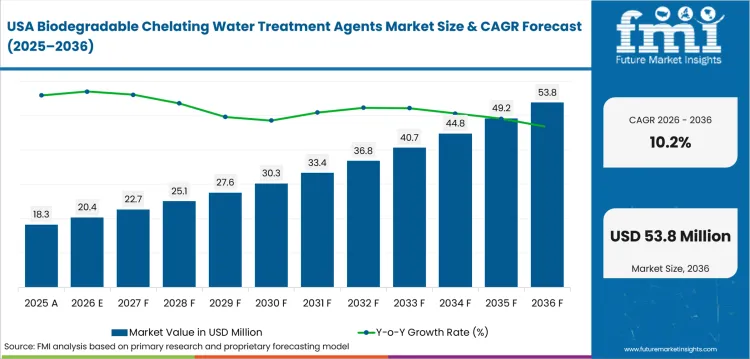
A 10.2% CAGR through 2036 is supported by water infrastructure funding, safer-chemistry screening, and industrial compliance programs.
Country Market Snapshot Table
| Parameter | Value |
|---|---|
| Market Size in 2025 (Value) | USD 8.2 million |
| Market Size in 2026 (Value) | USD 9.0 million |
| Market Forecast in 2036 (Value) | USD 23.8 million |
| CAGR (2026 to 2036) | 10.2% |
| Years Considered | 2021 to 2036 |
| Base Year | 2025 |
| Forecast Period | 2026 to 2036 |
| Units Considered | Value (USD million) |
| Leading Sub-Region | Great Lakes and Gulf industrial water corridors |
United States Biodegradable Chelating Water Treatment Agents Market Outlook
- United States demand starts with compliance review and safer-chemistry documentation before product switching. Municipal upgrades and industrial water-treatment accounts create opportunities for tested biodegradable chelants.
- Buyers still ask suppliers to prove dosing cost and hard-water control before replacing older chemistry. Product data can carry as much weight as price in this market.
Key Growth Drivers
- State revolving fund projects create chemical review points during wastewater plant upgrades, with EPA announcing USD 6.2 billion in fiscal year 2025 water infrastructure investments.
- Safer-chemistry screening supports formulation changes because EPA updated the Safer Chemical Ingredients List on September 30, 2025.
- Industrial cleaning formulators use safer-chemistry documentation to support customer audits in lower-risk product programs.
- Textile and metal-treatment users need hard-water control in plants facing discharge review.
Key Restraints
- Procurement cycles are slow when biodegradable chelants are treated as non-critical chemical changes.
- Performance trials can be delayed by concerns over corrosion, scaling, and dosing-equipment compatibility.
- EPA’s PFAS drinking-water rule targets exposure reduction for about 100 million people, which can shift utility budgets toward contaminant removal before specialty chelant changes.
What makes United States unique
United States is unique because safer-chemistry screening and decentralized water funding shape adoption through both public projects and private industrial accounts.
Key Companies
- BASF Corporation
- Nouryon Chemicals LLC
- LANXESS Corporation
- Innospec Inc.
- Jungbunzlauer Inc.
- Water-treatment service firms
- Specialty chemical distributors
Sales & Marketing Channels
- Direct technical sales to municipal utilities
- Specialty chemical distributors
- Water-treatment service firms
- Industrial cleaning formulators
- State and municipal procurement routes
- OEM dosing-system partners
Country Segment Breakdown Table
| Segment | Sub-Segments |
|---|---|
| By Application | Water Treatment · Textiles · Batteries · Construction · Personal Care |
| By Chemistry Type | Bio-based · Recycled · Low VOC · Halogen Free · Waterborne |
| By Function | Additive · Solvent · Binder · Coating · Process Aid |
| By End-use Industry | Industrial Manufacturing · Automotive · Electronics · Packaging · Agriculture |
| By Region | North America · Europe · East Asia · South Asia · Latin America |
| Key Sub-Regions Covered, Industrial and Municipal Corridors | Great Lakes · Gulf Coast · California · Texas · Mid-Atlantic · Pacific Northwest |
Frequently Asked Questions
How fast is United States biodegradable chelating water treatment agents market growing?
Sales in United States are expected to grow at 10.2% from 2026 to 2036, shaped by local wastewater and industrial process-water demand.
Who leads United States biodegradable chelating water treatment agents market?
BASF Corporation, Nouryon Chemicals LLC, LANXESS Corporation, and other verified suppliers compete based on documentation, technical support, and channel access.
What is driving adoption in United States biodegradable chelating water treatment agents market?
Wastewater treatment needs, process-water control, and documented biodegradable chemistry are moving United States buyers toward selective chelant substitution.
How is the biodegradable chelating water treatment agents market performing in the United Kingdom?
A 9.8% CAGR through 2036 reflects regulated water-company investment and tighter wastewater performance review.
Country Market Snapshot Table
| Parameter | Value |
|---|---|
| Market Size in 2025 (Value) | USD 1.9 million |
| Market Size in 2026 (Value) | USD 2.1 million |
| Market Forecast in 2036 (Value) | USD 5.3 million |
| CAGR (2026 to 2036) | 9.8% |
| Years Considered | 2021 to 2036 |
| Base Year | 2025 |
| Forecast Period | 2026 to 2036 |
| Units Considered | Value (USD million) |
| Leading Sub-Region | England and Wales regulated utility networks |
United Kingdom Biodegradable Chelating Water Treatment Agents Market Outlook
- United Kingdom demand is tied to regulated utility spending and public scrutiny of water quality. Biodegradable chelants fit treatment review cycles where utility frameworks require proven performance.
- Water-company cost pressure can limit premium additive trials. Suppliers need field evidence and approved-channel access before recurring orders develop.
Key Growth Drivers
- Ofwat approved a GBP 104 billion upgrade program in December 2024, creating treatment review cycles across water-company investment plans.
- Storm-overflow programs support chemical and process review, with almost GBP 12 billion allocated to reduce spills by 45.0% by 2030.
- Utility frameworks reward suppliers that combine documentation, service support, and clear dosing economics.
- Industrial parks and food-processing sites need chelants that fit wastewater discharge controls.
Key Restraints
- Water-company affordability checks can limit faster switching to premium biodegradable products.
- Conservative utility approval processes lengthen movement from trial to repeat orders.
- England recorded 2,469 sewerage pollution incidents in 2024, keeping utility attention on major performance recovery before smaller chemistry changes.
What makes United Kingdom unique
United Kingdom is unique because regulated water-company investment cycles make tender fit and framework access more important than open chemical trading.
Key Companies
- BASF UK
- Nouryon UK
- LANXESS UK
- Innospec UK
- Brenntag UK
- Veolia Water Technologies UK
- Suez Water Technologies UK
Sales & Marketing Channels
- Water utility framework agreements
- Direct sales to treatment contractors
- Distributor-led supply to industrial sites
- Pilot trials through process consultants
- Approved chemical supplier lists
- Technical seminars for utility buyers
Country Segment Breakdown Table
| Segment | Sub-Segments |
|---|---|
| By Application | Water Treatment · Textiles · Batteries · Construction · Personal Care |
| By Chemistry Type | Bio-based · Recycled · Low VOC · Halogen Free · Waterborne |
| By Function | Additive · Solvent · Binder · Coating · Process Aid |
| By End-use Industry | Industrial Manufacturing · Automotive · Electronics · Packaging · Agriculture |
| By Region | North America · Europe · East Asia · South Asia · Latin America |
| Key Sub-Regions Covered, Industrial and Municipal Corridors | London · Midlands · North West England · Yorkshire · Scotland · Wales |
Frequently Asked Questions
How fast is United Kingdom biodegradable chelating water treatment agents market growing?
Sales in United Kingdom are expected to grow at 9.8% from 2026 to 2036, shaped by local wastewater and industrial process-water demand.
Who leads United Kingdom biodegradable chelating water treatment agents market?
BASF UK, Nouryon UK, LANXESS UK, and other verified suppliers compete based on documentation, technical support, and channel access.
What is driving adoption in United Kingdom biodegradable chelating water treatment agents market?
Wastewater treatment needs, process-water control, and documented biodegradable chemistry are moving United Kingdom buyers toward selective chelant substitution.
What is the biodegradable chelating water treatment agents market forecast for Japan?
A 9.5% CAGR through 2036 reflects mature infrastructure, domestic chelant technology, and selective replacement programs.
Country Market Snapshot Table
| Parameter | Value |
|---|---|
| Market Size in 2025 (Value) | USD 2.1 million |
| Market Size in 2026 (Value) | USD 2.3 million |
| Market Forecast in 2036 (Value) | USD 5.7 million |
| CAGR (2026 to 2036) | 9.5% |
| Years Considered | 2021 to 2036 |
| Base Year | 2025 |
| Forecast Period | 2026 to 2036 |
| Units Considered | Value (USD million) |
| Leading Sub-Region | Kanto and Kansai industrial water corridors |
Japan Biodegradable Chelating Water Treatment Agents Market Outlook
- Japan demand is steady and quality-led, with buyer caution shaping biodegradable chelant approvals. New products enter through optimization and replacement programs rather than large greenfield treatment buildouts.
- Domestic supplier reputation supports HIDS and related biodegradable chelation technology. Buyers still require careful validation before moving from lab trials to recurring purchase.
Key Growth Drivers
- Mature wastewater systems create demand for low-risk chemical replacement, with MLIT material showing 101 million people connected to sewerage in 2022.
- Japan’s sewered population share reached 81.0% in 2022, supporting optimization-driven chemical review in established treatment networks.
- Nippon Shokubai’s HIDS portfolio supports domestic technical confidence in biodegradable chelation.
- Textile and metal-treatment users need stable chelation in high-quality production settings.
Key Restraints
- Long qualification cycles can delay movement from lab trials to recurring purchases.
- Buyers may retain legacy chelants when discharge risks are already controlled.
- Sewer infrastructure resilience remains a concern, with public discussion noting about 2,600 sinkholes linked to sewer pipeline failures in 2023.
What makes Japan unique
Japan is unique because supplier reputation and validation records decide adoption speed in a selective replacement market.
Key Companies
- Nippon Shokubai Co., Ltd.
- BASF Japan Ltd.
- Nouryon Japan
- LANXESS Japan
- Mitsubishi Chemical Group
- Kurita Water Industries Ltd.
- Specialty chemical distributors
Sales & Marketing Channels
- Direct supplier sales to manufacturers
- Specialty chemical distributors
- Municipal utility contractors
- Technical evaluation programs
- Industrial cleaning formulators
- Trade channels for textile auxiliaries
Country Segment Breakdown Table
| Segment | Sub-Segments |
|---|---|
| By Application | Water Treatment · Textiles · Batteries · Construction · Personal Care |
| By Chemistry Type | Bio-based · Recycled · Low VOC · Halogen Free · Waterborne |
| By Function | Additive · Solvent · Binder · Coating · Process Aid |
| By End-use Industry | Industrial Manufacturing · Automotive · Electronics · Packaging · Agriculture |
| By Region | North America · Europe · East Asia · South Asia · Latin America |
| Key Sub-Regions Covered, Industrial and Municipal Corridors | Kanto · Kansai · Chubu · Kyushu · Tohoku · Hokkaido |
Frequently Asked Questions
How fast is Japan biodegradable chelating water treatment agents market growing?
Sales in Japan are expected to grow at 9.5% from 2026 to 2036, shaped by local wastewater and industrial process-water demand.
Who leads Japan biodegradable chelating water treatment agents market?
Nippon Shokubai Co., Ltd., BASF Japan Ltd., Nouryon Japan, and other verified suppliers compete based on documentation, technical support, and channel access.
What is driving adoption in Japan biodegradable chelating water treatment agents market?
Wastewater treatment needs, process-water control, and documented biodegradable chemistry are moving Japan buyers toward selective chelant substitution.
Who are the leading companies in the biodegradable chelating water treatment agents market?
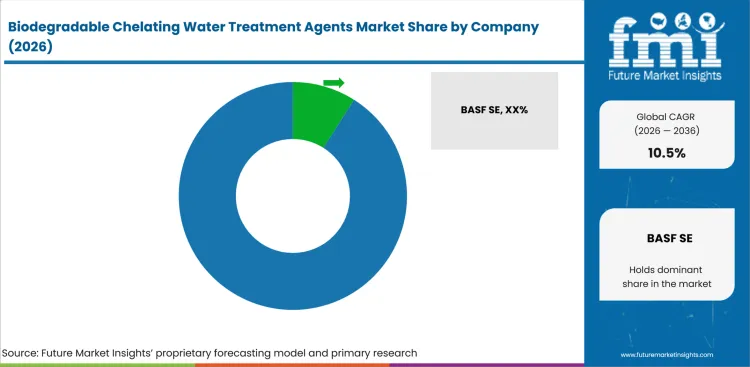
BASF, Nouryon, LANXESS, Nippon Shokubai, and Aquapharm Chemical Limited.
- Integrated chelant producers hold an advantage through molecule depth, global production reach, and regulatory proof files.
- Bio-based organic acid suppliers gain relevance where buyers need fermentation-derived gluconates and milder chelation profiles.
- Regional biodegradable chelant suppliers gain access through local stock, price fit, and faster support for plant trials.
- Technical documentation supports listing decisions through clear biodegradation files, pH-range data, and dosing evidence.
Supplier competition is built around evidence, not only around product availability. BASF’s April 2025 Trilon G launch shows how leading companies use GLDA chemistry, renewable-carbon positioning, and biodegradation documentation to support buyer conversion. This gives larger suppliers an advantage in regulated and export-facing applications. Technical files also influence adjacent demand for industrial cleaning and water softening systems.
Technical fit separates established chelant producers from smaller formulators. LANXESS describes BAYPURE CX 100 solid G as a readily biodegradable IDS-based chelating agent with calcium and heavy-metal binding capacity. That scope strengthens its case in cleaning, textile, and water-treatment accounts. Smaller suppliers can win in local tenders when they provide stock, blending support, and faster plant visits linked to cooling water treatment chemicals market demand.
Sodium gluconate suppliers such as Jungbunzlauer and Roquette are relevant where mild chelation and fermentation-based positioning are enough. Stronger specialty chelants are preferred where calcium scale, iron staining, or process residues create higher operating risk. Entrants serving the boiler water treatment chemicals market and oilfield scale inhibitor market face the same proof burden when water systems are complex.
How do top biodegradable chelating water treatment agents companies compare?
BASF and Nouryon score strongest on chelant depth while LANXESS and Aquapharm show strong relevance in biodegradable IDS and regional supply.
| Company | Relevance to Market Title | Biodegradable Chelant Chemistry Depth | Water Hardness and Scale Use Fit | Regulatory and Biodegradation Evidence | Geographic Footprint |
|---|---|---|---|---|---|
| BASF SE | Very High | Very Strong | Very Strong | Very Strong | Global |
| Nouryon | Very High | Very Strong | Very Strong | Strong | Global |
| LANXESS AG | Very High | Strong | Strong | Very Strong | Global |
| Aquapharm Chemical Limited | High | Strong | Strong | Moderate | India and Global |
| Jungbunzlauer Suisse AG | High | Moderate | Moderate | Strong | Europe and Global |
| Nippon Shokubai Co., Ltd. | High | Moderate | Strong | Moderate | Japan and Asia |
| Roquette Frères | Moderate to High | Moderate | Moderate | Moderate | Europe and Global |
| Innospec Inc. | Moderate | Moderate | Moderate | Moderate | North America and Europe |
Source: Future Market Insights competitive analysis, 2026.
Who are the key players in the biodegradable chelating water treatment agents market?
BASF, Nouryon, LANXESS, Nippon Shokubai, Jungbunzlauer, Roquette, Aquapharm, and Innospec are listed among other suppliers.
Key global companies leading the biodegradable chelating water treatment agents market include:
- BASF SE
- Nouryon
- LANXESS AG
- Nippon Shokubai Co., Ltd.
- Jungbunzlauer Suisse AG
- Roquette Frères
- Aquapharm Chemical Limited
- Innospec Inc.
- Italmatch Chemicals
- Kemira Oyj
Key Developments in Biodegradable Chelating Water Treatment Agents Market
- In April 2025, BASF launched Trilon G, a GLDA-based chelating agent with about 56.0% renewable carbon atoms and active-ingredient biodegradation above 60.0% within 28 days under OECD-style criteria.
- In July 2025, Aquapharm Chemical Limited published its Aquacid 2019EX IDS-Na4 product information, positioning the IDS-based chelant for water treatment, scale removal, scale prevention, and personal care applications.
- In December 2025, Jungbunzlauer updated sodium gluconate positioning as a readily biodegradable chelating agent with 98.0% biodegradation after 2 days, strengthening fermentation-derived options for milder chelation needs.
Key Players in the Biodegradable Chelating Water Treatment Agents Market
Integrated Chelant Producers
- BASF SE
- Nouryon
- LANXESS AG
- Nippon Shokubai Co., Ltd.
Bio-based Organic Acid and Gluconate Suppliers
- Jungbunzlauer Suisse AG
- Roquette Frères
- Corbion N.V.
Specialty Formulators and Regional Chelant Suppliers
- Aquapharm Chemical Limited
- Innospec Inc.
- Italmatch Chemicals
- Kemira Oyj
Biodegradable Chelating Water Treatment Agents Market - Scope & Definition
| Attribute | Detail |
|---|---|
| Market Definition | Biodegradable chelating agents used to bind metal ions, soften hard water, reduce scale, and stabilize water-treatment formulations. |
| Functions Covered | Metal-ion binding, hardness control, scale reduction, formulation stabilization, and process-water support. |
| Applications Covered | Water treatment, textiles, batteries, construction, and personal care applications where biodegradable chelation is a core function. |
| End-Use Industries | Industrial manufacturing, automotive, electronics, packaging, agriculture, and other water-sensitive industrial accounts. |
| Grades Covered | Bio-based, recycled, low VOC, halogen free, and waterborne chemistry routes used in biodegradable chelant positioning. |
| Inclusions | Commercially traded biodegradable chelants including GLDA, MGDA, IDS, HIDS, sodium gluconate, and related organic-acid chelants. |
| Exclusions | Persistent EDTA-only products, phosphonate-only scale inhibitors, disinfectants, coagulants, flocculants, membrane modules, and chemicals without biodegradable chelation function. |
Biodegradable Chelating Water Treatment Agents Market - Research Methodology
| Method | Description |
|---|---|
| Primary Research | FMI analyst interviews with water-treatment chemical buyers, textile effluent managers, industrial cleaning formulators, municipal-treatment specialists, and regional distributors across key markets. |
| Desk Research | Review of regulatory chemical inventories, biodegradability test guidance, safer-chemistry lists, official supplier product sheets, wastewater policy documents, and verified company materials. |
| Market Sizing & Forecasting | Bottom-up product-boundary approach using biodegradable chelant volumes, average selling prices, application mix, treatment intensity, and substitution rates from persistent chelants. |
| Data Validation | Cross-verification using wastewater investment patterns, industrial effluent needs, official biodegradability criteria, public product documentation, and company portfolio checks. |
Biodegradable Chelating Water Treatment Agents Market - Report Scope
| Item | Value |
|---|---|
| Market size by 2036 | USD 95.0 million |
| Growth rate | 10.5% CAGR from 2026 to 2036 |
| Forecast period | 2026 to 2036 |
| Base year value (2025) | USD 31.7 million |
| By application | Water treatment, textiles, batteries, construction, personal care |
| By chemistry type | Bio-based, recycled, low VOC, halogen free, waterborne |
| By function | Additive, solvent, binder, coating, process aid |
| By end-use industry | Industrial manufacturing, automotive, electronics, packaging, agriculture |
| Regions covered | North America, Latin America, Europe, East Asia, South Asia and Pacific, Middle East and Africa |
| Countries covered | India, China, South Korea, Germany, France, United States, United Kingdom, Japan |
| Key companies profiled | BASF, Nouryon, LANXESS, Nippon Shokubai, Jungbunzlauer, Roquette, Aquapharm, Innospec |
| Approach | Bottom-up product-boundary approach using eligible chelant revenue, channel presence, product positioning, and country-level treatment intensity |
Biodegradable Chelating Water Treatment Agents Market Breakdown by Application, Chemistry Type, Function, End-use Industry, and Region
Biodegradable Chelating Water Treatment Agents Market Segmented by Application
- Water Treatment
- Textiles
- Batteries
- Construction
- Personal Care
Biodegradable Chelating Water Treatment Agents Market Segmented by Chemistry Type
- Bio-based
- Recycled
- Low VOC
- Halogen Free
- Waterborne
Biodegradable Chelating Water Treatment Agents Market Segmented by Function
- Additive
- Solvent
- Binder
- Coating
- Process Aid
Biodegradable Chelating Water Treatment Agents Market Segmented by End-use Industry
- Industrial Manufacturing
- Automotive
- Electronics
- Packaging
- Agriculture
Biodegradable Chelating Water Treatment Agents Market by Region
- North America
- Latin America
- Europe
- East Asia
- South Asia and Pacific
- Middle East and Africa
Research Sources and Bibliography
- BASF SE. (2025, April 16). BASF expands sustainable chelating agent solutions with Trilon G. BASF.
- United States Environmental Protection Agency. (2024, October 23). Biden-Harris Administration announces USD 3.6 billion for water infrastructure through Investing in America agenda. USA EPA.
- United States Environmental Protection Agency. (2025, September 30). Safer Chemical Ingredients List. USA EPA.
- United States Environmental Protection Agency. (2024, April 10). Biden-Harris Administration finalizes first-ever national drinking water standard for PFAS. USA EPA.
- UN-Water. (2024, August 25). Progress on wastewater treatment: 2024 update. UN-Water.
- European Parliament and Council of the European Union. (2024, November 27). Directive (EU) 2024/3019 concerning urban wastewater treatment. EUR-Lex.
- European Commission. (2024, December 20). New rules for more thorough and cost-effective urban wastewater management enter into force. European Commission.
- Ofwat. (2024, December 19). Ofwat approves GBP 104 billion upgrade to accelerate delivery of cleaner rivers and seas. Ofwat.
- Environment Agency. (2025, October 23). Water and sewerage companies in England: Environmental performance report for 2024. GOV.UK.
- Statistisches Bundesamt. (2024, December 23). Water management: Disposal of sewage sludge from biological wastewater treatment, 2023. Destatis.
- Service des données et études statistiques. (2026, May 5). L’assainissement collectif en 2023. Ministère de la Transition Écologique.
- Ministry of Land, Infrastructure, Transport and Tourism. (2024, January 31). Introduction of the Asia Wastewater Management Partnership. MLIT Japan.
- International Trade Administration. (2025, September 25). China environmental technologies resource guide. USA Department of Commerce.
- Korea Environment Corporation. (2024). K-eco ESG performance summary report. K-eco.
- Press Information Bureau. (2024, September 1). Symbol of purity and a new beginning for the nation. Government of India.
- Aquapharm Chemical Limited. (2025, July 10). Tetrasodium iminodisuccinate IDS-Na4. Aquapharm Chemical Limited.
- Jungbunzlauer Suisse AG. (2025, December 2). Sodium gluconate. Jungbunzlauer.
- LANXESS AG. (2025). BAYPURE CX 100 solid G. LANXESS.
- Roquette Frères. (2026, January). Beauté by Roquette GA 080 sodium gluconate. Roquette.
- Innospec Inc. (2025, April 3). Personal care product guide. Innospec.
This Report Answers
- Market size estimates for 2026 and forecasts through 2036 for the biodegradable chelating water treatment agents market.
- Insights across selected regional and country-level markets with country CAGR comparison.
- Analysis of wastewater policy, industrial effluent pressure, and safer-chemistry screening as adoption drivers.
- Evaluation of key applications including water treatment, textiles, batteries, construction, and personal care.
- Assessment of biodegradable chemistry routes including GLDA, IDS, HIDS, and gluconate systems.
- Identification of growth opportunities across application, chemistry type, function, end-use industry, and region.
- Evaluation of supplier positioning, product documentation, and benchmark comparison among leading companies.
- Country-level growth analysis covering India, China, South Korea, Germany, France, the United States, the United Kingdom, and Japan.
- Assessment of the competitive landscape including integrated chelant producers, bio-based organic acid suppliers, and regional formulators.
- Regional outlooks across North America, Europe, East Asia, South Asia and Pacific, Latin America, and Middle East and Africa.
Frequently Asked Questions
What is the biodegradable chelating water treatment agents market size in 2026?
The biodegradable chelating water treatment agents market size is anticipated to cross USD 35.0 million in 2026.
What is the biodegradable chelating water treatment agents market forecast for 2036?
The biodegradable chelating water treatment agents industry revenue is predicted to reach USD 95.0 million by 2036 as documented biodegradable additives expand.
What is the biodegradable chelating water treatment agents market CAGR?
The biodegradable chelating water treatment agents sector is projected to expand at 10.5% CAGR from 2026 to 2036.
What segment leads the biodegradable chelating water treatment agents market?
Water treatment is likely to capture 46.0% share in 2026 due to scale-control and metal-ion binding demand.
What country grows fastest in the biodegradable chelating water treatment agents market?
India is set to record 12.4% CAGR by 2036, driven by sewage-treatment projects and industrial effluent-treatment demand.
Preview the report firsthand - request a free sample
Get SampleGet the brochure for pricing and purchase details.
Get PDFTable of Content
- Executive Summary
- Global Market Outlook
- Demand to side Trends
- Supply to side Trends
- Technology Roadmap Analysis
- Analysis and Recommendations
- Market Overview
- Market Coverage / Taxonomy
- Market Definition / Scope / Limitations
- Research Methodology
- Chapter Orientation
- Analytical Lens and Working Hypotheses
- Market Structure, Signals, and Trend Drivers
- Benchmarking and Cross-market Comparability
- Market Sizing, Forecasting, and Opportunity Mapping
- Research Design and Evidence Framework
- Desk Research Programme (Secondary Evidence)
- Company Annual and Sustainability Reports
- Peer-reviewed Journals and Academic Literature
- Corporate Websites, Product Literature, and Technical Notes
- Earnings Decks and Investor Briefings
- Statutory Filings and Regulatory Disclosures
- Technical White Papers and Standards Notes
- Trade Journals, Industry Magazines, and Analyst Briefs
- Conference Proceedings, Webinars, and Seminar Materials
- Government Statistics Portals and Public Data Releases
- Press Releases and Reputable Media Coverage
- Specialist Newsletters and Curated Briefings
- Sector Databases and Reference Repositories
- FMI Internal Proprietary Databases and Historical Market Datasets
- Subscription Datasets and Paid Sources
- Social Channels, Communities, and Digital Listening Inputs
- Additional Desk Sources
- Expert Input and Fieldwork (Primary Evidence)
- Primary Modes
- Qualitative Interviews and Expert Elicitation
- Quantitative Surveys and Structured Data Capture
- Blended Approach
- Why Primary Evidence is Used
- Field Techniques
- Interviews
- Surveys
- Focus Groups
- Observational and In-context Research
- Social and Community Interactions
- Stakeholder Universe Engaged
- C-suite Leaders
- Board Members
- Presidents and Vice Presidents
- R&D and Innovation Heads
- Technical Specialists
- Domain Subject-matter Experts
- Scientists
- Physicians and Other Healthcare Professionals
- Governance, Ethics, and Data Stewardship
- Research Ethics
- Data Integrity and Handling
- Primary Modes
- Tooling, Models, and Reference Databases
- Desk Research Programme (Secondary Evidence)
- Data Engineering and Model Build
- Data Acquisition and Ingestion
- Cleaning, Normalisation, and Verification
- Synthesis, Triangulation, and Analysis
- Quality Assurance and Audit Trail
- Market Background
- Market Dynamics
- Drivers
- Restraints
- Opportunity
- Trends
- Scenario Forecast
- Demand in Optimistic Scenario
- Demand in Likely Scenario
- Demand in Conservative Scenario
- Opportunity Map Analysis
- Product Life Cycle Analysis
- Supply Chain Analysis
- Investment Feasibility Matrix
- Value Chain Analysis
- PESTLE and Porter’s Analysis
- Regulatory Landscape
- Regional Parent Market Outlook
- Production and Consumption Statistics
- Import and Export Statistics
- Market Dynamics
- Global Market Analysis 2021 to 2025 and Forecast, 2026 to 2036
- Historical Market Size Value (USD Million) Analysis, 2021 to 2025
- Current and Future Market Size Value (USD Million) Projections, 2026 to 2036
- Y to o to Y Growth Trend Analysis
- Absolute $ Opportunity Analysis
- Global Market Pricing Analysis 2021 to 2025 and Forecast 2026 to 2036
- Global Market Analysis 2021 to 2025 and Forecast 2026 to 2036, By Application
- Introduction / Key Findings
- Historical Market Size Value (USD Million) Analysis By Application , 2021 to 2025
- Current and Future Market Size Value (USD Million) Analysis and Forecast By Application , 2026 to 2036
- Water Treatment
- Textiles
- Batteries
- Construction
- Personal Care
- Water Treatment
- Y to o to Y Growth Trend Analysis By Application , 2021 to 2025
- Absolute $ Opportunity Analysis By Application , 2026 to 2036
- Global Market Analysis 2021 to 2025 and Forecast 2026 to 2036, By Chemistry Type
- Introduction / Key Findings
- Historical Market Size Value (USD Million) Analysis By Chemistry Type, 2021 to 2025
- Current and Future Market Size Value (USD Million) Analysis and Forecast By Chemistry Type, 2026 to 2036
- Bio-based
- Recycled
- Low VOC
- Halogen Free
- Waterborne
- Bio-based
- Y to o to Y Growth Trend Analysis By Chemistry Type, 2021 to 2025
- Absolute $ Opportunity Analysis By Chemistry Type, 2026 to 2036
- Global Market Analysis 2021 to 2025 and Forecast 2026 to 2036, By Function
- Introduction / Key Findings
- Historical Market Size Value (USD Million) Analysis By Function, 2021 to 2025
- Current and Future Market Size Value (USD Million) Analysis and Forecast By Function, 2026 to 2036
- Additive
- Solvent
- Binder
- Coating
- Process Aid
- Additive
- Y to o to Y Growth Trend Analysis By Function, 2021 to 2025
- Absolute $ Opportunity Analysis By Function, 2026 to 2036
- Global Market Analysis 2021 to 2025 and Forecast 2026 to 2036, By End-use Industry
- Introduction / Key Findings
- Historical Market Size Value (USD Million) Analysis By End-use Industry, 2021 to 2025
- Current and Future Market Size Value (USD Million) Analysis and Forecast By End-use Industry, 2026 to 2036
- Industrial Manufacturing
- Automotive
- Electronics
- Packaging
- Agriculture
- Industrial Manufacturing
- Y to o to Y Growth Trend Analysis By End-use Industry, 2021 to 2025
- Absolute $ Opportunity Analysis By End-use Industry, 2026 to 2036
- Global Market Analysis 2021 to 2025 and Forecast 2026 to 2036, By Region
- Introduction
- Historical Market Size Value (USD Million) Analysis By Region, 2021 to 2025
- Current Market Size Value (USD Million) Analysis and Forecast By Region, 2026 to 2036
- North America
- Latin America
- Western Europe
- Eastern Europe
- East Asia
- South Asia and Pacific
- Middle East & Africa
- Market Attractiveness Analysis By Region
- North America Market Analysis 2021 to 2025 and Forecast 2026 to 2036, By Country
- Historical Market Size Value (USD Million) Trend Analysis By Market Taxonomy, 2021 to 2025
- Market Size Value (USD Million) Forecast By Market Taxonomy, 2026 to 2036
- By Country
- USA
- Canada
- Mexico
- By Application
- By Chemistry Type
- By Function
- By End-use Industry
- By Country
- Market Attractiveness Analysis
- By Country
- By Application
- By Chemistry Type
- By Function
- By End-use Industry
- Key Takeaways
- Latin America Market Analysis 2021 to 2025 and Forecast 2026 to 2036, By Country
- Historical Market Size Value (USD Million) Trend Analysis By Market Taxonomy, 2021 to 2025
- Market Size Value (USD Million) Forecast By Market Taxonomy, 2026 to 2036
- By Country
- Brazil
- Chile
- Rest of Latin America
- By Application
- By Chemistry Type
- By Function
- By End-use Industry
- By Country
- Market Attractiveness Analysis
- By Country
- By Application
- By Chemistry Type
- By Function
- By End-use Industry
- Key Takeaways
- Western Europe Market Analysis 2021 to 2025 and Forecast 2026 to 2036, By Country
- Historical Market Size Value (USD Million) Trend Analysis By Market Taxonomy, 2021 to 2025
- Market Size Value (USD Million) Forecast By Market Taxonomy, 2026 to 2036
- By Country
- Germany
- UK
- Italy
- Spain
- France
- Nordic
- BENELUX
- Rest of Western Europe
- By Application
- By Chemistry Type
- By Function
- By End-use Industry
- By Country
- Market Attractiveness Analysis
- By Country
- By Application
- By Chemistry Type
- By Function
- By End-use Industry
- Key Takeaways
- Eastern Europe Market Analysis 2021 to 2025 and Forecast 2026 to 2036, By Country
- Historical Market Size Value (USD Million) Trend Analysis By Market Taxonomy, 2021 to 2025
- Market Size Value (USD Million) Forecast By Market Taxonomy, 2026 to 2036
- By Country
- Russia
- Poland
- Hungary
- Balkan & Baltic
- Rest of Eastern Europe
- By Application
- By Chemistry Type
- By Function
- By End-use Industry
- By Country
- Market Attractiveness Analysis
- By Country
- By Application
- By Chemistry Type
- By Function
- By End-use Industry
- Key Takeaways
- East Asia Market Analysis 2021 to 2025 and Forecast 2026 to 2036, By Country
- Historical Market Size Value (USD Million) Trend Analysis By Market Taxonomy, 2021 to 2025
- Market Size Value (USD Million) Forecast By Market Taxonomy, 2026 to 2036
- By Country
- China
- Japan
- South Korea
- By Application
- By Chemistry Type
- By Function
- By End-use Industry
- By Country
- Market Attractiveness Analysis
- By Country
- By Application
- By Chemistry Type
- By Function
- By End-use Industry
- Key Takeaways
- South Asia and Pacific Market Analysis 2021 to 2025 and Forecast 2026 to 2036, By Country
- Historical Market Size Value (USD Million) Trend Analysis By Market Taxonomy, 2021 to 2025
- Market Size Value (USD Million) Forecast By Market Taxonomy, 2026 to 2036
- By Country
- India
- ASEAN
- Australia & New Zealand
- Rest of South Asia and Pacific
- By Application
- By Chemistry Type
- By Function
- By End-use Industry
- By Country
- Market Attractiveness Analysis
- By Country
- By Application
- By Chemistry Type
- By Function
- By End-use Industry
- Key Takeaways
- Middle East & Africa Market Analysis 2021 to 2025 and Forecast 2026 to 2036, By Country
- Historical Market Size Value (USD Million) Trend Analysis By Market Taxonomy, 2021 to 2025
- Market Size Value (USD Million) Forecast By Market Taxonomy, 2026 to 2036
- By Country
- Kingdom of Saudi Arabia
- Other GCC Countries
- Turkiye
- South Africa
- Other African Union
- Rest of Middle East & Africa
- By Application
- By Chemistry Type
- By Function
- By End-use Industry
- By Country
- Market Attractiveness Analysis
- By Country
- By Application
- By Chemistry Type
- By Function
- By End-use Industry
- Key Takeaways
- Key Countries Market Analysis
- USA
- Pricing Analysis
- Market Share Analysis, 2025
- By Application
- By Chemistry Type
- By Function
- By End-use Industry
- Canada
- Pricing Analysis
- Market Share Analysis, 2025
- By Application
- By Chemistry Type
- By Function
- By End-use Industry
- Mexico
- Pricing Analysis
- Market Share Analysis, 2025
- By Application
- By Chemistry Type
- By Function
- By End-use Industry
- Brazil
- Pricing Analysis
- Market Share Analysis, 2025
- By Application
- By Chemistry Type
- By Function
- By End-use Industry
- Chile
- Pricing Analysis
- Market Share Analysis, 2025
- By Application
- By Chemistry Type
- By Function
- By End-use Industry
- Germany
- Pricing Analysis
- Market Share Analysis, 2025
- By Application
- By Chemistry Type
- By Function
- By End-use Industry
- UK
- Pricing Analysis
- Market Share Analysis, 2025
- By Application
- By Chemistry Type
- By Function
- By End-use Industry
- Italy
- Pricing Analysis
- Market Share Analysis, 2025
- By Application
- By Chemistry Type
- By Function
- By End-use Industry
- Spain
- Pricing Analysis
- Market Share Analysis, 2025
- By Application
- By Chemistry Type
- By Function
- By End-use Industry
- France
- Pricing Analysis
- Market Share Analysis, 2025
- By Application
- By Chemistry Type
- By Function
- By End-use Industry
- India
- Pricing Analysis
- Market Share Analysis, 2025
- By Application
- By Chemistry Type
- By Function
- By End-use Industry
- ASEAN
- Pricing Analysis
- Market Share Analysis, 2025
- By Application
- By Chemistry Type
- By Function
- By End-use Industry
- Australia & New Zealand
- Pricing Analysis
- Market Share Analysis, 2025
- By Application
- By Chemistry Type
- By Function
- By End-use Industry
- China
- Pricing Analysis
- Market Share Analysis, 2025
- By Application
- By Chemistry Type
- By Function
- By End-use Industry
- Japan
- Pricing Analysis
- Market Share Analysis, 2025
- By Application
- By Chemistry Type
- By Function
- By End-use Industry
- South Korea
- Pricing Analysis
- Market Share Analysis, 2025
- By Application
- By Chemistry Type
- By Function
- By End-use Industry
- Russia
- Pricing Analysis
- Market Share Analysis, 2025
- By Application
- By Chemistry Type
- By Function
- By End-use Industry
- Poland
- Pricing Analysis
- Market Share Analysis, 2025
- By Application
- By Chemistry Type
- By Function
- By End-use Industry
- Hungary
- Pricing Analysis
- Market Share Analysis, 2025
- By Application
- By Chemistry Type
- By Function
- By End-use Industry
- Kingdom of Saudi Arabia
- Pricing Analysis
- Market Share Analysis, 2025
- By Application
- By Chemistry Type
- By Function
- By End-use Industry
- Turkiye
- Pricing Analysis
- Market Share Analysis, 2025
- By Application
- By Chemistry Type
- By Function
- By End-use Industry
- South Africa
- Pricing Analysis
- Market Share Analysis, 2025
- By Application
- By Chemistry Type
- By Function
- By End-use Industry
- USA
- Market Structure Analysis
- Competition Dashboard
- Competition Benchmarking
- Market Share Analysis of Top Players
- By Regional
- By Application
- By Chemistry Type
- By Function
- By End-use Industry
- Competition Analysis
- Competition Deep Dive
- BASF SE
- Overview
- Product Portfolio
- Profitability by Market Segments (Product/Age /Sales Channel/Region)
- Sales Footprint
- Strategy Overview
- Marketing Strategy
- Product Strategy
- Channel Strategy
- LANXESS AG
- Nouryon Germany
- Jungbunzlauer Germany
- Innospec Germany
- Water-treatment service contractors
- Specialty chemical distributors
- BASF SE
- Competition Deep Dive
- Assumptions & Acronyms Used


