

- Market Size (2026)
- USD 320.6 Mn
- Forecast (2036)
- USD 787.3 Mn
- CAGR (2026 to 2036)
- 9.4%
Biogas Collection Covers Market Size, Market Forecast and Outlook By FMI
USD 320.6 million in 2026 and USD 787.3 million by 2036 at a 9.4% CAGR.
The biogas collection covers industry value is forecast to grow from USD 293.053 million in 2025 to USD 787.3 million by 2036 at 9.4% CAGR as methane capture, gas routing, and lagoon retrofit needs become central to biogas infrastructure. New Installation is forecast to represent 58.0% share in 2026 as developers specify gas-tight covers during first-stage engineering. HDPE is expected to secure 55.0% share in 2026 since installers value weldable sheets, chemical resistance, and seam consistency across manure lagoons and wastewater ponds.
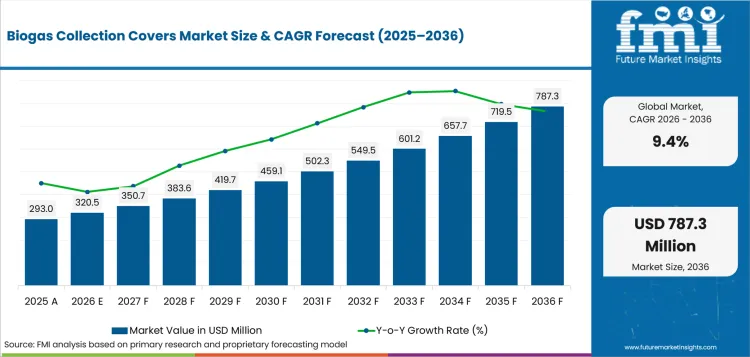
Biogas Collection Covers Market Overview: Size and Forecast
- 2026 Market Size: USD 320.6 million
- 2036 Market Size: USD 787.3 million
- Forecast CAGR: 9.4% from 2026 to 2036
- Leading Installation: New Installation
- New Installation Share in 2026: 58.0%
- Leading Material: HDPE
- HDPE Share in 2026: 55.0%
- Fastest-growing Country: India
- India CAGR: 11.3% by 2036
Summary of the Biogas Collection Covers Market
- Demand and Growth Drivers
- Municipal sludge projects support cover demand as wastewater plants seek reliable gas recovery from digestion and storage assets.
- Agricultural manure systems support floating cover sales with large lagoon formats that need flexible membranes and practical inspection access.
- Food processing plants create industrial wastewater demand where organic effluent can generate gas before final treatment and discharge control.
- Product and Segment View
- New Installation is projected to hold 58.0% share in 2026 as project developers include gas capture during initial plant engineering.
- HDPE is forecast to represent 55.0% share in 2026 because welded seams and chemical resistance suit broad cover fields.
- Floating Covers are expected to secure 42.0% share in 2026, supported by open lagoon applications and manure storage fit.
- Geography and Competitive Outlook
- India is projected to record 11.3% CAGR by 2036 as CBG and Bio-CNG project registration supports cover demand.
- China is expected to expand at 10.2% CAGR by 2036 through industrial wastewater, livestock manure, and municipal organic waste projects.
- Solmax, AGRU, and Carlisle SynTec compete through geomembrane quality, field welding compatibility, and installer networks.
- Ecomembrane, Genap, Membrane Systems Europe, and Balmoral Tanks focus on gas cover geometry, tank systems, and AD project references.
- Analyst Opinion
- Anurag Sharma, Principal Consultant for Food and Beverage at FMI, observes, "Biogas collection covers are moving from a sheet purchase into a gas capture system decision. Buyers now review seam testing, penetration design, anchoring, condensate routing, and service access before approving a supplier. Agriculture creates the largest area opportunity, while municipal and food-processing projects create stricter documentation needs. Suppliers with field crews, operating references, and clear inspection routines should gain stronger listing confidence."
Project selection is moving toward cover systems that prove methane containment and service access before buyers approve plant designs. The IEA stated in 2025 that global combined biogas and biomethane production is expected to expand 22% from 2025 to 2030, supporting demand for upstream gas capture hardware. The European Biogas Association reported in December 2025 that European biogas and biomethane production reached 22 bcm in 2024 and that installed biomethane capacity reached 7 bcm/year by early 2025. Solmax published an April 2024 biogas case using 1.0 mm HDPE for pond lining and 1.5 mm GSE HD geomembrane for gas capture over palm oil mill effluent, showing why membrane thickness, seam control, and field installation quality appraise project value together.
Which factors support expansion in the biogas collection covers market?
Finished gas-tight cover revenue and verified installation support market value across lagoons, digesters, landfills, and industrial wastewater assets.
- Market value is supported by cover material revenue before anchoring, gas outlets, and inspection services add incremental spending.
- Supplier pricing reflects membrane grade, field welding quality, and cover geometry before site-specific engineering increases project value.
- Revenue improves as uncovered lagoons and older digesters convert odor control assets into methane recovery systems.
- Buyer trust rises when suppliers document seam testing, gas take-off layout, warranty coverage, and safe maintenance access clearly.
Why is the biogas collection covers market growing?
Methane capture rules and project finance needs make gas-tight cover performance more important than basic pond sealing.
Agricultural buyers are making covers part of energy recovery rather than waste storage alone. The USA Environmental Protection Agency reported in 2025 that 191 manure-based anaerobic digestion systems were producing renewable natural gas as of June 2024, with 69 RNG projects under construction. This operating base matters because RNG projects need sealed covers, gas routing, condensate handling, and maintenance access before methane reaches compression or pipeline equipment. Larger farms often prefer floating covers where lagoons already exist, while municipal and landfill buyers are shaping the higher-specification end of the market. The practical result is a steady retrofit stream alongside new digester builds.
How is the biogas collection covers market segmented?
The biogas collection covers industry is segmented by cover type, application, material, end use, and installation.
- Floating Covers are projected to represent 42.0% of Cover Type demand in 2026 because open lagoons need wide-area sealing without fixed roofs and civil structures.
- Lagoons are expected to hold 36.0% of Application demand in 2026 as farms and industrial ponds need broad gas capture over high liquid volumes.
- HDPE membranes are anticipated to account for 55.0% of Material demand in 2026 because welded seams support durable cover fields under wastewater and manure exposure.
- Municipal buyers are projected to represent 33.0% of End Use demand in 2026 as sludge digestion and odor control remain part of public wastewater budgets.
- New Installation is expected to capture 58.0% of Installation demand in 2026 as more biogas projects specify gas capture during the design stage.
Segmentation is shaped by physical site design more than by the buyer’s industry label. Lagoon projects require wide flexible cover fields, while digesters often need modular or domed systems tied to tank geometry. The European Biogas Association reported in June 2025 that the number of biomethane plants in Europe increased from 1,548 to 1,678 between the 2024 and 2025 map editions. This changes cover specifications because grid-linked plants need stable gas handling upstream of upgrading. Suppliers win when cover design supports gas routing and not only liquid containment.
Insights into the Floating Covers Cover Type Segment
Biogas Collection Covers Market Analysis By Cover Type
- Floating Covers are projected to account for 42.0% of Cover Type demand in 2026 as open lagoons need wide-area sealing without the cost of fixed structures.
- Buyers in manure and industrial effluent projects compare buoyancy layout, ballast design, perimeter anchoring, and gas draw-off quality before choosing cover thickness alone.
Insights into the Lagoons Application Segment
Biogas Collection Covers Market Analysis By Application
- Lagoons are expected to hold 36.0% of Application demand in 2026 since they combine high liquid volume with lower-cost gas capture across farm and wastewater settings.
- Lagoon cover buyers often ask for perimeter anchoring and condensate control because gas pooling under the sheet can create operating and safety risks.
Insights into the HDPE Material Segment
Biogas Collection Covers Market Analysis By Material
- HDPE is anticipated to represent 55.0% of Material demand in 2026 as chemical resistance and field welding suit wastewater, manure, and organic effluent exposure.
- Installers prefer HDPE where large cover panels must be welded consistently and inspected across broad membrane fields under weather exposure.
Insights into the Municipal End Use Segment
Biogas Collection Covers Market Analysis By End Use
- Municipal is projected to account for 33.0% of End Use demand in 2026 as wastewater utilities add gas control to sludge treatment and odor management assets.
- Public buyers usually require installer references, inspection records, and warranty clarity before approving cover systems for digestion and storage sites.
Insights into the New Installation Installation Segment
Biogas Collection Covers Market Analysis By Installation
- New Installation is expected to hold 58.0% of Installation demand in 2026 as new biogas assets include gas collection in first-stage engineering.
- Retrofit demand stays active where older lagoons need membrane replacement, but new builds offer cleaner anchoring, drainage, and gas outlet design.
Biogas Collection Covers Market Drivers, Restraints, and Opportunities
Methane recovery, field installation risk, and renewable gas economics shape the main demand, restraint, and opportunity paths for this market.
- Driver: Gas-tight lagoon retrofits support demand as operators turn uncovered or odor-control ponds into methane recovery assets.
- Restraint: Field welding quality can limit adoption because poor seams and pipe penetrations can erase methane capture gains.
- Opportunity: Industrial wastewater projects create demand where high-organic effluent produces collectable gas before discharge treatment.
Lagoon Methane Recovery Outlook
Lagoon projects create the largest surface opportunity because manure storage and industrial effluent ponds need covers that control gas formation over broad areas. The USA Environmental Protection Agency reported in 2026 that more than 400 livestock farm digesters were operating and more than 70 projects were in construction in 2024. This creates two buying routes, since new sites need integrated cover systems while older sites need replacements that fit existing geometry. Suppliers with site measurement, custom fabrication, and field repair skills can price project risk more accurately.
Seam and Penetration Restraint Analysis
The main restraint is not membrane availability, but the ability to keep seams, anchors, and pipe penetrations gas-tight during years of movement. The IEA stated in 2025 that methane leakage during biogas production can range from 0% to 12%, making cover integrity a direct performance issue rather than a small installation detail. Covers flex under gas pressure, rainwater load, UV exposure, and liquid level changes. Buyers therefore evaluate system design, inspection documentation, and repair access as much as material grade.
Industrial Wastewater and Retrofit Opportunity
Industrial wastewater creates an opportunity because high-strength organic effluent can support gas capture before final treatment. The IEA’s 2025 outlook assessed biogas and biomethane potential across more than 30 feedstock types in more than 5 million locations worldwide, which reinforces how local waste streams can shape project economics. Food processors, palm oil mills, dairies, and starch plants can use covers when anaerobic ponds already exist. Suppliers that combine membrane selection with gas routing advice can move beyond commodity sheet pricing.
Which countries are growing fastest in the biogas collection covers market?
India 11.3% CAGR, China 10.2% CAGR, South Korea 9.7% CAGR, United States 8.6% CAGR, France 8.4% CAGR, United Kingdom 7.8% CAGR, Germany 7.1% CAGR, and Japan 6.8% CAGR through 2036.
| Country | CAGR |
| United States | 8.6% |
| United Kingdom | 7.8% |
| Germany | 7.1% |
| France | 8.4% |
| Japan | 6.8% |
| China | 10.2% |
| South Korea | 9.7% |
| India | 11.3% |
Source: Future Market Insights, 2026.
How do country-level CAGRs compare in the biogas collection covers market?
India leads country growth while Japan records the most measured expansion outlook among profiled markets.
- India is forecast to record 11.3% CAGR by 2036 as CBG and Bio-CNG projects increase installed cover requirements.
- China is expected to expand at 10.2% CAGR from 2026 to 2036 due to wastewater and agricultural residue treatment needs.
- South Korea is projected to grow at 9.7% CAGR through 2036 as municipal organic waste facilities support engineered covers.
- The United States is estimated to rise at 8.6% CAGR by 2036 with manure digesters and landfill gas projects supporting demand.
- France is expected to advance at 8.4% CAGR over the forecast period as biomethane injection projects raise upstream gas control needs.
- The United Kingdom is forecast to grow at 7.8% CAGR through 2036 as AD plant renewal and water utility procurement support retrofit work.
- Germany is projected to post 7.1% CAGR by 2036 as mature biogas assets require upkeep and performance upgrades.
- Japan is anticipated to rise at 6.8% CAGR through 2036 as compact wastewater and food-waste projects create selective cover demand.
How fast is the biogas collection covers market growing in the United States?
A 8.6% CAGR through 2036 reflects manure digesters, landfill gas projects, and wastewater utility procurement.
Country Market Snapshot Table
| Parameter | Value |
|---|---|
| Market Size in 2025 (Value) | USD 70.0 million |
| Market Size in 2026 (Value) | USD 76.0 million |
| Market Forecast in 2036 (Value) | USD 173.5 million |
| CAGR (2026 to 2036) | 8.6% |
| Years Considered | 2021 to 2036 |
| Base Year | 2025 |
| Forecast Period | 2026 to 2036 |
| Units Considered | Value (USD million) |
| Leading Sub-Region | South Atlantic manure and landfill gas corridors |
United States Biogas Collection Covers Market Outlook
United States biogas collection cover demand is broad because farms, wastewater plants, landfills, and food-waste digesters all need gas control. Farmers usually compare cover cost against odor reduction and gas value, while municipal buyers focus on safety and contractor accountability.
Retrofit work is active where older lagoons need flexible covers that avoid new civil structures. New projects are more likely to specify anchoring, inspection, and gas take-off details during engineering.
Key Growth Drivers
- Dairy manure digesters in California, Wisconsin, and New York create large-area floating cover demand. EPA reported 242 farms with active anaerobic digesters in June 2025.
- Landfill gas projects in Pennsylvania, Texas, and California support gas collection improvements. EPA listed 542 operational landfill gas energy projects and 444 candidate landfills as of September 2024.
- Public wastewater projects use engineering firms to specify cover materials, safety features, and installation testing during tender planning.
- Food-waste digestion projects support compact cover needs where municipalities combine organics diversion with renewable gas production.
Key Restraints
- Permitting can slow manure lagoon projects in states with odor, nutrient, and runoff concerns that require local review.
- Installer availability can restrict delivery in remote dairy and swine regions because field welding crews must travel with testing equipment.
- Project qualification is selective because EPA defines candidate landfills as sites with at least 1 million tons of waste and no operational or planned project.
What makes United States unique
The United States is unique because manure, landfill, wastewater, and food-waste buyers all create cover demand in one market.
Key Companies
- AGRU America
- Solmax
- Carlisle SynTec
- Viaflex
- Plastic Fusion Fabricators
- Lemna Environmental Technologies
- Layfield Group
Sales & Marketing Channels
- Direct sales to farm digester developers
- Engineering procurement through wastewater contractors
- Landfill gas project integrator channels
- Distributor-led geomembrane supply
- Certified installer networks
- Public utility tenders
Country Segment Breakdown Table
| Segment | Sub-Segments |
|---|---|
| By Cover Type | Floating Covers · Geomembrane Covers · Modular Tank Covers · Other |
| By Application | Lagoons · Digesters · Landfills · Industrial Wastewater |
| By Material | HDPE · PVC · EPDM / Other |
| By End Use | Municipal · Agriculture · Food Processing · Landfill Operators |
| By Installation | New Installation · Replacement / Retrofit |
| Key Sub-Regions Covered, Biogas Project Clusters | South Atlantic · Midwest dairy corridors · California · Texas · Pennsylvania · Pacific Northwest |
Market Taxonomy and Sub-Regions Covered
Frequently Asked Questions
How fast is United States biogas collection covers market growing?
Demand in United States is projected to rise at 8.6% CAGR from 2026 to 2036 as biogas cover projects scale in selected end uses.
Who leads United States biogas collection covers market?
AGRU America, Solmax, Carlisle SynTec, Viaflex compete through cover materials, engineering references, and installation support.
What is driving adoption in United States biogas collection covers market?
Adoption is supported by methane recovery needs, wastewater and organics treatment projects, and more formal gas capture specifications.
What is the biogas collection covers market outlook in the United Kingdom?
A 7.8% CAGR through 2036 reflects AD plant renewal, organics processing, and water utility cover replacement.
Country Market Snapshot Table
| Parameter | Value |
|---|---|
| Market Size in 2025 (Value) | USD 26.4 million |
| Market Size in 2026 (Value) | USD 28.5 million |
| Market Forecast in 2036 (Value) | USD 60.4 million |
| CAGR (2026 to 2036) | 7.8% |
| Years Considered | 2021 to 2036 |
| Base Year | 2025 |
| Forecast Period | 2026 to 2036 |
| Units Considered | Value (USD million) |
| Leading Sub-Region | England AD retrofit and water utility networks |
United Kingdom Biogas Collection Covers Market Outlook
United Kingdom demand is strongest in tank-based AD projects, wastewater treatment, and commercial organics processing. Buyers value long service records because weather exposure and gas safety remain high in plant risk reviews.
Retrofit activity is expected to stay important as older AD assets need membrane renewal and gas storage upgrades. Water utilities and private AD operators often specify covers through EPCs and tank suppliers.
Key Growth Drivers
- AD plant renewal supports cover replacement because ADBA stated in November 2024 that the United Kingdom had 756 operational AD plants.
- Feedstock movement supports biogas assets because ADBA also stated that the UK AD sector digests about 36 million tonnes of organic waste each year.
- Water utilities need covers around sludge digestion and odor management when public procurement requires documented service records.
- Agricultural AD projects need replacement membranes as first-generation assets age and operators seek safer gas handling.
Key Restraints
- Local opposition can slow large AD projects in rural counties when transport, odor, and landscape concerns shape planning decisions.
- Higher labor and installation costs raise the delivered price of cover replacement across tank-based and membrane systems.
- Standard permit capacity rules can add compliance work because the Environment Agency’s 2026 standard rules permit covers AD treatment capacity above 100 tonnes per day.
What makes United Kingdom unique
The United Kingdom is unique as a service-and-retrofit market where plant age and operator references matter more than new site count alone.
Key Companies
- Balmoral Tanks
- Membrane Systems Europe
- Genap
- Solmax
- Ecomembrane
- Gas Data Ltd.
- FM BioEnergy
Sales & Marketing Channels
- AD plant EPC contractors
- Water utility framework agreements
- Tank manufacturer channels
- Specialist membrane installers
- Agricultural dealer introductions
- Local authority waste contracts
Country Segment Breakdown Table
| Segment | Sub-Segments |
|---|---|
| By Cover Type | Floating Covers · Geomembrane Covers · Modular Tank Covers · Other |
| By Application | Lagoons · Digesters · Landfills · Industrial Wastewater |
| By Material | HDPE · PVC · EPDM / Other |
| By End Use | Municipal · Agriculture · Food Processing · Landfill Operators |
| By Installation | New Installation · Replacement / Retrofit |
| Key Sub-Regions Covered, Biogas Project Clusters | England AD clusters · Scotland farm AD assets · Wales organics projects · Northern England · Midlands · South West |
Market Taxonomy and Sub-Regions Covered
Frequently Asked Questions
How fast is United Kingdom biogas collection covers market growing?
Demand in United Kingdom is projected to rise at 7.8% CAGR from 2026 to 2036 as biogas cover projects scale in selected end uses.
Who leads United Kingdom biogas collection covers market?
Balmoral Tanks, Membrane Systems Europe, Genap, Solmax compete through cover materials, engineering references, and installation support.
What is driving adoption in United Kingdom biogas collection covers market?
Adoption is supported by methane recovery needs, wastewater and organics treatment projects, and more formal gas capture specifications.
How is the biogas collection covers market performing in Germany?
A 7.1% CAGR through 2036 reflects mature asset upkeep and engineering-led replacement work.
Country Market Snapshot Table
| Parameter | Value |
|---|---|
| Market Size in 2025 (Value) | USD 30.8 million |
| Market Size in 2026 (Value) | USD 33.0 million |
| Market Forecast in 2036 (Value) | USD 65.5 million |
| CAGR (2026 to 2036) | 7.1% |
| Years Considered | 2021 to 2036 |
| Base Year | 2025 |
| Forecast Period | 2026 to 2036 |
| Units Considered | Value (USD million) |
| Leading Sub-Region | Bavaria and Lower Saxony farm biogas belts |
Germany Biogas Collection Covers Market Outlook
Germany is a mature replacement and performance market with a deep operating fleet. Cover demand comes from refurbishment, farm plant life extension, and gas loss reduction rather than only new projects.
Buyers expect detailed technical files because German projects often involve strong engineering oversight. The market has less white-space expansion than India or China, but qualification standards are high.
Key Growth Drivers
- Farm biogas refurbishments in Bavaria and Lower Saxony sustain membrane replacement. The IEA described Germany as the world’s largest biogas and biomethane market with 329 PJ of production in 2024.
- Biomethane upgrading encourages tighter upstream gas collection. IEA Bioenergy’s 2024 Germany update stated that biogas was equivalent to 10% of natural gas consumption.
- Technical service firms support inspection and maintenance of cover systems as operators extend mature asset life.
- Engineering offices influence supplier selection by requiring documentation for welding, anchoring, and gas handling details.
Key Restraints
- Lower new plant additions limit first-time cover installations because asset renewal outweighs greenfield development in many regions.
- Feedstock and power tariff changes can delay capital work on older assets when operators reassess return periods.
- Auction economics can delay cover replacement decisions because the Federal Network Agency’s February 2026 determinations set ceilings at 19.43 ct/kWh for new biomass installations, 19.83 ct/kWh for existing biomass installations, and 23.13 ct/kWh for biomethane installations.
What makes Germany unique
Germany is the benchmark market for mature biogas asset upkeep and engineering-led supplier selection.
Key Companies
- HUESKER
- Ecomembrane
- Genap
- Membrane Systems Europe
- Solmax
- AGRU
- Sattler Ceno Biogas
Sales & Marketing Channels
- Engineering office specifications
- Farm biogas service contractors
- Regional membrane installers
- EPC retrofit packages
- Agricultural cooperatives
- Utility-linked biomethane projects
Country Segment Breakdown Table
| Segment | Sub-Segments |
|---|---|
| By Cover Type | Floating Covers · Geomembrane Covers · Modular Tank Covers · Other |
| By Application | Lagoons · Digesters · Landfills · Industrial Wastewater |
| By Material | HDPE · PVC · EPDM / Other |
| By End Use | Municipal · Agriculture · Food Processing · Landfill Operators |
| By Installation | New Installation · Replacement / Retrofit |
| Key Sub-Regions Covered, Biogas Project Clusters | Bavaria · Lower Saxony · North Rhine-Westphalia · Baden-Wurttemberg · Schleswig-Holstein · Saxony-Anhalt |
Market Taxonomy and Sub-Regions Covered
Frequently Asked Questions
How fast is Germany biogas collection covers market growing?
Demand in Germany is projected to rise at 7.1% CAGR from 2026 to 2036 as biogas cover projects scale in selected end uses.
Who leads Germany biogas collection covers market?
HUESKER, Ecomembrane, Genap, Membrane Systems Europe compete through cover materials, engineering references, and installation support.
What is driving adoption in Germany biogas collection covers market?
Adoption is supported by methane recovery needs, wastewater and organics treatment projects, and more formal gas capture specifications.
What is driving biogas collection covers growth in France?
A 8.4% CAGR through 2036 reflects biomethane injection projects and farm methanisation demand.
Country Market Snapshot Table
| Parameter | Value |
|---|---|
| Market Size in 2025 (Value) | USD 22.1 million |
| Market Size in 2026 (Value) | USD 24.0 million |
| Market Forecast in 2036 (Value) | USD 53.8 million |
| CAGR (2026 to 2036) | 8.4% |
| Years Considered | 2021 to 2036 |
| Base Year | 2025 |
| Forecast Period | 2026 to 2036 |
| Units Considered | Value (USD million) |
| Leading Sub-Region | Brittany, Grand Est, and biomethane injection regions |
France Biogas Collection Covers Market Outlook
France demand is moving from scattered biogas use toward grid-injection projects with more formal technical specifications. Cover demand sits close to farm methanisation, municipal organic waste processing, and digestate storage.
Buyers care about odor control and neighborhood acceptance because public trust affects project timelines. Suppliers gain ground when they support both gas control and reliable containment during rural project operation.
Key Growth Drivers
- Farm methanisation in Brittany and Grand Est supports covered storage demand. France’s ecological transition ministry reported 1,096 biogas-producing installations at the end of September 2024.
- Biomethane injection projects require tighter upstream gas capture. French statistical reporting in February 2026 recorded 803 biomethane injection installations with 15.5 TWh/year capacity at the end of 2025.
- Municipal food-waste diversion creates more treatment capacity needs as source-separated organics move toward recovery routes.
- Farm cooperatives help cover suppliers reach rural projects where digestate storage and gas capture must work together.
Key Restraints
- Local opposition can delay large rural methanisation projects when transport routes and odor risk affect community acceptance.
- Grid connection and tariff uncertainty can affect project timing because operators need predictable biomethane economics.
- Project finance is sensitive to policy structure because the European Commission approved a EUR 1.5 billion French scheme for sustainable biomethane production in July 2024.
What makes France unique
France combines biomethane injection expansion with strong local acceptance pressure around rural methanisation projects.
Key Companies
- Solmax
- Ecomembrane
- Genap
- Membrane Systems Europe
- RENOLIT
- Sattler Ceno Biogas
- Agripower France
Sales & Marketing Channels
- Farm cooperative referrals
- Biomethane project EPCs
- Municipal waste tenders
- Regional installer partnerships
- Water utility procurement
- Distributor-led membrane supply
Country Segment Breakdown Table
| Segment | Sub-Segments |
|---|---|
| By Cover Type | Floating Covers · Geomembrane Covers · Modular Tank Covers · Other |
| By Application | Lagoons · Digesters · Landfills · Industrial Wastewater |
| By Material | HDPE · PVC · EPDM / Other |
| By End Use | Municipal · Agriculture · Food Processing · Landfill Operators |
| By Installation | New Installation · Replacement / Retrofit |
| Key Sub-Regions Covered, Biogas Project Clusters | Brittany · Grand Est · Auvergne-Rhone-Alpes · Hauts-de-France · Normandy · Occitanie |
Market Taxonomy and Sub-Regions Covered
Frequently Asked Questions
How fast is France biogas collection covers market growing?
Demand in France is projected to rise at 8.4% CAGR from 2026 to 2036 as biogas cover projects scale in selected end uses.
Who leads France biogas collection covers market?
Solmax, Ecomembrane, Genap, Membrane Systems Europe compete through cover materials, engineering references, and installation support.
What is driving adoption in France biogas collection covers market?
Adoption is supported by methane recovery needs, wastewater and organics treatment projects, and more formal gas capture specifications.
What is the biogas collection covers market forecast for Japan?
A 6.8% CAGR through 2036 reflects compact wastewater, food-waste, and engineered tank projects.
Country Market Snapshot Table
| Parameter | Value |
|---|---|
| Market Size in 2025 (Value) | USD 11.2 million |
| Market Size in 2026 (Value) | USD 12.0 million |
| Market Forecast in 2036 (Value) | USD 23.2 million |
| CAGR (2026 to 2036) | 6.8% |
| Years Considered | 2021 to 2036 |
| Base Year | 2025 |
| Forecast Period | 2026 to 2036 |
| Units Considered | Value (USD million) |
| Leading Sub-Region | Tokyo, Chubu, and municipal wastewater clusters |
Japan Biogas Collection Covers Market Outlook
Japan is a selective market for covers because space, seismic design, and public procurement discipline affect project design. Projects often favor engineered tank and dome formats over broad lagoon systems.
Suppliers need strong documentation and local partner support to pass buyer review. Municipal and industrial buyers often use formal tenders where operating reliability weighs more than low material price.
Key Growth Drivers
- Municipal food-waste and wastewater projects support compact cover formats. IEA country data show biofuels and waste accounted for 3.5% of Japan’s total energy supply in 2024.
- Biomass power helps keep bioenergy infrastructure visible. The Institute for Sustainable Energy Policies reported in August 2025 that biomass power generation accounted for 5.9% of Japan’s electricity in 2024.
- Industrial processors use anaerobic treatment for high-moisture organic waste where controlled tanks suit compact sites.
- Imported membrane systems can win when backed by local engineering support and formal documentation.
Key Restraints
- Space constraints limit large lagoon-based cover demand because compact sites often require tank-mounted or modular systems.
- Conservative public procurement slows first-time supplier entry when buyers require domestic references and long documentation cycles.
- Energy-system conservatism can slow first-time biogas cover decisions because Japan’s Energy White Paper 2025 states the energy self-sufficiency rate was 15.3% and around 70% of electricity generation depended on fossil fuels.
What makes Japan unique
Japan is a compact-engineering market where documentation and local execution matter more than broad-area membrane volume.
Key Companies
- Membrane Systems Europe
- Solmax
- Ecomembrane
- Kanadevia Corporation
- Kubota Environmental Engineering
- Mitsubishi Chemical Aqua Solutions
- Hitachi Zosen Inova Japan
Sales & Marketing Channels
- Municipal engineering tenders
- Wastewater EPC contractors
- Industrial plant engineering firms
- Local distributor partnerships
- Imported membrane specialist channels
- Utility-linked procurement routes
Country Segment Breakdown Table
| Segment | Sub-Segments |
|---|---|
| By Cover Type | Floating Covers · Geomembrane Covers · Modular Tank Covers · Other |
| By Application | Lagoons · Digesters · Landfills · Industrial Wastewater |
| By Material | HDPE · PVC · EPDM / Other |
| By End Use | Municipal · Agriculture · Food Processing · Landfill Operators |
| By Installation | New Installation · Replacement / Retrofit |
| Key Sub-Regions Covered, Biogas Project Clusters | Tokyo · Osaka · Yokohama · Nagoya · Sapporo · Fukuoka |
Market Taxonomy and Sub-Regions Covered
Frequently Asked Questions
How fast is Japan biogas collection covers market growing?
Demand in Japan is projected to rise at 6.8% CAGR from 2026 to 2036 as biogas cover projects scale in selected end uses.
Who leads Japan biogas collection covers market?
Membrane Systems Europe, Solmax, Ecomembrane, Kanadevia Corporation compete through cover materials, engineering references, and installation support.
What is driving adoption in Japan biogas collection covers market?
Adoption is supported by methane recovery needs, wastewater and organics treatment projects, and more formal gas capture specifications.
How fast is China biogas collection covers market growing?
A 10.2% CAGR through 2036 reflects wastewater scale, agricultural residues, and larger organics projects.
Country Market Snapshot Table
| Parameter | Value |
|---|---|
| Market Size in 2025 (Value) | USD 39.0 million |
| Market Size in 2026 (Value) | USD 43.0 million |
| Market Forecast in 2036 (Value) | USD 113.5 million |
| CAGR (2026 to 2036) | 10.2% |
| Years Considered | 2021 to 2036 |
| Base Year | 2025 |
| Forecast Period | 2026 to 2036 |
| Units Considered | Value (USD million) |
| Leading Sub-Region | Eastern industrial wastewater and provincial organics projects |
China Biogas Collection Covers Market Outlook
China has scale, but the cover opportunity is uneven across project types. The most relevant demand comes from larger industrial and agricultural projects rather than small rural units.
Buyers often balance cost against service access, especially outside top-tier cities. International suppliers mainly compete in higher-specification projects where seam quality, UV resistance, or warranty support affects risk.
Key Growth Drivers
- Industrial wastewater treatment in food and starch processing supports covered anaerobic lagoons. China’s State Council reported renewable energy generation of 3.46 trillion kilowatt-hours in 2024.
- Livestock manure projects create demand for lower-cost floating cover systems. IEA Bioenergy’s 2024 country summary described more than 100,000 biogas plants in China.
- Provincial methane control efforts push larger plants toward better gas capture and more formal cover specification.
- Environmental EPC contractors create access for suppliers able to support large industrial wastewater and organics projects.
Key Restraints
- Low-cost local membrane supply creates price pressure for international suppliers competing in standard geomembrane work.
- Small project fragmentation makes after-sales service difficult across inland provinces and dispersed agricultural assets.
- Transport-fuel conversion is still developing because IEA Bioenergy’s 2024 China update noted that transport biofuels were less than 1.5% of transport fuels.
What makes China unique
China offers the largest physical project pool, but premium suppliers must target large projects rather than broad low-end sheet demand.
Key Companies
- Solmax
- AGRU
- HUESKER
- Ecomembrane
- Genap
- Naue Asia
- Local geomembrane manufacturers
Sales & Marketing Channels
- Environmental EPC contractors
- Provincial wastewater tenders
- Agricultural project developers
- Local membrane distributors
- Industrial park procurement
- Biogas plant integrators
Country Segment Breakdown Table
| Segment | Sub-Segments |
|---|---|
| By Cover Type | Floating Covers · Geomembrane Covers · Modular Tank Covers · Other |
| By Application | Lagoons · Digesters · Landfills · Industrial Wastewater |
| By Material | HDPE · PVC · EPDM / Other |
| By End Use | Municipal · Agriculture · Food Processing · Landfill Operators |
| By Installation | New Installation · Replacement / Retrofit |
| Key Sub-Regions Covered, Biogas Project Clusters | Yangtze River Delta · Pearl River Delta · Shandong · Sichuan · Henan · Guangdong |
Market Taxonomy and Sub-Regions Covered
Frequently Asked Questions
How fast is China biogas collection covers market growing?
Demand in China is projected to rise at 10.2% CAGR from 2026 to 2036 as biogas cover projects scale in selected end uses.
Who leads China biogas collection covers market?
Solmax, AGRU, HUESKER, Ecomembrane compete through cover materials, engineering references, and installation support.
What is driving adoption in China biogas collection covers market?
Adoption is supported by methane recovery needs, wastewater and organics treatment projects, and more formal gas capture specifications.
What is the biogas collection covers market outlook in South Korea?
A 9.7% CAGR through 2036 reflects food-waste digestion, sewage sludge projects, and municipal biogas policy.
Country Market Snapshot Table
| Parameter | Value |
|---|---|
| Market Size in 2025 (Value) | USD 12.8 million |
| Market Size in 2026 (Value) | USD 14.0 million |
| Market Forecast in 2036 (Value) | USD 35.4 million |
| CAGR (2026 to 2036) | 9.7% |
| Years Considered | 2021 to 2036 |
| Base Year | 2025 |
| Forecast Period | 2026 to 2036 |
| Units Considered | Value (USD million) |
| Leading Sub-Region | Seoul Capital Area and municipal organics networks |
South Korea Biogas Collection Covers Market Outlook
South Korea demand is tied to municipal organic waste and sewage sludge treatment. Centralized projects need reliable gas capture before upgrading or city-gas use.
Dense urban settings increase odor and safety scrutiny, so buyers value engineered covers and formal service support. Imported systems can win where local partners provide qualification and maintenance access.
Key Growth Drivers
- Food-waste separation creates steady feedstock for digestion projects. IEA Bioenergy’s 2024 Korea update stated selected pilot facilities are expected to process 1,660 tons of organic waste per day and produce about 140,000 Nm3 of biogas daily.
- Sewage sludge digestion supports tank and modular cover demand. The same update stated that South Korea plans to expand biogas production facilities from 110 to over 150 by 2030.
- City-gas use raises the value of captured methane because upgraded gas needs controlled storage and upstream leak prevention.
- Municipal tenders can support engineered covers when public operators combine food waste, sludge, and livestock manure streams.
Key Restraints
- Urban odor complaints can tighten performance requirements and push buyers toward higher-cost cover systems.
- Imported cover systems face qualification and local service barriers when public buyers require domestic execution support.
- Public and private waste producers face staged obligations because Korea’s Biogas Act sets public-sector conversion targets of 50% by 2025 and 80% by 2050.
What makes South Korea unique
South Korea links food-waste policy and biogas output more tightly than most Asian markets.
Key Companies
- Membrane Systems Europe
- Solmax
- Ecomembrane
- Korea Environment Corporation project partners
- Local EPC contractors
- HUESKER
- AGRU
Sales & Marketing Channels
- Municipal waste tenders
- Engineering company specifications
- Wastewater utility procurement
- EPC-led biogas projects
- Imported membrane distributors
- Public-private waste treatment projects
Country Segment Breakdown Table
| Segment | Sub-Segments |
|---|---|
| By Cover Type | Floating Covers · Geomembrane Covers · Modular Tank Covers · Other |
| By Application | Lagoons · Digesters · Landfills · Industrial Wastewater |
| By Material | HDPE · PVC · EPDM / Other |
| By End Use | Municipal · Agriculture · Food Processing · Landfill Operators |
| By Installation | New Installation · Replacement / Retrofit |
| Key Sub-Regions Covered, Biogas Project Clusters | Seoul Capital Area · Incheon · Gyeonggi-do · Busan · Daegu · Daejeon |
Market Taxonomy and Sub-Regions Covered
Frequently Asked Questions
How fast is South Korea biogas collection covers market growing?
Demand in South Korea is projected to rise at 9.7% CAGR from 2026 to 2036 as biogas cover projects scale in selected end uses.
Who leads South Korea biogas collection covers market?
Membrane Systems Europe, Solmax, Ecomembrane, Korea Environment Corporation project partners compete through cover materials, engineering references, and installation support.
What is driving adoption in South Korea biogas collection covers market?
Adoption is supported by methane recovery needs, wastewater and organics treatment projects, and more formal gas capture specifications.
Why is India the fastest-growing biogas collection covers market?
A 11.3% CAGR through 2036 reflects CBG registration, Bio-CNG projects, and municipal wet-waste treatment.
Country Market Snapshot Table
| Parameter | Value |
|---|---|
| Market Size in 2025 (Value) | USD 18.9 million |
| Market Size in 2026 (Value) | USD 21.0 million |
| Market Forecast in 2036 (Value) | USD 61.3 million |
| CAGR (2026 to 2036) | 11.3% |
| Years Considered | 2021 to 2036 |
| Base Year | 2025 |
| Forecast Period | 2026 to 2036 |
| Units Considered | Value (USD million) |
| Leading Sub-Region | Uttar Pradesh, Punjab, Gujarat, and CBG project corridors |
India Biogas Collection Covers Market Outlook
India is the fastest growth market because the project pool is moving from small biogas toward larger CBG and Bio-CNG assets. Each larger plant needs dependable gas sealing before cleaning, compression, or offtake.
Suppliers need to win on installed cost, local repair access, and feedstock-linked uptime. Domestic geomembrane suppliers compete with global membrane brands in price-sensitive tenders.
Key Growth Drivers
- CBG and biogas projects in Uttar Pradesh, Punjab, and Gujarat need covered digestion and storage systems. The GOBARdhan portal listed 1,700 registered biogas plants and 1,230 functional biogas plants in June 2026.
- Oil marketing and financing channels make methane capture commercially important. IREDA states that 5,000 CBG plants are planned in phases to produce 15 million tonnes of CBG per annum.
- Municipal wet-waste processing creates demand for compact and modular covers in urban treatment sites.
- Farm and gaushala projects support smaller floating covers where cow dung and organic residues are aggregated locally.
Key Restraints
- Feedstock collection costs can delay plant commissioning when wet waste, dung, and residues are dispersed across districts.
- Low-cost local sheets create quality variation in welded cover systems and can increase leakage risk after commissioning.
- Capital support remains capped because MNRE’s December 2025 Waste to Energy Programme provides Rs 4.0 crore per 4,800 kg/day for BioCNG from new biogas plants and a maximum CFA of Rs 10.0 crore per project.
What makes India unique
India combines the fastest CBG project pipeline with high cost pressure and a strong need for local service.
Key Companies
- Solmax
- AGRU
- Tuflex India
- Ocean Global
- Ravindra Energy project partners
- Sistema.bio India
- Local geomembrane fabricators
Sales & Marketing Channels
- CBG plant EPC contractors
- Oil marketing company project links
- Municipal solid waste tenders
- Local geomembrane distributors
- Farm and gaushala project networks
- State renewable energy agencies
Country Segment Breakdown Table
| Segment | Sub-Segments |
|---|---|
| By Cover Type | Floating Covers · Geomembrane Covers · Modular Tank Covers · Other |
| By Application | Lagoons · Digesters · Landfills · Industrial Wastewater |
| By Material | HDPE · PVC · EPDM / Other |
| By End Use | Municipal · Agriculture · Food Processing · Landfill Operators |
| By Installation | New Installation · Replacement / Retrofit |
| Key Sub-Regions Covered, Biogas Project Clusters | Uttar Pradesh · Punjab · Gujarat · Maharashtra · Karnataka · Tamil Nadu |
Market Taxonomy and Sub-Regions Covered
Frequently Asked Questions
How fast is India biogas collection covers market growing?
Demand in India is projected to rise at 11.3% CAGR from 2026 to 2036 as biogas cover projects scale in selected end uses.
Who leads India biogas collection covers market?
Solmax, AGRU, Tuflex India, Ocean Global compete through cover materials, engineering references, and installation support.
What is driving adoption in India biogas collection covers market?
Adoption is supported by methane recovery needs, wastewater and organics treatment projects, and more formal gas capture specifications.
Who are the leading companies in the biogas collection covers market?
Solmax, AGRU, Ecomembrane, Genap, Balmoral Tanks, Carlisle SynTec, and Membrane Systems Europe.
- Established geomembrane companies hold an advantage through material portfolios and welding documentation.
- Specialist cover system firms gain project access by offering gas storage, floating cover, and tank-cover engineering.
- Tank infrastructure suppliers gain demand where AD projects require complete storage and digestion systems.
- Regional installers create value by providing field welding, repair access, and fast site service.
Biogas collection cover suppliers compete by controlling the parts of the system that affect gas capture performance. Sheet suppliers have polymer credibility, but buyers also need anchoring, welding, gas take-off points, and repair planning. Solmax’s April 2024 Malaysia case strengthens its position because the project used HDPE geomembranes for both pond lining and biogas capture. Buyers use such references to judge whether suppliers understand gas production conditions.
Manufacturing scale has become a competitive separator as cover projects move beyond basic containment. AGRU, Carlisle SynTec, HUESKER, and Viaflex compete through geomembrane supply and material documentation. Ecomembrane, Genap, and Membrane Systems Europe compete through double membrane systems, floating covers, and gas storage engineering. Balmoral Tanks competes in tank-linked AD projects where covers and storage systems are part of a larger infrastructure package.
Smaller regional firms can win through local installation crews and faster repair. This is important because a failed cover can create odor issues, gas loss, and operational downtime. Suppliers with trained installers, seam-testing routines, gas pressure knowledge, and documented maintenance protocols should gain stronger tender positions. Companies that sell only commodity sheets are expected to face weaker buyer acceptance in higher-specification biogas projects.
How do top biogas collection covers companies compare?
Solmax and Membrane Systems Europe score strongest on market-title relevance, while AGRU and Carlisle SynTec score strongly on material and seam control.
| Company | Relevance to Market Title | Gas-Tight Cover Engineering | Field Welding and Seam Control | AD and Lagoon Reference Depth | Channel Reach | Geographic Footprint |
|---|---|---|---|---|---|---|
| Solmax | Very High | Very Strong | Very Strong | Strong | Very Strong | Global |
| AGRU | High | Strong | Very Strong | Moderate | Strong | North America and Europe |
| Ecomembrane | Very High | Very Strong | Strong | Strong | Strong | Europe and Americas |
| Genap | High | Very Strong | Strong | Strong | Moderate | Europe and export markets |
| Membrane Systems Europe | Very High | Very Strong | Strong | Strong | Strong | International |
| Balmoral Tanks | High | Strong | Strong | Strong | Strong | United Kingdom and United States |
| Carlisle SynTec | Moderate | Moderate | Very Strong | Moderate | Strong | United States |
| HUESKER | Moderate | Strong | Very Strong | Moderate | Strong | Global |
| Viaflex | Moderate | Moderate | Very Strong | Moderate | Moderate | North America |
| Lemna Environmental Technologies | High | Very Strong | Strong | Strong | Moderate | North America |
Source: Future Market Insights competitive analysis, 2026.
Who are the key players in the biogas collection covers market?
Solmax, AGRU, Ecomembrane, Genap, and Membrane Systems Europe are listed with Balmoral Tanks and Carlisle SynTec among other suppliers.
Key global companies leading the biogas collection covers market include:
- Solmax
- AGRU
- Ecomembrane
- Genap
- Membrane Systems Europe
- Balmoral Tanks
- Carlisle SynTec
- HUESKER
- Viaflex
- Lemna Environmental Technologies
Key Developments in Biogas Collection Covers Market
- In March 2024, AGRU America announced a USD 7.8 million expansion in Williamsburg County, supporting engineering plastics capacity relevant to containment and geomembrane supply.
- In April 2024, Solmax published its Cenergi biogas case in Malaysia using GSE HD geomembranes over a palm oil effluent lagoon, highlighting covered lagoon demand in industrial organic wastewater.
- In April 2025, Balmoral Tanks announced USA operations with a 16,600-square-foot manufacturing facility in Mentor, Ohio, strengthening tank supply for AD and wastewater projects.
Key Players in the Biogas Collection Covers Market
Material and Geomembrane Specialists
- Solmax
- AGRU
- Carlisle SynTec
- HUESKER
- Viaflex
Cover System and Gas Storage Specialists
- Ecomembrane
- Genap
- Membrane Systems Europe
- Lemna Environmental Technologies
Tank and AD Infrastructure Specialists
- Balmoral Tanks
- Sattler Ceno Biogas
- Regional tank and EPC suppliers
Biogas Collection Covers Market - Report Scope
| Parameter | Details |
|---|---|
| Forecast period | 2026 to 2036 |
| Historical period | 2021 to 2025 |
| Quantitative unit | Revenue in USD million |
| By cover type | Floating Covers, Geomembrane Covers, Modular Tank Covers, Other |
| By application | Lagoons, Digesters, Landfills, Industrial Wastewater |
| By material | HDPE, PVC, EPDM / Other |
| By end use | Municipal, Agriculture, Food Processing, Landfill Operators |
| By installation | New Installation, Replacement / Retrofit |
| Regions covered | North America, Western Europe, East Asia, and South Asia |
| Countries covered | United States, United Kingdom, Germany, France, Japan, China, South Korea, India |
| Key companies profiled | Solmax, AGRU, Ecomembrane, Genap, Balmoral Tanks, Carlisle SynTec, Membrane Systems Europe |
| Approach | Hybrid bottom-up and top-down methodology based on project counts, cover area, installed pricing, application mix, replacement timing, and country-level biogas activity |
Source: Future Market Insights competitive analysis, 2026.
Biogas Collection Covers Market - Scope & Definition
| Attribute | Detail |
|---|---|
| Market Definition | Gas-tight cover systems installed over anaerobic lagoons, digesters, slurry tanks, landfill cells, and industrial wastewater ponds to capture methane-rich biogas. |
| Functions Covered | Methane capture, odor containment, gas routing, cover anchoring, condensate management, and protected gas storage. |
| Applications Covered | Lagoons, digesters, landfills, industrial wastewater ponds, slurry tanks, and covered anaerobic treatment assets. |
| End-Use Industries | Municipal wastewater, agriculture, food processing, landfill operators, renewable gas developers, and industrial wastewater treatment. |
| Revenue Scope | Cover materials, fabricated cover systems, anchoring components, gas take-off interfaces, and installation-linked cover revenue. |
| Exclusions | Standalone gas upgrading units, compressors, flares, CHP engines, complete digester packages without cover revenue, and general pond liners without gas collection function. |
| Stakeholders | Geomembrane manufacturers, cover fabricators, certified installers, EPC contractors, wastewater utilities, farm digester developers, and landfill gas operators. |
Biogas Collection Covers Market - Research Methodology
| Method | Description |
|---|---|
| Primary Research | FMI analyst interviews with wastewater utilities, farm digester developers, landfill operators, food-processing wastewater teams, installers, and EPC contractors. |
| Desk Research | Review of methane and biogas data from public agencies, trade associations, energy bodies, company pages, and technical product documentation. |
| Market Sizing & Forecasting | Bottom-up project-boundary approach using cover area demand, installed pricing, application mix, material shares, replacement cycles, and country-level biogas activity. |
| Data Validation | Cross-verification using manure digester counts, landfill gas project data, biomethane plant additions, country policy signals, and company cover portfolios. |
Biogas Collection Covers Market by Segments
Biogas Collection Covers Market Segmented by Cover Type:
- Floating Covers
- Geomembrane Covers
- Modular Tank Covers
- Other
Biogas Collection Covers Market Segmented by Application:
- Lagoons
- Digesters
- Landfills
- Industrial Wastewater
Biogas Collection Covers Market Segmented by Material:
- HDPE
- PVC
- EPDM / Other
Biogas Collection Covers Market Segmented by End Use:
- Municipal
- Agriculture
- Food Processing
- Landfill Operators
Biogas Collection Covers Market Segmented by Installation:
- New Installation
- Replacement / Retrofit
Biogas Collection Covers Market by Region:
- North America
- United States
- Western Europe
- United Kingdom
- Germany
- France
- East Asia
- China
- Japan
- South Korea
- South Asia
- India
Research Sources and Bibliography
- AGRU America. (2024, March 19). AGRU America expands operations in Williamsburg County. AGRU America.
- Anaerobic Digestion and Bioresources Association. (2024, November 18). Hundreds of UK green gas plants at risk of closure. ADBA.
- Balmoral Tanks. (2025, April 24). Balmoral Tanks launches U.S. operations with new Ohio manufacturing facility. Balmoral Tanks.
- European Biogas Association. (2025, June 26). European biomethane map 2025. European Biogas Association.
- European Biogas Association. (2025, December 10). 15th statistical report of the European Biogas Association 2025. European Biogas Association.
- European Commission. (2024, July 24). State aid: Commission approves French scheme to support sustainable biomethane production. European Commission.
- Government of China. (2025, January 28). Renewable energy accounts for 56 pct of China’s total installed power capacity. State Council of the People’s Republic of China.
- Government of India. (2026, June). GOBARdhan unified registration portal for biogas plants. Ministry of Jal Shakti.
- Institute for Sustainable Energy Policies. (2025, August 20). 2024 share of electricity from renewable energy sources in Japan. ISEP.
- International Energy Agency. (2025, May 28). Outlook for biogas and biomethane. International Energy Agency.
- International Energy Agency. (2025, October 7). Biogases - Renewables 2025. International Energy Agency.
- IEA Bioenergy. (2024, December). Implementation of bioenergy in China - 2024 update. IEA Bioenergy.
- Statistical Data and Studies Department. (2026, February 27). Biomethane injected into gas networks: Fourth quarter 2025 dashboard. Ministry for Ecological Transition.
- IEA Bioenergy. (2024, December). Implementation of bioenergy in Germany - 2024 update. IEA Bioenergy.
- International Energy Agency. (2026). Japan - Countries & Regions. International Energy Agency.
- IEA Bioenergy. (2024, December). Implementation of bioenergy in the Republic of Korea - 2024 update. IEA Bioenergy.
- Bundesnetzagentur. (2026, February 20). Price ceilings for biomass and biomethane auctions in 2026. Bundesnetzagentur.
- Indian Renewable Energy Development Agency. (2026). Sectors - Compressed Bio-Gas. IREDA.
- Korea Legislation Research Institute. (2024). Act on promotion of production and use of biogas from organic waste resources. Korean Law Information Center.
- Ministry for Ecological Transition and Territorial Cohesion. (2024, September). Biogaz. Government of France.
- Ministry of New and Renewable Energy. (2025, December 30). Waste to energy programme. Government of India.
- Ofgem. (2025, July 31). Green Gas Support Scheme annual report: April 2024 to March 2025. Ofgem.
- Press Information Bureau. (2025, June 28). MNRE notifies revised guidelines for waste-to-energy programme. Government of India.
- Republic of Korea Ministry of Environment. (2024, March 4). Incheon and Gwangju biogas project press release. Ministry of Environment.
- Solmax. (2024, April 4). Biogas cover turns palm oil waste into fuel in Malaysia. Solmax.
- Ministry of Economy, Trade and Industry. (2025). Energy White Paper 2025 summary. Agency for Natural Resources and Energy.
- United States Environmental Protection Agency. (2025, June 24). Types of anaerobic digesters. U.S. Environmental Protection Agency.
- United States Environmental Protection Agency. (2025, September 12). Basic information about landfill gas. U.S. Environmental Protection Agency.
- United States Environmental Protection Agency. (2025, September 23). AgSTAR accomplishments. U.S. Environmental Protection Agency.
- United States Environmental Protection Agency. (2026, March 3). Frequent questions about livestock biogas projects. U.S. Environmental Protection Agency.
- United States Environmental Protection Agency. (2026, March 10). AgSTAR data and trends. U.S. Environmental Protection Agency.
This bibliography is provided for reader reference and is not exhaustive. The full report contains the complete reference list and detailed citations.
This Report Answers
- Market size estimates for 2026 and forecasts through 2036 for the biogas collection covers market.
- Insights across selected regional and country-level markets.
- Analysis of demand drivers, methane capture patterns, retrofit trends, and purchasing behavior.
- Evaluation of key applications and installation types, including lagoons, digesters, landfills, and industrial wastewater.
- Assessment of material selection, cover engineering, field welding, and gas-tight performance requirements.
- Identification of growth opportunities across cover type, material, end use, application, and installation segments.
- Evaluation of supply chain dynamics, product innovation trends, and installer-led channel structures.
- Country-level growth analysis covering the United States, United Kingdom, Germany, France, Japan, China, South Korea, and India.
- Assessment of the competitive landscape, including leading cover system, geomembrane, and tank infrastructure suppliers.
- Analysis of buyer preferences, retrofit demand, and emerging gas capture opportunities.
- Regional outlooks across North America, Western Europe, East Asia, and South Asia.
- Delivery of market data, forecasts, and supporting analysis in PDF and Excel formats.
Frequently Asked Questions
What is the growth prospect for biogas collection covers?
Demand for biogas collection covers is expected to rise at a considerable pace as methane capture and renewable gas projects expand.
Which companies are expected to shape the biogas collection covers market?
Solmax, AGRU, Ecomembrane, Genap, Balmoral Tanks, Carlisle SynTec, and Membrane Systems Europe are expected to shape competition through cover systems and geomembrane portfolios.
Why are biogas project developers investing in collection covers?
Biogas project developers are investing in collection covers to capture methane, reduce odor, and improve gas recovery from lagoons and digesters.
Why are field welding and seam testing important in biogas collection covers?
Field welding and seam testing are important because weak joints can reduce gas capture quality and increase repair risk after commissioning.
Which cover formats are gaining attention in biogas collection covers?
Floating covers and geomembrane covers are gaining attention as buyers seek practical systems for lagoons and wastewater ponds.
How do methane rules influence biogas collection cover demand?
Methane rules influence demand by pushing operators toward sealed cover systems with documented gas capture and inspection quality.
Why is HDPE important for biogas collection covers?
HDPE is important because weldable seams, chemical resistance, and installer familiarity support durable cover use across large lagoon fields.
What role do municipal wastewater projects play in biogas collection covers?
Municipal wastewater projects support adoption by adding cover systems around sludge digestion, odor control, and gas recovery assets.
How do industrial wastewater projects support biogas collection covers?
Industrial wastewater projects support cover demand when organic effluent creates gas that can be captured before final treatment.
Preview the report firsthand - request a free sample
Get SampleGet the brochure for pricing and purchase details.
Get PDFTable of Content
- Executive Summary
- Global Market Outlook
- Demand-side Trends
- Supply-side Trends
- Technology Roadmap Analysis
- Analysis and Recommendations
- Market Overview
- Market Coverage / Taxonomy
- Market Definition / Scope / Limitations
- Research Methodology
- Chapter Orientation
- Analytical Lens and Working Hypotheses
- Market Structure, Signals, and Trend Drivers
- Benchmarking and Cross-market Comparability
- Market Sizing, Forecasting, and Opportunity Mapping
- Research Design and Evidence Framework
- Desk Research Programme (Secondary Evidence)
- Company Annual and Sustainability Reports
- Peer-reviewed Journals and Academic Literature
- Corporate Websites, Product Literature, and Technical Notes
- Earnings Decks and Investor Briefings
- Statutory Filings and Regulatory Disclosures
- Technical White Papers and Standards Notes
- Trade Journals, Industry Magazines, and Analyst Briefs
- Conference Proceedings, Webinars, and Seminar Materials
- Government Statistics Portals and Public Data Releases
- Press Releases and Reputable Media Coverage
- Specialist Newsletters and Curated Briefings
- Sector Databases and Reference Repositories
- FMI Internal Proprietary Databases and Historical Market Datasets
- Subscription Datasets and Paid Sources
- Social Channels, Communities, and Digital Listening Inputs
- Additional Desk Sources
- Expert Input and Fieldwork (Primary Evidence)
- Primary Modes
- Qualitative Interviews and Expert Elicitation
- Quantitative Surveys and Structured Data Capture
- Blended Approach
- Why Primary Evidence is Used
- Field Techniques
- Interviews
- Surveys
- Focus Groups
- Observational and In-context Research
- Social and Community Interactions
- Stakeholder Universe Engaged
- C-suite Leaders
- Board Members
- Presidents and Vice Presidents
- R&D and Innovation Heads
- Technical Specialists
- Domain Subject-matter Experts
- Scientists
- Physicians and Other Healthcare Professionals
- Governance, Ethics, and Data Stewardship
- Research Ethics
- Data Integrity and Handling
- Primary Modes
- Tooling, Models, and Reference Databases
- Desk Research Programme (Secondary Evidence)
- Data Engineering and Model Build
- Data Acquisition and Ingestion
- Cleaning, Normalisation, and Verification
- Synthesis, Triangulation, and Analysis
- Quality Assurance and Audit Trail
- Market Background
- Market Dynamics
- Drivers
- Restraints
- Opportunity
- Trends
- Scenario Forecast
- Demand in Optimistic Scenario
- Demand in Likely Scenario
- Demand in Conservative Scenario
- Opportunity Map Analysis
- Product Life Cycle Analysis
- Supply Chain Analysis
- Investment Feasibility Matrix
- Value Chain Analysis
- PESTLE and Porter’s Analysis
- Regulatory Landscape
- Regional Parent Market Outlook
- Production and Consumption Statistics
- Import and Export Statistics
- Market Dynamics
- Global Market Analysis 2021 to 2025 and Forecast, 2026 to 2036
- Historical Market Size Value (USD Million) Analysis, 2021 to 2025
- Current and Future Market Size Value (USD Million) Projections, 2026 to 2036
- Y-o-Y Growth Trend Analysis
- Absolute $ Opportunity Analysis
- Global Market Pricing Analysis 2021 to 2025 and Forecast 2026 to 2036
- Global Market Analysis 2021 to 2025 and Forecast 2026 to 2036, By Cover Type
- Introduction / Key Findings
- Historical Market Size Value (USD Million) Analysis By Cover Type , 2021 to 2025
- Current and Future Market Size Value (USD Million) Analysis and Forecast By Cover Type , 2026 to 2036
- Floating Covers
- Geomembrane Covers
- Modular Tank Covers
- Floating Covers
- Y-o-Y Growth Trend Analysis By Cover Type , 2021 to 2025
- Absolute $ Opportunity Analysis By Cover Type , 2026 to 2036
- Global Market Analysis 2021 to 2025 and Forecast 2026 to 2036, By Application
- Introduction / Key Findings
- Historical Market Size Value (USD Million) Analysis By Application, 2021 to 2025
- Current and Future Market Size Value (USD Million) Analysis and Forecast By Application, 2026 to 2036
- Lagoons
- Digesters
- Landfills
- Lagoons
- Y-o-Y Growth Trend Analysis By Application, 2021 to 2025
- Absolute $ Opportunity Analysis By Application, 2026 to 2036
- Global Market Analysis 2021 to 2025 and Forecast 2026 to 2036, By Material
- Introduction / Key Findings
- Historical Market Size Value (USD Million) Analysis By Material, 2021 to 2025
- Current and Future Market Size Value (USD Million) Analysis and Forecast By Material, 2026 to 2036
- HDPE
- PVC
- EPDM / Other
- HDPE
- Y-o-Y Growth Trend Analysis By Material, 2021 to 2025
- Absolute $ Opportunity Analysis By Material, 2026 to 2036
- Global Market Analysis 2021 to 2025 and Forecast 2026 to 2036, By End Use
- Introduction / Key Findings
- Historical Market Size Value (USD Million) Analysis By End Use, 2021 to 2025
- Current and Future Market Size Value (USD Million) Analysis and Forecast By End Use, 2026 to 2036
- Municipal
- Agriculture
- Food Processing
- Municipal
- Y-o-Y Growth Trend Analysis By End Use, 2021 to 2025
- Absolute $ Opportunity Analysis By End Use, 2026 to 2036
- Global Market Analysis 2021 to 2025 and Forecast 2026 to 2036, By Installation
- Introduction / Key Findings
- Historical Market Size Value (USD Million) Analysis By Installation, 2021 to 2025
- Current and Future Market Size Value (USD Million) Analysis and Forecast By Installation, 2026 to 2036
- New Installation
- Replacement / Retrofit
- New Installation
- Y-o-Y Growth Trend Analysis By Installation, 2021 to 2025
- Absolute $ Opportunity Analysis By Installation, 2026 to 2036
- Global Market Analysis 2021 to 2025 and Forecast 2026 to 2036, By Region
- Introduction
- Historical Market Size Value (USD Million) Analysis By Region, 2021 to 2025
- Current Market Size Value (USD Million) Analysis and Forecast By Region, 2026 to 2036
- North America
- Latin America
- Western Europe
- Eastern Europe
- East Asia
- South Asia and Pacific
- Middle East & Africa
- Market Attractiveness Analysis By Region
- North America Market Analysis 2021 to 2025 and Forecast 2026 to 2036, By Country
- Historical Market Size Value (USD Million) Trend Analysis By Market Taxonomy, 2021 to 2025
- Market Size Value (USD Million) Forecast By Market Taxonomy, 2026 to 2036
- By Country
- USA
- Canada
- Mexico
- By Cover Type
- By Application
- By Material
- By End Use
- By Installation
- By Country
- Market Attractiveness Analysis
- By Country
- By Cover Type
- By Application
- By Material
- By End Use
- By Installation
- Key Takeaways
- Latin America Market Analysis 2021 to 2025 and Forecast 2026 to 2036, By Country
- Historical Market Size Value (USD Million) Trend Analysis By Market Taxonomy, 2021 to 2025
- Market Size Value (USD Million) Forecast By Market Taxonomy, 2026 to 2036
- By Country
- Brazil
- Chile
- Rest of Latin America
- By Cover Type
- By Application
- By Material
- By End Use
- By Installation
- By Country
- Market Attractiveness Analysis
- By Country
- By Cover Type
- By Application
- By Material
- By End Use
- By Installation
- Key Takeaways
- Western Europe Market Analysis 2021 to 2025 and Forecast 2026 to 2036, By Country
- Historical Market Size Value (USD Million) Trend Analysis By Market Taxonomy, 2021 to 2025
- Market Size Value (USD Million) Forecast By Market Taxonomy, 2026 to 2036
- By Country
- Germany
- UK
- Italy
- Spain
- France
- Nordic
- BENELUX
- Rest of Western Europe
- By Cover Type
- By Application
- By Material
- By End Use
- By Installation
- By Country
- Market Attractiveness Analysis
- By Country
- By Cover Type
- By Application
- By Material
- By End Use
- By Installation
- Key Takeaways
- Eastern Europe Market Analysis 2021 to 2025 and Forecast 2026 to 2036, By Country
- Historical Market Size Value (USD Million) Trend Analysis By Market Taxonomy, 2021 to 2025
- Market Size Value (USD Million) Forecast By Market Taxonomy, 2026 to 2036
- By Country
- Russia
- Poland
- Hungary
- Balkan & Baltic
- Rest of Eastern Europe
- By Cover Type
- By Application
- By Material
- By End Use
- By Installation
- By Country
- Market Attractiveness Analysis
- By Country
- By Cover Type
- By Application
- By Material
- By End Use
- By Installation
- Key Takeaways
- East Asia Market Analysis 2021 to 2025 and Forecast 2026 to 2036, By Country
- Historical Market Size Value (USD Million) Trend Analysis By Market Taxonomy, 2021 to 2025
- Market Size Value (USD Million) Forecast By Market Taxonomy, 2026 to 2036
- By Country
- China
- Japan
- South Korea
- By Cover Type
- By Application
- By Material
- By End Use
- By Installation
- By Country
- Market Attractiveness Analysis
- By Country
- By Cover Type
- By Application
- By Material
- By End Use
- By Installation
- Key Takeaways
- South Asia and Pacific Market Analysis 2021 to 2025 and Forecast 2026 to 2036, By Country
- Historical Market Size Value (USD Million) Trend Analysis By Market Taxonomy, 2021 to 2025
- Market Size Value (USD Million) Forecast By Market Taxonomy, 2026 to 2036
- By Country
- India
- ASEAN
- Australia & New Zealand
- Rest of South Asia and Pacific
- By Cover Type
- By Application
- By Material
- By End Use
- By Installation
- By Country
- Market Attractiveness Analysis
- By Country
- By Cover Type
- By Application
- By Material
- By End Use
- By Installation
- Key Takeaways
- Middle East & Africa Market Analysis 2021 to 2025 and Forecast 2026 to 2036, By Country
- Historical Market Size Value (USD Million) Trend Analysis By Market Taxonomy, 2021 to 2025
- Market Size Value (USD Million) Forecast By Market Taxonomy, 2026 to 2036
- By Country
- Kingdom of Saudi Arabia
- Other GCC Countries
- Turkiye
- South Africa
- Other African Union
- Rest of Middle East & Africa
- By Cover Type
- By Application
- By Material
- By End Use
- By Installation
- By Country
- Market Attractiveness Analysis
- By Country
- By Cover Type
- By Application
- By Material
- By End Use
- By Installation
- Key Takeaways
- Key Countries Market Analysis
- USA
- Pricing Analysis
- Market Share Analysis, 2025
- By Cover Type
- By Application
- By Material
- By End Use
- By Installation
- Canada
- Pricing Analysis
- Market Share Analysis, 2025
- By Cover Type
- By Application
- By Material
- By End Use
- By Installation
- Mexico
- Pricing Analysis
- Market Share Analysis, 2025
- By Cover Type
- By Application
- By Material
- By End Use
- By Installation
- Brazil
- Pricing Analysis
- Market Share Analysis, 2025
- By Cover Type
- By Application
- By Material
- By End Use
- By Installation
- Chile
- Pricing Analysis
- Market Share Analysis, 2025
- By Cover Type
- By Application
- By Material
- By End Use
- By Installation
- Germany
- Pricing Analysis
- Market Share Analysis, 2025
- By Cover Type
- By Application
- By Material
- By End Use
- By Installation
- UK
- Pricing Analysis
- Market Share Analysis, 2025
- By Cover Type
- By Application
- By Material
- By End Use
- By Installation
- Italy
- Pricing Analysis
- Market Share Analysis, 2025
- By Cover Type
- By Application
- By Material
- By End Use
- By Installation
- Spain
- Pricing Analysis
- Market Share Analysis, 2025
- By Cover Type
- By Application
- By Material
- By End Use
- By Installation
- France
- Pricing Analysis
- Market Share Analysis, 2025
- By Cover Type
- By Application
- By Material
- By End Use
- By Installation
- India
- Pricing Analysis
- Market Share Analysis, 2025
- By Cover Type
- By Application
- By Material
- By End Use
- By Installation
- ASEAN
- Pricing Analysis
- Market Share Analysis, 2025
- By Cover Type
- By Application
- By Material
- By End Use
- By Installation
- Australia & New Zealand
- Pricing Analysis
- Market Share Analysis, 2025
- By Cover Type
- By Application
- By Material
- By End Use
- By Installation
- China
- Pricing Analysis
- Market Share Analysis, 2025
- By Cover Type
- By Application
- By Material
- By End Use
- By Installation
- Japan
- Pricing Analysis
- Market Share Analysis, 2025
- By Cover Type
- By Application
- By Material
- By End Use
- By Installation
- South Korea
- Pricing Analysis
- Market Share Analysis, 2025
- By Cover Type
- By Application
- By Material
- By End Use
- By Installation
- Russia
- Pricing Analysis
- Market Share Analysis, 2025
- By Cover Type
- By Application
- By Material
- By End Use
- By Installation
- Poland
- Pricing Analysis
- Market Share Analysis, 2025
- By Cover Type
- By Application
- By Material
- By End Use
- By Installation
- Hungary
- Pricing Analysis
- Market Share Analysis, 2025
- By Cover Type
- By Application
- By Material
- By End Use
- By Installation
- Kingdom of Saudi Arabia
- Pricing Analysis
- Market Share Analysis, 2025
- By Cover Type
- By Application
- By Material
- By End Use
- By Installation
- Turkiye
- Pricing Analysis
- Market Share Analysis, 2025
- By Cover Type
- By Application
- By Material
- By End Use
- By Installation
- South Africa
- Pricing Analysis
- Market Share Analysis, 2025
- By Cover Type
- By Application
- By Material
- By End Use
- By Installation
- USA
- Market Structure Analysis
- Competition Dashboard
- Competition Benchmarking
- Market Share Analysis of Top Players
- By Regional
- By Cover Type
- By Application
- By Material
- By End Use
- By Installation
- Competition Analysis
- Competition Deep Dive
- Solmax
- Overview
- Product Portfolio
- Profitability by Market Segments (Product/Age /Sales Channel/Region)
- Sales Footprint
- Strategy Overview
- Marketing Strategy
- Product Strategy
- Channel Strategy
- AGRU
- Ecomembrane
- Genap
- Membrane Systems Europe
- Balmoral Tanks
- Solmax
- Competition Deep Dive
- Assumptions & Acronyms Used


