

- Market Size (2026)
- USD 300.0 Mn
- Forecast (2036)
- USD 635.8 Mn
- CAGR (2026 to 2036)
- 7.8%
Blueberry Powder Market Size, Forecast and Outlook By FMI
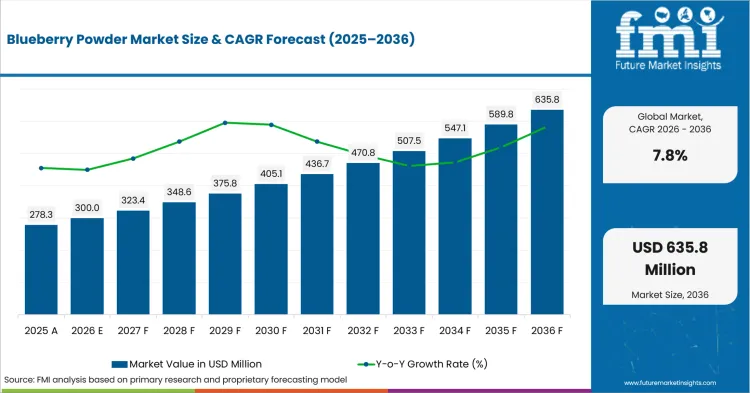
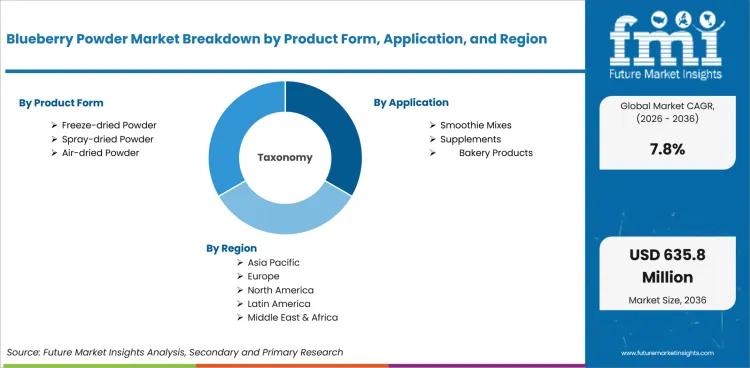
The blueberry powder market value is estimated to move from USD 278.3 million in 2025 to USD 635.8 million by 2036 at 7.8% CAGR as smoothie mixes and bakery inclusions require shelf-stable berry inputs. Freeze-dried powder is expected to secure 48.0% share in 2026 as processors need color retention and a clean ingredient statement. B2B ingredients are forecast to represent 57.0% share in 2026 as food makers buy bulk powder for consistent dosing.
Key Takeaways, Market Size and Forecast
- 2026 Market Size: USD 300.0 million
- 2036 Market Size: USD 635.8 million
- Forecast CAGR: 7.8% from 2026 to 2036
- Leading Product Form: Freeze-dried Powder
- Freeze-dried Powder Share in 2026: 48.0%
- Leading Sales Channel: B2B Ingredients
- B2B Ingredients Share in 2026: 57.0%
- Fastest-growing Country: United States
- United States CAGR: 8.3% by 2036
Summary of Blueberry Powder Market
- Demand and Growth Drivers
- Smoothie and beverage formulators are using blueberry powder when liquid puree creates storage and dosing issues.
- Supplement brands are using berry powder to support antioxidant-positioned blends with recognizable fruit names.
- Foodservice buyers are adding powders to smoothie bowls and bakery toppings where color consistency is important.
- Product and Segment View
- Freeze-dried powder is projected to represent 48.0% share in 2026 due to color retention and low moisture handling.
- Smoothie mixes are expected to hold 34.0% application share in 2026 as powdered beverage bases absorb concentrated berry inputs.
- B2B ingredients are forecast to account for 57.0% share in 2026 through bulk purchasing by food and supplement manufacturers.
- Geography and Competitive Outlook
- The United States is projected to record 8.3% CAGR by 2036 through crop scale and ingredient processing capacity.
- Canada is expected to expand at 8.0% CAGR by 2036 as highbush and wild blueberry supply supports powder conversion.
- Van Drunen Farms and MicroDried focus on North American fruit access and powder formats.
- Chaucer Foods and Thrive Freeze Dry based on freeze-dried ingredient portfolios and beverage-facing applications.
- Analyst Opinion
- Nandini Roy Choudhury, Principal Consultant for Food and Beverage at FMI observes: “I would not treat blueberry powder as only a superfruit label. Buyers are testing whether suppliers can give repeatable color, low moisture and stable particle size without adding unnecessary carriers. That is where the better contracts should move.”
- Blueberry Powder Market Value Analysis
- Market value is estimated to rise as powder keeps color and taste stable across beverage mixes without adding refrigerated storage.
- Buyer access widens as small supplement brands can launch berry blends using low minimum order retail packs.
- Volume increases when frozen processing fruit moves into powder streams after fresh-market grade sorting.
- Adoption barriers fall when suppliers offer particle-size options for beverages, capsules and bakery fillings and dairy bases.
- The trade-off is cost as freeze-dried formats carry higher unit pricing than spray-dried carrier blends.
Processing availability is one of the significant drivers for blueberry powder demand. The United States Department of Agriculture Economic Research Service reported in July 2025 that United States blueberry utilized production reached 880.3 million pounds in 2024. Wild blueberries reached 90.8 million pounds and almost all were directed to processing. That processing base gives powder suppliers a clearer route to frozen berry supply and milling-grade fruit. Canada also matters as Agriculture and Agri-Food Canada reported in July 2025 that highbush blueberry production rose 38.8% in 2024. Powder programs can therefore build around North American crop availability while using European and Asian channels for value-added beverage and supplement demand.
Blueberry Powder Market Definition
The blueberry powder market covers dried blueberry products milled or spray-dried into powder for use in smoothies, supplements and bakery products and dairy applications and foodservice recipes. Scope includes powder made from cultivated blueberries, wild blueberries and blueberry juice solids and carrier-based blueberry powders when blueberry remains the named ingredient. Revenue covers finished ingredient sales and retail powder packs sold for food or supplement use.
Blueberry Powder Market Inclusions
Market scope includes freeze-dried blueberry powder, spray-dried blueberry powder and air-dried blueberry powder and standardized extract powder sold for food and beverage and supplement formulation. It includes bulk cartons for manufacturers, resealable retail pouches and sachets for portion control. Buyers include food manufacturers, supplement brands and retail private labels and foodservice operators and ingredient distributors. Revenue covers activity from 2026 to 2036 across the United States, Canada and Europe and the United Kingdom and Japan and South Korea and Australia and the Gulf states and other import-led markets.
Blueberry Powder Market Exclusions
Scope excludes fresh blueberries, frozen blueberries and whole dried blueberries and blueberry juice and puree and jam and fillings and flavor-only powders without meaningful blueberry solids. Blueberry extracts sold only as pharmaceutical actives are excluded unless they are sold as food or supplement powder inputs. Packaging revenue is counted only when it is part of a finished blueberry powder SKU.
Blueberry Powder Market Research Methodology
- Primary Research: FMI analysts reviewed buyer requirements for particle size, moisture control and certification and pack format across ingredient distributors and supplement brands.
- Desk Research: Public data from the United States Department of Agriculture, Agriculture and Agri-Food Canada and the United Kingdom Department for Environment and Food & Rural Affairs and the Australian Bureau of Statistics and official supplier pages were checked against blueberry powder evidence.
- Market Sizing and Forecasting: The market size has been estimated using a bottom-up product-boundary approach. Each category has been defined by eligible SKUs, B2B ingredient revenue pools and channel availability and product positioning and drying method and country-level use in smoothies and supplements. Standard fruit powders were excluded unless they clearly matched the category definition as blueberry-derived powder for food, beverage and supplement and or foodservice use.
- Data Validation: Forecast checks compared blueberry processing availability, fruit powder channel growth and supplier portfolios and country-level food processing indicators. Estimates were reconciled against blueberry production data and active powder supplier evidence.
Why is the Blueberry Powder Market Growing?
- Powder formats solve storage and dosing problems for beverage mixes, supplement capsules and bakery mixes and foodservice recipes.
- Crop availability supports supply as North American blueberry production creates fruit streams that can be frozen and processed.
- Brand owners use blueberry powder when they need a recognizable fruit cue without adding liquid handling to production.
The supply argument starts with blueberries instead of finished powder. United States blueberry utilized production reached 880.3 million pounds in 2024 according to the United States Department of Agriculture Economic Research Service. That base supports milling-grade fruit supply after fresh sorting. The same data showed 90.8 million pounds of wild blueberries in 2024 and almost all wild fruit moved into processing. Powder suppliers involved in blueberry ingredients can therefore use processed berry streams before beverage and supplement brands add their own value.
Shelf-stable fruit ingredients are gaining a clearer role in beverage formulation. Chaucer Foods stated in May 2026 that freeze-dried fruit supports smoothies and functional blends by adding flavor and fiber in a stable format. This evidence aligns with freeze dried fruits where berry-based products are a major product family. It also explains why blueberry powder can grow faster than whole dried berry pieces in drink mixes.
Market Segmentation Analysis
- Freeze-dried powder is projected to secure 48.0% share in 2026 because its low moisture content and color retention suit beverages and supplement blends.
- Smoothie mixes are expected to hold 34.0% application share in 2026 since dry mixes require fruit flavor without refrigerated puree.
- B2B ingredients are forecast to represent 57.0% channel share in 2026, driven by bulk orders from manufacturers.
- Conventional powder is anticipated to hold 63.0% certification share in 2026 because cost-sensitive food makers rely on wider supply pools.
- Bulk cartons are projected to account for 51.0% pack format share in 2026 as a result of ingredient buyers preferring multi-kilogram formats.
The blueberry powder industry is segmented by product form, application, sales channel, certification type, buyer type, pack format and region. Product form covers freeze-dried powder, spray-dried powder and air-dried powder and extract powder. Application covers smoothie mixes, supplements and bakery products and dairy products and foodservice recipes. Sales channel covers B2B ingredients, retail packs and foodservice packs. Certification type covers conventional, organic and non-GMO products. Buyer type covers food manufacturers, supplement brands and retail brands and foodservice buyers.\
The segment logic matches the way formulators compare fruit powders during procurement. Buyers usually specify fruit identity, drying method; carrier level; moisture limit; and minimum order size before selecting a supplier. Freeze-drying remains the value reference for higher-priced berry powders. The freeze dried fruit powder category shows why product form and application must be separated, since the same powder can move into smoothies; bars; yogurt; and capsules.
Insights into Blueberry Powder Market by Product Form
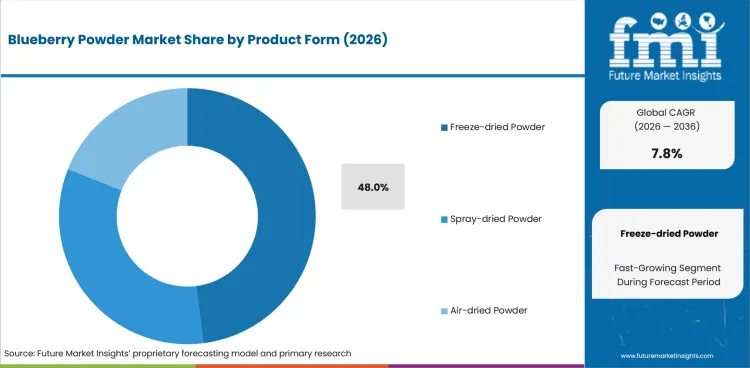
- Freeze-dried Powder is expected to account for 48.0% share in 2026 due to stronger color retention and lower moisture carryover.
- Spray-dried powder serves larger beverage programs when price and flowability matter more than whole-fruit positioning.
Insights into Blueberry Powder Market by Application
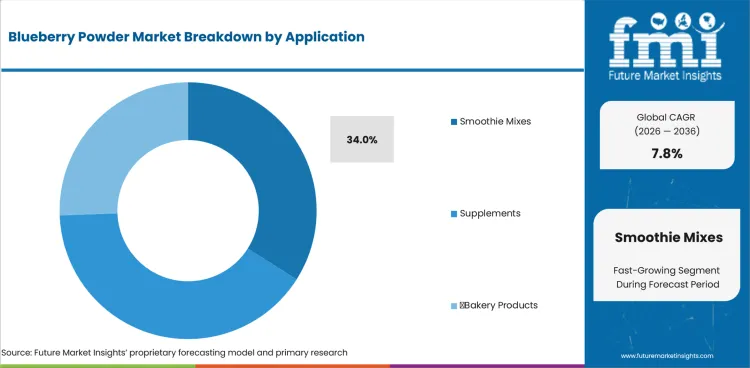
- Smoothie Mixes are forecast to represent 34.0% share in 2026 as powders simplify dry beverage blending.
- Supplements gain value when brands use blueberry powder with botanicals, probiotics and protein and or fiber.
Insights into Blueberry Powder Market by Sales Channel
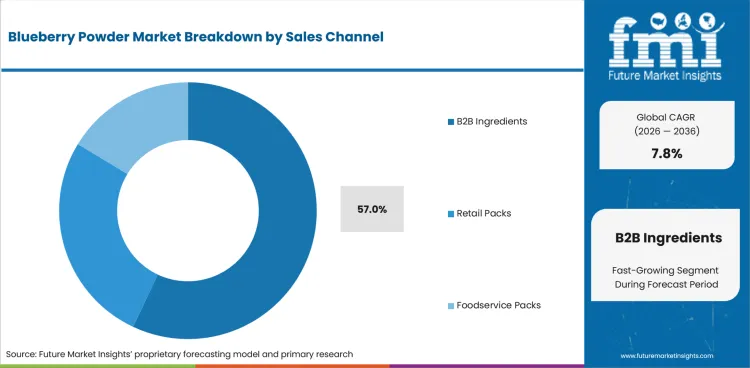
- B2B Ingredients are projected to hold 57.0% share in 2026 because manufacturers buy powder in planned batches.
- Retail packs give wellness brands smaller runs for online shoppers and smoothie users.
Insights into Blueberry Powder Market by Certification Type
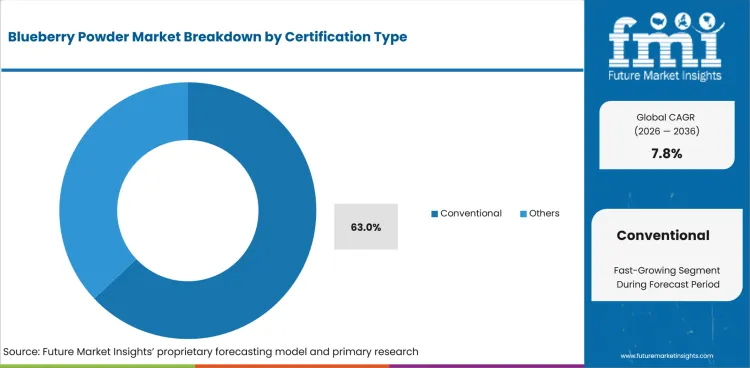
- Conventional is anticipated to secure 63.0% share in 2026. Organic positioning needs evidence at the ingredient level and not at general fruit claim.
- Organic powder earns higher pricing when retail brands need certified labels for premium smoothie and supplement shelves. Supplier programs serving organic fruit powder buyers are expected to separate certified lots and conventional lots before milling.
Insights into Blueberry Powder Market by Buyer Type
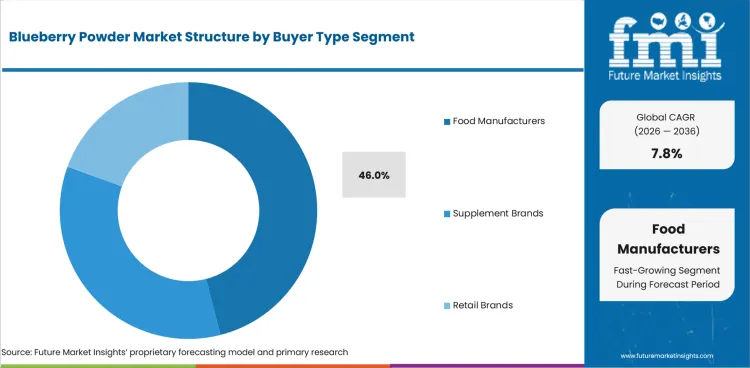
- Food Manufacturers are expected to account for 46.0% share in 2026 as they use powder in mixes, fillings and bars and dairy bases.
- Supplement brands specify lower moisture and tighter microbiology controls before adding powder to capsules or sachets.
Insights into Blueberry Powder Market by Pack Format
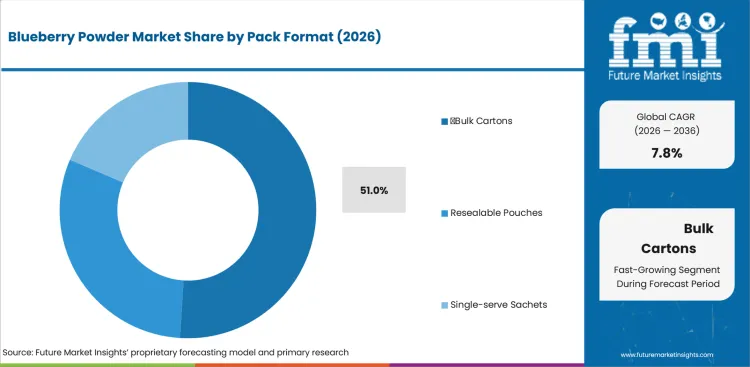
- Bulk Cartons are forecast to hold 51.0% share in 2026 as factories need bulk handling and lower packaging cost.
- Resealable pouches support direct-to-consumer packs where dosage instructions and storage guidance affect repeat purchase.
Blueberry Powder Market Drivers, Restraints and Opportunities
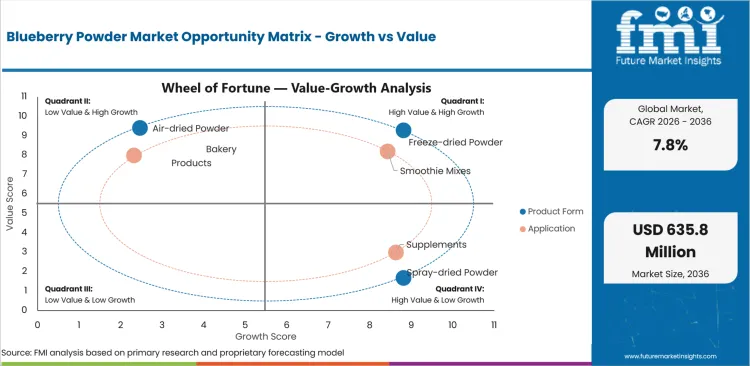
- Driver: Processed blueberry supply gives powder makers a workable raw material base after fresh-market sorting and frozen storage.
- Restraint: Freeze-dried powder remains expensive compared with spray-dried fruit solids and flavor systems.
- Opportunity: Blueberry powder can move into smoothie, supplement and yogurt and bakery platforms when suppliers prove particle size and moisture control.
Processing supply is the main driver. The United States Department of Agriculture Economic Research Service reported record United States blueberry utilized production of 880.3 million pounds in 2024. Wild blueberries are especially relevant as almost all United States wild blueberries were destined for processing. That pattern supports powder conversion from fruit that already moves through frozen or processed channels.
The restraint influencing the industry growth is present in drying economics. Freeze-dried powders can protect color and taste but the process raises cost. Spray-dried formats can lower price when carriers are accepted. Buyers in processed superfruits therefore compare fruit solids, ingredient declaration; color; and price before choosing a blueberry powder format.
The opportunity is strongest where powder does work that fresh fruit cannot. Beverage brands can use blueberry powder for shelf-stable mixes. Supplement brands can use it in capsules and sachets. Adjacent superfruit categories such as acai berry show the same pattern of moving from fruit identity into powders and blends.
Analysis of Blueberry Powder Market by Key Countries
.webp "Top Country Growth Comparison Blueberry Powder Market Cagr (2026 2036)")
| Country | CAGR |
|---|---|
| United States | 8.3% |
| Canada | 8.0% |
| Germany | 7.7% |
| United Kingdom | 7.5% |
| Japan | 7.2% |
| South Korea | 7.9% |
| Australia | 7.4% |
Source: Future Market Insights, 2026.
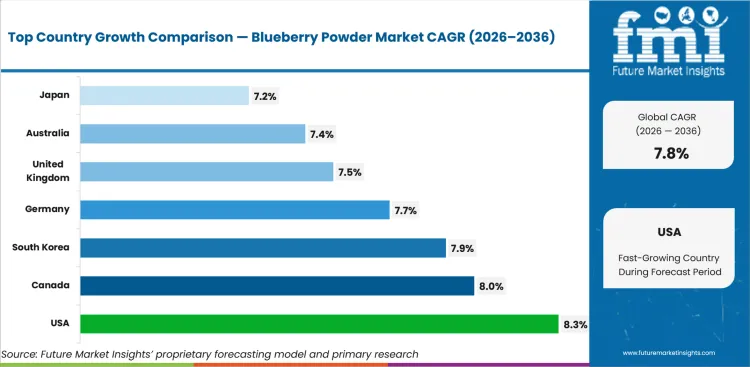
Blueberry Powder Market CAGR Analysis by Country
- United States is projected to record an 8.3% CAGR through 2036, supported by large blueberry output and strong processor access.
- Canada is expected to expand at 8.0% CAGR during the forecast period, driven by highbush and wild blueberry supply that supports conversion.
- Germany is forecast to grow at 7.7% CAGR by the end of 2036, owing to ingredient distributors serving beverage and bakery buyers.
- United Kingdom is expected to advance at 7.5% CAGR over the assessment period, with smoothie and wellness retail use widening.
- Japan is projected to rise at 7.2% CAGR across the forecast decade, supported by health-food and soft drink channels using stable fruit inputs.
- South Korea is forecast at 7.9% CAGR over the ten-year period, driven by online grocery growth and familiarity with frozen fruit supporting powder trials.
- Australia is expected to post 7.4% CAGR by 2036, supported by local berry production and growing supplement use creating a steady demand base.
The country set reflects blueberry supply on one side and finished powder demand on the other. North America leads in raw material access, while Europe and East Asia add higher value through beverage and supplement use. The global blueberries category remains the parent fruit base for powder sizing.
Sales Outlook for Blueberry Powder Market in the United States
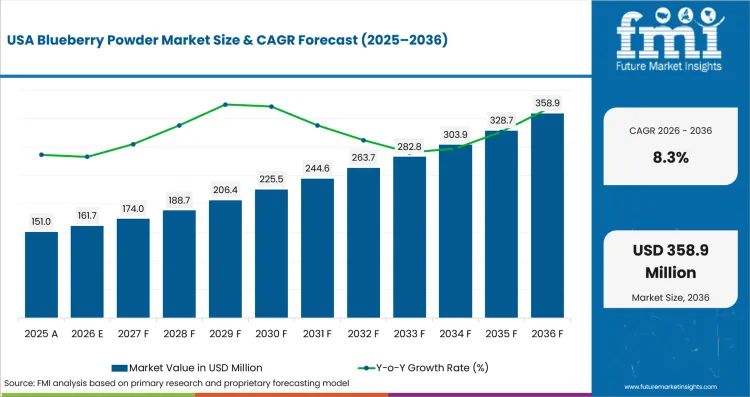
Processor scale and branded ingredient access center · 2026 to 2036
Country Market Snapshot Table
| Parameter | Value |
|---|---|
| Market Size in 2025 (Value) | USD 95.6 million |
| Market Size in 2026 (Value) | USD 103.5 million |
| Market Forecast in 2036 (Value) | USD 229.7 million |
| CAGR (2026 to 2036) | 8.3% |
| Years Considered | 2021 to 2036 |
| Base Year | 2025 |
| Forecast Period | 2026 to 2036 |
| Units Considered | Value (USD million) |
| Leading Sub-Region | Pacific Northwest and Midwest ingredient corridors |
United States Blueberry Powder Market Outlook
- United States blueberry powder demand is shaped by large fruit output and ingredient suppliers with direct processing links. Buyers can compare powder grade, microbial controls and lot traceability before signing bulk agreements.
- Record blueberry production gives processors a stronger base for frozen fruit diversion into dried ingredients. Suppliers with farms, dryers and milling controls can serve smoothie and supplement buyers with fewer handoffs.
Key Growth Drivers
- United States crop scale supports powder conversion. The United States Department of Agriculture Economic Research Service reported 880.3 million pounds of utilized blueberry production in 2024.
- Wild blueberries create a processing-ready stream for powder and frozen inputs. The same source reported 90.8 million pounds of wild blueberry output in 2024.
- Cultivated blueberry supply gives ingredient buyers several state-level sources across Washington, Oregon and Georgia and Michigan and Maine.
- Vertically integrated suppliers can give food brands tighter traceability from farm sourcing to final powder lot.
Key Restraints
- Freeze-dried powder pricing can remain above spray-dried options and flavor systems.
- Crop swings can affect color and anthocyanin intensity across production lots.
- Food makers may reformulate with mixed berry powders when blueberry solids become expensive.
What makes United States unique
The United States is unique due to record crop scale, processing fruit availability and active dried ingredient suppliers.
Key Companies
- Van Drunen Farms
- MicroDried
- Oregon Freeze Dry
- Graceland Fruit
- Decas Cranberry Products
- Tradin Organic USA
- Sow Good Inc.
Sales & Marketing Channels
- Ingredient distributors
- Supplement brands
- Smoothie chains
- Online retail packs
- Bakery manufacturers
- Foodservice distributors
Market Taxonomy and Sub-Regions Covered
| Segment | Sub-Segments |
|---|---|
| Product Form | Freeze-dried Powder · Spray-dried Powder · Air-dried Powder · Extract Powder |
| Application | Smoothie Mixes · Supplements · Bakery Products · Dairy Products · Foodservice Recipes |
| Sales Channel | B2B Ingredients · Retail Packs · Foodservice Packs |
| Certification Type | Conventional · Organic · Non-GMO |
| Buyer Type | Food Manufacturers · Supplement Brands · Retail Brands · Foodservice Buyers |
| Pack Format | Bulk Cartons · Resealable Pouches · Single-serve Sachets |
| Key Sub-Regions Covered, Ingredient and Wellness Corridors | Washington, Oregon and Georgia and Michigan and Maine |
Frequently Asked Questions
How fast is United States blueberry powder market growing?
United States demand is projected to rise at 8.3% CAGR from 2026 to 2036 through processor scale.
Who leads United States blueberry powder market?
Van Drunen Farms, MicroDried and Oregon Freeze Dry compete through fruit access and drying capacity.
What is driving adoption in United States blueberry powder market?
Crop scale and bulk ingredient buying move United States buyers toward blueberry powder.
Demand Outlook for Blueberry Powder Market in Canada
Highbush supply and wild blueberry processing center · 2026 to 2036
Country Market Snapshot Table
| Parameter | Value |
|---|---|
| Market Size in 2025 (Value) | USD 27.5 million |
| Market Size in 2026 (Value) | USD 29.7 million |
| Market Forecast in 2036 (Value) | USD 64.1 million |
| CAGR (2026 to 2036) | 8.0% |
| Years Considered | 2021 to 2036 |
| Base Year | 2025 |
| Forecast Period | 2026 to 2036 |
| Units Considered | Value (USD million) |
| Leading Sub-Region | British Columbia and Quebec processing corridors |
Canada Blueberry Powder Market Outlook
- Canada blueberry powder sales are connected to fresh and processed berry supply. The country has a visible crop base and a large frozen fruit trade environment.
- Ingredient buyers value Canadian origin when wild blueberry identity and North American sourcing are part of the label story. Powder suppliers still need enough drying capacity to convert fruit into stable bulk formats. Buyer interest in less common berry powders such as haskap berry powder shows why origin identity can support premium positioning.
Key Growth Drivers
- Highbush blueberry output improved in 2024. Agriculture and Agri-Food Canada reported highbush blueberry production rose 38.8% in 2024.
- Total Canadian fruit production reached 930,982 metric tons in 2024 and giving processors a broader fruit base for value addition.
- Wild blueberry origin supports premium powder positioning in supplements and smoothie packs.
- Import and export channels help Canadian processors serve the United States and Europe with seasonal balancing.
Key Restraints
- Short harvest windows can limit year-round fresh-origin claims without frozen inventory.
- Retail powder brands face competition from whole frozen blueberries in smoothies.
- Organic certification increases lot control cost for smaller powder processors.
What makes Canada unique
Canada is unique due to highbush rebound, wild blueberry identity and export-oriented frozen fruit channels.
Key Companies
- Van Dyk’s Health Juice Products
- Oxford Frozen Foods
- Patience Fruit & Co.
- Quebec Wild Blueberries
- Nature’s Touch Frozen Foods
- Canada Blueberries Inc.
- Nutra Canada
Sales & Marketing Channels
- Ingredient brokers
- Frozen fruit processors
- Health food stores
- Supplement formulators
- Export distributors
- Online wellness stores
Market Taxonomy and Sub-Regions Covered
| Segment | Sub-Segments |
|---|---|
| Product Form | Freeze-dried Powder · Spray-dried Powder · Air-dried Powder · Extract Powder |
| Application | Smoothie Mixes · Supplements · Bakery Products · Dairy Products · Foodservice Recipes |
| Sales Channel | B2B Ingredients · Retail Packs · Foodservice Packs |
| Certification Type | Conventional · Organic · Non-GMO |
| Buyer Type | Food Manufacturers · Supplement Brands · Retail Brands · Foodservice Buyers |
| Pack Format | Bulk Cartons · Resealable Pouches · Single-serve Sachets |
| Key Sub-Regions Covered, Ingredient and Wellness Corridors | British Columbia, Quebec and Ontario and Atlantic Canada |
Frequently Asked Questions
How fast is Canada blueberry powder market growing?
Canada demand is expected to expand at 8.0% CAGR from 2026 to 2036 through blueberry supply gains.
Who leads Canada blueberry powder market?
Oxford Frozen Foods, Van Dyk’s and Quebec wild blueberry suppliers support the local base.
What is driving adoption in Canada blueberry powder market?
Wild blueberry identity and highbush output are moving Canadian powder toward supplement and smoothie use.
Opportunity Analysis for Blueberry Powder Market in Germany
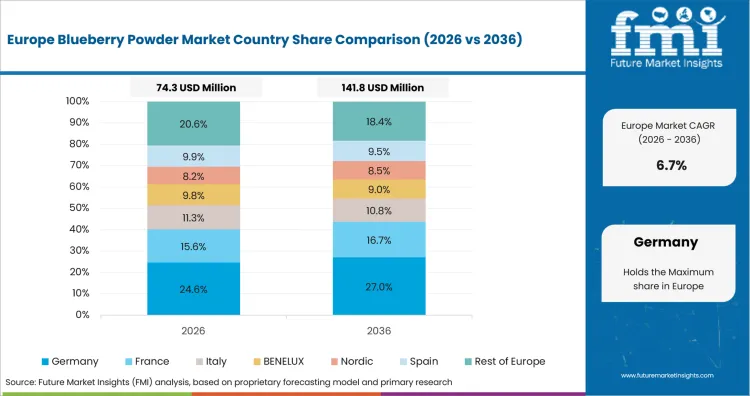
Ingredient distribution and bakery formulation center · 2026 to 2036
Country Market Snapshot Table
| Parameter | Value |
|---|---|
| Market Size in 2025 (Value) | USD 25.1 million |
| Market Size in 2026 (Value) | USD 27.0 million |
| Market Forecast in 2036 (Value) | USD 56.7 million |
| CAGR (2026 to 2036) | 7.7% |
| Years Considered | 2021 to 2036 |
| Base Year | 2025 |
| Forecast Period | 2026 to 2036 |
| Units Considered | Value (USD million) |
| Leading Sub-Region | North Rhine-Westphalia and southern ingredient hubs |
Germany Blueberry Powder Market Outlook
- Germany blueberry powder demand is shaped by bakery, muesli and dairy and beverage formulation. Buyers usually review fruit solids and carrier use before approving a powder.
- Germany is not only a consumption market. It also works as a European ingredient distribution point for berry powders and freeze-dried products. Adjacent Nordic berry benchmarks such as lingonberry powder also influence European buyer comparisons.
Key Growth Drivers
- Germany is a major European blueberry buyer. The Netherlands Ministry of Foreign Affairs Centre for the Promotion of Imports from developing countries reported German blueberry imports at 64,811 tonnes in 2023.
- Local growers added another 15,000 tonnes to Germany supply in 2023 according to the same source.
- Bakery and cereal makers use berry powders to add color and fruit identity without liquid handling.
- Ingredient distributors can bundle blueberry powder with other berry powders for muesli and snack brands.
Key Restraints
- Price-sensitive buyers can switch to mixed berry powders when pure blueberry powder is costly.
- Organic origin claims require stronger documentation across imported and local lots.
- Carrier-based powders can reduce fruit solids and weaken premium positioning.
What makes Germany unique
Germany is unique due to its role as a European blueberry import hub and ingredient distribution base.
Key Companies
- Döhler Group SE
- Paradise Fruits Freeze Dried
- Sensus Food Ingredients
- Kräuter Mix GmbH
- Freeze-Dry Foods GmbH
- SternVitamin GmbH
- Martin Braun KG
Sales & Marketing Channels
- Ingredient distributors
- Bakery suppliers
- Dairy processors
- Muesli makers
- Health stores
- Private label retail
Market Taxonomy and Sub-Regions Covered
| Segment | Sub-Segments |
|---|---|
| Product Form | Freeze-dried Powder · Spray-dried Powder · Air-dried Powder · Extract Powder |
| Application | Smoothie Mixes · Supplements · Bakery Products · Dairy Products · Foodservice Recipes |
| Sales Channel | B2B Ingredients · Retail Packs · Foodservice Packs |
| Certification Type | Conventional · Organic · Non-GMO |
| Buyer Type | Food Manufacturers · Supplement Brands · Retail Brands · Foodservice Buyers |
| Pack Format | Bulk Cartons · Resealable Pouches · Single-serve Sachets |
| Key Sub-Regions Covered, Ingredient and Wellness Corridors | North Rhine-Westphalia, Bavaria and Baden-Wurttemberg and Lower Saxony |
Frequently Asked Questions
How fast is Germany blueberry powder market growing?
Germany is forecast to grow at 7.7% CAGR from 2026 to 2036 as processors use berry powders in bakery and beverage applications.
Who leads Germany blueberry powder market?
Döhler, Paradise Fruits and Freeze-Dry Foods support Germany supply through powders and freeze-dried formats.
What is driving adoption in Germany blueberry powder market?
Ingredient distribution and bakery formulation make Germany a high-value blueberry powder market.
Growth Outlook for Blueberry Powder Market in the United Kingdom
Smoothie retail and import-reliant fruit supply center · 2026 to 2036
Country Market Snapshot Table
| Parameter | Value |
|---|---|
| Market Size in 2025 (Value) | USD 19.5 million |
| Market Size in 2026 (Value) | USD 21.0 million |
| Market Forecast in 2036 (Value) | USD 43.3 million |
| CAGR (2026 to 2036) | 7.5% |
| Years Considered | 2021 to 2036 |
| Base Year | 2025 |
| Forecast Period | 2026 to 2036 |
| Units Considered | Value (USD million) |
| Leading Sub-Region | Greater London and Midlands beverage channels |
United Kingdom Blueberry Powder Market Outlook
- United Kingdom blueberry powder demand is driven by smoothies, breakfast products and wellness retail. Domestic fruit supply is limited, so imported and processed ingredients matter for year-round availability.
- Powder suppliers can serve beverage brands that need consistent color and dosing without the waste risk of fresh fruit. Retail brands also use smaller pouches for home smoothie buyers.
Key Growth Drivers
- The United Kingdom fruit sector remains import reliant. The Department for Environment, Food & Rural Affairs reported home production contributed 15% of total United Kingdom fruit supply in 2024.
- Soft fruit production reached 138 thousand tonnes in 2024, giving berry suppliers a visible but weather-exposed base.
- Smoothie and breakfast brands use powders when fresh fruit prices move sharply by season.
- Clean ingredient lists help retail powder packs compete with flavors and syrups.
Key Restraints
- Domestic blueberry availability covers only part of annual use and raises dependence on imports.
- Retail buyers can compare blueberry powder against cheaper mixed fruit powders.
- Weather-exposed soft fruit supply can reduce local origin continuity for powder labels.
What makes United Kingdom unique
The United Kingdom is unique due to its import reliance and active smoothie retail culture.
Key Companies
- Chaucer Foods Ltd
- Natures Aid Ltd
- Bulk Powders
- Naturya
- Sevenhills Wholefoods
- Ingredients UK Ltd
- Healthy Supplies Ltd
Sales & Marketing Channels
- Smoothie bars
- Online supplement stores
- Health food retailers
- Ingredient distributors
- Private label grocery
- Bakery suppliers
Market Taxonomy and Sub-Regions Covered
| Segment | Sub-Segments |
|---|---|
| Product Form | Freeze-dried Powder · Spray-dried Powder · Air-dried Powder · Extract Powder |
| Application | Smoothie Mixes · Supplements · Bakery Products · Dairy Products · Foodservice Recipes |
| Sales Channel | B2B Ingredients · Retail Packs · Foodservice Packs |
| Certification Type | Conventional · Organic · Non-GMO |
| Buyer Type | Food Manufacturers · Supplement Brands · Retail Brands · Foodservice Buyers |
| Pack Format | Bulk Cartons · Resealable Pouches · Single-serve Sachets |
| Key Sub-Regions Covered, Ingredient and Wellness Corridors | London, Midlands and Manchester and Bristol and Glasgow |
Frequently Asked Questions
How fast is United Kingdom blueberry powder market growing?
United Kingdom sales are expected to advance at 7.5% CAGR from 2026 to 2036 through smoothies and wellness retail.
Who leads United Kingdom blueberry powder market?
Chaucer Foods, Naturya and Sevenhills Wholefoods are visible in powder and wellness channels.
What is driving adoption in United Kingdom blueberry powder market?
Import reliance and smoothie demand support shelf-stable blueberry powder use.
Demand Analysis for Blueberry Powder Market in Japan
Health-food processing and soft drink applications center · 2026 to 2036
Country Market Snapshot Table
| Parameter | Value |
|---|---|
| Market Size in 2025 (Value) | USD 21.5 million |
| Market Size in 2026 (Value) | USD 23.0 million |
| Market Forecast in 2036 (Value) | USD 46.1 million |
| CAGR (2026 to 2036) | 7.2% |
| Years Considered | 2021 to 2036 |
| Base Year | 2025 |
| Forecast Period | 2026 to 2036 |
| Units Considered | Value (USD million) |
| Leading Sub-Region | Tokyo and Kansai health-food channels |
Japan Blueberry Powder Market Outlook
Japan blueberry powder demand is linked to health foods, soft drinks and dairy and shelf-stable snacks. Buyers place high weight on safety documentation and consistent sensory performance.
Ingredient suppliers need small-format packs for premium consumers and bulk grades for beverage makers. Powder works when it adds fruit identity without creating refrigerated logistics.
Key Growth Drivers
- Japan has a large food processing base. The United States Department of Agriculture Foreign Agricultural Service reported Japan food processing value at USD 174 billion in 2025.
- The same 2026 report noted growth in soft drinks, health foods and frozen foods and shelf-stable products.
- Duty-free entry for fresh and dried United States blueberries under the United States-Japan Trade Agreement supports sourcing options.
- Convenience retail and pharmacy-adjacent nutrition channels give powder brands multiple trial routes.
Key Restraints
- Strict documentation expectations can slow supplier approvals for new powder grades.
- Small pack formats increase packaging and distribution costs compared with bulk B2B sales.
- Imported blueberry powder competes with local fruit flavors used in beverages and snacks.
What makes Japan unique
Japan is unique due to health-food processing, high documentation standards and compact premium retail packs.
Key Companies
- Aohata Corporation
- Kewpie Corporation
- House Wellness Foods
- Asahi Group Foods
- Nagatanien Holdings
- Yamamori Inc.
- Marusan Ai Co. Ltd.
Sales & Marketing Channels
- Food processors
- Drugstores
- Convenience retail
- Online health stores
- Beverage brands
- Dairy processors
Market Taxonomy and Sub-Regions Covered
| Segment | Sub-Segments |
|---|---|
| Product Form | Freeze-dried Powder · Spray-dried Powder · Air-dried Powder · Extract Powder |
| Application | Smoothie Mixes · Supplements · Bakery Products · Dairy Products · Foodservice Recipes |
| Sales Channel | B2B Ingredients · Retail Packs · Foodservice Packs |
| Certification Type | Conventional · Organic · Non-GMO |
| Buyer Type | Food Manufacturers · Supplement Brands · Retail Brands · Foodservice Buyers |
| Pack Format | Bulk Cartons · Resealable Pouches · Single-serve Sachets |
| Key Sub-Regions Covered, Ingredient and Wellness Corridors | Tokyo, Osaka and Yokohama and Nagoya and Fukuoka |
Frequently Asked Questions
How fast is Japan blueberry powder market growing?
Japan is projected to rise at 7.2% CAGR from 2026 to 2036 through health-food and soft drink use.
Who leads Japan blueberry powder market?
Japanese food processors and wellness brands lead demand instead of local blueberry powder makers alone.
What is driving adoption in Japan blueberry powder market?
Health-food processing and shelf-stable products are moving Japan toward berry powder ingredients.
Sales Analysis for Blueberry Powder Market in South Korea
Online grocery and frozen fruit familiarity center · 2026 to 2036
Country Market Snapshot Table
| Parameter | Value |
|---|---|
| Market Size in 2025 (Value) | USD 16.7 million |
| Market Size in 2026 (Value) | USD 18.0 million |
| Market Forecast in 2036 (Value) | USD 38.5 million |
| CAGR (2026 to 2036) | 7.9% |
| Years Considered | 2021 to 2036 |
| Base Year | 2025 |
| Forecast Period | 2026 to 2036 |
| Units Considered | Value (USD million) |
| Leading Sub-Region | Seoul and Gyeonggi online grocery channels |
South Korea Blueberry Powder Market Outlook
- South Korea blueberry powder demand is shaped by imported fruit familiarity and online retail. Frozen berries have made blueberries familiar to smoothie and home dessert users.
- Powder suppliers can convert that familiarity into shelf-stable sachets, smoothie bases and supplement blends. The main test is price against frozen berries and mixed berry powders.
Key Growth Drivers
- South Korea imported consumer-oriented agricultural products worth USD 20.6 billion in 2024 according to the United States Department of Agriculture Foreign Agricultural Service.
- Korean retail food sales totaled USD 132 billion in 2024, giving packaged food brands a large commercial base.
- Tariffs on United States blueberries entering Korea reached zero in 2021 under the United States-Korea Free Trade Agreement.
- Online grocery and home smoothie behavior can support small blueberry powder packs.
Key Restraints
- Imported powder faces exchange-rate pressure and shipping cost changes.
- Frozen blueberry packs compete directly for smoothie use at home.
- Pure blueberry powder can lose shelf space when mixed berry powders offer lower prices.
What makes South Korea unique
South Korea is unique due to online grocery strength and zero-tariff access for United States blueberries.
Key Companies
- CJ CheilJedang
- Daesang Corporation
- Nongshim Co. Ltd.
- Ottogi Corporation
- Maeil Dairies
- Pulmuone Co. Ltd.
- Lotte Wellfood
Sales & Marketing Channels
- Online grocery
- Health stores
- Cafes
- Supplement brands
- Food processors
- Convenience retail
Market Taxonomy and Sub-Regions Covered
| Segment | Sub-Segments |
|---|---|
| Product Form | Freeze-dried Powder · Spray-dried Powder · Air-dried Powder · Extract Powder |
| Application | Smoothie Mixes · Supplements · Bakery Products · Dairy Products · Foodservice Recipes |
| Sales Channel | B2B Ingredients · Retail Packs · Foodservice Packs |
| Certification Type | Conventional · Organic · Non-GMO |
| Buyer Type | Food Manufacturers · Supplement Brands · Retail Brands · Foodservice Buyers |
| Pack Format | Bulk Cartons · Resealable Pouches · Single-serve Sachets |
| Key Sub-Regions Covered, Ingredient and Wellness Corridors | Seoul, Gyeonggi and Busan and Daegu and Incheon |
Frequently Asked Questions
How fast is South Korea blueberry powder market growing?
South Korea is forecast at 7.9% CAGR from 2026 to 2036 through online retail and imported berry familiarity.
Who leads South Korea blueberry powder market?
CJ CheilJedang, Daesang and Lotte Wellfood can use berry powders in packaged foods and beverages.
What is driving adoption in South Korea blueberry powder market?
Online grocery and imported blueberry familiarity support powder trials in South Korea.
Opportunity Analysis for Blueberry Powder Market in Australia
Local berry production and supplement retail center · 2026 to 2036
Country Market Snapshot Table
| Parameter | Value |
|---|---|
| Market Size in 2025 (Value) | USD 11.2 million |
| Market Size in 2026 (Value) | USD 12.0 million |
| Market Forecast in 2036 (Value) | USD 24.5 million |
| CAGR (2026 to 2036) | 7.4% |
| Years Considered | 2021 to 2036 |
| Base Year | 2025 |
| Forecast Period | 2026 to 2036 |
| Units Considered | Value (USD million) |
| Leading Sub-Region | New South Wales and Victoria wellness retail corridors |
Australia Blueberry Powder Market Outlook
- Australia blueberry powder demand is supported by local berry production and health retail. Domestic output gives brands a local origin story, but powder manufacturing still depends on drying capacity and supply discipline.
- Ingredient buyers compare local powder with imported freeze-dried powders from North America and Europe. Winning suppliers need clear lot controls and storage guidance for warm distribution conditions.
Key Growth Drivers
- The Australian Bureau of Statistics reported Australian fruit value at AUD 6.8 billion in 2023-24, up AUD 492.9 million from the prior period.
- New South Wales blueberry production increased to just over 17 thousand tonnes in 2022-23, according to the state primary industries department.
- One in three Australians aged 2 years and over used dietary supplements in 2023 according to the Australian Bureau of Statistics.
- Local origin positioning supports premium smoothie and wellness powder packs.
Key Restraints
- Higher local processing cost can make imported powder more competitive for bulk buyers.
- Warm storage conditions increase the need for moisture protection in retail packs.
- Local berry supply can be diverted into fresh channels when fresh prices are higher.
What makes Australia unique
Australia is unique due to local berry production, supplement use and premium health retail channels.
Key Companies
- Costa Group
- Driscoll’s Australia
- Freeze Dry Industries
- Natural Evolution Foods
- Aussie Freeze Dried
- Nutra Organics
- The Source Bulk Foods
Sales & Marketing Channels
- Health food stores
- Ingredient distributors
- Supplement brands
- Smoothie cafes
- Online retail
- Grocery private label
Market Taxonomy and Sub-Regions Covered
| Segment | Sub-Segments |
|---|---|
| Product Form | Freeze-dried Powder · Spray-dried Powder · Air-dried Powder · Extract Powder |
| Application | Smoothie Mixes · Supplements · Bakery Products · Dairy Products · Foodservice Recipes |
| Sales Channel | B2B Ingredients · Retail Packs · Foodservice Packs |
| Certification Type | Conventional · Organic · Non-GMO |
| Buyer Type | Food Manufacturers · Supplement Brands · Retail Brands · Foodservice Buyers |
| Pack Format | Bulk Cartons · Resealable Pouches · Single-serve Sachets |
| Key Sub-Regions Covered, Ingredient and Wellness Corridors | New South Wales, Victoria and Queensland and Western Australia |
Frequently Asked Questions
How fast is Australia blueberry powder market growing?
Australia is expected to post 7.4% CAGR from 2026 to 2036 through local berry supply and supplement retail.
Who leads Australia blueberry powder market?
Costa Group, Freeze Dry Industries and Nutra Organics support local supply and wellness channels.
What is driving adoption in Australia blueberry powder market?
Local berry production and health retail create a steady route for blueberry powder in Australia.
Competitive Landscape and Strategic Positioning
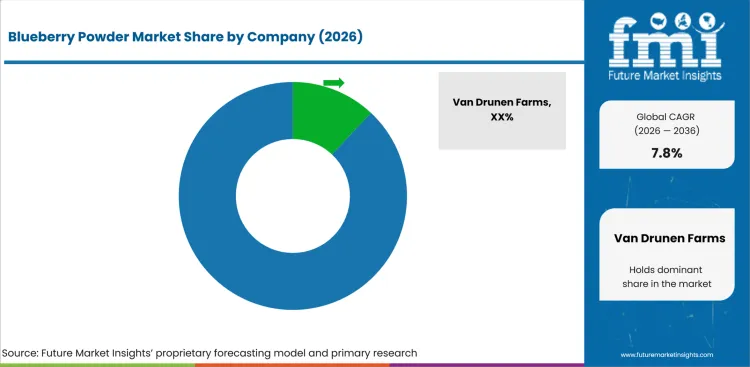
Competition in blueberry powder is shaped by raw fruit access, drying method and lot traceability and formulation support. Van Drunen Farms and MicroDried hold stronger positions where buyers want North American sourcing and identifiable dried blueberry formats. Thrive Freeze Dry and Paradise Fruits add European freeze-drying scale after the 2024 Paradiesfrucht transaction. Chaucer Foods competes through freeze-dried fruit formats and beverage application content.
Capability matters more than broad ingredient catalog size. Suppliers that can document moisture control, particle size and color stability and carrier use and microbiology checks are better placed for supplement and powdered beverage contracts. Smaller regional suppliers can win retail pouches, but they need stable crop access and pack protection. The best positioned suppliers are those that combine fruit sourcing with drying capacity and customer-specific milling.
Key Companies in the Blueberry Powder Market
- Van Drunen Farms
- MicroDried
- Chaucer Foods Ltd
- Thrive Freeze Dry
- Döhler Group SE
- Iprona Group
- European Freeze Dry
Competitive Benchmarking: Blueberry Powder Market
| Company | Blueberry Powder Portfolio | Drying and Milling Control | Traceability Position |
|---|---|---|---|
| Van Drunen Farms | High | Freeze-drying and drum-drying capability | North American fruit and custom ingredient support |
| MicroDried | High | Radiant Energy Vacuum process and powder formats | Eastern Washington farm-linked sourcing |
| Chaucer Foods Ltd | Medium | Freeze-dried fruit powder and beverage applications | Global freeze-dried ingredient network |
| Thrive Freeze Dry | Medium | Freeze-dried fruit and powder capacity | Multi-site network across North America and Europe |
| Döhler Group SE | Medium | Dry ingredient and fruit powder portfolio | Global beverage ingredient platform |
| Iprona Group | Medium | Juice solids, extracts and fruit powders | European berry ingredient base |
| European Freeze Dry | Medium | Freeze-dried fruit in powdered formats | European food ingredient supply |
Source: Future Market Insights competitive analysis, 2026.
Key Developments in Blueberry Powder Market
- In April 2025, MicroDried highlighted its vertically integrated blueberry ingredients from Eastern Washington and positioned MicroDried blueberries for better-for-you formulations. The portfolio includes whole blueberries, fragments and powder and organic powder formats for food and beverage use.
- In September 2025, Chaucer Foods published freeze-dried powder application guidance covering fruit and vegetable powders for drinks and desserts and product development. The update reinforces supplier emphasis on powders apart from only whole freeze-dried pieces.
- In May 2026, Chaucer Foods published beverage application guidance showing freeze-dried fruit in smoothies and functional blends and cocktails and mocktails and specialty coffee and tea. The company linked powders with shelf-stable drink development.
Key Players in the Blueberry Powder Market
- Van Drunen Farms
- MicroDried
- Chaucer Foods Ltd
- Thrive Freeze Dry
- Döhler Group SE
- Iprona Group
- European Freeze Dry
- Paradise Fruits Freeze Dried
- Oregon Freeze Dry
- Oxford Frozen Foods
- Naturya
- Nutra Organics
Blueberry Powder Market - Report Scope
| Parameter | Details |
|---|---|
| Market size by 2036 | USD 635.8 million |
| Growth rate | 7.8% CAGR from 2026 to 2036 |
| Forecast period | 2026 to 2036 |
| Base year value (2025) | USD 278.3 million |
| Estimated market size (2026) | USD 300.0 million |
| By product form | Freeze-dried powder, spray-dried powder, air-dried powder, extract powder |
| By application | Smoothie mixes, supplements, bakery products, dairy products, foodservice recipes |
| By sales channel | B2B ingredients, retail packs, foodservice packs |
| By certification type | Conventional, organic, non-GMO |
| By buyer type | Food manufacturers, supplement brands, retail brands, foodservice buyers |
| By pack format | Bulk cartons, resealable pouches, single-serve sachets |
| Regions covered | North America, Europe, East Asia, Oceania, Middle East and Africa |
| Countries covered | United States, Canada, Germany, United Kingdom, Japan, South Korea, Australia |
| Key companies profiled | Van Drunen Farms, MicroDried, Chaucer Foods Ltd, Thrive Freeze Dry, Döhler Group SE, Iprona Group, European Freeze Dry |
| Approach | Bottom-up product-boundary approach based on eligible SKU revenue, drying method, application demand, channel presence, pricing benchmarks, and country-level consumption and processing availability |
Source: Future Market Insights, 2026.
Blueberry Powder Market by Segments
Blueberry Powder Market Segmented by Product Form
- Freeze-dried Powder
- Spray-dried Powder
- Air-dried Powder
- Extract Powder
Blueberry Powder Market Segmented by Application
- Smoothie Mixes
- Supplements
- Bakery Products
- Dairy Products
- Foodservice Recipes
Blueberry Powder Market Segmented by Sales Channel
- B2B Ingredients
- Retail Packs
- Foodservice Packs
Blueberry Powder Market Segmented by Certification Type
- Conventional
- Organic
- Non-GMO
Blueberry Powder Market Segmented by Buyer Type
- Food Manufacturers
- Supplement Brands
- Retail Brands
- Foodservice Buyers
Blueberry Powder Market Segmented by Pack Format
- Bulk Cartons
- Resealable Pouches
- Single-serve Sachets
Blueberry Powder Market by Region
- North America
- Europe
- East Asia
- Oceania
- GCC
- Latin America
- Middle East and Africa
Research Sources and Bibliography
- Agriculture and Agri-Food Canada. (2025, July 16). Statistical overview of the Canadian fruit industry, 2024.
- Australian Bureau of Statistics. (2025, June 18). Australian agriculture: Horticulture, 2023-24 financial year.
- British Berry Growers. (2024, July 23). Berry industry being squeezed: Rising costs and retail pressures could put 40 percent of growers at risk of going out of business by 2026.
- Chaucer Foods. (2025, September 22). Revealing the versatility of freeze-dried powders.
- Chaucer Foods. (2026, May 1). Freeze-dried fruit: The game-changer for bold, convenient beverages.
- Council for Responsible Nutrition. (2024, October 29). CRN survey shows consistent supplement usage with increase in specialty product use over time.
- Department for Environment, Food & Rural Affairs. (2025, June 26). Horticulture statistics 2024.
- Döhler Group. (2026). Powders: Dry ingredients
- European Freeze Dry. (2026). Freeze dried fruit.
- International Food Information Council. (2025, January). 2025 Food & Health Survey.
- Iprona Group. (2026). Juices, purees, concentrates, powders, infusions.
- Japan Agricultural Trade Office. (2026, April 1). Japan: Food processing ingredients annual. United States Department of Agriculture Foreign Agricultural Service.
- Korea Agricultural Trade Office. (2025, May 5). Food processing ingredients annual: Republic of Korea. United States Department of Agriculture Foreign Agricultural Service.
- MicroDried. (2025, April 3). MicroDried blueberries: Elevating the standard for dried fruit ingredients.
- MicroDried. (2026). Premium dried blueberry ingredients.
- New South Wales Department of Primary Industries and Regional Development. (2024). Horticulture.
- Paradise Fruits. (2024, April 12). Thrive Freeze Dry signs definitive acquisition agreement with Paradiesfrucht GmbH.
- Paradise Fruits Freeze Dried. (2026). Freeze dried fruit powder.
- United States Department of Agriculture Economic Research Service. (2025, July 24). Fruit and tree nuts outlook: July 2025.
- United States Department of Agriculture Economic Research Service. (2025, September 18). Most cultivated blueberries are destined for the fresh market, while wild blueberries are bound for processing.
- Netherlands Ministry of Foreign Affairs Centre for the Promotion of Imports from developing countries. (2025, April 23). The European market potential for fresh blueberries.
This Report Answers
- How large is the blueberry powder market in 2026 and by 2036?
- Which product form leads blueberry powder demand?
- Which application creates the clearest volume base for blueberry powder?
- Which country is expected to grow fastest?
- Which suppliers are active in blueberry powder and freeze-dried fruit ingredients?
- How do source fruit supply and drying method affect supplier selection?
Frequently Asked Questions
What is the blueberry powder market size in 2026?
The blueberry powder market size is estimated at USD 300.0 million in 2026.
What is the blueberry powder market forecast for 2036?
The blueberry powder market is projected to reach USD 635.8 million by 2036.
What is the blueberry powder market CAGR?
The blueberry powder sector is projected to expand at 7.8% CAGR from 2026 to 2036.
What segment leads the blueberry powder market?
Freeze-dried powder leads with 48.0% share in 2026 due to color retention and low moisture handling.
What country grows fastest in the blueberry powder market?
The United States is projected to record 8.3% CAGR by 2036, supported by crop scale and processing access.
How is blueberry powder used in food and beverage production?
Manufacturers use blueberry powder in dry smoothie mixes, bakery fillings, yogurt bases, bars, and beverage sachets.
Is freeze-dried blueberry powder more expensive than spray-dried powder?
Freeze-dried powder usually carries higher unit pricing due to lower moisture and stronger color retention.
How long does blueberry powder last in storage?
Shelf life depends on moisture, pack barrier, and storage temperature, but many commercial powders are sold with 12 to 24 month guidance.
What should buyers check before choosing a supplier?
Buyers should check fruit solids, carrier use, moisture level, particle size, microbiology documentation, and lot traceability.
Preview the report firsthand - request a free sample
Get SampleGet the brochure for pricing and purchase details.
Get PDFTable of Content
- Executive Summary
- Global Market Outlook
- Demand to side Trends
- Supply to side Trends
- Technology Roadmap Analysis
- Analysis and Recommendations
- Market Overview
- Market Coverage / Taxonomy
- Market Definition / Scope / Limitations
- Research Methodology
- Chapter Orientation
- Analytical Lens and Working Hypotheses
- Market Structure, Signals, and Trend Drivers
- Benchmarking and Cross-market Comparability
- Market Sizing, Forecasting, and Opportunity Mapping
- Research Design and Evidence Framework
- Desk Research Programme (Secondary Evidence)
- Company Annual and Sustainability Reports
- Peer-reviewed Journals and Academic Literature
- Corporate Websites, Product Literature, and Technical Notes
- Earnings Decks and Investor Briefings
- Statutory Filings and Regulatory Disclosures
- Technical White Papers and Standards Notes
- Trade Journals, Industry Magazines, and Analyst Briefs
- Conference Proceedings, Webinars, and Seminar Materials
- Government Statistics Portals and Public Data Releases
- Press Releases and Reputable Media Coverage
- Specialist Newsletters and Curated Briefings
- Sector Databases and Reference Repositories
- FMI Internal Proprietary Databases and Historical Market Datasets
- Subscription Datasets and Paid Sources
- Social Channels, Communities, and Digital Listening Inputs
- Additional Desk Sources
- Expert Input and Fieldwork (Primary Evidence)
- Primary Modes
- Qualitative Interviews and Expert Elicitation
- Quantitative Surveys and Structured Data Capture
- Blended Approach
- Why Primary Evidence is Used
- Field Techniques
- Interviews
- Surveys
- Focus Groups
- Observational and In-context Research
- Social and Community Interactions
- Stakeholder Universe Engaged
- C-suite Leaders
- Board Members
- Presidents and Vice Presidents
- R&D and Innovation Heads
- Technical Specialists
- Domain Subject-matter Experts
- Scientists
- Physicians and Other Healthcare Professionals
- Governance, Ethics, and Data Stewardship
- Research Ethics
- Data Integrity and Handling
- Primary Modes
- Tooling, Models, and Reference Databases
- Desk Research Programme (Secondary Evidence)
- Data Engineering and Model Build
- Data Acquisition and Ingestion
- Cleaning, Normalisation, and Verification
- Synthesis, Triangulation, and Analysis
- Quality Assurance and Audit Trail
- Market Background
- Market Dynamics
- Drivers
- Restraints
- Opportunity
- Trends
- Scenario Forecast
- Demand in Optimistic Scenario
- Demand in Likely Scenario
- Demand in Conservative Scenario
- Opportunity Map Analysis
- Product Life Cycle Analysis
- Supply Chain Analysis
- Investment Feasibility Matrix
- Value Chain Analysis
- PESTLE and Porter’s Analysis
- Regulatory Landscape
- Regional Parent Market Outlook
- Production and Consumption Statistics
- Import and Export Statistics
- Market Dynamics
- Global Market Analysis 2021 to 2025 and Forecast, 2026 to 2036
- Historical Market Size Value (USD Million) Analysis, 2021 to 2025
- Current and Future Market Size Value (USD Million) Projections, 2026 to 2036
- Y to o to Y Growth Trend Analysis
- Absolute $ Opportunity Analysis
- Global Market Pricing Analysis 2021 to 2025 and Forecast 2026 to 2036
- Global Market Analysis 2021 to 2025 and Forecast 2026 to 2036, By Product Form
- Introduction / Key Findings
- Historical Market Size Value (USD Million) Analysis By Product Form , 2021 to 2025
- Current and Future Market Size Value (USD Million) Analysis and Forecast By Product Form , 2026 to 2036
- Freeze-dried Powder
- Spray-dried Powder
- Air-dried Powder
- Freeze-dried Powder
- Y to o to Y Growth Trend Analysis By Product Form , 2021 to 2025
- Absolute $ Opportunity Analysis By Product Form , 2026 to 2036
- Global Market Analysis 2021 to 2025 and Forecast 2026 to 2036, By Application
- Introduction / Key Findings
- Historical Market Size Value (USD Million) Analysis By Application, 2021 to 2025
- Current and Future Market Size Value (USD Million) Analysis and Forecast By Application, 2026 to 2036
- Smoothie Mixes
- Supplements
- Bakery Products
- Smoothie Mixes
- Y to o to Y Growth Trend Analysis By Application, 2021 to 2025
- Absolute $ Opportunity Analysis By Application, 2026 to 2036
- Global Market Analysis 2021 to 2025 and Forecast 2026 to 2036, By Sales Channel
- Introduction / Key Findings
- Historical Market Size Value (USD Million) Analysis By Sales Channel, 2021 to 2025
- Current and Future Market Size Value (USD Million) Analysis and Forecast By Sales Channel, 2026 to 2036
- B2B Ingredients
- Retail Packs
- Foodservice Packs
- B2B Ingredients
- Y to o to Y Growth Trend Analysis By Sales Channel, 2021 to 2025
- Absolute $ Opportunity Analysis By Sales Channel, 2026 to 2036
- Global Market Analysis 2021 to 2025 and Forecast 2026 to 2036, By Certification Type
- Introduction / Key Findings
- Historical Market Size Value (USD Million) Analysis By Certification Type, 2021 to 2025
- Current and Future Market Size Value (USD Million) Analysis and Forecast By Certification Type, 2026 to 2036
- Conventional
- Conventional
- Y to o to Y Growth Trend Analysis By Certification Type, 2021 to 2025
- Absolute $ Opportunity Analysis By Certification Type, 2026 to 2036
- Global Market Analysis 2021 to 2025 and Forecast 2026 to 2036, By Buyer Type
- Introduction / Key Findings
- Historical Market Size Value (USD Million) Analysis By Buyer Type, 2021 to 2025
- Current and Future Market Size Value (USD Million) Analysis and Forecast By Buyer Type, 2026 to 2036
- Food Manufacturers
- Supplement Brands
- Retail Brands
- Food Manufacturers
- Y to o to Y Growth Trend Analysis By Buyer Type, 2021 to 2025
- Absolute $ Opportunity Analysis By Buyer Type, 2026 to 2036
- Global Market Analysis 2021 to 2025 and Forecast 2026 to 2036, By Pack Format
- Introduction / Key Findings
- Historical Market Size Value (USD Million) Analysis By Pack Format, 2021 to 2025
- Current and Future Market Size Value (USD Million) Analysis and Forecast By Pack Format, 2026 to 2036
- Bulk Cartons
- Resealable Pouches
- Single-serve Sachets
- Bulk Cartons
- Y to o to Y Growth Trend Analysis By Pack Format, 2021 to 2025
- Absolute $ Opportunity Analysis By Pack Format, 2026 to 2036
- Global Market Analysis 2021 to 2025 and Forecast 2026 to 2036, By Region
- Introduction
- Historical Market Size Value (USD Million) Analysis By Region, 2021 to 2025
- Current Market Size Value (USD Million) Analysis and Forecast By Region, 2026 to 2036
- North America
- Latin America
- Western Europe
- Eastern Europe
- East Asia
- South Asia and Pacific
- Middle East & Africa
- Market Attractiveness Analysis By Region
- North America Market Analysis 2021 to 2025 and Forecast 2026 to 2036, By Country
- Historical Market Size Value (USD Million) Trend Analysis By Market Taxonomy, 2021 to 2025
- Market Size Value (USD Million) Forecast By Market Taxonomy, 2026 to 2036
- By Country
- USA
- Canada
- Mexico
- By Product Form
- By Application
- By Sales Channel
- By Certification Type
- By Buyer Type
- By Pack Format
- By Country
- Market Attractiveness Analysis
- By Country
- By Product Form
- By Application
- By Sales Channel
- By Certification Type
- By Buyer Type
- By Pack Format
- Key Takeaways
- Latin America Market Analysis 2021 to 2025 and Forecast 2026 to 2036, By Country
- Historical Market Size Value (USD Million) Trend Analysis By Market Taxonomy, 2021 to 2025
- Market Size Value (USD Million) Forecast By Market Taxonomy, 2026 to 2036
- By Country
- Brazil
- Chile
- Rest of Latin America
- By Product Form
- By Application
- By Sales Channel
- By Certification Type
- By Buyer Type
- By Pack Format
- By Country
- Market Attractiveness Analysis
- By Country
- By Product Form
- By Application
- By Sales Channel
- By Certification Type
- By Buyer Type
- By Pack Format
- Key Takeaways
- Western Europe Market Analysis 2021 to 2025 and Forecast 2026 to 2036, By Country
- Historical Market Size Value (USD Million) Trend Analysis By Market Taxonomy, 2021 to 2025
- Market Size Value (USD Million) Forecast By Market Taxonomy, 2026 to 2036
- By Country
- Germany
- UK
- Italy
- Spain
- France
- Nordic
- BENELUX
- Rest of Western Europe
- By Product Form
- By Application
- By Sales Channel
- By Certification Type
- By Buyer Type
- By Pack Format
- By Country
- Market Attractiveness Analysis
- By Country
- By Product Form
- By Application
- By Sales Channel
- By Certification Type
- By Buyer Type
- By Pack Format
- Key Takeaways
- Eastern Europe Market Analysis 2021 to 2025 and Forecast 2026 to 2036, By Country
- Historical Market Size Value (USD Million) Trend Analysis By Market Taxonomy, 2021 to 2025
- Market Size Value (USD Million) Forecast By Market Taxonomy, 2026 to 2036
- By Country
- Russia
- Poland
- Hungary
- Balkan & Baltic
- Rest of Eastern Europe
- By Product Form
- By Application
- By Sales Channel
- By Certification Type
- By Buyer Type
- By Pack Format
- By Country
- Market Attractiveness Analysis
- By Country
- By Product Form
- By Application
- By Sales Channel
- By Certification Type
- By Buyer Type
- By Pack Format
- Key Takeaways
- East Asia Market Analysis 2021 to 2025 and Forecast 2026 to 2036, By Country
- Historical Market Size Value (USD Million) Trend Analysis By Market Taxonomy, 2021 to 2025
- Market Size Value (USD Million) Forecast By Market Taxonomy, 2026 to 2036
- By Country
- China
- Japan
- South Korea
- By Product Form
- By Application
- By Sales Channel
- By Certification Type
- By Buyer Type
- By Pack Format
- By Country
- Market Attractiveness Analysis
- By Country
- By Product Form
- By Application
- By Sales Channel
- By Certification Type
- By Buyer Type
- By Pack Format
- Key Takeaways
- South Asia and Pacific Market Analysis 2021 to 2025 and Forecast 2026 to 2036, By Country
- Historical Market Size Value (USD Million) Trend Analysis By Market Taxonomy, 2021 to 2025
- Market Size Value (USD Million) Forecast By Market Taxonomy, 2026 to 2036
- By Country
- India
- ASEAN
- Australia & New Zealand
- Rest of South Asia and Pacific
- By Product Form
- By Application
- By Sales Channel
- By Certification Type
- By Buyer Type
- By Pack Format
- By Country
- Market Attractiveness Analysis
- By Country
- By Product Form
- By Application
- By Sales Channel
- By Certification Type
- By Buyer Type
- By Pack Format
- Key Takeaways
- Middle East & Africa Market Analysis 2021 to 2025 and Forecast 2026 to 2036, By Country
- Historical Market Size Value (USD Million) Trend Analysis By Market Taxonomy, 2021 to 2025
- Market Size Value (USD Million) Forecast By Market Taxonomy, 2026 to 2036
- By Country
- Kingdom of Saudi Arabia
- Other GCC Countries
- Turkiye
- South Africa
- Other African Union
- Rest of Middle East & Africa
- By Product Form
- By Application
- By Sales Channel
- By Certification Type
- By Buyer Type
- By Pack Format
- By Country
- Market Attractiveness Analysis
- By Country
- By Product Form
- By Application
- By Sales Channel
- By Certification Type
- By Buyer Type
- By Pack Format
- Key Takeaways
- Key Countries Market Analysis
- USA
- Pricing Analysis
- Market Share Analysis, 2025
- By Product Form
- By Application
- By Sales Channel
- By Certification Type
- By Buyer Type
- By Pack Format
- Canada
- Pricing Analysis
- Market Share Analysis, 2025
- By Product Form
- By Application
- By Sales Channel
- By Certification Type
- By Buyer Type
- By Pack Format
- Mexico
- Pricing Analysis
- Market Share Analysis, 2025
- By Product Form
- By Application
- By Sales Channel
- By Certification Type
- By Buyer Type
- By Pack Format
- Brazil
- Pricing Analysis
- Market Share Analysis, 2025
- By Product Form
- By Application
- By Sales Channel
- By Certification Type
- By Buyer Type
- By Pack Format
- Chile
- Pricing Analysis
- Market Share Analysis, 2025
- By Product Form
- By Application
- By Sales Channel
- By Certification Type
- By Buyer Type
- By Pack Format
- Germany
- Pricing Analysis
- Market Share Analysis, 2025
- By Product Form
- By Application
- By Sales Channel
- By Certification Type
- By Buyer Type
- By Pack Format
- UK
- Pricing Analysis
- Market Share Analysis, 2025
- By Product Form
- By Application
- By Sales Channel
- By Certification Type
- By Buyer Type
- By Pack Format
- Italy
- Pricing Analysis
- Market Share Analysis, 2025
- By Product Form
- By Application
- By Sales Channel
- By Certification Type
- By Buyer Type
- By Pack Format
- Spain
- Pricing Analysis
- Market Share Analysis, 2025
- By Product Form
- By Application
- By Sales Channel
- By Certification Type
- By Buyer Type
- By Pack Format
- France
- Pricing Analysis
- Market Share Analysis, 2025
- By Product Form
- By Application
- By Sales Channel
- By Certification Type
- By Buyer Type
- By Pack Format
- India
- Pricing Analysis
- Market Share Analysis, 2025
- By Product Form
- By Application
- By Sales Channel
- By Certification Type
- By Buyer Type
- By Pack Format
- ASEAN
- Pricing Analysis
- Market Share Analysis, 2025
- By Product Form
- By Application
- By Sales Channel
- By Certification Type
- By Buyer Type
- By Pack Format
- Australia & New Zealand
- Pricing Analysis
- Market Share Analysis, 2025
- By Product Form
- By Application
- By Sales Channel
- By Certification Type
- By Buyer Type
- By Pack Format
- China
- Pricing Analysis
- Market Share Analysis, 2025
- By Product Form
- By Application
- By Sales Channel
- By Certification Type
- By Buyer Type
- By Pack Format
- Japan
- Pricing Analysis
- Market Share Analysis, 2025
- By Product Form
- By Application
- By Sales Channel
- By Certification Type
- By Buyer Type
- By Pack Format
- South Korea
- Pricing Analysis
- Market Share Analysis, 2025
- By Product Form
- By Application
- By Sales Channel
- By Certification Type
- By Buyer Type
- By Pack Format
- Russia
- Pricing Analysis
- Market Share Analysis, 2025
- By Product Form
- By Application
- By Sales Channel
- By Certification Type
- By Buyer Type
- By Pack Format
- Poland
- Pricing Analysis
- Market Share Analysis, 2025
- By Product Form
- By Application
- By Sales Channel
- By Certification Type
- By Buyer Type
- By Pack Format
- Hungary
- Pricing Analysis
- Market Share Analysis, 2025
- By Product Form
- By Application
- By Sales Channel
- By Certification Type
- By Buyer Type
- By Pack Format
- Kingdom of Saudi Arabia
- Pricing Analysis
- Market Share Analysis, 2025
- By Product Form
- By Application
- By Sales Channel
- By Certification Type
- By Buyer Type
- By Pack Format
- Turkiye
- Pricing Analysis
- Market Share Analysis, 2025
- By Product Form
- By Application
- By Sales Channel
- By Certification Type
- By Buyer Type
- By Pack Format
- South Africa
- Pricing Analysis
- Market Share Analysis, 2025
- By Product Form
- By Application
- By Sales Channel
- By Certification Type
- By Buyer Type
- By Pack Format
- USA
- Market Structure Analysis
- Competition Dashboard
- Competition Benchmarking
- Market Share Analysis of Top Players
- By Regional
- By Product Form
- By Application
- By Sales Channel
- By Certification Type
- By Buyer Type
- By Pack Format
- Competition Analysis
- Competition Deep Dive
- Van Drunen Farms
- Overview
- Product Portfolio
- Profitability by Market Segments (Product/Age /Sales Channel/Region)
- Sales Footprint
- Strategy Overview
- Marketing Strategy
- Product Strategy
- Channel Strategy
- MicroDried
- Chaucer Foods Ltd
- Thrive Freeze Dry
- Döhler Group SE
- Iprona Group
- Van Drunen Farms
- Competition Deep Dive
- Assumptions & Acronyms Used


