

- Market Size (2026)
- USD 290.0 Mn
- Forecast (2036)
- USD 794.0 Mn
- CAGR (2026 to 2036)
- 10.6%
Bluetooth Tool Tracking Tags Market Size, Market Forecast and Outlook By FMI
USD 290.0 million in 2026 and USD 794.0 million by 2036 at a 10.6% CAGR.
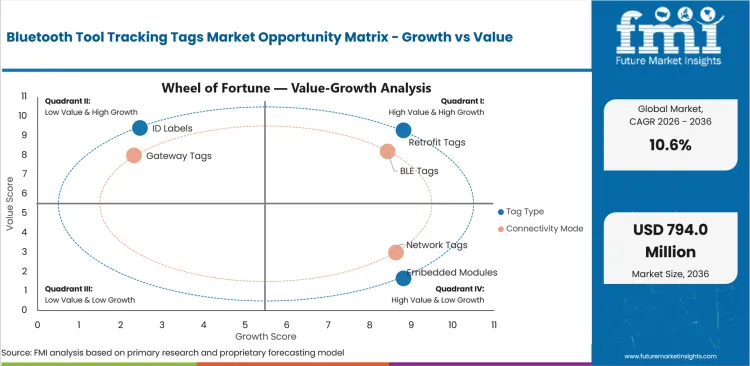
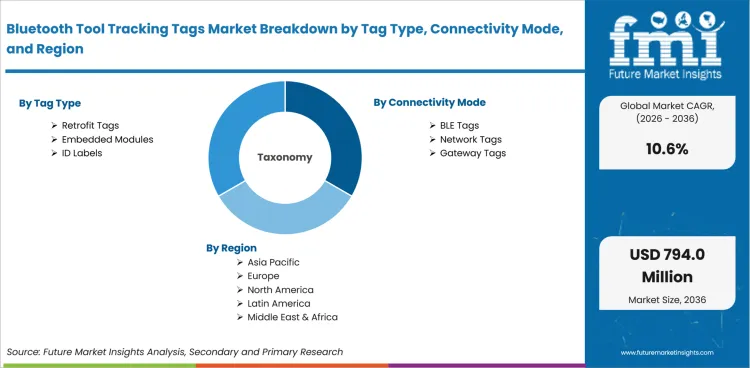
The Bluetooth tool tracking tags market was valued at USD 262.2 million in 2025. It is projected to reach USD 290.0 million in 2026 and USD 794.0 million by 2036, advancing at a 10.6% CAGR during the forecast period. Retrofit Tags are expected to account for 61.0% share by Tag Type in 2026, while BLE Tags are projected to account for 72.0% share by Connectivity Mode in 2026.
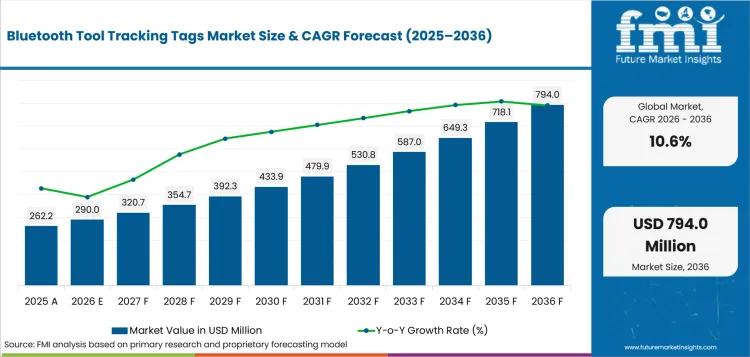
Bluetooth Tool Tracking Tags Market Overview: Size and Forecast
- 2026 Market Size: USD 290.0 million
- 2036 Market Size: USD 794.0 million
- Forecast CAGR: 10.6% from 2026 to 2036
- Leading Tag Type: Retrofit Tags
- Retrofit Tags Share in 2026: 61.0%
- Leading Connectivity Mode: BLE Tags
- BLE Tags Share in 2026: 72.0%
- Fastest-growing Country: India
- India CAGR: 12.1% by 2036
What are the key takeaways for the Bluetooth tool tracking tags market?
Retrofit Tags lead at 61.0% share with BLE Tags at 72.0% and India fastest at 12.1%.
- Demand and Growth Drivers
- Growing demand for real-time asset visibility across construction, manufacturing, and logistics industries is accelerating adoption of Bluetooth tool tracking tags to minimize tool loss and downtime.
- Increasing digitalization of industrial operations and integration with IoT platforms are driving large-scale deployment of tracking tags, particularly among enterprises managing distributed tool inventories.
- Rising costs associated with equipment misplacement and theft are pushing companies to invest in tracking solutions, contributing to steady growth in unit sales across both SMEs and large enterprises.
- Strong uptake in North America and Europe, coupled with expanding adoption in Asia-Pacific due to infrastructure growth, is supporting a consistent increase in market revenues and shipment volumes.
- Product and Segment View
- Retrofit Tags are expected to lead the Tag Type segment with 61.0% share as mixed-brand tool parks need low-friction tagging.
- BLE Tags are projected to lead Connectivity Mode with 72.0% share since phone scans and gateways fit most tool yards.
- Tool Inventory is estimated to lead Application with 43.0% share where contractors need accountability before theft recovery.
- Contractors are projected to lead End User demand with 46.0% share as jobsite movement creates the highest loss exposure.
- OEM Ecosystems are expected to lead Sales Channel with 44.0% share as tool brands bundle tags with software access.
- Geography and Competitive Outlook
- The United States is expected to grow at 10.4% CAGR through 2036, supported by large construction spending and tool rental density.
- The United Kingdom is projected to record 10.8% CAGR through 2036, with van theft and insurance pressure supporting tag demand.
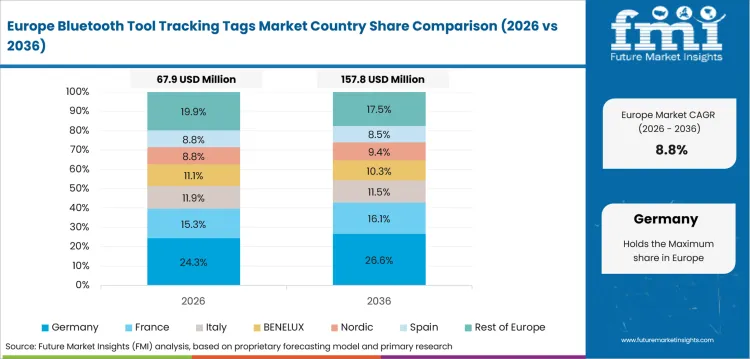
- Germany and France are forecast below the global pace, as slower construction activity tempers volume but raises interest in cost control.
- Milwaukee and DeWalt shape the OEM frame. Hilti, STIHL, ToolWatch, Tile, and Apple-linked networks add software and substitute pressure.
- Consumer networks create price pressure, while jobsite-grade systems win through rugged tag design and fleet workflow depth.
- Analyst Opinion
- Nikhil Kaitwade, Associate Vice President at FMI says, “I see this market less as a tag sale and more as a discipline shift inside tool ownership. Contractors first buy tags to stop losses, but the repeat value comes from knowing which crew has which tool and whether that tool is ready for the next job. The pressure comes from theft, rental billing disputes, and idle tool stock that sits unseen in vans or depots. Suppliers win when they connect rugged hardware to usable software and keep the setup simple for site supervisors. The point to watch is the substitute threat from Apple, Google, and Tile ecosystems. Those networks are expected to pull down hardware price expectations. Professional suppliers must prove better workflows and stronger attachment. Cleaner audit trails also support the premium case.”
- What supports value in the Bluetooth tool tracking tags market?
- Tag hardware, software dashboards, and custody records support market value across professional tool fleets.
- The market value is rising as contractors move from spreadsheet registers to tag-based logs that show tool location and custody.
- Retrofit demand expands the addressable pool since every high-value drill, saw, breaker, and mower can be tagged after purchase.
- Software revenue raises the value per account as buyers pay for dashboards, alerts, tool crib records, and maintenance logs.
- Consumer item-finder networks push price pressure, so professional systems must justify premiums through rugged tags and admin control.
- The 10.6% CAGR reflects adoption across contractors and rental fleets.
Demand is shifting from simple lost-item finding toward jobsite asset control. Bluetooth SIG released Core Specification 6.0 in September 2024 with Channel Sounding, which gives Bluetooth devices a clearer distance measurement path for future location use. Apple and Google introduced cross-platform unwanted tracker alerts in May 2024, which raises the compliance bar for tag makers. Google’s April 2024 Find My Device expansion and May 2025 Find Hub update widened the consumer-network substitute threat. For tool brands, this shifts the market toward secure tags, fleet dashboards, and jobsite workflows that prove accountability without creating privacy risk.
Why is the Bluetooth tool tracking tags market growing?
Contractors are tagging mixed-brand tool fleets as retrofit tags avoid the cost of replacing older equipment.
- Rental firms are using Bluetooth records to reduce checkout disputes and prove tool custody at branch level.
- Jobsite theft pressure supports buying in the United States and United Kingdom, where tools often move through vans and depots.
- Bluetooth platform changes support future accuracy gains as Channel Sounding shifts Bluetooth location beyond signal-strength estimates.
- Software bundles lift account value since tool managers pay for audit trails and maintenance prompts.
Professional buyers are treating tool loss as an operating cost that can be reduced with better custody records. The United States shows the strongest scale signal, with construction spending at a seasonally adjusted annual rate of USD 2,172.4 billion in April 2026. That spending base implies a very large moving pool of tools across sites and subcontractors. Bluetooth tags gain value when a foreman needs to know whether a tool is in the van, the depot, or another jobsite. This keeps early demand tied to accountability and utilization before buyers pay for deeper analytics. Platform change is widening the market beyond closed tool-brand systems. In May 2024, Apple and Google introduced support for unwanted tracking alerts across iOS and Android for Bluetooth tracking devices. This privacy standard changes product design and buyer screening. Fleet buyers now ask whether tags comply with safety expectations and avoid misuse risk. The practical result is a market where suppliers need both finding performance and defensible privacy controls. That favors professional vendors with admin settings and clear tag ownership records.
How is the Bluetooth tool tracking tags market segmented?
- With an estimated 61.0% share in 2026, Retrofit Tags are expected to lead by Tag Type as buyers attach them to existing mixed-brand fleets.
- BLE Tags are projected to account for 72.0% of Connectivity Mode in 2026, given their fit with phone scans and low-power beaconing.
- Contractors choosing Tool Inventory workflows are expected to push Application share to 43.0% in 2026 as check-out records come first.
- End-user demand is projected to place Contractors at 46.0% share in 2026, with rental fleets following through branch-level control.
- OEM Ecosystems are anticipated to hold 44.0% of Sales Channel in 2026 as brands tie tags to software and service contracts.
Segment demand behaves like an adoption ladder rather than a single product switch. Buyers usually start with retrofit BLE tags for high-loss items and then expand into software once custody records prove useful. Bluetooth SIG’s September 2024 Core Specification 6.0 added Channel Sounding, which creates a technical path toward better distance awareness in future devices. That does not replace current BLE tags immediately. It raises the long-term feature bar for products that must work in cluttered depots and dense jobsites. Suppliers need low-cost tags now and a roadmap toward better accuracy later.
Why do Retrofit Tags lead the Bluetooth tool tracking tags market?
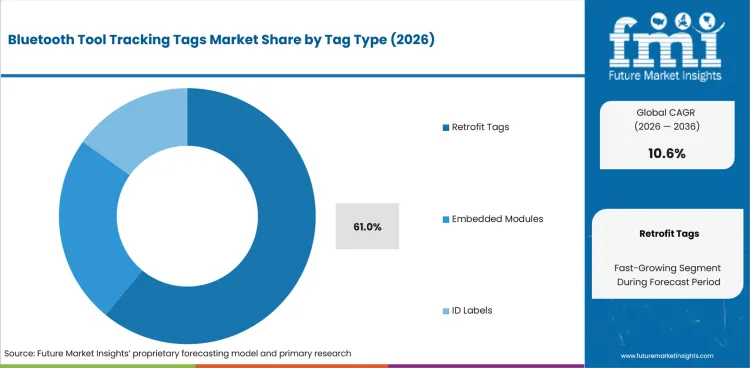
- Retrofit Tags are projected to account for 61.0% of Tag Type revenue in 2026 as contractors need a brand-neutral way to track older drills, saws, boxes, and ladders.
- Buyers prefer screw, rivet, zip-tie, or adhesive mounting for retrofit tags since jobsite abuse often breaks weak consumer-style attachments before electronics fail.
Which connectivity mode leads the Bluetooth tool tracking tags market?
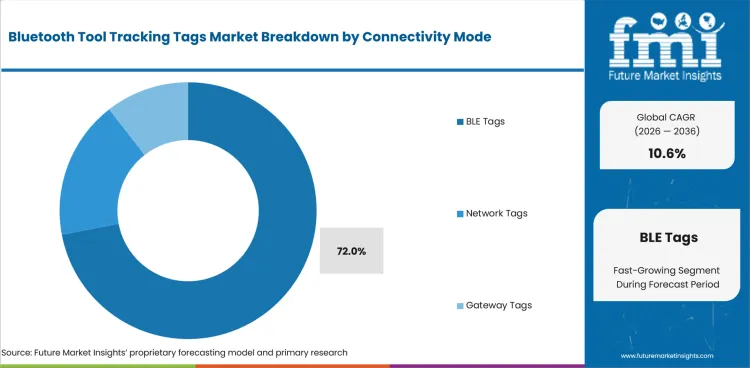
- BLE Tags are expected to represent 72.0% of Connectivity Mode revenue in 2026 as phone-based scanning keeps hardware cost low and setup time short.
- Bluetooth 6.0 Channel Sounding creates a future upgrade path, but most 2026 buyers still choose standard BLE due to price and battery life.
Which application leads the Bluetooth tool tracking tags market?
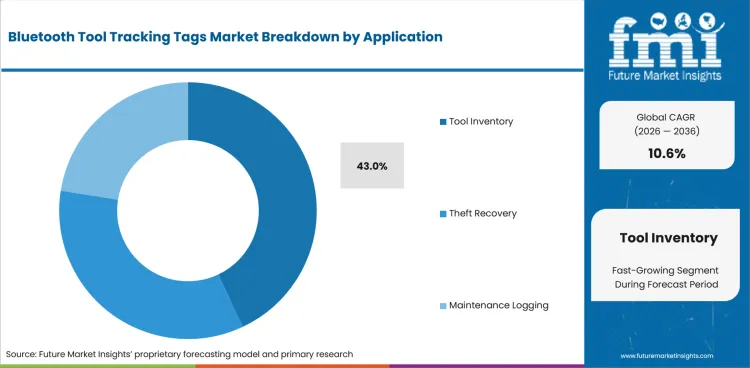
- Tool Inventory is anticipated to hold 43.0% of Application revenue in 2026 as managers first need check-in records before recovery alerts.
- Rental checkout workflows need named custody records, so tag systems with user assignment beat simple map-only trackers in branch operations.
Which end user leads the Bluetooth tool tracking tags market?
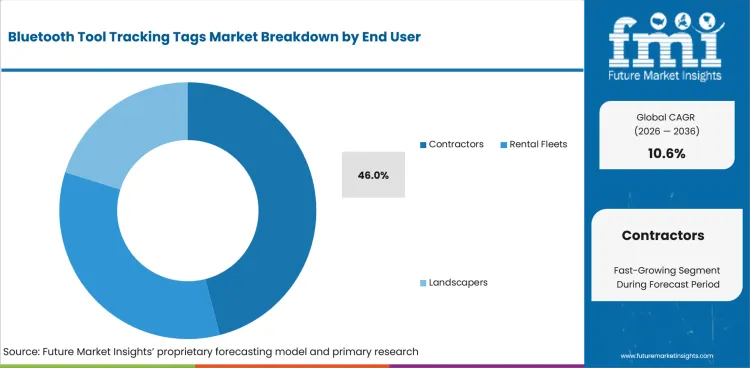
- Contractors are projected to account for 46.0% of End User revenue in 2026 as tool movement across vans and subcontracted sites creates daily loss risk.
- Large contractors compare tag systems by crew transfer records and admin controls, not by the lowest hardware price alone.
Which sales channel leads the Bluetooth tool tracking tags market?
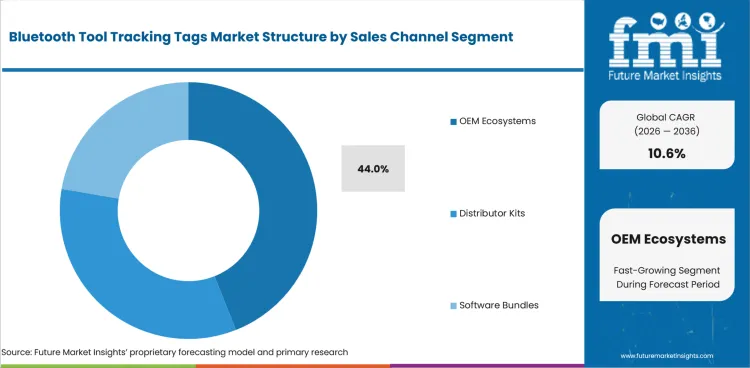
- OEM Ecosystems are estimated to hold 44.0% of Sales Channel revenue in 2026 as brands bundle tags with existing power tool accounts.
- Distributor kits stay important for mixed fleets since many buyers run Milwaukee, DeWalt, STIHL, Bosch, and Hilti tools in the same depot.
What are the drivers, restraints, and opportunities in the Bluetooth tool tracking tags market?
- Driver: Tool crib digitization turns Bluetooth tags into daily workflow tools rather than occasional loss-recovery accessories.
- Driver: Community-find networks raise buyer awareness of tracking, but professional fleets need ownership and audit controls.
- Driver: Rental branch checkout uses tags to reduce disputes over tool returns and tool movement between depots.
- Restraint: Consumer tracker prices make professional tag premiums harder to defend unless ruggedness and software value are clear.
- Opportunity: Bluetooth Channel Sounding gives professional suppliers a path to better near-field locating without shifting every tag to UWB.
Tool Crib Digitization
Tool rooms and depots are becoming the first serious buying point for Bluetooth tool tags. Managers do not only want a dot on a map. They need to know which crew took a tool and whether it came back. ToolWatch states that its platform supports BLE, barcode, and wireless tracking across tools and materials. That matters for contractors with mixed tool parks. Bluetooth tags gain repeat value when they cut manual entry and reduce disputes between field crews and warehouse staff. This shifts the supplier equation from hardware range to workflow fit.
Consumer Network Substitution
Consumer item-finder networks create both demand education and pricing pressure. Google said in April 2024 that Bluetooth tracker tags from Chipolo and Pebblebee would work with its Find My Device app from May 2024. That gives buyers a familiar reference point for item finding. Professional suppliers must respond by proving why jobsite tags cost more. The answer is not only range. It includes rugged mounting, admin rights, tool custody, and integration with service records. This makes consumer networks a substitute threat but not a full replacement.
Rugged Attachment Friction
The most practical restraint is attachment reliability on dusty and high-vibration assets. Milwaukee’s current ONE-KEY Bluetooth Tracking Tag can attach by glue, screw, rivet, or zip tie and lists a built-in three-year battery with up to 300 feet of Bluetooth range. Those features show what professional buyers expect from jobsite hardware. The risk is that cheap tags fail at the mounting point before buyers see software value. Suppliers need to test attachment methods for ladders, concrete tools, outdoor power tools, and boxes.
Competitive Landscape and Strategic Positioning
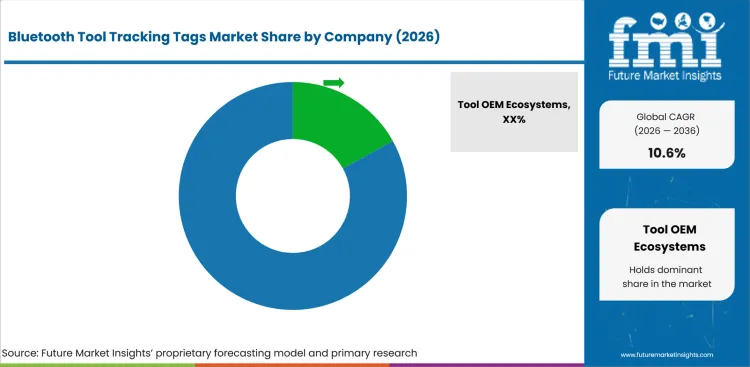
- The market is split between tool brands and consumer networks. Tool brands lead professional trust, while consumer networks shape buyer price expectations.
- Established suppliers win with rugged tags, fleet apps, dealer support, and compatibility with existing tool accounts.
- Specialist software firms compete by linking tool custody, branch movement, and job costing rather than selling tags alone.
- Entry barriers include durable attachment design, app reliability, platform privacy compliance, and channel access.
Competition is split between professional tool ecosystems and broader item-finder networks. Milwaukee’s ONE-KEY Bluetooth Tracking Tag lists a built-in three-year battery, up to 300 feet of Bluetooth range, and multiple attachment methods. That hardware detail shows why jobsite tags are not judged like key-finder tags. Buyers compare whether a tag survives dust, vibration, and tool-box abuse. Suppliers with rugged hardware and fleet software defend premium pricing better than hardware-only sellers. Tool brands hold an advantage when tags connect to tools already bought by contractors. DeWalt’s Tool Connect Tag tracks equipment, storage, large tools, and materials through its mobile app. Its chip option supports connected-ready products inside the same software system. This lets DeWalt sell both retrofit tags and embedded paths. The same strategy appears in industrial Bluetooth categories where device integration matters more than simple radio capability. Specialist software providers compete around operations rather than tag electronics. ToolWatch under AlignOps presents BLE, barcode, and wireless tracking inside a broader tool management workflow. That matters for contractors with branch transfers, requisitions, and billing needs. These buyers are closer to the equipment management software buyer than the consumer tracker buyer. Software specialists win when they reduce manual work and link missing tools to financial accountability. Consumer networks are the largest substitute pressure. Google’s Find Hub update in May 2025 added UWB-enabled nearby finding first on moto tag and named travel and lifestyle partners. Pebblebee Universal launched in October 2024 with support for both Apple Find My and Google Find My Device networks. These moves pressure professional suppliers to prove why micro-location technology needs jobsite-grade workflow and not only crowd-sourced finding.
Key Companies in the Bluetooth Tool Tracking Tags Market
Competition is best viewed by role, since tool OEMs, software firms, and consumer-network players solve different buyer problems.
Tool OEM Ecosystems: Milwaukee, DeWalt, Hilti, STIHL, and Bosch compete with branded tool systems that connect tags, apps, and service records. Milwaukee and DeWalt have the clearest retrofit tag offerings for contractors. Hilti and STIHL add fleet-management depth for professional users that want service and maintenance records. Bosch remains relevant through connected-tool modules and professional dealer reach.
Asset Workflow Platforms: ToolWatch by AlignOps competes by managing tools, materials, and branch movement through software workflows. Its strength is not a low-cost tag. Its value is concentrated in requisitions and transfers. Audit trails and financial visibility give contractors the operating case. This role overlaps with IoT-based asset tracking and monitoring where tags become part of operating systems.
Consumer Network Substitutes: Apple Find My, Google Find Hub, Tile by Life360, Pebblebee, Chipolo, and Motorola pressure the market through mass networks and lower hardware expectations. These firms are not always tool-specific. They matter because buyers compare their price, phone reach, and finding ease against professional tool tags.
Competitive Benchmarking: Bluetooth Tool Tracking Tags Market
| Company | Role in Market | Hardware / Software Fit | Channel Reach |
|---|---|---|---|
| Milwaukee Tool | OEM ecosystem leader | Rugged retrofit tags and ONE-KEY workflows | Very Strong |
| DeWalt | OEM ecosystem leader | Tool Connect tags and app-linked tool records | Very Strong |
| Hilti | Enterprise workflow supplier | ON!Track asset control and professional service | Strong |
| STIHL | Connected equipment supplier | Smart Connector ecosystem for outdoor tools | Strong |
| Bosch | Professional tool ecosystem | Tool and dealer-service coverage | Strong |
| ToolWatch by AlignOps | Asset workflow platform | Fleet dashboards and tool custody records | Strong |
| Tile by Life360 | Consumer network substitute | Broad Bluetooth item-finder network | Strong |
| Apple Find My ecosystem | Consumer network substitute | Large phone network and privacy controls | Very Strong |
| Google Find Hub ecosystem | Consumer network substitute | Android network and UWB upgrade path | Strong |
| Pebblebee and Chipolo | Item-finder hardware suppliers | Cross-network tracker products | Moderate |
Source: Future Market Insights competitive analysis, 2026. Ratings reflect relative positioning based on rugged tag attachment depth and fleet workflow integration.
Key Developments in Bluetooth Tool Tracking Tags Market
- In April 2024, Google launched its Find My Device network expansion and named Chipolo and Pebblebee Bluetooth tracker tags for item finding. This widened the Android ecosystem substitute threat.
- In May 2024, Apple and Google delivered support for unwanted tracking alerts across iOS and Android. This changed compliance expectations for Bluetooth tracking devices.
- In September 2024, Bluetooth SIG released Core Specification 6.0 with Channel Sounding. This gave tag makers a standards path toward better distance awareness.
- In September 2024, Life360 launched a new Tile Bluetooth tracker lineup with SOS features. This raised consumer-network competition around finding and safety use cases.
- In October 2024, Pebblebee launched Universal trackers compatible with Apple Find My and Google Find My Device networks. This pressured closed professional systems on network reach.
- In December 2024, Google updated Android unknown tracker alerts with stronger controls. This raised the privacy bar for tag products.
- In January 2025, Pebblebee introduced its “Find and Be Found” ecosystem at CES 2025. This pointed toward broader personal and enterprise asset tracking.
- In May 2025, Google announced Find Hub with UWB-enabled nearby finding first on moto tag. This improved precision expectations in Android tracking.
- In May 2025, Bluetooth SIG released Core Specification 6.1 with randomized RPA updates. This strengthened privacy and power features for Bluetooth devices.
- In March 2026, STIHL listed expanded Smart Connector 2 A compatibility for selected cordless professional products. This widened professional tool fleet coverage.
Key Players in the Bluetooth Tool Tracking Tags Market
- Tool OEM Ecosystems
- Milwaukee
- DeWalt
- Hilti
- STIHL
- Bosch
- Asset Workflow Platforms
- ToolWatch by AlignOps
- GigaTrak
- ToolSense
- Consumer Network Substitutes
- Apple Find My ecosystem
- Google Find Hub ecosystem
- Tile by Life360
- Pebblebee
- Chipolo
- Motorola
Which countries are growing fastest in the Bluetooth tool tracking tags market?
.webp "Top Country Growth Comparison Bluetooth Tool Tracking Tags Market Cagr (2026 2036)")
India reaches 12.1% CAGR followed by China at 11.2% through 2036.
| Country | CAGR |
|---|---|
| India | 12.1% |
| China | 11.2% |
| United Kingdom | 10.8% |
| South Korea | 10.6% |
| United States | 10.4% |
| Germany | 9.8% |
| France | 9.4% |
| Japan | 8.9% |
Source: Future Market Insights, 2026.
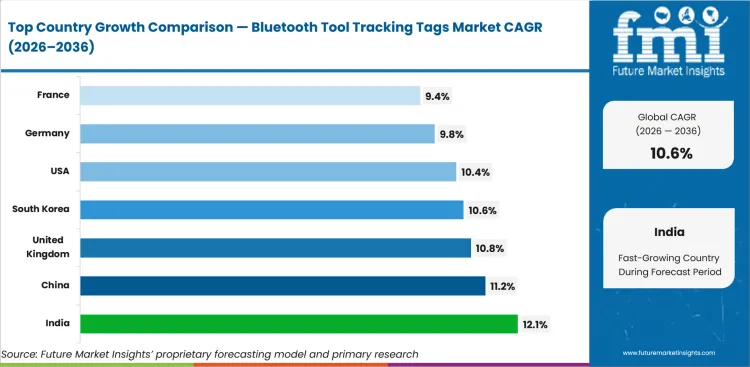
How do country-level CAGRs compare in the Bluetooth tool tracking tags market?
India leads country growth while Japan records the most measured expansion outlook among profiled markets.
- India is forecast to record 12.1% CAGR by 2036 as construction growth and low-cost distributor kits broaden adoption.
- China is projected to expand at 11.2% CAGR through 2036 with electronics supply depth and large project sites supporting demand.
- The United Kingdom is expected to advance at 10.8% CAGR through 2036 as theft-prevention pressure supports tag trials.
- South Korea is estimated to rise at 10.6% CAGR by 2036 with smart-tag familiarity and industrial site controls supporting adoption.
- The United States is forecast to grow at 10.4% CAGR through 2036 as construction scale and OEM ecosystems support tool tracking.
- Germany is projected to post 9.8% CAGR by 2036 as dealer-led service routes support maintenance-focused tracking.
- France is expected to expand at 9.4% CAGR through 2036 as rental firms use tags to reduce asset loss.
- Japan is anticipated to record 8.9% CAGR through 2036 as maintenance records guide controlled professional adoption.
How fast is the Bluetooth tool tracking tags market growing in India?
A 12.1% CAGR through 2036 reflects construction growth and low-cost distributor kits across contractor channels.
| Parameter | Value |
|---|---|
| Market Size in 2025 (Value) | USD 19.6 million |
| Market Size in 2026 (Value) | USD 22.0 million |
| Market Forecast in 2036 (Value) | USD 68.9 million |
| CAGR (2026 to 2036) | 12.1% |
| Years Considered | 2021 to 2036 |
| Base Year | 2025 |
| Forecast Period | 2026 to 2036 |
| Units Considered | Value (USD million) |
| Leading Sub-Region | Delhi NCR and western construction corridors |
India Bluetooth Tool Tracking Tags Market Outlook
India Bluetooth tool tracking tag demand is supported by expanding construction activity and early formalization of tool control. Small contractors can begin with low-cost multipacks before larger builders adopt site-level dashboards.
Distributor kits and mobile-first apps are expected to shape early adoption. Suppliers must keep setup simple and avoid subscription-heavy offers for first-time users.
Key Growth Drivers
- Construction growth is expected to expand the tracked tool base across small and mid-sized contractors. PIB reported that India’s construction sector grew 9.4% in FY 2024-25.
- Capital formation supports demand for jobsite equipment control. PIB reported that gross fixed capital formation grew 7.1% in FY 2024-25.
- E-commerce channels are expected to help low-cost tag multipacks reach tier-two contractor markets.
- Rental fleets are expected to use tags to reduce missing-item disputes between branch teams and field users.
Key Restraints
- Forecast moderation can keep subscription uptake price sensitive. PIB estimated manufacturing and construction in the secondary sector at 7.0% growth for FY 2025-26.
- Small contractors may keep manual registers unless recent loss events make tag spending easier to justify.
- Patchy site discipline can weaken repeat use when supervisors do not assign tools consistently.
What makes India unique
India offers the highest growth profile but needs the clearest low-price entry product and simple field training.
Key Companies
- Bosch Power Tools India
- Hilti India Pvt. Ltd.
- Stanley Black & Decker India
- Milwaukee Tool India channel partners
- STIHL India
- Taparia Tools Ltd.
- JK Files & Engineering Ltd.
Sales & Marketing Channels
- Tool distributors
- E-commerce platforms
- Rental shops
- OEM dealers
- Contractor associations
- Direct sales to large builders
Country Segment Breakdown Table
| Segment | Sub-Segments |
|---|---|
| By Tag Type | Retrofit Tags · Embedded Modules · ID Labels |
| By Connectivity Mode | BLE Tags · Network Tags · Gateway Tags · UWB Tags |
| By Application | Tool Inventory · Theft Recovery · Maintenance Logging · Rental Checkout · User Assignment |
| By End User | Contractors · Rental Fleets · Landscapers · Fire Rescue · Industrial MRO |
| By Sales Channel | OEM Ecosystems · Distributor Kits · Software Bundles · Retail Packs · Consumer Networks |
| Key Sub-Regions Covered, Professional Tool and Project Corridors | Delhi NCR · Mumbai · Bengaluru · Pune · Hyderabad · Chennai |
Frequently Asked Questions
How fast is India Bluetooth tool tracking tags market growing?
India is projected to grow at 12.1% CAGR from 2026 to 2036 as construction activity and low-cost distributor kits broaden adoption.
Who leads India Bluetooth tool tracking tags market?
Bosch Power Tools India, Hilti India, Stanley Black & Decker India, and STIHL India are relevant through professional tool channels.
What is driving adoption in India Bluetooth tool tracking tags market?
Construction growth and distributor-led multipack sales are expected to move Bluetooth tags into early contractor workflows.
What is the Bluetooth tool tracking tags market outlook in China?
An 11.2% CAGR through 2036 is supported by electronics supply depth and large construction-linked asset pools.
| Parameter | Value |
|---|---|
| Market Size in 2025 (Value) | USD 34.2 million |
| Market Size in 2026 (Value) | USD 38.0 million |
| Market Forecast in 2036 (Value) | USD 109.9 million |
| CAGR (2026 to 2036) | 11.2% |
| Years Considered | 2021 to 2036 |
| Base Year | 2025 |
| Forecast Period | 2026 to 2036 |
| Units Considered | Value (USD million) |
| Leading Sub-Region | Yangtze River Delta and Greater Bay Area project corridors |
China Bluetooth Tool Tracking Tags Market Outlook
China is a volume-led market where low-cost BLE hardware and large jobsite tool fleets meet quickly. Enterprise adoption depends on software quality and integration with contractor systems.
The strongest opportunity is concentrated in contractor and industrial tagging tied to tools and storage records. Hardware-only suppliers face price pressure from local electronics capacity.
Key Growth Drivers
- Industrial scale supports broad tool tracking demand. NBS reported China’s industrial value added at RMB 41,682.6 billion in 2025.
- Electronics manufacturing depth supports BLE tag supply. NBS reported computer and communication equipment manufacturing grew 10.6% in 2025.
- Large project sites are expected to need asset visibility across crews and storage zones.
- Industrial maintenance users are expected to extend Bluetooth tags beyond construction tools into plant equipment workflows.
Key Restraints
- Investment softness can limit premium tag rollouts. NBS reported fixed-asset investment fell 1.6% from January to April 2026.
- Low-cost hardware competition can compress margins for suppliers without software or workflow depth.
- Closed enterprise systems may restrict use of global consumer finding networks inside managed sites.
What makes China unique
China is both a demand market and a supply-side price setter for BLE tag hardware.
Key Companies
- Bosch Power Tools China
- Hilti China
- Stanley Black & Decker China
- Milwaukee Tool China channel partners
- Tuya Smart
- Quectel Wireless Solutions
- Minew Technologies
Sales & Marketing Channels
- Industrial distributors
- OEM dealer networks
- E-commerce stores
- Contractor software integrators
- Rental depots
- Direct enterprise sales
Country Segment Breakdown Table
| Segment | Sub-Segments |
|---|---|
| By Tag Type | Retrofit Tags · Embedded Modules · ID Labels |
| By Connectivity Mode | BLE Tags · Network Tags · Gateway Tags · UWB Tags |
| By Application | Tool Inventory · Theft Recovery · Maintenance Logging · Rental Checkout · User Assignment |
| By End User | Contractors · Rental Fleets · Landscapers · Fire Rescue · Industrial MRO |
| By Sales Channel | OEM Ecosystems · Distributor Kits · Software Bundles · Retail Packs · Consumer Networks |
| Key Sub-Regions Covered, Professional Tool and Project Corridors | Shanghai · Shenzhen · Guangzhou · Beijing · Suzhou · Chengdu |
Frequently Asked Questions
How fast is China Bluetooth tool tracking tags market growing?
China is forecast to expand at 11.2% CAGR from 2026 to 2036 as digital construction and industrial asset workflows spread.
Who leads China Bluetooth tool tracking tags market?
Bosch Power Tools China, Hilti China, Tuya Smart, and Minew Technologies are relevant through hardware and professional channels.
What is driving adoption in China Bluetooth tool tracking tags market?
Electronics supply depth and large project sites are expected to support low-cost Bluetooth tag deployment.
What is the Bluetooth tool tracking tags market outlook in the United Kingdom?
A 10.8% CAGR through 2036 reflects theft-prevention pressure and strong hire-depot routes.
| Parameter | Value |
|---|---|
| Market Size in 2025 (Value) | USD 23.5 million |
| Market Size in 2026 (Value) | USD 26.0 million |
| Market Forecast in 2036 (Value) | USD 72.5 million |
| CAGR (2026 to 2036) | 10.8% |
| Years Considered | 2021 to 2036 |
| Base Year | 2025 |
| Forecast Period | 2026 to 2036 |
| Units Considered | Value (USD million) |
| Leading Sub-Region | London and national tool hire corridors |
United Kingdom Bluetooth Tool Tracking Tags Market Outlook
United Kingdom demand has a sharper theft-led business case than many larger markets. Tradespeople often view tags as protection and proof before they treat them as workflow tools.
Hire companies and builders’ merchants are expected to test Bluetooth tags alongside van security. Adoption should widen when multipacks support boxes and repeated branch checkout use.
Key Growth Drivers
- Equipment theft pressure is expected to support tag trials in trade channels. The UK Government cited GBP 2.7 million in quad and ATV theft costs for 2024.
- Repair and maintenance work supports recurring tool movement. ONS reported repair and maintenance output grew 3.4% in Quarter 1 2026.
- Hire depots are expected to use tags to verify branch returns and reduce disputes over tool movement.
- Insurance and theft-prevention messaging can give distributors a clear sales story for higher-value tools.
Key Restraints
- New work softness can hold back broad fleet tagging. ONS reported new work fell 1.9% in Quarter 1 2026.
- Bluetooth range limits recovery once tools leave dense phone or gateway environments.
- Small trades may tag only high-value tools unless multipack pricing improves.
What makes United Kingdom unique
The United Kingdom is unusually theft-driven, with van security and hire-depot recovery shaping the sales message.
Key Companies
- Stanley Black & Decker UK
- Milwaukee Tool UK
- Hilti Great Britain
- STIHL GB
- Makita UK
- Toolstation
- Speedy Hire
Sales & Marketing Channels
- Builders’ merchants
- Tool hire branches
- Online trade retail
- OEM apps
- Insurer-adjacent campaigns
- Direct contractor sales
Country Segment Breakdown Table
| Segment | Sub-Segments |
|---|---|
| By Tag Type | Retrofit Tags · Embedded Modules · ID Labels |
| By Connectivity Mode | BLE Tags · Network Tags · Gateway Tags · UWB Tags |
| By Application | Tool Inventory · Theft Recovery · Maintenance Logging · Rental Checkout · User Assignment |
| By End User | Contractors · Rental Fleets · Landscapers · Fire Rescue · Industrial MRO |
| By Sales Channel | OEM Ecosystems · Distributor Kits · Software Bundles · Retail Packs · Consumer Networks |
| Key Sub-Regions Covered, Professional Tool and Project Corridors | London · Manchester · Birmingham · Leeds · Glasgow · Bristol |
Frequently Asked Questions
How fast is United Kingdom Bluetooth tool tracking tags market growing?
The United Kingdom is projected to expand at 10.8% CAGR from 2026 to 2036 due to theft-prevention demand.
Who leads United Kingdom Bluetooth tool tracking tags market?
Stanley Black & Decker UK, Milwaukee Tool UK, Hilti Great Britain, STIHL GB, and Speedy Hire are relevant channel participants.
What is driving adoption in United Kingdom Bluetooth tool tracking tags market?
Tool theft pressure and hire-depot control are expected to move Bluetooth tags into professional trade channels.
How is the Bluetooth tool tracking tags market performing in South Korea?
A 10.6% CAGR through 2036 reflects industrial project control and local smart-tag familiarity.
| Parameter | Value |
|---|---|
| Market Size in 2025 (Value) | USD 12.7 million |
| Market Size in 2026 (Value) | USD 14.0 million |
| Market Forecast in 2036 (Value) | USD 38.3 million |
| CAGR (2026 to 2036) | 10.6% |
| Years Considered | 2021 to 2036 |
| Base Year | 2025 |
| Forecast Period | 2026 to 2036 |
| Units Considered | Value (USD million) |
| Leading Sub-Region | Seoul Capital Area and semiconductor project corridors |
South Korea Bluetooth Tool Tracking Tags Market Outlook
South Korea demand is tied to disciplined project sites and high-value industrial construction. Buyers need tool custody and worker assignment inside controlled facilities.
Consumer smart-tag familiarity gives suppliers an easier first conversation. Broader adoption still depends on security approval and site-level pilots.
Key Growth Drivers
- Construction order growth supports project-led tag pilots. MODS reported construction orders received increased 39.3% year over year in April 2026.
- Mobile buying habits support e-commerce tag access. MODS reported mobile shopping transaction value at KRW 18.4382 trillion in April 2026.
- Samsung SmartThings Find is expected to make tag-based locating familiar to local users.
- Large contractors can scale approved systems after site-level pilots prove custody and assignment value.
Key Restraints
- Construction output pressure can delay discretionary tag budgets. MODS reported construction completed at constant prices fell 5.5% year over year in April 2026.
- Closed corporate security rules can restrict third-party tracking networks inside semiconductor or industrial sites.
- Procurement approvals can slow brand switching when tags connect to workforce assignment records.
What makes South Korea unique
South Korea combines consumer smart-tag familiarity with tightly controlled industrial project environments.
Key Companies
- Samsung Electronics
- Hilti Korea
- Bosch Korea
- Stanley Black & Decker Korea
- Milwaukee Tool Korea channel partners
- Makita Korea
- LS Electric
Sales & Marketing Channels
- Direct enterprise sales
- Industrial distributors
- OEM dealer networks
- E-commerce
- Contractor pilots
- Safety compliance channels
Country Segment Breakdown Table
| Segment | Sub-Segments |
|---|---|
| By Tag Type | Retrofit Tags · Embedded Modules · ID Labels |
| By Connectivity Mode | BLE Tags · Network Tags · Gateway Tags · UWB Tags |
| By Application | Tool Inventory · Theft Recovery · Maintenance Logging · Rental Checkout · User Assignment |
| By End User | Contractors · Rental Fleets · Landscapers · Fire Rescue · Industrial MRO |
| By Sales Channel | OEM Ecosystems · Distributor Kits · Software Bundles · Retail Packs · Consumer Networks |
| Key Sub-Regions Covered, Professional Tool and Project Corridors | Seoul · Incheon · Gyeonggi · Busan · Daegu · Daejeon |
Frequently Asked Questions
How fast is South Korea Bluetooth tool tracking tags market growing?
South Korea is expected to post 10.6% CAGR from 2026 to 2036 as industrial projects adopt more digital asset control.
Who leads South Korea Bluetooth tool tracking tags market?
Samsung Electronics, Hilti Korea, Bosch Korea, and Stanley Black & Decker Korea are relevant through smart-tag and professional tool channels.
What is driving adoption in South Korea Bluetooth tool tracking tags market?
Industrial project control and smart-tag familiarity are expected to support early Bluetooth tool tracking pilots.
What is the Bluetooth tool tracking tags market outlook in the United States?
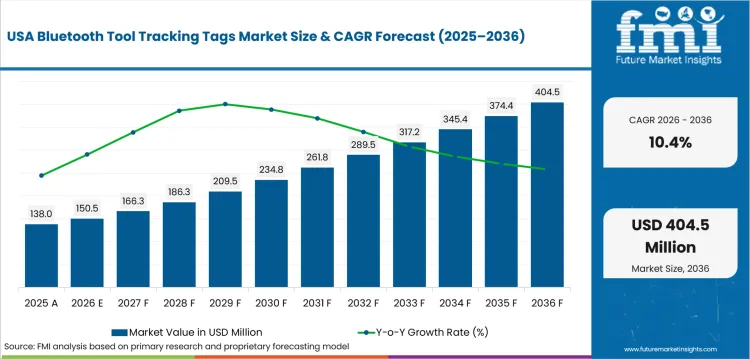
A 10.4% CAGR through 2036 reflects construction scale and OEM tool ecosystems.
| Parameter | Value |
|---|---|
| Market Size in 2025 (Value) | USD 68.8 million |
| Market Size in 2026 (Value) | USD 76.0 million |
| Market Forecast in 2036 (Value) | USD 204.4 million |
| CAGR (2026 to 2036) | 10.4% |
| Years Considered | 2021 to 2036 |
| Base Year | 2025 |
| Forecast Period | 2026 to 2036 |
| Units Considered | Value (USD million) |
| Leading Sub-Region | Sun Belt and national professional tool networks |
United States Bluetooth Tool Tracking Tags Market Outlook
United States demand is shaped by large jobsite fleets and daily movement across subcontractor teams. Tool custody records are often more valuable than simple last-known-location tracking.
Milwaukee ONE-KEY and DeWalt Tool Connect give buyers familiar brand-led options. Consumer networks affect price expectations, although professional buyers still pay for admin controls and rugged mounting.
Key Growth Drivers
- Large construction spending keeps tool fleets broad across commercial and infrastructure sites. USA Census Bureau estimated April 2026 construction spending at a USD 2,172.4 billion annual rate.
- Construction employment supports a large field-user base. BLS listed construction payroll employment at about 8.3 million in April 2026.
- Rental branches are expected to use Bluetooth records to reduce disputes over tools returned late or to the wrong depot.
- Pro distributors can bundle tags with power tools and service plans for account-level buyers.
Key Restraints
- Short-term spending growth remains modest. USA Census Bureau reported January to April 2026 construction spending was only 0.2% above the same period in 2025.
- AirTag and Tile pricing makes simple Bluetooth tags look costly to smaller contractors.
- Rural and low-density jobsites reduce community finding value outside phone-rich areas.
What makes United States unique
The United States is the clearest test bed for tool-brand ecosystems competing against consumer finding networks.
Key Companies
- Milwaukee Tool
- DeWalt
- Hilti North America
- ToolWatch by AlignOps
- STIHL USA
- Tile by Life360
- Apple Find My ecosystem partners
Sales & Marketing Channels
- Direct enterprise sales
- Pro tool distributors
- Home center retail
- Rental branch pilots
- OEM software bundles
- E-commerce multipacks
Country Segment Breakdown Table
| Segment | Sub-Segments |
|---|---|
| By Tag Type | Retrofit Tags · Embedded Modules · ID Labels |
| By Connectivity Mode | BLE Tags · Network Tags · Gateway Tags · UWB Tags |
| By Application | Tool Inventory · Theft Recovery · Maintenance Logging · Rental Checkout · User Assignment |
| By End User | Contractors · Rental Fleets · Landscapers · Fire Rescue · Industrial MRO |
| By Sales Channel | OEM Ecosystems · Distributor Kits · Software Bundles · Retail Packs · Consumer Networks |
| Key Sub-Regions Covered, Professional Tool and Project Corridors | Texas · California · Florida · Midwest · Northeast · Pacific Northwest |
Frequently Asked Questions
How fast is United States Bluetooth tool tracking tags market growing?
The United States is forecast to grow at 10.4% CAGR from 2026 to 2036 through construction scale and OEM ecosystems.
Who leads United States Bluetooth tool tracking tags market?
Milwaukee Tool, DeWalt, Hilti North America, ToolWatch, Tile, and Apple-linked partners shape the USA competitive frame.
What is driving adoption in United States Bluetooth tool tracking tags market?
Large construction spending and rental branch density are expected to support tool inventory and theft recovery workflows.
What is the Bluetooth tool tracking tags market outlook in Germany?
A 9.8% CAGR through 2036 reflects dealer-led tool service and maintenance-record demand.
| Parameter | Value |
|---|---|
| Market Size in 2025 (Value) | USD 21.9 million |
| Market Size in 2026 (Value) | USD 24.0 million |
| Market Forecast in 2036 (Value) | USD 61.1 million |
| CAGR (2026 to 2036) | 9.8% |
| Years Considered | 2021 to 2036 |
| Base Year | 2025 |
| Forecast Period | 2026 to 2036 |
| Units Considered | Value (USD million) |
| Leading Sub-Region | North Rhine-Westphalia and southern industrial corridors |
Germany Bluetooth Tool Tracking Tags Market Outlook
Germany is a professional maintenance-led market where uptime can matter as much as theft recovery. Specialist dealers and manufacturer-backed service routes influence early adoption.
Buyers are expected to compare tag systems by documentation and service value rather than consumer-style finding alone. Slower construction recovery can still delay broad deployments.
Key Growth Drivers
- Industrial operating activity supports maintenance-linked tag use. Destatis reported manufacturing value added rose 0.7% in Quarter 1 2026.
- Business scale supports organized fleet management. Destatis reported about 45.6 million persons in employment in Germany in Quarter 1 2026.
- STIHL and Bosch ecosystems are expected to give local buyers credible connected-tool references.
- Dealer-led service routes should support repeat sales after first pilot batches prove value.
Key Restraints
- Construction weakness can slow tag rollout. Destatis reported construction gross value added fell 3.6% in 2025.
- Lower housing activity can limit fast growth in construction-led tool demand.
- Buyers may reject consumer-style tags that lack professional documentation and service support.
What makes Germany unique
Germany is the clearest professional maintenance-led market where tool uptime can matter as much as theft recovery.
Key Companies
- STIHL Group
- Bosch Power Tools
- Hilti Deutschland
- Stanley Black & Decker Germany
- Milwaukee Tool Germany
- Würth Group
- Festool GmbH
Sales & Marketing Channels
- Specialist dealers
- OEM service networks
- Municipal procurement
- Rental depots
- Online pro retail
- Direct enterprise accounts
Country Segment Breakdown Table
| Segment | Sub-Segments |
|---|---|
| By Tag Type | Retrofit Tags · Embedded Modules · ID Labels |
| By Connectivity Mode | BLE Tags · Network Tags · Gateway Tags · UWB Tags |
| By Application | Tool Inventory · Theft Recovery · Maintenance Logging · Rental Checkout · User Assignment |
| By End User | Contractors · Rental Fleets · Landscapers · Fire Rescue · Industrial MRO |
| By Sales Channel | OEM Ecosystems · Distributor Kits · Software Bundles · Retail Packs · Consumer Networks |
| Key Sub-Regions Covered, Professional Tool and Project Corridors | North Rhine-Westphalia · Bavaria · Baden-Württemberg · Berlin · Hamburg · Hesse |
Frequently Asked Questions
How fast is Germany Bluetooth tool tracking tags market growing?
Germany is projected to expand at 9.8% CAGR from 2026 to 2036 as professional service channels test connected tool records.
Who leads Germany Bluetooth tool tracking tags market?
STIHL, Bosch Power Tools, Hilti Deutschland, Würth, and Festool are relevant through dealer and professional tool channels.
What is driving adoption in Germany Bluetooth tool tracking tags market?
Maintenance planning and dealer-led support are expected to move Bluetooth tool tags into professional fleets.
How is the Bluetooth tool tracking tags market performing in France?
A 9.4% CAGR through 2036 reflects margin-control demand across contractors and rental branches.
| Parameter | Value |
|---|---|
| Market Size in 2025 (Value) | USD 18.3 million |
| Market Size in 2026 (Value) | USD 20.0 million |
| Market Forecast in 2036 (Value) | USD 49.1 million |
| CAGR (2026 to 2036) | 9.4% |
| Years Considered | 2021 to 2036 |
| Base Year | 2025 |
| Forecast Period | 2026 to 2036 |
| Units Considered | Value (USD million) |
| Leading Sub-Region | Paris Region and national rental corridors |
France Bluetooth Tool Tracking Tags Market Outlook
France shows a cautious but real market for Bluetooth tool tags. Contractors are expected to use tags to reduce replacement purchases before they expand into software-led workflow control.
Rental firms and trade distributors influence professional tool access. Suppliers gain ground when multipacks and simple dashboards make payback easy to explain.
Key Growth Drivers
- Civil engineering recovery can support tracked tool use in public works. INSEE reported civil engineering output rebounded 2.9% in March 2026.
- Cost pressure is expected to make tool-loss reduction more relevant. INSEE reported construction production costs rose 1.6% year over year in Quarter 4 2025.
- Rental branches are expected to need better checkout and return records across regional depots.
- OEM software can bundle tool records with service and warranty data for larger contractors.
Key Restraints
- Construction output softness can slow large-fleet rollouts. INSEE reported construction output fell 1.3% in February 2026.
- Smaller contractors may avoid subscriptions unless theft loss or duplicate purchasing is recent.
- Dashboard training needs can slow adoption when distributors sell tags without workflow support.
What makes France unique
France is a margin-control market where tags are sold as a loss-reduction tool before workflow software gains wider use.
Key Companies
- Hilti France
- Bosch France
- Stanley Black & Decker France
- Milwaukee Tool France
- STIHL France
- Kiloutou
- Loxam
Sales & Marketing Channels
- Trade distributors
- Rental firms
- OEM service teams
- E-commerce multipacks
- Dealer training
- Contractor associations
Country Segment Breakdown Table
| Segment | Sub-Segments |
|---|---|
| By Tag Type | Retrofit Tags · Embedded Modules · ID Labels |
| By Connectivity Mode | BLE Tags · Network Tags · Gateway Tags · UWB Tags |
| By Application | Tool Inventory · Theft Recovery · Maintenance Logging · Rental Checkout · User Assignment |
| By End User | Contractors · Rental Fleets · Landscapers · Fire Rescue · Industrial MRO |
| By Sales Channel | OEM Ecosystems · Distributor Kits · Software Bundles · Retail Packs · Consumer Networks |
| Key Sub-Regions Covered, Professional Tool and Project Corridors | Paris Region · Lyon · Marseille · Lille · Toulouse · Nantes |
Frequently Asked Questions
How fast is France Bluetooth tool tracking tags market growing?
France is expected to advance at 9.4% CAGR from 2026 to 2036 as rental firms and contractors manage assets across branches.
Who leads France Bluetooth tool tracking tags market?
Hilti France, Bosch France, Milwaukee Tool France, Kiloutou, and Loxam are relevant through professional tool and rental channels.
What is driving adoption in France Bluetooth tool tracking tags market?
Margin pressure and rental checkout needs are expected to support Bluetooth tag use for loss reduction.
What is the Bluetooth tool tracking tags market forecast for Japan?
An 8.9% CAGR through 2036 reflects maintenance-record value and controlled professional dealer routes.
| Parameter | Value |
|---|---|
| Market Size in 2025 (Value) | USD 16.5 million |
| Market Size in 2026 (Value) | USD 18.0 million |
| Market Forecast in 2036 (Value) | USD 42.2 million |
| CAGR (2026 to 2036) | 8.9% |
| Years Considered | 2021 to 2036 |
| Base Year | 2025 |
| Forecast Period | 2026 to 2036 |
| Units Considered | Value (USD million) |
| Leading Sub-Region | Tokyo and Osaka industrial service corridors |
Japan Bluetooth Tool Tracking Tags Market Outlook
Japan demand behaves differently from theft-led Western markets. The core value lies in keeping tools ready and documenting use inside tightly managed work environments.
Maintenance-linked tags and embedded modules are expected to carry more weight than theft-only trackers. Suppliers with Japanese-language support and dealer-backed service are best placed.
Key Growth Drivers
- Urban digital infrastructure supports location-aware workflows. MLIT reported that Project PLATEAU provides 3D city models for about 250 cities.
- Enterprise land investment supports controlled project activity. MLIT cited planned enterprise land investment of JPY 3,775.8 billion for FY2025.
- Professional dealers are expected to train users on setup and repeat use.
- Maintenance-heavy buyers are expected to value runtime records and tool condition data.
Key Restraints
- Productivity pressure can slow workflow change. MLIT material ranked Japan 32nd among 38 OECD members in labor productivity per worker.
- Conservative procurement can slow the switch from paper or barcode systems.
- Consumer item finders can blur the value case for professional tags without service integration.
What makes Japan unique
Japan is the strongest maintenance-record market among the selected countries and theft recovery is less central.
Key Companies
- Hilti Japan
- Bosch Japan
- Makita Corporation
- Ryobi Limited
- STIHL Japan
- Stanley Black & Decker Japan
- KTC Kyoto Tool
Sales & Marketing Channels
- Professional tool dealers
- OEM service channels
- Rental depots
- Industrial MRO distributors
- E-commerce
- Contractor training
Country Segment Breakdown Table
| Segment | Sub-Segments |
|---|---|
| By Tag Type | Retrofit Tags · Embedded Modules · ID Labels |
| By Connectivity Mode | BLE Tags · Network Tags · Gateway Tags · UWB Tags |
| By Application | Tool Inventory · Theft Recovery · Maintenance Logging · Rental Checkout · User Assignment |
| By End User | Contractors · Rental Fleets · Landscapers · Fire Rescue · Industrial MRO |
| By Sales Channel | OEM Ecosystems · Distributor Kits · Software Bundles · Retail Packs · Consumer Networks |
| Key Sub-Regions Covered, Professional Tool and Project Corridors | Tokyo · Osaka · Yokohama · Nagoya · Fukuoka · Sapporo |
Frequently Asked Questions
How fast is Japan Bluetooth tool tracking tags market growing?
Japan is projected to rise at 8.9% CAGR from 2026 to 2036 as professional fleets adopt tags in controlled settings.
Who leads Japan Bluetooth tool tracking tags market?
Makita, Hilti Japan, Bosch Japan, STIHL Japan, and KTC Kyoto Tool are relevant through professional tool channels.
What is driving adoption in Japan Bluetooth tool tracking tags market?
Maintenance records and dealer-supported training are expected to support controlled Bluetooth tool tag adoption.
Bluetooth Tool Tracking Tags Market - Report Scope
| Item | Value |
|---|---|
| Market size by 2036 | USD 794.0 million |
| Growth rate | 10.6% CAGR from 2026 to 2036 |
| Forecast period | 2026 to 2036 |
| Base year value (2025) | USD 262.2 million |
| By tag type | Retrofit tags, embedded modules, ID labels |
| By connectivity mode | BLE tags, network tags, gateway tags, UWB tags |
| By application | Tool inventory, theft recovery, maintenance logging, rental checkout, user assignment |
| By end user | Contractors, rental fleets, landscapers, fire rescue, industrial MRO |
| By sales channel | OEM ecosystems, distributor kits, software bundles, retail packs, consumer networks |
| Regions covered | North America, Latin America, Europe, East Asia, South Asia and Pacific, Middle East and Africa |
| Countries covered | United States, United Kingdom, Germany, France, Japan, China, South Korea, India |
| Key companies profiled | Milwaukee Tool, DeWalt, Hilti, STIHL, Bosch, ToolWatch by AlignOps, Tile by Life360 |
| Approach | Bottom-up tool-fleet approach using tag attach rates, hardware pricing, software bundling, channel reach, and country-level adoption |
Source: Future Market Insights, 2026.
Bluetooth Tool Tracking Tags Market - Scope & Definition
| Attribute | Detail |
|---|---|
| Market Definition | Attachable or embedded Bluetooth identifiers used to locate and manage professional tools, equipment, storage boxes, and jobsite assets through apps, gateways, or fleet dashboards |
| Functions Covered | Tool locating, custody logging, inventory checks, theft recovery support, maintenance prompts, user assignment, and dashboard-linked audit trails |
| Applications Covered | Tool inventory, theft recovery, maintenance logging, rental checkout, user assignment, and branch-level asset control |
| End-Use Industries | Construction, tool rental, landscaping services, fire rescue, industrial maintenance, municipal works, and contractor service operations |
| Grades Covered | Retrofit BLE tags, embedded Bluetooth modules, ID labels, gateway-linked tags, network tags, and UWB-assisted tracking formats |
| Inclusions | Commercial Bluetooth tags, smart connectors, embedded modules, gateways, fleet software, and managed tag workflows sold for professional tool tracking |
| Exclusions | GPS-only vehicle telematics, passive barcode systems, standalone RFID deployments, consumer-only item finders, and general fleet software without Bluetooth tag revenue |
Bluetooth Tool Tracking Tags Market - Research Methodology
| Method | Description |
|---|---|
| Primary Research | FMI analyst interviews with contractors, tool rental firms, distributors, landscaping fleet managers, industrial maintenance teams, and OEM tool ecosystem managers across key markets |
| Desk Research | Review of Bluetooth standards, construction activity sources, public theft data, company product pages, official platform announcements, and country-level economic statistics |
| Market Sizing & Forecasting | Bottom-up tool-fleet approach using fleet volume, tag attach rates, replacement cycles, hardware pricing, software subscription use, channel reach, and country adoption timing |
| Data Validation | Cross-verification using government construction data, Bluetooth specification updates, product availability, company disclosures, channel checks, and buyer use-case validation |
Bluetooth Tool Tracking Tags Market Breakdown by Tag Type, Connectivity Mode, Application, End User, Sales Channel, and Region
Bluetooth Tool Tracking Tags Market Segmented by Tag Type
- Retrofit Tags
- Embedded Modules
- ID Labels
Bluetooth Tool Tracking Tags Market Segmented by Connectivity Mode
- BLE Tags
- Network Tags
- Gateway Tags
- UWB Tags
Bluetooth Tool Tracking Tags Market Segmented by Application
- Tool Inventory
- Theft Recovery
- Maintenance Logging
- Rental Checkout
- User Assignment
Bluetooth Tool Tracking Tags Market Segmented by End User
- Contractors
- Rental Fleets
- Landscapers
- Fire Rescue
- Industrial MRO
Bluetooth Tool Tracking Tags Market Segmented by Sales Channel
- OEM Ecosystems
- Distributor Kits
- Software Bundles
- Retail Packs
- Consumer Networks
Bluetooth Tool Tracking Tags Market by Region
- North America
- Latin America
- Europe
- East Asia
- South Asia and Pacific
- Middle East and Africa
Research Sources and Bibliography
- Apple. (2024, May 13). Apple and Google deliver support for unwanted tracking alerts in iOS and Android. Apple Newsroom.
- Bluetooth SIG. (2024, September 3). Now available: New version of the Bluetooth Core Specification. Bluetooth SIG.
- Destatis. (2026, January 15). Gross domestic product up 0.2% in 2025. Federal Statistical Office of Germany.
- Destatis. (2026, May 22). Gross domestic product: Detailed results on economic performance in the 1st quarter of 2026. Federal Statistical Office of Germany.
- Google. (2024, April 8). 5 ways to use the new Find My Device on Android. Google Blog.
- Google. (2025, May 13). Locate your lost belongings in more ways with Find Hub on Android. Google Blog.
- INSEE. (2026, April 3). In February 2026, manufacturing output was stable. National Institute of Statistics and Economic Studies.
- INSEE. (2026, April 30). GDP stalled in Q1 2026. National Institute of Statistics and Economic Studies.
- INSEE. (2026, March 24). In Q4 2025, production costs in construction rose by 0.2% over a quarter. National Institute of Statistics and Economic Studies.
- Milwaukee Tool. (2026). ONE-KEY Bluetooth Tracking Tag. Milwaukee Tool.
- Ministry of Data and Statistics. (2026, May 29). Monthly Industrial Statistics, April 2026. Republic of Korea.
- Ministry of Data and Statistics. (2026, June 1). Online Shopping in April 2026. Republic of Korea.
- Ministry of Land, Infrastructure, Transport and Tourism. (2025, September 2). Fiscal Year 2024 Trends Concerning Land. MLIT Japan.
- Ministry of Land, Infrastructure, Transport and Tourism. (2026, March 31). Project PLATEAU: The Initiative of Digital Twin in Japan. MLIT Japan.
- National Bureau of Statistics of China. (2026, February 28). Statistical communiqué of the People’s Republic of China on the 2025 national economic and social development.
- National Bureau of Statistics of China. (2026, May 19). Investment in fixed assets from January to April 2026.
- Office for National Statistics. (2026, June 11). Construction output in Great Britain: March 2026, new orders and construction output price indices, January to March 2026.
- Press Information Bureau. (2025, May 30). Provisional estimates of annual gross domestic product for FY 2024-25. Government of India.
- Press Information Bureau. (2026, January 7). First advance estimates of annual gross domestic product for FY 2025-26. Government of India.
- USA Bureau of Labor Statistics. (2026, May 8). Table B-1. Employees on nonfarm payrolls by industry sector and selected industry detail.
- USA Census Bureau. (2026, June 1). Monthly construction spending, April 2026.
- UK Government. (2026, March 10). Equipment Theft Prevention Act: Summary of call for evidence responses and conclusion.
This bibliography is provided for reader reference and is not exhaustive. The full report contains the complete reference list and detailed citations.
This Report Answers
- What is the 2026 value and 2036 forecast for Bluetooth tool tracking tags market?
- What tag type is projected to hold the leading share during the forecast period?
- What connectivity mode is expected to account for the leading 2026 share?
- How do privacy rules and unwanted tracker alerts affect professional tag design?
- What companies compete in Bluetooth tool tracking tags?
Frequently Asked Questions
What is the global market demand for Bluetooth Tool Tracking Tags Market in 2026?
In 2026, the global Bluetooth Tool Tracking Tags Market is expected to be worth USD 290.0 million as retrofit tagging expands.
What is the forecast value of the Bluetooth Tool Tracking Tags Market by 2036?
The Bluetooth Tool Tracking Tags Market is projected to reach USD 794.0 million by 2036 as software-linked tool control spreads.
What is the CAGR for the Bluetooth Tool Tracking Tags Market?
The Bluetooth Tool Tracking Tags Market is expected to grow at a 10.6% CAGR from 2026 to 2036.
Which tag type is expected to lead the market in 2026?
Retrofit Tags are projected to lead by Tag Type with 61.0% share in 2026 due to mixed-brand tool fleets.
Which application is expected to lead Bluetooth tool tag demand?
Tool Inventory is projected to lead Application demand with 43.0% share in 2026 as check-out records come before recovery use.
Why is India expected to grow fastest in this market?
India is projected to record 12.1% CAGR through 2036 as construction growth and low-cost distributor kits broaden adoption.
What does the Bluetooth Tool Tracking Tags Market include?
The market includes attachable BLE tags, embedded Bluetooth modules, smart connectors, gateways, and related software for professional tool tracking.
How is the Bluetooth Tool Tracking Tags Market forecast calculated?
The forecast combines tool fleet volume, tag attach rates, pricing, software use, country activity, and buyer adoption timing.
Preview the report firsthand - request a free sample
Get SampleGet the brochure for pricing and purchase details.
Get PDFTable of Content
- Key Takeaways
- Market Size and CAGR
- Top Growth Driver
- Fastest Growing Segment
- Leading Region
- Key Companies
- Emerging Opportunities
- Executive Summary
- Global Market Outlook
- Demand-side Trends
- Supply-side Trends
- Technology Roadmap Analysis
- Analysis and Recommendations
- Analyst Perspective (What is happening? Why now? What should investors know?)
- Key Questions Answered
- How large is the market?
- What is the CAGR?
- What are key trends?
- Which region dominates?
- Who are the leaders?
- Market Overview
- Market Coverage / Taxonomy
- Market Definition / Scope / Limitations
- Research Methodology
- Chapter Orientation
- Analytical Lens and Working Hypotheses
- Market Structure, Signals, and Trend Drivers
- Benchmarking and Cross-market Comparability
- Market Sizing, Forecasting, and Opportunity Mapping
- Research Design and Evidence Framework
- Desk Research Programme (Secondary Evidence)
- Expert Input and Fieldwork (Primary Evidence)
- Tooling, Models, and Reference Databases
- Data Engineering and Model Build
- Quality Assurance and Audit Trail
- Market Background
- Market Dynamics (Drivers, Restraints, Opportunity, Trends)
- Scenario Forecast (Optimistic, Likely, Conservative)
- Impact Analysis
- AI Impact
- Sustainability Impact
- Regulatory Impact
- Technology Impact
- Consumer / Buyer Analysis
- Purchase Drivers
- Adoption Barriers
- Buyer Journey
- Opportunity Map Analysis
- Product Life Cycle Analysis
- Supply Chain Analysis
- Investment Feasibility Matrix
- Value Chain Analysis
- PESTLE and Porter's Analysis
- Regulatory Landscape
- Regional Parent Market Outlook
- Production and Consumption Statistics
- Import and Export Statistics
- Global Market Analysis and Forecast, 2021 to 2036
- Historical Market Size Value (USD Million) & Volume (Unit) Analysis, 2021 to 2025
- Current and Future Market Size Value (USD Million) & Volume (Unit) Projections, 2026 to 2036
- Y-o-Y Growth Trend Analysis
- Absolute $ Opportunity Analysis
- Global Market Pricing Analysis, 2021 to 2036
- Global Market Analysis and Forecast, By Tag Type, 2021 to 2036
- Introduction / Key Findings
- Historical Market Size Value (USD Million) & Volume (Unit) Analysis By Tag Type, 2021 to 2025
- Current and Future Market Size Value (USD Million) & Volume (Unit) Analysis and Forecast By Tag Type, 2026 to 2036
- Retrofit Tags
- Embedded Modules
- ID Labels
- Retrofit Tags
- Y-o-Y Growth Trend Analysis By Tag Type, 2021 to 2025
- Absolute $ Opportunity Analysis By Tag Type, 2026 to 2036
- Global Market Analysis and Forecast, By Connectivity Mode, 2021 to 2036
- Introduction / Key Findings
- Historical Market Size Value (USD Million) & Volume (Unit) Analysis By Connectivity Mode, 2021 to 2025
- Current and Future Market Size Value (USD Million) & Volume (Unit) Analysis and Forecast By Connectivity Mode, 2026 to 2036
- BLE Tags
- Network Tags
- Gateway Tags
- UWB Tags
- BLE Tags
- Y-o-Y Growth Trend Analysis By Connectivity Mode, 2021 to 2025
- Absolute $ Opportunity Analysis By Connectivity Mode, 2026 to 2036
- Global Market Analysis and Forecast, By Application, 2021 to 2036
- Introduction / Key Findings
- Historical Market Size Value (USD Million) & Volume (Unit) Analysis By Application, 2021 to 2025
- Current and Future Market Size Value (USD Million) & Volume (Unit) Analysis and Forecast By Application, 2026 to 2036
- Tool Inventory
- Theft Recovery
- Maintenance Logging
- Rental Checkout
- User Assignment
- Tool Inventory
- Y-o-Y Growth Trend Analysis By Application, 2021 to 2025
- Absolute $ Opportunity Analysis By Application, 2026 to 2036
- Global Market Analysis and Forecast, By End User, 2021 to 2036
- Introduction / Key Findings
- Historical Market Size Value (USD Million) & Volume (Unit) Analysis By End User, 2021 to 2025
- Current and Future Market Size Value (USD Million) & Volume (Unit) Analysis and Forecast By End User, 2026 to 2036
- Contractors
- Rental Fleets
- Landscapers
- Fire Rescue
- Industrial MRO
- Contractors
- Y-o-Y Growth Trend Analysis By End User, 2021 to 2025
- Absolute $ Opportunity Analysis By End User, 2026 to 2036
- Global Market Analysis and Forecast, By Sales Channel, 2021 to 2036
- Introduction / Key Findings
- Historical Market Size Value (USD Million) & Volume (Unit) Analysis By Sales Channel, 2021 to 2025
- Current and Future Market Size Value (USD Million) & Volume (Unit) Analysis and Forecast By Sales Channel, 2026 to 2036
- OEM Ecosystems
- Distributor Kits
- Software Bundles
- Retail Packs
- Consumer Networks
- OEM Ecosystems
- Y-o-Y Growth Trend Analysis By Sales Channel, 2021 to 2025
- Absolute $ Opportunity Analysis By Sales Channel, 2026 to 2036
- Global Market Analysis and Forecast, By Region, 2021 to 2036
- Introduction
- Historical Market Size Value (USD Million) & Volume (Unit) Analysis By Region, 2021 to 2025
- Current Market Size Value (USD Million) & Volume (Unit) Analysis and Forecast By Region, 2026 to 2036
- North America
- Latin America
- Western Europe
- Eastern Europe
- East Asia
- South Asia and Pacific
- Middle East & Africa
- Market Attractiveness Analysis By Region
- North America Market Analysis and Forecast, By Country, 2021 to 2036
- Historical Market Size Value (USD Million) & Volume (Unit) Trend Analysis By Market Taxonomy, 2021 to 2025
- Market Size Value (USD Million) & Volume (Unit) Forecast By Market Taxonomy, 2026 to 2036
- By Country
- USA
- Canada
- Mexico
- By Tag Type
- By Connectivity Mode
- By Application
- By End User
- By Sales Channel
- By Country
- Market Attractiveness Analysis
- By Country
- By Tag Type
- By Connectivity Mode
- By Application
- By End User
- By Sales Channel
- Key Takeaways
- Latin America Market Analysis and Forecast, By Country
- Historical Market Size Value (USD Million) & Volume (Unit) Trend Analysis By Market Taxonomy, 2021 to 2025
- Market Size Value (USD Million) & Volume (Unit) Forecast By Market Taxonomy, 2026 to 2036
- By Country
- Brazil
- Chile
- Rest of Latin America
- By Tag Type
- By Connectivity Mode
- By Application
- By End User
- By Sales Channel
- By Country
- Market Attractiveness Analysis
- By Country
- By Tag Type
- By Connectivity Mode
- By Application
- By End User
- By Sales Channel
- Key Takeaways
- Western Europe Market Analysis and Forecast, By Country
- Historical Market Size Value (USD Million) & Volume (Unit) Trend Analysis By Market Taxonomy, 2021 to 2025
- Market Size Value (USD Million) & Volume (Unit) Forecast By Market Taxonomy, 2026 to 2036
- By Country
- Germany
- UK
- Italy
- Spain
- France
- Nordic
- BENELUX
- Rest of Western Europe
- By Tag Type
- By Connectivity Mode
- By Application
- By End User
- By Sales Channel
- By Country
- Market Attractiveness Analysis
- By Country
- By Tag Type
- By Connectivity Mode
- By Application
- By End User
- By Sales Channel
- Key Takeaways
- Eastern Europe Market Analysis and Forecast, By Country
- Historical Market Size Value (USD Million) & Volume (Unit) Trend Analysis By Market Taxonomy, 2021 to 2025
- Market Size Value (USD Million) & Volume (Unit) Forecast By Market Taxonomy, 2026 to 2036
- By Country
- Russia
- Poland
- Hungary
- Balkan & Baltic
- Rest of Eastern Europe
- By Tag Type
- By Connectivity Mode
- By Application
- By End User
- By Sales Channel
- By Country
- Market Attractiveness Analysis
- By Country
- By Tag Type
- By Connectivity Mode
- By Application
- By End User
- By Sales Channel
- Key Takeaways
- East Asia Market Analysis and Forecast, By Country
- Historical Market Size Value (USD Million) & Volume (Unit) Trend Analysis By Market Taxonomy, 2021 to 2025
- Market Size Value (USD Million) & Volume (Unit) Forecast By Market Taxonomy, 2026 to 2036
- By Country
- China
- Japan
- South Korea
- By Tag Type
- By Connectivity Mode
- By Application
- By End User
- By Sales Channel
- By Country
- Market Attractiveness Analysis
- By Country
- By Tag Type
- By Connectivity Mode
- By Application
- By End User
- By Sales Channel
- Key Takeaways
- South Asia and Pacific Market Analysis and Forecast, By Country
- Historical Market Size Value (USD Million) & Volume (Unit) Trend Analysis By Market Taxonomy, 2021 to 2025
- Market Size Value (USD Million) & Volume (Unit) Forecast By Market Taxonomy, 2026 to 2036
- By Country
- India
- ASEAN
- Australia & New Zealand
- Rest of South Asia and Pacific
- By Tag Type
- By Connectivity Mode
- By Application
- By End User
- By Sales Channel
- By Country
- Market Attractiveness Analysis
- By Country
- By Tag Type
- By Connectivity Mode
- By Application
- By End User
- By Sales Channel
- Key Takeaways
- Middle East & Africa Market Analysis and Forecast, By Country
- Historical Market Size Value (USD Million) & Volume (Unit) Trend Analysis By Market Taxonomy, 2021 to 2025
- Market Size Value (USD Million) & Volume (Unit) Forecast By Market Taxonomy, 2026 to 2036
- By Country
- Kingdom of Saudi Arabia
- Other GCC Countries
- Türkiye
- South Africa
- Other African Union
- Rest of Middle East & Africa
- By Tag Type
- By Connectivity Mode
- By Application
- By End User
- By Sales Channel
- By Country
- Market Attractiveness Analysis
- By Country
- By Tag Type
- By Connectivity Mode
- By Application
- By End User
- By Sales Channel
- Key Takeaways
- Key Countries Market Analysis
- USA
- Pricing Analysis
- Market Share Analysis, 2025
- By Tag Type
- By Connectivity Mode
- By Application
- By End User
- By Sales Channel
- Canada
- Pricing Analysis
- Market Share Analysis, 2025
- By Tag Type
- By Connectivity Mode
- By Application
- By End User
- By Sales Channel
- Mexico
- Pricing Analysis
- Market Share Analysis, 2025
- By Tag Type
- By Connectivity Mode
- By Application
- By End User
- By Sales Channel
- Brazil
- Pricing Analysis
- Market Share Analysis, 2025
- By Tag Type
- By Connectivity Mode
- By Application
- By End User
- By Sales Channel
- Chile
- Pricing Analysis
- Market Share Analysis, 2025
- By Tag Type
- By Connectivity Mode
- By Application
- By End User
- By Sales Channel
- Germany
- Pricing Analysis
- Market Share Analysis, 2025
- By Tag Type
- By Connectivity Mode
- By Application
- By End User
- By Sales Channel
- UK
- Pricing Analysis
- Market Share Analysis, 2025
- By Tag Type
- By Connectivity Mode
- By Application
- By End User
- By Sales Channel
- Italy
- Pricing Analysis
- Market Share Analysis, 2025
- By Tag Type
- By Connectivity Mode
- By Application
- By End User
- By Sales Channel
- Spain
- Pricing Analysis
- Market Share Analysis, 2025
- By Tag Type
- By Connectivity Mode
- By Application
- By End User
- By Sales Channel
- France
- Pricing Analysis
- Market Share Analysis, 2025
- By Tag Type
- By Connectivity Mode
- By Application
- By End User
- By Sales Channel
- India
- Pricing Analysis
- Market Share Analysis, 2025
- By Tag Type
- By Connectivity Mode
- By Application
- By End User
- By Sales Channel
- ASEAN
- Pricing Analysis
- Market Share Analysis, 2025
- By Tag Type
- By Connectivity Mode
- By Application
- By End User
- By Sales Channel
- Australia & New Zealand
- Pricing Analysis
- Market Share Analysis, 2025
- By Tag Type
- By Connectivity Mode
- By Application
- By End User
- By Sales Channel
- China
- Pricing Analysis
- Market Share Analysis, 2025
- By Tag Type
- By Connectivity Mode
- By Application
- By End User
- By Sales Channel
- Japan
- Pricing Analysis
- Market Share Analysis, 2025
- By Tag Type
- By Connectivity Mode
- By Application
- By End User
- By Sales Channel
- South Korea
- Pricing Analysis
- Market Share Analysis, 2025
- By Tag Type
- By Connectivity Mode
- By Application
- By End User
- By Sales Channel
- Russia
- Pricing Analysis
- Market Share Analysis, 2025
- By Tag Type
- By Connectivity Mode
- By Application
- By End User
- By Sales Channel
- Poland
- Pricing Analysis
- Market Share Analysis, 2025
- By Tag Type
- By Connectivity Mode
- By Application
- By End User
- By Sales Channel
- Hungary
- Pricing Analysis
- Market Share Analysis, 2025
- By Tag Type
- By Connectivity Mode
- By Application
- By End User
- By Sales Channel
- Kingdom of Saudi Arabia
- Pricing Analysis
- Market Share Analysis, 2025
- By Tag Type
- By Connectivity Mode
- By Application
- By End User
- By Sales Channel
- Türkiye
- Pricing Analysis
- Market Share Analysis, 2025
- By Tag Type
- By Connectivity Mode
- By Application
- By End User
- By Sales Channel
- South Africa
- Pricing Analysis
- Market Share Analysis, 2025
- By Tag Type
- By Connectivity Mode
- By Application
- By End User
- By Sales Channel
- USA
- Market Structure Analysis
- Competition Dashboard
- Competition Benchmarking
- Market Share Analysis of Top Players
- By Regional
- By Tag Type
- By Connectivity Mode
- By Application
- By End User
- By Sales Channel
- Emerging Startups
- Innovation Benchmarking
- Competition Analysis
- Competition Deep Dive
- Milwaukee Tool
- Overview
- Product Portfolio
- Profitability by Market Segments (Product/Region/Sales Channel)
- Sales Footprint
- Strategy Overview
- Marketing Strategy
- Product Strategy
- Channel Strategy
- DeWalt
- Hilti
- STIHL
- Bosch
- ToolWatch by AlignOps
- GigaTrak
- ToolSense
- Apple Find My ecosystem
- Google Find Hub ecosystem
- Tile by Life360
- Pebblebee
- Chipolo
- Motorola
- Milwaukee Tool
- Case Studies
- Success Stories
- Recent Developments
- Competition Deep Dive
- Assumptions & Acronyms Used


