

- Market Size (2026)
- USD 13.5 Mn
- Forecast (2036)
- USD 75.6 Mn
- CAGR (2026 to 2036)
- 18.8%
How big is Borophene Nanomaterials Market in 2026?
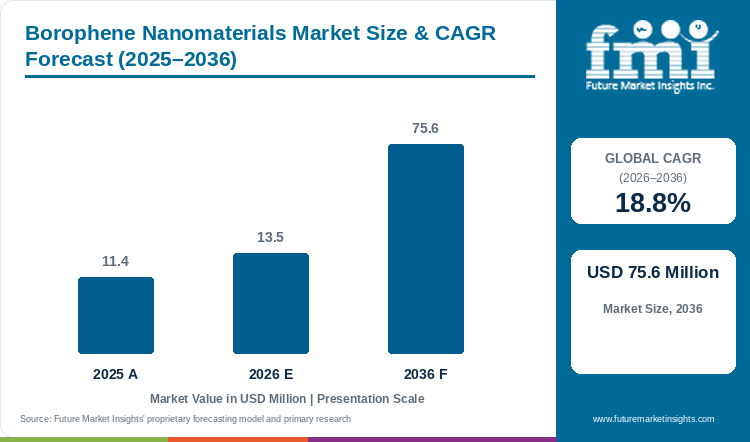
Forecast to expand at an 18.8% annual pace between 2026 and 2036, global borophene nanomaterials expenditure grows past USD 11.4 million for 2025 toward a forecasted USD 13.5 million throughout 2026 before reaching an anticipated USD 75.6 million in 2036.
Severe volumetric pulverization in silicon battery anodes and high contact resistance across sub-2-nanometer semiconductor interconnects are pushing electrochemists and device physicists toward buckled two-dimensional boron monolayers that combine metallic Dirac-cone transport with low atomic mass. Moving beyond USD 11.4 million recorded during 2025, global borophene nanomaterials turnover is estimated to hit USD 13.5 million across 2026 and is predicted to climb to a 2036 target of USD 75.6 million on a projected 18.8% CAGR, creating USD 62.1 million in annual revenue expansion between 2026 and 2036. In January 2025, The American Ceramic Society documented that closely spaced boron ridge configurations along synthetic borophene surfaces create directional metallic conduction channels alongside low lithium and sodium diffusion barriers and reversible hydrogen binding [1]. Because electron-beam boron evaporation onto single-crystal silver templates prevents three-dimensional clustering, Molecular Beam Epitaxy (MBE) on Ag(111) is slated to represent 48.0% of synthesis route volume in 2026 alongside engineered nanoscale materials.
Key Market Trends & Insights
- By synthesis route: Molecular Beam Epitaxy (MBE) on Ag(111) is anticipated to capture 48.0% of 2026 synthesis turnover because atomic-flux condensation on heated silver wafers yields defect-controlled single-phase boron monolayers.
- By allotropic phase: Beta-12 (β12) Sheet Phase is projected to secure 44.2% of 2026 phase demand since its planar hexagonal-vacancy arrangement stabilizes metallic electronic states across 450 K to 700 K growth windows.
- By product form: Substrate-Supported Epitaxial Films are expected to hold 52.5% of 2026 form volume as unencapsulated freestanding boron sheets oxidize rapidly when stripped from noble-metal templates.
- By application: Next-Gen Li-Ion & Na-Ion Battery Anodes are estimated to command 41.6% of 2026 application spending owing to theoretical gravimetric capacities above 1,800 mAh/g and strong lithium charge transfer.
Regional Highlights
- Fastest national expansion: South Korea is slated to lead major battery and display manufacturing economies with a 20.2% annual expansion pace through 2036 backed by solid-state battery anode and gas sensor R&D.
- Southeast Asian semiconductor hub: Singapore is pegged to follow closely at 19.7% per year through 2036 as national 2D-material foundries integrate atomic-layer boron films into post-silicon interconnects and catalysts.
- North American and Asian-European growth: United States demand is envisioned to rise 18.4% annually ahead of Japanese cleanrooms (foreseen at 18.0%) and German battery institutes (expected at 17.7%) on federal quantum and hydrogen grants.
Market Size & Forecast
Table 1: Market Size and Forecast for the Borophene Nanomaterials Market (USD million and CAGR percentage), 2025 to 2036
| Metric | Value |
|---|---|
| Market Value (2025) | USD 11.4 million |
| Estimated Market Size in 2026 | USD 13.5 million |
| Projected Market Size by 2036 | USD 75.6 million |
| CAGR (2026 to 2036) | 18.8% |
| Absolute Dollar Opportunity (2026 to 2036) | USD 62.1 million |
National battery-cell localization programs and post-silicon nanoelectronics initiatives across East Asia and North America alongside Western Europe are shifting two-dimensional boron from surface-science characterization toward functional device integration. During January 2026, a thirty-year ACS Applied Materials & Interfaces review (PMC12884472) detailed how scalable liquid-phase exfoliation and chemical vapor deposition are expanding borophene availability beyond ultra-high-vacuum chambers [2]. Thin-film equipment makers and specialty chemical suppliers consequently pair high-purity boron sources with high-purity sputtering targets and noble-metal epitaxial wafers. Vendors supplying oxidation-capped epitaxial wafers and anhydrous isopropanol nanoflake inks capture recurring supply contracts from battery and electrocatalysis institutes.
Epitaxial Wafer Output and Dispersed Nanoflake Production Sizing
Table 2: Wafer Output and Dispersed Nanoflake Sizing for the Borophene Nanomaterials Market (USD million, wafer units, and kilograms), mixed historical and forecast years from 2025 to 2036
| Metric | 2025 | 2026 | 2036 |
|---|---|---|---|
| Market size (USD million) | 11.4 | 13.5 | 75.6 |
| Epitaxial borophene-on-metal substrates shipped (units) | 4,200 to 4,800 | 5,100 to 5,800 | 32,000 to 36,500 |
| Exfoliated borophene powder & suspension output (kilograms) | 14.5 to 17.0 | 18.2 to 21.5 | 165.0 to 195.0 |
| Average price per 10x10 mm to 2-inch epitaxial crystal (USD) | 1,250 to 1,550 | 1,180 to 1,490 | 720 to 940 |
Operational note: Shipped substrate units reflect 10x10 mm to 2-inch Ag(111) and Cu(111) crystals carrying monolayer borophene, while kilogram volumes cover sonochemically and electrochemically exfoliated flakes.
Because boron possesses only three valence electrons across four atomic orbitals, two-dimensional boron sheets cannot form without substrate stabilization or controlled vacancy motifs. In March 2025, materials scientists in ACS Applied Electronic Materials demonstrated a straightforward 2-hour pulsed ice-bath sonochemical synthesis of borophene nanolayers in 2-propanol using Merck 2-micrometer boron powder and 6,000 rpm centrifugation, yielding 100-nanometer beta-rhombohedral sheets with 4.9-angstrom interlayer spacing and a 22.8 ppb nitrogen dioxide detection limit at 70% relative humidity [3]. While ultra-high-vacuum MBE chambers and vacuum sputtering deposition systems command the highest unit revenue per square centimeter, liquid-phase exfoliated suspensions are expected to supply the gram-scale quantities needed for coin-cell battery slurry casting.
Per Capita & Quantum/Battery Research Facility Sizing
Table 3: Per Capita and Research Facility Spending Indicators for the Borophene Nanomaterials Market (USD), mixed historical and forecast years from 2025 to 2036
| Metric | 2025 | 2026 | 2036 |
|---|---|---|---|
| World population (billion) | 8.23 | 8.30 | 8.95 |
| Spend per 1,000 people (USD) | 1.39 | 1.63 | 8.45 |
| Active 2D-material & battery R&D labs worldwide | 680 | 760 | 1,850 |
| Annual borophene spend per active laboratory (USD) | 16,765 | 17,763 | 40,865 |
Table 4: Segment and Application Spending Indicators for the Borophene Nanomaterials Market (USD million and percentages), mixed reporting years from 2025 to 2026
| Benchmark Indicator | Reported / Modeled Value | Institutional Reference Basis |
|---|---|---|
| Market size, 2026 | USD 13.5 million | Report value |
| MBE on Ag(111) synthesis revenue, 2026 | USD 6.5 million | 48.0% synthesis route share |
| Substrate-supported epitaxial films revenue, 2026 | USD 7.1 million | 52.5% product form share |
| Li-ion & Na-ion battery anodes revenue, 2026 | USD 5.6 million | 41.6% application share |
Procurement is anchored by national synchrotron user facilities and university cleanrooms alongside corporate solid-state battery laboratories evaluating low-mass anode hosts. Integrating two-dimensional boron nanoflakes into next-generation battery active materials suppresses sodium-dendrite nucleation and buffers volumetric expansion during high-rate cycling. Catalog chemical distributors that certify phase purity via scanning tunneling microscopy and X-ray photoelectron spectroscopy command strong repeat order velocity.
Analyst Perspective
"Metallic conductivity and ultra-light atomic mass make borophene an exceptional host for fast-charging battery anodes and hydrogen storage. Commercial scale-up still depends on stabilizing freestanding nanoflakes against ambient oxidation through hydrogenation or plasma functionalization."
- Nikhil Kaitwade, Principal Consultant, Future Market Insights.
How is the borophene nanomaterials market segmented?
The borophene nanomaterials market is segmented by synthesis route, allotropic phase, product form, application, and region. In 2026, Molecular Beam Epitaxy (MBE) on Ag(111) is anticipated at 48.0%, Beta-12 (β12) Sheet Phase at 44.2%, Substrate-Supported Epitaxial Films at 52.5%, and Next-Gen Li-Ion & Na-Ion Battery Anodes at 41.6%.
By synthesis route: Molecular Beam Epitaxy (MBE) on Ag(111), Liquid-Phase Sonochemical Exfoliation, Chemical Vapor Deposition (CVD), and Electrochemical Atomic Layer Delamination.
By allotropic phase: Beta-12 (β12) Sheet Phase, Chi-3 (χ3) Vacancy Phase, and Hydrogenated Borophene (Borophane).
By product form: Substrate-Supported Epitaxial Films, Solvent-Dispersed Nanoflake Suspensions, and Lyophilized Few-Layer Nanopowders.
By application: Next-Gen Li-Ion & Na-Ion Battery Anodes, Solid-State Hydrogen Storage Media, Flexible Transparent Conductors & Plasmonics, and Electrocatalytic HER/CO2RR Electrodes.
How Does Molecular Beam Epitaxy (MBE) on Ag(111) Command Synthesis Route Revenue?
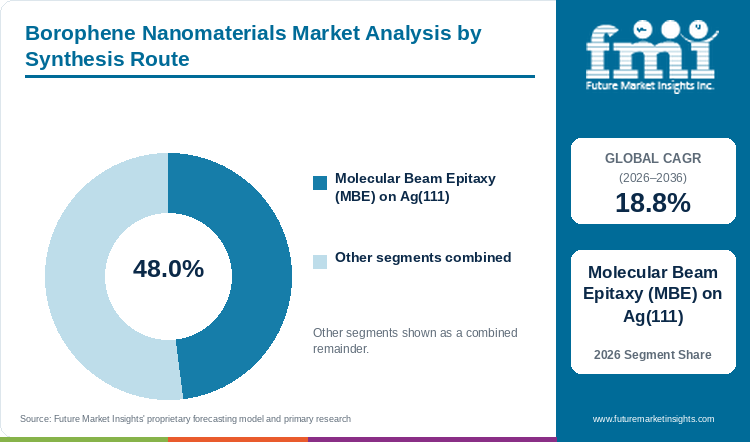
Molecular Beam Epitaxy (MBE) on Ag(111) claims 48.0% of synthesis route volume in 2026, linked to single-crystal monolayer precision.
Table 5: Synthesis Route Share for the Borophene Nanomaterials Market (percentage share), 2026
| Synthesis Route Segment | Share (2026) |
|---|---|
| Molecular Beam Epitaxy (MBE) on Ag(111) | 48.0% |
| Other Segments Combined | 52.0%* |
| Total | 100.0% |
*Note: Combined share of remaining synthesis route categories totaling 100.0% of 2026 market demand.
Table 6: Synthesis Route Leadership and Market Growth for the Borophene Nanomaterials Market (segment and CAGR percentage), 2026 to 2036
| Metric | Value |
|---|---|
| Global CAGR (2026 to 2036) | 18.8% |
| Leading Segment | Molecular Beam Epitaxy (MBE) on Ag(111) |
Evaporating 99.9999% pure elemental boron from electron-beam effusion cells onto atomically flat Ag(111) single crystals under ultra-high vacuum remains the benchmark for synthesizing phase-pure borophene monolayers. Silver substrates donate electronic charge to stabilize two-dimensional boron networks without forming brittle silver boride intermetallics, allowing researchers to dial between Beta-12 and Chi-3 phases by adjusting substrate temperature between 570 K and 650 K. Whereas top-down sonochemical exfoliation produces polydisperse few-layer flakes mixed with graphene-based conductive dispersions, MBE growth yields atomically continuous domains suitable for quantum transport and plasmonic device lithography.
- Sub-monolayer thickness control and zero intermetallic alloying are projected to give Molecular Beam Epitaxy (MBE) on Ag(111) 48.0% of 2026 synthesis route turnover.
- During June 2024, physicists at the National Institute of Standards and Technology (NIST) published a foundational evaluation of borophene synthesis and surface chemistry alongside epitaxial electronic properties across metallic growth templates [4].
Why Does the Beta-12 (β12) Sheet Phase Lead Allotropic Phase Procurement?
Beta-12 (β12) Sheet Phase secures 44.2% of allotropic phase revenue in 2026, enabled by thermodynamic stability on silver substrates.
Possessing a flat periodic one-sixth hexagonal hollow concentration, the Beta-12 (β12) Sheet Phase exhibits lower cohesive energy and broader thermal stability on noble-metal templates than buckled triangular boron lattices. Its coexistence of out-of-plane and in-plane metallic bands creates massless Dirac fermion transport and low contact resistance when interfaced with two-dimensional semiconductors in advanced functional thin films. Meanwhile, Chi-3 (χ3) vacancy sheets with one-fifth hollow density serve specialized anisotropic plasmonics, while hydrogenated borophane gains traction in ambient-exposed composite electrodes because surface B-H termination suppresses oxygen chemisorption.
- Thermodynamic preference on Ag(111) and Cu(111) templates is expected to place Beta-12 (β12) Sheet Phase at 44.2% of 2026 allotropic phase demand.
- In August 2025, crystallographic research in MDPI Crystals confirmed that Beta-12 borophene exhibits a 179 N/m Young's modulus alongside 198.5 N/m for Chi-3 and 398 N/m for 2-Pmmn phases while delivering over 10 wt% reversible hydrogen storage capacity and high hydrogen evolution activity [5].
What Keeps Substrate-Supported Epitaxial Films Ahead Among Product Forms?
Substrate-Supported Epitaxial Films represent 52.5% of product form sales in 2026, backed by ultra-high-vacuum wafer transfer reliability.
Delivering monolayer borophene directly on its growth crystal or beneath an amorphous silicon oxide or hexagonal boron nitride capping layer prevents rapid degradation in humid air. Semiconductor device physicists and spintronics engineers prefer purchasing pre-grown epitaxial films on mica-backed Ag(111) or Cu(111) wafers that integrate directly into cleanroom lithography lines alongside semiconductor packaging substrates. Solvent-dispersed nanoflake suspensions in anhydrous isopropanol or dimethylformamide and lyophilized nanopowders are estimated to make up the remaining 47.5% of form demand, serving wet-chemistry battery slurry and electrocatalyst ink coaters.
- Higher unit wafer pricing and oxidation protection are anticipated to enable Substrate-Supported Epitaxial Films to capture 52.5% of 2026 product form revenue.
- In May 2026, a Nanomanufacturing review documented that ultra-high-vacuum CVD produces monolayer Chi-6 borophene on Ir(111) at 1,233 K and Chi-3 borophene on Cu(111) at 773 K while in-situ hexagonal boron nitride or amorphous silicon-oxide capping protects epitaxial borophene films against oxidation up to 900 Langmuirs of oxygen exposure [6].
Why Do Next-Gen Li-Ion & Na-Ion Battery Anodes Anchor Application Demand?
Next-Gen Li-Ion & Na-Ion Battery Anodes account for 41.6% of application demand in 2026, stemming from low ion-diffusion barriers.
Elemental boron's low atomic weight (10.81 g/mol) and corrugated atomic troughs provide theoretical specific capacities up to 1,860 mAh/g for lithium ions and 1,218 mAh/g for sodium ions, nearly five times higher than conventional graphite anodes (372 mAh/g). Because borophene retains metallic electronic conductivity throughout sodiation and lithiation, composite anodes formulated with 2% to 8% exfoliated borophene nanoflakes achieve fast-charge rates without conductive carbon black overload. Battery developers also use few-layer borophene interlayers to trap polysulfide shuttling in lithium-sulfur cells and suppress dendrite short-circuits on metallic lithium foils.
- Ultra-low ion-migration energy barriers and high gravimetric capacity are forecast to give Next-Gen Li-Ion & Na-Ion Battery Anodes 41.6% of 2026 application revenue.
- During June 2026, surface physicists at the Institute of Science Tokyo and Shimane University demonstrated in ACS Nano (PMC13394391) that lithiating epitaxial monolayer χ6 borophene on Ir(111) transfers +0.84 to +0.86 electrons per lithium atom and lowers work function by 3.0 eV down to 1.7 eV with thermal desorption occurring above 500°C up to 700°C [7].
How Do Hydrogen Storage, Transparent Conductors & Electrocatalysis Drive Non-Anode Applications?
Hydrogen Storage, Transparent Conductors & Electrocatalysis represent 58.4% of non-anode application revenue in 2026, aided by metallic dirac cones.
Outside electrochemical battery cells, Solid-State Hydrogen Storage Media and Flexible Transparent Conductors & Plasmonics alongside Electrocatalytic HER/CO2RR Electrodes are projected to generate 58.4% of 2026 borophene application turnover. Alkali-metal-decorated and porous framework-grafted borophene sheets bind molecular hydrogen with enhanced adsorption enthalpy while maintaining reversible desorption kinetics. Concurrently, metallic borophene-graphene vertical heterostructures support low-loss surface plasmons across visible and ultraviolet wavelengths while undercoordinated boron sites drive non-precious-metal hydrogen evolution.
- Reversible hydrogen binding and visible-to-UV plasmonic conductivity are predicted to enable non-anode energy and photonic applications to claim 58.4% of 2026 application volume.
- During October 2024, first-principles research in MDPI Nanomaterials demonstrated that metallic graphene-borophene bilayers support tunable visible-to-UV surface plasmons across 1.5 to 3 eV and 16.5 to 18.5 eV while borophene-graphene humidity sensors exhibit 700 times higher sensitivity than pristine graphene [8].
What are the drivers, restraints, and opportunities in the borophene nanomaterials market?
Post-graphite battery anode programs and solid-state hydrogen storage R&D are anticipated to lift borophene nanomaterials orders through 2036, even as rapid ambient oxidation of unencapsulated monolayers and ultra-high-vacuum synthesis bottlenecks limit bulk volume.
- Driver: Urgent industry demand for high-rate sodium-ion and lithium-ion battery anodes alongside porous hybrid hydrogen storage frameworks fuels procurement of conductive borophene nanoflakes.
- Restraint: Spontaneous oxidation of bare two-dimensional boron in humid air and high capital costs of molecular beam epitaxy chambers limit bulk industrial roll-to-roll manufacturing.
- Opportunity: Scaling hydrogenated borophane and fluorine-plasma-functionalized borophene nanoflakes opens commercial ink formulations for printed sensors and silicon-composite anodes.
Growth Analysis and Future Potential: Qualitative Demand Catalysts
Commercial deployment of sodium-ion grid storage and material-based hydrogen carriers is driving intensive evaluation of two-dimensional boron additives and porous hybrids. Unlike crystalline silicon anodes that suffer 300% volume pulverization or hard carbon anodes with sluggish rate capability in sodium-ion storage cells, borophene monolayers offer directional ion channels and strong host-guest polarization. During August 2026, chemists from the Indian Institute of Technology Bhilai and the Indira Gandhi Centre for Atomic Research demonstrated in ACS Energy & Fuels that grafting 5 wt% DMF-exfoliated Beta-12 borophene nanosheets (0.51 nm d-spacing) onto a TpPa-1 covalent organic framework boosts hydrogen uptake 1.6-fold at 1.999 bar and 77 K while raising adsorption enthalpy from 2.85 to 13 kJ/mol [9]. Electrode and gas-storage formulators incorporating 3 wt% to 5 wt% exfoliated borophene into porous hosts achieve rapid 2-minute saturation kinetics.
Risk Assessment of the Borophene Nanomaterials Market: Operational and Formulation Friction
Chemical vulnerability of coordinatively unsaturated boron atoms to atmospheric oxygen and moisture represents the foremost technical barrier hindering commercial device assembly. Unprotected monolayer borophene films degrade within hours outside glovebox or ultra-high-vacuum environments, requiring immediate plasma functionalization or covalent surface passivation. Furthermore, transferring delicate epitaxial monolayers off expensive Ag(111) single crystals onto flexible polymer or silicon wafers for solid-state hydrogen storage tanks frequently introduces mechanical tears and silver etching residues. In August 2025, European researchers under Horizon Europe Grant 101066282 (GREBOS) demonstrated in MDPI Plasma that Ar:F2 (10:1) magnetron sputtering plasma at 100 W grafts protective C-F and B-F bonds onto 100-nanometer sonochemically exfoliated borophene nanoflakes supported on Merck KGaA Darmstadt copper grids [10].
Commercial Opportunity Analysis: Formulation Differentiation and Value-Add Formats
Nanomaterial suppliers can capture high-margin recurring orders by marketing pre-stabilized hydrogenated borophene (borophane) powders and ready-to-coat chemiresistive sensor and battery electrode inks. Atomic hydrogenation converts reactive boron centers into air-stable α'-4H semiconducting sheets (with a 2.48 to 2.49 eV direct bandgap) that withstand ambient slurry mixing. Blending air-stable borophene nanoflakes with high-capacity silicon battery anodes or graphene inks provides a drop-in conductive network that prevents electrode delamination. In February 2025, an ACS Sensors review documented that borophene-graphene chemiresistive heterostructures achieve 4,200% humidity sensitivity across 0% to 85% relative humidity alongside selective volatile organic compound and biosensing performance [11].
Borophene Nanomaterials Market by Country (2026 to 2036)
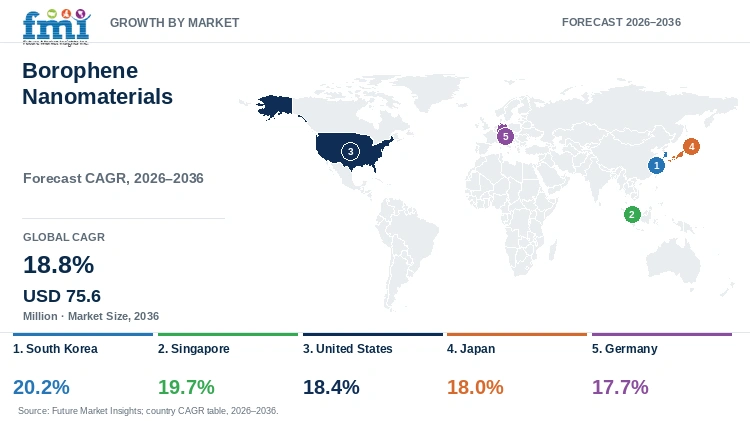
Solid-state battery anode pilot lines and power-grid gas sensor programs are slated to place South Korea at a 20.2% annual growth clip through 2036, just ahead of Singapore's 2D wafer and catalyst foundries (pegged at 19.7%). Meanwhile, national-laboratory quantum and boron nanocluster programs are envisioned to lift the United States by 18.4% per year alongside Japan (foreseen at 18.0%) and Germany (expected at 17.7%).
Table 7: Country CAGR and Primary Growth Levers for the Borophene Nanomaterials Market (CAGR percentage and operational drivers), 2026 to 2036
| Country | CAGR (2026 to 2036) | Primary Growth Lever |
|---|---|---|
| South Korea | 20.2% | Next-generation Li-ion/Na-ion battery anode pilot lines and ZIF-8/borophene power-grid gas sensors |
| Singapore | 19.7% | National 2D semiconductor wafer epitaxy hubs and β12 borophene single-atom electrocatalysis |
| United States | 18.4% | NSF/DOE boron nanocluster and lateral borophene-graphene contact resistance research |
| Japan | 18.0% | NIMS Tsukuba 2D quantum materials and epitaxial monolayer borophene lithiation studies |
| Germany | 17.7% | Ulm University borophene HER electrocatalyst modeling and Fraunhofer/Merck battery materials |
Source: Future Market Insights analysis
South Korea Borophene Nanomaterials Market Outlook (2026 to 2036)
Unlike Western markets dominated by academic ultra-high-vacuum crystal characterization, South Korea's borophene demand is uniquely driven by pouch-cell battery anode pilot lines and selective chemiresistive gas sensors for high-voltage power transformers. Battery and sensor divisions in Daejeon and Suwon evaluate sonochemically exfoliated borophene suspensions, with national turnover slated to increase at a 20.2% annual clip through 2036 as cell makers suppress silicon-anode swelling during fast charging. In October 2026, a transformer fault-gas sensing study in MDPI Chemosensors highlighted ZIF-8/polyethylenimine mixed-matrix membrane filters coated directly onto borophene gas sensors to achieve selective 5 to 25 ppm nitrogen dioxide detection [12]. High import dependence on ultra-pure boron targets nevertheless exposes domestic cleanrooms to precursor bottlenecks.
Key takeaway: In South Korea, fast-charging battery anode pilot lines and MOF-filtered borophene gas sensors are slated to propel a 20.2% yearly expansion to 2036.
Singapore Borophene Nanomaterials Market Outlook (2026 to 2036)
Distinct from bulk battery-slurry markets elsewhere, Singapore's commercial borophene ecosystem centers on wafer-scale two-dimensional semiconductor epitaxy and computational design of single-atom electrocatalysts for green ammonia and carbon-dioxide conversion. Cleanroom facilities across Jurong and One-North procure MBE-grown Beta-12 borophene on Ag(111) and sapphire-backed Cu(111) wafers to fabricate ultra-thin metallic ohmic contacts, with Singaporean borophene nanomaterials expenditure pegged to rise by 19.7% per annum across the 2026 to 2036 window. In February 2026, a computational review in the Royal Society of Chemistry's Journal of Materials Chemistry A detailed how Beta-12 borophene-supported transition-metal catalysts lower activation barriers for ecological ammonia synthesis [13]. Strict cleanroom humidity controls and single-crystal substrate costs remain key operational hurdles.
Key takeaway: In Singapore, national 2D semiconductor epitaxy testbeds and Beta-12 borophene ammonia/CO2 catalyst hubs are pegged to generate a 19.7% CAGR through 2036.
United States Borophene Nanomaterials Market Outlook (2026 to 2036)
When compared with Asian consumer-electronics hubs, the United States borophene market is uniquely anchored by federal National Science Foundation and Department of Energy programs investigating planar boron nanoclusters and 2D lateral quantum interconnects. Since U.S. national laboratories and universities pioneered Ag(111) MBE growth and photoelectron spectroscopy, domestic cleanrooms have led atomic-scale boron synthesis, with United States borophene nanomaterials demand envisioned to expand at an 18.4% yearly pace over the forecast decade. In August 2026, Brown University chemistry research funded by NSF Grant CHE-2403841 in Chemical Science mapped planar B36 hexagonal-vacancy borophene precursors alongside D2h B48- bilayer borophene and B80- boron buckminsterfullerene [14]. Scaling gram-scale exfoliated nanopowders without ambient surface oxidation remains the primary domestic bottleneck.
Key takeaway: In the United States, federal NSF/DOE boron nanocluster research and domestic 2D wafer suppliers are envisioned to support an 18.4% yearly growth pace to 2036.
Japan Borophene Nanomaterials Market Outlook (2026 to 2036)
Rather than focusing on liquid-phase sonochemical slurries like neighboring markets, Japan uniquely directs borophene nanomaterials toward epitaxial monolayer battery lithiation physics and atomic-layer 2D quantum heterostructures. Materials scientists at the Institute of Science Tokyo and the National Institute for Materials Science (NIMS) in Tsukuba utilize ultra-high-vacuum LEEM and photoelectron microscopy on single-crystal borophene monolayers, with Japanese borophene nanomaterials sales foreseen to climb 18.0% annually from 2026 to 2036. In July 2026, NIMS updated its 2D Quantum Materials research directory in Tsukuba advancing bottom-up atomic-layer synthesis and low-dimensional quantum transport device architectures across national laboratories [15]. Rigorous automotive thermal-runaway validation protocols nonetheless lengthen commercial electric-vehicle anode onboarding.
Key takeaway: In Japan, NIMS Tsukuba 2D quantum materials research and epitaxial monolayer lithiation programs are foreseen to sustain an 18.0% annual expansion through 2036.
Germany Borophene Nanomaterials Market Outlook (2026 to 2036)
Whereas North American and Asian buyers prioritize semiconductor contacts or display films, Germany's borophene adoption is uniquely shaped by theoretical and experimental hydrogen evolution reaction (HER) electrocatalysis alongside Fraunhofer battery-cell scaling. German electrochemical institutes and specialty chemical groups evaluate freestanding and substrate-supported borophene monolayers as platinum-free hydrogen evolution cathodes and silicon-anode buffers, with German borophene nanomaterials orders expected to gain 17.7% per year through 2036. In March 2026, Ulm University theoretical chemists demonstrated in Physical Review Materials that freestanding Beta-12 borophene fourfold on-top sites achieve an optimal hydrogen adsorption free energy of 0.019 eV while Ag(111) support shifts adsorption to -0.177 eV [16]. Strict European REACH nanomaterials registration dossiers add recurring compliance costs for domestic powder processors.
Key takeaway: In Germany, Ulm University hydrogen electrocatalyst modeling and Fraunhofer battery roadmaps are forecast to drive a 17.7% yearly expansion pace to 2036.
Full report country CAGRs cover: North America; Latin America; Western Europe; Eastern Europe; East Asia; South Asia and Pacific; Middle East and Africa.
Who are the notable companies in the borophene nanomaterials market?
Nanochemazone (Chemazone Inc.), ACS Material, LLC, Sigma-Aldrich (Merck KGaA), Nanografi Nano Technology, Tokyo Chemical Industry Co., Ltd. (TCI), 2D Semiconductors, Inc., Ossila Ltd., and Otto Chemie Pvt. Ltd. are the notable companies in the borophene nanomaterials market.
Vendor participation across the borophene nanomaterials ecosystem separates confirmed borophene and hydrogenated borophane powder producers from upstream elemental boron precursor suppliers and adjacent 2D material fabricators. Confirmed borophene suppliers led by Nanochemazone (Chemazone Inc.) and ACS Material LLC commercialize crystalline 2D borophene powders (Product Code NCZ-NP-7048/26) and air-stabilized hydrogenated borophane sheets (Product Code NCZ-NP-7049/26) alongside covalent organic framework hybrid substrates. Upstream precursor specialists including Sigma-Aldrich (Merck KGaA) and Nanografi Nano Technology together with Tokyo Chemical Industry Corporation (TCI) supply 2-micrometer and 100-nanometer elemental boron feedstocks alongside copper TEM grids and borazine CVD precursors used by laboratories to exfoliate or grow borophene in-house. Concurrently, 2D Semiconductors Inc. and Otto Chemie Private Limited alongside Ossila Ltd. supply adjacent hexagonal boron nitride capping layers and single-crystal growth templates co-integrated with borophene into heterostructure devices.
- Confirmed Borophene & Hydrogenated Borophane Producers: Nanochemazone (Chemazone Inc.) and ACS Material LLC supply commercial 99%-pure 2D Borophene Powder (NCZ-NP-7048/26) and Hydrogenated Borophane Powder (NCZ-NP-7049/26) alongside TpPa-1 COF hybrid host materials.
- Upstream Elemental Boron Precursor & Substrate Suppliers: Sigma-Aldrich (Merck KGaA) and Nanografi Nano Technology alongside TCI Chemicals supply 99.55+% pure 100 nm to 2 um elemental boron powders and copper grids used in sonochemical and CVD borophene synthesis.
- Adjacent 2D Heterostructure & Capping-Layer Suppliers: 2D Semiconductors Inc. and Otto Chemie Private Limited alongside Ossila Ltd. supply adjacent h-BN oxidation-capping layers and MBE/CVD 2D templates rather than standalone elemental borophene.
Competitive Benchmarking: Borophene Nanomaterials Market
Table 8: Competitive Benchmarking for the Borophene Nanomaterials Market (qualitative capability ratings), 2026
| Company | Direct Borophene & Phase Purity | Precursor & Substrate Supply | Oxidation Stabilization | Global Lab & OEM Reach |
|---|---|---|---|---|
| Nanochemazone (Chemazone Inc.) | High | High | High | High |
| ACS Material, LLC | High | High | High | High |
| Sigma-Aldrich (Merck KGaA) | Medium | High | High | High |
| Nanografi Nano Technology | Medium | High | Medium | High |
| Tokyo Chemical Industry Co., Ltd. (TCI) | Medium | High | High | High |
| 2D Semiconductors, Inc. | Medium | High | High | Medium |
| Ossila Ltd. | Medium | Medium | High | High |
| Otto Chemie Pvt. Ltd. | Medium | High | Medium | High |
Scoring basis: Direct Borophene & Phase Purity receives a High rating only where a vendor supplies explicitly verified elemental borophene or hydrogenated borophane powders and nanosheets (Nanochemazone and ACS Material), while Medium denotes upstream elemental boron precursor houses and adjacent 2D heterostructure or capping-layer suppliers. Precursor & Substrate Supply evaluates commercial availability of >=99.55% elemental boron nanopowders and noble-metal growth crystals alongside h-BN capping templates. Oxidation Stabilization reflects documented use of argon-sealed vials and hydrogenated B-H surface termination (borophane) alongside fluorine-plasma passivation.
Key Developments in the Borophene Nanomaterials Market
- In May 2025, materials scientists at Rice University and Northwestern University demonstrated how elemental boron forms 2D Cu8B14 copper boride on copper substrates versus borophene on silver and gold while creating lateral borophene-graphene edge contacts with lower contact resistance than gold [17].
- Under its 2026-27 product release, Leduc-based Nanochemazone (Chemazone Inc.) offers 99%-pure crystalline 2D Borophene Powder (Product Code NCZ-NP-7048/26 featuring 1 to 5 micrometer flake dimensions in argon-sealed vials) for fast-charging alkali-metal battery anodes and solid-state hydrogen storage [18].
- In its October 2026 catalog, Nanografi Nano Technology supplies 99.55+% pure elemental Boron (B) Nanopowder (100 nm average particle size with 7.89 m2/g specific surface area) as a high-purity precursor for sonochemical and solvothermal liquid-phase borophene exfoliation [19].
Key Players in the Borophene Nanomaterials Market
Confirmed Borophene & Hydrogenated Borophane Producers
- Nanochemazone (Chemazone Inc.)
- ACS Material, LLC
Upstream Elemental Boron Precursor & Substrate Suppliers
- Sigma-Aldrich (Merck KGaA)
- Nanografi Nano Technology
- Tokyo Chemical Industry Co., Ltd. (TCI)
Adjacent 2D Heterostructure & Capping-Layer Suppliers
- 2D Semiconductors, Inc.
- Ossila Ltd.
- Otto Chemie Pvt. Ltd.
Borophene Nanomaterials Market - Report Scope
Table 9: Report Scope for the Borophene Nanomaterials Market (coverage fields and definitions), 2026 to 2036
| Coverage field | Report scope |
|---|---|
| Market breakdown | Synthesis Route; Allotropic Phase; Product Form; Application; Region |
| Quantitative Units | USD Million |
| Market Definition | Includes supplier revenue from synthetic two-dimensional boron monolayers and few-layer borophene nanomaterials sold as substrate-supported epitaxial films, solvent-dispersed nanoflake suspensions, and lyophilized nanopowders. Category Scope Note: The valuation covers crystalline Beta-12, Chi-3, and hydrogenated borophane nanomaterials along with dedicated Ag(111)/Cu(111)/Ir(111) epitaxial borophene wafers, excluding bulk amorphous boron powder, boron-doped graphene, reduced graphene oxide, boron nitride (h-BN) sheets, and downstream finished battery cells. |
| Regions Covered | North America; Latin America; Western Europe; Eastern Europe; East Asia; South Asia and Pacific; Middle East and Africa |
| Countries Covered | South Korea, Singapore, United States, Japan, Germany, and additional countries in the full report |
| Key Companies Covered | Nanochemazone (Chemazone Inc.), ACS Material, LLC, Sigma-Aldrich (Merck KGaA), Nanografi Nano Technology, Tokyo Chemical Industry Co., Ltd. (TCI), 2D Semiconductors, Inc., Ossila Ltd., Otto Chemie Pvt. Ltd. |
| Forecast Period | 2026 to 2036 |
| Approach | Primary and secondary research with rigorous market triangulation. |
Borophene Nanomaterials Market - Research Methodology
Table 10: Research Methodology for the Borophene Nanomaterials Market (research methods and approach), 2026 edition
| Method | Approach |
|---|---|
| Primary Research | Primary interviews were conducted with molecular beam epitaxy crystal growers, liquid-phase exfoliation chemists, solid-state battery anode engineers, and cleanroom procurement managers to validate wafer yields, gram pricing, and oxidation shelf life. |
| Secondary Research | Secondary research included U.S. National Library of Medicine (PMC12884472 and PMC13394391) and NIST 2D boron synthesis reviews, Ulm University and IIT Bhilai/IGCAR experimental studies, Fraunhofer ISI battery roadmaps, and verified borophene product catalogs. |
| Market Sizing and Forecasting | Market sizing and forecasting from 2026 to 2036 combined bottom-up tracking of UHV epitaxial crystal shipments and exfoliated suspension volumes with top-down R&D and pilot-line adoption curves across battery, hydrogen, and photonic sectors. |
| Data Triangulation and Validation | Market totals were triangulated against active 2D-material cleanroom counts, coin-cell and pouch-cell anode loading ratios, and noble-metal substrate consumption to exclude boron-doped graphene, reduced graphene oxide, hexagonal boron nitride, and bulk boron chemicals. |
| Country Forecasting Model | Country CAGRs (17.7% to 20.2%) are calibrated around the 18.8% global CAGR using national battery-anode R&D intensity, 2D semiconductor foundry investments, synchrotron user-facility output, and clean-hydrogen catalyst funding. |
| Operational Benchmark Traceability | Operational indicators in Tables 2, 3, and 4 (epitaxial wafer units, exfoliated kilogram output, and per-lab spending) are modeled from NIST/PMC synthesis benchmarks, academic/industrial cleanroom registries, and verified borophene catalog disclosures. |
Borophene Nanomaterials Market by Segments
Borophene Nanomaterials Market segmented by Synthesis Route:
- Molecular Beam Epitaxy (MBE) on Ag(111)
- Liquid-Phase Sonochemical Exfoliation
- Chemical Vapor Deposition (CVD)
- Electrochemical Atomic Layer Delamination
Borophene Nanomaterials Market segmented by Allotropic Phase:
- Beta-12 (β12) Sheet Phase
- Chi-3 (χ3) Vacancy Phase
- Hydrogenated Borophene (Borophane)
Borophene Nanomaterials Market segmented by Product Form:
- Substrate-Supported Epitaxial Films
- Solvent-Dispersed Nanoflake Suspensions
- Lyophilized Few-Layer Nanopowders
Borophene Nanomaterials Market segmented by Application:
- Next-Gen Li-Ion & Na-Ion Battery Anodes
- Solid-State Hydrogen Storage Media
- Flexible Transparent Conductors & Plasmonics
- Electrocatalytic HER/CO2RR Electrodes
Borophene Nanomaterials Market by Region
- North America
- United States
- Canada
- Latin America
- Brazil
- Mexico
- Argentina
- Chile
- Western Europe
- Germany
- France
- United Kingdom
- Italy
- Spain
- Benelux
- Nordics
- Eastern Europe
- Poland
- Czech Republic
- Romania
- Hungary
- East Asia
- China
- Japan
- South Korea
- South Asia and Pacific
- India
- ASEAN
- Australia and New Zealand
- Middle East and Africa
- GCC Countries
- South Africa
- Türkiye
- Israel
Research Sources and Bibliography
- [1] McDonald, L. (2025, January 23). The rise of borophene: Inside the design and application of this emerging material system. The American Ceramic Society (Ceramic Tech Today).
- [2] Santos, T. F., Boustani, I., Dias, A. C., & Piotrowski, M. J. (2026, January 22). Thirty Years of Borophene: Origins, Scientific Progress, and Future Directions. ACS Applied Materials & Interfaces / U.S. National Library of Medicine (PMC12884472).
- [3] Casanova-Chafer, J., & Bittencourt, C. (2025, March 16). Straightforward Synthesis of Borophene Nanolayers for Enhanced NO2 Detection in Humid Environments. ACS Applied Electronic Materials (Vol. 7, Issue 6, 2305-2316).
- [4] Wang, K., Choyal, S., Schultz, J., Mahalingam, K., Bagues, N., et al. (2024, June 20). Borophene: Synthesis, Chemistry, and Electronic Properties. National Institute of Standards and Technology (NIST).
- [5] Vázquez-Vázquez, E. F., Trejo-Baños, A., Santana-Gómez, J. A., et al. (2025, August 25). Borophene: Synthesis, Properties and Experimental H2 Evolution Potential Applications. Crystals (Vol. 15, Issue 9, 753).
- [6] Du, Y., & Qu, X. (2026, May 18). Borophene-Based Nanomaterials for Energy and Biomedical Applications: Progress, Challenges, and Outlook. Nanomanufacturing (Vol. 6, Issue 2, 12).
- [7] Kamal, S., Seo, I., Cojocariu, I., Jugovac, M., Locatelli, A., Gohda, Y., Kralj, M., Menteş, T. O., & Petrović, M. (2026, June 08). Lithiation of Epitaxial Monolayer Borophene. ACS Nano / U.S. National Library of Medicine (PMC13394391).
- [8] Niu, L., Conquest, O. J., Verdi, C., & Stampfl, C. (2024, October 16). Electronic and Optical Properties of 2D Heterostructure Bilayers of Graphene, Borophene and 2D Boron Carbides from First Principles. Nanomaterials (Vol. 14, Issue 20, 1659).
- [9] Gogoi, A., Sengupta, S., Rathore, A., Kabilan, V. M., Abothu, S. R., Bootharajan, M., Rao, C. V. S. B., Vempati, S., Sreenivasulu, B., & Medishetty, R. (2026, August 19). Borophene Nanosheets-Grafted Covalent Organic Framework: A 2D Hybrid Porous Material for Hydrogen Adsorption Studies. Energy & Fuels (Vol. 40, Issue 35, 19717-19725).
- [10] Casanova-Chafer, J., Atienzar, P., & Bittencourt, C. (2025, August 22). Fluorine Plasma Functionalization of Borophene Nanoflakes. Plasma (Vol. 8, Issue 3, 33).
- [11] Sarma, N., Das, H., & Saikia, P. (2025, February 11). Borophene: The Frontier of Next-Generation Sensor Applications. ACS Sensors (Vol. 10, Issue 2, 622-641).
- [12] He, Y., Xie, Y., Liu, Y., et al. (2026, October 12). DFT Investigation on the Adsorption and Sensing Mechanisms of Transformer Fault Gases over MOF-Based Cu-BTC and ZIF-8. Chemosensors (Vol. 14, Issue 10, 229).
- [13] Royal Society of Chemistry. (2026, February 13). Electronic Frontiers of borophene: a computational mini-review on properties and emerging applications. Journal of Materials Chemistry A (Vol. 14, Issue 23, 13972-14005).
- [14] Wang, L.-S. (2026, August 10). Recent progress in boron nanoclusters: from borophene to boron buckminsterfullerene. Chemical Science (Vol. 17, Issue 35, 16584-16601).
- [15] National Institute for Materials Science (NIMS). (2026, July 28). 2D Quantum Materials. NIMS Research Directory.
- [16] Liu, J., & Groß, A. (2026, March 05). Exploring the hydrogen evolution reaction performance on a borophene monolayer. Physical Review Materials (Vol. 10, Issue 3, 035801).
- [17] Rice University. (2025, May 23). 'Hopelessly attached': Scientists discover new 2D material that sticks the landing. Rice University News and Media Relations.
- [18] Nanochemazone (Chemazone Inc.). (2026, January 15). Borophene Powder | Low Price #1 USA & Canada. Nanochemazone 2026-27 Product Catalogue (Product Code NCZ-NP-7048/26).
- [19] Nanografi Nano Technology. (2026, October 01). Boron (B) Nanopowder/Nanoparticles , APS:100 nm, Purity:99.55+%. Nanografi Advanced Materials Catalog.
- [20] Fraunhofer Institute for Systems and Innovation Research ISI. (2026, January 15). Battery research at Fraunhofer ISI. Fraunhofer ISI Competence Center Emerging Technologies.
- [21] Nanochemazone (Chemazone Inc.). (2026, January 15). Borophane Powder | Best Price #1 USA & Canada. Nanochemazone 2026-27 Product Catalogue (Product Code NCZ-NP-7049/26).
This bibliography is provided for reader reference and is not exhaustive. The full report contains the complete reference list and detailed citations.
This Report Answers
- How large is the borophene nanomaterials market in 2026 and what is projected for 2036?
- Which battery anode and quantum electronics catalysts drive borophene nanomaterials demand?
- Why does Molecular Beam Epitaxy (MBE) on Ag(111) lead the synthesis route category?
- Why do Substrate-Supported Epitaxial Films hold the largest product form share globally?
- How do national growth rates compare across South Korea, Singapore, the United States, Japan, and Germany?
- Which specialty suppliers manufacture explicit borophene powders versus upstream boron precursors?
- How does ambient oxidation sensitivity restrain bulk processing in the borophene nanomaterials market?
- What phase-purity and passivation metrics should buyers verify before ordering borophene nanomaterials?
Frequently Asked Questions
How big is the borophene nanomaterials market in 2026, and what is forecast for 2036?
Global borophene nanomaterials turnover is estimated at USD 13.5 million in 2026 (rising from USD 11.4 million in 2025) and is predicted to reach USD 75.6 million by 2036 as battery and nanoelectronics researchers scale 2D boron integration.
What CAGR is projected for the borophene nanomaterials market between 2026 and 2036?
Future Market Insights projects an 18.8% compound annual growth rate from 2026 to 2036 for global borophene nanomaterials demand, which corresponds to a USD 62.1 million increase in annual market revenue between 2026 and 2036.
Which synthesis route leads the borophene nanomaterials market in 2026?
Molecular Beam Epitaxy (MBE) on Ag(111) is anticipated to capture 48.0% of 2026 synthesis route revenue because ultra-high-vacuum condensation onto single-crystal silver templates yields phase-pure Beta-12 and Chi-3 monolayers.
Which allotropic phase and product form hold the largest shares in 2026?
Beta-12 (β12) Sheet Phase is projected to account for 44.2% of 2026 allotropic phase volume owing to its stable hexagonal vacancy lattice, while Substrate-Supported Epitaxial Films are expected to represent 52.5% of product form sales.
Which country records the fastest borophene nanomaterials growth through 2036?
According to FMI, South Korea is slated to lead major semiconductor and battery-manufacturing nations with a 20.2% CAGR from 2026 to 2036, supported by silicon-borophene anode pilot lines and MOF-filtered borophene gas sensors.
Which companies are key participants in the borophene nanomaterials market?
Active suppliers spanning the two-dimensional boron value chain encompass confirmed borophene and borophane manufacturers Nanochemazone (Chemazone Inc.) and ACS Material, LLC alongside upstream elemental boron precursor houses Sigma-Aldrich (Merck KGaA), Nanografi Nano Technology, and TCI Chemicals and adjacent 2D capping-layer providers 2D Semiconductors, Inc., Ossila Ltd., and Otto Chemie Pvt. Ltd.
Preview the report firsthand - request a free sample
Get SampleGet the brochure for pricing and purchase details.
Get PDFTable of Content
- Key Takeaways
- Market Size and CAGR
- Top Growth Driver
- Fastest Growing Segment
- Leading Region
- Key Companies
- Emerging Opportunities
- Executive Summary
- Global Market Outlook
- Demand-side Trends
- Supply-side Trends
- Technology Roadmap Analysis
- Analysis and Recommendations
- Analyst Perspective (What is happening? Why now? What should investors know?)
- Key Questions Answered
- How large is the market?
- What is the CAGR?
- What are key trends?
- Which region dominates?
- Who are the leaders?
- Market Overview
- Market Coverage / Taxonomy
- Market Definition / Scope / Limitations
- Research Methodology
- Chapter Orientation
- Analytical Lens and Working Hypotheses
- Market Structure, Signals, and Trend Drivers
- Benchmarking and Cross-market Comparability
- Market Sizing, Forecasting, and Opportunity Mapping
- Research Design and Evidence Framework
- Desk Research Programme (Secondary Evidence)
- Expert Input and Fieldwork (Primary Evidence)
- Tooling, Models, and Reference Databases
- Data Engineering and Model Build
- Quality Assurance and Audit Trail
- Market Background
- Market Dynamics (Drivers, Restraints, Opportunity, Trends)
- Scenario Forecast (Optimistic, Likely, Conservative)
- Impact Analysis
- AI Impact
- Sustainability Impact
- Regulatory Impact
- Technology Impact
- Consumer / Buyer Analysis
- Purchase Drivers
- Adoption Barriers
- Buyer Journey
- Opportunity Map Analysis
- Product Life Cycle Analysis
- Supply Chain Analysis
- Investment Feasibility Matrix
- Value Chain Analysis
- PESTLE and Porter's Analysis
- Regulatory Landscape
- Regional Parent Market Outlook
- Production and Consumption Statistics
- Import and Export Statistics
- Global Market Analysis and Forecast, 2021 to 2036
- Historical Market Size Value (USD Million) Analysis, 2021 to 2025
- Current and Future Market Size Value (USD Million) Projections, 2026 to 2036
- Y-o-Y Growth Trend Analysis
- Absolute $ Opportunity Analysis
- Global Market Pricing Analysis, 2021 to 2036
- Global Market Analysis and Forecast, By Synthesis Route, 2021 to 2036
- Introduction / Key Findings
- Historical Market Size Value (USD Million) Analysis By Synthesis Route, 2021 to 2025
- Current and Future Market Size Value (USD Million) Analysis and Forecast By Synthesis Route, 2026 to 2036
- Molecular Beam Epitaxy (MBE) on Ag(111)
- Liquid-Phase Sonochemical Exfoliation
- Chemical Vapor Deposition (CVD)
- Electrochemical Atomic Layer Delamination
- Y-o-Y Growth Trend Analysis By Synthesis Route, 2021 to 2025
- Absolute $ Opportunity Analysis By Synthesis Route, 2026 to 2036
- Global Market Analysis and Forecast, By Allotropic Phase, 2021 to 2036
- Introduction / Key Findings
- Historical Market Size Value (USD Million) Analysis By Allotropic Phase, 2021 to 2025
- Current and Future Market Size Value (USD Million) Analysis and Forecast By Allotropic Phase, 2026 to 2036
- Beta-12 (β12) Sheet Phase
- Chi-3 (χ3) Vacancy Phase
- Hydrogenated Borophene (Borophane)
- Y-o-Y Growth Trend Analysis By Allotropic Phase, 2021 to 2025
- Absolute $ Opportunity Analysis By Allotropic Phase, 2026 to 2036
- Global Market Analysis and Forecast, By Product Form, 2021 to 2036
- Introduction / Key Findings
- Historical Market Size Value (USD Million) Analysis By Product Form, 2021 to 2025
- Current and Future Market Size Value (USD Million) Analysis and Forecast By Product Form, 2026 to 2036
- Substrate-Supported Epitaxial Films
- Solvent-Dispersed Nanoflake Suspensions
- Lyophilized Few-Layer Nanopowders
- Y-o-Y Growth Trend Analysis By Product Form, 2021 to 2025
- Absolute $ Opportunity Analysis By Product Form, 2026 to 2036
- Global Market Analysis and Forecast, By Application, 2021 to 2036
- Introduction / Key Findings
- Historical Market Size Value (USD Million) Analysis By Application, 2021 to 2025
- Current and Future Market Size Value (USD Million) Analysis and Forecast By Application, 2026 to 2036
- Next-Gen Li-Ion & Na-Ion Battery Anodes
- Solid-State Hydrogen Storage Media
- Flexible Transparent Conductors & Plasmonics
- Electrocatalytic HER/CO2RR Electrodes
- Y-o-Y Growth Trend Analysis By Application, 2021 to 2025
- Absolute $ Opportunity Analysis By Application, 2026 to 2036
- Global Market Analysis and Forecast, By Region, 2021 to 2036
- Introduction
- Historical Market Size Value (USD Million) Analysis By Region, 2021 to 2025
- Current Market Size Value (USD Million) Analysis and Forecast By Region, 2026 to 2036
- North America
- Latin America
- Western Europe
- Eastern Europe
- East Asia
- South Asia and Pacific
- Middle East and Africa
- Market Attractiveness Analysis By Region
- North America Market Analysis and Forecast, By Country, 2021 to 2036
- Historical Market Size Value (USD Million) Trend Analysis By Market Taxonomy, 2021 to 2025
- Market Size Value (USD Million) Forecast By Market Taxonomy, 2026 to 2036
- By Country
- United States
- Canada
- By Synthesis Route
- By Allotropic Phase
- By Product Form
- By Application
- By Country
- Market Attractiveness Analysis
- By Country
- By Synthesis Route
- By Allotropic Phase
- By Product Form
- By Application
- Key Takeaways
- Latin America Market Analysis and Forecast, By Country
- Historical Market Size Value (USD Million) Trend Analysis By Market Taxonomy, 2021 to 2025
- Market Size Value (USD Million) Forecast By Market Taxonomy, 2026 to 2036
- By Country
- Brazil
- Mexico
- Argentina
- Chile
- By Synthesis Route
- By Allotropic Phase
- By Product Form
- By Application
- By Country
- Market Attractiveness Analysis
- By Country
- By Synthesis Route
- By Allotropic Phase
- By Product Form
- By Application
- Key Takeaways
- Western Europe Market Analysis and Forecast, By Country
- Historical Market Size Value (USD Million) Trend Analysis By Market Taxonomy, 2021 to 2025
- Market Size Value (USD Million) Forecast By Market Taxonomy, 2026 to 2036
- By Country
- Germany
- France
- United Kingdom
- Italy
- Spain
- Benelux
- Nordics
- By Synthesis Route
- By Allotropic Phase
- By Product Form
- By Application
- By Country
- Market Attractiveness Analysis
- By Country
- By Synthesis Route
- By Allotropic Phase
- By Product Form
- By Application
- Key Takeaways
- Eastern Europe Market Analysis and Forecast, By Country
- Historical Market Size Value (USD Million) Trend Analysis By Market Taxonomy, 2021 to 2025
- Market Size Value (USD Million) Forecast By Market Taxonomy, 2026 to 2036
- By Country
- Poland
- Czech Republic
- Romania
- Hungary
- By Synthesis Route
- By Allotropic Phase
- By Product Form
- By Application
- By Country
- Market Attractiveness Analysis
- By Country
- By Synthesis Route
- By Allotropic Phase
- By Product Form
- By Application
- Key Takeaways
- East Asia Market Analysis and Forecast, By Country
- Historical Market Size Value (USD Million) Trend Analysis By Market Taxonomy, 2021 to 2025
- Market Size Value (USD Million) Forecast By Market Taxonomy, 2026 to 2036
- By Country
- China
- Japan
- South Korea
- By Synthesis Route
- By Allotropic Phase
- By Product Form
- By Application
- By Country
- Market Attractiveness Analysis
- By Country
- By Synthesis Route
- By Allotropic Phase
- By Product Form
- By Application
- Key Takeaways
- South Asia and Pacific Market Analysis and Forecast, By Country
- Historical Market Size Value (USD Million) Trend Analysis By Market Taxonomy, 2021 to 2025
- Market Size Value (USD Million) Forecast By Market Taxonomy, 2026 to 2036
- By Country
- India
- ASEAN
- Australia and New Zealand
- By Synthesis Route
- By Allotropic Phase
- By Product Form
- By Application
- By Country
- Market Attractiveness Analysis
- By Country
- By Synthesis Route
- By Allotropic Phase
- By Product Form
- By Application
- Key Takeaways
- Middle East and Africa Market Analysis and Forecast, By Country
- Historical Market Size Value (USD Million) Trend Analysis By Market Taxonomy, 2021 to 2025
- Market Size Value (USD Million) Forecast By Market Taxonomy, 2026 to 2036
- By Country
- GCC Countries
- South Africa
- Türkiye
- Israel
- By Synthesis Route
- By Allotropic Phase
- By Product Form
- By Application
- By Country
- Market Attractiveness Analysis
- By Country
- By Synthesis Route
- By Allotropic Phase
- By Product Form
- By Application
- Key Takeaways
- Key Countries Market Analysis
- United States
- Pricing Analysis
- Market Share Analysis, 2025
- By Synthesis Route
- By Allotropic Phase
- By Product Form
- By Application
- Canada
- Pricing Analysis
- Market Share Analysis, 2025
- By Synthesis Route
- By Allotropic Phase
- By Product Form
- By Application
- Mexico
- Pricing Analysis
- Market Share Analysis, 2025
- By Synthesis Route
- By Allotropic Phase
- By Product Form
- By Application
- Brazil
- Pricing Analysis
- Market Share Analysis, 2025
- By Synthesis Route
- By Allotropic Phase
- By Product Form
- By Application
- Chile
- Pricing Analysis
- Market Share Analysis, 2025
- By Synthesis Route
- By Allotropic Phase
- By Product Form
- By Application
- Germany
- Pricing Analysis
- Market Share Analysis, 2025
- By Synthesis Route
- By Allotropic Phase
- By Product Form
- By Application
- United Kingdom
- Pricing Analysis
- Market Share Analysis, 2025
- By Synthesis Route
- By Allotropic Phase
- By Product Form
- By Application
- Italy
- Pricing Analysis
- Market Share Analysis, 2025
- By Synthesis Route
- By Allotropic Phase
- By Product Form
- By Application
- Spain
- Pricing Analysis
- Market Share Analysis, 2025
- By Synthesis Route
- By Allotropic Phase
- By Product Form
- By Application
- France
- Pricing Analysis
- Market Share Analysis, 2025
- By Synthesis Route
- By Allotropic Phase
- By Product Form
- By Application
- India
- Pricing Analysis
- Market Share Analysis, 2025
- By Synthesis Route
- By Allotropic Phase
- By Product Form
- By Application
- ASEAN
- Pricing Analysis
- Market Share Analysis, 2025
- By Synthesis Route
- By Allotropic Phase
- By Product Form
- By Application
- Australia and New Zealand
- Pricing Analysis
- Market Share Analysis, 2025
- By Synthesis Route
- By Allotropic Phase
- By Product Form
- By Application
- China
- Pricing Analysis
- Market Share Analysis, 2025
- By Synthesis Route
- By Allotropic Phase
- By Product Form
- By Application
- Japan
- Pricing Analysis
- Market Share Analysis, 2025
- By Synthesis Route
- By Allotropic Phase
- By Product Form
- By Application
- South Korea
- Pricing Analysis
- Market Share Analysis, 2025
- By Synthesis Route
- By Allotropic Phase
- By Product Form
- By Application
- Poland
- Pricing Analysis
- Market Share Analysis, 2025
- By Synthesis Route
- By Allotropic Phase
- By Product Form
- By Application
- Hungary
- Pricing Analysis
- Market Share Analysis, 2025
- By Synthesis Route
- By Allotropic Phase
- By Product Form
- By Application
- Türkiye
- Pricing Analysis
- Market Share Analysis, 2025
- By Synthesis Route
- By Allotropic Phase
- By Product Form
- By Application
- South Africa
- Pricing Analysis
- Market Share Analysis, 2025
- By Synthesis Route
- By Allotropic Phase
- By Product Form
- By Application
- Singapore
- Pricing Analysis
- Market Share Analysis, 2025
- By Synthesis Route
- By Allotropic Phase
- By Product Form
- By Application
- United States
- Market Structure Analysis
- Competition Dashboard
- Competition Benchmarking
- Market Share Analysis of Top Players
- By Regional
- By Synthesis Route
- By Allotropic Phase
- By Product Form
- By Application
- Emerging Startups
- Innovation Benchmarking
- Competition Analysis
- Competition Deep Dive
- Nanochemazone (Chemazone Inc.)
- Overview
- Product Portfolio
- Profitability by Market Segments
- Sales Footprint
- Strategy Overview
- Marketing Strategy
- Product Strategy
- Channel Strategy
- ACS Material, LLC
- Sigma-Aldrich (Merck KGaA)
- Nanografi Nano Technology
- Tokyo Chemical Industry Co., Ltd. (TCI)
- 2D Semiconductors, Inc.
- Ossila Ltd.
- Otto Chemie Pvt. Ltd.
- Nanochemazone (Chemazone Inc.)
- Case Studies
- Success Stories
- Recent Developments
- Competition Deep Dive
- Assumptions & Acronyms Used


