

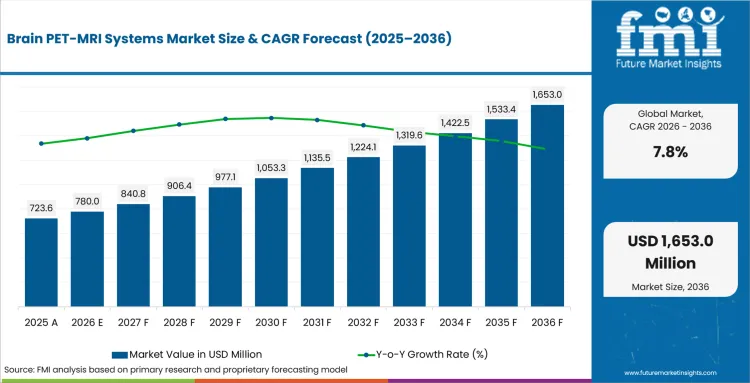
- Market Size (2026)
- USD 780.0 Mn
- Forecast (2036)
- USD 1653.0 Mn
- CAGR (2026 to 2036)
- 7.8%
How big is Brain PET-MRI Systems Market in 2026?
USD 780.0 million in 2026 and USD 1653.0 million by 2036 at a 7.8% CAGR.
Demand for brain PET-MRI systems is projected to expand at 7.8% CAGR between 2026 and 2036, increasing valuation from USD 780 million in 2026 to USD 1653.0 million by 2036. Brain PET-MRI systems combine PET molecular signals with MRI anatomy during one coordinated neurological or research examination. Anti-amyloid treatment pathways create a practical reason to align molecular confirmation with MRI safety monitoring inside the same specialist network. In August 2025, the FDA recommended an additional MRI scan before the third Leqembi infusion. The FDA recommendation adds a defined monitoring step that hospitals must coordinate with diagnostic imaging and infusion scheduling. Hybrid neuroimaging programs receive investment through reliable tracer access and recurring funded examinations that support long-term operation.
Clinical centers and research institutes approach brain PET-MRI through operating models shaped by referral density and funded study volume. Hospitals need clinical clearance and service coverage that protect daily PET scanner platforms across demanding neurological schedules. Research programs place greater weight on flexible protocols across magnetic resonance systems and specialized tracer schedules. Lower-cost alternatives answer selected anatomical questions without a hybrid suite and influence hospital capital review. In February 2025, NIBIB reported that AI-enhanced portable MRI matched conventional high-field measurements across nearly 100 dementia study participants. The result does not replace PET, but it raises the evidence threshold for a costly combined system. Investment concentrates in programs that use molecular information for care or research decisions and sustain recurring examinations.
Key Takeaways of Brain PET-MRI Systems Market
- Neurological protocols create demand for matched molecular activity and high-resolution anatomy under the same controlled acquisition conditions.
- By product type, integrated PET-MRI systems are projected to account for 46.0% share in 2026 due to simultaneous acquisition and consistent spatial alignment.
- Neurological disorders are estimated to hold 39.0% of application demand in 2026 owing to dementia and epilepsy questions that need combined evidence.
- In 2026, hospitals are forecast to represent 41.0% of end-user demand through licensed nuclear medicine operations and established MRI safety teams.
- High facility costs and specialist staffing requirements restrict viable utilization across centers without dependable tracer access or recurring protocol volume.
- Siemens Healthineers and GE HealthCare serve clinical installations alongside United Imaging Healthcare across hospital networks. Bruker and Mediso focus on research platforms, Cubresa and MR Solutions provide modular configurations for specialized neuroscience programs.
Analyst Perspective
"Brain PET-MRI systems become commercially defensible through specialist pathways that connect molecular confirmation with MRI safety monitoring. Alzheimer’s treatment programs provide a practical route through decisions that use both molecular and anatomical findings across one referral network. Research grants establish early utilization, but durable returns depend on repeat referrals and dependable tracer supply. Long-term service coverage must protect scheduled examinations across clinical care and funded neuroscience programs alike."
- Anurag Sharma, Principal Analyst, Future Market Insights
How is the Brain PET-MRI Systems market segmented?
The Brain PET-MRI Systems industry is segmented by Product Type, Application, End User, Distribution Channel, Technology, and Region.
The segmentation framework separates brain PET-MRI systems by product type, application, end user, distribution channel, technology, and region. Product type distinguishes integrated platforms from sequential and research configurations, while application covers neurological disorders, brain tumors, epilepsy, neurovascular research, and psychiatric disorders. End user separates hospitals, imaging centers, research institutes, cancer centers, and specialty imaging clinics with recurring referral volume. Distribution channel distinguishes direct contracts, authorized distributors, equipment integrators, public tenders, and managed-service arrangements with different service ownership. Technology covers digital PET, simultaneous acquisition, artificial intelligence, time-of-flight detection, and advanced MRI sequences affecting image quality and throughput. Regional analysis compares approval routes, tracer access, specialist staffing, service coverage, and funding conditions across health systems. Related molecular imaging portfolios provide context for clinical and preclinical acquisition requirements during system selection.
What supports the position of integrated PET-MRI systems within the product type category?
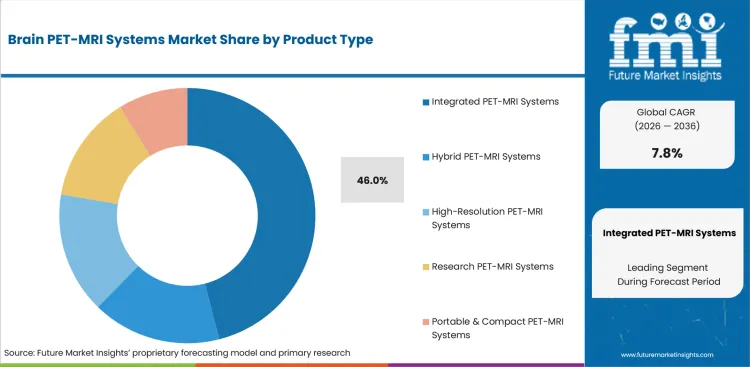
Integrated systems collect molecular and anatomical information without transferring the patient between scanners during one controlled examination. The shared patient position reduces registration error and preserves tracer timing across longitudinal neurological studies. In October 2025, Mediso announced that its nanoScan 7T PET-MRI system became operational at Northeastern University. The installation gives neuroscience researchers one controlled platform for simultaneous structural and molecular imaging at an academic reference center. Related nuclear imaging devices provide detector comparisons during research validation and neurological protocol design decisions.
- The integrated PET-MRI systems segment is likely to capture 46.0% share in 2026 driven by simultaneous acquisition and one coordinated patient setup. Fewer registration steps improve repeatability across treatment and follow-up studies that use identical neurological positioning protocols. Hospital investment teams must confirm enough funded protocols to sustain the dedicated room throughout the operating year.
- Academic medical centers use integrated systems for studies that compare tracer change with structural detail across the same biological interval. Repeat dementia protocols benefit from matched geometry and consistent patient positioning across serial neurological assessments. Institutions need coordinated tracer delivery and MRI safety review across a dependable daily schedule for wider adoption.
Why do neurological disorders shape the application category?
Neurological teams reserve brain PET-MRI for questions that separate imaging methods fail to answer with sufficient confidence. Combined data connects molecular pathology with anatomy and treatment-related change under matched acquisition conditions across neurological studies. In January 2025, the Alzheimer’s Association and SNMMI released updated criteria covering 17 amyloid and tau PET scenarios. The guidance limits PET use to cases in which results directly change specialist patient care. Reliable medical imaging software must preserve quantitative consistency across both modalities during longitudinal protocol review.
- Based on application, the neurological disorders segment is projected to account for 39.0% in 2026 attributable to clinical questions that require molecular and anatomical evidence in one examination. Dementia research and epilepsy evaluation require coordinated molecular and structural evidence across complex longitudinal neurological cases. Brain tumor programs add selected planning and response studies that benefit from matched acquisition conditions.
- Neurologists choose brain PET-MRI for decisions that require simultaneous data or a defined multimodal research endpoint. Treatment programs value MRI safety monitoring beside molecular assessment across the same specialist referral network. Utilization declines if blood biomarkers or separate scans answer the question with lower cost and simpler routine neurological scheduling.
How do hospitals shape demand within the end-user category?
Hospitals combine licensed nuclear medicine operations with MRI safety governance across complex neurological imaging pathways. A clinical installation must fit established referral and reporting routines instead of operating as an isolated research asset. In October 2025, Siemens Healthineers presented early Biograph One experience from Rigshospitalet and reported active clinical use. The deployment shows how tertiary centers place nuclear medicine equipment inside established neurological and molecular medicine services. Clinical referrals must eventually support utilization beyond the volume created by one sponsored research program.
- The hospitals segment is set to lead the end user category with 41.0% share in 2026 underpinned by licensed nuclear medicine services and established MRI safety governance. Tertiary centers combine neurological referrals with oncology studies and sponsored research across one imaging platform. Their position depends on protected capital budgets and enough specialists to operate both imaging functions safely.
- Hospital adoption improves through shared protocol ownership across radiology and nuclear medicine departments with aligned clinical responsibilities. Research agreements create early volume as clinical teams validate examination quality and patient throughput across funded programs. Expansion becomes difficult if tracer deliveries remain unreliable or service interruptions threaten higher-volume MRI and PET schedules during daily operation.
What keeps direct sales ahead within the distribution channel?
PET-MRI projects require coordinated room planning and acceptance testing across two imaging subsystems and specialist service teams. Direct manufacturer involvement assigns responsibility for installation and applications training through one accountable commercial contract. Engineering coordination becomes especially important when separate companies provide the PET insert and compatible MRI platform. In February 2025, Cubresa and Siemens Healthineers signed a global interface agreement for BrainPET compatibility across MAGNETOM systems. The agreement clarifies technical responsibility during integration testing and formal clinical acceptance across compatible imaging platforms.
- In 2026, the direct sales segment is expected to lead distribution channel with 49.0% share owing to complex installation and long-term service obligations. Direct contracts connect room planning with applications training and maintenance through one accountable service agreement. They also clarify responsibility for performance tests during formal clinical acceptance and later service escalation.
- Large hospitals favor direct contracts that define uptime and software support beside detector or coil service obligations. The channel permits phased applications training for nuclear medicine physicians and MRI technologists across the complete workflow. Regional distributors remain practical in smaller territories but need verified escalation routes for reconstruction and hardware faults.
Which operating gains support digital PET within the technology category?
Digital PET improves hybrid examinations through faster time-of-flight collection and stronger sensitivity across neurological protocols. Shorter acquisition reduces exposure to patient motion and releases scanner time across demanding neurological schedules. In May 2026, United Imaging introduced uPMR Zenith with higher sensitivity and advanced MRI capabilities. The company stated that United States and European clearance remained unavailable at the announcement date. New platforms must improve the complete examination instead of one isolated sequence during clinical review. Comparable preclinical imaging platforms help laboratories test reconstruction consistency during system selection and contract approval.
- The digital PET segment is projected to hold 36.0% share in 2026 supported by shorter acquisition and stronger time-of-flight performance. Digital detection becomes commercially useful through faster acquisition that reduces motion exposure or creates additional examination capacity. Attenuation correction and reconstruction quality must remain consistent across the complete neurological protocol and final clinical interpretation.
- Imaging centers evaluate digital PET through replacement projects that test sensitivity under their own neurological protocols. Research programs examine repeatability across longitudinal tracer studies and different patient motion profiles under matched acquisition settings. Adoption weakens if faster PET acquisition does not consistently reduce total examination time or specialist review effort.
What are the drivers, restraints, and opportunities in the Brain PET-MRI Systems Market?
Funded neurological research and treatment-linked imaging support demand, while capital intensity and specialist workflow requirements limit broader deployment.
- Driver: Funded neurological studies need synchronized molecular and anatomical information across repeat research or treatment-linked examinations.
- Restraint: Facility modifications and specialist staffing leave advanced systems below viable utilization across centers with limited referral volume.
- Opportunity: Modular brain inserts and treatment-linked protocols extend access through measurable neurological outcomes within existing MRI facilities.
Funded neuroscience programs create demand for PET-MRI systems that compare tracer behavior with anatomical change during one coordinated examination. Separate scans introduce timing and motion differences that weaken longitudinal analysis across repeat neurological studies. In September 2025, the National Institutes of Health awarded USD 1.02 million for a PET insert at the University of Maryland Baltimore. The award creates an initial imaging base for coordinated preclinical drug development across one laboratory program. Commercial demand becomes durable through recurring projects that fund technical support beyond the original equipment grant.
Capital intensity limits adoption among hospitals that cannot protect room capacity and specialist time for hybrid imaging. Installation teams must coordinate PET electronics with cooling and radiofrequency controls across one dedicated clinical suite. In December 2025, Siemens Healthineers updated Biograph mMR planning information that defines facility and equipment requirements. The documented specifications increase preparation work and extend formal acceptance testing across the complete installation schedule. Hospitals need utilization plans that cover engineering and clinical training without disrupting established imaging services.
Brain-focused PET inserts offer a route for research centers that already operate compatible high-field MRI systems. Modular configurations reduce the need for a second complete imaging platform inside an established research facility. In January 2026, Cubresa filed its first BrainPET 510(k) application for simultaneous clinical PET-MRI imaging. The submission established a regulatory route without confirming clearance or commercial acceptance for routine clinical service. Research centers also need dependable radiopharmaceutical logistics and coordinated MRI access to sustain repeat imaging examinations.
Which country CAGRs are profiled in the Brain PET-MRI Systems Market?
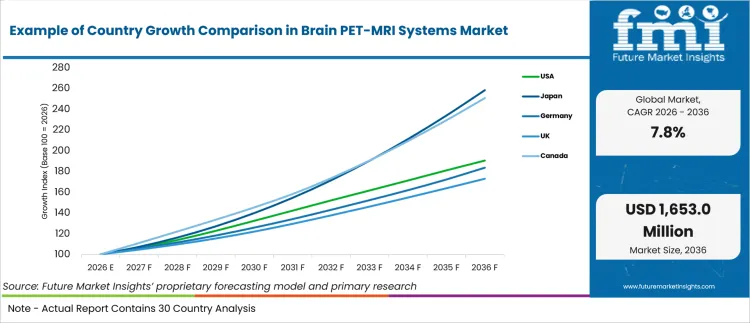
| Country | CAGR |
|---|---|
| Japan | 10.0% |
| Canada | 9.6% |
| South Korea | 8.2% |
| Australia | 7.3% |
| USA | 6.7% |
| Germany | 6.3% |
| UK | 5.6% |
How do country-level CAGRs compare in the Brain PET-MRI Systems Market?
Country forecasts form a concentrated progression and not a single separated leader across the selected brain PET-MRI markets. Japan and Canada combine specialist amyloid pathways with established academic imaging centers, but Canada requires a wider service model. South Korea and Australia rely on metropolitan expertise through different hospital density and tracer-distance conditions. The USA and Germany show similar momentum through large specialist networks with different payment and validation systems. The UK follows a narrower public funding route that concentrates activity within major neuroscience institutions. Similar rates therefore mask different routes to scanner utilization and treatment-linked imaging under reliable service coverage.
- Japan combines dense metropolitan dementia networks with treatment-linked MRI monitoring through centers that have trained readers and dependable tracer delivery.
- Canada relies on academic referral centers across a wide geography, making remote diagnostics and funded maintenance essential for advanced brain imaging outside metropolitan corridors.
- South Korea combines dense hospital access with domestic imaging engineering, but hybrid protocols must show a neurological benefit against higher-throughput separate scanners.
- Australia has metropolitan nuclear medicine expertise across widely separated population centers, so tracer production and field-service distance shape the practical installation model.
- The USA links academic treatment networks with covered amyloid PET pathways, yet payment differences create distinct capital review conditions across regional health systems.
- Germany combines university hospital expertise with detailed European treatment requirements, service-life scrutiny and public capital competition slow dedicated hybrid installations.
- The UK concentrates specialist imaging inside major public institutions, but national funding limits routine treatment-linked volume beyond selected academic and clinical programs.
Comparable forecasts do not create identical entry conditions across treatment pathways and service networks with different funding models. Manufacturers need country-specific plans that combine tracer logistics with clinical training and maintenance coverage to generate repeat system use. The full report provides country-level CAGR analysis across North America, Latin America, Europe, East Asia, South Asia, Oceania and the Middle East and Africa.
Country-wise Analysis
- Japanese treatment centers coordinate amyloid confirmation and MRI safety monitoring through specialist dementia networks with trained readers and dependable tracer access. Brain PET-MRI systems demand in Japan is forecast to rise at 10.0% CAGR over the forecast period, supported by specialist treatment pathways and dense metropolitan imaging networks. National requirements connect anti-amyloid treatment with molecular diagnosis and repeated magnetic resonance surveillance across qualified medical institutions. In August 2025, Japan’s Ministry of Health, Labour and Welfare revised the optimal-use guideline for donanemab. The guideline requires amyloid PET or cerebrospinal-fluid confirmation and MRI-capable treatment facilities with trained clinical teams. This route supports coordinated imaging at major centers, but limited reader capacity and tracer access constrain expansion outside metropolitan networks.
- Canadian brain imaging expertise remains concentrated within major university and provincial referral centers across a wide geography. A treatment route links amyloid confirmation and MRI monitoring with recurring work for established neuroscience programs. Health Canada issued a Notice of Compliance with conditions for Leqembi on October 24, 2025. By 2036, Canada’s brain PET-MRI systems market is projected to grow at 9.6% CAGR underpinned by conditional therapy authorization and concentrated academic referral centers. The authorization supports eligible treatment pathways but does not remove long travel distances outside metropolitan corridors. System providers need remote diagnostics and funded maintenance plans across the dispersed national service network.
- South Korean hospitals combine dense metropolitan referral networks with strong domestic medical imaging engineering capability. The South Korean brain PET-MRI systems sector is projected to record 8.2% CAGR during the assessment period, reinforced by dense hospital infrastructure and domestic imaging engineering capability. Clinical adoption also depends on local guidance that defines amyloid confirmation and MRI surveillance for anti-amyloid treatment. In May 2025, the Korean Dementia Association posted lecanemab appropriate-use recommendations for specialist care teams. The guidance gives major centers a common framework for molecular imaging and repeated MRI monitoring. Hospitals favor higher-throughput scanners, so hybrid protocols must show a distinct neurological benefit across selected specialist programs.
- Australian PET-MRI programs operate through widely separated metropolitan centers with established nuclear medicine and MRI services. A treatment-linked pathway requires validated amyloid evidence and repeated MRI safety monitoring inside specialist dementia programs. In September 2025, the Therapeutic Goods Administration approved Leqembi for eligible patients with confirmed amyloid pathology. Australia’s brain PET-MRI systems market is estimated to post 7.3% CAGR over the forecast period, shaped by validated amyloid testing requirements and established metropolitan imaging services. Geographic distance raises patient travel and field-service costs outside major metropolitan tracer-production and imaging corridors. Current portable MRI systems offer a broader access comparison, but PET-MRI remains tied to radiopharmaceutical infrastructure and specialist staffing.
- United States demand centers on academic hospitals that combine amyloid imaging with sponsored neurological treatment programs. In the USA, demand for brain PET-MRI systems is predicted to advance at 6.7% CAGR through 2036 aided by covered amyloid PET pathways and extensive academic treatment networks. Treatment pathways require molecular confirmation and a defined MRI schedule for safety surveillance across early infusion cycles. In July 2025, the National Library of Medicine published an updated Kisunla label requiring MRI scans before four early infusions. The label gives specialist networks a repeat imaging workflow across diagnosis and treatment monitoring programs. Payment variation and complex capital review remain material commercial frictions across diverse regional health systems.
- German university hospitals apply detailed technical validation and European medicine requirements before approving combined PET-MRI systems. Treatment-linked neurological imaging depends on qualified nuclear medicine teams and repeated MRI monitoring across specialist programs. In April 2025, the European Medicines Agency authorized Leqembi with MRI checks before several scheduled doses. Germany’s brain PET-MRI systems outlook is anticipated to advance at 6.3% CAGR over the assessment period, influenced by European treatment authorization and scheduled MRI monitoring requirements. The monitoring schedule creates recurring MRI work inside eligible specialist treatment pathways across university hospitals. Capital competition and service-life scrutiny delay dedicated hybrid installations across publicly funded university hospital programs.
- United Kingdom adoption depends on specialist public hospitals that must justify complex hybrid imaging within constrained budgets. Adoption of brain PET-MRI systems in the UK is estimated to expand at 5.6% CAGR through 2036, underpinned by concentrated specialist research and neurological imaging capacity. Treatment-linked demand remains sensitive to national funding decisions for anti-amyloid medicines and their imaging requirements. In June 2025, NICE concluded that lecanemab and donanemab did not justify their additional NHS costs. The funding position limits routine treatment-linked MRI and amyloid imaging volume across publicly financed pathways. Major neuroscience institutions provide research demand and multidisciplinary expertise for selected clinical and academic protocols.
Who are the notable companies in the Brain PET-MRI Systems Market?
Siemens Healthineers, GE HealthCare, United Imaging Healthcare, Bruker Corporation, MR Solutions, Mediso Ltd., Cubresa Inc., and Aspect Imaging are the notable companies shaping this market.
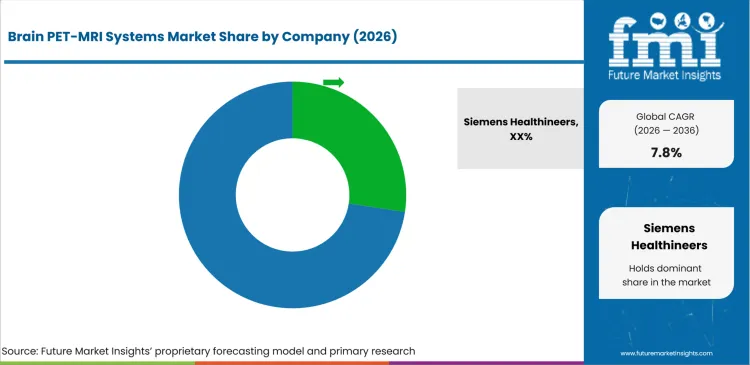
Clinical brain PET-MRI competition remains concentrated among companies with integrated platforms, specialist inserts, and verified service coverage. Siemens Healthineers and GE HealthCare address large hospital programs through simultaneous systems and field engineering. United Imaging Healthcare adds a digital clinical alternative for selected international hospital networks with local clearance and service support. Research laboratories have broader choices through Bruker, Mediso, and MR Solutions across integrated or modular preclinical configurations. Cubresa and Aspect Imaging provide narrower brain-focused or compact routes for specialized neuroscience and preclinical research programs. New entrants must pass site review for radiofrequency compatibility, attenuation correction, regulatory status, and service response. A credible entry route needs a distinct neurological workflow and dependable installed support rather than general imaging performance alone.
- Siemens Healthineers and GE HealthCare provide simultaneous clinical PET-MRI platforms for large hospitals with complex neurological programs. Their competitive position rests on integrated applications support and established field engineering across large hospital imaging networks. United Imaging Healthcare adds a digital clinical alternative for centers that confirm local clearance and service coverage.
- Bruker Corporation and Mediso Ltd. provide integrated preclinical platforms for neuroscience and drug development across longitudinal research programs. MR Solutions offers cryogen-free systems and modular PET inserts across several magnet strengths and laboratory configurations. These research specialists compete through flexible configurations and technical support for demanding longitudinal neurological and drug-development protocols.
- Cubresa Inc. develops a brain-focused PET insert designed to operate with compatible MRI systems in specialist neurological settings. Aspect Imaging combines compact MRI with SimPET modules for preclinical research sites that require smaller laboratory footprints. Both routes reduce facility complexity but require verified integration and dependable specialist support throughout operation.
Competitive Benchmarking: Brain PET-MRI Systems Market
| Company | Integration Breadth | Brain Imaging Evidence | Deployment and Support | Geographic Reach |
|---|---|---|---|---|
| Siemens Healthineers | High | High | High | Global |
| GE HealthCare | High | High | High | Global |
| United Imaging Healthcare | High | Medium | Medium | Multi-country |
| Bruker Corporation | High | High | High | Global |
| MR Solutions | High | Medium | Medium | Multi-country |
| Mediso Ltd. | High | High | High | Global |
| Cubresa Inc. | Low | High | Medium | North America and partners |
| Aspect Imaging | Medium | Medium | Medium | Multi-country |
Key Developments in the Brain PET-MRI Systems Market
- In January 2026, Siemens Healthineers received FDA clearance for the Biograph One PET-MRI scanner in the United States. The second-generation platform combines digital PET with a 3 Tesla MRI and supports shorter examinations through an updated workflow. The clearance gives hospitals a current regulatory route for simultaneous neurological and oncology imaging programs. Routine use also depends on aligned tracer supply, MRI safety review, and service coverage across complex referral networks.
- In May 2025, Mediso completed the first phase of a cryogen-free MRI magnet technology transfer with Superconducting Systems Inc. The agreement transferred foundational magnet intellectual property and supported expanded European manufacturing for future preclinical imaging platforms. Greater control over magnet design links product development with manufacturing and long-term service planning requirements. Later integrated systems must convert that capability into validated research workflows and dependable installed support.
- In May 2025, MR Solutions installed a 7T SPECT-MR platform with a large-bore PET insert at Houston Methodist. The configuration supports simultaneous PET and MR acquisition beside a detachable SPECT module for translational research. The installation gives laboratories a documented route for high-field multimodal imaging in neuroscience and drug-development studies. Its value depends on repeat protocols, trained research staff, and technical service that protects complex multimodal operation.
- In October 2025, GE HealthCare signed a fourteen-year Care Alliance with UC San Diego Health covering advanced imaging and service support. The agreement covers a broad suite of imaging platforms including PET-MR, CT, MRI, and nuclear medicine systems, alongside advanced education and service support across an academic health network. Field engineering and lifecycle planning connect equipment availability with technical support across several clinical departments. The arrangement reduces operational uncertainty for complex hybrid imaging but depends on sustained clinical and research utilization.
Key Players in the Brain PET-MRI Systems Market
Clinical Integrated PET-MRI Providers
- Siemens Healthineers
- GE HealthCare
- United Imaging Healthcare
Preclinical Integrated PET-MRI Providers
- Bruker Corporation
- MR Solutions
- Mediso Ltd.
Brain-Focused and Modular PET-MRI Developers
- Cubresa Inc.
- Aspect Imaging
Brain PET-MRI Systems Market - Report Scope
| Coverage field | Report scope |
|---|---|
| Market breakdown | Product type, application, end user, distribution channel, technology, and region. |
| Market Definition | Integrated and sequential PET-MRI systems used for simultaneous or coordinated molecular and magnetic resonance imaging in neurological research and selected clinical applications. |
| Regions Covered | North America, Latin America, Europe, East Asia, South Asia, Oceania, and Middle East and Africa. |
| Countries Covered | Japan, Canada, South Korea, Australia, USA, Germany, and the UK. |
| Key Companies Profiled | Siemens Healthineers, GE HealthCare, United Imaging Healthcare, Bruker Corporation, MR Solutions, Mediso Ltd., Cubresa Inc., and Aspect Imaging |
| Forecast Period | 2026 to 2036. |
| Approach | Hybrid bottom-up and top-down market sizing supported by primary interviews and official desk research. |
Brain PET-MRI Systems Market - Research Methodology
| Method | Approach |
|---|---|
| Primary Research | FMI analysts gathered input from manufacturers, service providers, technology developers, distributors, end users, procurement teams, and subject-matter experts. Interviews examined purchasing decisions, product or service evaluation, adoption barriers, approval requirements, pricing considerations, and expectations for technical or commercial support. Respondents were also asked what evidence is required before a trial, pilot, or initial order develops into regular purchasing. |
| Desk Research | Desk research covered government statistics, regulatory publications, trade data, industry associations, technical literature, standards, company filings, product information, and official corporate announcements. Sources were reviewed for relevance, publication date, geographic coverage, and consistency with the defined market scope. Claims relating to performance, applications, approvals, capacity, investment, and commercial activity were retained only when supported by credible public evidence. |
| Market Sizing and Forecasting | The market model combined the baseline value with historical performance, segment structure, pricing and volume indicators, adoption levels, company participation, and country-level demand conditions. Forecast assumptions considered economic activity, investment trends, regulatory developments, technology adoption, purchasing cycles, supply availability, and barriers to wider market use. Segment and regional estimates were reconciled before the final market total was calculated. |
| Data Validation | Estimates were checked against multiple independent indicators, including public data, company activity, trade patterns, industry developments, and findings from primary interviews. Validation also tested whether products, services, applications, and company revenues fell within the defined market boundaries. Adjacent categories, unsupported claims, overlapping revenues, and activities without direct market relevance were excluded to reduce double counting and maintain consistency across segments and countries. |
Brain PET-MRI Systems Market by Segments
Brain PET-MRI Systems Market segmented by Product Type:
- Integrated PET-MRI Systems
- Fully Integrated PET-MRI Systems
- Brain-Dedicated PET-MRI Systems
- Sequential PET-MRI Systems
- Simultaneous PET-MRI Systems
- Sequential PET-MRI Systems
- High-Resolution PET-MRI Systems
- Ultra-High-Resolution Systems
- Digital Detector Systems
- Research PET-MRI Systems
- Preclinical PET-MRI Systems
- Translational Research Systems
- Portable & Compact PET-MRI Systems
- Mobile PET-MRI Units
- Compact PET-MRI Imaging Systems
Brain PET-MRI Systems Market segmented by Application:
- Neurological Disorders
- Alzheimer’s Disease
- Parkinson’s Disease
- Brain Tumor Diagnosis
- Primary Brain Tumors
- Metastatic Brain Tumors
- Epilepsy Diagnosis
- Pre-Surgical Assessment
- Seizure Localization
- Neurovascular Research
- Brain Function Studies
- Cognitive Research
- Psychiatric Disorders
- Depression Assessment
- Schizophrenia Research
Brain PET-MRI Systems Market segmented by End User:
- Hospitals
- Public Hospitals
- Private Hospitals
- Diagnostic Imaging Centers
- Independent Imaging Centers
- Specialty Diagnostic Centers
- Research Institutes
- Academic Research Institutes
- Neuroscience Research Centers
- Cancer Centers
- Comprehensive Cancer Centers
- Oncology Hospitals
- Specialty Imaging Clinics
- Neuroimaging Clinics
- Brain Health Centers
Brain PET-MRI Systems Market segmented by Distribution Channel:
- Direct Sales
- Hospital Procurement
- Institutional Contracts
- Authorized Distributors
- National Distributors
- Regional Distributors
- Healthcare Equipment Integrators
- Turnkey Solution Providers
- System Integration Partners
- Government Tenders
- Public Healthcare Procurement
- Research Institution Procurement
- Leasing & Managed Services
- Equipment Leasing
- Managed Imaging Services
Brain PET-MRI Systems Market segmented by Technology:
- Digital PET Technology
- Silicon Photomultiplier (SiPM)
- Digital Detector Technology
- Simultaneous PET-MRI Imaging
- Fully Integrated Imaging
- Real-Time Image Fusion
- Artificial Intelligence
- AI Image Reconstruction
- AI Diagnostic Assistance
- Time-of-Flight PET
- High-Speed TOF PET
- Low-Noise TOF Imaging
- Advanced MRI Sequences
- Functional MRI
- Diffusion Tensor Imaging
Brain PET-MRI Systems Market by Region:
- North America
- USA
- Canada
- Latin America
- Brazil
- Mexico
- Argentina
- Western Europe
- Germany
- France
- United Kingdom
- Italy
- Spain
- Benelux
- Nordics
- Eastern Europe
- Poland
- Russia
- Czech Republic
- Romania
- Hungary
- East Asia
- China
- Japan
- South Korea
- South Asia and Pacific
- India
- ASEAN
- Australia and New Zealand
- Middle East and Africa
- GCC Countries
- South Africa
- Israel
Research Sources and Bibliography
- USA Food and Drug Administration. (2025, August 28). FDA to recommend additional, earlier MRI monitoring for patients with Alzheimer’s disease taking Leqembi (lecanemab).
- National Institute of Biomedical Imaging and Bioengineering. (2025, February 13). Portable MRI, enhanced by AI, proves viable in brain imaging for dementia.
- Mediso Ltd. (2025, December 19). Expanding our 7T PET/MRI Footprint to the United States.
- Alzheimer’s Association. (2025, January 8). New guidance for gold-standard imaging tests assists clinicians in diagnosis and management of Alzheimer’s and other dementia.
- Siemens Healthineers. (2025, October 5). First Experiences with BIOGRAPH One PET/MR | Symposium at EANM 2025.
- Cubresa Inc. (2025, February 11). Cubresa and Siemens Healthineers Sign Global Master Interface Agreement for the Cubresa BrainPET™ Scanner.
- United Imaging Healthcare. (2026, May 31). United Imaging Spotlights Molecular Imaging Showstoppers at SNMMI 2026.
- National Institutes of Health. (2025, September 25). PET insert Si 198 (Project No. 1S10OD038247-01).
- Siemens Healthineers. (2025, December 10). Biograph mMR 3.0 Tesla: Basic planning information.
- Cubresa Inc. (2026, January 13). Cubresa Files First FDA 510(k) Application.
- Ministry of Health, Labour and Welfare. (2025, August).
- Health Canada. (2025, October 24). Notice of Compliance with conditions (NOC/c).
- Korean Dementia Association. (2025, May 21). Lecanemab: Appropriate Use Recommendations by Korean Dementia Association.
- Therapeutic Goods Administration. (2025, September 24). TGA approves registration of lecanemab (LEQEMBI).
- National Library of Medicine. (2025, July). DailyMed - KISUNLA- donanemab-azbt injection, solution.
- European Medicines Agency. (2025, April 15). Leqembi.
- National Institute for Health and Care Excellence. (2025, June 19). Final draft guidance finds benefits of 2 Alzheimer’s treatments remain too small to justify the additional cost to the NHS.
- Siemens Healthineers. (2026, January 29). Siemens Healthineers receives FDA clearance for Biograph One positron emission tomography/magnetic resonance imaging scanner.
- Mediso Ltd. (2025, May 9). Cryogen-free MRI Magnet Tech Transfer.
- MR Solutions. (2025, May 29). World’s first 7T SPECT/MR system with PET insert installed at Houston Methodist.
- GE HealthCare. (2025, October 16). GE HealthCare signs a 14-year Care Alliance enabling advanced imaging solutions to enhance timely patient care.
- MR Solutions. (n.d.). MR Solutions’ preclinical PET/MR product range up to 9.4T - cryogen-free.
- Aspect Imaging. (n.d.). SimPet™ Simultaneous PET/MRI System.
- United Imaging Healthcare. (n.d.). uPMR 790: HD TOF PET/MR.
- Aspect Imaging. (n.d.). M7™ Compact MRI System for small mice and large rat imaging.
This bibliography is provided for reader reference and is not exhaustive. The full report contains the complete reference list and detailed citations
This Report Answers
- How large is the Brain PET-MRI Systems Market in 2026 and 2036?
- Which neurological workflows justify simultaneous molecular and anatomical imaging within one examination?
- Why do Integrated PET-MRI Systems account for the largest Product Type share in 2026?
- How does neurological demand shape Application spending across dementia and epilepsy programs?
- Why do hospitals represent the largest End User share during the assessment period?
- How do country growth rates differ across Japan, Canada, South Korea and major Western markets?
- Which companies provide integrated clinical systems or research-focused PET inserts for MRI platforms?
- What limits utilization across centers with restricted tracer access and specialist staffing?
- How should capital committees compare installation breadth with brain imaging evidence and service coverage?
Frequently Asked Questions
How big is the Brain PET-MRI Systems Market in 2026?
The brain PET-MRI systems market is valued at USD 780.0 million in 2026 and is forecast to reach USD 1653.0 million by 2036. Growth is supported by anti-amyloid treatment pathways creating demand for coordinated molecular confirmation and MRI safety monitoring within specialist neurological networks across clinical and research programs worldwide.
What is the CAGR of the Brain PET-MRI Systems Market from 2026 to 2036?
The brain PET-MRI systems market grows at a CAGR of 7.8% between 2026 and 2036, supported by hospitals and research institutes investing in integrated platforms once those systems demonstrate dependable tracer access, reliable MRI safety governance, and enough funded neurological protocols to sustain recurring examination volume across the operating year.
Which product type leads the Brain PET-MRI Systems Market?
Integrated PET-MRI systems account for 46.0% of the brain PET-MRI systems market by product type in 2026, driven by simultaneous acquisition and consistent spatial alignment that reduces registration error across longitudinal dementia and epilepsy studies requiring matched molecular and anatomical findings within one coordinated neurological examination.
How much will the Brain PET-MRI Systems Market add between 2026 and 2036?
The brain PET-MRI systems market is set to add USD 873.0 million between 2026 and 2036, growing from USD 780.0 million to USD 1653.0 million as integrated clinical platforms, modular brain inserts, and treatment-linked neurological imaging protocols enter funded hospital and research pathways across a widening base of dementia and neuroscience programs worldwide.
Who are the leading companies in the Brain PET-MRI Systems Market?
Five companies lead the brain PET-MRI systems market, including Siemens Healthineers, GE HealthCare, United Imaging Healthcare, Bruker Corporation, and Mediso, competing through simultaneous integrated clinical platforms, preclinical research configurations, digital PET detection, and long-term field engineering support across global hospital and neuroscience research programs.
Preview the report firsthand - request a free sample
Get SampleGet the brochure for pricing and purchase details.
Get PDFTable of Content
- Key Takeaways
- Market Size and CAGR
- Top Growth Driver
- Fastest Growing Segment
- Leading Region
- Key Companies
- Emerging Opportunities
- Executive Summary
- Global Market Outlook
- Demand-side Trends
- Supply-side Trends
- Technology Roadmap Analysis
- Analysis and Recommendations
- Analyst Perspective (What is happening? Why now? What should investors know?)
- Key Questions Answered
- How large is the market?
- What is the CAGR?
- What are key trends?
- Which region dominates?
- Who are the leaders?
- Market Overview
- Market Coverage / Taxonomy
- Market Definition / Scope / Limitations
- Research Methodology
- Chapter Orientation
- Analytical Lens and Working Hypotheses
- Market Structure, Signals, and Trend Drivers
- Benchmarking and Cross-market Comparability
- Market Sizing, Forecasting, and Opportunity Mapping
- Research Design and Evidence Framework
- Desk Research Programme (Secondary Evidence)
- Expert Input and Fieldwork (Primary Evidence)
- Tooling, Models, and Reference Databases
- Data Engineering and Model Build
- Quality Assurance and Audit Trail
- Market Background
- Market Dynamics (Drivers, Restraints, Opportunity, Trends)
- Scenario Forecast (Optimistic, Likely, Conservative)
- Impact Analysis
- AI Impact
- Sustainability Impact
- Regulatory Impact
- Technology Impact
- Consumer / Buyer Analysis
- Purchase Drivers
- Adoption Barriers
- Buyer Journey
- Opportunity Map Analysis
- Product Life Cycle Analysis
- Supply Chain Analysis
- Investment Feasibility Matrix
- Value Chain Analysis
- PESTLE and Porter's Analysis
- Regulatory Landscape
- Regional Parent Market Outlook
- Production and Consumption Statistics
- Import and Export Statistics
- Global Market Analysis and Forecast, 2021 to 2036
- Historical Market Size Value (USD Million) Analysis, 2021 to 2025
- Current and Future Market Size Value (USD Million) Projections, 2026 to 2036
- Y-o-Y Growth Trend Analysis
- Absolute $ Opportunity Analysis
- Global Market Pricing Analysis, 2021 to 2036
- Global Market Analysis and Forecast, By Product Type, 2021 to 2036
- Introduction / Key Findings
- Historical Market Size Value (USD Million) Analysis By Product Type, 2021 to 2025
- Current and Future Market Size Value (USD Million) Analysis and Forecast By Product Type, 2026 to 2036
- Integrated PET-MRI Systems
- Whole-Body PET-MRI Systems
- Brain-Dedicated PET-MRI Systems
- Hybrid PET-MRI Systems
- Simultaneous PET-MRI Systems
- Sequential PET-MRI Systems
- High-Resolution PET-MRI Systems
- Ultra-High Resolution Systems
- Digital Detector Systems
- Research PET-MRI Systems
- Preclinical PET-MRI Systems
- Translational Research Systems
- Portable & Compact PET-MRI Systems
- Mobile PET-MRI Units
- Compact Brain Imaging Systems
- Integrated PET-MRI Systems
- Y-o-Y Growth Trend Analysis By Product Type, 2021 to 2025
- Absolute $ Opportunity Analysis By Product Type, 2026 to 2036
- Global Market Analysis and Forecast, By Application, 2021 to 2036
- Introduction / Key Findings
- Historical Market Size Value (USD Million) Analysis By Application, 2021 to 2025
- Current and Future Market Size Value (USD Million) Analysis and Forecast By Application, 2026 to 2036
- Neurological Disorders
- Alzheimer's Disease
- Parkinson's Disease
- Brain Tumor Diagnosis
- Primary Brain Tumors
- Metastatic Brain Tumors
- Epilepsy Evaluation
- Pre-Surgical Assessment
- Seizure Localization
- Neuroscience Research
- Brain Function Studies
- Cognitive Research
- Psychiatric Disorders
- Depression Assessment
- Schizophrenia Research
- Neurological Disorders
- Y-o-Y Growth Trend Analysis By Application, 2021 to 2025
- Absolute $ Opportunity Analysis By Application, 2026 to 2036
- Global Market Analysis and Forecast, By End User, 2021 to 2036
- Introduction / Key Findings
- Historical Market Size Value (USD Million) Analysis By End User, 2021 to 2025
- Current and Future Market Size Value (USD Million) Analysis and Forecast By End User, 2026 to 2036
- Hospitals
- Public Hospitals
- Private Hospitals
- Diagnostic Imaging Centers
- Independent Imaging Centers
- Specialty Diagnostic Centers
- Research Institutes
- Academic Research Institutes
- Neuroscience Research Centers
- Cancer Centers
- Comprehensive Cancer Centers
- Oncology Hospitals
- Specialty Neurology Clinics
- Neurology Clinics
- Brain Health Centers
- Hospitals
- Y-o-Y Growth Trend Analysis By End User, 2021 to 2025
- Absolute $ Opportunity Analysis By End User, 2026 to 2036
- Global Market Analysis and Forecast, By Distribution Channel, 2021 to 2036
- Introduction / Key Findings
- Historical Market Size Value (USD Million) Analysis By Distribution Channel, 2021 to 2025
- Current and Future Market Size Value (USD Million) Analysis and Forecast By Distribution Channel, 2026 to 2036
- Direct Sales
- Hospital Procurement
- Institutional Contracts
- Authorized Distributors
- National Distributors
- Regional Distributors
- Healthcare Equipment Integrators
- Turnkey Solution Providers
- System Integration Partners
- Government Tenders
- Public Healthcare Procurement
- Research Institution Procurement
- Leasing & Managed Services
- Equipment Leasing
- Managed Imaging Services
- Direct Sales
- Y-o-Y Growth Trend Analysis By Distribution Channel, 2021 to 2025
- Absolute $ Opportunity Analysis By Distribution Channel, 2026 to 2036
- Global Market Analysis and Forecast, By Technology, 2021 to 2036
- Introduction / Key Findings
- Historical Market Size Value (USD Million) Analysis By Technology, 2021 to 2025
- Current and Future Market Size Value (USD Million) Analysis and Forecast By Technology, 2026 to 2036
- Digital PET Technology
- Silicon Photomultiplier (SiPM)
- Digital Detector Technology
- Simultaneous PET-MRI Imaging
- Fully Integrated Imaging
- Real-Time Image Fusion
- Artificial Intelligence
- AI Image Reconstruction
- AI Diagnostic Assistance
- Time-of-Flight PET
- High-Speed TOF PET
- Low-Noise TOF Imaging
- Advanced MRI Sequences
- Functional MRI
- Diffusion Tensor Imaging
- Digital PET Technology
- Y-o-Y Growth Trend Analysis By Technology, 2021 to 2025
- Absolute $ Opportunity Analysis By Technology, 2026 to 2036
- Global Market Analysis and Forecast, By Region, 2021 to 2036
- Introduction
- Historical Market Size Value (USD Million) Analysis By Region, 2021 to 2025
- Current Market Size Value (USD Million) Analysis and Forecast By Region, 2026 to 2036
- North America
- Latin America
- Western Europe
- Eastern Europe
- East Asia
- South Asia and Pacific
- Middle East & Africa
- Market Attractiveness Analysis By Region
- North America Market Analysis and Forecast, By Country, 2021 to 2036
- Historical Market Size Value (USD Million) Trend Analysis By Market Taxonomy, 2021 to 2025
- Market Size Value (USD Million) Forecast By Market Taxonomy, 2026 to 2036
- By Country
- USA
- Canada
- By Product Type
- By Application
- By End User
- By Distribution Channel
- By Technology
- By Country
- Market Attractiveness Analysis
- By Country
- By Product Type
- By Application
- By End User
- By Distribution Channel
- By Technology
- Key Takeaways
- Latin America Market Analysis and Forecast, By Country
- Historical Market Size Value (USD Million) Trend Analysis By Market Taxonomy, 2021 to 2025
- Market Size Value (USD Million) Forecast By Market Taxonomy, 2026 to 2036
- By Country
- Brazil
- Mexico
- Chile
- Rest of Latin America
- By Product Type
- By Application
- By End User
- By Distribution Channel
- By Technology
- By Country
- Market Attractiveness Analysis
- By Country
- By Product Type
- By Application
- By End User
- By Distribution Channel
- By Technology
- Key Takeaways
- Western Europe Market Analysis and Forecast, By Country
- Historical Market Size Value (USD Million) Trend Analysis By Market Taxonomy, 2021 to 2025
- Market Size Value (USD Million) Forecast By Market Taxonomy, 2026 to 2036
- By Country
- Germany
- UK
- Italy
- Spain
- France
- Nordic
- BENELUX
- Rest of Western Europe
- By Product Type
- By Application
- By End User
- By Distribution Channel
- By Technology
- By Country
- Market Attractiveness Analysis
- By Country
- By Product Type
- By Application
- By End User
- By Distribution Channel
- By Technology
- Key Takeaways
- Eastern Europe Market Analysis and Forecast, By Country
- Historical Market Size Value (USD Million) Trend Analysis By Market Taxonomy, 2021 to 2025
- Market Size Value (USD Million) Forecast By Market Taxonomy, 2026 to 2036
- By Country
- Russia
- Poland
- Hungary
- Balkan & Baltic
- Rest of Eastern Europe
- By Product Type
- By Application
- By End User
- By Distribution Channel
- By Technology
- By Country
- Market Attractiveness Analysis
- By Country
- By Product Type
- By Application
- By End User
- By Distribution Channel
- By Technology
- Key Takeaways
- East Asia Market Analysis and Forecast, By Country
- Historical Market Size Value (USD Million) Trend Analysis By Market Taxonomy, 2021 to 2025
- Market Size Value (USD Million) Forecast By Market Taxonomy, 2026 to 2036
- By Country
- China
- Japan
- South Korea
- By Product Type
- By Application
- By End User
- By Distribution Channel
- By Technology
- By Country
- Market Attractiveness Analysis
- By Country
- By Product Type
- By Application
- By End User
- By Distribution Channel
- By Technology
- Key Takeaways
- South Asia and Pacific Market Analysis and Forecast, By Country
- Historical Market Size Value (USD Million) Trend Analysis By Market Taxonomy, 2021 to 2025
- Market Size Value (USD Million) Forecast By Market Taxonomy, 2026 to 2036
- By Country
- India
- ASEAN
- Australia & New Zealand
- Rest of South Asia and Pacific
- By Product Type
- By Application
- By End User
- By Distribution Channel
- By Technology
- By Country
- Market Attractiveness Analysis
- By Country
- By Product Type
- By Application
- By End User
- By Distribution Channel
- By Technology
- Key Takeaways
- Middle East & Africa Market Analysis and Forecast, By Country
- Historical Market Size Value (USD Million) Trend Analysis By Market Taxonomy, 2021 to 2025
- Market Size Value (USD Million) Forecast By Market Taxonomy, 2026 to 2036
- By Country
- Kingdom of Saudi Arabia
- Other GCC Countries
- Türkiye
- South Africa
- Other African Union
- Rest of Middle East & Africa
- By Product Type
- By Application
- By End User
- By Distribution Channel
- By Technology
- By Country
- Market Attractiveness Analysis
- By Country
- By Product Type
- By Application
- By End User
- By Distribution Channel
- By Technology
- Key Takeaways
- Key Countries Market Analysis
- USA
- Pricing Analysis
- Market Share Analysis, 2025
- By Product Type
- By Application
- By End User
- By Distribution Channel
- By Technology
- Canada
- Pricing Analysis
- Market Share Analysis, 2025
- By Product Type
- By Application
- By End User
- By Distribution Channel
- By Technology
- Mexico
- Pricing Analysis
- Market Share Analysis, 2025
- By Product Type
- By Application
- By End User
- By Distribution Channel
- By Technology
- Brazil
- Pricing Analysis
- Market Share Analysis, 2025
- By Product Type
- By Application
- By End User
- By Distribution Channel
- By Technology
- Chile
- Pricing Analysis
- Market Share Analysis, 2025
- By Product Type
- By Application
- By End User
- By Distribution Channel
- By Technology
- Germany
- Pricing Analysis
- Market Share Analysis, 2025
- By Product Type
- By Application
- By End User
- By Distribution Channel
- By Technology
- UK
- Pricing Analysis
- Market Share Analysis, 2025
- By Product Type
- By Application
- By End User
- By Distribution Channel
- By Technology
- Italy
- Pricing Analysis
- Market Share Analysis, 2025
- By Product Type
- By Application
- By End User
- By Distribution Channel
- By Technology
- Spain
- Pricing Analysis
- Market Share Analysis, 2025
- By Product Type
- By Application
- By End User
- By Distribution Channel
- By Technology
- France
- Pricing Analysis
- Market Share Analysis, 2025
- By Product Type
- By Application
- By End User
- By Distribution Channel
- By Technology
- India
- Pricing Analysis
- Market Share Analysis, 2025
- By Product Type
- By Application
- By End User
- By Distribution Channel
- By Technology
- ASEAN
- Pricing Analysis
- Market Share Analysis, 2025
- By Product Type
- By Application
- By End User
- By Distribution Channel
- By Technology
- Australia & New Zealand
- Pricing Analysis
- Market Share Analysis, 2025
- By Product Type
- By Application
- By End User
- By Distribution Channel
- By Technology
- China
- Pricing Analysis
- Market Share Analysis, 2025
- By Product Type
- By Application
- By End User
- By Distribution Channel
- By Technology
- Japan
- Pricing Analysis
- Market Share Analysis, 2025
- By Product Type
- By Application
- By End User
- By Distribution Channel
- By Technology
- South Korea
- Pricing Analysis
- Market Share Analysis, 2025
- By Product Type
- By Application
- By End User
- By Distribution Channel
- By Technology
- Russia
- Pricing Analysis
- Market Share Analysis, 2025
- By Product Type
- By Application
- By End User
- By Distribution Channel
- By Technology
- Poland
- Pricing Analysis
- Market Share Analysis, 2025
- By Product Type
- By Application
- By End User
- By Distribution Channel
- By Technology
- Hungary
- Pricing Analysis
- Market Share Analysis, 2025
- By Product Type
- By Application
- By End User
- By Distribution Channel
- By Technology
- Kingdom of Saudi Arabia
- Pricing Analysis
- Market Share Analysis, 2025
- By Product Type
- By Application
- By End User
- By Distribution Channel
- By Technology
- Türkiye
- Pricing Analysis
- Market Share Analysis, 2025
- By Product Type
- By Application
- By End User
- By Distribution Channel
- By Technology
- South Africa
- Pricing Analysis
- Market Share Analysis, 2025
- By Product Type
- By Application
- By End User
- By Distribution Channel
- By Technology
- USA
- Market Structure Analysis
- Competition Dashboard
- Competition Benchmarking
- Market Share Analysis of Top Players
- By Regional
- By Product Type
- By Application
- By End User
- By Distribution Channel
- By Technology
- Emerging Startups
- Innovation Benchmarking
- Competition Analysis
- Competition Deep Dive
- Siemens Healthineers
- Overview
- Product Portfolio
- Profitability by Market Segments
- Sales Footprint
- Strategy Overview
- Marketing Strategy
- Product Strategy
- Channel Strategy
- GE HealthCare
- Philips Healthcare
- United Imaging Healthcare
- Canon Medical Systems
- Bruker Corporation
- MR Solutions
- Mediso Ltd.
- Neusoft Medical Systems
- Cubresa Inc.
- Siemens Healthineers
- Case Studies
- Success Stories
- Recent Developments
- Competition Deep Dive
- Assumptions & Acronyms Used


