

- Market Size (2026)
- USD 437.4 Mn
- Forecast (2036)
- USD 679.3 Mn
- CAGR (2026 to 2036)
- 4.5%
How big is Builder Gels Market in 2026?
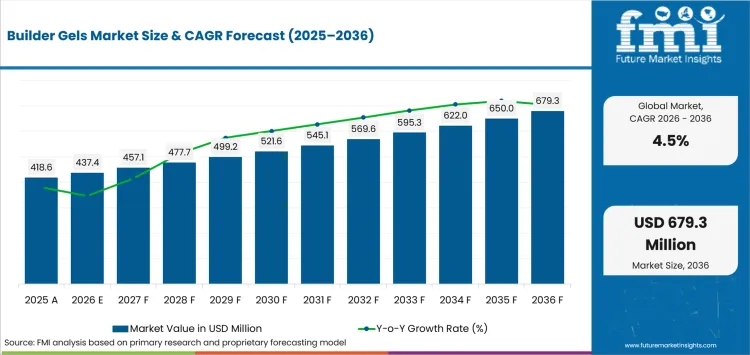
USD 437.4 million in 2026 and USD 679.3 million by 2036 at a 4.5% CAGR.
Demand for builder gels is projected to rise at a 4.5% CAGR by 2036, increasing valuation from USD 437.4 million in 2026 to USD 679.3 million. Structural gels earn repeat orders because salons can use one cured system for overlays, fills and short extensions. In January 2025, The GelBottle Inc released eight Sheer BIAB builder shades for natural finishes. That range gives technicians more service options without changing the builder workflow. Adjacent nail care products keep professional and home users familiar with gel-based reinforcement.
Route-to-market maturity changes how the global forecast converts into repeat orders. Destatis reported German internet and mail-order retail sales rose 2.2% year over year in February 2026. Digital access is expanding inside a mature system, so Germany needs different launch economics from faster UAE and Saudi Arabia profiles.
Key Takeaways
- Demand for builder gels rises as salons and home users buy structural formulas for reinforcement, overlays, fills and short extensions.
- By product type, core - classic lines are estimated to hold 39.0% in 2026 due to neutral builders covering the widest routine service range.
- Conventional formulations are projected to represent 58.0% of nature in 2026 owing to familiar photopolymer curing and removal behavior.
- In 2026, cream & balm is expected to lead format with 32.0% share because thicker gels give technicians better placement control.
- Ingredient restrictions and poor cure control can raise reformulation costs, technician training needs and the risk of abandoned repeat use.
- Some of the key players in this market include The GelBottle Inc, Aprés Nail, Nail Alliance - North America, Inc. (Gelish), and Wella Company.
Analyst Perspective
"Builder gels should be evaluated as a working system rather than a bottle price because viscosity, lamp protocol and refill access determine service consistency. Brands earn repeat orders when technicians can reproduce the same structure without adding cure uncertainty or unnecessary filing."
- Rahul Pandita, Principal Consultant, Future Market Insights
How is the builder gels market segmented?
The builder gels market is segmented by product type, nature, format, price positioning, sales channel and region.
Product type covers core - classic lines, targeted treatment lines, sensitive & gentle lines, premium & clinical lines, and kits & sets. Nature includes conventional, vegan & cruelty-free, natural & organic, dermocosmetic - clinical, and fragrance-free & sensitive. Format spans cream & balm, liquid & serum, stick & solid, spray & mist, sheet & patch, and powder. Price positioning covers mass, masstige, premium and professional. Sales channels include e-commerce & DTC, specialty beauty retail, pharmacies & drugstores, supermarkets & hypermarkets, and salons & spas.
What makes core - classic lines central to the product type category?
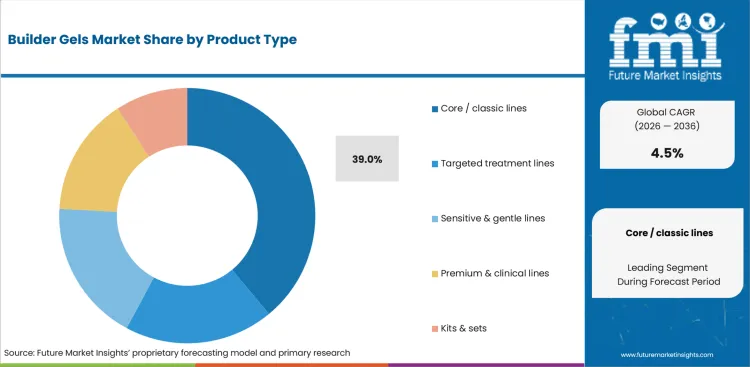
Core - classic lines cover the routine structural jobs that keep a builder system in regular salon use. Gelish described its Brush-On Builder in May 2025 as a thick-viscosity formula for reinforcement, overlays and sculpted length. That range of work lets technicians use one familiar foundation before color or finish choices change.
- By product type, core - classic lines are estimated to hold 39.0% in 2026 due to clear and neutral builders fitting the broadest service menu.
- Gelish positions Brush-On Builder for reinforcement or length, so the commercial value comes from repeat structural use instead of a single shade cycle.
Why does conventional lead the nature category?
Commercial qualification keeps conventional builder gels in the largest nature position through curing, adhesion and removal behavior. The European Commission confirmed in August 2025 that TPO became prohibited in cosmetic products from September 1,2025. The rule forces formula changes without removing the need for predictable UV or LED polymerization.
- Conventional formulations are forecast to represent 58.0% of nature in 2026 owing to established photopolymer chemistry setting the main performance reference.
- Reformulation work now has to preserve viscosity and cure response, which makes documented ingredient control more important than a broad conventional label.
How does cream & balm influence selection within the format category?
Cream & balm formats give technicians more placement time during apex building and localized reinforcement. Aprés Nail documented in July 2025 that its Soft Gel Builder uses a medium-to-thick self-leveling texture for overlays and fills. The format reduces uncontrolled flow before cure while retaining a smooth finish on natural-nail reinforcement and short extension work.
- Cream & balm is projected to hold 32.0% of format revenue in 2026 owing to thicker rheology that supports controlled structural placement.
- Technicians can build height where stress is highest before curing, which makes the format practical for short extensions and repair work.
What drives e-commerce & DTC within the sales channel category?
Digital channels work well for builder gels because shoppers need technique guidance before buying a lamp-cured structural product. The USA Census Bureau reported e-commerce sales rose 12.2% year over year in the second quarter of 2026. Detailed product education and refill ordering can therefore sit beside conversion in one channel, a pattern also visible in beauty and personal care retail.
- E-commerce & DTC is set to lead sales channel with 30.0% share in 2026 attributable to education, system selection and replenishment occurring together.
- Direct stores can keep cure instructions beside compatible refills, reducing the chance that a first purchase becomes an isolated trial.
What are the drivers, restraints and opportunities in the Builder Gels Market?
Multi-use structural services increase repeat demand, cure and ingredient risks limit conversion, and documented training plus compliant formula support provides the clearest commercial opening.
- Driver: Builder gels let technicians cover reinforcement, overlays, fills and selected extensions with fewer structural product changes.
- Restraint: Sensitization risk, incomplete curing and ingredient restrictions raise the cost of reformulation, education and salon switching.
- Opportunity: Brands that pair compliant formulas with teachable cure protocols can shorten technician qualification and protect refill purchasing.
Professional education turns a versatile builder formula into a repeatable service instead of a one-time product trial. The GelBottle Inc launched TGB Academy Online in July 2025 with industry-accredited courses that include BIAB training. A consistent teaching route lowers the time technicians spend learning application order, structure and cure practice. Brands can earn more value from replenishment once technicians adopt the formula as part of a service they know how to repeat.
Safety scrutiny can slow adoption even where structural-gel demand is intact. The UK Office for Product Safety and Standards said in August 2026 that it had started a market assessment of professional nail products to understand safety risks in the sector. Brands operating inside the wider cosmetics market therefore need ingredient records and cure instructions that withstand closer review. Weak documentation can delay listings or force retraining after a formula change.
Regulatory support becomes a practical opening for smaller cosmetics firms that struggle with files required for sale. France’s DGCCRF found that only 26 of more than 200 product information files reviewed in a 2026 control program were complete or nearly complete. Builder-gel brands that prepare formula records, safety information and channel instructions ahead of launch can reduce distributor rework and give salons a clearer basis for adopting a replacement formulation.
Which country CAGRs are profiled in the Builder Gels Market?
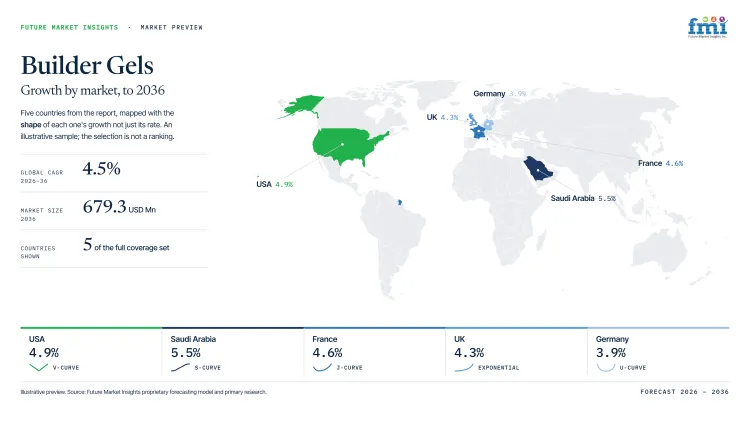
| Country | CAGR |
|---|---|
| UAE | 5.9% |
| Saudi Arabia | 5.5% |
| South Korea | 5.2% |
| USA | 4.9% |
| France | 4.6% |
| UK | 4.3% |
| Germany | 3.9% |
| Japan | 3.6% |
How do country-level CAGRs compare in the Builder Gels Market?
The eight profiled countries span 2.3 percentage points, with UAE and Saudi Arabia forming a clear upper-growth group. South Korea and USA occupy the next band. France and UK sit in a middle tier, with Germany and Japan forming the lower tier. The spacing reflects channel speed, salon structure and product-entry friction more than current market size.
- Premium salon traffic accelerates shade testing.
- Urban beauty retail widens trial frequency.
- Domestic manufacturing shortens assortment refresh cycles.
- Large beauty chains widen structural-gel discovery.
- Nail bars separate services by qualification.
- Independent technicians rely heavily on online ordering.
- Established salons raise switching-cost scrutiny.
- Compact salons reward low-filing application control.
Comparable CAGRs can still produce different entry costs as service structure, import duties and switching economics shape repeat purchasing.
The full report provides country-level CAGR analysis across North America, Latin America, Western Europe, Eastern Europe, East Asia, South Asia and Pacific, and Middle East and Africa.
Country-wise Analysis
- Dubai builder-gel launches depend on import clearance, product registration and salon distributors that can replenish matching shades after technicians qualify a formula, so commercial speed depends on documentation and stock depth as much as product novelty. Builder gel sales in UAE are forecast to expand at 5.9% CAGR through 2036, driven by premium salon demand and fast beauty-product turnover through specialist and digital channels. In October 2025, Dubai Municipality said nearly 13,000 cosmetics and consumer-product establishments operated in Dubai and local entry points handled over 90% of UAE imports, giving registered brands broad channel access but making incomplete files a direct launch-delay risk.
- Saudi builder-gel brands usually enter through local importers that coordinate customs release and salon distribution, so listing quality determines whether commercial inventory reaches technicians on schedule. In March 2025, the Saudi Food and Drug Authority published a searchable listed-cosmetics service covering product names, brands, barcodes and product numbers, making notification status a practical checkpoint at each new professional commercial salon release. Saudi Arabia is projected to record 5.5% CAGR through 2036, attributable to expanding beauty retail and salon demand, but each shade or formula change can require fresh documentation work that slows local replenishment if notification records are incomplete.
- South Korean builder-gel brands sell into a beauty sector where social discovery, fast shade rotation and domestic manufacturing compress the time between product launch and competitive response. Adoption of builder gels in South Korea is estimated to expand at 5.2% CAGR through 2036, tied to dense digital commerce and frequent assortment refreshes that keep structural nail formats visible to younger users. In April 2025, the Ministry of SMEs and Startups launched the K-Beauty Fund with more than 400 beauty SMEs and startups attending, giving smaller cosmetics companies additional commercialization support but leaving static shade ranges exposed to intense local competition.
- USA builder-gel demand is split between licensed nail technicians, professional distributors and direct-consumer systems, so brands must teach one cure protocol to users with very different application experience. The USA Bureau of Labor Statistics reported 152,770 employed manicurists and pedicurists in its May 2025 occupational data, confirming a large professional service base nationally even before self-employed technicians are counted. The USA builder gels outlook is anticipated to advance at 4.9% CAGR through 2036, because professional service depth and direct retail provide several refill routes, although state licensing differences and uneven home technique raise education costs after launch.
- French builder-gel sales pass through salons, nail bars and beauty retailers that do not all operate under the same professional qualification rules, so training assumptions affect product conversion. Builder gel demand in France is forecast to rise at 4.6% CAGR through 2036, helped by established beauty retail and specialist nail services that can support regular fills and shade replenishment. In February 2026, the DGCCRF clarified that manicure is reserved for qualified estheticians but standalone false-nail application can be performed by other nail-bar workers, meaning brands need instructions that remain clear for different operator backgrounds whenever viscosity, cure time or removal steps change.
- Great Britain requires cosmetic products sold to professionals or consumers to carry readable information and a named Responsible Person, making local documentation part of every builder-gel launch. In July 2025, the Office for Product Safety and Standards confirmed that cosmetics placed on the GB market must be notified and linked to a Responsible Person, giving compliant brands a clear listing route but adding work for multinational ranges. Builder gel demand in the UK is predicted to advance at 4.3% CAGR through 2036, aided by salon and online participation, while formula changes can delay relaunches if ingredient records, warnings or labels are not updated together.
- German builder-gel sales run through specialist beauty retail, professional salons and a mature online channel, so formula changes need a visible service benefit to justify technician retraining. Germany is estimated to post 3.9% CAGR through 2036, owing to stable beauty purchasing and digital access that keep refill ordering available even in a slower-growth market. Destatis reported in April 2026 that real retail sales for pharmacies, cosmetics, pharmaceuticals and medical products rose 2.0% year over year in March, confirming active category spending even as experienced technicians resist switches that change viscosity, cure response or removal time without improving service economics.
- Japanese builder-gel sales enter a mature beauty market where controlled application, consistent finish and detailed local instructions carry more weight than rapid assortment turnover for many salon purchases. METI reported in August 2025 that cosmetics and pharmaceuticals e-commerce sales rose 4.54% in 2024 and reached an 8.82% e-commerce ratio, giving specialist brands a measurable digital route without removing the need for professional technique support. By 2036, Japan is projected to grow at 3.6% CAGR, reflecting gradual online expansion and steady salon demand, so localization should prioritize clear Japanese instructions and repeatable cure performance ahead of wider structural shade ranges.
Who are the notable companies in the Builder Gels Market?
The GelBottle Inc, Aprés Nail, Nail Alliance - North America, Inc. (Gelish), and Wella Company are notable companies serving this market.
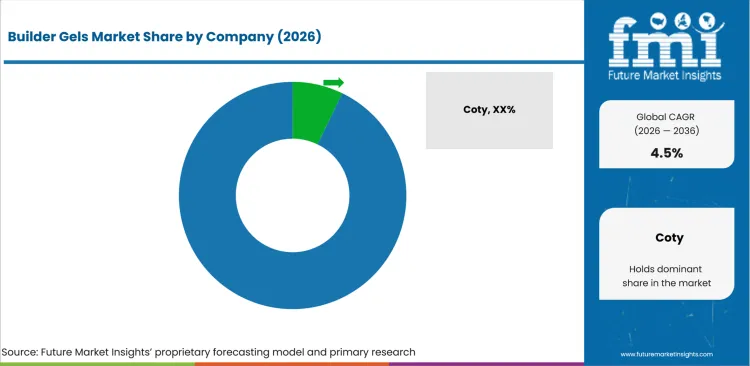
Competition is concentrated among specialist nail brands and beauty platforms with documented structural gel systems. Entry barriers come from cure control, education and refill availability. A broad beauty portfolio alone does not qualify without evidence covering overlays, fills, reinforcement or built length.
- The GelBottle Inc and Aprés Nail focus directly on structural builder formulas, refill use and professional or direct education.
- Nail Alliance - North America, Inc. (Gelish) and Wella Company compete with builder or extension systems linked to broader professional nail portfolios.
Competitive Benchmarking: Builder Gels Market
| Company | Structural Builder-Gel Depth | Cure Protocol & Professional Education | Direct / Professional Channel Coverage | Geographic Reach |
|---|---|---|---|---|
| The GelBottle Inc | High | High | High | Five-continent reach |
| Aprés Nail | Medium | Medium | High | North America-led direct sales |
| Nail Alliance - North America, Inc. (Gelish) | Medium | High | High | North America and selected international markets |
| Wella Company | Medium | High | High | Presence in over 100 countries |
Scoring basis: Structural depth is High for multiple builder formulas, Medium for one system, and Low for adjacent coverage. Education is High with a dedicated course, Medium with detailed guidance, and Low with limited instruction. Channel coverage is High with direct plus professional or retail access, Medium with one major route, and Low with narrower access. Geographic reach is descriptive.
Key Developments in the Builder Gels Market
- In October 2025, The GelBottle Inc introduced Hard BIAB as a file-off builder system offered in twelve shades, extending its builder range toward clients needing greater structural support.
- In July 2025, Aprés Nail introduced a 30ml size of Soft Gel Builder, increasing stock capacity for a two-in-one soak-off builder and base formula used for fills and natural overlays.
- In January 2025, Nail Alliance - North America, Inc. (Gelish) expanded its HEMA-free Brush-On Builder offer to six nude shades for reinforcement, overlays and sculpted length.
Key Players in the Builder Gels Market
Dedicated Builder-Gel Specialists
- The GelBottle Inc
- Aprés Nail
Professional Nail System Platforms
- Nail Alliance - North America, Inc. (Gelish)
- Wella Company
Builder Gels Market - Report Scope
| Coverage field | Report scope |
|---|---|
| Market breakdown | By product type, nature, format, price positioning, sales channel and region. |
| Quantitative Units | USD million. |
| Market Definition | Revenue includes builder gel formulations and builder-gel kits sold for nail reinforcement, structured overlays, fills, repairs, and form-built short or medium extensions. Revenue excludes salon service fees, conventional nail polish, non-structural gel polish, acrylic and dip systems, press-on nails, soft-gel tips, standalone adhesives, and lamps or tools sold separately. |
| Regions Covered | North America, Latin America, Western Europe, Eastern Europe, East Asia, South Asia and Pacific, and Middle East and Africa. |
| Countries Covered | USA, Germany, France, UK, Saudi Arabia, UAE, Japan, South Korea, and 20+ countries included in the full report. |
| Key Companies Profiled | The GelBottle Inc, Aprés Nail, Nail Alliance - North America, Inc. (Gelish), Wella Company. |
| Forecast Period | 2026 to 2036. |
| Approach | Primary and secondary research with market triangulation. |
Builder Gels Market - Research Methodology
| Method | Approach |
|---|---|
| Primary Research | FMI analysts gathered input from manufacturers, service providers, technology developers, distributors, end users, procurement teams, and subject-matter experts. Interviews examined purchasing decisions, product or service evaluation, adoption barriers, approval requirements, pricing considerations, and expectations for technical or commercial support. Respondents were also asked what evidence is required before a trial, pilot, or initial order develops into regular purchasing. |
| Desk Research | Desk research covered government statistics, regulatory publications, trade data, industry associations, technical literature, standards, company filings, product information, and official corporate announcements. Sources were reviewed for relevance, publication date, geographic coverage, and consistency with the defined market scope. Claims relating to performance, applications, approvals, capacity, investment, and commercial activity were retained only when supported by credible public evidence. |
| Market Sizing and Forecasting | The market model combined the baseline value with historical performance, segment structure, pricing and volume indicators, adoption levels, company participation, and country-level demand conditions. Forecast assumptions considered economic activity, investment trends, regulatory developments, technology adoption, purchasing cycles, supply availability, and barriers to wider market use. Segment and regional estimates were reconciled before the final market total was calculated. |
| Data Validation | Estimates were checked against multiple independent indicators, including public data, company activity, trade patterns, industry developments, and findings from primary interviews. Validation also tested whether products, services, applications, and company revenues fell within the defined market boundaries. Adjacent categories, unsupported claims, overlapping revenues, and activities without direct market relevance were excluded to reduce double counting and maintain consistency across segments and countries. |
Builder Gels Market by Segments
Builder Gels Market segmented by Product Type:
- Core - classic lines
- Targeted treatment lines
- Sensitive & gentle lines
- Premium & clinical lines
- Kits & sets
Builder Gels Market segmented by Nature:
- Conventional
- Vegan & cruelty-free
- Natural & organic
- Dermocosmetic - clinical
- Fragrance-free & sensitive
Builder Gels Market segmented by Format:
- Cream & balm
- Liquid & serum
- Stick & solid
- Spray & mist
- Sheet & patch
- Powder
Builder Gels Market segmented by Price Positioning:
- Mass
- Masstige
- Premium
- Professional
Builder Gels Market segmented by Sales Channel:
- E-commerce & DTC
- Specialty beauty retail
- Pharmacies & drugstores
- Supermarkets & hypermarkets
- Salons & spas
Builder Gels Market by Region:
- North America
- United States
- Canada
- Latin America
- Brazil
- Mexico
- Argentina
- Chile
- Western Europe
- Germany
- France
- United Kingdom
- Italy
- Spain
- Benelux
- Nordics
- Eastern Europe
- Poland
- Czech Republic
- Romania
- Hungary
- East Asia
- China
- Japan
- South Korea
- South Asia and Pacific
- India
- ASEAN
- Australia and New Zealand
- Middle East and Africa
- GCC Countries
- South Africa
- Türkiye
- Israel
Research Sources and Bibliography
- The GelBottle Inc. (2025, January). Introducing Our Brand-New Sheer BIAB Collection - 8 Flawless Shades for Every Skin Tone.
- Statistisches Bundesamt. (2026, March 31). Einzelhandelsumsatz im Februar 2026 real um 0,6 % niedriger als im Vormonat.
- Nail Alliance - North America, Inc. (2025, May 21). It's All About The Base.
- European Commission. (2025, August 7). TPO in Nail Products - Questions & Answers.
- Aprés Nail. (2025, July 17). Your Ultimate Gel Guide: Choosing the Right Aprés Gel for Every Nail Need.
- USA Census Bureau. (2026, August 18). Quarterly Retail E-Commerce Sales.
- The GelBottle Inc. (2025, July). Online Nail Courses Now Available: TGB Academy Online Launch.
- Office for Product Safety and Standards. (2026, August 5). OPSS Delivery Report 2025-2026.
- Direction générale de la concurrence, de la consommation et de la répression des fraudes. (2026, February 2). Cosmétiques : des TPE nouvelles dans le secteur qui méconnaissent trop souvent la réglementation.
- USA Bureau of Labor Statistics. (2026, May 15). National employment and wage data from the Occupational Employment and Wage Statistics survey by occupation, May 2025.
- Dubai Municipality. (2025, October 27). Product safety at Beautyworld Middle East 2025.
- Saudi Food and Drug Authority. (2025, March 5). List of Notification of Marketing for Cosmetic Products (Listed Products).
- Ministry of SMEs and Startups. (2025, April 11). MSS Holds K-Beauty Fund Launch Ceremony.
- Direction générale de la concurrence, de la consommation et de la répression des fraudes. (2026, February 19). FAQ - Encadrement des soins esthétiques et de la coiffure.
- Office for Product Safety and Standards. (2025, July 10). Consumer products: cosmetics.
- Statistisches Bundesamt. (2026, April 30). Einzelhandelsumsatz im März 2026 real um 2,0 % niedriger als im Vormonat.
- Ministry of Economy, Trade and Industry. (2025, August 26). Results of FY2024 E-Commerce Market Survey Compiled.
- The GelBottle Inc. (2025, October). Hard BIAB: The Next Chapter for Builder Gel.
- Aprés Nail. (2025, July 7). New Size, Same Strength: Soft Gel Builder Now in 30ml!
- Nail Alliance - North America, Inc. (2025, January 29). Naked Nails.
- OPI. (2025). Meet GELevate by OPI - The Gel Extension System.
- Wella Company. (2026, August 31). OPI Rereleases Celebrated Cult Classic Shades Plus New Remixes of Iconic Hues with OPI’s Most Requested Collection for Fall 2026.
- The GelBottle Inc. (2025, March). Introducing TGB Insiders: Elevate Your Career & Earnings with Our New Advocacy Programme.
- The GelBottle Inc. (2025, September). TPO Explained: Everything You Need to Know.
- The GelBottle Inc. (2025, March). Introducing the World’s First Pastel BIAB Collection!
- The GelBottle Inc. (2026, January). New Year, New BIAB.
- The GelBottle Inc. (2026, June). Fibre BIAB Clear and Colour | TGB Clear Fibre Builder Gel.
- The GelBottle Inc. (2026, May). The TGB Memo - Issue 01: May.
This bibliography is provided for reader reference and is not exhaustive. The full report contains the complete reference list and detailed citations.
This Report Answers
- What is the builder gels market size in 2026 and what value is forecast for 2036?
- Why do multi-use structural services support repeat builder-gel demand?
- Why do core - classic lines hold the leading position within product type?
- How do conventional formulations balance familiar cure behavior with ingredient restrictions?
- Why does cream & balm lead the format category?
- How do growth rates differ across UAE, Saudi Arabia, South Korea, USA, France, UK, Germany and Japan?
- Which companies provide directly documented structural builder-gel systems?
- What should salons and distributors check before switching builder-gel formulas?
Frequently Asked Questions
How big is the builder gels market in 2026?
The builder gels market is valued at USD 437.4 million in 2026 and is projected to reach USD 679.3 million by 2036. Demand rises as structural gels move between professional reinforcement, fills and short-extension services.
What is the CAGR of the builder gels market from 2026 to 2036?
The builder gels market is projected to grow at a CAGR of 4.5% between 2026 and 2036. Expansion is supported by repeat structural services, at-home systems and digital refill purchasing.
Which product type leads the builder gels market?
The core - classic lines segment is expected to hold 39.0% of the builder gels market in 2026, attributable to clear and neutral builders covering the widest routine service range. Their versatility supports overlays, fills and reinforcement.
Which nature segment leads the builder gels market?
The conventional segment is projected to represent 58.0% of the builder gels market in 2026, driven by familiar photopolymer curing and removal behavior. Formula changes must preserve that performance as ingredient rules tighten.
Which countries are projected to record the highest growth in the builder gels market?
UAE is projected to grow at 5.9% CAGR, followed by Saudi Arabia at 5.5% and South Korea at 5.2% through 2036. Their faster profiles reflect active beauty commerce, distributor development and rapid digital product discovery.
Which companies are active in the builder gels market?
Key companies operating in the builder gels market include The GelBottle Inc, Aprés Nail, Nail Alliance - North America, Inc. (Gelish), and Wella Company. They compete through formula depth, professional education, channel access and system-specific application support.
Preview the report firsthand - request a free sample
Get SampleGet the brochure for pricing and purchase details.
Get PDFTable of Content
- Key Takeaways
- Market Size and CAGR
- Top Growth Driver
- Fastest Growing Segment
- Leading Region
- Key Companies
- Emerging Opportunities
- Executive Summary
- Global Market Outlook
- Demand-side Trends
- Supply-side Trends
- Technology Roadmap Analysis
- Analysis and Recommendations
- Analyst Perspective (What is happening? Why now? What should investors know?)
- Key Questions Answered
- How large is the market?
- What is the CAGR?
- What are key trends?
- Which region dominates?
- Who are the leaders?
- Market Overview
- Market Coverage / Taxonomy
- Market Definition / Scope / Limitations
- Research Methodology
- Chapter Orientation
- Analytical Lens and Working Hypotheses
- Market Structure, Signals, and Trend Drivers
- Benchmarking and Cross-market Comparability
- Market Sizing, Forecasting, and Opportunity Mapping
- Research Design and Evidence Framework
- Desk Research Programme (Secondary Evidence)
- Expert Input and Fieldwork (Primary Evidence)
- Tooling, Models, and Reference Databases
- Data Engineering and Model Build
- Quality Assurance and Audit Trail
- Market Background
- Market Dynamics (Drivers, Restraints, Opportunity, Trends)
- Scenario Forecast (Optimistic, Likely, Conservative)
- Impact Analysis
- AI Impact
- Sustainability Impact
- Regulatory Impact
- Technology Impact
- Consumer / Buyer Analysis
- Purchase Drivers
- Adoption Barriers
- Buyer Journey
- Opportunity Map Analysis
- Product Life Cycle Analysis
- Supply Chain Analysis
- Investment Feasibility Matrix
- Value Chain Analysis
- PESTLE and Porter's Analysis
- Regulatory Landscape
- Regional Parent Market Outlook
- Production and Consumption Statistics
- Import and Export Statistics
- Global Market Analysis and Forecast, 2021 to 2036
- Historical Market Size Value (USD Million) Analysis, 2021 to 2025
- Current and Future Market Size Value (USD Million) Projections, 2026 to 2036
- Y-o-Y Growth Trend Analysis
- Absolute $ Opportunity Analysis
- Global Market Pricing Analysis, 2021 to 2036
- Global Market Analysis and Forecast, By Product Type, 2021 to 2036
- Introduction / Key Findings
- Historical Market Size Value (USD Million) Analysis By Product Type, 2021 to 2025
- Current and Future Market Size Value (USD Million) Analysis and Forecast By Product Type, 2026 to 2036
- Core / classic lines
- Targeted treatment lines
- Sensitive & gentle lines
- Premium & clinical lines
- Kits & sets
- Core / classic lines
- Y-o-Y Growth Trend Analysis By Product Type, 2021 to 2025
- Absolute $ Opportunity Analysis By Product Type, 2026 to 2036
- Global Market Analysis and Forecast, By Nature, 2021 to 2036
- Introduction / Key Findings
- Historical Market Size Value (USD Million) Analysis By Nature, 2021 to 2025
- Current and Future Market Size Value (USD Million) Analysis and Forecast By Nature, 2026 to 2036
- Conventional
- Vegan & cruelty-free
- Natural & organic
- Dermocosmetic / clinical
- Fragrance-free & sensitive
- Conventional
- Y-o-Y Growth Trend Analysis By Nature, 2021 to 2025
- Absolute $ Opportunity Analysis By Nature, 2026 to 2036
- Global Market Analysis and Forecast, By Format, 2021 to 2036
- Introduction / Key Findings
- Historical Market Size Value (USD Million) Analysis By Format, 2021 to 2025
- Current and Future Market Size Value (USD Million) Analysis and Forecast By Format, 2026 to 2036
- Cream & balm
- Liquid & serum
- Stick & solid
- Spray & mist
- Sheet & patch
- Powder
- Cream & balm
- Y-o-Y Growth Trend Analysis By Format, 2021 to 2025
- Absolute $ Opportunity Analysis By Format, 2026 to 2036
- Global Market Analysis and Forecast, By Price Positioning, 2021 to 2036
- Introduction / Key Findings
- Historical Market Size Value (USD Million) Analysis By Price Positioning, 2021 to 2025
- Current and Future Market Size Value (USD Million) Analysis and Forecast By Price Positioning, 2026 to 2036
- Mass
- Masstige
- Premium
- Professional
- Mass
- Y-o-Y Growth Trend Analysis By Price Positioning, 2021 to 2025
- Absolute $ Opportunity Analysis By Price Positioning, 2026 to 2036
- Global Market Analysis and Forecast, By Sales Channel, 2021 to 2036
- Introduction / Key Findings
- Historical Market Size Value (USD Million) Analysis By Sales Channel, 2021 to 2025
- Current and Future Market Size Value (USD Million) Analysis and Forecast By Sales Channel, 2026 to 2036
- E-commerce & DTC
- Specialty beauty retail
- Pharmacies & drugstores
- Supermarkets & hypermarkets
- Salons & spas
- E-commerce & DTC
- Y-o-Y Growth Trend Analysis By Sales Channel, 2021 to 2025
- Absolute $ Opportunity Analysis By Sales Channel, 2026 to 2036
- Global Market Analysis and Forecast, By Region, 2021 to 2036
- Introduction
- Historical Market Size Value (USD Million) Analysis By Region, 2021 to 2025
- Current Market Size Value (USD Million) Analysis and Forecast By Region, 2026 to 2036
- North America
- Latin America
- Western Europe
- Eastern Europe
- East Asia
- South Asia and Pacific
- Middle East & Africa
- Market Attractiveness Analysis By Region
- North America Market Analysis and Forecast, By Country, 2021 to 2036
- Historical Market Size Value (USD Million) Trend Analysis By Market Taxonomy, 2021 to 2025
- Market Size Value (USD Million) Forecast By Market Taxonomy, 2026 to 2036
- By Country
- USA
- Canada
- By Product Type
- By Nature
- By Format
- By Price Positioning
- By Sales Channel
- By Country
- Market Attractiveness Analysis
- By Country
- By Product Type
- By Nature
- By Format
- By Price Positioning
- By Sales Channel
- Key Takeaways
- Latin America Market Analysis and Forecast, By Country
- Historical Market Size Value (USD Million) Trend Analysis By Market Taxonomy, 2021 to 2025
- Market Size Value (USD Million) Forecast By Market Taxonomy, 2026 to 2036
- By Country
- Brazil
- Mexico
- Chile
- Rest of Latin America
- By Product Type
- By Nature
- By Format
- By Price Positioning
- By Sales Channel
- By Country
- Market Attractiveness Analysis
- By Country
- By Product Type
- By Nature
- By Format
- By Price Positioning
- By Sales Channel
- Key Takeaways
- Western Europe Market Analysis and Forecast, By Country
- Historical Market Size Value (USD Million) Trend Analysis By Market Taxonomy, 2021 to 2025
- Market Size Value (USD Million) Forecast By Market Taxonomy, 2026 to 2036
- By Country
- Germany
- UK
- Italy
- Spain
- France
- Nordic
- BENELUX
- Rest of Western Europe
- By Product Type
- By Nature
- By Format
- By Price Positioning
- By Sales Channel
- By Country
- Market Attractiveness Analysis
- By Country
- By Product Type
- By Nature
- By Format
- By Price Positioning
- By Sales Channel
- Key Takeaways
- Eastern Europe Market Analysis and Forecast, By Country
- Historical Market Size Value (USD Million) Trend Analysis By Market Taxonomy, 2021 to 2025
- Market Size Value (USD Million) Forecast By Market Taxonomy, 2026 to 2036
- By Country
- Russia
- Poland
- Hungary
- Balkan & Baltic
- Rest of Eastern Europe
- By Product Type
- By Nature
- By Format
- By Price Positioning
- By Sales Channel
- By Country
- Market Attractiveness Analysis
- By Country
- By Product Type
- By Nature
- By Format
- By Price Positioning
- By Sales Channel
- Key Takeaways
- East Asia Market Analysis and Forecast, By Country
- Historical Market Size Value (USD Million) Trend Analysis By Market Taxonomy, 2021 to 2025
- Market Size Value (USD Million) Forecast By Market Taxonomy, 2026 to 2036
- By Country
- China
- Japan
- South Korea
- By Product Type
- By Nature
- By Format
- By Price Positioning
- By Sales Channel
- By Country
- Market Attractiveness Analysis
- By Country
- By Product Type
- By Nature
- By Format
- By Price Positioning
- By Sales Channel
- Key Takeaways
- South Asia and Pacific Market Analysis and Forecast, By Country
- Historical Market Size Value (USD Million) Trend Analysis By Market Taxonomy, 2021 to 2025
- Market Size Value (USD Million) Forecast By Market Taxonomy, 2026 to 2036
- By Country
- India
- ASEAN
- Australia & New Zealand
- Rest of South Asia and Pacific
- By Product Type
- By Nature
- By Format
- By Price Positioning
- By Sales Channel
- By Country
- Market Attractiveness Analysis
- By Country
- By Product Type
- By Nature
- By Format
- By Price Positioning
- By Sales Channel
- Key Takeaways
- Middle East & Africa Market Analysis and Forecast, By Country
- Historical Market Size Value (USD Million) Trend Analysis By Market Taxonomy, 2021 to 2025
- Market Size Value (USD Million) Forecast By Market Taxonomy, 2026 to 2036
- By Country
- Kingdom of Saudi Arabia
- Other GCC Countries
- Türkiye
- South Africa
- Other African Union
- Rest of Middle East & Africa
- By Product Type
- By Nature
- By Format
- By Price Positioning
- By Sales Channel
- By Country
- Market Attractiveness Analysis
- By Country
- By Product Type
- By Nature
- By Format
- By Price Positioning
- By Sales Channel
- Key Takeaways
- Key Countries Market Analysis
- USA
- Pricing Analysis
- Market Share Analysis, 2025
- By Product Type
- By Nature
- By Format
- By Price Positioning
- By Sales Channel
- Canada
- Pricing Analysis
- Market Share Analysis, 2025
- By Product Type
- By Nature
- By Format
- By Price Positioning
- By Sales Channel
- Mexico
- Pricing Analysis
- Market Share Analysis, 2025
- By Product Type
- By Nature
- By Format
- By Price Positioning
- By Sales Channel
- Brazil
- Pricing Analysis
- Market Share Analysis, 2025
- By Product Type
- By Nature
- By Format
- By Price Positioning
- By Sales Channel
- Chile
- Pricing Analysis
- Market Share Analysis, 2025
- By Product Type
- By Nature
- By Format
- By Price Positioning
- By Sales Channel
- Germany
- Pricing Analysis
- Market Share Analysis, 2025
- By Product Type
- By Nature
- By Format
- By Price Positioning
- By Sales Channel
- UK
- Pricing Analysis
- Market Share Analysis, 2025
- By Product Type
- By Nature
- By Format
- By Price Positioning
- By Sales Channel
- Italy
- Pricing Analysis
- Market Share Analysis, 2025
- By Product Type
- By Nature
- By Format
- By Price Positioning
- By Sales Channel
- Spain
- Pricing Analysis
- Market Share Analysis, 2025
- By Product Type
- By Nature
- By Format
- By Price Positioning
- By Sales Channel
- France
- Pricing Analysis
- Market Share Analysis, 2025
- By Product Type
- By Nature
- By Format
- By Price Positioning
- By Sales Channel
- India
- Pricing Analysis
- Market Share Analysis, 2025
- By Product Type
- By Nature
- By Format
- By Price Positioning
- By Sales Channel
- ASEAN
- Pricing Analysis
- Market Share Analysis, 2025
- By Product Type
- By Nature
- By Format
- By Price Positioning
- By Sales Channel
- Australia & New Zealand
- Pricing Analysis
- Market Share Analysis, 2025
- By Product Type
- By Nature
- By Format
- By Price Positioning
- By Sales Channel
- China
- Pricing Analysis
- Market Share Analysis, 2025
- By Product Type
- By Nature
- By Format
- By Price Positioning
- By Sales Channel
- Japan
- Pricing Analysis
- Market Share Analysis, 2025
- By Product Type
- By Nature
- By Format
- By Price Positioning
- By Sales Channel
- South Korea
- Pricing Analysis
- Market Share Analysis, 2025
- By Product Type
- By Nature
- By Format
- By Price Positioning
- By Sales Channel
- Russia
- Pricing Analysis
- Market Share Analysis, 2025
- By Product Type
- By Nature
- By Format
- By Price Positioning
- By Sales Channel
- Poland
- Pricing Analysis
- Market Share Analysis, 2025
- By Product Type
- By Nature
- By Format
- By Price Positioning
- By Sales Channel
- Hungary
- Pricing Analysis
- Market Share Analysis, 2025
- By Product Type
- By Nature
- By Format
- By Price Positioning
- By Sales Channel
- Kingdom of Saudi Arabia
- Pricing Analysis
- Market Share Analysis, 2025
- By Product Type
- By Nature
- By Format
- By Price Positioning
- By Sales Channel
- Türkiye
- Pricing Analysis
- Market Share Analysis, 2025
- By Product Type
- By Nature
- By Format
- By Price Positioning
- By Sales Channel
- South Africa
- Pricing Analysis
- Market Share Analysis, 2025
- By Product Type
- By Nature
- By Format
- By Price Positioning
- By Sales Channel
- USA
- Market Structure Analysis
- Competition Dashboard
- Competition Benchmarking
- Market Share Analysis of Top Players
- By Regional
- By Product Type
- By Nature
- By Format
- By Price Positioning
- By Sales Channel
- Emerging Startups
- Innovation Benchmarking
- Competition Analysis
- Competition Deep Dive
- Coty
- Overview
- Product Portfolio
- Profitability by Market Segments
- Sales Footprint
- Strategy Overview
- Marketing Strategy
- Product Strategy
- Channel Strategy
- L'Oreal
- Church & Dwight
- e.l.f. Beauty
- Wella Company
- Glamnetic
- Unilever
- Kiss Products
- Estee Lauder Companies
- Olive & June
- Coty
- Case Studies
- Success Stories
- Recent Developments
- Competition Deep Dive
- Assumptions & Acronyms Used


