

- Market Size (2026)
- USD 520.6 Mn
- Forecast (2036)
- USD 856.1 Mn
- CAGR (2026 to 2036)
- 5.1%
How big is Cable Release Agent Market in 2026?
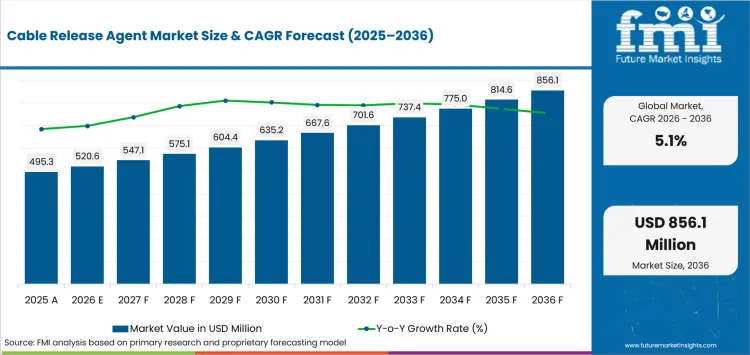
USD 520.6 million in 2026 and USD 856.1 million by 2036 at a 5.1% CAGR.
Demand for cable release agents is projected to expand at 5.1% CAGR between 2026 and 2036, increasing valuation from USD 520.6 million in 2026 to USD 856.1 million by 2036. Higher wire and cable production raises the cost of die fouling as every cleaning stop removes usable extrusion time. Prysmian opened a 340,800-square-foot copper building wire plant in Texas during April 2026 and expanded its adjacent service center to one million square feet. The added capacity raises the operating value of qualified release chemistry during production.
Cable release-agent demand converts differently by country as grid construction changes cable schedules without removing plant qualification requirements. The USA Department of Energy announced an approximately USD 1.9 billion funding opportunity for urgent grid upgrades in March 2026 as electricity loads increased. USA cable plants therefore face replacement and expansion work while German plants place heavier documentation demands on chemistry changes. Companies serving medium-voltage cable systems need local trials that prove low transfer before recurring orders replace sample volumes.
Key Takeaways of Cable Release Agent Market
- Grid expansion and higher cable output increase demand for release chemistry that reduces fouling without disturbing downstream jacket performance.
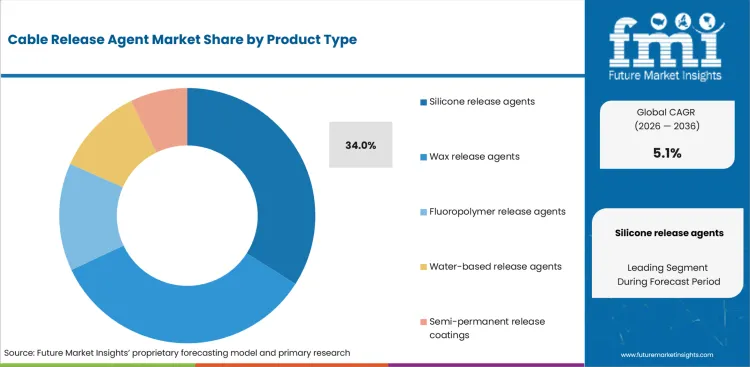
- The silicone release agents segment is likely to capture 34.0% share in 2026 attributable to stable release across heat-exposed cable polymers.
- Liquid is set to lead the form category with 39.0% share in 2026 due to flexible film dosing across varied tooling geometries.
- The application category is forecast to be led by cable extrusion tooling at 31.0% share in 2026 due to continuous-line sensitivity to deposits and cleaning stops.
- Line-specific qualification restrains switching by raising residue risks that can disrupt printing or bonding despite improved release performance.
- Active companies include Chem-Trend, Wacker Chemie, Momentive, Dow, Shin-Etsu Chemical, Henkel, McLube, and Parker LORD.
Analyst Perspective
"Process engineers should start with downstream surface requirements because easier die release has little value if residue disrupts printing or accessory bonding. Commercial value comes from pairing the chemistry with application settings that remain repeatable across qualified compounds and production shifts."
- Nikhil Kaitwade, Principal Consultant, Future Market Insights
How is the Cable Release Agent Market segmented?
The cable release agent market is segmented by chemistry, form, application, end use, sales channel, and region.
Chemistry includes silicone, wax, fluoropolymer, water-based and semi-permanent systems. Form covers liquid, aerosol / spray, emulsion and paste / concentrate. Applications include cable extrusion tooling, molded cable accessories, connector overmolding, rubber cable processing and spooling / handling release. End users are cable manufacturers, molded accessory makers, rubber processors and contract compounders. Sales channels cover direct chemical supply, industrial distributors and tooling / maintenance supply.
Why do silicone release agents lead demand within the chemistry category?
Silicone chemistry suits cable lines as low surface energy can release rubber and thermoplastic compounds under repeated heat exposure. Dow announced about USD 100 million of specialty-silicone investment across the United States and Asia in June 2026 to expand manufacturing capacity.
- Based on chemistry, silicone release agents are projected to account for 34.0% in 2026 due to thermal stability during repeated cable-processing cycles.
- Cable process engineers test silicone fluid applications against jacket printing and accessory bonding to prevent residue from compromising later operations. Low-transfer formulations therefore receive stronger consideration on lines that combine extrusion with printing or bonded accessory production.
Why does liquid lead demand within the form category?
Liquid release agents let plant technicians meter film weight on dies and molds during continuous production without changing the underlying release chemistry.
- By form, liquid is estimated to hold 39.0% in 2026 owing to flexible dosing across continuous equipment and maintenance work.
- Wacker Chemie reported in March 2026 that 2025 spending extended capacity at Zhangjiagang, a site making silicone fluids and emulsions for silicone elastomer processing. Cable plants qualify liquid carriers on their own tooling to confirm stable drying and film weight until repeat orders replace trial volumes. Application engineers compare drying time with line speed and film transfer during controlled production trials.
Why does cable extrusion tooling lead demand within the application category?
Deposit buildup on extrusion dies processing wire and cable compounds can mark finished cable jackets and force unscheduled cleaning during production runs at high line speeds.
- By application, cable extrusion tooling is forecast to represent 31.0% in 2026 driven by costly deposit-related line stops. Nexans reported in September 2025 that EIB financing would back industrial investments including a Lens copper-wire factory planned for 2026.
- Plant engineers compare release performance with cleaning frequency and jacket quality at the polymer formulation and line speed used in routine production. A formulation that reduces die stops without changing printability or bonding can convert a plant trial into recurring supply.
Why do cable manufacturers lead demand within the end use category?
Cable manufacturers use release agents across extrusion and accessory-processing workflows that repeat every shift under different polymer compounds and tooling temperatures.
- Cable manufacturers are projected to hold 45.0% share in 2026 owing to repeated sticking and tooling-cleaning costs at high-throughput facilities.
- Unstable tool release becomes more costly on high-voltage cable programs as production interruptions remove output from tightly scheduled lines. Technical teams therefore compare residue behavior across several compounds as a condition for approving a release agent on another production line. Prysmian reported in May 2025 that its completed Pikkala expansion added a line producing about one cable kilometer daily for cable accessories.
What are the drivers, restraints and opportunities in the Cable Release Agent Market?
Higher cable production raises release-agent demand while line qualification and contamination risks slow chemistry switching across established plants. Water-based or nonfluorinated systems offer a differentiated route when they preserve release consistency and downstream surface performance.
- Driver: Grid and industrial cable programs increase extrusion hours and make fouling or unplanned tool cleaning more costly.
- Restraint: Release chemistry requires line-specific validation to prevent residue or transfer from disrupting jacket printing and later bonding performance.
- Opportunity: Water-based and nonfluorinated formulations can address handling or reporting pressures when they also meet existing release and drying requirements.
Cable Production Raises the Cost of Tool Fouling
Release agent formulations earn recurring orders by reducing die-cleaning time on cable lines at high production rates. The USA Department of Energy said in January 2025 that a proposed AEP program could rebuild or reconductor almost 5,000 transmission miles across five states. Grid work at that scale raises cable-production requirements and increases the value of qualified formulations that reduce fouling without changing jacket quality.
Qualification Risk Slows Chemistry Changes
Plant engineers cannot accept a release formulation that solves sticking but leaves residue that disrupts jacket printing or bonded accessories. The USA Environmental Protection Agency proposed in January 2025 to clarify notification timing for products containing TRI-listed PFAS. Chemical formulators serving cable plants need composition records and line trials for fluoropolymer coatings that avoid new surface-quality risks during routine qualification.
Nonfluorinated Formulations Offer a Qualification Route
Commercial use of water-based and nonfluorinated formulations depends on maintaining release consistency across the qualified cable process. The USA Environmental Protection Agency added nine PFAS to the Toxics Release Inventory in January 2025 and raised the reporting-year total to 205. Release-agent formulators seeking to displace high-performance fluoropolymers must match the drying and line-stability requirements already qualified by cable plants during extrusion.
Which country CAGRs are profiled in the Cable Release Agent Market?
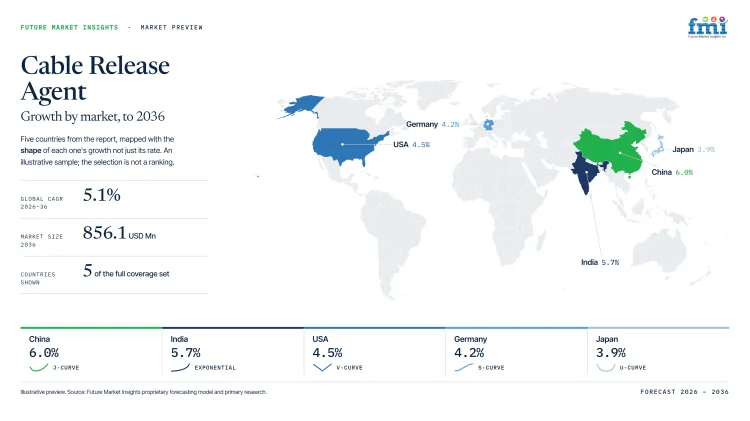
| Country | CAGR |
|---|---|
| Mexico | 4.9% |
| Italy | 4.6% |
| USA | 4.5% |
| Germany | 4.2% |
| Japan | 3.9% |
How do country-level CAGRs compare in the Cable Release Agent Market?
The five profiled markets span 1.0 percentage point between Mexico and Japan during the forecast period. Mexico and Italy form a narrow upper pair as transmission programs add cable-production load. The USA and Germany remain close despite different plant structures, while Japan anchors the lower end with controlled qualification practices.
- CFE reinforcement concentrates Mexican cable demand in industrial corridors requiring local chemical stock.
- Italian submarine interconnector work favors low-transfer formulations for specified high-voltage cable production.
- Dispersed USA replacement projects reward application teams reaching plants quickly during qualification.
- German grid planning reinforces documentation for residue control during cable-plant chemistry changes.
- Japanese HVDC capacity plans favor disciplined transfer testing before new release chemistries enter standardized lines.
Comparable CAGRs produce different service costs and qualification timelines across identical formulations.
The full report provides country-level CAGR analysis across North America, Latin America, Europe, East Asia, South Asia, Oceania and the Middle East and Africa.
Country-wise Analysis
- Mexican cable plants serve industrial corridors that cannot absorb avoidable extrusion stops during utility and manufacturing orders. CFE's August 2025 transmission plan covers 275 new lines and 524 substation works under USD 8.177 billion of planned investment. Mexico is estimated to post 4.9% CAGR over the forecast period, supported by cable schedules that reward stable release performance on high-volume lines. Regional stocking shortens replenishment, but varied compounds and plant scales keep qualification local and favor bilingual application engineers who document film transfer quickly. New entrants therefore need service coverage near major manufacturing clusters instead of relying on cross-border deliveries for routine trial support.
- Italian cable processors serve domestic grid upgrades and submarine interconnector projects with tightly specified high-voltage constructions that make residue transfer a serious qualification concern. Italy's cable release agent outlook is anticipated to advance at 4.6% CAGR over the assessment period, aided by recurring production for utility and export programs. Terna's April 2025 plan targets roughly 39 GW of exchange capacity between market zones compared with 16 GW at the time. Italian plants can run detailed trials, although different polymer constructions keep formulation approval site-specific across domestic factories. Release-agent companies therefore compete on transferable technical records and dependable local supply across tightly controlled cable programs.
- USA cable manufacturers serve building-wire plants and utility programs with different compounds, printing requirements and qualification routines across a dispersed production base. Cable release agent sales in the USA are forecast to expand at 4.5% CAGR by 2036, shaped by recurring output across regional facilities. Plant specifications differ on printing and bonding performance, so local application engineers must reproduce residue behavior for each new formulation entering repeat supply. DOE's July 2026 draft Needs Study found a pressing need for additional transmission infrastructure as data centers and manufacturing raised electricity loads. Producers that can revisit trials quickly reduce approval delays across plants that cannot share one release specification.
- German cable plants use extrusion equipment and process records that make chemistry changes slower than replenishing an approved release agent. The German cable release agent sector is projected to record 4.2% CAGR during the assessment period, shaped by steady utility work. Technical teams require residue data that survives quality review on jackets scheduled for later printing or bonding. Local application engineers can shorten trials by reproducing film weight and drying conditions on existing compounds. Bundesnetzagentur reported in June 2026 that 118 of 159 proposed grid measures were provisionally confirmable, tying transmission investment to planning gates. Release-agent companies therefore need documentation that remains usable across Germany's project and qualification cycles.
- Japanese cable processors use production controls on power-cable lines, so residue variation receives careful review during standardization. Adoption of cable release agents in Japan is estimated to expand at 3.9% CAGR through 2036, influenced by high-voltage investment. Plant engineers test transfer on the polymer compound to prevent formulation changes from affecting later printing or accessory bonding. Local technical teams reproduce trials carefully, but that discipline lengthens the route from samples to recurring supply. Planned high-voltage capacity therefore raises the value of stable release data without representing current production. Furukawa Electric's October 2025 investment covers a planned Chiba HVDC line with 200 km annual capacity and operations targeted by 2030.
Who are the notable companies in the Cable Release Agent Market?
Notable companies include Chem-Trend, Wacker Chemie, Momentive, Dow, Shin-Etsu Chemical, Henkel, McLube, and Parker LORD.
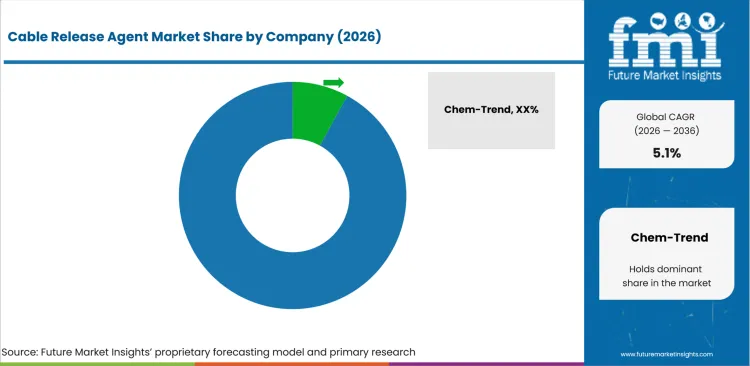
Competition is split between specialist release formulators and larger silicone or engineered-material companies entering from adjacent polymer applications. Entry depends on proving low transfer and stable film behavior on the cable plant's exact compound. Companies with broader silicone materials use local application support to convert controlled trials into repeat supply.
- Chem-Trend and McLube compete as release specialists with formulation choice and direct support during controlled plant trials.
- Wacker Chemie, Momentive, Dow, and Shin-Etsu Chemical participate from broader silicone platforms serving industrial polymer processing.
- Henkel and Parker LORD compete from engineered-material portfolios that overlap rubber or polymer processing at the market boundary.
Competitive Benchmarking: Cable Release Agent Market
| Company | Cable and Elastomer Process Fit | Release Chemistry Breadth | Technical Application Support | Geographic Reach |
|---|---|---|---|---|
| Chem-Trend | High | High | High | North America, Europe, Asia, and Latin America |
| Wacker Chemie | High | Medium | High | Europe, Asia, North America, and Latin America |
| Momentive | Medium | Medium | Medium | North America, Europe, and Asia |
| Dow | High | Medium | High | Americas, Europe, and Asia-Pacific |
| Shin-Etsu Chemical | Medium | High | Medium | Japan, Asia, North America, and Europe |
| Henkel | Medium | High | High | Global industrial network |
| McLube | High | High | High | North America with international distribution |
| Parker LORD | High | Medium | High | Global Parker distribution network |
Key Developments in the Cable Release Agent Market
- In April 2026, Shin-Etsu Chemical announced a price increase of 10% or more across its Silicone Division from May 1. The increase changes silicone input costs for release-agent formulations but does not establish cable-specific product activity.
- In February 2025, Momentive and Jiangxi Hungpai signed a definitive Asia-Pacific silane manufacturing joint-venture agreement. The proposed venture remains subject to closing conditions and is adjacent to cable release-agent formulations.
- In January 2025, Wacker Chemie commissioned specialty-silicone plants in Tsukuba and Jincheon for industrial markets. The capacity broadens Asian specialty-silicone availability without establishing cable release-agent production at either documented site.
Key Players in the Cable Release Agent Market
Process-Focused Release Specialists
- Chem-Trend
- McLube
Silicone and Specialty-Materials Platforms
- Wacker Chemie
- Momentive
- Dow
- Shin-Etsu Chemical
Engineered Polymer-Processing Suppliers
- Henkel
- Parker LORD
Cable Release Agent Market - Report Scope
| Coverage field | Report scope |
|---|---|
| Market breakdown | By chemistry, form, application, end use, sales channel and region. |
| Quantitative Units | Revenue in USD million and CAGR in %. |
| Market Definition | Commercial revenue from release and anti-stick agents supplied for cable extrusion, molding, accessory processing, and related cable-production operations. |
| Regions Covered | North America, Latin America, Europe, East Asia, South Asia and Pacific and Middle East and Africa. |
| Countries Covered | Mexico, Italy, USA, Germany, Japan, and 20+ countries included in the full report. |
| Key Companies Profiled | Chem-Trend, Wacker Chemie, Momentive, Dow, Shin-Etsu Chemical, Henkel, McLube, and Parker LORD. |
| Forecast Period | 2026 to 2036. |
| Approach | Primary and secondary research with market triangulation. |
Cable Release Agent Market - Research Methodology
| Method | Approach |
|---|---|
| Primary Research | FMI analysts gathered input from manufacturers, service providers, technology developers, distributors, end users, procurement teams, and subject-matter experts. Interviews examined purchasing decisions, product or service evaluation, adoption barriers, approval requirements, pricing considerations, and expectations for technical or commercial support. Respondents were also asked what evidence is required before a trial, pilot, or initial order develops into regular purchasing. |
| Desk Research | Desk research covered government statistics, regulatory publications, trade data, industry associations, technical literature, standards, company filings, product information, and official corporate announcements. Sources were reviewed for relevance, publication date, geographic coverage, and consistency with the defined market scope. Claims relating to performance, applications, approvals, capacity, investment, and commercial activity were retained only when supported by credible public evidence. |
| Market Sizing and Forecasting | The market model combined the baseline value with historical performance, segment structure, pricing and volume indicators, adoption levels, company participation, and country-level demand conditions. Forecast assumptions considered economic activity, investment trends, regulatory developments, technology adoption, purchasing cycles, supply availability, and barriers to wider market use. Segment and regional estimates were reconciled before the final market total was calculated. |
| Data Validation | Estimates were checked against multiple independent indicators, including public data, company activity, trade patterns, industry developments, and findings from primary interviews. Validation also tested whether products, services, applications, and company revenues fell within the defined market boundaries. Adjacent categories, unsupported claims, overlapping revenues, and activities without direct market relevance were excluded to reduce double counting and maintain consistency across segments and countries. |
Cable Release Agent Market by Segments
Cable Release Agent Market segmented by Chemistry:
- Silicone release agents
- Wax release agents
- Fluoropolymer release agents
- Water-based release agents
- Semi-permanent release coatings
Cable Release Agent Market segmented by Form:
- Liquid
- Aerosol / spray
- Emulsion
- Paste / concentrate
Cable Release Agent Market segmented by Application:
- Cable extrusion tooling
- Molded cable accessories
- Connector overmolding
- Rubber cable processing
- Spooling / handling release
Cable Release Agent Market segmented by End Use:
- Cable manufacturers
- Molded accessory makers
- Rubber processors
- Contract compounders
Cable Release Agent Market segmented by Sales Channel:
- Direct chemical supply
- Industrial distributors
- Tooling / maintenance supply
Cable Release Agent Market by Region:
- North America
- United States
- Canada
- Latin America
- Brazil
- Mexico
- Chile
- Rest of Latin America
- Western Europe
- Germany
- United Kingdom
- Italy
- Spain
- France
- Nordics
- Benelux
- Rest of Western Europe
- Eastern Europe
- Russia
- Poland
- Hungary
- Balkan and Baltic States
- Rest of Eastern Europe
- East Asia
- China
- Japan
- South Korea
- South Asia and Pacific
- India
- ASEAN
- Australia and New Zealand
- Rest of South Asia and Pacific
- Middle East and Africa
- Kingdom of Saudi Arabia
- Other GCC Countries
- Türkiye
- South Africa
- Other African Union Countries
- Rest of Middle East and Africa
Research Sources and Bibliography
- Prysmian. (2026, April 13). Prysmian | Encore Wire Unveils New Industry-Leading Plant and 1M Square Foot Service Center.
- USA Department of Energy. (2026, March 12). Energy Department Announces $1.9B Investment in Critical Grid Infrastructure to Reduce Electricity Costs.
- Dow. (2026, June 23). Dow expands product and innovation capabilities to support continued growth in specialty silicones markets.
- Wacker Chemie AG. (2026, March 11). Silicones.
- Nexans. (2025, September 22). EIB Provides €250 Million for Nexans R&D Investments.
- Prysmian. (2025, May 14). PRYSMIAN’S TRANSMISSION BUSINESS STRENGTHENED AS ITS STATE-OF-THE-ART PRYSMIAN MONNA LISA SUBMARINE CABLE LAYING VESSEL AND SUBMARINE CABLES’ FACTORY EXPANSION IN FINLAND ARE UNVEILED.
- USA Department of Energy. (2025, January 16). LPO Announces Conditional Commitment to AEP to Upgrade Nearly 5,000 Miles of Transmission Lines.
- USA Environmental Protection Agency. (2025, January 16). EPA Proposes Rule to Clarify Supplier Notification Requirements for TRI-Listed PFAS.
- USA Environmental Protection Agency. (2025, January 3). EPA Adds Nine Additional PFAS to the Toxics Release Inventory.
- Proyectos México. (2025, August 22). CFE will invest 8.177 billion USD to strengthen the Transmission Network.
- Terna S.p.A. (2025, April 14). The future of Italy hinges on its electricity transmission grid.
- USA Department of Energy. (2026, July 9). DOE’s Office of Electricity Publishes 2026 Draft National Transmission Needs Study to Strengthen America’s Grid.
- Bundesnetzagentur. (2026, June 12). Bundesnetzagentur launches consultation on the network development plan for the expansion of the electricity grid.
- Furukawa Electric Co., Ltd. (2025, October 8). Notice regarding capital expenditure (acquisition of non-current asset) for the production of HVDC cable.
- Shin-Etsu Chemical Co., Ltd. (2026, April). Revision to Selling Price of Silicone.
- Momentive Performance Materials. (2025, February 25). Momentive and Jiangxi Hungpai New Material Co., Ltd Announce Strategic Joint Venture Agreement in Asia Pacific.
- Wacker Chemie AG. (2026, March 11). Highlights from 2025.
This bibliography is provided for reader reference and is not exhaustive. The full report contains the complete reference list and detailed citations.
This Report Answers
- How large is the cable release agent market in 2026 and 2036?
- Which production conditions convert cable output into recurring release-agent demand?
- Why do silicone release agents account for 34.0% of chemistry demand in 2026?
- How does liquid form affect application control and drying across cable tools and molded components?
- Why does cable extrusion tooling account for the largest application share within the current market model?
- How do growth conditions differ across Mexico, Italy, the USA, Germany, and Japan during the forecast period?
- Which qualification risks slow chemistry switching despite lower residue or easier handling from an alternative release agent?
- Which companies compete through process-release specialization and which companies participate from broader silicone or engineered-material platforms?
Frequently Asked Questions
How big is the Cable Release Agent Market in 2026?
The Cable Release Agent Market is valued at USD 520.6 million in 2026 and is projected to reach USD 856.1 million by 2036. Higher cable output raises the value of reducing sticking and die fouling during continuous processing.
What is the CAGR of the Cable Release Agent Market from 2026 to 2036?
The Cable Release Agent Market is projected to expand at a 5.1% CAGR between 2026 and 2036. Growth follows recurring cable production and qualification that protects downstream surface performance during processing.
Which chemistry leads the Cable Release Agent Market?
Silicone release agents are projected to account for 34.0% of the Cable Release Agent Market in 2026. Their leading share reflects heat stability and low surface energy across repeated cable-polymer release cycles.
Which application dominates the Cable Release Agent Market?
Cable extrusion tooling is projected to account for 31.0% of the Cable Release Agent Market in 2026. Its leading position reflects the commercial cost of deposit-related stops on continuous production lines.
Which companies are active in the Cable Release Agent Market?
Active companies include Chem-Trend, Wacker Chemie and Momentive. Dow, Shin-Etsu Chemical and Henkel work alongside McLube and Parker LORD through release chemistry and technical support.
Preview the report firsthand - request a free sample
Get SampleGet the brochure for pricing and purchase details.
Get PDFTable of Content
- Key Takeaways
- Market Size and CAGR
- Top Growth Driver
- Fastest Growing Segment
- Leading Region
- Key Companies
- Emerging Opportunities
- Executive Summary
- Global Market Outlook
- Demand-side Trends
- Supply-side Trends
- Technology Roadmap Analysis
- Analysis and Recommendations
- Analyst Perspective (What is happening? Why now? What should investors know?)
- Key Questions Answered
- How large is the market?
- What is the CAGR?
- What are key trends?
- Which region dominates?
- Who are the leaders?
- Market Overview
- Market Coverage / Taxonomy
- Market Definition / Scope / Limitations
- Research Methodology
- Chapter Orientation
- Analytical Lens and Working Hypotheses
- Market Structure, Signals, and Trend Drivers
- Benchmarking and Cross-market Comparability
- Market Sizing, Forecasting, and Opportunity Mapping
- Research Design and Evidence Framework
- Desk Research Programme (Secondary Evidence)
- Expert Input and Fieldwork (Primary Evidence)
- Tooling, Models, and Reference Databases
- Data Engineering and Model Build
- Quality Assurance and Audit Trail
- Market Background
- Market Dynamics (Drivers, Restraints, Opportunity, Trends)
- Scenario Forecast (Optimistic, Likely, Conservative)
- Impact Analysis
- AI Impact
- Sustainability Impact
- Regulatory Impact
- Technology Impact
- Consumer / Buyer Analysis
- Purchase Drivers
- Adoption Barriers
- Buyer Journey
- Opportunity Map Analysis
- Product Life Cycle Analysis
- Supply Chain Analysis
- Investment Feasibility Matrix
- Value Chain Analysis
- PESTLE and Porter's Analysis
- Regulatory Landscape
- Regional Parent Market Outlook
- Production and Consumption Statistics
- Import and Export Statistics
- Global Market Analysis and Forecast, 2021 to 2036
- Historical Market Size Value (USD Million) Analysis, 2021 to 2025
- Current and Future Market Size Value (USD Million) Projections, 2026 to 2036
- Y-o-Y Growth Trend Analysis
- Absolute $ Opportunity Analysis
- Global Market Pricing Analysis, 2021 to 2036
- Global Market Analysis and Forecast, By Product Type, 2021 to 2036
- Introduction / Key Findings
- Historical Market Size Value (USD Million) Analysis By Product Type, 2021 to 2025
- Current and Future Market Size Value (USD Million) Analysis and Forecast By Product Type, 2026 to 2036
- Silicone release agents
- Wax release agents
- Fluoropolymer release agents
- Water-based release agents
- Semi-permanent release coatings
- Silicone release agents
- Y-o-Y Growth Trend Analysis By Product Type, 2021 to 2025
- Absolute $ Opportunity Analysis By Product Type, 2026 to 2036
- Global Market Analysis and Forecast, By Form, 2021 to 2036
- Introduction / Key Findings
- Historical Market Size Value (USD Million) Analysis By Form, 2021 to 2025
- Current and Future Market Size Value (USD Million) Analysis and Forecast By Form, 2026 to 2036
- Liquid
- Aerosol or spray
- Emulsion
- Paste or concentrate
- Liquid
- Y-o-Y Growth Trend Analysis By Form, 2021 to 2025
- Absolute $ Opportunity Analysis By Form, 2026 to 2036
- Global Market Analysis and Forecast, By Application, 2021 to 2036
- Introduction / Key Findings
- Historical Market Size Value (USD Million) Analysis By Application, 2021 to 2025
- Current and Future Market Size Value (USD Million) Analysis and Forecast By Application, 2026 to 2036
- Cable extrusion tooling
- Molded cable accessories
- Connector overmolding
- Rubber cable processing
- Spooling or handling release
- Cable extrusion tooling
- Y-o-Y Growth Trend Analysis By Application, 2021 to 2025
- Absolute $ Opportunity Analysis By Application, 2026 to 2036
- Global Market Analysis and Forecast, By End User, 2021 to 2036
- Introduction / Key Findings
- Historical Market Size Value (USD Million) Analysis By End User, 2021 to 2025
- Current and Future Market Size Value (USD Million) Analysis and Forecast By End User, 2026 to 2036
- Cable manufacturers
- Molded accessory makers
- Rubber processors
- Contract compounders
- Cable manufacturers
- Y-o-Y Growth Trend Analysis By End User, 2021 to 2025
- Absolute $ Opportunity Analysis By End User, 2026 to 2036
- Global Market Analysis and Forecast, By Sales Channel, 2021 to 2036
- Introduction / Key Findings
- Historical Market Size Value (USD Million) Analysis By Sales Channel, 2021 to 2025
- Current and Future Market Size Value (USD Million) Analysis and Forecast By Sales Channel, 2026 to 2036
- Direct chemical supply
- Industrial distributors
- Tooling or maintenance supply
- Direct chemical supply
- Y-o-Y Growth Trend Analysis By Sales Channel, 2021 to 2025
- Absolute $ Opportunity Analysis By Sales Channel, 2026 to 2036
- Global Market Analysis and Forecast, By Region, 2021 to 2036
- Introduction
- Historical Market Size Value (USD Million) Analysis By Region, 2021 to 2025
- Current Market Size Value (USD Million) Analysis and Forecast By Region, 2026 to 2036
- North America
- Latin America
- Western Europe
- Eastern Europe
- East Asia
- South Asia and Pacific
- Middle East & Africa
- Market Attractiveness Analysis By Region
- North America Market Analysis and Forecast, By Country, 2021 to 2036
- Historical Market Size Value (USD Million) Trend Analysis By Market Taxonomy, 2021 to 2025
- Market Size Value (USD Million) Forecast By Market Taxonomy, 2026 to 2036
- By Country
- USA
- Canada
- By Product Type
- By Form
- By Application
- By End User
- By Sales Channel
- By Country
- Market Attractiveness Analysis
- By Country
- By Product Type
- By Form
- By Application
- By End User
- By Sales Channel
- Key Takeaways
- Latin America Market Analysis and Forecast, By Country
- Historical Market Size Value (USD Million) Trend Analysis By Market Taxonomy, 2021 to 2025
- Market Size Value (USD Million) Forecast By Market Taxonomy, 2026 to 2036
- By Country
- Brazil
- Mexico
- Chile
- Rest of Latin America
- By Product Type
- By Form
- By Application
- By End User
- By Sales Channel
- By Country
- Market Attractiveness Analysis
- By Country
- By Product Type
- By Form
- By Application
- By End User
- By Sales Channel
- Key Takeaways
- Western Europe Market Analysis and Forecast, By Country
- Historical Market Size Value (USD Million) Trend Analysis By Market Taxonomy, 2021 to 2025
- Market Size Value (USD Million) Forecast By Market Taxonomy, 2026 to 2036
- By Country
- Germany
- UK
- Italy
- Spain
- France
- Nordic
- BENELUX
- Rest of Western Europe
- By Product Type
- By Form
- By Application
- By End User
- By Sales Channel
- By Country
- Market Attractiveness Analysis
- By Country
- By Product Type
- By Form
- By Application
- By End User
- By Sales Channel
- Key Takeaways
- Eastern Europe Market Analysis and Forecast, By Country
- Historical Market Size Value (USD Million) Trend Analysis By Market Taxonomy, 2021 to 2025
- Market Size Value (USD Million) Forecast By Market Taxonomy, 2026 to 2036
- By Country
- Russia
- Poland
- Hungary
- Balkan & Baltic
- Rest of Eastern Europe
- By Product Type
- By Form
- By Application
- By End User
- By Sales Channel
- By Country
- Market Attractiveness Analysis
- By Country
- By Product Type
- By Form
- By Application
- By End User
- By Sales Channel
- Key Takeaways
- East Asia Market Analysis and Forecast, By Country
- Historical Market Size Value (USD Million) Trend Analysis By Market Taxonomy, 2021 to 2025
- Market Size Value (USD Million) Forecast By Market Taxonomy, 2026 to 2036
- By Country
- China
- Japan
- South Korea
- By Product Type
- By Form
- By Application
- By End User
- By Sales Channel
- By Country
- Market Attractiveness Analysis
- By Country
- By Product Type
- By Form
- By Application
- By End User
- By Sales Channel
- Key Takeaways
- South Asia and Pacific Market Analysis and Forecast, By Country
- Historical Market Size Value (USD Million) Trend Analysis By Market Taxonomy, 2021 to 2025
- Market Size Value (USD Million) Forecast By Market Taxonomy, 2026 to 2036
- By Country
- India
- ASEAN
- Australia & New Zealand
- Rest of South Asia and Pacific
- By Product Type
- By Form
- By Application
- By End User
- By Sales Channel
- By Country
- Market Attractiveness Analysis
- By Country
- By Product Type
- By Form
- By Application
- By End User
- By Sales Channel
- Key Takeaways
- Middle East & Africa Market Analysis and Forecast, By Country
- Historical Market Size Value (USD Million) Trend Analysis By Market Taxonomy, 2021 to 2025
- Market Size Value (USD Million) Forecast By Market Taxonomy, 2026 to 2036
- By Country
- Kingdom of Saudi Arabia
- Other GCC Countries
- Türkiye
- South Africa
- Other African Union
- Rest of Middle East & Africa
- By Product Type
- By Form
- By Application
- By End User
- By Sales Channel
- By Country
- Market Attractiveness Analysis
- By Country
- By Product Type
- By Form
- By Application
- By End User
- By Sales Channel
- Key Takeaways
- Key Countries Market Analysis
- USA
- Pricing Analysis
- Market Share Analysis, 2025
- By Product Type
- By Form
- By Application
- By End User
- By Sales Channel
- Canada
- Pricing Analysis
- Market Share Analysis, 2025
- By Product Type
- By Form
- By Application
- By End User
- By Sales Channel
- Mexico
- Pricing Analysis
- Market Share Analysis, 2025
- By Product Type
- By Form
- By Application
- By End User
- By Sales Channel
- Brazil
- Pricing Analysis
- Market Share Analysis, 2025
- By Product Type
- By Form
- By Application
- By End User
- By Sales Channel
- Chile
- Pricing Analysis
- Market Share Analysis, 2025
- By Product Type
- By Form
- By Application
- By End User
- By Sales Channel
- Germany
- Pricing Analysis
- Market Share Analysis, 2025
- By Product Type
- By Form
- By Application
- By End User
- By Sales Channel
- UK
- Pricing Analysis
- Market Share Analysis, 2025
- By Product Type
- By Form
- By Application
- By End User
- By Sales Channel
- Italy
- Pricing Analysis
- Market Share Analysis, 2025
- By Product Type
- By Form
- By Application
- By End User
- By Sales Channel
- Spain
- Pricing Analysis
- Market Share Analysis, 2025
- By Product Type
- By Form
- By Application
- By End User
- By Sales Channel
- France
- Pricing Analysis
- Market Share Analysis, 2025
- By Product Type
- By Form
- By Application
- By End User
- By Sales Channel
- India
- Pricing Analysis
- Market Share Analysis, 2025
- By Product Type
- By Form
- By Application
- By End User
- By Sales Channel
- ASEAN
- Pricing Analysis
- Market Share Analysis, 2025
- By Product Type
- By Form
- By Application
- By End User
- By Sales Channel
- Australia & New Zealand
- Pricing Analysis
- Market Share Analysis, 2025
- By Product Type
- By Form
- By Application
- By End User
- By Sales Channel
- China
- Pricing Analysis
- Market Share Analysis, 2025
- By Product Type
- By Form
- By Application
- By End User
- By Sales Channel
- Japan
- Pricing Analysis
- Market Share Analysis, 2025
- By Product Type
- By Form
- By Application
- By End User
- By Sales Channel
- South Korea
- Pricing Analysis
- Market Share Analysis, 2025
- By Product Type
- By Form
- By Application
- By End User
- By Sales Channel
- Russia
- Pricing Analysis
- Market Share Analysis, 2025
- By Product Type
- By Form
- By Application
- By End User
- By Sales Channel
- Poland
- Pricing Analysis
- Market Share Analysis, 2025
- By Product Type
- By Form
- By Application
- By End User
- By Sales Channel
- Hungary
- Pricing Analysis
- Market Share Analysis, 2025
- By Product Type
- By Form
- By Application
- By End User
- By Sales Channel
- Kingdom of Saudi Arabia
- Pricing Analysis
- Market Share Analysis, 2025
- By Product Type
- By Form
- By Application
- By End User
- By Sales Channel
- Türkiye
- Pricing Analysis
- Market Share Analysis, 2025
- By Product Type
- By Form
- By Application
- By End User
- By Sales Channel
- South Africa
- Pricing Analysis
- Market Share Analysis, 2025
- By Product Type
- By Form
- By Application
- By End User
- By Sales Channel
- USA
- Market Structure Analysis
- Competition Dashboard
- Competition Benchmarking
- Market Share Analysis of Top Players
- By Regional
- By Product Type
- By Form
- By Application
- By End User
- By Sales Channel
- Emerging Startups
- Innovation Benchmarking
- Competition Analysis
- Competition Deep Dive
- Chem-Trend
- Overview
- Product Portfolio
- Profitability by Market Segments
- Sales Footprint
- Strategy Overview
- Marketing Strategy
- Product Strategy
- Channel Strategy
- Wacker Chemie
- Momentive
- Dow
- Shin-Etsu Chemical
- Henkel
- Croda
- McLube
- Münzing
- Parker LORD
- Chem-Trend
- Case Studies
- Success Stories
- Recent Developments
- Competition Deep Dive
- Assumptions & Acronyms Used


