

- Market Size (2026)
- USD 1240.6 Mn
- Forecast (2036)
- USD 2200.9 Mn
- CAGR (2026 to 2036)
- 5.9%
How big is Cable Processing Aids Market in 2026?
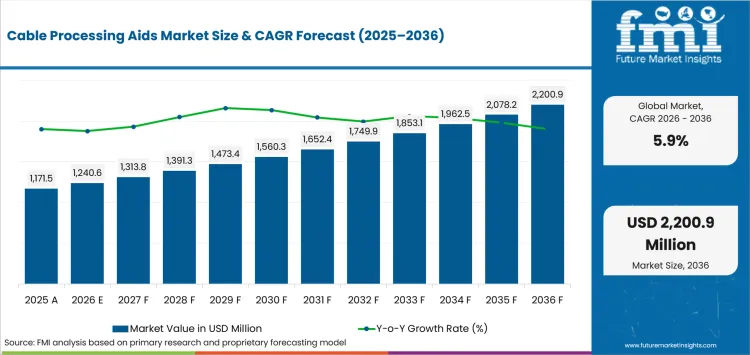
USD 1240.6 million in 2026 and USD 2200.9 million by 2036 at a 5.9% CAGR.
Sales of cable processing aids are estimated to rise at 5.9% CAGR through 2036, increasing valuation from USD 1240.6 million in 2026 to USD 2200.9 million by 2036. Cable producers turn to these additives as melt fracture or die deposits cut usable output on qualified lines. In January 2026, Chengdu Silike Technology Co., Ltd. introduced silicone additives for LSZH wire and cable compounds to improve extrusion stability and line speed. Repeat orders depend on reproducing those operating gains in the processor's own compound without weakening cable performance.
Cable infrastructure programs enlarge the production base in which compounders may encounter extrusion bottlenecks and qualify processing aids. Mexico illustrates that conversion route as utilities advance transmission work into active project packages that require cable materials and compound production. CFE reported in March 2026 that its 2026-2027 portfolio covered 138 transmission lines and 249 substations. Regional stock and plant trials become practical order conditions as additive changes must fit project schedules without disrupting approved cable specifications.
Key Takeaways of Cable Processing Aids Market
- Grid reinforcement and rising cable output increase processing-aid demand once extrusion defects or cleaning interruptions reduce usable manufacturing capacity.
- In 2026, the fluoropolymer processing aids segment is expected to lead product type with 28.0% share because established low-dosage defect control supports polyolefin extrusion.
- The PVC cable compounds segment is set to lead the cable compound category with 28.0% share in 2026 due to its broad installed processing base across established applications.
- The melt fracture reduction segment is likely to capture 26.0% share in 2026 attributable to its direct effect on stable extrusion speed.
- Formulation qualification and changing PFAS requirements extend switching timelines as processing gains must preserve accepted electrical and mechanical cable properties.
- Daikin, Arkema, BYK, Clariant, Avient, Ampacet, Baerlocher and Chengdu Silike Technology Co., Ltd. are some notable players.
Analyst Perspective
"Cable processors should judge a processing aid by the defect rate and cleaning time it removes from a qualified extrusion line. The stronger offer pairs those measured gains with chemistry documentation that helps PVC, PE / XLPE and LSZH formulations complete requalification without adding avoidable plant risk."
- Nikhil Kaitwade, Principal Consultant, Future Market Insights
How is the Cable Processing Aids Market segmented?
The market is segmented by product type, cable compound, function, end use, sales channel and region.
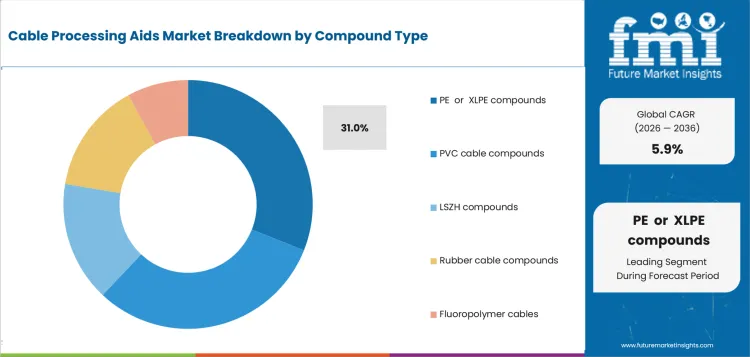
The market is segmented by product type, cable compound, function, end use, sales channel and region. Product types include fluoropolymer, silicone and wax processing aids plus metal stearates, compatibilizers and dispersing aids. Cable compounds include PVC, PE / XLPE, LSZH, rubber and fluoropolymer cables. Functions cover melt fracture reduction, extrusion rate improvement, die build-up control, dispersion improvement and surface finish enhancement. End uses include power cables, communication cables, automotive wires, building wires and specialty industrial cables. Sales channels include compounders, cable OEMs, additive distributors and masterbatch suppliers.
Why do PVC cable compounds hold the leading cable compound position?
PVC cable compounds remain common across building wire and power applications, so processing aids must work beside plastic additives such as stabilizers and fillers without disturbing electrical or fire-performance targets.
- In 2026, the PVC cable compounds segment is expected to lead cable compound with 28.0% share because its installed base sustains recurring formulation demand.
- Filled cable compounds make pellet handling part of plant qualification as material defects can interrupt downstream extrusion. Coperion reported in April 2026 that its redesigned EGR serves soft PVC and HFFR formulations and cuts conveying energy by up to 75%.
Why do fluoropolymer processing aids lead the product type category?
Fluoropolymer processing aids reduce die friction at low dosage and help cable extruders control melt fracture or deposits. ECHA's August 2025 PFAS update followed more than 5,600 consultation comments and adds regulatory uncertainty to future fluorinated PPA qualification.
- By product type, the fluoropolymer processing aids segment is estimated to hold 28.0% in 2026 owing to established defect control across polyolefin extrusion.
- Cable compounders compare fluoropolymer PPAs with alternatives during long-lived formulation reviews and require replacement chemistry to reproduce stable output without weakening qualified cable properties.
Why does melt fracture reduction lead the function category?
Melt fracture forces extruders to reduce line speed or adjust pressure to protect cable surface quality.
- The melt fracture reduction segment is projected to hold 26.0% share in 2026 owing to its direct connection with stable extrusion speed.
- Cable line trials test whether an aid widens the usable operating window without weakening the qualified compound. Recurring use depends on maintaining surface quality at production rates that justify formulation changes.
Why do power cables lead the end use category?
Power cable programs use qualified wire and cable compounds in long extrusion campaigns, making stable insulation and sheathing performance a prerequisite for uninterrupted production.
- The end use category is forecast to be led by power cables at 30.0% share in 2026 due to recurring transmission production. DOE approved the RELIEF framework in January 2026 for 250 miles of high-temperature low-sag conductors designed to double existing capacity.
- Infrastructure spending enlarges the cable production base, but additive orders depend on trials that verify lower defect or cleaning losses on the exact compound.
What are the drivers, restraints and opportunities in the Cable Processing Aids Market?
Higher cable output raises the cost of extrusion defects as qualification work and PFAS policy slow chemistry changes, leaving qualified alternative aids as the main route to new orders.
- Driver: Higher cable output raises the cost of melt fracture and cleaning interruptions across extrusion lines operating near stable capacity.
- Restraint: Cable formulations require line-level qualification as PFAS policy changes complicate chemistry selection and long-term sourcing decisions.
- Opportunity: Alternative processing aids can win recurring orders as cable-line trials verify defect control and retained compound performance.
Grid Expansion Raises the Cost of Extrusion Stops
Long cable production campaigns make melt fracture and cleaning stops more expensive as lost line time reduces usable output. The USA Department of Energy announced an approximately USD 1.9 billion grid-upgrade funding opportunity in March 2026 for reconductoring and related transmission work. Cable plants place processing-aid orders once line trials show measurable defect or cleaning losses on the added output.
Qualification Work Extends Chemistry Changes Under PFAS Rules
Cable compounders must preserve electrical and mechanical properties while changing processing chemistry, which makes requalification a material switching cost. ECHA reported in March 2026 that RAC supported an EU-wide PFAS restriction and SEAC issued a draft opinion with targeted derogations. Long-lived cable recipes therefore require additional documentation during decisions to retain or replace fluorinated PPAs.
Alternative PPAs Need Cable-Line Proof
Cable plants repeat orders for alternative processing aids once trials match defect control on the plant's resin and filler system. Chengdu Silike Technology Co., Ltd. reported in June 2026 that LYSI silicone masterbatch reduced die drool and unstable extrusion in LSZH and HFFR cable compounds. Cable-specific trial data provides a revenue route for alternative chemistries based on documented line performance instead of a broad PFAS-free claim.
Which country CAGRs are profiled in the Cable Processing Aids Market?
| Country | CAGR |
|---|---|
| South Korea | 5.9% |
| Mexico | 5.7% |
| USA | 5.3% |
| Germany | 4.9% |
| Japan | 4.6% |
How do country-level CAGRs compare in the Cable Processing Aids Market?
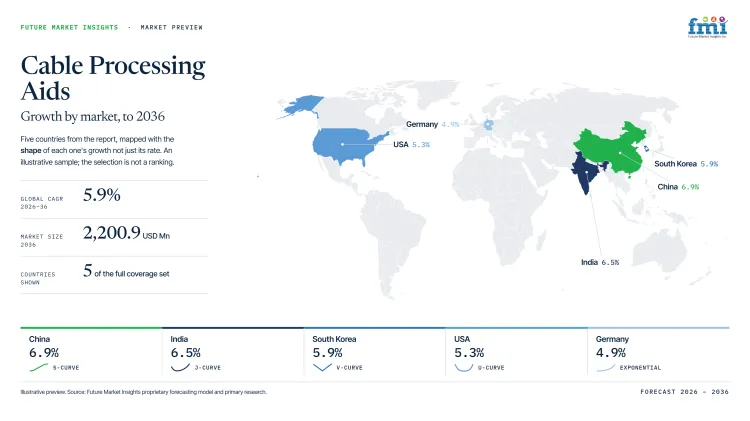
The country forecasts span 1.3 percentage points and form three practical growth bands. South Korea and Mexico define the upper band, with the USA between them and the more measured German and Japanese outlooks. Qualification cost and local service coverage therefore matter more for entry planning than small differences in forecast pace.
- South Korea combines export-grade cable production with strict consistency and local testing requirements.
- Mexico pairs active transmission construction with imported-additive lead times and regional stocking needs.
- US plants prioritize line economics as multi-site qualification makes chemistry changes expensive.
- Germany combines grid expansion with chemical documentation and longer alternative-PPA requalification.
- Japan rewards reproducible grades and technical support across conservative material change cycles.
Similar CAGRs mask different costs of converting line trials into recurring orders. The full report provides country-level CAGR analysis across North America, Latin America, Europe, East Asia, South Asia, Oceania and the Middle East and Africa.
Country-wise Analysis
- South Korean cable producers serve export-oriented power and industrial programs that demand stable compound behavior at high line speeds, so local testing helps plants qualify formulation changes against established customer specifications during recurring production. The South Korean cable processing aids sector is projected to record 5.9% CAGR during the assessment period, supported by local engineering teams and strict repeatability requirements across qualified cable production for overseas programs. MCEE's February 2026 distributed-grid rollout formalized grid-information sharing and workforce training, but export-grade qualification remains a friction because additive changes must reproduce line performance across customer programs and equipment settings during repeated qualification.
- Mexican cable plants serve utility projects and export manufacturing across lines with uneven process control, so regional inventory and Spanish-language technical service help plants complete formulation trials without delaying scheduled production at major sites. By 2036, Mexico is projected to grow at 5.7% CAGR supported by CFE's April 2026 report that 47 transmission projects were already under construction within the national grid expansion program across multiple regions. Imported-additive lead times and OEM approvals remain material frictions during chemistry changes, making local stock and plant trials important for keeping project orders moving without disrupting qualified cable recipes across varied plant equipment.
- US cable plants usually require measured line economics for additive changes in qualified formulations, and DOE's February 2026 review identified 20 Pennsylvania interconnection points that could host grid upgrades within existing transmission corridors. Adoption of cable processing aids in the USA is estimated to expand at 5.3% CAGR through 2036, supported by transmission upgrades and established regional application support across major cable manufacturing centers serving domestic programs. Plant-by-plant qualification and changing chemical documentation extend switching timelines, so processors need reliable local inventory and technical support while comparing throughput gains with requalification cost and production interruption risk across customer programs nationwide.
- German cable compounders work under industrial specifications and EU chemical rules that require documented processing performance for formulation changes entering established power and industrial cable programs serving major domestic utilities and export customers nationwide. Bundesnetzagentur reported in June 2026 that 118 proposed transmission expansion measures were eligible for confirmation, giving compounders a defined grid-work pipeline that keeps cable-production and qualification work tied to major upcoming projects. Germany is estimated to post 4.9% CAGR over the forecast period, yet PFAS policy development and long cable approval cycles require alternative aids to preserve downstream properties and complete customer documentation across existing formulations.
- Japanese cable and materials companies emphasize reproducible processing across established production programs, and METI's March 2026 bill adds financing routes for large intra-regional and inter-regional transmission-line development serving future national network expansion plans. Long validation cycles make dependable grades and detailed local application support important during material changes as major cable programs retain proven recipes across extended production runs and customer approval cycles at established plants. Cable processing aid sales in Japan are forecast to expand at 4.6% CAGR by 2036, shaped by transmission investment but constrained by the commercial risk of requalifying established formulations across customer programs and plants.
Who are the notable companies in the Cable Processing Aids Market?
Daikin, Arkema, BYK, Clariant, Avient, Ampacet, Baerlocher and Chengdu Silike Technology Co., Ltd. are the notable companies serving this market.
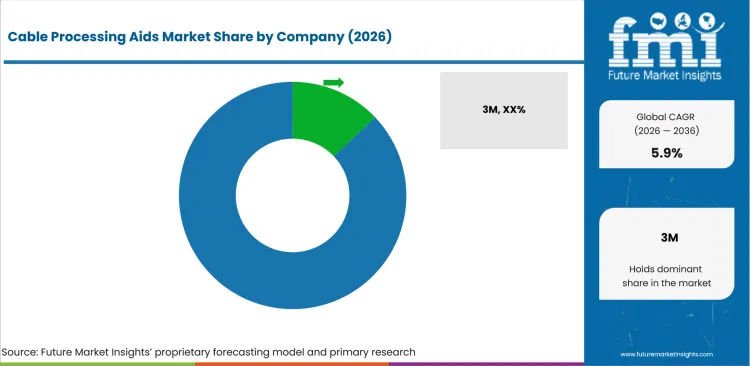
Cable processing aids remain fragmented across fluorinated PPAs, non-fluorinated alternatives and silicone or masterbatch routes. Entry requires proof that an additive controls melt fracture or die deposits without weakening qualified cable properties during plant trials. The same additive can behave differently across PVC, PE / XLPE and LSZH formulations. Local application engineers help processors confirm repeatable results on the target compound during transfer from plant trial to recurring production.
- Multi-chemistry PPA platforms: Daikin and Arkema combine fluorinated processing-aid experience with current non-fluorinated routes for thermoplastic extrusion.
- Specialty additive formulators: BYK and Clariant join Baerlocher plus Chengdu Silike Technology Co., Ltd. with PFAS-free or silicone-based processing routes and application support.
- Masterbatch and cable-application specialists: Avient provides cable-specific PVDF processing aids while Ampacet combines additive masterbatch supply with current wire and cable coverage.
Competitive Benchmarking: Cable Processing Aids Market
| Company | PPA Chemistry Breadth | Fluorine-Free Transition Capability | Extrusion Problem Coverage | Geographic Reach |
|---|---|---|---|---|
| Daikin | High | High | Medium | Global |
| Arkema | High | High | High | Global |
| BYK | Medium | High | High | Europe, Americas and Asia-Pacific |
| Clariant | Medium | High | High | Europe, Americas and Asia-Pacific |
| Avient | High | High | High | Global |
| Ampacet | Low | High | Medium | Americas, Europe and Asia-Pacific |
| Baerlocher | Medium | High | High | Global |
| Chengdu Silike Technology Co., Ltd. | High | High | High | China, Asia-Pacific and international export channels |
Key Developments in the Cable Processing Aids Market
- In July 2025, BYK introduced BYK-MAX P 4110 as a PFAS-free processing additive for polyolefin extrusion with documented melt-fracture and die-build-up control.
- In June 2025, Clariant launched AddWorks PFAS-free polymer processing aids for polyolefin extrusion in fine-grain and masterbatch formats across several regional markets.
- In May 2025, Avient announced Colorant Chromatics PVDF Processing Aids for wire and cable extrusion to reduce die build-up and prevent melt fracture while supporting higher line speed.
Key Players in the Cable Processing Aids Market
Fluoropolymer and Multi-Chemistry PPA Platforms
- Daikin
- Arkema
Specialty Additive and PFAS-Free Formulators
- BYK
- Clariant
- Baerlocher
- Chengdu Silike Technology Co., Ltd.
Masterbatch and Cable-Application Specialists
- Avient
- Ampacet
Cable Processing Aids Market - Report Scope
| Coverage field | Report scope |
|---|---|
| Market breakdown | By product type, cable compound, function, end use, sales channel and region. |
| Quantitative Units | Revenue in USD million and CAGR in %. |
| Market Definition | Commercial processing aids used during cable-compound preparation or cable extrusion to improve melt flow, surface quality, die cleanliness, throughput, dispersion or related processing behavior. |
| Regions Covered | North America, Latin America, Europe, East Asia, South Asia and Pacific and Middle East and Africa. |
| Countries Covered | South Korea, Mexico, USA, Germany, Japan, and 20+ countries included in the full report. |
| Key Companies Profiled | Daikin, Arkema, BYK, Clariant, Avient, Ampacet, Baerlocher, Chengdu Silike Technology Co., Ltd. |
| Forecast Period | 2026 to 2036. |
| Approach | Primary and secondary research with market triangulation. |
Cable Processing Aids Market - Research Methodology
| Method | Approach |
|---|---|
| Primary Research | FMI analysts gathered input from manufacturers, service providers, technology developers, distributors, end users, procurement teams, and subject-matter experts. Interviews examined purchasing decisions, product or service evaluation, adoption barriers, approval requirements, pricing considerations, and expectations for technical or commercial support. Respondents were also asked what evidence is required before a trial, pilot, or initial order develops into regular purchasing. |
| Desk Research | Desk research covered government statistics, regulatory publications, trade data, industry associations, technical literature, standards, company filings, product information, and official corporate announcements. Sources were reviewed for relevance, publication date, geographic coverage, and consistency with the defined market scope. Claims relating to performance, applications, approvals, capacity, investment, and commercial activity were retained only when supported by credible public evidence. |
| Market Sizing and Forecasting | The market model combined the baseline value with historical performance, segment structure, pricing and volume indicators, adoption levels, company participation, and country-level demand conditions. Forecast assumptions considered economic activity, investment trends, regulatory developments, technology adoption, purchasing cycles, supply availability, and barriers to wider market use. Segment and regional estimates were reconciled before the final market total was calculated. |
| Data Validation | Estimates were checked against multiple independent indicators, including public data, company activity, trade patterns, industry developments, and findings from primary interviews. Validation also tested whether products, services, applications, and company revenues fell within the defined market boundaries. Adjacent categories, unsupported claims, overlapping revenues, and activities without direct market relevance were excluded to reduce double counting and maintain consistency across segments and countries. |
Cable Processing Aids Market by Segments
Cable Processing Aids Market segmented by Product Type:
- Fluoropolymer Processing Aids
- Silicone Processing Aids
- Wax Processing Aids
- Metal Stearates
- Compatibilizers
- Dispersing Aids
Cable Processing Aids Market segmented by Cable Compound:
- PVC Cable Compounds
- PE / XLPE Compounds
- LSZH Compounds
- Rubber Cable Compounds
- Fluoropolymer Cables
Cable Processing Aids Market segmented by Function:
- Melt Fracture Reduction
- Extrusion Rate Improvement
- Die Build-Up Control
- Dispersion Improvement
- Surface Finish Enhancement
Cable Processing Aids Market segmented by End Use:
- Power Cables
- Communication Cables
- Automotive Wires
- Building Wires
- Specialty Industrial Cables
Cable Processing Aids Market segmented by Sales Channel:
- Compounders
- Cable OEMs
- Additive Distributors
- Masterbatch Suppliers
Cable Processing Aids Market by Region:
- North America
- United States
- Canada
- Latin America
- Brazil
- Mexico
- Chile
- Rest of Latin America
- Western Europe
- Germany
- United Kingdom
- Italy
- Spain
- France
- Nordics
- Benelux
- Rest of Western Europe
- Eastern Europe
- Russia
- Poland
- Hungary
- Balkan and Baltic States
- Rest of Eastern Europe
- East Asia
- China
- Japan
- South Korea
- South Asia and Pacific
- India
- ASEAN
- Australia and New Zealand
- Rest of South Asia and Pacific
- Middle East and Africa
- Kingdom of Saudi Arabia
- Other GCC Countries
- Türkiye
- South Africa
- Other African Union Countries
- Rest of Middle East and Africa
Research Sources and Bibliography
- Chengdu Silike Technology Co., Ltd. (2026, January 8). LSZH Wire and Cable Compounds Solutions with SILIKE Silicone Additives.
- Comisión Federal de Electricidad. (2026, March 22). CFE PRESENTA PORTAFOLIO 2026-2027 CON 58 PROYECTOS PARA REFORZAR LA TRANSMISIÓN ELÉCTRICA EN MÉXICO.
- European Chemicals Agency. (2025, August 20). ECHA publishes updated PFAS restriction proposal.
- Coperion. (2026, April 16). More Quality, Less Energy: Coperion optimizes Eccentric Pelletizer EGR.
- Chengdu Silike Technology Co., Ltd. (2026, May 15). High-Efficiency Extrusion Solutions for LSZH B1 Cables: Maximizing Throughput and Eliminating Surface Defects.
- USA Department of Energy. (2026, January 8). CX-035305: Reliable Electric Lines: Infrastructure Expansion Framework (RELIEF).
- USA Department of Energy. (2026, March 12). Energy Department Announces $1.9B Investment in Critical Grid Infrastructure to Reduce Electricity Costs.
- European Chemicals Agency. (2026, March 26). ECHA supports PFAS restriction with targeted derogations.
- Chengdu Silike Technology Co., Ltd. (2026, June 18). Eliminating Die Drool and Rough Surfaces: How Silicone Masterbatch Solves LSZH Cable Processing Challenges.
- Ministry of Climate, Energy and Environment, Republic of Korea. (2026, February 20). Carbon-Neutral “Next-Generation Distributed Power Grid” Launches Full-Scale Rollout This Year.
- Comisión Federal de Electricidad. (2026, April 20). LA CFE EJECUTA UN AMBICIOSO PROGRAMA DE EXPANSIÓN Y FORTALECIMIENTO DE LA RED NACIONAL DE TRANSMISIÓN.
- USA Department of Energy. (2026, February 3). Energy Department Awards $2.5M to Accelerate Transmission, Lower Energy Costs, and Maintain a Reliable and Resilient Grid.
- Bundesnetzagentur. (2026, June 12). Bundesnetzagentur launches consultation on the network development plan for the expansion of the electricity grid.
- Ministry of Economy, Trade and Industry, Japan. (2026, March 24). Cabinet Decision on the Bill for the Act for Partially Amending the Electricity Business Act.
- Daikin Chemical Europe GmbH. (2025, March 13). K SHOW 2025.
- Arkema. (2026, February 24). SPE International Polyolefins Conference.
- Ampacet Corporation. (2026, February 5). Ampacet Showcases Advanced Materials and Technology for Plastics at Plastindia 2026.
- Baerlocher. (2026, April 15). Baerlocher Showcases PFAS Free and Circular Solutions at PRSE 2026 in Amsterdam.
- BYK. (2025, July 8). PFAS-free process additives facilitate faster production speeds and shorter downtimes.
- Clariant. (2025, June 5). Clariant launches innovative PFAS-free polymer processing aids for more sustainable polyolefin extrusion.
- Avient Corporation. (2025, May 27). PVDF Processing Aids for Enhancing Extrusion Efficiency Now Available from Avient.
- Wells Performance Materials. (2026, June 8). Wells Performance Materials Celebrates a Successful Exhibition at Interplas 2026.
- Tosaf. (2026, April 16). Tosaf Expands Its European Footprint with a New Masterbatch Facility in Poland.
- 3M Company. (2026, February 3). Annual Report on Form 10-K for the Year Ended December 31, 2025.
- Tosaf. (2025, January 8). Food-safe production compliance: Tosaf’s ISO 22000 certifications.
- Avient Corporation. (2025, May 2). PVDF Wire & Cable Extrusion.
- Chengdu Silike Technology Co., Ltd. (2025, October 10). Optimizing LSZH Cable Compound Manufacturing: Key Processing Challenges and Solutions.
This bibliography is provided for reader reference and is not exhaustive. The full report contains the complete reference list and detailed citations.
This Report Answers
- What operating factors connect the 2026 market base with the 2036 cable processing aids outlook?
- How do extrusion defects translate into recurring processing-aid purchases across cable production lines?
- Why do fluoropolymer processing aids retain the largest product type share in 2026?
- How do PVC cable compounds and power-cable programs shape additive qualification requirements?
- Which regulatory conditions influence fluorinated and alternative processing-aid selection?
- How do country growth rates change technical-service, qualification and inventory requirements across the five profiled markets?
- Which PPA chemistry and extrusion-performance capabilities matter most during cable-compound trials and recurring qualification?
- How should processors compare measurable line economics with chemistry-transition and requalification risk?
Frequently Asked Questions
How big is the Cable Processing Aids Market in 2026?
The cable processing aids market is expected to be valued at USD 1240.6 million in 2026. Cable producers purchase these additives as melt fracture and die-cleaning losses reduce usable output on qualified extrusion lines.
What is the CAGR of the Cable Processing Aids Market from 2026 to 2036?
The cable processing aids market is projected to expand at a 5.9% CAGR between 2026 and 2036. The forecast assumes cable plants place repeat orders once line trials confirm lower melt fracture, die buildup or cleaning time.
Which product type segment is projected to lead the Cable Processing Aids Market?
The cable processing aids market is expected to record a 28.0% product type share for fluoropolymer processing aids in 2026. Low-dosage control of melt fracture and die deposits explains their position on demanding extrusion lines.
How much will the Cable Processing Aids Market add between 2026 and 2036?
The cable processing aids market is expected to add USD 960.3 million between 2026 and 2036. Additional revenue depends on larger cable programs producing repeat orders as line trials confirm lower defects or cleaning losses.
Which companies are active in the Cable Processing Aids Market?
The cable processing aids market includes Daikin, Arkema, BYK and Clariant alongside Avient, Ampacet, Baerlocher and Chengdu Silike Technology Co., Ltd. The group spans fluorinated PPAs, non-fluorinated alternatives, silicone processing aids and masterbatch routes.
Preview the report firsthand - request a free sample
Get SampleGet the brochure for pricing and purchase details.
Get PDFTable of Content
- Key Takeaways
- Market Size and CAGR
- Top Growth Driver
- Fastest Growing Segment
- Leading Region
- Key Companies
- Emerging Opportunities
- Executive Summary
- Global Market Outlook
- Demand-side Trends
- Supply-side Trends
- Technology Roadmap Analysis
- Analysis and Recommendations
- Analyst Perspective (What is happening? Why now? What should investors know?)
- Key Questions Answered
- How large is the market?
- What is the CAGR?
- What are key trends?
- Which region dominates?
- Who are the leaders?
- Market Overview
- Market Coverage / Taxonomy
- Market Definition / Scope / Limitations
- Research Methodology
- Chapter Orientation
- Analytical Lens and Working Hypotheses
- Market Structure, Signals, and Trend Drivers
- Benchmarking and Cross-market Comparability
- Market Sizing, Forecasting, and Opportunity Mapping
- Research Design and Evidence Framework
- Desk Research Programme (Secondary Evidence)
- Expert Input and Fieldwork (Primary Evidence)
- Tooling, Models, and Reference Databases
- Data Engineering and Model Build
- Quality Assurance and Audit Trail
- Market Background
- Market Dynamics (Drivers, Restraints, Opportunity, Trends)
- Scenario Forecast (Optimistic, Likely, Conservative)
- Impact Analysis
- AI Impact
- Sustainability Impact
- Regulatory Impact
- Technology Impact
- Consumer / Buyer Analysis
- Purchase Drivers
- Adoption Barriers
- Buyer Journey
- Opportunity Map Analysis
- Product Life Cycle Analysis
- Supply Chain Analysis
- Investment Feasibility Matrix
- Value Chain Analysis
- PESTLE and Porter's Analysis
- Regulatory Landscape
- Regional Parent Market Outlook
- Production and Consumption Statistics
- Import and Export Statistics
- Global Market Analysis and Forecast, 2021 to 2036
- Historical Market Size Value (USD Million) Analysis, 2021 to 2025
- Current and Future Market Size Value (USD Million) Projections, 2026 to 2036
- Y-o-Y Growth Trend Analysis
- Absolute $ Opportunity Analysis
- Global Market Pricing Analysis, 2021 to 2036
- Global Market Analysis and Forecast, By Product Type, 2021 to 2036
- Introduction / Key Findings
- Historical Market Size Value (USD Million) Analysis By Product Type, 2021 to 2025
- Current and Future Market Size Value (USD Million) Analysis and Forecast By Product Type, 2026 to 2036
- Fluoropolymer processing aids
- Silicone processing aids
- Wax processing aids
- Metal stearates
- Compatibilizers
- Dispersing aids
- Fluoropolymer processing aids
- Y-o-Y Growth Trend Analysis By Product Type, 2021 to 2025
- Absolute $ Opportunity Analysis By Product Type, 2026 to 2036
- Global Market Analysis and Forecast, By Compound Type, 2021 to 2036
- Introduction / Key Findings
- Historical Market Size Value (USD Million) Analysis By Compound Type, 2021 to 2025
- Current and Future Market Size Value (USD Million) Analysis and Forecast By Compound Type, 2026 to 2036
- PE or XLPE compounds
- PVC cable compounds
- LSZH compounds
- Rubber cable compounds
- Fluoropolymer cables
- PE or XLPE compounds
- Y-o-Y Growth Trend Analysis By Compound Type, 2021 to 2025
- Absolute $ Opportunity Analysis By Compound Type, 2026 to 2036
- Global Market Analysis and Forecast, By Function, 2021 to 2036
- Introduction / Key Findings
- Historical Market Size Value (USD Million) Analysis By Function, 2021 to 2025
- Current and Future Market Size Value (USD Million) Analysis and Forecast By Function, 2026 to 2036
- Melt fracture reduction
- Extrusion rate improvement
- Die build-up control
- Dispersion improvement
- Surface finish enhancement
- Melt fracture reduction
- Y-o-Y Growth Trend Analysis By Function, 2021 to 2025
- Absolute $ Opportunity Analysis By Function, 2026 to 2036
- Global Market Analysis and Forecast, By Application, 2021 to 2036
- Introduction / Key Findings
- Historical Market Size Value (USD Million) Analysis By Application, 2021 to 2025
- Current and Future Market Size Value (USD Million) Analysis and Forecast By Application, 2026 to 2036
- Power cables
- Communication cables
- Automotive wires
- Building wires
- Specialty industrial cables
- Power cables
- Y-o-Y Growth Trend Analysis By Application, 2021 to 2025
- Absolute $ Opportunity Analysis By Application, 2026 to 2036
- Global Market Analysis and Forecast, By Sales Channel, 2021 to 2036
- Introduction / Key Findings
- Historical Market Size Value (USD Million) Analysis By Sales Channel, 2021 to 2025
- Current and Future Market Size Value (USD Million) Analysis and Forecast By Sales Channel, 2026 to 2036
- Compounders
- Cable OEMs
- Additive distributors
- Masterbatch suppliers
- Compounders
- Y-o-Y Growth Trend Analysis By Sales Channel, 2021 to 2025
- Absolute $ Opportunity Analysis By Sales Channel, 2026 to 2036
- Global Market Analysis and Forecast, By Region, 2021 to 2036
- Introduction
- Historical Market Size Value (USD Million) Analysis By Region, 2021 to 2025
- Current Market Size Value (USD Million) Analysis and Forecast By Region, 2026 to 2036
- North America
- Latin America
- Western Europe
- Eastern Europe
- East Asia
- South Asia and Pacific
- Middle East & Africa
- Market Attractiveness Analysis By Region
- North America Market Analysis and Forecast, By Country, 2021 to 2036
- Historical Market Size Value (USD Million) Trend Analysis By Market Taxonomy, 2021 to 2025
- Market Size Value (USD Million) Forecast By Market Taxonomy, 2026 to 2036
- By Country
- USA
- Canada
- By Product Type
- By Compound Type
- By Function
- By Application
- By Sales Channel
- By Country
- Market Attractiveness Analysis
- By Country
- By Product Type
- By Compound Type
- By Function
- By Application
- By Sales Channel
- Key Takeaways
- Latin America Market Analysis and Forecast, By Country
- Historical Market Size Value (USD Million) Trend Analysis By Market Taxonomy, 2021 to 2025
- Market Size Value (USD Million) Forecast By Market Taxonomy, 2026 to 2036
- By Country
- Brazil
- Mexico
- Chile
- Rest of Latin America
- By Product Type
- By Compound Type
- By Function
- By Application
- By Sales Channel
- By Country
- Market Attractiveness Analysis
- By Country
- By Product Type
- By Compound Type
- By Function
- By Application
- By Sales Channel
- Key Takeaways
- Western Europe Market Analysis and Forecast, By Country
- Historical Market Size Value (USD Million) Trend Analysis By Market Taxonomy, 2021 to 2025
- Market Size Value (USD Million) Forecast By Market Taxonomy, 2026 to 2036
- By Country
- Germany
- UK
- Italy
- Spain
- France
- Nordic
- BENELUX
- Rest of Western Europe
- By Product Type
- By Compound Type
- By Function
- By Application
- By Sales Channel
- By Country
- Market Attractiveness Analysis
- By Country
- By Product Type
- By Compound Type
- By Function
- By Application
- By Sales Channel
- Key Takeaways
- Eastern Europe Market Analysis and Forecast, By Country
- Historical Market Size Value (USD Million) Trend Analysis By Market Taxonomy, 2021 to 2025
- Market Size Value (USD Million) Forecast By Market Taxonomy, 2026 to 2036
- By Country
- Russia
- Poland
- Hungary
- Balkan & Baltic
- Rest of Eastern Europe
- By Product Type
- By Compound Type
- By Function
- By Application
- By Sales Channel
- By Country
- Market Attractiveness Analysis
- By Country
- By Product Type
- By Compound Type
- By Function
- By Application
- By Sales Channel
- Key Takeaways
- East Asia Market Analysis and Forecast, By Country
- Historical Market Size Value (USD Million) Trend Analysis By Market Taxonomy, 2021 to 2025
- Market Size Value (USD Million) Forecast By Market Taxonomy, 2026 to 2036
- By Country
- China
- Japan
- South Korea
- By Product Type
- By Compound Type
- By Function
- By Application
- By Sales Channel
- By Country
- Market Attractiveness Analysis
- By Country
- By Product Type
- By Compound Type
- By Function
- By Application
- By Sales Channel
- Key Takeaways
- South Asia and Pacific Market Analysis and Forecast, By Country
- Historical Market Size Value (USD Million) Trend Analysis By Market Taxonomy, 2021 to 2025
- Market Size Value (USD Million) Forecast By Market Taxonomy, 2026 to 2036
- By Country
- India
- ASEAN
- Australia & New Zealand
- Rest of South Asia and Pacific
- By Product Type
- By Compound Type
- By Function
- By Application
- By Sales Channel
- By Country
- Market Attractiveness Analysis
- By Country
- By Product Type
- By Compound Type
- By Function
- By Application
- By Sales Channel
- Key Takeaways
- Middle East & Africa Market Analysis and Forecast, By Country
- Historical Market Size Value (USD Million) Trend Analysis By Market Taxonomy, 2021 to 2025
- Market Size Value (USD Million) Forecast By Market Taxonomy, 2026 to 2036
- By Country
- Kingdom of Saudi Arabia
- Other GCC Countries
- Türkiye
- South Africa
- Other African Union
- Rest of Middle East & Africa
- By Product Type
- By Compound Type
- By Function
- By Application
- By Sales Channel
- By Country
- Market Attractiveness Analysis
- By Country
- By Product Type
- By Compound Type
- By Function
- By Application
- By Sales Channel
- Key Takeaways
- Key Countries Market Analysis
- USA
- Pricing Analysis
- Market Share Analysis, 2025
- By Product Type
- By Compound Type
- By Function
- By Application
- By Sales Channel
- Canada
- Pricing Analysis
- Market Share Analysis, 2025
- By Product Type
- By Compound Type
- By Function
- By Application
- By Sales Channel
- Mexico
- Pricing Analysis
- Market Share Analysis, 2025
- By Product Type
- By Compound Type
- By Function
- By Application
- By Sales Channel
- Brazil
- Pricing Analysis
- Market Share Analysis, 2025
- By Product Type
- By Compound Type
- By Function
- By Application
- By Sales Channel
- Chile
- Pricing Analysis
- Market Share Analysis, 2025
- By Product Type
- By Compound Type
- By Function
- By Application
- By Sales Channel
- Germany
- Pricing Analysis
- Market Share Analysis, 2025
- By Product Type
- By Compound Type
- By Function
- By Application
- By Sales Channel
- UK
- Pricing Analysis
- Market Share Analysis, 2025
- By Product Type
- By Compound Type
- By Function
- By Application
- By Sales Channel
- Italy
- Pricing Analysis
- Market Share Analysis, 2025
- By Product Type
- By Compound Type
- By Function
- By Application
- By Sales Channel
- Spain
- Pricing Analysis
- Market Share Analysis, 2025
- By Product Type
- By Compound Type
- By Function
- By Application
- By Sales Channel
- France
- Pricing Analysis
- Market Share Analysis, 2025
- By Product Type
- By Compound Type
- By Function
- By Application
- By Sales Channel
- India
- Pricing Analysis
- Market Share Analysis, 2025
- By Product Type
- By Compound Type
- By Function
- By Application
- By Sales Channel
- ASEAN
- Pricing Analysis
- Market Share Analysis, 2025
- By Product Type
- By Compound Type
- By Function
- By Application
- By Sales Channel
- Australia & New Zealand
- Pricing Analysis
- Market Share Analysis, 2025
- By Product Type
- By Compound Type
- By Function
- By Application
- By Sales Channel
- China
- Pricing Analysis
- Market Share Analysis, 2025
- By Product Type
- By Compound Type
- By Function
- By Application
- By Sales Channel
- Japan
- Pricing Analysis
- Market Share Analysis, 2025
- By Product Type
- By Compound Type
- By Function
- By Application
- By Sales Channel
- South Korea
- Pricing Analysis
- Market Share Analysis, 2025
- By Product Type
- By Compound Type
- By Function
- By Application
- By Sales Channel
- Russia
- Pricing Analysis
- Market Share Analysis, 2025
- By Product Type
- By Compound Type
- By Function
- By Application
- By Sales Channel
- Poland
- Pricing Analysis
- Market Share Analysis, 2025
- By Product Type
- By Compound Type
- By Function
- By Application
- By Sales Channel
- Hungary
- Pricing Analysis
- Market Share Analysis, 2025
- By Product Type
- By Compound Type
- By Function
- By Application
- By Sales Channel
- Kingdom of Saudi Arabia
- Pricing Analysis
- Market Share Analysis, 2025
- By Product Type
- By Compound Type
- By Function
- By Application
- By Sales Channel
- Türkiye
- Pricing Analysis
- Market Share Analysis, 2025
- By Product Type
- By Compound Type
- By Function
- By Application
- By Sales Channel
- South Africa
- Pricing Analysis
- Market Share Analysis, 2025
- By Product Type
- By Compound Type
- By Function
- By Application
- By Sales Channel
- USA
- Market Structure Analysis
- Competition Dashboard
- Competition Benchmarking
- Market Share Analysis of Top Players
- By Regional
- By Product Type
- By Compound Type
- By Function
- By Application
- By Sales Channel
- Emerging Startups
- Innovation Benchmarking
- Competition Analysis
- Competition Deep Dive
- 3M
- Overview
- Product Portfolio
- Profitability by Market Segments
- Sales Footprint
- Strategy Overview
- Marketing Strategy
- Product Strategy
- Channel Strategy
- Daikin
- Chemours
- Shin-Etsu Chemical
- Wacker Chemie
- Momentive
- BYK
- Clariant
- Avient
- Ampacet
- 3M
- Case Studies
- Success Stories
- Recent Developments
- Competition Deep Dive
- Assumptions & Acronyms Used


