

- Market Size (2026)
- USD 720.7 Mn
- Forecast (2036)
- USD 1173.9 Mn
- CAGR (2026 to 2036)
- 5.0%
How Big is the Cement Density Reducers Market in 2026?
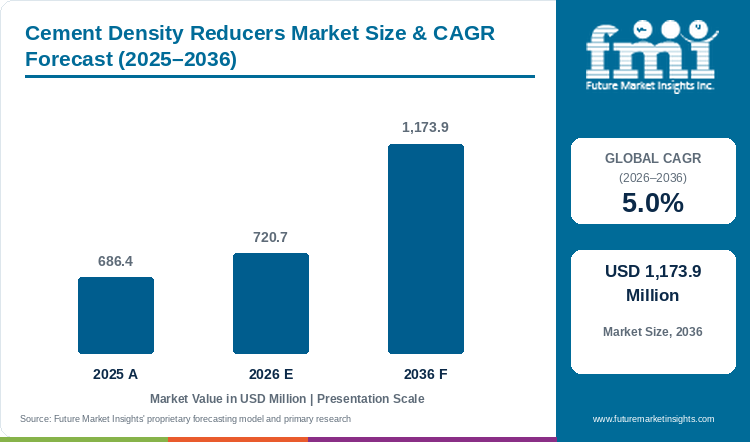
Demand for lightweight slurry from weak-formation wells puts cement density reducer revenue at USD 686.4 Million for 2025 and USD 720.7 Million for 2026, according to FMI, with a 5.0% CAGR leading to USD 1,173.9 Million in 2036.
Demand for cement density reducers is projected to expand at 5% CAGR between 2026 and 2036, as per FMI. Market valuation increases from USD 686.4 Million in 2025 to USD 720.7 Million in 2026 and is estimated to reach USD 1,173.9 Million by 2036, creating an opportunity of USD 453.2 Million over the forecast period.
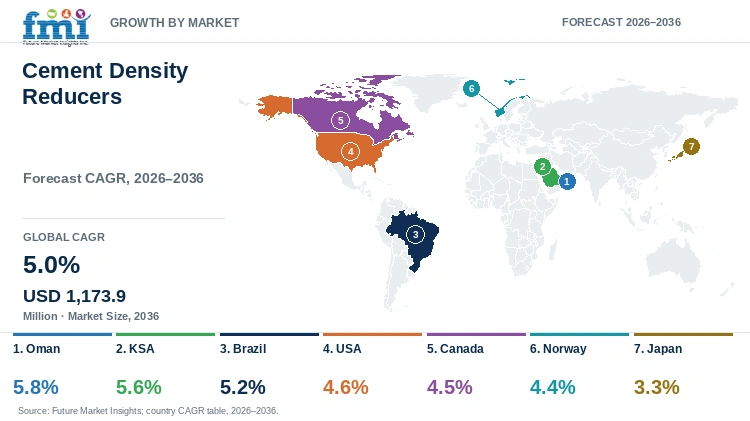
Increasing deep gas, deepwater and geothermal drilling is supporting the demand for cement density reducers, as weak formations on these wells keep capping slurry weight. In May 2026, Baker Hughes expanded an integrated well construction contract with Petrobras covering cementing and fluids in the Santos Basin [1]. Each job on such wells uses higher-value reducer grades, and 3M rates hollow glass spheres for drilling and cementing at isostatic crush strengths from 4,000 to 19,000 psi [2]. Due to this, spending per job will rise with well difficulty, as operators are paying a premium per treatment to avoid lost returns and remedial squeeze work. Onshore wells are expected to hold 34% of demand by well type in 2026, owing to high-frequency programs in the USA and Canada buying lightweight slurries from regional bulk plants. Oman, KSA and Brazil are projected at 5.8%, 5.6% and 5.2% CAGR, as gas and deepwater programs in these countries bring the highest-value orders, and Japan is forecast at 3.3% on a smaller geothermal drilling base.
Adjacent cementing chemistry is also expanding on the same difficult wells. The cement fluid loss additives category is projected to grow from USD 1.3 Billion in 2026 to USD 2.1 Billion by 2036 at 5.4% CAGR, an opportunity of USD 0.8 Billion. Sales of onshore drilling fluids are estimated to increase from USD 5.8 Billion to USD 9.3 Billion at 4.9% CAGR. FMI expects reducer makers qualifying spheres with fluid loss packages inside service-company laboratories to gain a larger share of each cementing order. However, laboratory proof of crush resistance and additive compatibility will decide the pace of new grade approvals. Deeper gas wells, deepwater campaigns and geothermal drilling are expected to keep reducer sales rising until 2036.
Key Takeaways
- Notable companies in the cement density reducers market include Halliburton, SLB, Baker Hughes, 3M, Trelleborg Applied Technologies, CenoStar, PQ Corporation, Sika, BASF and TETRA Technologies.
- Based on reducer type, hollow glass microspheres are projected to account for 24% in 2026, owing to an incompressible sphere cutting slurry weight without extra mix water.
- By cement system, lightweight cement is estimated to hold 39% in 2026, as lightweight slurries pump on standard units, and weak formations are expected at 29% by application.
- Oman is projected at 5.8% CAGR through 2036, followed by KSA at 5.6%, as new concession rounds and unconventional gas programs keep adding cementing work.
Analyst Perspective
“Deepwater and geothermal wells will offer the clearest revenue opportunity in cement density reducers through 2036, as each pairs a weak formation with offshore logistics or thermal cycling. Suppliers proving high-strength, low-density grades inside service-company laboratories and stocking those grades near the rig will receive repeat orders across whole drilling campaigns.”
- Nikhil Kaitwade, Principal Consultant, Future Market Insights
How is the Cement Density Reducers Market Segmented?
The cement density reducers market is segmented into reducer type, cement system, application, well type, sales channel and region.
As per FMI, the market is segmented by reducer type into hollow glass microspheres, lightweight extenders, foamed cement additives, pozzolanic extenders and low-density polymer beads. By cement system, the market is segmented into lightweight, foamed, deepwater and low-fracture-gradient cement. By application, the market is segmented into weak formations, deepwater wells, lost circulation zones, thermal wells and shallow gas zones. By well type, the market is segmented into onshore, offshore, deepwater, geothermal and unconventional wells. By sales channel, the market is segmented into cementing service companies, material suppliers, direct project supply and regional distributors. The regional analysis covers seven regions and more than 30 countries.
Why Do Hollow Glass Microspheres Lead the Cement Density Reducers Market by Reducer Type?
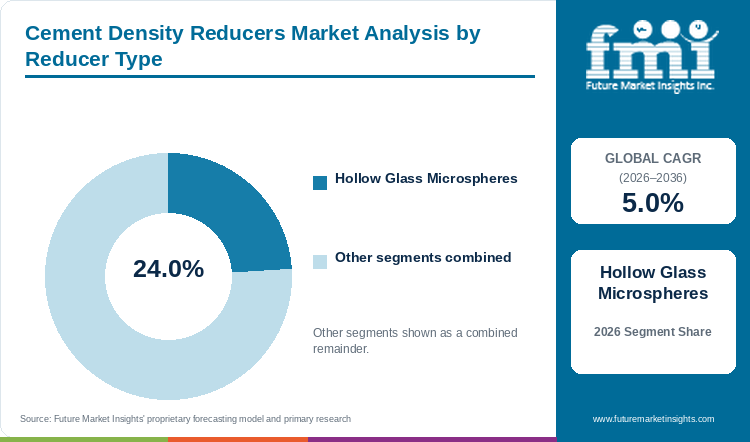
By reducer type, hollow glass microspheres will account for 24% of market share in 2026.
Increasing drilling through low-fracture-gradient zones is supporting the demand for cement density reducers in hollow glass microsphere form. Adding water to thin a slurry weakens the set cement, owing to which well operators pay a premium for a rigid glass bubble that brings down density with no extra water in the mix. Lightweight and pozzolanic extenders are growing at a slower pace, as both grades call for a wetter blend and give lower compressive strength. Foamed cement additives deliver very light slurries, but nitrogen equipment on location and gas behavior downhole raise job cost and operating risk. Low-density polymer beads find limited use, as hot wellbores soften the bead material. Glass bubbles serve the mid-range of downhole pressure, a band covering the bulk of weak-formation cementing. However, collapse resistance under deep-well pressure will decide the bubble grade specified for each job.
- Hollow glass microspheres are projected to account for 24% of demand by reducer type in 2026, owing to the strength-to-density profile of sphere grades.
- 3M states that low-density cement designs using glass bubbles help prevent lost circulation problems such as a reduced top of cement [2].
Why Does Lightweight Cement Lead the Cement Density Reducers Market by Cement System?
In 2026, lightweight cement will account for 39% of market share by cement system.
Lightweight cement is widely chosen by operators drilling density-limited wells, supporting the demand for cement density reducers in this cement system. Crews can blend and place a sphere or extender slurry with the regular cementing equipment present at the rig, due to which operators avoid extra spending on special units. Foamed systems are growing at a slower pace, as nitrogen handling and added safety checks raise cost per job. Deepwater systems call for cold-setting chemistry and marine supply logistics, so sales follow a small number of offshore campaigns. Low-fracture-gradient systems cover only the tightest pressure windows and are projected to remain a specialist niche until 2036. However, colder seabed conditions on deeper offshore wells will decide the share of volume shifting to deepwater designs.
- Lightweight cement is estimated to hold 39% of demand by cement system in 2026, supported by compatibility with conventional mixing and placement equipment.
- In November 2025, Halliburton introduced the LOGIX unit vitality system, which monitors more than 400 real-time parameters on land cementing units, with offshore deployment expected in 2026 [3].
Why Do Weak Formations Lead the Cement Density Reducers Market by Application?
Based on application, weak formations will account for 29% of market share in 2026.
Depleted reservoirs and loosely bonded rock are common across onshore and offshore drilling, which keeps the demand for cement density reducers highest in weak formations. Any primary job crossing such rock faces a fracture-gradient ceiling on slurry weight, owing to which operators spend on lighter blends to bring down hydrostatic and pumping pressure. Deepwater wells and shallow gas zones face a similar pressure ceiling over far fewer jobs. Lost circulation zones divert part of spending to plugging agents and other products to stop fluid loss. Thermal wells call for heat-stable blends, a need found mostly in geothermal or steam projects. However, heat and pressure ratings of each product will decide the jobs suited to a given lightweight blend.
- Weak formations are expected to account for 29% of demand by application in 2026, owing to lower slurry pressure reducing the risk of induced fractures.
- In October 2025, Sika issued a data sheet for Sikacrete-416 Light that sets defined temperature and pressure limits for well-plugging use [4].
Why Does Onshore Lead the Cement Density Reducers Market by Well Type?
By well type, onshore wells will account for 34% of market share in 2026.
High job counts in North American land basins are supporting the demand for cement density reducers in onshore wells. Repeat drilling of similar wells allows service crews to run one approved blend from regional bulk stations, owing to which onshore buyers place frequent, standardized orders. Offshore and deepwater campaigns spend more on each job, but complete far fewer jobs every year. Geothermal programs draw from a narrow base of active rigs, and unconventional operators choose cheap extenders to hold down spending per well. Most budgets in the drilling and completion fluids market also go to land programs, so onshore sales of reducers move with basin drilling activity. However, cost pressure across many repeat land jobs will decide the grade mix bought by onshore operators.
- Onshore wells are projected to hold 34% of demand by well type in 2026, supported by repeat formulation and bulk logistics at regional plants.
- The U.S. Energy Information Administration reported in July 2026 that U.S. crude oil and lease condensate production averaged a record 13.6 million barrels per day in 2025 [5].
Why Do Cementing Service Companies Lead the Cement Density Reducers Market by Sales Channel?
In 2026, cementing service companies will account for 44% of market share by sales channel.
Increasing use of integrated well construction contracts is supporting the demand for cement density reducers through cementing service companies. One contractor designs, tests and pumps each cement job, owing to which operators hand the bulk of reducer buying to these firms. Material suppliers reach operators directly in smaller volumes, mainly once a contractor laboratory approves a blend. Direct project supply is limited to a few operator-run campaigns, and regional distributors hold nearby stock with no role at the wellsite. Larger bundled awards across the oil and gas field services market are moving extra reducer buying into single contracts. However, test results on bubble toughness and on-site engineering help will decide the reducer maker named in each blend.
- Cementing service companies are projected to account for 44% of demand by sales channel in 2026, owing to integrated contracts covering slurry design and pump execution.
- In May 2026, Baker Hughes expanded an integrated Petrobras well construction contract that includes cementing in the Santos Basin [1].
What are the Drivers, Restraints, and Opportunities in the Cement Density Reducers Market?
As per FMI, narrow pressure windows will drive demand for reducers, qualification and the density-strength trade-off will slow supplier switching, and deepwater and geothermal wells will open a higher-value pool through 2036.
- Driver: Weak and depleted formations require lower slurry weight, owing to which density reducers are being used to bring cement to the planned top without inducing losses.
- Restraint: Laboratory work on crush resistance, strength, rheology and additive compatibility is required for each new grade before field use.
- Opportunity: Deepwater, geothermal and unconventional wells are creating demand for materials widening the usable density-strength window.
Operators are buying density reducers mainly to avoid lost returns during cementing. 3M says glass bubbles reduce the downhole pressure of the fluid column, helping operators avoid losses, prevent formation damage and cut nonproductive time [2]. Due to this, the saving is expected to justify a premium reducer over a multi-stage job or a foamed design needing nitrogen equipment.
Key challenges in the cement density reducers market start with qualification, as a lighter slurry still needs to survive downhole stress and remain compatible with dispersants and fluid loss additives. Operating limits vary by product, and Sika's October 2025 data sheet for Sikacrete-416 Light defines a specific temperature and pressure range [4]. Geothermal drilling is opening the next pool of orders, as JOGMEC selected four geothermal resource survey projects for subsidy support in July 2025 and flagged drilling risk and cost as barriers [6]. Suppliers holding thermal stability data are expected to convert this drilling into repeat orders.
Which Country CAGRs are Profiled in the Cement Density Reducers Market?
| Country | CAGR, 2026 to 2036 |
|---|---|
| Oman | 5.8% |
| KSA | 5.6% |
| Brazil | 5.2% |
| USA | 4.6% |
| Canada | 4.5% |
| Norway | 4.4% |
| Japan | 3.3% |
How do Country-level CAGRs Compare in the Cement Density Reducers Market?
Demand for cement density reducers across the seven profiled countries ranges from 5.8% CAGR in Oman to 3.3% in Japan, a gap of 2.5 percentage points, according to FMI's analysis. Gulf concession and gas programs and Brazilian deepwater work are projected at 5.2% or above, and mature basins are expected to grow at 4.6% or less. The USA, with heavy onshore job counts, is expected to carry larger revenue than faster-growing countries through 2036.
- New concession rounds will carry Oman to the fastest rate at 5.8%, with 64 wells drilled in 2025 [7].
- KSA will grow at 5.6% on unconventional gas, with Jafurah gas production starting in December 2025 [8].
- Demand for cement density reducers in Brazil will rise at 5.2% on deepwater service integration, ahead of the USA, Canada and Norway.
- Japan is projected at 3.3%, the slowest in the group, as geothermal drilling offers a narrower addressable base.
Demand for weak-formation cementing outside these seven markets is sized in the full study, which spans more than 30 countries grouped into seven regions.
Country Outlook
- Oman is projected at 5.8% CAGR, the fastest in the profiled group, owing to new concession activity. The energy ministry reported 64 wells drilled in 2025 and announced a bidding round for five concession areas in May 2026 [7]. Mature fields and new prospects carry different pressure windows, due to which suppliers are expected to qualify several grades.
- Pumping cost per lightweight slurry job matters most to buyers in the USA. Crude oil and lease condensate production averaged a record 13.6 million barrels per day in 2025, with the Permian Basin at 6.6 million barrels per day [5]. High job counts keep price pressure on additives, so sales in the USA will rise at a 4.6% CAGR.
- Japan offers a small but technically demanding route through geothermal wells with high temperatures and frequent loss zones. JOGMEC selected four projects in the second call of the FY2025 geothermal resource survey subsidy in July 2025 [6]. Adoption in Japan will grow at a 3.3% CAGR, led by suppliers holding thermal stability data.
- Unconventional gas development is reshaping the cementing work inside Saudi well programs. Aramco began gas production from the first phase of Jafurah in December 2025 at 450 million cubic feet per day [8]. Demand in KSA is forecast to increase at a 5.6% CAGR, with reducer qualifications tied to long-term barrier performance.
- Slurry recipe control by integrated contractors is shaping demand for cement density reducers in Brazil, a market projected at 5.2% CAGR. Baker Hughes expanded an integrated well-better construction contract with Petrobras in May 2026, covering cementing and fluids in deepwater pre-salt fields [1]. Due to this, reducer makers aligned with integrated contractors are expected to capture most offshore-grade volume.
- Demand for cement density reducers in Canada is building on a record production base, with crude oil and equivalent output averaging 5.35 million barrels per day in 2025 and Alberta supplying 83.8% of the total [9]. Tight wells call for economical extenders, and thin pressure margins call for microsphere grades. Sales in Canada are set to rise at a 4.5% CAGR through 2036.
- Offshore integrity scrutiny is raising the qualification bar for reducer suppliers in Norway. The Norwegian Offshore Directorate reported that 2025 oil production on the shelf was the highest since 2009 [10]. Equinor exercised drilling and well service options worth around NOK 17 billion in May 2026 [11]. Demand for cement density reducers in Norway is projected at 4.4% CAGR, and documented pressure and temperature data will open repeat use for reducer grades.
Who are the Notable Companies in the Cement Density Reducers Market?
Three service contractors, Halliburton, SLB and Baker Hughes, hold slurry specification in the FMI assessment, with 3M, Trelleborg Applied Technologies and CenoStar competing to supply the lightweight spheres used in each design.
Halliburton, SLB and Baker Hughes control slurry design through cementing contracts, due to which material makers supply spheres, extenders and polymers into designs set by the service companies. Operators are unlikely to change a reducer during an active drilling campaign, as a qualified slurry is costly to retest, and the service tier therefore holds most pricing power. Material makers are competing on documented crush strength and density, with 3M publishing grades from 0.28 to 0.60 g/cc [2]. Well-specific testing makes the first field trial difficult for new sphere and cenosphere producers. Service companies are also adding well integrity technology, as SLB acquired plug and abandonment specialist HydraWell in April 2026 [12]. Bundled chemistry covered in the oilfield chemicals market and oilfield production chemicals market follows the same service-led route, owing to which smaller formulators are partnering with large contractors. However, deeper gas wells and geothermal programs will reward suppliers holding high-strength and thermal stability data, and competition in the material tier is expected to increase through 2036.
- Integrated Cementing Systems and Services: Halliburton, SLB and Baker Hughes combine slurry design with field execution, and Baker Hughes added cementing scope to an expanded Petrobras contract in May 2026 [1].
- Engineered Lightweight Materials: 3M, Trelleborg Applied Technologies and CenoStar supply hollow glass spheres or cenospheres, and 3M documents glass bubble grades for drilling and cementing [2].
- Complementary Formulation and Well-Construction Companies: PQ Corporation, Sika, BASF and TETRA Technologies broaden the profiled set, with Sika documenting a lightweight well-plugging material [4].
Competitive Benchmarking
| Company | Low-Density Cement Capability | Reducer Material Depth | Well-Construction Customer Access | Geographic Reach |
|---|---|---|---|---|
| 3M | High | High | Medium | Global oil and gas materials sales and technical support |
| Halliburton | High | Medium | High | Global cementing services with land and offshore units |
| SLB | High | Medium | High | Global cementing platform with Norway barrier technology added in 2026 |
| Baker Hughes | High | Medium | High | Global, with documented Brazil deepwater cementing scope |
| Trelleborg Applied Technologies | Low | Medium | Low | Industrial hollow glass microsphere manufacturing |
| PQ Corporation | Low | Low | Low | Limited public evidence for this market |
| Sika | Medium | Low | Medium | Lightweight well-plugging material documented in Malaysia |
| BASF | Low | Low | Low | Limited public evidence for this market |
| TETRA Technologies | Low | Low | Low | Limited public evidence for this market |
| CenoStar | Medium | High | Low | Global distribution of cenospheres and lightweight fillers |
Scoring basis: Low-Density Cement Capability scores documented use of materials or systems that cut well-cement slurry density. Reducer Material Depth scores the range of documented lightweight grades or density-reduction mechanisms. Well-Construction Customer Access scores documented links to cementing services or oilfield chemical channels. A High score reflects broad documented evidence, Medium reflects narrower evidence, and Low signals scarce public records on cement density work.
Key Developments
- In November 2025, Halliburton introduced the LOGIX unit vitality system for cementing equipment, an AI platform tracking more than 400 real-time parameters on Elite and Elite Prime land units [3].
- In April 2026, SLB acquired HydraWell Intervention, a Norway-based plug and abandonment specialist with perforate, wash and cement technology for rock-to-rock barriers [12].
- In May 2026, Equinor exercised contract options with Baker Hughes, Halliburton and SLB for drilling and well services on the Norwegian continental shelf, with specialist frameworks increasing the combined value to around NOK 17 billion [11].
- In May 2026, Baker Hughes extended and expanded an integrated well construction contract with Petrobras covering cementing, fluids and wireline in the Santos Basin [1].
Key Players
Integrated Cementing Systems and Services
- Halliburton
- SLB
- Baker Hughes
Engineered Lightweight Materials
- 3M
- Trelleborg Applied Technologies
- CenoStar
Complementary Formulation and Well-Construction Companies
- PQ Corporation
- Sika
- BASF
- TETRA Technologies
Report Scope and Methodology
| Coverage field | Report scope |
|---|---|
| Market breakdown | 5 categories plus region: Reducer Type (Hollow Glass Microspheres, Lightweight Extenders, Foamed Cement Additives, Pozzolanic Extenders, Low-Density Polymer Beads), Cement System (Lightweight, Foamed, Deepwater, Low-Fracture-Gradient), Application (Weak Formations, Deepwater Wells, Lost Circulation Zones, Thermal Wells, Shallow Gas Zones), Well Type (Onshore, Offshore, Deepwater, Geothermal, Unconventional), Sales Channel (Cementing Service Companies, Material Suppliers, Direct Project Supply, Regional Distributors), and Region |
| Quantitative units | USD Million |
| Market definition | Covers revenue from cement density reducer materials and formulated additive packages sold for oil, gas and geothermal well cement slurries, as segmented in this study. Base cement revenue, cementing service fees, downstream well-construction revenue, and adjacent or substitute products fall outside the boundary. |
| Regions covered | North America, Latin America, Western Europe, Eastern Europe, East Asia, South Asia and Pacific, Middle East and Africa |
| Countries covered | More than 30 countries, including Oman, KSA, Brazil, the USA, Canada, Norway and Japan |
| Key companies profiled | Ten companies are profiled in depth from a wider tracked pool, namely 3M, Halliburton, SLB, Baker Hughes, Trelleborg Applied Technologies, PQ Corporation, Sika, BASF, TETRA Technologies, and CenoStar. |
| Forecast period | 2026 to 2036 |
| Approach | Reducer product revenue is built bottom-up and checked top-down against demand for well construction, application mix, channel structure and country-level operating conditions inside the defined market boundary. |
Research Methodology
| Method | Approach |
|---|---|
| Primary research | Structured discussions with material manufacturers, cementing service providers, operators, procurement teams and subject-matter experts test market scope, purchase criteria, channel behavior and application economics. |
| Desk research | The analysis reviews government energy statistics, operator and service-company disclosures, product documentation, technical literature and trade press. Sources are retained when a source supports the product boundary, operating mechanism, geography or a company action. |
| Market sizing and forecasting | Sizing reconciles revenue from reducer materials and qualified additive packages with well activity, application mix, cement-system requirements, channel structure and country conditions. Forecasts consider well-construction intensity and the mix of technically demanding cement jobs. |
| Data validation | Each quantitative and qualitative finding on demand for reducers is tested against at least two independent source types. Before the final reconciliation, the model removes base cement, cementing service revenue, downstream well-construction value, adjacent products, duplicate revenue and claims lacking support. |
Cement Density Reducers Market by Segments
Cement Density Reducers Market Segmented by Reducer Type
- Hollow Glass Microspheres
- Lightweight Extenders
- Foamed Cement Additives
- Pozzolanic Extenders
- Low-Density Polymer Beads
Cement Density Reducers Market Segmented by Cement System
- Lightweight Cement
- Foamed Cement
- Deepwater Cement
- Low-Fracture-Gradient Cement
Cement Density Reducers Market Segmented by Application
- Weak Formations
- Deepwater Wells
- Lost Circulation Zones
- Thermal Wells
- Shallow Gas Zones
Cement Density Reducers Market Segmented by Well Type
- Onshore
- Offshore
- Deepwater
- Geothermal
- Unconventional
Cement Density Reducers Market Segmented by Sales Channel
- Cementing Service Companies
- Material Suppliers
- Direct Project Supply
- Regional Distributors
Cement Density Reducers Market Segmented by Region
- North America
- Latin America
- Western Europe
- Eastern Europe
- East Asia
- South Asia and Pacific
- Middle East and Africa
Research Sources and Bibliography
- [1] Baker Hughes (2026, May 26). Baker Hughes Extends and Expands Integrated Well Construction Contract with Petrobras.
- [2] 3M (2026, October). Glass Bubbles for Drilling and Cementing.
- [3] World Oil (2025, November 4). Halliburton unveils AI-driven LOGIX system to enhance cementing equipment performance.
- [4] Sika (2025, October). Sikacrete-416 Light Product Data Sheet, Version 01.02.
- [5] U.S. Energy Information Administration (2026, July 9). The United States produced more crude oil than any other country in 2025.
- [6] Japan Organization for Metals and Energy Security (2025, July 14). Results of FY2025 Geothermal Resource Survey Subsidy Awards, Second Call.
- [7] Oman Observer (2026, May 13). Updated energy strategy targets production boost.
- [8] World Oil (2025, December 3). Aramco begins gas production at Jafurah, world's largest shale project outside U.S.
- [9] Canada Energy Regulator (2026, June 17). Market Snapshot: Canada sets new record in crude oil production in 2025.
- [10] Norwegian Offshore Directorate (2026, February 20). High production and increase in petroleum resources.
- [11] Drilling Contractor (2026, May 4). Baker Hughes, Halliburton, SLB win Equinor drilling and well services contracts on Norwegian shelf.
- [12] SLB (2026, April 8). SLB Acquires HydraWell.
This bibliography is provided for reader reference and is not exhaustive. The full report contains the complete reference list and detailed citations.
This Report Answers
- What revenue will cement density reducers generate in 2026, and what value will demand for well designs add by 2036?
- Which weak-formation and well-design conditions will keep cementing engineers specifying density reducers?
- Why will cementing engineers favor hollow glass microspheres over other reducer types in 2026?
- Why will lightweight cement lead the Cement System category?
- Why will weak formations remain the largest application for density reducers?
- Which of Oman, KSA, Brazil, the USA, Canada, Norway and Japan will add demand for reducers fastest till 2036, and which will lag?
- What effect will integrated cementing contracts have on the route to market for reducer suppliers?
- To what extent will qualification and the density-strength trade-off slow supplier switching?
- What will cementing engineers and procurement teams need to check before approving a new reducer grade?
Frequently Asked Questions
How Big Is the Cement Density Reducers Market Expected to Be in 2026?
Operators drilling weak formations will spend USD 720.7 Million on cement density reducers in 2026, compared with USD 686.4 Million during 2025, according to FMI. Narrow pressure windows will keep lightweight cement in well designs, increasing the total to USD 1,173.9 Million by 2036.
What Is the CAGR of the Cement Density Reducers Market from 2026 to 2036?
Onshore, offshore and geothermal well programs together will increase reducer revenue at a 5% CAGR between 2026 and 2036. Cementing laboratories will govern that pace, because a new grade enters routine use only after passing pressure, temperature and compatibility tests.
Which Reducer Type Holds the Largest Share of the Cement Density Reducers Market?
Hollow glass microspheres will lead with 24% of market share by reducer type in 2026. Incompressible low-density particles will let engineers cut slurry weight without foaming equipment on location.
Which Country Is Expected to Grow Fastest in the Cement Density Reducers Market?
Operators in Oman, drilling under new concession rounds, will drive the fastest growth at a 5.8% CAGR till 2036, ahead of KSA at 5.6%. Geothermal well programs in Japan will produce the slowest pace of the seven countries, at 3.3%.
What Notable Restraint Affects the Cement Density Reducers Market?
Key challenges will include well-specific qualification and the density-strength trade-off. Each new grade will need laboratory proof of crush resistance, rheology and additive compatibility before field use.
Which Are the Key Companies in the Cement Density Reducers Market?
For operators reviewing reducer suppliers, FMI profiles 3M, Halliburton, SLB, Baker Hughes, Trelleborg Applied Technologies, PQ Corporation, Sika, BASF, TETRA Technologies, and CenoStar. Those ten companies fall into three groups spanning integrated cementing services, engineered lightweight materials and complementary formulation work.
Preview the report firsthand - request a free sample
Get SampleGet the brochure for pricing and purchase details.
Get PDFTable of Content
- Key Takeaways
- Market Size and CAGR
- Top Growth Driver
- Fastest Growing Segment
- Leading Region
- Key Companies
- Emerging Opportunities
- Executive Summary
- Global Market Outlook
- Demand-side Trends
- Supply-side Trends
- Technology Roadmap Analysis
- Analysis and Recommendations
- Analyst Perspective (What is happening? Why now? What should investors know?)
- Key Questions Answered
- How large is the market?
- What is the CAGR?
- What are key trends?
- Which region dominates?
- Who are the leaders?
- Market Overview
- Market Coverage / Taxonomy
- Market Definition / Scope / Limitations
- Research Methodology
- Chapter Orientation
- Analytical Lens and Working Hypotheses
- Market Structure, Signals, and Trend Drivers
- Benchmarking and Cross-market Comparability
- Market Sizing, Forecasting, and Opportunity Mapping
- Research Design and Evidence Framework
- Desk Research Programme (Secondary Evidence)
- Expert Input and Fieldwork (Primary Evidence)
- Tooling, Models, and Reference Databases
- Data Engineering and Model Build
- Quality Assurance and Audit Trail
- Market Background
- Market Dynamics (Drivers, Restraints, Opportunity, Trends)
- Scenario Forecast (Optimistic, Likely, Conservative)
- Impact Analysis
- AI Impact
- Sustainability Impact
- Regulatory Impact
- Technology Impact
- Consumer / Buyer Analysis
- Purchase Drivers
- Adoption Barriers
- Buyer Journey
- Opportunity Map Analysis
- Product Life Cycle Analysis
- Supply Chain Analysis
- Investment Feasibility Matrix
- Value Chain Analysis
- PESTLE and Porter's Analysis
- Regulatory Landscape
- Regional Parent Market Outlook
- Production and Consumption Statistics
- Import and Export Statistics
- Global Market Analysis and Forecast, 2021 to 2036
- Historical Market Size Value (USD Million) Analysis, 2021 to 2025
- Current and Future Market Size Value (USD Million) Projections, 2026 to 2036
- Y-o-Y Growth Trend Analysis
- Absolute $ Opportunity Analysis
- Global Market Pricing Analysis, 2021 to 2036
- Global Market Analysis and Forecast, By Reducer Type, 2021 to 2036
- Introduction / Key Findings
- Historical Market Size Value (USD Million) Analysis By Reducer Type, 2021 to 2025
- Current and Future Market Size Value (USD Million) Analysis and Forecast By Reducer Type, 2026 to 2036
- Hollow Glass Microspheres
- Lightweight Extenders
- Foamed Cement Additives
- Pozzolanic Extenders
- Low-Density Polymer Beads
- Y-o-Y Growth Trend Analysis By Reducer Type, 2021 to 2025
- Absolute $ Opportunity Analysis By Reducer Type, 2026 to 2036
- Global Market Analysis and Forecast, By Cement System, 2021 to 2036
- Introduction / Key Findings
- Historical Market Size Value (USD Million) Analysis By Cement System, 2021 to 2025
- Current and Future Market Size Value (USD Million) Analysis and Forecast By Cement System, 2026 to 2036
- Lightweight Cement
- Foamed Cement
- Deepwater Cement
- Low-Fracture-Gradient Cement
- Y-o-Y Growth Trend Analysis By Cement System, 2021 to 2025
- Absolute $ Opportunity Analysis By Cement System, 2026 to 2036
- Global Market Analysis and Forecast, By Application, 2021 to 2036
- Introduction / Key Findings
- Historical Market Size Value (USD Million) Analysis By Application, 2021 to 2025
- Current and Future Market Size Value (USD Million) Analysis and Forecast By Application, 2026 to 2036
- Weak Formations
- Deepwater Wells
- Lost Circulation Zones
- Thermal Wells
- Shallow Gas Zones
- Y-o-Y Growth Trend Analysis By Application, 2021 to 2025
- Absolute $ Opportunity Analysis By Application, 2026 to 2036
- Global Market Analysis and Forecast, By Well Type, 2021 to 2036
- Introduction / Key Findings
- Historical Market Size Value (USD Million) Analysis By Well Type, 2021 to 2025
- Current and Future Market Size Value (USD Million) Analysis and Forecast By Well Type, 2026 to 2036
- Onshore
- Offshore
- Deepwater
- Geothermal
- Unconventional
- Y-o-Y Growth Trend Analysis By Well Type, 2021 to 2025
- Absolute $ Opportunity Analysis By Well Type, 2026 to 2036
- Global Market Analysis and Forecast, By Sales Channel, 2021 to 2036
- Introduction / Key Findings
- Historical Market Size Value (USD Million) Analysis By Sales Channel, 2021 to 2025
- Current and Future Market Size Value (USD Million) Analysis and Forecast By Sales Channel, 2026 to 2036
- Cementing Service Companies
- Material Suppliers
- Direct Project Supply
- Regional Distributors
- Y-o-Y Growth Trend Analysis By Sales Channel, 2021 to 2025
- Absolute $ Opportunity Analysis By Sales Channel, 2026 to 2036
- Global Market Analysis and Forecast, By Region, 2021 to 2036
- Introduction
- Historical Market Size Value (USD Million) Analysis By Region, 2021 to 2025
- Current Market Size Value (USD Million) Analysis and Forecast By Region, 2026 to 2036
- North America
- Latin America
- Western Europe
- Eastern Europe
- East Asia
- South Asia and Pacific
- Middle East and Africa
- Market Attractiveness Analysis By Region
- North America Market Analysis and Forecast, By Country, 2021 to 2036
- Historical Market Size Value (USD Million) Trend Analysis By Market Taxonomy, 2021 to 2025
- Market Size Value (USD Million) Forecast By Market Taxonomy, 2026 to 2036
- By Country
- By Reducer Type
- By Cement System
- By Application
- By Well Type
- By Sales Channel
- Market Attractiveness Analysis
- By Country
- By Reducer Type
- By Cement System
- By Application
- By Well Type
- By Sales Channel
- Key Takeaways
- Latin America Market Analysis and Forecast, By Country
- Historical Market Size Value (USD Million) Trend Analysis By Market Taxonomy, 2021 to 2025
- Market Size Value (USD Million) Forecast By Market Taxonomy, 2026 to 2036
- By Country
- By Reducer Type
- By Cement System
- By Application
- By Well Type
- By Sales Channel
- Market Attractiveness Analysis
- By Country
- By Reducer Type
- By Cement System
- By Application
- By Well Type
- By Sales Channel
- Key Takeaways
- Western Europe Market Analysis and Forecast, By Country
- Historical Market Size Value (USD Million) Trend Analysis By Market Taxonomy, 2021 to 2025
- Market Size Value (USD Million) Forecast By Market Taxonomy, 2026 to 2036
- By Country
- By Reducer Type
- By Cement System
- By Application
- By Well Type
- By Sales Channel
- Market Attractiveness Analysis
- By Country
- By Reducer Type
- By Cement System
- By Application
- By Well Type
- By Sales Channel
- Key Takeaways
- Eastern Europe Market Analysis and Forecast, By Country
- Historical Market Size Value (USD Million) Trend Analysis By Market Taxonomy, 2021 to 2025
- Market Size Value (USD Million) Forecast By Market Taxonomy, 2026 to 2036
- By Country
- By Reducer Type
- By Cement System
- By Application
- By Well Type
- By Sales Channel
- Market Attractiveness Analysis
- By Country
- By Reducer Type
- By Cement System
- By Application
- By Well Type
- By Sales Channel
- Key Takeaways
- East Asia Market Analysis and Forecast, By Country
- Historical Market Size Value (USD Million) Trend Analysis By Market Taxonomy, 2021 to 2025
- Market Size Value (USD Million) Forecast By Market Taxonomy, 2026 to 2036
- By Country
- By Reducer Type
- By Cement System
- By Application
- By Well Type
- By Sales Channel
- Market Attractiveness Analysis
- By Country
- By Reducer Type
- By Cement System
- By Application
- By Well Type
- By Sales Channel
- Key Takeaways
- South Asia and Pacific Market Analysis and Forecast, By Country
- Historical Market Size Value (USD Million) Trend Analysis By Market Taxonomy, 2021 to 2025
- Market Size Value (USD Million) Forecast By Market Taxonomy, 2026 to 2036
- By Country
- By Reducer Type
- By Cement System
- By Application
- By Well Type
- By Sales Channel
- Market Attractiveness Analysis
- By Country
- By Reducer Type
- By Cement System
- By Application
- By Well Type
- By Sales Channel
- Key Takeaways
- Middle East and Africa Market Analysis and Forecast, By Country
- Historical Market Size Value (USD Million) Trend Analysis By Market Taxonomy, 2021 to 2025
- Market Size Value (USD Million) Forecast By Market Taxonomy, 2026 to 2036
- By Country
- By Reducer Type
- By Cement System
- By Application
- By Well Type
- By Sales Channel
- Market Attractiveness Analysis
- By Country
- By Reducer Type
- By Cement System
- By Application
- By Well Type
- By Sales Channel
- Key Takeaways
- Key Countries Market Analysis
- Oman
- Pricing Analysis
- Market Share Analysis, 2025
- By Reducer Type
- By Cement System
- By Application
- By Well Type
- By Sales Channel
- KSA
- Pricing Analysis
- Market Share Analysis, 2025
- By Reducer Type
- By Cement System
- By Application
- By Well Type
- By Sales Channel
- Brazil
- Pricing Analysis
- Market Share Analysis, 2025
- By Reducer Type
- By Cement System
- By Application
- By Well Type
- By Sales Channel
- USA
- Pricing Analysis
- Market Share Analysis, 2025
- By Reducer Type
- By Cement System
- By Application
- By Well Type
- By Sales Channel
- Canada
- Pricing Analysis
- Market Share Analysis, 2025
- By Reducer Type
- By Cement System
- By Application
- By Well Type
- By Sales Channel
- Norway
- Pricing Analysis
- Market Share Analysis, 2025
- By Reducer Type
- By Cement System
- By Application
- By Well Type
- By Sales Channel
- Japan
- Pricing Analysis
- Market Share Analysis, 2025
- By Reducer Type
- By Cement System
- By Application
- By Well Type
- By Sales Channel
- Oman
- Market Structure Analysis
- Competition Dashboard
- Competition Benchmarking
- Market Share Analysis of Top Players
- By Regional
- By Reducer Type
- By Cement System
- By Application
- By Well Type
- By Sales Channel
- Emerging Startups
- Innovation Benchmarking
- Competition Analysis
- Competition Deep Dive
- 3M
- Overview
- Product Portfolio
- Profitability by Market Segments
- Sales Footprint
- Strategy Overview
- Marketing Strategy
- Product Strategy
- Channel Strategy
- Halliburton
- SLB
- Baker Hughes
- Trelleborg Applied Technologies
- PQ Corporation
- Sika
- BASF
- TETRA Technologies
- CenoStar
- 3M
- Case Studies
- Success Stories
- Recent Developments
- Competition Deep Dive
- Assumptions & Acronyms Used


