

- Industry Size (2026)
- USD 5.5 Bn
- Forecast (2036)
- USD 10.1 Bn
- CAGR (2026 to 2036)
- 6.3%
Chewable Hydration Market Size, Market Forecast and Outlook By FMI
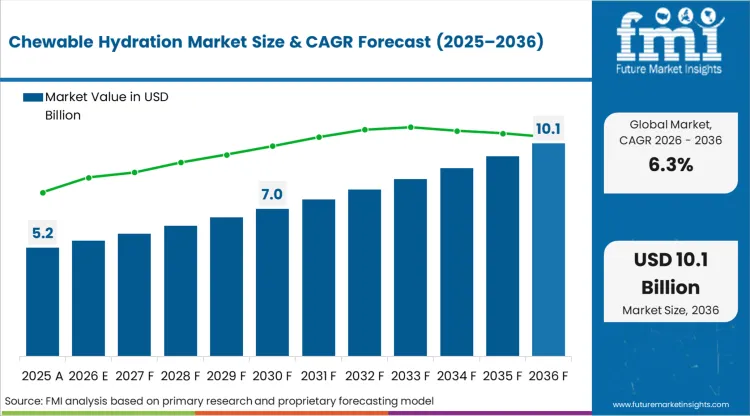
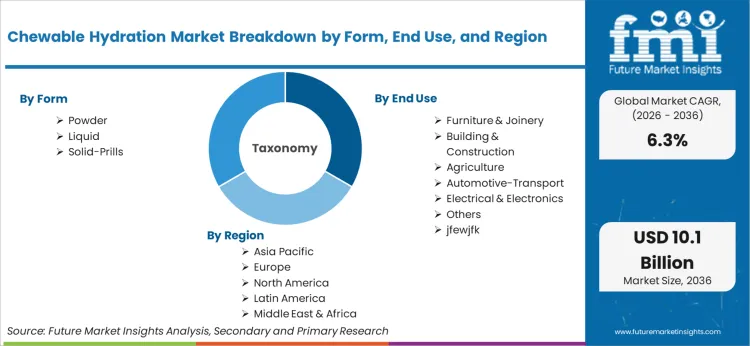
In 2025, the chewable hydration market was valued at USD 4.9 billion. It is expected to reach USD 5.5 billion in 2026 and USD 10.1 billion by 2036, implying a CAGR of 6.3%. This trajectory reflects a structural shift in hydration supplement procurement, where consumers and industrial buyers alike are prioritizing portable, waterless delivery systems over cumbersome powder-based solutions.
Absolute dollar growth of USD 4.6 billion over the decade signals a transformational opportunity driven by occupational safety mandates. With 2.41 billion workers globally now exposed to excessive heat annually, the "cost of inaction" regarding dehydration has shifted from a productivity issue to a liability risk [15]. This reality is forcing a procurement reset in sectors like construction and logistics, where chewable formats are replacing liquids to ensure compliance with safety protocols while minimizing waste.
Summary of Chewable Hydration Market
- Chewable Hydration Market Definition
- The industry covers high-efficacy solid electrolytes designed for rapid rehydration in water-scarce or high-convenience contexts.
- Demand Drivers in the Market
- Rising global heat exposure increases the medical necessity of daily electrolyte replenishment [21].
- Aging populations in developed nations drive demand for easy-to-swallow alternatives to pills [13].
- Expansion of "bleisure" travel fuels consumption of airport-friendly, liquid-free hydration formats [19].
- Key Segments Analyzed in the FMI Report
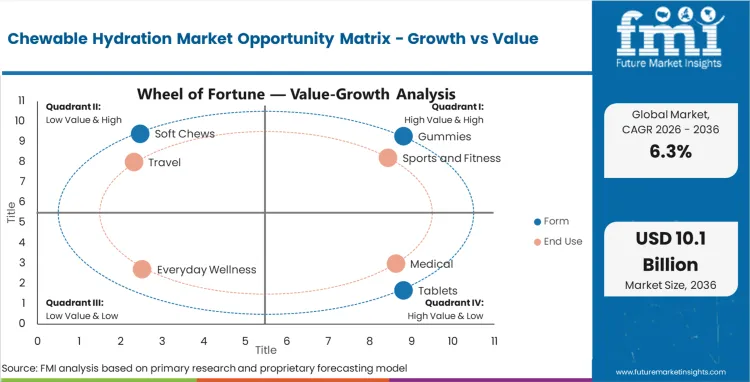
- Form: High-growth gummy formats versus traditional chewable energy tablets.
- End Use: Sports nutrition dominance yielding to industrial and geriatric use cases.
- Geography: Rapid adoption in heat-stressed Asia-Pacific markets versus premiumization in North America.
- Analyst Opinion at FMI
- Nikhil Kaitwade, Principal Consultant for Chemicals and Materials Industry at Future Market Insights, opines, "In the updated version of the Chewable Hydration Market Report for 2026 to 2036, CXOs will find insights into how climate change is reshaping the category from a 'nice-to-have' fitness accessory to a 'must-have' occupational safety tool. Besides this, my findings point at supply chain pressure for clean-label ingredients as consumers reject artificial additives in daily-use supplements."
- Strategic Implications/Executive Takeaways
- Shift focus from "sports performance" to "daily vitality" and "heat safety" messaging.
- Treat taste modulation as a critical IP barrier to entry in high-dose gummy formulations.
- Prioritize pharmacy channels to build clinical credibility for vitamin supplements with hydration claims.
- Methodology
- Validated through first-hand corporate production and capacity data.
- Zero reliance on speculative third-party market research reports.
- Based on verifiable industrial benchmarks and verified sources.
As Jennifer Toomey, Head of New Product Development at TopGum USA, noted regarding the push for clinical efficacy, "We formulated these gummies to carry the highest dose-per-gram of electrolytes available on the market." [2] This signals a move away from confectionery-style formulations toward high-load nutraceutical gummies that offer measurable physiological benefits.
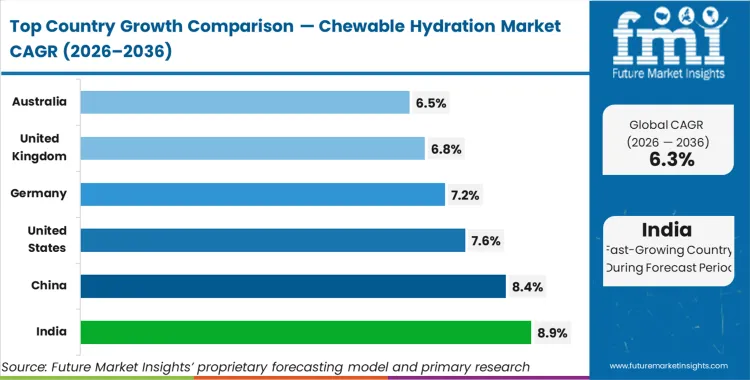
India (8.9% CAGR) and China (8.4% CAGR) drive new opportunities through urbanization and heat-stress adaptation. Mature markets such as the USA (7.6%), Germany (7.2%), and the UK (6.8%) generate replacement demand, where aging populations favor chewables to bypass pill fatigue, while the broader sports nutrition sector integrates these formats for endurance applications.
Chewable Hydration Market Definition
The chewable hydration market comprises the global production and trade of solid-format electrolyte supplements, including gummies, tablets, and soft chews. These products are engineered to deliver essential minerals like sodium, potassium, and magnesium through buccal absorption or rapid digestion, eliminating the need for water mixing.
Chewable Hydration Market Inclusions
The report includes a comprehensive analysis of market dynamics, covering hydration boosters sold through diverse channels such as pharmacies, sports specialty stores, and travel retail. It covers segmental breakdowns by product form (Gummies, Tablets) and functional variations (Caffeine-infused, Melatonin-blended, Sugar-free).
Chewable Hydration Market Exclusions
The scope excludes traditional liquid sports drinks, ready-to-drink (RTD) beverages, and bulk electrolyte powders that require reconstitution. It also omits intravenous hydration therapy services and general confectionery products that lack specific electrolyte dosage claims.
Chewable Hydration Market Research Methodology
- Primary Research: Interviews were conducted with product formulators, sports dietitians, and retail category managers to validate consumer adoption patterns.
- Desk Research: Production data from nutraceutical associations, UN Comtrade codes, and climate data from NOAA supported volume benchmarking.
- Market-Sizing and Forecasting: A hybrid top-down and bottom-up model was developed, reconstructing demand from occupational heat stress data and sports participation rates.
- Data Validation and Update Cycle: Outputs undergo anomaly screening against verified company financial disclosures and trade show announcements.
Segmental Analysis
Chewable Hydration Market Analysis by Form
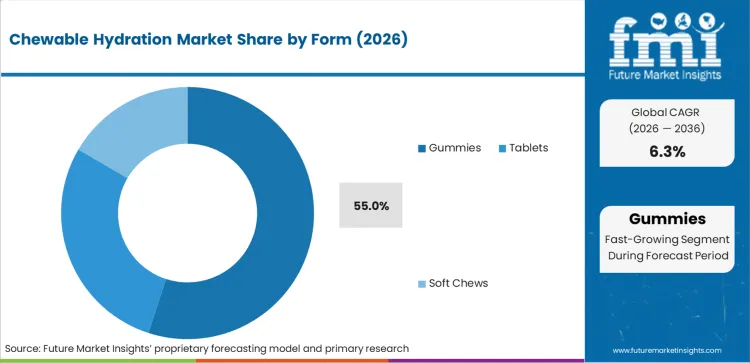
Based on FMI’s analysis, gummies are estimated to hold a 55% share in 2026, leveraging their high palatability to drive compliance among non-athlete consumers. Growth in demand for gummies comes from producers transforming the format from a "candy" alternative into a clinical delivery system capable of carrying significant electrolyte loads.
- Technology shift: Manufacturers are adopting advanced hydrocolloid systems to enable high-dose mineral loading without compromising texture, as seen in TopGum's October 2025 debut of specialized electrolyte gummies [15].
- Supply-side move: Sirio Pharma is aggressively expanding its capabilities, showcasing "snackable hydration gummies" at major trade shows in late 2024 to capture B2B contracts for hypotonic formulations [5].
- Buyer priority: Consumers are increasingly opting for sugar-free options to avoid caloric penalties, driving brands like Liquid I.V. to launch sugar-free multipliers that mirror the efficacy of their powder lines [11].
Chewable Hydration Market Analysis by End Use
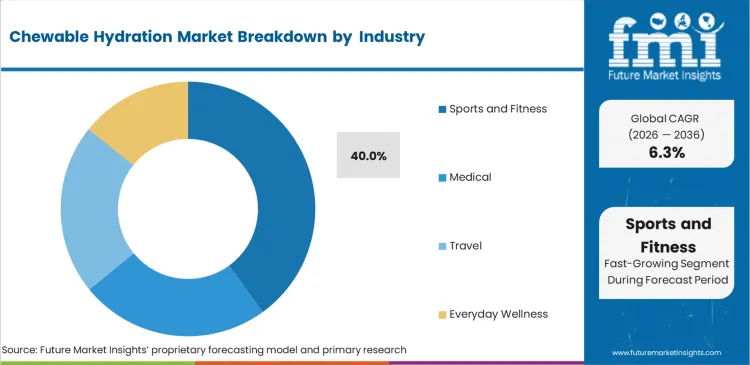
The Sports and Fitness segment's hold 40% market share in 2026 stems from the enduring need for rapid electrolyte replacement during endurance activities, yet this concentration is diluting as "Everyday Wellness" gains traction. The segment's dependence on active populations is being supplemented by the "industrial athlete" workforce, where heat stress is a daily operational hazard.
- Procurement trigger: Industrial safety managers are procuring military hydration products and commercial equivalents to mitigate the 22.85 million occupational injuries attributable to excessive heat annually [16].
- Regulatory signal: The International Labour Organization's flagging of 18,970 annual heat-related deaths is pushing corporations to mandate hydration breaks, creating a B2B bulk-buy channel for electrolyte chews [17].
- Adoption bridge: Brands like Himalaya Wellness are bridging the gap between recovery and lifestyle, launching "PartySmart" electrolytes in 2024 to target social and anti-hangover use cases [3].
Chewable Hydration Market Drivers, Restraints, and Opportunities
The relentless rise in global temperatures acts as the primary accelerator for the chewable hydration market, transforming electrolytes from a sports requirement into a daily survival necessity. With 2024 confirmed as the world's warmest year on record at +1.29°C above the 20th-century average, heat exposure is now a universal consumer concern [21]. This climatic shift drives mass adoption of portable hydration solutions beyond the gym, as commuters and outdoor workers seek convenient ways to manage thermal stress without carrying bulk liquids.
Despite the clear need, the market faces a "validity barrier" where skeptical consumers still perceive gummies as less effective than medical-grade powders or IV solutions. This restraint is compounded by the technical difficulty of masking the metallic taste of salts in chewable formats, which can limit repeat purchase rates among flavor-sensitive demographics. To mitigate this, leading players like Nuun are partnering with trusted fitness brands like Orangetheory to borrow credibility and frame chewables as a "proactive" tool rather than just a treat [1].
- Geriatric Compliance: A massive opportunity exists in the sleep gummy and hydration intersection for the elderly, particularly in Japan where 30% of the population is over 65 and struggles with liquid intake volume [10].
- Travel Retail: The recovery of global tourism to 1.52 billion arrivals in 2025 creates a high-margin channel for "flight-safe" hydration packs that do not count against liquid carry-on limits [20].
- Beauty Adjacency: Integrating electrolytes with beauty supplements offers a pathway to premiumization, appealing to consumers who link hydration with skin health.
Regional Analysis
Based on the regional analysis, the chewable hydration market is segmented into North America, Latin America, Europe, East Asia, South Asia, Oceania and Middle East & Africa across 40+ countries. The full report also offers market attractiveness analysis based on regional trends.
.webp "Top Country Growth Comparison Chewable Hydration Market Cagr (2026 2036)")
| Country | CAGR (2026 to 2036) |
|---|---|
| India | 8.9% |
| China | 8.4% |
| United States | 7.6% |
| Germany | 7.2% |
| United Kingdom | 6.8% |
| Australia | 6.5% |
Source: Future Market Insights (FMI) analysis
Asia Pacific Chewable Hydration Market Analysis
Asia Pacific demand is associated with export-oriented resin upgrading to satisfy stringent Western indoor air quality regulations, but in the context of hydration, it is driven by extreme urban heat density. The region is leveraging its massive pharmaceutical manufacturing base to produce cost-effective chewable formats that remain stable in tropical climates.
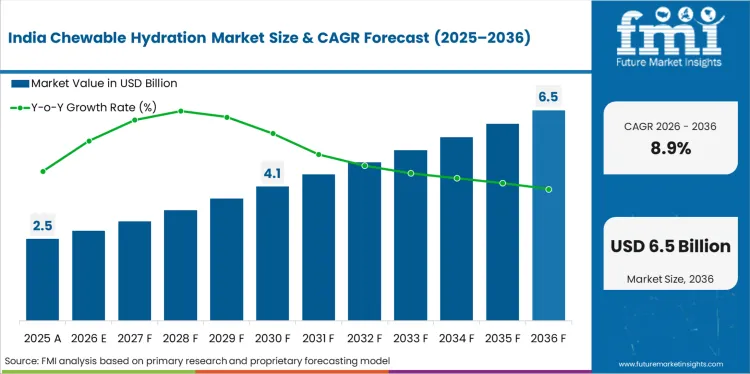
- India: Demand for chewable hydration in India is set to grow at 8.9% CAGR through 2036, supported by a 35% urban population that faces intense commute-related heat stress [1]. This trajectory is further validated by the widespread availability of single-serve sachets in pharmacy networks, catering to price-sensitive buyers.
- China: Chewable hydration sales in China are projected to rise at 8.4% CAGR from 2026 to 2036 as 66% of the population concentrates in urban centers, creating a "convenience-first" wellness culture [2]. Expansion is linked to the growing silver economy, where 15% of the population is aged 65+, requiring easy-to-consume health solutions [9].
- Japan: The Japan chewable hydration sector is poised to expand at steady rates because 30% of its citizens are over 65, making pill-swallowing difficulty a primary driver for gummy and chewable adoption [10].
FMI’s report includes a detailed growth analysis and country-wise assessment of this region. South Korea and Indonesia are also emerging as key markets, where younger consumers utilize "K-Beauty" trends to adopt hydration products with skin benefits. Buyers in these markets should watch for regulatory updates regarding sugar content in functional gummies, which may impact import viability.
North America Chewable Hydration Market Analysis
North America remains the innovation engine of the market, characterized by a rapid "green recovery" in ingredients and a shift toward clinical substantiation. The region's consumers are highly educated on bioavailability, forcing brands to substantiate their "rapid absorption" claims with clear labeling.
- United States: The outlook for chewable hydration in the United States indicates a 7.6% CAGR from 2026 to 2036 as 80% of the population resides in urban areas often prone to heat islands [6]. This demand is reinforced by the expansion of "active lifestyle" branding, exemplified by Liquid I.V.'s launch of Sugar-Free multipliers in 2025 to capture health-conscious demographics [11].
FMI’s report includes a comprehensive assessment of the market in Canada and Mexico. Canada is seeing a surge in demand for clean-label options, evidenced by Liquid I.V.'s debut of sugar-free lines in the country in August 2025 [11]. Retailers in these markets should anticipate a wave of "crossover" products that blend hydration with energy or sleep support.
Europe Chewable Hydration Market Analysis
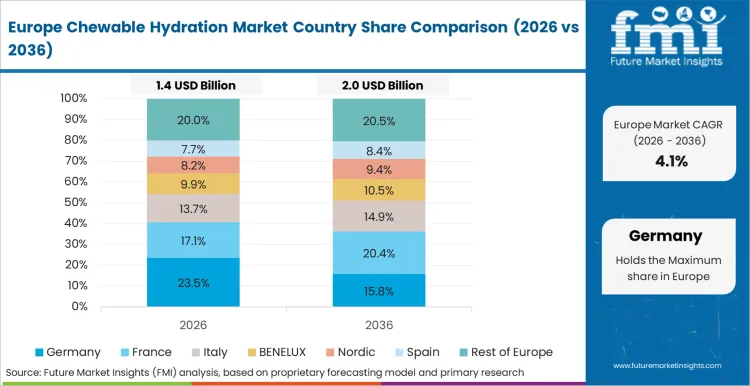
Europe is the global "regulatory laboratory," where market value is driven by strict adherence to EFSA health claims and a strong preference for pharmacy-grade quality. Growth is constrained by elevated scrutiny on sugar content, pushing the market toward stevia-sweetened and unflavored tablet variants.
- Germany: Growth in chewable hydration across Germany is estimated at 7.2% CAGR through 2036, driven by an aging demographic (23% over 65) that prioritizes functional medical nutrition over sports candy [12]. This is supported by high urban density (82%), facilitating distribution through dense apothecary networks [5].
- United Kingdom: The UK is expected to record 6.8% CAGR in chewable hydration demand over 2026 to 2036 as 83% of the population lives in cities and increasingly engages in travel and outdoor leisure [4]. This trend is bolstered by the 19% of the population aged 65+ seeking accessible wellness formats [11].
FMI’s report includes a detailed analysis of Italy, France, and Spain. These markets are increasingly adopting "beauty-from-within" hydration concepts. A key theme for suppliers here is the rising demand for sustainable packaging, as EU plastic waste directives impact single-use sachet and wrapper designs.
Competitive Aligners for Market Players
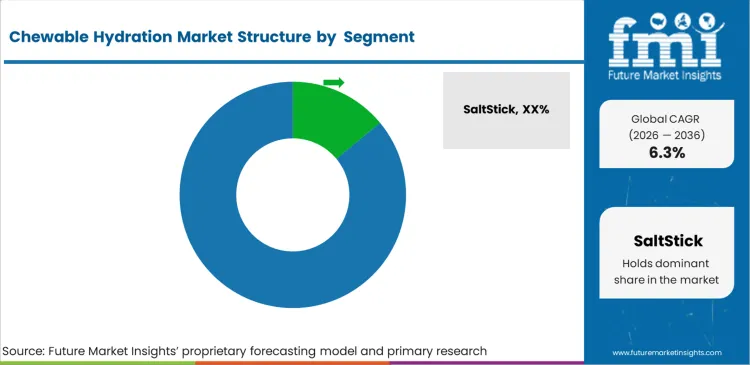
The market structure remains fragmented, yet practical competition is concentrated among a limited set of players capable of navigating the "taste vs. efficacy" trade-off. Specialized CDMOs like Sirio Pharma and TopGum Industries hold significant power, as their proprietary gummy technologies allow brands to launch high-dose products without investing in capex [5, 14].
Primary competitive variable is now "clinical validity" rather than just flavor. Brands like Nuun are differentiating themselves by securing partnerships with fitness giants like Orangetheory, effectively locking in a dedicated user base and validating their efficacy through professional association [1]. This "service conversion" strategy insulates them from the price wars typical of the generic supplement aisle.
Suppliers without access to advanced modulation technology depend on high-sugar formulations to mask electrolyte bitterness, increasing exposure to regulatory headwinds and consumer rejection. Conversely, vertically integrated players who can control their supply of natural sweeteners and flavor masking agents are better positioned to sustain margins during raw material price spikes.
Recent Developments
The report includes full coverage of key trends from competitive benchmarking. Some of the recent developments covered in the reports:
- In October 2025, TopGum Industries debuted a creatine and electrolyte gummy line at SupplySide West, targeting the dual needs of hydration and muscle performance.[15]
- In August 2025, Liquid I.V. launched its "Energy Multiplier Sugar-Free" to support sustained energy and hydration, marking a significant portfolio extension into functional adjacencies.[12]
Key Players in Chewable Hydration
- Nuun (Nestlé Health Science)
- Liquid I.V. (Unilever)
- SaltStick
- Hydralyte
- Seattle Gummy Company
- Sirio Pharma
- TopGum Industries
- PlantFuel Life
- Himalaya Wellness
- Plant People
- Limitless X
- DripDrop
- GU Energy Labs
- Skratch Labs
- Science in Sport (SiS)
Scope of the Report
| Metric | Value |
|---|---|
| Quantitative Units | USD 5.5 billion (2026) to USD 10.1 billion (2036), at a CAGR of 6.3% |
| Market Definition | The chewable hydration market comprises the global production and trade of solid-format electrolyte supplements, including gummies, tablets, and soft chews, designed for buccal or digestive absorption without water. |
| Form Segmentation | Gummies, Tablets, Soft Chews |
| Product Type Segmentation | Electrolyte-only, Vitamin-infused, Adaptogen-blended |
| End Use Segmentation | Sports and Fitness, Medical, Travel, Everyday Wellness |
| Application Coverage | Hydration maintenance, Heat stress management, Athletic recovery, Hangover relief |
| Regions Covered | North America, Latin America, Europe, East Asia, South Asia, Oceania, Middle East and Africa |
| Countries Covered | United States, Canada, Mexico, Brazil, Argentina, Germany, France, United Kingdom, Italy, Spain, China, India, Japan, South Korea, Indonesia, Australia and 40 plus countries |
| Key Companies Profiled | Nuun, Liquid I.V., SaltStick, Hydralyte, Seattle Gummy Company, Sirio Pharma, TopGum Industries, PlantFuel Life, Himalaya Wellness, Plant People |
| Forecast Period | 2026 to 2036 |
| Approach | Hybrid top-down and bottom-up market modeling validated through primary interviews with resin producers and panel manufacturers, supported by trade data benchmarking and plant level capacity verification |
Chewable Hydration Market Analysis by Segments
Form:
- Gummies
- Tablets
- Soft Chews
Product Type:
- Electrolyte-only
- Vitamin-infused
- Adaptogen-blended
End Use:
- Sports and Fitness
- Medical
- Travel
- Everyday Wellness
Region:
- Asia Pacific
- India
- China
- Japan
- South Korea
- Indonesia
- Australia & New Zealand
- ASEAN
- Rest of Asia Pacific
- Europe
- Germany
- Italy
- France
- United Kingdom
- Spain
- Benelux
- Nordics
- Central & Eastern Europe
- Rest of Europe
- North America
- United States
- Canada
- Mexico
- Latin America
- Brazil
- Argentina
- Chile
- Rest of Latin America
- Middle East & Africa
- Kingdom of Saudi Arabia
- United Arab Emirates
- South Africa
- Turkey
- Rest of Middle East & Africa
Bibliography
- [1] NutraIngredients.com. (2024). Orangetheory Fitness and Nuun join forces to elevate member hydration.
- [2] TMX Newsfile. (2024). PlantFuel Advances Its Innovative Product Portfolio with Amplify Nutrition PreWorkout and Electrolyte Gummies.
- [3] PR Newswire. (2024). Himalaya Wellness launches PartySmart Electrolytes.
- [4] Nestlé Health Science USA. (2024). Nuun turns 20.
- [5] WholeFoods Magazine. (2024). SupplySide West 2024 preview: Sirio Snackable Hydration Gummy.
- [6] World Bank Open Data. (2024). Urban population (% of total) - United States.
- [7] World Bank Open Data. (2024). Urban population (% of total) - Australia.
- [8] World Bank Open Data. (2024). Population ages 65+ (% of total) - India.
- [9] World Bank Open Data. (2024). Population ages 65+ (% of total) - China.
- [10] World Bank Open Data. (2024). Population ages 65+ (% of total) - Japan.
- [11] GlobeNewswire. (2025). Liquid I.V. debuts innovative Sugar-Free Hydration Multiplier in Canada.
- [12] PR Newswire. (2025). Liquid I.V. launches Energy Multiplier Sugar-Free.
- [13] World Bank Open Data. (2024). Population ages 65+ (% of total) - United States.
- [14] FoodBev Media. (2025). TopGum Industries launches sports nutrition gummies.
- [15] International Labour Organization. (2024). Workers exposed annually to excessive heat.
- [16] International Labour Organization. (2024). Occupational injuries attributable to excessive heat.
- [17] International Labour Organization. (2024). Work-related deaths attributable to excessive heat.
- [18] Seattle Gummy Company. (2025). New + improved HydraFuel Electrolyte Gummies.
- [19] UNWTO. (2025). International tourism recovers pre-pandemic levels in 2024.
- [20] UNWTO. (2025). UN Tourism World Tourism Barometer Data.
- [21] NOAA. (2025). 2024 was worlds warmest year on record.
This bibliography is provided for reader reference and is not exhaustive. The full report contains the complete reference list and detailed citations.
This Report Addresses
- Market intelligence to enable structured strategic decision making across mature and emerging resin economies
- Market size estimation and 10 year revenue forecasts from 2026 to 2036, supported by validated capacity and trade benchmarks
- Growth opportunity mapping across powder, liquid, and solid forms with emphasis on ULEF and NAF grade transitions
- Segment and regional revenue forecasts covering building and construction, furniture and joinery, agriculture, automotive, and electrical applications
- Competition strategy assessment including integration models, cost survivability positioning, and compliance capability benchmarking
- Product reformulation and emission compliance tracking including E0, E1, CARB Phase 2, and EPA TSCA Title VI aligned grades
- Regulatory impact analysis covering formaldehyde emission mandates, indoor air quality thresholds, and export driven specification upgrades
- Market report delivery in PDF, Excel, PPT, and interactive dashboard formats for executive and operational use
Frequently Asked Questions
How large is the demand for Chewable Hydration in the global market in 2026?
Demand for Chewable Hydration in the global market is estimated to be valued at USD 5.5 billion in 2026.
What will be the market size of Chewable Hydration in the global market by 2036?
Market size for Chewable Hydration is projected to reach USD 10.1 billion by 2036.
What is the expected demand growth for Chewable Hydration in the global market between 2026 and 2036?
Demand for Chewable Hydration in the global market is expected to grow at a CAGR of 6.3% between 2026 and 2036.
Which Form is poised to lead global sales by 2026?
Gummies are poised to lead due to high palatability and the ability to mask electrolyte taste, capturing the largest share of the consumer base.
How significant is the role of Sports and Fitness End Use in driving Chewable Hydration adoption in 2026?
Sports and Fitness represents a critical segment, serving as the foundational volume driver for electrolyte replacement products.
What is driving demand in India?
Growth in India is driven by rapid urbanization and the need for affordable, portable hydration solutions in high-heat environments.
What compliance standards or regulations are referenced for India?
The report references evolving food safety standards for nutraceuticals and functional claims in the Indian market.
What is the India growth outlook in this report?
India is projected to grow at a CAGR of 8.9% during 2026 to 2036.
Why is North America described as a priority region in this report?
North America is a priority due to its high spending on wellness products and the rapid adoption of specialized hydration formats.
What type of demand dominates in North America?
Replacement demand for sugar-free and clean-label hydration options dominates regional consumption.
What is the United States growth outlook in this report?
The United States is projected to grow at a CAGR of 7.6% during 2026 to 2036.
Does the report cover China in its regional analysis?
Yes, China is included within East Asia under the regional scope of analysis.
What are the sources referred to for analyzing the Market in China?
Official urbanization statistics and sports participation data are cited as primary reference sources for analyzing the Chinese market.
What is the main demand theme linked to China in Asia Coverage?
Asia Pacific demand in China is associated with the rising middle-class interest in fitness and convenience-led health products.
Does the report cover Germany in its regional analysis?
Yes, Germany is included within Europe under the regional coverage framework.
What is the main Germany Related Demand Theme in Asia Coverage?
Demand in Germany is driven by an aging population seeking easy-to-consume supplements and pharmacy-grade quality.
Which Product Formats are Strategically Important for Asia Pacific Supply Chains?
Stable, heat-resistant gummy and tablet formats are prioritized to withstand regional climatic conditions during distribution.
What is Chewable Hydration and What is It Mainly Used For?
Chewable hydration refers to solid electrolyte supplements like gummies and tablets used for rapid rehydration without water.
What does Chewable Hydration Market Mean in this Report?
Chewable Hydration market refers to the global production, trade, and consumption of these solid-format electrolyte products.
What is Included in the Scope of this Chewable Hydration Market Report?
Scope covers gummies, tablets, and soft chews across sports, medical, travel, and wellness applications.
What is Excluded from the Scope of this Report?
Liquid sports drinks, powders requiring mixing, and general confectionery without functional hydration claims are excluded.
What does Market Forecast Mean on this Page?
Market forecast represents a model based projection built on defined assumptions for strategic planning purposes.
How does FMI Build and Validate the Chewable Hydration Market Forecast?
Forecast is developed using hybrid top down and bottom up modeling validated through trade data, capacity checks, and industry review.
What does Zero Reliance on Speculative Third Party Market Research Mean Here?
Primary interviews and verifiable public datasets are used instead of unverified syndicated market estimates.
Preview the report firsthand - request a free sample
Get SampleGet the brochure for pricing and purchase details.
Get PDFTable of Content
- Executive Summary
- Global Market Outlook
- Demand-side Trends
- Supply-side Trends
- Technology Roadmap Analysis
- Analysis and Recommendations
- Market Overview
- Market Coverage / Taxonomy
- Market Definition / Scope / Limitations
- Research Methodology
- Chapter Orientation
- Analytical Lens and Working Hypotheses
- Market Structure, Signals, and Trend Drivers
- Benchmarking and Cross-market Comparability
- Market Sizing, Forecasting, and Opportunity Mapping
- Research Design and Evidence Framework
- Desk Research Programme (Secondary Evidence)
- Company Annual and Sustainability Reports
- Peer-reviewed Journals and Academic Literature
- Corporate Websites, Product Literature, and Technical Notes
- Earnings Decks and Investor Briefings
- Statutory Filings and Regulatory Disclosures
- Technical White Papers and Standards Notes
- Trade Journals, Industry Magazines, and Analyst Briefs
- Conference Proceedings, Webinars, and Seminar Materials
- Government Statistics Portals and Public Data Releases
- Press Releases and Reputable Media Coverage
- Specialist Newsletters and Curated Briefings
- Sector Databases and Reference Repositories
- FMI Internal Proprietary Databases and Historical Market Datasets
- Subscription Datasets and Paid Sources
- Social Channels, Communities, and Digital Listening Inputs
- Additional Desk Sources
- Expert Input and Fieldwork (Primary Evidence)
- Primary Modes
- Qualitative Interviews and Expert Elicitation
- Quantitative Surveys and Structured Data Capture
- Blended Approach
- Why Primary Evidence is Used
- Field Techniques
- Interviews
- Surveys
- Focus Groups
- Observational and In-context Research
- Social and Community Interactions
- Stakeholder Universe Engaged
- C-suite Leaders
- Board Members
- Presidents and Vice Presidents
- R&D and Innovation Heads
- Technical Specialists
- Domain Subject-matter Experts
- Scientists
- Physicians and Other Healthcare Professionals
- Governance, Ethics, and Data Stewardship
- Research Ethics
- Data Integrity and Handling
- Primary Modes
- Tooling, Models, and Reference Databases
- Desk Research Programme (Secondary Evidence)
- Data Engineering and Model Build
- Data Acquisition and Ingestion
- Cleaning, Normalisation, and Verification
- Synthesis, Triangulation, and Analysis
- Quality Assurance and Audit Trail
- Market Background
- Market Dynamics
- Drivers
- Restraints
- Opportunity
- Trends
- Scenario Forecast
- Demand in Optimistic Scenario
- Demand in Likely Scenario
- Demand in Conservative Scenario
- Opportunity Map Analysis
- Product Life Cycle Analysis
- Supply Chain Analysis
- Investment Feasibility Matrix
- Value Chain Analysis
- PESTLE and Porter’s Analysis
- Regulatory Landscape
- Regional Parent Market Outlook
- Production and Consumption Statistics
- Import and Export Statistics
- Market Dynamics
- Global Market Analysis 2021 to 2025 and Forecast, 2026 to 2036
- Historical Market Size Value (USD Million) Analysis, 2021 to 2025
- Current and Future Market Size Value (USD Million) Projections, 2026 to 2036
- Y-o-Y Growth Trend Analysis
- Absolute $ Opportunity Analysis
- Global Market Pricing Analysis 2021 to 2025 and Forecast 2026 to 2036
- Global Market Analysis 2021 to 2025 and Forecast 2026 to 2036, By Form
- Introduction / Key Findings
- Historical Market Size Value (USD Million) Analysis By Form , 2021 to 2025
- Current and Future Market Size Value (USD Million) Analysis and Forecast By Form , 2026 to 2036
- Gummies
- Tablets
- Soft Chews
- Gummies
- Y-o-Y Growth Trend Analysis By Form , 2021 to 2025
- Absolute $ Opportunity Analysis By Form , 2026 to 2036
- Global Market Analysis 2021 to 2025 and Forecast 2026 to 2036, By End Use
- Introduction / Key Findings
- Historical Market Size Value (USD Million) Analysis By End Use, 2021 to 2025
- Current and Future Market Size Value (USD Million) Analysis and Forecast By End Use, 2026 to 2036
- Sports and Fitness
- Medical
- Travel
- Everyday Wellness
- Sports and Fitness
- Y-o-Y Growth Trend Analysis By End Use, 2021 to 2025
- Absolute $ Opportunity Analysis By End Use, 2026 to 2036
- Global Market Analysis 2021 to 2025 and Forecast 2026 to 2036, By Region
- Introduction
- Historical Market Size Value (USD Million) Analysis By Region, 2021 to 2025
- Current Market Size Value (USD Million) Analysis and Forecast By Region, 2026 to 2036
- North America
- Latin America
- Western Europe
- Eastern Europe
- East Asia
- South Asia and Pacific
- Middle East & Africa
- Market Attractiveness Analysis By Region
- North America Market Analysis 2021 to 2025 and Forecast 2026 to 2036, By Country
- Historical Market Size Value (USD Million) Trend Analysis By Market Taxonomy, 2021 to 2025
- Market Size Value (USD Million) Forecast By Market Taxonomy, 2026 to 2036
- By Country
- USA
- Canada
- Mexico
- By Form
- By End Use
- By Country
- Market Attractiveness Analysis
- By Country
- By Form
- By End Use
- Key Takeaways
- Latin America Market Analysis 2021 to 2025 and Forecast 2026 to 2036, By Country
- Historical Market Size Value (USD Million) Trend Analysis By Market Taxonomy, 2021 to 2025
- Market Size Value (USD Million) Forecast By Market Taxonomy, 2026 to 2036
- By Country
- Brazil
- Chile
- Rest of Latin America
- By Form
- By End Use
- By Country
- Market Attractiveness Analysis
- By Country
- By Form
- By End Use
- Key Takeaways
- Western Europe Market Analysis 2021 to 2025 and Forecast 2026 to 2036, By Country
- Historical Market Size Value (USD Million) Trend Analysis By Market Taxonomy, 2021 to 2025
- Market Size Value (USD Million) Forecast By Market Taxonomy, 2026 to 2036
- By Country
- Germany
- UK
- Italy
- Spain
- France
- Nordic
- BENELUX
- Rest of Western Europe
- By Form
- By End Use
- By Country
- Market Attractiveness Analysis
- By Country
- By Form
- By End Use
- Key Takeaways
- Eastern Europe Market Analysis 2021 to 2025 and Forecast 2026 to 2036, By Country
- Historical Market Size Value (USD Million) Trend Analysis By Market Taxonomy, 2021 to 2025
- Market Size Value (USD Million) Forecast By Market Taxonomy, 2026 to 2036
- By Country
- Russia
- Poland
- Hungary
- Balkan & Baltic
- Rest of Eastern Europe
- By Form
- By End Use
- By Country
- Market Attractiveness Analysis
- By Country
- By Form
- By End Use
- Key Takeaways
- East Asia Market Analysis 2021 to 2025 and Forecast 2026 to 2036, By Country
- Historical Market Size Value (USD Million) Trend Analysis By Market Taxonomy, 2021 to 2025
- Market Size Value (USD Million) Forecast By Market Taxonomy, 2026 to 2036
- By Country
- China
- Japan
- South Korea
- By Form
- By End Use
- By Country
- Market Attractiveness Analysis
- By Country
- By Form
- By End Use
- Key Takeaways
- South Asia and Pacific Market Analysis 2021 to 2025 and Forecast 2026 to 2036, By Country
- Historical Market Size Value (USD Million) Trend Analysis By Market Taxonomy, 2021 to 2025
- Market Size Value (USD Million) Forecast By Market Taxonomy, 2026 to 2036
- By Country
- India
- ASEAN
- Australia & New Zealand
- Rest of South Asia and Pacific
- By Form
- By End Use
- By Country
- Market Attractiveness Analysis
- By Country
- By Form
- By End Use
- Key Takeaways
- Middle East & Africa Market Analysis 2021 to 2025 and Forecast 2026 to 2036, By Country
- Historical Market Size Value (USD Million) Trend Analysis By Market Taxonomy, 2021 to 2025
- Market Size Value (USD Million) Forecast By Market Taxonomy, 2026 to 2036
- By Country
- Kingdom of Saudi Arabia
- Other GCC Countries
- Turkiye
- South Africa
- Other African Union
- Rest of Middle East & Africa
- By Form
- By End Use
- By Country
- Market Attractiveness Analysis
- By Country
- By Form
- By End Use
- Key Takeaways
- Key Countries Market Analysis
- USA
- Pricing Analysis
- Market Share Analysis, 2025
- By Form
- By End Use
- Canada
- Pricing Analysis
- Market Share Analysis, 2025
- By Form
- By End Use
- Mexico
- Pricing Analysis
- Market Share Analysis, 2025
- By Form
- By End Use
- Brazil
- Pricing Analysis
- Market Share Analysis, 2025
- By Form
- By End Use
- Chile
- Pricing Analysis
- Market Share Analysis, 2025
- By Form
- By End Use
- Germany
- Pricing Analysis
- Market Share Analysis, 2025
- By Form
- By End Use
- UK
- Pricing Analysis
- Market Share Analysis, 2025
- By Form
- By End Use
- Italy
- Pricing Analysis
- Market Share Analysis, 2025
- By Form
- By End Use
- Spain
- Pricing Analysis
- Market Share Analysis, 2025
- By Form
- By End Use
- France
- Pricing Analysis
- Market Share Analysis, 2025
- By Form
- By End Use
- India
- Pricing Analysis
- Market Share Analysis, 2025
- By Form
- By End Use
- ASEAN
- Pricing Analysis
- Market Share Analysis, 2025
- By Form
- By End Use
- Australia & New Zealand
- Pricing Analysis
- Market Share Analysis, 2025
- By Form
- By End Use
- China
- Pricing Analysis
- Market Share Analysis, 2025
- By Form
- By End Use
- Japan
- Pricing Analysis
- Market Share Analysis, 2025
- By Form
- By End Use
- South Korea
- Pricing Analysis
- Market Share Analysis, 2025
- By Form
- By End Use
- Russia
- Pricing Analysis
- Market Share Analysis, 2025
- By Form
- By End Use
- Poland
- Pricing Analysis
- Market Share Analysis, 2025
- By Form
- By End Use
- Hungary
- Pricing Analysis
- Market Share Analysis, 2025
- By Form
- By End Use
- Kingdom of Saudi Arabia
- Pricing Analysis
- Market Share Analysis, 2025
- By Form
- By End Use
- Turkiye
- Pricing Analysis
- Market Share Analysis, 2025
- By Form
- By End Use
- South Africa
- Pricing Analysis
- Market Share Analysis, 2025
- By Form
- By End Use
- USA
- Market Structure Analysis
- Competition Dashboard
- Competition Benchmarking
- Market Share Analysis of Top Players
- By Regional
- By Form
- By End Use
- Competition Analysis
- Competition Deep Dive
- SaltStick
- Overview
- Product Portfolio
- Profitability by Market Segments (Product/Age /Sales Channel/Region)
- Sales Footprint
- Strategy Overview
- Marketing Strategy
- Product Strategy
- Channel Strategy
- Hydralyte
- Seattle Gummy Company
- Sirio Pharma
- TopGum Industries
- PlantFuel Life
- Himalaya Wellness
- Plant People
- SaltStick
- Competition Deep Dive
- Assumptions & Acronyms Used


