

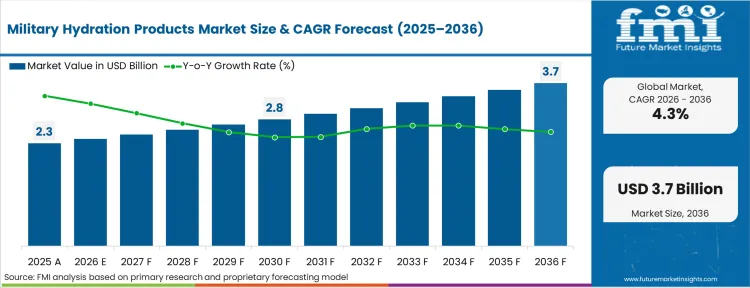
- Industry Size (2026)
- USD 2.4 Bn
- Forecast (2036)
- USD 3.6 Bn
- CAGR (2026 to 2036)
- 4.3%
Military Hydration Products Market Size, Market Forecast and Outlook By FMI
The Military Hydration Products surpassed a valuation of USD 2.3 billion in 2025. The industry is expected to cross USD 2.4 billion in 2026 at a CAGR of 4.3% during the forecast period. Ongoing investment is expected to raise the market to USD 3.6 billion by 2036 as modernization programs transition from centralized water transport to decentralized water purification and carriage systems aligned with highly mobile, dispersed operational doctrines.
Defense procurement strategies are moving beyond standalone reservoirs toward integrated hydration backpacks that align with plate carriers and protective gear. The operational penalty for choosing legacy systems is a reduction in infantry mobility and increased exposure times during active engagements. The true bottleneck in modern field deployment is not total reservoir capacity, but the physical compatibility of drinking valves with gas masks and military wearables. Modern load-bearing ecosystems require fluid systems that embed seamlessly into ballistic vests rather than acting as cumbersome secondary attachments.
Summary of Military Hydration Products Market
- Military Hydration Products Market Definition:
- The sector comprises specialized fluid carriage, delivery, and purification systems engineered to integrate with tactical gear. It is structurally defined by adherence to rigorous military specifications, CBRN compatibility, and integration with modern infantry load-bearing architectures.
- Demand Drivers in the Market:
- The transition toward highly dispersed, autonomous infantry operations compels military logistics commands to prioritize individual, decentralized water purification capabilities over vulnerable bulk transport.
- The adoption of modular, scalable tactical vest architectures requires defense procurement agencies to source low-profile hydration bladders that do not disrupt ballistic protection.
- Stringent combat readiness standards in extreme climatic zones drive tactical gear specifiers to procure advanced thermal insulation and freeze-resistant fluid delivery components.
- Key Segments Analyzed in the FMI Report:
- Hydration Packs: Hydration Packs is expected to hold 38.0% share in 2026, as this format integrates seamlessly into plate carriers and allows hands-free fluid intake during active engagements.
- National Defense Industry: National Defense Industry is anticipated to hold 61.0% share in 2026, representing the core volume of standardized procurement for active duty personnel deployments.
- India: 4.9% compound growth, reflecting rapid modernization of infantry under domestic manufacturing initiatives and specialized requirements for extreme altitude deployments.
- Analyst Opinion at FMI:
- Nikhil Kaitwade, Principal Consultant for Industrial Automation at Future Market Insights, opines, “In our latest Military Hydration Products Market evaluation, my team and I have identified mission duration and climate resilience as the key design parameters shaping procurement decisions. Military forces increasingly operate in extreme environments where dehydration directly impacts cognitive performance and physical endurance. Hydration systems must therefore combine lightweight construction, rapid refill capability, and contamination protection. Suppliers that integrate advanced polymer materials with ergonomic load distribution will strengthen their position in next-generation soldier support equipment.”
- Strategic Implications / Executive Takeaways:
- Tactical gear manufacturers must integrate robust micro-filtration directly into fluid delivery tubes to capture premium margins in upcoming specialized force modernization contracts.
- Defense logistics planners should accelerate the transition from rigid canteens to conformal reservoirs to avoid excessive physiological strain on infantry carrying heavy modular body armor.
- Legacy component suppliers face a structural shift toward pressurized systems that enable hands-free wound irrigation and gear cleaning in the field.
- Methodology:
- Primary Research: Consultations with defense procurement directors and military logistics specialists.
- Desk Research: Aggregation of defense contract awards and tactical equipment standardization documents.
- Market-Sizing and Forecasting: Anchored to active infantry counts and individual equipment refresh cycles.
- Data Validation and Update Cycle: Triangulated against allied military spending reports and modernization budget allocations.
The transition toward decentralized hydration will depend on reservoir systems that can incorporate in-line chemical and biological filtration without sharply reducing flow performance. Leading manufacturers trigger this shift by engineering micro-filtration matrices that operate efficiently under standard bite-valve suction pressure. Once this engineering threshold is crossed, individual soldiers can safely draw from unverified local water sources, drastically reducing the logistical resupply tail and reliance on heavy bulk transport.
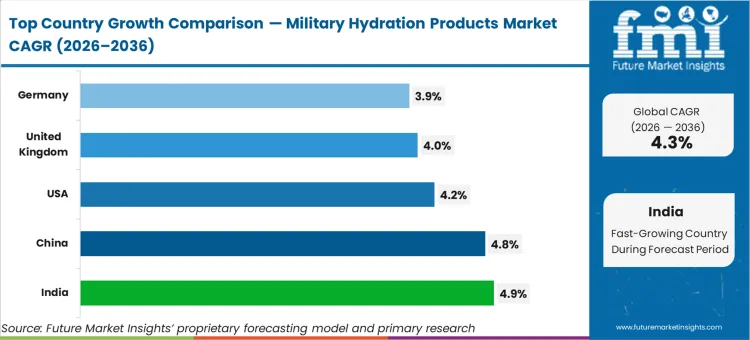
Regional growth patterns reflect how quickly armed forces are replacing legacy hydration gear with field-ready modular systems. India is poised to expand at 4.9%, driven by high-altitude border deployment requirements forcing upgrades from legacy canteens to freeze-resistant hydration systems. China is expected to advance at 4.8% as its military modernizes individual combat gear for amphibious and expeditionary readiness. The United States is likely to record a 4.2% rate as the dominant force standardizes modular load-bearing equipment across branches. The United Kingdom is anticipated to track at 4.0% through specialized procurement for extreme climate deployments. Germany is estimated to register 3.9%, reflecting systematic updates to its infantry supply chains. The divergence across this range stems directly from the varying states of baseline equipment modernization rather than purely budgetary differences.
Military Hydration Products Market Key Takeaways
| Metric | Details |
|---|---|
| Industry Size (2026) | USD 2.4 Billion |
| Industry Value (2036) | USD 3.6 Billion |
| CAGR (2026-2036) | 4.3% |
Source: Future Market Insights (FMI) analysis, based on proprietary forecasting model and primary research
Military Hydration Products Market Definition
The industry encompasses individual and squad-level fluid carriage, purification, and delivery systems engineered specifically to meet defense procurement specifications. This boundary strictly separates tactical, high-durability, CBRN-compatible fluid systems utilized in active combat and rigorous training environments from commercial outdoor recreation or consumer-grade sporting goods.
Military Hydration Products Market Inclusions
The scope includes ruggedized reservoirs, hydration backpacks, insulated canteens, bite valves, in-line microbiological water purifier bottles, thermal insulation sleeves, cleaning kits, and specialized pressurized bladders designed to integrate with tactical webbing and plate carriers. It encompasses both individual components and fully integrated fluid delivery systems procured through official defense supply chains.
Military Hydration Products Market Exclusions
Large-scale municipal or base-level water treatment systems, bulk water transport vehicles, commercial sporting goods, and disposable single-use plastic consumer water bottles are explicitly excluded. These items do not interface with individual load-bearing combat equipment, lack the requisite ballistic or CBRN compatibility standards, and function within entirely different logistical frameworks.
Military Hydration Products Market Research Methodology
- Primary Research: Procurement officers, tactical gear product managers, and military logistics commanders involved in infantry load-bearing equipment qualification.
- Desk Research: National Stock Number (NSN) registries, defense contract award databases, standard military specifications (Mil-Spec) archives, and allied tactical equipment testing protocols.
- Market-Sizing and Forecasting: Baseline anchors to the active-duty and reserve troop counts across major defense spending nations, multiplied by standard equipment replacement cycles and per-unit procurement costs.
- Data Validation and Update Cycle: Forecasts are cross-validated against publicly accessible defense budget allocations for individual combat equipment and infantry modernization programs.
Segmental Analysis
Military Hydration Products Market Analysis by Product Type
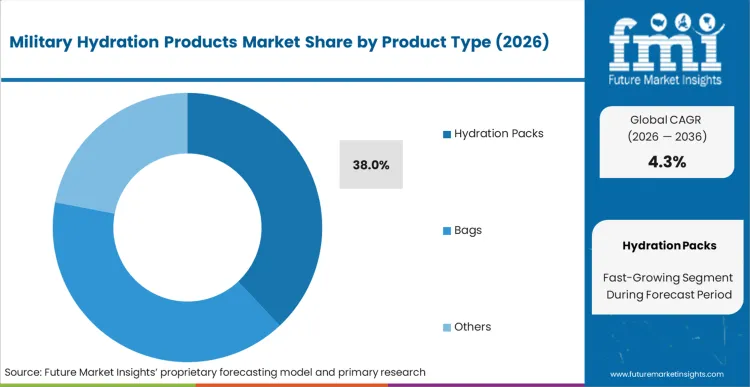
Military teams evaluating individual combat loads must choose between standard canteens and advanced hydration packs. According to FMI’s estimates, hydration packs account for a 38.0% share in 2026 because they fit against the soldier’s back panel and improve weight balance when heavy ballistic plates are worn. This format enables hands-free access to fluids, which is essential when infantry are operating weapons or communications equipment. Their adoption shifts hydration from scheduled breaks to a more continuous pattern, helping reduce heat stress risk in austere environments. Units that delay standardizing this format may weaken frontline mobility and situational awareness.
- Initial Trigger: The requirement for hands-free fluid intake during complex tactical movements forces procurement commands to mandate backpack-style reservoirs.
- Validation Metric: The ability of the bladder material to withstand blunt force impact and puncture without catastrophic failure confirms vendor suitability during trials.
- Expansion Driver: The seamless integration of in-line filtration and CBRN-compatible bite valves compels logistics commands to standardize these systems across wider force structures.
Military Hydration Products Market Analysis by Application
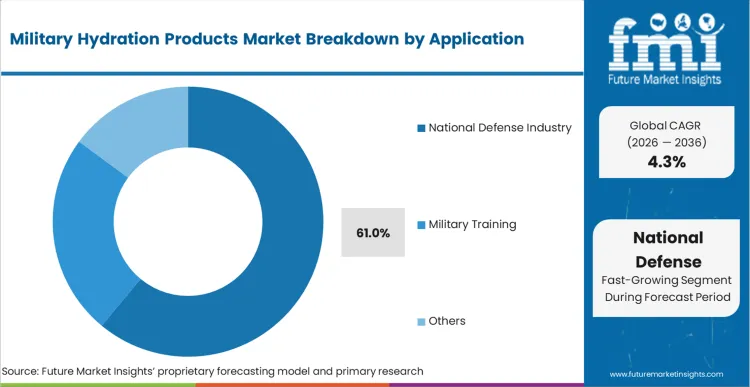
The reliance on centralized water buffalos fails to support the agile, distributed nature of modern expeditionary deployments. The national defense industry holds a dominant 61.0% share in 2026, as military branches aggressively push water carriage down to the individual operator level. FMI analysts opine that standardizing tactical hydration gear across entire branches simplifies the logistics chain and ensures uniformity in replacement parts like valves and cleaning kits. This massive scale of adoption transforms hydration from a secondary comfort item into a mission-critical survival asset strictly governed by military specifications. Procurement programs that fail to enforce these rigorous standards across their active forces risk critical dehydration casualties during sustained, decentralized combat operations.
- Baseline Requirement: The immediate need for durable fluid transport in active combat zones establishes the minimum mil-spec qualification for any vendor entering the space.
- Edge Weakness: Standard commercial-grade reservoirs fail under the extreme temperature fluctuations and abrasion common in mechanized infantry deployments.
- Acceptability Threshold: Strict adherence to National Stock Number (NSN) testing protocols ultimately dictates which systems are approved for national defense contracts.
Military Hydration Products Market Drivers, Restraints, and Opportunities
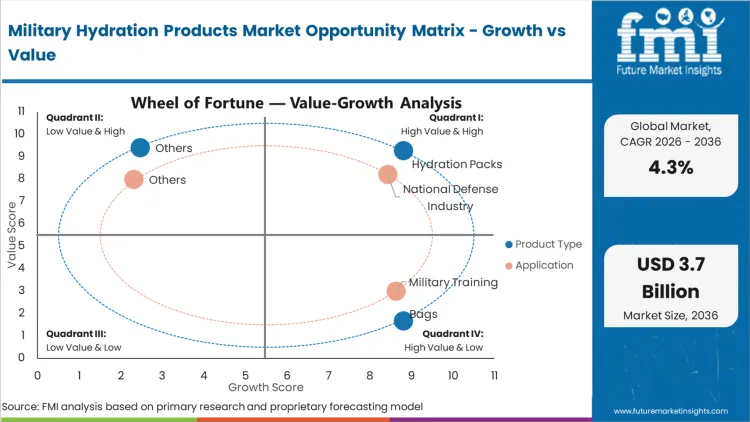
The transition toward distributed, highly mobile infantry doctrines requires defense procurement directors to source individual fluid systems that integrate directly with modular tactical vests. This structural imperative forces logistics planners to abandon rigid, bulky canteens in favor of conformal bladders that distribute weight evenly across the operator's back. The commercial stakes are high; manufacturers who successfully engineer low-profile, high-durability reservoirs secure multi-year contracts as entire military branches execute synchronized gear modernization programs to enhance soldier survivability.
The primary obstacle slowing universal adoption is the stringent requirement for cross-compatibility with existing CBRN (Chemical, Biological, Radiological, and Nuclear) defense equipment. Ensuring that a hydration bite valve forms a perfect, uncontaminated seal with a standard-issue gas mask is a complex engineering challenge, not merely a design preference. While some vendors offer specialized adapters, the lack of a universal interface standard across allied forces complicates international joint-deployment logistics and delays wide-scale procurement approvals.
Opportunities in the Military Hydration Products Market
- In-line Filtration: The shift toward decentralized water sourcing enables the development of micro-filtration matrices embedded directly within the hydration tube. Manufacturers of specialized filtration media can capture premium contracts by offering systems that allow safe consumption from unverified field sources.
- Pressurized Delivery: The need for rapid, hands-free fluid expulsion creates a niche for systems that use air pressure to force water through the tube. Tactical gear innovators capture this by engineering bladders that facilitate field wound irrigation and equipment cleaning without relying solely on suction.
- Smart Monitoring: The increasing digitization of the battlefield provides an opening to integrate fluid level and physiological tracking sensors into standard gear. Developers of wearable electronics can partner with hydration vendors to deliver real-time biometric data to squad leaders.
Regional Analysis
Based on the regional analysis, the Military Hydration Products market is segmented into North America, Europe, and Asia Pacific across 40 plus countries.
.webp "Top Country Growth Comparison Military Hydration Products Market Cagr (2026 2036)")
| Country | CAGR (2026 to 2036) |
|---|---|
| United States | 4.2% |
| United Kingdom | 4.0% |
| Germany | 3.9% |
| China | 4.8% |
| India | 4.9% |
Source: Future Market Insights (FMI) analysis, based on proprietary forecasting model and primary research
North America Military Hydration Products Market Analysis
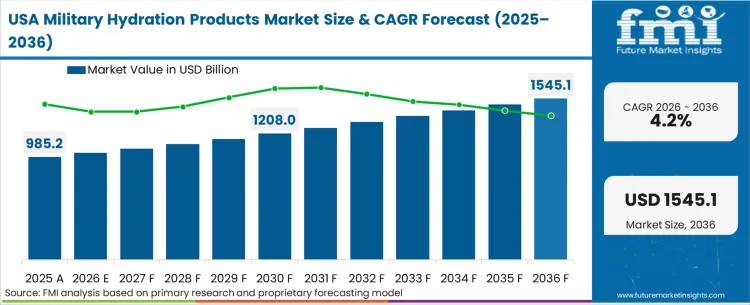
Stringent defense procurement policies and the push for total soldier system integration dictate the adoption patterns across North American forces. The focus is squarely on ensuring every piece of tactical gear, including hydration, meets exact specifications for CBRN survivability and interoperability with complex load-bearing equipment. As per FMI's projection, the emphasis is less on basic capacity and entirely on the resilience of the materials under combat stress and extreme climates. This environment forces vendors to navigate rigorous testing protocols involving military test equipment before their products are considered for National Stock Number assignment.
- United States: The modernization of infantry equipment across all military branches requires seamless integration of hydration systems into new modular plate carrier architectures. This shift forces domestic procurement commands to systematically replace legacy systems with advanced, low-profile bladders. The United States market is forecast to register a CAGR of 4.2%. Vendors who secure these primary NSN contracts establish an immediate, high-volume revenue stream insulated from commercial retail volatility.
FMI's report includes analysis of the Canadian defense market. The structural pattern across this broader region demonstrates a heavy reliance on joint-operability standards, ensuring that hydration components can be shared or serviced effectively during allied training exercises.
Europe Military Hydration Products Market Analysis
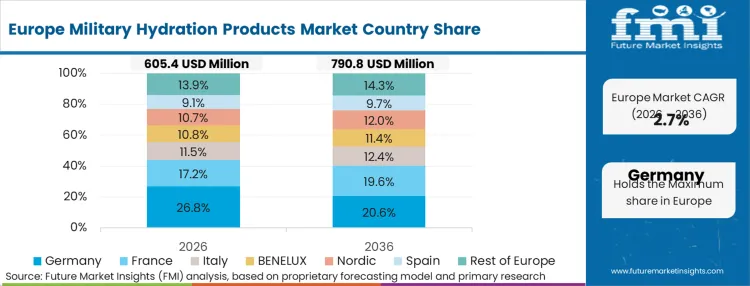
Tightening defense budgets relative to other regions force European procurement commands to prioritize extreme durability and lifecycle cost over rapid, iterative gear replacements. In FMI's view, the emphasis here is on procuring hydration systems that can survive multiple deployment cycles without requiring frequent component replacements. This economic reality means buyers heavily scrutinize the longevity of bite valves, the microbial resistance of the reservoir materials, and the availability of modular cleaning kits to extend the operational life of the primary asset.
- United Kingdom: Specialized expeditionary requirements dictate the sourcing of hydration systems capable of functioning reliably across vastly different climatic zones, from arctic to desert environments. Logistics directors must prioritize thermal insulation and freeze-resistant components over basic fluid carriage. A CAGR of 4.0% is expected for the United Kingdom over the forecast period. This distinct procurement focus positions the country's suppliers to out-compete broader commercial brands when bidding for allied extreme-weather deployment contracts.
- Germany: The systematic overhaul of standard infantry equipment within the Bundeswehr mandates the adoption of hydration solutions that integrate cleanly with newly issued protective vests. This modernization requires operational units to discard aging canteen inventories in favor of conformal back-panel bladders. Demand for military hydration products in Germany is set to grow at 3.9%. The successful integration of these systems directly reduces the physical fatigue experienced by mechanized infantry during sustained foot patrols.
FMI's report includes analysis of the French and Italian defense sectors. Across these nations, there is a distinct trend toward consolidating tactical gear procurement through centralized European defense frameworks to achieve economies of scale.
Asia Pacific Military Hydration Products Market Analysis
The rapid expansion and modernization of active-duty forces, coupled with complex territorial geographies, fundamentally shape the adoption of tactical hydration gear in the Asia Pacific. The necessity to project power across high-altitude borders, dense jungles, and maritime environments forces these militaries to rapidly upgrade from basic canteens to specialized, climate-specific fluid delivery systems. The sheer volume of active personnel means that even incremental upgrades to individual combat gear represent massive procurement events, drawing intense focus from global tactical equipment manufacturers.
- China: The shift toward expeditionary and amphibious operational readiness requires the mass distribution of ruggedized, high-capacity hydration systems to active frontline units. This strategic pivot forces domestic logistics commands to overhaul legacy infantry loads with modern modular backpacks. China is expected to see its military hydration sector grow at a compound annual rate of 4.8%. The completion of this individual equipment overhaul establishes a highly standardized, modern baseline for future digitized soldier system integration.
- India: Massive domestic procurement mandates under 'Make in India' intersect with the necessity to equip troops stationed in some of the most extreme high-altitude environments globally. Local manufacturers are pushed to rapidly reverse-engineer and improve upon freeze-resistant hydration technologies. The Indian landscape is set to achieve a CAGR of 4.9%. The reality on the ground is that troops require systems where the drinking tube will not freeze solid during winter deployments, making thermal sleeves just as critical as the bladder itself.
FMI's report includes analysis of the Australian and Japanese defense forces. These nations exhibit a structural preference for highly advanced, fully CBRN-compatible systems, mirroring the procurement standards of North American allies rather than regional mass-mobilization models.
Competitive Aligners for Market Players
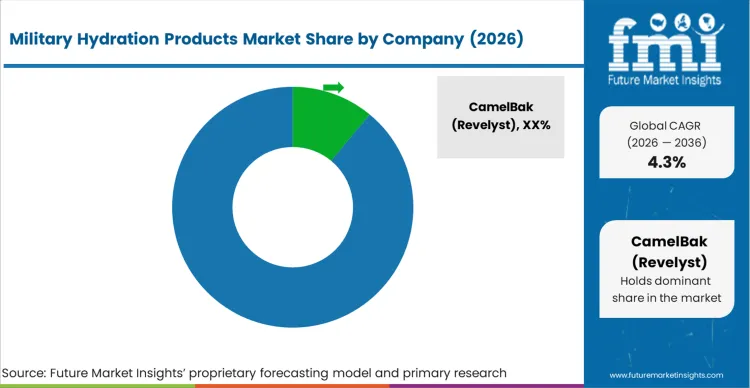
The competitive structure of this market is highly concentrated at the top due to the severe barriers to entry imposed by military qualification standards. Leading entities like CamelBak, SOURCE Tactical Gear, and HydraPak dominate because they possess the institutional knowledge required to navigate the NSN assignment process and deliver products that survive grueling Mil-Spec field testing. Procurement directors use past performance in active combat theaters as the primary variable to distinguish qualified defense contractors from commercial outdoor brands attempting to pivot into military sales.
Incumbents maintain their advantage through deep integration with the broader tactical gear ecosystem. Companies like Cascade Designs and Aquamira hold distinct structural advantages because their filtration and reservoir technologies interface perfectly with standard-issue gas masks and body armor systems. To replicate this, a challenger must build not just a durable water bladder, but a comprehensive understanding of military and defense ground support equipment interoperability. The capability to seamlessly pass CBRN seal integrity tests is the true moat protecting the dominant suppliers.
Large defense departments actively resist vendor lock-in by mandating standardized attachment points and universal drinking tube dimensions across their procurement contracts. The structural tension between the buyer's need for interchangeable components and the vendor's desire for proprietary, high-margin replacement parts defines the competitive trajectory. As the market heads toward 2036, it will likely remain concentrated, as only a select few manufacturers possess the capital to continuously innovate micro-filtration and pressurized delivery systems while absorbing the long lead times of defense procurement cycles.
Key Players in Military Hydration Products Market
- CamelBak (Revelyst)
- SOURCE Tactical Gear
- HydraPak
- Cascade Designs (Platypus / MSR)
- Cera Products
- Icon LifeSaver
- Aquamira (acquired Geigerrig)
Scope of the Report
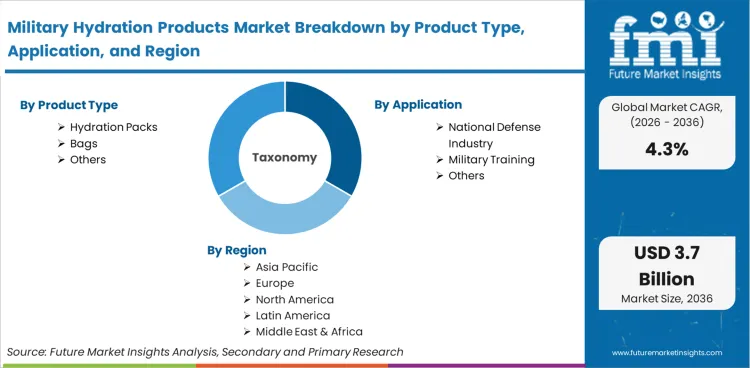
| Metric | Value |
|---|---|
| Quantitative Units | USD 2.4 Billion to USD 3.6 Billion, at a CAGR of 4.3% |
| Market Definition | The sector comprises specialized fluid carriage, delivery, and purification systems engineered to integrate with tactical gear and meet rigorous military specifications. |
| Product Type Segmentation | Hydration Packs, Bags, Water Bottles, Hydration Accessories, Purification Filtration Products, Reservoirs, Others |
| Application Segmentation | National Defense Industry, Military Training, Others |
| Regions Covered | North America, Europe, Asia Pacific |
| Countries Covered | United States, United Kingdom, Germany, China, India, and 40 plus countries |
| Key Companies Profiled | CamelBak (Revelyst), SOURCE Tactical Gear, HydraPak, Cascade Designs (Platypus / MSR), Cera Products, Icon LifeSaver, Aquamira (acquired Geigerrig) |
| Forecast Period | 2026 to 2036 |
| Approach | Primary interviews were conducted with defense procurement officers and tactical gear product managers. The baseline anchors to active-duty troop counts and standard individual equipment replacement cycles. Forecasts were cross-validated against publicly accessible defense budget allocations and infantry modernization programs. |
Source: Future Market Insights (FMI) analysis, based on proprietary forecasting model and primary research
Military Hydration Products Market Analysis by Segments
Product Type:
- Hydration Packs
- Bags
- Water Bottles
- Hydration Accessories
- Purification Filtration Products
- Reservoirs
- Others
Application:
- National Defense Industry
- Military Training
- Others
Region:
- Asia Pacific
- India
- China
- Japan
- South Korea
- Indonesia
- Australia & New Zealand
- ASEAN
- Rest of Asia Pacific
- Europe
- Germany
- Italy
- France
- United Kingdom
- Spain
- Benelux
- Nordics
- Central & Eastern Europe
- Rest of Europe
- North America
- United States
- Canada
- Mexico
- Latin America
- Brazil
- Argentina
- Chile
- Rest of Latin America
- Middle East & Africa
- Kingdom of Saudi Arabia
- United Arab Emirates
- South Africa
- Turkey
- Rest of Middle East & Africa
Bibliography
- NATO Standardization Office. (2025, June). AMedP-1.11, Requirements of Individual Operational Rations for Military Use (Edition C, Version 1). NATO.
- Defense Health Agency Public Health. (2024, March 22). DHA public health experts track climate change, heat trends impacting service members, training.
- U.S. Army Corps of Engineers, Engineer Research and Development Center. (2024). Deployable Resilient Installation Water Purification and Treatment System (DRIPS): Geoenabled water production and disinfection systems for installations.
- NATO Standardization Office. (2025, June). AMedP-1.18, Requirements of Group Operational Rations for Military Use (Edition B, Version 1). NATO.
This bibliography is provided for reader reference. The full FMI report contains the complete reference list with primary source documentation.
This Report Addresses
- Market intelligence to support strategic decision making across hydration packs, reservoirs, and specialized purification filtration products
- Market size estimation and 10-year revenue forecasts from 2026 to 2036, supported by active-duty troop counts and equipment refresh cycles
- Growth opportunity mapping across product type and application with emphasis on the integration of in-line CBRN filtration matrices
- Segment and regional revenue forecasts covering the national defense industry and military training across austere, extreme-climate deployment environments
- Competition strategy assessment including CBRN compatibility, Mil-Spec qualification, and NSN assignment capabilities
- Capability development tracking including modular tactical vest integration, micro-filtration matrices, and standard-issue gas mask interoperability
- Market access analysis covering rigorous National Stock Number testing protocols and centralized defense procurement pathways
- Market report delivery in PDF, Excel, PPT, and interactive dashboard formats for executive strategy, infantry modernization planning, and operational benchmarking use
Frequently Asked Questions
How large is the demand for Military Hydration Products in the global market in 2026?
Demand for Military Hydration Products in the global market is estimated to be valued at USD 2.4 billion in 2026.
What will be the market size of Military Hydration Products in the global market by 2036?
Market size for Military Hydration Products is projected to reach USD 3.6 billion by 2036.
What is the expected demand growth for Military Hydration Products in the global market between 2026 and 2036?
Demand for Military Hydration Products is expected to grow at a CAGR of 4.3% between 2026 and 2036.
Which Product Type is poised to lead global sales by 2026?
Hydration Packs account for 38.0% in 2026 as forces prioritize hands-free fluid access and low-profile integration with plate carriers and tactical gear.
How significant is the role of National Defense Industry in driving Military Hydration Products adoption in 2026?
National Defense Industry represents 61.0% of segment share in 2026 as active-duty procurement programs standardize hydration systems across military branches.
What is driving demand in China?
China’s modernization of expeditionary and amphibious combat gear is driving demand for ruggedized modular hydration systems across frontline force structures.
What compliance standards or regulations are referenced for Germany?
Germany’s market is shaped by military qualification standards, interoperability requirements, and systematic infantry equipment modernization programs.
What is the China growth outlook in this report?
China is projected to grow at a CAGR of 4.8% during 2026 to 2036.
Why is North America described as a priority region in this report?
North America is described as a priority region because soldier system integration, CBRN survivability, and strict military qualification protocols strongly shape procurement decisions.
What type of demand dominates in North America?
Demand heavily focuses on fully interoperable hydration systems that meet NSN, Mil-Spec, and CBRN compatibility requirements for integrated combat gear.
What is India's growth outlook in this report?
India is projected to expand at a CAGR of 4.9% during 2026 to 2036.
Does the report cover USA in its regional analysis?
Yes, USA is included within North America under the regional scope of analysis.
What are the sources referred to for analyzing USA?
Defense contract awards, tactical equipment standardization documents, active-duty troop counts, modernization budgets, and primary interviews with procurement officers form the analytical basis.
What is the main demand theme linked to USA in its region coverage?
The main demand theme in the United States is the replacement of legacy canteens with low-profile hydration systems integrated into modular plate carrier architectures.
Does the report cover Germany in its regional analysis?
Yes, Germany is included within Europe under the regional coverage framework.
What is the main Germany related demand theme in its region coverage?
Germany’s demand is linked to Bundeswehr infantry modernization and the transition toward conformal hydration systems compatible with updated protective vests.
Which product formats or configurations are strategically important for Asia Pacific supply chains?
Which product formats or configurations are strategically important for Asia Pacific supply chains?
Which product formats or configurations are strategically important for Asia Pacific supply chains?
Military Hydration Products include tactical fluid carriage, purification, and delivery systems designed for defense use, and they are mainly used to support hydration, mobility, and field survivability in combat and training operations.
What does Military Hydration Products mean in this report?
The scope refers to military-specified hydration systems engineered for tactical integration, CBRN compatibility, and rugged use in active deployment environments.
What is included in the scope of this Military Hydration Products report?
The market covers hydration packs, reservoirs, insulated canteens, bite valves, purification filtration products, thermal sleeves, cleaning kits, and integrated fluid delivery systems procured through defense channels.
What is excluded from the scope of this report?
Large-scale water treatment systems, bulk transport vehicles, commercial outdoor gear, and disposable consumer bottles are explicitly excluded because they do not integrate with individual combat load-bearing systems.
What does market forecast mean on this page?
The market forecast represents a model-based projection built on troop counts, equipment refresh cycles, modernization programs, and tactical hydration adoption trends.
How does FMI build and validate the Military Hydration Products forecast?
The model applies a bottom-up methodology anchored to active-duty and reserve troop counts and standard replacement cycles, then cross-validates projections against defense budget allocations and infantry modernization programs.
What does zero reliance on speculative third-party market research mean here?
Primary interviews, NSN registries, defense contract databases, Mil-Spec archives, testing protocols, and public defense budget data are used exclusively instead of unverified syndicated estimates.
Preview the report firsthand - request a free sample
Get SampleGet the brochure for pricing and purchase details.
Get PDFTable of Content
- Executive Summary
- Global Market Outlook
- Demand-side Trends
- Supply-side Trends
- Technology Roadmap Analysis
- Analysis and Recommendations
- Market Overview
- Market Coverage / Taxonomy
- Market Definition / Scope / Limitations
- Research Methodology
- Chapter Orientation
- Analytical Lens and Working Hypotheses
- Market Structure, Signals, and Trend Drivers
- Benchmarking and Cross-market Comparability
- Market Sizing, Forecasting, and Opportunity Mapping
- Research Design and Evidence Framework
- Desk Research Programme (Secondary Evidence)
- Company Annual and Sustainability Reports
- Peer-reviewed Journals and Academic Literature
- Corporate Websites, Product Literature, and Technical Notes
- Earnings Decks and Investor Briefings
- Statutory Filings and Regulatory Disclosures
- Technical White Papers and Standards Notes
- Sector Databases and Reference Repositories
- FMI Internal Proprietary Databases and Historical Market Datasets
- Subscription Datasets and Paid Sources
- Social Channels, Communities, and Digital Listening Inputs
- Additional Desk Sources
- Expert Input and Fieldwork (Primary Evidence)
- Primary Modes
- Qualitative Interviews and Expert Elicitation
- Quantitative Surveys and Structured Data Capture
- Blended Approach
- Why Primary Evidence is Used
- Field Techniques
- Interviews
- Surveys
- Focus Groups
- Observational and In-context Research
- Social and Community Interactions
- Stakeholder Universe Engaged
- C-suite Leaders
- Board Members
- Presidents and Vice Presidents
- R&D and Innovation Heads
- Technical Specialists
- Domain Subject-matter Experts
- Scientists
- Physicians and Other Healthcare Professionals
- Governance, Ethics, and Data Stewardship
- Research Ethics
- Data Integrity and Handling
- Primary Modes
- Tooling, Models, and Reference Databases
- Desk Research Programme (Secondary Evidence)
- Data Engineering and Model Build
- Data Acquisition and Ingestion
- Cleaning, Normalisation, and Verification
- Synthesis, Triangulation, and Analysis
- Quality Assurance and Audit Trail
- Market Background
- Market Dynamics
- Drivers
- Restraints
- Opportunity
- Trends
- Scenario Forecast
- Demand in Optimistic Scenario
- Demand in Likely Scenario
- Demand in Conservative Scenario
- Opportunity Map Analysis
- Product Life Cycle Analysis
- Supply Chain Analysis
- Investment Feasibility Matrix
- Value Chain Analysis
- PESTLE and Porter’s Analysis
- Regulatory Landscape
- Regional Parent Market Outlook
- Production and Consumption Statistics
- Import and Export Statistics
- Market Dynamics
- Global Market Analysis 2021 to 2025 and Forecast, 2026 to 2036
- Historical Market Size Value (USD Million) Analysis, 2021 to 2025
- Current and Future Market Size Value (USD Million) Projections, 2026 to 2036
- Y-o-Y Growth Trend Analysis
- Absolute $ Opportunity Analysis
- Global Market Pricing Analysis 2021 to 2025 and Forecast 2026 to 2036
- Global Market Analysis 2021 to 2025 and Forecast 2026 to 2036, By Product Type
- Introduction / Key Findings
- Historical Market Size Value (USD Million) Analysis By Product Type , 2021 to 2025
- Current and Future Market Size Value (USD Million) Analysis and Forecast By Product Type , 2026 to 2036
- Hydration Packs
- Bags
- Others
- Hydration Packs
- Y-o-Y Growth Trend Analysis By Product Type , 2021 to 2025
- Absolute $ Opportunity Analysis By Product Type , 2026 to 2036
- Global Market Analysis 2021 to 2025 and Forecast 2026 to 2036, By Application
- Introduction / Key Findings
- Historical Market Size Value (USD Million) Analysis By Application, 2021 to 2025
- Current and Future Market Size Value (USD Million) Analysis and Forecast By Application, 2026 to 2036
- National Defense Industry
- Military Training
- Others
- National Defense Industry
- Y-o-Y Growth Trend Analysis By Application, 2021 to 2025
- Absolute $ Opportunity Analysis By Application, 2026 to 2036
- Global Market Analysis 2021 to 2025 and Forecast 2026 to 2036, By Region
- Introduction
- Historical Market Size Value (USD Million) Analysis By Region, 2021 to 2025
- Current Market Size Value (USD Million) Analysis and Forecast By Region, 2026 to 2036
- North America
- Latin America
- Western Europe
- Eastern Europe
- East Asia
- South Asia and Pacific
- Middle East & Africa
- Market Attractiveness Analysis By Region
- North America Market Analysis 2021 to 2025 and Forecast 2026 to 2036, By Country
- Historical Market Size Value (USD Million) Trend Analysis By Market Taxonomy, 2021 to 2025
- Market Size Value (USD Million) Forecast By Market Taxonomy, 2026 to 2036
- By Country
- USA
- Canada
- Mexico
- By Product Type
- By Application
- By Country
- Market Attractiveness Analysis
- By Country
- By Product Type
- By Application
- Key Takeaways
- Latin America Market Analysis 2021 to 2025 and Forecast 2026 to 2036, By Country
- Historical Market Size Value (USD Million) Trend Analysis By Market Taxonomy, 2021 to 2025
- Market Size Value (USD Million) Forecast By Market Taxonomy, 2026 to 2036
- By Country
- Brazil
- Chile
- Rest of Latin America
- By Product Type
- By Application
- By Country
- Market Attractiveness Analysis
- By Country
- By Product Type
- By Application
- Key Takeaways
- Western Europe Market Analysis 2021 to 2025 and Forecast 2026 to 2036, By Country
- Historical Market Size Value (USD Million) Trend Analysis By Market Taxonomy, 2021 to 2025
- Market Size Value (USD Million) Forecast By Market Taxonomy, 2026 to 2036
- By Country
- Germany
- UK
- Italy
- Spain
- France
- Nordic
- BENELUX
- Rest of Western Europe
- By Product Type
- By Application
- By Country
- Market Attractiveness Analysis
- By Country
- By Product Type
- By Application
- Key Takeaways
- Eastern Europe Market Analysis 2021 to 2025 and Forecast 2026 to 2036, By Country
- Historical Market Size Value (USD Million) Trend Analysis By Market Taxonomy, 2021 to 2025
- Market Size Value (USD Million) Forecast By Market Taxonomy, 2026 to 2036
- By Country
- Russia
- Poland
- Hungary
- Balkan & Baltic
- Rest of Eastern Europe
- By Product Type
- By Application
- By Country
- Market Attractiveness Analysis
- By Country
- By Product Type
- By Application
- Key Takeaways
- East Asia Market Analysis 2021 to 2025 and Forecast 2026 to 2036, By Country
- Historical Market Size Value (USD Million) Trend Analysis By Market Taxonomy, 2021 to 2025
- Market Size Value (USD Million) Forecast By Market Taxonomy, 2026 to 2036
- By Country
- China
- Japan
- South Korea
- By Product Type
- By Application
- By Country
- Market Attractiveness Analysis
- By Country
- By Product Type
- By Application
- Key Takeaways
- South Asia and Pacific Market Analysis 2021 to 2025 and Forecast 2026 to 2036, By Country
- Historical Market Size Value (USD Million) Trend Analysis By Market Taxonomy, 2021 to 2025
- Market Size Value (USD Million) Forecast By Market Taxonomy, 2026 to 2036
- By Country
- India
- ASEAN
- Australia & New Zealand
- Rest of South Asia and Pacific
- By Product Type
- By Application
- By Country
- Market Attractiveness Analysis
- By Country
- By Product Type
- By Application
- Key Takeaways
- Middle East & Africa Market Analysis 2021 to 2025 and Forecast 2026 to 2036, By Country
- Historical Market Size Value (USD Million) Trend Analysis By Market Taxonomy, 2021 to 2025
- Market Size Value (USD Million) Forecast By Market Taxonomy, 2026 to 2036
- By Country
- Kingdom of Saudi Arabia
- Other GCC Countries
- Turkiye
- South Africa
- Other African Union
- Rest of Middle East & Africa
- By Product Type
- By Application
- By Country
- Market Attractiveness Analysis
- By Country
- By Product Type
- By Application
- Key Takeaways
- Key Countries Market Analysis
- USA
- Pricing Analysis
- Market Share Analysis, 2025
- By Product Type
- By Application
- Canada
- Pricing Analysis
- Market Share Analysis, 2025
- By Product Type
- By Application
- Mexico
- Pricing Analysis
- Market Share Analysis, 2025
- By Product Type
- By Application
- Brazil
- Pricing Analysis
- Market Share Analysis, 2025
- By Product Type
- By Application
- Chile
- Pricing Analysis
- Market Share Analysis, 2025
- By Product Type
- By Application
- Germany
- Pricing Analysis
- Market Share Analysis, 2025
- By Product Type
- By Application
- UK
- Pricing Analysis
- Market Share Analysis, 2025
- By Product Type
- By Application
- Italy
- Pricing Analysis
- Market Share Analysis, 2025
- By Product Type
- By Application
- Spain
- Pricing Analysis
- Market Share Analysis, 2025
- By Product Type
- By Application
- France
- Pricing Analysis
- Market Share Analysis, 2025
- By Product Type
- By Application
- India
- Pricing Analysis
- Market Share Analysis, 2025
- By Product Type
- By Application
- ASEAN
- Pricing Analysis
- Market Share Analysis, 2025
- By Product Type
- By Application
- Australia & New Zealand
- Pricing Analysis
- Market Share Analysis, 2025
- By Product Type
- By Application
- China
- Pricing Analysis
- Market Share Analysis, 2025
- By Product Type
- By Application
- Japan
- Pricing Analysis
- Market Share Analysis, 2025
- By Product Type
- By Application
- South Korea
- Pricing Analysis
- Market Share Analysis, 2025
- By Product Type
- By Application
- Russia
- Pricing Analysis
- Market Share Analysis, 2025
- By Product Type
- By Application
- Poland
- Pricing Analysis
- Market Share Analysis, 2025
- By Product Type
- By Application
- Hungary
- Pricing Analysis
- Market Share Analysis, 2025
- By Product Type
- By Application
- Kingdom of Saudi Arabia
- Pricing Analysis
- Market Share Analysis, 2025
- By Product Type
- By Application
- Turkiye
- Pricing Analysis
- Market Share Analysis, 2025
- By Product Type
- By Application
- South Africa
- Pricing Analysis
- Market Share Analysis, 2025
- By Product Type
- By Application
- USA
- Market Structure Analysis
- Competition Dashboard
- Competition Benchmarking
- Market Share Analysis of Top Players
- By Regional
- By Product Type
- By Application
- Competition Analysis
- Competition Deep Dive
- CamelBak (Revelyst)
- Overview
- Product Portfolio
- Profitability by Market Segments (Product/Age /Sales Channel/Region)
- Sales Footprint
- Strategy Overview
- Marketing Strategy
- Product Strategy
- Channel Strategy
- SOURCE Tactical Gear
- HydraPak
- Cascade Designs (Platypus / MSR)
- Cera Products
- Icon LifeSaver
- Aquamira (acquired Geigerrig)
- CamelBak (Revelyst)
- Competition Deep Dive
- Assumptions & Acronyms Used


