

- Market Size (2026)
- USD 2.9 Bn
- Forecast (2036)
- USD 4.9 Bn
- CAGR (2026 to 2036)
- 5.4%
How big is Cine Lenses Market in 2026?
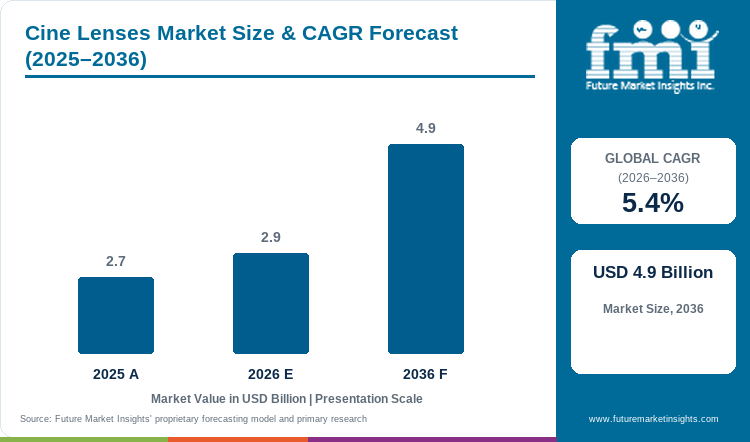
USD 2.9 billion in 2026 and USD 4.9 billion by 2036, expanding at 5.4% CAGR.
Sales of cine lenses are estimated to rise at 5.4% CAGR through 2036, increasing valuation from USD 2.7 billion in 2025 to USD 2.9 billion in 2026, and reaching USD 4.9 billion by 2036. Camera departments are selecting specific glass for each project based on artistic character and mechanical handling during principal photography. Rental houses face continuous financial pressure because expanding camera sensor sizes force frequent capital investments in larger image circles. Despite these high equipment costs, demand for proven glass remains firm. ARRI reported in March 2026 that its cinema optics supported multiple Academy Award-nominated productions. This constant need for distinct visual signatures is making optical sets a foundational asset for production suppliers.
South Korea is projected to grow at 6.3% CAGR through 2036 compared with 4.3% for Japan. The Korean Film Council selected 16 mid-budget live-action projects from 334 applications in April 2026. The program gives Korean rental houses funded productions that can justify dedicated professional lens packages. Japan’s slower rate remains tied to replacement timing and uneven production budgets within a mature production base.
Key Takeaways
- Professional film and premium video crews are sustaining cine-lens demand because repeatable rendering and mechanics reduce changeover risk during funded productions.
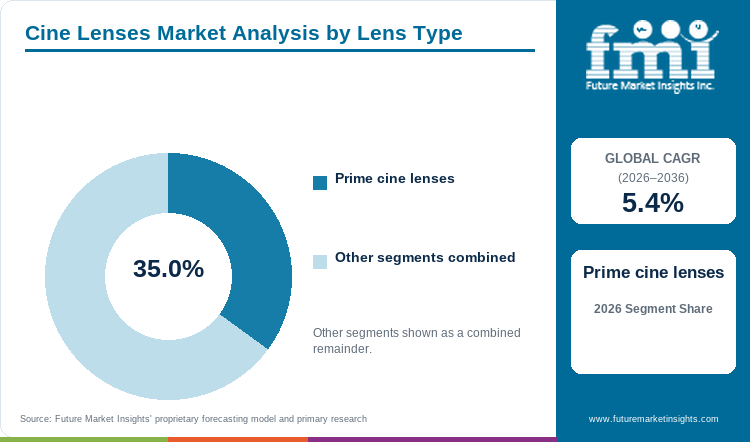
- By lens type, prime cine lenses are estimated to hold 35.0% of revenue in 2026. Matched focal-length sets support this position because they preserve rendering continuity during professional production work.
- In 2026, PL mount is expected to lead the mount category with 34.0% share. Mature rental inventories and professional cinema-body compatibility influence its position during repeat equipment selection.
- The sensor coverage category is forecast to be led by full frame at 34.0% share in 2026, driven by newer camera bodies that require broader image circles without abandoning smaller-format use.
- High acquisition costs and incompatible mount choices can delay ownership when a production company cannot keep an expensive set working between projects.
- Some of the key players in this market include ARRI, ZEISS, Canon, Cooke Optics, Angénieux, Leitz Cine, Sony, Fujifilm, Tokina Cinema, and Sigma.
Analyst Perspective
"Camera teams are treating lens families as long-lived production assets instead of accessories tied to one body. Suppliers gain repeat orders when optical character, mount support and metadata remain usable as camera systems change."
- Rahul Pandita, Principal Consultant, Future Market Insights
How is the cine lenses market segmented?
Cine Lenses Market is segmented by Lens Type, Mount, Sensor Coverage, End Use, Sales Channel, and Region. Forecast period from 2026 to 2036.
Lens type includes prime, zoom, anamorphic, macro and specialty - tilt-shift optics within the defined taxonomy. Mount includes PL, EF, E, LPL and RF - Z options and sensor coverage includes Super 35, full frame, large format, Micro Four Thirds and specialty formats. The end use category covers feature films, OTT - streaming production, commercials, broadcast and independent filmmaking. The sales channel category includes direct lens makers, rental houses, professional dealers and online - catalog routes.
How do prime cine lenses shape demand within the lens type category?
Cinematographers use matched camera lenses when focal-length changes must preserve color and mechanical placement during principal photography. ZEISS introduced nine Aatma T1.5 full-frame primes in February 2026 with consistent cine ergonomics and integrated lens-data support. Set depth and repeatable handling remain purchase criteria for prime families serving feature and premium episodic work.
- Based on lens type, prime cine lenses are projected to account for 35.0% in 2026, supported by matched focal-length families that protect a consistent visual treatment.
- Rental houses and owner-operators can reuse a complete prime family on multiple productions without rebuilding focus, matte-box and support setups for every focal length.
What keeps PL mount relevant within the mount category?
PL mount remains useful to professional camera departments because positive locking and repeatable flange depth suit heavy cine optics and motorized accessories. Cooke Optics added Nikon Z-mount support to SP3 and AP3 lenses in July 2026 through an interchangeable-mount program. Rental inventories used with broadcast equipment preserve demand for interfaces that keep existing professional lens libraries usable.
- By mount, PL mount is estimated to hold 34.0% in 2026, influenced by mature rental inventories and compatibility with professional cinema bodies.
- Camera teams retain PL access when a production mixes newer mirrorless bodies with existing lens libraries that still carry proven mechanical and service histories.
Why does full frame hold a major position within sensor coverage?
Full-frame coverage lets one lens family serve 36 mm-class image sensors and cropped modes without a second optical set. Sigma announced the April 2026 launch of its 28-105mm T3 full-frame autofocus cine zoom for L-Mount and Sony E-mount. Smaller professional crews gain format flexibility without abandoning cinema-style mechanics or familiar focus-control practices.
- In 2026, full frame is expected to lead sensor coverage with 34.0% share, driven by wider camera adoption of large image areas and flexible crop modes.
- Rental fleets value lenses that cover newer full-frame bodies while preserving practical use on Super 35 projects with different framing and acquisition needs.
What supports feature films within the end use category?
Feature productions can justify deeper optical sets because visual development starts before principal photography and continues during long shooting schedules. The British Film Institute reported 193 films entering production in the United Kingdom during 2025. Video streaming also supports premium episodic work, but feature films place longer demands on matched optical character during principal photography.
- By end use, feature films are forecast to represent 30.0% in 2026, attributable to longer shooting schedules and greater reliance on matched optical character.
- Streaming productions broaden professional lens demand while commercials and broadcast crews prioritize different balances of focal range, speed and electronic control.
How do direct lens makers influence the sales channel category?
Direct lens makers control mount configuration and factory calibration during expensive professional set purchases. ZEISS reported in July 2026 that 2D House became the first North American rental facility to receive the Aatma prime set. Manufacturer support and rental availability let crews test a complete family before deciding whether ownership improves utilization. Dealers supplying camera accessories remain relevant because local demonstrations and service can influence ownership decisions.
- The sales channel category is forecast to be led by direct lens makers at 34.0% share in 2026, reinforced by configuration support for long-lived cine assets.
- Professional dealers and rental houses remain important because demonstrations and local service can determine whether ownership beats repeated rental.
What are the drivers, restraints and opportunities in the Cine Lenses Market?
Funded productions sustain matched-set demand, compatibility work delays some purchases, and compact automated cine optics widen the addressable professional buyer base.
- Driver: Camera teams are specifying dedicated cine optics when repeatable rendering and controlled mechanics reduce risk during funded film and premium video work.
- Restraint: Mount compatibility and post-production correction requirements can raise workflow costs before an expensive lens family becomes usable across every camera body.
- Opportunity: Compact full-frame optics with autofocus or integrated lens data can move dedicated cine-lens ownership toward digital content creators and smaller crews that previously favored still-photo glass.
Production workflows are keeping dedicated optical sets tied to repeat professional use during funded film and episodic shoots
ARRI introduced the cforce MAX lens motor in April 2026 for high-torque control of cine primes and zooms. Crews using current camera technology can integrate the motor with Hi-5 control while retaining existing rods and drive gears. Dedicated cine optics gain practical value when focus systems keep pace with handheld and gimbal production without adding slow setup work.
Compatibility work can delay ownership even after optical performance has been approved for a production team’s intended camera bodies
Sony announced RIALTO 65 development in June 2026 as a 65 mm image-sensor block for VENICE 2 that preserves the existing camera platform. Larger capture areas narrow the pool of lenses that cover the frame without unwanted edge loss or optical compromise. Buyers therefore evaluate image-circle coverage before committing capital to sets intended for current and emerging large-format bodies.
Integrated controls widen cine-lens use beyond conventional manual camera packages used by smaller professional production crews
ZEISS introduced Horizon Anamorphic lenses in June 2026 with built-in focus and iris motors plus stored calibration data. Integrated control can reduce external motor rigging on virtual-production stages that also use 3D motion capture for performance and camera tracking. Owner-operators gain a clearer purchase case when automation cuts setup work without removing professional metadata or manual control.
Which country CAGRs are profiled in the Cine Lenses Market?
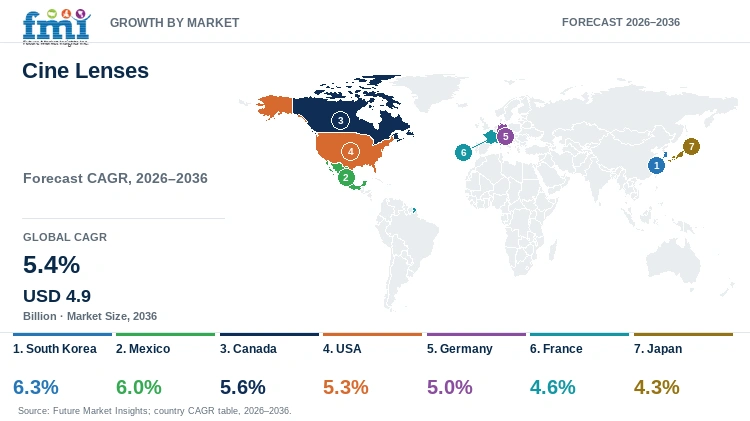
| Country | CAGR |
|---|---|
| South Korea | 6.3% |
| Mexico | 6.0% |
| Canada | 5.6% |
| USA | 5.3% |
| Germany | 5.0% |
| France | 4.6% |
| Japan | 4.3% |
How do country-level CAGRs compare in the Cine Lenses Market?
The profiled CAGRs span two percentage points from South Korea at 6.3% to Japan at 4.3%. South Korea and Mexico form the upper group as public support increases production starts. Canada and the USA rely more heavily on mature production services and established rental infrastructure. Germany and France use deeper rental capacity while Japan faces wider project-budget variation and ownership constraints.
- South Korea channels new mid-budget support into productions that can place compact premium lens sets with rental houses.
- Mexico’s larger domestic feature slate gives dealers and rental houses more productions requiring professional optical packages.
- Canada’s service-production workforce keeps professional rental inventories active as domestic and foreign projects move between locations.
- US demand spans studio, episodic and independent productions that value rapid lens servicing during compressed shooting schedules.
- Germany combines federal production funding with mature rentals that preserve mount continuity for professional optical inventories.
- France’s national film slate supports specialist rentals that replace heavily used prime and zoom families over time.
- Japan’s high release volume spans uneven budgets that favor compact sets and dealer support over premium ownership.
Comparable CAGRs still produce different purchasing conditions because financing and rental depth vary by country. The full report provides country-level CAGR analysis across North America, Latin America, Western Europe, Eastern Europe, East Asia, South Asia and Pacific, and the Middle East and Africa.
Country-wise Analysis
- South Korean production policy is moving more mid-budget projects toward crews using dedicated professional optics. Cine-lens demand in South Korea is forecast to rise at 6.3% CAGR over the forecast period, supported by a stronger funded project pipeline. Korean Film Council selected another 16 mid-budget films in September 2026 and half came from new directors. Growth in streaming media services gives local production teams another professional content route that can sustain lens rentals. Rental partnerships absorb utilization risk when producers cannot justify full-set ownership between funded projects.
- Mexican producers are working with a larger domestic feature slate and still rely on rental access when ownership costs exceed one project budget. Mexico is estimated to post 6.0% CAGR over the forecast period, influenced by continued national production activity. The Secretariat of Culture reported 235 Mexican feature films in some production stage during 2025 and 41% had public support. Dealers widen access by carrying matched sets for independent productions and larger co-productions with different budget structures. Regional servicing remains important because premium lens availability is concentrated in major production centers.
- Canadian production services keep lens inventories moving between domestic projects and foreign-location work with different camera requirements. Cine-lens sales in Canada are forecast to expand at 5.6% CAGR by 2036, linked to a substantial professional production workforce. CMPA reported 181,360 film and television production jobs in 2025 and foreign production activity increased 9.5%. Project mobility makes ownership uneven outside major rental centers, so suppliers need fast turnaround and replacement capacity between productions.
- US camera departments use owned and rented optics because professional work spans studios plus episodic teams and independent crews. The USA is projected to grow at 5.3% CAGR through 2036, shaped by a broad professional camera-operator base. The Bureau of Labor Statistics counted about 32,600 camera-operator jobs in 2025 and 21% worked in motion picture and video industries. Short production windows lower utilization for smaller owners, so rental partners need reliable calibration as dedicated sets move between projects.
- German rental houses serve productions that mix proven PL inventories with newer large-format bodies and metadata workflows. The German cine lenses sector is projected to record 5.0% CAGR during the assessment period, supported by active federal production funding and shooting starts. FFA reported 103 projects already awarded in 2026 by August with 111 additional applications being processed. Funding timing can shift equipment commitments between production periods, so local service becomes important for lenses moving between domestic and international shoots.
- French feature production gives cinematographers regular access to specialist rental inventories that can absorb the cost of character primes and premium zooms. France's cine lenses outlook is anticipated to advance at 4.6% CAGR over the assessment period, tied to a steady national film slate. CNC counted 290 approved films in 2025 including 228 French-initiative productions in its national production review. A mature rental base reduces pressure for complete-set ownership, so manufacturers compete on rendering plus full-frame coverage and service continuity.
- Japanese productions range from studio features to smaller independent releases with materially different lens budgets and ownership economics. Adoption of cine lenses in Japan is estimated to expand at 4.3% CAGR through 2036, influenced by high annual film output and varied project scale. The Motion Picture Producers Association of Japan recorded 694 Japanese films released in 2025 from 1,305 total releases. High output does not guarantee premium ownership, so compact full-frame families and reliable dealer service can convert more productions without oversized packages.
Who are the notable companies in the Cine Lenses Market?
ARRI, ZEISS, Canon, Cooke Optics, Angénieux, Leitz Cine, Sony, Fujifilm, Tokina Cinema, and Sigma are active in cine lenses.
Competition turns on optical character, lens-family depth and mount strategy over long asset lives. Premium cinema specialists sell matched systems to cinematographers and rental houses serving recurring productions. Camera-linked brands compete on electronic control while independent specialists emphasize large-format coverage and ownership economics. Metadata support also matters in virtual production workflows that carry lens information into compositing.
- ARRI and ZEISS join Cooke Optics, Angénieux and Leitz Cine in premium cinema workflows centered on matched lens families and specialist rental support.
- Canon and Sony join Fujifilm in camera-linked optics while Tokina Cinema and Sigma broaden large-format ownership choices.
Competitive Benchmarking: Cine Lenses Market
| Company | Full-Frame Prime Depth | Zoom/Specialty Depth | Mount & Metadata Integration | Geographic Reach |
|---|---|---|---|---|
| ARRI | High | Medium | High | Global professional cinema markets |
| ZEISS | High | High | High | Global dealer and rental coverage |
| Canon | Medium | High | High | Global professional imaging channels |
| Cooke Optics | High | High | High | Global dealer and rental coverage |
| Angénieux | Medium | High | High | Global cinema and broadcast channels |
| Leitz Cine | High | Medium | High | Global professional dealer network |
| Sony | Low | Medium | High | Global Cinema Line channels |
| Fujifilm | Low | High | Medium | Global cine and broadcast channels |
| Tokina Cinema | High | Medium | Medium | Distributor-led global coverage |
| Sigma | High | Medium | High | Global dealer network |
High ratings require broad current evidence and Medium or Low ratings mark progressively narrower documented benchmark scope. Geographic reach records documented commercial coverage for each company and does not assign a performance score.
Key Developments in the Cine Lenses Market
- In August 2026, Sigma released firmware for selected Canon EF-mount cine lenses to correct recognition issues on EOS R5 C and EOS C50 bodies using EF-EOS R adapters.
- In July 2026, Fujifilm released the GF19-35mmT3.5 PZ OIS WR cinema power zoom for large-format GFX filmmaking workflows.
- In March 2026, Angénieux introduced the Optimo Ultra 12x 65 cinema zoom for 65 mm-format production.
Key Players in the Cine Lenses Market
Premium cinema-optics systems
- ARRI
- ZEISS
- Cooke Optics
- Angénieux
- Leitz Cine
Camera-system-linked cine optics
- Canon
- Sony
- Fujifilm
Large-format and ownership-focused specialists
- Tokina Cinema
- Sigma
Cine Lenses Market - Report Scope
| Coverage field | Report scope |
|---|---|
| Market breakdown | By lens type, mount, sensor coverage, end use, sales channel and region. |
| Quantitative Units | USD billion. |
| Market Definition | New cine lenses sold for professional motion-picture and premium video capture are included. Camera bodies, rental-service fees, accessories, used-lens resale and still-photo lenses not sold as cine products are excluded. |
| Regions Covered | North America, Latin America, Western Europe, Eastern Europe, East Asia, South Asia and Pacific, and Middle East and Africa. |
| Countries Covered | South Korea, Mexico, Canada, USA, Germany, France, Japan, and 20+ countries included in the full report. |
| Key Companies Profiled | ARRI, ZEISS, Canon, Cooke Optics, Angénieux, Leitz Cine, Sony, Fujifilm, Tokina Cinema, Sigma. |
| Forecast Period | 2026 to 2036. |
| Approach | Primary and secondary research with market triangulation. |
Cine Lenses Market - Research Methodology
| Method | Approach |
|---|---|
| Primary Research | FMI analysts gathered input from manufacturers, service providers, technology developers, distributors, end users, procurement teams, and subject-matter experts. Interviews examined purchasing decisions, product or service evaluation, adoption barriers, approval requirements, pricing considerations, and expectations for technical or commercial support. Respondents were also asked what evidence is required before a trial, pilot, or initial order develops into regular purchasing. |
| Desk Research | Desk research covered government statistics, regulatory publications, trade data, industry associations, technical literature, standards, company filings, product information, and official corporate announcements. Sources were reviewed for relevance, publication date, geographic coverage, and consistency with the defined market scope. Claims relating to performance, applications, approvals, capacity, investment, and commercial activity were retained only when supported by credible public evidence. |
| Market Sizing and Forecasting | The market model combined the baseline value with historical performance, segment structure, pricing and volume indicators, adoption levels, company participation, and country-level demand conditions. Forecast assumptions considered economic activity, investment trends, regulatory developments, technology adoption, purchasing cycles, supply availability, and barriers to wider market use. Segment and regional estimates were reconciled before the final market total was calculated. |
| Data Validation | Estimates were checked against multiple independent indicators, including public data, company activity, trade patterns, industry developments, and findings from primary interviews. Validation also tested whether products, services, applications, and company revenues fell within the defined market boundaries. Adjacent categories, unsupported claims, overlapping revenues, and activities without direct market relevance were excluded to reduce double counting and maintain consistency across segments and countries. |
Cine Lenses Market by Segments
Cine Lenses Market segmented by Lens Type:
- Prime cine lenses
- Zoom cine lenses
- Anamorphic cine lenses
- Macro cine lenses
- Specialty - tilt-shift lenses
Cine Lenses Market segmented by Mount:
- PL mount
- EF mount
- E mount
- LPL mount
- RF - Z mount
Cine Lenses Market segmented by Sensor Coverage:
- Super 35
- Full frame
- Large format
- Micro Four Thirds
- Specialty formats
Cine Lenses Market segmented by End Use:
- Feature films
- OTT - streaming production
- Commercials
- Broadcast
- Independent filmmaking
Cine Lenses Market segmented by Sales Channel:
- Direct lens makers
- Rental houses
- Professional dealers
- Online - catalog
Cine Lenses Market by Region:
- North America
- United States
- Canada
- Latin America
- Brazil
- Mexico
- Chile
- Rest of Latin America
- Western Europe
- Germany
- United Kingdom
- Italy
- Spain
- France
- Nordics
- Benelux
- Rest of Western Europe
- Eastern Europe
- Russia
- Poland
- Hungary
- Balkan and Baltic States
- Rest of Eastern Europe
- East Asia
- China
- Japan
- South Korea
- South Asia and Pacific
- India
- ASEAN
- Australia and New Zealand
- Rest of South Asia and Pacific
- Middle East and Africa
- Kingdom of Saudi Arabia
- Other GCC Countries
- Türkiye
- South Africa
- Other African Union Countries
- Rest of Middle East and Africa
Research Sources and Bibliography
- ARRI. (2026, March 16). ARRI technology and services support Oscar® winners, including Best International Feature Film.
- Korean Film Council. (2026, April 8).
- ZEISS Photonics & Optics. (2026, February 10). ZEISS Aatma - Contemporary Full Frame Primes with a Soulful Legacy Look.
- Cooke Optics. (2026, July 28). Cooke announces Z-mount for SP3 and AP3 mirrorless lenses.
- Sigma Corporation. (2026, February 24). Launch schedule of AF Cine Line 28-105mm T3 FF.
- British Film Institute. (2026, February 5). Official BFI statistics reveal £6.8 billion film and high-end TV production spend in the UK.
- ZEISS Photonics & Optics. (2026, July 1). 2D House is First North American Rental Facility to Offer ZEISS AATMA Lenses.
- ARRI. (2026, April 29). Compact new cforce MAX lens motor brings unrivalled speed and responsiveness to the Hi-5 ecosystem.
- Sony Europe B.V. (2026, June 3). Development of RIALTO 65, an Image Sensor Block that Expands the Digital Cinema Camera VENICE 2 to 65mm Format.
- ZEISS Photonics & Optics. (2026, June 2). ZEISS Introduces Horizon Anamorphic: Full-Frame 2x Anamorphics with a New Lens Technology Platform.
- Korean Film Council. (2026, September 11).
- Secretaría de Cultura, Gobierno de México. (2026, April 14). LA SECRETARÍA DE CULTURA DEL GOBIERNO DE MÉXICO PRESENTA LA EDICIÓN NÚMERO 16 DEL ANUARIO ESTADÍSTICO DE CINE MEXICANO.
- Canadian Media Producers Association. (2026, April 20). Television and film production sector creates 181,000 jobs for Canadians in 2025.
- U.S. Bureau of Labor Statistics. (2026, August 27). Film and Video Editors and Camera Operators.
- Filmförderungsanstalt. (2026, August 11). DFFF und GMPF-Antragszahlen auf Allzeithoch - Aktualisierung der Antragsanforderungen notwendig.
- Centre national du cinéma et de l’image animée. (2026, March 18). Observatoire de la production cinématographique en 2025.
- Motion Picture Producers Association of Japan. (2026, January). Japanese Film Industry Statistics 2025.
- ARRI. (n.d.). ARRI Signature lenses. Retrieved September 18, 2026.
- ZEISS Photonics & Optics. (n.d.). ZEISS Cinematography. Retrieved September 18, 2026.
- Canon U.S.A., Inc. (n.d.). Canon Cinema Lenses. Retrieved September 18, 2026.
- Cooke Optics. (n.d.). Our Lenses. Retrieved September 18, 2026.
- Angénieux. (n.d.). All our lenses. Retrieved September 18, 2026.
- Leitz Cine. (n.d.). Products. Retrieved September 18, 2026.
- Sony Professional. (n.d.). Lenses and Lens Adapters. Retrieved September 18, 2026.
- FUJIFILM. (n.d.). Cine Lenses - Overview. Retrieved September 18, 2026.
- Kenko Professional Imaging Co., Ltd. (n.d.). Tokina. Retrieved September 18, 2026.
- Sigma Corporation. (n.d.). Our Cine Lenses. Retrieved September 18, 2026.
- Sigma Corporation. (2026, August 27). Firmware update for Canon EF Mount Sigma Cine LENS.
- FUJIFILM North America Corporation. (2026, July 9). Fujifilm Adds Second Cinema Power Zoom to GF Lens Lineup: FUJINON GF19-35mmT3.5 PZ OIS WR.
- Angénieux. (2026, March 18). NEW Angénieux Optimo Ultra 12x 65.
- Digital Cinema Society. (2026, September 9). Leitz Cine Introduces the Leitz iD Mount Enabling Metadata Interface for Leitz HUGO and Leitz SUMMILUX-C Lenses.
- Leitz Cine. (n.d.). iD MOUNT. Retrieved September 18, 2026.
- Sony Electronics. (2026, March 31). Firmware: ASR-CT1 V1.10.
- ZEISS Photonics & Optics. (2026, May 5). ZEISS CinCraft LensCore: Cinema Lens Looks for Compositing.
- FUJIFILM Corporation. (2026, September 8). Fujifilm Launches ETERNA ProRemote, Remote Control App for FUJIFILM GFX ETERNA 55 Filmmaking Camera.
- Kenko Professional Imaging Co., Ltd. (2026, May 1).
- ARRI. (2026, April 8). SmallHD Monitor Overlay License for Hi-5 and Hi-5 SX delivers customizable onscreen lens data.
- ZEISS Photonics & Optics. (2026, May 27). ZEISS Introduces Panoptes 65 Cinema Lenses at Cine Gear Expo LA.
- Canon U.S.A., Inc. (2026, April 15). Canon U.S.A. Empowers Modern Cinematography and Live Production with the CINE-SERVO 40-1200mm T5.0-10.8 Lens.
- Cooke Optics. (2026, May 21). Cooke launches AP3 1.5x anamorphic mirrorless primes.
- Angénieux. (2026, June 3). NEW Angénieux EZ 65 SERIES.
- AFC. (2026, May 27). Leitz Cine présente une monture Fujifilm G pour ses objectifs Hektor.
- Leitz Cine. (n.d.). HEKTOR. Retrieved September 18, 2026.
- Sony Europe B.V. (2026, September 8). Sony Launches New Controllers Integrating Camera Control and Monitoring for Cinema Line.
- FUJIFILM Corporation. (2026, July 15). Fujifilm Announces Firmware Roadmap for FUJIFILM GFX ETERNA 55 Filmmaking Camera.
- Kenko Professional Imaging Co., Ltd. (2026, January). Tokina Cinema VISTA-C series adds 21mm and 29mm models.
- Sigma Corporation. (2026, September 1). Launch schedule of Sigma Aizu Prime Line 21mm T1.3 LF, 100mm T1.3 LF and 125mm T1.3 LF.
This bibliography is provided for reader reference and is not exhaustive. The full report contains the complete reference list and detailed citations
This Report Answers
- How large is the cine lenses market in 2026 and 2036?
- Which production and camera-format changes support cine-lens purchases?
- Why do prime cine lenses hold 35.0% of lens type revenue in 2026?
- How does PL mount influence compatibility and utilization for professional lens inventories?
- Why does full-frame coverage account for 34.0% of sensor coverage revenue in 2026?
- How do forecast growth conditions differ among the seven profiled countries?
- Which companies are active in premium cinema optics, camera-linked systems and large-format specialist positions?
- How do acquisition cost and capture-to-post compatibility limit ownership for intermittent professional users?
Frequently Asked Questions
How big is the cine lenses market in 2026?
The cine lenses market is valued at USD 2.9 billion in 2026 and is projected to reach USD 4.9 billion by 2036. Demand depends on professional production activity and optical sets that remain compatible with changing camera formats.
What is the CAGR of the cine lenses market from 2026 to 2036?
The cine lenses market is projected to grow at 5.4% CAGR between 2026 and 2036. Growth depends on repeat professional production and large-format workflows that require dedicated optics instead of still-photo lens compromises.
Which lens type leads the cine lenses market?
The prime cine lenses segment is expected to hold 35.0% of lens type revenue in 2026. Matched focal-length families preserve optical character and mechanical consistency during productions that change focal lengths repeatedly.
Which sensor coverage segment holds an additional dominant share in the cine lenses market?
The full-frame segment is projected to hold 34.0% of sensor coverage revenue in 2026. Broader image circles let professional users move one lens family between full-frame bodies and cropped shooting modes.
Which companies are active in the cine lenses market?
Key companies operating in the cine lenses market include ARRI, ZEISS, Canon, Cooke Optics, Angénieux, Leitz Cine, Sony, Fujifilm, Tokina Cinema and Sigma. Lens-family depth and camera integration differentiate these suppliers, and mount support plus professional service shape repeat selection during long equipment cycles.
Preview the report firsthand - request a free sample
Get SampleGet the brochure for pricing and purchase details.
Get PDFTable of Content
- Key Takeaways
- Market Size and CAGR
- Top Growth Driver
- Fastest Growing Segment
- Leading Region
- Key Companies
- Emerging Opportunities
- Executive Summary
- Global Market Outlook
- Demand-side Trends
- Supply-side Trends
- Technology Roadmap Analysis
- Analysis and Recommendations
- Analyst Perspective (What is happening? Why now? What should investors know?)
- Key Questions Answered
- How large is the market?
- What is the CAGR?
- What are key trends?
- Which region dominates?
- Who are the leaders?
- Market Overview
- Market Coverage / Taxonomy
- Market Definition / Scope / Limitations
- Research Methodology
- Chapter Orientation
- Analytical Lens and Working Hypotheses
- Market Structure, Signals, and Trend Drivers
- Benchmarking and Cross-market Comparability
- Market Sizing, Forecasting, and Opportunity Mapping
- Research Design and Evidence Framework
- Desk Research Programme (Secondary Evidence)
- Expert Input and Fieldwork (Primary Evidence)
- Tooling, Models, and Reference Databases
- Data Engineering and Model Build
- Quality Assurance and Audit Trail
- Market Background
- Market Dynamics (Drivers, Restraints, Opportunity, Trends)
- Scenario Forecast (Optimistic, Likely, Conservative)
- Impact Analysis
- AI Impact
- Sustainability Impact
- Regulatory Impact
- Technology Impact
- Consumer / Buyer Analysis
- Purchase Drivers
- Adoption Barriers
- Buyer Journey
- Opportunity Map Analysis
- Product Life Cycle Analysis
- Supply Chain Analysis
- Investment Feasibility Matrix
- Value Chain Analysis
- PESTLE and Porter's Analysis
- Regulatory Landscape
- Regional Parent Market Outlook
- Production and Consumption Statistics
- Import and Export Statistics
- Global Market Analysis and Forecast, 2021 to 2036
- Historical Market Size Value (USD Billion) Analysis, 2021 to 2025
- Current and Future Market Size Value (USD Billion) Projections, 2026 to 2036
- Y-o-Y Growth Trend Analysis
- Absolute $ Opportunity Analysis
- Global Market Pricing Analysis, 2021 to 2036
- Global Market Analysis and Forecast, By Lens Type, 2021 to 2036
- Introduction / Key Findings
- Historical Market Size Value (USD Billion) Analysis By Lens Type, 2021 to 2025
- Current and Future Market Size Value (USD Billion) Analysis and Forecast By Lens Type, 2026 to 2036
- Prime cine lenses
- Zoom cine lenses
- Anamorphic cine lenses
- Macro cine lenses
- Specialty - tilt-shift lenses
- Y-o-Y Growth Trend Analysis By Lens Type, 2021 to 2025
- Absolute $ Opportunity Analysis By Lens Type, 2026 to 2036
- Global Market Analysis and Forecast, By Mount, 2021 to 2036
- Introduction / Key Findings
- Historical Market Size Value (USD Billion) Analysis By Mount, 2021 to 2025
- Current and Future Market Size Value (USD Billion) Analysis and Forecast By Mount, 2026 to 2036
- PL mount
- EF mount
- E mount
- LPL mount
- RF - Z mount
- Y-o-Y Growth Trend Analysis By Mount, 2021 to 2025
- Absolute $ Opportunity Analysis By Mount, 2026 to 2036
- Global Market Analysis and Forecast, By Sensor Coverage, 2021 to 2036
- Introduction / Key Findings
- Historical Market Size Value (USD Billion) Analysis By Sensor Coverage, 2021 to 2025
- Current and Future Market Size Value (USD Billion) Analysis and Forecast By Sensor Coverage, 2026 to 2036
- Super 35
- Full frame
- Large format
- Micro Four Thirds
- Specialty formats
- Y-o-Y Growth Trend Analysis By Sensor Coverage, 2021 to 2025
- Absolute $ Opportunity Analysis By Sensor Coverage, 2026 to 2036
- Global Market Analysis and Forecast, By End Use, 2021 to 2036
- Introduction / Key Findings
- Historical Market Size Value (USD Billion) Analysis By End Use, 2021 to 2025
- Current and Future Market Size Value (USD Billion) Analysis and Forecast By End Use, 2026 to 2036
- Feature films
- OTT - streaming production
- Commercials
- Broadcast
- Independent filmmaking
- Y-o-Y Growth Trend Analysis By End Use, 2021 to 2025
- Absolute $ Opportunity Analysis By End Use, 2026 to 2036
- Global Market Analysis and Forecast, By Sales Channel, 2021 to 2036
- Introduction / Key Findings
- Historical Market Size Value (USD Billion) Analysis By Sales Channel, 2021 to 2025
- Current and Future Market Size Value (USD Billion) Analysis and Forecast By Sales Channel, 2026 to 2036
- Direct lens makers
- Rental houses
- Professional dealers
- Online - catalog
- Y-o-Y Growth Trend Analysis By Sales Channel, 2021 to 2025
- Absolute $ Opportunity Analysis By Sales Channel, 2026 to 2036
- Global Market Analysis and Forecast, By Region, 2021 to 2036
- Introduction
- Historical Market Size Value (USD Billion) Analysis By Region, 2021 to 2025
- Current Market Size Value (USD Billion) Analysis and Forecast By Region, 2026 to 2036
- North America
- Latin America
- Western Europe
- Eastern Europe
- East Asia
- South Asia and Pacific
- Middle East and Africa
- Market Attractiveness Analysis By Region
- North America Market Analysis and Forecast, By Country, 2021 to 2036
- Historical Market Size Value (USD Billion) Trend Analysis By Market Taxonomy, 2021 to 2025
- Market Size Value (USD Billion) Forecast By Market Taxonomy, 2026 to 2036
- By Country
- United States
- Canada
- By Lens Type
- By Mount
- By Sensor Coverage
- By End Use
- By Sales Channel
- By Country
- Market Attractiveness Analysis
- By Country
- By Lens Type
- By Mount
- By Sensor Coverage
- By End Use
- By Sales Channel
- Key Takeaways
- Latin America Market Analysis and Forecast, By Country
- Historical Market Size Value (USD Billion) Trend Analysis By Market Taxonomy, 2021 to 2025
- Market Size Value (USD Billion) Forecast By Market Taxonomy, 2026 to 2036
- By Country
- Brazil
- Mexico
- Chile
- Rest of Latin America
- By Lens Type
- By Mount
- By Sensor Coverage
- By End Use
- By Sales Channel
- By Country
- Market Attractiveness Analysis
- By Country
- By Lens Type
- By Mount
- By Sensor Coverage
- By End Use
- By Sales Channel
- Key Takeaways
- Western Europe Market Analysis and Forecast, By Country
- Historical Market Size Value (USD Billion) Trend Analysis By Market Taxonomy, 2021 to 2025
- Market Size Value (USD Billion) Forecast By Market Taxonomy, 2026 to 2036
- By Country
- Germany
- United Kingdom
- Italy
- Spain
- France
- Nordics
- Benelux
- Rest of Western Europe
- By Lens Type
- By Mount
- By Sensor Coverage
- By End Use
- By Sales Channel
- By Country
- Market Attractiveness Analysis
- By Country
- By Lens Type
- By Mount
- By Sensor Coverage
- By End Use
- By Sales Channel
- Key Takeaways
- Eastern Europe Market Analysis and Forecast, By Country
- Historical Market Size Value (USD Billion) Trend Analysis By Market Taxonomy, 2021 to 2025
- Market Size Value (USD Billion) Forecast By Market Taxonomy, 2026 to 2036
- By Country
- Russia
- Poland
- Hungary
- Balkan and Baltic States
- Rest of Eastern Europe
- By Lens Type
- By Mount
- By Sensor Coverage
- By End Use
- By Sales Channel
- By Country
- Market Attractiveness Analysis
- By Country
- By Lens Type
- By Mount
- By Sensor Coverage
- By End Use
- By Sales Channel
- Key Takeaways
- East Asia Market Analysis and Forecast, By Country
- Historical Market Size Value (USD Billion) Trend Analysis By Market Taxonomy, 2021 to 2025
- Market Size Value (USD Billion) Forecast By Market Taxonomy, 2026 to 2036
- By Country
- China
- Japan
- South Korea
- By Lens Type
- By Mount
- By Sensor Coverage
- By End Use
- By Sales Channel
- By Country
- Market Attractiveness Analysis
- By Country
- By Lens Type
- By Mount
- By Sensor Coverage
- By End Use
- By Sales Channel
- Key Takeaways
- South Asia and Pacific Market Analysis and Forecast, By Country
- Historical Market Size Value (USD Billion) Trend Analysis By Market Taxonomy, 2021 to 2025
- Market Size Value (USD Billion) Forecast By Market Taxonomy, 2026 to 2036
- By Country
- India
- ASEAN
- Australia and New Zealand
- Rest of South Asia and Pacific
- By Lens Type
- By Mount
- By Sensor Coverage
- By End Use
- By Sales Channel
- By Country
- Market Attractiveness Analysis
- By Country
- By Lens Type
- By Mount
- By Sensor Coverage
- By End Use
- By Sales Channel
- Key Takeaways
- Middle East and Africa Market Analysis and Forecast, By Country
- Historical Market Size Value (USD Billion) Trend Analysis By Market Taxonomy, 2021 to 2025
- Market Size Value (USD Billion) Forecast By Market Taxonomy, 2026 to 2036
- By Country
- Kingdom of Saudi Arabia
- Other GCC Countries
- Türkiye
- South Africa
- Other African Union Countries
- Rest of Middle East and Africa
- By Lens Type
- By Mount
- By Sensor Coverage
- By End Use
- By Sales Channel
- By Country
- Market Attractiveness Analysis
- By Country
- By Lens Type
- By Mount
- By Sensor Coverage
- By End Use
- By Sales Channel
- Key Takeaways
- Key Countries Market Analysis
- United States
- Pricing Analysis
- Market Share Analysis, 2025
- By Lens Type
- By Mount
- By Sensor Coverage
- By End Use
- By Sales Channel
- Canada
- Pricing Analysis
- Market Share Analysis, 2025
- By Lens Type
- By Mount
- By Sensor Coverage
- By End Use
- By Sales Channel
- Mexico
- Pricing Analysis
- Market Share Analysis, 2025
- By Lens Type
- By Mount
- By Sensor Coverage
- By End Use
- By Sales Channel
- Brazil
- Pricing Analysis
- Market Share Analysis, 2025
- By Lens Type
- By Mount
- By Sensor Coverage
- By End Use
- By Sales Channel
- Chile
- Pricing Analysis
- Market Share Analysis, 2025
- By Lens Type
- By Mount
- By Sensor Coverage
- By End Use
- By Sales Channel
- Germany
- Pricing Analysis
- Market Share Analysis, 2025
- By Lens Type
- By Mount
- By Sensor Coverage
- By End Use
- By Sales Channel
- United Kingdom
- Pricing Analysis
- Market Share Analysis, 2025
- By Lens Type
- By Mount
- By Sensor Coverage
- By End Use
- By Sales Channel
- Italy
- Pricing Analysis
- Market Share Analysis, 2025
- By Lens Type
- By Mount
- By Sensor Coverage
- By End Use
- By Sales Channel
- Spain
- Pricing Analysis
- Market Share Analysis, 2025
- By Lens Type
- By Mount
- By Sensor Coverage
- By End Use
- By Sales Channel
- France
- Pricing Analysis
- Market Share Analysis, 2025
- By Lens Type
- By Mount
- By Sensor Coverage
- By End Use
- By Sales Channel
- India
- Pricing Analysis
- Market Share Analysis, 2025
- By Lens Type
- By Mount
- By Sensor Coverage
- By End Use
- By Sales Channel
- ASEAN
- Pricing Analysis
- Market Share Analysis, 2025
- By Lens Type
- By Mount
- By Sensor Coverage
- By End Use
- By Sales Channel
- Australia and New Zealand
- Pricing Analysis
- Market Share Analysis, 2025
- By Lens Type
- By Mount
- By Sensor Coverage
- By End Use
- By Sales Channel
- China
- Pricing Analysis
- Market Share Analysis, 2025
- By Lens Type
- By Mount
- By Sensor Coverage
- By End Use
- By Sales Channel
- Japan
- Pricing Analysis
- Market Share Analysis, 2025
- By Lens Type
- By Mount
- By Sensor Coverage
- By End Use
- By Sales Channel
- South Korea
- Pricing Analysis
- Market Share Analysis, 2025
- By Lens Type
- By Mount
- By Sensor Coverage
- By End Use
- By Sales Channel
- Russia
- Pricing Analysis
- Market Share Analysis, 2025
- By Lens Type
- By Mount
- By Sensor Coverage
- By End Use
- By Sales Channel
- Poland
- Pricing Analysis
- Market Share Analysis, 2025
- By Lens Type
- By Mount
- By Sensor Coverage
- By End Use
- By Sales Channel
- Hungary
- Pricing Analysis
- Market Share Analysis, 2025
- By Lens Type
- By Mount
- By Sensor Coverage
- By End Use
- By Sales Channel
- Kingdom of Saudi Arabia
- Pricing Analysis
- Market Share Analysis, 2025
- By Lens Type
- By Mount
- By Sensor Coverage
- By End Use
- By Sales Channel
- Türkiye
- Pricing Analysis
- Market Share Analysis, 2025
- By Lens Type
- By Mount
- By Sensor Coverage
- By End Use
- By Sales Channel
- South Africa
- Pricing Analysis
- Market Share Analysis, 2025
- By Lens Type
- By Mount
- By Sensor Coverage
- By End Use
- By Sales Channel
- United States
- Market Structure Analysis
- Competition Dashboard
- Competition Benchmarking
- Market Share Analysis of Top Players
- By Regional
- By Lens Type
- By Mount
- By Sensor Coverage
- By End Use
- By Sales Channel
- Emerging Startups
- Innovation Benchmarking
- Competition Analysis
- Competition Deep Dive
- ARRI
- Overview
- Product Portfolio
- Profitability by Market Segments
- Sales Footprint
- Strategy Overview
- Marketing Strategy
- Product Strategy
- Channel Strategy
- ZEISS
- Canon
- Cooke Optics
- Angénieux
- Leitz Cine
- Sony
- Fujifilm
- Tokina Cinema
- Sigma
- ARRI
- Case Studies
- Success Stories
- Recent Developments
- Competition Deep Dive
- Assumptions & Acronyms Used


