

- Market Size (2026)
- USD 640.0 Mn
- Forecast (2036)
- USD 2134.4 Mn
- CAGR (2026 to 2036)
- 12.8%
How big is Closed-Loop Spinal Cord Stimulation Market in 2026?
Sales of closed-loop spinal cord stimulation are estimated to rise at 12.8% CAGR through 2036. Market valuation increases from USD 567.4 million in 2025 to USD 640.0 million in 2026 and is estimated to reach USD 2,134.4 million by 2036.
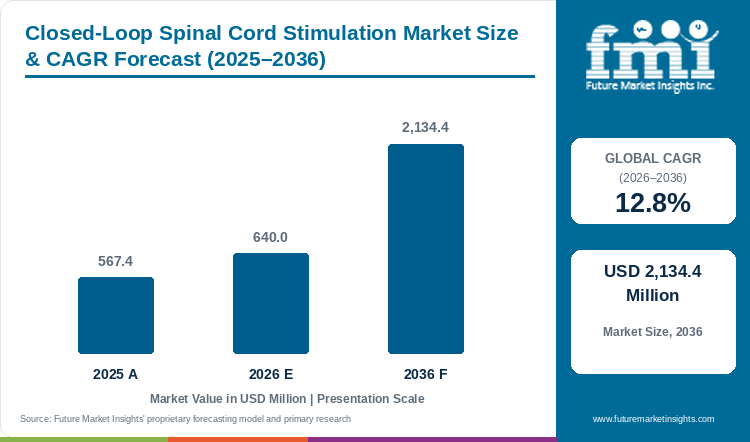
Closed-loop spinal cord stimulation market is valued at USD 567.4 million in 2025 and is projected to increase from USD 640.0 million in 2026 to USD 2,134.4 million by 2036, at 12.8% CAGR during the forecast period. Implantable pulse generators holds 65.8% of product type demand in 2026, as the implanted generator carries sensing, stimulation and therapy control in one system. Medtronic reported in January 2025 that 82% of participants achieved at least 50% reduction in low-back pain, mean pain reduction reached 67%, and 88% preferred closed-loop operation at 12 months.[1] These results are supporting the use of automatic dosing among suitable chronic pain patients. Saluda Medical also reported that EVA was used in more than 3,000 commercial patient visits during limited release in July 2025.[3] Apart from that, the Evoke system adjusts therapy more than 4 million times daily and Saluda Medical reports 95% patient satisfaction.[4] Such measurable neural-response adjustment is expected to drive the closed-loop spinal cord stimulation market over the forecast period.
Key Market Trends & Insights
- By product type, implantable pulse generators accounted for 65.8% of demand in 2026. The generator remains the system component carrying stimulation, sensing and programmed therapy control.
- By feedback mechanism, ECAP-based sensing represented the leading 73.5% share in 2026.
- By indication, chronic back and leg pain held 58.7% of demand in 2026. Established referral, trial and permanent implant pathways supports use among suitable patients with persistent pain.
- By end user, hospitals accounted for 49.0% of demand in 2026. Hospitals combine pain assessment, implantation, anaesthesia, imaging and post-implant programming under one care setting.
Regional Highlights
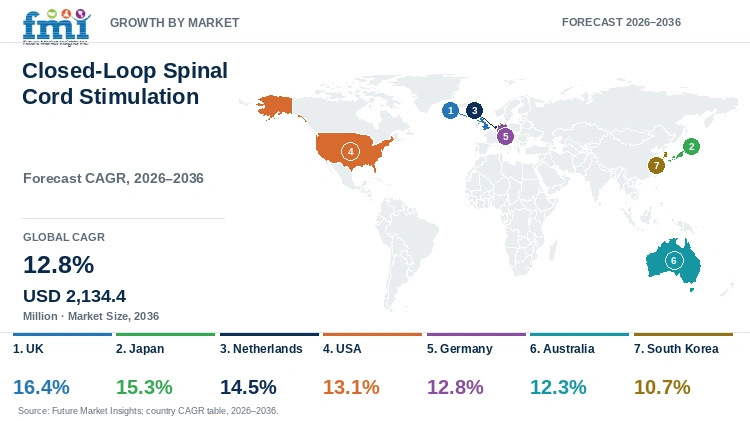
- Fastest-growing profiled country: UK (16.4% CAGR, 2026 to 2036). NHS England required providers to improve productivity by 4% during 2025/26 and use elective capacity more fully, increasing attention towards efficient theatre use and follow-up activity.[2]
- By country: Japan (15.3%) and the Netherlands (14.5%) follow, while South Korea records the lowest profiled CAGR at 10.7%.
Market Size & Forecast
- 2025 Market Size: USD 567.4 million
- Estimated Market Size in 2026: USD 640.0 million
- Projected Market Size by 2036: USD 2,134.4 million
- CAGR, 2026 to 2036: 12.8%
- Added Revenue, 2026 to 2036: USD 1,494.4 million
- Market Expansion Multiple: 3.34x
Chronic pain population does not directly represent the addressable closed-loop spinal cord stimulation market, as every suitable patient moves through assessment, trial response and permanent implantation. CMS approved spinal cord neurostimulation as a complex review topic on August 28, 2025 across ambulatory surgical centres, outpatient hospitals and professional services.[8] This makes patient selection, medical necessity and trial documents important for permanent implant payment. Medtronic recorded one median programming adjustment every 30 days with closed-loop operation, compared with frequent adjustments at least a few times per week for 50% of participants in a separate U.S. SCS survey.[1] Lower programming requirement can reduce follow-up burden after implantation. Abbott also stated that Eterna requires charging about five times a year under standard use and is 22% smaller than its earlier device.[11] These factors are expected to support adoption, while incomplete trial evidence may hamper conversion into permanent implant demand.
Treatment Pathway and Commercial Conversion
Closed-loop spinal cord stimulation demand is created when a suitable chronic pain patient completes trial evaluation and moves towards permanent implantation. The implanted generator, compatible leads and pain management programming support are required in one treatment pathway. Clinical response supports the permanent implant decision, whereas medical necessity and complete records supports payment. The indicators below explains how patient response, programming work, commercial use and documentation affects conversion into closed-loop spinal cord stimulation demand.
Table 1: Treatment Pathway and Commercial Conversion Indicators for the Closed-Loop Spinal Cord Stimulation Market (patients, percentages, adjustments, visits, and requirements), mixed reporting years from 2025 to 2026
| Indicator | Data Point | Market Meaning | Source |
|---|---|---|---|
| Low-back pain response | 82% achieved at least 50% pain reduction at 12 months | Supports trial-to-permanent implant consideration among responsive patients | [1] |
| Mean pain reduction | 67% at 12 months | Shows measurable outcome behind closed-loop adoption | [1] |
| Closed-loop preference | 88% preferred closed-loop operation | Indicates acceptance of automatic neural-response adjustment | [1] |
| Programming activity | One median adjustment every 30 days | Lower manual adjustment can reduce follow-up burden | [1] |
| Commercial use | More than 3,000 EVA patient visits during limited release | Shows use of automated programming beyond approval | [3] |
| Automatic adjustment | More than 4 million therapy adjustments daily | Explains demand for direct neural-response control | [4] |
| Japan chronic-pain base | 22.5% of adults, about 23.15 million people | Provides a large need base, while only selected patients reach SCS | [11] |
| Coverage review | Complex CMS review across ASCs, outpatient hospitals and professional services | Makes medical necessity and documentation part of commercial conversion | [8] |
Basis: Market values and segment shares are report estimates. The expansion multiple equals 2036 market value divided by 2026 market value. External indicators use the reporting year stated by each source and are not treated as market-size inputs.
Analyst Perspective
“Automatic neural-response dosing will gain preference where pain centres require stable therapy with fewer repeated programming visits. Hospitals having complete trial evidence and trained follow-up teams will convert more suitable patients into permanent implants.”
- Anurag Sharma, Principal Consultant, Future Market Insights.
How is the closed-loop spinal cord stimulation market segmented?
Closed-loop spinal cord stimulation market is segmented by product type, feedback mechanism, indication, end user, and region. In 2026, implantable pulse generators are projected at 65.8%, ECAP-based sensing at 73.5%, chronic back and leg pain at 58.7%, and hospitals at 49.0%.
By product type: implantable pulse generators, rechargeable closed-loop IPGs, non-rechargeable closed-loop IPGs, leads and electrodes, percutaneous leads, paddle leads, programmers and accessories, clinician programmers, patient controllers and chargers.
By feedback mechanism: ECAP-based sensing, evoked compound action potential loops, real-time dose titration algorithms, position and motion sensing, accelerometer-adaptive stimulation, posture-responsive programs, impedance-based adjustment, and biomarker-guided stimulation.
By indication: chronic back and leg pain, failed back surgery syndrome, non-surgical refractory back pain, complex regional pain syndrome, painful diabetic neuropathy, ischemic limb pain, and post-surgical neuropathic pain.
By end user: hospitals, neurosurgery departments, pain management units, ambulatory surgical centers, specialty pain clinics, interventional pain clinics, and neuromodulation centers.
By region: North America, Latin America, Western Europe, Eastern Europe, East Asia, South Asia and Pacific, and Middle East and Africa.
Why do implantable pulse generators anchor product type demand?
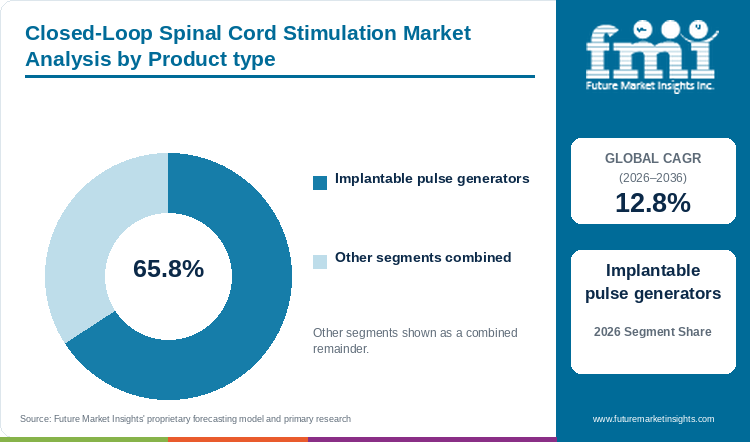
Based on product type, implantable pulse generators are projected to account for 65.8% in 2026, driven by integrated sensing and stimulation control.
Table 2: Product Type Share for the Closed-Loop Spinal Cord Stimulation Market (percentage share), 2026
| Product Type | Share (2026) |
|---|---|
| Implantable Pulse Generators | 65.8% |
| Other Segments Combined | 34.2%* |
| Total | 100.0% |
*Calculated as the balance remaining after deducting the leading segment's reported share from 100.0%.
Table 3: Product Type Leadership and Market Growth for the Closed-Loop Spinal Cord Stimulation Market (segment and CAGR percentage), 2026 to 2036
| Metric | Value |
|---|---|
| Global CAGR (2026 to 2036) | 12.8% |
| Leading Segment | Implantable Pulse Generators |
Implantable pulse generator is the main implanted component which delivers stimulation and stores the therapy settings of spinal cord stimulation system. Rechargeable generators are increasingly preferred where sensing, stimulation and patient charging are required in one compatible platform. In July 2025, Saluda Medical stated that EVA sensing technology had been used in more than 3,000 commercial patient visits during limited release.[3] Availability of integrated sensing with implanted generators is expected to support the segment growth during the forecast period.
- Implantable pulse generators are projected to hold 65.8% of product type demand in 2026.
- Compatibility with leads, charging hardware and clinician programmers supports repeat use of the complete system.
How does ECAP-based sensing meet feedback-control requirements?
By feedback mechanism, ECAP-based sensing is estimated to hold 73.5% in 2026, supported by direct neural-response measurement.
ECAP-based sensing measures the spinal cord response after every stimulation pulse and compares it with the target selected by clinician. Saluda Medical states that the Evoke system can adjust therapy more than 4 million times daily and reported 95% patient satisfaction.[4] Direct neural-response measurement differentiates ECAP sensing from position and motion sensing, which uses movement as a proxy. Owing to this measurable function, ECAP-based sensing is expected to witness higher demand over the forecast period.
- ECAP-based sensing is estimated to hold 73.5% share in 2026 owing to direct measurement of neural activation.
- Position and motion sensing remains another route because movement data does not measure the evoked neural response.
Why does chronic back and leg pain lead indication demand?
Chronic back and leg pain is likely to capture 58.7% share in 2026, owing to established SCS selection and trial pathways.
Chronic back and leg pain is one of the primary applications of spinal cord stimulation and has established referral, trial and permanent implant pathways. A peer-reviewed 2025 clinical evaluation in Biomedicines confirmed that closed-loop spinal cord stimulation achieves significantly higher sustained pain reduction and fewer overstimulation events in chronic back and leg pain than conventional open-loop stimulation.[5] Rising requirement for long-term relief among suitable patients is anticipated to support the segment. However, product labelling and patient selection will decide use of each system.
- Chronic back and leg pain is expected to represent 58.7% of indication demand in 2026.
- Applicable labelling and patient selection decide whether a named system can be used for each pain condition.
What keeps hospitals central to end user demand?
Hospitals are set to lead end user demand with 49.0% share in 2026, underpinned by multidisciplinary implant capability.
Hospitals provides pain assessment, implantation, anaesthesia, imaging and post-procedure management under one care setting. In June 2026, Saluda Medical stated that surgeons preferring paddle leads account for about 30% of U.S. SCS implants.[6] Paddle lead procedures requires surgical capability, due to which hospitals and equipped ambulatory surgical centres are expected to receive higher demand. Presence of multidisciplinary teams and programming support will propel the hospitals segment.
- Hospitals are projected to hold 49.0% of end user demand in 2026.
- Specialty clinics may lead referral and programming, while permanent implantation remains with hospitals or equipped ASCs.
What are the drivers, restraints, and opportunities in the closed-loop spinal cord stimulation market?
The key driver is measurable dosing, the key restraint is claim documentation, and the key opportunity is surgical access.
- Driver: Automatic neural-response adjustment supports adoption by reducing overstimulation and repeated manual changes.
- Restraint: Trial evidence, medical necessity and complete documentation can delay conversion to permanent implant.
- Opportunity: Closed-loop paddle leads can extend therapy into surgeon-led implant pathways through 2036.
Measured Dosing Supports Adoption
Automatic neural-response adjustment is one of the primary factor driving closed-loop spinal cord stimulation demand. The system compares delivered stimulation with the selected target and changes therapy within the programmed settings. In February 2025, Saluda Medical reported that EVA completed automated therapy optimisation in less than 13 minutes during clinical use.[7] Faster programming can reduce manual work during patient visits, which is expected to drive adoption among busy pain centres.
Documentation Limits Permanent Implant Conversion
Documentation requirement is one of the major factors which may hamper conversion from trial stimulation to permanent implant. Product authorisation does not itself provide payment, as every claim also requires patient selection, medical necessity and trial records. CMS approved spinal cord neurostimulation as a complex national review topic on August 28, 2025 across ambulatory surgical centres, outpatient hospitals and professional services.[8] Incomplete trial or follow-up records may therefore delay permanent implant payment even where the device is available.
Surgical Leads Widen Procedural Access
Surgical paddle leads provides another treatment route where anatomy or treatment plan does not support percutaneous implantation. Saluda Medical reported first U.S. CAP24 surgical cases in July 2026 at an academic hospital and an ambulatory surgical centre.[9] Availability of closed-loop therapy in paddle lead procedures is widening its application among surgeon-led implant pathways. Surgeon training, lead inventory and programming support is expected to create growth opportunities during the forecast period.
Which country CAGRs are profiled in the closed-loop spinal cord stimulation market?
Table 4: Country CAGR Comparison for the Closed-Loop Spinal Cord Stimulation Market (CAGR percentage), 2026 to 2036
| Country | CAGR |
|---|---|
| UK | 16.4% |
| Japan | 15.3% |
| Netherlands | 14.5% |
| USA | 13.1% |
| Germany | 12.8% |
| Australia | 12.3% |
| South Korea | 10.7% |
How do country-level CAGRs compare in the closed-loop spinal cord stimulation market?
Adoption develops differently across countries because specialist implant access, reimbursement coverage, and clinical programming teams vary across regional healthcare systems. In the FMI report, the UK is projected to register 16.4% CAGR through 2036, followed by Japan at 15.3% and the Netherlands at 14.5%. USA is estimated at 13.1%, while Germany and Australia are projected at 12.8% and 12.3%, respectively. South Korea follows at 10.7% CAGR. Specialist centres and dedicated follow-up teams govern the pace of conversion across remaining markets.
- UK demand is supported by local commissioning and use of funded elective capacity.
- Japan combines chronic-pain demand with institutional purchasing and rechargeable SCS choices.
- The Netherlands has a well-funded medical-device environment with centre-led implant access.
- USA adoption depends on an authorised system, successful trial and complete claim documentation.
- Germany provides a large hospital base, while budgets and programming capability govern adoption.
- Australia has a national device registration for the Evoke closed-loop stimulator.
- South Korea has structured rehabilitation data, but device access requires local registration and evidence.
Country-wise Analysis
- Closed-loop spinal cord stimulation demand in the UK is projected to rise at 16.4% CAGR through 2036. NHS England reported in December 2025 that 7.3 million consultant-led pathways were active, with 61.5% waiting up to 18 weeks to start elective treatment.[10] Implant centres are therefore focusing on structured trial selection, elective theatre use and follow-up programming within one funded pathway. Increasing requirement for procedural efficiency with accountable follow-up is expected to support the UK market growth.
- Japan is anticipated to advance at 15.3% CAGR over the assessment period, aided by institutional purchasing and a large chronic-pain population. Abbott Japan reported in January 2025 that chronic pain affected 22.5% of adults, or about 23.15 million people, and introduced the Eterna rechargeable SCS system locally.[11] Availability of different implant options and trained clinicians is expected to support completed trials and permanent implants.
- The Netherlands is estimated to post 14.5% CAGR through 2036. Statistics Netherlands reported that health spending increased 6.1% during 2025, while medicines and medical devices represented 9.7% of total spending.[12] The figures support a large healthcare funding environment, although closed-loop implants remains concentrated in specialist neuromodulation centres. Growth is likely to remain centre-led over the forecast period.
- The USA outlook is forecast to expand at 13.1% CAGR through 2036. The National Center for Health Statistics reported in November 2024 that 24.3% of U.S. adults experienced chronic pain, with 8.5% reporting high-impact chronic pain.[13] Increasing attention to claim documentation puts chart quality beside clinical response in the permanent implant decision. Centres connecting prior treatment, trial results and follow-up in one record is expected to witness higher adoption.
- The German market is projected to record 12.8% CAGR during the assessment period, supported by specialist hospital capacity. The Federal Statistical Office reported 17.5 million inpatient treatments during 2024 in a November 2025 release, along with 1,841 hospitals and 472,900 beds.[14] Presence of a large hospital base supports neuromodulation services, while product eligibility and programming teams will govern closed-loop adoption.
- Closed-loop spinal cord stimulation in Australia is estimated to expand at 12.3% CAGR through 2036. The Therapeutic Goods Administration entered the Evoke closed-loop stimulator as a Class III device on August 5, 2025 under ARTG ID 508085.[15] Registration supports authorised supply of the device, whereas a successful trial and continuing programming responsibility remains necessary for implantation. These factors are anticipated to support demand among specialist pain centres.
- Sales in South Korea are forecast to expand at 10.7% CAGR through 2036. A 2026 National Rehabilitation Center study analysed 538 adults with spinal cord injury using a 125-item national survey instrument.[16] The study does not measure closed-loop SCS demand, but it shows an organised evidence base for long-term spinal care. Local registration, hospital readiness and evidence for chronic-pain patients will remain important for market growth.
Who are the notable companies in the closed-loop spinal cord stimulation market?
Medtronic plc, Saluda Medical Pty Ltd, Abbott Laboratories, Boston Scientific Corporation, Globus Medical, Inc., Nalu Medical, Inc., and Biotronik SE & Co. KG are notable companies profiled in this market.
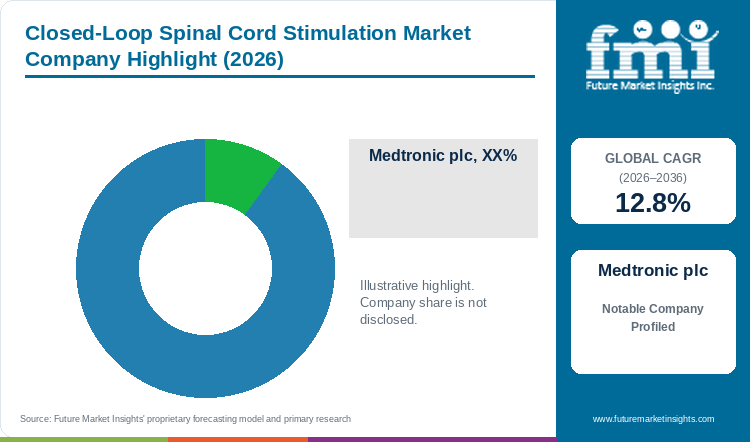
According to FMI, closed-loop spinal cord stimulation market is concentrated among few companies having directly evidenced neural-response controlled systems. Medtronic plc and Saluda Medical Pty Ltd offers physiological closed-loop platforms, whereas Abbott Laboratories, Boston Scientific Corporation and Globus Medical, Inc. provides wider SCS portfolios. Nalu Medical, Inc. and Biotronik SE & Co. KG are engaged in specialised neuromodulation architectures and connected follow-up technologies. Product launches, automated programming, smaller implants and acquisitions are expected to intensify the market competition over the forecast period.
- Physiological closed-loop platforms: Medtronic plc and Saluda Medical Pty Ltd.
- Broader SCS portfolios: Abbott Laboratories, Boston Scientific Corporation, and Globus Medical, Inc.
- Specialised neuromodulation architectures: Nalu Medical, Inc. and Biotronik SE & Co. KG.
Competitive Benchmarking: Closed-Loop Spinal Cord Stimulation Market
Table 5: Competitive Benchmarking for the Closed-Loop Spinal Cord Stimulation Market (qualitative capability ratings), 2026
| Company | Feedback control | Clinical evidence | Follow-up support | Reach |
|---|---|---|---|---|
| Medtronic plc | High | Medium | Medium | USA, Europe, Japan |
| Saluda Medical Pty Ltd | High | High | High | USA, Europe, Australia |
| Abbott Laboratories | Low | Medium | High | Multiple SCS markets |
| Boston Scientific Corporation | Low | Medium | Medium | Multiple SCS markets |
| Globus Medical, Inc. | Low | Medium | Medium | Nevro SCS footprint |
| Nalu Medical, Inc. | Low | Medium | Medium | USA focused |
| Biotronik SE & Co. KG | Low | Medium | High | USA Prospera footprint |
High indicates broad public evidence for the stated capability. Medium indicates narrower product-specific evidence. Low indicates limited direct evidence inside the physiological closed-loop boundary. Ratings do not represent market share or product quality.
Key Developments in the Closed-Loop Spinal Cord Stimulation Market
- In October 2026, Saluda Medical began full US commercial release of the CAP24 closed-loop surgical paddle lead after phased launch.
- In July 2026, BIOTRONIK Neuro launched Embrace One Proactive Intelligence after a pilot reviewed 188 behavioural-pattern instances across 175 patients.
- In July 2025, Saluda Medical launched EVA sensing technology nationally in the USA after more than 3,000 commercial patient visits during limited release.
- In January 2025, Medtronic reported 12-month Inceptiv findings including 82% low-back pain responders and 88% closed-loop preference.
Key Players in the Closed-Loop Spinal Cord Stimulation Market
Physiological closed-loop system platforms
- Medtronic plc
- Saluda Medical Pty Ltd
Broader SCS waveform and portfolio providers
- Abbott Laboratories
- Boston Scientific Corporation
- Globus Medical, Inc.
Specialised neuromodulation architectures
- Nalu Medical, Inc.
- Biotronik SE & Co. KG
Closed-Loop Spinal Cord Stimulation Market - Report Scope
Table 6: Report Scope for the Closed-Loop Spinal Cord Stimulation Market (coverage fields and definitions), 2026 to 2036
| Coverage field | Report scope |
|---|---|
| Market breakdown | Product type; feedback mechanism; indication; end user |
| Quantitative units | USD million |
| Market definition | Revenue from automatically feedback-adjusted spinal cord stimulation systems and attributable IPGs, leads, programmers, and accessories. Open-loop-only devices, peripheral nerve stimulation, procedures, and separately billed services are excluded. |
| Regions covered | North America; Latin America; Western Europe; Eastern Europe; East Asia; South Asia and Pacific; Middle East and Africa |
| Countries covered | UK, Japan, Netherlands, USA, Germany, Australia, South Korea |
| Key companies profiled | Medtronic plc; Saluda Medical Pty Ltd; Abbott Laboratories; Boston Scientific Corporation; Globus Medical, Inc.; Nalu Medical, Inc.; Biotronik SE & Co. KG |
| Forecast period | 2026 to 2036 |
| Approach | Primary and secondary research with market triangulation. |
Closed-Loop Spinal Cord Stimulation Market - Research Methodology
Table 7: Research Methodology for the Closed-Loop Spinal Cord Stimulation Market (research methods and approach), 2026 edition
| Method | Approach |
|---|---|
| Primary Research | The study includes interviews with manufacturers, technology developers, distributors, end users, procurement teams and industry experts. Interviews covers purchasing decision, adoption barrier, pricing, approval requirement and technical support. |
| Desk Research | Desk research covered government statistics, regulatory publications, industry associations, technical literature, standards, product information and official company announcements. |
| Market Sizing and Forecasting | Market sizing combines baseline value, historical performance, segment structure, pricing, adoption level, company participation and country demand condition. |
| Data Validation | Estimates were checked against public data, company activity, regulatory records and primary research. Segment shares and forecasts are FMI proprietary estimates. |
Closed-Loop Spinal Cord Stimulation Market by Segments
Closed-loop spinal cord stimulation market segmented by Product type:
- Implantable pulse generators
- Rechargeable closed-loop IPGs
- Non-rechargeable closed-loop IPGs
- Leads and electrodes
- Percutaneous leads
- Paddle leads
- Programmers and accessories
- Clinician programmers
- Patient controllers and chargers
Closed-loop spinal cord stimulation market segmented by Feedback mechanism:
- ECAP-based sensing
- Evoked compound action potential loops
- Real-time dose titration algorithms
- Position and motion sensing
- Accelerometer-adaptive stimulation
- Posture-responsive programs
- Other physiological feedback
- Impedance-based adjustment
- Biomarker-guided stimulation
Closed-loop spinal cord stimulation market segmented by Indication:
- Chronic back and leg pain
- Failed back surgery syndrome
- Non-surgical refractory back pain
- Complex regional pain syndrome
- CRPS type I
- CRPS type II
- Painful diabetic neuropathy
- Lower-limb neuropathic pain
- Refractory neuropathy cases
- Ischemic limb pain
- Post-surgical neuropathic pain
Closed-loop spinal cord stimulation market segmented by End user:
- Hospitals
- Neurosurgery departments
- Pain management units
- Ambulatory surgical centers
- Multispecialty ASCs
- Pain-focused ASCs
- Specialty pain clinics
- Interventional pain clinics
- Neuromodulation centers
Closed-Loop Spinal Cord Stimulation Market by Region
- North America
- United States
- Canada
- Latin America
- Brazil
- Mexico
- Argentina
- Chile
- Western Europe
- Germany
- France
- United Kingdom
- Italy
- Spain
- Benelux
- Nordics
- Eastern Europe
- Poland
- Czech Republic
- Romania
- Hungary
- East Asia
- Japan
- South Korea
- South Asia and Pacific
- ASEAN
- Australia and New Zealand
- Middle East and Africa
- GCC Countries
- South Africa
- Türkiye
- Israel
Research Sources and Bibliography
- [1] Medtronic. (2025, January 23). New 12-month clinical data highlights significant and sustained benefits of the Inceptiv closed-loop spinal cord stimulation system.
- [2] NHS England. (2025, January 30). 2025/26 priorities and operational planning guidance.
- [3] Saluda Medical. (2025, July 17). Full U.S. launch of EVA sensing technology for the Evoke SmartLoop system.
- [4] Saluda Medical. (2026). Evoke and EVA product information.
- [5] Al-Kaisy, A., et al. (2025, April 30). Closed-loop spinal cord stimulation in chronic pain management: Mechanisms, clinical evidence, and emerging perspectives. Biomedicines, 13(5), 1091.
- [6] Saluda Medical. (2026, June 30). FDA approval for the CAP24 surgical paddle lead.
- [7] Saluda Medical. (2025, February 5). FDA approval for the EVA automated programming platform in spinal cord stimulation.
- [8] Centers for Medicare & Medicaid Services. (2025, August 28). Spinal cord neurostimulation: Medical necessity and documentation requirements.
- [9] Saluda Medical. (2026, July 16). First U.S. surgical cases using the CAP24 paddle lead.
- [10] NHS England. (2025, December). Consultant-led referral to treatment waiting times data.
- [11] Abbott Japan. (2025, January 30). Abbott launches the Eterna rechargeable spinal cord stimulation system in Japan.
- [12] Statistics Netherlands. (2026, June 25). Spending on health care up by 6.1 percent in 2025.
- [13] National Center for Health Statistics. (2024, November). Chronic pain and high-impact chronic pain in U.S. adults, 2023. NCHS Data Brief, no 518.
- [14] Federal Statistical Office of Germany. (2025, November 6). Inpatient hospital treatments increased by 2.0 percent in 2024.
- [15] Therapeutic Goods Administration. (2025, August 5). Evoke closed-loop stimulator, ARTG 508085.
- [16] Song, K., Lim, J., & Kim, O. (2026). Predictors of paid employment among individuals with spinal cord injury in South Korea. Annals of Rehabilitation Medicine, 50(4), 290-301.
This bibliography is provided for reader reference. Four of the most authoritative entries carry direct external links, while remaining entries are retained in APA 7 format without displayed URLs.
This Report Answers
- How large is the closed-loop spinal cord stimulation market during 2026?
- What value is the market projected to reach by 2036?
- Which product type holds a notable share of market demand?
- Which feedback mechanism holds a notable share during 2026?
- Which country shows a notable expansion outlook?
- Which companies are notable in closed-loop spinal cord stimulation?
Frequently Asked Questions
How large is the closed-loop spinal cord stimulation market in 2026?
As per the analysis from FMI, the market is valued at USD 640.0 million in 2026 and is projected to reach USD 2,134.4 million by 2036.
What CAGR is projected for the market through 2036?
FMI data suggests that the closed-loop spinal cord stimulation market will grow at 12.8% CAGR between 2026 and 2036.
Which product type leads the market during 2026?
Implantable pulse generators are projected to hold 65.8% of product type demand in 2026, owing to integrated sensing and therapy control.
Which feedback mechanism holds a leading market share?
ECAP-based sensing is estimated to hold 73.5% of feedback mechanism demand in 2026 through direct measurement of neural activation.
Which country has a notable growth outlook through 2036?
The UK market is projected to expand at 16.4% CAGR through 2036, supported by specialist assessment and funded implant pathways.
Who are the key companies in the market?
Key companies include Medtronic plc, Saluda Medical Pty Ltd, Abbott Laboratories, Boston Scientific Corporation, Globus Medical, Inc., Nalu Medical, Inc., and Biotronik SE & Co. KG.
Preview the report firsthand - request a free sample
Get SampleGet the brochure for pricing and purchase details.
Get PDFTable of Content
- Key Takeaways
- Market Size and CAGR
- Top Growth Driver
- Fastest Growing Segment
- Leading Region
- Key Companies
- Emerging Opportunities
- Executive Summary
- Global Market Outlook
- Demand-side Trends
- Supply-side Trends
- Technology Roadmap Analysis
- Analysis and Recommendations
- Analyst Perspective (What is happening? Why now? What should investors know?)
- Key Questions Answered
- How large is the market?
- What is the CAGR?
- What are key trends?
- Which region dominates?
- Who are the leaders?
- Market Overview
- Market Coverage / Taxonomy
- Market Definition / Scope / Limitations
- Research Methodology
- Chapter Orientation
- Analytical Lens and Working Hypotheses
- Market Structure, Signals, and Trend Drivers
- Benchmarking and Cross-market Comparability
- Market Sizing, Forecasting, and Opportunity Mapping
- Research Design and Evidence Framework
- Desk Research Programme (Secondary Evidence)
- Expert Input and Fieldwork (Primary Evidence)
- Tooling, Models, and Reference Databases
- Data Engineering and Model Build
- Quality Assurance and Audit Trail
- Market Background
- Market Dynamics (Drivers, Restraints, Opportunity, Trends)
- Scenario Forecast (Optimistic, Likely, Conservative)
- Impact Analysis
- AI Impact
- Sustainability Impact
- Regulatory Impact
- Technology Impact
- Consumer / Buyer Analysis
- Purchase Drivers
- Adoption Barriers
- Buyer Journey
- Opportunity Map Analysis
- Product Life Cycle Analysis
- Supply Chain Analysis
- Investment Feasibility Matrix
- Value Chain Analysis
- PESTLE and Porter's Analysis
- Regulatory Landscape
- Regional Parent Market Outlook
- Production and Consumption Statistics
- Import and Export Statistics
- Global Market Analysis and Forecast, 2021 to 2036
- Historical Market Size Value (USD Million) Analysis, 2021 to 2025
- Current and Future Market Size Value (USD Million) Projections, 2026 to 2036
- Y-o-Y Growth Trend Analysis
- Absolute $ Opportunity Analysis
- Global Market Pricing Analysis, 2021 to 2036
- Global Market Analysis and Forecast, By Product type, 2021 to 2036
- Introduction / Key Findings
- Historical Market Size Value (USD Million) Analysis By Product type, 2021 to 2025
- Current and Future Market Size Value (USD Million) Analysis and Forecast By Product type, 2026 to 2036
- Implantable pulse generators
- Rechargeable closed-loop IPGs
- Non-rechargeable closed-loop IPGs
- Leads and electrodes
- Percutaneous leads
- Paddle leads
- Programmers and accessories
- Clinician programmers
- Patient controllers and chargers
- Y-o-Y Growth Trend Analysis By Product type, 2021 to 2025
- Absolute $ Opportunity Analysis By Product type, 2026 to 2036
- Global Market Analysis and Forecast, By Feedback mechanism, 2021 to 2036
- Introduction / Key Findings
- Historical Market Size Value (USD Million) Analysis By Feedback mechanism, 2021 to 2025
- Current and Future Market Size Value (USD Million) Analysis and Forecast By Feedback mechanism, 2026 to 2036
- ECAP-based sensing
- Evoked compound action potential loops
- Real-time dose titration algorithms
- Position and motion sensing
- Accelerometer-adaptive stimulation
- Posture-responsive programs
- Other physiological feedback
- Impedance-based adjustment
- Biomarker-guided stimulation
- Y-o-Y Growth Trend Analysis By Feedback mechanism, 2021 to 2025
- Absolute $ Opportunity Analysis By Feedback mechanism, 2026 to 2036
- Global Market Analysis and Forecast, By Indication, 2021 to 2036
- Introduction / Key Findings
- Historical Market Size Value (USD Million) Analysis By Indication, 2021 to 2025
- Current and Future Market Size Value (USD Million) Analysis and Forecast By Indication, 2026 to 2036
- Chronic back and leg pain
- Failed back surgery syndrome
- Non-surgical refractory back pain
- Complex regional pain syndrome
- CRPS type I
- CRPS type II
- Painful diabetic neuropathy
- Lower-limb neuropathic pain
- Refractory neuropathy cases
- Ischemic limb pain
- Post-surgical neuropathic pain
- Y-o-Y Growth Trend Analysis By Indication, 2021 to 2025
- Absolute $ Opportunity Analysis By Indication, 2026 to 2036
- Global Market Analysis and Forecast, By End user, 2021 to 2036
- Introduction / Key Findings
- Historical Market Size Value (USD Million) Analysis By End user, 2021 to 2025
- Current and Future Market Size Value (USD Million) Analysis and Forecast By End user, 2026 to 2036
- Hospitals
- Neurosurgery departments
- Pain management units
- Ambulatory surgical centers
- Multispecialty ASCs
- Pain-focused ASCs
- Specialty pain clinics
- Interventional pain clinics
- Neuromodulation centers
- Y-o-Y Growth Trend Analysis By End user, 2021 to 2025
- Absolute $ Opportunity Analysis By End user, 2026 to 2036
- Global Market Analysis and Forecast, By Region, 2021 to 2036
- Introduction
- Historical Market Size Value (USD Million) Analysis By Region, 2021 to 2025
- Current Market Size Value (USD Million) Analysis and Forecast By Region, 2026 to 2036
- North America
- Latin America
- Western Europe
- Eastern Europe
- East Asia
- South Asia and Pacific
- Middle East and Africa
- Market Attractiveness Analysis By Region
- North America Market Analysis and Forecast, By Country, 2021 to 2036
- Historical Market Size Value (USD Million) Trend Analysis By Market Taxonomy, 2021 to 2025
- Market Size Value (USD Million) Forecast By Market Taxonomy, 2026 to 2036
- By Country
- United States
- Canada
- By Product type
- By Feedback mechanism
- By Indication
- By End user
- By Country
- Market Attractiveness Analysis
- By Country
- By Product type
- By Feedback mechanism
- By Indication
- By End user
- Key Takeaways
- Latin America Market Analysis and Forecast, By Country
- Historical Market Size Value (USD Million) Trend Analysis By Market Taxonomy, 2021 to 2025
- Market Size Value (USD Million) Forecast By Market Taxonomy, 2026 to 2036
- By Country
- Brazil
- Mexico
- Argentina
- Chile
- By Product type
- By Feedback mechanism
- By Indication
- By End user
- By Country
- Market Attractiveness Analysis
- By Country
- By Product type
- By Feedback mechanism
- By Indication
- By End user
- Key Takeaways
- Western Europe Market Analysis and Forecast, By Country
- Historical Market Size Value (USD Million) Trend Analysis By Market Taxonomy, 2021 to 2025
- Market Size Value (USD Million) Forecast By Market Taxonomy, 2026 to 2036
- By Country
- Germany
- France
- United Kingdom
- Italy
- Spain
- Benelux
- Nordics
- By Product type
- By Feedback mechanism
- By Indication
- By End user
- By Country
- Market Attractiveness Analysis
- By Country
- By Product type
- By Feedback mechanism
- By Indication
- By End user
- Key Takeaways
- Eastern Europe Market Analysis and Forecast, By Country
- Historical Market Size Value (USD Million) Trend Analysis By Market Taxonomy, 2021 to 2025
- Market Size Value (USD Million) Forecast By Market Taxonomy, 2026 to 2036
- By Country
- Poland
- Czech Republic
- Romania
- Hungary
- By Product type
- By Feedback mechanism
- By Indication
- By End user
- By Country
- Market Attractiveness Analysis
- By Country
- By Product type
- By Feedback mechanism
- By Indication
- By End user
- Key Takeaways
- East Asia Market Analysis and Forecast, By Country
- Historical Market Size Value (USD Million) Trend Analysis By Market Taxonomy, 2021 to 2025
- Market Size Value (USD Million) Forecast By Market Taxonomy, 2026 to 2036
- By Country
- Japan
- South Korea
- By Product type
- By Feedback mechanism
- By Indication
- By End user
- By Country
- Market Attractiveness Analysis
- By Country
- By Product type
- By Feedback mechanism
- By Indication
- By End user
- Key Takeaways
- South Asia and Pacific Market Analysis and Forecast, By Country
- Historical Market Size Value (USD Million) Trend Analysis By Market Taxonomy, 2021 to 2025
- Market Size Value (USD Million) Forecast By Market Taxonomy, 2026 to 2036
- By Country
- ASEAN
- Australia and New Zealand
- By Product type
- By Feedback mechanism
- By Indication
- By End user
- By Country
- Market Attractiveness Analysis
- By Country
- By Product type
- By Feedback mechanism
- By Indication
- By End user
- Key Takeaways
- Middle East and Africa Market Analysis and Forecast, By Country
- Historical Market Size Value (USD Million) Trend Analysis By Market Taxonomy, 2021 to 2025
- Market Size Value (USD Million) Forecast By Market Taxonomy, 2026 to 2036
- By Country
- GCC Countries
- South Africa
- Türkiye
- Israel
- By Product type
- By Feedback mechanism
- By Indication
- By End user
- By Country
- Market Attractiveness Analysis
- By Country
- By Product type
- By Feedback mechanism
- By Indication
- By End user
- Key Takeaways
- Key Countries Market Analysis
- United States
- Pricing Analysis
- Market Share Analysis, 2025
- By Product type
- By Feedback mechanism
- By Indication
- By End user
- Canada
- Pricing Analysis
- Market Share Analysis, 2025
- By Product type
- By Feedback mechanism
- By Indication
- By End user
- Mexico
- Pricing Analysis
- Market Share Analysis, 2025
- By Product type
- By Feedback mechanism
- By Indication
- By End user
- Brazil
- Pricing Analysis
- Market Share Analysis, 2025
- By Product type
- By Feedback mechanism
- By Indication
- By End user
- Chile
- Pricing Analysis
- Market Share Analysis, 2025
- By Product type
- By Feedback mechanism
- By Indication
- By End user
- Germany
- Pricing Analysis
- Market Share Analysis, 2025
- By Product type
- By Feedback mechanism
- By Indication
- By End user
- United Kingdom
- Pricing Analysis
- Market Share Analysis, 2025
- By Product type
- By Feedback mechanism
- By Indication
- By End user
- Italy
- Pricing Analysis
- Market Share Analysis, 2025
- By Product type
- By Feedback mechanism
- By Indication
- By End user
- Spain
- Pricing Analysis
- Market Share Analysis, 2025
- By Product type
- By Feedback mechanism
- By Indication
- By End user
- France
- Pricing Analysis
- Market Share Analysis, 2025
- By Product type
- By Feedback mechanism
- By Indication
- By End user
- ASEAN
- Pricing Analysis
- Market Share Analysis, 2025
- By Product type
- By Feedback mechanism
- By Indication
- By End user
- Australia and New Zealand
- Pricing Analysis
- Market Share Analysis, 2025
- By Product type
- By Feedback mechanism
- By Indication
- By End user
- Japan
- Pricing Analysis
- Market Share Analysis, 2025
- By Product type
- By Feedback mechanism
- By Indication
- By End user
- South Korea
- Pricing Analysis
- Market Share Analysis, 2025
- By Product type
- By Feedback mechanism
- By Indication
- By End user
- Poland
- Pricing Analysis
- Market Share Analysis, 2025
- By Product type
- By Feedback mechanism
- By Indication
- By End user
- Hungary
- Pricing Analysis
- Market Share Analysis, 2025
- By Product type
- By Feedback mechanism
- By Indication
- By End user
- Türkiye
- Pricing Analysis
- Market Share Analysis, 2025
- By Product type
- By Feedback mechanism
- By Indication
- By End user
- South Africa
- Pricing Analysis
- Market Share Analysis, 2025
- By Product type
- By Feedback mechanism
- By Indication
- By End user
- Netherlands
- Pricing Analysis
- Market Share Analysis, 2025
- By Product type
- By Feedback mechanism
- By Indication
- By End user
- Australia
- Pricing Analysis
- Market Share Analysis, 2025
- By Product type
- By Feedback mechanism
- By Indication
- By End user
- United States
- Market Structure Analysis
- Competition Dashboard
- Competition Benchmarking
- Market Share Analysis of Top Players
- By Regional
- By Product type
- By Feedback mechanism
- By Indication
- By End user
- Emerging Startups
- Innovation Benchmarking
- Competition Analysis
- Competition Deep Dive
- Medtronic plc
- Overview
- Product Portfolio
- Profitability by Market Segments
- Sales Footprint
- Strategy Overview
- Marketing Strategy
- Product Strategy
- Channel Strategy
- Saluda Medical Pty Ltd
- Abbott Laboratories
- Boston Scientific Corporation
- Globus Medical, Inc.
- Nalu Medical, Inc.
- Biotronik SE & Co. KG
- Medtronic plc
- Case Studies
- Success Stories
- Recent Developments
- Competition Deep Dive
- Assumptions & Acronyms Used


