

- Market Size (2026)
- USD 544.0 Mn
- Forecast (2036)
- USD 1398.2 Mn
- CAGR (2026 to 2036)
- 9.9%
How big is Collagen Coffee Mixes Market in 2026?
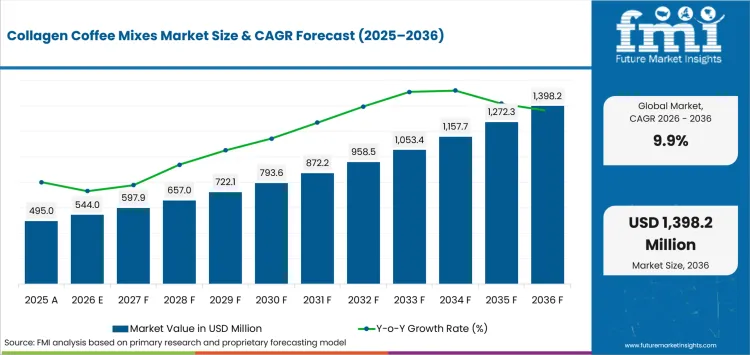
USD 544.0 million in 2026 and USD 1,398.2 million by 2036 at a 9.9% CAGR.
Demand for collagen coffee mixes is forecast to expand at 9.9% CAGR between 2026 and 2036, increasing from USD 544.0 million in 2026 to USD 1,398.2 million by 2036. The product succeeds when collagen is built into a familiar coffee routine without weakening taste, texture or preparation speed. Coffee-specific powders and creamers lower the behavior change required for a separate supplement occasion. Related coffee creamer categories provide a useful benchmark for flavor, mouthfeel and repeat-use packaging.
Country conversion differs because the same coffee-led proposition faces different claim and labeling rules. The USA gives brands broad retail and direct-to-consumer access, while Great Britain restricts health claims to authorized wording. Germany requires notification for food supplements, Japan provides a Foods with Function Claims route, and South Korea introduced nutrition-label changes effective in 2026. These differences shape launch sequencing even when the product formula is similar.
Key Takeaways
- Market value is forecast to rise from USD 544.0 million in 2026 to USD 1,398.2 million by 2036 at a 9.9% CAGR.
- Collagen Creamers are projected to hold 32.5% of Product Type demand in 2026 because they combine coffee modification with collagen delivery.
- Bovine collagen is estimated at 40.4% of Collagen Source demand in 2026, supported by broad use in hydrolyzed powder systems.
- Canisters are forecast to account for 37.9% of Format demand in 2026 as repeat users favor flexible dosing for home preparation.
- South Korea is projected to grow at 10.0% CAGR through 2036, while Japan is forecast at 7.9% across the same period.
- Vital Proteins, Ancient Nutrition, Bulletproof, Primal Kitchen, Sports Research, Orgain, Further Food, NeoCell, Garden of Life shape direct or adjacent competition.
Analyst Perspective
"Collagen coffee mixes earn repeat use when the product behaves like coffee first. Brand teams should test dispersion, flavor and serving economics before expanding claims or channels, because a strong collagen story cannot compensate for a weak daily beverage experience."
- Nandini Roy Choudhury, Principal Consultant, Future Market Insights
How is the Collagen Coffee Mixes Market segmented?
The collagen coffee mixes market is segmented by Product Type, Collagen Source, Format, Claim, Sales Channel and Region.
Product Type separates coffee creamers from instant coffee-collagen combinations, latte mixes, cold brew mixes, and other constructions. Collagen Source distinguishes bovine, marine, chicken, and other inputs that shape cost or claim architecture. Format captures canisters, stick packs, pods, and other delivery systems that alter dosing convenience and packaging economics. Claim separates grass-fed, sugar-free, keto-friendly, and other positioning choices used at shelf or online. Sales Channel distinguishes supermarkets and hypermarkets from online or DTC, convenience stores, specialty and health stores, and other outlets. The axes therefore describe different buying decisions rather than five versions of the same segmentation logic.
What drives Supermarkets & Hypermarkets within the Sales Channel category?
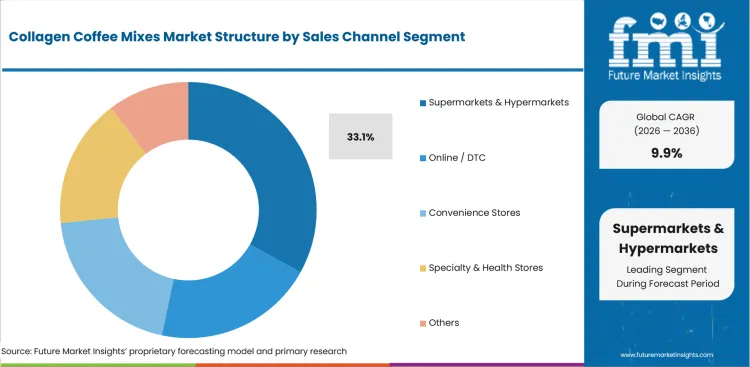
Supermarkets & Hypermarkets give collagen coffee mixes access to a broad grocery mission where coffee, creamer, and wellness products can be compared in one trip. The channel also reduces the discovery burden for consumers who do not begin with a specialist supplement search. Online / DTC remains important for education, subscriptions, and wider flavor choice. Specialty & Health Stores can support more detailed ingredient conversations. Convenience Stores favor immediate missions but have less space for canister-led assortments. Supermarkets & Hypermarkets lead because they combine traffic with adjacent category placement. Winning there still requires clear packaging because shoppers make faster decisions than they do on a detailed brand website.
- Supermarkets & Hypermarkets hold 33.1% share in 2026 because broad grocery traffic and adjacency to coffee or creamer can support routine-oriented discovery.
- Ancient Nutrition stated in October 2021 that its Collagen Peptides would roll out through retailers including Kroger, Target, Sprouts, and Whole Foods Market, illustrating the importance of conventional and natural retail distribution for collagen powders. (Ancient Nutrition, October 2021).
What makes Collagen Creamers central to the Product Type category?
Collagen Creamers are designed around the part of the coffee routine where consumers already add texture or flavor. That gives the format a clear job beyond simply delivering protein. The product can replace a conventional creamer while adding a collagen proposition in the same scoop. It also gives brands room to manage dairy-free cues, sweetness, and mouthfeel inside one formulation. Instant Coffee + Collagen compresses the whole beverage into one mix, while Latte Mixes and Cold Brew Mixes target more specific occasions. Creamers remain broader because they can be added to multiple coffee styles without forcing a consumer to switch the coffee itself. Adjacent non-dairy creamer formats provide a useful comparison for shelf placement and sensory expectations.
- Collagen Creamers hold 32.5% share in 2026 because the format combines a familiar coffee modifier with collagen delivery in one purchase.
- Vital Proteins stated in February 2021 that all three of its collagen creamers used 10 grams of grass-fed and pasture-raised bovine collagen, showing how the coffee modifier can carry both source and functional cues. (Vital Proteins, February 2021).
Why does Bovine lead the Collagen Source category?
Bovine collagen fits powder-based coffee mixes because hydrolyzed peptides can be formulated into neutral or flavored systems without requiring a marine positioning. It also supports a mature sourcing story around grass-fed or pasture-raised cattle. That matters when the source claim is part of the front-of-pack proposition. Marine collagen gives brands a different provenance and can support premium positioning, while chicken collagen appears more often in multi-source systems. Bovine remains the broadest base for coffee-led products because multiple companies already use it in powders that are mixed into hot beverages. Source leadership therefore reflects formulation familiarity and merchandising flexibility rather than a single end benefit.
- Bovine holds 40.4% share in 2026 because its use in hydrolyzed powder systems supports broad formulation and sourcing options for coffee-oriented products.
- Sports Research announced in August 2023 that its Organic Collagen Peptides used grass-fed bovine sourcing, illustrating how bovine collagen can carry a differentiated source claim without changing the powder delivery model. (Sports Research, August 2023).
How do Canisters support leadership in the Format category?
Canisters fit frequent home use because buyers can control the scoop size and use the same product across hot coffee, iced coffee, or other recipes. The package also gives suppliers enough label area for directions and sourcing information. Stick Packs trade that flexibility for portability and portion control. Pods can reduce preparation even further, but they require machine compatibility and tighter formulation constraints. Other formats can serve trial or niche needs. The canister therefore sits at the intersection of repeat-use economics and dosing freedom. That position is particularly useful when a household uses the same collagen coffee mix across several beverage occasions rather than one fixed serving each day.
- Canisters hold 37.9% share in 2026 because they support flexible dosing and repeat household use without committing every serving to single-use packaging.
- Ancient Nutrition reported in July 2019 that its Multi Collagen Protein rollout included single-serve stick packs alongside powder products, showing how brands use portable packs as an extension to larger repeat-use formats rather than a full replacement. (Ancient Nutrition, July 2019).
What supports Grass-Fed leadership in the Claim category?
Grass-Fed is a source-linked claim that can be understood at the point of purchase without asking the consumer to interpret a technical collagen type. It also travels across plain powders and coffee-specific creamers. Sugar-Free and Keto-Friendly claims address different nutritional goals, but they depend on the complete formula rather than the collagen input alone. Grass-Fed can therefore remain relevant even when flavor systems or sweeteners change. The claim still requires accurate sourcing documentation and disciplined language. Its leadership is commercially useful because it allows suppliers to signal provenance while keeping the formulation compatible with mainstream coffee preparation and with other claim combinations.
- Grass-Fed holds 35.7% share in 2026 because the claim connects ingredient provenance with a simple shopper-facing message across several coffee-mix formats.
- Sports Research announced its organic collagen line in August 2023 with grass-fed bovine sourcing, demonstrating how provenance can become a primary product differentiator even when the delivery format remains powder. (Sports Research, August 2023).
What are the drivers, restraints and opportunities in the Collagen Coffee Mixes Market?
Coffee-routine convenience supports demand, while claim substantiation and labeling complexity can slow conversion, and coffee-native low-sugar formats create room for differentiated products.
- Driver: Habit stacking places collagen inside a beverage ritual that many buyers already repeat every day.
- Restraint: Health-related claims require credible substantiation and market-specific labeling discipline.
- Opportunity: Coffee-first products can compete through solubility, flavor, portable formats, and carefully localized claims.
The main demand mechanism is routine compression. Buyers do not need to create a new supplement occasion when collagen is designed to dissolve into coffee or replace a conventional creamer. Vital Proteins described its collagen creamers in February 2021 as coffee modifiers with 10 grams of collagen per serving. The commercial effect is a lower behavior-change requirement than a product that must be consumed separately. That does not guarantee repeat purchase. The coffee still needs to taste familiar and mix cleanly. Suppliers therefore gain more from solving the beverage experience than from adding a long list of undifferentiated wellness messages. (Vital Proteins, February 2021).
The binding restraint appears at the claim and label stage. The US Federal Trade Commission updated its Health Products Compliance Guidance in December 2022 and emphasized truthful advertising supported by competent scientific evidence. Great Britain restricts health claims to authorized wording. Germany requires food supplements to be notified before first marketing. These obligations can narrow the language used on packaging and digital advertising. They also raise the cost of taking one formula across several countries. A product can therefore be easy to manufacture yet slower to commercialize when its benefit language is not prepared for the target jurisdiction. (FTC, December 2022).
The clearest opportunity is to design collagen coffee mixes as coffee products first. Better dispersion in hot or cold liquids and familiar flavor systems can widen use occasions. Laird Superfood disclosed in its March 2026 annual filing that it had launched a cold protein coffee with 10 grams of protein and zero grams of sugar per serving. The product uses dairy proteins rather than collagen, so it sits outside this market's revenue boundary. It still shows that protein and lower-sugar cues are being built directly into coffee formats. Collagen suppliers that match this convenience while maintaining compliant source claims can compete for more coffee occasions. (Laird Superfood Form 10-K, March 2026). The wider functional beverages category shows how convenience and function can converge without requiring a separate consumption occasion.
Which country CAGRs are assessed in the Collagen Coffee Mixes Market?
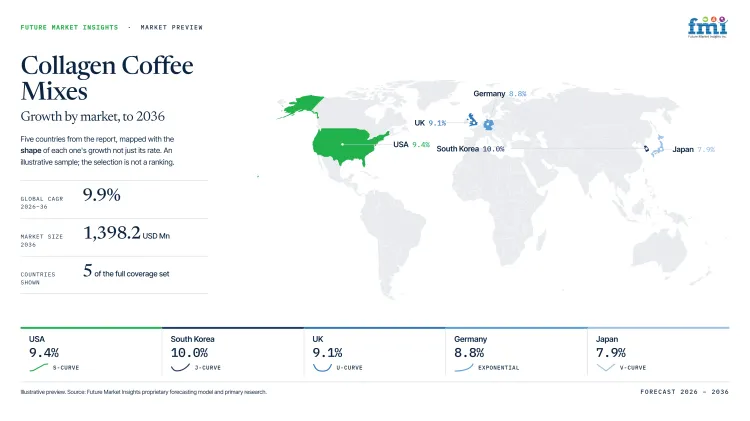
| Country | CAGR |
|---|---|
| USA | 9.4% |
| UK | 9.1% |
| Germany | 8.8% |
| Japan | 7.9% |
| South Korea | 10.0% |
How do country-level CAGRs compare in the Collagen Coffee Mixes Market?
The five assessed markets span 2.1 percentage points from South Korea at 10.0% to Japan at 7.9%. South Korea and USA form the upper growth band, separated by 0.6 percentage points. UK and Germany sit close together in the middle at 9.1% and 8.8%. Japan is a lower-growth outlier within this group and sits 0.9 percentage points below Germany. The differences are meaningful for launch pace, but they are not large enough to override execution conditions. Claim rules, channel access, and product fit can change the revenue outcome even when two countries have similar forecast rates.
- South Korea exceeds USA by 0.6 percentage points. Faster forecast growth raises the value of early label localization, especially as new nutrition-label requirements take effect in 2026.
- USA exceeds UK by 0.3 percentage points. The narrow gap means brand investment should be guided by channel economics and acceptable claim language rather than CAGR alone.
- UK exceeds Germany by 0.3 percentage points. Similar growth rates mask different entry work because Germany adds a supplement-notification step before first marketing.
- Germany exceeds Japan by 0.9 percentage points. Japan's slower rate still offers a structured functional-claims pathway, but evidence and notification choices can lengthen preparation.
CAGR does not establish absolute country market size. A slower-growing country can still represent a larger revenue pool if it begins from a higher base or has stronger retail penetration. Supplier decisions should therefore combine growth rate with category placement and regulatory effort. Consumer price tolerance and route-to-market economics also matter. The full regional coverage is designed to separate growth speed from addressable value so that expansion decisions are not based on one percentage alone.
Country-wise Analysis
- USA: Buyers can encounter collagen coffee products through grocery and health retail. Direct-to-consumer channels give brands another route-to-market model. Demand for Collagen Coffee Mixes in USA is forecast to expand at 9.4% CAGR from 2026 to 2036. In May 2026, the FDA reiterated that statements on food products must be truthful and not misleading, which keeps claim discipline central to launch execution. The friction is not product approval for ordinary foods; it is substantiation and clear classification when wellness language becomes prominent. Suppliers need coffee-specific sensory performance plus conservative claims that can survive retailer and regulatory review. (FDA, May 2026).
- UK: Packaged wellness products must fit a retail system where nutrition and health claims are tightly controlled, which makes label architecture an early commercial decision. Demand for Collagen Coffee Mixes in UK is forecast to rise at 9.1% CAGR from 2026 to 2036. The Great Britain Nutrition and Health Claims Register was updated on May 19, 2026, and only authorized claims may be used under the applicable framework. Suppliers should localize claims before shipment and avoid assuming that US-facing wellness language can move unchanged into British retail or DTC channels. (GOV.UK, May 2026).
- Germany: Market entry places more emphasis on notification and food-law compliance when a product is positioned as a supplement. Demand for Collagen Coffee Mixes in Germany is forecast to expand at 8.8% CAGR from 2026 to 2036. BVL states that food supplements must be notified in Germany, making documentation and local labeling part of launch preparation. Suppliers need German-language labels and a clear classification decision before commercial rollout. (BVL, January 2026).
- Japan: Suppliers must decide whether a coffee-collagen product uses general food positioning or enters the Foods with Function Claims pathway. Demand for Collagen Coffee Mixes in Japan is forecast to rise at 7.9% CAGR from 2026 to 2036. The Consumer Affairs Agency moved its Foods with Function Claims system to a new database on April 1, 2025, after changes to the framework increased attention to safety and evidence documentation. The friction is the preparation burden for substantiated functional positioning. Suppliers need localized evidence files, disciplined Japanese labeling, and product formats that justify the extra regulatory work through repeat purchase. (Consumer Affairs Agency, April 2025).
- South Korea: Packaged functional foods face increasingly detailed nutrition labels and claim wording. Demand for Collagen Coffee Mixes in South Korea is forecast to expand at 10.0% CAGR from 2026 to 2036. MFDS published a notice on February 28, 2025 describing nutrition-label changes that take effect on January 1, 2026. The notice includes additional information requirements for certain sugar-free or no-sugar products. The friction is label complexity when functional and low-sugar positioning are combined. Suppliers should build Korean labeling early and validate the evidence behind source, sugar, and nutrition claims before channel rollout. (MFDS, February 2025).
Who are the notable companies in the Collagen Coffee Mixes Market?
Vital Proteins (Nestle), Ancient Nutrition, Bulletproof, Laird Superfood, Primal Kitchen (Kraft Heinz), Sports Research, Orgain, Further Food, NeoCell and Garden of Life are notable companies active in the collagen coffee mixes market.
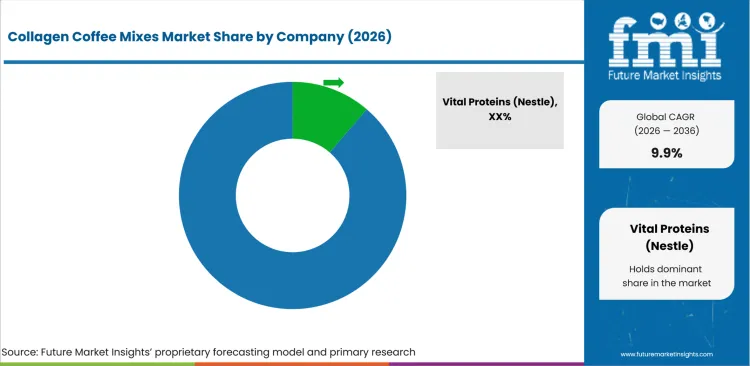
The competitive set is not uniform. Vital Proteins and Bulletproof place collagen directly into the coffee ritual through creamers or recipes. Primal Kitchen and Further Food also use flavored drink-mix positioning that can fit coffee. Ancient Nutrition, Sports Research, and Garden of Life compete more broadly through source architecture and collagen-platform breadth that can extend into coffee use. Orgain and NeoCell bring established nutrition or collagen powders that can be mixed into beverages.
- Coffee-Native Mix and Creamer Formats: Vital Proteins (Nestle), Bulletproof, Primal Kitchen (Kraft Heinz), and Further Food compete around direct coffee integration and sensory convenience.
- Multi-Source and Claims-Led Collagen Platforms: Ancient Nutrition, Sports Research, and Garden of Life emphasize sourcing narratives, collagen variety, and powder systems that can extend into coffee use.
- Scaled Nutrition and Functional-Ritual Platforms: Orgain, NeoCell, and Laird Superfood compete through nutrition reach or routine integration, with Laird serving as an adjacent coffee-format benchmark.
Competitive Benchmarking: Collagen Coffee Mixes Market
| Company | Coffee-Ritual Integration | Collagen Source & Claim Breadth | Format & Channel Flexibility | Geographic Reach |
|---|---|---|---|---|
| Vital Proteins (Nestle) | High | Medium | Medium | United States plus documented markets in Europe, Asia, and Latin America |
| Ancient Nutrition | Medium | High | High | United States with documented Canadian expansion |
| Bulletproof | High | Medium | Medium | Publicly documented USA and online channels |
| Laird Superfood | High | Unscored | High | United States DTC and wholesale channels |
| Primal Kitchen (Kraft Heinz) | High | Medium | Medium | Publicly documented USA retail and DTC channels |
| Sports Research | Unscored | High | Medium | Publicly documented USA DTC and retail channels |
| Orgain | Medium | Medium | High | Publicly documented USA retail and DTC channels |
| Further Food | High | Medium | Medium | Publicly documented USA DTC and specialty channels |
| NeoCell | Unscored | Medium | Medium | Publicly documented USA and online channels |
| Garden of Life | Medium | High | Medium | Publicly documented USA and selected international channels |
Scoring basis: Coffee-Ritual Integration measures documented coffee-specific products and creamers. It also considers recipes or beverage positioning. Collagen Source & Claim Breadth measures documented source diversity and relevant provenance claims. Format & Channel Flexibility measures evidence of multiple serving formats or materially different sales routes. High indicates broad documented capability against the criterion. Medium indicates credible but narrower capability. Low would indicate a documented limitation. Unavailable public information is left unscored rather than converted to Low.
Key Developments in the Collagen Coffee Mixes Market
- In January 2019, Kraft Heinz completed the acquisition of Primal Kitchen. The transaction placed the brand inside Kraft Heinz while retaining Primal Kitchen as a distinct portfolio platform. For collagen-coffee competition, the ownership change matters because Primal Kitchen's collagen drink mixes can sit within a much larger packaged-food organization with established retail relationships and commercialization capabilities. (Kraft Heinz, January 2019).
- In October 2021, Ancient Nutrition launched its Collagen Peptides line in unflavored and vanilla powders plus tablets. Retail distribution was planned across major natural and conventional chains. The formula combined fermented eggshell membrane collagen with grass-fed and pasture-raised bovine collagen. The launch expanded source and channel choice for a platform that can be extended into coffee use through powders or flavor-led formulations. (Ancient Nutrition, October 2021).
- In February 2022, Nestlé Health Science completed the final acquisition of Vital Proteins after taking a majority stake in 2020. Nestlé Health Science said the brand spanned supplements, beverages, and food products with an international footprint. The transaction placed a coffee-creamer collagen platform inside a global nutrition owner, increasing the resources available for channel expansion and product development without implying any numerical company share. (Nestlé Health Science, February 2022).
- In September 2024, Clorox completed the divestiture of its Better Health VMS business to an affiliate of Piping Rock Health Products. The transaction included NeoCell plus relevant trademarks and licenses. It also included associated manufacturing and distribution facilities in Sunrise, Florida. The ownership shift changed control of NeoCell's collagen platform and operating assets. Future format choices and sourcing decisions now sit with the new owner. (Clorox, September 2024).
Key Players in the Collagen Coffee Mixes Market
Coffee-Native Mix and Creamer Formats
- Vital Proteins (Nestle)
- Bulletproof
- Primal Kitchen (Kraft Heinz)
- Further Food
Multi-Source and Claims-Led Collagen Platforms
- Ancient Nutrition
- Sports Research
- Garden of Life
Scaled Nutrition and Functional-Ritual Platforms
- Orgain
- NeoCell
- Laird Superfood
Collagen Coffee Mixes Market - Report Scope
| Coverage field | Report scope |
|---|---|
| Market breakdown | Product Type, Collagen Source, Format, Claim, Sales Channel and Region. |
| Quantitative Units | USD million. |
| Market Definition | Revenue includes collagen-containing coffee mixes, collagen creamers, instant coffee plus collagen products, latte mixes, cold brew mixes and other products sold within the stated segmentation universe. Revenue excludes ready-to-drink finished coffee beverages, ordinary coffee or creamers without collagen, standalone collagen products not positioned for coffee use and downstream foodservice beverage revenue. |
| Regions Covered | North America, Latin America, Western Europe, Eastern Europe, East Asia, South Asia and Pacific, and Middle East and Africa. |
| Countries Covered | USA, UK, Germany, Japan and South Korea, with additional countries covered in the full report. |
| Companies Covered | Vital Proteins (Nestle), Ancient Nutrition, Bulletproof, Laird Superfood, Primal Kitchen (Kraft Heinz), Sports Research, Orgain, Further Food, NeoCell and Garden of Life. |
| Forecast Period | 2026 to 2036. |
| Approach | Hybrid bottom-up and top-down market sizing with revenue triangulation by product type, source, format, claim, sales channel, country and company presence. Adjacent categories are excluded from market revenue. |
Collagen Coffee Mixes Market - Research Methodology
| Method | Approach |
|---|---|
| Primary Research | FMI interviews and expert consultations focus on collagen ingredient suppliers, coffee and creamer formulators, distributors, retailers, e-commerce operators, end users, procurement stakeholders, and category specialists. Discussions test product boundaries, channel behavior, price architecture, purchasing criteria, and adoption frictions. |
| Desk Research | Review of regulatory guidance, public company filings, first-party product documentation, peer-reviewed literature, retailer evidence, and country-specific labeling or notification requirements. Sources are included only when they clarify the defined revenue boundary, buying mechanism, operating condition, or dated company action. |
| Market Sizing and Forecasting | Hybrid bottom-up and top-down estimation using product availability, price-volume relationships, channel mix, source and format mix, country growth signals, and company presence. Forecast assumptions reconcile product innovation and distribution expansion against claim, labeling, pricing, and repeat-purchase constraints. |
| Triangulation | Independent source types are compared against the market definition before final sizing. The process removes duplicate revenue, unsupported public claims, downstream finished-product revenue and adjacent products such as ordinary coffee, non-collagen creamers or collagen powders that are not positioned for coffee use. |
Collagen Coffee Mixes Market by Segments
Collagen Coffee Mixes Market segmented by Product Type:
- Collagen Creamers
- Instant Coffee + Collagen
- Latte Mixes
- Cold Brew Mixes
- Others
Collagen Coffee Mixes Market segmented by Collagen Source:
- Bovine
- Marine
- Chicken
- Others
Collagen Coffee Mixes Market segmented by Format:
- Canisters
- Stick Packs
- Pods
- Others
Collagen Coffee Mixes Market segmented by Claim:
- Grass-Fed
- Sugar-Free
- Keto-Friendly
- Others
Collagen Coffee Mixes Market segmented by Sales Channel:
- Supermarkets & Hypermarkets
- Online / DTC
- Convenience Stores
- Specialty & Health Stores
- Others
Collagen Coffee Mixes Market by Region:
- North America
- United States
- Canada
- Latin America
- Brazil
- Mexico
- Argentina
- Chile
- Western Europe
- Germany
- France
- United Kingdom
- Italy
- Spain
- Benelux
- Nordics
- Eastern Europe
- Poland
- Czech Republic
- Romania
- Hungary
- East Asia
- China
- Japan
- South Korea
- South Asia and Pacific
- India
- ASEAN
- Australia and New Zealand
- Middle East and Africa
- GCC Countries
- South Africa
- Türkiye
- Israel
Research Sources and Bibliography
- USA Food and Drug Administration (2026, May 4). Is It Really "FDA Approved"?.
- Federal Trade Commission (2022, December 20). Health Products Compliance Guidance.
- GOV.UK (2026, May 19). Great Britain nutrition and health claims (NHC) register.
- Federal Office of Consumer Protection and Food Safety (BVL) (2026, January 8). Modernisation of food-supplement notification procedures.
- Consumer Affairs Agency, Japan (2025, April 1). Renewal of the Foods with Function Claims system.
- Ministry of Food and Drug Safety, South Korea (2025, February 28). 2026 changes to the nutrition labeling system.
- Vital Proteins (2021, February 23). Coffee Creamer Fans: This Guide Was Made For You.
- Ancient Nutrition (2019, July 16). Ancient Nutrition Partners with Ulta Beauty to Release Re-Branded Multi-Collagen Protein Nationwide.
- Ancient Nutrition (2021, October 11). Ancient Nutrition Launches First Clinically Studied Collagen Peptides.
- Sports Research (2023, August 27). The 411 on Organic Collagen.
- Nestle Health Science (2022, February 21). Nestle Health Science Completes Acquisition of Vital Proteins.
- The Clorox Company (2024, September 10). Clorox Completes Previously Announced Divestiture of its Better Health VMS Business.
- The Kraft Heinz Company (2019, January 4). Kraft Heinz Completes Acquisition of Primal Kitchen.
- Laird Superfood, Inc. (2026, March 30). Annual Report on Form 10-K for the year ended December 31, 2025.
- Bulletproof (2025, May 24). Collagen Coffee Recipes.
This bibliography is provided for reader reference and is not exhaustive. The full report contains the complete reference list and detailed citations.
This Report Answers
- What is the current market scale and long-term growth outlook for collagen coffee mixes?
- Which coffee-consumption and wellness behaviors support demand for collagen coffee mixes?
- Why do Collagen Creamers lead the Product Type category?
- How does Bovine collagen influence formulation and sourcing decisions?
- Why do Canisters lead the Format category?
- How do country growth patterns differ across the major assessed markets?
- Which companies compete through coffee-native products or broader collagen platforms?
- How do claim substantiation and local labeling requirements constrain market entry?
- What should brand owners and retailers evaluate before launching collagen coffee mixes?
Frequently Asked Questions
What is driving growth in the Collagen Coffee Mixes Market?
Growth is supported by products that place collagen inside a familiar coffee routine, reducing the need for a separate supplement occasion. Repeat demand depends on taste and solubility; credible source claims and channel availability also matter.
Who are the key players in the Collagen Coffee Mixes Market?
Companies active in the market include Vital Proteins (Nestle); Ancient Nutrition; Bulletproof; Laird Superfood; Primal Kitchen (Kraft Heinz); Sports Research; Orgain; Further Food; NeoCell; and Garden of Life. Their roles differ across coffee-native formats, broader collagen platforms, and functional-coffee adjacency.
Why should executives track the Collagen Coffee Mixes Market?
The category links a repeat beverage occasion with functional nutrition, so it can influence coffee and creamer portfolios as well as supplements. Executives should track whether coffee-native formats convert consumer interest into repeat purchase without excessive claim or formulation complexity.
What business problem does the Collagen Coffee Mixes Market address?
The market addresses the friction of maintaining a collagen routine as a separate daily task by integrating it into coffee preparation. Successful products also solve sensory problems such as clumping, thin texture, or unwanted flavor that can undermine repeat use.
What should brand owners and retailers evaluate in the Collagen Coffee Mixes Market?
They should evaluate collagen source and dispersibility alongside flavor performance, serving format, and claim support. They also need to test coffee-merchandising fit and price per serving once the product replaces both a creamer and a collagen supplement.
What limits return on investment in the Collagen Coffee Mixes Market?
Return can be diluted when a premium product wins trial but fails to earn repeat purchase because of taste, mixing behavior, or price. Localization costs also rise when labels and claims change across countries, especially when packaging or importer requirements differ.
What supports long-term commercial confidence in the Collagen Coffee Mixes Market?
Confidence comes from the durability of the coffee occasion and from repeated supplier efforts to make collagen easier to mix into everyday beverages. Long-term value still depends on compliant claims, differentiated sensory performance, and channel economics that support repeat purchase at scale.
Preview the report firsthand - request a free sample
Get SampleGet the brochure for pricing and purchase details.
Get PDFTable of Content
- Key Takeaways
- Market Size and CAGR
- Top Growth Driver
- Fastest Growing Segment
- Leading Region
- Key Companies
- Emerging Opportunities
- Executive Summary
- Global Market Outlook
- Demand-side Trends
- Supply-side Trends
- Technology Roadmap Analysis
- Analysis and Recommendations
- Analyst Perspective (What is happening? Why now? What should investors know?)
- Key Questions Answered
- How large is the market?
- What is the CAGR?
- What are key trends?
- Which region dominates?
- Who are the leaders?
- Market Overview
- Market Coverage / Taxonomy
- Market Definition / Scope / Limitations
- Research Methodology
- Chapter Orientation
- Analytical Lens and Working Hypotheses
- Market Structure, Signals, and Trend Drivers
- Benchmarking and Cross-market Comparability
- Market Sizing, Forecasting, and Opportunity Mapping
- Research Design and Evidence Framework
- Desk Research Programme (Secondary Evidence)
- Expert Input and Fieldwork (Primary Evidence)
- Tooling, Models, and Reference Databases
- Data Engineering and Model Build
- Quality Assurance and Audit Trail
- Market Background
- Market Dynamics (Drivers, Restraints, Opportunity, Trends)
- Scenario Forecast (Optimistic, Likely, Conservative)
- Impact Analysis
- AI Impact
- Sustainability Impact
- Regulatory Impact
- Technology Impact
- Consumer / Buyer Analysis
- Purchase Drivers
- Adoption Barriers
- Buyer Journey
- Opportunity Map Analysis
- Product Life Cycle Analysis
- Supply Chain Analysis
- Investment Feasibility Matrix
- Value Chain Analysis
- PESTLE and Porter's Analysis
- Regulatory Landscape
- Regional Parent Market Outlook
- Production and Consumption Statistics
- Import and Export Statistics
- Global Market Analysis and Forecast, 2021 to 2036
- Historical Market Size Value (USD Million) Analysis, 2021 to 2025
- Current and Future Market Size Value (USD Million) Projections, 2026 to 2036
- Y-o-Y Growth Trend Analysis
- Absolute $ Opportunity Analysis
- Global Market Pricing Analysis, 2021 to 2036
- Global Market Analysis and Forecast, By Product Type, 2021 to 2036
- Introduction / Key Findings
- Historical Market Size Value (USD Million) Analysis By Product Type, 2021 to 2025
- Current and Future Market Size Value (USD Million) Analysis and Forecast By Product Type, 2026 to 2036
- Collagen Creamers
- Instant Coffee + Collagen
- Latte Mixes
- Cold Brew Mixes
- Others
- Collagen Creamers
- Y-o-Y Growth Trend Analysis By Product Type, 2021 to 2025
- Absolute $ Opportunity Analysis By Product Type, 2026 to 2036
- Global Market Analysis and Forecast, By Collagen Source, 2021 to 2036
- Introduction / Key Findings
- Historical Market Size Value (USD Million) Analysis By Collagen Source, 2021 to 2025
- Current and Future Market Size Value (USD Million) Analysis and Forecast By Collagen Source, 2026 to 2036
- Bovine
- Marine
- Chicken
- Others
- Bovine
- Y-o-Y Growth Trend Analysis By Collagen Source, 2021 to 2025
- Absolute $ Opportunity Analysis By Collagen Source, 2026 to 2036
- Global Market Analysis and Forecast, By Format, 2021 to 2036
- Introduction / Key Findings
- Historical Market Size Value (USD Million) Analysis By Format, 2021 to 2025
- Current and Future Market Size Value (USD Million) Analysis and Forecast By Format, 2026 to 2036
- Canisters
- Stick Packs
- Pods
- Others
- Canisters
- Y-o-Y Growth Trend Analysis By Format, 2021 to 2025
- Absolute $ Opportunity Analysis By Format, 2026 to 2036
- Global Market Analysis and Forecast, By Claim, 2021 to 2036
- Introduction / Key Findings
- Historical Market Size Value (USD Million) Analysis By Claim, 2021 to 2025
- Current and Future Market Size Value (USD Million) Analysis and Forecast By Claim, 2026 to 2036
- Grass-Fed
- Sugar-Free
- Keto-Friendly
- Others
- Grass-Fed
- Y-o-Y Growth Trend Analysis By Claim, 2021 to 2025
- Absolute $ Opportunity Analysis By Claim, 2026 to 2036
- Global Market Analysis and Forecast, By Sales Channel, 2021 to 2036
- Introduction / Key Findings
- Historical Market Size Value (USD Million) Analysis By Sales Channel, 2021 to 2025
- Current and Future Market Size Value (USD Million) Analysis and Forecast By Sales Channel, 2026 to 2036
- Supermarkets & Hypermarkets
- Online / DTC
- Convenience Stores
- Specialty & Health Stores
- Others
- Supermarkets & Hypermarkets
- Y-o-Y Growth Trend Analysis By Sales Channel, 2021 to 2025
- Absolute $ Opportunity Analysis By Sales Channel, 2026 to 2036
- Global Market Analysis and Forecast, By Region, 2021 to 2036
- Introduction
- Historical Market Size Value (USD Million) Analysis By Region, 2021 to 2025
- Current Market Size Value (USD Million) Analysis and Forecast By Region, 2026 to 2036
- North America
- Latin America
- Western Europe
- Eastern Europe
- East Asia
- South Asia and Pacific
- Middle East & Africa
- Market Attractiveness Analysis By Region
- North America Market Analysis and Forecast, By Country, 2021 to 2036
- Historical Market Size Value (USD Million) Trend Analysis By Market Taxonomy, 2021 to 2025
- Market Size Value (USD Million) Forecast By Market Taxonomy, 2026 to 2036
- By Country
- USA
- Canada
- By Product Type
- By Collagen Source
- By Format
- By Claim
- By Sales Channel
- By Country
- Market Attractiveness Analysis
- By Country
- By Product Type
- By Collagen Source
- By Format
- By Claim
- By Sales Channel
- Key Takeaways
- Latin America Market Analysis and Forecast, By Country
- Historical Market Size Value (USD Million) Trend Analysis By Market Taxonomy, 2021 to 2025
- Market Size Value (USD Million) Forecast By Market Taxonomy, 2026 to 2036
- By Country
- Brazil
- Mexico
- Chile
- Rest of Latin America
- By Product Type
- By Collagen Source
- By Format
- By Claim
- By Sales Channel
- By Country
- Market Attractiveness Analysis
- By Country
- By Product Type
- By Collagen Source
- By Format
- By Claim
- By Sales Channel
- Key Takeaways
- Western Europe Market Analysis and Forecast, By Country
- Historical Market Size Value (USD Million) Trend Analysis By Market Taxonomy, 2021 to 2025
- Market Size Value (USD Million) Forecast By Market Taxonomy, 2026 to 2036
- By Country
- Germany
- UK
- Italy
- Spain
- France
- Nordic
- BENELUX
- Rest of Western Europe
- By Product Type
- By Collagen Source
- By Format
- By Claim
- By Sales Channel
- By Country
- Market Attractiveness Analysis
- By Country
- By Product Type
- By Collagen Source
- By Format
- By Claim
- By Sales Channel
- Key Takeaways
- Eastern Europe Market Analysis and Forecast, By Country
- Historical Market Size Value (USD Million) Trend Analysis By Market Taxonomy, 2021 to 2025
- Market Size Value (USD Million) Forecast By Market Taxonomy, 2026 to 2036
- By Country
- Russia
- Poland
- Hungary
- Balkan & Baltic
- Rest of Eastern Europe
- By Product Type
- By Collagen Source
- By Format
- By Claim
- By Sales Channel
- By Country
- Market Attractiveness Analysis
- By Country
- By Product Type
- By Collagen Source
- By Format
- By Claim
- By Sales Channel
- Key Takeaways
- East Asia Market Analysis and Forecast, By Country
- Historical Market Size Value (USD Million) Trend Analysis By Market Taxonomy, 2021 to 2025
- Market Size Value (USD Million) Forecast By Market Taxonomy, 2026 to 2036
- By Country
- China
- Japan
- South Korea
- By Product Type
- By Collagen Source
- By Format
- By Claim
- By Sales Channel
- By Country
- Market Attractiveness Analysis
- By Country
- By Product Type
- By Collagen Source
- By Format
- By Claim
- By Sales Channel
- Key Takeaways
- South Asia and Pacific Market Analysis and Forecast, By Country
- Historical Market Size Value (USD Million) Trend Analysis By Market Taxonomy, 2021 to 2025
- Market Size Value (USD Million) Forecast By Market Taxonomy, 2026 to 2036
- By Country
- India
- ASEAN
- Australia & New Zealand
- Rest of South Asia and Pacific
- By Product Type
- By Collagen Source
- By Format
- By Claim
- By Sales Channel
- By Country
- Market Attractiveness Analysis
- By Country
- By Product Type
- By Collagen Source
- By Format
- By Claim
- By Sales Channel
- Key Takeaways
- Middle East & Africa Market Analysis and Forecast, By Country
- Historical Market Size Value (USD Million) Trend Analysis By Market Taxonomy, 2021 to 2025
- Market Size Value (USD Million) Forecast By Market Taxonomy, 2026 to 2036
- By Country
- Kingdom of Saudi Arabia
- Other GCC Countries
- Türkiye
- South Africa
- Other African Union
- Rest of Middle East & Africa
- By Product Type
- By Collagen Source
- By Format
- By Claim
- By Sales Channel
- By Country
- Market Attractiveness Analysis
- By Country
- By Product Type
- By Collagen Source
- By Format
- By Claim
- By Sales Channel
- Key Takeaways
- Key Countries Market Analysis
- USA
- Pricing Analysis
- Market Share Analysis, 2025
- By Product Type
- By Collagen Source
- By Format
- By Claim
- By Sales Channel
- Canada
- Pricing Analysis
- Market Share Analysis, 2025
- By Product Type
- By Collagen Source
- By Format
- By Claim
- By Sales Channel
- Mexico
- Pricing Analysis
- Market Share Analysis, 2025
- By Product Type
- By Collagen Source
- By Format
- By Claim
- By Sales Channel
- Brazil
- Pricing Analysis
- Market Share Analysis, 2025
- By Product Type
- By Collagen Source
- By Format
- By Claim
- By Sales Channel
- Chile
- Pricing Analysis
- Market Share Analysis, 2025
- By Product Type
- By Collagen Source
- By Format
- By Claim
- By Sales Channel
- Germany
- Pricing Analysis
- Market Share Analysis, 2025
- By Product Type
- By Collagen Source
- By Format
- By Claim
- By Sales Channel
- UK
- Pricing Analysis
- Market Share Analysis, 2025
- By Product Type
- By Collagen Source
- By Format
- By Claim
- By Sales Channel
- Italy
- Pricing Analysis
- Market Share Analysis, 2025
- By Product Type
- By Collagen Source
- By Format
- By Claim
- By Sales Channel
- Spain
- Pricing Analysis
- Market Share Analysis, 2025
- By Product Type
- By Collagen Source
- By Format
- By Claim
- By Sales Channel
- France
- Pricing Analysis
- Market Share Analysis, 2025
- By Product Type
- By Collagen Source
- By Format
- By Claim
- By Sales Channel
- India
- Pricing Analysis
- Market Share Analysis, 2025
- By Product Type
- By Collagen Source
- By Format
- By Claim
- By Sales Channel
- ASEAN
- Pricing Analysis
- Market Share Analysis, 2025
- By Product Type
- By Collagen Source
- By Format
- By Claim
- By Sales Channel
- Australia & New Zealand
- Pricing Analysis
- Market Share Analysis, 2025
- By Product Type
- By Collagen Source
- By Format
- By Claim
- By Sales Channel
- China
- Pricing Analysis
- Market Share Analysis, 2025
- By Product Type
- By Collagen Source
- By Format
- By Claim
- By Sales Channel
- Japan
- Pricing Analysis
- Market Share Analysis, 2025
- By Product Type
- By Collagen Source
- By Format
- By Claim
- By Sales Channel
- South Korea
- Pricing Analysis
- Market Share Analysis, 2025
- By Product Type
- By Collagen Source
- By Format
- By Claim
- By Sales Channel
- Russia
- Pricing Analysis
- Market Share Analysis, 2025
- By Product Type
- By Collagen Source
- By Format
- By Claim
- By Sales Channel
- Poland
- Pricing Analysis
- Market Share Analysis, 2025
- By Product Type
- By Collagen Source
- By Format
- By Claim
- By Sales Channel
- Hungary
- Pricing Analysis
- Market Share Analysis, 2025
- By Product Type
- By Collagen Source
- By Format
- By Claim
- By Sales Channel
- Kingdom of Saudi Arabia
- Pricing Analysis
- Market Share Analysis, 2025
- By Product Type
- By Collagen Source
- By Format
- By Claim
- By Sales Channel
- Türkiye
- Pricing Analysis
- Market Share Analysis, 2025
- By Product Type
- By Collagen Source
- By Format
- By Claim
- By Sales Channel
- South Africa
- Pricing Analysis
- Market Share Analysis, 2025
- By Product Type
- By Collagen Source
- By Format
- By Claim
- By Sales Channel
- USA
- Market Structure Analysis
- Competition Dashboard
- Competition Benchmarking
- Market Share Analysis of Top Players
- By Regional
- By Product Type
- By Collagen Source
- By Format
- By Claim
- By Sales Channel
- Emerging Startups
- Innovation Benchmarking
- Competition Analysis
- Competition Deep Dive
- Vital Proteins (Nestle)
- Overview
- Product Portfolio
- Profitability by Market Segments
- Sales Footprint
- Strategy Overview
- Marketing Strategy
- Product Strategy
- Channel Strategy
- Ancient Nutrition
- Bulletproof
- Laird Superfood
- Primal Kitchen (Kraft Heinz)
- Sports Research
- Orgain
- Further Food
- NeoCell
- Garden of Life
- Vital Proteins (Nestle)
- Case Studies
- Success Stories
- Recent Developments
- Competition Deep Dive
- Assumptions & Acronyms Used


