

- Market Size (2026)
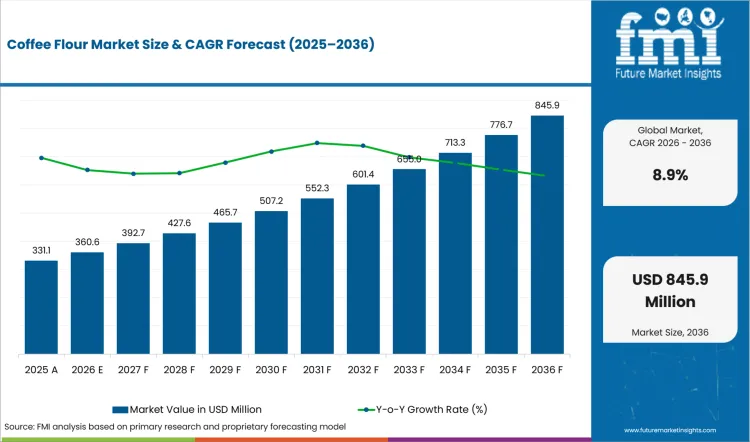
- USD 360.6 Mn
- Forecast (2036)
- USD 845.9 Mn
- CAGR (2026 to 2036)
- 8.9%
How big is Coffee Flour Market in 2026?
USD 360.6 million in 2026 and USD 845.9 million by 2036 at an 8.9% CAGR.
Demand for coffee flour is projected to expand at an 8.9% CAGR between 2026 and 2036, increasing valuation from USD 360.6 million in 2026 to USD 845.9 million by 2036. Food manufacturers need evidence that coffee-pulp flour works across multiple recipes before they broaden purchases. The Center for Circular Economy in Coffee documented coffee-pulp flour across 21 Colombian recipes in April 2025, giving upcycled food products several tested application routes. The same qualification work helps dietary fibres users compare texture and dose across repeated production batches.
Country economics separate origin markets from mature consuming markets as feedstock and qualification costs occur at different stages. USDA projected Brazil's 2026/27 coffee crop at a record 71.9 million 60-kilogram bags in July 2026, reinforcing the scale available for origin-side side-stream recovery. Mature-market developers need functional flours with documented safety before imported by-product material can enter recurring food production. Commercial adoption also depends on bakery ingredients support that defines workable inclusion rates and sensory limits for finished foods.
Key Takeaways of Coffee Flour Market
- Coffee flour demand is supported by processors converting stabilized coffee pulp or spent grounds into qualified food ingredients for recurring manufacturing use.
- Based on source, coffee cherry pulp / cascara is projected to account for 44.0% in 2026 due to concentrated origin-side feedstock availability.
- The fine flour segment is likely to capture 38.0% share in 2026 attributable to controlled dispersion across blended recipes and familiar mixing equipment.
- The nature category is forecast to be led by conventional supply at 58.0% share in 2026 due to broader feedstock access during initial commercial qualification.
- Variable caffeine levels and sensory effects increase formulation work during manufacturer qualification for recurring coffee-derived flour production schedules.
- Kaffe Bueno ApS, FOODTEMPLUM Scientific & Production Company, Coffee Resurrect Inc. and Groundup Eco-Ventures Ltd. represent coffee-flour or coffee-powder routes. ofi (Olam Food Ingredients), Connecting Grounds ApS, The Kawa Project Inc. and PectCof B.V. complete the eight-company profiled set.
Analyst Perspective
"Coffee flour earns repeat orders once food manufacturers can compare feedstock identity, microbiological controls and workable inclusion rates across batches. Strong offers pair a powder specification with bakery or formulation data that reduces repeated trials without hiding caffeine and sensory limits."
- Nandini Roy Choudhury, Principal Consultant, Future Market Insights
How is the Coffee Flour Market segmented?
The coffee flour market is segmented by source, form, nature, application, end use and region.
Source covers coffee cherry pulp / cascara, coffee grounds, green coffee beans and defatted coffee residue. Form covers fine flour, coarse powder, instant / soluble powder and blended flour mixes. Nature covers conventional, organic and upcycled / sustainability-certified supply. Applications include bakery, snacks & bars, beverages, chocolate & confectionery and nutritional products. End use covers food manufacturers, bakery / foodservice, retail consumers and ingredient blenders.
Why does coffee cherry pulp / cascara lead demand within the source category?
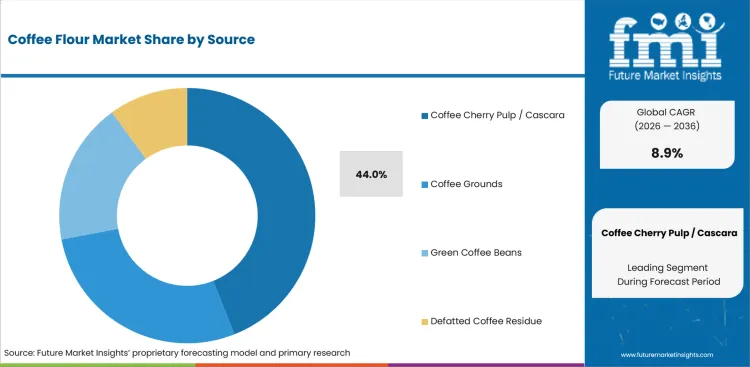
Coffee cherry pulp reaches the flour process immediately after depulping, so rapid stabilization decides whether processors retain food-grade material or lose it to spoilage. The Antioquia project reported in April 2025 that a 36-hour closed-tent drying period delivered its best microbiological control during harvest and gave mills a practical flour-preparation benchmark.
- By source, coffee cherry pulp / cascara is estimated to hold 44.0% in 2026 owing to concentrated feedstock availability near wet-processing operations.
- Origin processors need drying records and contamination controls that keep coffee-pulp powder suitable as a dietary fiber ingredient across repeated manufacturer qualification cycles and changing harvest conditions.
Why does fine flour lead demand within the form category?
Fine flour fits industrial blending as smaller particles distribute more evenly across bakery mixes and nutritional formulations. Manufacturers can test the ingredient on familiar dosing equipment without redesigning normal scale-up workflows.
- By form, fine flour is forecast to represent 38.0% in 2026 driven by controlled dispersion across blended recipes and familiar mixing equipment.
- Fine coffee particles can obstruct grinders and disrupt repeatable milling for gluten-free flours in commercial production. The Center for Circular Economy in Coffee reported in April 2025 that Connecting Grounds particles near 500 micrometers could stick inside grinders. Milling specifications therefore matter as coffee powder enters bean flour systems at production scale.
Why does bakery lead demand within the application category?
Bakery gives formulators a controlled setting for comparing coffee-derived flour against dough handling, product volume and sensory performance during familiar production trials. The Antioquia project documented in April 2025 that bakery recipes used eight to twelve grams of coffee-pulp flour per serving and provided a tested starting point for commercial recipe development.
- Bakery is projected to hold 32.0% share in 2026 owing to partial substitution fitting established commercial trial routines consistently.
- Commercial bakers using home baking ingredients need inclusion guidance that protects texture and flavor as coffee-derived powder moves from development samples into recurring production schedules at commercial scale.
Why do food manufacturers lead demand within the end use category?
Food manufacturers can spread qualification costs across larger production runs and several product lines. That scale gives technical teams more room to test microbiological limits, flavor effects and labeling requirements before recurring purchases.
- In 2026, food manufacturers are expected to lead end use with 38.0% share because their technical teams can validate specifications for recurring purchases.
- Application teams need evidence that one approved ingredient specification performs reliably across repeated batches. Connecting Grounds reported in April 2025 that Coffee Base could replace up to 15% of baked-product ingredient volume and gave food manufacturers a measurable scale-up starting point.
What are the drivers, restraints and opportunities in the Coffee Flour Market?
Coffee side-stream recovery expands supply while formulation control limits adoption and origin-side standardization offers the clearest commercial route.
- Driver: Processors recover more value as stabilized coffee pulp or grounds enter qualified food formulations instead of lower-value disposal routes.
- Restraint: Caffeine content and sensory variation increase testing requirements during coffee-derived flour qualification for recurring manufacturing schedules.
- Opportunity: Ingredient developers that stabilize feedstock near collection points can reduce deterioration and provide application-ready specifications to food manufacturers.
Food-Grade Recovery Raises the Value of Coffee Side Streams
Coffee processors can sell recovered pulp as a food ingredient once drying and contamination controls produce a specification manufacturers can repeat. The 44% dietary-fiber content measured by the Antioquia project in April 2025 gives formulation teams a concrete reason to test coffee-pulp flour beyond food waste management goals. Recurring orders then depend on consistent safety records and recipe performance across successive production batches instead of feedstock availability alone.
Caffeine and Sensory Variation Extend Qualification Work
Coffee flour chemistry can narrow workable inclusion rates as caffeine and flavor intensity shift with feedstock or processing conditions. Formulation teams need composition data before setting dose limits that protect taste and intended caffeine intake in commercial recipes. The Antioquia project measured 1.76 grams of caffeine per 100 grams of coffee-pulp flour in April 2025 and established a practical basis for dose guidance.
Origin-Side Control Improves Supply Reliability
Origin-side collection determines how much wet coffee residue reaches controlled processing while spoilage and contamination remain manageable. Short pickup intervals give processors a more predictable starting material and reduce variability entering drying or milling. Connecting Grounds documented a three-day spent-ground collection cycle in April 2025, linking route density with reliable Coffee Base production for products from food waste developers.
Which country CAGRs are profiled in the Coffee Flour Market?
| Country | CAGR |
|---|---|
| Vietnam | 9.8% |
| Brazil | 9.6% |
| Colombia | 9.4% |
| United States | 8.0% |
| United Kingdom | 7.9% |
How do country-level CAGRs compare in the Coffee Flour Market?
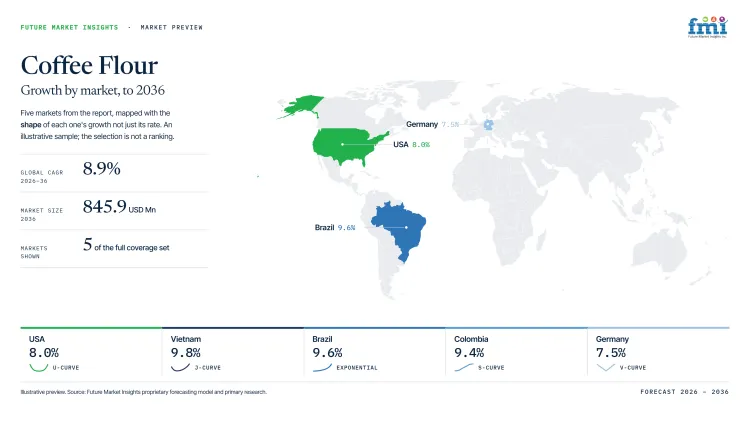
The 1.9 percentage-point range across the five profiled forecasts forms a narrow split between producing and consuming markets. Vietnam, Brazil and Colombia cluster above the two mature consuming markets as origin-side processing shortens recovery routes. United States and United Kingdom growth depends more on collection efficiency and formal ingredient qualification.
- Vietnam pairs robusta processing with shorter recovery routes for coffee side streams.
- Brazil combines origin scale with seasonal drying needs shaping recoverable pulp quality.
- Colombia uses cooperative networks as rainfall variability complicates pulp recovery across harvests.
- United States activity depends on dense collection routes and reliable food-grade stabilization.
- United Kingdom adoption faces regulatory checks for unfamiliar commercial coffee-derived food ingredients.
Similar CAGRs therefore mask different conversion costs across collection, stabilization and formal ingredient qualification routes.
The full report provides country-level CAGR analysis across North America, Latin America, Europe, East Asia, South Asia, Oceania and the Middle East and Africa.
Country-wise Analysis
- Vietnamese robusta mills concentrate coffee processing near existing drying infrastructure, giving coffee pulp and husks a shorter route to stabilization and leaving food-grade flour subject to separate hygiene and milling controls. Adoption of coffee flour in Vietnam is estimated to expand at a 9.8% CAGR through 2036, aided by origin-side residue availability and domestic food-processing capacity that can qualify recovered ingredients. Vietnam's Department of Information and Statistics reported in May 2025 that cascara exceeds 60% of fresh coffee-fruit mass and can enter a bottled food product, confirming a food-use route while flour orders depend on controlled drying and contamination testing.
- Brazilian coffee mills handle large origin volumes close to wet-processing sites, making rapid separation and drying practical while seasonal moisture and mixed residues can reduce food-grade consistency across major producing states and export corridors during routine commercial flour recovery programs. By 2036, Brazil is projected to grow at a 9.6% CAGR supported by concentrated side-stream supply that shortens collection routes for domestic manufacturers and export-oriented ingredient developers. Anvisa reported in June 2025 that recalled beverage powders contained coffee husks or residues alongside contamination failures, making traceable separation and hygiene controls necessary before recovered coffee material can enter qualified flour supply.
- Colombian cooperatives link growers with shared wet-processing and training routes, allowing coffee pulp to be dried near farms as independent producers maintain microbiological controls for reliable food-grade flour across dispersed mountain production areas nationwide each harvest season. Colombia is estimated to post a 9.4% CAGR over the forecast period driven by producer interest in retaining more value near origin with stabilized coffee-pulp ingredients for local food applications. The Center for Circular Economy in Coffee reported in April 2025 that some Antioquia participants had begun commercializing coffee-pulp flour, but wider orders depend on certification and repeatable controls across separate farm operations.
- United States food developers can collect spent coffee grounds from dense commercial brewing networks, but dispersed pickup points require controlled storage and predictable collection schedules before recovered material can enter food-grade powder production. Coffee flour demand in the United States is forecast to rise at an 8.0% CAGR over the forecast period as bakery and confectionery developers evaluate recovered coffee powders inside established pilot programs. The Center for Circular Economy in Coffee reported in April 2025 that The Kawa Project Inc. ran pilots with large confectionery companies, giving developers a direct application route while recurring purchases require consistent collection and manufacturing controls.
- United Kingdom bakery and ingredient companies operate inside mature food channels, so unfamiliar coffee-derived powders need clear legal status and technical dossiers before manufacturers can use them in routine commercial formulations. Coffee flour sales in the United Kingdom are forecast to expand at a 7.9% CAGR by 2036 owing to interest in upcycled ingredients across bakery channels despite imported supply and qualification costs. The Food Standards Agency novel-food register was updated on 31 March 2026 and remains the public authorization record for Great Britain, which gives novel coffee-derived ingredients a defined access route while each product requires its own regulatory assessment.
Who are the notable companies in the Coffee Flour Market?
Kaffe Bueno ApS, FOODTEMPLUM Scientific & Production Company, Coffee Resurrect Inc., Groundup Eco-Ventures Ltd., ofi (Olam Food Ingredients), Connecting Grounds ApS, The Kawa Project Inc. and PectCof B.V. are the notable companies profiled in this market.
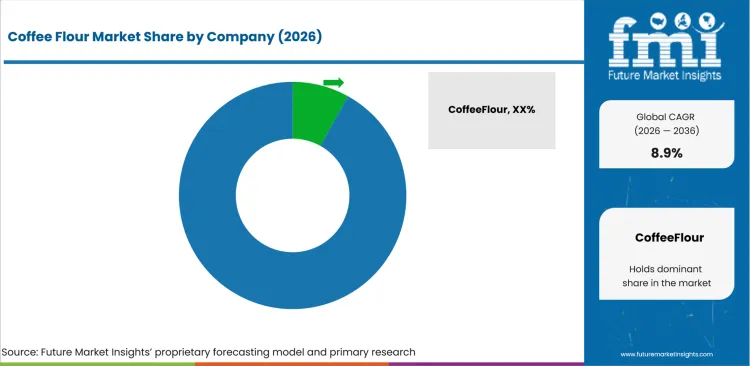
Coffee flour competition remains fragmented between coffee-fruit powder developers and spent-ground processors. Entry depends on food-safety records, repeatable milling and application data needed for recurring production orders.
- FOODTEMPLUM Scientific & Production Company and Coffee Resurrect Inc. document spent-ground flour routes, while Groundup Eco-Ventures Ltd. has coffee-flour development evidence for baking applications.
- Connecting Grounds ApS and The Kawa Project Inc. use spent grounds in food powders, while Kaffe Bueno ApS operates a coffee-biorefinery route.
- ofi (Olam Food Ingredients) supplies coffee-fruit powder, while PectCof B.V. develops coffee-pulp dietary fiber adjacent to milled-flour formats.
Competitive Benchmarking: Coffee Flour Market
| Company | Coffee Feedstock Coverage | Food-grade Flour / Powder Commercialization | Formulation & Scale-up Support | Geographic Reach |
|---|---|---|---|---|
| Kaffe Bueno ApS | Medium | Medium | Medium | Denmark and Europe |
| FOODTEMPLUM Scientific & Production Company | Medium | High | High | Ukraine, Europe and United Kingdom |
| Coffee Resurrect Inc. | Medium | High | Medium | Ethiopia |
| Groundup Eco-Ventures Ltd. | Medium | Medium | High | Canada |
| ofi (Olam Food Ingredients) | Medium | Medium | High | Global coffee sourcing and food ingredient network |
| Connecting Grounds ApS | Medium | High | Medium | Denmark |
| The Kawa Project Inc. | Medium | Medium | Medium | United States |
| PectCof B.V. | Medium | Medium | High | Netherlands and Europe |
Key Developments in the Coffee Flour Market
- In June 2026, ofi (Olam Food Ingredients) documented KOFEFRUT soluble cascara powder sourcing across six origins and a standardized route into food and beverage applications.
- In January 2026, PectCof B.V. reported a positive EFSA scientific opinion for coffee-fruit-pulp Dutch Gum and advanced its European food-access pathway without completing authorization.
- In November 2025, The Kawa Project Inc. won Bühler's New Chocolate Challenge with a cocoa alternative made from upcycled coffee grounds and entered industry-led scale-up work.
Key Players in the Coffee Flour Market
Direct Coffee-Flour Platforms
- FOODTEMPLUM Scientific & Production Company
- Coffee Resurrect Inc.
- Groundup Eco-Ventures Ltd.
Spent-Ground Food Powder Platforms
- Connecting Grounds ApS
- The Kawa Project Inc.
- Kaffe Bueno ApS
Coffee-Fruit Powder Platforms
- ofi (Olam Food Ingredients)
- PectCof B.V.
Coffee Flour Market - Report Scope
| Coverage field | Report scope |
|---|---|
| Market breakdown | By source, form, nature, application, end use and region. |
| Quantitative Units | Revenue in USD million and CAGR in %. |
| Market Definition | Revenue includes coffee-derived flour and powder ingredients made from coffee cherry pulp / cascara, coffee grounds, green coffee beans and defatted coffee residue. Finished foods and unrelated extracts or oils remain outside scope unless sold as a coffee-flour or powder ingredient. |
| Regions Covered | North America, Latin America, Europe, East Asia, South Asia and Pacific, and Middle East and Africa. |
| Countries Covered | Vietnam, Brazil, Colombia, United States, United Kingdom, and 20+ countries included in the full report. |
| Key Companies Profiled | Kaffe Bueno ApS, FOODTEMPLUM Scientific & Production Company, Coffee Resurrect Inc., Groundup Eco-Ventures Ltd., ofi (Olam Food Ingredients), Connecting Grounds ApS, The Kawa Project Inc., and PectCof B.V. |
| Forecast Period | 2026 to 2036. |
| Approach | Primary and secondary research with market triangulation. |
Coffee Flour Market - Research Methodology
| Method | Approach |
|---|---|
| Primary Research | FMI analysts gathered input from manufacturers, service providers, technology developers, distributors, end users, procurement teams, and subject-matter experts. Interviews examined purchasing decisions, product or service evaluation, adoption barriers, approval requirements, pricing considerations, and expectations for technical or commercial support. Respondents were also asked what evidence is required before a trial, pilot, or initial order develops into regular purchasing. |
| Desk Research | Desk research covered government statistics, regulatory publications, trade data, industry associations, technical literature, standards, company filings, product information, and official corporate announcements. Sources were reviewed for relevance, publication date, geographic coverage, and consistency with the defined market scope. Claims relating to performance, applications, approvals, capacity, investment, and commercial activity were retained only when supported by credible public evidence. |
| Market Sizing and Forecasting | The market model combined the baseline value with historical performance, segment structure, pricing and volume indicators, adoption levels, company participation, and country-level demand conditions. Forecast assumptions considered economic activity, investment trends, regulatory developments, technology adoption, purchasing cycles, supply availability, and barriers to wider market use. Segment and regional estimates were reconciled before the final market total was calculated. |
| Data Validation | Estimates were checked against multiple independent indicators, including public data, company activity, trade patterns, industry developments, and findings from primary interviews. Validation also tested whether products, services, applications, and company revenues fell within the defined market boundaries. Adjacent categories, unsupported claims, overlapping revenues, and activities without direct market relevance were excluded to reduce double counting and maintain consistency across segments and countries. |
Coffee Flour Market by Segments
Coffee Flour Market segmented by Source:
- Coffee Cherry Pulp / Cascara
- Coffee Grounds
- Green Coffee Beans
- Defatted Coffee Residue
Coffee Flour Market segmented by Form:
- Fine Flour
- Coarse Powder
- Instant / Soluble Powder
- Blended Flour Mixes
Coffee Flour Market segmented by Nature:
- Conventional
- Organic
- Upcycled / Sustainability-certified
Coffee Flour Market segmented by Application:
- Bakery
- Snacks & Bars
- Beverages
- Chocolate & Confectionery
- Nutritional Products
Coffee Flour Market segmented by End Use:
- Food Manufacturers
- Bakery / Foodservice
- Retail Consumers
- Ingredient Blenders
Coffee Flour Market by Region:
- North America
- United States
- Canada
- Latin America
- Brazil
- Mexico
- Chile
- Rest of Latin America
- Western Europe
- Germany
- United Kingdom
- Italy
- Spain
- France
- Nordics
- Benelux
- Rest of Western Europe
- Eastern Europe
- Russia
- Poland
- Hungary
- Balkan and Baltic States
- Rest of Eastern Europe
- East Asia
- China
- Japan
- South Korea
- South Asia and Pacific
- India
- ASEAN
- Australia and New Zealand
- Rest of South Asia and Pacific
- Middle East and Africa
- Kingdom of Saudi Arabia
- Other GCC Countries
- Türkiye
- South Africa
- Other African Union Countries
- Rest of Middle East and Africa
Research Sources and Bibliography
- Center for Circular Economy in Coffee. (2025, April 1). Coffee pulp flour as ingredient in traditional food of coffee growers - a project for and by women in Antioquia, Colombia.
- USDA Foreign Agricultural Service. (2026, July). Coffee: World Markets and Trade.
- Center for Circular Economy in Coffee. (2025, April 1). From Waste to Taste - A Food Ingredient Made from Spent Coffee Grounds.
- Department of Information and Statistics, Ministry of Science and Technology of Vietnam. (2025, May 19). Sử dụng phụ phẩm cà phê để sản xuất trà cascara đóng chai.
- Agência Nacional de Vigilância Sanitária. (2025, June 2). Anvisa determina recolhimento de café fake.
- Center for Circular Economy in Coffee. (2025, April 1). Turning spent coffee grounds into a cocoa substitute - The kawa project, USA.
- Food Standards Agency. (2026, March 31). Authorised Regulated Food and Feed Products for Great Britain.
- FOODTEMPLUM Scientific & Production Company. (n.d.). Foodtemplum Eng - Foodtemplum. Retrieved August 11, 2026.
- Coffee Resurrect Inc. (n.d.). Home - COFFEE RESURRECT | Giving Coffee A Second Life. Retrieved August 11, 2026.
- Innovation, Science and Economic Development Canada. (2025, May 27). Canadian Trademarks Details: GROUNDUP ECO-VENTURES - 2288396.
- National Research Council Canada. (2022, February 1). Recipe Development for Commercial Business.
- European Commission. (n.d.). Summary of applications and notifications. Retrieved August 11, 2026.
- ofi. (2026, June 5). Finding value in crop waste through innovative upcycling.
- PectCof B.V. (2026, January 27). Pectcof (NL) secures a positive EFSA scientific opinion for Dutch Gum as a novel food ingredient.
- Bühler Group. (2025, November 13). Start-ups redefine chocolate - Bühler awards innovators tackling cocoa shortages.
- SOI Inc. (2026, May 28).
- Kost Group. (2026, January 30). New spinout: Luvi Bio - fermentation technology to capture the value of coffee cherry at origin.
- EcoBean. (2025, September 21). Why EcoBean’s SCG Valorization Solution is Modular?
This bibliography is provided for reader reference and is not exhaustive. The full report contains the complete reference list and detailed citations
This Report Answers
- How large is the coffee flour market in 2026 and 2036?
- Which operating conditions convert coffee side streams into qualified food ingredients?
- Why does coffee cherry pulp / cascara account for 44.0% of source demand in 2026?
- How does fine flour reduce formulation friction across blended food applications?
- Why does bakery provide the largest application route for coffee-derived flour in 2026?
- How do country growth rates differ across the five profiled coffee flour markets?
- Which companies provide direct or adjacent coffee-flour and coffee-powder capabilities?
- What limits wider adoption across stabilization and recipe qualification requirements?
- Which supplier capabilities reduce scale-up risk for food manufacturers evaluating coffee flour?
Frequently Asked Questions
How big is the Coffee Flour Market in 2026?
The coffee flour market is expected to be valued at USD 360.6 million in 2026. Coffee side-stream recovery and food-grade ingredient qualification are projected to support expansion across bakery and other formulated food applications.
What is the CAGR of the Coffee Flour Market from 2026 to 2036?
The coffee flour market is projected to expand at an 8.9% CAGR between 2026 and 2036. Growth is expected to reflect wider recovery of coffee by-products alongside stronger control of drying and formulation performance.
Which source segment is projected to account for 44.0% of the Coffee Flour Market?
The coffee flour market is expected to record a 44.0% source share for coffee cherry pulp / cascara in 2026. Origin-side availability and early stabilization give this feedstock a practical path into qualified food-grade powder production.
How much will the Coffee Flour Market add between 2026 and 2036?
The coffee flour market is expected to add USD 485.3 million between 2026 and 2036. The increase reflects wider coffee side-stream recovery alongside stronger food-grade stabilization and formulation support.
Which companies are active in the Coffee Flour Market?
The coffee flour market includes Kaffe Bueno ApS, FOODTEMPLUM Scientific & Production Company, Coffee Resurrect Inc., Groundup Eco-Ventures Ltd., ofi (Olam Food Ingredients), Connecting Grounds ApS, The Kawa Project Inc. and PectCof B.V. Their documented roles cover spent-ground flour, coffee-fruit powder and distinct food-formulation routes.
Preview the report firsthand - request a free sample
Get SampleGet the brochure for pricing and purchase details.
Get PDFTable of Content
- Key Takeaways
- Market Size and CAGR
- Top Growth Driver
- Fastest Growing Segment
- Leading Region
- Key Companies
- Emerging Opportunities
- Executive Summary
- Global Market Outlook
- Demand-side Trends
- Supply-side Trends
- Technology Roadmap Analysis
- Analysis and Recommendations
- Analyst Perspective (What is happening? Why now? What should investors know?)
- Key Questions Answered
- How large is the market?
- What is the CAGR?
- What are key trends?
- Which region dominates?
- Who are the leaders?
- Market Overview
- Market Coverage / Taxonomy
- Market Definition / Scope / Limitations
- Research Methodology
- Chapter Orientation
- Analytical Lens and Working Hypotheses
- Market Structure, Signals, and Trend Drivers
- Benchmarking and Cross-market Comparability
- Market Sizing, Forecasting, and Opportunity Mapping
- Research Design and Evidence Framework
- Desk Research Programme (Secondary Evidence)
- Expert Input and Fieldwork (Primary Evidence)
- Tooling, Models, and Reference Databases
- Data Engineering and Model Build
- Quality Assurance and Audit Trail
- Market Background
- Market Dynamics (Drivers, Restraints, Opportunity, Trends)
- Scenario Forecast (Optimistic, Likely, Conservative)
- Impact Analysis
- AI Impact
- Sustainability Impact
- Regulatory Impact
- Technology Impact
- Consumer / Buyer Analysis
- Purchase Drivers
- Adoption Barriers
- Buyer Journey
- Opportunity Map Analysis
- Product Life Cycle Analysis
- Supply Chain Analysis
- Investment Feasibility Matrix
- Value Chain Analysis
- PESTLE and Porter's Analysis
- Regulatory Landscape
- Regional Parent Market Outlook
- Production and Consumption Statistics
- Import and Export Statistics
- Global Market Analysis and Forecast, 2021 to 2036
- Historical Market Size Value (USD Million) & Volume (Unit) Analysis, 2021 to 2025
- Current and Future Market Size Value (USD Million) & Volume (Unit) Projections, 2026 to 2036
- Y-o-Y Growth Trend Analysis
- Absolute $ Opportunity Analysis
- Global Market Pricing Analysis, 2021 to 2036
- Global Market Analysis and Forecast, By Source, 2021 to 2036
- Introduction / Key Findings
- Historical Market Size Value (USD Million) & Volume (Unit) Analysis By Source, 2021 to 2025
- Current and Future Market Size Value (USD Million) & Volume (Unit) Analysis and Forecast By Source, 2026 to 2036
- Coffee Cherry Pulp / Cascara
- Coffee Grounds
- Green Coffee Beans
- Defatted Coffee Residue
- Coffee Cherry Pulp / Cascara
- Y-o-Y Growth Trend Analysis By Source, 2021 to 2025
- Absolute $ Opportunity Analysis By Source, 2026 to 2036
- Global Market Analysis and Forecast, By Form, 2021 to 2036
- Introduction / Key Findings
- Historical Market Size Value (USD Million) & Volume (Unit) Analysis By Form, 2021 to 2025
- Current and Future Market Size Value (USD Million) & Volume (Unit) Analysis and Forecast By Form, 2026 to 2036
- Fine Flour
- Coarse Powder
- Instant / Soluble Powder
- Blended Flour Mixes
- Fine Flour
- Y-o-Y Growth Trend Analysis By Form, 2021 to 2025
- Absolute $ Opportunity Analysis By Form, 2026 to 2036
- Global Market Analysis and Forecast, By Nature, 2021 to 2036
- Introduction / Key Findings
- Historical Market Size Value (USD Million) & Volume (Unit) Analysis By Nature, 2021 to 2025
- Current and Future Market Size Value (USD Million) & Volume (Unit) Analysis and Forecast By Nature, 2026 to 2036
- Conventional
- Organic
- Upcycled / Sustainability-certified
- Conventional
- Y-o-Y Growth Trend Analysis By Nature, 2021 to 2025
- Absolute $ Opportunity Analysis By Nature, 2026 to 2036
- Global Market Analysis and Forecast, By Application, 2021 to 2036
- Introduction / Key Findings
- Historical Market Size Value (USD Million) & Volume (Unit) Analysis By Application, 2021 to 2025
- Current and Future Market Size Value (USD Million) & Volume (Unit) Analysis and Forecast By Application, 2026 to 2036
- Bakery
- Snacks & Bars
- Beverages
- Chocolate & Confectionery
- Nutritional Products
- Bakery
- Y-o-Y Growth Trend Analysis By Application, 2021 to 2025
- Absolute $ Opportunity Analysis By Application, 2026 to 2036
- Global Market Analysis and Forecast, By End Use, 2021 to 2036
- Introduction / Key Findings
- Historical Market Size Value (USD Million) & Volume (Unit) Analysis By End Use, 2021 to 2025
- Current and Future Market Size Value (USD Million) & Volume (Unit) Analysis and Forecast By End Use, 2026 to 2036
- Food Manufacturers
- Bakery / Foodservice
- Retail Consumers
- Ingredient Blenders
- Food Manufacturers
- Y-o-Y Growth Trend Analysis By End Use, 2021 to 2025
- Absolute $ Opportunity Analysis By End Use, 2026 to 2036
- Global Market Analysis and Forecast, By Region, 2021 to 2036
- Introduction
- Historical Market Size Value (USD Million) & Volume (Unit) Analysis By Region, 2021 to 2025
- Current Market Size Value (USD Million) & Volume (Unit) Analysis and Forecast By Region, 2026 to 2036
- North America
- Latin America
- Western Europe
- Eastern Europe
- East Asia
- South Asia and Pacific
- Middle East & Africa
- Market Attractiveness Analysis By Region
- North America Market Analysis and Forecast, By Country, 2021 to 2036
- Historical Market Size Value (USD Million) & Volume (Unit) Trend Analysis By Market Taxonomy, 2021 to 2025
- Market Size Value (USD Million) & Volume (Unit) Forecast By Market Taxonomy, 2026 to 2036
- By Country
- USA
- Canada
- By Source
- By Form
- By Nature
- By Application
- By End Use
- By Country
- Market Attractiveness Analysis
- By Country
- By Source
- By Form
- By Nature
- By Application
- By End Use
- Key Takeaways
- Latin America Market Analysis and Forecast, By Country
- Historical Market Size Value (USD Million) & Volume (Unit) Trend Analysis By Market Taxonomy, 2021 to 2025
- Market Size Value (USD Million) & Volume (Unit) Forecast By Market Taxonomy, 2026 to 2036
- By Country
- Brazil
- Mexico
- Chile
- Rest of Latin America
- By Source
- By Form
- By Nature
- By Application
- By End Use
- By Country
- Market Attractiveness Analysis
- By Country
- By Source
- By Form
- By Nature
- By Application
- By End Use
- Key Takeaways
- Western Europe Market Analysis and Forecast, By Country
- Historical Market Size Value (USD Million) & Volume (Unit) Trend Analysis By Market Taxonomy, 2021 to 2025
- Market Size Value (USD Million) & Volume (Unit) Forecast By Market Taxonomy, 2026 to 2036
- By Country
- Germany
- UK
- Italy
- Spain
- France
- Nordic
- BENELUX
- Rest of Western Europe
- By Source
- By Form
- By Nature
- By Application
- By End Use
- By Country
- Market Attractiveness Analysis
- By Country
- By Source
- By Form
- By Nature
- By Application
- By End Use
- Key Takeaways
- Eastern Europe Market Analysis and Forecast, By Country
- Historical Market Size Value (USD Million) & Volume (Unit) Trend Analysis By Market Taxonomy, 2021 to 2025
- Market Size Value (USD Million) & Volume (Unit) Forecast By Market Taxonomy, 2026 to 2036
- By Country
- Russia
- Poland
- Hungary
- Balkan & Baltic
- Rest of Eastern Europe
- By Source
- By Form
- By Nature
- By Application
- By End Use
- By Country
- Market Attractiveness Analysis
- By Country
- By Source
- By Form
- By Nature
- By Application
- By End Use
- Key Takeaways
- East Asia Market Analysis and Forecast, By Country
- Historical Market Size Value (USD Million) & Volume (Unit) Trend Analysis By Market Taxonomy, 2021 to 2025
- Market Size Value (USD Million) & Volume (Unit) Forecast By Market Taxonomy, 2026 to 2036
- By Country
- China
- Japan
- South Korea
- By Source
- By Form
- By Nature
- By Application
- By End Use
- By Country
- Market Attractiveness Analysis
- By Country
- By Source
- By Form
- By Nature
- By Application
- By End Use
- Key Takeaways
- South Asia and Pacific Market Analysis and Forecast, By Country
- Historical Market Size Value (USD Million) & Volume (Unit) Trend Analysis By Market Taxonomy, 2021 to 2025
- Market Size Value (USD Million) & Volume (Unit) Forecast By Market Taxonomy, 2026 to 2036
- By Country
- India
- ASEAN
- Australia & New Zealand
- Rest of South Asia and Pacific
- By Source
- By Form
- By Nature
- By Application
- By End Use
- By Country
- Market Attractiveness Analysis
- By Country
- By Source
- By Form
- By Nature
- By Application
- By End Use
- Key Takeaways
- Middle East & Africa Market Analysis and Forecast, By Country
- Historical Market Size Value (USD Million) & Volume (Unit) Trend Analysis By Market Taxonomy, 2021 to 2025
- Market Size Value (USD Million) & Volume (Unit) Forecast By Market Taxonomy, 2026 to 2036
- By Country
- Kingdom of Saudi Arabia
- Other GCC Countries
- Türkiye
- South Africa
- Other African Union
- Rest of Middle East & Africa
- By Source
- By Form
- By Nature
- By Application
- By End Use
- By Country
- Market Attractiveness Analysis
- By Country
- By Source
- By Form
- By Nature
- By Application
- By End Use
- Key Takeaways
- Key Countries Market Analysis
- USA
- Pricing Analysis
- Market Share Analysis, 2025
- By Source
- By Form
- By Nature
- By Application
- By End Use
- Canada
- Pricing Analysis
- Market Share Analysis, 2025
- By Source
- By Form
- By Nature
- By Application
- By End Use
- Mexico
- Pricing Analysis
- Market Share Analysis, 2025
- By Source
- By Form
- By Nature
- By Application
- By End Use
- Brazil
- Pricing Analysis
- Market Share Analysis, 2025
- By Source
- By Form
- By Nature
- By Application
- By End Use
- Chile
- Pricing Analysis
- Market Share Analysis, 2025
- By Source
- By Form
- By Nature
- By Application
- By End Use
- Germany
- Pricing Analysis
- Market Share Analysis, 2025
- By Source
- By Form
- By Nature
- By Application
- By End Use
- UK
- Pricing Analysis
- Market Share Analysis, 2025
- By Source
- By Form
- By Nature
- By Application
- By End Use
- Italy
- Pricing Analysis
- Market Share Analysis, 2025
- By Source
- By Form
- By Nature
- By Application
- By End Use
- Spain
- Pricing Analysis
- Market Share Analysis, 2025
- By Source
- By Form
- By Nature
- By Application
- By End Use
- France
- Pricing Analysis
- Market Share Analysis, 2025
- By Source
- By Form
- By Nature
- By Application
- By End Use
- India
- Pricing Analysis
- Market Share Analysis, 2025
- By Source
- By Form
- By Nature
- By Application
- By End Use
- ASEAN
- Pricing Analysis
- Market Share Analysis, 2025
- By Source
- By Form
- By Nature
- By Application
- By End Use
- Australia & New Zealand
- Pricing Analysis
- Market Share Analysis, 2025
- By Source
- By Form
- By Nature
- By Application
- By End Use
- China
- Pricing Analysis
- Market Share Analysis, 2025
- By Source
- By Form
- By Nature
- By Application
- By End Use
- Japan
- Pricing Analysis
- Market Share Analysis, 2025
- By Source
- By Form
- By Nature
- By Application
- By End Use
- South Korea
- Pricing Analysis
- Market Share Analysis, 2025
- By Source
- By Form
- By Nature
- By Application
- By End Use
- Russia
- Pricing Analysis
- Market Share Analysis, 2025
- By Source
- By Form
- By Nature
- By Application
- By End Use
- Poland
- Pricing Analysis
- Market Share Analysis, 2025
- By Source
- By Form
- By Nature
- By Application
- By End Use
- Hungary
- Pricing Analysis
- Market Share Analysis, 2025
- By Source
- By Form
- By Nature
- By Application
- By End Use
- Kingdom of Saudi Arabia
- Pricing Analysis
- Market Share Analysis, 2025
- By Source
- By Form
- By Nature
- By Application
- By End Use
- Türkiye
- Pricing Analysis
- Market Share Analysis, 2025
- By Source
- By Form
- By Nature
- By Application
- By End Use
- South Africa
- Pricing Analysis
- Market Share Analysis, 2025
- By Source
- By Form
- By Nature
- By Application
- By End Use
- USA
- Market Structure Analysis
- Competition Dashboard
- Competition Benchmarking
- Market Share Analysis of Top Players
- By Regional
- By Source
- By Form
- By Nature
- By Application
- By End Use
- Emerging Startups
- Innovation Benchmarking
- Competition Analysis
- Competition Deep Dive
- CoffeeFlour
- Overview
- Product Portfolio
- Profitability by Market Segments
- Sales Footprint
- Strategy Overview
- Marketing Strategy
- Product Strategy
- Channel Strategy
- ReGrained
- Kaffe Bueno
- The Coffee Cherry Co.
- Upcycled Foods
- Blue Stripes
- Cascara Foods
- NutraTech
- Mazza Innovation
- CF Global Holdings
- CoffeeFlour
- Case Studies
- Success Stories
- Recent Developments
- Competition Deep Dive
- Assumptions & Acronyms Used


