

- Industry Size (2026)
- USD 4.89 Bn
- Forecast (2036)
- USD 7.29 Bn
- CAGR (2026 to 2036)
- 4.1%
Collapsible Metal Tubes Market Size, Market Forecast and Outlook By FMI
In 2025, the collapsible metal tubes market was valued at USD 4.7 billion. Based on Future Market Insights' analysis, demand for collapsible metal tubes is estimated to grow to USD 4.89 billion in 2026 and USD 7.29 billion by 2036. FMI projects a CAGR of 4.1% during the forecast period.
An absolute dollar growth of USD 2.4 billion between 2026 and 2036 reflects sustained demand for high-barrier packaging formats that require zero light transmission and extended product shelf life without chemical leaching. Growth depends on the continued dominance of aluminum as the substrate of choice in pharmaceutical ointments and premium cosmetic packaging, where barrier properties against oxygen and moisture remain non-negotiable. As per FMI, metal tube converters are capturing value through lightweighting and the integration of recyclable membrane seals rather than volume-only expansion.
Summary of the Collapsible Metal Tubes Market
- Market Definition
- The market comprises impact‑extruded or drawn metal containers designed for viscous product dispensing across pharmaceutical, personal care, and industrial packaging applications.
- Demand Drivers
- Non‑negotiable barrier requirements for oxygen‑sensitive pharmaceuticals and light‑sensitive cosmetic actives.
- Preference for infinitely recyclable aluminum substrates in circular economy procurement frameworks. European Aluminium's 2024 market report confirms that aluminium tubes achieve a recycling rate exceeding 70% in the EU, supporting their classification as a permanent material under PPWR. [3]
- Replacement of lead and tin tubes with pharmaceutical‑grade aluminum in regulated health markets.
- Key Segments Analyzed
- Tube Type: Squeeze tubes lead, accounting for 42.1% share in 2025 due to ergonomic handling and complete product evacuation capability.
- Material Type: Aluminum remains dominant, capturing over 85% of metal tube substrate volume due to weight‑to‑strength efficiency and corrosion resistance.
- End Use Industries: Pharmaceuticals and Oral Care remain dominant consumption segments driven by topical ointments and toothpaste packaging.
- Closure Type: Nozzle caps, applicator caps, flip‑top caps.
- Geography: Asia‑Pacific leads volume growth in generic pharma; Europe and North America drive value through precision dispensing and aesthetic decoration.
- Analyst Opinion at FMI
- Ismail Sutaria, Head of Packaging at Future Market Insights, opines, 'In this updated edition of the Collapsible Metal Tubes Market report, CXOs will observe that value retention now depends less on raw material tonnage and more on defending metal against laminate intrusion in mid‑tier cosmetic segments. The report finds that the market has entered a replacement‑reliant phase in the West, while Asia builds new capacity for export‑oriented pharmaceutical contracting. Suppliers that automate decoration and internal coating processes to compete with plastic alternatives on cost will define the competitive landscape through 2036.'
- Strategic Implications/Executive Takeaways
- Invest in high‑speed impact extrusion lines and in‑line printing to offset labor cost disadvantages versus plastic laminates.
- Align internal lacquering chemistries with evolving food contact substance regulations in EU and FDA jurisdictions.
- Prioritize pharmaceutical sector contracting, where barrier requirements make metal technically irreplaceable.
- Methodology
- Built on primary interviews with tube manufacturers and pharmaceutical packaging procurement leaders.
- Benchmarked against aluminum semi‑fabricates consumption data and impact extrusion capacity trends.
- Validated using trade data and internal peer review as per FMI modeling standards.
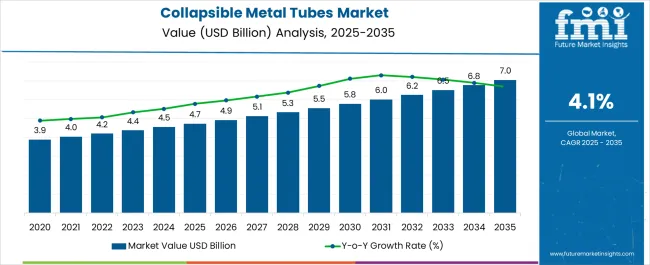
In May 2024, TUBEX GmbH announced a multi‑million‑euro investment in its Schwäbisch Gmünd plant to increase production capacity for aluminum tubes specifically targeting the European pharmaceutical industry, responding to a backlog in demand for primary packaging for dermatological creams and ophthalmic ointments. [1] This performance reflects tightening supply chains for high-barrier metal packaging in regulated healthcare segments.
China (5.5% CAGR) leads global expansion, supported by the scale‑up of domestic pharmaceutical manufacturing and the modernization of oral care packaging formats targeting export markets. The National Development and Reform Commission's 14th Five‑Year Plan for Circular Economy explicitly promotes packaging material optimisation and waste reduction, influencing tube specification upgrades for export-oriented beauty and healthcare products. [2]
India (5.1% CAGR) follows, driven by the production of generic topical pharmaceuticals and the expansion of contract manufacturing organizations supplying USFDA‑compliant packaging. Germany (4.7% CAGR) grows on the back of machinery exports and domestic production of industrial adhesives and artist paints packaged in metal tubes. Brazil (4.3% CAGR) benefits from recovering industrial activity and food paste packaging modernization.
Markets such as the United States (3.8%) , the United Kingdom (3.4%) , and Japan (3.0%) generate comparatively slower expansion, where demand is shaped primarily by replacement cycles in pharmaceutical and cosmetic packaging, with limited net new unit growth and substitution threats from high‑barrier plastic laminates in non‑critical applications.
Collapsible Metal Tubes Market Definition
The collapsible metal tubes market covers the global production and supply of seamless and welded metal containers manufactured through impact extrusion or drawn wall technology. These tubes are designed for the storage and controlled dispensing of viscous products, offering complete barrier protection against light, gases, and volatile compounds. They are widely used in pharmaceutical, oral care, cosmetic, food, and industrial applications where product integrity and precise dosage are required.
Market Inclusions
The report includes global and regional market size estimates in value terms, with a forecast period from 2026 to 2036. It provides segmentation by Material Type, Tube Type, End Use, Closure Type, and Region. The analysis incorporates manufacturing technology trends, impact extrusion efficiency gains, internal lacquering developments, and barrier property benchmarking. Regional demand dynamics, country-level growth rates, and competitive positioning are also evaluated as per FMI methodology.
Market Exclusions
The scope excludes rigid metal cans and aerosol containers, plastic squeeze tubes (mono-layer and co‑extruded), laminated tubes with aluminum foil barrier layers, and fully collapsible non-metal packaging formats. It also excludes revenues from packaged consumer goods and focuses strictly on the metal tube component manufacturing layer. Custom artisanal paint tubes produced in low volumes are not considered due to negligible market contribution.
Research Methodology
- Primary Research: Interviews were conducted with metal tube manufacturers, impact extrusion press suppliers, aluminum sheet and slug producers, pharmaceutical procurement heads, and cosmetic packaging designers.
- Desk Research: Public company filings, aluminum consumption statistics, trade data under HS Code 7612 (aluminum containers), packaging industry association publications, and regulatory documentation were reviewed.
- Market-Sizing and Forecasting: A hybrid top-down and bottom-up model was constructed, reconstructing demand from pharmaceutical dosage form output volumes and tube‑per‑unit consumption ratios across end-use industries.
- Data Validation and Update Cycle: Outputs were subjected to variance testing against production capacity data, trade flow benchmarking, and structured internal review prior to publication.
Collapsible Metal Tubes Market Drivers, Restraints, and Opportunities
Future Market Insights analysis indicates the market has historically existed as a mature, high‑barrier packaging category tied to essential healthcare and oral care routines. Its baseline scale is anchored in the clinical necessity of protecting hygroscopic and volatile active ingredients in topical pharmaceuticals. As per FMI, the market's valuation is linked to substitution defense, where metal tube converters must continuously offset higher unit costs through down‑gauging and decoration efficiency.
FMI analysts observe a clear tension between legacy impact‑extruded aluminum tubes optimized for barrier integrity and laminated plastic‑aluminum alternatives that offer cost savings at the expense of complete recyclability. Standard monobloc aluminum tubes face pressure where brands prioritize shelf appeal and tactile softness, while growth is concentrated in pharmaceutical contracts where material choice is dictated by stability protocols rather than procurement discretion.
- PPWR and aluminum recycling permanence: Regulation (EU) 2025/40 classifies aluminum as a permanent material, recognizing its infinite recyclability without loss of properties. This classification advantages metal tubes in e‑commerce and retail packaging subject to recyclability scoring, as aluminum content contributes positively to packaging recyclability assessments under the delegated acts. [4]
- Pharmaceutical supply chain resilience: Post‑pandemic inventory strategies have shifted toward multi‑year contracting and regionalization of primary packaging production. Metal tube manufacturers with FDA‑registered facilities and cGMP compliance are securing non‑displaceable volumes in dermatological, ophthalmic, and rectal therapy formats. The FDA's 1999 guidance on container closure systems remains the benchmark for demonstrating barrier equivalence during post‑approval changes. [5]
- Lightweighting ceiling: Unlike plastics, where lightweighting reduces material input significantly, aluminum tubes have limited down‑gauging headroom before compromising axial strength and buckle resistance during high‑speed filling. This acts as a structural constraint on resin intensity reduction, maintaining tonnage demand but limiting per‑unit cost reduction opportunities. The Aluminum Association's 2025 packaging outlook identifies this technical ceiling as a key differentiator between metal and flexible plastic formats. [6]
Segmental Analysis
Collapsible Metal Tubes Market Analysis by Tube Type
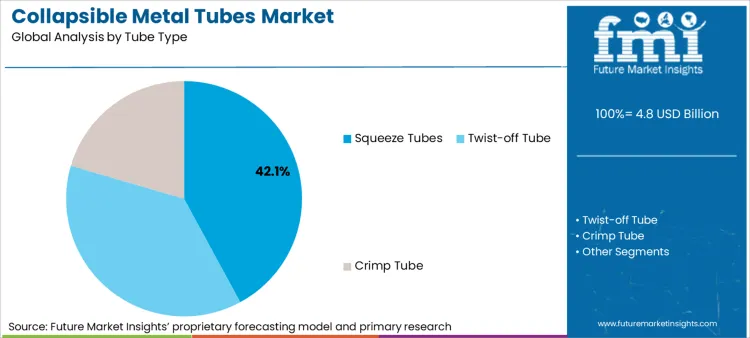
Based on FMI's collapsible metal tubes market report, demand for squeeze tubes remains the leading format, capturing 42.1% of the market share. The dominance of the squeeze tube is attributed to its ergonomic one‑handed operation, high product evacuation rate, and compatibility with high‑viscosity formulations. Squeeze tubes are the default format in pharmaceutical topical creams and toothpaste, where complete evacuation minimizes waste and ensures accurate dosing.
- Capacity acquisition: TUBEX GmbH completed the acquisition of a specialized impact extrusion facility in Hungary in Q3 2025, adding 180 million units of annual capacity targeted at EU pharmaceutical contract manufacturing organizations. [1]
- Product engineering: Hoffmann Neopac launched a new high‑speed tin tube production line in 2023, expanding its capacity for UV‑cured internal lacquers that meet the extractables and leachables requirements of ophthalmic and biologic formulations. [7]
- Compliance alignment: The US FDA's 1999 guidance on container closure systems for topical dermatological products reinforced the requirement for light protection and low moisture vapor transmission rates-specifications where aluminum tubes outperform laminate alternatives. [5]
Collapsible Metal Tubes Market Analysis by End Use
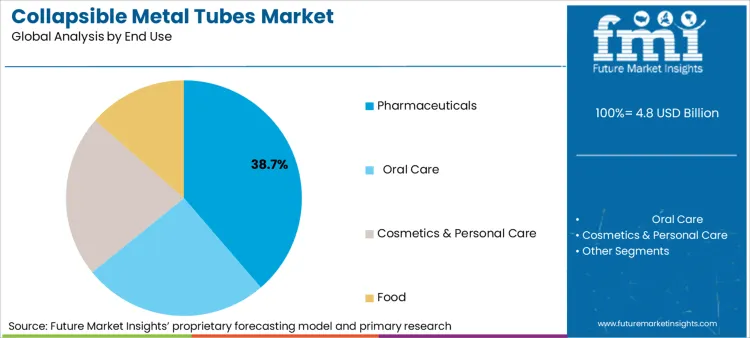
Pharmaceuticals generate maximum demand at 38.7% for metal tube dispensing formats because oxygen‑sensitive and light‑sensitive active ingredients in topical corticosteroids, antibiotics, and antifungals require absolute barrier protection. At the same time, faster value growth in metal tubes is concentrated in cosmetics and professional hair color, where brands pay for premium tactile feel, burst resistance, and the preservation of ammonia‑based formulations, pushing internally lacquered aluminum into higher‑margin packaging programs.
- Portfolio expansion: Albéa Group strengthened its metal tube manufacturing division through targeted investment in its American manufacturing footprint to serve the North American professional hair color market, a segment resistant to laminate conversion due to chemical compatibility requirements. In 2022, Albéa added a new metal tube production line in Brazil to serve Latin American personal care markets. [8]
- Regional pull-through: The growth split in this market increasingly tracks pharmaceutical R&D localization, with Asia‑Pacific scaling unit volumes through generic topical manufacturing, while Europe and North America pull higher‑value tube specifications through biologic cold‑fill requirements and child‑resistant closure integrations.
Regional Analysis
The collapsible metal tubes market is segmented geographically across North America, Europe, Asia‑Pacific, Latin America, and Middle East & Africa. Growth dynamics differ based on pharmaceutical manufacturing concentration, oral care consumption maturity, and substitution pressure from laminates. The full report also provides market attractiveness analysis across regions.
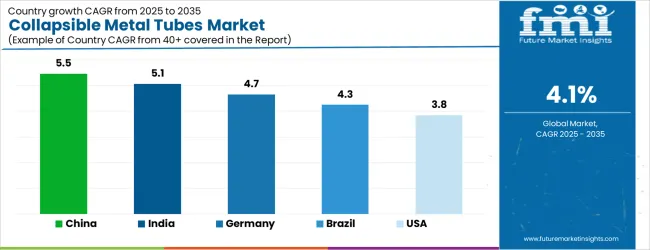
| Country | CAGR (2026-2036) |
|---|---|
| China | 5.5% |
| India | 5.1% |
| Germany | 4.7% |
| Brazil | 4.3% |
| USA | 3.8% |
| UK | 3.4% |
Source: Future Market Insights (FMI) analysis, based on proprietary forecasting model and primary research
North America Market Analysis
North America functions as a regulated procurement market, where FDA compliance and Drug Master File (DMF) submissions shape supplier qualification. Major players include TUBEX GmbH, Montebello Packaging, and Hoffmann Neopac, all operating FDA‑registered facilities serving pharmaceutical and cosmetic brands.
- United States: Demand for collapsible metal tubes in the United States is forecasted to advance at 3.8% CAGR through 2036. Pharmaceutical inventory rebuilding and the onshoring of topical generic manufacturing shape growth.
In June 2024, Montebello Packaging completed a multi‑year modernization of its Lebanon, Kentucky plant, introducing servo‑driven impact presses to improve energy efficiency and stroke rate consistency. [9] Unlike Asia, where growth is volume‑led, USA growth is driven by specification upgrades toward child‑resistant dispensing and senior‑friendly torque reduction closures.
FMI's analysis of collapsible metal tubes market in North America consists of country‑wise assessment that includes the United States and Canada. Readers can find FDA compliance tracking, Drug Master File trends, and specification evolution.
Europe Market Analysis
Europe acts as the sustainability‑advantaged zone of the metal tube sector. Regional players such as TUBEX GmbH, Albéa Group, and Hoffmann Neopac maintain strong impact extrusion networks and align closely with EU Permanent Material classification frameworks.
- Germany: Demand for collapsible metal tubes in Germany is projected to rise at 4.7% CAGR through 2036. Growth is influenced by the strength of the domestic pharmaceutical contract manufacturing sector and industrial adhesives production. Germany's export base in specialty chemicals packaged in metal tubes further supports volume stability. Growth in this market is export‑aligned and driven by machinery replacement cycles rather than purely consumption‑driven.
FMI's analysis of collapsible metal tubes market in Europe consists of country‑wise assessment that includes Germany, United Kingdom, France, Italy, and Spain. Readers can find regulatory impact assessment, recycling permanence modeling, and material transition defense insights.
Asia-Pacific Market Analysis
Asia‑Pacific remains the capacity expansion engine of the global market. The region benefits from dense pharmaceutical API manufacturing clusters and export‑oriented oral care conversion ecosystems. Key players include TUBEX's Asian subsidiaries, local impact extruders in China, and diversified packaging firms across India.
- China; Collapsible metal tubes sales in China are projected to rise at 5.5% CAGR through 2036. Growth is supported by domestic pharmaceutical quality upgrades and the expansion of Western‑branded oral care production. China's strength lies in manufacturing density and export‑oriented API packaging.
As export volumes grow toward regulated markets, compliance alignment with foreign pharmacopeia standards drives tube specification upgrades. The National Development and Reform Commission's 14th Five‑Year Plan for Circular Economy explicitly sets targets for reducing packaging waste and increasing the share of mono‑material recyclable formats, indirectly favoring aluminum tubes over multi‑material laminates. [2]
FMI's analysis of collapsible metal tubes market in Asia‑Pacific consists of country‑wise assessment that includes China, India, Japan, and South Korea. Readers can find capacity tracking, export linkage evaluation, and regional demand modeling.
- India: Demand for collapsible metal tubes in India is projected to rise at 5.1% CAGR through 2036. Growth is supported by the expansion of generic topical pharmaceutical exports to the US and Europe and increasing localization of impact extrusion manufacturing. Unlike China's balanced export model, India's growth is heavily weighted toward semi‑regulated and generic pharmaceutical contracting. USFDA‑approved manufacturing sites in India are increasingly specifying aluminum tubes for export batches to avoid laminate‑related stability failures.
In addition, India's Plastic Waste Management (Amendment) Rules, 2022 introduced Extended Producer Responsibility obligations requiring brand owners to meet defined recycling targets and maintain traceability of packaging materials. These provisions elevate scrutiny over component‑level design and encourage the specification of infinitely recyclable aluminum tube formats over non‑recyclable multi‑layer laminates in premium personal care and pharmaceutical packaging. [10]
FMI's analysis of collapsible metal tubes market in Asia‑Pacific consists of country‑wise assessment that includes China, India, Japan, and South Korea. Readers can find domestic manufacturing trends, USFDA establishment registration tracking, EPR compliance implications, and end‑use sector demand evolution insights.
Competitive Aligners for Market Players
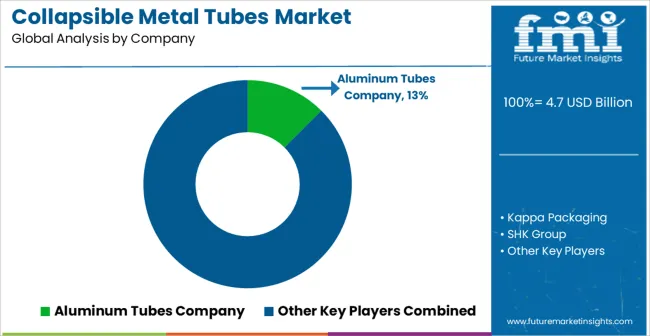
The collapsible metal tubes market is consolidated at the global level, with European‑headquartered specialists accounting for a significant share of value revenue, while regional extruders compete aggressively in domestic oral care programs. As per FMI estimates, the top five global players collectively control roughly 40% of total market value, particularly in pharmaceutical‑grade seamless tubes. The primary competitive variable is not aluminum pricing but cGMP compliance, decoration complexity, and just‑in‑time supply reliability to pharmaceutical lines.
Large integrated players such as TUBEX GmbH, Albéa Group, and Hoffmann Neopac benefit from scale advantages in impact extrusion tooling, in‑line printing, and global pharmaceutical master supply agreements. Companies with vertically integrated slug production or strategic aluminum sourcing arrangements insulate margins from LME price volatility.
Buyer behavior in this market reflects dual sourcing mandates from pharmaceutical procurement teams. Framework agreements often include rigid stability protocol lock‑in periods of 24 to 36 months, during which substitution by laminate tubes is technically prohibited without bioequivalence revalidation.
Recent Developments:
- TUBEX GmbH-Capacity Expansion (February 2025): TUBEX announced the inauguration of a new impact extrusion line at its Hungarian facility, specifically dedicated to 35mm and 40mm diameter formats for European dermatology contract manufacturing organizations. [1]
- Hoffmann Neopac-Tin Tube Capacity (March 2023): Hoffmann Neopac launched a new high‑speed tin tube production line in Switzerland, responding to demand for high‑barrier, chemically inert packaging for pharmaceutical ointments and artist paints. [7]
- Montebello Packaging-Facility Modernization (June 2024): Montebello completed a multi‑year modernization of its Lebanon, Kentucky plant, introducing servo‑driven impact presses to improve energy efficiency and stroke rate consistency. [9]
Key Players in the Collapsible Metal Tubes Market
- Aluminum Tubes Company
- Kappa Packaging
- SHK Group
- Somerset Aluminum Tube
- TUBEX GmbH
- Essentra Packaging
- Mason Packaging
- Allied Tube and Conduit Corporation
- A W Chesterton Company
- MettlerToledo International
- BWAY Corporation
- ArcelorMittal
- Apex Tubes
- Precision Tube
- Kraft Industries
Scope of Report
| Metric | Value |
|---|---|
| Quantitative Units | USD 4.89 billion (2026) to USD 7.29 billion (2036), at a CAGR of 4.1% |
| Market Definition | The collapsible metal tubes market comprises the global production and supply of impact‑extruded or drawn metal containers used for dispensing viscous products across pharmaceutical, oral care, cosmetic, food, and industrial packaging formats. |
| Tube Type Segmentation | Squeeze Tube, Twist‑off Tube, Crimp Tube |
| Material Type Segmentation | Aluminum, Tin, Lead, Laminated Metal |
| End Use Segmentation | Pharmaceuticals, Oral Care, Cosmetics & Personal Care, Food, Industrial Products, Adhesives, Others |
| Closure Type Segmentation | Nozzle Cap, Applicator Cap, Flip‑Top Cap, Others |
| Region Segmentation | North America, Europe, Asia‑Pacific, Latin America, Middle East & Africa |
| Countries Covered | United States, Canada, Germany, United Kingdom, France, Italy, Spain, China, India, Japan, South Korea, Brazil and 40+ countries |
| Key Companies Profiled | Aluminum Tubes Company, Kappa Packaging, SHK Group, Somerset Aluminum Tube, TUBEX GmbH, Essentra Packaging, Mason Packaging, Allied Tube and Conduit Corporation, A W Chesterton Company, MettlerToledo International, BWAY Corporation, ArcelorMittal, Apex Tubes, Precision Tube, Kraft Industries |
| Forecast Period | 2026 to 2036 |
Collapsible Metal Tubes Market Analysis by Segments
Tube Type
- Squeeze Tube
- Twist-off Tube
- Crimp Tube
Material
- Aluminum
- Tin
- Lead
- Laminated Metal
End-Use Industries
- Pharmaceuticals
- Oral Care
- Cosmetics & Personal Care
- Food
- Industrial Products
- Adhesives
- Others
Closure Type
- Nozzle Cap
- Applicator Cap
- Flip-Top Cap
- Others
Region
- North America (USA, Canada, Mexico)
- Latin America (Brazil, Chile, Rest of Latin America)
- Western Europe (Germany, UK, Italy, Spain, France, Nordic, BENELUX, Rest of Western Europe)
- Eastern Europe (Russia, Poland, Hungary, Balkan & Baltic, Rest of Eastern Europe)
- East Asia (China, Japan, South Korea)
- South Asia and Pacific (India, ASEAN, Australia & New Zealand, Rest of South Asia and Pacific)
- Middle East & Africa (Kingdom of Saudi Arabia, Other GCC Countries, Turkiye, South Africa, Other African Union, Rest of Middle East & Africa)
Bibliography
- [1] TUBEX GmbH. (2024, May 15). TUBEX invests in Schwäbisch Gmünd site to expand pharmaceutical tube capacity. TUBEX Corporate Communications.
- [2] National Development and Reform Commission, People's Republic of China. (2021). Circular Economy Development Plan (14th Five‑Year Plan, 2021-2025). Beijing: NDRC.
- [3] European Aluminium. (2024). Aluminium in Packaging: 2024 Market Report and Recycling Performance. Brussels: European Aluminium.
- [4] European Union. (2025). Regulation (EU) 2025/40 of the European Parliament and of the Council of 19 December 2024 on packaging and packaging waste. Official Journal of the European Union, L 11, 1-84.
- [5] USA Food and Drug Administration. (1999). Container Closure Systems for Packaging Human Drugs and Biologics; Guidance for Industry. Rockville, MD: FDA Center for Drug Evaluation and Research.
- [6] The Aluminum Association. (2025). Aluminum Packaging: 2025 Industry Outlook and Recycling Trends. Washington, D.C.: The Aluminum Association.
- [7] Hoffmann Neopac. (2023, March 22). Hoffmann Neopac launches new high‑speed tin tube line for pharmaceutical and industrial applications. Hoffmann Neopac Press Release.
- [8] Albéa Group. (2022, June 14). Albéa expands metal tube production capacity in Brazil. Albéa Press Release.
- [9] Montebello Packaging. (2024, June 10). Montebello Packaging completes major modernization project at Lebanon, KY facility. Montebello Corporate News.
- [10] Ministry of Environment, Forest and Climate Change, Government of India. (2022). Plastic Waste Management (Amendment) Rules, 2022. New Delhi: MoEFCC.
This Report Addresses
- Market intelligence to enable structured strategic decision-making across metal tube manufacturers, pharmaceutical packaging buyers, and impact extrusion converters.
- Market size estimation and 10-year revenue forecasts from 2026 to 2036, including validated CAGR and absolute dollar opportunity sizing.
- Growth opportunity mapping across Tube Type, Material Type, End Use Industry, Closure Type, and regional demand pockets, with emphasis on pharmaceutical‑grade tube specifications.
- Segment and regional forecasting covering aluminum, tin, and laminated metal substrates, alongside end‑use demand trajectories across pharmaceuticals, oral care, cosmetics, and industrial products.
- Competition strategy assessment, including cGMP compliance advantages, localization models, and stability protocol lock‑in dynamics shaping supplier retention in pharma supply contracts.
- Product and compliance tracking focused on down‑gauging limits, internal lacquering chemistry, and barrier property benchmarking against laminate intrusion.
- Regulatory impact analysis covering FDA establishment registration, EU permanent material classification, EPR-driven reporting, and pharmacopeial standard alignment influencing tube material selection.
- Report delivery in PDF, Excel, and presentation‑ready formats to support executive planning, procurement alignment, and operational benchmarking.
Frequently Asked Questions
How large is the demand for collapsible metal tubes in the global market in 2026?
Demand for collapsible metal tubes is estimated to be valued at USD 4.89 billion in 2026.
What will be the market size of collapsible metal tubes in the global market by 2036?
Market size for collapsible metal tubes is projected to reach USD 7.29 billion by 2036.
What is the expected demand growth for collapsible metal tubes between 2026 and 2036?
Demand for collapsible metal tubes is expected to grow at a 4.1% CAGR between 2026 and 2036.
Which tube type is poised to lead global sales?
Squeeze tubes are expected to remain the leading tube type, anchored by ergonomic handling and high evacuation rates, holding 42.1% share in 2025.
Which material type dominates the collapsible metal tubes market?
Aluminum is the dominant substrate, accounting for over 85% of metal tube volume due to its barrier properties, light weight, and infinite recyclability.
How significant is the role of Pharmaceuticals in driving adoption of collapsible metal tubes?
Pharmaceuticals is the primary consumption sector because oxygen sensitive and light sensitive topical formulations require absolute barrier protection that metal tubes provide.
What is driving demand in the United States?
Replacement cycles in pharmaceutical packaging and FDA compliance requirements supporting metal over laminate in topical generics are supporting demand growth in the United States.
What is the United States growth outlook in this report?
The United States is projected to expand at a 3.8% CAGR during 2026 to 2036.
Why is Europe described as a sustainability advantaged region in this report?
European demand is shaped by the Permanent Material classification of aluminum under PPWR, which advantages infinitely recyclable metal tubes in procurement scoring.
What type of demand dominates in Europe?
Demand is driven primarily by pharmaceutical contract manufacturing and industrial adhesive packaging, rather than net new unit expansion alone.
What is Germany's growth outlook in this report?
Germany is projected to expand at a 4.7% CAGR during 2026 to 2036.
Does the report cover the United Kingdom in its regional analysis?
Yes, the United Kingdom is included within Europe under the regional coverage framework.
What is the United Kingdom's growth outlook in this report?
The United Kingdom is projected to expand at a 3.4% CAGR during 2026 to 2036.
Does the report cover China in its regional analysis?
Yes, China is included within Asia Pacific and is a high growth country market covered in the report.
What is China's growth outlook in this report?
China is projected to expand at a 5.5% CAGR during 2026 to 2036.
Does the report cover India in its regional analysis?
Yes, India is included within Asia Pacific and is covered in the country wise assessment.
What is India's growth outlook in this report?
India is projected to expand at a 5.1% CAGR during 2026 to 2036.
Does the report cover Japan in its regional analysis?
Yes, Japan is included within Asia Pacific under the regional scope of analysis.
What is Japan's growth outlook in this report?
Japan is projected to expand at a 3.0% CAGR during 2026 to 2036.
Does the report cover Brazil in its regional analysis?
Yes, Brazil is included within Latin America and is covered in the country wise assessment.
What is Brazil's growth outlook in this report?
Brazil is projected to expand at a 4.3% CAGR during 2026 to 2036.
What is a collapsible metal tube and what is it mainly used for?
A collapsible metal tube is a seamless or welded metal container manufactured through impact extrusion, used for controlled dispensing of viscous products requiring absolute barrier protection, mainly in pharmaceutical, oral care, and cosmetic packaging.
What does the collapsible metal tubes market mean in this report?
It refers to the global manufacturing and supply of collapsible metal tubes by tube type, material type, end use, closure type, and region, measured in value terms.
What is included in the scope of this collapsible metal tubes market report?
Scope includes market sizing and forecasting for 2026 to 2036, segmentation by tube type, material type, end use, closure type, and region, along with competitive assessment and country wise outlook.
What is excluded from the scope of this report?
The scope excludes plastic squeeze tubes, laminated tubes, rigid metal cans, aerosol containers, and downstream packaged goods revenues, focusing strictly on metal tube component manufacturing and supply.
Preview the report firsthand - request a free sample
Get SampleGet the brochure for pricing and purchase details.
Get PDFTable of Content
- Executive Summary
- Global Market Outlook
- Demand-side Trends
- Supply-side Trends
- Technology Roadmap Analysis
- Analysis and Recommendations
- Market Overview
- Market Coverage / Taxonomy
- Market Definition / Scope / Limitations
- Research Methodology
- Chapter Orientation
- Analytical Lens and Working Hypotheses
- Market Structure, Signals, and Trend Drivers
- Benchmarking and Cross-market Comparability
- Market Sizing, Forecasting, and Opportunity Mapping
- Research Design and Evidence Framework
- Desk Research Programme (Secondary Evidence)
- Company Annual and Sustainability Reports
- Peer-reviewed Journals and Academic Literature
- Corporate Websites, Product Literature, and Technical Notes
- Earnings Decks and Investor Briefings
- Statutory Filings and Regulatory Disclosures
- Technical White Papers and Standards Notes
- Trade Journals, Industry Magazines, and Analyst Briefs
- Conference Proceedings, Webinars, and Seminar Materials
- Government Statistics Portals and Public Data Releases
- Press Releases and Reputable Media Coverage
- Specialist Newsletters and Curated Briefings
- Sector Databases and Reference Repositories
- FMI Internal Proprietary Databases and Historical Market Datasets
- Subscription Datasets and Paid Sources
- Social Channels, Communities, and Digital Listening Inputs
- Additional Desk Sources
- Expert Input and Fieldwork (Primary Evidence)
- Primary Modes
- Qualitative Interviews and Expert Elicitation
- Quantitative Surveys and Structured Data Capture
- Blended Approach
- Why Primary Evidence is Used
- Field Techniques
- Interviews
- Surveys
- Focus Groups
- Observational and In-context Research
- Social and Community Interactions
- Stakeholder Universe Engaged
- C-suite Leaders
- Board Members
- Presidents and Vice Presidents
- R&D and Innovation Heads
- Technical Specialists
- Domain Subject-matter Experts
- Scientists
- Physicians and Other Healthcare Professionals
- Governance, Ethics, and Data Stewardship
- Research Ethics
- Data Integrity and Handling
- Primary Modes
- Tooling, Models, and Reference Databases
- Desk Research Programme (Secondary Evidence)
- Data Engineering and Model Build
- Data Acquisition and Ingestion
- Cleaning, Normalisation, and Verification
- Synthesis, Triangulation, and Analysis
- Quality Assurance and Audit Trail
- Market Background
- Market Dynamics
- Drivers
- Restraints
- Opportunity
- Trends
- Scenario Forecast
- Demand in Optimistic Scenario
- Demand in Likely Scenario
- Demand in Conservative Scenario
- Opportunity Map Analysis
- Product Life Cycle Analysis
- Supply Chain Analysis
- Investment Feasibility Matrix
- Value Chain Analysis
- PESTLE and Porter’s Analysis
- Regulatory Landscape
- Regional Parent Market Outlook
- Production and Consumption Statistics
- Import and Export Statistics
- Market Dynamics
- Global Market Analysis 2021 to 2025 and Forecast, 2026 to 2036
- Historical Market Size Value (USD Million) Analysis, 2021 to 2025
- Current and Future Market Size Value (USD Million) Projections, 2026 to 2036
- Y-o-Y Growth Trend Analysis
- Absolute $ Opportunity Analysis
- Global Market Pricing Analysis 2021 to 2025 and Forecast 2026 to 2036
- Global Market Analysis 2021 to 2025 and Forecast 2026 to 2036, By Tube Type
- Introduction / Key Findings
- Historical Market Size Value (USD Million) Analysis By Tube Type , 2021 to 2025
- Current and Future Market Size Value (USD Million) Analysis and Forecast By Tube Type , 2026 to 2036
- Squeeze Tubes
- Twist-off Tube
- Crimp Tube
- Squeeze Tubes
- Y-o-Y Growth Trend Analysis By Tube Type , 2021 to 2025
- Absolute $ Opportunity Analysis By Tube Type , 2026 to 2036
- Global Market Analysis 2021 to 2025 and Forecast 2026 to 2036, By End Use
- Introduction / Key Findings
- Historical Market Size Value (USD Million) Analysis By End Use, 2021 to 2025
- Current and Future Market Size Value (USD Million) Analysis and Forecast By End Use, 2026 to 2036
- Pharmaceuticals
- Oral Care
- Cosmetics & Personal Care
- Food
- Pharmaceuticals
- Y-o-Y Growth Trend Analysis By End Use, 2021 to 2025
- Absolute $ Opportunity Analysis By End Use, 2026 to 2036
- Global Market Analysis 2021 to 2025 and Forecast 2026 to 2036, By Region
- Introduction
- Historical Market Size Value (USD Million) Analysis By Region, 2021 to 2025
- Current Market Size Value (USD Million) Analysis and Forecast By Region, 2026 to 2036
- North America
- Latin America
- Western Europe
- Eastern Europe
- East Asia
- South Asia and Pacific
- Middle East & Africa
- Market Attractiveness Analysis By Region
- North America Market Analysis 2021 to 2025 and Forecast 2026 to 2036, By Country
- Historical Market Size Value (USD Million) Trend Analysis By Market Taxonomy, 2021 to 2025
- Market Size Value (USD Million) Forecast By Market Taxonomy, 2026 to 2036
- By Country
- USA
- Canada
- Mexico
- By Tube Type
- By End Use
- By Country
- Market Attractiveness Analysis
- By Country
- By Tube Type
- By End Use
- Key Takeaways
- Latin America Market Analysis 2021 to 2025 and Forecast 2026 to 2036, By Country
- Historical Market Size Value (USD Million) Trend Analysis By Market Taxonomy, 2021 to 2025
- Market Size Value (USD Million) Forecast By Market Taxonomy, 2026 to 2036
- By Country
- Brazil
- Chile
- Rest of Latin America
- By Tube Type
- By End Use
- By Country
- Market Attractiveness Analysis
- By Country
- By Tube Type
- By End Use
- Key Takeaways
- Western Europe Market Analysis 2021 to 2025 and Forecast 2026 to 2036, By Country
- Historical Market Size Value (USD Million) Trend Analysis By Market Taxonomy, 2021 to 2025
- Market Size Value (USD Million) Forecast By Market Taxonomy, 2026 to 2036
- By Country
- Germany
- UK
- Italy
- Spain
- France
- Nordic
- BENELUX
- Rest of Western Europe
- By Tube Type
- By End Use
- By Country
- Market Attractiveness Analysis
- By Country
- By Tube Type
- By End Use
- Key Takeaways
- Eastern Europe Market Analysis 2021 to 2025 and Forecast 2026 to 2036, By Country
- Historical Market Size Value (USD Million) Trend Analysis By Market Taxonomy, 2021 to 2025
- Market Size Value (USD Million) Forecast By Market Taxonomy, 2026 to 2036
- By Country
- Russia
- Poland
- Hungary
- Balkan & Baltic
- Rest of Eastern Europe
- By Tube Type
- By End Use
- By Country
- Market Attractiveness Analysis
- By Country
- By Tube Type
- By End Use
- Key Takeaways
- East Asia Market Analysis 2021 to 2025 and Forecast 2026 to 2036, By Country
- Historical Market Size Value (USD Million) Trend Analysis By Market Taxonomy, 2021 to 2025
- Market Size Value (USD Million) Forecast By Market Taxonomy, 2026 to 2036
- By Country
- China
- Japan
- South Korea
- By Tube Type
- By End Use
- By Country
- Market Attractiveness Analysis
- By Country
- By Tube Type
- By End Use
- Key Takeaways
- South Asia and Pacific Market Analysis 2021 to 2025 and Forecast 2026 to 2036, By Country
- Historical Market Size Value (USD Million) Trend Analysis By Market Taxonomy, 2021 to 2025
- Market Size Value (USD Million) Forecast By Market Taxonomy, 2026 to 2036
- By Country
- India
- ASEAN
- Australia & New Zealand
- Rest of South Asia and Pacific
- By Tube Type
- By End Use
- By Country
- Market Attractiveness Analysis
- By Country
- By Tube Type
- By End Use
- Key Takeaways
- Middle East & Africa Market Analysis 2021 to 2025 and Forecast 2026 to 2036, By Country
- Historical Market Size Value (USD Million) Trend Analysis By Market Taxonomy, 2021 to 2025
- Market Size Value (USD Million) Forecast By Market Taxonomy, 2026 to 2036
- By Country
- Kingdom of Saudi Arabia
- Other GCC Countries
- Turkiye
- South Africa
- Other African Union
- Rest of Middle East & Africa
- By Tube Type
- By End Use
- By Country
- Market Attractiveness Analysis
- By Country
- By Tube Type
- By End Use
- Key Takeaways
- Key Countries Market Analysis
- USA
- Pricing Analysis
- Market Share Analysis, 2025
- By Tube Type
- By End Use
- Canada
- Pricing Analysis
- Market Share Analysis, 2025
- By Tube Type
- By End Use
- Mexico
- Pricing Analysis
- Market Share Analysis, 2025
- By Tube Type
- By End Use
- Brazil
- Pricing Analysis
- Market Share Analysis, 2025
- By Tube Type
- By End Use
- Chile
- Pricing Analysis
- Market Share Analysis, 2025
- By Tube Type
- By End Use
- Germany
- Pricing Analysis
- Market Share Analysis, 2025
- By Tube Type
- By End Use
- UK
- Pricing Analysis
- Market Share Analysis, 2025
- By Tube Type
- By End Use
- Italy
- Pricing Analysis
- Market Share Analysis, 2025
- By Tube Type
- By End Use
- Spain
- Pricing Analysis
- Market Share Analysis, 2025
- By Tube Type
- By End Use
- France
- Pricing Analysis
- Market Share Analysis, 2025
- By Tube Type
- By End Use
- India
- Pricing Analysis
- Market Share Analysis, 2025
- By Tube Type
- By End Use
- ASEAN
- Pricing Analysis
- Market Share Analysis, 2025
- By Tube Type
- By End Use
- Australia & New Zealand
- Pricing Analysis
- Market Share Analysis, 2025
- By Tube Type
- By End Use
- China
- Pricing Analysis
- Market Share Analysis, 2025
- By Tube Type
- By End Use
- Japan
- Pricing Analysis
- Market Share Analysis, 2025
- By Tube Type
- By End Use
- South Korea
- Pricing Analysis
- Market Share Analysis, 2025
- By Tube Type
- By End Use
- Russia
- Pricing Analysis
- Market Share Analysis, 2025
- By Tube Type
- By End Use
- Poland
- Pricing Analysis
- Market Share Analysis, 2025
- By Tube Type
- By End Use
- Hungary
- Pricing Analysis
- Market Share Analysis, 2025
- By Tube Type
- By End Use
- Kingdom of Saudi Arabia
- Pricing Analysis
- Market Share Analysis, 2025
- By Tube Type
- By End Use
- Turkiye
- Pricing Analysis
- Market Share Analysis, 2025
- By Tube Type
- By End Use
- South Africa
- Pricing Analysis
- Market Share Analysis, 2025
- By Tube Type
- By End Use
- USA
- Market Structure Analysis
- Competition Dashboard
- Competition Benchmarking
- Market Share Analysis of Top Players
- By Regional
- By Tube Type
- By End Use
- Competition Analysis
- Competition Deep Dive
- Aluminum Tubes Company
- Overview
- Product Portfolio
- Profitability by Market Segments (Product/Age /Sales Channel/Region)
- Sales Footprint
- Strategy Overview
- Marketing Strategy
- Product Strategy
- Channel Strategy
- Kappa Packaging
- SHK Group
- Somerset Aluminum Tube
- TUBEX GmbH
- Essentra Packaging
- Aluminum Tubes Company
- Competition Deep Dive
- Assumptions & Acronyms Used


