

- Market Size (2026)
- USD 12.7 Bn
- Forecast (2036)
- USD 35.1 Bn
- CAGR (2026 to 2036)
- 10.7%
How big is the Complement Inhibitors Market in 2026?
USD 12.7 billion in 2026 and USD 35.1 billion by 2036 at a 10.7% CAGR.
Sales in the complement inhibitors market are projected to grow at 10.7% CAGR through 2036, increasing valuation from USD 12.7 billion to USD 35.1 billion. Broader approval of orphan drugs expands treatment choice beyond terminal C5 blockade toward proximal and lectin pathway targets.
C3G adds a long-term targeted treatment pathway within nephrology services that manage rare kidney disorders. FDA reported in March 2025 that C3G affects two to three people per million worldwide. The limited patient pool concentrates diagnosis and rare disease clinical trials within experienced centers that coordinate treatment and recurring monitoring.
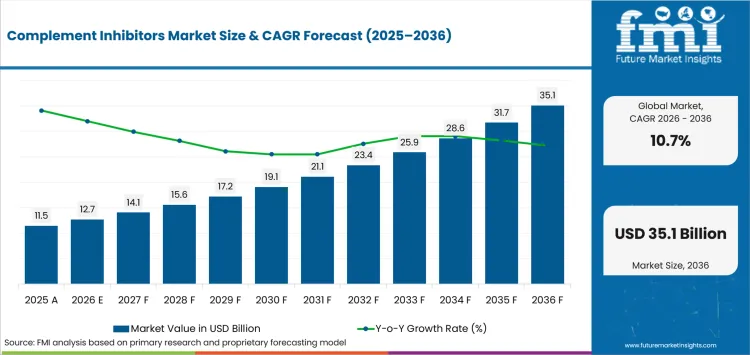
Key Takeaways of Complement Inhibitors Market
- Additional approvals are expanding treatment across complement-mediated kidney and blood disorders alongside neuromuscular and retinal conditions requiring specialist monitoring.
- C5 inhibitors are projected to account for 46.0% of drug class demand in 2026, supported by broad established approval coverage.
- Paroxysmal nocturnal hemoglobinuria is estimated to represent 34.0% of application demand in 2026, driven by competing pathway targets and administration routes.
- Hospitals are forecast to capture 41.0% of end-user demand in 2026, attributable to monitored initiation and infection-risk management.
- Vaccination requirements and indication-specific reimbursement reviews extend onboarding timelines for therapies carrying serious infection warnings.
- AstraZeneca PLC, Novartis AG, Biogen Inc. through Apellis Pharmaceuticals, Inc., Roche Holding AG, UCB S.A., Regeneron Pharmaceuticals, Inc.and Omeros Corporation are active companies in this market.
Analyst Perspective
“Complement inhibitor competition increasingly rewards companies that cover several pathway targets without adding avoidable treatment burden. Commercial strength depends on route flexibility, vaccination support and comparative evidence that helps specialists change therapy after breakthrough disease while preserving long-term control.”
- Anurag Sharma, Principal Consultant, Future Market Insights
How is the Complement Inhibitors Market segmented?
The complement inhibitors industry is segmented by drug class, application, end user, distribution channel, route of administration and region.
Drug class analysis includes C5, C3, factor D and factor B inhibitors across approved and investigational treatment pathways. Application analysis covers PNH, atypical hemolytic uremic syndrome, geographic atrophy and generalized myasthenia gravis, while end users include hospitals, specialty clinics, infusion centers and research institutes. Distribution channels include hospital, specialty, retail and online pharmacies, while administration routes cover intravenous, subcutaneous, oral and intravitreal treatment. Regional analysis covers North America, Latin America, Europe, East Asia, South Asia and Pacific, and Middle East and Africa.
What supports demand for C5 inhibitors within the drug class category?
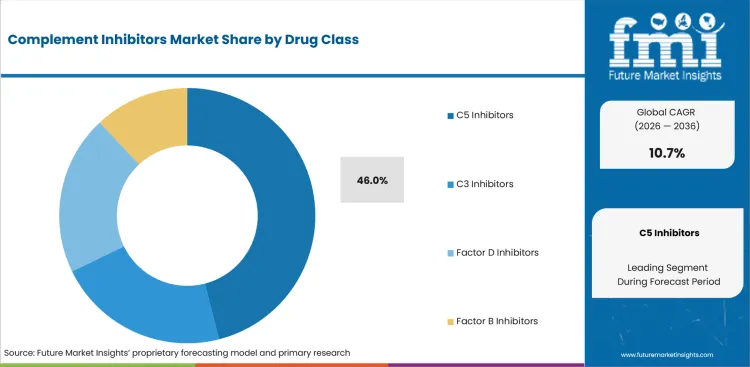
C5 inhibition anchors established hematology and neurology care through the broadest verified approval base among complement drug classes, with long-duration monoclonal antibodies supporting recurring specialist monitoring across chronic rare-disease pathways.
- The drug class is forecast to be led by C5 inhibitors at 46.0% share in 2026 due to established use across several approved complement-mediated conditions.
- Eligible PNH patients seeking fewer clinic visits need a route that preserves terminal C5 control under specialist monitoring. Roche received European Commission approval for monthly subcutaneous PiaSky in August 2024 with trained self-administration available for eligible patients.
How does paroxysmal nocturnal hemoglobinuria shape application demand?
PNH supports the most developed competition between terminal and proximal complement control across long-term hematology care. FDA approved oral Voydeya in March 2024 as add-on treatment for extravascular hemolysis during ravulizumab or eculizumab therapy in adults.
- The paroxysmal nocturnal hemoglobinuria segment is likely to capture 34.0% share in 2026 attributable to established diagnosis and mature specialist treatment pathways.
- Hematologists compare untreated-patient options with add-on control and monitored switching across biologic therapies and oral medicines. Laboratory follow-up identifies breakthrough hemolysis and helps specialists decide whether to change pathway targets or revise long-term administration support for individual patients.
What role do hospitals play within the end-user category?
Hospitals combine specialist prescribing with laboratory follow-up and urgent infection management for injectable drugs used across rare complement disorders. Vaccination review concentrates treatment decisions within tertiary facilities that coordinate hematology and nephrology care across regional referral networks.
- In 2026, hospitals are expected to lead the end-user category with 41.0% share because monitored initiation requires coordinated specialist treatment services nationwide.
- Meningococcal risk keeps emergency assessment and continuing safety education close to experienced treatment centers throughout therapy. CDC guidance indicates complement inhibitor recipients face disease risk up to 2,000 times above healthy people.
How does intravenous administration influence route selection?
Intravenous administration remains embedded in C5 protocols, although subcutaneous products now compete within pathways built around IV therapy systems. UCB reported in February 2026 that more than 1,300 gMG patients had received subcutaneous Zilbrysq by year-end 2025 worldwide.
- By route of administration, intravenous treatment is forecast to represent 52.0% in 2026 driven by established hospital and outpatient infusion care pathways.
- Home-administered formats reduce facility visits for suitable neurology patients and compete with recurring infusion schedules. Specialty pharmacies align drug delivery solutions with trained clinical teams so vaccination review and urgent support remain available throughout outpatient treatment.
What are the drivers, restraints and opportunities in the Complement Inhibitors Market?
Approval expansion widens eligible disorders, infection controls extend treatment onboarding and route innovation supports differentiated specialist access.
- Driver: Regulatory approvals across renal and transplant-related disorders broaden the commercial reach of complement pathway medicines.
- Restraint: Vaccination requirements and serious infection warnings require controlled initiation that extends specialist onboarding timelines.
- Opportunity: Oral and subcutaneous formats support service models that reduce recurring infusion visits for suitable patients.
New renal and transplant approvals give specialists pathway-specific alternatives in disorders that once depended on broader immune suppression. FDA approved Yartemlea for TA-TMA in December 2025, placing lectin-pathway treatment inside transplant-center protocols with dedicated monitoring and reimbursement processes.
Serious infection risk delays treatment initiation as complement blockade weakens defense against encapsulated bacteria during long-term therapy. Hospital pharmacists must confirm vaccination and teach urgent symptom response, concentrating treatment in centers that can maintain rapid assessment across long dosing periods.
Oral and subcutaneous formats reduce recurring facility visits for patients who can manage treatment at home. Manufacturers must coordinate specialty pharmacy delivery with escalation routes that preserve vaccination review and urgent clinical support during home treatment.
Which country CAGRs are profiled in the Complement Inhibitors Market?
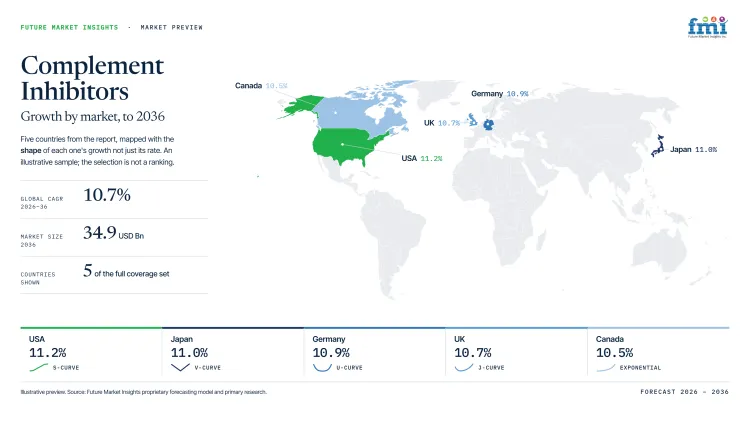
| Country | CAGR |
|---|---|
| United States | 11.2% |
| Japan | 11.0% |
| Germany | 10.9% |
| United Kingdom | 10.7% |
| Canada | 10.5% |
How do country-level CAGRs compare in the Complement Inhibitors Market?
The country CAGR range spans 0.7 percentage point across specialty-medicine systems with established access pathways. These rates describe forecast expansion and do not establish current treatment penetration across national healthcare systems.
- A 0.2-point gap separates the United States and Japan as national access controls shape label expansion.
- Japan and Germany differ by 0.1 point as specialist systems apply distinct benefit assessment requirements.
- Germany and the United Kingdom are 0.2 point apart as national appraisals shape supported access.
- The United Kingdom and Canada differ by 0.2 point through national and provincial funding timelines.
- The full 0.7-point spread indicates similar forecast pace despite distinct national launch and reimbursement barriers.
Comparable CAGRs can produce different entry conditions across national regulatory systems and specialist treatment networks. The report covers growth across North America, Latin America, Europe, East Asia, South Asia and Pacific, and the Middle East and Africa.
Country-wise Analysis
- United States treatment centers combine REMS-certified pharmacies with specialist vaccination and laboratory monitoring across hospital and outpatient routes that serve complex transplant and nephrology cases throughout geographically dispersed referral networks across several major regions. The United States is estimated to post 11.2% CAGR over the forecast period, supported by repeated label expansion and experienced nephrology services across public and private payer systems serving complex rare-disease cases nationwide. Omeros reported first commercial Yartemlea sales in January 2026, although long referral distances and insurer reviews can delay treatment for patients needing sustained therapy across regions with limited local complement expertise and infusion capacity.
- Japan combines centralized medicine review with national reimbursement and specialist hospitals that coordinate controlled dispensing and long-term monitoring for rare complement disorders across metropolitan referral networks serving patients from widely dispersed regional prefectures nationwide. Adoption of complement inhibitors in Japan is estimated to expand at 11.0% CAGR through 2036, aided by structured approval routes and renal centers within nationally organized hospital systems serving dispersed regional populations. Novartis Pharma received C3G approval for Fabhalta in May 2025, yet detailed evidence requirements and limited specialist capacity complicate access planning for patients living beyond major urban treatment areas who face repeated specialist travel.
- Germany routes rare complement medicines through university hospitals and referral centers that coordinate diagnosis, benefit assessment and long-term monitoring across sixteen federal states with uneven specialist capacity and local care systems serving dispersed patients. Germany's complement inhibitors outlook is anticipated to advance at 10.9% CAGR over the assessment period, reinforced by formal appraisal routes and experienced clinicians coordinating diagnosis and continuing follow-up across federal care systems. The Federal Joint Committee completed its iptacopan reassessment in June 2026, although comparative evidence requirements and negotiated pricing can delay wider adoption beyond metropolitan centers with established rare-disease expertise and monitoring capacity nationwide.
- United Kingdom access depends on technology appraisal and specialist NHS services that sequence complement medicines through indication-specific commissioning across regional referral networks serving rare kidney and blood disorders with uneven local capacity nationwide. NICE ended its C3G appraisal of iptacopan in October 2025 following sponsor withdrawal, leaving local organizations without national guidance and requiring case-specific funding decisions for eligible adult patients across NHS services with limited alternatives. Complement inhibitor demand in the United Kingdom is forecast to rise at 10.7% CAGR over the forecast period, shaped by coordinated national rare-disease services across specialist NHS networks and established regional referral systems.
- Canada combines federal authorization with provincial reimbursement and controlled distribution programs that confirm vaccination through specialist kidney and hematology services serving dispersed patients across long provincial referral routes and repeated travel for treatment. Complement inhibitor sales in Canada are forecast to expand at 10.5% CAGR by 2036, influenced by renal label expansion and specialty pharmacy coordination across public drug plans and private coverage for rare-disease patients. Novartis Canada reported Health Canada approval for oral Fabhalta in May 2026, although provincial funding timelines and geographic concentration can extend referral and dispensing routes beyond major urban treatment centers serving remote communities.
Who are the notable companies in the Complement Inhibitors Market?
AstraZeneca PLC, Novartis AG, Biogen Inc. (Apellis Pharmaceuticals, Inc.), Roche Holding AG, UCB S.A., Regeneron Pharmaceuticals, Inc., and Omeros Corporation are notable companies serving this market.
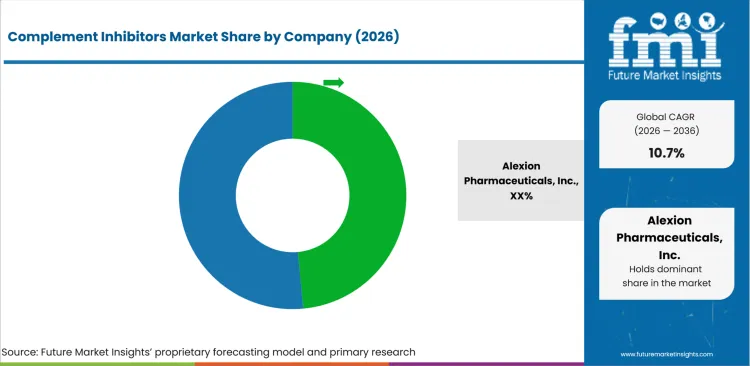
The field is moderately concentrated around commercial complement franchises but remains fragmented by pathway target, indication and administration route. Entry requires indication-specific evidence and specialty pharmacy logistics that support vaccination controls and high-cost therapy access.
- AstraZeneca PLC and Novartis AG maintain multi-indication complement portfolios across terminal and proximal pathway targets in several regulated markets.
- Biogen Inc. competes through C3 products from its wholly owned Apellis subsidiary, while Roche Holding AG and UCB S.A. differentiate through subcutaneous administration formats.
- Regeneron Pharmaceuticals, Inc. develops selective complement products across approved and late-stage rare-disease indications alongside and Omeros Corporation.
Competitive Benchmarking: Complement Inhibitors Market
| Company | Commercial Complement Portfolio | Route Breadth | Indication Breadth | Geographic Reach |
|---|---|---|---|---|
| AstraZeneca PLC | High | High | High | Global |
| Novartis AG | Medium | Low | High | Global |
| Biogen Inc. (Apellis Pharmaceuticals, Inc.) | High | High | High | United States with partner-led international coverage |
| Roche Holding AG | Medium | High | Medium | Global |
| UCB S.A. | Medium | Low | Low | United States, Europe and Japan |
| Regeneron Pharmaceuticals, Inc. | Medium | High | High | United States with global trials |
| Omeros Corporation | Medium | Low | Low | United States commercial coverage |
Key Developments in the Complement Inhibitors Market
- In July 2026, Novartis received FDA traditional approval for Fabhalta in adults with primary IgA nephropathy at progression risk. The decision extends oral factor B inhibition across a third approved kidney or blood indication.
- In December 2025, Omeros Corporation completed the global zaltenibart transaction with Novo Nordisk and received USD 240 million at closing. The transaction transferred late-stage MASP-3 development into a global portfolio with greater financing and commercialization capacity.
- In August 2025, Regeneron Pharmaceuticals, Inc. reported positive Phase 3 results for cemdisiran alone and combined with pozelimab in generalized myasthenia gravis. The results expanded late-stage competition by testing subcutaneous RNA interference both alone and with antibody-based terminal complement control.
Key Players in the Complement Inhibitors Market
Multi-Product Complement Portfolios
- AstraZeneca PLC
- Biogen Inc. (Apellis Pharmaceuticals, Inc.)
Approved C3, C5 and Factor B Platforms
- Novartis AG
- Roche Holding AG
- UCB S.A.
- Regeneron Pharmaceuticals, Inc.
Approved C5a and Lectin Pathway Platforms
- Omeros Corporation
Complement Inhibitors Market - Report Scope
| Coverage field | Report scope |
|---|---|
| Market breakdown | By drug class, application, end user, distribution channel, route of administration and region. |
| Quantitative Units | Revenue in USD billion and CAGR in %. |
| Market Definition | The market covers approved and investigational medicines that inhibit complement proteins or receptors across the stated taxonomy. |
| Regions Covered | North America, Latin America, Europe, East Asia, South Asia and Pacific, and Middle East and Africa. |
| Countries Covered | United States, Japan, Germany, United Kingdom, Canada, and 20+ countries included in the full report. |
| Key Companies Profiled | AstraZeneca PLC, Novartis AG, Biogen Inc. (Apellis Pharmaceuticals, Inc.), Roche Holding AG, UCB S.A., Regeneron Pharmaceuticals, Inc., and Omeros Corporation. |
| Forecast Period | 2026 to 2036. |
| Approach | Primary and secondary research with market triangulation. |
Complement Inhibitors Market - Research Methodology
| Method | Approach |
|---|---|
| Primary Research | FMI analysts gathered input from manufacturers, service providers, technology developers, distributors, end users, procurement teams, and subject-matter experts. Interviews examined purchasing decisions, product or service evaluation, adoption barriers, approval requirements, pricing considerations, and expectations for technical or commercial support. Respondents were also asked what evidence is required before a trial, pilot, or initial order develops into regular purchasing. |
| Desk Research | Desk research covered government statistics, regulatory publications, trade data, industry associations, technical literature, standards, company filings, product information, and official corporate announcements. Sources were reviewed for relevance, publication date, geographic coverage, and consistency with the defined market scope. Claims relating to performance, applications, approvals, capacity, investment, and commercial activity were retained only when supported by credible public evidence. |
| Market Sizing and Forecasting | The market model combined the baseline value with historical performance, segment structure, pricing and volume indicators, adoption levels, company participation, and country-level demand conditions. Forecast assumptions considered economic activity, investment trends, regulatory developments, technology adoption, purchasing cycles, supply availability, and barriers to wider market use. Segment and regional estimates were reconciled before the final market total was calculated. |
| Data Validation | Estimates were checked against multiple independent indicators, including public data, company activity, trade patterns, industry developments, and findings from primary interviews. Validation also tested whether products, services, applications, and company revenues fell within the defined market boundaries. Adjacent categories, unsupported claims, overlapping revenues, and activities without direct market relevance were excluded to reduce double counting and maintain consistency across segments and countries. |
Complement Inhibitors Market by Segments
Complement Inhibitors Market segmented by Drug Class:
- C5 Inhibitors
- Eculizumab
- Ravulizumab
- C3 Inhibitors
- Pegcetacoplan
- Next-Generation C3 Inhibitors
- Factor D Inhibitors
- Danicopan-Based Inhibitors
- Oral Factor D Inhibitors
- Factor B Inhibitors
- Oral Factor B Inhibitors
- Investigational Factor B Inhibitors
Complement Inhibitors Market segmented by Application:
- Paroxysmal Nocturnal Hemoglobinuria (PNH)
- First-Line Treatment
- Relapsed-Refractory PNH
- Atypical Hemolytic Uremic Syndrome (aHUS)
- Acute Disease Management
- Long-Term Maintenance
- Geographic Atrophy
- Early Geographic Atrophy
- Advanced Geographic Atrophy
- Generalized Myasthenia Gravis (gMG)
- AChR-Positive gMG
- Refractory gMG
Complement Inhibitors Market segmented by End User:
- Hospitals
- Tertiary Care Hospitals
- Specialty Hospitals
- Specialty Clinics
- Hematology Clinics
- Neurology Clinics
- Infusion Centers
- Hospital-Based Infusion Centers
- Independent Infusion Centers
- Academic & Research Institutes
- University Hospitals
- Clinical Research Centers
Complement Inhibitors Market segmented by Distribution Channel:
- Hospital Pharmacies
- Inpatient Pharmacies
- Outpatient Hospital Pharmacies
- Specialty Pharmacies
- Rare Disease Pharmacies
- Biologic Therapy Pharmacies
- Retail Pharmacies
- Chain Pharmacies
- Independent Pharmacies
- Online Pharmacies
- E-Pharmacy Platforms
- Home Delivery Services
Complement Inhibitors Market segmented by Route of Administration:
- Intravenous (IV)
- Hospital Infusion
- Outpatient Infusion
- Subcutaneous (SC)
- On-Body Delivery Systems
- Prefilled Syringes
- Oral
- Oral Small Molecules
- Oral Complement Inhibitors
- Intravitreal
- Intravitreal Injection
- Sustained-Release Ocular Delivery
Complement Inhibitors Market by Region:
- North America
- United States
- Canada
- Mexico
- Latin America
- Brazil
- Chile
- Rest of Latin America
- Western Europe
- Germany
- United Kingdom
- Italy
- Spain
- France
- Nordics
- Benelux
- Rest of Western Europe
- Eastern Europe
- Russia
- Poland
- Hungary
- Balkan and Baltic States
- Rest of Eastern Europe
- East Asia
- China
- Japan
- South Korea
- South Asia and Pacific
- India
- ASEAN
- Australia and New Zealand
- Rest of South Asia and Pacific
- Middle East and Africa
- Kingdom of Saudi Arabia
- Other GCC Countries
- Türkiye
- South Africa
- Other African Union Countries
- Rest of Middle East and Africa
Research Sources and Bibliography
- USA Food and Drug Administration. (2025, March 20). FDA approves first treatment for adults with complement 3 glomerulopathy, a rare kidney disease, to reduce proteinuria.
- Roche. (2024, August 27). Roche’s PiaSky approved in the EU as the first monthly subcutaneous treatment for people with PNH.
- USA Food and Drug Administration. (2024, March 29). Drug Trials Snapshots: VOYDEYA.
- Centers for Disease Control and Prevention. (2024, November 26). Clinical guidance for managing meningococcal disease risk in patients receiving complement inhibitor therapy.
- UCB. (2026, February 26). Strong execution fueling sustained company growth.
- USA Food and Drug Administration. (2026, January 5). FDA approves first drug to treat serious complication of stem cell transplant.
- Omeros Corporation. (2026, January 27). Omeros announces first commercial sales of YARTEMLEA®.
- Novartis Pharma K.K. (2025, May 19).
- Gemeinsamer Bundesausschuss. (2026, June 4). Nutzenbewertungsverfahren zum Wirkstoff Iptacopan (Neubewertung Orphan > 30 Mio: Paroxysmale Nächtliche Hämoglobinurie).
- National Institute for Health and Care Excellence. (2025, October 29). Iptacopan for treating complement 3 glomerulopathy (terminated appraisal).
- Novartis Pharmaceuticals Canada Inc. (2026, May 1). Novartis receives Health Canada approval for Fabhalta oral treatment for adults with C3G.
- Biogen Inc. (2026, May 14). Biogen completes acquisition of Apellis Pharmaceuticals.
- AstraZeneca PLC. (2026, February 24). Annual report and Form 20-F information 2025.
- Amgen. (2026, July 24). Frequently asked questions regarding important TAVNEOS® (avacopan) update.
- USA Food and Drug Administration. (2026, April 27). CDER proposes to withdraw approval of TAVNEOS.
- USA Food and Drug Administration. (2023, August 18). FDA approves first treatment for CD55-deficient protein-losing enteropathy (CHAPLE disease).
- Novartis. (2026, July 17). Novartis Fabhalta receives FDA traditional approval as first and only complement inhibitor to significantly slow kidney function decline in primary IgAN.
- Omeros Corporation. (2025, December 1). Omeros Corporation announces closing of asset purchase and license agreement with Novo Nordisk for Omeros’ clinical-stage MASP-3 inhibitor zaltenibart.
- Regeneron Pharmaceuticals, Inc. (2025, August 26). Regeneron announces positive results from Phase 3 trial in generalized myasthenia gravis.
- UCB. (2026, March 26). UCB receives positive CHMP opinion for new ZILBRYSQ® (zilucoplan) pre-filled pen in EU for adults living with generalized myasthenia gravis.
- Dianthus Therapeutics, Inc. (2026, June 29). Dianthus Therapeutics announces initiation of Phase 3 EMERGE trial of claseprubart in generalized myasthenia gravis.
This bibliography is provided for reader reference and is not exhaustive. The full report contains the complete reference list and detailed citations.
This Report Answers
- How large is the complement inhibitors market in 2026 and 2036?
- Which operating conditions support complement inhibitor demand?
- Which drug class holds the significant 2026 complement inhibitor share?
- How does application mix shape treatment and administration selection?
- Why do hospitals remain central to complement inhibitor initiation?
- How do growth rates differ across profiled complement inhibitor countries?
- Which companies operate approved and clinical-stage complement platforms?
- What infection-risk and reimbursement conditions restrict wider treatment access?
Frequently Asked Questions
How big is the complement inhibitors market in 2026?
In 2026, the complement inhibitors market is valued at USD 12.7 billion across pathway inhibitors used in specialist care. Additional approvals support the projected increase to USD 35.1 billion by 2036 through coordinated diagnosis, vaccination and reimbursement pathways.
What is the CAGR of the complement inhibitors market from 2026 to 2036?
The complement inhibitors market is projected to expand at 10.7% CAGR from 2026 to 2036 across rare-disease applications. Forecast performance depends on label expansion and specialist access systems that manage infection risk and reimbursement across terminal, proximal and lectin pathway products.
Which drug class is projected to account for 46.0% of the complement inhibitors market?
C5 inhibitors are projected to account for 46.0% of the complement inhibitors market by drug class in 2026. Their established approval base supports current use as C3, factor B and factor D medicines expand proximal pathway competition across specialist care.
Which application is projected to account for 34.0% of the complement inhibitors market?
PNH is projected to account for 34.0% of the complement inhibitors market by application in 2026. Its developed treatment pathway supports competition among terminal blockade, proximal inhibition and several administration routes across long-term specialist care and evidence-based switching decisions.
Which end user is projected to account for 41.0% of the complement inhibitors market?
Hospitals are projected to account for 41.0% of the complement inhibitors market by end user in 2026. Specialist initiation and laboratory follow-up sustain hospital use across kidney and blood disorders plus neuromuscular conditions requiring vaccination controls and continuing infection-risk monitoring.
Which route is projected to account for 52.0% of the complement inhibitors market?
Intravenous administration is projected to account for 52.0% of the complement inhibitors market by route in 2026. Established infusion schedules sustain current use as oral and subcutaneous formats reduce recurring facility visits for eligible patients within coordinated specialist treatment pathways.
How much will the complement inhibitors market add between 2026 and 2036?
USD 22.4 billion is expected to be added to the complement inhibitors market between 2026 and 2036. Forecast value depends on approved indications and access routes that balance pathway selectivity with administration burden, vaccination controls and specialist reimbursement requirements.
Which companies are active in the complement inhibitors market?
The complement inhibitors market includes AstraZeneca, Novartis and Biogen-owned Apellis across established commercial portfolios and multiple current pathway targets globally. Roche, UCB, Regeneron, Amgen and Omeros add approved C5, C5a, C3 or lectin-pathway products that broaden route and indication competition.
Preview the report firsthand - request a free sample
Get SampleGet the brochure for pricing and purchase details.
Get PDFTable of Content
- Key Takeaways
- Market Size and CAGR
- Top Growth Driver
- Fastest Growing Segment
- Leading Region
- Key Companies
- Emerging Opportunities
- Executive Summary
- Global Market Outlook
- Demand-side Trends
- Supply-side Trends
- Technology Roadmap Analysis
- Analysis and Recommendations
- Analyst Perspective (What is happening? Why now? What should investors know?)
- Key Questions Answered
- How large is the market?
- What is the CAGR?
- What are key trends?
- Which region dominates?
- Who are the leaders?
- Market Overview
- Market Coverage / Taxonomy
- Market Definition / Scope / Limitations
- Research Methodology
- Chapter Orientation
- Analytical Lens and Working Hypotheses
- Market Structure, Signals, and Trend Drivers
- Benchmarking and Cross-market Comparability
- Market Sizing, Forecasting, and Opportunity Mapping
- Research Design and Evidence Framework
- Desk Research Programme (Secondary Evidence)
- Expert Input and Fieldwork (Primary Evidence)
- Tooling, Models, and Reference Databases
- Data Engineering and Model Build
- Quality Assurance and Audit Trail
- Market Background
- Market Dynamics (Drivers, Restraints, Opportunity, Trends)
- Scenario Forecast (Optimistic, Likely, Conservative)
- Impact Analysis
- AI Impact
- Sustainability Impact
- Regulatory Impact
- Technology Impact
- Consumer / Buyer Analysis
- Purchase Drivers
- Adoption Barriers
- Buyer Journey
- Opportunity Map Analysis
- Product Life Cycle Analysis
- Supply Chain Analysis
- Investment Feasibility Matrix
- Value Chain Analysis
- PESTLE and Porter's Analysis
- Regulatory Landscape
- Regional Parent Market Outlook
- Production and Consumption Statistics
- Import and Export Statistics
- Global Market Analysis and Forecast, 2021 to 2036
- Historical Market Size Value (USD Billion) Analysis, 2021 to 2025
- Current and Future Market Size Value (USD Billion) Projections, 2026 to 2036
- Y-o-Y Growth Trend Analysis
- Absolute $ Opportunity Analysis
- Global Market Pricing Analysis, 2021 to 2036
- Global Market Analysis and Forecast, By Drug Class, 2021 to 2036
- Introduction / Key Findings
- Historical Market Size Value (USD Billion) Analysis By Drug Class, 2021 to 2025
- Current and Future Market Size Value (USD Billion) Analysis and Forecast By Drug Class, 2026 to 2036
- C5 Inhibitors
- Eculizumab
- Ravulizumab
- C3 Inhibitors
- Pegcetacoplan
- Next-Generation C3 Inhibitors
- Factor D Inhibitors
- Danisertib-Based Inhibitors
- Oral Factor D Inhibitors
- Factor B Inhibitors
- Oral Factor B Inhibitors
- Investigational Factor B Inhibitors
- C5 Inhibitors
- Y-o-Y Growth Trend Analysis By Drug Class, 2021 to 2025
- Absolute $ Opportunity Analysis By Drug Class, 2026 to 2036
- Global Market Analysis and Forecast, By Application, 2021 to 2036
- Introduction / Key Findings
- Historical Market Size Value (USD Billion) Analysis By Application, 2021 to 2025
- Current and Future Market Size Value (USD Billion) Analysis and Forecast By Application, 2026 to 2036
- Paroxysmal Nocturnal Hemoglobinuria (PNH)
- First-Line Treatment
- Relapsed-Refractory PNH
- Atypical Hemolytic Uremic Syndrome (aHUS)
- Acute Disease Management
- Long-Term Maintenance
- Geographic Atrophy
- Dry Age-Related Macular Degeneration
- Advanced Retinal Degeneration
- Generalized Myasthenia Gravis
- AChR-Positive gMG
- Refractory gMG
- Paroxysmal Nocturnal Hemoglobinuria (PNH)
- Y-o-Y Growth Trend Analysis By Application, 2021 to 2025
- Absolute $ Opportunity Analysis By Application, 2026 to 2036
- Global Market Analysis and Forecast, By End User, 2021 to 2036
- Introduction / Key Findings
- Historical Market Size Value (USD Billion) Analysis By End User, 2021 to 2025
- Current and Future Market Size Value (USD Billion) Analysis and Forecast By End User, 2026 to 2036
- Hospitals
- Tertiary Care Hospitals
- Specialty Hospitals
- Specialty Clinics
- Hematology Clinics
- Neurology & Ophthalmology Clinics
- Infusion Centers
- Hospital Infusion Centers
- Independent Infusion Centers
- Academic & Research Institutes
- University Hospitals
- Clinical Research Centers
- Hospitals
- Y-o-Y Growth Trend Analysis By End User, 2021 to 2025
- Absolute $ Opportunity Analysis By End User, 2026 to 2036
- Global Market Analysis and Forecast, By Distribution Channel, 2021 to 2036
- Introduction / Key Findings
- Historical Market Size Value (USD Billion) Analysis By Distribution Channel, 2021 to 2025
- Current and Future Market Size Value (USD Billion) Analysis and Forecast By Distribution Channel, 2026 to 2036
- Hospital Pharmacies
- Inpatient Pharmacies
- Outpatient Hospital Pharmacies
- Specialty Pharmacies
- Rare Disease Pharmacies
- Biologic Therapy Pharmacies
- Retail Pharmacies
- Chain Pharmacies
- Independent Pharmacies
- Online Pharmacies
- E-Pharmacy Platforms
- Home Delivery Services
- Hospital Pharmacies
- Y-o-Y Growth Trend Analysis By Distribution Channel, 2021 to 2025
- Absolute $ Opportunity Analysis By Distribution Channel, 2026 to 2036
- Global Market Analysis and Forecast, By Route of Administration, 2021 to 2036
- Introduction / Key Findings
- Historical Market Size Value (USD Billion) Analysis By Route of Administration, 2021 to 2025
- Current and Future Market Size Value (USD Billion) Analysis and Forecast By Route of Administration, 2026 to 2036
- Intravenous (IV)
- Hospital Infusion
- Outpatient Infusion
- Subcutaneous (SC)
- On-Body Delivery Systems
- Prefilled Syringes
- Oral
- Oral Small Molecules
- Oral Complement Inhibitors
- Intravitreal
- Intravitreal Injection
- Sustained-Release Ocular Delivery
- Intravenous (IV)
- Y-o-Y Growth Trend Analysis By Route of Administration, 2021 to 2025
- Absolute $ Opportunity Analysis By Route of Administration, 2026 to 2036
- Global Market Analysis and Forecast, By Region, 2021 to 2036
- Introduction
- Historical Market Size Value (USD Billion) Analysis By Region, 2021 to 2025
- Current Market Size Value (USD Billion) Analysis and Forecast By Region, 2026 to 2036
- North America
- Latin America
- Western Europe
- Eastern Europe
- East Asia
- South Asia and Pacific
- Middle East & Africa
- Market Attractiveness Analysis By Region
- North America Market Analysis and Forecast, By Country, 2021 to 2036
- Historical Market Size Value (USD Billion) Trend Analysis By Market Taxonomy, 2021 to 2025
- Market Size Value (USD Billion) Forecast By Market Taxonomy, 2026 to 2036
- By Country
- USA
- Canada
- By Drug Class
- By Application
- By End User
- By Distribution Channel
- By Route of Administration
- By Country
- Market Attractiveness Analysis
- By Country
- By Drug Class
- By Application
- By End User
- By Distribution Channel
- By Route of Administration
- Key Takeaways
- Latin America Market Analysis and Forecast, By Country
- Historical Market Size Value (USD Billion) Trend Analysis By Market Taxonomy, 2021 to 2025
- Market Size Value (USD Billion) Forecast By Market Taxonomy, 2026 to 2036
- By Country
- Brazil
- Mexico
- Chile
- Rest of Latin America
- By Drug Class
- By Application
- By End User
- By Distribution Channel
- By Route of Administration
- By Country
- Market Attractiveness Analysis
- By Country
- By Drug Class
- By Application
- By End User
- By Distribution Channel
- By Route of Administration
- Key Takeaways
- Western Europe Market Analysis and Forecast, By Country
- Historical Market Size Value (USD Billion) Trend Analysis By Market Taxonomy, 2021 to 2025
- Market Size Value (USD Billion) Forecast By Market Taxonomy, 2026 to 2036
- By Country
- Germany
- UK
- Italy
- Spain
- France
- Nordic
- BENELUX
- Rest of Western Europe
- By Drug Class
- By Application
- By End User
- By Distribution Channel
- By Route of Administration
- By Country
- Market Attractiveness Analysis
- By Country
- By Drug Class
- By Application
- By End User
- By Distribution Channel
- By Route of Administration
- Key Takeaways
- Eastern Europe Market Analysis and Forecast, By Country
- Historical Market Size Value (USD Billion) Trend Analysis By Market Taxonomy, 2021 to 2025
- Market Size Value (USD Billion) Forecast By Market Taxonomy, 2026 to 2036
- By Country
- Russia
- Poland
- Hungary
- Balkan & Baltic
- Rest of Eastern Europe
- By Drug Class
- By Application
- By End User
- By Distribution Channel
- By Route of Administration
- By Country
- Market Attractiveness Analysis
- By Country
- By Drug Class
- By Application
- By End User
- By Distribution Channel
- By Route of Administration
- Key Takeaways
- East Asia Market Analysis and Forecast, By Country
- Historical Market Size Value (USD Billion) Trend Analysis By Market Taxonomy, 2021 to 2025
- Market Size Value (USD Billion) Forecast By Market Taxonomy, 2026 to 2036
- By Country
- China
- Japan
- South Korea
- By Drug Class
- By Application
- By End User
- By Distribution Channel
- By Route of Administration
- By Country
- Market Attractiveness Analysis
- By Country
- By Drug Class
- By Application
- By End User
- By Distribution Channel
- By Route of Administration
- Key Takeaways
- South Asia and Pacific Market Analysis and Forecast, By Country
- Historical Market Size Value (USD Billion) Trend Analysis By Market Taxonomy, 2021 to 2025
- Market Size Value (USD Billion) Forecast By Market Taxonomy, 2026 to 2036
- By Country
- India
- ASEAN
- Australia & New Zealand
- Rest of South Asia and Pacific
- By Drug Class
- By Application
- By End User
- By Distribution Channel
- By Route of Administration
- By Country
- Market Attractiveness Analysis
- By Country
- By Drug Class
- By Application
- By End User
- By Distribution Channel
- By Route of Administration
- Key Takeaways
- Middle East & Africa Market Analysis and Forecast, By Country
- Historical Market Size Value (USD Billion) Trend Analysis By Market Taxonomy, 2021 to 2025
- Market Size Value (USD Billion) Forecast By Market Taxonomy, 2026 to 2036
- By Country
- Kingdom of Saudi Arabia
- Other GCC Countries
- Türkiye
- South Africa
- Other African Union
- Rest of Middle East & Africa
- By Drug Class
- By Application
- By End User
- By Distribution Channel
- By Route of Administration
- By Country
- Market Attractiveness Analysis
- By Country
- By Drug Class
- By Application
- By End User
- By Distribution Channel
- By Route of Administration
- Key Takeaways
- Key Countries Market Analysis
- USA
- Pricing Analysis
- Market Share Analysis, 2025
- By Drug Class
- By Application
- By End User
- By Distribution Channel
- By Route of Administration
- Canada
- Pricing Analysis
- Market Share Analysis, 2025
- By Drug Class
- By Application
- By End User
- By Distribution Channel
- By Route of Administration
- Mexico
- Pricing Analysis
- Market Share Analysis, 2025
- By Drug Class
- By Application
- By End User
- By Distribution Channel
- By Route of Administration
- Brazil
- Pricing Analysis
- Market Share Analysis, 2025
- By Drug Class
- By Application
- By End User
- By Distribution Channel
- By Route of Administration
- Chile
- Pricing Analysis
- Market Share Analysis, 2025
- By Drug Class
- By Application
- By End User
- By Distribution Channel
- By Route of Administration
- Germany
- Pricing Analysis
- Market Share Analysis, 2025
- By Drug Class
- By Application
- By End User
- By Distribution Channel
- By Route of Administration
- UK
- Pricing Analysis
- Market Share Analysis, 2025
- By Drug Class
- By Application
- By End User
- By Distribution Channel
- By Route of Administration
- Italy
- Pricing Analysis
- Market Share Analysis, 2025
- By Drug Class
- By Application
- By End User
- By Distribution Channel
- By Route of Administration
- Spain
- Pricing Analysis
- Market Share Analysis, 2025
- By Drug Class
- By Application
- By End User
- By Distribution Channel
- By Route of Administration
- France
- Pricing Analysis
- Market Share Analysis, 2025
- By Drug Class
- By Application
- By End User
- By Distribution Channel
- By Route of Administration
- India
- Pricing Analysis
- Market Share Analysis, 2025
- By Drug Class
- By Application
- By End User
- By Distribution Channel
- By Route of Administration
- ASEAN
- Pricing Analysis
- Market Share Analysis, 2025
- By Drug Class
- By Application
- By End User
- By Distribution Channel
- By Route of Administration
- Australia & New Zealand
- Pricing Analysis
- Market Share Analysis, 2025
- By Drug Class
- By Application
- By End User
- By Distribution Channel
- By Route of Administration
- China
- Pricing Analysis
- Market Share Analysis, 2025
- By Drug Class
- By Application
- By End User
- By Distribution Channel
- By Route of Administration
- Japan
- Pricing Analysis
- Market Share Analysis, 2025
- By Drug Class
- By Application
- By End User
- By Distribution Channel
- By Route of Administration
- South Korea
- Pricing Analysis
- Market Share Analysis, 2025
- By Drug Class
- By Application
- By End User
- By Distribution Channel
- By Route of Administration
- Russia
- Pricing Analysis
- Market Share Analysis, 2025
- By Drug Class
- By Application
- By End User
- By Distribution Channel
- By Route of Administration
- Poland
- Pricing Analysis
- Market Share Analysis, 2025
- By Drug Class
- By Application
- By End User
- By Distribution Channel
- By Route of Administration
- Hungary
- Pricing Analysis
- Market Share Analysis, 2025
- By Drug Class
- By Application
- By End User
- By Distribution Channel
- By Route of Administration
- Kingdom of Saudi Arabia
- Pricing Analysis
- Market Share Analysis, 2025
- By Drug Class
- By Application
- By End User
- By Distribution Channel
- By Route of Administration
- Türkiye
- Pricing Analysis
- Market Share Analysis, 2025
- By Drug Class
- By Application
- By End User
- By Distribution Channel
- By Route of Administration
- South Africa
- Pricing Analysis
- Market Share Analysis, 2025
- By Drug Class
- By Application
- By End User
- By Distribution Channel
- By Route of Administration
- USA
- Market Structure Analysis
- Competition Dashboard
- Competition Benchmarking
- Market Share Analysis of Top Players
- By Regional
- By Drug Class
- By Application
- By End User
- By Distribution Channel
- By Route of Administration
- Emerging Startups
- Innovation Benchmarking
- Competition Analysis
- Competition Deep Dive
- Alexion Pharmaceuticals, Inc.
- Overview
- Product Portfolio
- Profitability by Market Segments
- Sales Footprint
- Strategy Overview
- Marketing Strategy
- Product Strategy
- Channel Strategy
- Novartis AG
- Apellis Pharmaceuticals, Inc.
- Roche Holding AG
- UCB S.A.
- Regeneron Pharmaceuticals, Inc.
- AstraZeneca PLC
- Omeros Corporation
- BioCryst Pharmaceuticals, Inc.
- Alexion Pharmaceuticals, Inc.
- Case Studies
- Success Stories
- Recent Developments
- Competition Deep Dive
- Assumptions & Acronyms Used


