

- Market Size (2026)
- USD 720.7 Mn
- Forecast (2036)
- USD 1207.9 Mn
- CAGR (2026 to 2036)
- 5.3%
How big is Constant Force Springs Market in 2026?
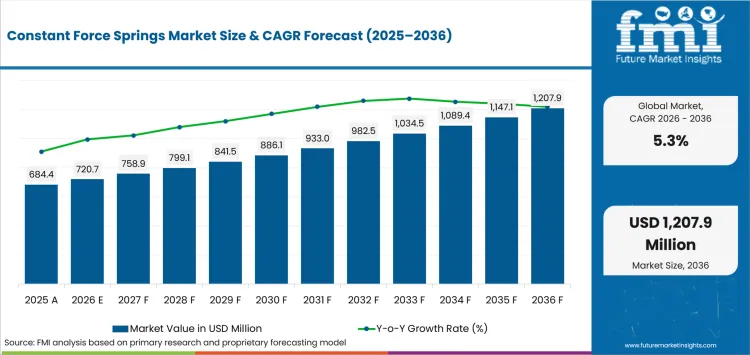
USD 720.7 million in 2026 and USD 1,207.9 million by 2036 at a 5.3% CAGR.
Sales of constant force springs are estimated to rise at 5.3% CAGR through 2036, increasing valuation from USD 720.7 million in 2026 to USD 1,207.9 million by 2036. Compact equipment uses these strips where a mechanism needs steady pull through long travel without a large helical envelope. IFR counted 542,000 industrial robot installations in 2024 during its September 2025 release. Each robot does not require a constant force spring, but robotic equipment deployment increases the number of counterbalance and retraction positions that engineers must package.
Country demand separates according to manufacturing mix, qualification burden and the speed of local platform change. Czech vehicle programs are unusually export exposed because AutoSAP reported in January 2026 that 92.5% of passenger cars produced in 2025 went abroad. Mexico and South Korea also depend heavily on vehicle platforms, whereas USA orders span factory automation systems plus medical and aerospace programs. Those differences change the required stocking depth and documentation before an engineered spring advances from prototype quantities into repeat production.
Key Takeaways of Constant Force Springs Market
- Compact motion systems increase demand where engineers need near-uniform force through travel without allocating space for a long helical spring.
- By spring type, standard constant force springs are estimated to hold 34.0% in 2026 because their strip geometry suits common retraction and counterbalance duties.
- In 2026, stainless steel is expected to lead material with 46.0% share owing to corrosion resistance and familiar spring-temper processing.
- Light load is projected to hold 29.0% share in 2026 due to compact mechanisms that need controlled pull with limited stored energy.
- Fatigue life and end-use qualification can slow design approval because force stability depends on strip stress, coil diameter and mounting geometry.
- Some of the key players in this market include Hunter Spring, Vulcan Spring & Manufacturing Company, Lee Spring, John Evans' Sons, MW Components, KERN-LIEBERS, Lesjöfors, and Ming Tai Industrial Co., Ltd.
Analyst Perspective
"Constant force springs should be specified from the force-travel curve backward because coil diameter and strip width determine whether the mechanism fits. A credible production offer keeps that geometry unchanged through fatigue testing and qualification so a late source change does not reopen the mechanical design."
- Nikhil Kaitwade, Principal Consultant, Future Market Insights
How is the constant force springs market segmented?
The constant force springs market is assessed by spring type, material, load range, end use and sales channel.
By spring type, the analysis covers standard constant force springs, motor springs, negator springs, pre-stressed strip springs and custom coiled springs. Material includes stainless steel, high-carbon steel, pre-tempered steel and specialty alloys. Load range covers light, medium, heavy and precision micro-load duties. End use includes medical devices, automotive, aerospace, industrial equipment and consumer products. Sales channels comprise spring manufacturers direct, industrial distributors, custom engineering supply and catalog or e-commerce ordering.
What supports Medical devices within the End use category?
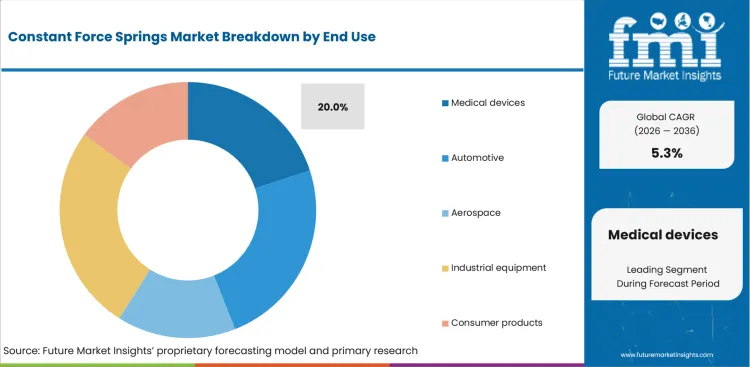
Medical mechanisms require controlled movement in compact housings and impose tighter records on materials or design changes during regulated production. Constant force springs can handle positioning and retraction inside medical robot systems without a steep increase in pull through the working stroke.
- Medical devices are set to lead the end use category with 20.0% share in 2026 due to compact motion needs and formal quality controls.
- USA device manufacturers now work under the FDA's QMSR, which became effective in February 2026 and incorporates ISO 13485:2016. The revised framework raises the value of traceable spring materials and controlled revisions after a component enters validated production.
What makes Standard constant force springs central to the Spring type category?
Standard constant force springs suit mechanisms that need steady pull through a long linear stroke without a large helical envelope. Their pre-stressed strip unwinds from a compact coil and fits lifts or retractors where packaging space is constrained. A3 recorded 9,055 industrial robot orders in North America during the first quarter of 2026.
- By spring type, standard constant force springs are estimated to hold 34.0% in 2026 because the familiar strip format covers common counterbalance and take-up duties.
- Automation engineers use the standard geometry as an early design reference because predictable force through travel reduces packaging changes before production tooling is released.
Why does Stainless steel lead the Material category?
Material selection starts with repeated strip bending at the storage coil before corrosion exposure becomes relevant in service. Stainless steel grades reduce corrosion risk in medical and industrial equipment without forcing every application into a higher-cost specialty alloy.
- In 2026, stainless steel is expected to lead material with 46.0% share owing to corrosion resistance and spring-temper behavior that fits repeated service.
- World Stainless Association reported in February 2026 that global stainless melt-shop production reached 64.2 million tonnes in 2025. The broad material base does not remove the need for application-specific temper and finish before tooling release.
How does Light load shape the load Range category?
Light-load designs fit retractors and automated slides that need useful travel without reinforced mounting structures. In April 2025, Hunter Spring expanded its EV charging application coverage with spring-driven cable-management systems using NEG'ATOR constant-force assemblies for repeated cable movement. The example shows how a compact strip spring can control a moving service cable without a heavy counterweight.
- The light-load segment is likely to capture 29.0% share in 2026 attributable to small mechanisms that need useful travel without heavy mounting structures.
- Cable reels and compact sliding mechanisms favor lower moving mass because wider strips or stacked springs can enlarge the assembly before higher force becomes necessary.
What are the drivers, restraints and opportunities in the constant force springs market?
Automation increases spring positions in compact motion systems, qualification lengthens source approval, and faster engineering handoffs improve conversion from prototype to production.
- Driver: Automated equipment introduces more counterbalance, tensioning and retraction duties that fit a near-uniform force profile over useful travel.
- Restraint: Qualification records and fatigue evidence can delay source changes after strip geometry becomes part of an approved mechanism.
- Opportunity: Spring makers can retain prototype speed by pairing accessible standard parts with documented custom engineering for qualified production programs.
Automation demand reaches constant force springs through mechanisms that need counterbalance or retraction inside a fixed package. A3 recorded 8,940 North American robot orders in the second quarter of 2026. Semiconductors and life sciences were among the sectors increasing automation purchases during the period. Spring makers capture a share where an axis or cable path needs near-uniform force without a larger motor.
Qualification becomes expensive once a spring geometry is frozen inside regulated or flight-critical equipment. Lee Spring India achieved AS9100D certification in December 2025 for custom spring manufacturing, illustrating the formal process controls that aerospace programs can require before a source gains approval. These controls raise switching costs because a lower part price does not remove repeated documentation or validation work in precision mechanical components.
Digital selection tools can shorten early mechanical screening before a custom spring program reaches detailed engineering. ASRaymond relaunched its Counterbalance Configurator in January 2026 with direct add-to-cart functionality. The relaunch moved counterbalance screening closer to initial design work and gives constant-force specialists a clear benchmark for faster force selection and quotation.
Which country CAGRs are profiled in the constant force springs market?
| Country | CAGR |
|---|---|
| Czech Republic | 6.0% |
| Mexico | 5.4% |
| USA | 4.8% |
| Germany | 4.6% |
| Japna | 4.0% |
How do country-level CAGRs compare in the constant force springs market?
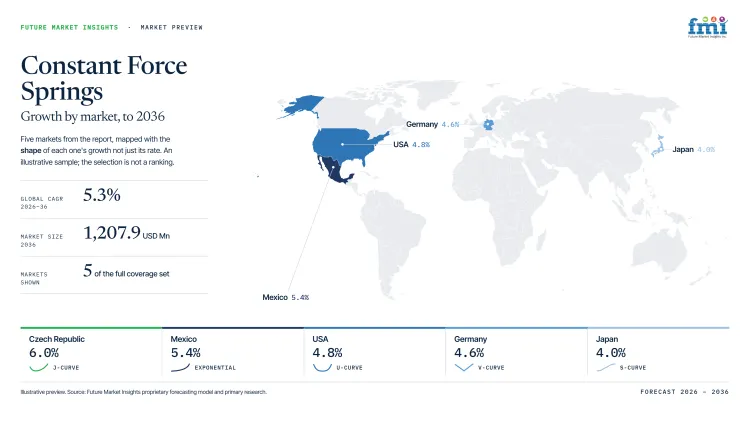
The profiled countries span 2.0 percentage points, with the Czech Republic leading and Japan recording the lowest CAGR. Czech Republic leads at 6.0%, followed by Mexico at 5.4%, while USA and Germany form a close pair at 4.8% and 4.6%. Japan trails at 4.0%. The differences reflect automotive production.
- Czech vehicle programs reward fast engineering response near Central European assembly plants.
- Mexico links spring demand to localized North American model launches and assembly corridors.
- USA combines long aerospace program lives with slower redesign frequency after formal approval.
- Germany reflects steady automotive and industrial automation demand across established manufacturing bases.
- Japan shows slower growth as mature automotive and industrial programs emphasize durability and replacement demand.
Similar CAGRs produce different entry conditions because service and qualification routes vary locally. The full report provides country-level CAGR analysis across North America, Latin America, Europe, East Asia, South Asia, Oceania and the Middle East and Africa.
Country-wise Analysis
- Czech constant force spring purchasing follows export vehicle programs and the engineering calendars of nearby European assembly plants. AutoSAP reported in July 2026 that 40% of first-half passenger vehicles used an electrified drivetrain. The Czech Republic is projected to grow at 6.0% CAGR through 2036 because electrified platforms increase compact retraction and counterbalance duties. High export exposure gives local spring makers a direct route into regional programs, yet late force-curve revisions can disrupt release schedules. Firms with nearby prototyping and repeatable strip forming are better placed to carry approved geometry into series production without delaying vehicle launches or reopening an accepted component design.
- Mexican spring demand follows North American vehicle launch calendars, so local inventory becomes valuable during production ramps and engineering changes. INEGI's August 2026 record showed July exports of 261,534 light vehicles from Mexican assembly plants. The export volume keeps North American launch schedules central to local spring sourcing decisions. Imported strip lead times and multi-tier approvals can delay a revised spring even if vehicle plants need a faster response. Constant force spring sales in Mexico are forecast to expand at 5.4% CAGR during the forecast period, tied to localized automotive spring programs. Growth should favor companies that stock material locally and shorten the technical loop between tier engineers and spring forming.
- USA constant force spring demand is spread among automation, medical equipment and aerospace programs with different approval and stocking routes. IFR's June 2026 release counted 38,000 USA industrial robot installations in 2025 and documented an 11% annual increase. The installed automation base gives spring makers retraction and counterbalance opportunities outside a single vehicle platform. The USA constant force springs sector is projected to record 4.8% CAGR during the assessment period, reflecting diversified equipment investment. Material traceability and end-use validation can lengthen source changes, so distribution reach alone does not secure regulated programs without application engineering support near the final mechanism.
- Germany’s constant force spring demand is supported by automotive manufacturing, industrial automation, medical equipment, and precision machinery programs with established qualification and supplier networks. The country’s large installed manufacturing base creates opportunities for retraction, counterbalance, and tension-control applications across factory equipment and vehicle systems. The Germany constant force springs sector is projected to record 4.6% CAGR during the assessment period, reflecting steady industrial investment and replacement demand. Tight engineering specifications and established supplier relationships can lengthen source changes, making application engineering and localized technical support important for securing OEM and industrial automation programs.
- Japan’s constant force spring demand is concentrated across automotive, industrial automation, electronics equipment, medical devices, and precision machinery programs with demanding reliability requirements. The country’s mature manufacturing base supports recurring applications in compact mechanisms, retraction systems, counterbalance assemblies, and automated equipment. The Japan constant force springs sector is projected to record 4.0% CAGR during the assessment period, reflecting stable replacement demand and selective equipment investment. Long-running product platforms and stringent qualification practices can slow supplier changes, increasing the importance of consistent quality, dimensional control, and application-specific engineering support.
Who are the notable companies in the constant force springs market?
Hunter Spring, Vulcan Spring & Manufacturing Company, Lee Spring, John Evans' Sons, MW Components, KERN-LIEBERS, Lesjöfors, and Ming Tai Industrial Co., Ltd. are the notable companies serving this market.
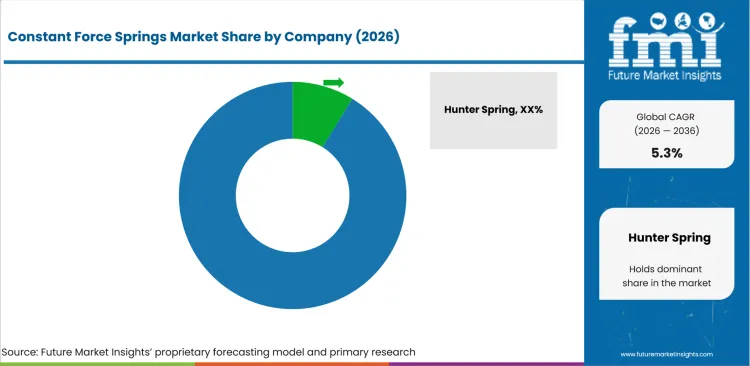
Competition divides between flat-strip specialists and broader spring groups that can carry a design from sample quantities into controlled production. Specialist firms compete on pre-stressed strip geometry and termination design. Broader manufacturers pair stock ranges with custom tooling for precision switch components and other electromechanical assemblies. Entry barriers come from repeatable force curves, fatigue evidence and qualification support instead of corporate size alone.
- Hunter Spring, Vulcan Spring & Manufacturing Company, John Evans' Sons and Ming Tai Industrial Co., Ltd. compete through specialist constant-force or steel-strip engineering.
- Lee Spring, MW Components and Lesjöfors serve programs that move between standard selection and application-specific custom manufacturing.
- KERN-LIEBERS brings constant-force spring production into a wider precision-component and automotive OEM engineering network for series programs.
Competitive Benchmarking: Constant Force Springs Market
| Company | Constant-force strip portfolio | Qualification-critical end-use readiness | Stock-to-custom sourcing flexibility | Geographic reach |
|---|---|---|---|---|
| Hunter Spring | High | Medium | High | North America and international supply |
| Vulcan Spring & Manufacturing Company | High | High | High | North America and international customers |
| Lee Spring | High | High | High | North America, Europe, Mexico and Asia |
| John Evans' Sons | High | High | Medium | North America and international programs |
| MW Components | High | High | High | United States and international distribution |
| KERN-LIEBERS | Medium | High | Medium | Europe, North America and Asia |
| Lesjöfors | High | High | High | Europe, North America and Asia |
| Ming Tai Industrial Co., Ltd. | High | Medium | High | Taiwan and international export markets |
Scoring basis: High constant-force portfolio breadth requires at least three documented strip-spring families. Medium portfolio breadth covers one or two current families and Low identifies a documented single-family limit in exact-market breadth. High qualification readiness requires at least two controlled end-use or certification routes. Medium qualification readiness requires one verified route and Low requires a documented limitation against the defined quality threshold. High sourcing flexibility requires standard availability and custom engineering within one company route. Medium sourcing flexibility requires one route plus engineering support and Low requires a documented stock-only or custom-only model. Geographic reach records current operating or sales regions and is not scored.
Key Developments in the Constant Force Springs Market
- In July 2026, Ming Tai Industrial Co., Ltd. launched constant-force spring balancing system solutions for Z-axis automation and precision equipment.
- In February 2026, Lee Spring acquired Thomas Spring to gain flat-spring manufacturing expertise and additional Connecticut capacity for stock-to-custom spring programs.
- In April 2025, Lesjöfors completed its 51% acquisition of International Industrial Springs in India and extended its spring portfolio through regional production.
Key Players in the Constant Force Springs Market
Dedicated constant-force and flat-strip specialists
- Hunter Spring
- Vulcan Spring & Manufacturing Company
- John Evans' Sons
- Ming Tai Industrial Co., Ltd.
Broad stock and custom spring platforms
- Lee Spring
- MW Components
- Lesjöfors
Precision spring and OEM engineering group
- KERN-LIEBERS
Constant Force Springs Market - Report Scope
| Coverage field | Report scope |
|---|---|
| Market breakdown | By spring type, material, load range, end use and sales channel. |
| Quantitative Units | USD Million. |
| Market Definition | Commercial constant force springs and related pre-stressed strip spring products sold as standard or custom components within the defined application and channel universe. |
| Regions Covered | North America, Latin America, Europe, East Asia, South Asia and Pacific, and Middle East and Africa. |
| Countries Covered | Czech Republic, Mexico, South Korea, USA, France, and 20+ countries included in the full report. |
| Key Companies Profiled | Hunter Spring, Vulcan Spring & Manufacturing Company, Lee Spring, John Evans' Sons, MW Components, KERN-LIEBERS, Lesjöfors, and Ming Tai Industrial Co., Ltd. |
| Forecast Period | 2026 to 2036. |
| Approach | Primary and secondary research with market triangulation. |
Constant Force Springs Market - Research Methodology
| Method | Approach |
|---|---|
| Primary Research | FMI analysts gathered input from manufacturers, service providers, technology developers, distributors, end users, procurement teams, and subject-matter experts. Interviews examined purchasing decisions, product or service evaluation, adoption barriers, approval requirements, pricing considerations, and expectations for technical or commercial support. Respondents were also asked what evidence is required before a trial, pilot, or initial order develops into regular purchasing. |
| Desk Research | Desk research covered government statistics, regulatory publications, trade data, industry associations, technical literature, standards, company filings, product information, and official corporate announcements. Sources were reviewed for relevance, publication date, geographic coverage, and consistency with the defined market scope. Claims relating to performance, applications, approvals, capacity, investment, and commercial activity were retained only when supported by credible public evidence. |
| Market Sizing and Forecasting | The market model combined the baseline value with historical performance, segment structure, pricing and volume indicators, adoption levels, company participation, and country-level demand conditions. Forecast assumptions considered economic activity, investment trends, regulatory developments, technology adoption, purchasing cycles, supply availability, and barriers to wider market use. Segment and regional estimates were reconciled before the final market total was calculated. |
| Data Validation | Estimates were checked against multiple independent indicators, including public data, company activity, trade patterns, industry developments, and findings from primary interviews. Validation also tested whether products, services, applications, and company revenues fell within the defined market boundaries. Adjacent categories, unsupported claims, overlapping revenues, and activities without direct market relevance were excluded to reduce double counting and maintain consistency across segments and countries. |
Constant Force Springs Market by Segments
Constant Force Springs Market segmented by Spring Type:
- Standard constant force springs
- Motor springs
- Negator springs
- Pre-stressed strip springs
- Custom coiled springs
Constant Force Springs Market segmented by Material:
- Stainless steel
- High-carbon steel
- Pre-tempered steel
- Specialty alloys
Constant Force Springs Market segmented by Load Range:
- Light load
- Medium load
- Heavy load
- Precision micro-load
Constant Force Springs Market segmented by End Use:
- Medical devices
- Automotive
- Aerospace
- Industrial equipment
- Consumer products
Constant Force Springs Market segmented by Sales Channel:
- Spring manufacturers direct
- Industrial distributors
- Custom engineering supply
- Catalog/e-commerce
Constant Force Springs Market by Region:
- North America
- United States
- Canada
- Latin America
- Brazil
- Mexico
- Chile
- Rest of Latin America
- Western Europe
- Germany
- United Kingdom
- Italy
- Spain
- France
- Nordics
- Benelux
- Rest of Western Europe
- Eastern Europe
- Russia
- Poland
- Hungary
- Balkan and Baltic States
- Rest of Eastern Europe
- East Asia
- China
- Japan
- South Korea
- South Asia and Pacific
- India
- ASEAN
- Australia and New Zealand
- Rest of South Asia and Pacific
- Middle East and Africa
- Kingdom of Saudi Arabia
- Other GCC Countries
- Türkiye
- South Africa
- Other African Union Countries
- Rest of Middle East and Africa
Research Sources and Bibliography
- International Federation of Robotics. (2025, September 25). Global robot demand in factories doubles over 10 years.
- Automotive Industry Association of the Czech Republic. (2026, January 27). 2025: Second strongest year in passenger car production, record year for bus production.
- Association for Advancing Automation. (2026, May 13). Robot orders hold steady in Q1 2026 as demand broadens across non-automotive industries.
- World Stainless Association. (2026, February 27). Stainless steel melt shop production increases by 2.1% in 2025.
- Hunter Spring. (2025, April 15). EV without the chaos: The unsung hero of trouble-free charging stations.
- USA Food and Drug Administration. (2026, February 2). Quality Management System Regulation (QMSR).
- Association for Advancing Automation. (2026, August 11). Robot orders increase in Q2 as automation demand broadens across industries.
- Lee Spring. (2025, December 8). Lee Spring India achieves AS9100D certification, reinforcing commitment to quality excellence across industries.
- ASRaymond. (2026, January 19). Smarter selection starts here: The Counterbalance Configurator Tool is back.
- Automotive Industry Association of the Czech Republic. (2026, July 17). Over three quarters of a million vehicles produced in the first half of the year. The Czech automotive industry maintains strong performance.
- Instituto Nacional de Estadística y Geografía. (2026, August 7). Administrative record of the light vehicle automotive industry.
- Ministry of Trade, Industry and Resources, Republic of Korea. (2026, August 14). Automobile exports hit record high for July; government and industry join forces on future-vehicle transition and mutual growth.
- International Federation of Robotics. (2026, June 18). US robot industry returns to double digit growth.
- GIFAS. (2026, May 11). The French aerospace industry remains strongly positioned for the future - 2025 results.
- Ming Tai Industrial Co., Ltd. (2026, July 22). Constant force spring for balanced system solutions.
- Lee Spring. (2026, February 12). Lee Spring continues strategic expansion with Thomas Spring acquisition.
- Lesjöfors. (2025, April 3). Acquisition of India based International Industrial Springs completed.
- KERN-LIEBERS. (2026, July 9). A new chapter for KERN LIEBERS in China.
- Lesjöfors. (2026, April 21). New global catalog opens the door to Lesjöfors stock products worldwide.
- Lesjöfors. (2025, September 11). Lesjöfors strengthens European medical capabilities with ISO 13485 certification in Sweden.
- KERN-LIEBERS. (2026, July 1). Carl Haas becomes KERN LIEBERS Lienberg GmbH.
- Lesjöfors. (2026, March 18). Lesjöfors AB becomes Beijer Components AB.
- MW Components. (2025, October 13). MW Components launches Office of Commercial Excellence.
- Lee Spring. (2025, December). Lee Spring achieves Cyber Essentials certification.
- Bureau Veritas Certification. (2025, February 21). Certification [ISO 13485:2016 certificate for RPK, S.COOP.].
- TR Fastenings. (2025, March 10). Collaboration for bespoke solutions.
- ASRaymond. (2025, September 8). ASRaymond to enhance customer experience.
- Smalley. (2025, October 1). Smalley debuts Nestawave compression spring, redefining performance in compact applications.
This bibliography is provided for reader reference and is not exhaustive. The full report contains the complete reference list and detailed citations.
This Report Answers
- How large is the constant force springs market in 2026 and what value is forecast for 2036?
- Which automation and equipment-design conditions increase demand for constant force springs?
- Why do standard constant force springs hold 34.0% of the spring type category in 2026?
- Why does stainless steel account for 46.0% of the material category in 2026?
- How does the 29.0% light-load share relate to compact retraction and counterbalance mechanisms?
- How do country growth rates differ among Czech Republic, Mexico, South Korea, USA and France?
- Which companies compete through specialist flat-strip engineering or broader stock-to-custom spring platforms?
- How do fatigue life and end-use qualification affect source changes and production approval?
- What should engineering teams evaluate before moving a constant force spring from prototype into series production?
Frequently Asked Questions
How big is the constant force springs market in 2026?
The constant force springs market is valued at USD 720.7 million in 2026 and is projected to reach USD 1,207.9 million by 2036. Compact automated equipment increases the number of mechanisms requiring steady force through long travel in confined spaces.
What is the CAGR of the constant force springs market from 2026 to 2036?
The constant force springs market is projected to grow at a CAGR of 5.3% between 2026 and 2036. Expansion is tied to automation and compact counterbalance systems that require repeatable force over useful travel.
Which spring type leads the constant force springs market?
The standard constant force springs segment is expected to hold 34.0% of the constant force springs market in 2026, driven by broad use in counterbalance and retraction duties. Its familiar strip geometry gives engineers a practical starting point for custom designs with controlled travel.
Which material leads the constant force springs market?
The stainless steel segment is expected to hold 46.0% of the constant force springs market in 2026, attributable to corrosion resistance and spring-temper behavior. The material fits repeated service in medical and industrial mechanisms without requiring premium alloys for every application.
How much value will the constant force springs market add between 2026 and 2036?
The constant force springs market is expected to add USD 487.2 million in value between 2026 and 2036. The increase follows broader use of compact counterbalance and retraction mechanisms in automated and qualification-sensitive equipment.
Which countries are projected to record the highest growth in the constant force springs market?
Czech Republic is projected to grow at 6.0% CAGR, followed by Mexico at 5.4% and South Korea at 5.2% through 2036. Vehicle-platform turnover and concentrated manufacturing programs shape the faster growth rates in these three countries.
Which companies are active in the constant force springs market?
Key companies operating in the constant force springs market include Hunter Spring, Vulcan Spring & Manufacturing Company, Lee Spring, John Evans' Sons, MW Components, KERN-LIEBERS, Lesjöfors, and Ming Tai Industrial Co., Ltd. Their positions differ by strip specialization, application engineering and regional production access.
Preview the report firsthand - request a free sample
Get SampleGet the brochure for pricing and purchase details.
Get PDFTable of Content
- Key Takeaways
- Market Size and CAGR
- Top Growth Driver
- Fastest Growing Segment
- Leading Region
- Key Companies
- Emerging Opportunities
- Executive Summary
- Global Market Outlook
- Demand-side Trends
- Supply-side Trends
- Technology Roadmap Analysis
- Analysis and Recommendations
- Analyst Perspective (What is happening? Why now? What should investors know?)
- Key Questions Answered
- How large is the market?
- What is the CAGR?
- What are key trends?
- Which region dominates?
- Who are the leaders?
- Market Overview
- Market Coverage / Taxonomy
- Market Definition / Scope / Limitations
- Research Methodology
- Chapter Orientation
- Analytical Lens and Working Hypotheses
- Market Structure, Signals, and Trend Drivers
- Benchmarking and Cross-market Comparability
- Market Sizing, Forecasting, and Opportunity Mapping
- Research Design and Evidence Framework
- Desk Research Programme (Secondary Evidence)
- Expert Input and Fieldwork (Primary Evidence)
- Tooling, Models, and Reference Databases
- Data Engineering and Model Build
- Quality Assurance and Audit Trail
- Market Background
- Market Dynamics (Drivers, Restraints, Opportunity, Trends)
- Scenario Forecast (Optimistic, Likely, Conservative)
- Impact Analysis
- AI Impact
- Sustainability Impact
- Regulatory Impact
- Technology Impact
- Consumer / Buyer Analysis
- Purchase Drivers
- Adoption Barriers
- Buyer Journey
- Opportunity Map Analysis
- Product Life Cycle Analysis
- Supply Chain Analysis
- Investment Feasibility Matrix
- Value Chain Analysis
- PESTLE and Porter's Analysis
- Regulatory Landscape
- Regional Parent Market Outlook
- Production and Consumption Statistics
- Import and Export Statistics
- Global Market Analysis and Forecast, 2021 to 2036
- Historical Market Size Value (USD Million) Analysis, 2021 to 2025
- Current and Future Market Size Value (USD Million) Projections, 2026 to 2036
- Y-o-Y Growth Trend Analysis
- Absolute $ Opportunity Analysis
- Global Market Pricing Analysis, 2021 to 2036
- Global Market Analysis and Forecast, By Spring Type, 2021 to 2036
- Introduction / Key Findings
- Historical Market Size Value (USD Million) Analysis By Spring Type, 2021 to 2025
- Current and Future Market Size Value (USD Million) Analysis and Forecast By Spring Type, 2026 to 2036
- Standard constant force springs
- Motor springs
- Negator springs
- Pre-stressed strip springs
- Custom coiled springs
- Standard constant force springs
- Y-o-Y Growth Trend Analysis By Spring Type, 2021 to 2025
- Absolute $ Opportunity Analysis By Spring Type, 2026 to 2036
- Global Market Analysis and Forecast, By Material, 2021 to 2036
- Introduction / Key Findings
- Historical Market Size Value (USD Million) Analysis By Material, 2021 to 2025
- Current and Future Market Size Value (USD Million) Analysis and Forecast By Material, 2026 to 2036
- Stainless steel
- High-carbon steel
- Pre-tempered steel
- Specialty alloys
- Stainless steel
- Y-o-Y Growth Trend Analysis By Material, 2021 to 2025
- Absolute $ Opportunity Analysis By Material, 2026 to 2036
- Global Market Analysis and Forecast, By Load Range, 2021 to 2036
- Introduction / Key Findings
- Historical Market Size Value (USD Million) Analysis By Load Range, 2021 to 2025
- Current and Future Market Size Value (USD Million) Analysis and Forecast By Load Range, 2026 to 2036
- Light load
- Medium load
- Heavy load
- Precision micro-load
- Light load
- Y-o-Y Growth Trend Analysis By Load Range, 2021 to 2025
- Absolute $ Opportunity Analysis By Load Range, 2026 to 2036
- Global Market Analysis and Forecast, By End Use, 2021 to 2036
- Introduction / Key Findings
- Historical Market Size Value (USD Million) Analysis By End Use, 2021 to 2025
- Current and Future Market Size Value (USD Million) Analysis and Forecast By End Use, 2026 to 2036
- Medical devices
- Automotive
- Aerospace
- Industrial equipment
- Consumer products
- Medical devices
- Y-o-Y Growth Trend Analysis By End Use, 2021 to 2025
- Absolute $ Opportunity Analysis By End Use, 2026 to 2036
- Global Market Analysis and Forecast, By Sales Channel, 2021 to 2036
- Introduction / Key Findings
- Historical Market Size Value (USD Million) Analysis By Sales Channel, 2021 to 2025
- Current and Future Market Size Value (USD Million) Analysis and Forecast By Sales Channel, 2026 to 2036
- Spring manufacturers direct
- Industrial distributors
- Custom engineering supply
- Catalog/e-commerce
- Spring manufacturers direct
- Y-o-Y Growth Trend Analysis By Sales Channel, 2021 to 2025
- Absolute $ Opportunity Analysis By Sales Channel, 2026 to 2036
- Global Market Analysis and Forecast, By Region, 2021 to 2036
- Introduction
- Historical Market Size Value (USD Million) Analysis By Region, 2021 to 2025
- Current Market Size Value (USD Million) Analysis and Forecast By Region, 2026 to 2036
- North America
- Latin America
- Western Europe
- Eastern Europe
- East Asia
- South Asia and Pacific
- Middle East & Africa
- Market Attractiveness Analysis By Region
- North America Market Analysis and Forecast, By Country, 2021 to 2036
- Historical Market Size Value (USD Million) Trend Analysis By Market Taxonomy, 2021 to 2025
- Market Size Value (USD Million) Forecast By Market Taxonomy, 2026 to 2036
- By Country
- USA
- Canada
- By Spring Type
- By Material
- By Load Range
- By End Use
- By Sales Channel
- By Country
- Market Attractiveness Analysis
- By Country
- By Spring Type
- By Material
- By Load Range
- By End Use
- By Sales Channel
- Key Takeaways
- Latin America Market Analysis and Forecast, By Country
- Historical Market Size Value (USD Million) Trend Analysis By Market Taxonomy, 2021 to 2025
- Market Size Value (USD Million) Forecast By Market Taxonomy, 2026 to 2036
- By Country
- Brazil
- Mexico
- Chile
- Rest of Latin America
- By Spring Type
- By Material
- By Load Range
- By End Use
- By Sales Channel
- By Country
- Market Attractiveness Analysis
- By Country
- By Spring Type
- By Material
- By Load Range
- By End Use
- By Sales Channel
- Key Takeaways
- Western Europe Market Analysis and Forecast, By Country
- Historical Market Size Value (USD Million) Trend Analysis By Market Taxonomy, 2021 to 2025
- Market Size Value (USD Million) Forecast By Market Taxonomy, 2026 to 2036
- By Country
- Germany
- UK
- Italy
- Spain
- France
- Nordic
- BENELUX
- Rest of Western Europe
- By Spring Type
- By Material
- By Load Range
- By End Use
- By Sales Channel
- By Country
- Market Attractiveness Analysis
- By Country
- By Spring Type
- By Material
- By Load Range
- By End Use
- By Sales Channel
- Key Takeaways
- Eastern Europe Market Analysis and Forecast, By Country
- Historical Market Size Value (USD Million) Trend Analysis By Market Taxonomy, 2021 to 2025
- Market Size Value (USD Million) Forecast By Market Taxonomy, 2026 to 2036
- By Country
- Russia
- Poland
- Hungary
- Balkan & Baltic
- Rest of Eastern Europe
- By Spring Type
- By Material
- By Load Range
- By End Use
- By Sales Channel
- By Country
- Market Attractiveness Analysis
- By Country
- By Spring Type
- By Material
- By Load Range
- By End Use
- By Sales Channel
- Key Takeaways
- East Asia Market Analysis and Forecast, By Country
- Historical Market Size Value (USD Million) Trend Analysis By Market Taxonomy, 2021 to 2025
- Market Size Value (USD Million) Forecast By Market Taxonomy, 2026 to 2036
- By Country
- China
- Japan
- South Korea
- By Spring Type
- By Material
- By Load Range
- By End Use
- By Sales Channel
- By Country
- Market Attractiveness Analysis
- By Country
- By Spring Type
- By Material
- By Load Range
- By End Use
- By Sales Channel
- Key Takeaways
- South Asia and Pacific Market Analysis and Forecast, By Country
- Historical Market Size Value (USD Million) Trend Analysis By Market Taxonomy, 2021 to 2025
- Market Size Value (USD Million) Forecast By Market Taxonomy, 2026 to 2036
- By Country
- India
- ASEAN
- Australia & New Zealand
- Rest of South Asia and Pacific
- By Spring Type
- By Material
- By Load Range
- By End Use
- By Sales Channel
- By Country
- Market Attractiveness Analysis
- By Country
- By Spring Type
- By Material
- By Load Range
- By End Use
- By Sales Channel
- Key Takeaways
- Middle East & Africa Market Analysis and Forecast, By Country
- Historical Market Size Value (USD Million) Trend Analysis By Market Taxonomy, 2021 to 2025
- Market Size Value (USD Million) Forecast By Market Taxonomy, 2026 to 2036
- By Country
- Kingdom of Saudi Arabia
- Other GCC Countries
- Türkiye
- South Africa
- Other African Union
- Rest of Middle East & Africa
- By Spring Type
- By Material
- By Load Range
- By End Use
- By Sales Channel
- By Country
- Market Attractiveness Analysis
- By Country
- By Spring Type
- By Material
- By Load Range
- By End Use
- By Sales Channel
- Key Takeaways
- Key Countries Market Analysis
- USA
- Pricing Analysis
- Market Share Analysis, 2025
- By Spring Type
- By Material
- By Load Range
- By End Use
- By Sales Channel
- Canada
- Pricing Analysis
- Market Share Analysis, 2025
- By Spring Type
- By Material
- By Load Range
- By End Use
- By Sales Channel
- Mexico
- Pricing Analysis
- Market Share Analysis, 2025
- By Spring Type
- By Material
- By Load Range
- By End Use
- By Sales Channel
- Brazil
- Pricing Analysis
- Market Share Analysis, 2025
- By Spring Type
- By Material
- By Load Range
- By End Use
- By Sales Channel
- Chile
- Pricing Analysis
- Market Share Analysis, 2025
- By Spring Type
- By Material
- By Load Range
- By End Use
- By Sales Channel
- Germany
- Pricing Analysis
- Market Share Analysis, 2025
- By Spring Type
- By Material
- By Load Range
- By End Use
- By Sales Channel
- UK
- Pricing Analysis
- Market Share Analysis, 2025
- By Spring Type
- By Material
- By Load Range
- By End Use
- By Sales Channel
- Italy
- Pricing Analysis
- Market Share Analysis, 2025
- By Spring Type
- By Material
- By Load Range
- By End Use
- By Sales Channel
- Spain
- Pricing Analysis
- Market Share Analysis, 2025
- By Spring Type
- By Material
- By Load Range
- By End Use
- By Sales Channel
- France
- Pricing Analysis
- Market Share Analysis, 2025
- By Spring Type
- By Material
- By Load Range
- By End Use
- By Sales Channel
- India
- Pricing Analysis
- Market Share Analysis, 2025
- By Spring Type
- By Material
- By Load Range
- By End Use
- By Sales Channel
- ASEAN
- Pricing Analysis
- Market Share Analysis, 2025
- By Spring Type
- By Material
- By Load Range
- By End Use
- By Sales Channel
- Australia & New Zealand
- Pricing Analysis
- Market Share Analysis, 2025
- By Spring Type
- By Material
- By Load Range
- By End Use
- By Sales Channel
- China
- Pricing Analysis
- Market Share Analysis, 2025
- By Spring Type
- By Material
- By Load Range
- By End Use
- By Sales Channel
- Japan
- Pricing Analysis
- Market Share Analysis, 2025
- By Spring Type
- By Material
- By Load Range
- By End Use
- By Sales Channel
- South Korea
- Pricing Analysis
- Market Share Analysis, 2025
- By Spring Type
- By Material
- By Load Range
- By End Use
- By Sales Channel
- Russia
- Pricing Analysis
- Market Share Analysis, 2025
- By Spring Type
- By Material
- By Load Range
- By End Use
- By Sales Channel
- Poland
- Pricing Analysis
- Market Share Analysis, 2025
- By Spring Type
- By Material
- By Load Range
- By End Use
- By Sales Channel
- Hungary
- Pricing Analysis
- Market Share Analysis, 2025
- By Spring Type
- By Material
- By Load Range
- By End Use
- By Sales Channel
- Kingdom of Saudi Arabia
- Pricing Analysis
- Market Share Analysis, 2025
- By Spring Type
- By Material
- By Load Range
- By End Use
- By Sales Channel
- Türkiye
- Pricing Analysis
- Market Share Analysis, 2025
- By Spring Type
- By Material
- By Load Range
- By End Use
- By Sales Channel
- South Africa
- Pricing Analysis
- Market Share Analysis, 2025
- By Spring Type
- By Material
- By Load Range
- By End Use
- By Sales Channel
- USA
- Market Structure Analysis
- Competition Dashboard
- Competition Benchmarking
- Market Share Analysis of Top Players
- By Regional
- By Spring Type
- By Material
- By Load Range
- By End Use
- By Sales Channel
- Emerging Startups
- Innovation Benchmarking
- Competition Analysis
- Competition Deep Dive
- Hunter Spring
- Overview
- Product Portfolio
- Profitability by Market Segments
- Sales Footprint
- Strategy Overview
- Marketing Strategy
- Product Strategy
- Channel Strategy
- Vulcan Spring
- Smalley
- MW Components
- Lee Spring
- John Evans' Sons
- Associated Spring Raymond
- Kern-Liebers
- Lesjöfors
- Mubea
- Hunter Spring
- Case Studies
- Success Stories
- Recent Developments
- Competition Deep Dive
- Assumptions & Acronyms Used


