

- Market Size (2026)
- USD 250.0 Mn
- Forecast (2036)
- USD 6262.3 Mn
- CAGR (2026 to 2036)
- 38.0%
How big is the Consumer Home Humanoids Market in 2026?
USD 250.0 million in 2026 and USD 6,262.3 million by 2036 at a 38.0% CAGR.
Demand for consumer home humanoids is projected to expand at 38.0% CAGR between 2026 and 2036, increasing valuation from USD 250.0 million in 2026 to USD 6,262.3 million by 2036. Growth depends on a simple test: one robot must save enough time across several chores to justify a price far above single-purpose home automation systems. In October 2025 the International Federation of Robotics reported close to 20 million consumer service robots sold during 2024, an 11% increase from 2023. Domestic-task robots were the largest consumer category in its 294-company sample. This shows that households already pay for robotic help, though it does not prove demand for humanoid designs.
USA developers have attracted large private funding rounds that support longer home trials and faster hardware changes. European launches need more planning for software security and incident reporting on connected products. Figure AI announced more than USD 1 billion in Series C funding during September 2025 at a USD 39 billion post-money valuation. The company linked that capital to Helix training and BotQ production, which can expand home trials and expose grasp failures in changing rooms. Machine vision cameras improve object tracking as people pass through the same space, and larger battery systems give the robot more time between charges. In June 2026 the European Commission confirmed that Cyber Resilience Act reporting starts on September 11, 2026. These conditions may change launch speed, but both regions need safe movement and dependable software support.
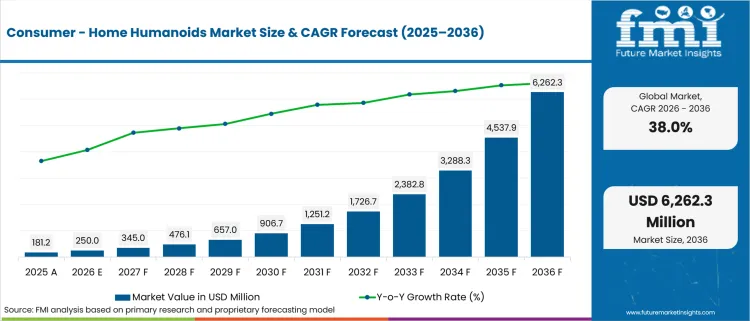
Key Takeaways of Consumer Home Humanoids Market
- Demand for consumer home humanoids is driven by their ability to finish several chores safely and reduce the time owners spend correcting errors, competing against cheaper single-task devices already common in households.
- By component, hardware is expected to lead with 58.0% share in 2026, reflecting the importance of physical systems in determining grip strength, balance, and motion quality.
- Household chores are the dominant application segment, projected to hold 46.0% share in 2026, as time savings provide a clear and measurable benefit for users.
- Bipedal humanoids are estimated to lead the form factor category with 52.0% share in 2026, supported by their ability to navigate stairs and operate at human height.
- Early-adopter households are anticipated to contribute 56.0% of end-user demand, while direct purchase models are projected to lead the business model segment with 44.0% share.
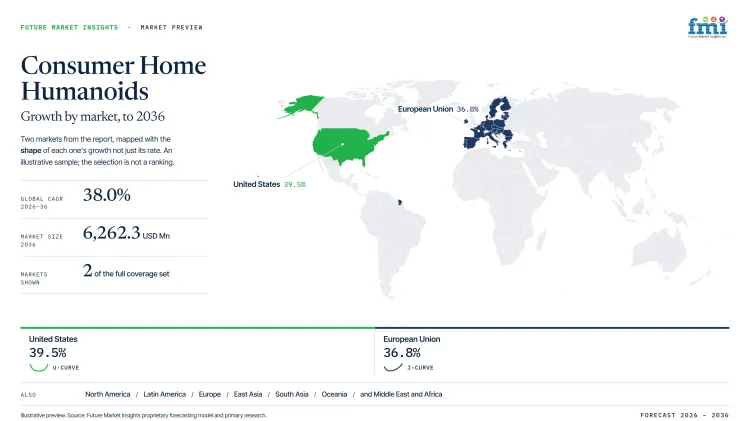
- The United States and European Union are expected to lead growth at 39.5% and 36.8% CAGR respectively through 2036, close to the 38.0% global forecast, with US programs offering clearer pricing and delivery while European data rights may support independent repair services.
- Competition centers on 1X Technologies, Figure AI, LG Electronics, Sunday, and Realbotix, with vendors differentiating through bipedal versus wheeled mobility, appliance integration, and chore-specific versus conversational focus.
Analyst Perspective
"The home humanoid robots market will be defined by dependable everyday assistance rather than headline demonstrations of human-like movement. Consumers are placing greater value on products that operate reliably within real household routines, require minimal intervention, and continue improving through secure software updates over time. Brands that balance practical functionality with privacy protection, dependable after-sales service, and straightforward maintenance are expected to build stronger customer trust as adoption expands."
- Rahul Pandita, Principal Analyst at Future Market Insights
Source: FMI's proprietary forecasting model and primary research
How is the Consumer Home Humanoids Market segmented?
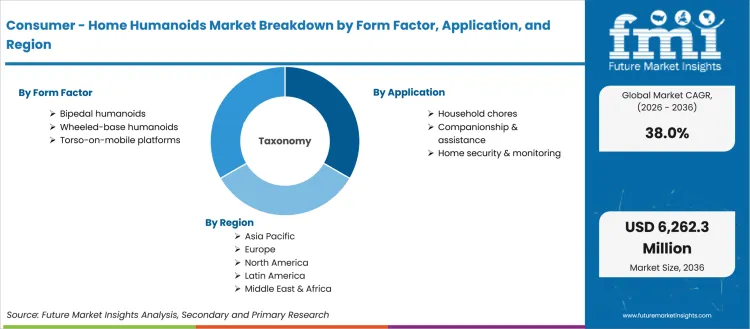
Form factor, application, component, end user, business model, and region
The segmentation separates robot design from the job each system performs at home. Form Factor separates bipedal robots from wheeled machines and torso-on-mobile designs that carry a humanlike upper body through rooms. Application covers household chores alongside companionship and home monitoring, giving each use case a clear test of useful performance. Component analysis separates the physical machine from AI software and paid services that shape performance over time. End User compares early-adopter households with premium smart homes and research programs; Business Model covers direct purchase and subscriptions plus pilot access. Regional analysis stays separate to show how funding, product rules and service networks affect launch timing. Robot sensors connect software decisions to safe motion and grip control in rooms that change throughout the day.
How does bipedal design shape demand within the form factor category?
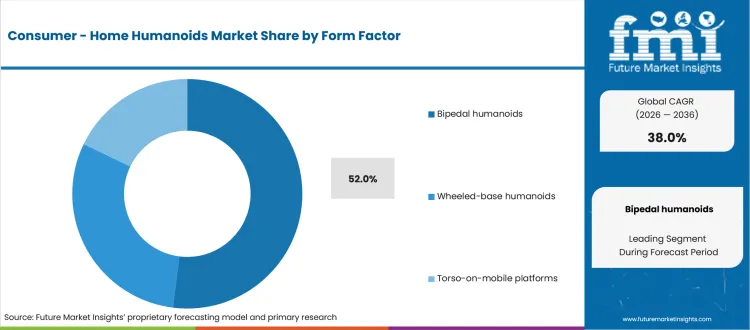
Bipedal robots can climb stairs and reach work surfaces built for people, but that access adds joints and makes balance harder near furniture. In February 2025 1X Technologies introduced NEO Gamma with soft joint covers and tendon-driven motion. The company reported ten times higher hardware reliability and a 10-decibel reduction in operating noise. The design shows that quiet movement and safer contact are as important as walking ability in a home.
- Bipedal humanoids are projected to hold 52.0% share in 2026 owing to stair access and human-height reach. Tactile sensing helps the hands control grip on glassware or fabric and lowers the chance that one slip stops an entire chore. The design has its strongest case in multi-level homes that need work on stairs and counters.
- Households are expected to favor bipedal humanoids over alternatives due to their ability to work on several floors within one routine. Extra motors and balance controls raise repair needs, so robot makers must prove that stair access creates enough useful work to cover the added cost. Wheeled models may offer better value in single-level homes that do not need stair access or complex balance control.
What supports demand for household chores within the application category?
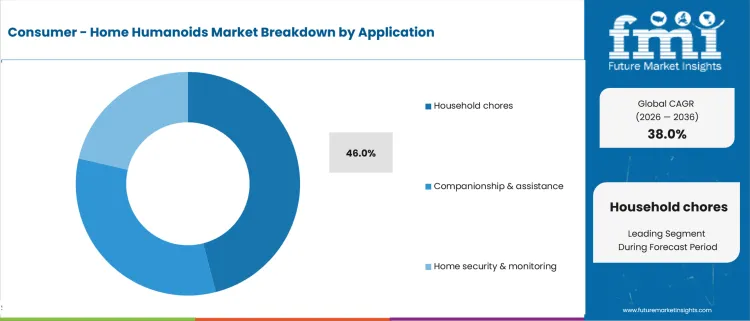
Household chores expose faults that short demonstrations often hide, especially as fabric changes shape and forces the robot to adjust its grip. In August 2025 Figure AI reported fully autonomous towel folding with the same Helix model used for earlier tasks. Figure changed the training data without changing the model or its settings, suggesting that one control system can learn different chores from well-chosen examples.
- By application, household chores are forecast to represent 46.0% in 2026 driven by the time saved on cleaning and laundry. In November 2025, Sunday reported a 90% success rate for converting glove demonstrations into robot training data. Lower training costs could help a single system learn more chores during home trials.
- Purchase activity for household chore robots is anticipated to rise driven by the need for dependable error recovery. Dish handling and fabric care expose weak grip control quickly, so a useful robot should correct small mistakes without asking a person to restart the chore. Frequent rescue removes the time saving that justified the purchase and weakens the case for a broad household rollout.
How is hardware positioned within the component category?
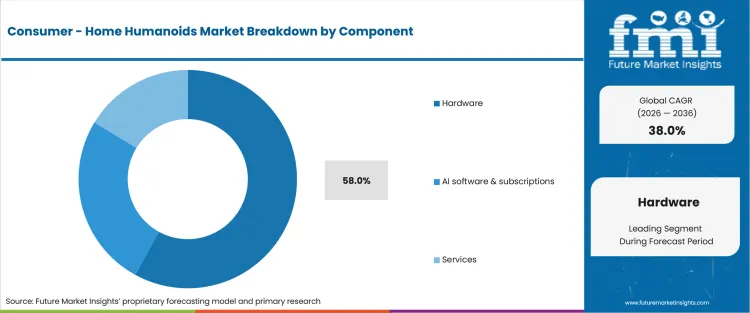
Hardware decides how long a robot can work and how safely it can touch people or objects. Figure AI presented its F.03 battery in July 2025 with 2.3 kilowatt-hours of capacity and five hours of peak runtime. The company reported a 78% cost reduction from the previous design, reducing one major source of hardware expense. Far-field speech recognition can improve commands during longer routines, but durable joints and safe motion decide whether the machine finishes the chore without human rescue.
- By component, hardware is estimated to hold 58.0% share in 2026 owing to the cost of motors and safety systems. Modular joints can shorten common repairs and make routine checks easier, but software training cannot overcome weak joints or limited battery life. These limits become visible as the robot lifts objects and carries them through a full chore.
- Modular hardware is drawing demand from home-robot developers owing to shorter repairs and less service disruption. Conversational AI can improve instructions and user support, but it cannot repair a weak joint or correct poor grip control. Service plans are easier to trust if technicians can replace common parts and return the robot to normal use without a long delay.
What are the drivers, restraints, and opportunities in the Consumer Home Humanoids Market?
Longer home trials reveal failures that controlled stage demonstrations often hide during normal household use. Sunday announced a USD 165 million Series B in March 2026 at a USD 1.15 billion valuation. The company said a public Memo beta would start in fall 2026 for selected homes and test routine household work. The funding supports a wider test of task recovery and service needs, but remote assistance must remain limited enough to protect privacy inside participating homes.
- Driver: Longer home trials show task recovery and service needs that short stage demonstrations can hide.
- Restraint: Safety tests and repair costs can delay household adoption during the first years of commercial use.
- Opportunity: Subscriptions can reduce the first payment and combine maintenance with software support under one service plan.
Home robots work near people and valuable property, so safety duties shape product plans from the start. Regulation (EU) 2023/1230 applies from January 20, 2027 to machinery and related products within its scope. The rule increases the need for documented risk controls and clear instructions, and movement changes delivered through software may require another safety review. Complex joints can raise repair costs over the ownership period, so safety work may slow releases and increase service expense.
Subscriptions can reduce the first payment for a costly home robot and make monthly support costs easier to compare. Appliance links add value by giving the robot status data from ovens or washing machines. A credible contract states repair times and update terms at the start of use. Poor task performance remains a bad deal at any payment level, so Robotics subscription models need clear service standards and support throughout the contract.
Which country CAGRs are profiled in the Consumer Home Humanoids Market?
| Country | CAGR |
|---|---|
| United States | 39.5% |
| European Union | 36.8% |
Source: FMI's proprietary forecasting model and primary research
How do country-level CAGRs compare in the Consumer Home Humanoids Market?
The country comparison covers a modest 2.7 percentage point range, pointing to strong growth in both profiled markets for the consumer home humanoids market. The United States leads at 39.5% CAGR, with the European Union following at 36.8%. The relatively small gap indicates that consumer-facing humanoid robots are attracting interest on both sides of the Atlantic, although purchasing behavior and commercialization pathways differ.
-
With a CAGR of 39.5%, the United States represents the faster-growing market. Consumer interest is centered on AI-enabled humanoids that assist with everyday household activities, home monitoring, interactive companionship and smart home integration. Early availability of consumer robotics platforms and an established ecosystem for AI-powered home technologies continue to encourage market expansion.
-
The European Union follows at 36.8%, remaining 2.7 percentage points behind the United States. Demand is influenced by growing acceptance of domestic service robots, increasing investment in AI innovation and continued development of connected home ecosystems. Commercial adoption is expected to progress at different rates across member states because household robotics penetration, regulatory approaches and consumer preferences are not uniform across the region.
Comparable CAGRs do not necessarily result in identical commercial opportunities. Differences in consumer acceptance, AI ecosystem maturity, household spending patterns and product availability shape adoption rates and long-term market potential. The full report provides country-level CAGR analysis across North America, Latin America, Europe, East Asia, South Asia, Oceania and the Middle East and Africa.
Country-wise Analysis
Growth differs between the United States and the European Union. The United States is forecast to expand at 39.5% CAGR from 2026 to 2036, while the European Union is projected to grow at 36.8%. The 38.0% global rate sits between these forecasts and reflects two routes to household adoption. Large private funding rounds support earlier home trials in the United States. European launches require more work on safety and connected-device data rights. Both regions face the same commercial test: each robot must complete useful work safely enough to justify its purchase price and service cost.
- American programs now extend from funded prototypes to offers with stated prices and delivery dates. Consumer home humanoid demand in the United States is forecast to rise at 39.5% CAGR over the 2026 to 2036 period. In October 2025 1X Technologies set NEO early access at USD 20,000 with priority delivery during 2026. The company announced a USD 499 monthly plan for a later release and said USA homes would receive the first units. This offer gives owners a real price point for comparing a humanoid with narrower home robots or paid domestic services. Connected cameras may improve room awareness, but owners need control over recordings and remote assistance. Faster growth depends on dependable service following delivery rather than attention from a public demonstration.
- European adoption is likely to depend on repair rights and control over data collected inside the home. Consumer home humanoid demand in the European Union is projected to grow at 36.8% CAGR from 2026 to 2036. In July 2026 European Commission guidance stated that the Data Act gives users control over data generated by connected devices. Users may share that data with third-party repair services instead of relying on the original maker. This right matters for robots that record task performance and may need specialist maintenance over several years. Early contracts should explain data access and remote assistance in plain language, which may support trust and competition among repair services despite added launch work.
Who are the notable companies in the Consumer Home Humanoids Market?
1X Technologies, Figure AI, LG Electronics, Sunday, and Realbotix are notable developers across general household work, appliance-linked chores, and companion humanoid systems.
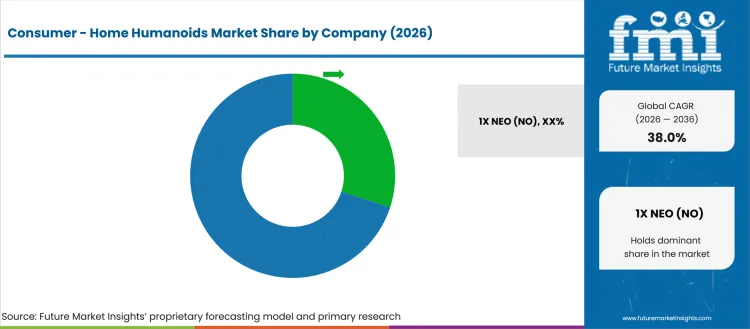
Competition is forming around the job each robot is designed to perform at home rather than body shape alone. 1X Technologies and Figure AI are developing bipedal machines for varied physical work in spaces built for people. Sunday uses a wheeled base to reduce balance risk during routine chores, and LG Electronics links robot actions with appliance data from ThinQ. Realbotix focuses on conversation and personal interaction rather than broad physical work throughout a home. The strongest position should belong to humanoid robots that complete repeatable work and receive dependable support over several weeks. Humanlike appearance cannot make up for frequent failures or long repair delays during ordinary use in the home.
- 1X Technologies and Figure AI compete through bipedal reach and flexible hand use in spaces built for people. Their position depends on repeatable work across several rooms; stair access adds little value if the machine cannot finish the chore that started the trip.
- Wheeled movement reduces balance risk during early home trials, which suits chores in single-level homes that do not need stair access. LG Electronics uses appliance data to guide multi-step chores, and Sunday focuses on table clearing plus dish handling through direct physical work.
- Realbotix enters through companionship and personal interaction rather than broad chore coverage, reducing the need for complex movement through a home. The commercial test is whether scene awareness provides useful help over time inside the home instead of short-lived novelty during daily use.
Competitive Benchmarking: Consumer Home Humanoids Market
| Company | Household Task Range | Mobility in Homes | Human Interaction | Geographic Frame |
|---|---|---|---|---|
| 1X Technologies | High | High | Medium | USA launch; Norway base |
| Figure AI | High | High | Medium | USA |
| LG Electronics | Medium | High | Medium | Global appliance channels |
| Sunday | Medium | High | Low | USA beta |
| Realbotix | Low | Low | High | North America |
Scoring basis: High indicates broad capability supported by official product evidence, Medium indicates partial coverage and Low indicates limited direct evidence in the assessed area.
Source: Future Market Insights competitive analysis, 2026.
Key Developments in the Consumer Home Humanoids Market
- In July 2026, 1X Technologies announced NEO hands with 25 force-controlled degrees of freedom and tactile sensing for pressure plus contact location and finger slip during household handling. The company described the IP68 design as waterproof and food safe and reported a dedicated line with testing for every unit plus capacity for 10,000 hands during 2026, linking wider trials with repeatable manufacturing.
- In October 2025, Figure AI introduced Figure 03 with a softer exterior and wireless charging plus added battery safeguards for safe daily use in occupied homes. Its fingertip sensors detect forces as low as three grams and cameras deliver twice the frame rate with one-quarter the latency of the earlier system, improving control around fragile objects and supporting production at BotQ.
- In January 2026, LG Electronics presented CLOiD at CES 2026 as a wheeled home robot with two articulated arms that coordinate cooking and laundry through ThinQ-connected appliances. The demonstration covered food retrieval and complete laundry steps and LG said the low center of gravity reduces tipping risk near children or pets, showing how appliance data and stable mobility can support multi-step chores.
- In February 2025, Realbotix launched a robotic vision system that combines face and object recognition with real-time scene detection for more responsive humanoid interaction in homes and care settings. The company said current owners could add the system to existing robots, giving companion humanoids better awareness of people and changing rooms during daily use without replacing the full unit or its core hardware.
Key Players in the Consumer Home Humanoids Market
General-purpose home humanoid developers
- 1X Technologies
- Figure AI
Household task and connected-home developers
- LG Electronics
- Sunday
Companion humanoid specialist
- Realbotix
Consumer Home Humanoids Market - Report Scope
| Report Attribute | Coverage |
|---|---|
| Market Breakdown | Form Factor, Application, Component, End User, Business Model, and Region |
| Quantitative Units | USD million, percentage share, and CAGR from 2026 to 2036 |
| Market Definition | Complete consumer humanoid robots and bundled software or support services used for household chores, assistance, companionship, and home monitoring |
| Regions Covered | North America, Latin America, Europe, East Asia, South Asia, Oceania, and Middle East and Africa |
| Countries Covered | United States country forecast and European Union regional benchmark, with other countries covered within the regional analysis |
| Key Companies Profiled | 1X Technologies, Figure AI, LG Electronics, Sunday, and Realbotix |
| Approach | Demand-side review of household use cases and payment models combined with official company announcements and regional launch analysis |
Source: Future Market Insights analysis based on proprietary forecasting models and primary research
Consumer Home Humanoids Market - Research Methodology
| Method | Application |
|---|---|
| Primary Research | FMI analysts gathered input from manufacturers, service providers, technology developers, distributors, end users, procurement teams, and subject-matter experts. Interviews examined purchasing decisions, product or service evaluation, adoption barriers, approval requirements, pricing considerations, and expectations for technical or commercial support. Respondents were also asked what evidence is required before a trial, pilot, or initial order develops into regular purchasing. |
| Desk Research | Desk research covered government statistics, regulatory publications, trade data, industry associations, technical literature, standards, company filings, product information, and official corporate announcements. Sources were reviewed for relevance, publication date, geographic coverage, and consistency with the defined market scope. Claims relating to performance, applications, approvals, capacity, investment, and commercial activity were retained only when supported by credible public evidence. |
| Market Sizing and Forecasting | The market model combined the baseline value with historical performance, segment structure, pricing and volume indicators, adoption levels, company participation, and country-level demand conditions. Forecast assumptions considered economic activity, investment trends, regulatory developments, technology adoption, purchasing cycles, supply availability, and barriers to wider market use. Segment and regional estimates were reconciled before the final market total was calculated. |
| Data Validation | Estimates were checked against multiple independent indicators, including public data, company activity, trade patterns, industry developments, and findings from primary interviews. Validation also tested whether products, services, applications, and company revenues fell within the defined market boundaries. Adjacent categories, unsupported claims, overlapping revenues, and activities without direct market relevance were excluded to reduce double counting and maintain consistency across segments and countries. |
Source: Future Market Insights methodology based on proprietary forecasting models and primary research
Consumer Home Humanoids Market by Segments
Consumer Home Humanoids Market segmented by Form Factor:
- Bipedal humanoids
- Wheeled-base humanoids
- Torso-on-mobile platforms
Consumer Home Humanoids Market segmented by Application:
- Household chores
- Companionship and assistance
- Home security and monitoring
Consumer Home Humanoids Market segmented by Component:
- Hardware
- AI software and subscriptions
- Services
Consumer Home Humanoids Market segmented by End User:
- Early-adopter households
- Premium smart homes
- Developers and research programs
Consumer Home Humanoids Market segmented by Business Model:
- Direct purchase
- Subscription
- Pilot programs
Consumer Home Humanoids Market by Region:
- North America
- United States
- Canada
- Latin America
- Brazil
- Mexico
- Argentina
- Europe
- Germany
- United Kingdom
- France
- Italy
- Spain
- East Asia
- China
- Japan
- South Korea
- South Asia
- India
- Thailand
- Indonesia
- Oceania
- Australia
- New Zealand
- Middle East and Africa
- GCC countries
- South Africa
- Turkey
Research Sources and Bibliography
- International Federation of Robotics. (2025, October 7). World Robotics 2025 report: Service robots see global growth boom.
- Figure AI. (2025, September 16). Figure exceeds USD 1 billion in Series C funding at a USD 39 billion post-money valuation.
- European Commission. (2026, June 8). Cyber Resilience Act: Reporting obligations.
- 1X Technologies. (2025, February 21). Introducing NEO Gamma.
- Figure AI. (2025, August 12). Helix learns to fold laundry.
- Sunday (2025, November 19). ACT-1: A robot foundation model trained on zero robot data.
- Figure AI. (2025, July 17). F.03 battery development.
- Sunday. (2026, March 12). Sunday's Series B: No more demos.
- European Union. (2025, June 12). Machinery safety requirements: Regulation (EU) 2023/1230.
- 1X Technologies. (2025, October 28). NEO home robot: Order today.
- European Commission. (2026, July 2). Data Act.
- 1X Technologies. (2026, July 9). NEO's hands: An API to the physical world.
- Figure AI. (2025, October 9). Introducing Figure 03.
- LG Electronics. (2026, January 4). LG Electronics presents LG CLOiD home robot to demonstrate Zero Labor Home at CES 2026.
- Realbotix. (2025, February 18). Realbotix releases robotic AI vision system.
This bibliography lists primary government, standards-body, official trade body, and company sources used in the analysis.
This Report Answers
- How large is the Consumer Home Humanoids Market in 2026 and what value is forecast for 2036?
- What supports the 38.0% CAGR projected from 2026 to 2036?
- Why do bipedal humanoids lead the form factor category during 2026?
- Which household chores provide the clearest early test of useful performance?
- How do hardware cost and safety duties limit household adoption?
- Why does the United States growth profile exceed the EU outlook?
- Which companies are developing bipedal and wheeled systems for household work?
- How do direct purchase and subscription plans change access to home robots?
- Which repair and privacy terms should households examine during early access?
Frequently Asked Questions
What is driving growth in the Consumer Home Humanoids Market?
Growth comes from robots learning to complete several household jobs safely enough to justify a high price. Better hands and longer home trials are turning short demonstrations into useful work in changing rooms.
Who are the key players in the Consumer Home Humanoids Market?
The bipedal group includes 1X Technologies and Figure AI with systems built for varied physical work. LG Electronics and Sunday Robotics focus on household chores, and Realbotix targets conversation plus personal interaction.
What is a notable restraint in the Consumer Home Humanoids Market?
Home use creates a demanding safety test near people and valuable property during ordinary routines. High hardware cost and uneven task completion can delay purchases despite an impressive public demonstration.
Why should executives track the Consumer Home Humanoids Market?
The category may extend household automation beyond single-purpose devices into flexible help across several chores. Executives should track which companies turn demonstrations into supported products with clear repair terms and service costs.
What business problem does the Consumer Home Humanoids Market address?
The market addresses repetitive household work that fixed appliances and narrow robots cannot complete alone. A useful humanoid combines movement with careful handling so one machine can perform several related jobs.
What should procurement leaders evaluate before selecting suppliers?
Evaluation should focus on task completion and safe contact during home trials rather than humanlike appearance. Later software can change performance inside the home, so repair response and update controls deserve equal weight.
What limits return on investment for purchasers?
Return falls if a robot needs frequent rescue or misses the jobs that justified its purchase. Repair time and subscription fees can widen the gap between a good demonstration and daily household value.
How do suppliers build long-term account confidence?
Robot makers build trust by stating product limits and showing repeatable results in varied homes. Clear service terms and controlled updates show that performance can improve without creating new safety or privacy risks.
Preview the report firsthand - request a free sample
Get SampleGet the brochure for pricing and purchase details.
Get PDFTable of Content
- Key Takeaways
- Market Size and CAGR
- Top Growth Driver
- Fastest Growing Segment
- Leading Region
- Key Companies
- Emerging Opportunities
- Executive Summary
- Global Market Outlook
- Demand-side Trends
- Supply-side Trends
- Technology Roadmap Analysis
- Analysis and Recommendations
- Analyst Perspective (What is happening? Why now? What should investors know?)
- Key Questions Answered
- How large is the market?
- What is the CAGR?
- What are key trends?
- Which region dominates?
- Who are the leaders?
- Market Overview
- Market Coverage / Taxonomy
- Market Definition / Scope / Limitations
- Research Methodology
- Chapter Orientation
- Analytical Lens and Working Hypotheses
- Market Structure, Signals, and Trend Drivers
- Benchmarking and Cross-market Comparability
- Market Sizing, Forecasting, and Opportunity Mapping
- Research Design and Evidence Framework
- Desk Research Programme (Secondary Evidence)
- Expert Input and Fieldwork (Primary Evidence)
- Tooling, Models, and Reference Databases
- Data Engineering and Model Build
- Quality Assurance and Audit Trail
- Market Background
- Market Dynamics (Drivers, Restraints, Opportunity, Trends)
- Scenario Forecast (Optimistic, Likely, Conservative)
- Impact Analysis
- AI Impact
- Sustainability Impact
- Regulatory Impact
- Technology Impact
- Consumer / Buyer Analysis
- Purchase Drivers
- Adoption Barriers
- Buyer Journey
- Opportunity Map Analysis
- Product Life Cycle Analysis
- Supply Chain Analysis
- Investment Feasibility Matrix
- Value Chain Analysis
- PESTLE and Porter's Analysis
- Regulatory Landscape
- Regional Parent Market Outlook
- Production and Consumption Statistics
- Import and Export Statistics
- Global Market Analysis and Forecast, 2021 to 2036
- Historical Market Size Value (USD Million) Analysis, 2021 to 2025
- Current and Future Market Size Value (USD Million) Projections, 2026 to 2036
- Y-o-Y Growth Trend Analysis
- Absolute $ Opportunity Analysis
- Global Market Pricing Analysis, 2021 to 2036
- Global Market Analysis and Forecast, By Form Factor, 2021 to 2036
- Introduction / Key Findings
- Historical Market Size Value (USD Million) Analysis By Form Factor, 2021 to 2025
- Current and Future Market Size Value (USD Million) Analysis and Forecast By Form Factor, 2026 to 2036
- Bipedal humanoids
- Wheeled-base humanoids
- Torso-on-mobile platforms
- Bipedal humanoids
- Y-o-Y Growth Trend Analysis By Form Factor, 2021 to 2025
- Absolute $ Opportunity Analysis By Form Factor, 2026 to 2036
- Global Market Analysis and Forecast, By Application, 2021 to 2036
- Introduction / Key Findings
- Historical Market Size Value (USD Million) Analysis By Application, 2021 to 2025
- Current and Future Market Size Value (USD Million) Analysis and Forecast By Application, 2026 to 2036
- Household chores
- Companionship & assistance
- Home security & monitoring
- Household chores
- Y-o-Y Growth Trend Analysis By Application, 2021 to 2025
- Absolute $ Opportunity Analysis By Application, 2026 to 2036
- Global Market Analysis and Forecast, By Component, 2021 to 2036
- Introduction / Key Findings
- Historical Market Size Value (USD Million) Analysis By Component, 2021 to 2025
- Current and Future Market Size Value (USD Million) Analysis and Forecast By Component, 2026 to 2036
- Hardware
- AI software & subscriptions
- Services
- Hardware
- Y-o-Y Growth Trend Analysis By Component, 2021 to 2025
- Absolute $ Opportunity Analysis By Component, 2026 to 2036
- Global Market Analysis and Forecast, By End User, 2021 to 2036
- Introduction / Key Findings
- Historical Market Size Value (USD Million) Analysis By End User, 2021 to 2025
- Current and Future Market Size Value (USD Million) Analysis and Forecast By End User, 2026 to 2036
- Early-adopter households
- Premium smart homes
- Developers & research
- Early-adopter households
- Y-o-Y Growth Trend Analysis By End User, 2021 to 2025
- Absolute $ Opportunity Analysis By End User, 2026 to 2036
- Global Market Analysis and Forecast, By Business Model, 2021 to 2036
- Introduction / Key Findings
- Historical Market Size Value (USD Million) Analysis By Business Model, 2021 to 2025
- Current and Future Market Size Value (USD Million) Analysis and Forecast By Business Model, 2026 to 2036
- Direct purchase
- Subscription
- Pilot programs
- Direct purchase
- Y-o-Y Growth Trend Analysis By Business Model, 2021 to 2025
- Absolute $ Opportunity Analysis By Business Model, 2026 to 2036
- Global Market Analysis and Forecast, By Region, 2021 to 2036
- Introduction
- Historical Market Size Value (USD Million) Analysis By Region, 2021 to 2025
- Current Market Size Value (USD Million) Analysis and Forecast By Region, 2026 to 2036
- North America
- Latin America
- Western Europe
- Eastern Europe
- East Asia
- South Asia and Pacific
- Middle East & Africa
- Market Attractiveness Analysis By Region
- North America Market Analysis and Forecast, By Country, 2021 to 2036
- Historical Market Size Value (USD Million) Trend Analysis By Market Taxonomy, 2021 to 2025
- Market Size Value (USD Million) Forecast By Market Taxonomy, 2026 to 2036
- By Country
- USA
- Canada
- By Form Factor
- By Application
- By Component
- By End User
- By Business Model
- By Country
- Market Attractiveness Analysis
- By Country
- By Form Factor
- By Application
- By Component
- By End User
- By Business Model
- Key Takeaways
- Latin America Market Analysis and Forecast, By Country
- Historical Market Size Value (USD Million) Trend Analysis By Market Taxonomy, 2021 to 2025
- Market Size Value (USD Million) Forecast By Market Taxonomy, 2026 to 2036
- By Country
- Brazil
- Mexico
- Chile
- Rest of Latin America
- By Form Factor
- By Application
- By Component
- By End User
- By Business Model
- By Country
- Market Attractiveness Analysis
- By Country
- By Form Factor
- By Application
- By Component
- By End User
- By Business Model
- Key Takeaways
- Western Europe Market Analysis and Forecast, By Country
- Historical Market Size Value (USD Million) Trend Analysis By Market Taxonomy, 2021 to 2025
- Market Size Value (USD Million) Forecast By Market Taxonomy, 2026 to 2036
- By Country
- Germany
- UK
- Italy
- Spain
- France
- Nordic
- BENELUX
- Rest of Western Europe
- By Form Factor
- By Application
- By Component
- By End User
- By Business Model
- By Country
- Market Attractiveness Analysis
- By Country
- By Form Factor
- By Application
- By Component
- By End User
- By Business Model
- Key Takeaways
- Eastern Europe Market Analysis and Forecast, By Country
- Historical Market Size Value (USD Million) Trend Analysis By Market Taxonomy, 2021 to 2025
- Market Size Value (USD Million) Forecast By Market Taxonomy, 2026 to 2036
- By Country
- Russia
- Poland
- Hungary
- Balkan & Baltic
- Rest of Eastern Europe
- By Form Factor
- By Application
- By Component
- By End User
- By Business Model
- By Country
- Market Attractiveness Analysis
- By Country
- By Form Factor
- By Application
- By Component
- By End User
- By Business Model
- Key Takeaways
- East Asia Market Analysis and Forecast, By Country
- Historical Market Size Value (USD Million) Trend Analysis By Market Taxonomy, 2021 to 2025
- Market Size Value (USD Million) Forecast By Market Taxonomy, 2026 to 2036
- By Country
- China
- Japan
- South Korea
- By Form Factor
- By Application
- By Component
- By End User
- By Business Model
- By Country
- Market Attractiveness Analysis
- By Country
- By Form Factor
- By Application
- By Component
- By End User
- By Business Model
- Key Takeaways
- South Asia and Pacific Market Analysis and Forecast, By Country
- Historical Market Size Value (USD Million) Trend Analysis By Market Taxonomy, 2021 to 2025
- Market Size Value (USD Million) Forecast By Market Taxonomy, 2026 to 2036
- By Country
- India
- ASEAN
- Australia & New Zealand
- Rest of South Asia and Pacific
- By Form Factor
- By Application
- By Component
- By End User
- By Business Model
- By Country
- Market Attractiveness Analysis
- By Country
- By Form Factor
- By Application
- By Component
- By End User
- By Business Model
- Key Takeaways
- Middle East & Africa Market Analysis and Forecast, By Country
- Historical Market Size Value (USD Million) Trend Analysis By Market Taxonomy, 2021 to 2025
- Market Size Value (USD Million) Forecast By Market Taxonomy, 2026 to 2036
- By Country
- Kingdom of Saudi Arabia
- Other GCC Countries
- Türkiye
- South Africa
- Other African Union
- Rest of Middle East & Africa
- By Form Factor
- By Application
- By Component
- By End User
- By Business Model
- By Country
- Market Attractiveness Analysis
- By Country
- By Form Factor
- By Application
- By Component
- By End User
- By Business Model
- Key Takeaways
- Key Countries Market Analysis
- USA
- Pricing Analysis
- Market Share Analysis, 2025
- By Form Factor
- By Application
- By Component
- By End User
- By Business Model
- Canada
- Pricing Analysis
- Market Share Analysis, 2025
- By Form Factor
- By Application
- By Component
- By End User
- By Business Model
- Mexico
- Pricing Analysis
- Market Share Analysis, 2025
- By Form Factor
- By Application
- By Component
- By End User
- By Business Model
- Brazil
- Pricing Analysis
- Market Share Analysis, 2025
- By Form Factor
- By Application
- By Component
- By End User
- By Business Model
- Chile
- Pricing Analysis
- Market Share Analysis, 2025
- By Form Factor
- By Application
- By Component
- By End User
- By Business Model
- Germany
- Pricing Analysis
- Market Share Analysis, 2025
- By Form Factor
- By Application
- By Component
- By End User
- By Business Model
- UK
- Pricing Analysis
- Market Share Analysis, 2025
- By Form Factor
- By Application
- By Component
- By End User
- By Business Model
- Italy
- Pricing Analysis
- Market Share Analysis, 2025
- By Form Factor
- By Application
- By Component
- By End User
- By Business Model
- Spain
- Pricing Analysis
- Market Share Analysis, 2025
- By Form Factor
- By Application
- By Component
- By End User
- By Business Model
- France
- Pricing Analysis
- Market Share Analysis, 2025
- By Form Factor
- By Application
- By Component
- By End User
- By Business Model
- India
- Pricing Analysis
- Market Share Analysis, 2025
- By Form Factor
- By Application
- By Component
- By End User
- By Business Model
- ASEAN
- Pricing Analysis
- Market Share Analysis, 2025
- By Form Factor
- By Application
- By Component
- By End User
- By Business Model
- Australia & New Zealand
- Pricing Analysis
- Market Share Analysis, 2025
- By Form Factor
- By Application
- By Component
- By End User
- By Business Model
- China
- Pricing Analysis
- Market Share Analysis, 2025
- By Form Factor
- By Application
- By Component
- By End User
- By Business Model
- Japan
- Pricing Analysis
- Market Share Analysis, 2025
- By Form Factor
- By Application
- By Component
- By End User
- By Business Model
- South Korea
- Pricing Analysis
- Market Share Analysis, 2025
- By Form Factor
- By Application
- By Component
- By End User
- By Business Model
- Russia
- Pricing Analysis
- Market Share Analysis, 2025
- By Form Factor
- By Application
- By Component
- By End User
- By Business Model
- Poland
- Pricing Analysis
- Market Share Analysis, 2025
- By Form Factor
- By Application
- By Component
- By End User
- By Business Model
- Hungary
- Pricing Analysis
- Market Share Analysis, 2025
- By Form Factor
- By Application
- By Component
- By End User
- By Business Model
- Kingdom of Saudi Arabia
- Pricing Analysis
- Market Share Analysis, 2025
- By Form Factor
- By Application
- By Component
- By End User
- By Business Model
- Türkiye
- Pricing Analysis
- Market Share Analysis, 2025
- By Form Factor
- By Application
- By Component
- By End User
- By Business Model
- South Africa
- Pricing Analysis
- Market Share Analysis, 2025
- By Form Factor
- By Application
- By Component
- By End User
- By Business Model
- USA
- Market Structure Analysis
- Competition Dashboard
- Competition Benchmarking
- Market Share Analysis of Top Players
- By Regional
- By Form Factor
- By Application
- By Component
- By End User
- By Business Model
- Emerging Startups
- Innovation Benchmarking
- Competition Analysis
- Competition Deep Dive
- 1X NEO (NO)
- Overview
- Product Portfolio
- Profitability by Market Segments
- Sales Footprint
- Strategy Overview
- Marketing Strategy
- Product Strategy
- Channel Strategy
- Tesla Optimus consumer (US)
- Figure (US)
- 1X NEO (NO)
- Case Studies
- Success Stories
- Recent Developments
- Competition Deep Dive
- Assumptions & Acronyms Used


