

- Market Size (2026)
- USD 7.3 Bn
- Forecast (2036)
- USD 20.9 Bn
- CAGR (2026 to 2036)
- 11.1%
How big is the Continuous Bioprocessing Market in 2026?
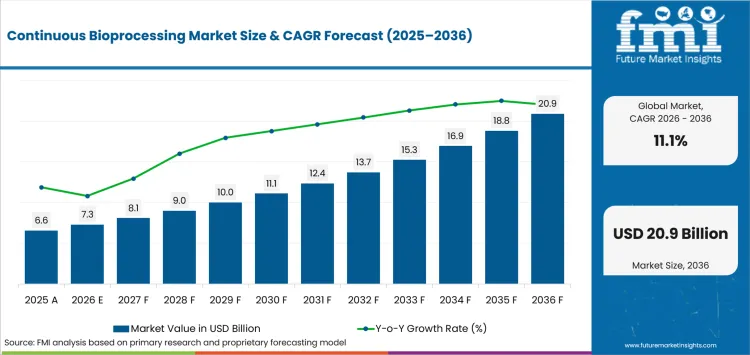
USD 7.3 billion in 2026 and USD 20.9 billion by 2036 at an 11.1% CAGR.
Demand for continuous bioprocessing is set to rise from USD 7.3 billion in 2026, expanding at an 11.1% CAGR through 2036, as biologics manufacturers turn to bioprocessing systems that lift throughput without adding intermediate holds or manual transfers. Growth is rooted in the push to eliminate batch based bottlenecks, where linked unit operations must run continuously while still generating the control records regulators expect. Manufacturers are connecting upstream bioprocessing equipment with downstream capacity so that disturbances in one stage do not stall the entire line, a design priority reinforced by funding activity such as NIIMBL's April 2025 support for eleven biomanufacturing projects, including one focused on automated qualification of continuous downstream processing.
Restraints stem from the technical difficulty of validating continuous runs across long durations and the capital burden of retrofitting facilities built for batch production. Opportunity favors automation and sensor technologies that qualify processes in real time, along with modular skids that let manufacturers adopt continuous steps incrementally rather than converting entire lines at once. Segment level activity spans upstream processing, downstream purification, and the automation and control layer that ties them together, with adoption pace tied to how much validation burden each segment carries. Regionally, North America and Europe lead on established biologics manufacturing bases, while Asia Pacific adoption tracks capacity expansion by contract manufacturers.
Key Takeaways of Continuous Bioprocessing Market
- Connected processing raises facility output by reducing intermediate holds and manual transfers during biologics campaigns.
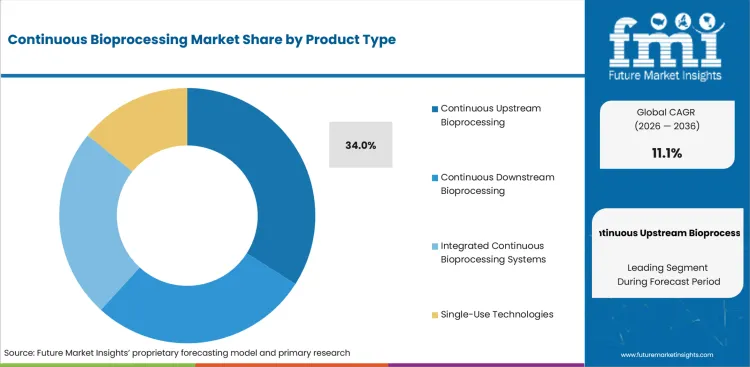
- Continuous upstream bioprocessing is projected at 34.0% in 2026 through sustained cell density and harvest.
- Monoclonal antibody production is estimated at 37.0% in 2026 through established culture and purification workflows.
- Biopharmaceutical companies are forecast at 41.0% in 2026 owing to validation and release control responsibilities.
- Connected campaigns increase contamination consequences and require qualified assemblies with traceable records across material transitions.
- Active companies include Cytiva, Sartorius AG, Thermo Fisher Scientific Inc., Merck KGaA, Repligen Corporation, Eppendorf SE, Getinge AB and FUJIFILM Biotechnologies.
Analyst Perspective
"Continuous bioprocessing succeeds through balanced perfusion harvest rates and matched purification capacity across extended campaigns. Commercial value depends on disturbance records that isolate affected material and prevent unnecessary batch disposal."
- Anurag Sharma, Principal Consultant, Future Market Insights
How is the Continuous Bioprocessing Market segmented?
Continuous bioprocessing is segmented by product type, application, end user, distribution channel, technology and region.
Product type covers continuous upstream and downstream processing alongside integrated systems and qualified single-use technologies for connected production. Applications include monoclonal antibodies, vaccines, cell and gene therapies and recombinant proteins across clinical and commercial manufacturing. End users include biopharmaceutical companies, CDMOs, research institutes and CROs using direct sales, distributors, integrators or online channels. Technology covers perfusion, continuous chromatography, filtration and buffer preparation across the report's published regional taxonomy.
Why does continuous upstream bioprocessing lead the product type category?
Continuous upstream processing retains cells as fresh medium enters and harvest leaves through a closed fluid path supported by single-use bioreactors. In April 2025, Thermo Fisher Scientific introduced the 5L DynaDrive Single-Use Bioreactor, a bench-scale system that preserves one vessel architecture from development toward commercial production scale.
- Based on product type, continuous upstream bioprocessing is projected to account for 34.0% in 2026 due to sustained cell density and recurring harvest collection across extended campaigns.
- Process teams qualify retention reliability apart from purification capacity so higher upstream output does not overwhelm capture and polishing operations during commercial scale-up.
Why does monoclonal antibody production lead the application category?
Monoclonal antibody production uses mature mammalian-cell workflows and repeatable purification sequences across clinical and commercial facilities. Connected downstream processing balances frequent perfusion harvest with capture capacity during campaigns that must preserve product quality without extensive intermediate storage.
- By application, monoclonal antibody production is estimated to hold 37.0% in 2026 owing to established expression systems and highly predictable purification requirements.
- Connected antibody processing gained practical support in July 2025 as Sartorius launched two continuous-manufacturing modules with a major customer. The modules support repeated purification steps without expanding hold-tank capacity across multiple regulated commercial production sites.
Why do biopharmaceutical companies lead the end user category?
Biopharmaceutical companies control process definitions and the evidence submitted for regulatory approval across development and commercial manufacturing. Biologics contract manufacturing expands available capacity but sponsors retain responsibility for comparability decisions and final product release across registered products and sites under approved control strategies.
- In 2026, biopharmaceutical companies are expected to lead the end-user category with 41.0% share because sponsors own validation and lifecycle changes across registered manufacturing sites.
- Platform selection joins equipment records with consumable agreements and technical service coverage so one validated process remains reproducible during technology transfer and commercial supply across regions.
Why does perfusion technology lead the technology category?
Perfusion technology retains cells through hollow-fiber or alternating tangential-flow devices as medium and harvest pass through a controlled vessel. Integrated bioprocess analytics help operators identify cell-density or filter disturbances early enough to protect downstream balance during extended campaigns across regulated manufacturing sites.
- The technology category is forecast to be led by perfusion technology at 35.0% share in 2026 due to sustained productivity within compact vessels and recurring harvest cycles.
- Engineering teams compare shear exposure and filter life against harvest stability as retention performance determines whether connected purification receives a consistent load during scale transfer.
What are the drivers, restraints and opportunities in the Continuous Bioprocessing Market?
Connected platforms raise output despite control risks, while modular equipment and analytics support staged qualification.
- Driver: Connected processing raises facility output by reducing idle time between culture and purification operations.
- Restraint: Long campaigns amplify contamination consequences and require traceable control across filtration assemblies and operations.
- Opportunity: Modular equipment and rapid analytics support staged qualification across upstream and downstream process trains.
Connected production raises output by reducing waiting time between culture and purification during manufacturing campaigns. In March 2025, NIST updated a biomanufacturing data project linking process controls with deviation records. Shared records help engineers isolate disturbances without rebuilding equipment histories throughout the connected manufacturing sequence.
Extended campaigns expose bags and tubing to repeated product contact across several linked manufacturing operations. In November 2025, FDA issued draft Q3E guidance for risk-based control of extractables and leachables. Qualified fluid transfer solutions require material records that remain consistent throughout campaigns and process changes.
Continuous virus-clearance studies consume impractical test-virus quantities under conventional methods during extended connected manufacturing campaigns. In June 2026, NIIMBL recognized an inline spiking project supporting challenge testing during active processing. The method reduces validation burden without consuming excessive bioprocessing supplies during repeated process qualification studies.
Which country CAGRs are profiled in the Continuous Bioprocessing Market?
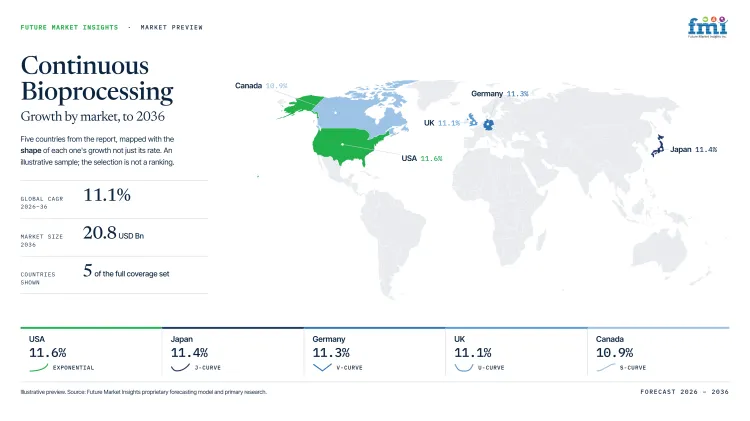
| Country | CAGR |
|---|---|
| United States | 11.6% |
| Japan | 11.4% |
| Germany | 11.3% |
| United Kingdom | 11.1% |
| Canada | 10.9% |
How do country-level CAGRs compare in the Continuous Bioprocessing Market?
Country CAGRs span 1.1 percentage points across seven national biomanufacturing systems with distinct service structures. Common platform portfolios hold rates close, but qualification capacity and service distance change entry conditions.
- United States and Japan forecasts differ by 0.2 point as American clusters provide wider coverage.
- Japan and Germany forecasts differ by 0.1 point despite distinct national documentation and service networks.
- Germany and the United Kingdom differ by 0.2 point as engineering depth supports technology transfer programs.
- The United Kingdom, Canada and Australia form a group shaped by investment patterns and service availability.
Similar CAGRs produce different commercial conditions across national documentation systems and regional technical support networks. Platform providers need country-specific qualification plans and practical coverage for maintenance and qualified consumable replacement.
Country-wise Analysis
- The United States combines large biologics plants with application laboratories and service inventory across major production clusters, giving manufacturers nearby engineering support for integrated commissioning and rapid replacement of qualified components during commercial campaigns. In May 2026, NIIMBL selected eight projects involving 39 organizations and included continuous downstream purification with integrated process analytics that extends process-control expertise across participating research and manufacturing sites for regulated production. Adoption of continuous bioprocessing in the United States is estimated to expand at 11.6% CAGR through 2036, supported by engineering depth despite multi-platform validation across facilities using different automation architectures and legacy equipment.
- Japan relies on domestic CDMOs and metropolitan engineering centers to coordinate translated records with scheduled maintenance, giving advanced-therapy manufacturers established support for controlled transfers across concentrated biologics production regions and manufacturing programs. Japan's continuous bioprocessing outlook is anticipated to advance at 11.4% CAGR over the assessment period, shaped by concentrated expertise despite limited service coverage beyond major production clusters and longer travel for regional technicians. METI published a 26-company regenerative medicine CDMO list in April 2025 to improve visibility into domestic manufacturing partners, although detailed Japanese documentation and scheduled support can extend qualification outside established metropolitan networks during transfers.
- Germany combines pharmaceutical engineering companies with regional biotechnology clusters, giving biologics manufacturers access to equipment validation and specialist maintenance across established production corridors supporting domestic and international manufacturing programs and mature service networks. In February 2026, Germany Trade and Invest documented regional biotechnology clusters that connect companies with research institutes and technology parks, helping project teams locate experienced partners for complex regulated process transfer projects nationwide. The German continuous bioprocessing sector is projected to record 11.3% CAGR during the assessment period, reinforced by engineering depth despite demanding validation records and limited automation staffing for multi-site legacy upgrades across facilities.
- The United Kingdom connects academic manufacturing centers with CDMOs and specialist integrators across concentrated life-science regions, giving developers access to training and early process support near regulated clinical and commercial production sites nationwide. Continuous bioprocessing demand in the United Kingdom is forecast to rise at 11.1% CAGR over the forecast period, driven by local manufacturing support despite uneven financing and service capacity beyond established regional clusters. The July 2025 Life Sciences Sector Plan strengthened new routes for advanced manufacturing investment and scale-up support, although experienced automation teams remain concentrated around established hubs serving complex regulated technology transfer programs nationwide.
- Canada combines vaccine facilities with research centers across widely separated production corridors, making local inventory and planned engineering support essential for connected campaigns beyond major metropolitan clusters and established biologics sites during commercial production. The federal government reported 43 new or expanded biomanufacturing projects in September 2025 and confirmed domestic vaccine production, improving local platform experience while reinforcing the need for regional stocking agreements and integrators nationally. By 2036, Canada is projected to grow at 10.9% CAGR aided by domestic capacity investment despite long service distances and dependence on imported single-use components during scheduled maintenance and replacement across facilities.
Who are the notable companies in the Continuous Bioprocessing Market?
Cytiva, Sartorius AG, Thermo Fisher Scientific Inc., Merck KGaA, Repligen Corporation, Eppendorf SE, Getinge AB and FUJIFILM Biotechnologies.
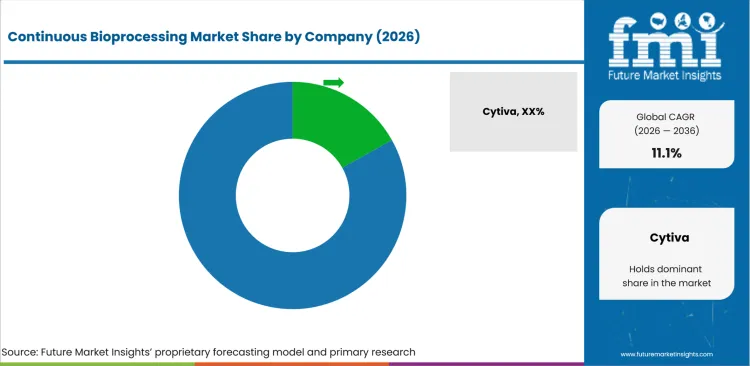
Competition is moderately concentrated among platform groups linking perfusion, purification and digital control across production. Entry requires validated performance, consumable continuity and field service supporting multi-site qualification across manufacturing networks. Specialists compete through cell-retention expertise or analytics while closed-system bioprocessing relies on regulated manufacturing experience.
- Cytiva and Sartorius provide connected platforms while Thermo Fisher Scientific and Merck supply process systems.
- Repligen and Eppendorf support process development as Getinge provides life-science systems through global service routes.
- FUJIFILM Biotechnologies combines perfusion culture with automated downstream operations through an integrated manufacturing service platform.
Competitive Benchmarking: Continuous Bioprocessing Market
| Company | Continuous Upstream | Continuous Downstream | Integration and Automation | Geographic Reach |
|---|---|---|---|---|
| Cytiva | High | High | High | Global |
| Sartorius AG | High | High | High | Global |
| Thermo Fisher Scientific Inc. | High | Medium | Medium | Global |
| Merck KGaA | Medium | High | High | Global |
| Repligen Corporation | High | Medium | Medium | Global |
| Eppendorf SE | Medium | Low | Medium | Global |
| Getinge AB | Medium | Low | Medium | Global |
| FUJIFILM Biotechnologies | High | High | High | Global |
Key Developments in the Continuous Bioprocessing Market
- In January 2026, Danaher reported that Cytiva expanded its Xcellerex X-platform bioreactor portfolio with 500 L and 2,000 L formats, helping biologics manufacturers improve yields while reducing the time and cost of biologic manufacturing.
- In July 2026, Sartorius launched Pionic Quad and Pionic Cross for intensified downstream processing applications. The modules join multicolumn chromatography with integrated ultrafiltration and diafiltration across connected regulated purification campaigns.
- In January 2025, Repligen launched CTech SoloVPE PLUS for rapid at-line concentration measurement during production. The system returns results within thirty seconds and supports standardized communication across connected bioprocess workflows.
Key Players in the Continuous Bioprocessing Market
Integrated Bioprocessing Platform Providers
- Cytiva
- Sartorius AG
- Thermo Fisher Scientific Inc.
- Merck KGaA
Continuous Upstream and Process Technology Specialists
- Repligen Corporation
- Eppendorf SE
- Getinge AB
Continuous Manufacturing Service Platforms
- FUJIFILM Biotechnologies
Continuous Bioprocessing Market - Report Scope
| Coverage field | Report scope |
|---|---|
| Market breakdown | Product type, application, end user, distribution channel, technology and region. |
| Quantitative Units | Revenue in USD billion and CAGR in %. |
| Market Definition | Connected systems for upstream production, downstream purification, analytics and automation. |
| Regions Covered | North America, Latin America, Western Europe, Eastern Europe, East Asia, South Asia and Pacific, and Middle East and Africa. |
| Countries Covered | United States, Japan, Germany, United Kingdom, Canada, Australia, France and 30+ countries. |
| Key Companies Profiled | Cytiva, Sartorius AG, Thermo Fisher Scientific Inc., Merck KGaA, Repligen Corporation, Eppendorf SE, Getinge AB and FUJIFILM Biotechnologies. |
| Forecast Period | 2026 to 2036. |
| Approach | Primary and secondary research with market triangulation. |
Continuous Bioprocessing Market - Research Methodology
| Method | Approach |
|---|---|
| Primary Research | FMI analysts gathered input from manufacturers, service providers, technology developers, distributors, end users, procurement teams, and subject-matter experts. Interviews examined purchasing decisions, product or service evaluation, adoption barriers, approval requirements, pricing considerations, and expectations for technical or commercial support. Respondents were also asked what evidence is required before a trial, pilot, or initial order develops into regular purchasing. |
| Desk Research | Desk research covered government statistics, regulatory publications, trade data, industry associations, technical literature, standards, company filings, product information, and official corporate announcements. Sources were reviewed for relevance, publication date, geographic coverage, and consistency with the defined market scope. Claims relating to performance, applications, approvals, capacity, investment, and commercial activity were retained only when supported by credible public evidence. |
| Market Sizing and Forecasting | The market model combined the baseline value with historical performance, segment structure, pricing and volume indicators, adoption levels, company participation, and country-level demand conditions. Forecast assumptions considered economic activity, investment trends, regulatory developments, technology adoption, purchasing cycles, supply availability, and barriers to wider market use. Segment and regional estimates were reconciled before the final market total was calculated. |
| Data Validation | Estimates were checked against multiple independent indicators, including public data, company activity, trade patterns, industry developments, and findings from primary interviews. Validation also tested whether products, services, applications, and company revenues fell within the defined market boundaries. Adjacent categories, unsupported claims, overlapping revenues, and activities without direct market relevance were excluded to reduce double counting and maintain consistency across segments and countries. |
Continuous Bioprocessing Market by Segments
Continuous Bioprocessing Market segmented by Product Type:
- Continuous Upstream Bioprocessing
- Perfusion Bioreactors
- Continuous Cell Culture Systems
- Continuous Downstream Bioprocessing
- Continuous Chromatography Systems
- Continuous Filtration Systems
- Integrated Continuous Bioprocessing Systems
- End-to-End Continuous Platforms
- Modular Continuous Systems
- Single-Use Technologies
- Single-Use Bioreactors
- Single-Use Flow Paths
Continuous Bioprocessing Market segmented by Application:
- Monoclonal Antibody Production
- Commercial Manufacturing
- Clinical Manufacturing
- Vaccine Manufacturing
- Viral Vaccines
- Recombinant Vaccines
- Cell & Gene Therapy Manufacturing
- Cell Therapy Production
- Gene Therapy Production
- Recombinant Protein Production
- Enzyme Production
- Therapeutic Protein Production
Continuous Bioprocessing Market segmented by End User:
- Biopharmaceutical Companies
- Large Biopharmaceutical Companies
- Emerging Biotech Companies
- Contract Development & Manufacturing Organizations (CDMOs)
- Biologics CDMOs
- Cell & Gene Therapy CDMOs
- Academic & Research Institutes
- Universities
- Public Research Institutes
- Contract Research Organizations (CROs)
- Process Development CROs
- Preclinical Research CROs
Continuous Bioprocessing Market segmented by Distribution Channel:
- Direct Sales
- Key Account Sales
- OEM Supply Agreements
- Authorized Distributors
- Regional Distributors
- Global Life Science Distributors
- System Integrators
- Bioprocess Automation Providers
- Process Engineering Firms
- Online Sales
- Manufacturer Websites
- B2B E-Commerce Platforms
Continuous Bioprocessing Market segmented by Technology:
- Perfusion Technology
- Hollow Fiber Perfusion
- ATF Perfusion Systems
- Continuous Chromatography
- Multi-Column Chromatography
- Simulated Moving Bed Chromatography
- Continuous Filtration
- Tangential Flow Filtration
- Virus Filtration
- Continuous Mixing & Buffer Preparation
- In-Line Buffer Dilution
- Continuous Media Preparation
Continuous Bioprocessing Market by Region:
- North America
- United States
- Canada
- Mexico
- Latin America
- Brazil
- Chile
- Rest of Latin America
- Western Europe
- Germany
- United Kingdom
- Italy
- Spain
- France
- Nordics
- Benelux
- Rest of Western Europe
- Eastern Europe
- Russia
- Poland
- Hungary
- Balkan and Baltic States
- Rest of Eastern Europe
- East Asia
- China
- Japan
- South Korea
- South Asia and Pacific
- India
- ASEAN
- Australia and New Zealand
- Rest of South Asia and Pacific
- Middle East and Africa
- Kingdom of Saudi Arabia
- Other GCC Countries
- Türkiye
- South Africa
- Other African Union Countries
- Rest of Middle East and Africa
Research Sources and Bibliography
- National Institute for Innovation in Manufacturing Biopharmaceuticals. (2025, April 29). NIIMBL Announces 11 New Technology, Workforce, and Global Health Fund Projects.
- National Institute of Standards and Technology. (2025, March 26). Data Infrastructure for Biomanufacturing Process Control.
- USA Food and Drug Administration. (2025, November). Q3E Guideline for Extractables and Leachables.
- National Institute for Innovation in Manufacturing Biopharmaceuticals. (2026, May 19). NIIMBL Announces 8 New Technology and Workforce Projects.
- National Institute for Innovation in Manufacturing Biopharmaceuticals. (2026, June 17). Inline Spiking Method Project Receives 2026 NIIMBL Project Impact Award.
- Ministry of Economy, Trade and Industry. (2025, April 1).
- Germany Trade & Invest. (2026, February). Biotechnology Cluster in Germany.
- Department for Business and Trade, Department of Health and Social Care, Department for Science, Innovation and Technology, & Office for Life Sciences. (2025, July 16). Life Sciences Sector Plan.
- Innovation, Science and Economic Development Canada. (2025, September 19). Government of Canada announces major milestone in the Canadian biomanufacturing sector.
- Australian Government Department of Health, Disability and Ageing. (2025, December 2). High-tech vaccine plant opens in Melbourne.
- Direction générale des Entreprises. (2025, April 30). France 2030 : 9 nouveaux lauréats du dispositif « Première Usine ».
- Rockwell Automation. (2026, April 29). Rockwell Automation and Cytiva Launch Platform to Accelerate Digital Transformation for Biopharma Companies.
- Sartorius AG. (2026, July 23). Sartorius maintains positive momentum and continues to grow profitably.
- Repligen Corporation. (2025, January 6). Repligen Launches the CTech™ SoloVPE® PLUS System.
- Thermo Fisher Scientific Inc. (2025, July 23). Thermo Fisher Scientific Reports Second Quarter 2025 Results.
- Merck KGaA. (2026, April 1). MilliporeSigma Completes Acquisition of JSR Life Sciences’ Chromatography Business.
- Eppendorf SE. (2026). Eppendorf SE - Annual Report 2025.
- Getinge AB. (2026, March 26). Getinge publishes Annual Report for 2025.
- FUJIFILM Corporation. (2026, June 17). Fujifilm Life Sciences at BIO 2026.
- Sartorius AG. (2025, July 22). Sartorius continues growth course; earnings rise at a significantly overproportionate rate.
- Repligen Corporation. (2025, March 4). Repligen Purchases Bioprocessing Analytics Portfolio from 908 Devices.
- Thermo Fisher Scientific Inc. (2025, December 2). Thermo Fisher Scientific Deepens Investment in Asia's Biopharma Ecosystem with Expansion of Bioprocess Design Centers.
- Repligen Corporation. (2026). Quality Documents. Retrieved August 5, 2026.
This bibliography is provided for reader reference and is not exhaustive. The full report contains the complete reference list and detailed citations
This Report Answers
- How large is continuous bioprocessing?
- What supports connected production?
- Which product type leads?
- Why do antibodies lead?
- How are platforms qualified?
- Why does perfusion lead?
- How do country rates differ?
- Which companies compete in continuous bioprocessing?
Frequently Asked Questions
How big is the Continuous Bioprocessing Market in 2026?
The Continuous Bioprocessing Market is estimated at USD 7.3 billion in 2026. Growing adoption of integrated manufacturing systems to improve biologics production efficiency is expected to drive the market to strong growth through 2036.
What is the CAGR of the Continuous Bioprocessing Market from 2026 to 2036?
The Continuous Bioprocessing Market is projected to grow at a CAGR of 11.1% between 2026 and 2036. Rising demand for higher biologics output and streamlined manufacturing processes is supporting market expansion.
Which product type is projected to account for 34.0% of the Continuous Bioprocessing Market?
The continuous upstream bioprocessing segment is projected to account for 34.0% of the market in 2026. Its growth is driven by the increasing use of perfusion culture systems that enable sustained cell productivity and continuous harvesting.
How much will the Continuous Bioprocessing Market add between 2026 and 2036?
The Continuous Bioprocessing Market is expected to add USD 13.6 billion in value between 2026 and 2036. This increase reflects the broader adoption of connected equipment, advanced analytics, and single-use technologies across biomanufacturing facilities.
Which application is projected to account for 37.0% of the Continuous Bioprocessing Market?
The monoclonal antibody production segment is projected to hold a 37.0% market share in 2026. Established cell culture processes and scalable purification workflows continue to support its leading position.
Which end user is projected to account for 41.0% of the Continuous Bioprocessing Market?
The biopharmaceutical companies segment is expected to account for 41.0% of the market in 2026. These organizations are the primary adopters of continuous bioprocessing technologies to improve production efficiency and maintain regulatory compliance.
Which technology is projected to account for 35.0% of the Continuous Bioprocessing Market?
The perfusion systems segment is projected to capture 35.0% of the market in 2026. The technology supports continuous cell retention and higher productivity, making it a preferred choice for modern biomanufacturing operations.
Which companies are active in the continuous bioprocessing market?
Companies are active in the continuous bioprocessing market across equipment and service platforms including Cytiva, Sartorius AG, Thermo Fisher Scientific Inc., Merck KGaA, Repligen Corporation, Eppendorf SE, Getinge AB and FUJIFILM Biotechnologies.
Preview the report firsthand - request a free sample
Get SampleGet the brochure for pricing and purchase details.
Get PDFTable of Content
- Key Takeaways
- Market Size and CAGR
- Top Growth Driver
- Fastest Growing Segment
- Leading Region
- Key Companies
- Emerging Opportunities
- Executive Summary
- Global Market Outlook
- Demand-side Trends
- Supply-side Trends
- Technology Roadmap Analysis
- Analysis and Recommendations
- Analyst Perspective (What is happening? Why now? What should investors know?)
- Key Questions Answered
- How large is the market?
- What is the CAGR?
- What are key trends?
- Which region dominates?
- Who are the leaders?
- Market Overview
- Market Coverage / Taxonomy
- Market Definition / Scope / Limitations
- Research Methodology
- Chapter Orientation
- Analytical Lens and Working Hypotheses
- Market Structure, Signals, and Trend Drivers
- Benchmarking and Cross-market Comparability
- Market Sizing, Forecasting, and Opportunity Mapping
- Research Design and Evidence Framework
- Desk Research Programme (Secondary Evidence)
- Expert Input and Fieldwork (Primary Evidence)
- Tooling, Models, and Reference Databases
- Data Engineering and Model Build
- Quality Assurance and Audit Trail
- Market Background
- Market Dynamics (Drivers, Restraints, Opportunity, Trends)
- Scenario Forecast (Optimistic, Likely, Conservative)
- Impact Analysis
- AI Impact
- Sustainability Impact
- Regulatory Impact
- Technology Impact
- Consumer / Buyer Analysis
- Purchase Drivers
- Adoption Barriers
- Buyer Journey
- Opportunity Map Analysis
- Product Life Cycle Analysis
- Supply Chain Analysis
- Investment Feasibility Matrix
- Value Chain Analysis
- PESTLE and Porter's Analysis
- Regulatory Landscape
- Regional Parent Market Outlook
- Production and Consumption Statistics
- Import and Export Statistics
- Global Market Analysis and Forecast, 2021 to 2036
- Historical Market Size Value (USD Billion) Analysis, 2021 to 2025
- Current and Future Market Size Value (USD Billion) Projections, 2026 to 2036
- Y-o-Y Growth Trend Analysis
- Absolute $ Opportunity Analysis
- Global Market Pricing Analysis, 2021 to 2036
- Global Market Analysis and Forecast, By Product Type, 2021 to 2036
- Introduction / Key Findings
- Historical Market Size Value (USD Billion) Analysis By Product Type, 2021 to 2025
- Current and Future Market Size Value (USD Billion) Analysis and Forecast By Product Type, 2026 to 2036
- Continuous Upstream Bioprocessing
- Perfusion Bioreactors
- Continuous Cell Culture Systems
- Continuous Downstream Bioprocessing
- Continuous Chromatography Systems
- Continuous Filtration Systems
- Integrated Continuous Bioprocessing Systems
- End-to-End Continuous Platforms
- Modular Continuous Systems
- Single-Use Technologies
- Single-Use Bioreactors
- Single-Use Flow Paths
- Continuous Upstream Bioprocessing
- Y-o-Y Growth Trend Analysis By Product Type, 2021 to 2025
- Absolute $ Opportunity Analysis By Product Type, 2026 to 2036
- Global Market Analysis and Forecast, By Application, 2021 to 2036
- Introduction / Key Findings
- Historical Market Size Value (USD Billion) Analysis By Application, 2021 to 2025
- Current and Future Market Size Value (USD Billion) Analysis and Forecast By Application, 2026 to 2036
- Monoclonal Antibody Production
- Commercial Manufacturing
- Clinical Manufacturing
- Vaccine Manufacturing
- Viral Vaccines
- Recombinant Vaccines
- Cell & Gene Therapy Manufacturing
- Cell Therapy Production
- Gene Therapy Production
- Recombinant Protein Production
- Enzyme Production
- Therapeutic Protein Production
- Monoclonal Antibody Production
- Y-o-Y Growth Trend Analysis By Application, 2021 to 2025
- Absolute $ Opportunity Analysis By Application, 2026 to 2036
- Global Market Analysis and Forecast, By End User, 2021 to 2036
- Introduction / Key Findings
- Historical Market Size Value (USD Billion) Analysis By End User, 2021 to 2025
- Current and Future Market Size Value (USD Billion) Analysis and Forecast By End User, 2026 to 2036
- Biopharmaceutical Companies
- Large Biopharmaceutical Companies
- Emerging Biotech Companies
- Contract Development & Manufacturing Organizations (CDMOs)
- Biologics CDMOs
- Cell & Gene Therapy CDMOs
- Academic & Research Institutes
- Universities
- Public Research Institutes
- Contract Research Organizations (CROs)
- Process Development CROs
- Preclinical Research CROs
- Biopharmaceutical Companies
- Y-o-Y Growth Trend Analysis By End User, 2021 to 2025
- Absolute $ Opportunity Analysis By End User, 2026 to 2036
- Global Market Analysis and Forecast, By Distribution Channel, 2021 to 2036
- Introduction / Key Findings
- Historical Market Size Value (USD Billion) Analysis By Distribution Channel, 2021 to 2025
- Current and Future Market Size Value (USD Billion) Analysis and Forecast By Distribution Channel, 2026 to 2036
- Direct Sales
- Key Account Sales
- OEM Supply Agreements
- Authorized Distributors
- Regional Distributors
- Global Life Science Distributors
- System Integrators
- Bioprocess Automation Providers
- Process Engineering Firms
- Online Sales
- Manufacturer Websites
- B2B E-Commerce Platforms
- Direct Sales
- Y-o-Y Growth Trend Analysis By Distribution Channel, 2021 to 2025
- Absolute $ Opportunity Analysis By Distribution Channel, 2026 to 2036
- Global Market Analysis and Forecast, By Technology, 2021 to 2036
- Introduction / Key Findings
- Historical Market Size Value (USD Billion) Analysis By Technology, 2021 to 2025
- Current and Future Market Size Value (USD Billion) Analysis and Forecast By Technology, 2026 to 2036
- Perfusion Technology
- Hollow Fiber Perfusion
- ATF Perfusion Systems
- Continuous Chromatography
- Multi-Column Chromatography
- Simulated Moving Bed Chromatography
- Continuous Filtration
- Tangential Flow Filtration
- Virus Filtration
- Continuous Mixing & Buffer Preparation
- In-Line Buffer Dilution
- Continuous Media Preparation
- Perfusion Technology
- Y-o-Y Growth Trend Analysis By Technology, 2021 to 2025
- Absolute $ Opportunity Analysis By Technology, 2026 to 2036
- Global Market Analysis and Forecast, By Region, 2021 to 2036
- Introduction
- Historical Market Size Value (USD Billion) Analysis By Region, 2021 to 2025
- Current Market Size Value (USD Billion) Analysis and Forecast By Region, 2026 to 2036
- North America
- Latin America
- Western Europe
- Eastern Europe
- East Asia
- South Asia and Pacific
- Middle East & Africa
- Market Attractiveness Analysis By Region
- North America Market Analysis and Forecast, By Country, 2021 to 2036
- Historical Market Size Value (USD Billion) Trend Analysis By Market Taxonomy, 2021 to 2025
- Market Size Value (USD Billion) Forecast By Market Taxonomy, 2026 to 2036
- By Country
- USA
- Canada
- By Product Type
- By Application
- By End User
- By Distribution Channel
- By Technology
- By Country
- Market Attractiveness Analysis
- By Country
- By Product Type
- By Application
- By End User
- By Distribution Channel
- By Technology
- Key Takeaways
- Latin America Market Analysis and Forecast, By Country
- Historical Market Size Value (USD Billion) Trend Analysis By Market Taxonomy, 2021 to 2025
- Market Size Value (USD Billion) Forecast By Market Taxonomy, 2026 to 2036
- By Country
- Brazil
- Mexico
- Chile
- Rest of Latin America
- By Product Type
- By Application
- By End User
- By Distribution Channel
- By Technology
- By Country
- Market Attractiveness Analysis
- By Country
- By Product Type
- By Application
- By End User
- By Distribution Channel
- By Technology
- Key Takeaways
- Western Europe Market Analysis and Forecast, By Country
- Historical Market Size Value (USD Billion) Trend Analysis By Market Taxonomy, 2021 to 2025
- Market Size Value (USD Billion) Forecast By Market Taxonomy, 2026 to 2036
- By Country
- Germany
- UK
- Italy
- Spain
- France
- Nordic
- BENELUX
- Rest of Western Europe
- By Product Type
- By Application
- By End User
- By Distribution Channel
- By Technology
- By Country
- Market Attractiveness Analysis
- By Country
- By Product Type
- By Application
- By End User
- By Distribution Channel
- By Technology
- Key Takeaways
- Eastern Europe Market Analysis and Forecast, By Country
- Historical Market Size Value (USD Billion) Trend Analysis By Market Taxonomy, 2021 to 2025
- Market Size Value (USD Billion) Forecast By Market Taxonomy, 2026 to 2036
- By Country
- Russia
- Poland
- Hungary
- Balkan & Baltic
- Rest of Eastern Europe
- By Product Type
- By Application
- By End User
- By Distribution Channel
- By Technology
- By Country
- Market Attractiveness Analysis
- By Country
- By Product Type
- By Application
- By End User
- By Distribution Channel
- By Technology
- Key Takeaways
- East Asia Market Analysis and Forecast, By Country
- Historical Market Size Value (USD Billion) Trend Analysis By Market Taxonomy, 2021 to 2025
- Market Size Value (USD Billion) Forecast By Market Taxonomy, 2026 to 2036
- By Country
- China
- Japan
- South Korea
- By Product Type
- By Application
- By End User
- By Distribution Channel
- By Technology
- By Country
- Market Attractiveness Analysis
- By Country
- By Product Type
- By Application
- By End User
- By Distribution Channel
- By Technology
- Key Takeaways
- South Asia and Pacific Market Analysis and Forecast, By Country
- Historical Market Size Value (USD Billion) Trend Analysis By Market Taxonomy, 2021 to 2025
- Market Size Value (USD Billion) Forecast By Market Taxonomy, 2026 to 2036
- By Country
- India
- ASEAN
- Australia & New Zealand
- Rest of South Asia and Pacific
- By Product Type
- By Application
- By End User
- By Distribution Channel
- By Technology
- By Country
- Market Attractiveness Analysis
- By Country
- By Product Type
- By Application
- By End User
- By Distribution Channel
- By Technology
- Key Takeaways
- Middle East & Africa Market Analysis and Forecast, By Country
- Historical Market Size Value (USD Billion) Trend Analysis By Market Taxonomy, 2021 to 2025
- Market Size Value (USD Billion) Forecast By Market Taxonomy, 2026 to 2036
- By Country
- Kingdom of Saudi Arabia
- Other GCC Countries
- Türkiye
- South Africa
- Other African Union
- Rest of Middle East & Africa
- By Product Type
- By Application
- By End User
- By Distribution Channel
- By Technology
- By Country
- Market Attractiveness Analysis
- By Country
- By Product Type
- By Application
- By End User
- By Distribution Channel
- By Technology
- Key Takeaways
- Key Countries Market Analysis
- USA
- Pricing Analysis
- Market Share Analysis, 2025
- By Product Type
- By Application
- By End User
- By Distribution Channel
- By Technology
- Canada
- Pricing Analysis
- Market Share Analysis, 2025
- By Product Type
- By Application
- By End User
- By Distribution Channel
- By Technology
- Mexico
- Pricing Analysis
- Market Share Analysis, 2025
- By Product Type
- By Application
- By End User
- By Distribution Channel
- By Technology
- Brazil
- Pricing Analysis
- Market Share Analysis, 2025
- By Product Type
- By Application
- By End User
- By Distribution Channel
- By Technology
- Chile
- Pricing Analysis
- Market Share Analysis, 2025
- By Product Type
- By Application
- By End User
- By Distribution Channel
- By Technology
- Germany
- Pricing Analysis
- Market Share Analysis, 2025
- By Product Type
- By Application
- By End User
- By Distribution Channel
- By Technology
- UK
- Pricing Analysis
- Market Share Analysis, 2025
- By Product Type
- By Application
- By End User
- By Distribution Channel
- By Technology
- Italy
- Pricing Analysis
- Market Share Analysis, 2025
- By Product Type
- By Application
- By End User
- By Distribution Channel
- By Technology
- Spain
- Pricing Analysis
- Market Share Analysis, 2025
- By Product Type
- By Application
- By End User
- By Distribution Channel
- By Technology
- France
- Pricing Analysis
- Market Share Analysis, 2025
- By Product Type
- By Application
- By End User
- By Distribution Channel
- By Technology
- India
- Pricing Analysis
- Market Share Analysis, 2025
- By Product Type
- By Application
- By End User
- By Distribution Channel
- By Technology
- ASEAN
- Pricing Analysis
- Market Share Analysis, 2025
- By Product Type
- By Application
- By End User
- By Distribution Channel
- By Technology
- Australia & New Zealand
- Pricing Analysis
- Market Share Analysis, 2025
- By Product Type
- By Application
- By End User
- By Distribution Channel
- By Technology
- China
- Pricing Analysis
- Market Share Analysis, 2025
- By Product Type
- By Application
- By End User
- By Distribution Channel
- By Technology
- Japan
- Pricing Analysis
- Market Share Analysis, 2025
- By Product Type
- By Application
- By End User
- By Distribution Channel
- By Technology
- South Korea
- Pricing Analysis
- Market Share Analysis, 2025
- By Product Type
- By Application
- By End User
- By Distribution Channel
- By Technology
- Russia
- Pricing Analysis
- Market Share Analysis, 2025
- By Product Type
- By Application
- By End User
- By Distribution Channel
- By Technology
- Poland
- Pricing Analysis
- Market Share Analysis, 2025
- By Product Type
- By Application
- By End User
- By Distribution Channel
- By Technology
- Hungary
- Pricing Analysis
- Market Share Analysis, 2025
- By Product Type
- By Application
- By End User
- By Distribution Channel
- By Technology
- Kingdom of Saudi Arabia
- Pricing Analysis
- Market Share Analysis, 2025
- By Product Type
- By Application
- By End User
- By Distribution Channel
- By Technology
- Türkiye
- Pricing Analysis
- Market Share Analysis, 2025
- By Product Type
- By Application
- By End User
- By Distribution Channel
- By Technology
- South Africa
- Pricing Analysis
- Market Share Analysis, 2025
- By Product Type
- By Application
- By End User
- By Distribution Channel
- By Technology
- USA
- Market Structure Analysis
- Competition Dashboard
- Competition Benchmarking
- Market Share Analysis of Top Players
- By Regional
- By Product Type
- By Application
- By End User
- By Distribution Channel
- By Technology
- Emerging Startups
- Innovation Benchmarking
- Competition Analysis
- Competition Deep Dive
- Cytiva
- Overview
- Product Portfolio
- Profitability by Market Segments
- Sales Footprint
- Strategy Overview
- Marketing Strategy
- Product Strategy
- Channel Strategy
- Sartorius AG
- Thermo Fisher Scientific Inc.
- Merck KGaA
- Danaher Corporation
- Repligen Corporation
- Eppendorf SE
- Corning Incorporated
- Getinge AB
- FUJIFILM Diosynth Biotechnologies
- Cytiva
- Case Studies
- Success Stories
- Recent Developments
- Competition Deep Dive
- Assumptions & Acronyms Used


