
- Market Size (2026)
- USD 8030.0 Mn
- Forecast (2036)
- USD 19009.9 Mn
- CAGR (2026 to 2036)
- 9.0%
How big is the Continuous Subcutaneous Insulin Infusion Market in 2026?
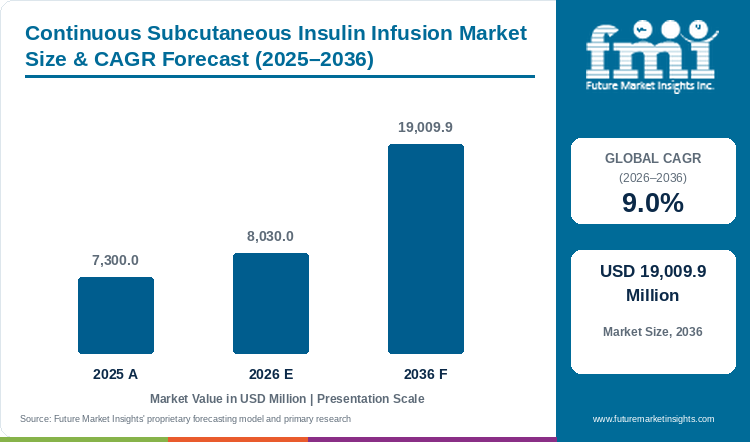
FMI projects the global continuous subcutaneous insulin infusion market at USD 19,009.9 million in 2036, a CAGR of 9.0% over 2026 to 2036. The market was valued at USD 7,300.0 million in 2025 and is estimated at USD 8,030.0 million in 2026.
Continuous Subcutaneous Insulin Infusion Market Size and Forecast
Table 1: Continuous Subcutaneous Insulin Infusion Market Size and Forecast
| Market size and forecast | Value |
|---|---|
| Market size in 2025 | USD 7,300.0 million |
| Estimated market size in 2026 | USD 8,030.0 million |
| Projected market size by 2036 | USD 19,009.9 million |
| CAGR from 2026 to 2036 | 9.0% |
Source: Future Market Insights analysis of the continuous subcutaneous insulin infusion market, 2026.
The addressable patient group is widening faster than the established pump replacement cycle. In February 2025, Tandem announced FDA clearance of Control-IQ+ for adults with type 2 diabetes. The FDA approved an equivalent indication expansion for the MiniMed 780G system on 29 August 2025. These decisions expand which patients suppliers can serve.
Demand therefore depends on two commercial conversions: obtaining a funded therapy start and retaining a user through repeat supply orders. England's phased hybrid closed-loop rollout illustrates the first constraint. The NHS describes a five-year introduction from April 2024, prioritising people with the greatest need. The continuing supplies business illustrates the second. NDSS lists infusion sets, reservoirs and pods among subsidised pump consumables for eligible Australians with type 1 diabetes. FMI expects the insulin pumps market to remain closely linked to recurring supplies and software compatibility.
Key Market Trends & Insights
- Sensor partnerships are changing the competitive unit from a pump to a compatible treatment system. Diabeloop's July 2026 German prescription launch combines DBLG2 with Kaleido and Dexcom G7, allowing separate hardware and algorithm suppliers to participate in one offer.
- Supplier continuity has become a purchasing issue. Roche's June 2025 UK and Ireland notice set an end-January 2026 phase-out for Accu-Chek pump consumables, creating a defined migration requirement for affected users.
- Public procurement is incorporating service obligations. Italy's Consip tender describes full-risk rental over 36 months, tying the commercial offer to maintenance and continuity of therapy.
Regional Highlights
- China and Spain are gaining share of global revenue. FMI projects China from 4.0% to 7.0% and Spain from 2.0% to 2.2% over 2026 to 2036.
- Revenue rises in the United States and Australia, though each loses global share. FMI projects the United States from 52.0% to 48.3% and Australia from 3.0% to 2.8% over the same period.
Analyst Perspective
“FMI expects suppliers to win additional users where an expanded indication is matched by a funded start and reliable repeat supply. The strongest commercial offer will account for the complete treatment arrangement: compatible components, local clinical onboarding and a clear route through software changes. A smaller pump or a new algorithm will have limited value to a purchasing organisation if patients cannot obtain replacement delivery supplies. Type 2 expansion creates headroom, but country payment decisions will govern its pace.”
- Anurag Sharma, Principal Consultant, FMI
How is the Continuous Subcutaneous Insulin Infusion Market segmented?
- By product: Insulin Pumps and Patch Pumps, Infusion Sets and Cartridges, and Software and Accessories.
- By technology: Automated Insulin Delivery Systems, Predictive Low-Glucose Suspend Pumps, and Manual Pumps.
- By diabetes type: Type 1, Type 2, and Gestational and Other.
- By region: North America, Western Europe, East Asia, Oceania, and the remaining world aggregate.
Why does the Infusion Sets and Cartridges segment lead by Product in the Continuous Subcutaneous Insulin Infusion Market in 2026?
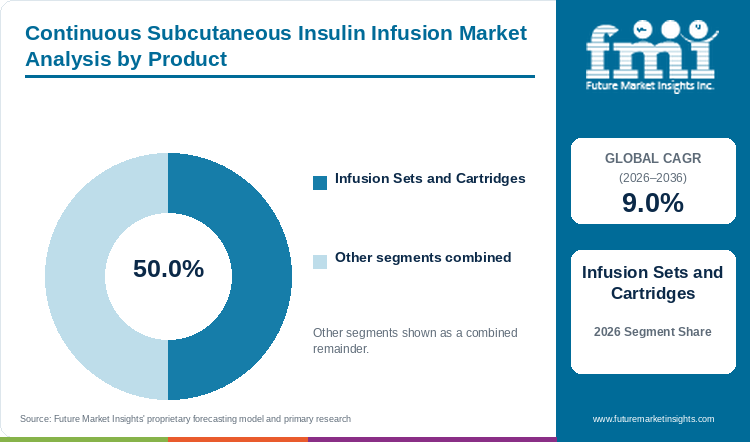
The Infusion Sets and Cartridges segment holds 50.0% of the Continuous Subcutaneous Insulin Infusion Market by product in 2026.
Delivery supplies generate purchases throughout therapy as well as at pump replacement. Ontario's funding structure makes this distinction explicit: its January 2025 information sheet describes full payment of the approved pump price and a separate CAD 2,400.0 annual supplies grant. That structure supports a commercial distinction between installing a device and maintaining recurring use.
The leading product category is forecast to reach USD 9,175.6 million in 2036, although its share eases to 48.3%. Software and Accessories grow faster at 10.6% CAGR over 2026 to 2036. FMI reads this as a change in revenue mix.
An installed pump base is valuable only while the correct compatible supplies remain accessible. Roche's regional phase-out notice demonstrates the consequence of a discontinued supply route. Manufacturers and distributors therefore need a documented transition plan when ending a product line. The broader glucose monitoring devices market also affects which combinations remain commercially attractive, but it is measured separately here.
Insulin Pumps and Patch Pumps and Software and Accessories together account for the remaining 50.0% by product.
Table 2: Product, 2026 Share
| Leading Share | 2026 market share |
|---|---|
| Infusion Sets and Cartridges | 50.0% |
| All Other Segments Combined Share | 50.0% |
Source: Future Market Insights analysis of the continuous subcutaneous insulin infusion market, 2026.
Why does the Automated Insulin Delivery Systems segment lead by Technology in the Continuous Subcutaneous Insulin Infusion Market in 2026?
The Automated Insulin Delivery Systems segment holds 55.0% of the Continuous Subcutaneous Insulin Infusion Market by technology in 2026.
The commercial advantage of automation is increasingly tied to the range of compatible components and approved users. Tandem's 2025 type 2 clearance expanded the permitted treatment population without requiring every existing user to buy a different physical pump. This gives software development a different revenue and retention role from a conventional hardware replacement cycle.
FMI projects technology revenue of USD 4,416.5 million in 2026 and USD 14,458.4 million in 2036 for Automated Insulin Delivery Systems, a 12.6% CAGR. Manual Pumps remain in the outlook at USD 2,832.0 million in 2036. Their persistence reflects the fact that regulatory access, payer decisions and practical compatibility vary across markets.
Commercial claims must also preserve the distinction between automation and fully autonomous treatment. The Italian diabetes societies' 2025 practical paper describes continuing user involvement and limitations involving sensor lag and loss of connectivity. Suppliers serving clinical teams must support the actual approved configuration. An algorithm's clearance cannot be extended by implication to every available pump, sensor or smartphone. This is particularly relevant as partnerships create more component combinations and as buyers compare a familiar integrated system with a newly assembled offer.
Predictive Low-Glucose Suspend Pumps and Manual Pumps together hold the remaining 45.0% by technology.
Table 3: Technology, 2026 Share
| Leading Share | 2026 market share |
|---|---|
| Automated Insulin Delivery Systems | 55.0% |
| All Other Segments Combined Share | 45.0% |
Source: Future Market Insights analysis of the continuous subcutaneous insulin infusion market, 2026.
Why does the Type 1 segment lead by Diabetes Type in the Continuous Subcutaneous Insulin Infusion Market in 2026?
The Type 1 segment holds 70.0% of the Continuous Subcutaneous Insulin Infusion Market by diabetes type in 2026.
Established coverage pathways continue to concentrate commercial activity in type 1 diabetes. The NHS describes its hybrid closed-loop rollout for eligible people with type 1 diabetes and states that pumps and hybrid closed-loop systems are not currently available through that pathway for type 2 diabetes. This is a UK access distinction.
The forecast nonetheless assigns faster growth to Type 2 at 15.3% CAGR from 2026 to 2036. Its revenue increases from USD 1,766.6 million to USD 7,320.5 million. Type 1 remains larger in 2036 at USD 10,386.6 million, while its revenue share declines to 54.6%.
FMI expects a widening type 2 offer to change commercial priorities. Suppliers will need evidence and distribution suited to adults who have not previously used pump therapy. The FDA's 2024 SmartAdjust decision rested on a study of insulin-treated adults. The addressable group is therefore smaller than all people diagnosed with type 2 diabetes. The relevant market conversion is from an eligible intensive-insulin pathway to funded and sustained infusion use.
Type 2 and Gestational and Other together hold the remaining 30.0% by diabetes type.
Table 4: Diabetes Type, 2026 Share
| Leading Share | 2026 market share |
|---|---|
| Type 1 | 70.0% |
| All Other Segments Combined Share | 30.0% |
Source: Future Market Insights analysis of the continuous subcutaneous insulin infusion market, 2026.
What are the key drivers restraints and opportunities?
Expanded approved populations support new therapy starts. Funded supplies and clinical onboarding constrain conversion, while interoperable systems and service-based procurement create additional commercial routes.
Driver
New adult type 2 indications allow established automated systems to address another insulin-treated population.
Restraint
A device approval does not fund the sensor, repeat consumables or clinical time needed for continuing use.
Opportunity
Multi-component partnerships and therapy-service contracts allow suppliers to compete on continuity of treatment instead of a standalone hardware offer.
How do purchasing rules and qualification affect continuous subcutaneous insulin infusion market demand?
Type 2 label expansion is the clearest new source of addressable demand. The FDA's August 2025 MiniMed decision covers adults requiring insulin. Suppliers need to establish how a new indication will be translated into prescriptions and paid delivery supplies. Injection-based delivery, which this scope excludes, is covered in FMI's insulin pens market.
Public rollout programmes add another growth mechanism. Their purchasing schedules may be slower than product availability because training and follow-up are part of implementation. This makes annual therapy starts and continuation more informative commercial measures than product announcements alone. The market's 7.9% user CAGR provides a volume framework for assessing that conversion without treating every cleared device as an incremental patient.
What limits reliable continuous subcutaneous insulin infusion market supply and quality?
Treatment interruption is a material commercial risk because it can arise from a consumables shortage or from the withdrawal of a supported combination. The notice names separate end dates and remaining shelf lives for supplies in the UK and Ireland. A purchasing organisation therefore needs to examine both the order cut-off and the transition window.
Software and communications add another source of service work. Japan's March 2026 Medtronic notice announced labelling updates concerning pump position and delivery variation. The planned instructions update adds work for local support teams serving existing users. Warranty and training arrangements consequently belong in a therapy contract alongside device specifications.
Where can suppliers win additional business in the continuous subcutaneous insulin infusion market?
Component partnerships allow an algorithm supplier to enter markets without owning every part of a delivery system. Diabeloop and Sequel announced integration work in January 2026, with US launch planned for 2027.
Italy's Consip approach offers a separate purchasing opportunity through service provision. A supplier able to support a multi-year treatment arrangement can compete for continuing therapy revenue while assuming defined maintenance obligations. FMI expects this type of offer to make after-sales capacity more visible in competitive comparisons. It also gives buyers a practical basis for comparing the cost of maintaining a user on treatment across a contract term.
Continuous Subcutaneous Insulin Infusion Market by Country (2026 to 2036)
Table 5: Continuous Subcutaneous Insulin Infusion Market Country Growth Forecast
| Country | CAGR, 2026 to 2036 |
|---|---|
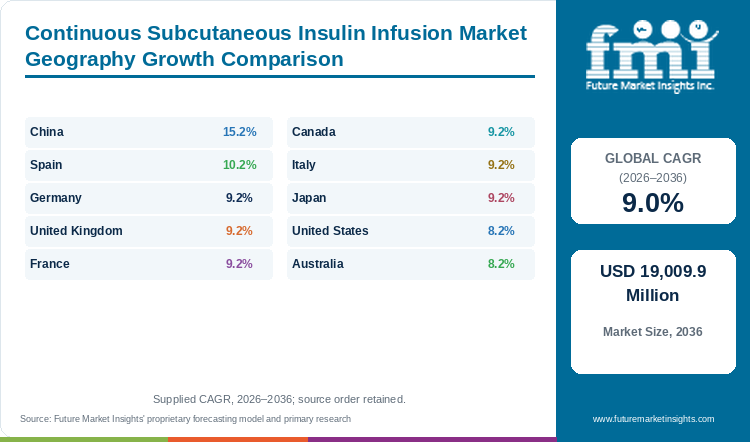
| China | 15.2% |
| Spain | 10.2% |
| Germany | 9.2% |
| United Kingdom | 9.2% |
| France | 9.2% |
| Canada | 9.2% |
| Italy | 9.2% |
| Japan | 9.2% |
| United States | 8.2% |
| Australia | 8.2% |
Source: Future Market Insights analysis of the continuous subcutaneous insulin infusion market, 2026.
China
Domestic device development gives China a different competitive starting point from markets dominated by imported pump brands. MicroTech Medical's first-half 2025 report described increasing penetration of its Equil patch pump and AiDEX X glucose-monitoring products. It also reported that its products had access to more than 2,500 domestic hospitals. That hospital figure covers the company's products collectively and is not a count of pump users or of hospitals prescribing automated infusion.
FMI forecasts Chinese infusion revenue increasing from USD 321.2 million in 2026 to USD 1,323.5 million in 2036. Its 15.2% CAGR between 2026 and 2036 is the highest among the ten countries assessed. Revenue share rises from 4.0% to 7.0%. The forecast presents considerable expansion potential from a smaller base than the United States. China records a USD 1,002.3 million increase, second of the ten.
FMI's commercial reading is that domestic suppliers can compete through established clinical relationships and service coverage, provided the precise device has the appropriate approval. A broad product portfolio creates several routes into a hospital, while pump initiation requires support for a particular treatment configuration. Distribution breadth and therapy availability remain separate measures.
MicroTech's interim disclosure also described ongoing hybrid closed-loop clinical development. Buyers evaluating a domestic system should distinguish the existing marketed pump from the configuration or indication still in study.
Spain
Spanish purchasing evidence shows how regional treatment programmes create concrete orders for systems and associated equipment. A September 2026 BOE notice invited bids for hybrid closed-loop insulin delivery in Ceuta. The notice gave an estimated value of EUR 1,900,800.0 and a 24-month duration.
FMI expects Spanish revenue to increase from USD 160.6 million in 2026 to USD 424.3 million in 2036, corresponding to a 10.2% CAGR from 2026 to 2036. Regional purchasing can support that expansion, although the timing of a tender and the timing of a therapy start are different commercial events. Suppliers must allow for award processes and clinical implementation before assuming recurring supply revenue. Spain's share of the world total stands at 2.0% in 2026 and 2.2% in 2036. Spain adds USD 263.7 million, ranking ninth for increase.
The Spanish Diabetes Society's closed-loop guide addresses available commercial systems and the education needed to use them. This reinforces the significance of training within a purchasing offer. A supplier entering a regional contract needs to account for how clinical teams will support the chosen system after delivery.
FMI expects local tenders to reward a clear division of responsibilities for equipment, consumables and support. Commercial assessment should follow individual regional opportunities and retain their actual scope. That approach gives a more defensible view of prospective demand than extrapolating one tender's value across all Spanish health services.
Germany
Germany combines established pump reimbursement with an expanding choice of component partnerships. DAK-Gesundheit describes a medically justified pump application followed by a trial phase of up to four months. Continuing payment depends on the treating diabetologist's assessment of glucose control and the user's ability to handle the device. This gives suppliers a defined conversion point between an initial placement and a continuing consumables relationship.
FMI assigns Germany USD 562.1 million in 2026 revenue and USD 1,355.3 million in 2036. The resulting 9.2% CAGR from 2026 to 2036 reflects growth beyond the existing user base. The commercial offer must work for the clinician documenting a treatment outcome as well as for the distributor delivering supplies. An attractive device specification will not by itself complete the pathway described by the payer.
Newly available configurations add competitive pressure. DBLG2 with Kaleido and Dexcom G7 was announced as open for prescription in Germany on 10 July 2026. German clinical teams consequently have another configuration to assess alongside established integrated systems. For distributors, that choice introduces a new product combination into local purchasing and support discussions.
FMI expects local support to matter when a service offers more combinations of pumps and sensors. Staff need to know which configurations are approved and which party handles a fault. Suppliers with clear responsibilities across partners will have a more credible proposition during both the trial period and subsequent repeat orders.
United Kingdom
The NHS rollout timetable provides a more useful UK demand signal than an unrestricted addressable-patient calculation. Its published guidance describes gradual introduction of hybrid closed-loop treatment over five years from April 2024, starting with people with the greatest need. FMI forecasts a CAGR of 9.2% for the United Kingdom across 2026 to 2036, with revenue increasing from USD 401.5 million to USD 968.1 million.
Commercial execution is tied to the capacity of diabetes services to initiate and support users. A phased programme allows purchasing to proceed alongside clinical preparation. FMI therefore expects training arrangements and the consistency of repeat deliveries to influence supplier selection. A contract that supplies devices without allowing for supported treatment starts may leave purchasing capacity ahead of actual use.
The UK also faces migration work involving older systems. The June 2025 notice scheduled the Accu-Chek pump consumables phase-out in the UK and Ireland by the end of January 2026. The remaining shelf life described in that notice creates a transition period instead of an instantaneous stop in every user's treatment.
These two demand streams require different commercial handling. The rollout supports eligible new users while a product transition concerns people already using infusion. FMI expects providers to separate them when scheduling clinical appointments and replacement supplies. The UK forecast consequently depends on orderly implementation as much as on the availability of another cleared automated system.
France
French access decisions examine a named treatment configuration, which makes the identity of the sensor and controller commercially consequential. HAS's 14 January 2025 assessment considered Omnipod 5 with FreeStyle Libre 2 Plus. It addressed the system's place in care and retained requirements for further evidence concerning outcomes and system use. That continuing evidence requirement gives post-launch clinical follow-up a commercial role alongside initial market access.
The French market reaches USD 321.2 million in FMI's 2026 assessment and USD 774.5 million in 2036, corresponding to a 9.2% CAGR during 2026 to 2036. FMI expects the purchasing proposition to depend on making the assessed configuration available through a workable service route. Compatibility can expand choice, but it also changes the evidence and support information that clinical teams must review. France records a USD 453.3 million increase, joint fifth of the ten. That leaves France with 4.1% of global revenue in 2036, against 4.0% in 2026.
France is also relevant to algorithm development. The January 2026 partnership announcement described a US integration programme and identified DBLG2's regulatory milestones. The development shows how a French software specialist can participate in international infusion systems without being the pump manufacturer.
For suppliers, the commercial implication is to keep the product claim and market access claim aligned. A broad technology platform may support several countries, while a local assessment still concerns a particular combination and patient group.
Canada
Ontario's funding design separates pump acquisition from the recurring cost of keeping it in use. The province's January 2025 information sheet states that ADP pays the approved pump price directly to the vendor and provides an annual CAD 2,400.0 supplies grant to the user. It also describes a 90-day trial and annual renewal requirements.
FMI forecasts Canadian revenue of USD 321.2 million in 2026 and USD 774.5 million in 2036, with a 9.2% CAGR over 2026 to 2036. The Canadian outlook therefore involves more than adding pump placements. Continuing use requires patients to maintain eligibility and obtain the supplies appropriate to their chosen system.
For suppliers, the separate payment flows create different commercial relationships. The pump vendor deals with the approved acquisition route while repeat supply purchases may involve the user and any additional insurance. FMI expects the clarity of those arrangements to affect retention, especially when a person compares systems with different ongoing costs. A funded pump should not be described as evidence that all associated expenditure is reimbursed.
Ontario's approach also makes trial conversion commercially visible. A user who does not continue after the assessment does not create the same long-term supply demand as one who successfully completes it. National forecasts must allow for different provincial arrangements instead of assuming that a launch or clearance produces uniform access throughout Canada. The opportunity lies in a reliable regional delivery route with a transparent continuing cost.
Italy
Italy is developing a purchasing mechanism that values the treatment service across several years. Consip's integrated diabetes technology initiative has an announced value of EUR 674.0 million and covers glucose monitoring, pumps and integrated systems. It describes a multi-award framework with a 36-month full-risk rental model. The full tender value must not be counted as insulin pump revenue because it includes adjacent technologies and service.
FMI forecasts the Italian infusion market to rise from USD 240.9 million in 2026 to USD 580.8 million in 2036, a 9.2% CAGR during 2026 to 2036. Service-based procurement is relevant to that outlook because it changes how suppliers present continuing cost and maintenance responsibility. The initial device price becomes one part of the contract economics. In the continuous subcutaneous insulin infusion market, Italy's 9.2% CAGR sits 0.2 points above the global 9.0%. Global revenue share for Italy increases from 3.0% to 3.1%.
Clinical differentiation still matters within a framework. The Italian AMD-SID-SIEDP working group's April 2025 practical guidance addressed the particular characteristics of available automated systems and their continuing user requirements.
FMI expects suppliers to compete on the combination of a suitable approved system and credible delivery of the contracted service. A multi-supplier framework can retain choice while making suppliers responsible for practical continuity. The commercial test is whether the promised maintenance and supply route works over the treatment term.
Japan
After-sales work remains important in Japan even when a device has an established clinical presence. Medtronic's 4 March 2026 Japanese notice addressed delivery variation associated with pump position relative to the infusion site and announced instructions-for-use updates. The notice stated that no related user complaints had been confirmed as of 9 February 2026. Its immediate commercial implication is additional communication with clinical services and installed users about the instructions update.
FMI projects Japanese revenue of USD 160.6 million in 2026 and USD 387.2 million in 2036, with a 9.2% CAGR from 2026 to 2036. The smaller starting base makes supported expansion important, while the safety communication illustrates a continuing obligation attached to installed systems. Local-language communication and coordination with clinical teams remain part of the commercial service after a device has been sold. A 9.2% CAGR leaves Japan 0.2 points above the 9.0% global pace.
For suppliers, changes to instructions can affect training material and the questions received by customer support. FMI expects organisations purchasing infusion systems to consider how effectively the manufacturer communicates such changes. The issue is broader than whether a pump can be shipped to a customer: the product must remain supported through its useful life.
Japan's outlook should also be distinguished from US indication developments. Commercial plans therefore need to specify the local approved configuration and eligible population.
United States
Adult type 2 expansion gives US pump suppliers a new commercial task alongside replacing devices for established users. Control-IQ+ clearance for adults with type 2 diabetes was announced in February 2025, and the 780G type 2 indication followed in August. FMI forecasts US revenue rising from USD 4,175.6 million in 2026 to USD 9,181.5 million in 2036, an 8.2% CAGR over 2026 to 2036. The country's share declines from 52.0% to 48.3% as other markets expand faster.
The important distinction is between an eligible indication and a paid treatment start. A new adult population may enter through different prescribing practices from the specialist services supporting long-standing type 1 users. FMI expects suppliers to assess onboarding costs and repeat supply access when choosing distribution partners. Broad diabetes prevalence is a poor substitute for measuring the insulin-treated population that meets an approved indication and receives continuing therapy support. Suppliers that track only device shipments can miss whether new adult users remain on therapy and reorder consumables.
Competitive comparisons also need to distinguish established commercial products from future integrations. A January 2026 partnership announcement targeted a 2027 US launch for the combined system. Commercial contribution depends on completing that integration and launch. Purchasers can evaluate existing offers while considering whether the future configuration would justify another clinical onboarding programme and additional support responsibilities once it reaches the market.
Australia
Australia distinguishes the cost of obtaining a pump from access to continuing consumables. NDSS describes subsidised infusion sets, reservoirs and pods for eligible people with type 1 diabetes, while noting that pump acquisition may involve private insurance. FMI's outlook assigns Australia an 8.2% CAGR from 2026 to 2036, with revenue increasing from USD 240.9 million to USD 529.7 million. Australia's 2026 revenue equals 3.0% of the global total, and its 2036 revenue equals 2.8%.
A separate public programme addresses eligible younger people who lack another funding route. Diabetes Australia became administrator of the Insulin Pump Program in August 2026. Applications remained closed as of this assessment, with reopening expected later in the year. This timetable limits immediate programme-based starts while existing applications and waitlists transfer to the new administrator.
FMI expects these distinct routes to shape the mix of therapy starts. Patients using private insurance may follow another acquisition route while obtaining eligible consumables through NDSS. Commercial planning needs to align device availability with the correct support and payment channel.
The country's procurement opportunity is consequently specific: establish a supported treatment arrangement whose hardware and supplies remain available together. Compatibility and warranty details deserve attention when a user enters through one funding route and purchases consumables through another. A clear explanation of continuing access will be more persuasive than treating the national diabetes population as a single pool of pump buyers.
Who are the notable companies in the Continuous Subcutaneous Insulin Infusion Market?
Notable companies in the Continuous Subcutaneous Insulin Infusion Market include Insulet, MiniMed, the former Medtronic Diabetes business, Tandem Diabetes Care, Ypsomed, with its former Diabetes Care business sold to TecMed and Roche, including legacy Accu-Chek pump transition activity.
Competition spans manufacturers that combine pumps and control software, partners supplying interoperable algorithms and businesses managing older installed systems. Insulet, Tandem Diabetes Care and the MiniMed platform compete through established automated delivery offers and expanding indications. Their relative commercial positions should be evaluated against the actual market-specific product configuration instead of a single global list of approved components.
Ownership and participation have changed. MiniMed's October 2026 exchange-offer completion separates the current company from its Medtronic history. Ypsomed completed the sale of Ypsomed Diabetes Care to TecMed in August 2025. Roche's UK and Ireland consumables notice concerns transition from named Accu-Chek pumps, while Embecta discontinued planned commercialisation of its insulin delivery system. These companies remain relevant to the competitive history and user transition picture, but neither notice supports treating them as equivalent new-pump entrants in every market.
Sequel Med Tech and Diabeloop illustrate partnership competition. Their announced integration programme targets a future combined product, while Diabeloop also launched a separate configuration in Germany in July 2026. MicroTech Medical and Medtrum add patch-pump and monitoring capabilities. FMI expects supplier assessment to distinguish present availability, development commitments and legacy support obligations.
Key Developments in the Continuous Subcutaneous Insulin Infusion Market
- On 15 October 2026, MiniMed completed the exchange offer that ended Medtronic's ownership relationship, establishing a separate corporate identity for the diabetes business.
- On 10 July 2026, Diabeloop announced that DBLG2 with Kaleido and Dexcom G7 was open for prescription in Germany. The announcement identified the Netherlands as a later-summer launch plan.
Key Players in the Continuous Subcutaneous Insulin Infusion Market
- Insulet
- MiniMed, the former Medtronic Diabetes business
- Tandem Diabetes Care
- Ypsomed, with its former Diabetes Care business sold to TecMed
- Roche, including legacy Accu-Chek pump transition activity
- Embecta, whose pump commercialisation programme was discontinued
- Sequel Med Tech
- MicroTech Medical
- Medtrum
- Diabeloop
Continuous Subcutaneous Insulin Infusion Market Report Scope
Table 6: Continuous Subcutaneous Insulin Infusion Market Report Scope
| Coverage field | Report scope |
|---|---|
| Market definition | Insulin pumps, infusion sets, cartridges, patch pumps and related supplies and software for continuous subcutaneous insulin delivery. |
| System coverage | Tethered and tubeless systems, including automated insulin delivery. |
| Exclusions | Insulin drug sales, injection pens and syringes, and standalone glucose-monitoring revenue outside the infusion offer. |
| Quantitative Units | USD million |
| Volume basis | Thousand users, distinct from devices shipped or disposable sets consumed. |
| Market breakdown | Product, Technology and Diabetes Type. |
| Country coverage | United States, Germany, United Kingdom, France, China, Canada, Australia, Italy, Japan, Spain and a separate remaining world aggregate. |
| Competitive coverage | Ten named companies, with verified active, transferred, legacy and discontinued roles distinguished. |
Source: Future Market Insights analysis of the continuous subcutaneous insulin infusion market, 2026.
Continuous Subcutaneous Insulin Infusion Market Research Methodology
FMI's market outlook covers infusion hardware, delivery supplies and related software. Revenue and user measures remain separate. Secondary research draws on original regulatory decisions and national access documents, procurement notices and company disclosures. Country analysis follows documented payment and implementation routes. Competitive review distinguishes available products and announced development, ownership transfers and legacy support.
Continuous Subcutaneous Insulin Infusion Market by Segments
Continuous Subcutaneous Insulin Infusion Market segmented by Product:
- Insulin Pumps and Patch Pumps
- Infusion Sets and Cartridges
- Software and Accessories
Continuous Subcutaneous Insulin Infusion Market segmented by Technology:
- Automated Insulin Delivery Systems
- Predictive Low-Glucose Suspend Pumps
- Manual Pumps
Continuous Subcutaneous Insulin Infusion Market segmented by Diabetes Type:
- Type 1
- Type 2
- Gestational and Other
Continuous Subcutaneous Insulin Infusion Market by Region
- North America
- United States
- Canada
- Western Europe
- Germany
- United Kingdom
- France
- Italy
- Spain
- East Asia
- China
- Japan
- Oceania
- Australia
- Remaining coverage
- Rest of world aggregate
Research Sources and Bibliography
- Associazione Medici Diabetologi. (2025, April 22). Suggerimenti per un impiego di successo dei sistemi automatizzati per la somministrazione di insulina. https://aemmedi.it/suggerimenti-per-un-impiego-di-successo-dei-sistemi-automatizzati-per-la-somministrazione-di-insulina-un-documento-del-gruppo-di-lavoro-italiano-su-diabete-e-tecnologia/
- Boletín Oficial del Estado. (2026, September 16). Notice 30012: Ceuta hybrid closed-loop insulin delivery tender PA/2026/055/GCE. https://www.boe.es/boe/dias/2026/09/16/pdfs/BOE-B-2026-30012.pdf
- Consip. (Accessed 2026, November 9). Al via la prima gara Consip per la gestione del diabete con tecnologie innovative. https://www.consip.it/notizie-e-comunicati/al-via-la-prima-gara-consip-per-la-gestione-del-diabete-con-tecnologie-innovative
- DAK-Gesundheit. (Accessed 2026, November 9). Insulinpumpen. https://www.dak.de/dak/leistungen/hilfsmittel/insulinpumpen_20846
- Diabetes Australia. (Accessed 2026, November 9). Insulin Pump Program, including August 2026 administration transition. https://www.diabetesaustralia.com.au/kids-and-teens/insulin-pump-program/
- Diabeloop. (2026, January 14). Diabeloop and Sequel Med Tech Enter Partnership to Integrate FDA-Cleared DBLG2 into the twiist Automated Insulin Delivery System. https://www.diabeloop.com/media-press/press-releases/dbl-sequel-pr-en
- Diabeloop. (2026, July 10). Diabeloop and ViCentra Launch Smartphone-Controlled DBLG2 System Integrated with Kaleido Insulin Patch Pump and Dexcom G7 CGM, Now Open for Prescription. https://www.diabeloop.com/news/company/dblg2-kaleido-dexcom-g7-launch
- Embecta. (2025). Annual Report for the year ended September 30, 2025, Patch Pump Restructuring Plan disclosure. https://investors.embecta.com/static-files/e77d894b-3d2d-4003-ba99-ff3b4bf8ec61
- Haute Autorité de santé. (2025, January 14). OMNIPOD 5 with FREESTYLE LIBRE 2 PLUS, CNEDiMTS opinion. https://has-sante.fr/upload/docs/application/pdf/2025-01/omnipod_5_fsl2_14_janvier_2025_7613_avis.pdf
- Medtronic Japan. (2026, March 4). Insulin pump safety communication and planned instructions update, DIAB2602-07. https://www.medtronic.com/content/dam/medtronic-wide/public/asia-pacific/japan/products/diabetes/diab-hcp-260304info-ja.pdf
- Medtrum. (Accessed 2026, November 9). TouchCare Nano Pump product information. https://www.medtrum.com/product/nanopump
- MicroTech Medical (Hangzhou). (2025). Interim Report 2025, Research and Development and Clinical Progress; Core Product Market Performance. https://www.microtechmd.com/mtsc/uploads/single/2025%E5%B9%B4%E4%B8%AD%E6%9C%9F%E6%8A%A5%E5%91%8AEN.pdf
- MiniMed Group. (2026, October 16). Form 8-K reporting exchange-offer completion on October 15, 2026. U.S. Securities and Exchange Commission. https://www.sec.gov/Archives/edgar/data/2062583/000110465926116441/tm2627653d1_8k.htm
- National Diabetes Services Scheme. (Accessed 2026, November 9). Insulin Pumps Fact Sheet. https://www.ndss.com.au/managing-diabetes/insulin-and-medicines/insulin-pumps/
- NHS. (2024, October 14). Continuous glucose monitoring and hybrid closed loop for diabetes. https://www.nhs.uk/tests-and-treatments/cgm-and-hcl-for-diabetes/
- Ontario Ministry of Health. (2025, January). Applicant Information Sheet: Application for Insulin Pump and Supplies for Adults, 4537-67E. https://forms.mgcs.gov.on.ca/dataset/49b3a22d-48d1-4f4a-b1c5-58132e5f70cb/resource/bb7983ad-740e-497f-b87a-51b3e0199692/download/4537-67e_info.pdf
- Roche Diagnostics. (2025, June). Accu-Chek insulin pump communication to UK and Ireland users. https://www.accu-chek.co.uk/sites/g/files/papvje266/files/2025-06/accu-chek-insulin-pump-comms-patient-ukie-june-2025.pdf
- Sociedad Española de Diabetes. (Accessed 2026, November 9). Guía de Uso de Sistemas de Asa Cerrada. https://www.sediabetes.org/publicaciones/publicaciones-sed/guia-de-uso-de-sistemas-de-asa-cerrada/
- Tandem Diabetes Care. (2025, February 25). Tandem Diabetes Care Announces FDA Clearance of Control-IQ+ Automated Insulin Delivery Technology for People with Type 2 Diabetes. https://investor.tandemdiabetes.com/news-releases/news-release-details/tandem-diabetes-care-announces-fda-clearance-control-iq
- U.S. Food and Drug Administration. (2024, August 26). FDA Clears First Device to Enable Automated Insulin Dosing for Individuals with Type 2 Diabetes. https://content.govdelivery.com/accounts/USFDA/bulletins/3b13619
- U.S. Food and Drug Administration. (2025, August 29). MiniMed 780G System, PMA P160017/S124, indication expansion approval. https://www.accessdata.fda.gov/scripts/cdrh/cfdocs/cfpma/pma.cfm?ID=P160017S124
- Ypsomed. (2025, August 4). Ypsomed completes the sale of Ypsomed Diabetes Care to TecMed AG. https://www.ypsomed.com/en/news-insights/news/press-releases/news-reader-detail-page/ypsomed-completes-the-sale-of-ypsomed-diabetes-care-to-tecmed-ag
This bibliography is provided for reader reference and is not exhaustive. The full report contains the complete reference list and detailed citations.
Table of Content
- Key Takeaways
- Market Size and CAGR
- Top Growth Driver
- Fastest Growing Segment
- Leading Region
- Key Companies
- Emerging Opportunities
- Executive Summary
- Global Market Outlook
- Demand-side Trends
- Supply-side Trends
- Technology Roadmap Analysis
- Analysis and Recommendations
- Analyst Perspective (What is happening? Why now? What should investors know?)
- Key Questions Answered
- How large is the market?
- What is the CAGR?
- What are key trends?
- Which region dominates?
- Who are the leaders?
Read More...
- Market Overview
- Market Coverage / Taxonomy
- Market Definition / Scope / Limitations
- Research Methodology
- Chapter Orientation
- Analytical Lens and Working Hypotheses
- Market Structure, Signals, and Trend Drivers
- Benchmarking and Cross-market Comparability
- Market Sizing, Forecasting, and Opportunity Mapping
- Research Design and Evidence Framework
- Desk Research Programme (Secondary Evidence)
- Expert Input and Fieldwork (Primary Evidence)
- Tooling, Models, and Reference Databases
- Data Engineering and Model Build
- Quality Assurance and Audit Trail
- Market Background
- Market Dynamics (Drivers, Restraints, Opportunity, Trends)
- Scenario Forecast (Optimistic, Likely, Conservative)
- Impact Analysis
- AI Impact
- Sustainability Impact
- Regulatory Impact
- Technology Impact
- Consumer / Buyer Analysis
- Purchase Drivers
- Adoption Barriers
- Buyer Journey
- Opportunity Map Analysis
- Product Life Cycle Analysis
- Supply Chain Analysis
- Investment Feasibility Matrix
- Value Chain Analysis
- PESTLE and Porter's Analysis
- Regulatory Landscape
- Regional Parent Market Outlook
- Production and Consumption Statistics
- Import and Export Statistics
- Global Market Analysis and Forecast, 2021 to 2036
- Historical Market Size Value (USD Million) Analysis, 2021 to 2025
- Current and Future Market Size Value (USD Million) Projections, 2026 to 2036
- Y-o-Y Growth Trend Analysis
- Absolute $ Opportunity Analysis
- Global Market Pricing Analysis, 2021 to 2036
- Global Market Analysis and Forecast, By Product, 2021 to 2036
- Introduction / Key Findings
- Historical Market Size Value (USD Million) Analysis By Product, 2021 to 2025
- Current and Future Market Size Value (USD Million) Analysis and Forecast By Product, 2026 to 2036
- Insulin Pumps and Patch Pumps
- Infusion Sets and Cartridges
- Software and Accessories
- Y-o-Y Growth Trend Analysis By Product, 2021 to 2025
- Absolute $ Opportunity Analysis By Product, 2026 to 2036
- Global Market Analysis and Forecast, By Technology, 2021 to 2036
- Introduction / Key Findings
- Historical Market Size Value (USD Million) Analysis By Technology, 2021 to 2025
- Current and Future Market Size Value (USD Million) Analysis and Forecast By Technology, 2026 to 2036
- Automated Insulin Delivery Systems
- Predictive Low-Glucose Suspend Pumps
- Manual Pumps
- Y-o-Y Growth Trend Analysis By Technology, 2021 to 2025
- Absolute $ Opportunity Analysis By Technology, 2026 to 2036
- Global Market Analysis and Forecast, By Diabetes Type, 2021 to 2036
- Introduction / Key Findings
- Historical Market Size Value (USD Million) Analysis By Diabetes Type, 2021 to 2025
- Current and Future Market Size Value (USD Million) Analysis and Forecast By Diabetes Type, 2026 to 2036
- Type 1
- Type 2
- Gestational and Other
- Y-o-Y Growth Trend Analysis By Diabetes Type, 2021 to 2025
- Absolute $ Opportunity Analysis By Diabetes Type, 2026 to 2036
- Global Market Analysis and Forecast, By Region, 2021 to 2036
- Introduction
- Historical Market Size Value (USD Million) Analysis By Region, 2021 to 2025
- Current Market Size Value (USD Million) Analysis and Forecast By Region, 2026 to 2036
- North America
- Western Europe
- East Asia
- Oceania
- Market Attractiveness Analysis By Region
- North America Market Analysis and Forecast, By Country, 2021 to 2036
- Historical Market Size Value (USD Million) Trend Analysis By Market Taxonomy, 2021 to 2025
- Market Size Value (USD Million) Forecast By Market Taxonomy, 2026 to 2036
- By Country
- United States
- Canada
- By Product
- By Technology
- By Diabetes Type
- By Country
- Market Attractiveness Analysis
- By Country
- By Product
- By Technology
- By Diabetes Type
- Key Takeaways
- Western Europe Market Analysis and Forecast, By Country
- Historical Market Size Value (USD Million) Trend Analysis By Market Taxonomy, 2021 to 2025
- Market Size Value (USD Million) Forecast By Market Taxonomy, 2026 to 2036
- By Country
- Germany
- United Kingdom
- France
- Italy
- Spain
- By Product
- By Technology
- By Diabetes Type
- By Country
- Market Attractiveness Analysis
- By Country
- By Product
- By Technology
- By Diabetes Type
- Key Takeaways
- East Asia Market Analysis and Forecast, By Country
- Historical Market Size Value (USD Million) Trend Analysis By Market Taxonomy, 2021 to 2025
- Market Size Value (USD Million) Forecast By Market Taxonomy, 2026 to 2036
- By Country
- China
- Japan
- By Product
- By Technology
- By Diabetes Type
- By Country
- Market Attractiveness Analysis
- By Country
- By Product
- By Technology
- By Diabetes Type
- Key Takeaways
- Oceania Market Analysis and Forecast, By Country
- Historical Market Size Value (USD Million) Trend Analysis By Market Taxonomy, 2021 to 2025
- Market Size Value (USD Million) Forecast By Market Taxonomy, 2026 to 2036
- By Country
- Australia
- Remaining coverage
- Rest of world aggregate
- By Product
- By Technology
- By Diabetes Type
- By Country
- Market Attractiveness Analysis
- By Country
- By Product
- By Technology
- By Diabetes Type
- Key Takeaways
- Key Countries Market Analysis
- United States
- Pricing Analysis
- Market Share Analysis, 2025
- By Product
- By Technology
- By Diabetes Type
- Canada
- Pricing Analysis
- Market Share Analysis, 2025
- By Product
- By Technology
- By Diabetes Type
- Germany
- Pricing Analysis
- Market Share Analysis, 2025
- By Product
- By Technology
- By Diabetes Type
- United Kingdom
- Pricing Analysis
- Market Share Analysis, 2025
- By Product
- By Technology
- By Diabetes Type
- Italy
- Pricing Analysis
- Market Share Analysis, 2025
- By Product
- By Technology
- By Diabetes Type
- Spain
- Pricing Analysis
- Market Share Analysis, 2025
- By Product
- By Technology
- By Diabetes Type
- France
- Pricing Analysis
- Market Share Analysis, 2025
- By Product
- By Technology
- By Diabetes Type
- China
- Pricing Analysis
- Market Share Analysis, 2025
- By Product
- By Technology
- By Diabetes Type
- Japan
- Pricing Analysis
- Market Share Analysis, 2025
- By Product
- By Technology
- By Diabetes Type
- Australia
- Pricing Analysis
- Market Share Analysis, 2025
- By Product
- By Technology
- By Diabetes Type
- United States
- Market Structure Analysis
- Competition Dashboard
- Competition Benchmarking
- Market Share Analysis of Top Players
- By Regional
- By Product
- By Technology
- By Diabetes Type
- Emerging Startups
- Innovation Benchmarking
- Competition Analysis
- Competition Deep Dive
- Insulet
- Overview
- Product Portfolio
- Profitability by Market Segments
- Sales Footprint
- Strategy Overview
- Marketing Strategy
- Product Strategy
- Channel Strategy
- MiniMed, formerly Medtronic Diabetes
- Tandem Diabetes Care
- MicroTech Medical
- Diabeloop
- MiniMed, the former Medtronic Diabetes business
- Ypsomed, with its former Diabetes Care business sold to TecMed
- Roche, including legacy Accu-Chek pump transition activity
- Embecta, whose pump commercialisation programme was discontinued
- Sequel Med Tech
- Medtrum
- Insulet
- Case Studies
- Success Stories
- Recent Developments
- Competition Deep Dive
- Assumptions & Acronyms Used
List of Tables
- Table 1: Global Market Value (USD Million) Forecast by Region, 2021 to 2036
- Table 2: Global Market Value (USD Million) Forecast by Product, 2021 to 2036
- Table 3: Global Market Value (USD Million) Forecast by Technology, 2021 to 2036
- Table 4: Global Market Value (USD Million) Forecast by Diabetes Type, 2021 to 2036
- Table 5: North America Market Value (USD Million) Forecast by Country, 2021 to 2036
- Table 6: North America Market Value (USD Million) Forecast by Product, 2021 to 2036
- Table 7: North America Market Value (USD Million) Forecast by Technology, 2021 to 2036
- Table 8: North America Market Value (USD Million) Forecast by Diabetes Type, 2021 to 2036
- Table 9: Western Europe Market Value (USD Million) Forecast by Country, 2021 to 2036
- Table 10: Western Europe Market Value (USD Million) Forecast by Product, 2021 to 2036
- Table 11: Western Europe Market Value (USD Million) Forecast by Technology, 2021 to 2036
- Table 12: Western Europe Market Value (USD Million) Forecast by Diabetes Type, 2021 to 2036
- Table 13: East Asia Market Value (USD Million) Forecast by Country, 2021 to 2036
- Table 14: East Asia Market Value (USD Million) Forecast by Product, 2021 to 2036
- Table 15: East Asia Market Value (USD Million) Forecast by Technology, 2021 to 2036
- Table 16: East Asia Market Value (USD Million) Forecast by Diabetes Type, 2021 to 2036
- Table 17: Oceania Market Value (USD Million) Forecast by Country, 2021 to 2036
- Table 18: Oceania Market Value (USD Million) Forecast by Product, 2021 to 2036
- Table 19: Oceania Market Value (USD Million) Forecast by Technology, 2021 to 2036
- Table 20: Oceania Market Value (USD Million) Forecast by Diabetes Type, 2021 to 2036
List of Figures
- Figure 1: Global Market Pricing Analysis
- Figure 2: Global Market Value (USD Million) Forecast 2021-2036
- Figure 3: Global Market Value Share and BPS Analysis by Product, 2026 and 2036
- Figure 4: Global Market Y-o-Y Growth Comparison by Product, 2026-2036
- Figure 5: Global Market Attractiveness Analysis by Product
- Figure 6: Global Market Value Share and BPS Analysis by Technology, 2026 and 2036
- Figure 7: Global Market Y-o-Y Growth Comparison by Technology, 2026-2036
- Figure 8: Global Market Attractiveness Analysis by Technology
- Figure 9: Global Market Value Share and BPS Analysis by Diabetes Type, 2026 and 2036
- Figure 10: Global Market Y-o-Y Growth Comparison by Diabetes Type, 2026-2036
- Figure 11: Global Market Attractiveness Analysis by Diabetes Type
- Figure 12: Global Market Value (USD Million) Share and BPS Analysis by Region, 2026 and 2036
- Figure 13: Global Market Y-o-Y Growth Comparison by Region, 2026-2036
- Figure 14: Global Market Attractiveness Analysis by Region
- Figure 15: North America Market Incremental Dollar Opportunity, 2026-2036
- Figure 16: Western Europe Market Incremental Dollar Opportunity, 2026-2036
- Figure 17: East Asia Market Incremental Dollar Opportunity, 2026-2036
- Figure 18: Oceania Market Incremental Dollar Opportunity, 2026-2036
- Figure 19: North America Market Value Share and BPS Analysis by Country, 2026 and 2036
- Figure 20: North America Market Value Share and BPS Analysis by Product, 2026 and 2036
- Figure 21: North America Market Y-o-Y Growth Comparison by Product, 2026-2036
- Figure 22: North America Market Attractiveness Analysis by Product
- Figure 23: North America Market Value Share and BPS Analysis by Technology, 2026 and 2036
- Figure 24: North America Market Y-o-Y Growth Comparison by Technology, 2026-2036
- Figure 25: North America Market Attractiveness Analysis by Technology
- Figure 26: North America Market Value Share and BPS Analysis by Diabetes Type, 2026 and 2036
- Figure 27: North America Market Y-o-Y Growth Comparison by Diabetes Type, 2026-2036
- Figure 28: North America Market Attractiveness Analysis by Diabetes Type
- Figure 29: Western Europe Market Value Share and BPS Analysis by Country, 2026 and 2036
- Figure 30: Western Europe Market Value Share and BPS Analysis by Product, 2026 and 2036
- Figure 31: Western Europe Market Y-o-Y Growth Comparison by Product, 2026-2036
- Figure 32: Western Europe Market Attractiveness Analysis by Product
- Figure 33: Western Europe Market Value Share and BPS Analysis by Technology, 2026 and 2036
- Figure 34: Western Europe Market Y-o-Y Growth Comparison by Technology, 2026-2036
- Figure 35: Western Europe Market Attractiveness Analysis by Technology
- Figure 36: Western Europe Market Value Share and BPS Analysis by Diabetes Type, 2026 and 2036
- Figure 37: Western Europe Market Y-o-Y Growth Comparison by Diabetes Type, 2026-2036
- Figure 38: Western Europe Market Attractiveness Analysis by Diabetes Type
- Figure 39: East Asia Market Value Share and BPS Analysis by Country, 2026 and 2036
- Figure 40: East Asia Market Value Share and BPS Analysis by Product, 2026 and 2036
- Figure 41: East Asia Market Y-o-Y Growth Comparison by Product, 2026-2036
- Figure 42: East Asia Market Attractiveness Analysis by Product
- Figure 43: East Asia Market Value Share and BPS Analysis by Technology, 2026 and 2036
- Figure 44: East Asia Market Y-o-Y Growth Comparison by Technology, 2026-2036
- Figure 45: East Asia Market Attractiveness Analysis by Technology
- Figure 46: East Asia Market Value Share and BPS Analysis by Diabetes Type, 2026 and 2036
- Figure 47: East Asia Market Y-o-Y Growth Comparison by Diabetes Type, 2026-2036
- Figure 48: East Asia Market Attractiveness Analysis by Diabetes Type
- Figure 49: Oceania Market Value Share and BPS Analysis by Country, 2026 and 2036
- Figure 50: Oceania Market Value Share and BPS Analysis by Product, 2026 and 2036
- Figure 51: Oceania Market Y-o-Y Growth Comparison by Product, 2026-2036
- Figure 52: Oceania Market Attractiveness Analysis by Product
- Figure 53: Oceania Market Value Share and BPS Analysis by Technology, 2026 and 2036
- Figure 54: Oceania Market Y-o-Y Growth Comparison by Technology, 2026-2036
- Figure 55: Oceania Market Attractiveness Analysis by Technology
- Figure 56: Oceania Market Value Share and BPS Analysis by Diabetes Type, 2026 and 2036
- Figure 57: Oceania Market Y-o-Y Growth Comparison by Diabetes Type, 2026-2036
- Figure 58: Oceania Market Attractiveness Analysis by Diabetes Type
- Figure 59: Global Market - Tier Structure Analysis
- Figure 60: Global Market - Company Share Analysis
Frequently Asked Questions
How big is the continuous subcutaneous insulin infusion market in 2026?
FMI estimates the market at USD 8,030.0 million in 2026, up from USD 7,300.0 million in 2025. It is forecast to reach USD 19,009.9 million by 2036 at a 9.0% CAGR.
Which product leads the continuous subcutaneous insulin infusion market in 2026?
Infusion Sets and Cartridges leads by product with 50.0% in 2026. All other segments together hold 50.0%.
Which technology and diabetes type lead in 2026?
Automated Insulin Delivery Systems holds 55.0% by technology and Type 1 holds 70.0% by diabetes type in FMI's 2026 assessment.
Which market is forecast to grow fastest through 2036?
China has the highest forecast CAGR at 15.2% during 2026 to 2036, followed by Spain at 10.2%.
Does an expanded device indication guarantee access to pump treatment?
No. Regulatory permission and a funded therapy pathway are distinct. The NHS phased programme and Ontario's separate acquisition and consumables arrangements illustrate why access must be assessed locally.[4][8]
Preview the report firsthand - request a free sample
Get SampleGet the brochure for pricing and purchase details.
Get PDF
