

- Market Size (2026)
- USD 523.5 Mn
- Forecast (2036)
- USD 820.8 Mn
- CAGR (2026 to 2036)
- 4.6%
How big is Corner Rounding Machines Market in 2026?
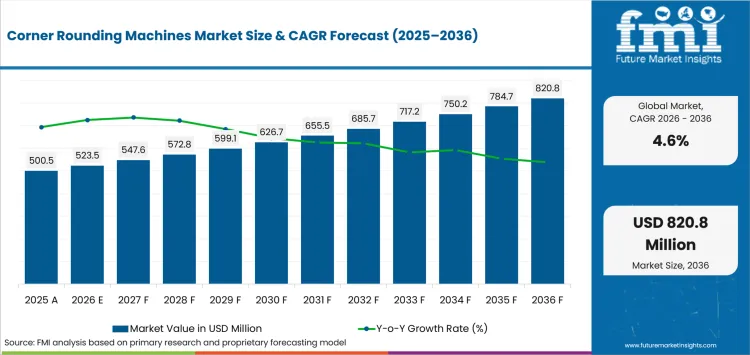
USD 523.5 million in 2026 and USD 820.8 million by 2036 at a 4.6% CAGR.
Sales of corner rounding machines are estimated to rise at a 4.6% CAGR through 2036, increasing from USD 523.5 million in 2026 to USD 820.8 million by 2036. Furniture manufacturers continue to evaluate finishing processes as part of broader production-line modernization programs. Biesse's May 2025 LIGNA presentation combined integrated production lines with updated woodworking machinery in the same commercial offering. The approach highlights growing interest in replacing manual finishing steps with more standardized processing equipment.
Czech Republic's expected 5.8% CAGR over the forecast contrasts with Japan's 3.8% projection because replacement investment faces different utilization conditions. The Czech Statistical Office recorded 2.8% growth in new industrial orders during 2024 even though total industrial production declined. Selective order recovery gives machinery vendors a clearer renewal case in Czech plants. Japanese factories, by comparison, need compact upgrades with a more conservative payback threshold.
Key Takeaways
- Furniture and cabinet plants purchase corner rounding machines to remove hand routing and preserve visible edge quality during repeat production.
- Semi-automatic machines are estimated to hold 29.0% of machine type demand in 2026 because they reduce handwork without full line-integration cost.
- Wood panels are projected to represent 31.0% of material demand in 2026 owing to routine radius finishing after edge application.
- Furniture production is anticipated to account for 31.0% of end-use demand in 2026 as edging and corner finishing occur in the same production sequence.
- Capital approval weakens in low-utilization shops because utilities, setup skills and service access can raise effective installed cost above machine price.
- Some of the key players in this market include Felder Group, SCM Group, Biesse, HOMAG, IMA Schelling Group, HOLZ-HER, Altendorf, and OAV Equipment and Tools, Inc.
Analyst Perspective
"A furniture plant should judge corner-rounding equipment by handwork removed at its actual panel mix and radius schedule. The investment case strengthens if changeover time, finish repeatability and local service response are measured beside machine price."
- Nikhil Kaitwade, Principal Consultant, Future Market Insights
How is the corner rounding machines market segmented?
The corner rounding machines market is segmented by machine type, material, end use, automation level, sales channel and region.
Machine type covers semi-automatic, manual, CNC, edge-bander integrated and multi-radius corner rounders. Material includes wood panels, laminated boards, PVC/ABS edges, paperboard/cardstock and plastic sheets. End use covers furniture production, cabinet shops, packaging converting, signage and plastics, and print finishing. Automation level includes pneumatic, manual, servo-controlled and line integrated systems. Sales channels comprise machinery dealers, OEM direct, aftermarket/catalog and e-commerce.
How does furniture production lead the end use category?
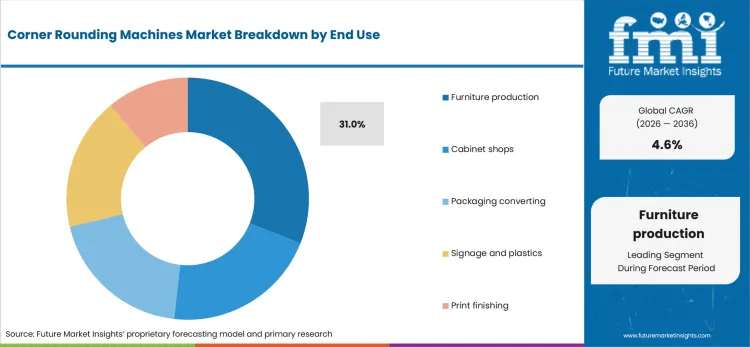
Furniture producers judge corner finish beside edge adhesion and assembly readiness because a visible radius defect can return a completed component to rework. Powered finishing therefore carries a direct labor and quality consequence on cabinet and interior-furniture lines.
- Furniture production is expected to account for 31.0% of end-use demand in 2026 due to frequent edge-banded panels in cabinets, storage systems and interior furniture.
- Altendorf reported in June 2025 that its Hebrock F next and K next edgebanders received revised controls and stronger processing units. The update points to continued investment in workshop-scale edge-finishing productivity and repeatable adjustment.
Why do semi-automatic machines lead the machine type category?
Furniture shops often need powered trimming and corner finishing before a fully linked edge line can reach profitable utilization. Semi-automatic machines retain flexible job loading but standardize the finishing cycle that most directly affects visible quality.
- By machine type, semi-automatic machines are estimated to hold 29.0% in 2026 owing to lower integration cost than CNC line-based alternatives.
- HOMAG's May 2025 LIGNA program covered entry-level through industrial edgebanders with programmable profile trimming and corner-processing functions. The range gives mixed-volume shops a staged path toward deeper automation without replacing the complete production system.
Why do wood panels lead the material category?
Panel furniture generates repeated corner-finishing work because applied edges must be trimmed and radiused before assembly. Standard panel geometry also lets machine builders control cutter position more consistently than less stable sheet materials.
- Wood panels are forecast to represent 31.0% of material demand in 2026 because furniture production repeatedly pairs applied edges with final radius finishing.
- SCM introduced the stefani m at LIGNA in May 2025 for flexible panel processing with automated setup and cell integration. Its production logic keeps corner finishing inside the same controlled route used for high-mix panel work.
Why do machinery dealers lead the sales channel category?
Corner-rounding purchases require configuration work before delivery because panel size, edge thickness, utilities and operator skill determine whether the machine fits the workload. Machinery dealers shorten that specification process and provide a local route for commissioning and service.
- Machinery dealers are estimated to capture 39.0% of sales in 2026 since configuration support and technical response shape smaller-shop purchasing decisions.
- Biesse opened a Guadalajara branch in February 2026 with expanded after-sales and spare-parts support for Mexico and Central America. Local technical coverage reduces the service risk that can otherwise delay machinery approval.
What are the drivers, restraints and opportunities in the Corner Rounding Machines Market?
Furniture plants automate corner finishing to remove hand rework, though utilization and service costs restrain smaller shops and programmable setup improves mixed-batch economics.
- Driver: Furniture plants justify corner rounding where the machine removes secondary handling and preserves visible edge quality at repeat volumes.
- Restraint: Installation, maintenance and service requirements can delay approval where machine utilization is intermittent or technical coverage is thin.
- Opportunity: Digital setup and nesting-compatible edge processing can shorten changeovers for plants running small batches with frequent panel variation.
The finishing station earns approval by preventing a second handling step on panels already moving through edgebanding. In June 2025, Biesse documented Hawk Furniture's use of a Stream A edgebander with panel return to cut manual handling and raise daily throughput. Corner rounding follows the same payback logic, provided the saved handling does not return as rework from inconsistent radius quality.
Service access can raise effective ownership cost because a stopped edge-finishing machine interrupts several downstream operations. HOMAG launched serviceRemote Bridge in April 2026 to provide secure remote maintenance for new and installed machines. The release confirms that recovery support is part of operating readiness, so smaller plants need a service route that matches the uptime assumptions used in the investment case.
Mixed-batch plants gain more from programmable corner finishing once radius settings follow digital panel data instead of manual resets. OAV integrated a nesting device into its edge banders in October 2025 to handle panels with pre-machined openings without copy-wheel interference. Edge-line builders can extend that logic to corner-radius recipes, reducing setup time on nested parts that vary by batch.
Which country CAGRs are profiled in the Corner Rounding Machines Market?
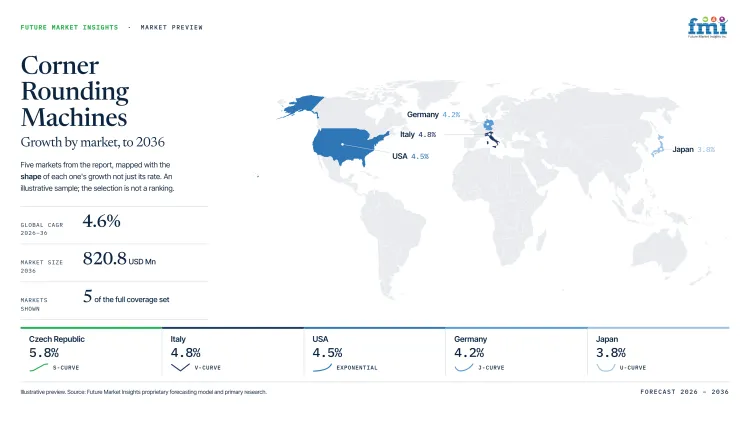
| Country | CAGR |
|---|---|
| Czech Republic | 5.8% |
| Mexico | 5.5% |
| Brazil | 5.2% |
| Italy | 4.8% |
| USA | 4.5% |
| Germany | 4.2% |
| Japan | 3.8% |
How do country-level CAGRs compare in the Corner Rounding Machines Market?
The seven forecasts span 2.0 percentage points, with Czech Republic, Mexico and Brazil above 5.0%. Italy and the USA track near the global rate, whereas Germany and Japan form the slower replacement-led group. The spread comes from different order visibility, service distance and installed-base maturity instead of current market size.
- Czech producers gain from short Central European service routes.
- Mexican export plants value technicians near furniture corridors.
- Brazilian financing favors machinery with lower installed capital needs.
- Italian plants benchmark features against domestic machinery engineering.
- USA dealer finance broadens access beyond factory-direct projects.
- German replacement sales face a higher payback threshold.
- Japanese plants prioritize repeatable geometry over headline throughput.
Similar CAGRs can mask different routes to orders. The full report covers North America, Latin America, Western Europe, Eastern Europe, East Asia, South Asia and Pacific, and Middle East and Africa.
Country-wise Analysis
- Czech furniture plants make capital decisions against uneven industrial orders, so automation must justify utilization before replacing hand finishing. The Czech Statistical Office recorded 1.5% year-on-year industrial production growth in February 2025 and listed machinery manufacturing among positive contributors. Czech Republic is projected to expand at 5.8% CAGR through 2036, tied to selective renewal and short service routes into Central Europe. Nearby machinery channels give smaller factories workable access to commissioning, spare parts and technician support. Order volatility limits the case for larger systems, which makes semi-automatic equipment easier to defend than high-capacity lines requiring steadier loading and longer payback assumptions.
- Mexican furniture exporters need technical response near production corridors because imported machinery loses value quickly during extended service delays. Corner rounding machine demand in Mexico is forecast to rise at 5.5% CAGR over the assessment period, aided by concentrated export manufacturing and improving local support. INEGI counted 136 IMMEX establishments in furniture, mattresses and blinds for November 2024 in its January 2025 release. Regional service points can shorten commissioning, spare-parts delivery and technician travel for export plants. The remaining friction is reliance on imported equipment, so manufacturers with stocked parts and trained regional technicians have a stronger route to repeat orders and replacement business.
- Brazilian furniture producers operate over long industrial distances, which makes field service and spare-parts placement part of the equipment decision. In April 2025, IBGE reported that furniture output increased 11.6% in February 2025 compared with February 2024. Sales of corner rounding machines in Brazil are anticipated to expand at 5.2% CAGR by 2036, reflecting selective factory modernization and continued furniture output. Regional dealers can reduce downtime by holding common parts closer to major furniture clusters and arranging local technician visits. Financing costs limit broad line replacement, so mid-capex configurations should convert more readily than complex systems requiring distant specialist support and longer capital-recovery periods.
- Italian furniture manufacturers work beside a strong domestic woodworking-machinery base, giving plants many options for comparing setup flexibility and service. The sector is estimated to post 4.8% CAGR during the forecast period, as a large but fragmented furniture-production base sustains replacement demand. Istat's March 2025 sector sheet lists 15,299 furniture enterprises for 2022, its latest structural count in that publication. Local engineering depth gives plants more choices for installation, troubleshooting and machine comparison before an imported system reaches the shortlist. Fragmentation limits one-size-fits-all economics, so compact machines suit smaller producers while high-utilization plants can justify deeper line integration and more automated changeover.
- USA demand ranges from small cabinet shops to large casework factories, making configuration breadth and dealer reach central to equipment selection. BLS data show 14,590 woodworking machine setters, operators and tenders employed in furniture manufacturing during 2025. The USA is expected to record 4.5% CAGR over the forecast period, as a sizeable production workforce leaves repetitive finishing tasks available for automation. National dealer coverage broadens access to demonstrations, financing, training and local service without requiring factory engineers on every installation. Floor space and utility readiness still limit smaller shops, so practical commissioning often decides whether expected labor savings become a credible payback.
- German furniture plants evaluate automation against tight cost control and a mature installed base, which raises the proof required for replacement projects. Destatis reported in March 2025 that furniture-industry turnover declined 7.8% during 2024. Demand in Germany is projected to advance at 4.2% CAGR through 2036, attributable to selective upgrades that cut handling or speed changeovers. Dense domestic machinery service lets plants compare uptime, spare-parts response and technician availability before approval. Weak industry revenue raises the threshold for discretionary capital, so machine builders must prove labor recovery and faster setup without forcing a plant into oversized line architecture or unnecessary capacity.
- Japanese furniture factories set a high bar for repeatability and compact process control, especially where existing plants replace equipment within limited floor space. Japan is forecast to expand at 3.8% CAGR during the assessment period, given a replacement-led demand profile with slower greenfield expansion. The Statistical Handbook of Japan 2025 records 6,378 furniture and fixtures establishments in 2023, confirming a broad installed manufacturing base. Domestic service expectations favor machines that hold finish quality after routine radius changes and require limited specialist intervention. Growth is slower than in the other profiled countries, but compact layouts and repeatable radius control can compete without relying on aggressive throughput claims.
Who are the notable companies in the Corner Rounding Machines Market?
Felder Group, SCM Group, Biesse, HOMAG, IMA Schelling Group, HOLZ-HER, Altendorf, and OAV Equipment and Tools, Inc. are notable companies serving this market.
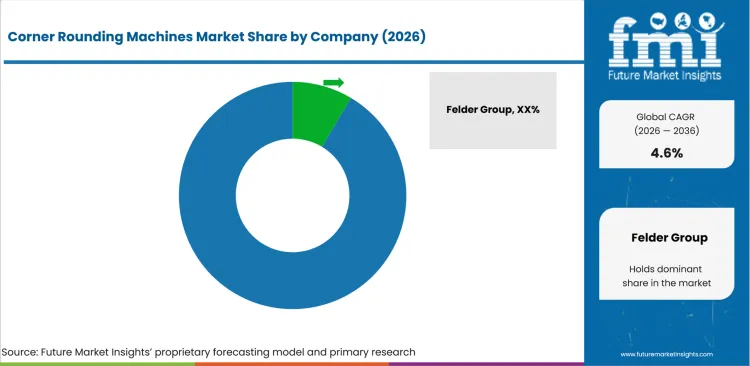
Competition separates industrial edge-processing groups from workshop machinery brands and programmable-finishing specialists. Entry becomes harder once manufacturers require corner processing, repeatable changeover and service support in the same offer. Stronger positions come from companies that document the corner function inside a working edge-banding route instead of treating it as an isolated accessory.
- Industrial edge-processing platforms: SCM Group, Biesse, HOMAG and IMA Schelling Group cover larger panel lines with deeper automation and digital control.
- Flexible workshop and mid-scale systems: Felder Group, HOLZ-HER and Altendorf address plants that need automated edge finishing without a full high-output line.
- Specialist export machinery: OAV Equipment and Tools, Inc. supplies compact edge-banding systems with corner-rounding configurations for distributor-led international sales.
Competitive Benchmarking: Corner Rounding Machines Market
| Company | Integrated Edge-Finishing Automation | Programmed Changeover Control | Service and Channel Support | Geographic Reach |
|---|---|---|---|---|
| Felder Group | High | High | High | Europe, North America, Asia-Pacific and international sales |
| SCM Group | High | High | High | Global |
| Biesse | High | High | High | Global |
| HOMAG | High | High | High | Global |
| IMA Schelling Group | High | High | High | Europe, North America and Asia |
| HOLZ-HER | Medium | Medium | High | Europe, North America and international dealer markets |
| Altendorf | Medium | High | High | Europe, North America, Asia and Australia |
| OAV Equipment and Tools, Inc. | High | Medium | Medium | Asia, Europe and distributor-led export markets |
Scoring basis: High integration requires automated edge processing with corner finishing and several linked machining stages. Medium identifies a narrower powered configuration. High changeover requires servo, recipe, multi-profile or automatic setting control, while Medium uses assisted adjustment. High service support requires documented multi-region infrastructure. Medium reflects a narrower distributor route. Ratings describe published capability and reach, not company size or market share.
Key Developments in the Corner Rounding Machines Market
- In July 2026, Biesse acquired Orchestra Srl to extend machine interconnection and manufacturing-process monitoring inside its digital production offer.
- In November 2025, IMA Schelling Group introduced four edging technologies covering milling, soft-forming, groove processing and PUR edge banding for integrated furniture production.
- In November 2025, SCM Group announced the first of three stefani rocket H lines for Taiwan Order Furniture with automatic label reading and MES interaction.
Key Players in the Corner Rounding Machines Market
Industrial Edge-Processing Platforms
- SCM Group
- Biesse
- HOMAG
- IMA Schelling Group
Flexible Furniture and Panel Machinery
- Felder Group
- HOLZ-HER
- Altendorf
Specialist Edge-Banding Machinery
- OAV Equipment and Tools, Inc.
Corner Rounding Machines Market - Report Scope
| Coverage field | Report scope |
|---|---|
| Market breakdown | By machine type, material, end use, automation level, sales channel and region. |
| Quantitative Units | USD million. |
| Market Definition | Revenue from corner rounding machines and integrated corner-rounding equipment sold within the stated segmentation boundary. Downstream finished products and adjacent equipment without a corner-rounding revenue component are excluded. |
| Regions Covered | North America, Latin America, Western Europe, Eastern Europe, East Asia, South Asia and Pacific, and Middle East and Africa. |
| Countries Covered | Czech Republic, Mexico, Brazil, Italy, USA, Germany, Japan, and 25+ countries included in the full report. |
| Key Companies Profiled | Felder Group, SCM Group, Biesse, HOMAG, IMA Schelling Group, HOLZ-HER, Altendorf, OAV Equipment and Tools, Inc. |
| Forecast Period | 2026 to 2036. |
| Approach | Primary and secondary research with market triangulation. |
Corner Rounding Machines Market - Research Methodology
| Method | Approach |
|---|---|
| Primary Research | FMI analysts gathered input from manufacturers, service providers, technology developers, distributors, end users, procurement teams, and subject-matter experts. Interviews examined purchasing decisions, product or service evaluation, adoption barriers, approval requirements, pricing considerations, and expectations for technical or commercial support. Respondents were also asked what evidence is required before a trial, pilot, or initial order develops into regular purchasing. |
| Desk Research | Desk research covered government statistics, regulatory publications, trade data, industry associations, technical literature, standards, company filings, product information, and official corporate announcements. Sources were reviewed for relevance, publication date, geographic coverage, and consistency with the defined market scope. Claims relating to performance, applications, approvals, capacity, investment, and commercial activity were retained only when supported by credible public evidence. |
| Market Sizing and Forecasting | The market model combined the baseline value with historical performance, segment structure, pricing and volume indicators, adoption levels, company participation, and country-level demand conditions. Forecast assumptions considered economic activity, investment trends, regulatory developments, technology adoption, purchasing cycles, supply availability, and barriers to wider market use. Segment and regional estimates were reconciled before the final market total was calculated. |
| Data Validation | Estimates were checked against multiple independent indicators, including public data, company activity, trade patterns, industry developments, and findings from primary interviews. Validation also tested whether products, services, applications, and company revenues fell within the defined market boundaries. Adjacent categories, unsupported claims, overlapping revenues, and activities without direct market relevance were excluded to reduce double counting and maintain consistency across segments and countries. |
Corner Rounding Machines Market by Segments
Corner Rounding Machines Market segmented by Machine Type:
- Semi-automatic machines
- Manual corner rounders
- CNC corner rounding machines
- Edge-bander integrated rounders
- Multi-radius corner rounders
Corner Rounding Machines Market segmented by Material:
- Wood panels
- Laminated boards
- PVC/ABS edges
- Paperboard/cardstock
- Plastic sheets
Corner Rounding Machines Market segmented by End Use:
- Furniture production
- Cabinet shops
- Packaging converting
- Signage and plastics
- Print finishing
Corner Rounding Machines Market segmented by Automation Level:
- Pneumatic
- Manual
- Servo-controlled
- Line integrated
Corner Rounding Machines Market segmented by Sales Channel:
- Machinery dealers
- OEM direct
- Aftermarket/catalog
- E-commerce
Corner Rounding Machines Market by Region:
- North America
- United States
- Canada
- Latin America
- Brazil
- Mexico
- Argentina
- Chile
- Western Europe
- Germany
- France
- United Kingdom
- Italy
- Spain
- Benelux
- Nordics
- Eastern Europe
- Poland
- Czech Republic
- Romania
- Hungary
- East Asia
- China
- Japan
- South Korea
- South Asia and Pacific
- India
- ASEAN
- Australia and New Zealand
- Middle East and Africa
- GCC Countries
- South Africa
- Türkiye
- Israel
Research Sources and Bibliography
- Biesse. (2025, May 25). Biesse at Ligna: focus on wood within a comprehensive multimaterial portfolio.
- Czech Statistical Office. (2025, February 6). Industry and construction recorded declines in production in 2024.
- HOMAG. (2025, May 26). Future-oriented solutions for carpenters/joiners in all performance classes of edge banding machines.
- SCM Group. (2025, May 23). SCM presents stefani m.
- Altendorf Group. (2025, June 6). Altendorf Group impresses at LIGNA 2025: Innovation, Connectivity, and Strong Partnerships.
- Biesse. (2026, February 2). Mexican Market: Biesse strengthens its presence in Latin America through expansion in Mexico.
- Biesse. (2025, June 4). Hawk Furniture: Reliability with Edgebanding.
- HOMAG. (2026, April 1). New level of remote service with sR Bridge.
- OAV Equipment and Tools, Inc. (2025, October 27). OAV integrates nesting technology into edge banders, enabling high-precision, fully automated production.
- Czech Statistical Office. (2025, April 7). Industry - February 2025.
- INEGI. (2025, January 20). Indicadores de Establecimientos con Programa IMMEX, November 2024.
- IBGE. (2025, April 2). Produção industrial varia -0,1% em fevereiro.
- Istat. (2025, March 20). Rapporto sulla competitività dei settori produttivi - Edizione 2025: Settore 31 - Fabbricazione di mobili.
- USA Bureau of Labor Statistics. (2026, September 2). Furniture and Related Product Manufacturing: NAICS 337.
- Federal Statistical Office of Germany. (2025, March 20). German furniture industry: turnover declined in 2024.
- Statistics Bureau of Japan. (2025, September). Statistical Handbook of Japan 2025.
- Biesse. (2026, July 5). Biesse acquires Orchestra Srl, strengthening its digital strategy to optimize and simplify manufacturing processes.
- IMA Schelling Group. (2025, November 18). IMA Schelling rethinks edging.
- SCM Group. (2025, November 10). Taiwan Order Furniture chooses SCM for a new high-efficiency edge banding line.
- IMA Schelling Group. (2026, April 22). Secure Manufacturing with IMA Schelling.
- Altendorf. (2026, April 27). Altendorf is bringing its edgebanding machines under a single brand name - the F Series and K Series have been repositioned.
- Biesse. (2026, May 1). Hansen & Company Woodworks Unveils HCo 2.0 Powered by Biesse.
- SCM Group. (2026, June 22). SCM confirms its role as a strategic partner for the entire wood industry at Xylexpo 2026.
- HOMAG. (2026, August 11). EDGETEQ S-500 Special Offer Models: Faster to the Perfect Edge.
- Felder Group. (2025, May 26-30). LIGNA 2025.
- SCM Group. (2025, June 24). TECNO LOGICA launches a new automation paradigm at Ligna 2025.
- Biesse. (2025, June 4). abox: Automating the process.
- HOMAG. (2026, July 24). More Performance with Less Floor Space: The New Footprint Saver package for the LOOPTEQ O-400.
- IMA Schelling Group. (2025, December 3). Automated production of handleless fronts.
- WEINIG Group. (2026, July 6). The WEINIG Group Returns to IWF 2026 Bigger Than Ever.
- Altendorf Group. (2025, May 15). Altendorf Group presents NEXUS IIOT - The control center for the digital workshop.
- OAV Equipment and Tools, Inc. (2025, April 14). Compact Edge Bander with Multi-Functions MAX370M.
This bibliography is provided for reader reference and is not exhaustive. The full report contains the complete reference list and detailed citations
This Report Answers
- How large is the corner rounding machines market in 2026 and 2036?
- Which operating conditions support automated corner finishing?
- Why do semi-automatic machines hold the leading machine type share?
- Why do wood panels account for the leading material share?
- How does furniture production shape corner-rounding equipment demand?
- Which conditions explain the seven profiled country growth rates?
- Which companies provide integrated and workshop-scale corner finishing?
- What installation and utilization constraints can delay equipment approval?
Frequently Asked Questions
How big is the Corner Rounding Machines Market in 2026?
The corner rounding machines market is valued at USD 523.5 million in 2026 and is projected to reach USD 820.8 million by 2036. Furniture plants support growth by replacing secondary hand routing with repeatable machine finishing.
What is the CAGR of the Corner Rounding Machines Market from 2026 to 2036?
The corner rounding machines market is projected to grow at a CAGR of 4.6% between 2026 and 2036. Expansion is supported by integrated edge finishing, programmable setup and replacement of repetitive manual routing.
Which machine type leads the Corner Rounding Machines Market?
The semi-automatic machines segment is expected to hold 29.0% of the corner rounding machines market in 2026, driven by controlled finishing without full line-integration cost. The format suits plants that cannot load a larger CNC system consistently.
Which material leads the Corner Rounding Machines Market?
The wood panels segment is expected to hold 31.0% of the corner rounding machines market in 2026, attributable to repeated radius finishing after edge application. Standard panel geometry also fits controlled trimming on regular furniture production runs.
Which countries are projected to record the highest growth in the Corner Rounding Machines Market?
Czech Republic is projected to grow at 5.8% CAGR, followed by Mexico at 5.5% and Brazil at 5.2% through 2036. Their growth routes differ through industrial order recovery, export manufacturing and furniture-production activity.
Which companies are active in the Corner Rounding Machines Market?
Key companies operating in the market include Felder Group, SCM Group, Biesse, HOMAG, IMA Schelling Group, HOLZ-HER, Altendorf, and OAV Equipment and Tools, Inc. Their positions differ by automation depth, changeover control and service reach.
Preview the report firsthand - request a free sample
Get SampleGet the brochure for pricing and purchase details.
Get PDFTable of Content
- Key Takeaways
- Market Size and CAGR
- Top Growth Driver
- Fastest Growing Segment
- Leading Region
- Key Companies
- Emerging Opportunities
- Executive Summary
- Global Market Outlook
- Demand-side Trends
- Supply-side Trends
- Technology Roadmap Analysis
- Analysis and Recommendations
- Analyst Perspective (What is happening? Why now? What should investors know?)
- Key Questions Answered
- How large is the market?
- What is the CAGR?
- What are key trends?
- Which region dominates?
- Who are the leaders?
- Market Overview
- Market Coverage / Taxonomy
- Market Definition / Scope / Limitations
- Research Methodology
- Chapter Orientation
- Analytical Lens and Working Hypotheses
- Market Structure, Signals, and Trend Drivers
- Benchmarking and Cross-market Comparability
- Market Sizing, Forecasting, and Opportunity Mapping
- Research Design and Evidence Framework
- Desk Research Programme (Secondary Evidence)
- Expert Input and Fieldwork (Primary Evidence)
- Tooling, Models, and Reference Databases
- Data Engineering and Model Build
- Quality Assurance and Audit Trail
- Market Background
- Market Dynamics (Drivers, Restraints, Opportunity, Trends)
- Scenario Forecast (Optimistic, Likely, Conservative)
- Impact Analysis
- AI Impact
- Sustainability Impact
- Regulatory Impact
- Technology Impact
- Consumer / Buyer Analysis
- Purchase Drivers
- Adoption Barriers
- Buyer Journey
- Opportunity Map Analysis
- Product Life Cycle Analysis
- Supply Chain Analysis
- Investment Feasibility Matrix
- Value Chain Analysis
- PESTLE and Porter's Analysis
- Regulatory Landscape
- Regional Parent Market Outlook
- Production and Consumption Statistics
- Import and Export Statistics
- Global Market Analysis and Forecast, 2021 to 2036
- Historical Market Size Value (USD Million) Analysis, 2021 to 2025
- Current and Future Market Size Value (USD Million) Projections, 2026 to 2036
- Y-o-Y Growth Trend Analysis
- Absolute $ Opportunity Analysis
- Global Market Pricing Analysis, 2021 to 2036
- Global Market Analysis and Forecast, By Machine Type, 2021 to 2036
- Introduction / Key Findings
- Historical Market Size Value (USD Million) Analysis By Machine Type, 2021 to 2025
- Current and Future Market Size Value (USD Million) Analysis and Forecast By Machine Type, 2026 to 2036
- Semi-automatic machines
- Manual corner rounders
- CNC corner rounding machines
- Edge-bander integrated rounders
- Multi-radius corner rounders
- Semi-automatic machines
- Y-o-Y Growth Trend Analysis By Machine Type, 2021 to 2025
- Absolute $ Opportunity Analysis By Machine Type, 2026 to 2036
- Global Market Analysis and Forecast, By Material, 2021 to 2036
- Introduction / Key Findings
- Historical Market Size Value (USD Million) Analysis By Material, 2021 to 2025
- Current and Future Market Size Value (USD Million) Analysis and Forecast By Material, 2026 to 2036
- Wood panels
- Laminated boards
- PVC/ABS edges
- Paperboard/cardstock
- Plastic sheets
- Wood panels
- Y-o-Y Growth Trend Analysis By Material, 2021 to 2025
- Absolute $ Opportunity Analysis By Material, 2026 to 2036
- Global Market Analysis and Forecast, By End Use, 2021 to 2036
- Introduction / Key Findings
- Historical Market Size Value (USD Million) Analysis By End Use, 2021 to 2025
- Current and Future Market Size Value (USD Million) Analysis and Forecast By End Use, 2026 to 2036
- Furniture production
- Cabinet shops
- Packaging converting
- Signage and plastics
- Print finishing
- Furniture production
- Y-o-Y Growth Trend Analysis By End Use, 2021 to 2025
- Absolute $ Opportunity Analysis By End Use, 2026 to 2036
- Global Market Analysis and Forecast, By Automation Level, 2021 to 2036
- Introduction / Key Findings
- Historical Market Size Value (USD Million) Analysis By Automation Level, 2021 to 2025
- Current and Future Market Size Value (USD Million) Analysis and Forecast By Automation Level, 2026 to 2036
- Pneumatic
- Manual
- Servo-controlled
- Line integrated
- Pneumatic
- Y-o-Y Growth Trend Analysis By Automation Level, 2021 to 2025
- Absolute $ Opportunity Analysis By Automation Level, 2026 to 2036
- Global Market Analysis and Forecast, By Sales Channel, 2021 to 2036
- Introduction / Key Findings
- Historical Market Size Value (USD Million) Analysis By Sales Channel, 2021 to 2025
- Current and Future Market Size Value (USD Million) Analysis and Forecast By Sales Channel, 2026 to 2036
- Machinery dealers
- OEM direct
- Aftermarket/catalog
- E-commerce
- Machinery dealers
- Y-o-Y Growth Trend Analysis By Sales Channel, 2021 to 2025
- Absolute $ Opportunity Analysis By Sales Channel, 2026 to 2036
- Global Market Analysis and Forecast, By Region, 2021 to 2036
- Introduction
- Historical Market Size Value (USD Million) Analysis By Region, 2021 to 2025
- Current Market Size Value (USD Million) Analysis and Forecast By Region, 2026 to 2036
- North America
- Latin America
- Western Europe
- Eastern Europe
- East Asia
- South Asia and Pacific
- Middle East & Africa
- Market Attractiveness Analysis By Region
- North America Market Analysis and Forecast, By Country, 2021 to 2036
- Historical Market Size Value (USD Million) Trend Analysis By Market Taxonomy, 2021 to 2025
- Market Size Value (USD Million) Forecast By Market Taxonomy, 2026 to 2036
- By Country
- USA
- Canada
- By Machine Type
- By Material
- By End Use
- By Automation Level
- By Sales Channel
- By Country
- Market Attractiveness Analysis
- By Country
- By Machine Type
- By Material
- By End Use
- By Automation Level
- By Sales Channel
- Key Takeaways
- Latin America Market Analysis and Forecast, By Country
- Historical Market Size Value (USD Million) Trend Analysis By Market Taxonomy, 2021 to 2025
- Market Size Value (USD Million) Forecast By Market Taxonomy, 2026 to 2036
- By Country
- Brazil
- Mexico
- Chile
- Rest of Latin America
- By Machine Type
- By Material
- By End Use
- By Automation Level
- By Sales Channel
- By Country
- Market Attractiveness Analysis
- By Country
- By Machine Type
- By Material
- By End Use
- By Automation Level
- By Sales Channel
- Key Takeaways
- Western Europe Market Analysis and Forecast, By Country
- Historical Market Size Value (USD Million) Trend Analysis By Market Taxonomy, 2021 to 2025
- Market Size Value (USD Million) Forecast By Market Taxonomy, 2026 to 2036
- By Country
- Germany
- UK
- Italy
- Spain
- France
- Nordic
- BENELUX
- Rest of Western Europe
- By Machine Type
- By Material
- By End Use
- By Automation Level
- By Sales Channel
- By Country
- Market Attractiveness Analysis
- By Country
- By Machine Type
- By Material
- By End Use
- By Automation Level
- By Sales Channel
- Key Takeaways
- Eastern Europe Market Analysis and Forecast, By Country
- Historical Market Size Value (USD Million) Trend Analysis By Market Taxonomy, 2021 to 2025
- Market Size Value (USD Million) Forecast By Market Taxonomy, 2026 to 2036
- By Country
- Russia
- Poland
- Hungary
- Balkan & Baltic
- Rest of Eastern Europe
- By Machine Type
- By Material
- By End Use
- By Automation Level
- By Sales Channel
- By Country
- Market Attractiveness Analysis
- By Country
- By Machine Type
- By Material
- By End Use
- By Automation Level
- By Sales Channel
- Key Takeaways
- East Asia Market Analysis and Forecast, By Country
- Historical Market Size Value (USD Million) Trend Analysis By Market Taxonomy, 2021 to 2025
- Market Size Value (USD Million) Forecast By Market Taxonomy, 2026 to 2036
- By Country
- China
- Japan
- South Korea
- By Machine Type
- By Material
- By End Use
- By Automation Level
- By Sales Channel
- By Country
- Market Attractiveness Analysis
- By Country
- By Machine Type
- By Material
- By End Use
- By Automation Level
- By Sales Channel
- Key Takeaways
- South Asia and Pacific Market Analysis and Forecast, By Country
- Historical Market Size Value (USD Million) Trend Analysis By Market Taxonomy, 2021 to 2025
- Market Size Value (USD Million) Forecast By Market Taxonomy, 2026 to 2036
- By Country
- India
- ASEAN
- Australia & New Zealand
- Rest of South Asia and Pacific
- By Machine Type
- By Material
- By End Use
- By Automation Level
- By Sales Channel
- By Country
- Market Attractiveness Analysis
- By Country
- By Machine Type
- By Material
- By End Use
- By Automation Level
- By Sales Channel
- Key Takeaways
- Middle East & Africa Market Analysis and Forecast, By Country
- Historical Market Size Value (USD Million) Trend Analysis By Market Taxonomy, 2021 to 2025
- Market Size Value (USD Million) Forecast By Market Taxonomy, 2026 to 2036
- By Country
- Kingdom of Saudi Arabia
- Other GCC Countries
- Türkiye
- South Africa
- Other African Union
- Rest of Middle East & Africa
- By Machine Type
- By Material
- By End Use
- By Automation Level
- By Sales Channel
- By Country
- Market Attractiveness Analysis
- By Country
- By Machine Type
- By Material
- By End Use
- By Automation Level
- By Sales Channel
- Key Takeaways
- Key Countries Market Analysis
- USA
- Pricing Analysis
- Market Share Analysis, 2025
- By Machine Type
- By Material
- By End Use
- By Automation Level
- By Sales Channel
- Canada
- Pricing Analysis
- Market Share Analysis, 2025
- By Machine Type
- By Material
- By End Use
- By Automation Level
- By Sales Channel
- Mexico
- Pricing Analysis
- Market Share Analysis, 2025
- By Machine Type
- By Material
- By End Use
- By Automation Level
- By Sales Channel
- Brazil
- Pricing Analysis
- Market Share Analysis, 2025
- By Machine Type
- By Material
- By End Use
- By Automation Level
- By Sales Channel
- Chile
- Pricing Analysis
- Market Share Analysis, 2025
- By Machine Type
- By Material
- By End Use
- By Automation Level
- By Sales Channel
- Germany
- Pricing Analysis
- Market Share Analysis, 2025
- By Machine Type
- By Material
- By End Use
- By Automation Level
- By Sales Channel
- UK
- Pricing Analysis
- Market Share Analysis, 2025
- By Machine Type
- By Material
- By End Use
- By Automation Level
- By Sales Channel
- Italy
- Pricing Analysis
- Market Share Analysis, 2025
- By Machine Type
- By Material
- By End Use
- By Automation Level
- By Sales Channel
- Spain
- Pricing Analysis
- Market Share Analysis, 2025
- By Machine Type
- By Material
- By End Use
- By Automation Level
- By Sales Channel
- France
- Pricing Analysis
- Market Share Analysis, 2025
- By Machine Type
- By Material
- By End Use
- By Automation Level
- By Sales Channel
- India
- Pricing Analysis
- Market Share Analysis, 2025
- By Machine Type
- By Material
- By End Use
- By Automation Level
- By Sales Channel
- ASEAN
- Pricing Analysis
- Market Share Analysis, 2025
- By Machine Type
- By Material
- By End Use
- By Automation Level
- By Sales Channel
- Australia & New Zealand
- Pricing Analysis
- Market Share Analysis, 2025
- By Machine Type
- By Material
- By End Use
- By Automation Level
- By Sales Channel
- China
- Pricing Analysis
- Market Share Analysis, 2025
- By Machine Type
- By Material
- By End Use
- By Automation Level
- By Sales Channel
- Japan
- Pricing Analysis
- Market Share Analysis, 2025
- By Machine Type
- By Material
- By End Use
- By Automation Level
- By Sales Channel
- South Korea
- Pricing Analysis
- Market Share Analysis, 2025
- By Machine Type
- By Material
- By End Use
- By Automation Level
- By Sales Channel
- Russia
- Pricing Analysis
- Market Share Analysis, 2025
- By Machine Type
- By Material
- By End Use
- By Automation Level
- By Sales Channel
- Poland
- Pricing Analysis
- Market Share Analysis, 2025
- By Machine Type
- By Material
- By End Use
- By Automation Level
- By Sales Channel
- Hungary
- Pricing Analysis
- Market Share Analysis, 2025
- By Machine Type
- By Material
- By End Use
- By Automation Level
- By Sales Channel
- Kingdom of Saudi Arabia
- Pricing Analysis
- Market Share Analysis, 2025
- By Machine Type
- By Material
- By End Use
- By Automation Level
- By Sales Channel
- Türkiye
- Pricing Analysis
- Market Share Analysis, 2025
- By Machine Type
- By Material
- By End Use
- By Automation Level
- By Sales Channel
- South Africa
- Pricing Analysis
- Market Share Analysis, 2025
- By Machine Type
- By Material
- By End Use
- By Automation Level
- By Sales Channel
- USA
- Market Structure Analysis
- Competition Dashboard
- Competition Benchmarking
- Market Share Analysis of Top Players
- By Regional
- By Machine Type
- By Material
- By End Use
- By Automation Level
- By Sales Channel
- Emerging Startups
- Innovation Benchmarking
- Competition Analysis
- Competition Deep Dive
- Felder Group
- Overview
- Product Portfolio
- Profitability by Market Segments
- Sales Footprint
- Strategy Overview
- Marketing Strategy
- Product Strategy
- Channel Strategy
- SCM Group
- Biesse
- HOMAG
- Virutex
- Casadei Busellato
- Cantek
- Laguna Tools
- Ritter Machinery
- Grizzly Industrial
- Felder Group
- Case Studies
- Success Stories
- Recent Developments
- Competition Deep Dive
- Assumptions & Acronyms Used


