

- Market Size (2026)
- USD 1.5 Bn
- Forecast (2036)
- USD 3.2 Bn
- CAGR (2026 to 2036)
- 7.9%
How big is Crispy Chickpea Snacks Market in 2026?
USD 1.5 Billion in 2026 and USD 3.2 Billion by 2036 at a 7.9% CAGR.
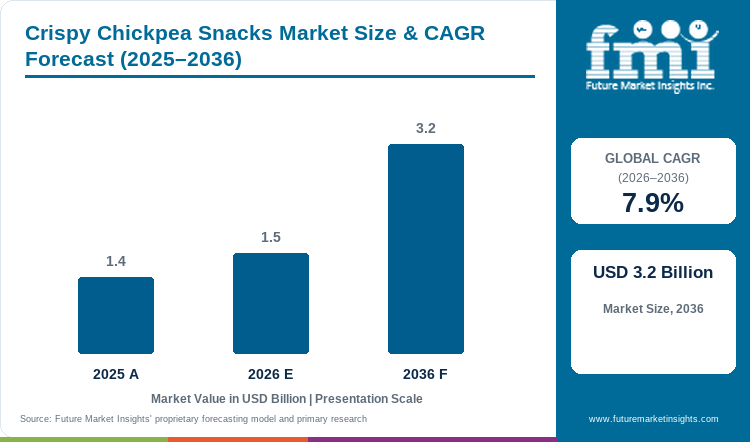
Sales of crispy chickpea snacks are estimated at USD 1.5 Billion in 2026 and are forecast to reach USD 3.2 Billion by 2036 at a 7.9% CAGR. The market was valued at USD 1.4 Billion in 2025. Demand starts with a simple conversion: a low-cost pulse is roasted, baked, fried or traditionally heat-treated until it becomes a shelf-stable snack with much higher value per kilogram. The supply base is deep enough to support that conversion. India reported 11.1 million tonnes of chickpea production in 2024-25, while the United States produced 684.4 million pounds in 2025. Australia estimated 2.2 million tonnes for 2025-26. Processors can source chickpeas from several major producing regions.
Whole roasted chickpeas offer a visible pulse ingredient alongside nuts and chips in the healthy snacks market. Protein or fibre claims depend on the finished formulation. The more immediate test for consumers is the bite: excessive hardness makes the snack difficult to eat, while moisture pickup removes its crunch. Roasting, seasoning and the package's moisture barrier have to deliver the same texture through distribution and storage.
Key Takeaways
- The market is estimated at USD 1.5 Billion in 2026 and is forecast to reach USD 3.2 Billion by 2036 at a 7.9% CAGR. The 2025 base is USD 1.4 Billion.
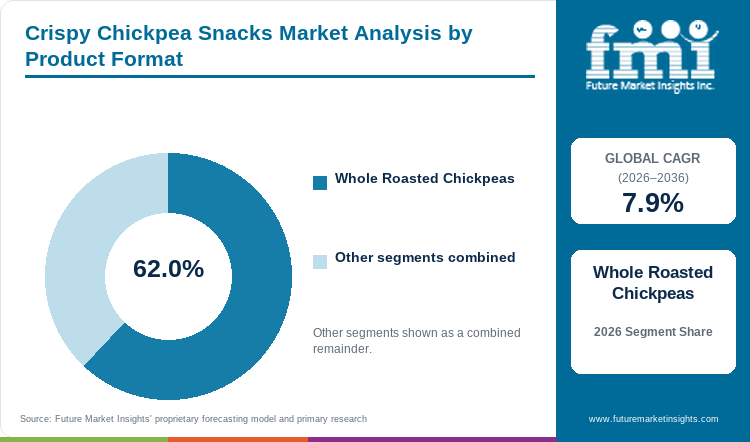
- Whole Roasted Chickpeas account for 62.0% of Product Format demand in 2026 because the intact pulse supports a clear ingredient story and a familiar roasted-snack eating experience.
- Dry-Roasted & Air-Roasted products hold 55.0% of Processing Method demand in 2026 as brands use heat treatment to build crunch while controlling added oil.
- Savory & Spiced flavors represent 66.0% of Flavor Profile demand, reflecting established salted, chili, cumin, barbecue and globally inspired seasoning systems.
- The 50-150 g pack band accounts for 47.0% of Pack Size demand, while Supermarkets & Hypermarkets hold 39.0% of Sales Channel demand because the format works for both trial and repeat household purchase.
- Country CAGRs range from 9.2% in the USA to 6.6% in Türkiye from 2026 to 2036. Growth depends on the maturity of roasted-chickpea habits, retail placement and how strongly brands can translate nutrition claims into repeat purchase.
Analyst Perspective
Roasted chana and leblebi already have established consumers in India and Türkiye. In newer snack markets, brands often introduce chickpeas through familiar savory flavors and nutrition claims. Both routes require a consistent bite. Conditioning and roasting must prevent excessive hardness, and the package must keep moisture out after processing. Pack size then affects how long the snack stays open before it is finished.
- Nandini Roy Choudhury, Principal Consultant, Future Market Insights
How is the Crispy Chickpea Snacks Market segmented?
The Crispy Chickpea Snacks Market is segmented by Product Format, Processing Method, Flavor Profile, Pack Size, Sales Channel, and Region.
Product Format includes Whole Roasted Chickpeas, Split/Dehulled Chickpeas, Flattened Chickpea Snacks and Coated Chickpea Snacks. Processing Method covers Dry-Roasted & Air-Roasted, Baked, Fried and Traditional Sand/Clay Roasted products. Flavor Profile includes Savory & Spiced, Salted/Plain and Sweet/Coated. Pack Size covers Below 50 g, 50-150 g, 151-250 g and Above 250 g. Sales Channel includes Supermarkets & Hypermarkets, Convenience Stores, Specialty/Health Food Stores, Online/DTC and Other Channels. Regional analysis covers North America, Latin America, Western Europe, Eastern Europe, East Asia, South Asia & Pacific and Middle East & Africa.
Why do Whole Roasted Chickpeas lead the Product Format category?
Whole chickpeas make the ingredient immediately legible. The shopper can see that the snack is a pulse rather than an extruded shape, and manufacturers can build their proposition around roast, seasoning and origin instead of a complex flour formula. The Good Bean sells gently roasted whole chickpeas, while The Happy Snack Company states that its chickpeas are not blended or extruded. Jabsons uses whole chickpeas in traditional clay-roasted products. This common architecture also lowers the need for extrusion equipment and gives the product a texture that distinguishes it from pulse puffs or chips.
- Whole Roasted Chickpeas hold 62.0% of Product Format demand in 2026 because the format supports a simple ingredient identity and works across Western better-for-you brands and traditional roasted-chana portfolios.
- Flattened formats such as Chana Jor Garam remain commercially important in India, but they create a different bite and seasoning surface than intact roasted chickpeas.
Why do Dry-Roasted & Air-Roasted products lead the Processing Method category?
Dry roasting and air roasting give manufacturers a direct way to build crunch while keeping the product close to a whole-food snack. Three Farmers positions its pulse snacks around roasting, The Good Bean uses gently roasted chickpeas, and The Happy Snack Company slow-cooks and roasts chickpeas in its own facility. This processing route also fits the wider plant-based snacks market because it keeps the pulse itself at the centre of the product. Fried formats can deliver a different texture and seasoning carry, while traditional clay or sand roasting remains relevant where the method itself is part of the product identity.
- Dry-Roasted & Air-Roasted products account for 55.0% of Processing Method demand in 2026 because they combine scalable heat treatment with the ingredient visibility buyers expect from whole-pulse snacks.
- Processing choice changes more than oil content. It affects fracture, seasoning pickup, hardness and the moisture level needed to protect crunch through the stated shelf life.
Why do Savory & Spiced flavors lead the Flavor Profile category?
Chickpeas have a mild base flavor, so seasoning does much of the work in creating a reason to repurchase. Current assortments range from The Good Bean’s chili-lime and hummus profiles to Saffron Road’s Korean BBQ and Bombay Spice. Jabsons uses cumin, asafoetida and tandoori seasoning, while Haldiram’s sells tangy Chana Jor Garam. These products compete for occasions already served by the savory snack market, which makes familiar salt, chili, barbecue and spice systems commercially useful. Sweet coatings can widen the category, but they change the health cue and can add processing or allergen complexity.
- Savory & Spiced flavors hold 66.0% of Flavor Profile demand in 2026 because they connect chickpeas with existing snack habits across India, Türkiye, North America and other markets.
- Flavor breadth matters when the base product is visually similar from SKU to SKU. Seasoning becomes the main tool for creating shelf distinction without changing the processing line.
Why does the 50-150 g band lead the Pack Size category?
The 50-150 g band balances trial with enough product for more than one eating occasion. Tadım lists roasted chickpeas in 90 g and 180 g packs, Jabsons sells several roasted chana products around 140 g to 200 g, while The Happy Snack Company carries 100 g and 150 g roasted chickpea formats. Small single-serve packs suit lunchboxes or vending, but larger household packs expose more product to humidity after opening. The middle band therefore gives brands room to serve both portable snacking and modest sharing while keeping the opened-pack risk manageable.
- The 50-150 g band accounts for 47.0% of Pack Size demand in 2026 because it supports a practical balance between price, trial and post-opening texture control.
- Resealable packaging becomes more valuable as pack size rises because the product can absorb moisture after opening and lose the crisp bite that defines the category.
Why do Supermarkets & Hypermarkets lead the Sales Channel category?
Supermarkets place crispy chickpea snacks where shoppers can compare them with nuts, popcorn and conventional salty snacks. That visibility matters because the category crosses several merchandising logics. Some retailers place roasted chickpeas in health-food sets, while others treat them as salty snacks or international foods. Shelf placement can therefore change who discovers the product. Large-format retail also supports flavor variety and multi-pack formats that are harder to justify in a small convenience set. Online channels remain useful for discovery, but grocery distribution is important for turning occasional trial into routine replenishment.
- Supermarkets & Hypermarkets hold 39.0% of Sales Channel demand in 2026 because they give brands enough shelf space to explain the format, compare nutritional cues and offer more than one flavor.
- Online/DTC performs a different job. It can support variety packs and niche claims, but repeat economics depend on shipping cost and whether the shopper wants to reorder a relatively low-ticket snack.
What are the drivers, restraints and opportunities in the Crispy Chickpea Snacks Market?
Whole-pulse nutrition and familiar savory occasions support demand, texture control limits poor execution, and broader retail distribution creates room for new formats and flavors.
- Driver: Consumers can move from chips or nuts to a whole-pulse snack without changing the basic eating occasion, while qualifying products can communicate protein, fibre or gluten-free attributes.
- Restraint: Roast conditions and final moisture have to be controlled tightly. Excess hardness, broken chickpeas or moisture pickup can undermine repeat purchase even when the ingredient story is strong.
- Opportunity: Manufacturers can localize seasonings, build school or travel packs and use private-label production to take a traditional pulse snack into new retail markets.
Nutrition cues help open the shelf, but they are governed by the finished product rather than the raw chickpea alone. The Good Bean reports 6 g of protein and 5 g of fibre per serving for its Sea Salt Crunchy Chickpeas. Saffron Road describes its crunchy chickpeas as plant-based and certified gluten-free. These attributes place the format close to the protein snacks market. In the European Union, a source-of-protein claim requires at least 12% of the food’s energy to come from protein, while a source-of-fibre claim requires at least 3 g of fibre per 100 g or 1.5 g per 100 kcal. Formulators therefore need the finished nutrition panel to support the claim they put on pack.
The restraint sits inside the production line. Chickpeas begin as a hard dry pulse and must be hydrated or otherwise conditioned before heat treatment. If the process leaves too much internal moisture, the product can soften during storage. If it drives moisture too far down or over-roasts the outer layer, the bite can become unpleasantly hard. Seasonings add another variable because oil, sugar or hygroscopic powders can alter moisture movement. The processor has to hit a narrow sensory target and then protect it with a high-barrier pack. That operating discipline explains why apparently simple roasted chickpeas can have very different repeat-purchase performance.
A second opportunity comes from claim-specific and allergen-aware retail. Chickpeas are naturally free of gluten-containing grains, but a packaged product can only carry a compliant gluten-free claim when the finished manufacturing system meets the relevant threshold. The U.S. FDA requires foods labeled gluten-free to contain less than 20 ppm gluten and restricts intentional use of gluten-containing grains. That links crispy chickpeas to the wider gluten-free food market. The commercial payoff is clearest for manufacturers that can combine the claim with seasoning variety without creating uncontrolled cross-contact elsewhere in the facility.
Which country CAGRs are profiled in the Crispy Chickpea Snacks Market?
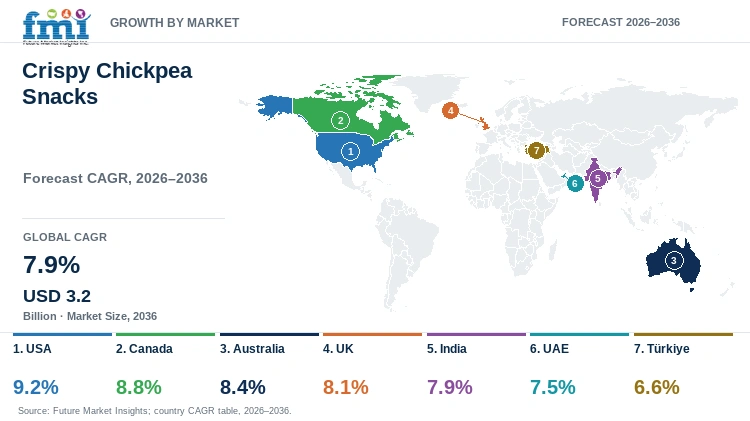
| Country | CAGR |
|---|---|
| USA | 9.2% |
| Canada | 8.8% |
| Australia | 8.4% |
| UK | 8.1% |
| India | 7.9% |
| UAE | 7.5% |
| Türkiye | 6.6% |
How do country-level CAGRs compare in the Crispy Chickpea Snacks Market?
Country growth ranges from 9.2% CAGR in the USA to 6.6% in Türkiye from 2026 to 2036. US, Canadian and Australian brands sell chickpeas alongside packaged savory and nutrition-oriented snacks. India and Türkiye have established roasted-pulse habits, so their opportunities include branded packs, additional flavors and premium assortments. Ingredient availability supports production, while shelf placement and texture determine repeat purchases.
- The USA at 9.2% has a broad pulse supply base and multiple branded crunchy-chickpea lines, giving retailers several ways to merchandise the product outside an ethnic-food aisle.
- Canada at 8.8% combines domestic pulse capability with Three Farmers’ North American expansion, which helps whole roasted pulses move through mainstream better-for-you channels.
- Australia at 8.4% links deep chickpea production with a domestic branded example that controls roasting and packing locally.
- India at 7.9% and Türkiye at 6.6% have established roasted-chickpea habits. Their growth is more closely tied to packaging, flavor extension and channel formalization than to basic category education.
Country-wise Analysis
- USA: Demand for Crispy Chickpea Snacks is forecast to expand at 9.2% CAGR from 2026 to 2036. USDA NASS reported 684.4 million pounds of U.S. chickpea production in 2025, while World Bank WITS records 98.8 million kg of dried chickpea imports in 2023. This gives processors access to domestic and imported supply. The Good Bean and Saffron Road demonstrate how the ingredient can be sold through roasted whole-pulse snacks with recognizable savory flavors and nutrition claims. Growth depends on winning space beside nuts, protein snacks and conventional salty snacks rather than remaining a specialty pulse item.
- Canada: Demand is forecast to expand at 8.8% CAGR from 2026 to 2036. Canada exported 220.2 million kg of dried chickpeas in 2023, according to World Bank WITS. Three Farmers closed an equity financing round in January 2025 after expanding manufacturing in Saskatoon and said the capital would support further growth in Canada and the USA. The country therefore combines raw-material capability with a branded processing route. Retail growth should favor suppliers that can maintain whole-pulse texture while scaling multi-flavor production and cross-border distribution.
- Australia: Demand is forecast to expand at 8.4% CAGR from 2026 to 2036. ABARES estimated chickpea production at 2.2 million tonnes in 2025-26. The Happy Snack Company uses Australian-grown chickpeas and roasts and packs them on Queensland’s Sunshine Coast. Its lightly salted product contains whole chickpeas and is not blended or extruded. Local chickpea production gives Australian processors nearby raw-material supply for branded snacks.
- UK: Demand is forecast to expand at 8.1% CAGR from 2026 to 2036. WITS records significant 2023 chickpea flows into the UK from Australia, India, Argentina and Canada. That ingredient access supports both conventional food use and snack processing. The UK retail environment is also familiar with plant-based and free-from propositions, giving crispy chickpeas a clear route to trial. Brands still need to manage value perception because a roasted pulse can be compared with lower-cost crisps on one shelf and with nuts or protein snacks on another.
- India: Demand is forecast to expand at 7.9% CAGR from 2026 to 2036. India reported 11.1 million tonnes of chickpea production in 2024-25. The demand mechanism is different from North America because roasted chana is already culturally familiar. Jabsons sells traditional clay-roasted whole chickpeas across multiple seasonings, while Haldiram’s sells flattened Chana Jor Garam. The growth opportunity is therefore in formal packaging, portion control, modern flavor systems and wider branded distribution rather than in teaching consumers what a roasted chickpea is.
- UAE: Demand is forecast to expand at 7.5% CAGR from 2026 to 2036. World Bank WITS records 151.5 million kg of dried chickpea imports in 2023, with Australia and India as major suppliers. A large imported ingredient base supports local packing and food manufacturing while the country’s multicultural retail system creates demand for South Asian and Middle Eastern snack formats. Crispy chickpea suppliers can serve both traditional roasted products and internationally seasoned variants, but pack labeling and halal positioning remain important commercial details.
- Türkiye: Demand is forecast to expand at 6.6% CAGR from 2026 to 2036. Türkiye exported 287.2 million kg of dried chickpeas in 2023. Tadım currently sells roasted and salted yellow chickpeas, double-roasted yellow chickpeas and roasted white chickpeas. The category is therefore mature in product recognition. Growth comes from branded premiumization, convenient pack formats and flavor extension rather than first-time adoption. Suppliers also have an export opportunity because the local leblebi tradition gives Turkish processors a product story that travels well into diaspora and neighboring markets.
Who are the notable companies in the Crispy Chickpea Snacks Market?
Biena Snacks; The Good Bean; Saffron Road; Three Farmers Foods; Festive Food Brands; The Happy Snack Company; Jabsons Foods; Haldiram’s; Tadım; Youi Foods
Competition spans three different business models. North American brands such as Biena, The Good Bean, Saffron Road and Three Farmers sell roasted pulses through modern better-for-you snack channels. Indian and Turkish suppliers such as Jabsons, Haldiram’s and Tadım build on established chana or leblebi consumption, where traditional roasting and spice profiles matter as much as health positioning. Festive and Youi Foods use shape, flavor and processing variation to push the category closer to conventional chips. The Happy Snack Company combines local Australian chickpea sourcing with its own roasting and packing operation. This variety keeps the market fragmented by region and product architecture.
- Whole-pulse specialists compete on roast quality, seasoning breadth and the ability to keep chickpeas crisp without making them difficult to bite.
- Traditional snack companies compete from cultural familiarity, then use branded packaging and flavor systems to widen the purchase occasion.
- Newer product platforms compete by reshaping the chickpea, adding coatings or combining baking and frying to create a snack experience closer to mainstream crisps.
Competitive Benchmarking: Crispy Chickpea Snacks Market
| Company | Whole-Chickpea Snack Depth | Flavor / Coating Breadth | Retail / Export Reach | Geographic Reach |
|---|---|---|---|---|
| Biena Snacks | High | High | High | USA with broad retail distribution |
| The Good Bean | High | High | Medium | USA |
| Saffron Road | High | High | High | North America |
| Three Farmers Foods | High | Medium | High | Canada and USA |
| Festive Food Brands | Medium | High | Medium | USA |
| The Happy Snack Company | High | High | High | Australia with export availability |
| Jabsons Foods | High | High | High | India with export channels |
| Haldiram’s | Medium | Medium | High | India with international packaged-food reach |
| Tadım | High | Medium | High | Türkiye and European markets |
| Youi Foods | Medium | High | Medium | China with export and manufacturing focus |
Scoring basis: Whole-Chickpea Snack Depth reflects the documented breadth of intact, split or flattened chickpea snack products. Flavor / Coating Breadth reflects the number and diversity of seasoning or coating routes visible in the current portfolio. Retail / Export Reach reflects documented distribution, export or cross-border selling capability. High indicates broad documented capability against the criterion. Medium indicates relevant but narrower coverage.
Key Developments in the Crispy Chickpea Snacks Market
- In August 2025, Youi Foods announced a chickpea product line that included Crispy Chickpea Snacks produced through fried and baked processing. The snack line included Seaweed Wasabi, Black Truffle and Corn Chowder flavors, showing how manufacturers are translating chickpeas into flavor-led formats closer to conventional chips.
- In March 2025, Festive Chickpea Hearts announced White Cheddar and Nacho Cheese flavors together with 5-ounce resealable bags and variety packs. The move broadened both flavor architecture and pack format, giving the brand more routes into household sharing and multi-flavor trial.
- In January 2025, Three Farmers Foods closed an equity financing round that included Farm Credit Canada. The company said the funding would support sales growth, product innovation and operating efficiency as it expanded in Canada and the USA, following manufacturing expansion in Saskatoon.
Key Players in the Crispy Chickpea Snacks Market
Whole-Chickpea Snack Specialists
- Biena Snacks
- The Good Bean
- Three Farmers Foods
- Festive Food Brands
- The Happy Snack Company
Traditional and Global-Cuisine Snack Portfolios
- Saffron Road
- Jabsons Foods
- Haldiram’s
- Tadım
Manufacturing and New Product Platforms
- Youi Foods
Crispy Chickpea Snacks Market - Report Scope
| Coverage field | Report scope |
|---|---|
| Market breakdown | Product Format; Processing Method; Flavor Profile; Pack Size; Sales Channel; Region |
| Quantitative Units | USD Billion |
| Market Definition | Revenue from packaged ready-to-eat crispy chickpea snacks made primarily from whole, split, dehulled, flattened or coated chickpeas. The scope includes roasted, baked, fried and traditional heat-treated products sold as snacks. |
| Regions Covered | North America; Latin America; Western Europe; Eastern Europe; East Asia; South Asia & Pacific; Middle East & Africa |
| Countries Covered | USA; Canada; Australia; UK; India; UAE; Türkiye; and more than twenty-five additional countries in the full report |
| Key Companies Profiled | Biena Snacks; The Good Bean; Saffron Road; Three Farmers Foods; Festive Food Brands; The Happy Snack Company; Jabsons Foods; Haldiram’s; Tadım; Youi Foods |
| Forecast Period | 2026 to 2036 |
| Approach | Hybrid bottom-up and top-down sizing that reconciles packaged product economics, chickpea supply and trade, retail channel activity and country-level adoption within the defined snack boundary. |
Crispy Chickpea Snacks Market - Research Methodology
| Method | Approach |
|---|---|
| Primary Research | Market assessment is informed by the purchase criteria normally tested with snack manufacturers, pulse processors, retailers, importers and distribution specialists, with focus on texture, pack performance, price points, repeat purchase and channel fit. |
| Desk Research | The evidence base uses government crop statistics, World Bank trade data, food-labeling rules, current product catalogs and dated company releases that are directly relevant to chickpeas or packaged crispy snacks. |
| Market Sizing and Forecasting | Sizing reconciles estimated packaged snack volume with observed pack economics and country adoption, then checks the result against chickpea production and trade so the snack estimate remains a plausible fraction of the underlying pulse value chain. Forecast assumptions reflect retail penetration, branded conversion, product innovation and claim-led positioning. |
| Data Validation | Country, segment and supplier views are cross-checked against the defined boundary. Chickpea flour chips, hummus, canned chickpeas, raw pulses and snack mixes in which chickpeas are a minor ingredient are kept outside the revenue estimate. |
Crispy Chickpea Snacks Market by Segments
Crispy Chickpea Snacks Market segmented by Product Format:
- Whole Roasted Chickpeas
- Split/Dehulled Chickpeas
- Flattened Chickpea Snacks
- Coated Chickpea Snacks
Crispy Chickpea Snacks Market segmented by Processing Method:
- Dry-Roasted & Air-Roasted
- Baked
- Fried
- Traditional Sand/Clay Roasted
Crispy Chickpea Snacks Market segmented by Flavor Profile:
- Savory & Spiced
- Salted/Plain
- Sweet/Coated
Crispy Chickpea Snacks Market segmented by Pack Size:
- Below 50 g
- 50-150 g
- 151-250 g
- Above 250 g
Crispy Chickpea Snacks Market segmented by Sales Channel:
- Supermarkets & Hypermarkets
- Convenience Stores
- Specialty/Health Food Stores
- Online/DTC
- Other Channels
Crispy Chickpea Snacks Market by Region:
- North America
- United States
- Canada
- Latin America
- Brazil
- Mexico
- Argentina
- Chile
- Western Europe
- Germany
- France
- United Kingdom
- Italy
- Spain
- Benelux
- Nordics
- Eastern Europe
- Poland
- Czech Republic
- Romania
- Hungary
- East Asia
- China
- Japan
- South Korea
- South Asia & Pacific
- India
- ASEAN
- Australia and New Zealand
- Middle East & Africa
- GCC Countries
- South Africa
- Türkiye
- Israel
Research Sources and Bibliography
- USDA, National Agricultural Statistics Service. Crop Production 2025 Summary. January 2026.
- USDA, Economic Research Service. Vegetables and Pulses Outlook: December 2025.
- Government of India, Press Information Bureau. Final Estimates of Production of Foodgrains for 2024-25. 2025.
- Australian Bureau of Agricultural and Resource Economics and Sciences. Australian Crop Report, March 2026.
- World Bank World Integrated Trade Solution, based on UN Comtrade. Dried chickpeas, shelled, global export and country trade data for 2023.
- U.S. Food and Drug Administration. Questions and Answers on the Gluten-Free Food Labeling Final Rule.
- European Commission. Nutrition Claims under Regulation (EC) No 1924/2006.
- The Good Bean. Current Crunchy Chickpeas product pages.
- Saffron Road. Current Crunchy Chickpeas product collection and product pages.
- Three Farmers Foods. Strategic investment announcement, January 22, 2025.
- The Happy Snack Company. Current roasted chickpea products and company information.
- Jabsons Foods. Current roasted chana product catalog.
- Haldiram’s. Current Chana Jor Garam product page.
- Tadım. Current roasted yellow and white chickpea product pages.
- Youi Foods. Chickpea product line announcement, August 20, 2025.
- Festive Food Brands. Chickpea Hearts flavor and packaging announcement, March 2025.
This Report Answers
- What is the Crispy Chickpea Snacks Market size in 2026 and what value is forecast for 2036?
- Why do Whole Roasted Chickpeas hold 62.0% of Product Format demand in 2026?
- Why do Dry-Roasted & Air-Roasted products account for 55.0% of Processing Method demand?
- How do flavor systems and roast conditions affect repeat purchase?
- How do growth rates differ across the USA, Canada, Australia, UK, India, UAE and Türkiye?
- Which companies serve modern better-for-you and traditional roasted-chickpea occasions?
- How do protein, fibre and gluten-free claims affect product formulation and labeling?
- What should retailers and private-label buyers evaluate before listing a crispy chickpea snack?
Frequently Asked Questions
How big is the Crispy Chickpea Snacks Market in 2026?
The Crispy Chickpea Snacks Market is estimated at USD 1.5 Billion in 2026 and is forecast to reach USD 3.2 Billion by 2036. The market was valued at USD 1.4 Billion in 2025.
What is the CAGR of the Crispy Chickpea Snacks Market from 2026 to 2036?
Demand is forecast to expand at a 7.9% CAGR from 2026 to 2036. Growth reflects wider modern-retail placement and a shift from loose roasted pulses toward branded, seasoned and claim-supported packaged snacks.
Which Product Format leads the Crispy Chickpea Snacks Market?
Whole Roasted Chickpeas lead Product Format with a 62.0% share in 2026. Keeping the chickpea intact gives shoppers a visible whole-pulse proposition and allows manufacturers to differentiate mainly through roast profile, seasoning and packaging.
Which Sales Channel leads the Crispy Chickpea Snacks Market?
Supermarkets & Hypermarkets account for 39.0% of Sales Channel demand in 2026. The channel can carry multiple flavors and place chickpea snacks near nuts, health foods or savory snacks, giving the product more discovery routes than a narrow specialty channel.
What notable restraint affects the Crispy Chickpea Snacks Market?
Texture consistency is a central restraint. A batch that is too hard can be unpleasant to eat, while a product that absorbs moisture can lose its crunch. Processing and pack-barrier decisions therefore have a direct effect on repeat purchase.
Why should executives track the Crispy Chickpea Snacks Market?
The category shows how a widely traded pulse can move into higher-value packaged snacking through relatively simple processing. It also demonstrates how the same ingredient can be commercialized differently across mature roasted-chickpea cultures and newer health-oriented snack markets.
What should retail and private-label buyers evaluate before listing a Crispy Chickpea Snack?
Buyers should test bite hardness, broken-piece rates, flavor coverage, post-opening crunch, allergen controls and claim documentation. They should also compare pack weights, shelf-life evidence, minimum order quantities and whether the supplier can keep texture consistent across production batches.
Preview the report firsthand - request a free sample
Get SampleGet the brochure for pricing and purchase details.
Get PDFTable of Content
- Key Takeaways
- Market Size and CAGR
- Top Growth Driver
- Fastest Growing Segment
- Leading Region
- Key Companies
- Emerging Opportunities
- Executive Summary
- Global Market Outlook
- Demand-side Trends
- Supply-side Trends
- Technology Roadmap Analysis
- Analysis and Recommendations
- Analyst Perspective (What is happening? Why now? What should investors know?)
- Key Questions Answered
- How large is the market?
- What is the CAGR?
- What are key trends?
- Which region dominates?
- Who are the leaders?
- Market Overview
- Market Coverage / Taxonomy
- Market Definition / Scope / Limitations
- Research Methodology
- Chapter Orientation
- Analytical Lens and Working Hypotheses
- Market Structure, Signals, and Trend Drivers
- Benchmarking and Cross-market Comparability
- Market Sizing, Forecasting, and Opportunity Mapping
- Research Design and Evidence Framework
- Desk Research Programme (Secondary Evidence)
- Expert Input and Fieldwork (Primary Evidence)
- Tooling, Models, and Reference Databases
- Data Engineering and Model Build
- Quality Assurance and Audit Trail
- Market Background
- Market Dynamics (Drivers, Restraints, Opportunity, Trends)
- Scenario Forecast (Optimistic, Likely, Conservative)
- Impact Analysis
- AI Impact
- Sustainability Impact
- Regulatory Impact
- Technology Impact
- Consumer / Buyer Analysis
- Purchase Drivers
- Adoption Barriers
- Buyer Journey
- Opportunity Map Analysis
- Product Life Cycle Analysis
- Supply Chain Analysis
- Investment Feasibility Matrix
- Value Chain Analysis
- PESTLE and Porter's Analysis
- Regulatory Landscape
- Regional Parent Market Outlook
- Production and Consumption Statistics
- Import and Export Statistics
- Global Market Analysis and Forecast, 2021 to 2036
- Historical Market Size Value (USD Billion) Analysis, 2021 to 2025
- Current and Future Market Size Value (USD Billion) Projections, 2026 to 2036
- Y-o-Y Growth Trend Analysis
- Absolute $ Opportunity Analysis
- Global Market Pricing Analysis, 2021 to 2036
- Global Market Analysis and Forecast, By Product Format, 2021 to 2036
- Introduction / Key Findings
- Historical Market Size Value (USD Billion) Analysis By Product Format, 2021 to 2025
- Current and Future Market Size Value (USD Billion) Analysis and Forecast By Product Format, 2026 to 2036
- Whole Roasted Chickpeas
- Split/Dehulled Chickpeas
- Flattened Chickpea Snacks
- Coated Chickpea Snacks
- Y-o-Y Growth Trend Analysis By Product Format, 2021 to 2025
- Absolute $ Opportunity Analysis By Product Format, 2026 to 2036
- Global Market Analysis and Forecast, By Processing Method, 2021 to 2036
- Introduction / Key Findings
- Historical Market Size Value (USD Billion) Analysis By Processing Method, 2021 to 2025
- Current and Future Market Size Value (USD Billion) Analysis and Forecast By Processing Method, 2026 to 2036
- Dry-Roasted & Air-Roasted
- Baked
- Fried
- Traditional Sand/Clay Roasted
- Y-o-Y Growth Trend Analysis By Processing Method, 2021 to 2025
- Absolute $ Opportunity Analysis By Processing Method, 2026 to 2036
- Global Market Analysis and Forecast, By Flavor Profile, 2021 to 2036
- Introduction / Key Findings
- Historical Market Size Value (USD Billion) Analysis By Flavor Profile, 2021 to 2025
- Current and Future Market Size Value (USD Billion) Analysis and Forecast By Flavor Profile, 2026 to 2036
- Savory & Spiced
- Salted/Plain
- Sweet/Coated
- Y-o-Y Growth Trend Analysis By Flavor Profile, 2021 to 2025
- Absolute $ Opportunity Analysis By Flavor Profile, 2026 to 2036
- Global Market Analysis and Forecast, By Pack Size, 2021 to 2036
- Introduction / Key Findings
- Historical Market Size Value (USD Billion) Analysis By Pack Size, 2021 to 2025
- Current and Future Market Size Value (USD Billion) Analysis and Forecast By Pack Size, 2026 to 2036
- Below 50 g
- 50-150 g
- 151-250 g
- Above 250 g
- Y-o-Y Growth Trend Analysis By Pack Size, 2021 to 2025
- Absolute $ Opportunity Analysis By Pack Size, 2026 to 2036
- Global Market Analysis and Forecast, By Sales Channel, 2021 to 2036
- Introduction / Key Findings
- Historical Market Size Value (USD Billion) Analysis By Sales Channel, 2021 to 2025
- Current and Future Market Size Value (USD Billion) Analysis and Forecast By Sales Channel, 2026 to 2036
- Supermarkets & Hypermarkets
- Convenience Stores
- Specialty/Health Food Stores
- Online/DTC
- Other Channels
- Y-o-Y Growth Trend Analysis By Sales Channel, 2021 to 2025
- Absolute $ Opportunity Analysis By Sales Channel, 2026 to 2036
- Global Market Analysis and Forecast, By Region, 2021 to 2036
- Introduction
- Historical Market Size Value (USD Billion) Analysis By Region, 2021 to 2025
- Current Market Size Value (USD Billion) Analysis and Forecast By Region, 2026 to 2036
- North America
- Latin America
- Western Europe
- Eastern Europe
- East Asia
- South Asia & Pacific
- Middle East & Africa
- Market Attractiveness Analysis By Region
- North America Market Analysis and Forecast, By Country, 2021 to 2036
- Historical Market Size Value (USD Billion) Trend Analysis By Market Taxonomy, 2021 to 2025
- Market Size Value (USD Billion) Forecast By Market Taxonomy, 2026 to 2036
- By Country
- United States
- Canada
- By Product Format
- By Processing Method
- By Flavor Profile
- By Pack Size
- By Sales Channel
- By Country
- Market Attractiveness Analysis
- By Country
- By Product Format
- By Processing Method
- By Flavor Profile
- By Pack Size
- By Sales Channel
- Key Takeaways
- Latin America Market Analysis and Forecast, By Country
- Historical Market Size Value (USD Billion) Trend Analysis By Market Taxonomy, 2021 to 2025
- Market Size Value (USD Billion) Forecast By Market Taxonomy, 2026 to 2036
- By Country
- Brazil
- Mexico
- Argentina
- Chile
- By Product Format
- By Processing Method
- By Flavor Profile
- By Pack Size
- By Sales Channel
- By Country
- Market Attractiveness Analysis
- By Country
- By Product Format
- By Processing Method
- By Flavor Profile
- By Pack Size
- By Sales Channel
- Key Takeaways
- Western Europe Market Analysis and Forecast, By Country
- Historical Market Size Value (USD Billion) Trend Analysis By Market Taxonomy, 2021 to 2025
- Market Size Value (USD Billion) Forecast By Market Taxonomy, 2026 to 2036
- By Country
- Germany
- France
- United Kingdom
- Italy
- Spain
- Benelux
- Nordics
- By Product Format
- By Processing Method
- By Flavor Profile
- By Pack Size
- By Sales Channel
- By Country
- Market Attractiveness Analysis
- By Country
- By Product Format
- By Processing Method
- By Flavor Profile
- By Pack Size
- By Sales Channel
- Key Takeaways
- Eastern Europe Market Analysis and Forecast, By Country
- Historical Market Size Value (USD Billion) Trend Analysis By Market Taxonomy, 2021 to 2025
- Market Size Value (USD Billion) Forecast By Market Taxonomy, 2026 to 2036
- By Country
- Poland
- Czech Republic
- Romania
- Hungary
- By Product Format
- By Processing Method
- By Flavor Profile
- By Pack Size
- By Sales Channel
- By Country
- Market Attractiveness Analysis
- By Country
- By Product Format
- By Processing Method
- By Flavor Profile
- By Pack Size
- By Sales Channel
- Key Takeaways
- East Asia Market Analysis and Forecast, By Country
- Historical Market Size Value (USD Billion) Trend Analysis By Market Taxonomy, 2021 to 2025
- Market Size Value (USD Billion) Forecast By Market Taxonomy, 2026 to 2036
- By Country
- China
- Japan
- South Korea
- By Product Format
- By Processing Method
- By Flavor Profile
- By Pack Size
- By Sales Channel
- By Country
- Market Attractiveness Analysis
- By Country
- By Product Format
- By Processing Method
- By Flavor Profile
- By Pack Size
- By Sales Channel
- Key Takeaways
- South Asia & Pacific Market Analysis and Forecast, By Country
- Historical Market Size Value (USD Billion) Trend Analysis By Market Taxonomy, 2021 to 2025
- Market Size Value (USD Billion) Forecast By Market Taxonomy, 2026 to 2036
- By Country
- India
- ASEAN
- Australia and New Zealand
- By Product Format
- By Processing Method
- By Flavor Profile
- By Pack Size
- By Sales Channel
- By Country
- Market Attractiveness Analysis
- By Country
- By Product Format
- By Processing Method
- By Flavor Profile
- By Pack Size
- By Sales Channel
- Key Takeaways
- Middle East & Africa Market Analysis and Forecast, By Country
- Historical Market Size Value (USD Billion) Trend Analysis By Market Taxonomy, 2021 to 2025
- Market Size Value (USD Billion) Forecast By Market Taxonomy, 2026 to 2036
- By Country
- GCC Countries
- South Africa
- Türkiye
- Israel
- By Product Format
- By Processing Method
- By Flavor Profile
- By Pack Size
- By Sales Channel
- By Country
- Market Attractiveness Analysis
- By Country
- By Product Format
- By Processing Method
- By Flavor Profile
- By Pack Size
- By Sales Channel
- Key Takeaways
- Key Countries Market Analysis
- United States
- Pricing Analysis
- Market Share Analysis, 2025
- By Product Format
- By Processing Method
- By Flavor Profile
- By Pack Size
- By Sales Channel
- Canada
- Pricing Analysis
- Market Share Analysis, 2025
- By Product Format
- By Processing Method
- By Flavor Profile
- By Pack Size
- By Sales Channel
- Mexico
- Pricing Analysis
- Market Share Analysis, 2025
- By Product Format
- By Processing Method
- By Flavor Profile
- By Pack Size
- By Sales Channel
- Brazil
- Pricing Analysis
- Market Share Analysis, 2025
- By Product Format
- By Processing Method
- By Flavor Profile
- By Pack Size
- By Sales Channel
- Chile
- Pricing Analysis
- Market Share Analysis, 2025
- By Product Format
- By Processing Method
- By Flavor Profile
- By Pack Size
- By Sales Channel
- Germany
- Pricing Analysis
- Market Share Analysis, 2025
- By Product Format
- By Processing Method
- By Flavor Profile
- By Pack Size
- By Sales Channel
- United Kingdom
- Pricing Analysis
- Market Share Analysis, 2025
- By Product Format
- By Processing Method
- By Flavor Profile
- By Pack Size
- By Sales Channel
- Italy
- Pricing Analysis
- Market Share Analysis, 2025
- By Product Format
- By Processing Method
- By Flavor Profile
- By Pack Size
- By Sales Channel
- Spain
- Pricing Analysis
- Market Share Analysis, 2025
- By Product Format
- By Processing Method
- By Flavor Profile
- By Pack Size
- By Sales Channel
- France
- Pricing Analysis
- Market Share Analysis, 2025
- By Product Format
- By Processing Method
- By Flavor Profile
- By Pack Size
- By Sales Channel
- India
- Pricing Analysis
- Market Share Analysis, 2025
- By Product Format
- By Processing Method
- By Flavor Profile
- By Pack Size
- By Sales Channel
- ASEAN
- Pricing Analysis
- Market Share Analysis, 2025
- By Product Format
- By Processing Method
- By Flavor Profile
- By Pack Size
- By Sales Channel
- Australia and New Zealand
- Pricing Analysis
- Market Share Analysis, 2025
- By Product Format
- By Processing Method
- By Flavor Profile
- By Pack Size
- By Sales Channel
- China
- Pricing Analysis
- Market Share Analysis, 2025
- By Product Format
- By Processing Method
- By Flavor Profile
- By Pack Size
- By Sales Channel
- Japan
- Pricing Analysis
- Market Share Analysis, 2025
- By Product Format
- By Processing Method
- By Flavor Profile
- By Pack Size
- By Sales Channel
- South Korea
- Pricing Analysis
- Market Share Analysis, 2025
- By Product Format
- By Processing Method
- By Flavor Profile
- By Pack Size
- By Sales Channel
- Poland
- Pricing Analysis
- Market Share Analysis, 2025
- By Product Format
- By Processing Method
- By Flavor Profile
- By Pack Size
- By Sales Channel
- Hungary
- Pricing Analysis
- Market Share Analysis, 2025
- By Product Format
- By Processing Method
- By Flavor Profile
- By Pack Size
- By Sales Channel
- Türkiye
- Pricing Analysis
- Market Share Analysis, 2025
- By Product Format
- By Processing Method
- By Flavor Profile
- By Pack Size
- By Sales Channel
- South Africa
- Pricing Analysis
- Market Share Analysis, 2025
- By Product Format
- By Processing Method
- By Flavor Profile
- By Pack Size
- By Sales Channel
- Australia
- Pricing Analysis
- Market Share Analysis, 2025
- By Product Format
- By Processing Method
- By Flavor Profile
- By Pack Size
- By Sales Channel
- UAE
- Pricing Analysis
- Market Share Analysis, 2025
- By Product Format
- By Processing Method
- By Flavor Profile
- By Pack Size
- By Sales Channel
- United States
- Market Structure Analysis
- Competition Dashboard
- Competition Benchmarking
- Market Share Analysis of Top Players
- By Regional
- By Product Format
- By Processing Method
- By Flavor Profile
- By Pack Size
- By Sales Channel
- Emerging Startups
- Innovation Benchmarking
- Competition Analysis
- Competition Deep Dive
- Biena Snacks
- Overview
- Product Portfolio
- Profitability by Market Segments
- Sales Footprint
- Strategy Overview
- Marketing Strategy
- Product Strategy
- Channel Strategy
- The Good Bean
- Saffron Road
- Three Farmers Foods
- Festive Food Brands
- The Happy Snack Company
- Jabsons Foods
- Haldiram’s
- Tadım
- Youi Foods
- Biena Snacks
- Case Studies
- Success Stories
- Recent Developments
- Competition Deep Dive
- Assumptions & Acronyms Used


