

- Market Size (2026)
- USD 1.6 Bn
- Forecast (2036)
- USD 5.4 Bn
- CAGR (2026 to 2036)
- 12.6%
How big is Croissants Market in 2026?
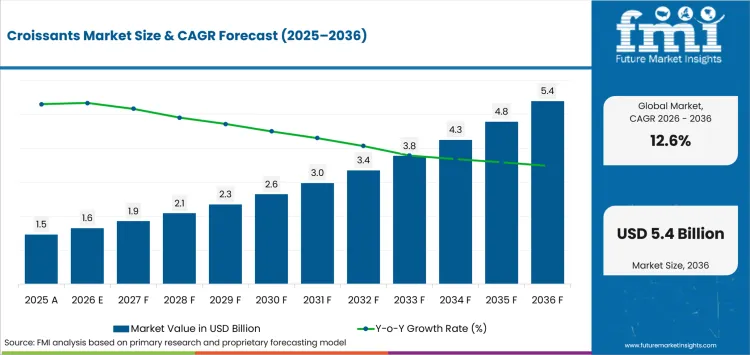
USD 1.6 billion in 2026 and USD 5.4 billion by 2036 at a 12.6% CAGR.
Croissant demand is projected to expand at a 12.6% CAGR between 2026 and 2036, lifting valuation from USD 1.6 billion to USD 5.4 billion. Prepared frozen bakery programs shift lamination and proofing into centralized production for high-volume service accounts. USDA Economic Research Service data published in July 2026 show food away from home represented 56.3% of USA food expenditures in 2025. That service share favors pastries that reduce preparation time during breakfast and snack periods.
The market was valued at USD 1.5 billion in 2025 but service economics differ by country. The UAE Ministry of Economy and Tourism documented 110.62 million hotel guest nights during 2025. That volume gives distributors repeated breakfast demand through hospitality accounts. Mature markets place more weight on bakery ingredients that preserve texture after centralized production without adding outlet labor.
Key Takeaways of Croissants Market
- Commercial kitchens purchase prepared croissants to reduce pastry work and preserve a fresh-finished breakfast or snack offer.
- By product type, all-butter straight is estimated to hold 31.0% in 2026 because familiar butter flavor and straight shape fit several occasions.
- In 2026, conventional is expected to lead claim - nature with 52.0% share given formulation range without specialty certification constraints.
- Fresh is projected to hold 37.0% share in 2026 attributable to the value retailers and cafes place on recently baked texture.
- Butter-price swings and frozen logistics compress margins once premium recipes meet weak yield or inconsistent outlet execution.
- Some of the key players in this market include Bridor, Délifrance, Vandemoortele, Europastry, Lantmännen Unibake, ARYZTA, Cérélia, and General Mills.
Analyst Perspective
"Croissant programs should be judged on baked yield and labor minutes beside case price because proofing variation can erase expected savings. Strong offers preserve butter-led texture after transport and give outlet staff a repeatable finishing method."
- Nandini Roy Choudhury, Principal Consultant, Future Market Insights
How is the croissants market segmented?
The croissants market is segmented by product type, claim - nature, format, packaging format, sales channel and region.
Product type covers all-butter straight, filled, mini and savory or hybrid croissants. Claim - nature includes conventional, clean label, organic, gluten-free and high-protein or fortified products. Format covers fresh, frozen, ambient packaged, chilled and par-baked or thaw-and-serve products. Packaging format includes multipack, single-serve, family pack and bulk foodservice. Sales channels include supermarkets and hypermarkets, artisan bakeries, convenience outlets, online sellers and foodservice distributors.
What makes All-butter straight central to the Product type category?
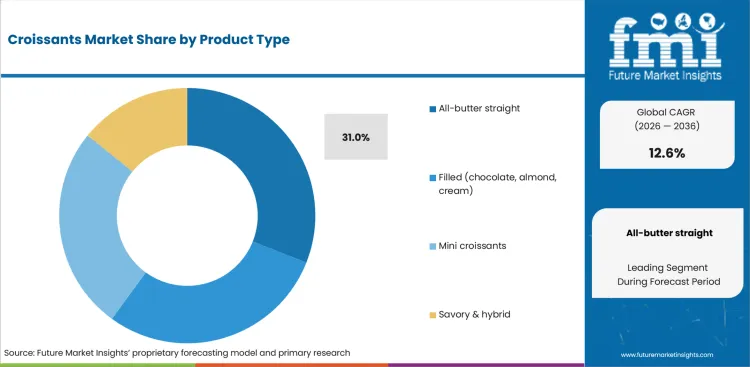
All-butter straight gives commercial bakeries a reference recipe for lamination depth and butter-led flavor before they compare fillings or portions. Its specification carries direct input exposure because margarine alternatives change the fat system and can alter finished texture.
- By product type, all-butter straight is forecast to represent 31.0% in 2026 owing to its familiar sensory profile and flexibility from breakfast plates to sandwich service.
- FAO's January 2025 data put the 2024 Dairy Price Index 4.7% above 2023, mainly because butter prices surged during the year and raised exposure for all-butter specifications.
Why does Conventional lead the Claim - nature category?
Conventional formulas give manufacturers broad choice of fats and process aids before claim-specific certification narrows ingredient options. Teams using baking ingredients and dough improvers can adjust handling for high-volume lines without redesigning the commercial recipe for one dietary claim.
- In 2026, conventional is expected to lead claim - nature with 52.0% share because wider ingredient choices support repeat output and broad price points without additional claim-specific certification steps.
- Vandemoortele tested the conventional reference point in May 2025 by introducing a Banquet d’Or plant-based pastry range that included a vegan croissant made with an alternative to butter.
How does Fresh anchor the Format category?
Fresh croissants are judged at sale through crust crispness and visible flake even if frozen dough systems carry much upstream production work. Retailers can protect a recently baked cue without running full scratch lamination at every site or adding specialist pastry labor.
- Fresh is projected to hold 37.0% share in 2026 tied to the value retailers and cafes place on warm presentation and recently baked texture at the point of sale.
- France provides a demanding fresh-bakery reference because Insee published in July 2025 that the country counted 50,106 bakery-pastry outlets during 2024.
What supports Multipack in the Packaging format category?
Multipacks spread one household purchase over several breakfast occasions without the handling demands of professional bulk cases. The retail pack gives manufacturers printed surface for brand claims and lets pastry fillings differentiate units without changing the common pack architecture.
- By packaging format, multipack is estimated to hold 38.0% in 2026 because several portions can be purchased together without forcing foodservice-style case quantities or storage practices.
- Retail concentration reinforces this pack route because USDA Economic Research Service data updated in August 2026 place grocery stores at 56.2% of USA food-at-home sales during 2025.
What are the drivers, restraints and opportunities in the Croissants Market?
Prepared bake-off systems reduce specialist pastry work while butter-price exposure tests margins and differentiated formats earn repeat orders after texture survives the outlet preparation routine.
- Ready-to-bake and finished croissants let hotel, cafe and in-store bakery teams transfer complex lamination work away from each individual outlet.
- Butter-price volatility and frozen logistics raise delivered cost or waste once a premium recipe enters multi-site distribution with inconsistent handling.
- Plant-based, filled and portioned croissants widen serving occasions provided manufacturers preserve flake and keep outlet preparation simple and repeatable.
Foodservice Labor Favors Prepared Croissant Systems
Professional outlets use bakery processing equipment to standardize laminated pastry during peak service without maintaining a dedicated pastry bench. In June 2026, USDA Economic Research Service documented USD 1.41 trillion of USA food-away-from-home spending during 2025. Industrial bakery mixes and centralized dough production reduce outlet complexity because staff can reproduce proofing and bake results during normal service consistently.
Butter Exposure Keeps Specification Economics Volatile
Premium croissants expose margins to dairy pricing because butter defines flavor and lamination performance in premium recipes. FAO's August 2026 release recorded a 0.7% decline in its Dairy Price Index during July as butter quotations also fell. One monthly decline does not remove input risk, so manufacturers need yield control since cheaper fat systems can weaken the sensory promise behind premium prices.
Format Innovation Must Survive Outlet Execution
Revenue expansion depends on new claims or serving occasions that do not add difficult preparation at the outlet. Cérélia stated in June 2025 that more than 10.5 million Jus-Rol puff-pastry units had been sold in the United States within three years. Frozen baked goods use similar prepared-dough logic, but croissant launches need separate proofing and flake validation before distributors scale the format.
Which country CAGRs are profiled in the Croissants Market?
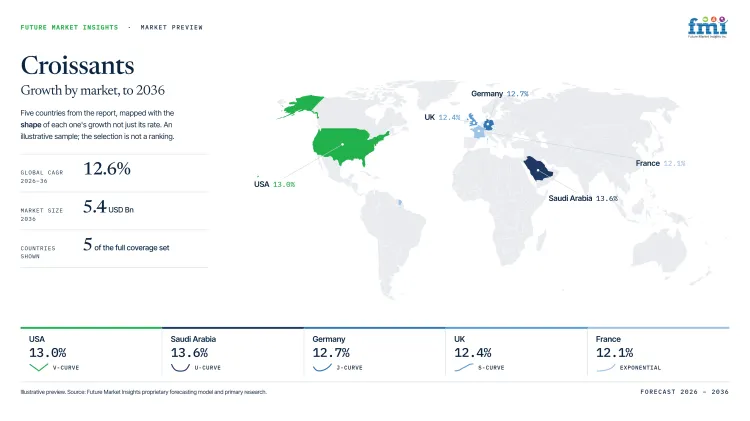
| Country | CAGR |
|---|---|
| UAE | 13.9% |
| Saudi Arabia | 13.6% |
| South Korea | 13.3% |
| USA | 13.0% |
| Germany | 12.7% |
| UK | 12.4% |
| France | 12.1% |
| Japan | 11.7% |
How do country-level CAGRs compare in the Croissants Market?
The profiled CAGRs span 2.2 percentage points from UAE at 13.9% to Japan at 11.7%. Gulf hospitality markets form the upper band with South Korea close behind. USA and Germany occupy the middle before UK and France. Japan records the slowest forecast pace in this set.
- UAE concentrates hotel breakfast demand in cities.
- Saudi Arabia needs freezer stocking between distant hospitality clusters.
- South Korea rewards bakery flavor rotation.
- USA prioritizes case yields for multi-site accounts.
- Germany balances bake-off scale with strict sensory expectations.
- UK grocery concentration increases retailer continuity needs.
- France benchmarks industrial croissants against specialist bakery quality.
- Japan rewards assortment because slower growth raises waste risk.
Similar CAGRs produce materially different entry conditions because distance and channel concentration alter service costs. The full geographic analysis includes country CAGRs for North America, Latin America, Europe, East Asia, South Asia, Oceania and the Middle East and Africa.
Country-wise Analysis
- Hotel and cafe programs in the UAE operate with high room turnover and concentrated urban foodservice demand during high-volume breakfast service in major cities. The Ministry of Economy and Tourism recorded 79.3% hotel occupancy during 2025. Croissant sales in the UAE are forecast to expand at 13.9% CAGR by 2036 because hotel breakfast service gives distributors repeated morning demand. Premium-menu competition is intense and cold-chain errors become visible quickly during daily breakfast peaks. Manufacturers need consistent frozen handling plus distinct fillings or mini formats that diversify menus without changing the outlet's standard bake routine for large hotel accounts.
- Bakery distribution must cover long distances between hospitality clusters and frozen product quality depends on temperature control during delivery. Saudi Arabia's croissants market outlook is anticipated to advance at 13.6% CAGR over the assessment period given the expansion of accommodation demand. GASTAT reported in July 2025 that hotel room occupancy reached about 63% during Q1 2025 and increased 2.1 percentage points from Q1 2024. Hotels provide repeated breakfast occasions but national coverage becomes expensive outside major cities. Regional freezer stocking and low-handling formats therefore carry more commercial value than broad SKU breadth without reliable service coverage.
- Bakery and cafe operators in South Korea refresh recipes quickly and use visual novelty to generate short product cycles. MAFRA documented in April 2025 that 120 floury-rice breads and confections were developed with 30 bakeries during 2024. Fast flavor turnover can shorten the useful life of a specialty croissant before national distribution develops. Croissant demand in South Korea is forecast to rise at 13.3% CAGR over the forecast period tied to this active product-development culture. Manufacturers using modular fillings and limited runs can localize faster without committing large inventories to one short-lived national flavor concept or seasonal promotion.
- Large USA foodservice and in-store bakery accounts place preparation speed beside product consistency because one specification may reach many outlets. Adoption of croissants in USA is estimated to expand at 13.0% CAGR through 2036 aided by national distributor depth and repeated breakfast occasions. USDA Economic Research Service found in April 2026 that cereal and bakery prices increased 1.0% during 2025 compared with a 2.8% twenty-year average. Relatively mild category inflation does not remove case-yield pressure for multi-site croissant programs and national accounts still need proofing instructions and case yields that keep waste predictable as ingredient costs change.
- Retail and foodservice channels use centralized frozen production to support local bake-off and preserve consistent case specifications. Destatis recorded 497.5 million guest nights in Germany during 2025 and reported a 0.3% increase from 2024. The German croissants sector is projected to record 12.7% CAGR during the assessment period owing to industrial bakery capacity and steady hospitality volume. Strong sensory expectations limit labor-saving formats that lose butter flavor or visible flake during finishing. Regional production and efficient distribution therefore need to protect product quality instead of substituting logistics scale for the finished eating experience at customer sites.
- Grocery concentration gives national retailers strong control over shelf access and makes manufacturer continuity a central commercial test. The Competition and Markets Authority closed the Cérélia and Jus-Rol merger inquiry in March 2025 after Cérélia completed the required divestment sale to Brioche UK Limited. In the UK, croissant demand is forecast to advance at 12.3% CAGR through 2036 supported by mature retail dough and bake-off purchasing. Chilled and frozen economics remain sensitive to case yield plus promotional price pressure. New entrants need a retailer value case covering availability and preparation labor without depending on premium pricing alone for growth.
- Industrial and frozen croissants compete beside a dense specialist bakery channel that sets a demanding reference for finished quality. France is estimated to post 12.0% CAGR over the forecast period attributable to frequent bakery purchasing and deep local service coverage. Insee published in July 2025 that France counted 50,106 bakery-pastry outlets during 2024. That outlet density gives fresh products immediate sensory comparison and exposes weak flake or butter flavor in industrial formats quickly. Premium industrial recipes therefore need proven texture after thawing or bake-off before operating simplicity and price become deciding criteria at French retail and foodservice sites.
- Croissant programs require tight assortment control because convenience and premium bakery channels both carry high expectations for finish and portion fit. Japan Tourism Agency final data released in July 2026 recorded 661.11 million guest nights during 2025 and city-hotel occupancy reached 74.1%. Excess variety raises waste once slower-moving flavors compete for freezer and display space beside core products. Croissant sales in Japan are forecast to expand at 11.7% CAGR by 2036 as hospitality and urban bakery traffic provide stable serving occasions. Slower growth increases the value of disciplined portioning and local flavor trials before manufacturers commit to broad distribution.
Who are the notable companies in the Croissants Market?
Bridor, Délifrance, Vandemoortele, Europastry, Lantmännen Unibake, ARYZTA, Cérélia and General Mills are the notable companies serving this market.
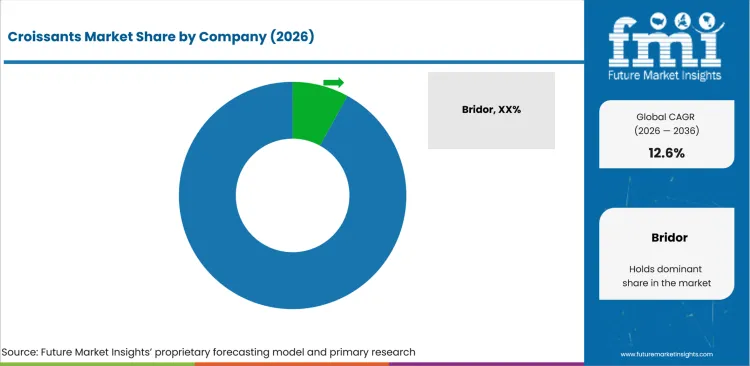
Competition separates frozen viennoiserie producers from prepared-dough platforms through different production economics and finishing responsibilities. Bridor, Délifrance, Vandemoortele and Europastry emphasize frozen pastry with professional bakery support. Lantmännen Unibake and ARYZTA extend bake-off coverage through regional production whereas Cérélia and General Mills serve refrigerated-dough demand.
- Bridor, Délifrance, Vandemoortele and Europastry compete directly through frozen viennoiserie depth and professional bakery support for commercial operators.
- Lantmännen Unibake and ARYZTA serve retail and foodservice accounts through large regional bake-off production and distribution networks.
- Cérélia and General Mills serve adjacent demand through refrigerated or ready-to-bake dough platforms that reduce preparation steps.
Competitive Benchmarking: Croissants Market
| Company | Croissant and Viennoiserie Breadth | Bake-off Preparation Depth | Retail and Foodservice Coverage | Geographic Reach |
|---|---|---|---|---|
| Bridor | High | High | High | Europe, North America and international markets |
| Délifrance | High | High | High | Europe, Asia and international B2B markets |
| Vandemoortele | High | High | High | Europe, North America and international markets |
| Europastry | High | High | High | Europe, North America and international markets |
| Lantmännen Unibake | Medium | High | High | Europe, North America and international markets |
| ARYZTA | Medium | High | High | Europe, Asia, Australia and New Zealand |
| Cérélia | Medium | Medium | High | Europe and North America |
| General Mills | Low | Medium | High | North America and selected international markets |
Scoring basis: High croissant breadth requires several laminated-pastry families, Medium reflects narrower pastry coverage and Low reflects adjacent dough evidence. Multiple frozen or ready-to-bake routes qualify for High bake-off depth, whereas one documented route receives Medium. Retail and foodservice evidence qualifies for High channel coverage, compared with Medium for one primary channel and Low for narrower access.
Key Developments in the Croissants Market
- In June 2026, ARYZTA acquired Société Européenne des Beurres through Coup de Pates and extended frozen-bakery distribution capacity in southwest France.
- In January 2026, Bridor inaugurated its Vineland expansion after the new viennoiserie line became operational during summer 2025 and doubled site production capacity.
- In March 2025, Vandemoortele and VIVESCIA entered an agreement for Vandemoortele's proposed Délifrance acquisition covering frozen bakery networks serving retail, foodservice and artisan customers.
Key Players in the Croissants Market
Frozen Viennoiserie Specialists
- Bridor
- Délifrance
- Vandemoortele
- Europastry
Large Bake-off Bakery Networks
- Lantmännen Unibake
- ARYZTA
Prepared Dough Platforms
- Cérélia
- General Mills
Croissants Market - Report Scope
| Coverage field | Report scope |
|---|---|
| Market breakdown | By product type, claim - nature, format, packaging format, sales channel and region. |
| Quantitative Units | USD Billion. |
| Market Definition | Commercial croissants sold as fresh, frozen, ambient packaged, chilled, par-baked, thaw-and-serve or ready-to-bake consumer and professional formats. Downstream prepared sandwiches, plated meals, coffee bundles, ingredients, equipment and adjacent bakery products are excluded. |
| Regions Covered | North America, Latin America, Europe, East Asia, South Asia and Pacific, and Middle East and Africa. |
| Countries Covered | UAE, Saudi Arabia, South Korea, USA, Germany, UK, France, Japan, and 20+ countries included in the full report. |
| Key Companies Profiled | Bridor, Délifrance, Vandemoortele, Europastry, Lantmännen Unibake, ARYZTA, Cérélia, General Mills. |
| Forecast Period | 2026 to 2036. |
| Approach | Primary and secondary research with market triangulation. |
Croissants Market - Research Methodology
| Method | Approach |
|---|---|
| Primary Research | FMI analysts gathered input from manufacturers, service providers, technology developers, distributors, end users, procurement teams, and subject-matter experts. Interviews examined purchasing decisions, product or service evaluation, adoption barriers, approval requirements, pricing considerations, and expectations for technical or commercial support. Respondents were also asked what evidence is required before a trial, pilot, or initial order develops into regular purchasing. |
| Desk Research | Desk research covered government statistics, regulatory publications, trade data, industry associations, technical literature, standards, company filings, product information, and official corporate announcements. Sources were reviewed for relevance, publication date, geographic coverage, and consistency with the defined market scope. Claims relating to performance, applications, approvals, capacity, investment, and commercial activity were retained only when supported by credible public evidence. |
| Market Sizing and Forecasting | The market model combined the baseline value with historical performance, segment structure, pricing and volume indicators, adoption levels, company participation, and country-level demand conditions. Forecast assumptions considered economic activity, investment trends, regulatory developments, technology adoption, purchasing cycles, supply availability, and barriers to wider market use. Segment and regional estimates were reconciled before the final market total was calculated. |
| Data Validation | Estimates were checked against multiple independent indicators, including public data, company activity, trade patterns, industry developments, and findings from primary interviews. Validation also tested whether products, services, applications, and company revenues fell within the defined market boundaries. Adjacent categories, unsupported claims, overlapping revenues, and activities without direct market relevance were excluded to reduce double counting and maintain consistency across segments and countries. |
Croissants Market by Segments
Croissants Market segmented by Product Type:
- All-butter straight
- Filled (chocolate, almond, cream)
- Mini croissants
- Savory & hybrid
Croissants Market segmented by Claim - nature:
- Conventional
- Clean label
- Organic
- Gluten-free
- High-protein / fortified
Croissants Market segmented by Format:
- Fresh
- Frozen
- Ambient packaged
- Chilled
- Par-baked / thaw-and-serve
Croissants Market segmented by Packaging Format:
- Multipack
- Single-serve
- Family / loaf pack
- Bulk foodservice
Croissants Market segmented by Sales Channel:
- Supermarkets & hypermarkets
- Artisan & specialty bakeries
- Convenience & forecourt
- Online & DTC
- Foodservice distributors
Croissants Market by Region:
- North America
- United States
- Canada
- Latin America
- Brazil
- Mexico
- Argentina
- Chile
- Rest of Latin America
- Western Europe
- Germany
- Italy
- France
- Nordics
- Benelux
- Rest of Western Europe
- Eastern Europe
- Russia
- Poland
- Hungary
- Balkan and Baltic States
- Rest of Eastern Europe
- East Asia
- China
- Japan
- South Korea
- South Asia and Pacific
- India
- ASEAN
- Australia and New Zealand
- Rest of South Asia and Pacific
- Middle East and Africa
- Kingdom of Saudi Arabia
- Other GCC Countries
- Türkiye
- South Africa
- Other African Union Countries
- Rest of Middle East and Africa
Research Sources and Bibliography
- USA Department of Agriculture, Economic Research Service. (2026, July 8). Food Service Industry - Market Segments.
- Ministry of Economy and Tourism, UAE. (2026, April 13). Emirates Tourism Council discusses new action plans to enhance the growth and resilience of the sector in the coming period.
- Food and Agriculture Organization of the United Nations. (2025, January 3). FAO Food Price Index dips during the month of December.
- Vandemoortele. (2025, May 15). A new kind of delicious: innovating with a new range of plant-based pastry.
- Insee. (2025, July 10). Équipements et services à la population en 2024 - France entière.
- USA Department of Agriculture, Economic Research Service. (2026, August 17). Retailing & Wholesaling - Retail Trends.
- USA Department of Agriculture, Economic Research Service. (2026, June 11). Total USA food spending reached $2.51 trillion in 2025.
- Food and Agriculture Organization of the United Nations. (2026, August 7). FAO Food Price Index edges up amid weather, energy and geopolitical concerns.
- Cérélia. (2025, June 20). Jus-Rol hit a major milestone!
- USA Department of Agriculture, Economic Research Service. (2026, April 30). USA food-at-home prices increased 2.3 percent in 2025, compared with 2024.
- Statistisches Bundesamt. (2026, February 11). Tourismus in Deutschland im Jahr 2025: Erneut Rekordwert bei Gästeübernachtungen.
- Competition and Markets Authority. (2025, March 7). Cérélia / Jus-Rol merger inquiry.
- General Authority for Statistics, Saudi Arabia. (2025, July 3). GASTAT publishes Tourism Establishments Statistics for Q1 2025.
- Ministry of Agriculture, Food and Rural Affairs, Republic of Korea. (2025, April 2). Invigorating the Floury Rice Industry: a Win-Win Situation for Both Bakeries and Farmers.
- Japan Tourism Agency. (2026, July 6). 宿泊旅行統計調査(2026年4月・第2次速報、2026年5月・第1次速報及び2025年年間値(確定値)).
- ARYZTA AG. (2026, June 23). ARYZTA acquires French distribution business.
- Groupe LE DUFF. (2026, February 27). BRIDOR poursuit son expansion aux États-Unis et double la capacité de production de Vineland.
- Vandemoortele and VIVESCIA. (2025, March 28). Vandemoortele and Délifrance intend to form a new leading player in frozen bakery.
- Groupe LE DUFF. (2026, March 23). BRIDOR strengthens its position as a global player in the premium bakery-viennese pastry sector with the acquisition of the PANAMAR bakery Group.
- Groupe LE DUFF. (2025, April 24). LE DUFF Group is accelerating its global growth.
- Lantmännen. (2025, December 23). Lantmännen Unibake signs agreement to expand in Italy.
- Blue Yonder. (2025, January 15). Europastry and Blue Yonder Team Up To Strategically Drive Efficiency, Sustainability and Customer Satisfaction.
- General Mills. (2025, September 16). The Pillsbury Doughboy Is Headed to the Big Apple to Roll Out His Biggest Bakes Yet.
- ARYZTA AG. (2026, August 26). New Perth bakery officially opened.
- Vandemoortele. (2025, February 14). Vandemoortele acquires Lizzi in Italy, a specialty player in frozen Bakery.
- Grupo Bimbo. (2026, May 5). Grupo Bimbo Announces Approximately US $1 Billion Investment in the United States Between 2026 and 2028.
This bibliography is provided for reader reference and is not exhaustive. The full report contains the complete reference list and detailed citations
This Report Answers
- What is Croissants Market size in 2026 and 2036?
- What operating conditions support prepared croissant demand?
- Why does all-butter straight hold 31.0% of product type demand?
- How do conventional and fresh formats shape purchasing?
- How do butter prices and frozen logistics affect margins?
- Why do growth rates differ among eight countries?
- Which companies hold strong frozen viennoiserie positions?
- Which company actions changed capacity or distribution?
Frequently Asked Questions
How big is the Croissants Market in 2026?
The croissants market is valued at USD 1.6 billion in 2026 and is projected to reach USD 5.4 billion by 2036. Prepared formats reduce specialist pastry labor and preserve fresh-finished service during busy breakfast periods.
What is the CAGR of the Croissants Market from 2026 to 2036?
The croissants market is projected to grow at a CAGR of 12.6% between 2026 and 2036. Foodservice labor constraints and wider frozen bake-off use sustain the forecast through 2036.
Which product type leads the Croissants Market?
The all-butter straight segment is expected to hold 31.0% of the croissants market in 2026, driven by butter flavor and serving flexibility. Operators use the straight format to compare texture and bake consistency for several serving occasions.
Which claim - nature segment leads the Croissants Market?
The conventional segment is expected to hold 52.0% of the croissants market in 2026, attributable to wider ingredient choices and fewer certification constraints. Specialty dietary claims address narrower customer groups without changing the conventional volume reference.
How much incremental opportunity will the Croissants Market create between 2026 and 2036?
The croissants market is expected to add USD 3.8 billion in value between 2026 and 2036. Repeatable bake-off performance protects labor savings by reducing preparation waste during routine outlet service.
Which countries are projected to record the highest growth in the Croissants Market?
UAE is projected to grow at 13.9% CAGR, followed by Saudi Arabia at 13.6% and South Korea at 13.3% through 2036. Hospitality expansion and rapid bakery assortment refresh sustain the strongest forecasts among the profiled countries.
Which companies are active in the Croissants Market?
Key companies in the croissants market include Bridor, Délifrance, Vandemoortele, Europastry, Lantmännen Unibake, ARYZTA, Cérélia, and General Mills. Their positions differ through frozen pastry depth, bake-off support and distribution reach.
Preview the report firsthand - request a free sample
Get SampleGet the brochure for pricing and purchase details.
Get PDFTable of Content
- Key Takeaways
- Market Size and CAGR
- Top Growth Driver
- Fastest Growing Segment
- Leading Region
- Key Companies
- Emerging Opportunities
- Executive Summary
- Global Market Outlook
- Demand-side Trends
- Supply-side Trends
- Technology Roadmap Analysis
- Analysis and Recommendations
- Analyst Perspective (What is happening? Why now? What should investors know?)
- Key Questions Answered
- How large is the market?
- What is the CAGR?
- What are key trends?
- Which region dominates?
- Who are the leaders?
- Market Overview
- Market Coverage / Taxonomy
- Market Definition / Scope / Limitations
- Research Methodology
- Chapter Orientation
- Analytical Lens and Working Hypotheses
- Market Structure, Signals, and Trend Drivers
- Benchmarking and Cross-market Comparability
- Market Sizing, Forecasting, and Opportunity Mapping
- Research Design and Evidence Framework
- Desk Research Programme (Secondary Evidence)
- Expert Input and Fieldwork (Primary Evidence)
- Tooling, Models, and Reference Databases
- Data Engineering and Model Build
- Quality Assurance and Audit Trail
- Market Background
- Market Dynamics (Drivers, Restraints, Opportunity, Trends)
- Scenario Forecast (Optimistic, Likely, Conservative)
- Impact Analysis
- AI Impact
- Sustainability Impact
- Regulatory Impact
- Technology Impact
- Consumer / Buyer Analysis
- Purchase Drivers
- Adoption Barriers
- Buyer Journey
- Opportunity Map Analysis
- Product Life Cycle Analysis
- Supply Chain Analysis
- Investment Feasibility Matrix
- Value Chain Analysis
- PESTLE and Porter's Analysis
- Regulatory Landscape
- Regional Parent Market Outlook
- Production and Consumption Statistics
- Import and Export Statistics
- Global Market Analysis and Forecast, 2021 to 2036
- Historical Market Size Value (USD Billion) Analysis, 2021 to 2025
- Current and Future Market Size Value (USD Billion) Projections, 2026 to 2036
- Y-o-Y Growth Trend Analysis
- Absolute $ Opportunity Analysis
- Global Market Pricing Analysis, 2021 to 2036
- Global Market Analysis and Forecast, By Product Type, 2021 to 2036
- Introduction / Key Findings
- Historical Market Size Value (USD Billion) Analysis By Product Type, 2021 to 2025
- Current and Future Market Size Value (USD Billion) Analysis and Forecast By Product Type, 2026 to 2036
- All-butter straight
- Filled (chocolate, almond, cream)
- Mini croissants
- Savory & hybrid
- All-butter straight
- Y-o-Y Growth Trend Analysis By Product Type, 2021 to 2025
- Absolute $ Opportunity Analysis By Product Type, 2026 to 2036
- Global Market Analysis and Forecast, By Claim / Nature, 2021 to 2036
- Introduction / Key Findings
- Historical Market Size Value (USD Billion) Analysis By Claim / Nature, 2021 to 2025
- Current and Future Market Size Value (USD Billion) Analysis and Forecast By Claim / Nature, 2026 to 2036
- Conventional
- Clean label
- Organic
- Gluten-free
- High-protein / fortified
- Conventional
- Y-o-Y Growth Trend Analysis By Claim / Nature, 2021 to 2025
- Absolute $ Opportunity Analysis By Claim / Nature, 2026 to 2036
- Global Market Analysis and Forecast, By Format, 2021 to 2036
- Introduction / Key Findings
- Historical Market Size Value (USD Billion) Analysis By Format, 2021 to 2025
- Current and Future Market Size Value (USD Billion) Analysis and Forecast By Format, 2026 to 2036
- Fresh
- Frozen
- Ambient packaged
- Chilled
- Par-baked / thaw-and-serve
- Fresh
- Y-o-Y Growth Trend Analysis By Format, 2021 to 2025
- Absolute $ Opportunity Analysis By Format, 2026 to 2036
- Global Market Analysis and Forecast, By Packaging Format, 2021 to 2036
- Introduction / Key Findings
- Historical Market Size Value (USD Billion) Analysis By Packaging Format, 2021 to 2025
- Current and Future Market Size Value (USD Billion) Analysis and Forecast By Packaging Format, 2026 to 2036
- Multipack
- Single-serve
- Family / loaf pack
- Bulk foodservice
- Multipack
- Y-o-Y Growth Trend Analysis By Packaging Format, 2021 to 2025
- Absolute $ Opportunity Analysis By Packaging Format, 2026 to 2036
- Global Market Analysis and Forecast, By Sales Channel, 2021 to 2036
- Introduction / Key Findings
- Historical Market Size Value (USD Billion) Analysis By Sales Channel, 2021 to 2025
- Current and Future Market Size Value (USD Billion) Analysis and Forecast By Sales Channel, 2026 to 2036
- Supermarkets & hypermarkets
- Artisan & specialty bakeries
- Convenience & forecourt
- Online & DTC
- Foodservice distributors
- Supermarkets & hypermarkets
- Y-o-Y Growth Trend Analysis By Sales Channel, 2021 to 2025
- Absolute $ Opportunity Analysis By Sales Channel, 2026 to 2036
- Global Market Analysis and Forecast, By Region, 2021 to 2036
- Introduction
- Historical Market Size Value (USD Billion) Analysis By Region, 2021 to 2025
- Current Market Size Value (USD Billion) Analysis and Forecast By Region, 2026 to 2036
- North America
- Latin America
- Western Europe
- Eastern Europe
- East Asia
- South Asia and Pacific
- Middle East & Africa
- Market Attractiveness Analysis By Region
- North America Market Analysis and Forecast, By Country, 2021 to 2036
- Historical Market Size Value (USD Billion) Trend Analysis By Market Taxonomy, 2021 to 2025
- Market Size Value (USD Billion) Forecast By Market Taxonomy, 2026 to 2036
- By Country
- USA
- Canada
- By Product Type
- By Claim / Nature
- By Format
- By Packaging Format
- By Sales Channel
- By Country
- Market Attractiveness Analysis
- By Country
- By Product Type
- By Claim / Nature
- By Format
- By Packaging Format
- By Sales Channel
- Key Takeaways
- Latin America Market Analysis and Forecast, By Country
- Historical Market Size Value (USD Billion) Trend Analysis By Market Taxonomy, 2021 to 2025
- Market Size Value (USD Billion) Forecast By Market Taxonomy, 2026 to 2036
- By Country
- Brazil
- Mexico
- Chile
- Rest of Latin America
- By Product Type
- By Claim / Nature
- By Format
- By Packaging Format
- By Sales Channel
- By Country
- Market Attractiveness Analysis
- By Country
- By Product Type
- By Claim / Nature
- By Format
- By Packaging Format
- By Sales Channel
- Key Takeaways
- Western Europe Market Analysis and Forecast, By Country
- Historical Market Size Value (USD Billion) Trend Analysis By Market Taxonomy, 2021 to 2025
- Market Size Value (USD Billion) Forecast By Market Taxonomy, 2026 to 2036
- By Country
- Germany
- UK
- Italy
- Spain
- France
- Nordic
- BENELUX
- Rest of Western Europe
- By Product Type
- By Claim / Nature
- By Format
- By Packaging Format
- By Sales Channel
- By Country
- Market Attractiveness Analysis
- By Country
- By Product Type
- By Claim / Nature
- By Format
- By Packaging Format
- By Sales Channel
- Key Takeaways
- Eastern Europe Market Analysis and Forecast, By Country
- Historical Market Size Value (USD Billion) Trend Analysis By Market Taxonomy, 2021 to 2025
- Market Size Value (USD Billion) Forecast By Market Taxonomy, 2026 to 2036
- By Country
- Russia
- Poland
- Hungary
- Balkan & Baltic
- Rest of Eastern Europe
- By Product Type
- By Claim / Nature
- By Format
- By Packaging Format
- By Sales Channel
- By Country
- Market Attractiveness Analysis
- By Country
- By Product Type
- By Claim / Nature
- By Format
- By Packaging Format
- By Sales Channel
- Key Takeaways
- East Asia Market Analysis and Forecast, By Country
- Historical Market Size Value (USD Billion) Trend Analysis By Market Taxonomy, 2021 to 2025
- Market Size Value (USD Billion) Forecast By Market Taxonomy, 2026 to 2036
- By Country
- China
- Japan
- South Korea
- By Product Type
- By Claim / Nature
- By Format
- By Packaging Format
- By Sales Channel
- By Country
- Market Attractiveness Analysis
- By Country
- By Product Type
- By Claim / Nature
- By Format
- By Packaging Format
- By Sales Channel
- Key Takeaways
- South Asia and Pacific Market Analysis and Forecast, By Country
- Historical Market Size Value (USD Billion) Trend Analysis By Market Taxonomy, 2021 to 2025
- Market Size Value (USD Billion) Forecast By Market Taxonomy, 2026 to 2036
- By Country
- India
- ASEAN
- Australia & New Zealand
- Rest of South Asia and Pacific
- By Product Type
- By Claim / Nature
- By Format
- By Packaging Format
- By Sales Channel
- By Country
- Market Attractiveness Analysis
- By Country
- By Product Type
- By Claim / Nature
- By Format
- By Packaging Format
- By Sales Channel
- Key Takeaways
- Middle East & Africa Market Analysis and Forecast, By Country
- Historical Market Size Value (USD Billion) Trend Analysis By Market Taxonomy, 2021 to 2025
- Market Size Value (USD Billion) Forecast By Market Taxonomy, 2026 to 2036
- By Country
- Kingdom of Saudi Arabia
- Other GCC Countries
- Türkiye
- South Africa
- Other African Union
- Rest of Middle East & Africa
- By Product Type
- By Claim / Nature
- By Format
- By Packaging Format
- By Sales Channel
- By Country
- Market Attractiveness Analysis
- By Country
- By Product Type
- By Claim / Nature
- By Format
- By Packaging Format
- By Sales Channel
- Key Takeaways
- Key Countries Market Analysis
- USA
- Pricing Analysis
- Market Share Analysis, 2025
- By Product Type
- By Claim / Nature
- By Format
- By Packaging Format
- By Sales Channel
- Canada
- Pricing Analysis
- Market Share Analysis, 2025
- By Product Type
- By Claim / Nature
- By Format
- By Packaging Format
- By Sales Channel
- Mexico
- Pricing Analysis
- Market Share Analysis, 2025
- By Product Type
- By Claim / Nature
- By Format
- By Packaging Format
- By Sales Channel
- Brazil
- Pricing Analysis
- Market Share Analysis, 2025
- By Product Type
- By Claim / Nature
- By Format
- By Packaging Format
- By Sales Channel
- Chile
- Pricing Analysis
- Market Share Analysis, 2025
- By Product Type
- By Claim / Nature
- By Format
- By Packaging Format
- By Sales Channel
- Germany
- Pricing Analysis
- Market Share Analysis, 2025
- By Product Type
- By Claim / Nature
- By Format
- By Packaging Format
- By Sales Channel
- UK
- Pricing Analysis
- Market Share Analysis, 2025
- By Product Type
- By Claim / Nature
- By Format
- By Packaging Format
- By Sales Channel
- Italy
- Pricing Analysis
- Market Share Analysis, 2025
- By Product Type
- By Claim / Nature
- By Format
- By Packaging Format
- By Sales Channel
- Spain
- Pricing Analysis
- Market Share Analysis, 2025
- By Product Type
- By Claim / Nature
- By Format
- By Packaging Format
- By Sales Channel
- France
- Pricing Analysis
- Market Share Analysis, 2025
- By Product Type
- By Claim / Nature
- By Format
- By Packaging Format
- By Sales Channel
- India
- Pricing Analysis
- Market Share Analysis, 2025
- By Product Type
- By Claim / Nature
- By Format
- By Packaging Format
- By Sales Channel
- ASEAN
- Pricing Analysis
- Market Share Analysis, 2025
- By Product Type
- By Claim / Nature
- By Format
- By Packaging Format
- By Sales Channel
- Australia & New Zealand
- Pricing Analysis
- Market Share Analysis, 2025
- By Product Type
- By Claim / Nature
- By Format
- By Packaging Format
- By Sales Channel
- China
- Pricing Analysis
- Market Share Analysis, 2025
- By Product Type
- By Claim / Nature
- By Format
- By Packaging Format
- By Sales Channel
- Japan
- Pricing Analysis
- Market Share Analysis, 2025
- By Product Type
- By Claim / Nature
- By Format
- By Packaging Format
- By Sales Channel
- South Korea
- Pricing Analysis
- Market Share Analysis, 2025
- By Product Type
- By Claim / Nature
- By Format
- By Packaging Format
- By Sales Channel
- Russia
- Pricing Analysis
- Market Share Analysis, 2025
- By Product Type
- By Claim / Nature
- By Format
- By Packaging Format
- By Sales Channel
- Poland
- Pricing Analysis
- Market Share Analysis, 2025
- By Product Type
- By Claim / Nature
- By Format
- By Packaging Format
- By Sales Channel
- Hungary
- Pricing Analysis
- Market Share Analysis, 2025
- By Product Type
- By Claim / Nature
- By Format
- By Packaging Format
- By Sales Channel
- Kingdom of Saudi Arabia
- Pricing Analysis
- Market Share Analysis, 2025
- By Product Type
- By Claim / Nature
- By Format
- By Packaging Format
- By Sales Channel
- Türkiye
- Pricing Analysis
- Market Share Analysis, 2025
- By Product Type
- By Claim / Nature
- By Format
- By Packaging Format
- By Sales Channel
- South Africa
- Pricing Analysis
- Market Share Analysis, 2025
- By Product Type
- By Claim / Nature
- By Format
- By Packaging Format
- By Sales Channel
- USA
- Market Structure Analysis
- Competition Dashboard
- Competition Benchmarking
- Market Share Analysis of Top Players
- By Regional
- By Product Type
- By Claim / Nature
- By Format
- By Packaging Format
- By Sales Channel
- Emerging Startups
- Innovation Benchmarking
- Competition Analysis
- Competition Deep Dive
- Bridor
- Overview
- Product Portfolio
- Profitability by Market Segments
- Sales Footprint
- Strategy Overview
- Marketing Strategy
- Product Strategy
- Channel Strategy
- Delifrance
- Lantmannen Unibake
- Vandemoortele
- Cerelia
- Europastry
- Aryzta
- General Mills
- Groupe Le Duff
- Grupo Bimbo
- Bridor
- Case Studies
- Success Stories
- Recent Developments
- Competition Deep Dive
- Assumptions & Acronyms Used


