

- Market Size (2026)
- USD 423.9 Mn
- Forecast (2036)
- USD 671.0 Mn
- CAGR (2026 to 2036)
- 4.7%
How big is Cuticle Oils Market in 2026?
USD 423.9 Million in 2026 and USD 671.0 Million by 2036 at a 4.7% CAGR.
The Cuticle Oils Market is valued at USD 423.9 Million in 2026 and is forecast to reach USD 671.0 Million by 2036 at a 4.7% CAGR. The Cuticle Oils Market was valued at USD 404.9 Million in 2025. Demand is tied to recurring manicure and nail-recovery routines rather than a one-time treatment cycle. The U.S. Bureau of Labor Statistics counted 201,800 manicurist and pedicurist jobs in 2025 and projects employment to rise 9% through 2035. [1] That service base keeps cuticle conditioning close to routine nail care and supports replenishment across home and professional channels.
Growth conditions differ by digital access and cosmetic-formula requirements. Saudi Arabia and the UAE have the fastest profiled CAGRs as digital retail widens product discovery. South Korea combines strong cosmetics export capability with frequent product launches. Germany and Japan expand more slowly within mature retail systems. Suppliers need low-mess application and clear ingredient information at prices that encourage repeat purchase.
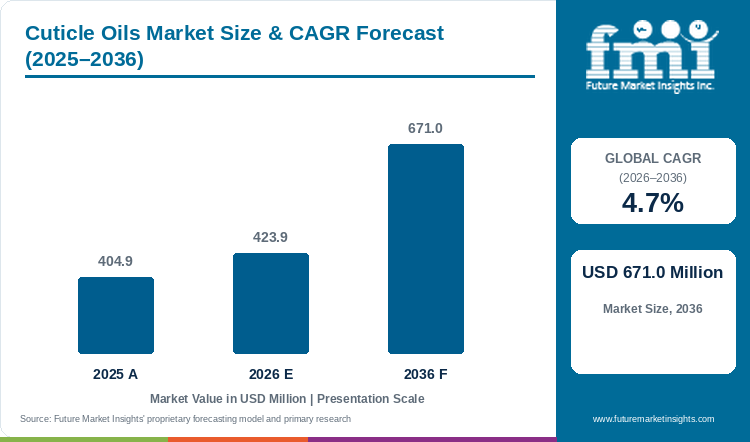
Cuticle Oils Market Size & CAGR Forecast (2025-2036)
| Year | Basis | Market value (USD million) |
|---|---|---|
| 2025 | Actual | 404.9 |
| 2026 | Estimate | 423.9 |
| 2036 | Forecast | 671.0 |
| CAGR, 2026 to 2036 | 4.7% | |
Source: Future Market Insights proprietary forecasting model and primary research.
Key Takeaways
- Core / classic lines lead Product Type with a 38.0% share in 2026 because straightforward hydration has the lowest education burden and supports regular replenishment.
- Conventional leads Nature with a 54.0% share in 2026. Established formulas retain broad mass-retail availability. Vegan cosmetics and natural or sensitive-positioned alternatives widen choice.
- Cream & balm leads Format with a 32.0% share in 2026 because localized application limits spill risk and supports controlled use around the nail fold.
- The principal purchasing friction is substitutability. Buyers can use general moisturizers or simple oils, while fragrance sensitivity and labeling obligations add formulation and communication costs.
- Profiled companies include Glamnetic and Olive & June alongside Estee Lauder Companies and L'Oreal. The report also covers Unilever and e.l.f. Beauty plus Coty and Church & Dwight. Wella Company and Kiss Products complete the profiles.
Analyst Perspective
"Repeat revenue depends on making cuticle care easy to use around manicure removal and daily hydration. Portable applicators and comfortable formulas give buyers practical reasons to replenish."
- Rahul Pandita, Principal Consultant, Future Market Insights
How is the cuticle oils market segmented?
The market is segmented by Product Type, Nature, Format, Price Positioning and Sales Channel.
- Product Type comprises Core / classic lines, Targeted treatment lines, Sensitive & gentle lines, Premium & clinical lines, and Kits & sets.
- Nature includes Conventional, Vegan & cruelty-free, Natural & organic, Dermocosmetic / clinical, and Fragrance-free & sensitive.
- Format covers Cream & balm, Liquid & serum, Stick & solid, Spray & mist, Sheet & patch, and Powder.
- Price Positioning spans Mass, Masstige, Premium, and Professional.
- Sales Channel includes E-commerce & DTC, Specialty beauty retail, Pharmacies & drugstores, Supermarkets & hypermarkets, and Salons & spas.
Why do Core / classic lines anchor the Product Type category?
Core / classic products address the most common purchase trigger: visibly dry or rough cuticles that need straightforward conditioning.
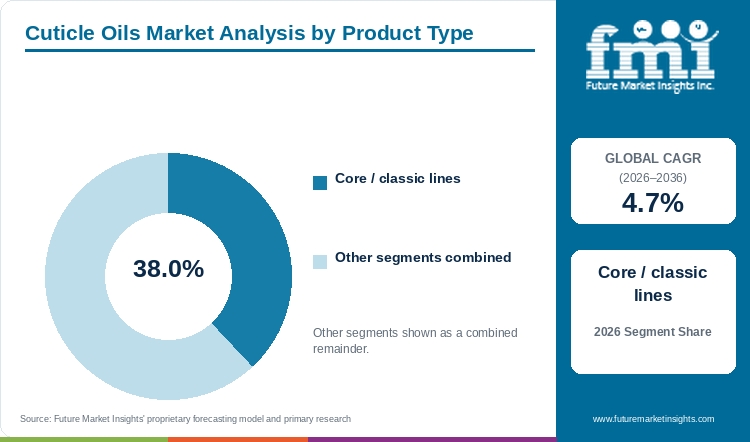
| Product type | Share (2026) |
|---|---|
| Core / classic lines | 38.0% |
| Other segments combined | 62.0%* |
| Total | 100.0% |
| Metric | Value |
|---|---|
| Global CAGR (2026 to 2036) | 4.7% |
| Leading segment | Core / classic lines |
They fit both a home manicure routine and a salon aftercare recommendation. The proposition is easy to understand and does not require the consumer to identify a specific clinical condition. That simplicity supports wider shelf placement and lowers the risk that an occasional buyer abandons the category after one use.
- Core / classic lines hold 38.0% of Product Type demand in 2026. Their leadership reflects a broad-use hydration proposition with repeat-purchase potential across skill levels.
Why does Conventional retain the lead in Nature?
Conventional formulations benefit from established ingredient systems and broad retailer familiarity.
The segment can cover botanical oils as well as mineral or synthetic emollients without depending on a narrow certification claim. Natural cosmetics and vegan positioning are increasingly visible. Sensitive users still evaluate the complete ingredient list. Conventional products remain competitive when they deliver acceptable feel and price while meeting regional cosmetic-label requirements.
- Conventional accounts for 54.0% of Nature demand in 2026. Broad availability and a flexible ingredient palette let suppliers balance absorption and cost with application feel.
What are the drivers, restraints and opportunities in the cuticle oils market?
Repeat manicure and nail-recovery routines support demand. Substitution and sensitivity concerns limit habitual use. Portable targeted formats create room for more frequent replenishment.
- Frequent nail-care occasions support demand. Professional services create one route to repeat use while at-home systems create another. The U.S. Bureau of Labor Statistics expects manicurist and pedicurist employment to rise 9% from 2025 to 2035. It links the increase to services such as mini-sessions and mobile manicures. [1] Each manicure offers a point at which a technician or consumer can add moisturizing care. Suppliers benefit when cuticle conditioning becomes part of preparation and aftercare.
- Substitution affects the repurchase decision. A consumer can switch to hand cream or a general cosmetic oil when the cuticle-specific benefit is unclear. Sensitive users face another filter because fragranced formulas may contain declared allergens. Commission Regulation (EU) 2023/1545 expanded fragrance-allergen labeling requirements for cosmetics and emphasized avoidance information for sensitized consumers. [2] Glamnetic's cuticle-oil ingredient list includes fragrance. [17] Suppliers need clear labeling and a comfortable sensory profile to encourage regular use.
- Portable applicators make the category easier to carry and use between manicure sessions. essie markets a leak-resistant rollerball cuticle oil. [21] Sally Hansen presents its Vitamin E Nail & Cuticle Oil Pen as a mess-free travel format. [22] Glamnetic combines cuticle oil with a pusher tool. [17] These designs offer alternatives to a glass bottle. Digital channels can reinforce use with application content and bundles. Portability can support targeted propositions such as sensitive care or post-manicure conditioning.
Which country CAGRs are profiled in the cuticle oils market?
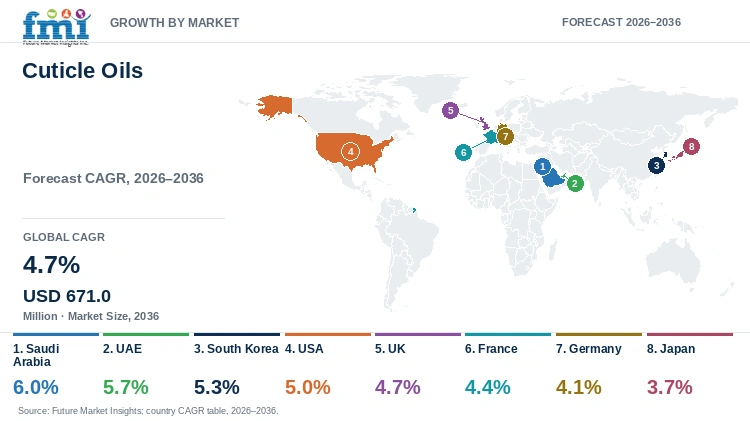
The following country CAGRs cover 2026 to 2036.
| Country | CAGR |
|---|---|
| Saudi Arabia | 6.0% |
| UAE | 5.7% |
| South Korea | 5.3% |
| USA | 5.0% |
| UK | 4.7% |
| France | 4.4% |
| Germany | 4.1% |
| Japan | 3.7% |
Country-wise Analysis
Country-wise Analysis
- Saudi Arabia: Online retail is opening a wider route for specialist nail-care products in Saudi Arabia. The Ministry of Commerce recorded 6,406 newly registered online stores in Q2 2025 and conducted more than 7,000 electronic inspection visits. That reach comes with a trust requirement because e-commerce also generated the largest number of commercial complaints. Cuticle-oil brands that combine licensed distribution with clear returns and dependable fulfilment should be better placed to convert digital discovery into repeat purchases. Saudi Arabia has the fastest growth among the profiled countries at 6.0% CAGR from 2026 to 2036.
- UAE: Nearly universal internet use gives beauty brands a direct route to consumers in the UAE. Dubai Chamber reported active internet use at 99% of the population and highlighted continued investment in payments and logistics. Cuticle oil fits this environment well because the product is inexpensive to ship and easy to demonstrate through short-form content. The bigger challenge is standing out in a crowded beauty feed. Precise applicators and clearly differentiated care benefits can help a small product earn repeat use. The UAE carries a 5.7% CAGR through 2036.
- South Korea: South Korea offers cuticle-care suppliers access to a highly developed cosmetics manufacturing base. K-beauty exports exceeded US$10 billion in 2024, giving local formulators experience in textures and ingredient-led product development. That capability can support experimentation with lightweight oils and portable applicators. However the same innovation culture also creates intense product choice. Cuticle oils therefore need a clear place within the nail routine rather than relying on a novel ingredient alone. South Korea is forecast to grow at 5.3% CAGR from 2026 to 2036.
- USA: Professional nail services give cuticle oils a natural recommendation point in the USA. The Bureau of Labor Statistics counted 201,800 manicurist and pedicurist jobs in 2025 and expects employment to grow 9% through 2035. Technicians also advise clients about nail and skin care. This creates an opportunity to move cuticle oil from salon aftercare into regular home maintenance. Suppliers that connect professional recommendation with easy retail replenishment can capture both occasions. The USA carries a 5.0% CAGR through 2036.
- UK: Cuticle oils enter a market where online replenishment is already routine. Internet sales represented 27.4% of UK retail sales in 2025 and reached 27.8% in the second quarter of 2026. That makes it easier for specialist nail products to reach buyers without depending entirely on salon or beauty-store distribution. It also makes price and ingredient comparisons almost immediate. Clear applicator demonstrations and straightforward usage guidance can therefore matter as much as brand awareness. The UK is expected to grow at 4.7% CAGR from 2026 to 2036.
- France: Digital beauty discovery reaches a broad consumer base in France. INSEE reported that 63% of people aged 15 or older had purchased online during the previous three months in 2024. The rate reached 83% among women aged 15 to 44. Cuticle oils still compete for attention against hand creams and multipurpose oils, so the product needs a specific role around manicure maintenance or nail recovery. Clear ingredient information also becomes more important as European fragrance-label requirements expand. France carries a 4.4% CAGR through 2036.
- Germany: Cuticle oil competes with a well-developed pharmacy and drugstore personal-care offer in Germany. Online purchasing adds another route but does not remove the need for a simple reason to add a specialist product to the routine. Low-mess packaging and precise dosing can make that case stronger than broad moisturising language alone. European fragrance-allergen requirements also increase the importance of transparent formulation information. Germany is forecast to grow at 4.1% CAGR from 2026 to 2036.
- Japan: Japan presents a mature beauty market where convenience can matter more than category novelty. METI reported 4.54% growth in cosmetics and pharmaceuticals B2C e-commerce during 2024, with an e-commerce ratio of 8.82%. Cuticle oils therefore have room to grow through better execution rather than simply wider awareness. Lightweight formulas and controlled applicators can fit short maintenance occasions after polish removal or between salon visits. Japan has the lowest growth rate in the group at 3.7% CAGR from 2026 to 2036.
Who are the notable companies in the cuticle oils market?
The market profiles Glamnetic and Olive & June alongside Estee Lauder Companies and L'Oreal. It also covers Unilever and e.l.f. Beauty plus Coty and Church & Dwight. Wella Company and Kiss Products complete the company coverage.
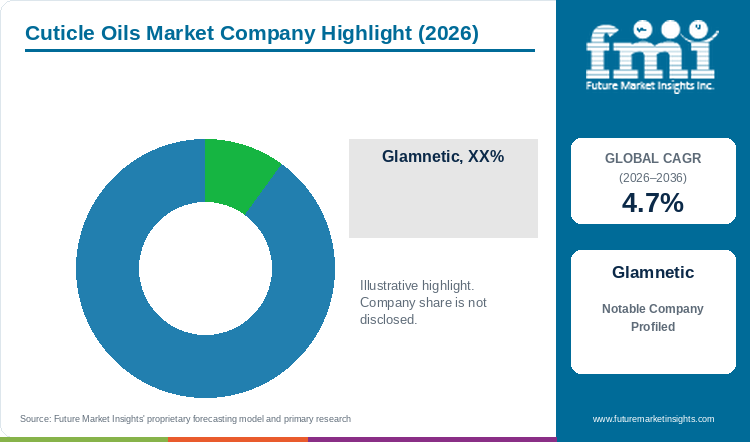
Nail specialists such as Glamnetic and Olive & June place care products inside at-home manicure systems. [17][25][27] L'Oreal offers essie cuticle oils while Coty supplies Sally Hansen care products and Wella Company offers OPI. [20][23][24] These nail brands combine product breadth with established retail or professional channels. Kiss Products supplies at-home nail systems that create adjacent maintenance occasions. [13][14] The report also profiles diversified beauty and personal-care companies for comparison with specialist suppliers.
- Direct nail-care specialists and at-home systems: Glamnetic and Olive & June sell cuticle-care products within broader manicure routines. [17][26][27] Kiss Products supplies at-home nail systems that create adjacent care occasions. [14]
- Global groups with nail-care brands: L'Oreal through essie and Coty through Sally Hansen offer cuticle-care products. [20][21][22][23] Wella Company's OPI portfolio connects care to professional manicure routines. [24]
- Diversified beauty and personal-care portfolios: Estee Lauder Companies and Unilever are profiled alongside e.l.f. Beauty and Church & Dwight.
Competitive Benchmarking: Cuticle Oils Market
| Company | Cuticle-Specific Portfolio Depth | Mess-Control & Portable Application | Manicure-Ecosystem Cross-Sell | Geographic Reach |
|---|---|---|---|---|
| Glamnetic | Medium | High | High | United States-centered DTC activity with a cuticle-oil offering. [17] |
| Olive & June | High | High | High | United States DTC and mass retail including Walmart. [12][25][26][27] |
| Estee Lauder Companies | - | - | - | - |
| L'Oreal | High | High | High | United States retail and e-commerce through essie cuticle oils. [20][21] |
| Unilever | - | - | - | - |
| e.l.f. Beauty | - | - | - | - |
| Coty | High | High | High | United States mass and e-commerce retail through Sally Hansen. [22][23] |
| Church & Dwight | - | - | - | - |
| Wella Company | Medium | Medium | High | United States OPI product availability and professional nail-care channels. [24] |
| Kiss Products | - | - | High | United States mass and e-commerce retail for at-home nail systems. [13][14] |
The benchmark compares cuticle-care range and applicator convenience alongside manicure cross-selling and geographic reach. High and Medium indicate relative strength within the documented offers. A dash indicates no rating.
Key Developments in the Cuticle Oils Market
- In January 2026, Kiss Products announced a KISS brand relaunch across major retailers and Amazon. Clearer collections and improved sizing focused on at-home nails. [13] The relaunch increases manicure traffic and creates opportunities to recommend maintenance products.
- In December 2024, Olive & June became part of Helen of Troy following the completed acquisition. Helen of Troy described an omnichannel nail-care brand spanning polish and artificial nails alongside tools and treatment or care. [11] The larger consumer platform can support distribution for repeat-use care products.
Key Players in the Cuticle Oils Market
Direct Nail-Care Specialists and At-Home Systems
- Glamnetic
- Olive & June
- Kiss Products
Global Beauty Groups with Nail-Care Brands
- L'Oreal
- Coty
- Wella Company
Diversified Beauty and Personal-Care Portfolios
- Estee Lauder Companies
- Unilever
- e.l.f. Beauty
- Church & Dwight
Cuticle Oils Market - Report Scope
| Coverage field | Report scope |
|---|---|
| Market breakdown | Product Type, Nature, Format, Price Positioning and Sales Channel |
| Quantitative Units | USD Million |
| Market Definition | Includes revenue from products marketed primarily to condition, moisturize, soften, protect or treat the cuticle and surrounding nail-fold area within the listed segmentation universe. Nail color, press-ons, adhesives, removers, manicure tools, general hand creams, salon service fees and other adjacent categories are excluded. For kits and sets, only value attributable to the cuticle-care product is considered. |
| Regions Covered | North America; Latin America; Western Europe; Eastern Europe; East Asia; South Asia and Pacific; Middle East and Africa |
| Countries Covered | USA, Germany, France, UK, Saudi Arabia, UAE, Japan, South Korea |
| Key Companies Profiled | Glamnetic, Olive & June, Estee Lauder Companies, L'Oreal, Unilever, e.l.f. Beauty, Coty, Church & Dwight, Wella Company, Kiss Products |
| Forecast Period | 2026 to 2036 |
| Approach | Market analysis using FMI estimates and official statistical sources alongside company and product information. |
Cuticle Oils Market - Research Methodology
| Method | Approach |
|---|---|
| Primary Research | Industry assessment considers consumer application habits and technician recommendations alongside retailer purchasing requirements. These factors help assess repeat use and channel fit. |
| Desk Research | Government statistics and regulatory publications provide country and formulation context. Company announcements and product pages establish available formats and distribution activity. Source dates and geographic coverage are considered alongside the market definition. |
| Market Sizing and Forecasting | The FMI baseline and forecast define the market total. Segment shares and country CAGRs describe the demand mix and growth outlook. Public retail and nail-service statistics provide context for purchasing conditions. |
| Data Validation | The market definition separates cuticle-care products from nail color and manicure tools or services. Only the cuticle-care component of a kit contributes to category revenue. Company developments are compared with the relevant product and channel boundaries to avoid counting adjacent nail-system sales. |
Cuticle Oils Market by Segments
Cuticle Oils Market segmented by Product Type:
- Core / classic lines
- Targeted treatment lines
- Sensitive & gentle lines
- Premium & clinical lines
- Kits & sets
Cuticle Oils Market segmented by Nature:
- Conventional
- Vegan & cruelty-free
- Natural & organic
- Dermocosmetic / clinical
- Fragrance-free & sensitive
Cuticle Oils Market segmented by Format:
- Cream & balm
- Liquid & serum
- Stick & solid
- Spray & mist
- Sheet & patch
- Powder
Cuticle Oils Market segmented by Price Positioning:
- Mass
- Masstige
- Premium
- Professional
Cuticle Oils Market segmented by Sales Channel:
- E-commerce & DTC
- Specialty beauty retail
- Pharmacies & drugstores
- Supermarkets & hypermarkets
- Salons & spas
Cuticle Oils Market by Region:
- North America
- United States
- Canada
- Latin America
- Brazil
- Mexico
- Argentina
- Chile
- Western Europe
- Germany
- France
- United Kingdom
- Italy
- Spain
- Benelux
- Nordics
- Eastern Europe
- Poland
- Czech Republic
- Romania
- Hungary
- East Asia
- China
- Japan
- South Korea
- South Asia and Pacific
- India
- ASEAN
- Australia and New Zealand
- Middle East and Africa
- GCC Countries
- South Africa
- Türkiye
- Israel
Research Sources and Bibliography
- [1] U.S. Bureau of Labor Statistics (2026, August 27). Manicurists and Pedicurists.
- [2] European Commission (2023, July 26). Commission Regulation (EU) 2023/1545 on labelling of fragrance allergens in cosmetic products.
- Statistisches Bundesamt (Destatis) (2024, February 27). 23% of 16- to 74-year-olds buy food or cosmetics online.
- Insee (2025, October 14). Achats de produits et de services en ligne.
- Office for National Statistics (2026, August 21). Internet sales as a percentage of total retail sales (ratio).
- Saudi Ministry of Commerce (2025, July 13). Quarterly consumer bulletin reporting e-commerce inspections and new store registrations.
- [7] Saudi Ministry of Commerce (2025, August 18). Ministry of Commerce Announces the Results of E-Commerce Store Evaluation.
- Dubai Chambers (2024, March 14). Dubai Chamber of Commerce collaborates with Amazon to strengthen ecommerce capabilities.
- Ministry of Economy, Trade and Industry, Japan (2025, August 26). Results of FY2024 E-Commerce Market Survey Compiled.
- Ministry of Food and Drug Safety, Republic of Korea (2025, January 6). 2024 K-beauty global exports surpass US$10 billion.
- [11] Helen of Troy Limited (2024, December 16). Helen of Troy Completes Acquisition of Olive & June, LLC.
- [12] Olive & June (2023, January 5). Olive & June Launches Nationwide at Walmart.
- [13] Kiss Products Inc. (2026, January 26). KISS Debuts a Bold NEW Look with MORE Nails for a BETTER Fit.
- [14] KISS Products, Inc. (2024, January 24). KISS Launches Salon X-tend LED Soft Gel System.
- [15] KISS Products, Inc. (2024, August 21). KISS Teams Up With Prabal Gurung for Limited-Edition Nail Collection.
- Coty (2024, August 7). Sally Hansen and Warner Bros. Discovery Team Up for a Beetlejuice Beetlejuice Nail Polish Collection.
- [17] Glamnetic (n.d.). 2-in-1 Cuticle Oil.
- [18] Glamnetic (2026, July 23). Time For Your Routine Refresh: New Press-On Nails & Accessories.
- [19] Glamnetic (2026, May 12). Glamnetic x GLAMZILLA: GLAMSQUAD FOREVER Is Here.
- [20] essie (n.d.). Apricot Cuticle Oil.
- [21] essie (n.d.). On A Roll Apricot Nail & Cuticle Oil.
- [22] Sally Hansen (n.d.). Vitamin E Nail & Cuticle Oil Pen.
- [23] Sally Hansen (n.d.). Nail and Cuticle Care Products.
- [24] OPI (n.d.). Nail & Cuticle Oil.
- [25] Olive & June (n.d.). Cuticle Care.
- [26] Olive & June (n.d.). Cuticle Oil.
- [27] Olive & June (n.d.). The Olive & June Mani System.
This Report Answers
- How large is the Cuticle Oils Market in 2026 and what value is forecast for 2036?
- Which industry pressures support recurring demand for cuticle-conditioning products?
- Why do Core / classic lines hold the leading position in Product Type?
- Why does Conventional remain the leading Nature segment?
- How do the profiled country growth rates differ from 2026 to 2036?
- Which profiled companies supply or participate in relevant cuticle-care and nail-care categories?
- What limits adoption, repeat purchase or supplier switching in the cuticle oils market?
- What should buyers evaluate before purchasing a cuticle oil or related cuticle-care format?
Frequently Asked Questions
How big is the Cuticle Oils Market in 2026, and what is forecast for 2036?
The market is valued at USD 423.9 Million in 2026 and is forecast to reach USD 671.0 Million by 2036. The increase reflects repeat use around manicure and nail-recovery routines rather than a single treatment event.
What is the CAGR for the Cuticle Oils Market from 2026 to 2036?
The market is forecast to grow at a 4.7% CAGR from 2026 to 2036. Growth depends on converting occasional cuticle treatment into a repeat beauty-care habit across home and professional channels.
Which Product Type segment leads the Cuticle Oils Market?
Core / classic lines lead Product Type with a 38.0% share in 2026. Their straightforward hydration proposition supports broad use and lowers the education burden for first-time buyers.
Which Nature segment leads the Cuticle Oils Market?
Conventional leads Nature with a 54.0% share in 2026. Established formulas remain widely available. Vegan and natural or sensitive-positioned options broaden the competitive set.
Which profiled countries have the highest growth rates in the Cuticle Oils Market?
Saudi Arabia has the highest profiled CAGR at 6.0%. The UAE follows at 5.7% and South Korea at 5.3% from 2026 to 2036. These rates describe forecast growth; country revenue depends on the starting market size.
Which companies are active in the Cuticle Oils Market?
Profiled companies include Glamnetic and Olive & June alongside Estee Lauder Companies and L'Oreal. Unilever and e.l.f. Beauty are also covered with Coty and Church & Dwight. Wella Company and Kiss Products complete the company list.
Preview the report firsthand - request a free sample
Get SampleGet the brochure for pricing and purchase details.
Get PDFTable of Content
- Key Takeaways
- Market Size and CAGR
- Top Growth Driver
- Fastest Growing Segment
- Leading Region
- Key Companies
- Emerging Opportunities
- Executive Summary
- Global Market Outlook
- Demand-side Trends
- Supply-side Trends
- Technology Roadmap Analysis
- Analysis and Recommendations
- Analyst Perspective (What is happening? Why now? What should investors know?)
- Key Questions Answered
- How large is the market?
- What is the CAGR?
- What are key trends?
- Which region dominates?
- Who are the leaders?
- Market Overview
- Market Coverage / Taxonomy
- Market Definition / Scope / Limitations
- Research Methodology
- Chapter Orientation
- Analytical Lens and Working Hypotheses
- Market Structure, Signals, and Trend Drivers
- Benchmarking and Cross-market Comparability
- Market Sizing, Forecasting, and Opportunity Mapping
- Research Design and Evidence Framework
- Desk Research Programme (Secondary Evidence)
- Expert Input and Fieldwork (Primary Evidence)
- Tooling, Models, and Reference Databases
- Data Engineering and Model Build
- Quality Assurance and Audit Trail
- Market Background
- Market Dynamics (Drivers, Restraints, Opportunity, Trends)
- Scenario Forecast (Optimistic, Likely, Conservative)
- Impact Analysis
- AI Impact
- Sustainability Impact
- Regulatory Impact
- Technology Impact
- Consumer / Buyer Analysis
- Purchase Drivers
- Adoption Barriers
- Buyer Journey
- Opportunity Map Analysis
- Product Life Cycle Analysis
- Supply Chain Analysis
- Investment Feasibility Matrix
- Value Chain Analysis
- PESTLE and Porter's Analysis
- Regulatory Landscape
- Regional Parent Market Outlook
- Production and Consumption Statistics
- Import and Export Statistics
- Global Market Analysis and Forecast, 2021 to 2036
- Historical Market Size Value (USD Million) Analysis, 2021 to 2025
- Current and Future Market Size Value (USD Million) Projections, 2026 to 2036
- Y-o-Y Growth Trend Analysis
- Absolute $ Opportunity Analysis
- Global Market Pricing Analysis, 2021 to 2036
- Global Market Analysis and Forecast, By Product Type, 2021 to 2036
- Introduction / Key Findings
- Historical Market Size Value (USD Million) Analysis By Product Type, 2021 to 2025
- Current and Future Market Size Value (USD Million) Analysis and Forecast By Product Type, 2026 to 2036
- Core / classic lines
- Targeted treatment lines
- Sensitive & gentle lines
- Premium & clinical lines
- Kits & sets
- Y-o-Y Growth Trend Analysis By Product Type, 2021 to 2025
- Absolute $ Opportunity Analysis By Product Type, 2026 to 2036
- Global Market Analysis and Forecast, By Nature, 2021 to 2036
- Introduction / Key Findings
- Historical Market Size Value (USD Million) Analysis By Nature, 2021 to 2025
- Current and Future Market Size Value (USD Million) Analysis and Forecast By Nature, 2026 to 2036
- Conventional
- Vegan & cruelty-free
- Natural & organic
- Dermocosmetic / clinical
- Fragrance-free & sensitive
- Y-o-Y Growth Trend Analysis By Nature, 2021 to 2025
- Absolute $ Opportunity Analysis By Nature, 2026 to 2036
- Global Market Analysis and Forecast, By Format, 2021 to 2036
- Introduction / Key Findings
- Historical Market Size Value (USD Million) Analysis By Format, 2021 to 2025
- Current and Future Market Size Value (USD Million) Analysis and Forecast By Format, 2026 to 2036
- Cream & balm
- Liquid & serum
- Stick & solid
- Spray & mist
- Sheet & patch
- Powder
- Y-o-Y Growth Trend Analysis By Format, 2021 to 2025
- Absolute $ Opportunity Analysis By Format, 2026 to 2036
- Global Market Analysis and Forecast, By Price Positioning, 2021 to 2036
- Introduction / Key Findings
- Historical Market Size Value (USD Million) Analysis By Price Positioning, 2021 to 2025
- Current and Future Market Size Value (USD Million) Analysis and Forecast By Price Positioning, 2026 to 2036
- Mass
- Masstige
- Premium
- Professional
- Y-o-Y Growth Trend Analysis By Price Positioning, 2021 to 2025
- Absolute $ Opportunity Analysis By Price Positioning, 2026 to 2036
- Global Market Analysis and Forecast, By Sales Channel, 2021 to 2036
- Introduction / Key Findings
- Historical Market Size Value (USD Million) Analysis By Sales Channel, 2021 to 2025
- Current and Future Market Size Value (USD Million) Analysis and Forecast By Sales Channel, 2026 to 2036
- E-commerce & DTC
- Specialty beauty retail
- Pharmacies & drugstores
- Supermarkets & hypermarkets
- Salons & spas
- Y-o-Y Growth Trend Analysis By Sales Channel, 2021 to 2025
- Absolute $ Opportunity Analysis By Sales Channel, 2026 to 2036
- Global Market Analysis and Forecast, By Region, 2021 to 2036
- Introduction
- Historical Market Size Value (USD Million) Analysis By Region, 2021 to 2025
- Current Market Size Value (USD Million) Analysis and Forecast By Region, 2026 to 2036
- North America
- Latin America
- Western Europe
- Eastern Europe
- East Asia
- South Asia and Pacific
- Middle East and Africa
- Market Attractiveness Analysis By Region
- North America Market Analysis and Forecast, By Country, 2021 to 2036
- Historical Market Size Value (USD Million) Trend Analysis By Market Taxonomy, 2021 to 2025
- Market Size Value (USD Million) Forecast By Market Taxonomy, 2026 to 2036
- By Country
- United States
- Canada
- By Product Type
- By Nature
- By Format
- By Price Positioning
- By Sales Channel
- By Country
- Market Attractiveness Analysis
- By Country
- By Product Type
- By Nature
- By Format
- By Price Positioning
- By Sales Channel
- Key Takeaways
- Latin America Market Analysis and Forecast, By Country
- Historical Market Size Value (USD Million) Trend Analysis By Market Taxonomy, 2021 to 2025
- Market Size Value (USD Million) Forecast By Market Taxonomy, 2026 to 2036
- By Country
- Brazil
- Mexico
- Argentina
- Chile
- By Product Type
- By Nature
- By Format
- By Price Positioning
- By Sales Channel
- By Country
- Market Attractiveness Analysis
- By Country
- By Product Type
- By Nature
- By Format
- By Price Positioning
- By Sales Channel
- Key Takeaways
- Western Europe Market Analysis and Forecast, By Country
- Historical Market Size Value (USD Million) Trend Analysis By Market Taxonomy, 2021 to 2025
- Market Size Value (USD Million) Forecast By Market Taxonomy, 2026 to 2036
- By Country
- Germany
- France
- United Kingdom
- Italy
- Spain
- Benelux
- Nordics
- By Product Type
- By Nature
- By Format
- By Price Positioning
- By Sales Channel
- By Country
- Market Attractiveness Analysis
- By Country
- By Product Type
- By Nature
- By Format
- By Price Positioning
- By Sales Channel
- Key Takeaways
- Eastern Europe Market Analysis and Forecast, By Country
- Historical Market Size Value (USD Million) Trend Analysis By Market Taxonomy, 2021 to 2025
- Market Size Value (USD Million) Forecast By Market Taxonomy, 2026 to 2036
- By Country
- Poland
- Czech Republic
- Romania
- Hungary
- By Product Type
- By Nature
- By Format
- By Price Positioning
- By Sales Channel
- By Country
- Market Attractiveness Analysis
- By Country
- By Product Type
- By Nature
- By Format
- By Price Positioning
- By Sales Channel
- Key Takeaways
- East Asia Market Analysis and Forecast, By Country
- Historical Market Size Value (USD Million) Trend Analysis By Market Taxonomy, 2021 to 2025
- Market Size Value (USD Million) Forecast By Market Taxonomy, 2026 to 2036
- By Country
- China
- Japan
- South Korea
- By Product Type
- By Nature
- By Format
- By Price Positioning
- By Sales Channel
- By Country
- Market Attractiveness Analysis
- By Country
- By Product Type
- By Nature
- By Format
- By Price Positioning
- By Sales Channel
- Key Takeaways
- South Asia and Pacific Market Analysis and Forecast, By Country
- Historical Market Size Value (USD Million) Trend Analysis By Market Taxonomy, 2021 to 2025
- Market Size Value (USD Million) Forecast By Market Taxonomy, 2026 to 2036
- By Country
- India
- ASEAN
- Australia and New Zealand
- By Product Type
- By Nature
- By Format
- By Price Positioning
- By Sales Channel
- By Country
- Market Attractiveness Analysis
- By Country
- By Product Type
- By Nature
- By Format
- By Price Positioning
- By Sales Channel
- Key Takeaways
- Middle East and Africa Market Analysis and Forecast, By Country
- Historical Market Size Value (USD Million) Trend Analysis By Market Taxonomy, 2021 to 2025
- Market Size Value (USD Million) Forecast By Market Taxonomy, 2026 to 2036
- By Country
- GCC Countries
- South Africa
- Türkiye
- Israel
- By Product Type
- By Nature
- By Format
- By Price Positioning
- By Sales Channel
- By Country
- Market Attractiveness Analysis
- By Country
- By Product Type
- By Nature
- By Format
- By Price Positioning
- By Sales Channel
- Key Takeaways
- Key Countries Market Analysis
- United States
- Pricing Analysis
- Market Share Analysis, 2025
- By Product Type
- By Nature
- By Format
- By Price Positioning
- By Sales Channel
- Canada
- Pricing Analysis
- Market Share Analysis, 2025
- By Product Type
- By Nature
- By Format
- By Price Positioning
- By Sales Channel
- Mexico
- Pricing Analysis
- Market Share Analysis, 2025
- By Product Type
- By Nature
- By Format
- By Price Positioning
- By Sales Channel
- Brazil
- Pricing Analysis
- Market Share Analysis, 2025
- By Product Type
- By Nature
- By Format
- By Price Positioning
- By Sales Channel
- Chile
- Pricing Analysis
- Market Share Analysis, 2025
- By Product Type
- By Nature
- By Format
- By Price Positioning
- By Sales Channel
- Germany
- Pricing Analysis
- Market Share Analysis, 2025
- By Product Type
- By Nature
- By Format
- By Price Positioning
- By Sales Channel
- United Kingdom
- Pricing Analysis
- Market Share Analysis, 2025
- By Product Type
- By Nature
- By Format
- By Price Positioning
- By Sales Channel
- Italy
- Pricing Analysis
- Market Share Analysis, 2025
- By Product Type
- By Nature
- By Format
- By Price Positioning
- By Sales Channel
- Spain
- Pricing Analysis
- Market Share Analysis, 2025
- By Product Type
- By Nature
- By Format
- By Price Positioning
- By Sales Channel
- France
- Pricing Analysis
- Market Share Analysis, 2025
- By Product Type
- By Nature
- By Format
- By Price Positioning
- By Sales Channel
- India
- Pricing Analysis
- Market Share Analysis, 2025
- By Product Type
- By Nature
- By Format
- By Price Positioning
- By Sales Channel
- ASEAN
- Pricing Analysis
- Market Share Analysis, 2025
- By Product Type
- By Nature
- By Format
- By Price Positioning
- By Sales Channel
- Australia and New Zealand
- Pricing Analysis
- Market Share Analysis, 2025
- By Product Type
- By Nature
- By Format
- By Price Positioning
- By Sales Channel
- China
- Pricing Analysis
- Market Share Analysis, 2025
- By Product Type
- By Nature
- By Format
- By Price Positioning
- By Sales Channel
- Japan
- Pricing Analysis
- Market Share Analysis, 2025
- By Product Type
- By Nature
- By Format
- By Price Positioning
- By Sales Channel
- South Korea
- Pricing Analysis
- Market Share Analysis, 2025
- By Product Type
- By Nature
- By Format
- By Price Positioning
- By Sales Channel
- Poland
- Pricing Analysis
- Market Share Analysis, 2025
- By Product Type
- By Nature
- By Format
- By Price Positioning
- By Sales Channel
- Hungary
- Pricing Analysis
- Market Share Analysis, 2025
- By Product Type
- By Nature
- By Format
- By Price Positioning
- By Sales Channel
- Türkiye
- Pricing Analysis
- Market Share Analysis, 2025
- By Product Type
- By Nature
- By Format
- By Price Positioning
- By Sales Channel
- South Africa
- Pricing Analysis
- Market Share Analysis, 2025
- By Product Type
- By Nature
- By Format
- By Price Positioning
- By Sales Channel
- Saudi Arabia
- Pricing Analysis
- Market Share Analysis, 2025
- By Product Type
- By Nature
- By Format
- By Price Positioning
- By Sales Channel
- UAE
- Pricing Analysis
- Market Share Analysis, 2025
- By Product Type
- By Nature
- By Format
- By Price Positioning
- By Sales Channel
- United States
- Market Structure Analysis
- Competition Dashboard
- Competition Benchmarking
- Market Share Analysis of Top Players
- By Regional
- By Product Type
- By Nature
- By Format
- By Price Positioning
- By Sales Channel
- Emerging Startups
- Innovation Benchmarking
- Competition Analysis
- Competition Deep Dive
- Glamnetic
- Overview
- Product Portfolio
- Profitability by Market Segments
- Sales Footprint
- Strategy Overview
- Marketing Strategy
- Product Strategy
- Channel Strategy
- Olive & June
- Estee Lauder Companies
- L'Oreal
- Unilever
- e.l.f. Beauty
- Coty
- Church & Dwight
- Wella Company
- Kiss Products
- Glamnetic
- Case Studies
- Success Stories
- Recent Developments
- Competition Deep Dive
- Assumptions & Acronyms Used


