

- Industry Size (2026)
- USD 2.2 Bn
- Forecast (2036)
- USD 4.4 Bn
- CAGR (2026 to 2036)
- 5.8%
Spora Face Oils Market Forecast and Outlook 2026 to 2036
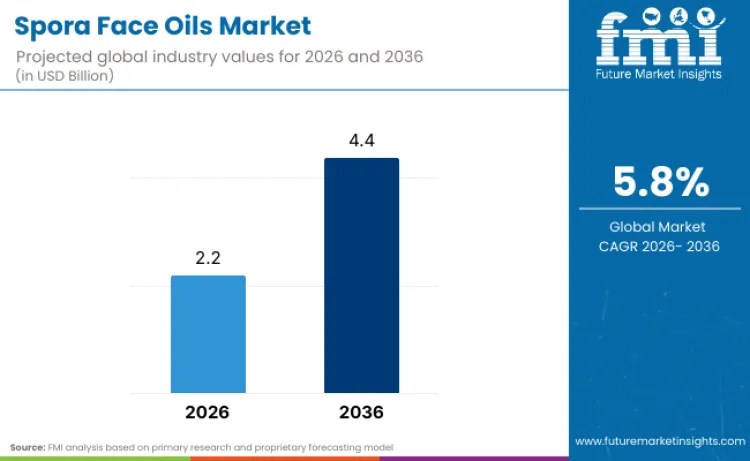
The global Spora face oils market is projected to reach a valuation of USD 2.2 billion in 2026 and accelerate to USD 4.4 billion by 2036, expanding at a steady 5.8% CAGR. Demand for Spora face oils, as per Future Market Insights, is being driven by a structural reorientation of beauty and dermatology toward equity-led, outcomes-based skincare models that directly address underserved populations rather than mass-market averages. This shift reflects growing recognition that dermatological health disparities are not cosmetic gaps but systemic healthcare failures requiring culturally informed product design and care delivery.
Foundational to this positioning is Spora Health’s clinical-first philosophy, articulated by its founder and CEO Dan Miller, who stated: “We’re trying to work backwards from the cultural disparities that currently exist. For example, the health outcomes of Black women are poorer than other populations.” This framing underscores how Spora face oils are not positioned as trend-driven beauty products, but as adjuncts to personalized dermatological care optimized for melanin-rich skin, barrier repair, and inflammation control.
As consumer trust increasingly shifts toward physician-backed, data-informed brands, the Spora face oils segment benefits from alignment with teledermatology, preventative skin health, and culturally competent formulation science. This integration allows the category to scale without diluting its core medical credibility, ensuring sustained growth through 2036 rather than short-term influencer-led demand cycles.
Summary of the Spora Face Oils Market
What Is Growth Outlook for Spora Face Oils Market as per Future Market Insights Projection?
Future Market Insights projects the Spora face oils market to grow at a 5.8% CAGR, from USD 2.2 Billion in 2026 to USD 4.4 Billion by 2036.
FMI Research Approach: Forecasting based on barrier-repair routines, lipid-based formulation demand, and microbiome-active skincare adoption.
How Do FMI Analysts Perceive Spora Face Oils Market to Evolve?
FMI sees the market shifting toward barrier-first, lipid-identical skincare, where spore-based oils function as daily skin health tools rather than cosmetic add-ons.
FMI Research Approach: Analysis of microbiome science, anhydrous formulation trends, and dermatologist-backed lipid therapy adoption.
Which Country Holds Largest Share in Global Spora Face Oils Market?
China holds a significant share, supported by cosmetic safety monitoring infrastructure and faster approval of microbiome-active formulations.
FMI Research Approach: Country-level CAGR modeling aligned with NMPA safety assessment systems and ingredient innovation pathways.
How Large Will Spora Face Oils Market Be by 2036?
The global market is projected to reach USD 4.4 Billion by 2036.
FMI Research Approach: Long-term revenue modeling based on repeat purchase behavior, oil-based routine integration, and digital retail expansion.
What Is Definition of Spora Face Oils Market?
The market includes facial oils formulated with lipid-based and spore-active ingredients designed to repair the skin barrier and retain moisture without water-based emulsions.
FMI Research Approach: Inclusion based on oil as primary delivery system, microbiome compatibility, and barrier-repair functionality.
What Are Globally Unique Trends Shaping Spora Face Oils Market?
Key trends include AI-guided oil selection, microbiome-active spore formulations, and the shift from creams to anhydrous lipid therapy.
FMI Research Approach: Review of dermocosmetic guidelines, cold-pressed oil efficacy studies, and regulatory support for microbiome skincare.
Spora Face Oils Market Key Takeaways
| Metric | Details |
|---|---|
| Industry Size (2026) | USD 2.2 Billion |
| Industry Value (2036) | USD 4.4 Billion |
| CAGR (2026-2036) | 5.8% |
Source: Future Market Insights (FMI) analysis, based on proprietary forecasting model and primary research
Which Factors Drive Spora Face Oils Adoption?
The Spora face oils market is being driven by a decisive consumer shift away from temporary aesthetic hydration toward long-term lipid health, where barrier repair and bio-identical nourishment are prioritized over short-lived cosmetic effects. This transition is reinforced by growing rejection of “over-optimization” in skincare routines, as users increasingly favor spore-based functional oils and anhydrous delivery systems that work with the skin’s natural biology rather than masking underlying imbalance. The resulting adoption reflects a structural move away from synthetic, water-heavy moisturizers toward lipid-dense formulations designed for sustained skin resilience.
Industry leaders and brand founders consistently frame this transition as a response to real-world health disparities and unmet dermatological needs rather than trend-driven clean beauty positioning. Dan Miller, Founder and CEO of Spora Health, articulated this philosophy clearly by stating: “We’re trying to work backwards from the cultural disparities that currently exist. For example, the health outcomes of Black women are poorer than other populations.” This emphasis on culturally informed formulation and outcomes-based care is reshaping face oils from indulgent add-ons into functional skin health tools. Formulation efficiency and ingredient integrity further validate this adoption curve, as brands increasingly rely on cold-pressed, food-grade botanical oils that deliver high antioxidant potency without water dilution. The integration of spore-based probiotics, circular ingredient utilization, and science-backed “skinification” allows Spora face oils to meet rising performance expectations while aligning with ethical and quality-driven purchasing criteria, ensuring durable demand rather than cyclical cosmetic interest.
How is the Spora Face Oils Market Segmented?
The Spora face oils market is segmented by product type, nature, skin type, distribution channel, end user, and region to reflect the diverse pathways of formulation, purchase, and use. By product type, the market includes spore based functional oils, single ingredient face oils, and blended face oils that serve as the primary lipid delivery formats. By nature, demand spans organic and conventional formulations, reflecting the growing preference for bio-identical oils alongside established cosmetic standards.
By skin type, adoption covers sensitive, dry, oily, combination, and normal skin, though sensitive skin is emerging as a key entry point due to barrier repair requirements. FMI analysis suggests that while innovation in functional and spore-based oils is accelerating, the market structure remains strongly anchored in ingredient credibility and dermatological compatibility. This segmentation highlights a dual-track market where performance-led formulations provide depth while digital retail and expanded end-user demographics provide breadth and scale.
Why do Spore Based Functional Oils hold a Dominant Share?
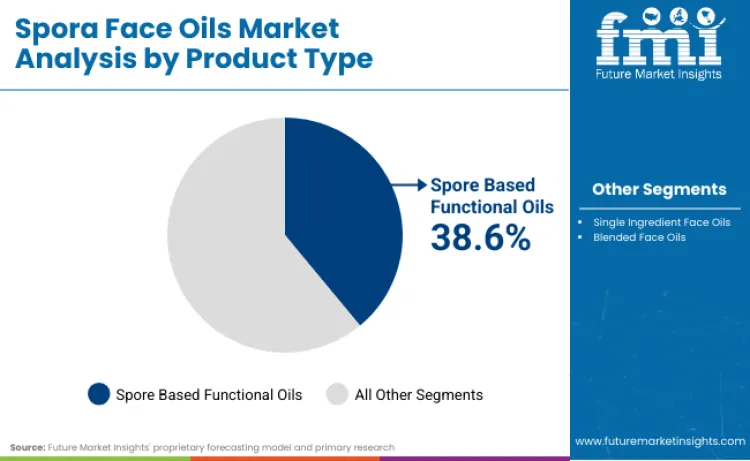
Spore based functional oils command a dominant 38.6% share because they are increasingly recognized as the core “locking mechanism” for long-term skin barrier health rather than as optional finishing products. Facial oils are now understood to strengthen the skin barrier and lock moisture into the skin by minimizing transepidermal water loss, positioning lipid-identical oils as a functional necessity rather than a cosmetic enhancer. This shift is reinforced by a broader consumer mindset where beauty is being reframed as a daily wellness ritual focused on resilience and repair rather than short-term aesthetic correction.
Dan Miller, Founder and CEO of Spora Health, captured this deeper orientation toward outcomes-driven care by stating: “We’re trying to work backwards from the cultural disparities that currently exist. For example, the health outcomes of Black women are poorer than other populations.” This perspective anchors spore based functional oils in biological compatibility and barrier-first science, strengthening trust in formulations designed to integrate with the skin’s natural lipid structure. The segment’s dominance is further protected by its alignment with human biology, as facial oils closely mirror the skin’s own lipid composition that forms the protective barrier. This biological familiarity reduces irritation risk and improves efficacy, allowing spore based functional oils to maintain leadership even as blended and single-ingredient oils expand, ensuring sustained preference within the Spora face oils market.
Why is Organic formulation share expanding?
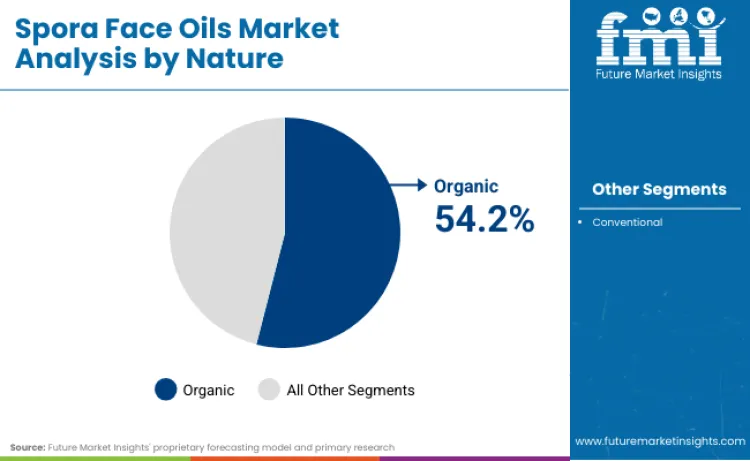
The organic segment holds a dominant 54.2% share as skincare consumers increasingly equate clinical trust with ingredient transparency and multi-functionality, making clean-label oils a default choice rather than a premium alternative. Brands such as The Ordinary have reinforced this trust by demonstrating that single ingredient and minimally processed oils can act as proven multi-taskers, delivering barrier support, hydration retention, and skin comfort within one formulation. This validation shifts organic oils from optional lifestyle products into credible, everyday skin health solutions.
This leadership position is further reinforced by an industry-wide emphasis on authenticity and long-term value, where quality is defined by functional performance, clarity of sourcing, and sensible pricing rather than marketing complexity. The move toward cold-pressed botanical oils derived from high-integrity raw materials strengthens confidence in organic formulations, while the broader industry sentiment that beauty should prioritize doing better rather than doing more protects the segment from trend volatility. As a result, organic face oils transition from niche clean beauty offerings into structurally embedded standards within the Spora face oils market.
Why Is Spore-Based AI Reshaping Assessment?
Artificial intelligence is fundamentally reshaping face oil assessment by replacing subjective skin typing with quantifiable microbiome and barrier data captured through rapid analytical tools. Advanced AI systems now enable scientists to analyze skin and microbiome findings faster than previously possible, allowing brands to deliver tailored face oil recommendations within hours rather than weeks. This technology allows non-specialists and consumers themselves to access high-fidelity skin insights, effectively relieving dependency on traditional dermatological consultations. It enables earlier and more precise intervention for barrier imbalance, effectively functioning as an AI-powered formulation guidance system by matching spore-based oils to individual biological conditions rather than generic skin categories.
How Is Physiological Biomarker Commercialization Changing Clinical Practice?
The Spora face oils sector is pivoting decisively from surface-level visual assessment to incorporating objective biological evidence embedded directly within formulations. Innovative oils now utilize probiotic spores such as Bacillus subtilis and Bacillus coagulans that can communicate with and adapt to the skin’s environment, creating formulations that respond dynamically rather than passively. This shift moves face oils closer to the precision of pharmaceutical-grade care by using resilient microbial systems that remain dormant until activated by the skin’s unique conditions, effectively creating a reliable “biological positive” for barrier repair. It reduces the prolonged trial-and-error cycle traditionally associated with skincare, allowing consumers to achieve functional outcomes faster and with greater confidence than conventional observational routines allow.
What Role Does Scientific Maturation Play in Formulation Innovation?
Increased scientific clarity around microbiome behavior and spore viability is stabilizing the innovation landscape for advanced face oil formulations, allowing brands to invest more confidently in research and development. As the mechanisms behind spore activation and lipid interaction become better defined, formulators can introduce new oils without relying on vague claims or aesthetic positioning. This maturation lowers the barrier for specialized brands to launch biologically intelligent oils that target specific barrier dysfunctions without excessive reformulation risk. It fosters an environment where niche, high-performance face oils can reach the market faster, directly supporting innovation in personalized skincare while ensuring credibility and functional consistency across product lines.
What is Spora Face Oils Market Regional Outlook?
Sales in emerging skincare markets are expanding faster than the global average, driven by rapid adoption of barrier-focused routines, rising dermatological awareness, and the normalization of functional oils within daily care. While the global Spora face oils market grows at a 5.8% CAGR, high-growth regions are accelerating demand by bypassing traditional cream-based regimens and moving directly toward lipid-identical and spore-based oil formats. China leads this growth with a 7.8% CAGR, followed by India at 7.3% and Germany at 6.7%, forming a strong growth corridor across Asia and Europe. In contrast, mature markets such as the United States (5.5%) and the United Kingdom (4.9%) are driven more by formulation refinement, brand trust, and repeat purchase behavior rather than first-time adoption. FMI analysis indicates that future growth will be anchored in regions where skin barrier health is becoming a primary entry point into skincare rather than an advanced concern.
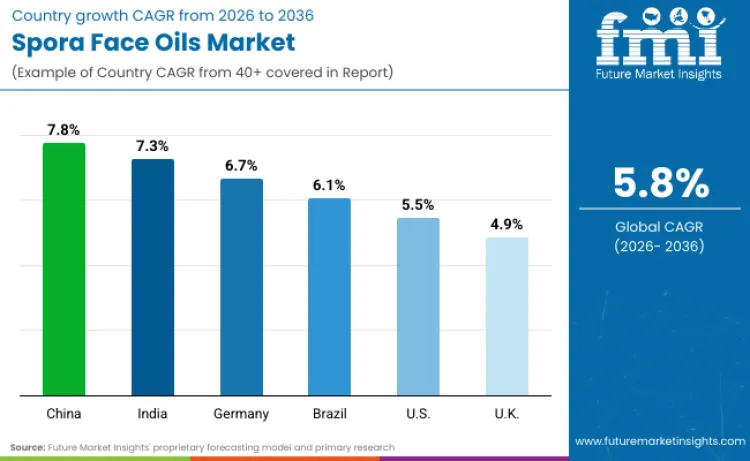
| Country | CAGR (2026 to 2036) |
|---|---|
| China | 7.8% |
| India | 7.3% |
| Germany | 6.7% |
| Brazil | 6.1% |
| United States | 5.5% |
| United Kingdom | 4.9% |
Source: FMI historical analysis and forecast data.
Why is the India government standardizing assessment protocols?
India is growing at a strong 7.3% CAGR, driven primarily by regulatory formalization of the dermocosmetic and skin health sector as authorities move to standardize how barrier-related conditions are managed nationwide. In 2025, a modified Delphi process led by the IADVL Special Interest Group produced the first comprehensive, India-specific clinical guideline incorporating recent advances in dermocosmetic science.
These guidelines aim to enhance clinical outcomes while creating a uniform national approach to skin barrier management, reducing inconsistencies caused by fragmented private practices. This standardization is critical in a country where regional climate variation, socioeconomic disparities, and uneven access to dermatological care significantly influence disease presentation and treatment response. FMI predicts that the adoption of standardized protocols will accelerate the use of lipid-based interventions by 2030, particularly through individualized moisturiser and oil regimens aligned with BIS product-specific requirements. While innovation in formulations continues, the core growth driver remains the government’s push toward documented, measurable, and guideline-backed skin health management. This regulatory clarity incentivizes clinicians and consumers to shift toward clinically recognized lipid-identical face oils, anchoring long-term market expansion beyond urban premium segments.
How is China deploying Mass-screening Infrastructure?
China is expanding at a rapid 7.8% CAGR, supported by a state-led effort to standardize safety monitoring and risk assessment across specialized skincare and functional cosmetic categories. As of 2025, the National Medical Products Administration implemented the Administrative Measures for Cosmetic Safety Risk Monitoring and Assessment, establishing a centralized framework to standardize ingredient evaluation, post-market surveillance, and safety signal reporting.
This approach mirrors China’s broader strategy of scaling consumer health categories through regulatory infrastructure rather than fragmented oversight. The rollout includes system upgrades designed to streamline the evaluation and approval of new cosmetic ingredients and their associated specialized products, reducing approval uncertainty while strengthening oversight. FMI analysis indicates that this infrastructure enables rapid scale without compromising regulatory control, allowing advanced formulations such as spore-based and microbiome-active oils to reach consumers faster. By embedding standardized monitoring into market access, China is creating an environment where safety substantiation and ingredient innovation coexist, positioning the country as a high-volume growth engine for advanced face oil adoption.
Why is Brazil focusing on Epidemiological Tracking?
Brazil’s Spora face oils market is rising at a 6.1% CAGR as regulatory authorities strengthen visibility, traceability, and safety oversight for topical and dermocosmetic products. ANVISA’s clarification of cosmetic regularization under RDC 752/2022 has simplified compliance pathways by digitizing procedures and standardizing documentation, allowing regulators to better track product categories and ingredient usage patterns. This shift reduces ambiguity for manufacturers while ensuring consistent data capture across the national market.
ANVISA’s enforcement of prohibitions on newly restricted ingredients further elevates ingredient-level scrutiny, reinforcing consumer protection and regulatory confidence. FMI analysis suggests that this enhanced tracking framework encourages brands to prioritize well-characterized lipid and oil systems that meet evolving safety expectations. As a result, Brazil’s growth is increasingly driven by trust in regulatory oversight rather than novelty alone, supporting steady adoption of functional face oils that align with clearer compliance and surveillance standards while maintaining competitiveness in international markets.
How is the US Market Maturing Around Reimbursement?
The USA is growing at a steady 5.5% CAGR, characterized by a shift from rapid product proliferation toward regulatory-backed credibility and documented safety substantiation. The implementation of the Modernization of Cosmetics Regulation Act marks a turning point, requiring manufacturers to register facilities, submit full product listings, and maintain comprehensive ingredient disclosures. By 2025, documented safety substantiation became a prerequisite for market access, fundamentally altering commercialization strategies.
FMI analysis indicates that this maturation favors brands with robust formulation science, testing documentation, and transparent ingredient narratives. Rather than driving volume through aggressive launches, the US market increasingly rewards products that can withstand regulatory scrutiny and support long-term consumer trust. This environment benefits lipid-identical and spore-based face oils positioned as functional skin health tools rather than cosmetic add-ons. As compliance becomes embedded in brand value, growth is expected to remain steady, anchored in repeat usage, clinical confidence, and regulatory alignment rather than short-term trend cycles.
How is the Competition in the Spora Face Oils Market?
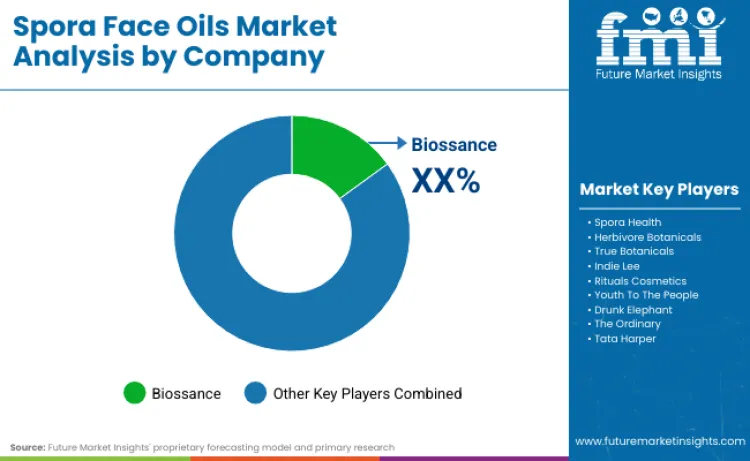
Established leaders such as L’Oréal and The Estée Lauder Companies protect their market share by embedding face oils within broader science-led skincare ecosystems rather than positioning them as standalone botanical products. These companies leverage large-scale R&D platforms, biotechnology hubs, and longevity-focused narratives to maintain authority, ensuring that face oils are framed as clinically informed components of long-term skin health rather than trend-driven add-ons. Their scale allows them to continuously reformulate, validate, and distribute advanced oil systems while maintaining strong retailer and dermatologist relationships that act as key gatekeepers for consumer trust. At the same time, startups are challenging this dominance by building credibility through bio-identical lipid science and direct-to-consumer education, effectively bypassing traditional brand loyalty structures. The integration of AI-powered diagnostics and personalized recommendations is creating a new competitive front, where consumer data and tailored regimens function as loyalty anchors. Strategic collaborations between emerging brands, ingredient innovators, and digital skin analysis platforms are further reshaping competition, shifting it from shelf visibility to ecosystem control. This dynamic ensures that competition in the Spora face oils market is increasingly defined by scientific depth, personalization capability, and sustained outcomes rather than marketing scale alone.
Recent Developments:
- In February 2026, NIVEA Canada expanded its Luminous630® range with the Skin Glow Liquid Refiner and Instant Glow Serum, building on the award-winning Dark Spot Advanced Serum to deliver science-backed radiance and even-toned skin across its Canadian skincare portfolio.
- In December 2025, Herbivore partnered with Ulta Beauty to launch an exclusive 15-piece Body Collection, debuting in 850+ stores nationwide from December 28, strengthening clean, plant-powered prestige beauty retail presence and consumer access across the United States.
Key Players in Spora Face Oils Market
- Biossance
- Spora Health
- Herbivore Botanicals
- True Botanicals
- Indie Lee
- Rituals Cosmetics
- Youth To The People
- Drunk Elephant
- The Ordinary
- Tata Harper
Market Definition
The Spora Face Oils Market refers to the global market for facial oil formulations designed to support skin barrier integrity, lipid balance, and long-term skin health through oil-based delivery systems. These products are characterized by the use of functional lipids, botanical oils, and spore-based or microbiome-aligned actives that integrate with the skin’s natural lipid structure rather than relying on water-based emulsions. The market includes single-ingredient oils, blended oils, and advanced functional oils positioned for daily facial skincare routines. Spora face oils are typically used for nourishment, barrier repair, and moisture retention across multiple skin types and are distributed through online retail, specialty beauty stores, pharmacies, and select mass retail channels, serving both preventive and maintenance-focused skincare regimens.
Market Inclusion
The market includes all commercially marketed facial oil products formulated primarily with lipid-based ingredients intended for facial application. This covers spore-based functional oils, single-ingredient botanical oils, and blended face oils positioned for barrier support, hydration retention, and skin comfort. Products may be positioned as organic or conventional and can incorporate microbiome-aligned actives, probiotics, or bio-identical lipid systems. Included products are sold through direct-to-consumer platforms, specialty beauty retailers, pharmacies, dermatology-linked channels, and select supermarkets. The scope also includes products marketed to women, men, and unisex consumers, as well as oils formulated for sensitive, dry, oily, combination, and normal skin types when explicitly positioned as facial oils.
Market Exclusion
The market excludes water-based creams, lotions, gels, serums, and emulsions where oils are secondary ingredients rather than the primary delivery system. Body oils, hair oils, massage oils, and aromatherapy oils not intended for facial skincare use are also excluded. Prescription dermatological treatments, medicated ointments, and pharmaceutical-grade topical drugs fall outside the market scope, even if oil-based. DIY or home-blended oils without commercial branding and regulatory labeling are not considered. Additionally, multifunctional cosmetic products such as foundations, tinted oils, or sunscreens are excluded unless facial oil use is the primary positioning, ensuring the market remains focused on dedicated face oil formulations.
Scope of Report
| Items | Values |
|---|---|
| Quantitative Units | USD billion |
| Product Type | Spore-Based Functional Oils; Single Ingredient Face Oils; Blended Face Oils |
| Nature | Organic; Conventional |
| Skin Type | Sensitive Skin; Dry Skin; Oily Skin; Combination Skin; Normal Skin |
| Distribution Channel | Online Retail; Specialty Beauty Stores; Pharmacies & Drug Stores; Supermarkets & Hypermarkets |
| End User | Women; Men; Unisex |
| Formulation & Technology Focus | Microbiome-Active Spore Oils; Lipid-Identical Barrier Repair Systems; Cold-Pressed Botanical Oil Platforms; AI-Guided Personalized Oil Selection; Probiotic-Infused Functional Skincare Oils |
| Regions Covered | North America, Europe, Asia Pacific, Latin America, Middle East & Africa |
| Countries Covered | China, India, Germany, Brazil, United States, United Kingdom, Japan, South Korea, France, and 40+ countries |
| Key Companies Profiled | Biossance; Spora Health; Herbivore Botanicals; True Botanicals; Indie Lee; Rituals Cosmetics; Youth To The People; Drunk Elephant; The Ordinary; Tata Harper |
| Additional Attributes | Dollar sales by product type, nature, skin type, distribution channel, and end user; performance benchmarking across barrier repair efficacy, lipid absorption rate, microbiome compatibility, and long-term skin resilience; adoption trends for spore-based functional oils and organic formulations; impact on routine simplification, repeat purchase frequency, and dermatologist-backed recommendations; regulatory influence on microbiome-active cosmetic approval and ingredient safety substantiation; supply chain dynamics across cold-pressed botanical sourcing, sustainable packaging, and digital-first retail ecosystems |
Spora Face Oils Market by Segments
By Product Type:
- Spore-Based Functional Oils
- Single Ingredient Face Oils
- Blended Face Oils
By Nature:
- Organic
- Conventional
By Skin Type:
- Sensitive Skin
- Dry Skin
- Oily Skin
- Combination Skin
- Normal Skin
By Distribution Channel:
- Online Retail
- Specialty Beauty Stores
- Pharmacies and Drug Stores
- Supermarkets and Hypermarkets
By End User:
- Women
- Men
- Unisex
By Region:
- North America
- Europe
- East Asia
- South Asia
- Latin America
- Middle East & Africa
Bibliography
- Indian Association of Dermatologists, Venereologists and Leprologists (IADVL). (2025). Consensus guidelines for dermocosmetic use in skin barrier management using modified Delphi methodology.
- Journal of Cosmetic Dermatology. (2025). Cold‑pressed botanical oils, lipid compatibility, and antioxidant performance in facial skincare.
- International Journal of Cosmetic Science. (2024). Anhydrous formulations and barrier repair: efficacy of oil‑based delivery systems in skincare.
Frequently Asked Questions
What is the current global market size for Spora Face Oils?
The global Spora face oils market is valued at USD 2.2 billion in 2026.
What is the projected CAGR for the Spora Face Oils market?
The market is projected to grow at a 5.8% CAGR from 2026 to 2036.
Which segment currently dominates the industry?
Spore-based functional oils hold the leading share at 38.6% while organic formulations dominate by nature with 54.2%.
What are the primary drivers for adoption in emerging markets?
Adoption is driven by regulatory standardization of dermocosmetic care in India and large-scale cosmetic safety monitoring infrastructure in China.
Who are the leading players in the Spora Face Oils space?
Key players include Biossance, Spora Health, Herbivore Botanicals, True Botanicals, Tata Harper, Drunk Elephant, and The Ordinary.
Preview the report firsthand - request a free sample
Get SampleGet the brochure for pricing and purchase details.
Get PDFTable of Content
- Executive Summary
- Global Market Outlook
- Demand Side Trends
- Supply Side Trends
- Technology Roadmap Analysis
- Analysis and Recommendations
- Market Overview
- Market Coverage / Taxonomy
- Market Definition / Scope / Limitations
- Research Methodology
- Chapter Orientation
- Analytical Lens and Working Hypotheses
- Market Structure, Signals, and Trend Drivers
- Benchmarking and Cross-market Comparability
- Market Sizing, Forecasting, and Opportunity Mapping
- Research Design and Evidence Framework
- Desk Research Programme (Secondary Evidence)
- Company Annual and Sustainability Reports
- Peer-reviewed Journals and Academic Literature
- Corporate Websites, Product Literature, and Technical Notes
- Earnings Decks and Investor Briefings
- Statutory Filings and Regulatory Disclosures
- Technical White Papers and Standards Notes
- Trade Journals, Industry Magazines, and Analyst Briefs
- Conference Proceedings, Webinars, and Seminar Materials
- Government Statistics Portals and Public Data Releases
- Press Releases and Reputable Media Coverage
- Specialist Newsletters and Curated Briefings
- Sector Databases and Reference Repositories
- FMI Internal Knowledge Base and Historical Datasets
- Subscription Datasets and Paid Sources
- Social Channels, Communities, and Digital Listening Inputs
- Additional Desk Sources
- Expert Input and Fieldwork (Primary Evidence)
- Primary Modes
- Qualitative Interviews and Expert Elicitation
- Quantitative Surveys and Structured Data Capture
- Blended Approach
- Why Primary Evidence is Used
- Field Techniques
- Interviews
- Surveys
- Focus Groups
- Observational and In-context Research
- Social and Community Interactions
- Stakeholder Universe Engaged
- C-suite Leaders
- Board Members
- Presidents and Vice Presidents
- R&D and Innovation Heads
- Technical Specialists
- Domain Subject-matter Experts
- Scientists
- Physicians and Other Healthcare Professionals
- Governance, Ethics, and Data Stewardship
- Research Ethics
- Data Integrity and Handling
- Primary Modes
- Tooling, Models, and Reference Databases
- Desk Research Programme (Secondary Evidence)
- Data Engineering and Model Build
- Data Acquisition and Ingestion
- Cleaning, Normalisation, and Verification
- Synthesis, Triangulation, and Analysis
- Quality Assurance and Audit Trail
- Market Background
- Market Dynamics
- Drivers
- Restraints
- Opportunity
- Trends
- Scenario Forecast
- Demand in Optimistic Scenario
- Demand in Likely Scenario
- Demand in Conservative Scenario
- Opportunity Map Analysis
- Product Life Cycle Analysis
- Supply Chain Analysis
- Investment Feasibility Matrix
- Value Chain Analysis
- PESTLE and Porter’s Analysis
- Regulatory Landscape
- Regional Parent Market Outlook
- Production and Consumption Statistics
- Import and Export Statistics
- Market Dynamics
- Global Spora Face Oils Market Analysis 2021 to 2025 and Forecast, 2026 to 2036
- Historical Market Size Value (USD Billion) Analysis, 2021 to 2025
- Current and Future Market Size Value (USD Billion) Projections, 2026 to 2036
- Y-o-Y Growth Trend Analysis
- Absolute $ Opportunity Analysis
- Global Market Pricing Analysis 2021 to 2025 and Forecast 2026 to 2036
- Y-o-Y Growth Trend Analysis 2021 to 2025
- Absolute $ Opportunity Analysis 2026 to 2036
- Global Market Analysis 2021 to 2025 and Forecast 2026 to 2036, By Product Type
- Introduction / Key Findings
- Historical Market Size Value Analysis By Product Type, 2021 to 2025
- Current and Future Market Size Value Analysis and Forecast By Product Type, 2026 to 2036
- Spore-Based Functional Oils
- Single Ingredient Face Oils
- Blended Face Oils
- Y-o-Y Growth Trend Analysis By Product Type, 2021 to 2025
- Absolute $ Opportunity Analysis By Product Type, 2026 to 2036
- Global Market Analysis 2021 to 2025 and Forecast 2026 to 2036, By Nature
- Introduction / Key Findings
- Historical Market Size Value Analysis By Nature, 2021 to 2025
- Current and Future Market Size Value Analysis and Forecast By Nature, 2026 to 2036
- Organic
- Conventional
- Y-o-Y Growth Trend Analysis By Nature, 2021 to 2025
- Absolute $ Opportunity Analysis By Nature, 2026 to 2036
- Global Market Analysis 2021 to 2025 and Forecast 2026 to 2036, By Skin Type
- Introduction / Key Findings
- Historical Market Size Value Analysis By Skin Type, 2021 to 2025
- Current and Future Market Size Value Analysis and Forecast By Skin Type, 2026 to 2036
- Sensitive Skin
- Dry Skin
- Oily Skin
- Combination Skin
- Normal Skin
- Y-o-Y Growth Trend Analysis By Skin Type, 2021 to 2025
- Absolute $ Opportunity Analysis By Skin Type, 2026 to 2036
- Global Market Analysis 2021 to 2025 and Forecast 2026 to 2036, By Distribution Channel
- Introduction / Key Findings
- Historical Market Size Value Analysis By Distribution Channel, 2021 to 2025
- Current and Future Market Size Value Analysis and Forecast By Distribution Channel, 2026 to 2036
- Online Retail
- Specialty Beauty Stores
- Pharmacies & Drug Stores
- Supermarkets & Hypermarkets
- Y-o-Y Growth Trend Analysis By Distribution Channel, 2021 to 2025
- Absolute $ Opportunity Analysis By Distribution Channel, 2026 to 2036
- Global Market Analysis 2021 to 2025 and Forecast 2026 to 2036, By End User
- Introduction / Key Findings
- Historical Market Size Value Analysis By End User, 2021 to 2025
- Current and Future Market Size Value Analysis and Forecast By End User, 2026 to 2036
- Women
- Men
- Unisex
- Y-o-Y Growth Trend Analysis By End User, 2021 to 2025
- Absolute $ Opportunity Analysis By End User, 2026 to 2036
- Global Market Analysis 2021 to 2025 and Forecast 2026 to 2036, By Region
- Introduction
- Historical Market Size Value Analysis By Region, 2021 to 2025
- Current Market Size Value Analysis and Forecast By Region, 2026 to 2036
- North America
- Europe
- East Asia
- South Asia
- Latin America
- Middle East & Africa
- Market Attractiveness Analysis By Region
- Market Structure Analysis
- Competition Dashboard
- Competition Benchmarking
- Market Share Analysis of Top Players
- Competition Analysis
- Competition Deep Dive
- Biossance
- Spora Health
- Herbivore Botanicals
- True Botanicals
- Indie Lee
- Rituals Cosmetics
- Youth To The People
- Drunk Elephant
- The Ordinary
- Tata Harper
- Competition Deep Dive
- Assumptions & Acronyms Used


