

- Market Size (2026)
- USD 1.5 Bn
- Forecast (2036)
- USD 3.8 Bn
- CAGR (2026 to 2036)
- 9.7%
How big is CVD CVI Vacuum Furnaces Market in 2026?
USD 1.5 billion in 2026 and USD 3.8 billion by 2036 at a 9.7% CAGR.
Sales of CVD CVI vacuum furnaces are estimated to rise at 9.7% CAGR through 2036, increasing valuation from USD 1.5 billion in 2026 to USD 3.8 billion by 2036. Qualified ceramic matrix composite programs are driving the demand for controlled coating and infiltration across porous hardware. NASA reported in January 2025 that alternate-CVI composite airfoils completed more than 76 hours near 3,000°F and met every criterion for technology readiness level five. The result confirms a demanding acceptance route for advanced composite hardware without proving commercial furnace adoption across production sites. Industrial furnace systems gain commercial value through repeatable gas flow and temperature across representative customer loads. Nominal chamber ratings provide limited acceptance evidence without representative production results across the approved component geometry and process chemistry.
United States projects often fund custom production systems through aerospace or semiconductor capital budgets inside established manufacturing clusters. Japanese programs place greater weight on local process support and long qualification schedules for ceramic components. CVD Equipment reported in May 2025 that a USD 1.2 million semiconductor-system order entered its backlog during early April. The order confirms a funded route for chemical vapor deposition equipment without proving demand for every CVD or CVI configuration. Engineering groups compare precursor safety with cycle yield across representative production loads during site review. Each carbon fiber composite geometry changes gas access and processing time, which creates a different infiltration route. Service coverage therefore affects financial approval as directly as chamber size and maximum temperature during project review.
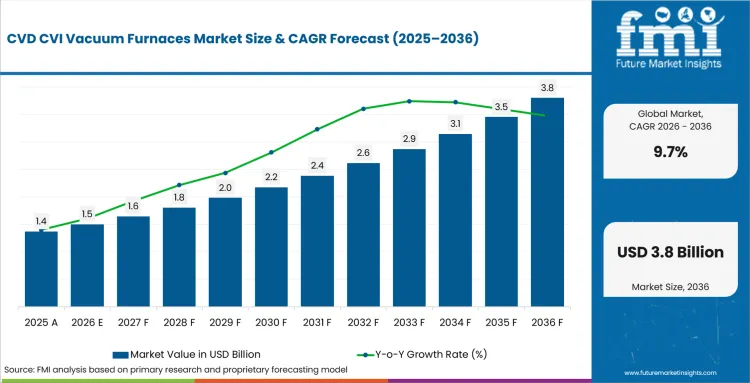
Key Takeaways of CVD CVI Vacuum Furnaces Market
- Qualified component programs create revenue through controlled coating or infiltration across porous hardware that existing thermal assets cannot process consistently.
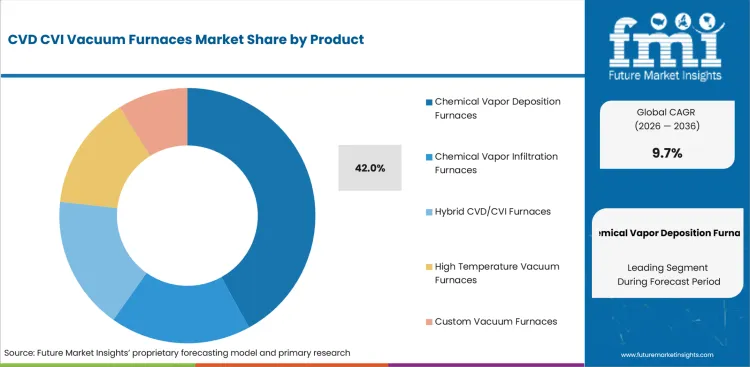
- Chemical vapor deposition furnaces are forecast to represent 42.0% share in 2026, shaped by repeatable coating control and broad process flexibility.
- Aerospace components are projected to hold 39.0% share in 2026, supported by demanding propulsion programs and formal component qualification routes.
- Aerospace and defense companies are estimated to capture 41.0% share in 2026, reflecting long program lives and documented acceptance responsibilities.
- Long processing cycles and high installation requirements delay commercial conversion by extending validation work across utilities and representative component loads.
- Competition includes CVD Equipment Corporation, AVS, ACME, IHI Bernex, PVA MPA, Centorr Vacuum Industries, Shanghai Haoyue Technology, and Annealsys. Their positions depend on proven process scope with credible integration support and service coverage for each material route.
Analyst Perspective
“The decisive question extends beyond whether a furnace reaches its specified temperature during an isolated demonstration cycle. A project succeeds through repeatable chemistry across full loads and a service plan that protects the approved recipe during long campaigns. Companies that connect uniformity records with accepted component quality can shorten technical review and defend repeat orders. Weak maintenance ownership can erase those gains despite a successful technical demonstration across representative customer hardware.”
- Nikhil Kaitwade, Principal Analyst, Future Market Insights
How is the CVD CVI Vacuum Furnaces Market segmented?
The CVD CVI vacuum furnaces market is segmented by product, application, end user, distribution channel, heating technology, and region.
The market is segmented by product, application, end user, distribution channel, heating technology, and region. Product categories separate chemical vapor deposition, chemical vapor infiltration, hybrid systems, high-temperature vacuum furnaces, and custom equipment. Application categories cover aerospace components, semiconductor manufacturing, energy and power, automotive components, and industrial manufacturing. End-user categories distinguish aerospace and defense companies, semiconductor manufacturers, research institutions, industrial manufacturers, and energy companies. Distribution channels include direct sales, authorized distributors, engineering and construction companies, online sales, and aftermarket service providers. Heating technology categories cover graphite, metal, induction, resistance, and hybrid systems across temperature or contamination requirements. Regional analysis compares installation conditions and service access across markets with distinct qualification routes and engineering capacity. The structure distinguishes specialized furnace scope from the semiconductor manufacturing equipment market and adjacent thermal-processing categories.
What supports the position of chemical vapor deposition furnaces within the product category?
Chemical vapor deposition furnaces control surface formation through linked gas delivery and pressure regulation across thermally uniform components. IHI reported in October 2025 that its high-speed silicon-carbide CVI process increased growth rate and preserved coating uniformity with acceptable composite properties. The study supports technical feasibility through measured process results rather than proving commercial adoption across customer production sites. It also shows why product selection depends on stable chemistry across the complete work zone and representative hardware.
- Based on product, chemical vapor deposition furnaces are projected to account for 42.0% in 2026 due to their use across coating and infiltration programs. Accepted surface properties must remain consistent through several component geometries under one qualified production recipe. Uniform gas delivery across the usable work zone therefore supports the segment’s position in specialized component programs.
- Aerospace engineers and advanced-material producers adopt these furnaces through staged recipe qualification that links precursor delivery with accepted component properties. Successful coupon results provide limited value without dependable performance across full loads and extended production campaigns. Programs involving high-temperature ceramics add contamination requirements that must remain stable through chamber maintenance and configuration changes.
Why do aerospace components shape the application category?
Aerospace components must retain coating integrity and composite density under thermal loads that exceed conventional alloy limits. Furnace qualification therefore links each recipe with representative turbine hardware and defined inspection stages during formal customer review. NASA published a March 2025 final report on high-temperature ceramic-matrix-composite vanes for small-core turbine programs. The report documents a component-level qualification route without proving commercial furnace purchases across aerospace production sites.
- By application, aerospace components are forecast to represent 39.0% in 2026 driven by propulsion and thermal-protection programs with demanding acceptance routes. Each geometry can alter gas access and final material density, so their position reflects staged testing across coupons and representative hardware. The share does not represent total aerospace output or prove purchases from any furnace company.
- Aircraft and space programs expand furnace demand as test coupons progress into hardware that carries the final thermal load. Traceable process records must remain available through inspection and customer approval across full components with different high-performance fiber architectures. .
How do aerospace and defense companies shape demand within the end user category?
Aerospace and defense organizations fund qualification programs that connect material performance with controlled production routes. Long program lives require furnace records to remain consistent across development batches and later production campaigns. End users therefore assess chamber capability beside inspection capacity and delivery obligations throughout each qualification campaign and production transfer. A technically successful cycle has limited commercial value without documented ownership of recipe control and corrective action.
- By end user, aerospace and defense companies are estimated to hold 41.0% in 2026 owing to long programs and strict configuration control. GE Aerospace announced in March 2025 that its United States investment included an Ohio industrial furnace and Alabama ceramic-matrix-composite equipment. The spending directly confirms advanced-material production investment across named sites that use specialized thermal and composite-processing equipment.
- Program owners adopt new furnaces through site acceptance and process evidence that remains valid for advanced ceramic components during production changes. Unclear maintenance responsibility or precursor handling can weaken the investment case despite successful temperature testing. Engineering support must connect control records with inspection findings and corrective actions across the approved component route.
How does direct sales influence purchasing within the distribution channel category?
Direct sales connect furnace design with plant utilities and process hazards during a customized installation. The commercial route lets one engineering organization coordinate chamber changes with gas delivery and exhaust treatment. Customers need direct access to specialists through each installation stage and formal technical site-acceptance review. Distributor support can improve regional communication, but complex projects retain direct responsibility for process integration and final performance.
- In 2026, direct sales are expected to lead distribution channel with 48.0% share because customized chamber designs require site-specific process integration. Direct contracts create one accountable route for design changes and acceptance testing across gas delivery and exhaust handling. The same route coordinates plant utilities with control-system interfaces throughout installation and final site-acceptance activities.
- Furnace manufacturers use direct contracts to coordinate vacuum pump stations with site acceptance across complex production installations. CVD Equipment reported in March 2026 that its updated sales strategy would add distributors and external representatives beside internal resources. The change expands commercial reach without transferring engineering responsibility, so maintenance boundaries must remain clear across production sites.
Which buying mechanism supports graphite heating in the heating technology category?
Graphite heating supports high process temperatures and limits metallic contamination across carbon or ceramic composite work. Independent zones also help engineers correct temperature differences across long usable chambers throughout representative production loads. CVD Equipment documented in January 2025 that several CVI platforms use graphite retorts with independently controlled resistance-heating zones. The design supports load-level correction, but customers need evidence for element life under their selected chemistry.
- The heating technology category is forecast to be led by graphite heating at 46.0% share in 2026 due to high-temperature capability and carbon-process compatibility. Independently controlled zones reduce temperature variation through the usable work volume across representative production loads. Graphite construction also limits metallic contamination during coating and infiltration programs that use reactive precursor gases.
- Engineering groups adopt graphite hot zones through maintenance plans that price element replacement and contamination control across production campaigns. Alternative heating designs suit lower-temperature work with stricter cleanliness needs or simpler maintenance across specialized research and industrial installations. Complete hot zones need high-temperature insulation that preserves thermal stability without raising energy losses across accepted production cycles.
What are the drivers, restraints, and opportunities in the CVD CVI Vacuum Furnaces Market?
Qualified high-temperature component programs support demand, while long recipes and installation requirements restrict conversion. Instrumented modular platforms create an opening to improve recipe transfer and accepted component yield.
- Driver: Qualified aerospace and energy programs require repeatable coating or densification routes for components that operate under severe thermal conditions.
- Restraint: Long recipes and component-specific qualification increase working-capital exposure until equipment produces accepted output across repeated customer loads.
- Opportunity: Instrumented modular furnaces can shorten recipe development through linked gas-flow and temperature records that explain accepted component yield.
Qualified high-temperature component programs provide a direct driver for CVD and CVI furnace investment across aerospace and energy applications. CVD Equipment reported in March 2025 that an existing aerospace customer placed a USD 3.5 million follow-on order for a CVI 3500 system. The repeat order confirms that accepted process performance can convert into additional capacity demand from an established aerospace program. Furnace companies therefore need reference results that connect chamber control with the approved component route and production schedule.
Long qualification programs remain a material restraint because composite performance depends on linked material and process histories. CVD Equipment reported in November 2025 that slower product adoption affected bookings across its emerging markets. The disclosure establishes a direct commercial barrier for specialized process equipment rather than a general materials concern. Project proposals must define acceptance milestones and installation responsibility before a trial can progress into recurring production.
Instrumented production platforms create an opportunity to reduce uncertainty during recipe transfer and customer acceptance. ACME explained in September 2025 that silicon-carbide CVD requires coordinated temperature fields with controlled gas flow and pressure under integrated safety systems. The technical requirement supports modular controls that preserve comparable process records across development and production chambers. Furnace companies can improve commercial conversion by linking those records with accepted component quality instead of presenting isolated equipment specifications.
Which country CAGRs are profiled in the CVD CVI Vacuum Furnaces Market?
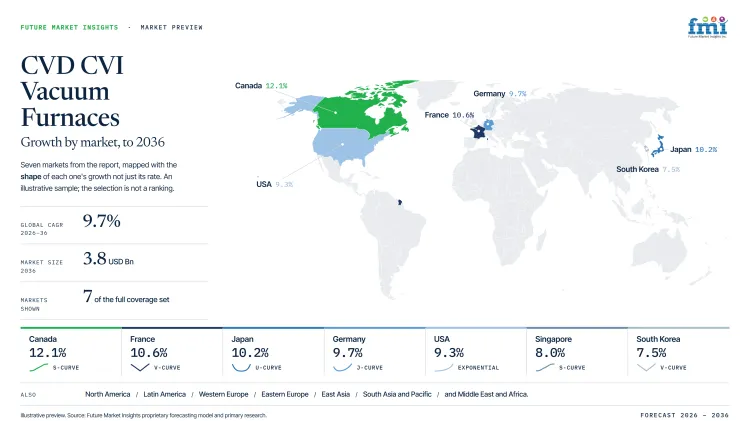
| Country | CAGR |
|---|---|
| Canada | 12.1% |
| France | 10.6% |
| Japan | 10.2% |
| Germany | 9.7% |
| USA | 9.3% |
| Singapore | 8.0% |
| South Korea | 7.5% |
How do country-level CAGRs compare in the CVD CVI Vacuum Furnaces Market?
The country forecasts show a differentiated growth pattern across the CVD CVI vacuum furnaces market, with a noticeable transition from high-growth aerospace and advanced materials hubs to more established industrial markets. Canada forms a distinct upper position and is separated from France by a 1.5 percentage point gap, the widest interval in the comparison. France, Japan, Germany and the USA create a tightly grouped middle band with just 1.3 percentage points separating the four markets, indicating broadly similar momentum. A further step-down is visible between the USA and Singapore, while Singapore and South Korea remain closely aligned. This pattern reflects differences in composite materials production, aerospace investment and the deployment of CVD/CVI technologies for high-performance carbon-carbon and ceramic matrix composite applications. Countries with stronger activity in advanced manufacturing and next-generation aerospace programs generally demonstrate higher growth expectations.
- Canada benefits from increasing investment in aerospace materials, defense applications and advanced composite manufacturing that require precise thermal processing capabilities offered by CVD and CVI vacuum furnaces.
- France remains supported by its established aerospace supply chain, where demand for ceramic matrix composites and high-temperature materials continues to encourage furnace adoption.
- Japan reflects steady activity in advanced materials engineering and precision manufacturing, supporting the use of specialized furnace technologies across industrial applications.
- Germany's outlook is influenced by strong industrial manufacturing capabilities and continued development of high-performance materials for automotive, aerospace and energy applications.
- The USA benefits from ongoing investment in aerospace, defense and advanced composites production, where CVD and CVI processes play an important role in material performance enhancement.
- Singapore supports market growth through its focus on high-value manufacturing and advanced engineering activities that increasingly require sophisticated thermal processing infrastructure.
- South Korea maintains steady momentum as investment in advanced materials, semiconductor-related technologies and industrial modernization supports demand for vacuum furnace systems.
Similar CAGRs do not necessarily translate into identical market opportunities. Differences in aerospace production volumes, advanced materials research programs, capital investment cycles and end-use industry requirements can significantly influence purchasing decisions and equipment deployment timelines. As a result, suppliers may encounter distinct competitive and commercialization conditions despite broadly comparable growth trends. The full report provides country-level CAGR analysis across North America, Latin America, Europe, East Asia, South Asia, Oceania and the Middle East and Africa.
Country-wise Analysis
- Canadian furnace projects enter an aerospace coating base that combines specialized materials engineering with established component manufacturers. Canada’s CVD CVI vacuum furnaces outlook is anticipated to advance at 12.1% CAGR over the assessment period, supported by expanding aerospace coating capacity. Innovation, Science and Economic Development Canada reported in March 2025 that a proposed MDS Coating Technologies project would double the company’s facility capacity. The expansion strengthens local coating-process capability without proving a CVD or CVI furnace purchase across the proposed facility. Aerospace coating knowledge provides a direct adoption enabler for specialized process equipment within established Canadian engineering clusters. Long service distances create material friction by raising field response and specialist travel costs during extended acceptance campaigns.
- French furnace projects enter an established carbon-brake production cluster with dedicated chemical vapor infiltration equipment and formal aerospace quality systems. By 2036 the French CVD CVI vacuum furnaces market is projected to grow at 10.6% CAGR, reinforced by local carbon-component manufacturing. CVI exhaust streams require controlled recovery and utility planning across the installation, expanding the project scope beyond furnace hardware. Safran stated in February 2026 that its new carbon-factory project had developed a gas-recovery prototype for CVI furnace effluents. The project directly confirms CVI hardware and effluent-control work inside a French carbon-component production program. Furnace companies need service plans that address energy exposure and long qualification schedules across hot-zone maintenance and gas-treatment systems.
- Japanese projects operate within an aerospace research base that emphasizes precise process control and dependable local support. NEDO updated its aircraft composite program in April 2025 with work on 1,400°C ceramic-matrix-composite components and higher-rate manufacturing methods. The Japanese CVD CVI vacuum furnaces sector is projected to record 10.2% CAGR during the assessment period, underpinned by higher-rate composite research. The program creates a technical route for new process equipment without proving commercial furnace orders. Domestic engineering depth supports recipe transfer and specialist training across demanding composite programs with formal acceptance requirements. Conservative approval cycles remain the main friction, so laboratory performance must repeat on representative hardware before production use.
- German furnace installations face demanding component qualification and close scrutiny of lifecycle energy use across aerospace production programs. In Germany CVD CVI vacuum furnace demand is predicted to advance at 9.7% CAGR through 2036 owing to advanced composite testing. DLR reported in October 2025 that its ATHEAt flight experiment reached Mach 9.3 and used C/C-SiC thermal protection under surface conditions above 2,000°C. The flight test provides a local enabler through advanced composite design and qualification expertise without proving a furnace purchase. High energy costs and lengthy process validation remain material frictions across repeated industrial production cycles. Equipment proposals need credible efficiency data with defined service responsibility throughout the approved manufacturing route.
- United States projects combine aerospace and nuclear programs with a broad base of custom furnace engineering and field service. Adoption of CVD CVI vacuum furnaces in the USA is estimated to expand at 9.3% CAGR through 2036, shaped by domestic composite manufacturing programs. Hybrid densification gives manufacturers a productivity benchmark that challenges long conventional CVI cycles and energy use. General Atomics reported in December 2025 that its route produced dense SiC/SiC composites 70% faster and with 80% less energy than traditional CVI. The result creates a local enabler for controlled composite densification, but it raises competitive pressure on conventional CVI systems. Furnace companies need stronger productivity evidence and defined service ownership for customers to approve additional production capacity.
- Singapore projects benefit from precision-manufacturing infrastructure and regional service links across aerospace and semiconductor operations. The Ministry of Trade and Industry announced four advanced-manufacturing joint laboratories in October 2025, including work on high-value ceramics for aerospace and semiconductor use. Singapore’s CVD CVI vacuum furnaces market is estimated to post 8.0% CAGR over the forecast period, facilitated by process-development links and regional technical support. Joint laboratories create a local enabler for specialist training and process development across shared advanced-manufacturing facilities. The limited number of production-scale composite programs remains a material friction for continuous furnace utilization and repeat capital orders. Research activity must progress into repeated component work before a commercial installation can support recurring capital demand.
- South Korean furnace projects enter aerospace and composite programs through formal testing and certification routes supported by national industry organizations. CVD CVI vacuum furnace sales in South Korea are forecast to expand at 7.5% CAGR by 2036, supported by a defined carbon-product certification route. The Korea Carbon Industry Promotion Agency opened a domestic and international certification-support program in January 2025 for carbon products. The program provides a local route for test documentation and certification without proving a furnace order. Dense manufacturing networks support local service access, but limited exact-market references create friction for new production installations. Equipment companies must connect chamber performance with the certified component route for customers to approve broader production capacity.
Who are the notable companies in the CVD CVI Vacuum Furnaces Market?
CVD Equipment Corporation, AVS, Inc., Advanced Corporation for Materials & Equipments, IHI Bernex AG, PVA MPA Industrie, Centorr Vacuum Industries, Shanghai Haoyue Technology Co., Ltd., and Annealsys are notable companies in this market.
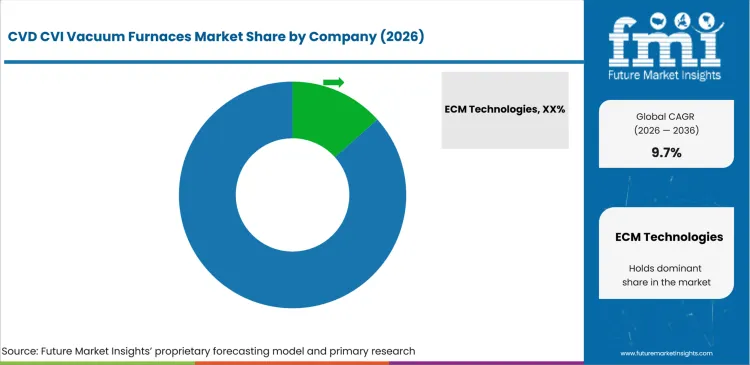
The competitive set combines production-scale CVI specialists with configurable coating-system manufacturers and smaller research-platform providers. CVD Equipment, AVS, and ACME document direct CVD or CVI furnace capability across composite or industrial applications. IHI Bernex and PVA MPA combine reactor engineering with coating-process support across international installations and customer-specific configurations. Centorr and Shanghai Haoyue provide configurable controlled-atmosphere platforms for narrower production or research requirements across several chamber designs. Annealsys addresses rapid thermal and direct-liquid-injection CVD applications through the ECM Group service network across several regions. Competitive position depends on exact process coverage with commissioning support and service routes that remain credible during lengthy acceptance campaigns.
- CVD Equipment Corporation, AVS, and ACME address production-scale projects that require customized precursor delivery and acceptance testing. Their positions depend on repeat performance across representative loads rather than broad thermal-equipment catalogues without exact process references. Documented production references and responsive field engineering give customers a stronger basis for approving additional chamber capacity.
- IHI Bernex, PVA MPA, and Centorr Vacuum Industries compete through configurable systems and process engineering across coating or infiltration applications. Service coverage becomes decisive during local commissioning and lengthy maintenance campaigns that require specialist process knowledge and responsive field support. Their project value depends on connecting equipment configuration with the intended material chemistry and accepted component route.
- Shanghai Haoyue Technology and Annealsys serve specialized development or smaller production routes through adaptable reactor designs. Their entry path is strongest for research groups that need controlled process flexibility without dedicated composite-production scale. Local technical assistance can reduce process-transfer risk during early application work and equipment selection across unfamiliar material routes.
Competitive Benchmarking: CVD CVI Vacuum Furnaces Market
| Company | Core Technology Depth | Application Engineering | Service Support | Geographic Reach |
|---|---|---|---|---|
| CVD Equipment Corporation | High | High | Medium | Multi-country |
| AVS, Inc. | High | High | High | Global |
| Advanced Corporation for Materials & Equipments | High | Medium | Medium | Multi-country |
| IHI Bernex AG | High | High | High | Global |
| PVA MPA Industrie | High | High | High | Global |
| Centorr Vacuum Industries | High | High | Medium | North America |
| Shanghai Haoyue Technology Co., Ltd. | Medium | Medium | Medium | Multi-country |
| Annealsys | Medium | High | High | Global |
Key Developments in the CVD CVI Vacuum Furnaces Market
- In July 2025, AVS supplied the chemical vapor infiltration furnace that BWX Technologies installed and tested for an advanced nuclear-fuel production line. The United States Department of Energy said the commissioning completed the line required to manufacture TRISO fuel at the site. The development gives AVS a documented production deployment and shows how furnace acceptance becomes commercial through an authorized component program rather than an isolated demonstration.
- In August 2025, CVD Equipment reported shipment of its first CVD4000 production system for silicon-carbide coating on graphite components. The company connected the platform with industrial applications that require high-temperature deposition under controlled process conditions. The shipment expands documented commercial availability beyond pilot equipment and gives commercial customers a production reference for evaluating chamber scale with throughput and process-transfer support.
- In September 2025, IHI Bernex appointed Rieckermann as agent for Korea and Vietnam to sell Bernex and Hauzer coating equipment. Rieckermann combines production machinery with local services and surface-technology expertise for manufacturers across both appointed national territories. The agreement expands commercial availability and support access for CVD coating systems across both countries. It gives customers a defined local route for specification and service without proving adoption of a particular furnace.
- In March 2025, PVA TePla announced continued expansion of sales and service organizations in North America and Asia under Strategy 2028. The company’s official portfolio includes turnkey CVD and CVI reactors for composite applications across several industrial material routes. The expansion broadens regional support capacity for those systems, although the financial release does not isolate furnace-specific orders. Customers gain a clearer route for commissioning and post-installation service coverage across international projects that require specialized reactor knowledge.
Key Players in the CVD CVI Vacuum Furnaces Market
Production-scale CVD and CVI system companies
- CVD Equipment Corporation
- AVS, Inc.
- Advanced Corporation for Materials & Equipments
Turnkey coating and infiltration engineering companies
- IHI Bernex AG
- PVA MPA Industrie
- Centorr Vacuum Industries
Specialized research and configurable CVD system companies
- Shanghai Haoyue Technology Co., Ltd.
- Annealsys, an ECM Group company
CVD CVI Vacuum Furnaces Market - Report Scope
| Coverage field | Report scope |
|---|---|
| Market breakdown | Product, application, end user, distribution channel, heating technology, and region. |
| Market Definition | Vacuum furnace systems used for chemical vapor deposition or chemical vapor infiltration across carbon, ceramic, semiconductor, and other high-performance components. |
| Regions Covered | North America, Latin America, Western Europe, Eastern Europe, East Asia, South Asia and Pacific, and Middle East and Africa. |
| Countries Covered | Canada, France, Japan, Germany, USA, Singapore, and South Korea. |
| Key Companies Profiled | CVD Equipment Corporation, AVS, Inc., Advanced Corporation for Materials & Equipments, IHI Bernex AG, PVA MPA Industrie, Centorr Vacuum Industries, Shanghai Haoyue Technology Co., Ltd., and Annealsys. |
| Forecast Period | 2026 to 2036. |
| Approach | Hybrid bottom-up and top-down market sizing supported by primary interviews and official desk research. |
CVD CVI Vacuum Furnaces Market - Research Methodology
| Method | Approach |
|---|---|
| Primary Research | FMI analysts gathered input from manufacturers, service providers, technology developers, distributors, end users, procurement teams, and subject-matter experts. Interviews examined purchasing decisions, product or service evaluation, adoption barriers, approval requirements, pricing considerations, and expectations for technical or commercial support. Respondents were also asked what evidence is required before a trial, pilot, or initial order develops into regular purchasing. |
| Desk Research | Desk research covered government statistics, regulatory publications, trade data, industry associations, technical literature, standards, company filings, product information, and official corporate announcements. Sources were reviewed for relevance, publication date, geographic coverage, and consistency with the defined market scope. Claims relating to performance, applications, approvals, capacity, investment, and commercial activity were retained only when supported by credible public evidence. |
| Market Sizing and Forecasting | The market model combined the baseline value with historical performance, segment structure, pricing and volume indicators, adoption levels, company participation, and country-level demand conditions. Forecast assumptions considered economic activity, investment trends, regulatory developments, technology adoption, purchasing cycles, supply availability, and barriers to wider market use. Segment and regional estimates were reconciled before the final market total was calculated. |
| Data Validation | Estimates were checked against multiple independent indicators, including public data, company activity, trade patterns, industry developments, and findings from primary interviews. Validation also tested whether products, services, applications, and company revenues fell within the defined market boundaries. Adjacent categories, unsupported claims, overlapping revenues, and activities without direct market relevance were excluded to reduce double counting and maintain consistency across segments and countries. |
CVD CVI Vacuum Furnaces Market by Segments
CVD CVI Vacuum Furnaces Market Segmented by Product
- Chemical Vapor Deposition Furnaces
- Hot Wall CVD Furnaces
- Cold Wall CVD Furnaces
- Chemical Vapor Infiltration Furnaces
- Isothermal CVI Furnaces
- Thermal Gradient CVI Furnaces
- Hybrid CVD/CVI Furnaces
- Multi Process Furnaces
- Integrated Coating Systems
- High Temperature Vacuum Furnaces
- Graphite Heated Furnaces
- Metal Heated Furnaces
- Custom Vacuum Furnaces
- Batch Vacuum Furnaces
- Continuous Vacuum Furnaces
CVD CVI Vacuum Furnaces Market Segmented by Application
- Aerospace Components
- Carbon Carbon Composites
- Ceramic Matrix Composites
- Semiconductor Manufacturing
- Silicon Wafer Processing
- Thin Film Deposition
- Energy and Power
- Fuel Cell Components
- Nuclear Materials
- Automotive Components
- Brake Discs
- Powertrain Components
- Industrial Manufacturing
- Cutting Tools
- Wear Resistant Coatings
CVD CVI Vacuum Furnaces Market Segmented by End User
- Aerospace and Defense Companies
- Aircraft Manufacturers
- Defense Contractors
- Semiconductor Manufacturers
- Foundries
- Integrated Device Manufacturers
- Research Institutions
- National Laboratories
- University Research Centers
- Industrial Manufacturers
- Advanced Material Producers
- Specialty Component Manufacturers
- Energy Companies
- Nuclear Industry
- Clean Energy Equipment Manufacturers
CVD CVI Vacuum Furnaces Market Segmented by Distribution Channel
- Direct Sales
- OEM Contracts
- Project-Based Procurement
- Authorized Distributors
- Regional Distributors
- Global Distribution Partners
-
Engineering Procurement and Construction Companies
- Turnkey Project Providers
- System Integrators
- Online Sales
- Manufacturer Portals
- Industrial E-Commerce Platforms
- Aftermarket Service Providers
- Maintenance Contracts
- Equipment Refurbishment Services
CVD CVI Vacuum Furnaces Market Segmented by Heating Technology
- Graphite Heating
- High Temperature Graphite Elements
- Graphite Resistance Heating
- Metal Heating
- Molybdenum Heating Elements
- Tungsten Heating Elements
- Induction Heating
- Medium Frequency Induction
- High Frequency Induction
- Resistance Heating
- Ceramic Resistance Heating
- Metal Resistance Heating
- Hybrid Heating Systems
- Combined Graphite and Induction
- Multi Zone Heating Systems
CVD CVI Vacuum Furnaces Market by Region:
- North America
- United States
- Canada
- Latin America
- Brazil
- Mexico
- Argentina
- Chile
- Western Europe
- Germany
- France
- United Kingdom
- Italy
- Spain
- Benelux
- Nordics
- Eastern Europe
- Poland
- Czech Republic
- Romania
- Hungary
- East Asia
- China
- Japan
- South Korea
- South Asia and Pacific
- India
- ASEAN
- Australia and New Zealand
- Middle East and Africa
- GCC Countries
- South Africa
- Türkiye
- Israel
Research Sources and Bibliography
- National Aeronautics and Space Administration. (2025, January 1).
- CVD Equipment Corporation. (2025, May 13)
- IHI Corporation. (2025, October 22).
- National Aeronautics and Space Administration. (2025, March 1).
- GE Aerospace. (2025, March 12).
- CVD Equipment Corporation. (2026, March 30).
- CVD Equipment Corporation. (2025, January)
- CVD Equipment Corporation. (2025, March 19)
- General Atomics. (2025, December 18).
- Advanced Corporation for Materials & Equipments. (2025, September 5).
- Innovation, Science and Economic Development Canada. (2025, March 21).
- Safran Landing Systems. (2026, February 5).
- New Energy and Industrial Technology Development Organization. (2025, April 21).
- German Aerospace Center. (2025, October 7).
- CVD Equipment Corporation. (2025, November 10).
- Ministry of Trade and Industry Singapore. (2025, October 3)
- Korea Carbon Industry Promotion Agency. (2025, January 24).
- PVA TePla AG. (n.d.).Retrieved July 27, 2026.
- AVS, Inc. (n.d.). Retrieved July 27, 2026.
- Centorr Vacuum Industries. (n.d.).Retrieved July 27, 2026.
- Shanghai Haoyue Technology Co., Ltd. (n.d.).Retrieved July 27, 2026.
- Annealsys. (n.d.). Retrieved July 27, 2026.
- IHI Corporation. (n.d.).Retrieved July 27, 2026.
- Advanced Corporation for Materials & Equipments. (n.d.).Retrieved July 27, 2026.
- USA Department of Energy, Office of Nuclear Energy. (2025, July 22).
- PVA TePla AG. (2025, March 19).
This bibliography is provided for reader reference and is not exhaustive. The full report contains the complete reference list and detailed citations
This Report Answers
- How large is the CVD CVI vacuum furnaces market in 2026 and 2036?
- Which operating requirements convert CVD or CVI furnace interest into funded production projects?
- Why do chemical vapor deposition furnaces hold the largest product share in 2026?
- How do aerospace component qualification routes shape furnace specifications and buying cycles?
- Why does direct sales account for the largest distribution channel share in 2026?
- How do country growth rates differ across Canada, France, Japan, Germany, the USA, Singapore, and South Korea?
- Which companies provide production-scale or specialized CVD and CVI vacuum furnace systems?
- What limits return on investment across long infiltration cycles and component-specific qualification?
- How can instrumented furnace platforms improve recipe development and acceptance evidence?
Frequently Asked Questions
How big is the CVD CVI Vacuum Furnaces Market in 2026?
The CVD CVI vacuum furnaces market is valued at USD 1.5 billion in 2026 and is forecast to reach USD 3.8 billion by 2036, reflecting growing demand for controlled coating and infiltration systems across qualified aerospace composite and semiconductor programs that require repeatable gas flow and temperature uniformity.
What is the CAGR of the CVD CVI Vacuum Furnaces Market from 2026 to 2036?
The CVD CVI vacuum furnaces market is projected to grow at a CAGR of 9.7% between 2026 and 2036, supported by qualified aerospace and energy programs that require repeatable coating or densification routes for components operating under severe thermal conditions.
Which application leads the CVD CVI Vacuum Furnaces Market?
Aerospace components account for 39.0% of the CVD CVI vacuum furnaces market by application in 2026, driven by demanding propulsion and thermal-protection programs with formal component qualification routes that link each recipe with representative turbine hardware and defined inspection stages.
Which country is growing fastest in the CVD CVI Vacuum Furnaces Market?
The CVD CVI vacuum furnaces market in Canada is projected to expand at a CAGR of 12.1% through 2036, ahead of France at 10.6%, Japan at 10.2%, Germany at 9.7%, the USA at 9.3%, Singapore at 8.0%, and South Korea at 7.5%, reflecting expanding aerospace coating capacity and increasing investment in advanced composite manufacturing.
Who are the leading companies in the CVD CVI Vacuum Furnaces Market?
Leading companies in the CVD CVI vacuum furnaces market include CVD Equipment Corporation, AVS Inc., Advanced Corporation for Materials and Equipments, IHI Bernex AG, PVA MPA Industries S.A., Centorr Vacuum Industries, Shanghai Haoyue Technology Co. Ltd., and Annealsys, spanning production-scale CVD and CVI systems, turnkey coating and infiltration engineering, and specialized research reactor platforms across global aerospace and industrial programs.
Preview the report firsthand - request a free sample
Get SampleGet the brochure for pricing and purchase details.
Get PDFTable of Content
- Key Takeaways
- Market Size and CAGR
- Top Growth Driver
- Fastest Growing Segment
- Leading Region
- Key Companies
- Emerging Opportunities
- Executive Summary
- Global Market Outlook
- Demand-side Trends
- Supply-side Trends
- Technology Roadmap Analysis
- Analysis and Recommendations
- Analyst Perspective (What is happening? Why now? What should investors know?)
- Key Questions Answered
- How large is the market?
- What is the CAGR?
- What are key trends?
- Which region dominates?
- Who are the leaders?
- Market Overview
- Market Coverage / Taxonomy
- Market Definition / Scope / Limitations
- Research Methodology
- Chapter Orientation
- Analytical Lens and Working Hypotheses
- Market Structure, Signals, and Trend Drivers
- Benchmarking and Cross-market Comparability
- Market Sizing, Forecasting, and Opportunity Mapping
- Research Design and Evidence Framework
- Desk Research Programme (Secondary Evidence)
- Expert Input and Fieldwork (Primary Evidence)
- Tooling, Models, and Reference Databases
- Data Engineering and Model Build
- Quality Assurance and Audit Trail
- Market Background
- Market Dynamics (Drivers, Restraints, Opportunity, Trends)
- Scenario Forecast (Optimistic, Likely, Conservative)
- Impact Analysis
- AI Impact
- Sustainability Impact
- Regulatory Impact
- Technology Impact
- Consumer / Buyer Analysis
- Purchase Drivers
- Adoption Barriers
- Buyer Journey
- Opportunity Map Analysis
- Product Life Cycle Analysis
- Supply Chain Analysis
- Investment Feasibility Matrix
- Value Chain Analysis
- PESTLE and Porter's Analysis
- Regulatory Landscape
- Regional Parent Market Outlook
- Production and Consumption Statistics
- Import and Export Statistics
- Global Market Analysis and Forecast, 2021 to 2036
- Historical Market Size Value (USD Billion) Analysis, 2021 to 2025
- Current and Future Market Size Value (USD Billion) Projections, 2026 to 2036
- Y-o-Y Growth Trend Analysis
- Absolute $ Opportunity Analysis
- Global Market Pricing Analysis, 2021 to 2036
- Global Market Analysis and Forecast, By Product, 2021 to 2036
- Introduction / Key Findings
- Historical Market Size Value (USD Billion) Analysis By Product, 2021 to 2025
- Current and Future Market Size Value (USD Billion) Analysis and Forecast By Product, 2026 to 2036
- Chemical Vapor Deposition Furnaces
- Hot Wall CVD Furnaces
- Cold Wall CVD Furnaces
- Chemical Vapor Infiltration Furnaces
- Isothermal CVI Furnaces
- Thermal Gradient CVI Furnaces
- Hybrid CVD/CVI Furnaces
- Multi Process Furnaces
- Integrated Coating Systems
- High Temperature Vacuum Furnaces
- Graphite Heated Furnaces
- Metal Heated Furnaces
- Custom Vacuum Furnaces
- Batch Vacuum Furnaces
- Continuous Vacuum Furnaces
- Chemical Vapor Deposition Furnaces
- Y-o-Y Growth Trend Analysis By Product, 2021 to 2025
- Absolute $ Opportunity Analysis By Product, 2026 to 2036
- Global Market Analysis and Forecast, By Application, 2021 to 2036
- Introduction / Key Findings
- Historical Market Size Value (USD Billion) Analysis By Application, 2021 to 2025
- Current and Future Market Size Value (USD Billion) Analysis and Forecast By Application, 2026 to 2036
- Aerospace Components
- Carbon Carbon Composites
- Ceramic Matrix Composites
- Semiconductor Manufacturing
- Silicon Wafer Processing
- Thin Film Deposition
- Energy and Power
- Fuel Cell Components
- Nuclear Materials
- Automotive Components
- Brake Discs
- Powertrain Components
- Industrial Manufacturing
- Cutting Tools
- Wear Resistant Coatings
- Aerospace Components
- Y-o-Y Growth Trend Analysis By Application, 2021 to 2025
- Absolute $ Opportunity Analysis By Application, 2026 to 2036
- Global Market Analysis and Forecast, By End User, 2021 to 2036
- Introduction / Key Findings
- Historical Market Size Value (USD Billion) Analysis By End User, 2021 to 2025
- Current and Future Market Size Value (USD Billion) Analysis and Forecast By End User, 2026 to 2036
- Aerospace and Defense Companies
- Aircraft Manufacturers
- Defense Contractors
- Semiconductor Manufacturers
- Foundries
- Integrated Device Manufacturers
- Research Institutions
- National Laboratories
- University Research Centers
- Industrial Manufacturers
- Advanced Material Producers
- Specialty Component Manufacturers
- Energy Companies
- Nuclear Industry
- Clean Energy Equipment Manufacturers
- Aerospace and Defense Companies
- Y-o-Y Growth Trend Analysis By End User, 2021 to 2025
- Absolute $ Opportunity Analysis By End User, 2026 to 2036
- Global Market Analysis and Forecast, By Distribution Channel, 2021 to 2036
- Introduction / Key Findings
- Historical Market Size Value (USD Billion) Analysis By Distribution Channel, 2021 to 2025
- Current and Future Market Size Value (USD Billion) Analysis and Forecast By Distribution Channel, 2026 to 2036
- Direct Sales
- OEM Contracts
- Project-Based Procurement
- Authorized Distributors
- Regional Distributors
- Global Distribution Partners
- Engineering Procurement and Construction Companies
- Turnkey Project Providers
- System Integrators
- Online Sales
- Manufacturer Portals
- Industrial E-Commerce Platforms
- Aftermarket Service Providers
- Maintenance Contracts
- Equipment Refurbishment Services
- Direct Sales
- Y-o-Y Growth Trend Analysis By Distribution Channel, 2021 to 2025
- Absolute $ Opportunity Analysis By Distribution Channel, 2026 to 2036
- Global Market Analysis and Forecast, By Heating Technology, 2021 to 2036
- Introduction / Key Findings
- Historical Market Size Value (USD Billion) Analysis By Heating Technology, 2021 to 2025
- Current and Future Market Size Value (USD Billion) Analysis and Forecast By Heating Technology, 2026 to 2036
- Graphite Heating
- High Temperature Graphite Elements
- Graphite Resistance Heating
- Metal Heating
- Molybdenum Heating Elements
- Tungsten Heating Elements
- Induction Heating
- Medium Frequency Induction
- High Frequency Induction
- Resistance Heating
- Ceramic Resistance Heating
- Metal Resistance Heating
- Hybrid Heating Systems
- Combined Graphite and Induction
- Multi Zone Heating Systems
- Graphite Heating
- Y-o-Y Growth Trend Analysis By Heating Technology, 2021 to 2025
- Absolute $ Opportunity Analysis By Heating Technology, 2026 to 2036
- Global Market Analysis and Forecast, By Region, 2021 to 2036
- Introduction
- Historical Market Size Value (USD Billion) Analysis By Region, 2021 to 2025
- Current Market Size Value (USD Billion) Analysis and Forecast By Region, 2026 to 2036
- North America
- Latin America
- Western Europe
- Eastern Europe
- East Asia
- South Asia and Pacific
- Middle East & Africa
- Market Attractiveness Analysis By Region
- North America Market Analysis and Forecast, By Country, 2021 to 2036
- Historical Market Size Value (USD Billion) Trend Analysis By Market Taxonomy, 2021 to 2025
- Market Size Value (USD Billion) Forecast By Market Taxonomy, 2026 to 2036
- By Country
- USA
- Canada
- By Product
- By Application
- By End User
- By Distribution Channel
- By Heating Technology
- By Country
- Market Attractiveness Analysis
- By Country
- By Product
- By Application
- By End User
- By Distribution Channel
- By Heating Technology
- Key Takeaways
- Latin America Market Analysis and Forecast, By Country
- Historical Market Size Value (USD Billion) Trend Analysis By Market Taxonomy, 2021 to 2025
- Market Size Value (USD Billion) Forecast By Market Taxonomy, 2026 to 2036
- By Country
- Brazil
- Mexico
- Chile
- Rest of Latin America
- By Product
- By Application
- By End User
- By Distribution Channel
- By Heating Technology
- By Country
- Market Attractiveness Analysis
- By Country
- By Product
- By Application
- By End User
- By Distribution Channel
- By Heating Technology
- Key Takeaways
- Western Europe Market Analysis and Forecast, By Country
- Historical Market Size Value (USD Billion) Trend Analysis By Market Taxonomy, 2021 to 2025
- Market Size Value (USD Billion) Forecast By Market Taxonomy, 2026 to 2036
- By Country
- Germany
- UK
- Italy
- Spain
- France
- Nordic
- BENELUX
- Rest of Western Europe
- By Product
- By Application
- By End User
- By Distribution Channel
- By Heating Technology
- By Country
- Market Attractiveness Analysis
- By Country
- By Product
- By Application
- By End User
- By Distribution Channel
- By Heating Technology
- Key Takeaways
- Eastern Europe Market Analysis and Forecast, By Country
- Historical Market Size Value (USD Billion) Trend Analysis By Market Taxonomy, 2021 to 2025
- Market Size Value (USD Billion) Forecast By Market Taxonomy, 2026 to 2036
- By Country
- Russia
- Poland
- Hungary
- Balkan & Baltic
- Rest of Eastern Europe
- By Product
- By Application
- By End User
- By Distribution Channel
- By Heating Technology
- By Country
- Market Attractiveness Analysis
- By Country
- By Product
- By Application
- By End User
- By Distribution Channel
- By Heating Technology
- Key Takeaways
- East Asia Market Analysis and Forecast, By Country
- Historical Market Size Value (USD Billion) Trend Analysis By Market Taxonomy, 2021 to 2025
- Market Size Value (USD Billion) Forecast By Market Taxonomy, 2026 to 2036
- By Country
- China
- Japan
- South Korea
- By Product
- By Application
- By End User
- By Distribution Channel
- By Heating Technology
- By Country
- Market Attractiveness Analysis
- By Country
- By Product
- By Application
- By End User
- By Distribution Channel
- By Heating Technology
- Key Takeaways
- South Asia and Pacific Market Analysis and Forecast, By Country
- Historical Market Size Value (USD Billion) Trend Analysis By Market Taxonomy, 2021 to 2025
- Market Size Value (USD Billion) Forecast By Market Taxonomy, 2026 to 2036
- By Country
- India
- ASEAN
- Australia & New Zealand
- Rest of South Asia and Pacific
- By Product
- By Application
- By End User
- By Distribution Channel
- By Heating Technology
- By Country
- Market Attractiveness Analysis
- By Country
- By Product
- By Application
- By End User
- By Distribution Channel
- By Heating Technology
- Key Takeaways
- Middle East & Africa Market Analysis and Forecast, By Country
- Historical Market Size Value (USD Billion) Trend Analysis By Market Taxonomy, 2021 to 2025
- Market Size Value (USD Billion) Forecast By Market Taxonomy, 2026 to 2036
- By Country
- Kingdom of Saudi Arabia
- Other GCC Countries
- Türkiye
- South Africa
- Other African Union
- Rest of Middle East & Africa
- By Product
- By Application
- By End User
- By Distribution Channel
- By Heating Technology
- By Country
- Market Attractiveness Analysis
- By Country
- By Product
- By Application
- By End User
- By Distribution Channel
- By Heating Technology
- Key Takeaways
- Key Countries Market Analysis
- USA
- Pricing Analysis
- Market Share Analysis, 2025
- By Product
- By Application
- By End User
- By Distribution Channel
- By Heating Technology
- Canada
- Pricing Analysis
- Market Share Analysis, 2025
- By Product
- By Application
- By End User
- By Distribution Channel
- By Heating Technology
- Mexico
- Pricing Analysis
- Market Share Analysis, 2025
- By Product
- By Application
- By End User
- By Distribution Channel
- By Heating Technology
- Brazil
- Pricing Analysis
- Market Share Analysis, 2025
- By Product
- By Application
- By End User
- By Distribution Channel
- By Heating Technology
- Chile
- Pricing Analysis
- Market Share Analysis, 2025
- By Product
- By Application
- By End User
- By Distribution Channel
- By Heating Technology
- Germany
- Pricing Analysis
- Market Share Analysis, 2025
- By Product
- By Application
- By End User
- By Distribution Channel
- By Heating Technology
- UK
- Pricing Analysis
- Market Share Analysis, 2025
- By Product
- By Application
- By End User
- By Distribution Channel
- By Heating Technology
- Italy
- Pricing Analysis
- Market Share Analysis, 2025
- By Product
- By Application
- By End User
- By Distribution Channel
- By Heating Technology
- Spain
- Pricing Analysis
- Market Share Analysis, 2025
- By Product
- By Application
- By End User
- By Distribution Channel
- By Heating Technology
- France
- Pricing Analysis
- Market Share Analysis, 2025
- By Product
- By Application
- By End User
- By Distribution Channel
- By Heating Technology
- India
- Pricing Analysis
- Market Share Analysis, 2025
- By Product
- By Application
- By End User
- By Distribution Channel
- By Heating Technology
- ASEAN
- Pricing Analysis
- Market Share Analysis, 2025
- By Product
- By Application
- By End User
- By Distribution Channel
- By Heating Technology
- Australia & New Zealand
- Pricing Analysis
- Market Share Analysis, 2025
- By Product
- By Application
- By End User
- By Distribution Channel
- By Heating Technology
- China
- Pricing Analysis
- Market Share Analysis, 2025
- By Product
- By Application
- By End User
- By Distribution Channel
- By Heating Technology
- Japan
- Pricing Analysis
- Market Share Analysis, 2025
- By Product
- By Application
- By End User
- By Distribution Channel
- By Heating Technology
- South Korea
- Pricing Analysis
- Market Share Analysis, 2025
- By Product
- By Application
- By End User
- By Distribution Channel
- By Heating Technology
- Russia
- Pricing Analysis
- Market Share Analysis, 2025
- By Product
- By Application
- By End User
- By Distribution Channel
- By Heating Technology
- Poland
- Pricing Analysis
- Market Share Analysis, 2025
- By Product
- By Application
- By End User
- By Distribution Channel
- By Heating Technology
- Hungary
- Pricing Analysis
- Market Share Analysis, 2025
- By Product
- By Application
- By End User
- By Distribution Channel
- By Heating Technology
- Kingdom of Saudi Arabia
- Pricing Analysis
- Market Share Analysis, 2025
- By Product
- By Application
- By End User
- By Distribution Channel
- By Heating Technology
- Türkiye
- Pricing Analysis
- Market Share Analysis, 2025
- By Product
- By Application
- By End User
- By Distribution Channel
- By Heating Technology
- South Africa
- Pricing Analysis
- Market Share Analysis, 2025
- By Product
- By Application
- By End User
- By Distribution Channel
- By Heating Technology
- USA
- Market Structure Analysis
- Competition Dashboard
- Competition Benchmarking
- Market Share Analysis of Top Players
- By Regional
- By Product
- By Application
- By End User
- By Distribution Channel
- By Heating Technology
- Emerging Startups
- Innovation Benchmarking
- Competition Analysis
- Competition Deep Dive
- ECM Technologies
- Overview
- Product Portfolio
- Profitability by Market Segments
- Sales Footprint
- Strategy Overview
- Marketing Strategy
- Product Strategy
- Channel Strategy
- SECO/WARWICK
- ALD Vacuum Technologies
- PVA TePla
- Ipsen
- Centorr Vacuum Industries
- TAV Vacuum Furnaces
- Thermal Technology LLC
- Nabertherm
- VAC AERO International
- ECM Technologies
- Case Studies
- Success Stories
- Recent Developments
- Competition Deep Dive
- Assumptions & Acronyms Used


