

Data Center CPU Market Size and Share Forecast Outlook from 2025
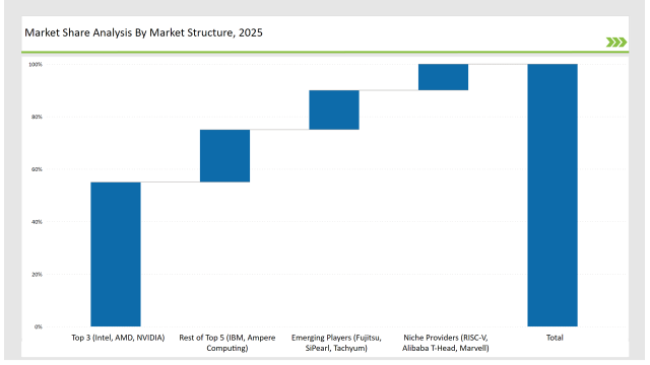
There is a massive evolution happening in the Data Center CPU Market, driven by the growing demand for high-performance computing, AI workloads, and processing the data coming from cloud. For example, the top three vendors in terms of market share, Intel, AMD and NVIDIA collectively dominate its market with a share of 55%, offering first-of-their-kind x86, ARM and GPU-based processors. IBM and Ampere Computing round out the top five, capturing 20% as they focus on enterprise-scale performance, custom cloud workloads and ARM-based power efficiency.
Innovations in HPC (high-performance computing), exascale computing, and cloud-native architectures are being driven by the 15% of the market currently held by emerging players such as Fujitsu, SiPearl, and Tachyum. On the other hand, niche vendors (RISC-V ecosystem players, Alibaba's T-Head, and Marvell) occupy another 10% of the market with their optimized CPUs designed for hyperscale cloud providers and edge computing.
Global Market Share Distribution by Leading Data Center CPU Suppliers (2025)
| Category | Industry Share (%) |
|---|---|
| Top 3 (Intel, AMD, NVIDIA) | 55% |
| Rest of Top 5 (IBM, Ampere Computing) | 20% |
| Emerging Players (Fujitsu, SiPearl, Tachyum) | 15% |
| Niche Providers (RISC-V, Alibaba T-Head, Marvell) | 10% |
Market Concentration Outlook by Architecture Type, Workload Efficiency, and Node Compatibility
The Data Center CPU market is highly consolidated, with a significant presence of top players while allowing room for disruptive newcomers and specialized architectures. Leading companies hold around 60%-70% market share.
Data Center CPU Market by Core Count, Fabric Integration, Cloud Tier, Deployment Model, and Region
By Component
- x86 Processors (65%): Intel and AMD lead in this segment, providing CPUs optimized for traditional enterprise and cloud workloads.
- ARM Processors (25%): Ampere, NVIDIA, and Fujitsu drive ARM-based solutions, offering energy-efficient alternatives for cloud hyperscalers.
- Power Processors (10%): IBM's Power CPUs are primarily used in enterprise, HPC, and financial sectors for mission-critical applications.
By Number of CPU Cores
- 8-Core & 16-Core (35%): The most common configurations in mainstream enterprise and cloud environments.
- 32-Core & 64-Core (30%): Increasing demand for AI, ML, and HPC workloads boosts adoption.
- 128-Core & Others (256-Core, 512-Core) (20%): Focused on exascale computing and next-gen AI/ML inference workloads.
Key Players Who Shaped the Year Through Chip Innovation and Server Integration (2024)
- Intel: launched its 5th-gen Xeon processors with enhanced AI acceleration and power efficiency.
- AMD: introduced next-gen EPYC chips with 3D V-Cache technology for superior workload performance.
- NVIDIA: expanded its Grace CPU Superchip adoption, targeting AI-driven data centers.
- IBM: enhanced its Power10 processors with quantum-inspired acceleration for enterprise applications.
- Ampere Computing: strengthened ARM’s presence in cloud computing with high-core-count, power-efficient CPUs.
Key Highlights from the Forecast on AI Acceleration, Modular CPUs, and Thermal Efficiency
AI-Powered Data Center Optimization
AI-driven CPU scheduling and workload balancing are enhancing data center efficiency. Intel, NVIDIA, and AMD are integrating AI-specific accelerators within their CPU architectures to optimize inference and deep learning applications.
Chiplet-Based CPU Architectures
Leading CPU manufacturers are transitioning to chiplet-based designs, improving modular scalability. AMD’s EPYC Genoa and Intel’s Sapphire Rapids leverage this innovation for better performance-per-watt ratios.
ARM’s Expanding Market Share
Major cloud providers (AWS Graviton, Google Cloud, Microsoft Azure) continue adopting ARM-based CPUs due to cost efficiency and energy savings, challenging x86 dominance.
Rise of RISC-V for Custom Compute
RISC-V is gaining traction in hyperscaler-driven and open-source computing, with Alibaba and Western Digital leading development efforts.
Quantum & Neuromorphic Computing Implications
While not a mainstream solution yet, early investments in quantum-inspired and neuromorphic computing architectures are shaping the future landscape.
Integration with Cloud and Edge Computing
Data Center CPUs are increasingly optimized for cloud-native applications and edge computing. AI inference workloads demand lower latency, prompting real-time processing capabilities directly at the edge.
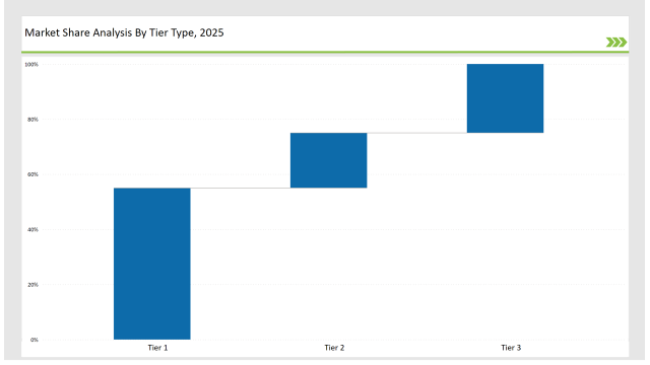
Tier-Wise Classification of CPU Manufacturers by Node Roadmap, Server Deployment, and OEM Adoption (2025)
| Tier | Tier 1 |
|---|---|
| Vendors | Intel, AMD, NVIDIA |
| Consolidated Market Share (%) | 55% |
| Tier | Tier 2 |
|---|---|
| Vendors | IBM, Ampere Computing, Fujitsu |
| Consolidated Market Share (%) | 20% |
| Tier | Tier 3 |
|---|---|
| Vendors | SiPearl, Tachyum, RISC-V players, Marvell |
| Consolidated Market Share (%) | 25% |
Key Company Initiatives in Multi-Die Packaging, Liquid Cooling Support, and Custom Instruction Sets
| Vendor | Key Focus |
|---|---|
| Intel | AI acceleration, power-efficient Xeon processors |
| AMD | 3D V-Cache for HPC, AI workload optimization |
| NVIDIA | Grace CPU Superchip for AI & cloud hyperscalers |
| IBM | Power10 processors for enterprise and quantum computing |
| Ampere Computing | ARM-based cloud processors with high core counts |
| SiPearl | Custom HPC processors for European supercomputing |
| Tachyum | Universal Processing Units (UPU) for AI/HPC |
Strategic Recommendations for Vendors Targeting Hyperscalers, Edge Data Centers, and Hybrid Infrastructure
- Advance AI-Specific CPU Features: Invest in neural acceleration and AI workload optimization.
- Expand ARM & RISC-V Capabilities: Strengthen adoption in hyperscale cloud and open computing environments.
- Optimize for Edge & 5G Data Centers: Leverage AI-driven optimizations for edge and telco applications.
- Enhance Energy Efficiency: Develop processors with better performance-per-watt to align with sustainability goals.
- Strengthen Security & Confidential Computing: Introduce hardware-based encryption and data integrity protection.
- Leverage Chiplet-Based Architectures: Improve scalability and modular performance enhancements.
Future Roadmap for Data Center CPUs with Emphasis on Green Computing, Scalability, and Vertical Integration
The next evolution in Data Center CPUs will focus on
- Hybrid Computing Models: Integrating CPUs, GPUs, and DPUs (Data Processing Units) for optimized workloads.
- Exascale & Quantum Integration: Leveraging quantum-inspired accelerators for high-performance applications.
- Security-Driven Computing: Implementing confidential computing models with end-to-end encryption.
- Regulatory Compliance & Sustainability: Driving power-efficient architectures to meet global energy regulations.
Top Segments Studied in the Data Center CPU Market: Core Architecture, TDP Rating, Deployment Tier, End Use, and Region
By Component:
- x86 Processors
- ARM Processors
- Power Processors
By Number of CPU Cores:
- 8-Core & 16-Core
- 32-Core & 64-Core
- 128-Core & Others
Frequently Asked Questions
Which companies hold the largest market share in the Data Center CPU industry?
Intel, AMD, and NVIDIA collectively hold 55% of the market.
What is the projected market concentration for 2025?
The market is categorized as medium concentration, with the top 10 players controlling 60-70%.
How is AI shaping the future of data center CPUs?
AI workloads drive demand for CPU-GPU hybrid processing, AI acceleration features, and optimized power efficiency.
Preview the report firsthand - request a free sample
Get SampleGet the brochure for pricing and purchase details.
Get PDFTable of Content
- Executive Summary
- Market Overview
- Competitive Landscape
- Market Concentration
- Market Share Analysis
- Segment Analysis
- Who Shaped the Year
- Key Highlights from the Forecast
- Tier-Wise Company Classification
- Key Company Initiatives
- Recommendations for Vendors
- Future Roadmap


