

- Market Size (2026)
- USD 198.6 Bn
- Forecast (2036)
- USD 474.5 Bn
- CAGR (2026 to 2036)
- 9.1%
How big is Data Processing Hosting Services Market size?
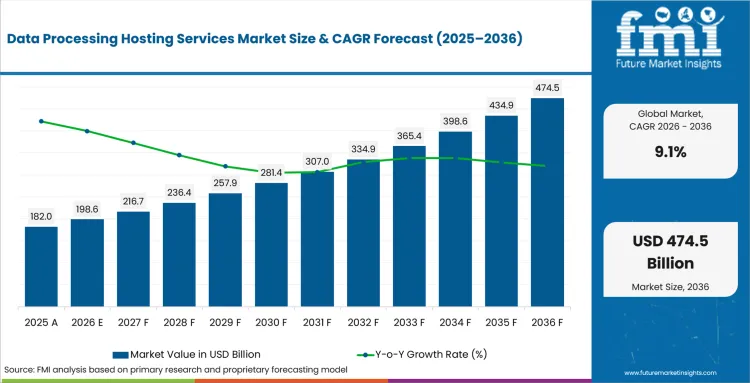
USD 198.6 billion in 2026 and USD 474.5 billion by 2036 at a 9.1% CAGR.
Demand for data processing hosting services is projected to expand at 9.1% CAGR between 2026 and 2036, increasing valuation from USD 198.6 billion in 2026 to USD 474.5 billion by 2036. Businesses deploy cloud computing resources to position processing power depending on the workloads. Amazon Web Services announced 114 availability zones spanning 36 regions during March 2025, significantly improving location transparency for regulated data-residency reviews. Clear geographical visibility accelerates infrastructure screening across multi-country deployments and streamlines migration planning for IT teams.
Sourcing priorities naturally differ across international markets based on local compliance and operational demands. Technology buyers in the United States and Germany scrutinize workload governance and audit-ready service controls. IT operators in Australia and Singapore focus their evaluations on local processing capacity and cross-border service continuity. Eurostat published data in February 2026 shows 52.7% of European Union businesses actively used paid cloud services throughout 2025. Widespread workplace familiarity with virtual infrastructure encourages organizations to expand their hosting adoption even further. This leads corporate decision-makers to award commercial approval on providers promising measurable uptime and strict workload cost controls.
Key Takeaways for the Data Processing Hosting Services Market
- Demand for data processing hosting services is driven by AI workload expansion and managed resilience requirements across distributed operations.
- Large enterprises are estimated to garner 46.0% share of end user in 2026, backed by extensive application estates and formal security review across business units.
- Direct sales are set to lead distribution channel with 44.0% share in 2026, aided by negotiated service commitments and direct accountability across complex enterprise workloads.
- Provider concentration and uncontrolled consumption represent primary barriers limiting predictable hosting economics.
- Competition focuses on Amazon Web Services (AWS), Microsoft Azure, Google Cloud, IBM, Oracle Corporation, Alibaba Cloud, Digital Realty, Equinix, NTT DATA, and Rackspace Technology, with providers differentiated depending on infrastructure control and operational support.
Analyst Perspective
“Data processing hosting services influence dependable workload placement and disciplined resource use. Enterprise buyers examine service ownership and contract portability during platform review. Stronger adoption follows providers connecting infrastructure scale with accepted availability and controlled workload economics.”
- Sudip Saha, Principal Analyst for Technology at Future Market Insights
How is Data Processing Hosting Services Market segmented?
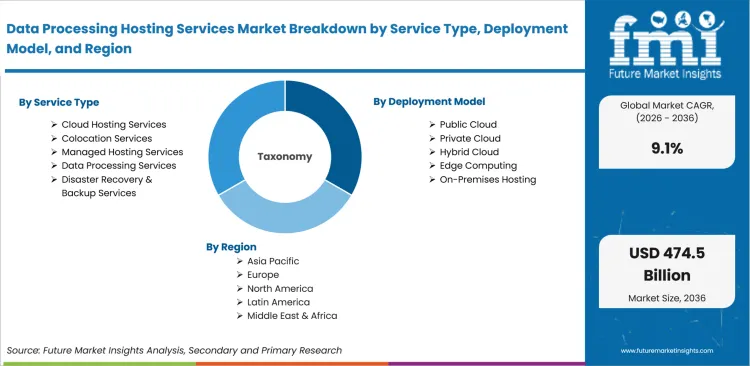
The data processing hosting services industry is segmented by service type, deployment model, end user, distribution channel, infrastructure type, and region.
The data processing hosting services market is segmented by service type, deployment model, end user, distribution channel, infrastructure type, and region. Service type spans cloud hosting, data center colocation, managed hosting, data processing, disaster recovery, and backup. Deployment model covers public cloud, private cloud, hybrid cloud, edge computing, and on-premises hosting. End-user coverage includes large enterprises, small and medium enterprises, BFSI, government organizations, and healthcare organizations. Distribution coverage spans direct sales, channel partners, cloud marketplaces, managed service providers, and online sales. Infrastructure coverage includes hyperscale data centers, enterprise data centers, colocation facilities, edge data centers, and modular data centers. Regional assessment covers North America, Europe, East Asia, South Asia and Pacific, Latin America, and Middle East and Africa.
What supports cloud hosting services across service type demand?
Cloud hosting services combine elastic compute and managed platform access under shared operating controls. UK Department for Science, Innovation and Technology reported 19% public-cloud use and 13% private-cloud use among businesses during 2024 in its June 2024 release. Mixed usage supports hosting offers spanning shared capacity and controlled private environments. Service selection rests on application availability and continuing cost visibility.
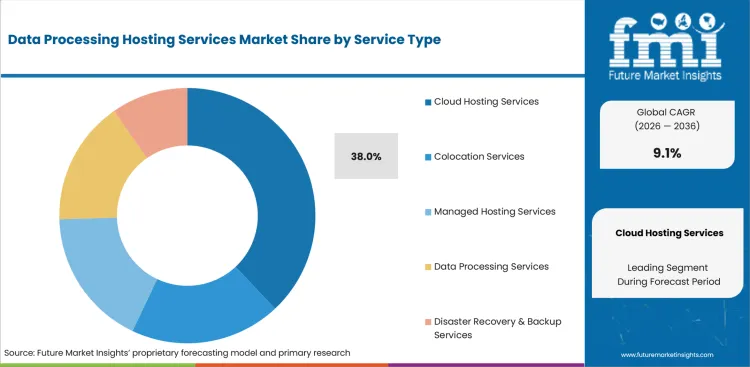
- Based on service type, cloud hosting services is likely to secure 38.0% share in 2026 due to elastic capacity and quicker workload placement across changing application requirements. Enterprise reviews examine recovery commitments and service portability across critical production environments.
- Data processing services and disaster recovery & backup services serve workloads requiring physical control or dedicated recovery support. Buyer decisions compare internal operating effort against provider accountability across security and incident response tasks.
Why does public cloud lead deployment model demand?
Public cloud supports pooled infrastructure access and usage-based resource allocation across enterprise applications. Eurostat reported 85% of large European Union businesses buying cloud services during 2025 in its April 2026 publication, compared with smaller enterprise participation. Extensive use among larger organizations creates recurring demand for hosted compute and platform services. Supplier assessment concentrates on transfer controls and predictable consumption.
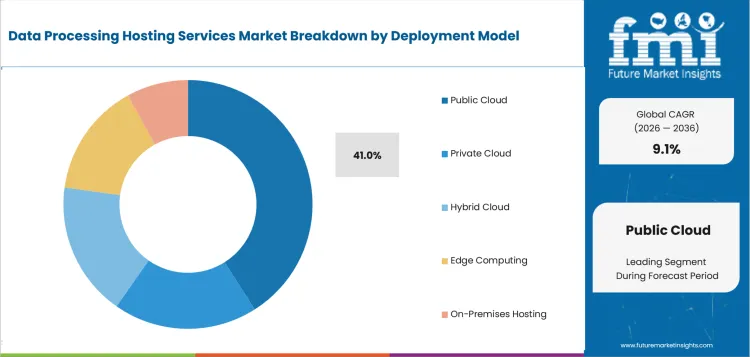
- Public cloud is anticipated to account for 41.0% share of deployment model in 2026, driven by prompt capacity access and standardized service delivery across regional operations. Workload owners test data-residency settings and cost controls during enterprise approval.
- Private Cloud and On-Premises Hosting retain demand for sensitive applications and latency-constrained processing. Architecture choices reflect integration effort and local infrastructure economics across each workload group.
What supports large enterprises across end user demand?
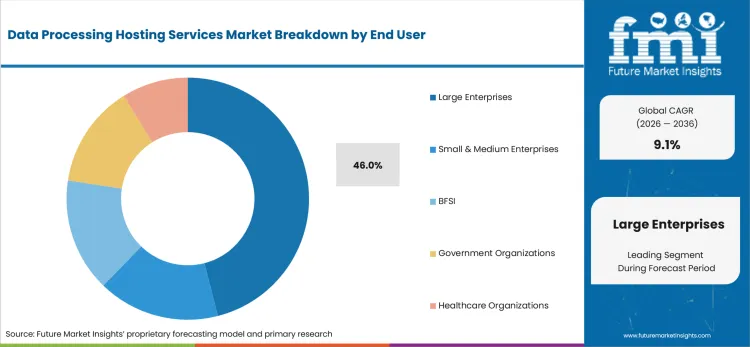
- By end user, large enterprises are set to hold 46.0% share in 2026 as it reflects complex workload portfolios and formal availability requirements across distributed operations. Direct governance supports common security controls and coordinated migration across business functions.
- Small & medium enterprises and healthcare organizations create distinct demand through outsourced operations and limited internal infrastructure capacity. Provider selection varies through workload sensitivity and service-support depth across each buyer group.
How does direct sales shape distribution channel demand?
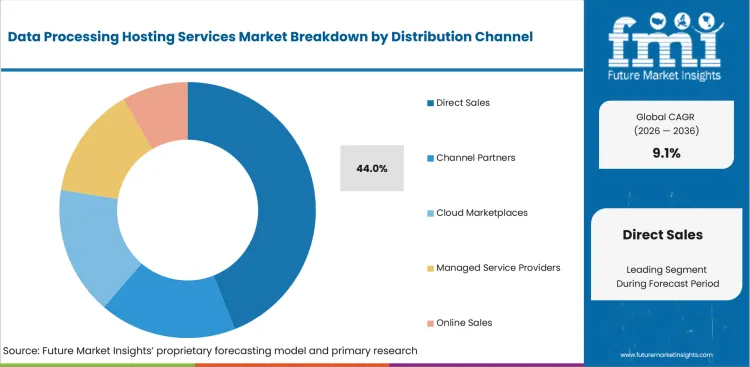
Direct Sales supports negotiated architecture and transition commitments across enterprise hosting programs. Competition and markets authority reported a large majority of cloud services sold directly through online portals or bilateral negotiations in July 2025. Direct relationships place contract ownership and performance escalation with the platform provider. Complex buyers use negotiated terms to align service scope with compliance and continuity duties.
- In 2026, direct sales are projected to capture 44.0% share since being influenced by direct technical review and negotiated operating commitments across high-value accounts. Account teams coordinate migration plans and escalation responsibilities with enterprise decision makers.
- Managed service providers and online sales extend access for smaller teams or specialized service needs. Indirect routes gain importance for migrations requiring assistance and ongoing skills beyond standard platform access.
What keeps hyperscale data centers ahead within infrastructure type?
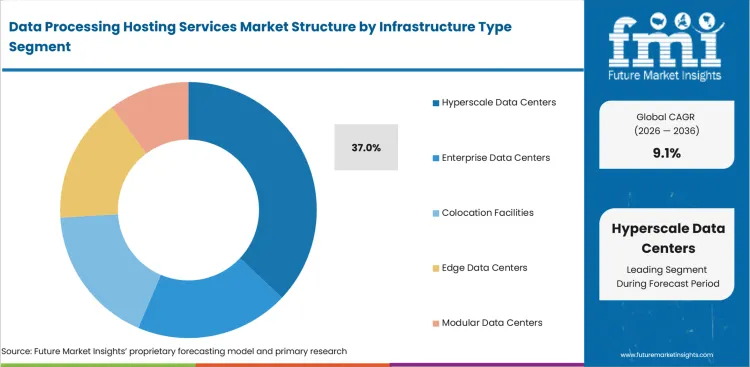
Hyperscale data centers concentrate compute and power systems for large-scale cloud and AI workloads. International Energy Agency reported an AI-focused hyperscale facility reaching 100 MW or more and consuming electricity comparable with 100,000 households in its April 2025 report. Power density places grid access and cooling design inside commercial capacity planning. Edge data centers and smaller facilities complement hyperscale sites for latency-sensitive services and regional processing.
- Hyperscale data centers are forecast to secure 37.0% share in 2026, guided by concentrated capacity and standardized operations across global cloud platforms. Buyers review regional redundancy and energy availability prior to moving critical workloads.
- Enterprise Data Centers and Modular Data Center facilities address proximity and staged-capacity requirements across varied workloads. Infrastructure selection connects workload density with network latency and local facility constraints.
What are drivers, restraints, and opportunities in Data Processing Hosting Services Market?
Enterprise migration and AI processing support hosting demand. Provider concentration and infrastructure bottlenecks delay conversion.
- Driver: Enterprise application migration and AI processing increase demand for elastic hosting capacity across production workloads. Service providers gain recurring business through dependable compute access and managed recovery across distributed application estates.
- Restraint: Provider concentration and switching expense delay approval for critical workloads with complex integration duties. Power limitations and uncertain consumption weaken budget confidence during capacity planning and contract renewal.
- Opportunity: Hybrid architecture and sovereign controls support regulated workloads requiring local processing and documented operating responsibility. Providers pairing cost engineering with accountable support gain access to latency-sensitive programs under strict service conditions.
Enterprise application migration expands hosted processing and storage requirements across production environments. International Energy Agency reported a 17% increase in data-center electricity demand during 2025 in its April 2026 release, reflecting significant expansion in hosted computing activity. Rising resource use increases demand for scalable infrastructure and active capacity management. Commercial value follows providers converting resource expansion into dependable application performance.
Provider concentration and operational complexity constrain migration decisions across critical workloads. Uptime Institute reported a fourth consecutive annual decline in outage frequency and severity during May 2025 as cyber incidents continued rising. Facility resilience improvements do not remove software or security exposure across distributed architectures. Buyers require documented recovery procedures and data center security controls prior to wider deployment.
Regulated computing and AI infrastructure create openings for providers combining local capacity with controlled service delivery. European Commission reported 19 AI Factories across 16 member states in October 2025, expanding Europe’s high-performance computing network. Public high-performance infrastructure increases demand for hosting, connectivity, storage, and governance services supporting specialized workloads. Providers linking cloud compliance with measurable operational support gain access to documentation-intensive programs.
How are country CAGRs aligned in Data Processing Hosting Services Market?
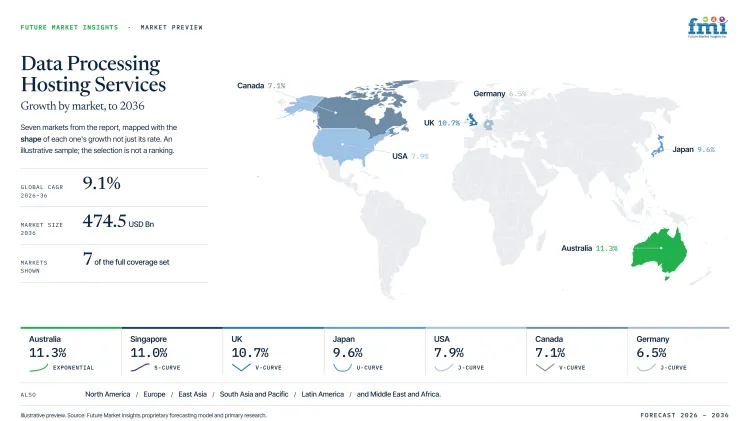
| Country or Market | CAGR |
|---|---|
| Australia | 11.3% |
| Singapore | 11.0% |
| UK | 10.7% |
| Japan | 9.6% |
| USA | 7.9% |
| Canada | 7.1% |
| Germany | 6.5% |
Source: Future Market Insights analysis, 2026.
How do country-level CAGRs compare in Data Processing Hosting Services Market?
Country comparison forms a measured step-down across profiled markets. Australia occupies the upper position, followed by Singapore and United Kingdom. Japan forms the central forecast band across disclosed rates. Canada along with the United States and Germany complete the lower sequence. A 4.8 percentage-point spread separates Australia from Germany. National rates reflect different governance and enterprise migration conditions.
- Australia is anticipated to lead the disclosed comparison due to substantial data-center power demand and expanding cloud infrastructure planning.
- Singapore is likely to follow Australia depending on controlled capacity allocation and regional hosting demand across Asia-Pacific operations.
- The United Kingdom is expected to occupy the next forecast position under growing public-cloud use and documentation-intensive service review.
- Japan is projected to form the middle tier led by government-cloud migration and formal supplier qualification practices.
- USA is estimated to follow Japan as AI capacity additions meet power and grid-connection constraints across major clusters.
- Canada is forecast to form the next band based on data-center load additions and province-specific infrastructure planning.
- Germany is predicted to complete the comparison under established cloud adoption and stringent data-control requirements.
Similar CAGRs are anticipated to produce different entry conditions through contract structures and local service obligations. Full report coverage includes North America, Europe, East Asia, South Asia and Pacific, Latin America, and Middle East and Africa.
Country-wise Analysis
- Sales in Australia are set to rise at 11.3% CAGR during the study period, guided by AI processing demand and utility planning for concentrated data-center loads. Australian Energy Market Operator estimated data centers at 2.2% of National Electricity Market grid demand during FY2025 in its August 2025 release, reinforcing power access as a direct hosting constraint. Local deployment plans connect site efficiency with grid availability and long-term capacity commitments. Providers need measurable energy and redundancy plans during enterprise review.
- Infocomm Media Development Authority announced at least 200 MW of data-center capacity in December 2025 under a second application round, expanding room for efficient hosting facilities. Sustainability thresholds influence site qualification and operating design across new projects. Service providers gain traction through regional connectivity and dependable cross-border governance. Adoption in Singapore is expected to grow at 11.0% CAGR by 2036, reflecting regional headquarters demand and controlled allocation of new capacity.
- Demand in the United Kingdom is forecast to scale at 10.7% CAGR from 2026 to 2036, led by enterprise cloud use and established service-review practices. Department for Science, Innovation and Technology reported 31% public-cloud use among businesses handling digitized data during 2025 to 2026 in its June 2026 release, indicating a growing addressable base for hosted infrastructure. Contract portability and security documentation influence platform expansion across larger accounts. Buyers examine outage response and data-location controls during renewal.
- Digital Agency reported 258 municipalities joining an early-transition verification group for Government Cloud in March 2025, extending implementation experience across local administrations. Multi-vendor operating procedures and security validation shape supplier selection across public workloads. Sector in Japan at 9.6% CAGR during the assessment period, driven by government-cloud migration and formal operating verification. Local support capacity improves transition confidence for regulated applications.
- Industry in the United States is projected to increase at 7.9% CAGR through 2036, guided by AI infrastructure additions and enterprise application USA Department of Energy reported a 6.7% to 12% data-center share of national electricity use by 2028 in December 2024, placing power availability inside capacity planning. Grid connection and regional redundancy influence site selection across major hosting clusters. Providers need clear energy and workload-cost evidence during large account review.
- Canada Energy Regulator stated a 1.5 GW addition to data-center load by 2030 under its current-measures scenario in March 2026, confirming material infrastructure demand across national energy planning. Regional power conditions influence facility timing and operating economics. Managed support and workload portability aid adoption across geographically separated customers. The market in Canada is anticipated to progress at 7.1% CAGR between 2026 and 2036, shaped by province-level capacity planning and expanding AI infrastructure needs.
- Sector in Germany is estimated to record 6.5% CAGR during the forecast period, backed by established enterprise cloud use and strict data-control expectations. German Federal Statistical Office reported 54% of enterprises purchasing cloud computing services during 2025 in its November 2025 release, supporting a substantial base for hosting and managed infrastructure demand. Buyers emphasize sovereignty settings and documented incident response across critical applications. Local infrastructure and compliance support influence renewal and workload expansion.
Who are notable companies in Data Processing Hosting Services Market?
Amazon Web Services (AWS), Microsoft Azure, Google Cloud, IBM, Oracle Corporation, Alibaba Cloud, Digital Realty, Equinix, NTT DATA, and Rackspace Technology are prominent companies influencing the market.
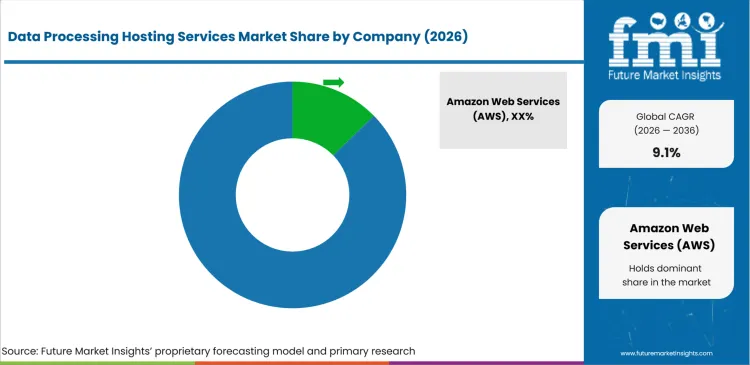
Competition centers on infrastructure reach and service accountability across enterprise programs. Hyperscale providers combine global compute capacity with extensive software and data services. Enterprise platform groups connect hosting with hybrid-cloud and managed operations. Data-center operators provide neutral facilities and network-dense interconnection. Service specialists focus on optimization and continuing workload administration.
- Amazon Web Services (AWS) and Google Cloud compete based on extensive infrastructure footprints and deep platform portfolios. Enterprise teams compare regional availability and workload economics during selection.
- Oracle Corporation and Alibaba Cloud compete depending on enterprise applications and regional cloud capacity. Buyer assessment examines migration complexity and operational responsibility across mixed environments.
- Digital Realty and Equinix compete led by carrier-neutral facilities and colocation capacity across global business centers. Customers assess facility resilience and network access across distributed infrastructure plans.
- NTT DATA and Rackspace Technology compete due to optimization and managed operations across multi-platform estates. Data center outsourcing support appeals to organizations needing specialist accountability without expanding internal infrastructure teams.
Competitive Benchmarking: Data Processing Hosting Services Market
| Company | Hosting Workflow | Infrastructure Control | Governance Capability | Service Reach |
|---|---|---|---|---|
| Amazon Web Services (AWS) | High | High | High | Global |
| Microsoft Azure | High | High | High | Global |
| Google Cloud | High | High | High | Global |
| IBM | High | Medium | High | Global |
| Oracle Corporation | High | High | High | Global |
| Alibaba Cloud | High | High | Medium | International |
| Digital Realty | Medium | High | High | Global |
| Equinix | Medium | High | High | Global |
Source: Future Market Insights competitive analysis, 2026.
Key Developments in Data Processing Hosting Services Market
- In January 2025, Amazon Web Services launched a Local Zone in New York City for low-latency edge workloads. Company information connected local compute and storage access with applications requiring nearby infrastructure and controlled response times.
- In March 2025, Oracle and Microsoft expanded Oracle Database@Azure with Exascale Infrastructure availability. Company information connected integrated database hosting with wider multicloud migration options across Oracle and Azure services.
- In January 2026, Google Cloud launched a cloud region in Bangkok for domestic data residency and low-latency delivery. Company information connected local infrastructure with hosting requirements across regulated Thai organizations and regional applications.
Key Players in Data Processing Hosting Services Market
Hyperscale Cloud Platforms
- Amazon Web Services (AWS)
- Microsoft Azure
- Google Cloud
- Alibaba Cloud
Enterprise and Multicloud Platforms
- IBM
- Oracle Corporation
- NTT DATA
- Rackspace Technology
Data Center Infrastructure Providers
- Digital Realty
- Equinix
Data Processing Hosting Services Market Report Scope
| Coverage field | Report scope |
|---|---|
| Market breakdown | Data processing hosting services market breakdown includes service type, deployment model, end user, distribution channel, infrastructure type, and region. |
| Market Definition | Data processing hosting services include cloud hosting, managed infrastructure, colocation, compute, storage, networking, backup, and processing delivered from enterprise and hyperscale data centers. Hosting Infrastructure Services supporting defined customer workloads are included. Generic software without hosting or infrastructure delivery is excluded. |
| Regions Covered | North America, Europe, East Asia, South Asia and Pacific, Latin America, and Middle East and Africa. |
| Countries Covered | Australia, Singapore, UK, Japan, USA, Canada, Germany, and additional countries covered across full regional analysis. |
| Key Companies Profiled | Amazon Web Services (AWS), Microsoft Azure, Google Cloud, IBM, Oracle Corporation, Alibaba Cloud, Digital Realty, Equinix, NTT DATA, and Rackspace Technology. |
| Forecast Period | 2026 to 2036 |
| Approach | Hybrid bottom-up and top-down methodology uses segment shares and country CAGRs. Company activity, infrastructure capacity, and enterprise adoption support final reconciliation. |
Source: Future Market Insights analysis, 2026.
Data Processing Hosting Services Market - Research Methodology
| Method | Approach |
|---|---|
| Primary Research | FMI analysts gathered input from manufacturers, service providers, technology developers, distributors, end users, procurement teams, and subject-matter experts. Interviews examined purchasing decisions, product or service evaluation, adoption barriers, approval requirements, pricing considerations, and expectations for technical or commercial support. Respondents were also asked what evidence is required before a trial, pilot, or initial order develops into regular purchasing. |
| Desk Research | Desk research covered government statistics, regulatory publications, trade data, industry associations, technical literature, standards, company filings, product information, and official corporate announcements. Sources were reviewed for relevance, publication date, geographic coverage, and consistency with the defined market scope. Claims relating to performance, applications, approvals, capacity, investment, and commercial activity were retained only when supported by credible public evidence. |
| Market Sizing and Forecasting | The market model combined the baseline value with historical performance, segment structure, pricing and volume indicators, adoption levels, company participation, and country-level demand conditions. Forecast assumptions considered economic activity, investment trends, regulatory developments, technology adoption, purchasing cycles, supply availability, and barriers to wider market use. Segment and regional estimates were reconciled before the final market total was calculated. |
| Data Validation | Estimates were checked against multiple independent indicators, including public data, company activity, trade patterns, industry developments, and findings from primary interviews. Validation also tested whether products, services, applications, and company revenues fell within the defined market boundaries. Adjacent categories, unsupported claims, overlapping revenues, and activities without direct market relevance were excluded to reduce double counting and maintain consistency across segments and countries. |
Source: Future Market Insights research methodology, 2026.
Data Processing Hosting Services Market by Segments
Data Processing Hosting Services Market segmented by Service Type:
- Cloud Hosting Services
- Colocation Services
- Managed Hosting Services
- Data Processing Services
- Disaster Recovery & Backup Services
Data Processing Hosting Services Market segmented by Deployment Model:
- Public Cloud
- Private Cloud
- Hybrid Cloud
- Edge Computing
- On-Premises Hosting
Data Processing Hosting Services Market segmented by End User:
- Large Enterprises
- Small & Medium Enterprises
- BFSI
- Government Organizations
- Healthcare Organizations
Data Processing Hosting Services Market segmented by Distribution Channel:
- Direct Sales
- Channel Partners
- Cloud Marketplaces
- Managed Service Providers
- Online Sales
Data Processing Hosting Services Market segmented by Infrastructure Type:
- Hyperscale Data Centers
- Enterprise Data Centers
- Colocation Facilities
- Edge Data Centers
- Modular Data Centers
Data Processing Hosting Services Market segmented by Region:
- North America
- United States
- Canada
- Latin America
- Brazil
- Mexico
- Argentina
- Chile
- Western Europe
- Germany
- France
- United Kingdom
- Italy
- Spain
- Benelux
- Nordics
- Eastern Europe
- Poland
- Czech Republic
- Romania
- Hungary
- East Asia
- China
- Japan
- South Korea
- South Asia and Pacific
- India
- ASEAN
- Australia and New Zealand
- Middle East and Africa
- GCC Countries
- South Africa
- Türkiye
- Israel
Research Sources and Bibliography
- Rao, P. (2025, March 25). Detailed geographic information for all AWS Regions and Availability Zones is now available. Amazon Web Services.
- Eurostat. (2026, February 3). 53% EU enterprises used paid cloud services in 2025.
- Department for Science, Innovation and Technology. (2024, June 27). UK Business Data Survey 2024.
- Eurostat. (2026, April 23). Digitalisation in Europe - 2026 edition.
- Eurostat. (2026, May 20). Larger enterprises used more e-business apps in 2025.
- Competition and Markets Authority. (2025, July 31). Appendix A: Demand for cloud services and how customers purchase cloud services.
- International Energy Agency. (2025, April 10). Understanding the energy-AI nexus.
- International Energy Agency. (2026, April 16). Data centre electricity use surged in 2025, even with tightening bottlenecks driving a scramble for solutions.
- Uptime Institute. (2025, May 6). Uptime Announces Annual Outage Analysis Report 2025.
- European Commission. (2025, October 10). EU expands network of AI Factories, strengthening its AI Continent ambition.
- Australian Energy Market Operator. (2025, August 6). AEMO’s updated forecasting methodology targets rapidly growing electricity loads, following industry consultation.
- Infocomm Media Development Authority. (2025, December 1). Launch of second data centre.
- Department for Science, Innovation and Technology. (2026, June 18). UK Business Data Survey 2026.
- Digital Agency. (2025, March 31). The results of the 2024 Government Cloud Early Transition Organization Verification Project (1st to 3rd) were announced [For local government employees].
- USA Department of Energy. (2024, December 20). DOE Releases New Report Evaluating Increase in Electricity Demand from Data Centers.
- Canada Energy Regulator. (2026, March 17). Canada’s Energy Futures 2026 Fact Sheet: Current Measures Scenario.
- German Federal Statistical Office. (2025, November 24). Enterprises using cloud computing services.
- Amazon Web Services. (2025, January 8). Announcing the general availability of a new AWS Local Zone in New York City.
- Oracle. (2025, March 20). Oracle and Microsoft Add Powerful, Flexible New Services to Oracle Database@Azure and Expand Regional Availability.
- Bajwa, K. (2026, January 22). Sawasdee Thailand! Google Cloud launches new region in Bangkok. Google Cloud.
This bibliography is provided for reader reference and is not exhaustive. The full report contains the complete reference list and detailed citations.
This Report Answers
- How do service type and deployment model influence demand across hosted infrastructure programs?
- What criteria guide enterprises evaluating data processing hosting services prior to migration?
- Why do country CAGRs differ across profiled national markets?
- What companies compete through data-center infrastructure and managed operations?
- How are forecasts validated through bottom-up and top-down analysis using independent indicators?
- What evidence supports workload migration prior to multi-region service expansion?
- Why do power access and contract portability influence provider selection?
- How does uncontrolled consumption limit return across hosted application estates?
- How do recovery records influence approval across infrastructure and security teams?
- What provider capabilities improve long-term confidence and recurring service use?
Frequently Asked Questions
How big is the Data Processing Hosting Services Market in 2026?
The data processing hosting services market is valued at USD 198.6 billion in 2026 and is forecast to reach USD 474.5 billion by 2036, reflecting growing enterprise demand for elastic hosting capacity driven by AI workload expansion and managed resilience requirements across distributed operations.
What is the CAGR of the Data Processing Hosting Services Market from 2026 to 2036?
The data processing hosting services market is projected to grow at a CAGR of 9.1% between 2026 and 2036, supported by enterprise application migration and AI processing requirements that increase demand for scalable hosted infrastructure across production workloads.
Which infrastructure type leads the Data Processing Hosting Services Market?
Hyperscale data centers account for 37.0% of the data processing hosting services market by infrastructure type in 2026, driven by concentrated compute and power systems that support large-scale cloud and AI workloads across global platform operations.
Which country is growing fastest in the Data Processing Hosting Services Market?
The data processing hosting services market in Australia is projected to expand at a CAGR of 11.3% through 2036, ahead of Singapore at 11.0%, the UK at 10.7%, Japan at 9.6%, the USA at 7.9%, Canada at 7.1%, and Germany at 6.5%, reflecting AI processing demand and utility planning for concentrated data center loads.
Who are the leading companies in the Data Processing Hosting Services Market?
Leading companies in the data processing hosting services market include Amazon Web Services, Microsoft Azure, Google Cloud, IBM, Oracle Corporation, Alibaba Cloud, Digital Realty, Equinix, NTT DATA, and Rackspace Technology, spanning hyperscale cloud platforms, enterprise multicloud infrastructure, and carrier-neutral colocation facilities across global operations.
Preview the report firsthand - request a free sample
Get SampleGet the brochure for pricing and purchase details.
Get PDFTable of Content
- Key Takeaways
- Market Size and CAGR
- Top Growth Driver
- Fastest Growing Segment
- Leading Region
- Key Companies
- Emerging Opportunities
- Executive Summary
- Global Market Outlook
- Demand-side Trends
- Supply-side Trends
- Technology Roadmap Analysis
- Analysis and Recommendations
- Analyst Perspective (What is happening? Why now? What should investors know?)
- Key Questions Answered
- How large is the market?
- What is the CAGR?
- What are key trends?
- Which region dominates?
- Who are the leaders?
- Market Overview
- Market Coverage / Taxonomy
- Market Definition / Scope / Limitations
- Research Methodology
- Chapter Orientation
- Analytical Lens and Working Hypotheses
- Market Structure, Signals, and Trend Drivers
- Benchmarking and Cross-market Comparability
- Market Sizing, Forecasting, and Opportunity Mapping
- Research Design and Evidence Framework
- Desk Research Programme (Secondary Evidence)
- Expert Input and Fieldwork (Primary Evidence)
- Tooling, Models, and Reference Databases
- Data Engineering and Model Build
- Quality Assurance and Audit Trail
- Market Background
- Market Dynamics (Drivers, Restraints, Opportunity, Trends)
- Scenario Forecast (Optimistic, Likely, Conservative)
- Impact Analysis
- AI Impact
- Sustainability Impact
- Regulatory Impact
- Technology Impact
- Consumer / Buyer Analysis
- Purchase Drivers
- Adoption Barriers
- Buyer Journey
- Opportunity Map Analysis
- Product Life Cycle Analysis
- Supply Chain Analysis
- Investment Feasibility Matrix
- Value Chain Analysis
- PESTLE and Porter's Analysis
- Regulatory Landscape
- Regional Parent Market Outlook
- Production and Consumption Statistics
- Import and Export Statistics
- Global Market Analysis and Forecast, 2021 to 2036
- Historical Market Size Value (USD Billion) Analysis, 2021 to 2025
- Current and Future Market Size Value (USD Billion) Projections, 2026 to 2036
- Y-o-Y Growth Trend Analysis
- Absolute $ Opportunity Analysis
- Global Market Pricing Analysis, 2021 to 2036
- Global Market Analysis and Forecast, By Service Type, 2021 to 2036
- Introduction / Key Findings
- Historical Market Size Value (USD Billion) Analysis By Service Type, 2021 to 2025
- Current and Future Market Size Value (USD Billion) Analysis and Forecast By Service Type, 2026 to 2036
- Cloud Hosting Services
- Public Cloud Hosting
- Private Cloud Hosting
- Colocation Services
- Retail Colocation
- Wholesale Colocation
- Managed Hosting Services
- Fully Managed Hosting
- Hybrid Managed Hosting
- Data Processing Services
- Batch Processing
- Real-Time Processing
- Disaster Recovery & Backup Services
- Backup as a Service (BaaS)
- Disaster Recovery as a Service (DRaaS)
- Cloud Hosting Services
- Y-o-Y Growth Trend Analysis By Service Type, 2021 to 2025
- Absolute $ Opportunity Analysis By Service Type, 2026 to 2036
- Global Market Analysis and Forecast, By Deployment Model, 2021 to 2036
- Introduction / Key Findings
- Historical Market Size Value (USD Billion) Analysis By Deployment Model, 2021 to 2025
- Current and Future Market Size Value (USD Billion) Analysis and Forecast By Deployment Model, 2026 to 2036
- Public Cloud
- Multi-Tenant Cloud
- Hyperscale Cloud
- Private Cloud
- On-Premises Private Cloud
- Hosted Private Cloud
- Hybrid Cloud
- Cloud Bursting
- Multi-Cloud Deployment
- Edge Computing
- Edge Data Centers
- Micro Data Centers
- On-Premises Hosting
- Dedicated Infrastructure
- Enterprise Data Centers
- Public Cloud
- Y-o-Y Growth Trend Analysis By Deployment Model, 2021 to 2025
- Absolute $ Opportunity Analysis By Deployment Model, 2026 to 2036
- Global Market Analysis and Forecast, By End User, 2021 to 2036
- Introduction / Key Findings
- Historical Market Size Value (USD Billion) Analysis By End User, 2021 to 2025
- Current and Future Market Size Value (USD Billion) Analysis and Forecast By End User, 2026 to 2036
- Large Enterprises
- Multinational Enterprises
- Public Enterprises
- Small & Medium Enterprises
- Small Businesses
- Mid-Sized Businesses
- BFSI
- Banking
- Insurance
- Government Organizations
- Central Government
- Local Government
- Healthcare Organizations
- Hospitals
- Healthcare Networks
- Large Enterprises
- Y-o-Y Growth Trend Analysis By End User, 2021 to 2025
- Absolute $ Opportunity Analysis By End User, 2026 to 2036
- Global Market Analysis and Forecast, By Distribution Channel, 2021 to 2036
- Introduction / Key Findings
- Historical Market Size Value (USD Billion) Analysis By Distribution Channel, 2021 to 2025
- Current and Future Market Size Value (USD Billion) Analysis and Forecast By Distribution Channel, 2026 to 2036
- Direct Sales
- Enterprise Sales
- Key Account Management
- Channel Partners
- Value-Added Resellers
- System Integrators
- Cloud Marketplaces
- Public Cloud Marketplace
- Third-Party Marketplace
- Managed Service Providers
- IT Service Providers
- Cloud Service Brokers
- Online Sales
- Vendor Portals
- Digital Procurement Platforms
- Direct Sales
- Y-o-Y Growth Trend Analysis By Distribution Channel, 2021 to 2025
- Absolute $ Opportunity Analysis By Distribution Channel, 2026 to 2036
- Global Market Analysis and Forecast, By Infrastructure Type, 2021 to 2036
- Introduction / Key Findings
- Historical Market Size Value (USD Billion) Analysis By Infrastructure Type, 2021 to 2025
- Current and Future Market Size Value (USD Billion) Analysis and Forecast By Infrastructure Type, 2026 to 2036
- Hyperscale Data Centers
- Cloud Data Centers
- AI Data Centers
- Enterprise Data Centers
- Private Enterprise Facilities
- Corporate Data Centers
- Colocation Facilities
- Retail Colocation
- Wholesale Colocation
- Edge Data Centers
- Regional Edge Facilities
- Micro Edge Facilities
- Modular Data Centers
- Containerized Data Centers
- Prefabricated Data Centers
- Hyperscale Data Centers
- Y-o-Y Growth Trend Analysis By Infrastructure Type, 2021 to 2025
- Absolute $ Opportunity Analysis By Infrastructure Type, 2026 to 2036
- Global Market Analysis and Forecast, By Region, 2021 to 2036
- Introduction
- Historical Market Size Value (USD Billion) Analysis By Region, 2021 to 2025
- Current Market Size Value (USD Billion) Analysis and Forecast By Region, 2026 to 2036
- North America
- Latin America
- Western Europe
- Eastern Europe
- East Asia
- South Asia and Pacific
- Middle East & Africa
- Market Attractiveness Analysis By Region
- North America Market Analysis and Forecast, By Country, 2021 to 2036
- Historical Market Size Value (USD Billion) Trend Analysis By Market Taxonomy, 2021 to 2025
- Market Size Value (USD Billion) Forecast By Market Taxonomy, 2026 to 2036
- By Country
- USA
- Canada
- By Service Type
- By Deployment Model
- By End User
- By Distribution Channel
- By Infrastructure Type
- By Country
- Market Attractiveness Analysis
- By Country
- By Service Type
- By Deployment Model
- By End User
- By Distribution Channel
- By Infrastructure Type
- Key Takeaways
- Latin America Market Analysis and Forecast, By Country
- Historical Market Size Value (USD Billion) Trend Analysis By Market Taxonomy, 2021 to 2025
- Market Size Value (USD Billion) Forecast By Market Taxonomy, 2026 to 2036
- By Country
- Brazil
- Mexico
- Chile
- Rest of Latin America
- By Service Type
- By Deployment Model
- By End User
- By Distribution Channel
- By Infrastructure Type
- By Country
- Market Attractiveness Analysis
- By Country
- By Service Type
- By Deployment Model
- By End User
- By Distribution Channel
- By Infrastructure Type
- Key Takeaways
- Western Europe Market Analysis and Forecast, By Country
- Historical Market Size Value (USD Billion) Trend Analysis By Market Taxonomy, 2021 to 2025
- Market Size Value (USD Billion) Forecast By Market Taxonomy, 2026 to 2036
- By Country
- Germany
- UK
- Italy
- Spain
- France
- Nordic
- BENELUX
- Rest of Western Europe
- By Service Type
- By Deployment Model
- By End User
- By Distribution Channel
- By Infrastructure Type
- By Country
- Market Attractiveness Analysis
- By Country
- By Service Type
- By Deployment Model
- By End User
- By Distribution Channel
- By Infrastructure Type
- Key Takeaways
- Eastern Europe Market Analysis and Forecast, By Country
- Historical Market Size Value (USD Billion) Trend Analysis By Market Taxonomy, 2021 to 2025
- Market Size Value (USD Billion) Forecast By Market Taxonomy, 2026 to 2036
- By Country
- Russia
- Poland
- Hungary
- Balkan & Baltic
- Rest of Eastern Europe
- By Service Type
- By Deployment Model
- By End User
- By Distribution Channel
- By Infrastructure Type
- By Country
- Market Attractiveness Analysis
- By Country
- By Service Type
- By Deployment Model
- By End User
- By Distribution Channel
- By Infrastructure Type
- Key Takeaways
- East Asia Market Analysis and Forecast, By Country
- Historical Market Size Value (USD Billion) Trend Analysis By Market Taxonomy, 2021 to 2025
- Market Size Value (USD Billion) Forecast By Market Taxonomy, 2026 to 2036
- By Country
- China
- Japan
- South Korea
- By Service Type
- By Deployment Model
- By End User
- By Distribution Channel
- By Infrastructure Type
- By Country
- Market Attractiveness Analysis
- By Country
- By Service Type
- By Deployment Model
- By End User
- By Distribution Channel
- By Infrastructure Type
- Key Takeaways
- South Asia and Pacific Market Analysis and Forecast, By Country
- Historical Market Size Value (USD Billion) Trend Analysis By Market Taxonomy, 2021 to 2025
- Market Size Value (USD Billion) Forecast By Market Taxonomy, 2026 to 2036
- By Country
- India
- ASEAN
- Australia & New Zealand
- Rest of South Asia and Pacific
- By Service Type
- By Deployment Model
- By End User
- By Distribution Channel
- By Infrastructure Type
- By Country
- Market Attractiveness Analysis
- By Country
- By Service Type
- By Deployment Model
- By End User
- By Distribution Channel
- By Infrastructure Type
- Key Takeaways
- Middle East & Africa Market Analysis and Forecast, By Country
- Historical Market Size Value (USD Billion) Trend Analysis By Market Taxonomy, 2021 to 2025
- Market Size Value (USD Billion) Forecast By Market Taxonomy, 2026 to 2036
- By Country
- Kingdom of Saudi Arabia
- Other GCC Countries
- Türkiye
- South Africa
- Other African Union
- Rest of Middle East & Africa
- By Service Type
- By Deployment Model
- By End User
- By Distribution Channel
- By Infrastructure Type
- By Country
- Market Attractiveness Analysis
- By Country
- By Service Type
- By Deployment Model
- By End User
- By Distribution Channel
- By Infrastructure Type
- Key Takeaways
- Key Countries Market Analysis
- USA
- Pricing Analysis
- Market Share Analysis, 2025
- By Service Type
- By Deployment Model
- By End User
- By Distribution Channel
- By Infrastructure Type
- Canada
- Pricing Analysis
- Market Share Analysis, 2025
- By Service Type
- By Deployment Model
- By End User
- By Distribution Channel
- By Infrastructure Type
- Mexico
- Pricing Analysis
- Market Share Analysis, 2025
- By Service Type
- By Deployment Model
- By End User
- By Distribution Channel
- By Infrastructure Type
- Brazil
- Pricing Analysis
- Market Share Analysis, 2025
- By Service Type
- By Deployment Model
- By End User
- By Distribution Channel
- By Infrastructure Type
- Chile
- Pricing Analysis
- Market Share Analysis, 2025
- By Service Type
- By Deployment Model
- By End User
- By Distribution Channel
- By Infrastructure Type
- Germany
- Pricing Analysis
- Market Share Analysis, 2025
- By Service Type
- By Deployment Model
- By End User
- By Distribution Channel
- By Infrastructure Type
- UK
- Pricing Analysis
- Market Share Analysis, 2025
- By Service Type
- By Deployment Model
- By End User
- By Distribution Channel
- By Infrastructure Type
- Italy
- Pricing Analysis
- Market Share Analysis, 2025
- By Service Type
- By Deployment Model
- By End User
- By Distribution Channel
- By Infrastructure Type
- Spain
- Pricing Analysis
- Market Share Analysis, 2025
- By Service Type
- By Deployment Model
- By End User
- By Distribution Channel
- By Infrastructure Type
- France
- Pricing Analysis
- Market Share Analysis, 2025
- By Service Type
- By Deployment Model
- By End User
- By Distribution Channel
- By Infrastructure Type
- India
- Pricing Analysis
- Market Share Analysis, 2025
- By Service Type
- By Deployment Model
- By End User
- By Distribution Channel
- By Infrastructure Type
- ASEAN
- Pricing Analysis
- Market Share Analysis, 2025
- By Service Type
- By Deployment Model
- By End User
- By Distribution Channel
- By Infrastructure Type
- Australia & New Zealand
- Pricing Analysis
- Market Share Analysis, 2025
- By Service Type
- By Deployment Model
- By End User
- By Distribution Channel
- By Infrastructure Type
- China
- Pricing Analysis
- Market Share Analysis, 2025
- By Service Type
- By Deployment Model
- By End User
- By Distribution Channel
- By Infrastructure Type
- Japan
- Pricing Analysis
- Market Share Analysis, 2025
- By Service Type
- By Deployment Model
- By End User
- By Distribution Channel
- By Infrastructure Type
- South Korea
- Pricing Analysis
- Market Share Analysis, 2025
- By Service Type
- By Deployment Model
- By End User
- By Distribution Channel
- By Infrastructure Type
- Russia
- Pricing Analysis
- Market Share Analysis, 2025
- By Service Type
- By Deployment Model
- By End User
- By Distribution Channel
- By Infrastructure Type
- Poland
- Pricing Analysis
- Market Share Analysis, 2025
- By Service Type
- By Deployment Model
- By End User
- By Distribution Channel
- By Infrastructure Type
- Hungary
- Pricing Analysis
- Market Share Analysis, 2025
- By Service Type
- By Deployment Model
- By End User
- By Distribution Channel
- By Infrastructure Type
- Kingdom of Saudi Arabia
- Pricing Analysis
- Market Share Analysis, 2025
- By Service Type
- By Deployment Model
- By End User
- By Distribution Channel
- By Infrastructure Type
- Türkiye
- Pricing Analysis
- Market Share Analysis, 2025
- By Service Type
- By Deployment Model
- By End User
- By Distribution Channel
- By Infrastructure Type
- South Africa
- Pricing Analysis
- Market Share Analysis, 2025
- By Service Type
- By Deployment Model
- By End User
- By Distribution Channel
- By Infrastructure Type
- USA
- Market Structure Analysis
- Competition Dashboard
- Competition Benchmarking
- Market Share Analysis of Top Players
- By Regional
- By Service Type
- By Deployment Model
- By End User
- By Distribution Channel
- By Infrastructure Type
- Emerging Startups
- Innovation Benchmarking
- Competition Analysis
- Competition Deep Dive
- Amazon Web Services (AWS)
- Overview
- Product Portfolio
- Profitability by Market Segments
- Sales Footprint
- Strategy Overview
- Marketing Strategy
- Product Strategy
- Channel Strategy
- Microsoft Azure
- Google Cloud
- IBM
- Oracle Corporation
- Alibaba Cloud
- Digital Realty
- Equinix
- NTT DATA
- Rackspace Technology
- Amazon Web Services (AWS)
- Case Studies
- Success Stories
- Recent Developments
- Competition Deep Dive
- Assumptions & Acronyms Used


