

- Market Size (2026)
- USD 9.8 Bn
- Forecast (2036)
- USD 30.7 Bn
- CAGR (2026 to 2036)
- 12.1%
How big is De-Identified Health Data Market size?
USD 9.8 billion in 2026 and USD 30.7 billion by 2036 at a 12.1% CAGR.
Demand for de-identified health data is projected to expand at 12.1% CAGR between 2026 and 2036, increasing valuation from USD 9.8 billion in 2026 to USD 30.7 billion by 2036. Pharmaceutical researchers license patient-level records to generate regulatory evidence and build analytical models. Veradigm enhanced its database with natural language processing across more than 154 million patient records during October 2024. Repeatable cohort reviews across diverse evidence programs rely on standardized de-identified datasets. Detailed field-level tracking and verified privacy testing directly increase the commercial value of these medical archives. Poor system interoperability complicates data preparation across both pharmacy logs and longitudinal clinical histories.
Healthcare buyers in the United States and Germany demand robust linkage controls alongside secure data processing. High-quality local access registries and policy-aligned secondary usage remain top priorities for research programs across Japan and Brazil. European Health Data Space regulations took effect in March 2025 to establish secure data reuse pathways for healthcare innovation and regulatory monitoring. Structured access permits and secure processing requirements safeguard licensed medical records without compromising patient privacy.
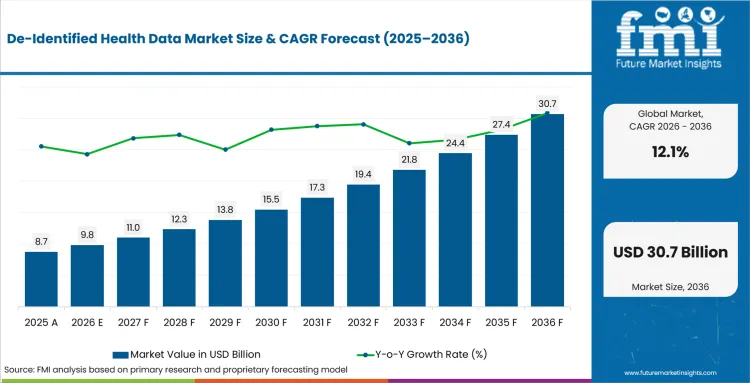
Key Takeaways for the De-Identified Health Data Market
- Demand for de-identified health data receives support from real-world evidence and payer analytics.
- Direct enterprise licensing is likely to garner 38.0% share of distribution channel in 2026, supported by defined usage rights and controlled access.
- Pharmaceutical & biopharmaceutical companies are estimated to lead end user with 36.0% share in 2026, backed by recurring evidence needs across development and post-market work.
- Residual re-identification exposure and limited interoperability restrict approval speed across enterprise programs.
- Competition focuses on IQVIA, Oracle Health, Veradigm, Komodo Health, HealthVerity, Datavant, Optum, and Truveta depending on privacy controls and research support.
Analyst Perspective
“Commercial adoption hinges on providers delivering usable patient-level evidence without weakening privacy safeguards. Buyers examine permitted use and missingness during every approval stage. Sustained adoption follows providers connecting secure access with reproducible evidence across real operating conditions.”
- Anurag Sharma, Principal Consultant at Future Market Insights
How is De-Identified Health Data Market segmented?
The de-identified health data industry is segmented by product type, application, end user, distribution channel, data type, and region.
The de-identified health data sector is segmented by product type, application, end user, distribution channel, data type, and region. Product type includes structured records, clinical data sets, real-world data, imaging, and omics information. Application coverage addresses clinical research, drug development, healthcare analytics, regulatory work, and artificial intelligence. End user coverage includes pharmaceutical companies, providers, research organizations, public agencies, and health technology companies. Distribution channel covers direct licensing, cloud platforms, partnerships, resellers, and API access. Data type covers patient records, claims, laboratory results, imaging, and prescription information. Regional coverage includes North America, Europe, East Asia, South Asia and Pacific, Latin America, and Middle East and Africa.
What supports structured de-identified data across product type demand?
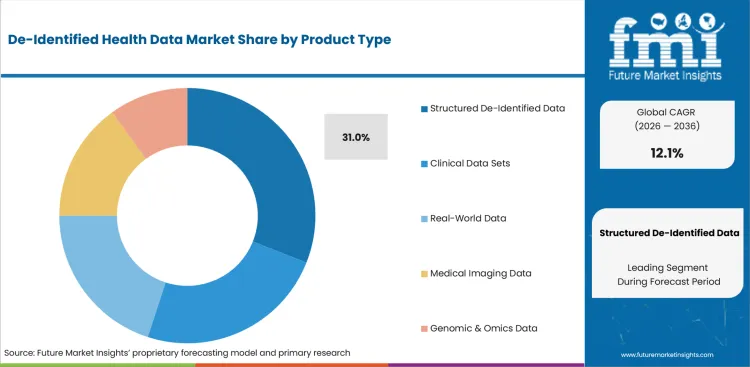
Structured de-identified data organizes repeatable fields across claims and electronic health records. Standardized schemas improve cohort construction and linkage across approved research programs. Truveta reported more than 120 million de-identified patients in November 2024, showing commercial demand for extensive structured longitudinal coverage across regulated research uses. Greater scale supports subgroup analysis only with consistent provenance and privacy review.
- Structured de-identified data is likely to represent 31.0% share of product type in 2026, influenced by repeatable fields supporting cohort creation and statistical review. Buyers examine coding consistency and missingness prior to accepting multi-source records.
- Clinical data sets and real-world data support outcomes research and disease-level studies across varied evidence questions. Medical imaging data and genomic & omics data add richer context under stricter storage and linkage controls.
Why does clinical research lead application demand?
Clinical research uses patient-level records for comparator development and outcomes measurement. Research sponsors seek reproducible cohorts linked across care settings without exposing direct identifiers. NHS England reported 545 supported research projects as of December 2025 in its May 2026 programme evaluation, showing sustained use of secure health-data infrastructure. Data suppliers gain commercial acceptance through traceable methods and study-specific quality assessment.
- In 2026, clinical research is expected to account for 32.0% share through recurring demand across external controls and post-authorization evidence. Study teams assess cohort definitions and endpoint availability during dataset review.
- Drug discovery & development and artificial intelligence & machine learning use linked records for target evaluation and model validation. Regulatory & compliance and healthcare analytics require documented transformation histories across accepted evidence workflows.
What supports pharmaceutical & biopharmaceutical companies across end user demand?
HealthVerity stated Recursion licensed de-identified data covering over 340 million lives in April 2025, supporting trial design and feasibility work within machine-learning workflows. Repeat purchasing follows evidence quality across several development stages. Pharmaceutical & biopharmaceutical companies purchase data across clinical development and commercialization. Enterprise programs require longitudinal records matching therapeutic populations and defined research questions.
- Based on end user, pharmaceutical & biopharmaceutical companies are predicted to garner 36.0% share in 2026 since it reflects recurring requirements across evidence generation and development decisions. Internal governance teams assess privacy methods and scientific suitability.
- Healthcare providers and research organizations contribute clinical context and study expertise across disease programs. Government & public health agencies and health technology companies require secure access supporting population studies and algorithm assessment.
What keeps direct enterprise licensing central to distribution channel selection?
HealthVerity and Medeloop opened research access to over 200 million de-identified patient records in June 2025, connecting licensed datasets with guided analytical workflows. Commercial continuity relies on permission clarity and dependable technical support. Direct enterprise licensing establishes negotiated data rights and renewal terms. Large research programs prefer defined access conditions across several therapeutic and functional teams.
- Direct enterprise licensing is set to account for 38.0% share in 2026, backed by custom access terms and governed multi-year relationships. Buyers compare update cadence, service responsibilities, and permitted analytical uses.
- Cloud-Based Data Platforms and API-Based Data Access shorten research access for approved users. Strategic Partnerships and Data Resellers & Aggregators extend dataset combinations under separate governance and quality controls.
Why do Patient Health Records lead Data Type demand?
Patient Health Records connect diagnoses, treatment, utilization, laboratory findings, and longitudinal clinical context. Linked records support patient journeys extending beyond isolated claims or single encounters. Oracle announced a platform uniting more than 129 million de-identified longitudinal records in January 2026, expanding evidence access across research and clinical workflows. Data value increases with record continuity and transparent lineage.
- By data type, patient health records are estimated to secure 34.0% share in 2026 as it is driven by longitudinal evidence across care settings and therapeutic pathways. Research teams inspect encounter continuity and linkage quality during qualification.
- Claims & billing data and laboratory data support utilization and outcomes analysis. Medical imaging data and pharmacy & prescription data enrich disease progression and treatment adherence under specialized de-identification controls.
What are drivers, restraints, and opportunities in De-Identified Health Data Market?
Research evidence needs support licensed patient-level data. Privacy exposure and incomplete interoperability slow enterprise approval.
- Driver: Clinical evidence programs require patient-level records for treatment comparison and post-market assessment. Licensed datasets reduce preparation work through standardized histories protected by approved privacy controls.
- Restraint: Residual re-identification exposure extends legal review across linked records and secondary-use agreements. Unclear transformation histories increase validation work for privacy teams evaluating access requests.
- Opportunity: Purpose-specific datasets combine transparent transformation methods with reproducible cohort definitions for approved studies. Secure linkage services improve research continuity across clinical records and laboratory results.
Real-world evidence programs convert routinely collected records into study-specific commercial demand. NHS England reported 91 live projects inside its Secure Data Environment in November 2024, demonstrating approved research activity with de-identified information. Secure access supports repeated analysis without distributing identifiable source records. Dataset suppliers benefit through maintained cohorts and controlled research services.
Privacy incidents raise diligence requirements across data processing and research access. United States health authorities settled four ransomware investigations affecting over 427,000 individuals in April 2026, reinforcing scrutiny around safeguards and electronic health information. Buyers respond through privacy reviews and contractual accountability. Longer reviews postpone commercial conversion even with a valid scientific use.
Secure research environments provide an expansion route for purpose-specific datasets and governed analysis. Office for National Statistics reported 868 active approved projects in its Secure Research Service during July 2026, showing sustained demand for controlled data use. Providers offering traceable transformations and checked outputs gain stronger positions across institutional research programs. Real World Evidence Solutions benefit from similar governance expectations.
How are country CAGRs aligned in De-Identified Health Data Market?
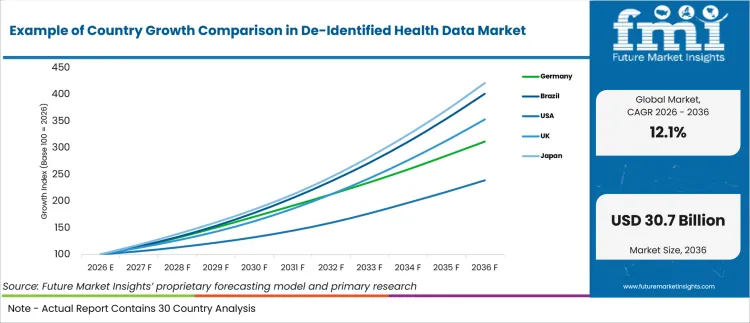
| Country or Market | CAGR |
|---|---|
| Japan | 15.5% |
| Brazil | 14.9% |
| UK | 13.4% |
| South Korea | 12.8% |
| Germany | 12.0% |
| Australia | 11.6% |
| USA | 9.1% |
Source: Future Market Insights analysis, 2026.
How do country-level CAGRs compare in De-Identified Health Data Market?
The country comparison shows a gradual step-down in growth across the markets covered. Japan and Brazil occupy the upper end of the range, followed by the United Kingdom and South Korea as a closely grouped second tier. Germany and Australia form the next growth band. The United States records the lower rate among the markets shown. The 6.4 percentage-point spread shows that all seven markets retain positive expansion prospects, although their relative positions indicate different levels of market momentum.
- Japan and Brazil lead the comparison and establish the upper growth cluster among the markets shown.
- The United Kingdom and South Korea follow closely, indicating a limited difference from the leading group.
- Germany and Australia form the next growth band and maintain a relatively small gap from the middle tier.
- The United States records the slowest growth among the listed markets, although its forecast remains positive within the wider market context.
- The pattern resembles a gradual downward slope instead of a sharp separation between high-growth and low-growth markets.
Markets carrying similar CAGRs are likely to present different entry conditions due to privacy requirements and healthcare information infrastructure. The full report provides country-level analysis across North America, Europe, East Asia, South Asia and Pacific, Latin America, and Middle East and Africa.
Country-wise Analysis
- Sales in Japan are predicted to rise at 15.5% CAGR by 2036 as regulatory programs encourage real-world data use across medical product development. Pharmaceuticals and Medical Devices Agency held 4 symposia from February to March 2026 covering generative artificial intelligence and real-world data. Research access gains value through clear consultation routes and accepted analytical methods. Local success requires disciplined provenance and policy-aligned data handling.
- Pan American Health Organization described 3 strategic initiatives for Brazil’s unified health system in September 2025, linking platform work with decision support and professional guidance. Coordinated information systems create additional sources for outcomes analysis and public-health research. Commercial providers need local partnerships and transparent permissions across institutional programs. Industry in Brazil is projected to scale at 14.9% CAGR during 2026 to 2036, led by public-health integration and secondary-use opportunities.
- Adoption in the United Kingdom is anticipated to expand at 13.4% CAGR during the study period, driven by established research services and linked primary-care records. Medicines and Healthcare products Regulatory Agency reported Clinical Practice Research Datalink records covering over 71 million patients in March 2026. Longitudinal primary-care coverage supports epidemiology and linked outcomes research. Supplier selection emphasizes linkage documentation and research turnaround.
- Ministry of Health and Welfare planned national integrated bio big data participation reaching 190,000 people during 2025 program expansion. Larger consented cohorts strengthen opportunities for longitudinal studies and precision-medicine research. Commercial adoption relies on approved access routes and dependable local institutional support. The market in South Korea is set to grow at 12.8% CAGR from 2026 to 2036, helped by coordinated biomedical programs that expand participant and clinical-data access.
- Demand in Germany is forecast to increase at 12.0% CAGR through 2036, led by planned linkage and secure health-data processing. Federal Ministry of Health targets at least 300 research projects using Health Data Lab information by year-end 2026. Structured access points support linked routine and study-related records across approved research. Providers need interoperability support and clear handling across national and European requirements.
- Australian Digital Health Agency reported more than 5 million weekly pathology and imaging uploads by June 2026. Expanded report availability improves longitudinal evidence across testing and diagnostic pathways. Research use requires permission controls and consistent national data standards. The sector in Australia is expected to scale at 11.6% CAGR during the assessment period, aided by greater clinical-record availability and connected care.
- Industry in the United States is likely to progress at 9.1% CAGR through 2036 due to extensive commercial data assets and rigorous privacy review. National Institutes of Health released data from over 747,000 participants in June 2026 for registered scientific users. Genomic and electronic health record linkage supports precision research across diverse populations. Enterprise buying emphasizes privacy verification and reproducible cohort methods.
Who are notable companies in De-Identified Health Data Market?
IQVIA, Oracle Health, Veradigm, Komodo Health, HealthVerity, Datavant, Optum, and Truveta are notable companies participating in de-identified health data.
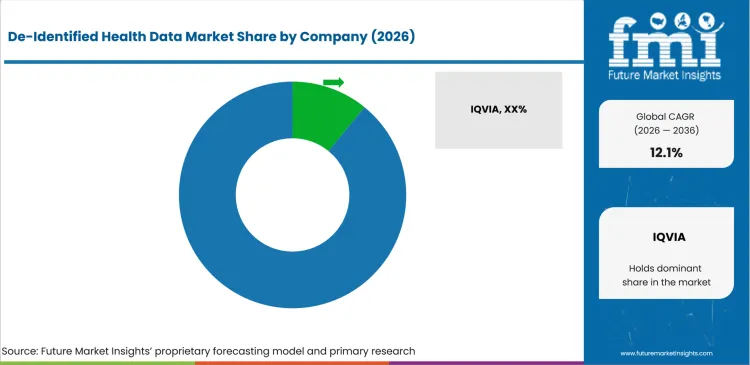
Competition in the industry centers on analytical access and research support. IQVIA and Optum combine established real-world data assets with life-science research services. Oracle Health and Veradigm connect clinical records with analytical platforms and evidence workflows. Komodo Health and HealthVerity emphasize longitudinal patient journeys and research-ready datasets. Datavant specializes in tokenization and data connectivity across participating organizations. Truveta uses health-system records within research environments supporting longitudinal clinical evidence.
- IQVIA and Optum compete based on extensive claims and research services supporting life-science decisions. Buyers assess longitudinal continuity and expert assistance across therapeutic programs.
- Oracle Health and Veradigm compete led by clinical-data integration and analytical workflows. Enterprise review examines implementation support and research governance.
- Komodo Health and Datavant compete due to de-identified patient journeys and secure data connectivity. Customers compare privacy methods and reproducibility.
- Truveta competes depending on health-system sourced longitudinal records and trusted research environments. Study teams evaluate representativeness and access conditions.
Competitive Benchmarking: De-Identified Health Data Market
| Company | Data Breadth | Linkage and Privacy | Research Workflow | Service Reach |
|---|---|---|---|---|
| IQVIA | High | High | High | Global |
| Oracle Health | High | High | High | Global |
| Veradigm | High | Medium | High | International |
| Komodo Health | High | High | High | North America-led |
| HealthVerity | High | High | High | United States-led |
| Datavant | Medium | High | High | International |
| Optum | High | High | High | United States-led |
| Truveta | High | High | High | United States-led |
Source: Future Market Insights competitive analysis, 2026
Key Developments in De-Identified Health Data Market
- In January 2025, Truveta announced a genome project designed to sequence 10 million initial exomes from consented and de-identified volunteers. Linked genomic and clinical information expands research depth for drug discovery and precision evidence programs.
- In May 2025, Datavant expanded its Boehringer Ingelheim partnership across 75 additional clinical trials using privacy-preserving tokenization and secure data discovery. Expanded trial coverage strengthens scalable linkage infrastructure across clinical development and launch planning.
- In June 2025, HealthVerity launched a de-identified clinical narrative dataset built from over 2.5 billion electronic health record notes. Preserved clinical context supports natural-language analysis across development and patient-journey research.
De-Identified Health Data Market Report Scope
| Coverage field | Report scope |
|---|---|
| Market breakdown | De-identified health data market breakdown includes product type, application, end user, distribution channel, data type, and region. |
| Quantitative Units | USD billion in 2026 to USD billion by 2036 at CAGR |
| Market Definition | Licensed or shared health records, claims, laboratory, imaging, pharmacy, and longitudinal patient data processed to reduce direct re-identification exposure. Public aggregate records and identifiable clinical data remain outside defined coverage. |
| Regions Covered | North America, Europe, East Asia, South Asia and Pacific, Latin America, Middle East and Africa. |
| Countries Covered | Japan, Brazil, UK, South Korea, Germany, Australia, USA, and additional countries included in full regional coverage. |
| Key Companies Profiled | IQVIA, Oracle Health, Veradigm, Komodo Health, HealthVerity, Datavant, Optum, and Truveta. |
| Forecast Period | 2026 to 2036 |
| Approach | Hybrid bottom-up and top-down methodology uses segment shares and country CAGRs. Company activity, buyer approval, data coverage, and privacy controls support final reconciliation. |
Source: Future Market Insights analysis, 2026.
De-Identified Health Data Market - Research Methodology
| Method | Approach |
|---|---|
| Primary Research | FMI analysts gathered input from manufacturers, service providers, technology developers, distributors, end users, procurement teams, and subject-matter experts. Interviews examined purchasing decisions, product or service evaluation, adoption barriers, approval requirements, pricing considerations, and expectations for technical or commercial support. Respondents were also asked what evidence is required before a trial, pilot, or initial order develops into regular purchasing. |
| Desk Research | Desk research covered government statistics, regulatory publications, trade data, industry associations, technical literature, standards, company filings, product information, and official corporate announcements. Sources were reviewed for relevance, publication date, geographic coverage, and consistency with the defined market scope. Claims relating to performance, applications, approvals, capacity, investment, and commercial activity were retained only when supported by credible public evidence. |
| Market Sizing and Forecasting | The market model combined the baseline value with historical performance, segment structure, pricing and volume indicators, adoption levels, company participation, and country-level demand conditions. Forecast assumptions considered economic activity, investment trends, regulatory developments, technology adoption, purchasing cycles, supply availability, and barriers to wider market use. Segment and regional estimates were reconciled before the final market total was calculated. |
| Data Validation | Estimates were checked against multiple independent indicators, including public data, company activity, trade patterns, industry developments, and findings from primary interviews. Validation also tested whether products, services, applications, and company revenues fell within the defined market boundaries. Adjacent categories, unsupported claims, overlapping revenues, and activities without direct market relevance were excluded to reduce double counting and maintain consistency across segments and countries. |
Source: Future Market Insights analysis, 2026.
De-Identified Health Data Market by Segments
De-Identified Health Data Market segmented by Product Type:
- Structured De-Identified Data
- Clinical Data Sets
- Real-World Data
- Medical Imaging Data
- Genomic & Omics Data
De-Identified Health Data Market segmented by Application:
- Clinical Research
- Drug Discovery & Development
- Healthcare Analytics
- Regulatory & Compliance
- Artificial Intelligence & Machine Learning
De-Identified Health Data Market segmented by End User:
- Pharmaceutical & Biopharmaceutical Companies
- Healthcare Providers
- Research Organizations
- Government & Public Health Agencies
- Health Technology Companies
De-Identified Health Data Market segmented by Distribution Channel:
- Direct Enterprise Licensing
- Cloud-Based Data Platforms
- Strategic Partnerships
- Data Resellers & Aggregators
- API-Based Data Access
De-Identified Health Data Market segmented by Data Type:
- Patient Health Records
- Claims & Billing Data
- Laboratory Data
- Medical Imaging Data
- Pharmacy & Prescription Data
De-Identified Health Data Market segmented by Region:
- North America
- United States
- Canada
- Latin America
- Brazil
- Mexico
- Argentina
- Chile
- Western Europe
- Germany
- France
- United Kingdom
- Italy
- Spain
- Benelux
- Nordics
- Eastern Europe
- Poland
- Czech Republic
- Romania
- Hungary
- East Asia
- China
- Japan
- South Korea
- South Asia and Pacific
- India
- ASEAN
- Australia and New Zealand
- Middle East and Africa
- GCC Countries
- South Africa
- Türkiye
- Israel
Research Sources and Bibliography
- Australian Digital Health Agency. (2026, July 8). Australians already seeing the benefits of sharing health information by default.
- Datavant. (2025, May 5). Datavant and Boehringer Ingelheim expand partnership to fuel scalable real-world evidence infrastructure.
- European Commission. (2025, March 26). European Health Data Space Regulation.
- Federal Ministry of Health. (2026, February 10). The strategy’s key content.
- HealthVerity. (2025, April 16). HealthVerity partners with Recursion to enhance clinical trial analytics with real-world data.
- HealthVerity. (2025, June 5). HealthVerity and Medeloop partner on AI-driven real-world evidence.
- HealthVerity. (2025, June 18). Introducing HealthVerity Notes: Verified clinical narratives now available for real-world research and commercial use.
- Medicines and Healthcare products Regulatory Agency. (2026, March 10). Global impact of UK health data resource highlighted in newly published paper.
- Ministry of Health and Welfare. (2025, January 13). A welfare state where people are happy and healthy.
- National Health Service England. (2024, November 15). Introduction to the Secure Data Environment.
- National Health Service England. (2026, May 29). Data for Research and Development Programme - Evaluation.
- National Institutes of Health. (2026, June 30). NIH’s All of Us Research Program is now the largest integrated genomics and health database in the world.
- Office for National Statistics. (2026, July). About the Secure Research Service.
- Oracle. (2026, January 29). Oracle Life Sciences AI Data Platform unites data and agentic intelligence to accelerate medical breakthroughs and drive commercial success.
- Pan American Health Organization. (2025, September 2). Projects cooperate to SUS’ digital transformation.
- Pharmaceuticals and Medical Devices Agency. (2026, July 21). Software as a Medical Device.
- Truveta. (2024, November 14). Truveta Data now includes more than 120 million de-identified patients.
- Truveta. (2025, January 13). US health systems announce the Truveta Genome Project.
- Veradigm. (2024, October 10). Veradigm advances deeper clinical insights through NLP-enhanced EHR data.
- USA Department of Health and Human Services. (2026, April 23). Office for Civil Rights settles four HIPAA Security Rule ransomware investigations.
This bibliography includes official sources supporting retained statistics and company developments. The full report research contains additional working records reviewed during market reconciliation.
This Report Answers
- How do product type and application segments influence demand for de-identified health data?
- What criteria guide pharmaceutical teams evaluating de-identified patient-level datasets?
- Why do country CAGRs differ across profiled countries for de-identified health data?
- What companies compete through data breadth and research support?
- How are forecasts validated through bottom-up and top-down analysis?
- What evidence supports enterprise approval prior to multi-program data licensing?
- Why do permitted use and cohort quality influence provider selection?
- How does weak interoperability reduce returns across data preparation and linkage?
- How do privacy reviews influence access across research and compliance teams?
- What company capabilities support recurring confidence and license renewal?
Frequently Asked Questions
How big is the De-Identified Health Data Market in 2026?
The de-identified health data market is valued at USD 9.8 billion in 2026 and is forecast to reach USD 30.7 billion by 2036. Growth is supported by pharmaceutical researchers licensing patient-level records to generate regulatory evidence and build analytical models across repeatable evidence programs.
What is the CAGR of the De-Identified Health Data Market from 2026 to 2036?
The de-identified health data market grows at a CAGR of 12.1% between 2026 and 2036, supported by clinical evidence programs that require patient-level records for treatment comparison and post-market assessment, with licensed datasets reducing preparation work through standardized, privacy-controlled histories.
Which distribution channel leads the De-Identified Health Data Market?
Direct enterprise licensing accounts for 38.0% of the de-identified health data market by distribution channel in 2026, driven by negotiated data rights and governed multi-year relationships that give large research programs defined access conditions across therapeutic and functional teams.
How much will the De-Identified Health Data Market add between 2026 and 2036?
The de-identified health data market is set to add USD 20.9 billion between 2026 and 2036, growing from USD 9.8 billion to USD 30.7 billion as secure research environments and purpose-specific datasets expand governed analysis across institutional research programs.
Who are the leading companies in the De-Identified Health Data Market?
Eight companies lead the de-identified health data market, including IQVIA, Oracle Health, Veradigm, Komodo Health, HealthVerity, Datavant, Optum, and Truveta, competing through data breadth, linkage and privacy controls, and research-workflow support across global enterprise licensing and clinical research programs.
Preview the report firsthand - request a free sample
Get SampleGet the brochure for pricing and purchase details.
Get PDFTable of Content
- Key Takeaways
- Market Size and CAGR
- Top Growth Driver
- Fastest Growing Segment
- Leading Region
- Key Companies
- Emerging Opportunities
- Executive Summary
- Global Market Outlook
- Demand-side Trends
- Supply-side Trends
- Technology Roadmap Analysis
- Analysis and Recommendations
- Analyst Perspective (What is happening? Why now? What should investors know?)
- Key Questions Answered
- How large is the market?
- What is the CAGR?
- What are key trends?
- Which region dominates?
- Who are the leaders?
- Market Overview
- Market Coverage / Taxonomy
- Market Definition / Scope / Limitations
- Research Methodology
- Chapter Orientation
- Analytical Lens and Working Hypotheses
- Market Structure, Signals, and Trend Drivers
- Benchmarking and Cross-market Comparability
- Market Sizing, Forecasting, and Opportunity Mapping
- Research Design and Evidence Framework
- Desk Research Programme (Secondary Evidence)
- Expert Input and Fieldwork (Primary Evidence)
- Tooling, Models, and Reference Databases
- Data Engineering and Model Build
- Quality Assurance and Audit Trail
- Market Background
- Market Dynamics (Drivers, Restraints, Opportunity, Trends)
- Scenario Forecast (Optimistic, Likely, Conservative)
- Impact Analysis
- AI Impact
- Sustainability Impact
- Regulatory Impact
- Technology Impact
- Consumer / Buyer Analysis
- Purchase Drivers
- Adoption Barriers
- Buyer Journey
- Opportunity Map Analysis
- Product Life Cycle Analysis
- Supply Chain Analysis
- Investment Feasibility Matrix
- Value Chain Analysis
- PESTLE and Porter's Analysis
- Regulatory Landscape
- Regional Parent Market Outlook
- Production and Consumption Statistics
- Import and Export Statistics
- Global Market Analysis and Forecast, 2021 to 2036
- Historical Market Size Value (USD Billion) Analysis, 2021 to 2025
- Current and Future Market Size Value (USD Billion) Projections, 2026 to 2036
- Y-o-Y Growth Trend Analysis
- Absolute $ Opportunity Analysis
- Global Market Pricing Analysis, 2021 to 2036
- Global Market Analysis and Forecast, By Product Type, 2021 to 2036
- Introduction / Key Findings
- Historical Market Size Value (USD Billion) Analysis By Product Type, 2021 to 2025
- Current and Future Market Size Value (USD Billion) Analysis and Forecast By Product Type, 2026 to 2036
- Structured De-Identified Data
- Claims Data
- Electronic Health Records
- Clinical Data Sets
- Clinical Trial Data
- Registry Data
- Real-World Data
- Longitudinal Patient Data
- Disease-Specific Data
- Medical Imaging Data
- Radiology Images
- Pathology Images
- Genomic & Omics Data
- Genomic Data
- Proteomic Data
- Structured De-Identified Data
- Y-o-Y Growth Trend Analysis By Product Type, 2021 to 2025
- Absolute $ Opportunity Analysis By Product Type, 2026 to 2036
- Global Market Analysis and Forecast, By Application, 2021 to 2036
- Introduction / Key Findings
- Historical Market Size Value (USD Billion) Analysis By Application, 2021 to 2025
- Current and Future Market Size Value (USD Billion) Analysis and Forecast By Application, 2026 to 2036
- Clinical Research
- Phase I-IV Clinical Trials
- Protocol Design
- Drug Discovery & Development
- Target Identification
- Biomarker Discovery
- Healthcare Analytics
- Predictive Analytics
- Population Health Management
- Regulatory & Compliance
- Post-Market Surveillance
- Health Economics Studies
- Artificial Intelligence & Machine Learning
- Model Training
- Algorithm Validation
- Clinical Research
- Y-o-Y Growth Trend Analysis By Application, 2021 to 2025
- Absolute $ Opportunity Analysis By Application, 2026 to 2036
- Global Market Analysis and Forecast, By End User, 2021 to 2036
- Introduction / Key Findings
- Historical Market Size Value (USD Billion) Analysis By End User, 2021 to 2025
- Current and Future Market Size Value (USD Billion) Analysis and Forecast By End User, 2026 to 2036
- Pharmaceutical & Biopharmaceutical Companies
- Innovator Companies
- Generic Drug Manufacturers
- Healthcare Providers
- Hospitals
- Integrated Delivery Networks
- Research Organizations
- Academic Research Institutes
- Contract Research Organizations
- Government & Public Health Agencies
- Public Health Departments
- Regulatory Agencies
- Health Technology Companies
- AI Healthcare Companies
- Digital Health Companies
- Pharmaceutical & Biopharmaceutical Companies
- Y-o-Y Growth Trend Analysis By End User, 2021 to 2025
- Absolute $ Opportunity Analysis By End User, 2026 to 2036
- Global Market Analysis and Forecast, By Distribution Channel, 2021 to 2036
- Introduction / Key Findings
- Historical Market Size Value (USD Billion) Analysis By Distribution Channel, 2021 to 2025
- Current and Future Market Size Value (USD Billion) Analysis and Forecast By Distribution Channel, 2026 to 2036
- Direct Enterprise Licensing
- Annual Licensing Agreements
- Multi-Year Contracts
- Cloud-Based Data Platforms
- SaaS Platforms
- Data Marketplaces
- Strategic Partnerships
- Data Collaboration Agreements
- Research Partnerships
- Data Resellers & Aggregators
- Value-Added Resellers
- Data Brokers
- API-Based Data Access
- REST APIs
- FHIR APIs
- Direct Enterprise Licensing
- Y-o-Y Growth Trend Analysis By Distribution Channel, 2021 to 2025
- Absolute $ Opportunity Analysis By Distribution Channel, 2026 to 2036
- Global Market Analysis and Forecast, By Data Type, 2021 to 2036
- Introduction / Key Findings
- Historical Market Size Value (USD Billion) Analysis By Data Type, 2021 to 2025
- Current and Future Market Size Value (USD Billion) Analysis and Forecast By Data Type, 2026 to 2036
- Patient Health Records
- Electronic Medical Records
- Electronic Health Records
- Claims & Billing Data
- Private Insurance Claims
- Public Insurance Claims
- Laboratory Data
- Diagnostic Test Results
- Pathology Reports
- Medical Imaging Data
- CT & MRI Images
- X-Ray Images
- Pharmacy & Prescription Data
- Prescription Records
- Medication Adherence Data
- Patient Health Records
- Y-o-Y Growth Trend Analysis By Data Type, 2021 to 2025
- Absolute $ Opportunity Analysis By Data Type, 2026 to 2036
- Global Market Analysis and Forecast, By Region, 2021 to 2036
- Introduction
- Historical Market Size Value (USD Billion) Analysis By Region, 2021 to 2025
- Current Market Size Value (USD Billion) Analysis and Forecast By Region, 2026 to 2036
- North America
- Latin America
- Western Europe
- Eastern Europe
- East Asia
- South Asia and Pacific
- Middle East & Africa
- Market Attractiveness Analysis By Region
- North America Market Analysis and Forecast, By Country, 2021 to 2036
- Historical Market Size Value (USD Billion) Trend Analysis By Market Taxonomy, 2021 to 2025
- Market Size Value (USD Billion) Forecast By Market Taxonomy, 2026 to 2036
- By Country
- USA
- Canada
- By Product Type
- By Application
- By End User
- By Distribution Channel
- By Data Type
- By Country
- Market Attractiveness Analysis
- By Country
- By Product Type
- By Application
- By End User
- By Distribution Channel
- By Data Type
- Key Takeaways
- Latin America Market Analysis and Forecast, By Country
- Historical Market Size Value (USD Billion) Trend Analysis By Market Taxonomy, 2021 to 2025
- Market Size Value (USD Billion) Forecast By Market Taxonomy, 2026 to 2036
- By Country
- Brazil
- Mexico
- Chile
- Rest of Latin America
- By Product Type
- By Application
- By End User
- By Distribution Channel
- By Data Type
- By Country
- Market Attractiveness Analysis
- By Country
- By Product Type
- By Application
- By End User
- By Distribution Channel
- By Data Type
- Key Takeaways
- Western Europe Market Analysis and Forecast, By Country
- Historical Market Size Value (USD Billion) Trend Analysis By Market Taxonomy, 2021 to 2025
- Market Size Value (USD Billion) Forecast By Market Taxonomy, 2026 to 2036
- By Country
- Germany
- UK
- Italy
- Spain
- France
- Nordic
- BENELUX
- Rest of Western Europe
- By Product Type
- By Application
- By End User
- By Distribution Channel
- By Data Type
- By Country
- Market Attractiveness Analysis
- By Country
- By Product Type
- By Application
- By End User
- By Distribution Channel
- By Data Type
- Key Takeaways
- Eastern Europe Market Analysis and Forecast, By Country
- Historical Market Size Value (USD Billion) Trend Analysis By Market Taxonomy, 2021 to 2025
- Market Size Value (USD Billion) Forecast By Market Taxonomy, 2026 to 2036
- By Country
- Russia
- Poland
- Hungary
- Balkan & Baltic
- Rest of Eastern Europe
- By Product Type
- By Application
- By End User
- By Distribution Channel
- By Data Type
- By Country
- Market Attractiveness Analysis
- By Country
- By Product Type
- By Application
- By End User
- By Distribution Channel
- By Data Type
- Key Takeaways
- East Asia Market Analysis and Forecast, By Country
- Historical Market Size Value (USD Billion) Trend Analysis By Market Taxonomy, 2021 to 2025
- Market Size Value (USD Billion) Forecast By Market Taxonomy, 2026 to 2036
- By Country
- China
- Japan
- South Korea
- By Product Type
- By Application
- By End User
- By Distribution Channel
- By Data Type
- By Country
- Market Attractiveness Analysis
- By Country
- By Product Type
- By Application
- By End User
- By Distribution Channel
- By Data Type
- Key Takeaways
- South Asia and Pacific Market Analysis and Forecast, By Country
- Historical Market Size Value (USD Billion) Trend Analysis By Market Taxonomy, 2021 to 2025
- Market Size Value (USD Billion) Forecast By Market Taxonomy, 2026 to 2036
- By Country
- India
- ASEAN
- Australia & New Zealand
- Rest of South Asia and Pacific
- By Product Type
- By Application
- By End User
- By Distribution Channel
- By Data Type
- By Country
- Market Attractiveness Analysis
- By Country
- By Product Type
- By Application
- By End User
- By Distribution Channel
- By Data Type
- Key Takeaways
- Middle East & Africa Market Analysis and Forecast, By Country
- Historical Market Size Value (USD Billion) Trend Analysis By Market Taxonomy, 2021 to 2025
- Market Size Value (USD Billion) Forecast By Market Taxonomy, 2026 to 2036
- By Country
- Kingdom of Saudi Arabia
- Other GCC Countries
- Türkiye
- South Africa
- Other African Union
- Rest of Middle East & Africa
- By Product Type
- By Application
- By End User
- By Distribution Channel
- By Data Type
- By Country
- Market Attractiveness Analysis
- By Country
- By Product Type
- By Application
- By End User
- By Distribution Channel
- By Data Type
- Key Takeaways
- Key Countries Market Analysis
- USA
- Pricing Analysis
- Market Share Analysis, 2025
- By Product Type
- By Application
- By End User
- By Distribution Channel
- By Data Type
- Canada
- Pricing Analysis
- Market Share Analysis, 2025
- By Product Type
- By Application
- By End User
- By Distribution Channel
- By Data Type
- Mexico
- Pricing Analysis
- Market Share Analysis, 2025
- By Product Type
- By Application
- By End User
- By Distribution Channel
- By Data Type
- Brazil
- Pricing Analysis
- Market Share Analysis, 2025
- By Product Type
- By Application
- By End User
- By Distribution Channel
- By Data Type
- Chile
- Pricing Analysis
- Market Share Analysis, 2025
- By Product Type
- By Application
- By End User
- By Distribution Channel
- By Data Type
- Germany
- Pricing Analysis
- Market Share Analysis, 2025
- By Product Type
- By Application
- By End User
- By Distribution Channel
- By Data Type
- UK
- Pricing Analysis
- Market Share Analysis, 2025
- By Product Type
- By Application
- By End User
- By Distribution Channel
- By Data Type
- Italy
- Pricing Analysis
- Market Share Analysis, 2025
- By Product Type
- By Application
- By End User
- By Distribution Channel
- By Data Type
- Spain
- Pricing Analysis
- Market Share Analysis, 2025
- By Product Type
- By Application
- By End User
- By Distribution Channel
- By Data Type
- France
- Pricing Analysis
- Market Share Analysis, 2025
- By Product Type
- By Application
- By End User
- By Distribution Channel
- By Data Type
- India
- Pricing Analysis
- Market Share Analysis, 2025
- By Product Type
- By Application
- By End User
- By Distribution Channel
- By Data Type
- ASEAN
- Pricing Analysis
- Market Share Analysis, 2025
- By Product Type
- By Application
- By End User
- By Distribution Channel
- By Data Type
- Australia & New Zealand
- Pricing Analysis
- Market Share Analysis, 2025
- By Product Type
- By Application
- By End User
- By Distribution Channel
- By Data Type
- China
- Pricing Analysis
- Market Share Analysis, 2025
- By Product Type
- By Application
- By End User
- By Distribution Channel
- By Data Type
- Japan
- Pricing Analysis
- Market Share Analysis, 2025
- By Product Type
- By Application
- By End User
- By Distribution Channel
- By Data Type
- South Korea
- Pricing Analysis
- Market Share Analysis, 2025
- By Product Type
- By Application
- By End User
- By Distribution Channel
- By Data Type
- Russia
- Pricing Analysis
- Market Share Analysis, 2025
- By Product Type
- By Application
- By End User
- By Distribution Channel
- By Data Type
- Poland
- Pricing Analysis
- Market Share Analysis, 2025
- By Product Type
- By Application
- By End User
- By Distribution Channel
- By Data Type
- Hungary
- Pricing Analysis
- Market Share Analysis, 2025
- By Product Type
- By Application
- By End User
- By Distribution Channel
- By Data Type
- Kingdom of Saudi Arabia
- Pricing Analysis
- Market Share Analysis, 2025
- By Product Type
- By Application
- By End User
- By Distribution Channel
- By Data Type
- Türkiye
- Pricing Analysis
- Market Share Analysis, 2025
- By Product Type
- By Application
- By End User
- By Distribution Channel
- By Data Type
- South Africa
- Pricing Analysis
- Market Share Analysis, 2025
- By Product Type
- By Application
- By End User
- By Distribution Channel
- By Data Type
- USA
- Market Structure Analysis
- Competition Dashboard
- Competition Benchmarking
- Market Share Analysis of Top Players
- By Regional
- By Product Type
- By Application
- By End User
- By Distribution Channel
- By Data Type
- Emerging Startups
- Innovation Benchmarking
- Competition Analysis
- Competition Deep Dive
- IQVIA
- Overview
- Product Portfolio
- Profitability by Market Segments
- Sales Footprint
- Strategy Overview
- Marketing Strategy
- Product Strategy
- Channel Strategy
- Oracle Health
- Veradigm
- Komodo Health
- HealthVerity
- Datavant
- Optum
- Truveta
- Flatiron Health
- Ciox Health
- IQVIA
- Case Studies
- Success Stories
- Recent Developments
- Competition Deep Dive
- Assumptions & Acronyms Used


