

- Market Size (2026)
- USD 975.2 Mn
- Forecast (2036)
- 2622.8 Mn
- CAGR (2026 to 2036)
- 10.4%
How big is Diabetes-Related PAD Management Market size?
USD 975.2 million in 2026 and USD 2,622.8 million by 2036 at a 10.4% CAGR.
Sales in the diabetes-related PAD management market are estimated to rise at 10.4% CAGR through 2036, driving valuation to USD 2622.8 million by 2036 from USD 975.2 million in 2026. The number of people living with diabetes continues to rise significantly worldwide. International Diabetes Federation reported 589 million adults living with diabetes in April 2025. Such extensive patient scale reflects healthcare providers being required to focus extensively on consistent vascular screening and controlling complications across long-term care pathways. Medical teams are able to better protect patients from severe arterial disease over time by identifying circulatory issues early.
Healthcare systems in different countries rely on distinct approaches to manage such chronic complications effectively. Providers in South Korea and Japan emphasize early vascular assessment along with coordinated diabetic-foot referrals. The United Kingdom and United States programs favor therapy sequencing driven by clinical evidence. High local case numbers further justify such dedicated programs. Diabetes UK reported 4.6 million diagnosed cases across the UK in February 2025. This high disease prevalence reinforces why structured surveillance is vital across both primary and specialist care settings.
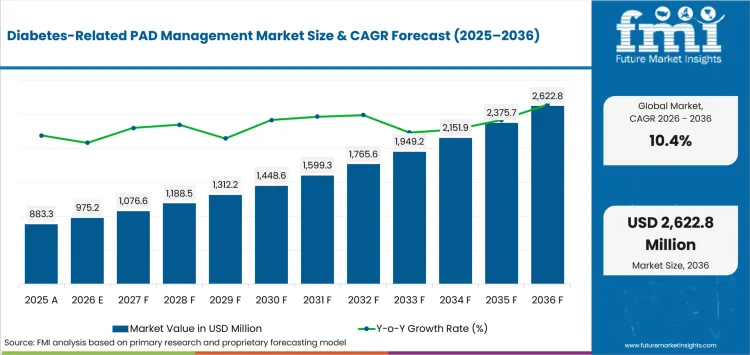
Key Takeaways of Diabetes-Related PAD Management Market
- Demand for diabetes-related PAD management is driven by earlier vascular identification for people receiving continuing diabetes care, with coordinated referral moving patients from screening into suitable medical or procedural treatment.
- By management type, pharmacological therapy holds the leading share at 40.7% in 2026, backed by continuing cardiovascular and limb-risk management across varied PAD presentations.
- Hospitals lead end-user demand at 40.1% share in 2026, driven by access to multidisciplinary assessment and vascular procedures.
- Asymptomatic PAD is the dominant disease stage segment, holding 36.0% share in 2026, influenced by risk-based screening within diabetes populations.
- Antiplatelet therapy accounts for 35.6% treatment share in 2026, through regular use for cardiovascular and limb-event prevention.
- South Korea, Japan, and the United Kingdom record CAGRs of 11.8%, 10.7%, and 10.3% respectively through 2036, shaped by tertiary-care capacity, specialist concentration, and national diabetes monitoring.
- Competition centers on Abbott Laboratories, Medtronic, Boston Scientific, Terumo Corporation, Royal Philips, and Johnson & Johnson MedTech, with vendors differentiating through peripheral intervention portfolios, vessel treatment across lesion profiles, and imaging/calcium-modification capabilities.
Analyst Perspective
Asymptomatic PAD's large share reflects a screening gap more than disease rarity: with confirmed cases running 20-59% asymptomatic, absent classic symptoms routinely delay diagnosis, making ankle-brachial index testing during routine diabetes visits the practical lever for catching vascular impairment before functional decline.
-Anurag Sharma, Principal Consultant for Healthcare at Future Market Insights
Source: Future Market Insights analysis, 2026.
How is Diabetes-Related PAD Management Market segmented?
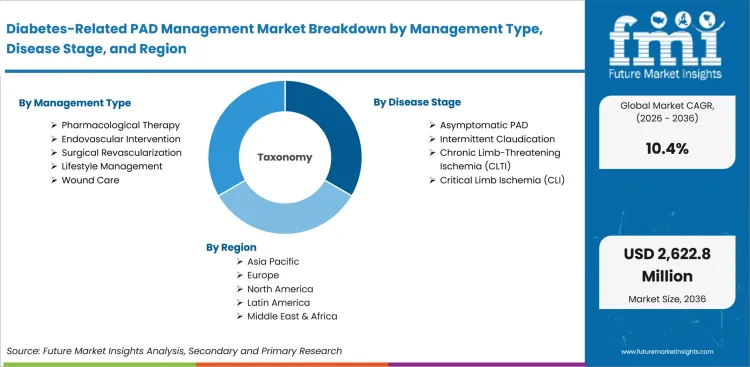
The diabetes-related PAD management industry is segmented by management type, disease stage, end user, treatment, and region.
The diabetes-related PAD management sector is segmented by management type, disease stage, end user, treatment, and region. Management type separates medical care from endovascular or surgical approaches, followed by lifestyle management and wound care. Disease stage moves from asymptomatic PAD into intermittent claudication and limb-threatening ischemia, establishing distinct clinical priorities for each patient group. End-user coverage follows care delivery across hospitals, diabetes clinics, vascular surgery centers, and ambulatory surgical centers. Treatment coverage compares antiplatelet therapy with lipid lowering, drug-coated devices, atherectomy, and bypass surgery. Regional coverage examines seven geographic groups through local referral structures and specialist capacity.
Why does pharmacological therapy shape management type selection?
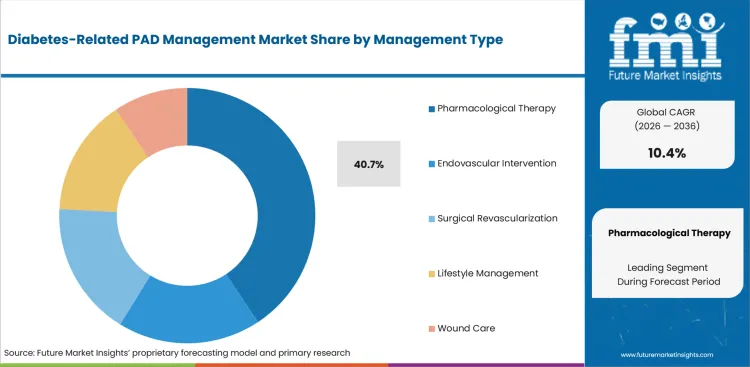
American Heart Association guidance updated in May 2024 defines 4 clinical subsets and recommends medical therapy across PAD care. Such guidance places pharmacological treatment at an early risk-control stage, then preserves its role during intervention planning and follow-up. Antiplatelet and lipid-lowering medicines address cardiovascular exposure, and diabetes management supports limb protection. Medication review links diagnosis with continuing specialist care.
- Based on management type, pharmacological therapy is set to secure 40.7% share in 2026 as prescribing remains central across varied PAD presentations. Clinical teams maintain treatment during screening and procedural review, creating continuity across each stage of care.
- Endovascular intervention restores blood flow across lesions requiring catheter-based treatment, and surgical revascularization addresses selected complex disease. Lifestyle management supports walking capacity with chronic wound care promoting tissue recovery during limb-preservation follow-up.
Why does asymptomatic PAD shape disease stage assessment?
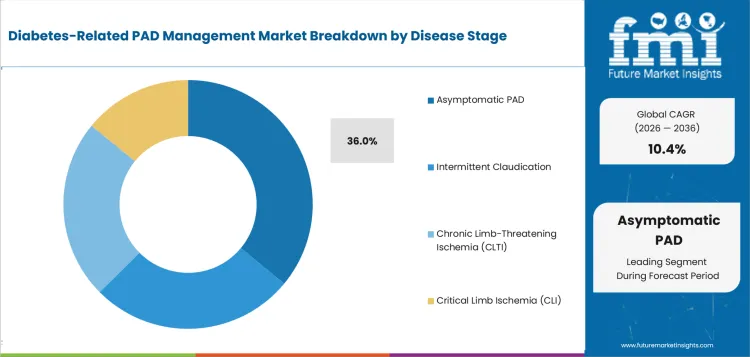
Earlier recognition connects medical therapy with foot protection and scheduled surveillance. Pulse examination and ankle-brachial index testing identify impaired circulation prior to functional decline. American College of Cardiology reported in May 2024 a 20% to 59% representation for asymptomatic PAD in objectively confirmed cases. Such prevalence supports risk-based screening during routine diabetes visits, since absent classic symptoms may delay vascular assessment.
- In 2026, asymptomatic PAD is projected to capture 36.0% share since diagnosis often follows pulse examination or ankle-brachial index testing. Early identification supports medical treatment and foot surveillance, allowing clinicians to address vascular exposure prior to symptomatic decline.
- Intermittent claudication creates demand for structured exercise and symptom-directed therapy, linking mobility goals with cardiovascular risk control. Chronic limb-threatening ischemia requires urgent specialist review as tissue loss raises amputation exposure and treatment intensity.
Why do hospitals lead end-user demand?
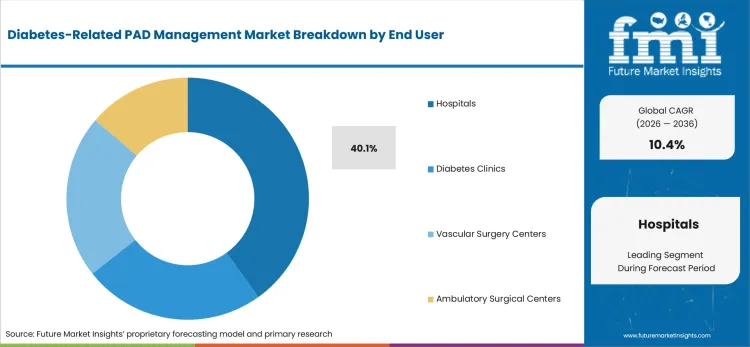
Fitridge and colleagues reported in 2024 a 50% healing rate for ischemic diabetic foot ulcers in people unsuitable for revascularization. Such outcomes require coordinated decisions across vascular medicine and wound care, placing hospitals in a central position within complex treatment pathways. Hospital-based records connect perfusion findings with wound progress and mobility goals. Shared specialist access shortens communication during treatment escalation.
- Hospitals are anticipated to represent 40.1% share of end-user in 2026, backed by access to vascular laboratories and operating rooms. Referral centers combine diagnostic testing with inpatient care, helping specialist teams coordinate treatment for advanced disease.
- Diabetes clinics maintain routine surveillance and cardiovascular risk management, preparing patients for specialist review following abnormal findings. Vascular surgery centers concentrate procedural expertise with ambulatory surgical centers managing selected interventions with planned follow-up.
Why does antiplatelet therapy shape treatment demand?
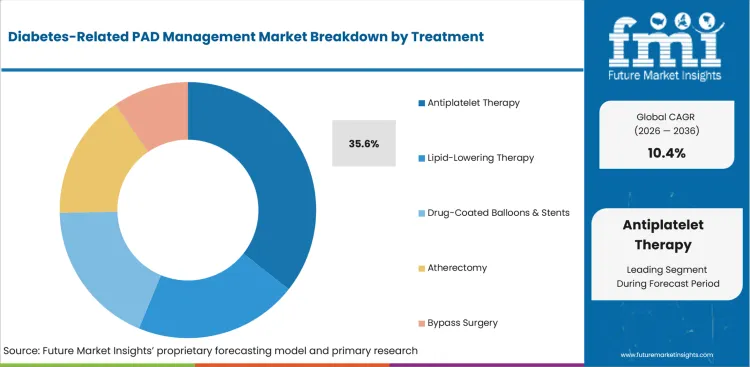
Bleeding assessment guides antiplatelet selection throughout follow-up. Abbott reported 48% fewer repeat procedures over 2 years for Esprit BTK recipients in November 2024 compared with balloon angioplasty. Such evidence encourages treatment review across medicines and below-knee devices, linking restenosis control with durable blood-flow restoration. Medication review continues during pre-intervention and post-intervention care.
- By treatment, antiplatelet therapy is forecast to secure 35.6% share in 2026 through regular use for cardiovascular and limb-event prevention. Prescribing decisions consider bleeding exposure and concurrent antithrombotic treatment, maintaining protection across long-term follow-up.
- Drug-coated balloons and stents address restenosis risk in selected lesions, extending vessel treatment beyond medical therapy. Atherectomy devices support plaque modification, and bypass surgery provides durable blood-flow restoration for extensive disease.
What are drivers, restraints, and opportunities in Diabetes-Related PAD Management Market?
Screening demand imnfluences earlier identification of arterial impairment for people receiving diabetes care. Delayed referral and functional decline restrict consistent movement into complete management pathways.
- Driver: Routine diabetes reviews create a practical entry point for lower-limb pulse checks and ankle-brachial testing. Earlier vascular findings support timely therapy adjustments and structured podiatry referrals.
- Restraint: Mild arterial impairment often escapes recognition until walking discomfort or tissue damage prompts investigation. Scarce vascular appointments extend referral intervals and weaken continuity between primary care and specialist treatment.
- Opportunity: Combined diabetes and vascular clinics align perfusion testing with wound review during scheduled visits. Shared care plans improve treatment sequencing and protect mobility across long-term follow-up.
A 2024 multisociety guideline reported diabetes-associated PAD odds ratios ranging from 1.89 to 4.05. Such exposure supports regular vascular evaluation for patients carrying several cardiovascular risk conditions. Earlier identification improves access to medical therapy and structured exercise. Routine diabetes appointments create repeatable opportunities for pulse examination and foot review. Clear escalation criteria guide patients toward vascular testing prior to advanced limb complications.
Mobility loss reduces participation in supervised exercise and scheduled rehabilitation. Transport barriers may further weaken follow-up for patients requiring several specialist visits. A New England Journal of Medicine review published in January 2026 reported inability to complete a six-minute walk test without resting in 52.0% of older people with severe PAD. Functional impairment complicates rehabilitation planning and may restrict treatment adherence. Care programs require practical support across continuing follow-up.
American College of Cardiology reported in March 2025 an estimated maximum-walking-distance ratio of 1.13 for semaglutide compared with placebo in people with symptomatic PAD and type 2 diabetes. Functional evidence supports closer coordination between diabetes and vascular specialists. Treatment review may extend beyond conventional symptom control. Combined clinics permit shared treatment decisions across prescribing and vascular services. Functional monitoring helps teams evaluate progress beyond lesion treatment and symptom reporting.
How are country CAGRs aligned in Diabetes-Related PAD Management Market?
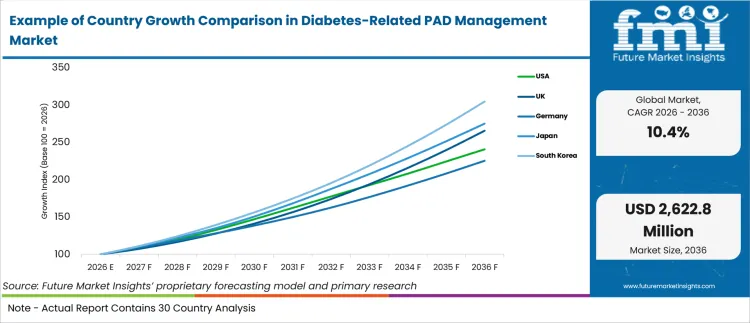
| Country or Market | CAGR |
|---|---|
| South Korea | 11.8% |
| Japan | 10.7% |
| United Kingdom | 10.3% |
| United States | 9.2% |
| Germany | 8.5% |
Source: Future Market Insights analysis, 2026.
How do country-level CAGRs compare in Diabetes-Related PAD Management Market?
Country comparison shows a measured step-down across five profiled markets. South Korea occupies first position, followed by Japan. United Kingdom forms middle position. United States follows at a modest distance. Germany closes comparison. CAGR spread measures 3.3 points, indicating different adoption speeds across established healthcare systems.
- South Korea establishes East Asia as initial expansion cluster within profiled countries.
- Japan follows with strong specialist concentration across advanced vascular services.
- United Kingdom maintains a middle position supported by national diabetes monitoring.
- United States records measured expansion from an established peripheral intervention base.
- Germany completes profiled group through regulated hospital pathways and established vascular capacity.
Similar CAGRs may produce different entry conditions due to referral design and specialist availability. Full country coverage spans North America and Latin America. European assessment covers western and eastern systems. Asian coverage extends across East Asia and South Asia and Pacific, followed by Middle East and Africa.
Country-wise Analysis
- Adoption in South Korean is likely to expand at 11.8% CAGR from 2026 to 2036, led by tertiary-care capacity and greater attention toward vascular complications for older adults. Diabetes clinics and vascular centers provide practical referral points for earlier PAD identification. United States Social Security Administration reported in April 2025 a 20.3% share for South Koreans aged at least 65 years during 2025. Population aging increases need for mobility and circulation assessment across diabetes and vascular services. Specialist education is expected to support consistent screening for older patients experiencing reduced mobility.
- Specialist concentration and population aging encourage structured PAD management across Japanese referral centers. Market expansion in Japan is predicted to rise 10.7% CAGR during forecast period, influenced by established hospital services and measured treatment review. Statistics Bureau of Japan reported 36.243 million residents aged at least 65 years during 2024 in its April 2025 publication, reinforcing clinical demand for lower-limb complication management. Academic centers provide controlled settings for multidisciplinary treatment review and clinician education. Community follow-up supports medication adherence and foot-care continuity between specialist consultations.
- Office for Health Improvement and Disparities reported in March 2025 a 7.0% recorded type 2 diabetes prevalence for adults in England. National monitoring provides primary-care teams a regular setting for foot checks and vascular risk review. Demand in the United Kingdom is estimated to rise at 10.3% CAGR between 2026 and 2036, due to integrated specialist referral. Primary-care records assist timely identification of patients needing ankle-brachial index testing.
- Established vascular centers support multidisciplinary assessment across prominent United States hospital systems. Centers for Disease Control and Prevention reported in January 2026 an estimated 40.1 million people with diagnosed or undiagnosed diabetes. Industry in the United States demand on a projected 9.2% CAGR path by 2036, driven by extensive vascular-care capacity enabling earlier diagnosis and coordinated treatment across diabetes and limb-preservation programs. Hospital education programs support consistent treatment review across complex comorbid patient groups.
- German Federal Statistical Office listed 1,874 hospitals in data presented during September 2024. Such institutional capacity supports vascular diagnosis and treatment across regional hospital networks. Sales in Germany are forecast to progress at 8.5% CAGR during the study period, backed by disciplined referral and regulated device review. Hospital networks provide established settings for medical therapy and revascularization planning. Standardized documentation supports coordinated decisions across diabetology and vascular departments.
Who are notable companies in Diabetes-Related PAD Management Market?
Abbott Laboratories supplies peripheral intervention devices used across below-knee and other PAD procedures. Medtronic plc participates led by drug-coated balloons and atherectomy systems. Boston Scientific Corporation supports peripheral intervention through balloons and stents. Terumo Corporation adds guidewires and vascular treatment devices.
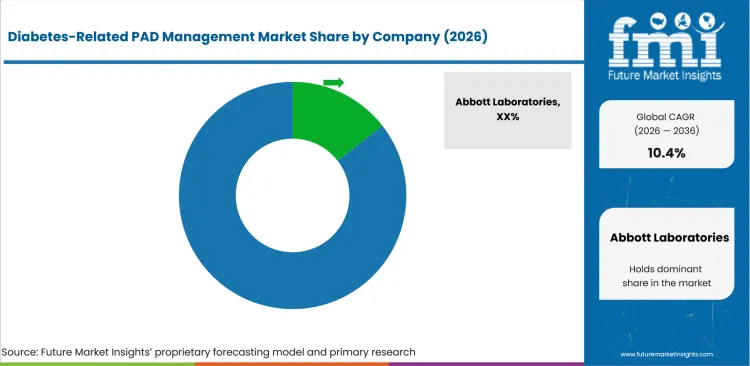
Competition in diabetes-related PAD management is anticipated to center on clinical evidence and procedural support. Hospital teams are likely to compare companies due to lesion coverage and service quality prior to product selection. Abbott Laboratories is expected to receive attention due to below-knee scaffold and vessel-treatment evidence. Medtronic plc is projected to support review through drug-coated balloon and atherectomy portfolios. Boston Scientific Corporation is estimated to compete across stent and balloon treatment pathways. Terumo Corporation is anticipated to support procedural planning through crossing and access technologies.
- Abbott Laboratories and Medtronic plc gain review attention based on established peripheral vascular devices. Clinical teams assess lesion coverage and physician education across complete treatment pathways.
- Boston Scientific Corporation competes based on balloons and stents used across peripheral interventions. Hospital programs compare deliverability and service response across difficult lesions.
- Terumo Corporation supports guidewire and vascular-device selection across peripheral procedures. Product familiarity influences use for interventional specialists.
- Royal Philips receives review through image-guided therapy and peripheral intravascular ultrasound. Training resources improve interpretation confidence across vascular suites.
Competitive Benchmarking: Diabetes-Related PAD Management Market
| Company | Portfolio Depth | Clinical Match | Service Support | Service Reach |
|---|---|---|---|---|
| Abbott Laboratories | High | High | High | Global vascular markets |
| Medtronic plc | High | High | High | Global vascular markets |
| Boston Scientific Corporation | High | High | High | Global vascular markets |
| Terumo Corporation | High | High | High | Global interventional markets |
Source: Future Market Insights competitive analysis, 2026.
Key Developments in Diabetes-Related PAD Management Market
- In January 2025, W. L. Gore & Associates, Inc. announced CE Mark approval for a lower-profile VIABAHN VBX Balloon Expandable Endoprosthesis compatible with 6 Fr sheaths. Company information linked reduced delivery profile with access through smaller sheaths, supporting procedure planning across selected complex peripheral lesions.
- In March 2025, Johnson & Johnson MedTech announced United States launch of Shockwave Javelin Peripheral IVL Catheter for difficult-to-cross calcified lesions. Company information reported a 150-centimeter working length, supporting peripheral intravascular lithotripsy across extremely narrowed vessels.
- In August 2025, Abbott announced CE Mark approval for Esprit BTK Everolimus Eluting Resorbable Scaffold System. Company information cited more than 50 million Europeans living with PAD, supporting below-knee treatment review for severe disease requiring restored blood flow.
Key Players in Diabetes-Related PAD Management Market
Peripheral intervention companies
- Abbott Laboratories
- Medtronic plc
- Boston Scientific Corporation
- Terumo Corporation
Access, imaging, and vascular-support companies
- Cook Medical
- Royal Philips
- Becton, Dickinson and Company
- W. L. Gore & Associates, Inc.
Pharmacological and calcium-modification participants
- Bayer AG
- Johnson & Johnson MedTech
Diabetes-Related PAD Management Market Report Scope
| Coverage field | Report scope |
|---|---|
| Market breakdown | Diabetes-related PAD management market breakdown by management type, disease stage, end user, treatment, and region |
| Quantitative Units | Revenue in USD Million, CAGR in %. |
| Market Definition | Diabetes-related PAD management includes medicines and vascular devices used across diagnosis, risk reduction, intervention, wound care, and continuing follow-up. |
| Regions Covered | North America, Latin America, Western Europe, Eastern Europe, East Asia, South Asia and Pacific, and Middle East and Africa |
| Countries Covered | United States, United Kingdom, Germany, Japan, and South Korea |
| Key Companies Profiled | Abbott Laboratories, Medtronic plc, Boston Scientific Corporation, Terumo Corporation, Cook Medical, Royal Philips, Bayer AG, Johnson & Johnson MedTech, Becton, Dickinson and Company, and W. L. Gore & Associates, Inc. |
| Forecast Period | 2026 to 2036 |
| Approach | Hybrid bottom-up and top-down methodology using supplied segment shares and country CAGRs with clinical indicators and company participation. |
Source: Future Market Insights analysis, 2026.
Diabetes-Related PAD Management Market - Research Methodology
| Method | Approach |
|---|---|
| Primary Research | FMI analysts gathered input from manufacturers, service providers, technology developers, distributors, end users, procurement teams, and subject-matter experts. Interviews examined purchasing decisions, product or service evaluation, adoption barriers, approval requirements, pricing considerations, and expectations for technical or commercial support. Respondents were also asked what evidence is required before a trial, pilot, or initial order develops into regular purchasing. |
| Desk Research | Desk research covered government statistics, regulatory publications, trade data, industry associations, technical literature, standards, company filings, product information, and official corporate announcements. Sources were reviewed for relevance, publication date, geographic coverage, and consistency with the defined market scope. Claims relating to performance, applications, approvals, capacity, investment, and commercial activity were retained only when supported by credible public evidence. |
| Market Sizing and Forecasting | The market model combined the baseline value with historical performance, segment structure, pricing and volume indicators, adoption levels, company participation, and country-level demand conditions. Forecast assumptions considered economic activity, investment trends, regulatory developments, technology adoption, purchasing cycles, supply availability, and barriers to wider market use. Segment and regional estimates were reconciled before the final market total was calculated. |
| Data Validation | Estimates were checked against multiple independent indicators, including public data, company activity, trade patterns, industry developments, and findings from primary interviews. Validation also tested whether products, services, applications, and company revenues fell within the defined market boundaries. Adjacent categories, unsupported claims, overlapping revenues, and activities without direct market relevance were excluded to reduce double counting and maintain consistency across segments and countries. |
Source: Future Market Insights analysis, 2026.
Diabetes-Related PAD Management Market by Segments
Diabetes-related PAD management market segmented by Management Type:
- Pharmacological Therapy
- Endovascular Intervention
- Surgical Revascularization
- Lifestyle Management
- Wound Care
Diabetes-related PAD management market segmented by Disease Stage:
- Asymptomatic PAD
- Intermittent Claudication
- Chronic Limb-Threatening Ischemia (CLTI)
- Critical Limb Ischemia (CLI)
Diabetes-related PAD management market segmented by End User:
- Hospitals
- Diabetes Clinics
- Vascular Surgery Centers
- Ambulatory Surgical Centers
Diabetes-related PAD management market segmented by Treatment:
- Antiplatelet Therapy
- Lipid-Lowering Therapy
- Drug-Coated Balloons & Stents
- Atherectomy
- Bypass Surgery
Diabetes-related PAD management market segmented by Region:
- North America
- United States
- Canada
- Latin America
- Brazil
- Mexico
- Argentina
- Chile
- Western Europe
- Germany
- France
- United Kingdom
- Italy
- Spain
- Benelux
- Nordics
- Eastern Europe
- Poland
- Czech Republic
- Romania
- Hungary
- East Asia
- China
- Japan
- South Korea
- South Asia and Pacific
- India
- ASEAN
- Australia and New Zealand
- Middle East and Africa
- GCC Countries
- South Africa
- Türkiye
- Israel
Research Sources and Bibliography
- Abbott. (2024, November 4). Late-Breaking Data Shows Sustained Benefits of Abbott’s Esprit BTK System for People Battling Peripheral Artery Disease Below the Knee.
- Abbott. (2025, August 25). Abbott's dissolving stent receives CE Mark, pioneering a new era in peripheral vascular treatment.
- American College of Cardiology. (2024, May 14). 2024 ACC/AHA/Multisociety Guideline for Lower Extremity PAD: Key Points.
- American College of Cardiology. (2025, March 29). Semaglutide and walking capacity in people with symptomatic peripheral artery disease and type 2 diabetes: STRIDE.
- American Heart Association. (2024, May 14). Top things to know: 2024 guideline for the management of lower extremity peripheral artery disease.
- Social Security Administration. (2025, April). International Update, April 2025.
- Centers for Disease Control and Prevention. (2026, January 21). National Diabetes Statistics Report.
- Diabetes UK. (2025, February 6). One in five adults now live with diabetes or prediabetes in the UK.
- Fitridge, R., Chuter, V., Mills, J., Hinchliffe, R., Azuma, N., Behrendt, C.-A., Boyko, E. J., Conte, M. S., Humphries, M., Kirksey, L., McGinigle, K. C., Nikol, S., Nordanstig, J., Rowe, V., Russell, D., van den Berg, J. C., Venermo, M., & Schaper, N. (2024). The intersocietal IWGDF, ESVS, SVS guidelines on peripheral artery disease in people with diabetes and a foot ulcer. Diabetes/Metabolism Research and Reviews, 40(3), e3686.
- German Federal Statistical Office. (2024, September 27). Hospitals: Medical facilities, hospital beds and movement of patient.
- Gornik, H. L., Aronow, H. D., Goodney, P. P., Arya, S., Brewster, L. P., Byrd, L., Chandra, V., Drachman, D. E., Eaves, J. M., Ehrman, J. K., Evans, J. N., Getchius, T. S. D., Gutiérrez, J. A., Hawkins, B. M., Hess, C. N., Ho, K. J., Jones, W. S., Kim, E. S. H., Kinlay, S., . . . Wilkins, L. R. (2024). 2024 ACC/AHA/AACVPR/APMA/ABC/SCAI/SVM/SVN/SVS/SIR/VESS guideline for the management of lower extremity peripheral artery disease. Circulation, 149(24), e1313-e1410.
- International Diabetes Federation. (2025, April 7). Over 250 million people worldwide unaware they have diabetes, according to new IDF research.
- Johnson & Johnson. (2025, March 4). Shockwave Medical launches novel forward intravascular lithotripsy platform in United States to transform treatment of difficult-to-cross calcified lesions.
- McDermott, M. M. (2026, January 28). Peripheral artery disease in the legs. New England Journal of Medicine, 394(5), 486-496.
- Office for Health Improvement and Disparities. (2025, March 4). Diabetes profile: Statistical commentary, March 2025.
- Statistics Bureau of Japan. (2025, April 14). Current population estimates as of October 1, 2024.
- W. L. Gore & Associates, Inc. (2025, January 13). W. L. Gore & Associates receives CE Mark for lower-profile VIABAHN VBX balloon-expandable endoprosthesis, now 6 Fr sheath compatible.
This bibliography is provided for reader reference and is not exhaustive. The full report contains the complete reference list and detailed citations.
This Report Answers
- What segment dimensions influence diabetes-related peripheral artery disease management?
- How do clinicians assess management type during treatment planning?
- Why does asymptomatic disease influence screening activity?
- What supports hospital participation across coordinated PAD care?
- How do treatment pathways differ across medical and procedural options?
- How do profiled country rates compare across established healthcare systems?
- What company capabilities influence selection across vascular programs?
- How are forecasts validated through clinical and demographic evidence?
- What barriers delay earlier referral into specialist care?
- What supports continuing confidence across limb-preservation pathways?
Frequently Asked Questions
How big is the Diabetes-Related PAD Management Market in 2026?
The diabetes-related PAD management market is valued at USD 975.2 million in 2026 and is forecast to reach USD 2,622.8 million by 2036. Growth reflects expanding vascular screening, multidisciplinary diabetes care, and greater emphasis on early identification and long-term management of peripheral artery disease.
What is the CAGR of the Diabetes-Related PAD Management Market from 2026 to 2036?
Abbott Laboratories and Medtronic plc participate led by established peripheral vascular portfolios covering several treatment requirements. Boston Scientific Corporation and Terumo Corporation contribute devices used during vessel preparation and endovascular intervention procedures.
Which management type leads the Diabetes-Related PAD Management Market?
Pharmacological therapy accounts for 40.7% of the diabetes-related PAD management market by management type in 2026, reflecting its central role in cardiovascular risk reduction, limb-event prevention, and long-term treatment across multiple stages of peripheral artery disease.
How much will the Diabetes-Related PAD Management Market add between 2026 and 2036?
The diabetes-related PAD management market is set to add USD 1,647.6 million between 2026 and 2036, growing from USD 975.2 million to USD 2,622.8 million as healthcare systems strengthen vascular screening, multidisciplinary care, and specialist treatment for diabetes-associated peripheral artery disease.
Who are the leading companies in the Diabetes-Related PAD Management Market?
Ten companies lead the diabetes-related PAD management market, including Abbott Laboratories, Medtronic plc, Boston Scientific Corporation, Terumo Corporation, Cook Medical, Royal Philips, Bayer AG, Johnson & Johnson MedTech, Becton, Dickinson and Company, and W. L. Gore & Associates, Inc., competing across peripheral intervention devices, vascular imaging, pharmacological therapies, and specialist treatment technologies.
Preview the report firsthand - request a free sample
Get SampleGet the brochure for pricing and purchase details.
Get PDFTable of Content
- Key Takeaways
- Market Size and CAGR
- Top Growth Driver
- Fastest Growing Segment
- Leading Region
- Key Companies
- Emerging Opportunities
- Executive Summary
- Global Market Outlook
- Demand-side Trends
- Supply-side Trends
- Technology Roadmap Analysis
- Analysis and Recommendations
- Analyst Perspective (What is happening? Why now? What should investors know?)
- Key Questions Answered
- How large is the market?
- What is the CAGR?
- What are key trends?
- Which region dominates?
- Who are the leaders?
- Market Overview
- Market Coverage / Taxonomy
- Market Definition / Scope / Limitations
- Research Methodology
- Chapter Orientation
- Analytical Lens and Working Hypotheses
- Market Structure, Signals, and Trend Drivers
- Benchmarking and Cross-market Comparability
- Market Sizing, Forecasting, and Opportunity Mapping
- Research Design and Evidence Framework
- Desk Research Programme (Secondary Evidence)
- Expert Input and Fieldwork (Primary Evidence)
- Tooling, Models, and Reference Databases
- Data Engineering and Model Build
- Quality Assurance and Audit Trail
- Market Background
- Market Dynamics (Drivers, Restraints, Opportunity, Trends)
- Scenario Forecast (Optimistic, Likely, Conservative)
- Impact Analysis
- AI Impact
- Sustainability Impact
- Regulatory Impact
- Technology Impact
- Consumer / Buyer Analysis
- Purchase Drivers
- Adoption Barriers
- Buyer Journey
- Opportunity Map Analysis
- Product Life Cycle Analysis
- Supply Chain Analysis
- Investment Feasibility Matrix
- Value Chain Analysis
- PESTLE and Porter's Analysis
- Regulatory Landscape
- Regional Parent Market Outlook
- Production and Consumption Statistics
- Import and Export Statistics
- Global Market Analysis and Forecast, 2021 to 2036
- Historical Market Size Value (USD Million) Analysis, 2021 to 2025
- Current and Future Market Size Value (USD Million) Projections, 2026 to 2036
- Y-o-Y Growth Trend Analysis
- Absolute $ Opportunity Analysis
- Global Market Pricing Analysis, 2021 to 2036
- Global Market Analysis and Forecast, By Management Type, 2021 to 2036
- Introduction / Key Findings
- Historical Market Size Value (USD Million) Analysis By Management Type, 2021 to 2025
- Current and Future Market Size Value (USD Million) Analysis and Forecast By Management Type, 2026 to 2036
- Pharmacological Therapy
- Endovascular Intervention
- Surgical Revascularization
- Lifestyle Management
- Wound Care
- Pharmacological Therapy
- Y-o-Y Growth Trend Analysis By Management Type, 2021 to 2025
- Absolute $ Opportunity Analysis By Management Type, 2026 to 2036
- Global Market Analysis and Forecast, By Disease Stage, 2021 to 2036
- Introduction / Key Findings
- Historical Market Size Value (USD Million) Analysis By Disease Stage, 2021 to 2025
- Current and Future Market Size Value (USD Million) Analysis and Forecast By Disease Stage, 2026 to 2036
- Asymptomatic PAD
- Intermittent Claudication
- Chronic Limb-Threatening Ischemia (CLTI)
- Critical Limb Ischemia (CLI)
- Asymptomatic PAD
- Y-o-Y Growth Trend Analysis By Disease Stage, 2021 to 2025
- Absolute $ Opportunity Analysis By Disease Stage, 2026 to 2036
- Global Market Analysis and Forecast, By End User, 2021 to 2036
- Introduction / Key Findings
- Historical Market Size Value (USD Million) Analysis By End User, 2021 to 2025
- Current and Future Market Size Value (USD Million) Analysis and Forecast By End User, 2026 to 2036
- Hospitals
- Diabetes Clinics
- Vascular Surgery Centers
- Ambulatory Surgical Centers
- Hospitals
- Y-o-Y Growth Trend Analysis By End User, 2021 to 2025
- Absolute $ Opportunity Analysis By End User, 2026 to 2036
- Global Market Analysis and Forecast, By Treatment, 2021 to 2036
- Introduction / Key Findings
- Historical Market Size Value (USD Million) Analysis By Treatment, 2021 to 2025
- Current and Future Market Size Value (USD Million) Analysis and Forecast By Treatment, 2026 to 2036
- Antiplatelet Therapy
- Lipid-Lowering Therapy
- Drug-Coated Balloons & Stents
- Atherectomy
- Bypass Surgery
- Antiplatelet Therapy
- Y-o-Y Growth Trend Analysis By Treatment, 2021 to 2025
- Absolute $ Opportunity Analysis By Treatment, 2026 to 2036
- Global Market Analysis and Forecast, By Region, 2021 to 2036
- Introduction
- Historical Market Size Value (USD Million) Analysis By Region, 2021 to 2025
- Current Market Size Value (USD Million) Analysis and Forecast By Region, 2026 to 2036
- North America
- Latin America
- Western Europe
- Eastern Europe
- East Asia
- South Asia and Pacific
- Middle East & Africa
- Market Attractiveness Analysis By Region
- North America Market Analysis and Forecast, By Country, 2021 to 2036
- Historical Market Size Value (USD Million) Trend Analysis By Market Taxonomy, 2021 to 2025
- Market Size Value (USD Million) Forecast By Market Taxonomy, 2026 to 2036
- By Country
- USA
- Canada
- By Management Type
- By Disease Stage
- By End User
- By Treatment
- By Country
- Market Attractiveness Analysis
- By Country
- By Management Type
- By Disease Stage
- By End User
- By Treatment
- Key Takeaways
- Latin America Market Analysis and Forecast, By Country
- Historical Market Size Value (USD Million) Trend Analysis By Market Taxonomy, 2021 to 2025
- Market Size Value (USD Million) Forecast By Market Taxonomy, 2026 to 2036
- By Country
- Brazil
- Mexico
- Chile
- Rest of Latin America
- By Management Type
- By Disease Stage
- By End User
- By Treatment
- By Country
- Market Attractiveness Analysis
- By Country
- By Management Type
- By Disease Stage
- By End User
- By Treatment
- Key Takeaways
- Western Europe Market Analysis and Forecast, By Country
- Historical Market Size Value (USD Million) Trend Analysis By Market Taxonomy, 2021 to 2025
- Market Size Value (USD Million) Forecast By Market Taxonomy, 2026 to 2036
- By Country
- Germany
- UK
- Italy
- Spain
- France
- Nordic
- BENELUX
- Rest of Western Europe
- By Management Type
- By Disease Stage
- By End User
- By Treatment
- By Country
- Market Attractiveness Analysis
- By Country
- By Management Type
- By Disease Stage
- By End User
- By Treatment
- Key Takeaways
- Eastern Europe Market Analysis and Forecast, By Country
- Historical Market Size Value (USD Million) Trend Analysis By Market Taxonomy, 2021 to 2025
- Market Size Value (USD Million) Forecast By Market Taxonomy, 2026 to 2036
- By Country
- Russia
- Poland
- Hungary
- Balkan & Baltic
- Rest of Eastern Europe
- By Management Type
- By Disease Stage
- By End User
- By Treatment
- By Country
- Market Attractiveness Analysis
- By Country
- By Management Type
- By Disease Stage
- By End User
- By Treatment
- Key Takeaways
- East Asia Market Analysis and Forecast, By Country
- Historical Market Size Value (USD Million) Trend Analysis By Market Taxonomy, 2021 to 2025
- Market Size Value (USD Million) Forecast By Market Taxonomy, 2026 to 2036
- By Country
- China
- Japan
- South Korea
- By Management Type
- By Disease Stage
- By End User
- By Treatment
- By Country
- Market Attractiveness Analysis
- By Country
- By Management Type
- By Disease Stage
- By End User
- By Treatment
- Key Takeaways
- South Asia and Pacific Market Analysis and Forecast, By Country
- Historical Market Size Value (USD Million) Trend Analysis By Market Taxonomy, 2021 to 2025
- Market Size Value (USD Million) Forecast By Market Taxonomy, 2026 to 2036
- By Country
- India
- ASEAN
- Australia & New Zealand
- Rest of South Asia and Pacific
- By Management Type
- By Disease Stage
- By End User
- By Treatment
- By Country
- Market Attractiveness Analysis
- By Country
- By Management Type
- By Disease Stage
- By End User
- By Treatment
- Key Takeaways
- Middle East & Africa Market Analysis and Forecast, By Country
- Historical Market Size Value (USD Million) Trend Analysis By Market Taxonomy, 2021 to 2025
- Market Size Value (USD Million) Forecast By Market Taxonomy, 2026 to 2036
- By Country
- Kingdom of Saudi Arabia
- Other GCC Countries
- Türkiye
- South Africa
- Other African Union
- Rest of Middle East & Africa
- By Management Type
- By Disease Stage
- By End User
- By Treatment
- By Country
- Market Attractiveness Analysis
- By Country
- By Management Type
- By Disease Stage
- By End User
- By Treatment
- Key Takeaways
- Key Countries Market Analysis
- USA
- Pricing Analysis
- Market Share Analysis, 2025
- By Management Type
- By Disease Stage
- By End User
- By Treatment
- Canada
- Pricing Analysis
- Market Share Analysis, 2025
- By Management Type
- By Disease Stage
- By End User
- By Treatment
- Mexico
- Pricing Analysis
- Market Share Analysis, 2025
- By Management Type
- By Disease Stage
- By End User
- By Treatment
- Brazil
- Pricing Analysis
- Market Share Analysis, 2025
- By Management Type
- By Disease Stage
- By End User
- By Treatment
- Chile
- Pricing Analysis
- Market Share Analysis, 2025
- By Management Type
- By Disease Stage
- By End User
- By Treatment
- Germany
- Pricing Analysis
- Market Share Analysis, 2025
- By Management Type
- By Disease Stage
- By End User
- By Treatment
- UK
- Pricing Analysis
- Market Share Analysis, 2025
- By Management Type
- By Disease Stage
- By End User
- By Treatment
- Italy
- Pricing Analysis
- Market Share Analysis, 2025
- By Management Type
- By Disease Stage
- By End User
- By Treatment
- Spain
- Pricing Analysis
- Market Share Analysis, 2025
- By Management Type
- By Disease Stage
- By End User
- By Treatment
- France
- Pricing Analysis
- Market Share Analysis, 2025
- By Management Type
- By Disease Stage
- By End User
- By Treatment
- India
- Pricing Analysis
- Market Share Analysis, 2025
- By Management Type
- By Disease Stage
- By End User
- By Treatment
- ASEAN
- Pricing Analysis
- Market Share Analysis, 2025
- By Management Type
- By Disease Stage
- By End User
- By Treatment
- Australia & New Zealand
- Pricing Analysis
- Market Share Analysis, 2025
- By Management Type
- By Disease Stage
- By End User
- By Treatment
- China
- Pricing Analysis
- Market Share Analysis, 2025
- By Management Type
- By Disease Stage
- By End User
- By Treatment
- Japan
- Pricing Analysis
- Market Share Analysis, 2025
- By Management Type
- By Disease Stage
- By End User
- By Treatment
- South Korea
- Pricing Analysis
- Market Share Analysis, 2025
- By Management Type
- By Disease Stage
- By End User
- By Treatment
- Russia
- Pricing Analysis
- Market Share Analysis, 2025
- By Management Type
- By Disease Stage
- By End User
- By Treatment
- Poland
- Pricing Analysis
- Market Share Analysis, 2025
- By Management Type
- By Disease Stage
- By End User
- By Treatment
- Hungary
- Pricing Analysis
- Market Share Analysis, 2025
- By Management Type
- By Disease Stage
- By End User
- By Treatment
- Kingdom of Saudi Arabia
- Pricing Analysis
- Market Share Analysis, 2025
- By Management Type
- By Disease Stage
- By End User
- By Treatment
- Türkiye
- Pricing Analysis
- Market Share Analysis, 2025
- By Management Type
- By Disease Stage
- By End User
- By Treatment
- South Africa
- Pricing Analysis
- Market Share Analysis, 2025
- By Management Type
- By Disease Stage
- By End User
- By Treatment
- USA
- Market Structure Analysis
- Competition Dashboard
- Competition Benchmarking
- Market Share Analysis of Top Players
- By Regional
- By Management Type
- By Disease Stage
- By End User
- By Treatment
- Emerging Startups
- Innovation Benchmarking
- Competition Analysis
- Competition Deep Dive
- Abbott Laboratories
- Overview
- Product Portfolio
- Profitability by Market Segments
- Sales Footprint
- Strategy Overview
- Marketing Strategy
- Product Strategy
- Channel Strategy
- Medtronic plc
- Boston Scientific Corporation
- Terumo Corporation
- Cook Medical LLC
- Philips Healthcare
- Bayer AG
- Johnson & Johnson MedTech
- Becton, Dickinson and Company
- W. L. Gore & Associates, Inc.
- Abbott Laboratories
- Case Studies
- Success Stories
- Recent Developments
- Competition Deep Dive
- Assumptions & Acronyms Used


