

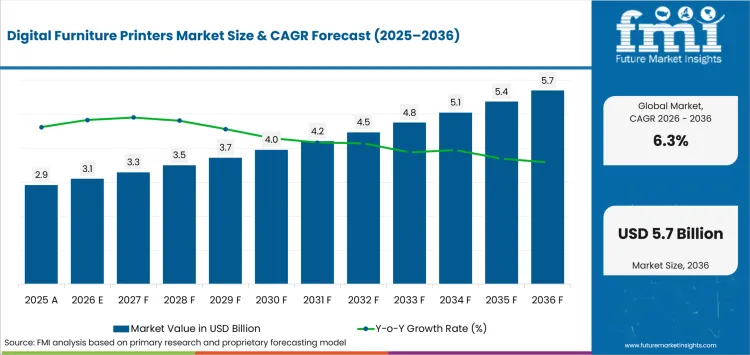
- Market Size (2026)
- USD 3.1 Bn
- Forecast (2036)
- USD 5.7 Bn
- CAGR (2026 to 2036)
- 6.3%
How big is Digital Furniture Printers Market in 2026?
USD 3.1 billion in 2026 and USD 5.7 billion by 2036 at a 6.3% CAGR.
Demand for digital furniture printers is projected to expand at 6.3% CAGR between 2026 and 2036, increasing valuation from USD 3.1 billion in 2026 to USD 5.7 billion by 2036. Shorter décor runs weaken analog setup economics because each new pattern requires plates, screens, or finished-décor inventory. Koenig & Bauer's March 2026 annual report states that digital décor printing for furniture and flooring permits fast design changes and low-cost idea testing. Industrial inkjet systems therefore reduce plate-change work and finished décor inventory in plants carrying many design variants.
Country conversion depends on installed finishing assets and the capital discipline applied to replacement projects. Destatis reported in March 2025 that German furniture-industry revenue fell 7.8% during 2024, tightening the payback test for new presses. Managers therefore ask printer OEMs to prove savings against existing preparation, curing and finishing assets. Service coverage and line-level cost reductions determine whether the investment clears that test.
Key Takeaways
- Short-run furniture programs support digital printing by reducing analog setup work through file changes and limiting finished-décor inventory tied to slow designs.
- By printer type, flatbed UV printers are estimated to hold 33.0% in 2026 as rigid boards move directly from printing into downstream handling.
- UV-curable inks are projected to account for 42.0% by ink type in 2026 owing to immediate curing on rigid panel workflows.
- In 2026, MDF/HDF panels are expected to represent 31.0% by substrate since their engineered surfaces support controlled preparation and repeatable transport.
- Capital approval slows where a printer also requires new coating preparation, transport automation, operator training, or service arrangements before stable production begins.
- Some of the key players in this market include Barberán, Cefla Finishing, Hymmen, Durst, Agfa, Koenig & Bauer, Mimaki and Roland DG.
Analyst Perspective
"Furniture plants should compare digital printers on the cost of a finished decorated panel, not nominal print speed or press price alone. The stronger business case appears where substrate preparation, curing, board transport, color control and service response reduce changeover labor without shifting cost into coating rework or downstream handling."
- Nikhil Kaitwade, Principal Consultant, Future Market Insights
How is the digital furniture printers market segmented?
The digital furniture printers market is segmented by printer type, ink type, substrate, end use and sales channel.
Printer type covers flatbed UV printers, single-pass digital printers, inkjet décor printers, direct-to-panel printers and hybrid print-coat lines. Ink type includes UV-curable, water-based, pigment, solvent/eco-solvent inks and functional coatings. Substrates include MDF/HDF panels, particleboard, plywood, laminates and glass/metal furniture parts. End use covers furniture panels, cabinet fronts, decorative wall panels, doors and custom interior panels. Sales channels comprise printer OEMs, furniture plant projects, system integrators and aftermarket/service.
What supports furniture panels within the end use category?
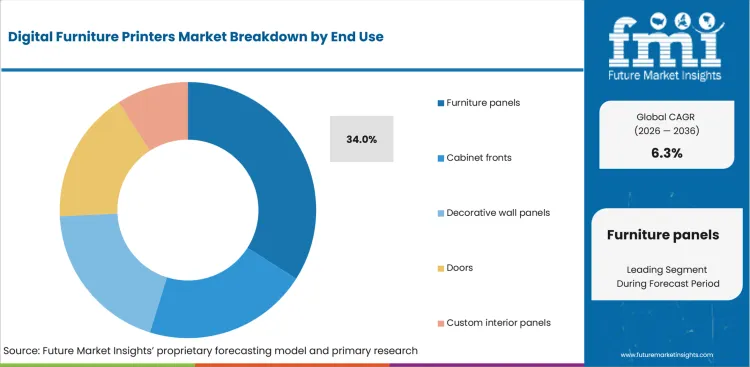
Panelized production places digital décor ahead of cutting, edging, or final assembly. Hymmen stated in June 2026 that its furniture-facing surface systems can pair digital décor with digital structure printing, including DLEplus following single- or multi-pass output.
- By end use, furniture panels are forecast to represent 34.0% in 2026 as a common board format can carry many décor files without dedicated analog tooling.
- Panel programs convert most readily after image registration and tactile finishing are validated together on the intended board. An attractive print alone does not guarantee an acceptable finished surface after coating and handling.
What makes flatbed UV printers central to the printer type category?
Rigid furniture parts suit flatbed architecture because boards stay stationary during image placement and leave the print zone ready for handling. Agfa documented the North American Onset Panthera FB3216 installation in October 2025, confirming investment in rigid-media production.
- By printer type, flatbed UV printers are estimated to hold 33.0% in 2026 owing to direct board handling that avoids a separate roll-printing and mounting step.
- Automated flatbeds suit mixed-format plants by cutting non-print time through board loading and file changes between short jobs. Production approval still requires repeatable registration on the plant's actual panel sizes.
Why do UV-curable inks lead the ink type category?
Furniture lines need printed boards to move into inspection or finishing without a long evaporation stage. Mimaki launched the UJF-7151 plusII e flatbed in October 2025 with UV-curable ink configurations for industrial applications, giving users another current route for immediate-cure rigid-media work.
- In 2026, UV-curable inks are expected to lead ink type with 42.0% share owing to rapid curing that supports direct handling and reduces post-print dwell time on rigid panels.
- Furniture applications also overlap with UV-curable technologies since cure control and adhesion must match the actual board finish for routine production approval.
How do MDF/HDF panels shape demand within the substrate category?
MDF and HDF provide flat engineered surfaces that can be prepared consistently for transport and image placement. Durst launched the P5 SMP in November 2025 as a 3.5-meter hybrid LED system for board and roll production, supporting industrial rigid-board workflows after substrate qualification.
- MDF/HDF panels are projected to hold 31.0% of substrate demand in 2026 attributable to repeatable board geometry and routine use in furniture-panel production.
- Panel printers must still test porosity, coating and adhesion on each board grade. This qualification also affects adjacent decorative laminates used in furniture surfacing.
What drives printer OEMs within the sales channel category?
Furniture-printing projects bundle the press, ink, curing, workflow software and commissioning under one OEM relationship. In May 2026, Roland DG previewed an industrial portfolio spanning UV flatbeds and industrial inks. OEM-led projects gain weight once equipment, ink and service are qualified together.
- Printer OEMs are set to lead the sales channel category with 44.0% share in 2026 due to direct responsibility for system commissioning and application qualification.
- Plant projects often involve woodworking machinery and finishing assets, so the OEM relationship carries more weight in projects requiring several process stages to be commissioned as one production line.
What are the drivers, restraints and opportunities in the Digital Furniture Printers Market?
Short-run décor economics support demand, capital and integration requirements slow adoption and inline surface finishing expands the value available from each digital line.
- Driver: File-driven design changes reduce setup labor and finished-décor stock as furniture programs fragment into more variants.
- Restraint: Large equipment projects face tighter approval if furniture plants must fund integration and prove stable utilization to establish credible payback.
- Opportunity: Integrating digital texture, coating and surface control with the décor stage can increase the value captured by each production line.
Short-run décor programs become more labor-sensitive as file changes replace repeated analog setup and handling. The USA Bureau of Labor Statistics reported in June 2026 that furniture-manufacturing unit labor costs rose 5.7% during 2025. Plants with stable board volumes can compare automated loading and file changes directly against labor consumed between short runs, making labor removal a measurable part of payback.
Capital approval tightens if integration spending arrives ahead of demonstrated savings on the existing line. Federal Reserve data published through FRED in August 2026 show the furniture and related product production index easing from 74.2131 in Q1 to 73.1566 in Q2. During weaker production, a press needing new transport or finishing assets must show credible inventory, setup, or labor savings for management to accept the disruption.
Furniture producers capture more value when digital décor and surface finishing are qualified as one production sequence. Hymmen's March 2026 MIKO material covered furniture fronts and panels that pair digital printing or structuring with finishing technology. OEMs that prove décor, tactile effects and coating order on the customer's board can extend the project beyond the press without leaving integration risk to the plant.
Which country CAGRs are profiled in the Digital Furniture Printers Market?
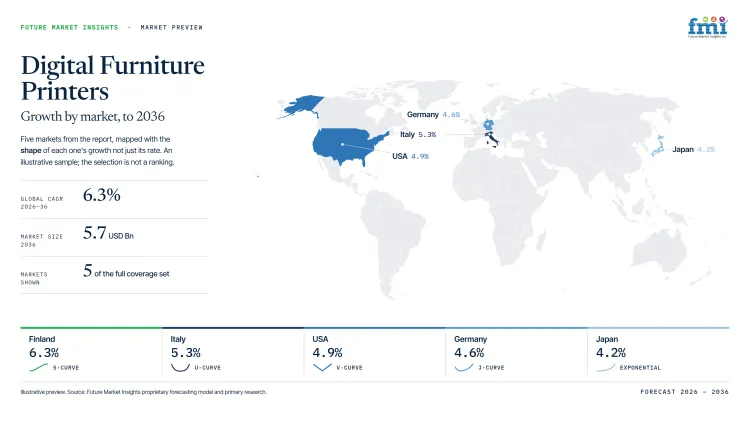
| Country | CAGR |
|---|---|
| Finland | 6.3% |
| Mexico | 5.9% |
| Brazil | 5.6% |
| Italy | 5.3% |
| USA | 4.9% |
| Germany | 4.6% |
| Japan | 4.2% |
How do country-level CAGRs compare in the Digital Furniture Printers Market?
The profiled forecasts span 2.1 percentage points from Finland at 6.3% CAGR to Japan at 4.2%. Finland, Mexico and Brazil form the faster group, with Italy and USA in the middle. Germany and Japan close the range. The spread reflects different modernization speeds and approval conditions, not current national market size.
- Finland rewards systems serving several Nordic décor programs.
- Mexico rewards direct-board workflows that reduce export-program inventory.
- Brazilian clusters favor flexible capacity for varied board programs.
- Italian producers value fast file changes for short design series.
- Large USA panel plants justify automated loading at sufficient scale.
- German plants require clear payback for new digital presses.
- Japanese factories extend digital use after board qualification.
Country-specific capital tests can produce different equipment mixes despite similar CAGRs. The full report extends country-level analysis across North America, Latin America, Western Europe, Eastern Europe, East Asia, South Asia and Pacific and Middle East and Africa.
Country-wise Analysis
- Finland's furniture producers face a compact domestic equipment base, so a new digital printer must cover several décor programs and justify fewer high-ticket projects each year in a small market. Statistics Finland confirmed in July 2026 that industrial sold-output value returned to growth during 2025, giving capital projects a firmer operating backdrop for replacement spending. Digital furniture printer demand is projected to expand at 6.3% CAGR during the assessment period, owing to automation fit and Nordic technical coverage. Long travel between production sites raises service costs outside established clusters, so plants favor multifunction systems that spread press cost over a wider product mix.
- Mexican furniture exporters schedule production against external customer programs, which makes uptime and repeatability more important than nominal press speed. Mexico is forecast to grow at 5.9% CAGR over the assessment period, driven by export-facing factories that benefit from rapid digital changeovers. INEGI counted 135 IMMEX establishments in furniture, mattress and blind manufacturing in April 2026. The IMMEX base gives imported digital systems a direct route into plants with fixed delivery windows. Spare-parts delays and specialist travel can extend downtime, so OEMs with Mexican service capacity hold a stronger conversion position than brands depending on cross-border support inside the country.
- Brazilian furniture producers often stage machinery purchases since financing costs and long service distances make large integrated projects harder to approve. ABIMÓVEL documented a 0.8% increase in furniture and mattress exports during 2025, preserving an external outlet for differentiated surface programs among domestic producers. Brazil is positioned to record 5.6% CAGR through 2036, attributable to export demand and selective automation that can be installed in stages. Regional application teams can shorten substrate trials on real boards during pre-purchase trials. Recovery after faults takes longer outside major clusters, so flexible systems gain ground by proving inventory or setup savings to justify broader line expansion.
- Italian furniture plants compare digital décor with mature coating and finishing equipment already operating on the line, so retrofit fit is central to capital review. In January 2026, ACIMALL reported that domestic sales of Italian wood and furniture technology fell 2.0% during 2025. Italy's digital furniture printer sector is anticipated to advance at 5.3% CAGR over the forecast period, given deep local machinery and application expertise. Nearby integrators can shorten trials on real boards, though new presses must prove color and coating compatibility without forcing replacement of serviceable assets. Projects that preserve useful sanding, coating and handling equipment have a clearer approval route than full line rebuilds.
- USA furniture production spans small cabinet shops and multi-plant manufacturers, so equipment sizing changes sharply with order mix and automation readiness. Private furniture-manufacturing establishments reached 18,021 in the first quarter of 2026 according to the USA Bureau of Labor Statistics, confirming a broad and highly fragmented production base with varied plant sizes. Digital furniture printer sales in the USA are forecast to expand at 4.9% CAGR by 2036, supported by file-driven décor and direct-board handling. Dealer coverage gives flatbed systems access to smaller plants, while larger panel operations need quantified labor savings and throughput proof to clear capital review.
- German furniture manufacturers often evaluate digital presses beside coating, sanding and panel-transport assets in many established plants that still have useful service life. Germany is set to post 4.6% CAGR over the forecast period, tied to selective modernization that preserves functioning finishing equipment. The German Furniture Industry Association reported in September 2026 that exports reached 35.2% of first-half industry revenue, raising the value of repeatable color and controlled board handling. Weak domestic business still tightens full-line payback, so retrofit-compatible projects that limit production disruption have a clearer approval route than greenfield configurations that replace serviceable assets in one investment cycle.
- Japanese furniture manufacturers tend to change proven finishing processes cautiously, especially in plants whose current equipment already meets repeatability and surface-quality requirements. METI's February 2026 final report placed the December 2025 furniture production index at 96.3, down 2.2% from the previous month. Local application engineering can lower trial risk by testing real boards and documenting color, adhesion and handling ahead of capital approval. Japan's digital furniture printer outlook is expected to maintain 4.2% CAGR through 2036, helped by selective automation and compact production upgrades. Plants are more likely to extend digital printing after a system proves stable output on a defined product family.
Who are the notable companies in the Digital Furniture Printers Market?
Barberán, Cefla Finishing, Hymmen, Durst, Agfa, Koenig & Bauer, Mimaki and Roland DG are notable companies serving this market.
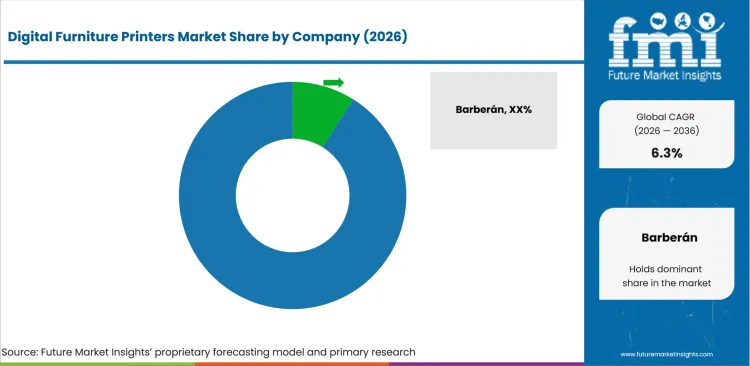
Furniture-surface integration separates the competitive field more clearly than printer specifications alone. Line commissioning raises entry barriers by requiring print quality to match board preparation, curing and downstream finishing. A printer fault on an integrated line can stop several linked stages, which makes local service response commercially important.
- Barberán, Cefla Finishing and Hymmen concentrate on integrated furniture-surface lines that coordinate printing with coating, texture, or panel transport.
- Durst, Agfa and Koenig & Bauer address higher-output industrial inkjet work with board, hybrid, or décor-web architectures.
- Mimaki and Roland DG provide flexible UV flatbed or hybrid routes for prototypes, short runs and lower-capacity direct-board production.
Competitive Benchmarking: Digital Furniture Printers Market
| Company | Industrial Throughput Evidence | Workflow / Line Integration | Application Breadth | Geographic Reach |
|---|---|---|---|---|
| Barberán | High | High | Medium | Europe and North America with international projects |
| Cefla Finishing | Medium | High | High | Europe, Americas and Asia |
| Hymmen | High | High | Medium | Europe and North America with international projects |
| Durst | High | High | High | Global |
| Agfa | High | High | High | Global |
| Koenig & Bauer | High | Medium | Medium | Global |
| Mimaki | Medium | Medium | High | Global distribution |
| Roland DG | Medium | Medium | High | Global dealer network |
Scoring basis: High industrial-throughput evidence requires a current automated, single-pass, or high-output production route. Medium reflects a narrower current production platform. High workflow integration requires documented automation, finishing, or line-control links. Medium records a more limited integration route. High application breadth requires several verified media, ink, or production uses. Medium identifies a narrower current set. Geographic reach records documented sales or service coverage and is not scored.
Key Developments in the Digital Furniture Printers Market
- In June 2026, Barberán and Fujifilm presented a technical preview of a fully digital single-pass UV route pairing high-speed color printing with digital varnish for rigid surfaces.
- In April 2026, Roland DG launched the EU2-1000MF direct-to-board UV flatbed printer, removing roll printing, laminating and mounting from workflows that decorate large rigid panels and related interior surfaces.
- In March 2026, Mimaki announced the UJ330H-160 hybrid UV inkjet printer for rigid board and roll media, with commercial sales scheduled to start in April 2026.
Key Players in the Digital Furniture Printers Market
Integrated Furniture Surface Lines
- Barberán
- Cefla Finishing
- Hymmen
High-Output Industrial Inkjet Platforms
- Durst
- Agfa
- Koenig & Bauer
Flexible UV and Hybrid Digital Systems
- Mimaki
- Roland DG
Digital Furniture Printers Market - Report Scope
| Coverage field | Report scope |
|---|---|
| Market breakdown | By printer type, ink type, substrate, end use, sales channel and region. |
| Quantitative Units | USD billion. |
| Market Definition | Commercial digital printer systems and integrated print-and-finish lines used to decorate furniture panels, cabinet fronts, doors and related interior surfaces. Finished-furniture revenue, stand-alone ink or coating revenue, analog presses, coating-only lines and additive furniture printing are excluded. |
| Regions Covered | North America, Latin America, Western Europe, Eastern Europe, East Asia, South Asia and Pacific and Middle East and Africa. |
| Countries Covered | Finland, Mexico, Brazil, Italy, USA, Germany, Japan and 25+ countries included in the full report. |
| Key Companies Profiled | Barberán, Cefla Finishing, Hymmen, Durst, Agfa, Koenig & Bauer, Mimaki and Roland DG. |
| Forecast Period | 2026 to 2036. |
| Approach | Primary and secondary research with market triangulation. |
Digital Furniture Printers Market - Research Methodology
| Method | Approach |
|---|---|
| Primary Research | FMI analysts gathered input from manufacturers, service providers, technology developers, distributors, end users, procurement teams and subject-matter experts. Interviews examined purchasing decisions, product or service evaluation, adoption barriers, approval requirements, pricing considerations and expectations for technical or commercial support. Respondents were also asked what evidence is required before a trial, pilot, or initial order develops into regular purchasing. |
| Desk Research | Desk research covered government statistics, regulatory publications, trade data, industry associations, technical literature, standards, company filings, product information and official corporate announcements. Sources were reviewed for relevance, publication date, geographic coverage and consistency with the defined market scope. Claims relating to performance, applications, approvals, capacity, investment and commercial activity were retained only when supported by credible public evidence. |
| Market Sizing and Forecasting | The market model combined the baseline value with historical performance, segment structure, pricing and volume indicators, adoption levels, company participation and country-level demand conditions. Forecast assumptions considered economic activity, investment trends, regulatory developments, technology adoption, purchasing cycles, supply availability and barriers to wider market use. Segment and regional estimates were reconciled before the final market total was calculated. |
| Data Validation | Estimates were checked against multiple independent indicators, including public data, company activity, trade patterns, industry developments and findings from primary interviews. Validation also tested whether products, services, applications and company revenues fell within the defined market boundaries. Adjacent categories, unsupported claims, overlapping revenues and activities without direct market relevance were excluded to reduce double counting and maintain consistency across segments and countries. |
Digital Furniture Printers Market by Segments
Digital Furniture Printers Market segmented by Printer Type:
- Flatbed UV printers
- Single-pass digital printers
- Inkjet décor printers
- Direct-to-panel printers
- Hybrid print-coat lines
Digital Furniture Printers Market segmented by Ink Type:
- UV-curable inks
- Water-based inks
- Pigment inks
- Solvent/eco-solvent inks
- Functional coatings
Digital Furniture Printers Market segmented by Substrate:
- MDF/HDF panels
- Particleboard
- Plywood
- Laminates
- Glass/metal furniture parts
Digital Furniture Printers Market segmented by End Use:
- Furniture panels
- Cabinet fronts
- Decorative wall panels
- Doors
- Custom interior panels
Digital Furniture Printers Market segmented by Sales Channel:
- Printer OEMs
- Furniture plant projects
- System integrators
- Aftermarket/service
Digital Furniture Printers Market by Region:
- North America
- United States
- Canada
- Latin America
- Brazil
- Mexico
- Argentina
- Chile
- Western Europe
- Germany
- France
- United Kingdom
- Italy
- Spain
- Benelux
- Nordics
- Eastern Europe
- Poland
- Czech Republic
- Romania
- Hungary
- East Asia
- China
- Japan
- South Korea
- South Asia and Pacific
- India
- ASEAN
- Australia and New Zealand
- Middle East and Africa
- GCC Countries
- South Africa
- Türkiye
- Israel
Research Sources and Bibliography
- Koenig & Bauer. (2026, March 26). Corporate structures 2025
- Statistisches Bundesamt (Destatis). (2025, March 20). Möbelindustrie verzeichnet 2024 Umsatzrückgang von 7,8 %
- Agfa. (2025, October 16). Cameron Advertising becomes first in North America to install Panthera flatbed printing system by Agfa
- Mimaki Engineering. (2025, October 21). Unlock new dimensions - The new standard in industrial printing: Launching Flatbed UV Inkjet Printer "UJF-7151 plusII e"
- Durst Group. (2025, November 14). Durst P5 SMP - The Game Changer in Large Format Printing
- Hymmen. (2026, June 17). Hymmen at IWF in Atlanta
- Roland DG. (2026, May 19). Roland DG Signals Strategic Expansion into Industrial Digital Printing with New Portfolio Preview
- USA Bureau of Labor Statistics. (2026, June 24). Productivity and Costs by Industry: Manufacturing and Mining Industries News Release - 2025 A01 Results
- Board of Governors of the Federal Reserve System. (2026, August 18). Industrial Production: Manufacturing: Durable Goods: Furniture and Related Product (NAICS = 337) (IPG337SQ)
- Hymmen. (2026, March 6). Advanced furniture production with Hymmen at MIKO Connect
- Statistics Finland. (2026, July 2). Value of sold output made an upturn in 2025
- INEGI. (2026, June 22). Indicadores de establecimientos con programa IMMEX: abril de 2026
- ABIMÓVEL. (2026, January 28). Exportações de móveis e colchões crescem 0,8% em 2025, aquém das expectativas para o ano
- ACIMALL. (2026, January 30). ACIMALL: PRELIMINARY 2025 BALANCE FOR WOOD AND FURNITURE TECHNOLOGY
- USA Bureau of Labor Statistics. (2026, August 21). Furniture and Related Product Manufacturing: NAICS 337
- German Furniture Industry Association. (2026, September 1). Deutsche Möbelindustrie verzeichnet im ersten Halbjahr 2026 ein Umsatzminus von 2,7 Prozent
- Ministry of Economy, Trade and Industry, Japan. (2026, February 16). 2025
- Fujifilm. (2026, June 23). Technical Preview: Industry-First Fully Digital Single-Pass UV Solution Advances High-Speed Print Production from Barberan and Fujifilm
- Roland DG. (2026, April 14). Roland DG launches EU2-1000MF, simplifying high-output board production with direct-to-board UV flatbed printing
- Mimaki Engineering. (2026, March 3). "Next Standard": Create a wide range of graphics in one machine, Launching Hybrid UV Inkjet Printer "UJ330H-160"
- Hymmen. (2026, January 20). Classen proves the capabilities of digital printing on industrial scale
- Roland DG. (2026, June 30). Roland DG introduces EUV-H, a new UV hard ink, unlocking durable, high-value applications for industrial printing
- Durst Group. (2026, May 18). Durst at FESPA 2026: One Integrated System. One Production Platform.
- Agfa. (2026, June 30). Sign & Display
- Fujifilm. (2025, July 16). Fujifilm rebrands HS Series as Acuity Aristo and hosts Barcelona Open House event
- Mimaki Engineering. (2026, February 10). Mimaki's Flagship LED-UV printer and UV-curable inks approved for the 3M™ MCS™ Warranty Program: Offers high application performance and long-term durability warranty
- Barberán. (2026, May 20). Open House Barberán
- Cefla. (2025, May 27). Cefla Finishing at LIGNA 2025: innovation, sustainability and digitalization take centre-stage
- Hymmen. (2025, May 5). Groundbreaking pilot project using smart2i
- Durst Group. (2025, April 28). Durst Group at FESPA 2025 - Innovations “Made in Durst”
- Agfa. (2026, July 3). Mauveworx Future-Proofs Production with Dual Agfa Tauro Investment
- Koenig & Bauer. (2026, June 25). Koenig & Bauer and INX Forge Global Alliance for More Profitable and Sustainable LED/UV Printing
- Mimaki Engineering. (2025, May 1). Mimaki launches "ELH" and "ELS," Next generation UV-curable inks Even more friendly to people and the environment
- Roland DG. (2026, January 8). Roland DG announces global distribution partnership with LSINC, expanding access to industrial direct-to-object printing worldwide
This bibliography is provided for reader reference and is not exhaustive. The full report contains the complete reference list and detailed citations.
This Report Answers
- What are the 2026 and 2036 market values?
- Why do short furniture runs improve digital décor economics?
- Why do flatbed UV printers lead printer type?
- Why do UV-curable inks lead ink type?
- Why do MDF/HDF panels lead substrate demand?
- How do profiled country CAGRs differ?
- Which companies serve the main digital printing routes?
- Which integration and service conditions slow adoption?
Frequently Asked Questions
How big is the Digital Furniture Printers Market in 2026?
The digital furniture printers market is valued at USD 3.1 billion in 2026 and is projected to reach USD 5.7 billion by 2036. File-driven décor cuts setup work and slow-design inventory.
What is the CAGR of the Digital Furniture Printers Market from 2026 to 2036?
The digital furniture printers market is projected to grow at a CAGR of 6.3% between 2026 and 2036. Shorter décor cycles and direct-board printing support plants carrying more product variants.
Which printer type leads the Digital Furniture Printers Market?
The flatbed UV printers segment is expected to hold 33.0% of the digital furniture printers market in 2026, attributable to direct rigid-board handling. Immediate curing lets printed panels proceed quickly into inspection or finishing.
Which ink type leads the Digital Furniture Printers Market?
The UV-curable inks segment is projected to account for 42.0% of the digital furniture printers market in 2026, supported by rapid curing on rigid media. Shorter post-print dwell time improves board handling before the next finishing stage.
Which countries are projected to record the highest growth in the Digital Furniture Printers Market?
Finland is projected to grow at 6.3% CAGR, followed by Mexico at 5.9% and Brazil at 5.6% through 2036. Automation fit, export production, financing and service coverage shape conversion differently by country.
Which companies are active in the Digital Furniture Printers Market?
Key companies operating in the digital furniture printers market include Barberán, Cefla Finishing, Hymmen, Durst, Agfa, Koenig & Bauer, Mimaki and Roland DG. Their positions differ by furniture-line integration, industrial inkjet scale and flexible UV systems.
Preview the report firsthand - request a free sample
Get SampleGet the brochure for pricing and purchase details.
Get PDFTable of Content
- Key Takeaways
- Market Size and CAGR
- Top Growth Driver
- Fastest Growing Segment
- Leading Region
- Key Companies
- Emerging Opportunities
- Executive Summary
- Global Market Outlook
- Demand-side Trends
- Supply-side Trends
- Technology Roadmap Analysis
- Analysis and Recommendations
- Analyst Perspective (What is happening? Why now? What should investors know?)
- Key Questions Answered
- How large is the market?
- What is the CAGR?
- What are key trends?
- Which region dominates?
- Who are the leaders?
- Market Overview
- Market Coverage / Taxonomy
- Market Definition / Scope / Limitations
- Research Methodology
- Chapter Orientation
- Analytical Lens and Working Hypotheses
- Market Structure, Signals, and Trend Drivers
- Benchmarking and Cross-market Comparability
- Market Sizing, Forecasting, and Opportunity Mapping
- Research Design and Evidence Framework
- Desk Research Programme (Secondary Evidence)
- Expert Input and Fieldwork (Primary Evidence)
- Tooling, Models, and Reference Databases
- Data Engineering and Model Build
- Quality Assurance and Audit Trail
- Market Background
- Market Dynamics (Drivers, Restraints, Opportunity, Trends)
- Scenario Forecast (Optimistic, Likely, Conservative)
- Impact Analysis
- AI Impact
- Sustainability Impact
- Regulatory Impact
- Technology Impact
- Consumer / Buyer Analysis
- Purchase Drivers
- Adoption Barriers
- Buyer Journey
- Opportunity Map Analysis
- Product Life Cycle Analysis
- Supply Chain Analysis
- Investment Feasibility Matrix
- Value Chain Analysis
- PESTLE and Porter's Analysis
- Regulatory Landscape
- Regional Parent Market Outlook
- Production and Consumption Statistics
- Import and Export Statistics
- Global Market Analysis and Forecast, 2021 to 2036
- Historical Market Size Value (USD Billion) Analysis, 2021 to 2025
- Current and Future Market Size Value (USD Billion) Projections, 2026 to 2036
- Y-o-Y Growth Trend Analysis
- Absolute $ Opportunity Analysis
- Global Market Pricing Analysis, 2021 to 2036
- Global Market Analysis and Forecast, By Printer Type, 2021 to 2036
- Introduction / Key Findings
- Historical Market Size Value (USD Billion) Analysis By Printer Type, 2021 to 2025
- Current and Future Market Size Value (USD Billion) Analysis and Forecast By Printer Type, 2026 to 2036
- Flatbed UV printers
- Single-pass digital printers
- Inkjet décor printers
- Direct-to-panel printers
- Hybrid print-coat lines
- Flatbed UV printers
- Y-o-Y Growth Trend Analysis By Printer Type, 2021 to 2025
- Absolute $ Opportunity Analysis By Printer Type, 2026 to 2036
- Global Market Analysis and Forecast, By Ink Type, 2021 to 2036
- Introduction / Key Findings
- Historical Market Size Value (USD Billion) Analysis By Ink Type, 2021 to 2025
- Current and Future Market Size Value (USD Billion) Analysis and Forecast By Ink Type, 2026 to 2036
- UV-curable inks
- Water-based inks
- Pigment inks
- Solvent/eco-solvent inks
- Functional coatings
- UV-curable inks
- Y-o-Y Growth Trend Analysis By Ink Type, 2021 to 2025
- Absolute $ Opportunity Analysis By Ink Type, 2026 to 2036
- Global Market Analysis and Forecast, By Substrate, 2021 to 2036
- Introduction / Key Findings
- Historical Market Size Value (USD Billion) Analysis By Substrate, 2021 to 2025
- Current and Future Market Size Value (USD Billion) Analysis and Forecast By Substrate, 2026 to 2036
- MDF/HDF panels
- Particleboard
- Plywood
- Laminates
- Glass/metal furniture parts
- MDF/HDF panels
- Y-o-Y Growth Trend Analysis By Substrate, 2021 to 2025
- Absolute $ Opportunity Analysis By Substrate, 2026 to 2036
- Global Market Analysis and Forecast, By End Use, 2021 to 2036
- Introduction / Key Findings
- Historical Market Size Value (USD Billion) Analysis By End Use, 2021 to 2025
- Current and Future Market Size Value (USD Billion) Analysis and Forecast By End Use, 2026 to 2036
- Furniture panels
- Cabinet fronts
- Decorative wall panels
- Doors
- Custom interior panels
- Furniture panels
- Y-o-Y Growth Trend Analysis By End Use, 2021 to 2025
- Absolute $ Opportunity Analysis By End Use, 2026 to 2036
- Global Market Analysis and Forecast, By Sales Channel, 2021 to 2036
- Introduction / Key Findings
- Historical Market Size Value (USD Billion) Analysis By Sales Channel, 2021 to 2025
- Current and Future Market Size Value (USD Billion) Analysis and Forecast By Sales Channel, 2026 to 2036
- Printer OEMs
- Furniture plant projects
- System integrators
- Aftermarket/service
- Printer OEMs
- Y-o-Y Growth Trend Analysis By Sales Channel, 2021 to 2025
- Absolute $ Opportunity Analysis By Sales Channel, 2026 to 2036
- Global Market Analysis and Forecast, By Region, 2021 to 2036
- Introduction
- Historical Market Size Value (USD Billion) Analysis By Region, 2021 to 2025
- Current Market Size Value (USD Billion) Analysis and Forecast By Region, 2026 to 2036
- North America
- Latin America
- Western Europe
- Eastern Europe
- East Asia
- South Asia and Pacific
- Middle East & Africa
- Market Attractiveness Analysis By Region
- North America Market Analysis and Forecast, By Country, 2021 to 2036
- Historical Market Size Value (USD Billion) Trend Analysis By Market Taxonomy, 2021 to 2025
- Market Size Value (USD Billion) Forecast By Market Taxonomy, 2026 to 2036
- By Country
- USA
- Canada
- By Printer Type
- By Ink Type
- By Substrate
- By End Use
- By Sales Channel
- By Country
- Market Attractiveness Analysis
- By Country
- By Printer Type
- By Ink Type
- By Substrate
- By End Use
- By Sales Channel
- Key Takeaways
- Latin America Market Analysis and Forecast, By Country
- Historical Market Size Value (USD Billion) Trend Analysis By Market Taxonomy, 2021 to 2025
- Market Size Value (USD Billion) Forecast By Market Taxonomy, 2026 to 2036
- By Country
- Brazil
- Mexico
- Chile
- Rest of Latin America
- By Printer Type
- By Ink Type
- By Substrate
- By End Use
- By Sales Channel
- By Country
- Market Attractiveness Analysis
- By Country
- By Printer Type
- By Ink Type
- By Substrate
- By End Use
- By Sales Channel
- Key Takeaways
- Western Europe Market Analysis and Forecast, By Country
- Historical Market Size Value (USD Billion) Trend Analysis By Market Taxonomy, 2021 to 2025
- Market Size Value (USD Billion) Forecast By Market Taxonomy, 2026 to 2036
- By Country
- Germany
- UK
- Italy
- Spain
- France
- Nordic
- BENELUX
- Rest of Western Europe
- By Printer Type
- By Ink Type
- By Substrate
- By End Use
- By Sales Channel
- By Country
- Market Attractiveness Analysis
- By Country
- By Printer Type
- By Ink Type
- By Substrate
- By End Use
- By Sales Channel
- Key Takeaways
- Eastern Europe Market Analysis and Forecast, By Country
- Historical Market Size Value (USD Billion) Trend Analysis By Market Taxonomy, 2021 to 2025
- Market Size Value (USD Billion) Forecast By Market Taxonomy, 2026 to 2036
- By Country
- Russia
- Poland
- Hungary
- Balkan & Baltic
- Rest of Eastern Europe
- By Printer Type
- By Ink Type
- By Substrate
- By End Use
- By Sales Channel
- By Country
- Market Attractiveness Analysis
- By Country
- By Printer Type
- By Ink Type
- By Substrate
- By End Use
- By Sales Channel
- Key Takeaways
- East Asia Market Analysis and Forecast, By Country
- Historical Market Size Value (USD Billion) Trend Analysis By Market Taxonomy, 2021 to 2025
- Market Size Value (USD Billion) Forecast By Market Taxonomy, 2026 to 2036
- By Country
- China
- Japan
- South Korea
- By Printer Type
- By Ink Type
- By Substrate
- By End Use
- By Sales Channel
- By Country
- Market Attractiveness Analysis
- By Country
- By Printer Type
- By Ink Type
- By Substrate
- By End Use
- By Sales Channel
- Key Takeaways
- South Asia and Pacific Market Analysis and Forecast, By Country
- Historical Market Size Value (USD Billion) Trend Analysis By Market Taxonomy, 2021 to 2025
- Market Size Value (USD Billion) Forecast By Market Taxonomy, 2026 to 2036
- By Country
- India
- ASEAN
- Australia & New Zealand
- Rest of South Asia and Pacific
- By Printer Type
- By Ink Type
- By Substrate
- By End Use
- By Sales Channel
- By Country
- Market Attractiveness Analysis
- By Country
- By Printer Type
- By Ink Type
- By Substrate
- By End Use
- By Sales Channel
- Key Takeaways
- Middle East & Africa Market Analysis and Forecast, By Country
- Historical Market Size Value (USD Billion) Trend Analysis By Market Taxonomy, 2021 to 2025
- Market Size Value (USD Billion) Forecast By Market Taxonomy, 2026 to 2036
- By Country
- Kingdom of Saudi Arabia
- Other GCC Countries
- Türkiye
- South Africa
- Other African Union
- Rest of Middle East & Africa
- By Printer Type
- By Ink Type
- By Substrate
- By End Use
- By Sales Channel
- By Country
- Market Attractiveness Analysis
- By Country
- By Printer Type
- By Ink Type
- By Substrate
- By End Use
- By Sales Channel
- Key Takeaways
- Key Countries Market Analysis
- USA
- Pricing Analysis
- Market Share Analysis, 2025
- By Printer Type
- By Ink Type
- By Substrate
- By End Use
- By Sales Channel
- Canada
- Pricing Analysis
- Market Share Analysis, 2025
- By Printer Type
- By Ink Type
- By Substrate
- By End Use
- By Sales Channel
- Mexico
- Pricing Analysis
- Market Share Analysis, 2025
- By Printer Type
- By Ink Type
- By Substrate
- By End Use
- By Sales Channel
- Brazil
- Pricing Analysis
- Market Share Analysis, 2025
- By Printer Type
- By Ink Type
- By Substrate
- By End Use
- By Sales Channel
- Chile
- Pricing Analysis
- Market Share Analysis, 2025
- By Printer Type
- By Ink Type
- By Substrate
- By End Use
- By Sales Channel
- Germany
- Pricing Analysis
- Market Share Analysis, 2025
- By Printer Type
- By Ink Type
- By Substrate
- By End Use
- By Sales Channel
- UK
- Pricing Analysis
- Market Share Analysis, 2025
- By Printer Type
- By Ink Type
- By Substrate
- By End Use
- By Sales Channel
- Italy
- Pricing Analysis
- Market Share Analysis, 2025
- By Printer Type
- By Ink Type
- By Substrate
- By End Use
- By Sales Channel
- Spain
- Pricing Analysis
- Market Share Analysis, 2025
- By Printer Type
- By Ink Type
- By Substrate
- By End Use
- By Sales Channel
- France
- Pricing Analysis
- Market Share Analysis, 2025
- By Printer Type
- By Ink Type
- By Substrate
- By End Use
- By Sales Channel
- India
- Pricing Analysis
- Market Share Analysis, 2025
- By Printer Type
- By Ink Type
- By Substrate
- By End Use
- By Sales Channel
- ASEAN
- Pricing Analysis
- Market Share Analysis, 2025
- By Printer Type
- By Ink Type
- By Substrate
- By End Use
- By Sales Channel
- Australia & New Zealand
- Pricing Analysis
- Market Share Analysis, 2025
- By Printer Type
- By Ink Type
- By Substrate
- By End Use
- By Sales Channel
- China
- Pricing Analysis
- Market Share Analysis, 2025
- By Printer Type
- By Ink Type
- By Substrate
- By End Use
- By Sales Channel
- Japan
- Pricing Analysis
- Market Share Analysis, 2025
- By Printer Type
- By Ink Type
- By Substrate
- By End Use
- By Sales Channel
- South Korea
- Pricing Analysis
- Market Share Analysis, 2025
- By Printer Type
- By Ink Type
- By Substrate
- By End Use
- By Sales Channel
- Russia
- Pricing Analysis
- Market Share Analysis, 2025
- By Printer Type
- By Ink Type
- By Substrate
- By End Use
- By Sales Channel
- Poland
- Pricing Analysis
- Market Share Analysis, 2025
- By Printer Type
- By Ink Type
- By Substrate
- By End Use
- By Sales Channel
- Hungary
- Pricing Analysis
- Market Share Analysis, 2025
- By Printer Type
- By Ink Type
- By Substrate
- By End Use
- By Sales Channel
- Kingdom of Saudi Arabia
- Pricing Analysis
- Market Share Analysis, 2025
- By Printer Type
- By Ink Type
- By Substrate
- By End Use
- By Sales Channel
- Türkiye
- Pricing Analysis
- Market Share Analysis, 2025
- By Printer Type
- By Ink Type
- By Substrate
- By End Use
- By Sales Channel
- South Africa
- Pricing Analysis
- Market Share Analysis, 2025
- By Printer Type
- By Ink Type
- By Substrate
- By End Use
- By Sales Channel
- USA
- Market Structure Analysis
- Competition Dashboard
- Competition Benchmarking
- Market Share Analysis of Top Players
- By Regional
- By Printer Type
- By Ink Type
- By Substrate
- By End Use
- By Sales Channel
- Emerging Startups
- Innovation Benchmarking
- Competition Analysis
- Competition Deep Dive
- Barberán
- Overview
- Product Portfolio
- Profitability by Market Segments
- Sales Footprint
- Strategy Overview
- Marketing Strategy
- Product Strategy
- Channel Strategy
- Cefla Finishing
- Hymmen
- EFI
- Durst
- Agfa
- Koenig & Bauer Kammann
- Mimaki
- Roland DG
- Inca Digital / Agfa
- Barberán
- Case Studies
- Success Stories
- Recent Developments
- Competition Deep Dive
- Assumptions & Acronyms Used


