

- Industry Size (2026)
- USD 920.2 Mn
- Forecast (2036)
- USD 1793.3 Mn
- CAGR (2026 to 2036)
- 6.9%
Dilators Needles Market Forecast and Outlook 2026 to 2036
The dilators needles market is estimated at USD 920.2 million in 2026 and is expected to reach USD 1,793.3 million by 2036, reflecting a CAGR of 6.9%. Balloon dilators are predominantly used in urology procedures, while mechanical dilators and specialty needles serve gynecology, gastrointestinal, and other clinical applications. Hospitals remain the primary end users, supported by ambulatory surgery centers and clinics. Leading companies driving growth include Boston Scientific, Cook Medical, Medtronic, Olympus, and BD. Rising demand stems from increasing procedural volumes and evolving minimally invasive techniques.
Growth is fueled by advancements in dilator and needle technologies that enhance precision, safety, and patient comfort. Expanding healthcare infrastructure globally, coupled with greater adoption in outpatient and specialized clinical settings, supports market expansion. Continuous product innovation, along with training programs for healthcare professionals, ensures reliable usage and procedural efficiency. The combination of growing clinical demand and technological progress sustains the market’s trajectory through 2036.
Quick Stats for Dilators Needles Market
- Dilators Needles Market Value (2026): USD 920.2 million
- Dilators Needles Market Forecast Value (2036): USD 1,793.3 million
- Dilators Needles Market Forecast CAGR: 6.9%
- Leading Type in Dilators Needles Market: Balloon Dilators
- Key Growth Regions in Dilators Needles Market: North America, Europe, and Asia Pacific
- Top Players in Dilators Needles Market: Boston Scientific, Cook Medical, Medtronic, Olympus, BD
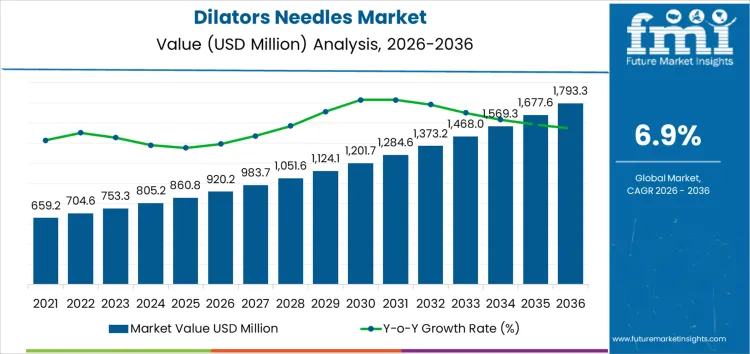
What is the Growth Forecast for the Dilators Needles Market through 2036?
From 2026 to 2031, the Dilators Needles market grows from USD 920.2 million to approximately USD 1,206.2 million, representing the early adoption phase. Annual increments increase from USD 60.2 million in 2026 to USD 78.9 million in 2031. Growth is driven by hospitals, specialty clinics, and minimally invasive procedure centers where dilators and needles are critical for gynecology, urology, and interventional procedures. North America and Europe account for roughly 65% of early adoption, supported by procedural volumes, regulatory compliance, and clinician training programs. Emerging adoption is observed in Asia Pacific and Latin America, initially focused on high-volume urban hospitals.
Between 2031 and 2036, the market expands from roughly USD 1,206.2 million to USD 1,808.5 million, illustrating the late adoption phase characterized by broader commercialization. Annual increments increase from USD 78.9 million to USD 117.0 million, supported by repeat procurement, multi-site deployments, and expansion into emerging markets. Growth is reinforced by product innovation, improved material technologies, and integration with advanced minimally invasive devices. Early growth relied on selective high-value hospitals and pilot projects, whereas later expansion reflects structural adoption across global healthcare facilities and portfolio-wide deployment by leading players.
Dilators Needles Market Key Takeaways
| Metric | Value |
|---|---|
| Market Value (2026) | USD 920.2 million |
| Forecast Value (2036) | USD 1,793.3 million |
| Forecast CAGR (2026 to 2036) | 6.9% |
What Factors Are Driving Growth in the Dilators and Needles Market?
Market growth is being driven by sustained expansion of minimally invasive procedures across diagnostic, interventional, and surgical care. Clinicians increasingly rely on controlled access tools to reduce tissue trauma and procedural risk. Higher volumes of vascular access, biopsy, catheter placement, and image guided interventions are raising baseline demand. Device selection is influenced by accuracy, consistency, and ease of handling during complex procedures. Hospitals and ambulatory centres are standardising single use sterile needles and dilators to limit infection exposure. Training protocols now emphasise precision access techniques, reinforcing routine use. Together, these factors increase procedural reliance on specialised dilators and needles.
Future growth reflects structural changes in care delivery and device expectations rather than simple procedure volume increases. Healthcare systems prioritise efficiency, complication reduction, and predictable outcomes under cost pressure. This shifts procurement toward devices that integrate smoothly with imaging systems and minimally invasive workflows. Advancements in needle geometry, surface coatings, and dilator flexibility support safer access with lower insertion force. Regulatory emphasis on traceability, biocompatibility, and sterility further favours modern device designs. Expansion of outpatient surgery and interventional clinics accelerates adoption of reliable access tools. Market growth follows protocol driven standardisation and performance based purchasing across clinical settings.
What Factors Are Affecting the Demand for Dilators Needles Market in Terms of Product Type and Application?
The dilators needles market is shaped by procedural volume growth, preference for minimally invasive techniques, and expanding use across urology, gynecology, and gastrointestinal interventions. Demand concentrates on devices that offer controlled dilation, procedural safety, and compatibility with image guided techniques. Market leadership reflects clinical effectiveness and procedural reliability rather than device diversity. Adoption patterns are influenced by specialty specific workflows, patient safety considerations, and physician familiarity with established dilation methods.
What Is Driving Leadership by Product Type in the Dilators Needles Market?
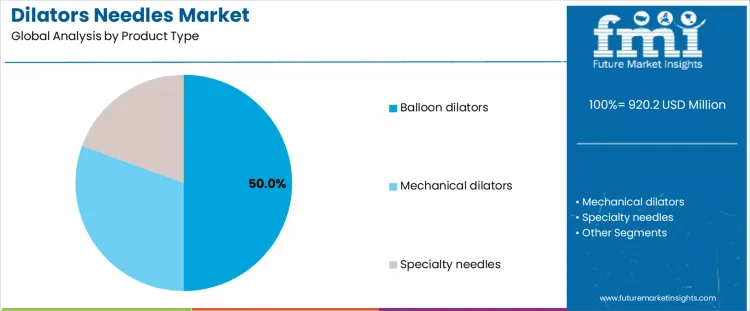
Balloon dilators account for about 50% of demand because they provide controlled, uniform dilation with reduced trauma to surrounding tissue. Their ability to apply radial force evenly makes them suitable for delicate anatomical structures and minimizes perforation risk. Clinicians favor balloon dilators in procedures requiring precision and predictability, particularly in minimally invasive settings. These devices also integrate well with fluoroscopic and endoscopic guidance, supporting accurate placement. Mechanical dilators remain in use where gradual, tactile dilation is preferred and cost sensitivity is higher. They are commonly selected in settings with established protocols and lower reliance on advanced imaging. Specialty needles support access and guidance in complex procedures but serve narrower indications. Product type leadership is therefore driven by safety profile, procedural control, and adaptability to minimally invasive techniques rather than device simplicity or lower upfront cost alone.
Balloon dilators also benefit from growing adoption of outpatient procedures, where reduced complication risk is critical. Mechanical options persist but are gradually displaced in high risk applications. Specialty needles remain adjunctive rather than primary drivers of demand.
What Is Driving Leadership by Application in the Dilators Needles Market?
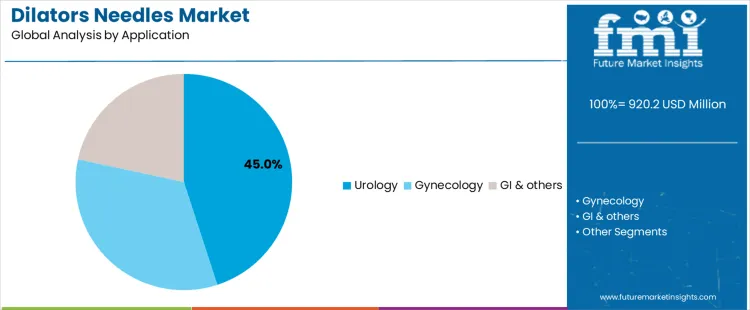
Urology accounts for about 45% of demand because dilation is central to managing strictures, obstructions, and access challenges within the urinary tract. Procedures such as ureteral dilation and nephrostomy access rely heavily on precise dilation tools, supporting consistent utilization. Balloon dilators are particularly favored in urology due to narrow luminal anatomy and sensitivity to tissue damage. Gynecology represents a significant secondary application, where cervical dilation and access procedures drive demand, often using both mechanical and balloon based devices. Gastrointestinal and other applications rely on dilators for endoscopic access but account for a smaller share due to lower procedural frequency.
Urology leadership reflects high intervention volumes and reliance on minimally invasive approaches. Gynecologic use remains steady but less frequent. GI applications are procedure specific. Application dominance therefore reflects procedural dependence and anatomical sensitivity rather than overall patient population size.
How Is the Dilators Needles Market Being Applied Across Gynecology and Urology Procedures?
Use appears in hospitals, clinics, and surgical centers where precise tissue dilation and access are required. Gynecologists use dilator needles during intrauterine procedures, embryo transfer, or hysteroscopic access. Urologists apply them in minimally invasive procedures such as percutaneous nephrolithotomy or catheterization. Medical device manufacturers design needles for controlled diameter expansion, minimal trauma, and compatibility with imaging or guide systems. These applications reflect operational and procedural priorities rather than aesthetic purposes, with adoption driven by safety, procedural accuracy, and patient outcomes.
What Operational and Material Conditions Support Adoption of Dilator Needles?
Selection aligns with sterile, biocompatible materials such as stainless steel or coated alloys that maintain sharpness and structural integrity. Surgical teams require needles compatible with standard guidewires, dilators, or catheters. Precision manufacturing ensures consistent diameter, taper, and surface finish to reduce tissue trauma. Hospitals integrate needles into procedural kits and maintain strict sterilization, storage, and handling protocols. These conditions emerge from operational reliability, procedural safety, and patient care priorities in structured clinical workflows.
Which Practical Considerations Limit Wider Use of Dilator Needles?
High-quality materials and precision manufacturing increase device cost, limiting adoption in low-resource facilities. Incorrect sizing or handling can lead to tissue injury. Sterility must be maintained throughout packaging, storage, and use. Compatibility with different procedural kits or imaging guidance systems may restrict usage. These factors lead to selective deployment where procedural accuracy, patient safety, and operational efficiency justify incremental cost and careful workflow management.
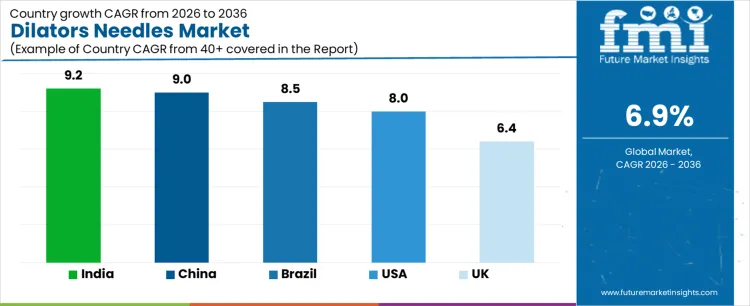
What is the Demand for Dilators and Needles by Country?
| Country | CAGR (%) |
|---|---|
| USA | 8.0% |
| Brazil | 8.5% |
| China | 9.0% |
| India | 9.2% |
| UK | 6.4% |
The demand for dilators and needles varies across countries, driven by surgical procedures, medical device adoption, and healthcare infrastructure expansion. India leads with a 9.2% CAGR, supported by growing surgical volumes, increasing hospital capacity, and adoption of minimally invasive procedures. China follows at 9.0%, driven by large healthcare facilities, rising procedure volumes, and expanding access to medical devices. Brazil records 8.5%, shaped by improving healthcare access and hospital infrastructure. The USA grows at 8.0%, reflecting steady adoption in hospitals and specialized surgical clinics. The UK posts 6.4%, supported by mature healthcare systems and consistent usage of dilators and needle devices.
How Is the Dilators Needles Market Expanding in the United States?
In the United States, revenue from the Dilators Needles Market is growing at a CAGR of 8% through 2036, driven by increasing adoption in gynecological, urological, and minimally invasive surgical procedures. Hospitals, specialty clinics, and outpatient care centers are integrating precision dilators and needles to improve procedural accuracy, patient safety, and treatment outcomes. Demand is concentrated in surgical units, diagnostic facilities, and specialty hospitals. Domestic suppliers provide high-performance, medical-grade dilators and needles compatible with standard surgical protocols and sterilization requirements. Rising procedural volumes, regulatory compliance, and recurring device use are sustaining predictable adoption nationwide.
- Surgical units, diagnostic facilities, and specialty hospitals drive adoption
- Dilators and needles improve procedural accuracy and patient safety
- Domestic suppliers provide medical-grade, protocol-compatible devices
- Recurring procedural use sustains predictable adoption
How Are Surgical Standards Supporting Growth in Brazil?
In Brazil, the market is growing at a CAGR of 8.5% through 2036, supported by increasing procedural volumes in hospitals, specialty clinics, and minimally invasive surgery centers. Manufacturers are providing high-quality dilators and needles to enhance accuracy, reduce patient risk, and maintain compliance with medical regulations. Demand is concentrated in hospitals, gynecology and urology clinics, and surgical centers. Local suppliers deliver devices compatible with existing surgical protocols and sterilization standards. Expansion of healthcare infrastructure, regulatory oversight, and recurring device usage are sustaining adoption nationwide.
- Hospitals, surgical centers, and specialty clinics drive adoption
- Dilators and needles enhance accuracy and reduce patient risk
- Local suppliers provide medical-grade, compliant devices
- Recurring device usage sustains adoption
How Is Surgical Infrastructure Expansion Accelerating Adoption in China?
China is witnessing growth at a CAGR of 9% through 2036, driven by increasing adoption of minimally invasive surgeries and procedural precision tools. Manufacturers are integrating dilators and needles into surgical and diagnostic workflows to improve patient outcomes and efficiency. Demand is concentrated in tertiary hospitals, specialty surgical centers, and urban clinics. Domestic suppliers are scaling production of high-performance, medical-grade devices compatible with surgical protocols and sterilization procedures. Expanding healthcare infrastructure, increasing surgical volumes, and recurring procedural use are sustaining rapid adoption nationwide.
- Tertiary hospitals, surgical centers, and urban clinics drive adoption
- Dilators and needles improve patient outcomes and procedural efficiency
- Domestic suppliers scale high-performance, medical-grade devices
- Recurring procedural use sustains rapid adoption
How Is Healthcare and Surgical Expansion Supporting Growth in India?
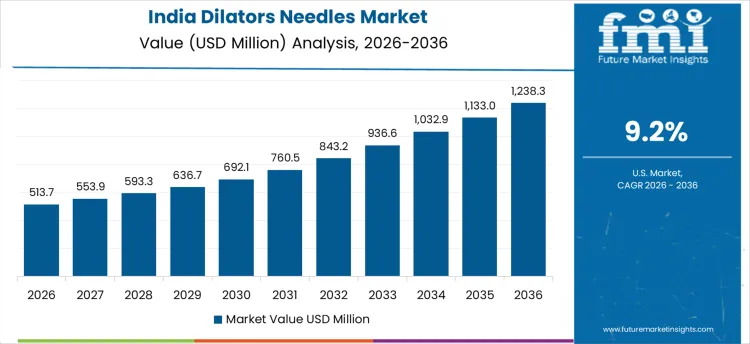
In India, revenue from the Dilators Needles Market is expanding at a CAGR of 9.2% through 2036, supported by growing hospital infrastructure, outpatient surgical services, and gynecological and urological care. Manufacturers are adopting precision dilators and needles to improve procedural accuracy, patient safety, and surgical outcomes. Demand is concentrated in specialty hospitals, clinics, and surgical units. Domestic suppliers provide high-performance, medical-grade devices compatible with standard surgical protocols. Expansion of healthcare services, regulatory compliance, and recurring device usage are sustaining robust adoption nationwide.
- Specialty hospitals, clinics, and surgical units drive adoption
- Dilators and needles improve procedural accuracy and patient safety
- Domestic suppliers provide medical-grade, high-performance devices
- Recurring device usage sustains robust adoption
How Are Clinical Protocols Supporting Adoption in the United Kingdom?
In the United Kingdom, the market is growing at a CAGR of 6.4% through 2036, driven by adoption of dilators and needles in hospitals, specialty clinics, and outpatient surgical centers. Manufacturers are providing high-quality devices to improve procedural accuracy, patient safety, and compliance with medical standards. Demand is concentrated in gynecology, urology, and minimally invasive surgery units. Domestic suppliers provide medical-grade, protocol-compatible dilators and needles suitable for standard sterilization and clinical workflows. Procedural volume, regulatory compliance, and recurring device use are sustaining consistent procurement nationwide.
- Gynecology, urology, and minimally invasive surgery units drive adoption
- Devices improve procedural accuracy, patient safety, and compliance
- Domestic suppliers provide protocol-compatible, medical-grade devices
- Recurring device use sustains consistent procurement
Which Strategic Approaches Are Companies Using to Compete in The Dilators Needles Market Across Interventional Procedures?
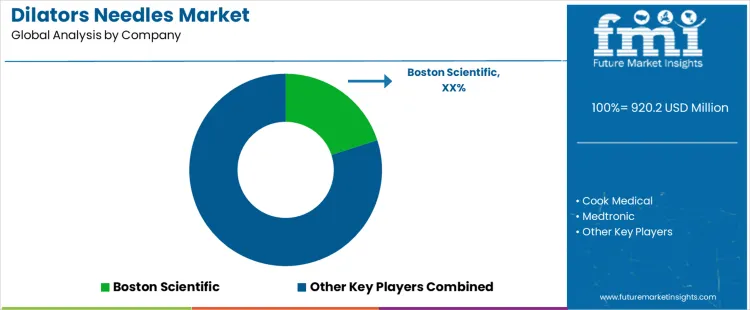
Competition in the Dilators Needles Market is shaped by procedural integration and physician preference rather than standalone device innovation. Boston Scientific, Cook Medical, and Medtronic pursue strategies centered on embedding dilators and access needles within broader interventional portfolios used in urology, cardiology, and minimally invasive surgery. By aligning these products with guidewires, sheaths, and delivery systems, they reduce variability during access steps and reinforce clinician familiarity.
Olympus approaches the market through endoscopy aligned access solutions, where compatibility with visualization platforms influences selection. BD competes through reliability, standardization, and scale, supplying needles and access components used widely in hospitals and ambulatory settings. Purchasing decisions emphasize tactile feedback, dimensional consistency, and predictable performance under imaging guidance rather than design novelty.
Regulatory positioning and clinical trust define longer term strategy. Leading suppliers prioritize incremental refinements that preserve existing approvals while improving ease of use and safety margins. Training programs, procedural kits, and standardized configurations are used to reinforce repeat adoption and simplify inventory management for hospitals. Smaller participants typically enter through niche indications or regional distribution rather than direct competition with integrated system providers.
Across the market, strategies focus on minimizing procedural risk, supporting workflow efficiency, and maintaining strong relationships with clinicians. Competitive advantage is sustained through consistent manufacturing quality, alignment with procedural standards, and long qualification cycles that limit rapid supplier substitution.
Key Players in the Dilators Needles Market
- Boston Scientific
- Cook Medical
- Medtronic
- Olympus
- BD
- Others
Scope of the Report
| Items | Values |
|---|---|
| Quantitative Units (2026) | USD million |
| Product Type | Balloon dilators, Mechanical dilators, Specialty needles |
| Application | Urology, Gynecology, GI & others |
| End-Use Industry | Hospitals, ASCs, Clinics |
| Region | Asia Pacific (China, Japan, South Korea, India, Australia & New Zealand, ASEAN, Rest of Asia Pacific), Europe (Germany, UK, France, Italy, Spain, Nordic, BENELUX, Rest of Europe), North America (United States, Canada, Mexico), Latin America (Brazil, Chile, Rest of Latin America), Middle East & Africa (KSA, Other GCC, Turkey, South Africa, Other African Union, Rest of MEA) |
| Key Companies Profiled | Boston Scientific, Cook Medical, Medtronic, Olympus, BD, Others |
| Additional Attributes | Dollar by sales by product type, Dollar by sales by application, Dollar by sales by end-user, Dollar by sales by region, Annual procurement cycles, Procedural volume coverage, Device precision and control ratings, Sterility and biocompatibility compliance, Material durability and coating technology, Compatibility with imaging and guide systems, Training and handling programs, Repeat procurement frequency, Integration with minimally invasive procedural kits, Domestic vs. imported product distribution, Supply chain reliability and batch traceability, Regulatory adherence (FDA, ISO, CE), Adoption by specialty surgical units, Hospital inventory stocking levels, Operational efficiency metrics |
Dilators Needles Market Segmentation
By Product Type:
- Balloon dilators
- Mechanical dilators
- Specialty needles
By Application:
- Urology
- Gynecology
- GI & others
By End User:
- Hospitals
- ASCs
- Clinics
By Region:
- Asia Pacific
- China
- Japan
- South Korea
- India
- Australia & New Zealand
- ASEAN
- Rest of Asia Pacific
- Europe
- Germany
- United Kingdom
- France
- Italy
- Spain
- Nordic
- BENELUX
- Rest of Europe
- North America
- United States
- Canada
- Mexico
- Latin America
- Brazil
- Chile
- Rest of Latin America
- Middle East & Africa
- Kingdom of Saudi Arabia
- Other GCC Countries
- Turkey
- South Africa
- Other African Union
- Rest of Middle East & Africa
Bibliography
- Lammer, J., Hausegger, K. A., Flückiger, F., Waltman, A. C., & McLean, G. K. (1999). Balloon dilatation of benign and malignant ureteral strictures: Results of a multicenter study. Radiology, 211(1), 189-197.
- Vesely, T. M. (2003). Central venous catheter tip position: A continuing controversy. Journal of Vascular and Interventional Radiology, 14(5), 527-534.
Frequently Asked Questions
How big is the dilators needles market in 2026?
The global dilators needles market is estimated to be valued at USD 920.2 million in 2026.
What will be the size of dilators needles market in 2036?
The market size for the dilators needles market is projected to reach USD 1,793.3 million by 2036.
How much will be the dilators needles market growth between 2026 and 2036?
The dilators needles market is expected to grow at a 6.9% CAGR between 2026 and 2036.
What are the key product types in the dilators needles market?
The key product types in dilators needles market are balloon dilators, mechanical dilators and specialty needles.
Which application segment to contribute significant share in the dilators needles market in 2026?
In terms of application, urology segment to command 45.0% share in the dilators needles market in 2026.
Preview the report firsthand - request a free sample
Get SampleGet the brochure for pricing and purchase details.
Get PDFTable of Content
- Executive Summary
- Global Market Outlook
- Demand-side Trends
- Supply-side Trends
- Technology Roadmap Analysis
- Analysis and Recommendations
- Market Overview
- Market Coverage / Taxonomy
- Market Definition / Scope / Limitations
- Market Background
- Market Dynamics
- Drivers
- Restraints
- Opportunity
- Trends
- Scenario Forecast
- Demand in Optimistic Scenario
- Demand in Likely Scenario
- Demand in Conservative Scenario
- Opportunity Map Analysis
- Product Life Cycle Analysis
- Supply Chain Analysis
- Investment Feasibility Matrix
- Value Chain Analysis
- PESTLE and Porter’s Analysis
- Regulatory Landscape
- Regional Parent Market Outlook
- Production and Consumption Statistics
- Import and Export Statistics
- Market Dynamics
- Global Market Analysis 2021 to 2025 and Forecast, 2026 to 2036
- Historical Market Size Value (USD Million) Analysis, 2021 to 2025
- Current and Future Market Size Value (USD Million) Projections, 2026 to 2036
- Y-o-Y Growth Trend Analysis
- Absolute $ Opportunity Analysis
- Global Market Pricing Analysis 2021 to 2025 and Forecast 2026 to 2036
- Global Market Analysis 2021 to 2025 and Forecast 2026 to 2036, By Product Type
- Introduction / Key Findings
- Historical Market Size Value (USD Million) Analysis By Product Type , 2021 to 2025
- Current and Future Market Size Value (USD Million) Analysis and Forecast By Product Type , 2026 to 2036
- Balloon dilators
- Mechanical dilators
- Specialty needles
- Balloon dilators
- Y-o-Y Growth Trend Analysis By Product Type , 2021 to 2025
- Absolute $ Opportunity Analysis By Product Type , 2026 to 2036
- Global Market Analysis 2021 to 2025 and Forecast 2026 to 2036, By Application
- Introduction / Key Findings
- Historical Market Size Value (USD Million) Analysis By Application, 2021 to 2025
- Current and Future Market Size Value (USD Million) Analysis and Forecast By Application, 2026 to 2036
- Urology
- Gynecology
- GI & others
- Urology
- Y-o-Y Growth Trend Analysis By Application, 2021 to 2025
- Absolute $ Opportunity Analysis By Application, 2026 to 2036
- Global Market Analysis 2021 to 2025 and Forecast 2026 to 2036, By End User
- Introduction / Key Findings
- Historical Market Size Value (USD Million) Analysis By End User, 2021 to 2025
- Current and Future Market Size Value (USD Million) Analysis and Forecast By End User, 2026 to 2036
- Hospitals
- ASCs
- Clinics
- Hospitals
- Y-o-Y Growth Trend Analysis By End User, 2021 to 2025
- Absolute $ Opportunity Analysis By End User, 2026 to 2036
- Global Market Analysis 2021 to 2025 and Forecast 2026 to 2036, By Region
- Introduction
- Historical Market Size Value (USD Million) Analysis By Region, 2021 to 2025
- Current Market Size Value (USD Million) Analysis and Forecast By Region, 2026 to 2036
- North America
- Latin America
- Western Europe
- Eastern Europe
- East Asia
- South Asia and Pacific
- Middle East & Africa
- Market Attractiveness Analysis By Region
- North America Market Analysis 2021 to 2025 and Forecast 2026 to 2036, By Country
- Historical Market Size Value (USD Million) Trend Analysis By Market Taxonomy, 2021 to 2025
- Market Size Value (USD Million) Forecast By Market Taxonomy, 2026 to 2036
- By Country
- USA
- Canada
- Mexico
- By Product Type
- By Application
- By End User
- By Country
- Market Attractiveness Analysis
- By Country
- By Product Type
- By Application
- By End User
- Key Takeaways
- Latin America Market Analysis 2021 to 2025 and Forecast 2026 to 2036, By Country
- Historical Market Size Value (USD Million) Trend Analysis By Market Taxonomy, 2021 to 2025
- Market Size Value (USD Million) Forecast By Market Taxonomy, 2026 to 2036
- By Country
- Brazil
- Chile
- Rest of Latin America
- By Product Type
- By Application
- By End User
- By Country
- Market Attractiveness Analysis
- By Country
- By Product Type
- By Application
- By End User
- Key Takeaways
- Western Europe Market Analysis 2021 to 2025 and Forecast 2026 to 2036, By Country
- Historical Market Size Value (USD Million) Trend Analysis By Market Taxonomy, 2021 to 2025
- Market Size Value (USD Million) Forecast By Market Taxonomy, 2026 to 2036
- By Country
- Germany
- UK
- Italy
- Spain
- France
- Nordic
- BENELUX
- Rest of Western Europe
- By Product Type
- By Application
- By End User
- By Country
- Market Attractiveness Analysis
- By Country
- By Product Type
- By Application
- By End User
- Key Takeaways
- Eastern Europe Market Analysis 2021 to 2025 and Forecast 2026 to 2036, By Country
- Historical Market Size Value (USD Million) Trend Analysis By Market Taxonomy, 2021 to 2025
- Market Size Value (USD Million) Forecast By Market Taxonomy, 2026 to 2036
- By Country
- Russia
- Poland
- Hungary
- Balkan & Baltic
- Rest of Eastern Europe
- By Product Type
- By Application
- By End User
- By Country
- Market Attractiveness Analysis
- By Country
- By Product Type
- By Application
- By End User
- Key Takeaways
- East Asia Market Analysis 2021 to 2025 and Forecast 2026 to 2036, By Country
- Historical Market Size Value (USD Million) Trend Analysis By Market Taxonomy, 2021 to 2025
- Market Size Value (USD Million) Forecast By Market Taxonomy, 2026 to 2036
- By Country
- China
- Japan
- South Korea
- By Product Type
- By Application
- By End User
- By Country
- Market Attractiveness Analysis
- By Country
- By Product Type
- By Application
- By End User
- Key Takeaways
- South Asia and Pacific Market Analysis 2021 to 2025 and Forecast 2026 to 2036, By Country
- Historical Market Size Value (USD Million) Trend Analysis By Market Taxonomy, 2021 to 2025
- Market Size Value (USD Million) Forecast By Market Taxonomy, 2026 to 2036
- By Country
- India
- ASEAN
- Australia & New Zealand
- Rest of South Asia and Pacific
- By Product Type
- By Application
- By End User
- By Country
- Market Attractiveness Analysis
- By Country
- By Product Type
- By Application
- By End User
- Key Takeaways
- Middle East & Africa Market Analysis 2021 to 2025 and Forecast 2026 to 2036, By Country
- Historical Market Size Value (USD Million) Trend Analysis By Market Taxonomy, 2021 to 2025
- Market Size Value (USD Million) Forecast By Market Taxonomy, 2026 to 2036
- By Country
- Kingdom of Saudi Arabia
- Other GCC Countries
- Turkiye
- South Africa
- Other African Union
- Rest of Middle East & Africa
- By Product Type
- By Application
- By End User
- By Country
- Market Attractiveness Analysis
- By Country
- By Product Type
- By Application
- By End User
- Key Takeaways
- Key Countries Market Analysis
- USA
- Pricing Analysis
- Market Share Analysis, 2025
- By Product Type
- By Application
- By End User
- Canada
- Pricing Analysis
- Market Share Analysis, 2025
- By Product Type
- By Application
- By End User
- Mexico
- Pricing Analysis
- Market Share Analysis, 2025
- By Product Type
- By Application
- By End User
- Brazil
- Pricing Analysis
- Market Share Analysis, 2025
- By Product Type
- By Application
- By End User
- Chile
- Pricing Analysis
- Market Share Analysis, 2025
- By Product Type
- By Application
- By End User
- Germany
- Pricing Analysis
- Market Share Analysis, 2025
- By Product Type
- By Application
- By End User
- UK
- Pricing Analysis
- Market Share Analysis, 2025
- By Product Type
- By Application
- By End User
- Italy
- Pricing Analysis
- Market Share Analysis, 2025
- By Product Type
- By Application
- By End User
- Spain
- Pricing Analysis
- Market Share Analysis, 2025
- By Product Type
- By Application
- By End User
- France
- Pricing Analysis
- Market Share Analysis, 2025
- By Product Type
- By Application
- By End User
- India
- Pricing Analysis
- Market Share Analysis, 2025
- By Product Type
- By Application
- By End User
- ASEAN
- Pricing Analysis
- Market Share Analysis, 2025
- By Product Type
- By Application
- By End User
- Australia & New Zealand
- Pricing Analysis
- Market Share Analysis, 2025
- By Product Type
- By Application
- By End User
- China
- Pricing Analysis
- Market Share Analysis, 2025
- By Product Type
- By Application
- By End User
- Japan
- Pricing Analysis
- Market Share Analysis, 2025
- By Product Type
- By Application
- By End User
- South Korea
- Pricing Analysis
- Market Share Analysis, 2025
- By Product Type
- By Application
- By End User
- Russia
- Pricing Analysis
- Market Share Analysis, 2025
- By Product Type
- By Application
- By End User
- Poland
- Pricing Analysis
- Market Share Analysis, 2025
- By Product Type
- By Application
- By End User
- Hungary
- Pricing Analysis
- Market Share Analysis, 2025
- By Product Type
- By Application
- By End User
- Kingdom of Saudi Arabia
- Pricing Analysis
- Market Share Analysis, 2025
- By Product Type
- By Application
- By End User
- Turkiye
- Pricing Analysis
- Market Share Analysis, 2025
- By Product Type
- By Application
- By End User
- South Africa
- Pricing Analysis
- Market Share Analysis, 2025
- By Product Type
- By Application
- By End User
- USA
- Market Structure Analysis
- Competition Dashboard
- Competition Benchmarking
- Market Share Analysis of Top Players
- By Regional
- By Product Type
- By Application
- By End User
- Competition Analysis
- Competition Deep Dive
- Boston Scientific
- Overview
- Product Portfolio
- Profitability by Market Segments (Product/Age /Sales Channel/Region)
- Sales Footprint
- Strategy Overview
- Marketing Strategy
- Product Strategy
- Channel Strategy
- Cook Medical
- Medtronic
- Olympus
- BD
- Others
- Boston Scientific
- Competition Deep Dive
- Assumptions & Acronyms Used
- Research Methodology


