

- Industry Size (2026)
- USD 80.9 Mn
- Forecast (2036)
- USD 161.0 Mn
- CAGR (2026 to 2036)
- 7.1%
Disposable Spinal Instrument Market Size, Market Forecast and Outlook By FMI
The disposable spinal instrument market is projected to grow from USD 80.9 million in 2026 to USD 161.0 million by 2036. Demand is anticipated to register 7.1% CAGR during the assessment period. Hospitals are likely to lead with 48.0% share in 2026, while pedicle screw systems may hold 37.0% of product type demand. Spinal fusion is poised to remain the main procedure with 62.0% share.
Summary of the Disposable Spinal Instrument Market
- Demand and Growth Drivers
- Infection control needs are likely to support wider use of sterile spinal kits.
- Operating room efficiency may lift demand for pre-packed single-use instruments.
- Ambulatory spine procedures are anticipated to increase adoption of ready-to-use kits.
- Product and Segment View
- Pedicle screw systems are expected to lead demand due to their role in spinal stability.
- Spinal fusion is likely to stay ahead as surgeons need reliable sterile instrumentation.
- Hospitals may retain the main share due to high procedure volumes and safety protocols.
- Geography and Competitive Outlook
- North America is likely to remain important due to strict reprocessing and infection control rules.
- Europe may favor procedure-specific kits that reduce sterilization workload.
- Asia Pacific is anticipated to record faster gains as surgical infrastructure improves.
- Analyst Opinion
- Sabyasachi Ghosh, Principal Consultant for Healthcare at FMI, suggests, “The disposable spinal instrument market is likely to favor suppliers that can deliver sterile, procedure-specific kits with reliable performance. Hospitals and spine centers will prefer instruments that reduce reprocessing burden, support surgical consistency, and lower contamination risk.”
- Disposable Spinal Instrument Market Value Analysis
- The disposable spinal instrument market is moving from reusable tool reliance toward sterile single-use surgical kits.
- Hospital demand is likely to stay strong as infection control remains central to spinal surgery.
- Pedicle screw systems may gain wider use where torque precision and sterility are critical.
- Spending is anticipated to be backed by ambulatory spine care and operating room efficiency needs.
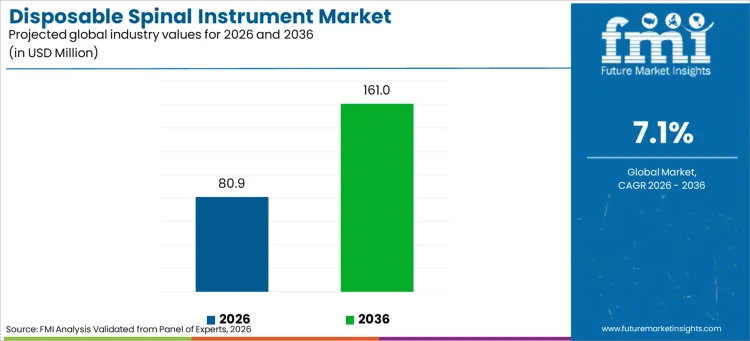
Key Takeaways, Market Size, and Forecast
| Metric | Value |
|---|---|
| Market Size (2026) | USD 80.9 Million |
| Market Size (2036) | USD 161.0 Million |
| CAGR (2026–2036) | 7.1% |
| Leading End User (2026) | Hospitals (48.0%) |
| Leading Product Type (2026) | Pedicle Screw Systems (37.0%) |
| Leading Procedure (2026) | Spinal Fusion (62.0%) |
| Key Markets | North America, Europe |
Companies are witnessing robust growth potential in developing nations, where improving surgical infrastructure aligns perfectly with cost-effective safety adoption. Researchers are combining spinal devices with CF peek for medical applications to ensure instrument durability. Development of spinal implants and devices compatible kits is gaining traction, addressing logistical challenges in hospitals. Focus is shifting toward comprehensive non fusion spinal devices delivery systems. Advancements in dynamic spinal tethering systems enable clinicians to perform complex corrections with sterile-packed tools, enhancing patient safety while significantly reducing hospital liability. These innovations are pivotal in shaping a future where spinal surgery is both efficient and infection-free.
Disposable Spinal Instrument Market Key Takeaways
| Metric | Value |
|---|---|
| Industry Size (2026) | USD 80.9 Million |
| Industry Value (2036) | USD 161.0 Million |
| CAGR (2026 to 2036) | 7.1% |
Source: FMI analysis based on primary research and proprietary forecasting model
What Factors Are Propelling Single-Use Adoption?
Shift toward sterile-packed instruments is serving as a significant catalyst for broader acceptance of disposable kits. Recent breakthroughs in spinal osteosynthesis units manufacturing have complemented treatment protocols by ensuring precise torque delivery without calibration needs. This holistic approach appeals to hospital administrators managing tight budgets. Clinical success of minimally invasive neurosurgery devices integration has expanded procedural capabilities. Education programs highlighting infection risks associated with reusable tools are driving procurement proactivity. Pharmaceutical firms are capitalizing on these trends by introducing electrosurgery devices that pair with disposable handpieces. Integrating disposable trocars into spinal workflows is becoming standard practice, ensuring sterile access does not require extensive processing.
How Is the Disposable Spinal Instrument Market Segmented Across Key Categories?
Global landscape is intricately segmented to address diverse requirements of modern spinal surgery, categorizing sector by procedure type, end-user, and product type. Structural division allows stakeholders to identify specific growth pockets, such as rising demand for lumbar kits in ambulatory centers or preference for cervical kits in orthopedic clinics. By analyzing these segments, manufacturers can tailor production lines to meet distinct needs of large trauma centers versus specialized spine clinics. Segmentation also highlights shift from complex, reusable trays to streamlined, procedure-specific disposable packs. As industry matures, granular segmentation becomes essential for understanding flow of capital and innovation, ensuring product development aligns perfectly with evolving clinical protocols of orthopedic community.
Why Do Spinal Fusion Procedures Maintain Dominance?
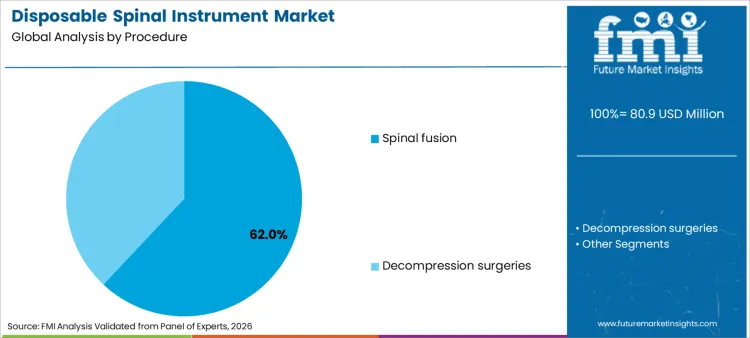
Spinal fusion procedures account for 62% of share in 2026, driven by widespread prevalence of degenerative disc diseases. Leadership position is underpinned by clinical guidelines recommending fusion for stabilizing vertebral segments. Segment benefits from continuous kit improvements, such as inclusion of orthopedic power tools adapters. Research focused on spinal stenosis outcomes is renewing interest among surgeons. Critical role in managing spine pain further solidifies standing, as these surgeries require extensive instrumentation. As healthcare systems prioritize long-term stability, demand for reliable fusion instrumentation is expected to remain robust.
Why Are Hospitals the Preferred Setting?
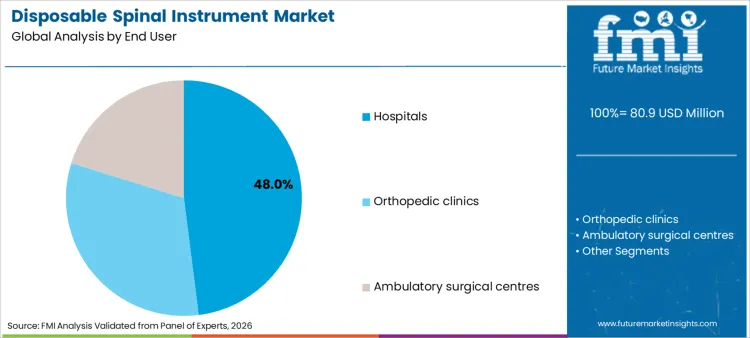
Hospitals command 48% share of sector in 2026, reflecting global reliance on acute care facilities for complex spinal interventions. Dominance is inextricably linked to need for comprehensive post-operative care and intensive monitoring. Hospitals rely on specialized disposable laparoscopic instruments to manage minimally invasive approaches effectively. These settings are essential for handling high-risk cases, driving priority status in equipment procurement budgets. Relentless pursuit of infection reduction ensures products designed specifically for sterile hospital environments remain top priority. High procedural volume necessitates dynamic equipment supply, bolstering sustained revenue streams for device manufacturers.
Why Do Pedicle Screw Systems Lead Product Types?
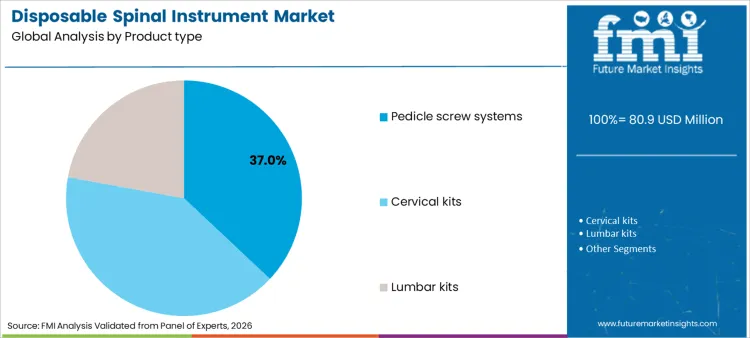
Pedicle screw systems capture 37% of market share in 2026, owing to their critical role in achieving spinal stability. Dominance stems from engineering precision required for screw placement, which disposable kits guarantee through pre-calibrated torque handles. Surgeons prefer these systems for their consistent performance compared to reusable drivers that may degrade over time. Usage in treating deformities and trauma drives continuous volume growth. Compatibility with various surgical scalpel incisions allows for versatile application. Manufacturers focusing on ergonomic design for these high-torque instruments secure significant loyalty among surgical teams.
How Will Cost-Benefit Analysis Impact Future Sales?
Economic evaluation adoption is set to reshape sales landscapes by highlighting long-term savings of disposables. As hospital budgets tighten, administrators access data showing reduced reprocessing and repair costs associated with single-use tools. Shift toward value-based care creates demand for instruments guaranteeing sterility and performance. Manufacturers failing to provide economic evidence risk losing visibility among cost-conscious procurement teams. Availability of comprehensive procedure kits stimulates innovation. Rise of outpatient surgery stimulates innovation, with companies differentiating offerings by bundling instruments with implants.
How Will the Disposable Spinal Instrument Industry Evolve in Major Nations?
Global landscape for spinal instruments is characterized by diverse growth patterns, influenced by reimbursement policies and surgical volume. Established markets prioritize infection control and procedural efficiency, whereas emerging economies rely on disposables to bypass expensive sterilization infrastructure. Asia-Pacific is emerging as rapid growth hub due to increasing medical tourism and spine surgery adoption. Conversely, North American sectors pivot towards ambulatory spine centers. Government initiatives in developing nations supporting surgical safety ensure sustained demand for essential tools across all geographies.
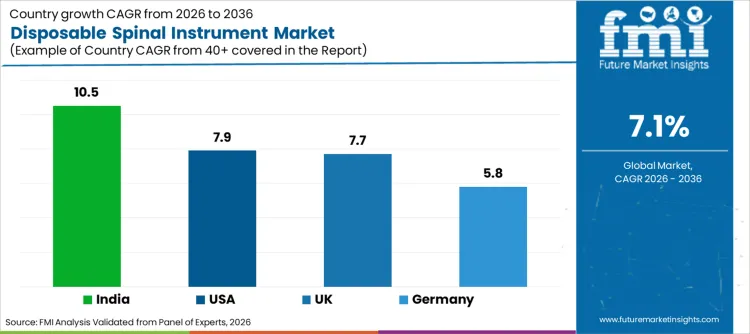
| Country | CAGR (2026 to 2036) |
|---|---|
| United States | 7.90% |
| India | 10.50% |
| United Kingdom | 7.70% |
| Germany | 5.80% |
Source: FMI analysis based on primary research and proprietary forecasting model
Why is the Disposable Spinal Instrument Industry in the United States Growing?
Demand for sterile spinal kits in United States is set to grow at 7.90% CAGR through 2036. Expansion is underpinned by stringent regulatory standards regarding device reprocessing. Growth is fueled by widespread availability of ambulatory surgical centers performing spine procedures. Rapid adoption of single-use torque limiters drives revenue generation per surgery. Presence of major medical technology players headquartered within country streamlines supply chains. Emphasis on reducing hospital-acquired infections continues to be primary driver, maintaining United States position as critical revenue generator.
Why is the Disposable Spinal Instrument Sector in India Expanding?
Disposable spinal instrument sales in India are projected to rise at 10.50% CAGR during assessment period. Initiatives emphasizing surgical safety awareness foster favorable environment for domestic and international vendors. Increasing investment in private hospital chains creates massive supply channel for advanced surgical tools. Rising patient volumes requiring spinal correction prompts local administrators to seek scalable solutions. Shift is supported by cost benefits of avoiding sterilization infrastructure setup, accelerating uptake of pre-sterilized packs across country and fueling sector expansion.
Why is the Disposable Spinal Instrument Industry in the United Kingdom Showing Potential?
Industry for disposable spine tools in United Kingdom is poised to expand at 7.70% CAGR. Surge is largely attributed to NHS guidelines promoting single-use devices for high-risk procedures to prevent prion transmission. Government focus on improving surgical throughput encourages facilities to opt for ready-to-use instruments. Increasing partnerships between UK distributors and global manufacturers necessitate availability of high-quality devices. Cost advantages of reduced sterile processing department load attract significant investment. Strict adherence to safety protocols further drives adoption of compliant instrumentation.
Why is the Disposable Spinal Instrument Industry in Germany Growing?
Sales of single-use spinal tools in Germany are set to grow at 5.80% CAGR. Expansion is underpinned by robust engineering standards and high volume of orthopedic surgeries. Growth is fueled by increasing preference for procedure-specific kits that minimize waste. Moderate adoption of hybrid models involving both reusable and disposable elements drives revenue generation. Presence of leading medical device manufacturers ensures steady supply of innovative products. Emphasis on precision medicine continues to be primary driver, maintaining Germany position as steady revenue generator.
What is the Competitive Outlook for the Disposable Spinal Instrument Market?
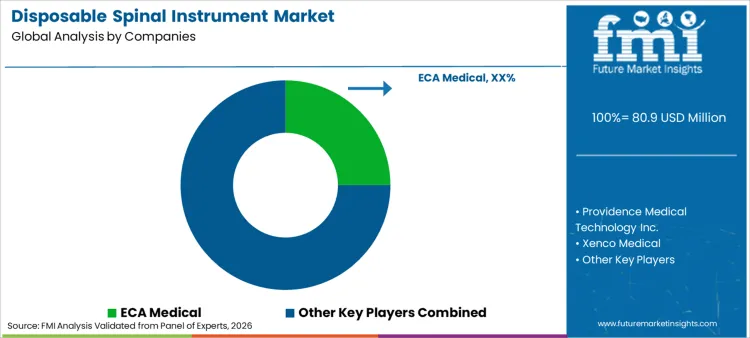
Market participants are increasingly focusing on kit customization to capture value beyond standard instruments. Leading players like ECA Medical and Xenco Medical are directing investment toward high-strength polymer development. Significant trend involves developing recycling programs for used instruments to address environmental concerns. Companies actively engage in strategic collaborations with implant manufacturers to create matched instrumentation sets. Sustainability emerges as competitive frontier, with providers exploring biodegradable packaging materials. Consolidation activities remain moderate as large orthopedic firms acquire specialized disposable instrument startups to broaden their surgical solution portfolios against regional competitors. ECA Medical holds a significant 25% share, leveraging its early mover advantage in single-use torque-limiting technology.
Key Players in Disposable Spinal Instrument Market
- ECA Medical
- Providence Medical Technology Inc.
- Xenco Medical
- Paradigm Spine
- Intelligent Implant Systems LLC
- Safe Orthopaedics SA
Scope of Report
| Items | Values |
|---|---|
| Quantitative Units | USD Million |
| Procedure | Spinal fusion, Decompression surgeries |
| End User | Hospitals, Orthopedic clinics, Ambulatory surgical centres |
| Product type | Pedicle screw systems, Cervical kits, Lumbar kits |
| Countries | United States, United Kingdom, Germany, India |
Disposable Spinal Instrument Market by Segments
Procedure
- Spinal fusion
- Decompression surgeries
End User
- Hospitals
- Orthopedic clinics
- Ambulatory surgical centres
Product type
- Pedicle screw systems
- Cervical kits
- Lumbar kits
Regions
- North America
- Europe
- East Asia
- South Asia
- Latin America
- Middle East & Africa
Bibliography
- North American Spine Society. (2024). NASS clinical practice guideline library: Updated spine care guidelines and evidence summaries. North American Spine Society, United States.
- American Academy of Orthopaedic Surgeons. (2024). Prevention of surgical site infections after major extremity trauma: Evidence-based clinical practice guideline (updated edition). American Academy of Orthopaedic Surgeons, United States.
- USA Food and Drug Administration. (2024). Reprocessing medical devices in health care settings: Validation methods and labeling (current guidance). USA Food and Drug Administration, United States.
- World Health Organization. (2024). Global guidelines for the prevention of surgical site infection: Updated evidence and device-related sterilization practices. World Health Organization.
- Association of periOperative Registered Nurses. (2025, March 19). AORN guideline in focus: Sterile technique in the operating room. Association of periOperative Registered Nurses, United States.
Frequently Asked Questions
How large is the demand for Disposable Spinal Instruments in the global market in 2026?
Demand for Disposable Spinal Instruments in global market is estimated to be valued at USD 80.9 million in 2026.
What will be the market size of Disposable Spinal Instruments in the global market by 2036?
Market size for Disposable Spinal Instruments in global market is projected to reach USD 161.0 million by 2036.
What is the expected demand growth for Disposable Spinal Instruments in the global market between 2026 and 2036?
Demand for Disposable Spinal Instruments in global market is expected to grow at CAGR of 7.1% between 2026 and 2036.
Which Product Type is poised to lead global sales by 2026?
Pedicle screw systems are expected to be dominant product type, capturing approximately 37% of global market share in 2026 due to procedural necessity.
How significant is the role of Hospitals in driving Disposable Spinal Instrument adoption in 2026?
Hospitals represent critical end user, projected to hold substantial 48% share of total market in 2026 as facilities manage infection control.
Preview the report firsthand - request a free sample
Get SampleGet the brochure for pricing and purchase details.
Get PDFTable of Content
- Executive Summary
- Global Market Outlook
- Demand-side Trends
- Supply-side Trends
- Technology Roadmap Analysis
- Analysis and Recommendations
- Market Overview
- Market Coverage / Taxonomy
- Market Definition / Scope / Limitations
- Market Background
- Market Dynamics
- Drivers
- Restraints
- Opportunity
- Trends
- Scenario Forecast
- Demand in Optimistic Scenario
- Demand in Likely Scenario
- Demand in Conservative Scenario
- Opportunity Map Analysis
- Product Life Cycle Analysis
- Supply Chain Analysis
- Investment Feasibility Matrix
- Value Chain Analysis
- PESTLE and Porter’s Analysis
- Regulatory Landscape
- Regional Parent Market Outlook
- Production and Consumption Statistics
- Import and Export Statistics
- Market Dynamics
- Global Market Analysis 2021 to 2025 and Forecast, 2026 to 2036
- Historical Market Size Value (USD Million) Analysis, 2021 to 2025
- Current and Future Market Size Value (USD Million) Projections, 2026 to 2036
- Y-o-Y Growth Trend Analysis
- Absolute $ Opportunity Analysis
- Global Market Pricing Analysis 2021 to 2025 and Forecast 2026 to 2036
- Global Market Analysis 2021 to 2025 and Forecast 2026 to 2036, By Procedure
- Introduction / Key Findings
- Historical Market Size Value (USD Million) Analysis By Procedure , 2021 to 2025
- Current and Future Market Size Value (USD Million) Analysis and Forecast By Procedure , 2026 to 2036
- Spinal fusion
- Decompression surgeries
- Spinal fusion
- Y-o-Y Growth Trend Analysis By Procedure , 2021 to 2025
- Absolute $ Opportunity Analysis By Procedure , 2026 to 2036
- Global Market Analysis 2021 to 2025 and Forecast 2026 to 2036, By End User
- Introduction / Key Findings
- Historical Market Size Value (USD Million) Analysis By End User, 2021 to 2025
- Current and Future Market Size Value (USD Million) Analysis and Forecast By End User, 2026 to 2036
- Hospitals
- Orthopedic clinics
- Ambulatory surgical centres
- Hospitals
- Y-o-Y Growth Trend Analysis By End User, 2021 to 2025
- Absolute $ Opportunity Analysis By End User, 2026 to 2036
- Global Market Analysis 2021 to 2025 and Forecast 2026 to 2036, By Product type
- Introduction / Key Findings
- Historical Market Size Value (USD Million) Analysis By Product type, 2021 to 2025
- Current and Future Market Size Value (USD Million) Analysis and Forecast By Product type, 2026 to 2036
- Pedicle screw systems
- Cervical kits
- Lumbar kits
- Pedicle screw systems
- Y-o-Y Growth Trend Analysis By Product type, 2021 to 2025
- Absolute $ Opportunity Analysis By Product type, 2026 to 2036
- Global Market Analysis 2021 to 2025 and Forecast 2026 to 2036, By Region
- Introduction
- Historical Market Size Value (USD Million) Analysis By Region, 2021 to 2025
- Current Market Size Value (USD Million) Analysis and Forecast By Region, 2026 to 2036
- North America
- Latin America
- Western Europe
- Eastern Europe
- East Asia
- South Asia and Pacific
- Middle East & Africa
- Market Attractiveness Analysis By Region
- North America Market Analysis 2021 to 2025 and Forecast 2026 to 2036, By Country
- Historical Market Size Value (USD Million) Trend Analysis By Market Taxonomy, 2021 to 2025
- Market Size Value (USD Million) Forecast By Market Taxonomy, 2026 to 2036
- By Country
- USA
- Canada
- Mexico
- By Procedure
- By End User
- By Product type
- By Country
- Market Attractiveness Analysis
- By Country
- By Procedure
- By End User
- By Product type
- Key Takeaways
- Latin America Market Analysis 2021 to 2025 and Forecast 2026 to 2036, By Country
- Historical Market Size Value (USD Million) Trend Analysis By Market Taxonomy, 2021 to 2025
- Market Size Value (USD Million) Forecast By Market Taxonomy, 2026 to 2036
- By Country
- Brazil
- Chile
- Rest of Latin America
- By Procedure
- By End User
- By Product type
- By Country
- Market Attractiveness Analysis
- By Country
- By Procedure
- By End User
- By Product type
- Key Takeaways
- Western Europe Market Analysis 2021 to 2025 and Forecast 2026 to 2036, By Country
- Historical Market Size Value (USD Million) Trend Analysis By Market Taxonomy, 2021 to 2025
- Market Size Value (USD Million) Forecast By Market Taxonomy, 2026 to 2036
- By Country
- Germany
- UK
- Italy
- Spain
- France
- Nordic
- BENELUX
- Rest of Western Europe
- By Procedure
- By End User
- By Product type
- By Country
- Market Attractiveness Analysis
- By Country
- By Procedure
- By End User
- By Product type
- Key Takeaways
- Eastern Europe Market Analysis 2021 to 2025 and Forecast 2026 to 2036, By Country
- Historical Market Size Value (USD Million) Trend Analysis By Market Taxonomy, 2021 to 2025
- Market Size Value (USD Million) Forecast By Market Taxonomy, 2026 to 2036
- By Country
- Russia
- Poland
- Hungary
- Balkan & Baltic
- Rest of Eastern Europe
- By Procedure
- By End User
- By Product type
- By Country
- Market Attractiveness Analysis
- By Country
- By Procedure
- By End User
- By Product type
- Key Takeaways
- East Asia Market Analysis 2021 to 2025 and Forecast 2026 to 2036, By Country
- Historical Market Size Value (USD Million) Trend Analysis By Market Taxonomy, 2021 to 2025
- Market Size Value (USD Million) Forecast By Market Taxonomy, 2026 to 2036
- By Country
- China
- Japan
- South Korea
- By Procedure
- By End User
- By Product type
- By Country
- Market Attractiveness Analysis
- By Country
- By Procedure
- By End User
- By Product type
- Key Takeaways
- South Asia and Pacific Market Analysis 2021 to 2025 and Forecast 2026 to 2036, By Country
- Historical Market Size Value (USD Million) Trend Analysis By Market Taxonomy, 2021 to 2025
- Market Size Value (USD Million) Forecast By Market Taxonomy, 2026 to 2036
- By Country
- India
- ASEAN
- Australia & New Zealand
- Rest of South Asia and Pacific
- By Procedure
- By End User
- By Product type
- By Country
- Market Attractiveness Analysis
- By Country
- By Procedure
- By End User
- By Product type
- Key Takeaways
- Middle East & Africa Market Analysis 2021 to 2025 and Forecast 2026 to 2036, By Country
- Historical Market Size Value (USD Million) Trend Analysis By Market Taxonomy, 2021 to 2025
- Market Size Value (USD Million) Forecast By Market Taxonomy, 2026 to 2036
- By Country
- Kingdom of Saudi Arabia
- Other GCC Countries
- Turkiye
- South Africa
- Other African Union
- Rest of Middle East & Africa
- By Procedure
- By End User
- By Product type
- By Country
- Market Attractiveness Analysis
- By Country
- By Procedure
- By End User
- By Product type
- Key Takeaways
- Key Countries Market Analysis
- USA
- Pricing Analysis
- Market Share Analysis, 2025
- By Procedure
- By End User
- By Product type
- Canada
- Pricing Analysis
- Market Share Analysis, 2025
- By Procedure
- By End User
- By Product type
- Mexico
- Pricing Analysis
- Market Share Analysis, 2025
- By Procedure
- By End User
- By Product type
- Brazil
- Pricing Analysis
- Market Share Analysis, 2025
- By Procedure
- By End User
- By Product type
- Chile
- Pricing Analysis
- Market Share Analysis, 2025
- By Procedure
- By End User
- By Product type
- Germany
- Pricing Analysis
- Market Share Analysis, 2025
- By Procedure
- By End User
- By Product type
- UK
- Pricing Analysis
- Market Share Analysis, 2025
- By Procedure
- By End User
- By Product type
- Italy
- Pricing Analysis
- Market Share Analysis, 2025
- By Procedure
- By End User
- By Product type
- Spain
- Pricing Analysis
- Market Share Analysis, 2025
- By Procedure
- By End User
- By Product type
- France
- Pricing Analysis
- Market Share Analysis, 2025
- By Procedure
- By End User
- By Product type
- India
- Pricing Analysis
- Market Share Analysis, 2025
- By Procedure
- By End User
- By Product type
- ASEAN
- Pricing Analysis
- Market Share Analysis, 2025
- By Procedure
- By End User
- By Product type
- Australia & New Zealand
- Pricing Analysis
- Market Share Analysis, 2025
- By Procedure
- By End User
- By Product type
- China
- Pricing Analysis
- Market Share Analysis, 2025
- By Procedure
- By End User
- By Product type
- Japan
- Pricing Analysis
- Market Share Analysis, 2025
- By Procedure
- By End User
- By Product type
- South Korea
- Pricing Analysis
- Market Share Analysis, 2025
- By Procedure
- By End User
- By Product type
- Russia
- Pricing Analysis
- Market Share Analysis, 2025
- By Procedure
- By End User
- By Product type
- Poland
- Pricing Analysis
- Market Share Analysis, 2025
- By Procedure
- By End User
- By Product type
- Hungary
- Pricing Analysis
- Market Share Analysis, 2025
- By Procedure
- By End User
- By Product type
- Kingdom of Saudi Arabia
- Pricing Analysis
- Market Share Analysis, 2025
- By Procedure
- By End User
- By Product type
- Turkiye
- Pricing Analysis
- Market Share Analysis, 2025
- By Procedure
- By End User
- By Product type
- South Africa
- Pricing Analysis
- Market Share Analysis, 2025
- By Procedure
- By End User
- By Product type
- USA
- Market Structure Analysis
- Competition Dashboard
- Competition Benchmarking
- Market Share Analysis of Top Players
- By Regional
- By Procedure
- By End User
- By Product type
- Competition Analysis
- Competition Deep Dive
- ECA Medical
- Overview
- Product Portfolio
- Profitability by Market Segments (Product/Age /Sales Channel/Region)
- Sales Footprint
- Strategy Overview
- Marketing Strategy
- Product Strategy
- Channel Strategy
- Providence Medical Technology
- Xenco Medical
- Paradigm Spine
- Intelligent Implant Systems
- Safe Orthopaedics
- TeDan Surgical Innovations
- Joimax GmbH
- ECA Medical
- Competition Deep Dive
- Assumptions & Acronyms Used
- Research Methodology


