

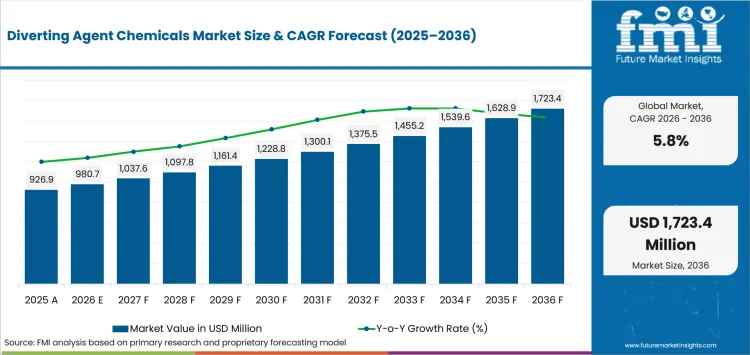
- Market Size (2026)
- USD 980.7 Mn
- Forecast (2036)
- USD 1723.4 Mn
- CAGR (2026 to 2036)
- 5.8%
How big is Diverting Agent Chemicals Market in 2026?
USD 980.7 million in 2026 and USD 1723.4 million by 2036 at a 5.8% CAGR.
Demand for diverting agent chemicals is projected to rise at 5.8% CAGR between 2026 and 2036 as longer stimulated intervals require selective fluid placement. USA Energy Information Administration data published in March 2026 show record 2025 crude output despite fewer Lower 48 rigs and wells. The Permian accounted for 48% of USA crude output during 2025, concentrating stimulation activity in a major shale basin. That operating intensity keeps diversion relevant for programs requiring treatment fluid to reach lower-intake clusters without permanent isolation hardware.
Mature-field work provides a second demand route for operators improving recovery without rebuilding every completion. Brazil separates field-life extension from new drilling through active contract renewal programs. In March 2026, ANP confirmed contract extensions for 34 producing fields during 2025 and identified 13 mature fields receiving both extensions and royalty relief. Those programs enlarge the addressable intervention base, although each purchase depends on laboratory compatibility and an acceptable degradation window.
Key Takeaways of Diverting Agent Chemicals Market
- Demand follows stimulation programs that need selective acid diversion so dominant intake zones do not consume later treatment stages.
- By agent type, particulate diverters are estimated to hold 26.0% in 2026 owing to graded particles that form temporary barriers without permanent completion hardware.
- In 2026, acidizing is expected to lead operation with 31.0% share because temporary resistance redirects live acid toward lower-intake intervals.
- Water soluble chemistry is projected to hold 23.0% share in 2026 owing to post-treatment dissolution that removes the need for mechanical retrieval.
- Qualification is the principal restraint since well stimulation materials must survive pumping and dissolve under actual temperature and fluid conditions.
- Some of the key players in this market include Halliburton, SLB, Baker Hughes, Nouryon, Clariant, Stepan Company, SNF Group, and Locus Bio-Energy.
Analyst Perspective
"Commercial value depends on two proofs: the diverter must redirect fluid during pumping and then clear within the cleanup window. A low unit price loses relevance if the treatment leaves untreated rock or delays production restart."
- Nikhil Kaitwade, Principal Consultant, Future Market Insights
How is the Diverting Agent Chemicals Market segmented?
The diverting agent chemicals market is segmented by agent type, operation, degradability, well type, sales channel and region.
Market taxonomy separates particulate, viscous gel, fiber, degradable and self-diverting acid systems by agent type. Operations include acidizing, hydraulic fracturing, matrix stimulation, water shutoff and remedial treatments. Degradability covers water soluble, oil soluble, temperature degradable, biodegradable and temporary non-degradable systems. Well type and sales channel distinguish reservoir geometry from the route used to package chemistry with field execution.
Why do Particulate diverters lead demand within the Agent type category?
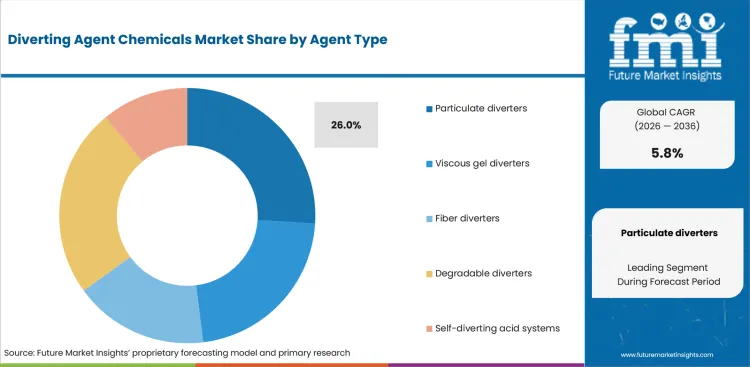
Particulate systems are selected through particle-distribution comparisons against perforation or fracture openings that take excess fluid. They become more valuable in hydraulic fracturing services as long laterals expose uneven intake behavior between successive treatment stages.
- By agent type, particulate diverters are estimated to hold 26.0% share in 2026 because graded particles form temporary barriers without permanent completion hardware.
- Pressure response is the field check that shows a temporary barrier redirected treatment fluid instead of merely surviving pumping. A March 2025 Journal of Petroleum Technology case documented chemical restimulation using a diverter to distribute a 2,700-barrel treatment through a fracture network.
Why does Acidizing lead demand within the Operation category?
Acidizing loses value quickly if live acid enters the easiest flow path and misses lower-intake rock. Diversion changes local injectivity so later acid stages can reach additional intervals and complements oilfield stimulation chemicals used for placement and cleanup.
- Acidizing is set to lead the operation category with 31.0% share in 2026 due to the direct need to control acid contact in uneven intake zones.
- Halliburton and Pertamina signed a February 2026 MOU to evaluate acid stimulation and multistage hydraulic fracturing in selected Indonesian onshore fields. The program ties acid placement to integrated stimulation design during field evaluation.
Why does Water soluble chemistry lead demand within the Degradability category?
Water soluble diverters are evaluated against two opposite failure modes: premature dissolution during barrier formation and persistence beyond stimulation. Dissolution timing also affects compatibility with completion fluid systems during the transition back to production.
- The water soluble segment is likely to capture 23.0% share in 2026 attributable to temporary barriers that dissolve without mechanical retrieval.
- The Society of Petroleum Engineers’ June 2025 Acidizing review highlighted experimental work on degradable solids diverter efficiency for different matrix-acid completions. The review makes dissolution behavior a direct qualification variable for engineers evaluating temporary barriers under different completion conditions.
Why do Stimulation service companies lead demand within the Sales channel category?
The service channel controls particle loading, carrier fluid and pump schedule during placement. Service-company control becomes more valuable in jobs using onshore drilling fluids that require tightly synchronized pumping and completion chemistry on site.
- In 2026, stimulation service companies are expected to lead sales channel with 45.0% share because chemical choice and pumping execution are usually qualified together.
- Operators favor service-led purchasing when chemistry selection and pumping execution must remain under one treatment design. ADNOC Drilling received a five-year hydraulic-fracturing contract in June 2025 covering design and execution plus evaluation of multistage treatments.
What are the drivers, restraints and opportunities in the Diverting Agent Chemicals Market?
Long horizontal intervals raise placement risk, reservoir-specific qualification slows standardization and degradable chemistry with reliable field support offers the clearest commercial opening.
- Driver: Longer horizontal intervals increase the number of clusters competing for treatment fluid during one stimulation program.
- Restraint: Temperature, fluid chemistry and opening size can change bridging strength or degradation timing enough to delay field approval.
- Opportunity: Better-matched degradable systems can reduce cleanup work and extend diversion to more intervals during one treatment.
Long laterals increase the value of temporary diversion
Horizontal development increases the number of intake points that must share fluid through one wellbore. Alberta Energy Regulator statistics for 2025 recorded 9,151 successful horizontal wells among 9,592 successful wells. Early clusters can absorb a disproportionate share of later stages, raising repeat demand for temporary isolation during oilfield chemicals programs. Commercial value depends on pressure response confirming improved fluid placement in the targeted interval.
Qualification limits one-formulation deployment
A diverter must maintain temporary isolation through the planned pump schedule and then clear without restricting flowback. In February 2025, SLB described work with Pemex that used advanced stimulation chemistry for high-pressure and high-temperature reservoirs. The same program used a design-execute-evaluate workflow that tied chemistry choice to field data. Reservoir conditions and execution data therefore determine local qualification for chemistry transfer into another field.
Field comparisons can widen the addressable job set
Chemical formulations gain a wider job set once field performance is demonstrated against comparable untreated wells. In November 2025, Locus Bio-Energy disclosed Delaware Basin results from three treated Wolfcamp A wells and three control wells under identical completion parameters. The treated wells produced 20% more oil over six months than the controls. For oilfield surfactants and related stimulation chemistry, controlled field comparisons give operators a clearer basis for expanding programs beyond initial trials.
Which country CAGRs are profiled in the Diverting Agent Chemicals Market?
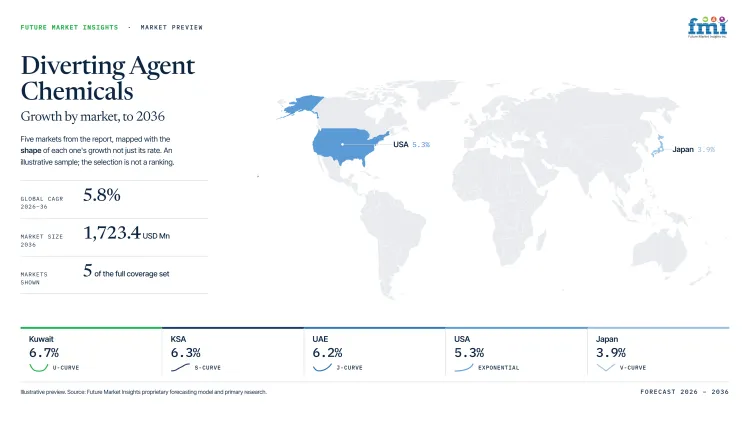
| Country | CAGR |
|---|---|
| Kuwait | 6.7% |
| KSA | 6.3% |
| UAE | 6.2% |
| Brazil | 5.8% |
| USA | 5.3% |
| Canada | 5.1% |
| Japan | 3.9% |
How do country-level CAGRs compare in the Diverting Agent Chemicals Market?
The growth range spans 2.8 percentage points between Kuwait at 6.7% and Japan at 3.9%. Kuwait, KSA and UAE form a Gulf group above 6.0%, with Brazil at 5.8% below them. USA and Canada form a North American pair, while Japan defines the lower end.
- Kuwait’s mature heavy-oil repairs favor local intervention inventory.
- KSA’s Jafurah ramp expands multistage stimulation requirements.
- UAE unconventional campaigns reward integrated pressure-pumping execution.
- Brazil couples deepwater logistics with mature-field intervention demand.
- USA shale programs impose strict payout tests on restimulation chemistry.
- Canada’s winter access compresses chemical delivery windows in western basins.
- Japan’s sparse upstream projects favor selective high-specification qualification.
CAGR alone does not show chemical spend per treatment or the number of intervals handled during each campaign. The full report provides country-level CAGR analysis across North America, Latin America, Europe, East Asia, South Asia, Oceania and the Middle East and Africa.
Country-wise Analysis
- Kuwait operators manage mature and heavy-oil assets with inactive wells that can return to intervention programs without new-field drilling. Kuwait is estimated to post 6.7% CAGR over the forecast period, tied to repair programs that need selective placement in heterogeneous reservoirs. Kuwait Oil Company reported in June 2025 that it evaluated 21 unused exploratory wells at Sabriya and prepared repair plans using available inventory. Existing production infrastructure shortens market access, though variable permeability and temperature require stimulation materials to pass treatment-specific qualification during each field program. New entrants therefore need local technical support that can match particle size and degradation timing to secure routine ordering.
- Saudi unconventional gas development is shifting toward repeatable field execution as Jafurah enters production. Aramco confirmed in February 2026 that Jafurah started production in December 2025 and that technology has reduced drilling and stimulation costs. The KSA diverting agent chemicals sector is projected to record 6.3% CAGR during the assessment period, given longer unconventional intervals that raise placement risk. Established pressure-pumping infrastructure provides a direct route into hydraulic fracturing programs, though high treatment intensity raises the penalty for inconsistent degradation or bridging behavior. Companies with Saudi laboratory support and field inventory are better positioned than exporters dependent on technical response.
- UAE operators are standardizing unconventional workflows and retain close control over treatment design and field execution in Abu Dhabi. Integrated service capacity gives chemical formulators a direct route into large multistage programs once field qualification is complete. ADNOC Drilling stated in October 2025 that its unconventional platform has potential for more than 300 wells annually. Diverting agent chemical demand in the UAE is forecast to rise at 6.2% CAGR over the forecast period, reflecting repeated placement requirements in multistage treatments. Large programs magnify small formulation errors, so market entry depends on proving pressure response and cleanup behavior inside ADNOC-linked operating workflows.
- Brazil presents two purchasing environments as deepwater stimulation logistics coexist with mature fields seeking recovery from existing assets. Adoption of diverting agent chemicals in Brazil is estimated to expand at 5.8% CAGR through 2036, supported by exploration and field-life extension. ANP reported in December 2025 that 433 exploration blocks were under contract and exploration-well starts rose 90% from 2024. Offshore service infrastructure gives qualified chemistry access to complex treatments, but long supply routes and enhanced oil recovery programs raise failed-qualification costs. Companies can defend technical-service premiums if chemistry arrives with basin-specific test data and delivery plans matched to offshore campaign timing.
- United States operators work from a large shale installed base and continue to scrutinize the payout from every treatment. EIA reported in July 2026 that national crude production averaged 13.6 million barrels per day in 2025 and the Permian supplied about 48%. By 2036, USA is projected to grow at 5.3% CAGR, attributable to continued work in long horizontal wells and mature unconventional assets. Dense service coverage eases field trials, but lower commodity prices keep marginal restimulation jobs under strict payout tests. Chemistry companies therefore compete on repeatable pressure response and cleanup evidence instead of broad portfolio claims.
- Western Canadian basins concentrate purchasing in provinces with long laterals and seasonal field access that shape treatment planning. Basin concentration gives chemistry access to laboratories and service fleets near producing areas. The Canada Energy Regulator reported in June 2026 that national crude production averaged 5.35 million barrels per day during 2025 and Alberta supplied 83.8%. Canada's diverting agent chemicals outlook is anticipated to advance at 5.1% CAGR over the assessment period, reflecting a producing base that needs completion and intervention work. Winter logistics narrow delivery windows, so new entrants need regional stock plus chemistry that stays stable through cold-weather handling.
- Japan offers a smaller opportunity since upstream projects are selective and operators face commercial thresholds for repeated stimulation work. Diverting agent chemical sales in Japan are forecast to expand at 3.9% CAGR by 2036, supported by domestic exploration and high-specification treatment requirements rather than broad shale activity. JAPEX completed Hidaka exploratory drilling in June 2026 after drilling from 1,070 meters of water depth. The project confirmed natural gas but not enough volume for commercialization, which limits repeat treatment programs. Strong engineering standards favor qualification, so companies should treat Japan as a high-specification project market instead of a volume-led national channel.
Who are the notable companies in the Diverting Agent Chemicals Market?
Halliburton, SLB, Baker Hughes, Nouryon, Clariant, Stepan Company, SNF Group and Locus Bio-Energy are the notable companies serving this market.
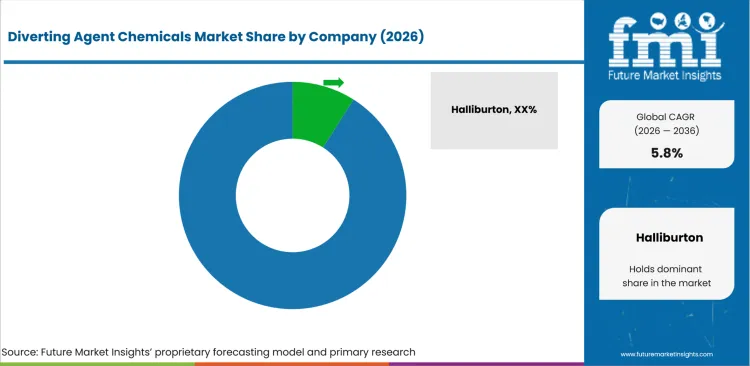
The competitive field includes oilfield service contractors and specialty chemistry producers that enter through different qualification routes. Halliburton, SLB and Baker Hughes can tie diversion to treatment design and pumping. Chemistry specialists also sell adjacent production chemicals that deepen account access once technical qualification is complete. Entry barriers therefore rise through laboratory fit, field execution records and local technical coverage instead of corporate scale alone.
- Halliburton, SLB and Baker Hughes compete through integrated stimulation programs with laboratory support and field execution.
- Nouryon, Clariant, Stepan Company, SNF Group and Locus Bio-Energy compete through specialty chemistry, surfactants, polymers or focused stimulation formulations.
Competitive Benchmarking: Diverting Agent Chemicals Market
| Company | Stimulation-Service Integration | Diversion and Adjacent Chemistry Breadth | Regional Technical Support | Geographic Reach |
|---|---|---|---|---|
| Halliburton | High | High | High | Global |
| SLB | High | High | High | Global |
| Baker Hughes | High | High | High | Global |
| Nouryon | Low | High | High | Global |
| Clariant | Low | High | High | Global |
| Stepan Company | Low | Medium | Medium | Americas, Middle East and selected international markets |
| SNF Group | Low | High | High | Global |
| Locus Bio-Energy | Medium | Medium | Medium | North America and selected international markets |
Scoring basis: High stimulation-service integration requires documented treatment design and field execution. Medium reflects delivery through a service partner and Low identifies chemistry supply without integrated pumping. High chemistry breadth requires several documented stimulation or acidizing routes. Medium reflects one direct route plus adjacent oilfield chemistry. High regional technical support requires documented laboratories, service operations or local supply infrastructure in several major regions. Medium reflects narrower regional support and Low identifies limited disclosed coverage.
Key Developments in the Diverting Agent Chemicals Market
- In April 2025, Stepan Company started production at its Pasadena alkoxylation facility with 75,000 metric tons of annual capacity for surfactant technologies serving oilfield and other markets.
- In June 2025, Nouryon opened a Houston innovation center focused on oilfield drilling, completion, production and stimulation research with dedicated testing and customer collaboration facilities.
- In August 2025, SNF Group announced the acquisition of Obsidian Chemical Solutions, adding Permian manufacturing and bulk storage plus formulations for stimulation, acidizing and completion operations.
Key Players in the Diverting Agent Chemicals Market
Integrated stimulation-service platforms
- Halliburton
- SLB
- Baker Hughes
Specialty oilfield chemistry suppliers
- Nouryon
- Clariant
- Stepan Company
- SNF Group
Focused stimulation chemistry specialist
- Locus Bio-Energy
Diverting Agent Chemicals Market - Report Scope
| Coverage field | Report scope |
|---|---|
| Market breakdown | By agent type, operation, degradability, well type, sales channel and region. |
| Quantitative Units | USD Million. |
| Market Definition | Commercial chemical diverting agents and self-diverting fluid systems used for acid placement, hydraulic fracturing diversion, matrix stimulation, water shutoff and remedial treatment. Mechanical diversion tools and unrelated stimulation additives are excluded. |
| Regions Covered | North America, Latin America, Europe, East Asia, South Asia and Pacific, and Middle East and Africa. |
| Countries Covered | Kuwait, KSA, UAE, Brazil, USA, Canada, Japan, and 20+ countries included in the full report. |
| Key Companies Profiled | Halliburton, SLB, Baker Hughes, Nouryon, Clariant, Stepan Company, SNF Group, Locus Bio-Energy. |
| Forecast Period | 2026 to 2036. |
| Approach | Primary and secondary research with market triangulation. |
Diverting Agent Chemicals Market - Research Methodology
| Method | Approach |
|---|---|
| Primary Research | FMI analysts gathered input from manufacturers, service providers, technology developers, distributors, end users, procurement teams, and subject-matter experts. Interviews examined purchasing decisions, product or service evaluation, adoption barriers, approval requirements, pricing considerations, and expectations for technical or commercial support. Respondents were also asked what evidence is required before a trial, pilot, or initial order develops into regular purchasing. |
| Desk Research | Desk research covered government statistics, regulatory publications, trade data, industry associations, technical literature, standards, company filings, product information, and official corporate announcements. Sources were reviewed for relevance, publication date, geographic coverage, and consistency with the defined market scope. Claims relating to performance, applications, approvals, capacity, investment, and commercial activity were retained only when supported by credible public evidence. |
| Market Sizing and Forecasting | The market model combined the baseline value with historical performance, segment structure, pricing and volume indicators, adoption levels, company participation, and country-level demand conditions. Forecast assumptions considered economic activity, investment trends, regulatory developments, technology adoption, purchasing cycles, supply availability, and barriers to wider market use. Segment and regional estimates were reconciled before the final market total was calculated. |
| Data Validation | Estimates were checked against multiple independent indicators, including public data, company activity, trade patterns, industry developments, and findings from primary interviews. Validation also tested whether products, services, applications, and company revenues fell within the defined market boundaries. Adjacent categories, unsupported claims, overlapping revenues, and activities without direct market relevance were excluded to reduce double counting and maintain consistency across segments and countries. |
Diverting Agent Chemicals Market by Segments
Diverting Agent Chemicals Market segmented by Agent Type:
- Particulate diverters
- Viscous gel diverters
- Fiber diverters
- Degradable diverters
- Self-diverting acid systems
Diverting Agent Chemicals Market segmented by Operation:
- Acidizing
- Hydraulic fracturing
- Matrix stimulation
- Water shutoff
- Remedial treatments
Diverting Agent Chemicals Market segmented by Degradability:
- Water soluble
- Oil soluble
- Temperature degradable
- Biodegradable
- Non-degradable temporary
Diverting Agent Chemicals Market segmented by Well Type:
- Horizontal wells
- Carbonate reservoirs
- Sandstone reservoirs
- Unconventional wells
- Mature wells
Diverting Agent Chemicals Market segmented by Sales Channel:
- Stimulation service companies
- Specialty chemical suppliers
- Direct operator supply
- Regional distributors
Diverting Agent Chemicals Market by Region:
- North America
- United States
- Canada
- Latin America
- Brazil
- Mexico
- Argentina
- Chile
- Western Europe
- Germany
- France
- United Kingdom
- Italy
- Spain
- Benelux
- Nordics
- Eastern Europe
- Poland
- Czech Republic
- Romania
- Hungary
- East Asia
- China
- Japan
- South Korea
- South Asia and Pacific
- India
- ASEAN
- Australia and New Zealand
- Middle East and Africa
- GCC Countries
- South Africa
- Türkiye
- Israel
Research Sources and Bibliography
- USA Energy Information Administration. (2026, March 31). USA crude oil production rose in 2025, setting new record.
- Agência Nacional do Petróleo, Gás Natural e Biocombustíveis. (2026, March 10). ANP estendeu contratos de 34 campos de produção de petróleo e gás em 2025.
- Lantz, M., & Mazon, C. (2025, March 1). Case Study • Beyond Acid: Advancing Unconventional Reservoir Recovery With Chemical Restimulation. Journal of Petroleum Technology.
- Halliburton. (2026, February 22). Pertamina and Halliburton sign an integrated unconventional fracturing MOU in Indonesia.
- Society of Petroleum Engineers. (2025, June 1). Acidizing-2025. Journal of Petroleum Technology.
- ADNOC Drilling. (2025, June 30). ADNOC Drilling Awarded Five-Year Contract for Oilfield Services worth up to $800 Million.
- Alberta Energy Regulator. (2025, December). Statistical Series 59: Alberta Drilling Activity Monthly Statistics.
- SLB. (2025, February 20). Pemex interview: SLB well stimulation.
- Locus Bio-Energy. (2025, November 25). Locus Biosurfactants deliver industry leading oil production uplift in the Permian.
- Kuwait Oil Company. (2025, June 20). Manager Fields Development Group (NK) Visits Sabriya Field.
- Aramco. (2026, February 26). Aramco’s gas strategy builds momentum with major progress towards growth target.
- ADNOC Drilling. (2025, October 28). ADNOC Drilling Delivers Record 3Q and 9M 2025 Results, Upgrades Guidance, Reinforces Transformational Growth.
- Agência Nacional do Petróleo, Gás Natural e Biocombustíveis. (2025, December 19). Número de blocos sob contrato cresce em 2025 e é o maior pelo segundo ano consecutivo.
- USA Energy Information Administration. (2026, July 9). The United States produced more crude oil than any other country in 2025.
- Canada Energy Regulator. (2026, June 17). Market Snapshot: Canada sets new record in crude oil production in 2025.
- Japan Petroleum Exploration Co., Ltd. (2026, June 12). Completion of Exploratory Drilling at Offshore Hidaka Area of Hokkaido.
- Nouryon. (2025, June 18). Nouryon launches Innovation Center for oilfield solutions in Texas, US.
- Stepan Company. (2025, April 28). Stepan Company Starts Production at New Alkoxylation Hub in Pasadena, Texas.
- SNF Group. (2025, August 15). SNF to Acquire Obsidian Chemical Solutions LLC.
- SLB. (2025, July 16). SLB Completes Acquisition of ChampionX.
- Halliburton. (2025, October 15). Petrobras awards Halliburton deepwater contracts for completion and stimulation services in Brazil.
- Halliburton. (2026, July 15). Aramco awards Halliburton long-term contract for unconventional gas program.
- SLB. (2025, December 23). Aramco Awards SLB Long-Term Contract to Support Kingdom’s Unconventional Gas Production Growth.
- Clariant. (2026, July 29). Clariant appoints Gapuma Group as Well Service Additives distributor across West Africa.
- Halliburton. (2025, August 13). ConocoPhillips awards Halliburton multi-year well stimulation services contract in the North Sea.
- SLB. (2026, August 6). SLB and Equinor Sign Multi-Year Stimulation Agreement for Norwegian Continental Shelf.
- Baker Hughes. (2025, September 17). Baker Hughes Secures Multi-Year Contract with Petrobras for Offshore Stimulation Vessels.
- Nouryon. (2025, February 10). Nouryon opens new office in Al Dhahran to strengthen presence in Saudi Arabia and the Middle East.
- Clariant. (2025, September 2). Clariant Oil Services and Swire Energy Services open new supply base in Norway supporting European energy production.
- SNF Group. (2026, January 2). SNF GROUP COMPLETES THE ACQUISITION OF THE OIL & GAS DIVISION OF SYENSQO.
- Locus Bio-Energy. (2025, July 23). Cal Coast Acidizing Partners with Locus Bio-Energy to Deliver High-Performance Well Treatments Across California.
- Weatherford International plc. (2025, October 21). Weatherford Announces Third Quarter 2025 Results.
This bibliography is provided for reader reference and is not exhaustive. The full report contains the complete reference list and detailed citations.
This Report Answers
- What are the 2026 and 2036 market values?
- Which stimulation conditions increase chemical-diversion demand?
- Why do particulate diverters hold 26.0%?
- Why does acidizing hold 31.0% share?
- Why does water soluble chemistry hold 23.0%?
- How do the seven profiled country CAGRs differ?
- Which companies lead integrated and specialty chemistry supply?
- Which qualification conditions limit wider adoption?
Frequently Asked Questions
How big is the diverting agent chemicals market in 2026?
The diverting agent chemicals market is valued at USD 980.7 million in 2026 and is projected to reach USD 1,723.4 million by 2036. Longer stimulation intervals and mature-well interventions increase demand for selective fluid placement.
What is the CAGR of the diverting agent chemicals market from 2026 to 2036?
The diverting agent chemicals market is projected to grow at a CAGR of 5.8% between 2026 and 2036. Horizontal-well stimulation and mature-field intervention sustain demand for temporary zonal isolation during repeat treatments.
Which agent type leads the diverting agent chemicals market?
The particulate diverters segment is expected to hold 26.0% of the diverting agent chemicals market in 2026, driven by graded particles suited to varied openings. Engineered size distributions help later treatment stages reach lower-intake intervals more consistently.
Which operation leads the diverting agent chemicals market?
The acidizing segment is projected to hold 31.0% of the diverting agent chemicals market in 2026, attributable to selective acid placement. Temporary resistance limits premature entry into dominant intake zones during staged treatments.
Which degradability segment leads the diverting agent chemicals market?
The water soluble segment is anticipated to represent 23.0% of the diverting agent chemicals market in 2026, supported by barriers that dissolve after placement. Commercial qualification depends on dissolution timing under actual operating conditions at each well.
Which countries are projected to record the highest growth in the diverting agent chemicals market?
Kuwait is projected to grow at 6.7% CAGR, followed by KSA at 6.3% and UAE at 6.2% through 2036. Unconventional development sustains demand for qualified Gulf stimulation chemistry during repeated multistage treatments.
Which companies are active in the diverting agent chemicals market?
Key companies operating in the market include Halliburton, SLB, Baker Hughes, Nouryon, Clariant, Stepan Company, SNF Group, and Locus Bio-Energy. They compete through treatment integration and specialty chemistry with regional field support.
Preview the report firsthand - request a free sample
Get SampleGet the brochure for pricing and purchase details.
Get PDFTable of Content
- Key Takeaways
- Market Size and CAGR
- Top Growth Driver
- Fastest Growing Segment
- Leading Region
- Key Companies
- Emerging Opportunities
- Executive Summary
- Global Market Outlook
- Demand-side Trends
- Supply-side Trends
- Technology Roadmap Analysis
- Analysis and Recommendations
- Analyst Perspective (What is happening? Why now? What should investors know?)
- Key Questions Answered
- How large is the market?
- What is the CAGR?
- What are key trends?
- Which region dominates?
- Who are the leaders?
- Market Overview
- Market Coverage / Taxonomy
- Market Definition / Scope / Limitations
- Research Methodology
- Chapter Orientation
- Analytical Lens and Working Hypotheses
- Market Structure, Signals, and Trend Drivers
- Benchmarking and Cross-market Comparability
- Market Sizing, Forecasting, and Opportunity Mapping
- Research Design and Evidence Framework
- Desk Research Programme (Secondary Evidence)
- Expert Input and Fieldwork (Primary Evidence)
- Tooling, Models, and Reference Databases
- Data Engineering and Model Build
- Quality Assurance and Audit Trail
- Market Background
- Market Dynamics (Drivers, Restraints, Opportunity, Trends)
- Scenario Forecast (Optimistic, Likely, Conservative)
- Impact Analysis
- AI Impact
- Sustainability Impact
- Regulatory Impact
- Technology Impact
- Consumer / Buyer Analysis
- Purchase Drivers
- Adoption Barriers
- Buyer Journey
- Opportunity Map Analysis
- Product Life Cycle Analysis
- Supply Chain Analysis
- Investment Feasibility Matrix
- Value Chain Analysis
- PESTLE and Porter's Analysis
- Regulatory Landscape
- Regional Parent Market Outlook
- Production and Consumption Statistics
- Import and Export Statistics
- Global Market Analysis and Forecast, 2021 to 2036
- Historical Market Size Value (USD Million) Analysis, 2021 to 2025
- Current and Future Market Size Value (USD Million) Projections, 2026 to 2036
- Y-o-Y Growth Trend Analysis
- Absolute $ Opportunity Analysis
- Global Market Pricing Analysis, 2021 to 2036
- Global Market Analysis and Forecast, By Agent Type, 2021 to 2036
- Introduction / Key Findings
- Historical Market Size Value (USD Million) Analysis By Agent Type, 2021 to 2025
- Current and Future Market Size Value (USD Million) Analysis and Forecast By Agent Type, 2026 to 2036
- Particulate diverters
- Viscous gel diverters
- Fiber diverters
- Degradable diverters
- Self-diverting acid systems
- Particulate diverters
- Y-o-Y Growth Trend Analysis By Agent Type, 2021 to 2025
- Absolute $ Opportunity Analysis By Agent Type, 2026 to 2036
- Global Market Analysis and Forecast, By Operation, 2021 to 2036
- Introduction / Key Findings
- Historical Market Size Value (USD Million) Analysis By Operation, 2021 to 2025
- Current and Future Market Size Value (USD Million) Analysis and Forecast By Operation, 2026 to 2036
- Acidizing
- Hydraulic fracturing
- Matrix stimulation
- Water shutoff
- Remedial treatments
- Acidizing
- Y-o-Y Growth Trend Analysis By Operation, 2021 to 2025
- Absolute $ Opportunity Analysis By Operation, 2026 to 2036
- Global Market Analysis and Forecast, By Degradability, 2021 to 2036
- Introduction / Key Findings
- Historical Market Size Value (USD Million) Analysis By Degradability, 2021 to 2025
- Current and Future Market Size Value (USD Million) Analysis and Forecast By Degradability, 2026 to 2036
- Water soluble
- Oil soluble
- Temperature degradable
- Biodegradable
- Non-degradable temporary
- Water soluble
- Y-o-Y Growth Trend Analysis By Degradability, 2021 to 2025
- Absolute $ Opportunity Analysis By Degradability, 2026 to 2036
- Global Market Analysis and Forecast, By Well Type, 2021 to 2036
- Introduction / Key Findings
- Historical Market Size Value (USD Million) Analysis By Well Type, 2021 to 2025
- Current and Future Market Size Value (USD Million) Analysis and Forecast By Well Type, 2026 to 2036
- Horizontal wells
- Carbonate reservoirs
- Sandstone reservoirs
- Unconventional wells
- Mature wells
- Horizontal wells
- Y-o-Y Growth Trend Analysis By Well Type, 2021 to 2025
- Absolute $ Opportunity Analysis By Well Type, 2026 to 2036
- Global Market Analysis and Forecast, By Sales Channel, 2021 to 2036
- Introduction / Key Findings
- Historical Market Size Value (USD Million) Analysis By Sales Channel, 2021 to 2025
- Current and Future Market Size Value (USD Million) Analysis and Forecast By Sales Channel, 2026 to 2036
- Stimulation service companies
- Specialty chemical suppliers
- Direct operator supply
- Regional distributors
- Stimulation service companies
- Y-o-Y Growth Trend Analysis By Sales Channel, 2021 to 2025
- Absolute $ Opportunity Analysis By Sales Channel, 2026 to 2036
- Global Market Analysis and Forecast, By Region, 2021 to 2036
- Introduction
- Historical Market Size Value (USD Million) Analysis By Region, 2021 to 2025
- Current Market Size Value (USD Million) Analysis and Forecast By Region, 2026 to 2036
- North America
- Latin America
- Western Europe
- Eastern Europe
- East Asia
- South Asia and Pacific
- Middle East & Africa
- Market Attractiveness Analysis By Region
- North America Market Analysis and Forecast, By Country, 2021 to 2036
- Historical Market Size Value (USD Million) Trend Analysis By Market Taxonomy, 2021 to 2025
- Market Size Value (USD Million) Forecast By Market Taxonomy, 2026 to 2036
- By Country
- USA
- Canada
- By Agent Type
- By Operation
- By Degradability
- By Well Type
- By Sales Channel
- By Country
- Market Attractiveness Analysis
- By Country
- By Agent Type
- By Operation
- By Degradability
- By Well Type
- By Sales Channel
- Key Takeaways
- Latin America Market Analysis and Forecast, By Country
- Historical Market Size Value (USD Million) Trend Analysis By Market Taxonomy, 2021 to 2025
- Market Size Value (USD Million) Forecast By Market Taxonomy, 2026 to 2036
- By Country
- Brazil
- Mexico
- Chile
- Rest of Latin America
- By Agent Type
- By Operation
- By Degradability
- By Well Type
- By Sales Channel
- By Country
- Market Attractiveness Analysis
- By Country
- By Agent Type
- By Operation
- By Degradability
- By Well Type
- By Sales Channel
- Key Takeaways
- Western Europe Market Analysis and Forecast, By Country
- Historical Market Size Value (USD Million) Trend Analysis By Market Taxonomy, 2021 to 2025
- Market Size Value (USD Million) Forecast By Market Taxonomy, 2026 to 2036
- By Country
- Germany
- UK
- Italy
- Spain
- France
- Nordic
- BENELUX
- Rest of Western Europe
- By Agent Type
- By Operation
- By Degradability
- By Well Type
- By Sales Channel
- By Country
- Market Attractiveness Analysis
- By Country
- By Agent Type
- By Operation
- By Degradability
- By Well Type
- By Sales Channel
- Key Takeaways
- Eastern Europe Market Analysis and Forecast, By Country
- Historical Market Size Value (USD Million) Trend Analysis By Market Taxonomy, 2021 to 2025
- Market Size Value (USD Million) Forecast By Market Taxonomy, 2026 to 2036
- By Country
- Russia
- Poland
- Hungary
- Balkan & Baltic
- Rest of Eastern Europe
- By Agent Type
- By Operation
- By Degradability
- By Well Type
- By Sales Channel
- By Country
- Market Attractiveness Analysis
- By Country
- By Agent Type
- By Operation
- By Degradability
- By Well Type
- By Sales Channel
- Key Takeaways
- East Asia Market Analysis and Forecast, By Country
- Historical Market Size Value (USD Million) Trend Analysis By Market Taxonomy, 2021 to 2025
- Market Size Value (USD Million) Forecast By Market Taxonomy, 2026 to 2036
- By Country
- China
- Japan
- South Korea
- By Agent Type
- By Operation
- By Degradability
- By Well Type
- By Sales Channel
- By Country
- Market Attractiveness Analysis
- By Country
- By Agent Type
- By Operation
- By Degradability
- By Well Type
- By Sales Channel
- Key Takeaways
- South Asia and Pacific Market Analysis and Forecast, By Country
- Historical Market Size Value (USD Million) Trend Analysis By Market Taxonomy, 2021 to 2025
- Market Size Value (USD Million) Forecast By Market Taxonomy, 2026 to 2036
- By Country
- India
- ASEAN
- Australia & New Zealand
- Rest of South Asia and Pacific
- By Agent Type
- By Operation
- By Degradability
- By Well Type
- By Sales Channel
- By Country
- Market Attractiveness Analysis
- By Country
- By Agent Type
- By Operation
- By Degradability
- By Well Type
- By Sales Channel
- Key Takeaways
- Middle East & Africa Market Analysis and Forecast, By Country
- Historical Market Size Value (USD Million) Trend Analysis By Market Taxonomy, 2021 to 2025
- Market Size Value (USD Million) Forecast By Market Taxonomy, 2026 to 2036
- By Country
- Kingdom of Saudi Arabia
- Other GCC Countries
- Türkiye
- South Africa
- Other African Union
- Rest of Middle East & Africa
- By Agent Type
- By Operation
- By Degradability
- By Well Type
- By Sales Channel
- By Country
- Market Attractiveness Analysis
- By Country
- By Agent Type
- By Operation
- By Degradability
- By Well Type
- By Sales Channel
- Key Takeaways
- Key Countries Market Analysis
- USA
- Pricing Analysis
- Market Share Analysis, 2025
- By Agent Type
- By Operation
- By Degradability
- By Well Type
- By Sales Channel
- Canada
- Pricing Analysis
- Market Share Analysis, 2025
- By Agent Type
- By Operation
- By Degradability
- By Well Type
- By Sales Channel
- Mexico
- Pricing Analysis
- Market Share Analysis, 2025
- By Agent Type
- By Operation
- By Degradability
- By Well Type
- By Sales Channel
- Brazil
- Pricing Analysis
- Market Share Analysis, 2025
- By Agent Type
- By Operation
- By Degradability
- By Well Type
- By Sales Channel
- Chile
- Pricing Analysis
- Market Share Analysis, 2025
- By Agent Type
- By Operation
- By Degradability
- By Well Type
- By Sales Channel
- Germany
- Pricing Analysis
- Market Share Analysis, 2025
- By Agent Type
- By Operation
- By Degradability
- By Well Type
- By Sales Channel
- UK
- Pricing Analysis
- Market Share Analysis, 2025
- By Agent Type
- By Operation
- By Degradability
- By Well Type
- By Sales Channel
- Italy
- Pricing Analysis
- Market Share Analysis, 2025
- By Agent Type
- By Operation
- By Degradability
- By Well Type
- By Sales Channel
- Spain
- Pricing Analysis
- Market Share Analysis, 2025
- By Agent Type
- By Operation
- By Degradability
- By Well Type
- By Sales Channel
- France
- Pricing Analysis
- Market Share Analysis, 2025
- By Agent Type
- By Operation
- By Degradability
- By Well Type
- By Sales Channel
- India
- Pricing Analysis
- Market Share Analysis, 2025
- By Agent Type
- By Operation
- By Degradability
- By Well Type
- By Sales Channel
- ASEAN
- Pricing Analysis
- Market Share Analysis, 2025
- By Agent Type
- By Operation
- By Degradability
- By Well Type
- By Sales Channel
- Australia & New Zealand
- Pricing Analysis
- Market Share Analysis, 2025
- By Agent Type
- By Operation
- By Degradability
- By Well Type
- By Sales Channel
- China
- Pricing Analysis
- Market Share Analysis, 2025
- By Agent Type
- By Operation
- By Degradability
- By Well Type
- By Sales Channel
- Japan
- Pricing Analysis
- Market Share Analysis, 2025
- By Agent Type
- By Operation
- By Degradability
- By Well Type
- By Sales Channel
- South Korea
- Pricing Analysis
- Market Share Analysis, 2025
- By Agent Type
- By Operation
- By Degradability
- By Well Type
- By Sales Channel
- Russia
- Pricing Analysis
- Market Share Analysis, 2025
- By Agent Type
- By Operation
- By Degradability
- By Well Type
- By Sales Channel
- Poland
- Pricing Analysis
- Market Share Analysis, 2025
- By Agent Type
- By Operation
- By Degradability
- By Well Type
- By Sales Channel
- Hungary
- Pricing Analysis
- Market Share Analysis, 2025
- By Agent Type
- By Operation
- By Degradability
- By Well Type
- By Sales Channel
- Kingdom of Saudi Arabia
- Pricing Analysis
- Market Share Analysis, 2025
- By Agent Type
- By Operation
- By Degradability
- By Well Type
- By Sales Channel
- Türkiye
- Pricing Analysis
- Market Share Analysis, 2025
- By Agent Type
- By Operation
- By Degradability
- By Well Type
- By Sales Channel
- South Africa
- Pricing Analysis
- Market Share Analysis, 2025
- By Agent Type
- By Operation
- By Degradability
- By Well Type
- By Sales Channel
- USA
- Market Structure Analysis
- Competition Dashboard
- Competition Benchmarking
- Market Share Analysis of Top Players
- By Regional
- By Agent Type
- By Operation
- By Degradability
- By Well Type
- By Sales Channel
- Emerging Startups
- Innovation Benchmarking
- Competition Analysis
- Competition Deep Dive
- Halliburton
- Overview
- Product Portfolio
- Profitability by Market Segments
- Sales Footprint
- Strategy Overview
- Marketing Strategy
- Product Strategy
- Channel Strategy
- SLB
- Baker Hughes
- ChampionX
- Clariant
- Innospec
- Nouryon
- Solvay
- TETRA Technologies
- Aubin Group
- Halliburton
- Case Studies
- Success Stories
- Recent Developments
- Competition Deep Dive
- Assumptions & Acronyms Used


