

- Market Size (2026)
- USD 1.2 Bn
- Forecast (2036)
- USD 24.8 Bn
- CAGR (2026 to 2036)
- 35.4%
How big is the Agentic AI in Healthcare Market in 2026?
USD 1.2 billion in 2026 and USD 24.8 billion by 2036 at a 35.4% CAGR.
Sales in agentic AI for healthcare are set to expand from USD 1.2 billion in 2026 to USD 24.8 billion by 2036, a 35.4% CAGR that marks one of the steepest adoption curves in health IT, as agents move from pilot documentation assistants to systems trusted with governed, multi-step actions inside live clinical and administrative workflows.
What separates this cycle from prior health-tech waves is the shift from passive AI output to accountable AI action: an agent that drafts a note is a productivity tool, but an agent that schedules a follow-up, reconciles a claim, or triggers a care pathway is an operational actor, and health systems are only now building the audit trails, escalation rules, and clinician-in-the-loop checkpoints that make that shift defensible. Physician familiarity built through documentation and research use is functioning as a trust bridge, lowering resistance to expanding agent scope into higher-stakes, revenue-and-safety-adjacent tasks.
Growth is not friction-free. Liability ambiguity around autonomous clinical actions, fragmented EHR data standards, and health system IT budgets still weighted toward maintenance over innovation all temper the pace of scaled deployment. Opportunity is concentrated where agents can absorb high-volume, rules-bound administrative burden, including prior authorization, claims adjudication, and revenue cycle management, ahead of fully autonomous clinical decision-making.
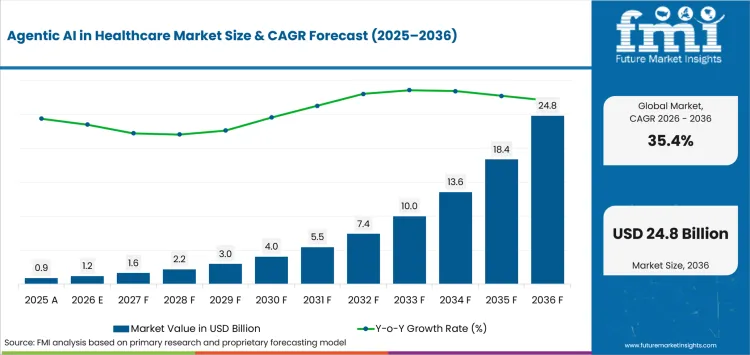
Key Takeaways of Agentic AI in Healthcare Market
- Health systems are expanding agentic workflows to reduce documentation effort and coordinate repetitive administrative tasks under defined human oversight.
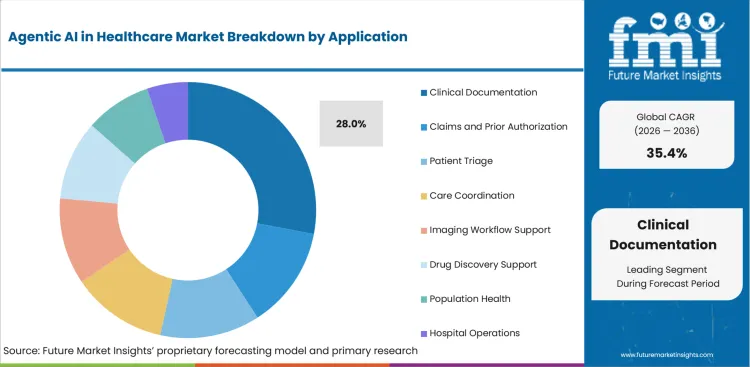
- Clinical documentation is projected to account for 28.0% of application demand in 2026 due to measurable clinician time savings.
- Claims and prior authorization are estimated to represent 18.0% of application demand in 2026 owing to rules-based document handling.
- Patient triage is forecast to capture 14.0% of application demand in 2026 supported by digital intake and routing requirements.
- Privacy obligations and clinical liability restrict autonomous decisions because healthcare organizations require validation and accountable human review.
- Microsoft, Oracle, Salesforce, Amazon Web Services, Innovaccer, Hippocratic AI, NVIDIA and IQVIA serve enterprise, clinical and research agent workflows.
Analyst Perspective
"Health systems should test whether an agent can complete one governed task across records, policies and escalation queues without hiding source context. Commercial advantage depends on reducing rework while the clinician or administrator who signs the final action retains clear accountability."
- Anurag Sharma, Principal Consultant, Future Market Insights
How is the Agentic AI in Healthcare Market segmented?
The agentic AI in healthcare industry is segmented by agent system, product, technology, application, end user and region.
The agentic AI in healthcare market is segmented by agent system, product, technology, application, end user and region. Agent systems cover single, multi-agent and human-supervised designs across clinical, administrative, engagement, revenue-cycle and research roles. Products include platforms, workflow tools, decision-support agents, documentation agents, virtual-care agents and related implementation services. Technologies span language models, machine learning, natural language processing, retrieval augmented generation, knowledge graphs, multimodal AI and orchestration frameworks. Applications and end users follow the complete taxonomy covering eight healthcare workflows and six organization types.
What supports clinical documentation within the application category?
Documentation agents turn patient conversations and context into draft notes that clinicians review inside systems. Health systems need measured operating evidence before extending one agent across specialties and clinical sites. Oracle reported in May 2025 that United States organizations using its Clinical AI Agent averaged 30% less documentation time, giving technology teams a staffing benchmark for healthcare NLP deployments.
- Clinical documentation is projected to hold 28.0% share in 2026 owing to measurable time savings across note completion and coding review.
- Expansion depends on source traceability and accountable approval because correction work can erase the expected productivity benefit across busy clinical departments.
How do claims teams evaluate prior authorization agents?
Claims agents compare supporting records with payer rules before routing exceptions to trained authorization staff. Incomplete submissions disrupt handoffs between provider and payer teams using prior authorization orchestration across high-volume cases.
- By application, claims and prior authorization are forecast to represent 18.0% in 2026 driven by rules-based evidence assembly and policy checks.
- Structured exchange routes determine whether authorization agents can retrieve evidence without hiding policy logic from staff reviewers. CMS finalized electronic prior authorization API requirements in January 2024 for cases across health systems. The requirements preserve policy traceability and staff review during automated information retrieval across payer and provider workflows.
What makes patient triage central to the application category?
Patient triage agents collect symptoms and access needs before routing individuals toward suitable services or professional review queues. Commercial deployment requires connected scheduling and escalation workflows across every digital care access channel today. Salesforce introduced Agentforce for Health in February 2025 with matching and scheduling skills through patient engagement platforms, linking intake automation with actions that access teams manage.
- Based on application, patient triage is projected to account for 14.0% in 2026 due to intake and service-routing requirements.
- Care teams need defined escalation rules for urgent or ambiguous symptoms because routine automation cannot safely resolve every presentation without licensed judgment.
How does care coordination shape agent deployment?
Care coordination agents connect referrals and follow-up tasks across clinicians or service locations that use operational systems. The segment addresses missed handoffs and duplicated outreach across distributed care settings supported by connected care coordination workflows and assigned review queues.
- The care coordination segment is likely to capture 12.0% share in 2026 attributable to fragmented records and distributed follow-up responsibilities.
- Reusable connectivity determines whether coordination agents can extend beyond one department across affiliated hospital systems. In February 2025 Innovaccer launched Agents of Care with more than 80 electronic health record connections supporting referrals and care-gap workflows without rebuilding every interface.
What are the drivers, restraints and opportunities in the Agentic AI in Healthcare Market?
Administrative workload drives adoption, governance requirements restrict autonomy and workflow integration services provide the clearest commercial expansion route.
- Driver: Hospitals and payers fund agents that reduce repetitive documentation and authorization work across measurable operating queues serving clinical capacity.
- Restraint: Clinical risk and fragmented records materially slow deployment as organizations must validate outputs and control every consequential action.
- Opportunity: Integration and monitoring specialists can extend validated agents across departments without replacing established healthcare platforms or governance systems.
Administrative workload consumes clinical capacity that hospitals need for direct patient care across busy departments. The American Medical Association reported in March 2025 that 57% of surveyed physicians viewed administrative automation as AI’s greatest opportunity. Health systems can convert that priority into contracts through measured reductions in documentation and authorization queues.
Clinical deployment requires evidence that an agent remains reliable across software updates and changing patient populations. FDA guidance issued in January 2025 emphasizes lifecycle monitoring, transparency and bias controls for AI-enabled devices. Healthcare organizations apply comparable disciplines through clinical AI governance for non-device agents that influence documentation or routing.
Integration specialists already connect agents with records and policy systems without replacing established healthcare platforms. Reusable healthcare APIs and active monitoring services reduce implementation work across additional departments and sites. Providers that document data boundaries and escalation routes can earn recurring service revenue from validated population health platforms and other multi-site deployments.
Which country CAGRs are profiled in the Agentic AI in Healthcare Market?
| Country | CAGR |
|---|---|
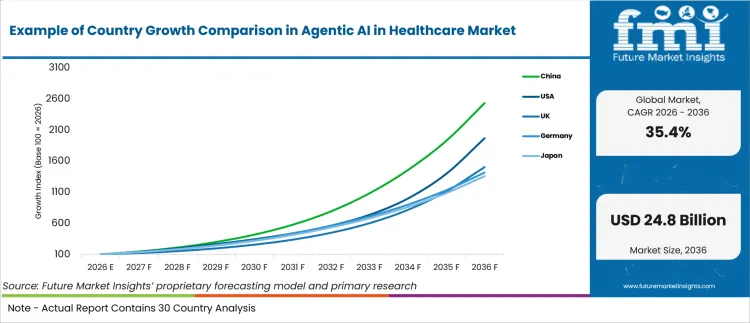
| China | 38.2% |
| United States | 34.8% |
| United Kingdom | 31.2% |
| Germany | 30.4% |
| Japan | 29.8% |
How do country-level CAGRs compare in the Agentic AI in Healthcare Market?
The country CAGRs span 8.4 percentage points and describe forecast pace rather than current market size. Their spacing reflects digital infrastructure and policy support across health systems with different purchasing routes.
- China combines nationally defined health AI scenarios with large hospital networks that support coordinated platform deployment across major medical services.
- The United States combines established electronic records with broad payer workflows and active governance requirements for deployed healthcare models.
- The United Kingdom links centralized NHS guidance with documented ambient-voice trials across diverse clinical settings and public providers.
- Germany connects nationwide patient records with strict privacy controls and slower integration across technically complex hospital systems.
- Japan combines rising electronic-record adoption with security requirements that require local technology companies and hospitals to coordinate system upgrades.
Comparable CAGRs can produce different market entry conditions across health systems with distinct data infrastructure and purchasing routes. The full report provides country-level CAGR analysis across North America, Latin America, Europe, East Asia, South Asia and Pacific, and the Middle East and Africa.
Country-wise Analysis
- China’s national health AI scenario framework gives major hospital networks a defined route for testing agents across medical services, public health programs and locally governed digital platforms under coordinated national oversight arrangements. China is estimated to post 38.2% CAGR over the forecast period, supported by nationally specified use cases and hospital networks that can standardize deployment across major urban medical centers and provincial care systems. The National Health Commission reported in August 2025 that 950 submitted cases covered all 84 national scenarios by March, yet regional hospitals need clear accountability procedures before enterprise orders can recur consistently across regions.
- United States hospitals already operate predictive models inside electronic records, and payer organizations maintain mature authorization and revenue-cycle automation teams across large multi-site systems with established governance committees and technical support nationwide currently. ASTP reported in September 2025 that 71% of nonfederal acute-care hospitals used predictive AI during 2024, giving implementation teams a practical national governance base for evaluating broader agent deployment across additional clinical sites nationwide. Adoption of agentic AI in healthcare in the United States is estimated to expand at 34.8% CAGR through 2036, yet smaller hospitals face integration costs and limited governance staff beyond initial pilot programs.
- United Kingdom health providers test agentic workflows through coordinated NHS programs that connect national guidance with public clinical networks, established assessment routes and shared implementation knowledge across regional care systems and national service networks. The United Kingdom’s agentic AI in healthcare outlook is anticipated to advance at 31.2% CAGR over the assessment period, supported by coordinated evaluation across public providers and common clinical governance requirements. In April 2025 the Department of Health and Social Care reported that ambient voice evaluation involved more than seven thousand patients, yet individual trusts must fund workforce training and privacy controls before multi-site purchasing.
- Germany’s electronic patient record gives authorized clinical workflows a standardized data route, and local software partners support integration across physician practices and technically diverse hospitals with different infrastructure and service requirements across Germany. Gematik reported in April 2026 that insurers had created about 73 million records containing more than 100 million documents, establishing a growing national information base for governed agent workflows across national care settings. The German agentic AI in healthcare sector is projected to record 30.4% CAGR during the assessment period, yet complex hospital infrastructure requires longer adaptation and dependable local service support before broader inpatient deployment.
- Japan is expanding electronic medical records through national digitization programs that require hospitals and technology companies to coordinate secure data exchange, authentication and workflow changes across metropolitan and regional care networks throughout the country. Agentic AI in healthcare sales in Japan are forecast to expand at 29.8% CAGR by 2036, supported by wider electronic-record use across hospitals and stronger coordination between national programs and local technology providers. The Ministry of Health reported in May 2026 that hospital adoption reached 74% while two-factor authentication covered about 10%, so cybersecurity upgrades and limited budgets can delay integration outside major urban systems.
Who are the notable companies in the Agentic AI in Healthcare Market?
Microsoft, Oracle, Salesforce, Amazon Web Services, Innovaccer, Hippocratic AI, NVIDIA and IQVIA are the notable companies serving this market.
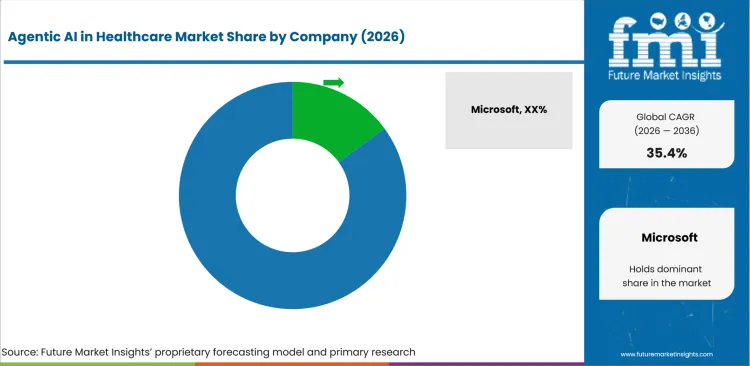
The field remains fragmented because enterprise software groups cover broad data environments while healthcare-native firms concentrate on narrower clinical and administrative tasks. Competition turns on integration depth, documented safety controls and workflow breadth instead of general model access. Research-focused entrants also need governed domain data and scientific validation for AI-enabled drug discovery workflows across regulated life-science programs.
- Microsoft and Oracle compete with Salesforce and Amazon Web Services through enterprise platforms that connect agents with existing healthcare data environments.
- Innovaccer and Hippocratic AI focus on healthcare-native workflows across referrals, patient outreach and supervised clinical support.
- NVIDIA and IQVIA support research or life-science agents through computing infrastructure, domain data and development services.
Competitive Benchmarking: Agentic AI in Healthcare Market
| Company | Workflow Breadth | Healthcare Data Integration | Human Oversight Controls | Geographic Reach |
|---|---|---|---|---|
| Microsoft | High | High | High | United States, Canada and Europe |
| Oracle | High | High | High | United States and Canada |
| Salesforce | High | High | Medium | Global cloud availability |
| Amazon Web Services | High | High | High | United States regions |
| Innovaccer | High | High | Medium | United States |
| Hippocratic AI | High | Medium | High | United States |
| NVIDIA | Medium | Medium | Low | Global partner programs |
| IQVIA | High | High | High | More than 100 countries |
Key Developments in the Agentic AI in Healthcare Market
- In April 2026, Hippocratic AI launched Polaris 5.0 after validation through more than 180 million patient interactions and testing by licensed clinicians.
- In March 2026, Oracle expanded Clinical AI Agent into United States emergency and inpatient settings for draft documentation with clinician review and approval.
- In March 2026, Amazon Web Services introduced Amazon Connect Health with five agent types for patient engagement and point-of-care workflows in two United States regions.
Key Players in the Agentic AI in Healthcare Market
Clinical Workflow and Enterprise Platforms
- Microsoft
- Oracle
- Salesforce
- Amazon Web Services
Healthcare-Native Agent Platforms
- Innovaccer
- Hippocratic AI
Research and AI Infrastructure Platforms
- NVIDIA
- IQVIA
Agentic AI in Healthcare Market - Report Scope
| Coverage field | Report scope |
|---|---|
| Market breakdown | By agent system, product, technology, application, end user and region. |
| Market Definition | Software platforms, workflow agents and implementation services that execute governed multi-step healthcare tasks. |
| Regions Covered | North America, Latin America, Europe, East Asia, South Asia and Pacific, and Middle East and Africa. |
| Countries Covered | China, United States, United Kingdom, Germany, Japan, and 20+ countries included in the full report. |
| Key Companies Profiled | Microsoft, Oracle, Salesforce, Amazon Web Services, Innovaccer, Hippocratic AI, NVIDIA and IQVIA. |
| Forecast Period | 2026 to 2036. |
| Approach | Primary and secondary research with market triangulation. |
Agentic AI in Healthcare Market - Research Methodology
| Method | Approach |
|---|---|
| Primary Research | FMI analysts gathered input from manufacturers, service providers, technology developers, distributors, end users, procurement teams, and subject-matter experts. Interviews examined purchasing decisions, product or service evaluation, adoption barriers, approval requirements, pricing considerations, and expectations for technical or commercial support. Respondents were also asked what evidence is required before a trial, pilot, or initial order develops into regular purchasing. |
| Desk Research | Desk research covered government statistics, regulatory publications, trade data, industry associations, technical literature, standards, company filings, product information, and official corporate announcements. Sources were reviewed for relevance, publication date, geographic coverage, and consistency with the defined market scope. Claims relating to performance, applications, approvals, capacity, investment, and commercial activity were retained only when supported by credible public evidence. |
| Market Sizing and Forecasting | The market model combined the baseline value with historical performance, segment structure, pricing and volume indicators, adoption levels, company participation, and country-level demand conditions. Forecast assumptions considered economic activity, investment trends, regulatory developments, technology adoption, purchasing cycles, supply availability, and barriers to wider market use. Segment and regional estimates were reconciled before the final market total was calculated. |
| Data Validation | Estimates were checked against multiple independent indicators, including public data, company activity, trade patterns, industry developments, and findings from primary interviews. Validation also tested whether products, services, applications, and company revenues fell within the defined market boundaries. Adjacent categories, unsupported claims, overlapping revenues, and activities without direct market relevance were excluded to reduce double counting and maintain consistency across segments and countries. |
Agentic AI in Healthcare Market by Segments
Agentic AI in Healthcare Market segmented by Agent System:
- Single Agent Systems
- Multi-agent Systems
- Human-supervised Agent Workflows
- Clinical Workflow Agents
- Administrative Agents
- Patient Engagement Agents
- Revenue Cycle Agents
- Research Agents
Agentic AI in Healthcare Market segmented by Product:
- Software Platforms
- Workflow Automation Tools
- Clinical Decision Support Agents
- Documentation Agents
- Virtual Care Agents
- Services
Agentic AI in Healthcare Market segmented by Technology:
- Large Language Models
- Machine Learning
- Natural Language Processing
- Retrieval Augmented Generation
- Knowledge Graphs
- Multimodal AI
- Orchestration Frameworks
Agentic AI in Healthcare Market segmented by Application:
- Clinical Documentation
- Care Coordination
- Patient Triage
- Imaging Workflow Support
- Drug Discovery Support
- Claims and Prior Authorization
- Population Health
- Hospital Operations
Agentic AI in Healthcare Market segmented by End User:
- Hospitals
- Payers
- Pharmaceutical Companies
- Diagnostic Centers
- Digital Health Firms
- Research Organizations
Agentic AI in Healthcare Market by Region:
- North America
- United States
- Canada
- Mexico
- Latin America
- Brazil
- Chile
- Rest of Latin America
- Western Europe
- Germany
- United Kingdom
- Italy
- Spain
- France
- Nordics
- Benelux
- Rest of Western Europe
- Eastern Europe
- Russia
- Poland
- Hungary
- Balkan and Baltic States
- Rest of Eastern Europe
- East Asia
- China
- Japan
- South Korea
- South Asia and Pacific
- India
- ASEAN
- Australia and New Zealand
- Rest of South Asia and Pacific
- Middle East and Africa
- Kingdom of Saudi Arabia
- Other GCC Countries
- Türkiye
- South Africa
- Other African Union Countries
- Rest of Middle East and Africa
Research Sources and Bibliography
- American Medical Association. (2026, March 12)
- Oracle. (2025, May 14).
- Centers for Medicare & Medicaid Services. (2024, January 17).
- Salesforce. (2025, February 28).
- Innovaccer. (2025, February 17).
- American Medical Association. (2025, March 20).
- National Health Commission of the People’s Republic of China. (2025, August 26).
- Assistant Secretary for Technology Policy. (2025, September).
- Department of Health and Social Care. (2025, April 27).
- Gematik. (2026, April 15)
- Ministry of Health, Labour and Welfare. (2026, May 29).
- Microsoft. (2025, March 3).
- Hippocratic AI. (2026, April 30).
- Oracle. (2026, March 11).
- Amazon Web Services. (2026, March 5)
- NVIDIA. (2025, January 13).
- IQVIA. (2025, June 11).
This bibliography is provided for reader reference and is not exhaustive. The full report contains the complete reference list and detailed citations
This Report Answers
- How large is the Agentic AI in Healthcare Market in 2026 and 2036?
- Which operating conditions support demand for agentic healthcare workflows?
- Which application accounts for the significant 2026 share within the market?
- How do documentation and authorization agents change administrative workflows?
- Which governance requirements limit autonomous clinical actions?
- How do country growth rates differ across the profiled healthcare systems?
- Which companies provide enterprise and healthcare-native agent platforms?
- What capabilities determine competitive positioning across agentic healthcare deployments?
Frequently Asked Questions
How big is the Agentic AI in Healthcare Market in 2026?
In 2026, the agentic AI in healthcare market is valued at USD 1.2 billion across governed clinical and administrative workflows. Documentation savings and connected records support the projected increase to USD 24.8 billion by 2036 as organizations extend validated agents across additional departments and sites.
What is the CAGR of the Agentic AI in Healthcare Market from 2026 to 2036?
The agentic AI in healthcare market is projected to expand at 35.4% CAGR from 2026 to 2036 across healthcare organizations. Forecast performance depends on measurable workflow value and reliable oversight as hospitals and payers connect agents with records, policies and professional approval routes.
Which application is projected to account for 28.0% of the Agentic AI in Healthcare Market?
Clinical documentation is projected to account for 28.0% of the agentic AI in healthcare market by application during 2026. Hospitals can measure saved clinician time directly, although source traceability and final professional review remain necessary for reliable note completion across existing record systems.
How much absolute dollar opportunity is projected for the Agentic AI in Healthcare Market?
USD 23.6 billion in absolute dollar opportunity is projected for the agentic AI in healthcare market between 2026 and 2036. The increase depends on organizations extending governed agents from isolated administrative uses into connected workflows that retain human approval for consequential actions.
Why do administrative workflows support the Agentic AI in Healthcare Market?
Administrative workflows support the agentic AI in healthcare market through repeated documentation and authorization steps that agents prepare for staff review. Hospitals and payers can compare queue times, corrected records and exception rates before approving broader deployment across additional departments.
What is the main restraint on the Agentic AI in Healthcare Market?
Clinical risk and fragmented records form the main restraint on the agentic AI in healthcare market across consequential workflows. Organizations must validate outputs and preserve accountable escalation before agents influence patient routing or clinical documentation at scale across wider deployment programs.
How does human oversight affect the Agentic AI in Healthcare Market?
Human oversight affects the agentic AI in healthcare market by defining which actions an agent prepares and which decisions require professional approval. Review controls and source traceability help healthcare organizations expand automation without transferring clinical accountability to software during phased deployment.
Which companies are active in the Agentic AI in Healthcare Market?
Microsoft and Oracle join Salesforce and Amazon Web Services in the agentic AI in healthcare market through enterprise workflow platforms. Innovaccer and Hippocratic AI join NVIDIA and IQVIA across healthcare-native agents or research infrastructure with governed data integration across clinical and commercial functions.
Preview the report firsthand - request a free sample
Get SampleGet the brochure for pricing and purchase details.
Get PDFTable of Content
- Key Takeaways
- Market Size and CAGR
- Top Growth Driver
- Fastest Growing Segment
- Leading Region
- Key Companies
- Emerging Opportunities
- Executive Summary
- Global Market Outlook
- Demand-side Trends
- Supply-side Trends
- Technology Roadmap Analysis
- Analysis and Recommendations
- Analyst Perspective (What is happening? Why now? What should investors know?)
- Key Questions Answered
- How large is the market?
- What is the CAGR?
- What are key trends?
- Which region dominates?
- Who are the leaders?
- Market Overview
- Market Coverage / Taxonomy
- Market Definition / Scope / Limitations
- Research Methodology
- Chapter Orientation
- Analytical Lens and Working Hypotheses
- Market Structure, Signals, and Trend Drivers
- Benchmarking and Cross-market Comparability
- Market Sizing, Forecasting, and Opportunity Mapping
- Research Design and Evidence Framework
- Desk Research Programme (Secondary Evidence)
- Expert Input and Fieldwork (Primary Evidence)
- Tooling, Models, and Reference Databases
- Data Engineering and Model Build
- Quality Assurance and Audit Trail
- Market Background
- Market Dynamics (Drivers, Restraints, Opportunity, Trends)
- Scenario Forecast (Optimistic, Likely, Conservative)
- Impact Analysis
- AI Impact
- Sustainability Impact
- Regulatory Impact
- Technology Impact
- Consumer / Buyer Analysis
- Purchase Drivers
- Adoption Barriers
- Buyer Journey
- Opportunity Map Analysis
- Product Life Cycle Analysis
- Supply Chain Analysis
- Investment Feasibility Matrix
- Value Chain Analysis
- PESTLE and Porter's Analysis
- Regulatory Landscape
- Regional Parent Market Outlook
- Production and Consumption Statistics
- Import and Export Statistics
- Global Market Analysis and Forecast, 2021 to 2036
- Historical Market Size Value (USD Billion) Analysis, 2021 to 2025
- Current and Future Market Size Value (USD Billion) Projections, 2026 to 2036
- Y-o-Y Growth Trend Analysis
- Absolute $ Opportunity Analysis
- Global Market Pricing Analysis, 2021 to 2036
- Global Market Analysis and Forecast, By Agent System, 2021 to 2036
- Introduction / Key Findings
- Historical Market Size Value (USD Billion) Analysis By Agent System, 2021 to 2025
- Current and Future Market Size Value (USD Billion) Analysis and Forecast By Agent System, 2026 to 2036
- Single Agent Systems
- Multi-agent Systems
- Human-supervised Agent Workflows
- Clinical Workflow Agents
- Administrative Agents
- Patient Engagement Agents
- Revenue Cycle Agents
- Research Agents
- Single Agent Systems
- Y-o-Y Growth Trend Analysis By Agent System, 2021 to 2025
- Absolute $ Opportunity Analysis By Agent System, 2026 to 2036
- Global Market Analysis and Forecast, By Product, 2021 to 2036
- Introduction / Key Findings
- Historical Market Size Value (USD Billion) Analysis By Product, 2021 to 2025
- Current and Future Market Size Value (USD Billion) Analysis and Forecast By Product, 2026 to 2036
- Software Platforms
- Workflow Automation Tools
- Clinical Decision Support Agents
- Documentation Agents
- Virtual Care Agents
- Services
- Software Platforms
- Y-o-Y Growth Trend Analysis By Product, 2021 to 2025
- Absolute $ Opportunity Analysis By Product, 2026 to 2036
- Global Market Analysis and Forecast, By Technology, 2021 to 2036
- Introduction / Key Findings
- Historical Market Size Value (USD Billion) Analysis By Technology, 2021 to 2025
- Current and Future Market Size Value (USD Billion) Analysis and Forecast By Technology, 2026 to 2036
- Large Language Models
- Machine Learning
- Natural Language Processing
- Retrieval Augmented Generation
- Knowledge Graphs
- Multimodal AI
- Orchestration Frameworks
- Large Language Models
- Y-o-Y Growth Trend Analysis By Technology, 2021 to 2025
- Absolute $ Opportunity Analysis By Technology, 2026 to 2036
- Global Market Analysis and Forecast, By Application, 2021 to 2036
- Introduction / Key Findings
- Historical Market Size Value (USD Billion) Analysis By Application, 2021 to 2025
- Current and Future Market Size Value (USD Billion) Analysis and Forecast By Application, 2026 to 2036
- Clinical Documentation
- Claims and Prior Authorization
- Patient Triage
- Care Coordination
- Imaging Workflow Support
- Drug Discovery Support
- Population Health
- Hospital Operations
- Clinical Documentation
- Y-o-Y Growth Trend Analysis By Application, 2021 to 2025
- Absolute $ Opportunity Analysis By Application, 2026 to 2036
- Global Market Analysis and Forecast, By End User, 2021 to 2036
- Introduction / Key Findings
- Historical Market Size Value (USD Billion) Analysis By End User, 2021 to 2025
- Current and Future Market Size Value (USD Billion) Analysis and Forecast By End User, 2026 to 2036
- Hospitals
- Payers
- Pharmaceutical Companies
- Diagnostic Centers
- Digital Health Firms
- Research Organizations
- Hospitals
- Y-o-Y Growth Trend Analysis By End User, 2021 to 2025
- Absolute $ Opportunity Analysis By End User, 2026 to 2036
- Global Market Analysis and Forecast, By Region, 2021 to 2036
- Introduction
- Historical Market Size Value (USD Billion) Analysis By Region, 2021 to 2025
- Current Market Size Value (USD Billion) Analysis and Forecast By Region, 2026 to 2036
- North America
- Latin America
- Western Europe
- Eastern Europe
- East Asia
- South Asia and Pacific
- Middle East & Africa
- Market Attractiveness Analysis By Region
- North America Market Analysis and Forecast, By Country, 2021 to 2036
- Historical Market Size Value (USD Billion) Trend Analysis By Market Taxonomy, 2021 to 2025
- Market Size Value (USD Billion) Forecast By Market Taxonomy, 2026 to 2036
- By Country
- USA
- Canada
- By Agent System
- By Product
- By Technology
- By Application
- By End User
- By Country
- Market Attractiveness Analysis
- By Country
- By Agent System
- By Product
- By Technology
- By Application
- By End User
- Key Takeaways
- Latin America Market Analysis and Forecast, By Country
- Historical Market Size Value (USD Billion) Trend Analysis By Market Taxonomy, 2021 to 2025
- Market Size Value (USD Billion) Forecast By Market Taxonomy, 2026 to 2036
- By Country
- Brazil
- Mexico
- Chile
- Rest of Latin America
- By Agent System
- By Product
- By Technology
- By Application
- By End User
- By Country
- Market Attractiveness Analysis
- By Country
- By Agent System
- By Product
- By Technology
- By Application
- By End User
- Key Takeaways
- Western Europe Market Analysis and Forecast, By Country
- Historical Market Size Value (USD Billion) Trend Analysis By Market Taxonomy, 2021 to 2025
- Market Size Value (USD Billion) Forecast By Market Taxonomy, 2026 to 2036
- By Country
- Germany
- UK
- Italy
- Spain
- France
- Nordic
- BENELUX
- Rest of Western Europe
- By Agent System
- By Product
- By Technology
- By Application
- By End User
- By Country
- Market Attractiveness Analysis
- By Country
- By Agent System
- By Product
- By Technology
- By Application
- By End User
- Key Takeaways
- Eastern Europe Market Analysis and Forecast, By Country
- Historical Market Size Value (USD Billion) Trend Analysis By Market Taxonomy, 2021 to 2025
- Market Size Value (USD Billion) Forecast By Market Taxonomy, 2026 to 2036
- By Country
- Russia
- Poland
- Hungary
- Balkan & Baltic
- Rest of Eastern Europe
- By Agent System
- By Product
- By Technology
- By Application
- By End User
- By Country
- Market Attractiveness Analysis
- By Country
- By Agent System
- By Product
- By Technology
- By Application
- By End User
- Key Takeaways
- East Asia Market Analysis and Forecast, By Country
- Historical Market Size Value (USD Billion) Trend Analysis By Market Taxonomy, 2021 to 2025
- Market Size Value (USD Billion) Forecast By Market Taxonomy, 2026 to 2036
- By Country
- China
- Japan
- South Korea
- By Agent System
- By Product
- By Technology
- By Application
- By End User
- By Country
- Market Attractiveness Analysis
- By Country
- By Agent System
- By Product
- By Technology
- By Application
- By End User
- Key Takeaways
- South Asia and Pacific Market Analysis and Forecast, By Country
- Historical Market Size Value (USD Billion) Trend Analysis By Market Taxonomy, 2021 to 2025
- Market Size Value (USD Billion) Forecast By Market Taxonomy, 2026 to 2036
- By Country
- India
- ASEAN
- Australia & New Zealand
- Rest of South Asia and Pacific
- By Agent System
- By Product
- By Technology
- By Application
- By End User
- By Country
- Market Attractiveness Analysis
- By Country
- By Agent System
- By Product
- By Technology
- By Application
- By End User
- Key Takeaways
- Middle East & Africa Market Analysis and Forecast, By Country
- Historical Market Size Value (USD Billion) Trend Analysis By Market Taxonomy, 2021 to 2025
- Market Size Value (USD Billion) Forecast By Market Taxonomy, 2026 to 2036
- By Country
- Kingdom of Saudi Arabia
- Other GCC Countries
- Türkiye
- South Africa
- Other African Union
- Rest of Middle East & Africa
- By Agent System
- By Product
- By Technology
- By Application
- By End User
- By Country
- Market Attractiveness Analysis
- By Country
- By Agent System
- By Product
- By Technology
- By Application
- By End User
- Key Takeaways
- Key Countries Market Analysis
- USA
- Pricing Analysis
- Market Share Analysis, 2025
- By Agent System
- By Product
- By Technology
- By Application
- By End User
- Canada
- Pricing Analysis
- Market Share Analysis, 2025
- By Agent System
- By Product
- By Technology
- By Application
- By End User
- Mexico
- Pricing Analysis
- Market Share Analysis, 2025
- By Agent System
- By Product
- By Technology
- By Application
- By End User
- Brazil
- Pricing Analysis
- Market Share Analysis, 2025
- By Agent System
- By Product
- By Technology
- By Application
- By End User
- Chile
- Pricing Analysis
- Market Share Analysis, 2025
- By Agent System
- By Product
- By Technology
- By Application
- By End User
- Germany
- Pricing Analysis
- Market Share Analysis, 2025
- By Agent System
- By Product
- By Technology
- By Application
- By End User
- UK
- Pricing Analysis
- Market Share Analysis, 2025
- By Agent System
- By Product
- By Technology
- By Application
- By End User
- Italy
- Pricing Analysis
- Market Share Analysis, 2025
- By Agent System
- By Product
- By Technology
- By Application
- By End User
- Spain
- Pricing Analysis
- Market Share Analysis, 2025
- By Agent System
- By Product
- By Technology
- By Application
- By End User
- France
- Pricing Analysis
- Market Share Analysis, 2025
- By Agent System
- By Product
- By Technology
- By Application
- By End User
- India
- Pricing Analysis
- Market Share Analysis, 2025
- By Agent System
- By Product
- By Technology
- By Application
- By End User
- ASEAN
- Pricing Analysis
- Market Share Analysis, 2025
- By Agent System
- By Product
- By Technology
- By Application
- By End User
- Australia & New Zealand
- Pricing Analysis
- Market Share Analysis, 2025
- By Agent System
- By Product
- By Technology
- By Application
- By End User
- China
- Pricing Analysis
- Market Share Analysis, 2025
- By Agent System
- By Product
- By Technology
- By Application
- By End User
- Japan
- Pricing Analysis
- Market Share Analysis, 2025
- By Agent System
- By Product
- By Technology
- By Application
- By End User
- South Korea
- Pricing Analysis
- Market Share Analysis, 2025
- By Agent System
- By Product
- By Technology
- By Application
- By End User
- Russia
- Pricing Analysis
- Market Share Analysis, 2025
- By Agent System
- By Product
- By Technology
- By Application
- By End User
- Poland
- Pricing Analysis
- Market Share Analysis, 2025
- By Agent System
- By Product
- By Technology
- By Application
- By End User
- Hungary
- Pricing Analysis
- Market Share Analysis, 2025
- By Agent System
- By Product
- By Technology
- By Application
- By End User
- Kingdom of Saudi Arabia
- Pricing Analysis
- Market Share Analysis, 2025
- By Agent System
- By Product
- By Technology
- By Application
- By End User
- Türkiye
- Pricing Analysis
- Market Share Analysis, 2025
- By Agent System
- By Product
- By Technology
- By Application
- By End User
- South Africa
- Pricing Analysis
- Market Share Analysis, 2025
- By Agent System
- By Product
- By Technology
- By Application
- By End User
- USA
- Market Structure Analysis
- Competition Dashboard
- Competition Benchmarking
- Market Share Analysis of Top Players
- By Regional
- By Agent System
- By Product
- By Technology
- By Application
- By End User
- Emerging Startups
- Innovation Benchmarking
- Competition Analysis
- Competition Deep Dive
- Microsoft
- Overview
- Product Portfolio
- Profitability by Market Segments
- Sales Footprint
- Strategy Overview
- Marketing Strategy
- Product Strategy
- Channel Strategy
- Oracle
- Salesforce
- Amazon Web Services
- Innovaccer
- Hippocratic AI
- NVIDIA
- IQVIA
- Microsoft
- Case Studies
- Success Stories
- Recent Developments
- Competition Deep Dive
- Assumptions & Acronyms Used


