

- Industry Size (2026)
- USD 7.36 Bn
- Forecast (2036)
- USD 55 Bn
- CAGR (2026 to 2036)
- 22.28%
Agentic Automation Market Size, Market Forecast and Outlook By FMI
In 2025, the agentic automation market was valued at USD 6.02 billion and is projected to reach USD 7.36 billion in 2026 and USD 55 billion by 2036, reflecting a 22.28% CAGR as enterprise IT architectures transition from passive machine learning augmentation toward autonomous, multi-step workflow execution models. Capital allocation shifts aggressively toward autonomous systems as software vendors embed native orchestration layers directly into enterprise resource planning networks.
UiPath launched agentic AI solutions tailored for healthcare environments, specifically targeting medical records summarization and prior authorization automation [11], signaling that domain-specific execution engines have crossed the threshold from pilot conceptualization to mass commercial deployment. Procurement directors evaluating infrastructure upgrades face an immediate pivot point: relying on deterministic scripts over autonomous, goal-seeking agents now introduces severe structural disadvantages.
Buyers operating without autonomous orchestration architectures prior to the 2028 procurement cycle will structurally fail to match the operational velocity and margin protection achieved by integrated, AI-first competitors. Daniel Dines, Founder and CEO of UiPath, opined, “Agentic automation is the natural evolution of RPA. Since our inception, we have helped our customers revolutionize their businesses by emulating humans through robotic process automation. Now, we’re advancing enterprise automation with agents, allowing customers to automate entire end-to-end processes and orchestrate workflows seamlessly. The result is more substantial business outcomes, greater productivity, and more customer-facing direct benefits from automation.” [21] This confirms that hardware infrastructure is being actively redesigned to support persistent, autonomous inference loops rather than discrete query responses.
Summary of Agentic Automation Market
- Agentic Automation Market Definition
- An advanced enterprise software architecture utilizing autonomous artificial intelligence agents capable of independent reasoning, multi-step planning, and direct execution of complex business workflows without continuous human supervision.
- Demand Drivers in the Market
- Enterprise margin compression forces chief operating officers to substitute manual administrative processing with autonomous software execution.
- Rapid maturation of large language models enables dynamic, goal-oriented reasoning that surpasses the limitations of deterministic robotic process automation.
- Deep API integration standardizes communication layers, allowing discrete AI agents to negotiate and execute cross-platform tasks autonomously.
- Key Segments Analyzed in the FMI Report
- Task-execution Agents: 40% share in 2026, driven by immediate corporate mandates to automate high-volume, repetitive digital operations.
- Cloud: 65% share in 2026, reflecting the massive computational scaling required to run continuous multi-agent inference loops.
- BFSI: 38% share in 2026, as highly regulated entities deploy decision engines to manage real-time fraud detection and compliance auditing.
- Analyst Opinion at FMI
- Rahul Pandita, Principal Consultant for Technology, opines, “The rapid commercialization of agentic automation is structurally altering software procurement. We observe that enterprises are abandoning traditional integration vendors in favor of platforms natively hosting autonomous reasoning engines, fundamentally shifting competitive leverage toward specialized AI orchestrators capable of independent error correction.”
- Strategic Implications / Executive Takeaways
- Mandate autonomous agent compatibility for all future enterprise software procurement to prevent infrastructure obsolescence.
- Restructure operational teams around AI governance rather than direct task execution to capture maximum productivity gains.
- Prioritize cloud-native integration partners who demonstrate proven multi-agent orchestration within strict regulatory compliance boundaries.
- Methodology
- Primary Research: Direct interviews with chief technology officers, enterprise software architects, and AI platform developers across North America, Europe, and Asia Pacific.
- Desk Research: Exhaustive analysis of corporate product announcements, regulatory agency adoption databases, and institutional investment filings.
- Market-Sizing and Forecasting: Bottom-up demand modeling originating from regional software expenditure baselines, projected forward utilizing enterprise cloud migration rates.
- Data Validation and Update Cycle: Iterative cross-verification against government labor statistics and peer-reviewed economic impact assessments prior to forecast finalization.
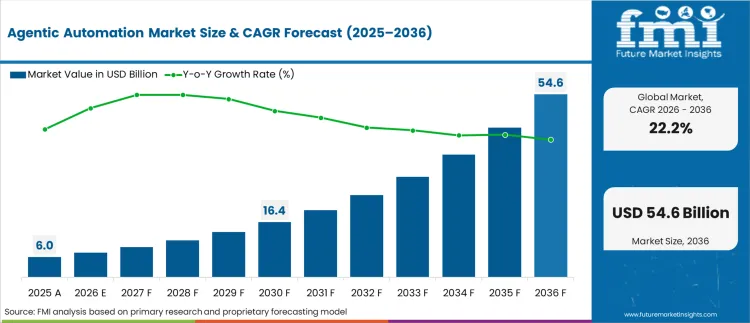
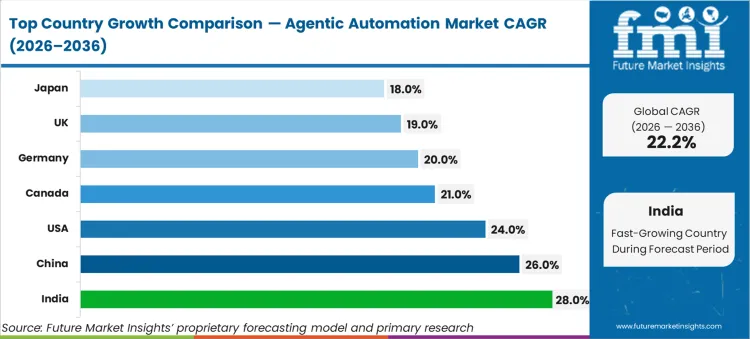
Demand expansion across key geographies reveals a bifurcated adoption trajectory driven by specific national industrial policies and labor economics. India accelerates at a 28.0% CAGR, supported by IT service exporters rapidly weaponizing autonomous platforms to offset wage inflation and maintain global margin competitiveness. China closely follows at 26.0%, leveraging state-backed manufacturing digitization mandates to deploy advanced orchestration engines across localized, on-premise infrastructure. The USA expands at 24.0%, anchored by mature financial services and retail ecosystems aggressively pursuing task-execution efficiency. Canada matches pace at 21.0% through deep integration with the North American cloud corridor. Germany advances at 20.0%, prioritizing precision manufacturing integration, while the UK scales at 19.0% via hybrid BFSI deployments. Japan trails slightly at 18.0%, reflecting demographic-forced automation tempered by conservative corporate governance.
Agentic Automation Market Definition
The Agentic Automation market comprises the commercial ecosystem of software platforms, discrete artificial intelligence agents, and specialized integration services designed to execute multi-step operational tasks autonomously. These systems utilize dynamic reasoning, environmental perception, and API control to achieve predefined business objectives without requiring step-by-step human programming. This architecture represents the structural evolution from static, rules-based processing toward goal-directed software autonomy.
Agentic Automation Market Inclusions
The scope captures software licensing for autonomous task-execution agents, decision-support reasoning models, and complex workflow orchestration platforms deployed across both cloud and on-premise environments. It includes integration services dedicated explicitly to deploying these autonomous systems within enterprise networks. For example, process automation and instrumentation frameworks that utilize generative AI engines to autonomously correct supply chain routing errors are fully included within the market sizing parameters.
Agentic Automation Market Exclusions
The market boundary explicitly excludes traditional, rules-based robotic process automation (RPA) tools that lack independent reasoning and dynamic pathfinding capabilities. Standard consumer-grade virtual assistants, generic generative AI text-generation tools lacking execution permissions, and fundamental hardware components are excluded. Additionally, broad enterprise software suites where agentic capabilities constitute an undefined or non-monetized feature rather than a core functional offering fall outside the evaluation scope.
Agentic Automation Market Research Methodology
- Primary Research: Comprehensive interviews with tier-1 enterprise software developers, cloud infrastructure providers, and corporate IT procurement heads to validate adoption rates and pricing structures.
- Desk Research: Extraction of verifiable implementation metrics from government agency usage databases, institutional economic reports, and verified corporate press releases concerning platform launches.
- Market-Sizing and Forecasting: A highly granular bottom-up adoption model anchored to current enterprise software spend, applying historical disruptive technology penetration curves to project future agent deployment volumes.
- Data Validation and Update Cycle: Continuous cross-referencing of vendor-reported revenues against objective economic output analyses and regulatory compliance filings to ensure maximum baseline accuracy.
Segmental Analysis
Agentic Automation Market Analysis by Capability
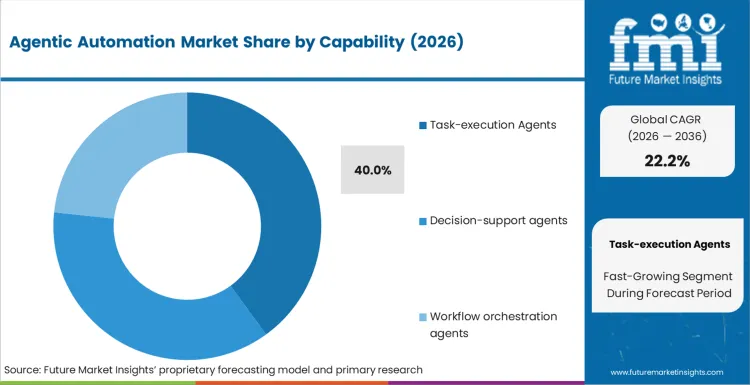
Software engineering divisions are fundamentally shifting development pipelines away from passive analytics toward active, autonomous systems capable of bridging the execution gap. The USA Government Accountability Office documented that from 2023 to 2024, federal agencies’ generative AI use cases rose from 32 to 282 across selected departments [2], demonstrating that institutional deployment scales exponentially once baseline security parameters are established. Buyers are actively standardizing procurement around legal ai and compliance reasoning engines that can autonomously navigate complex regulatory environments. The task-execution agents account for 40% of the capability segment share in 2026, commanding early enterprise budgets due to their immediate, measurable impact on administrative overhead. System architects specify interoperability protocols to ensure discrete execution agents can operate within legacy enterprise resource planning frameworks without causing systemic disruption.
- Technical Validation: Autonomous agents equipped with deep API access successfully execute multi-application workflows, reducing process completion latency by eliminating human approval bottlenecks.
- Procurement Shifts: Chief financial officers demand software solutions that actively reduce administrative headcount rather than merely augmenting existing worker productivity.
- Adoption Accelaration: High-volume, standardized digital operations, such as invoice processing and IT ticketing, provide immediate return on investment for autonomous execution deployments.
Agentic Automation Market Analysis by Deployment
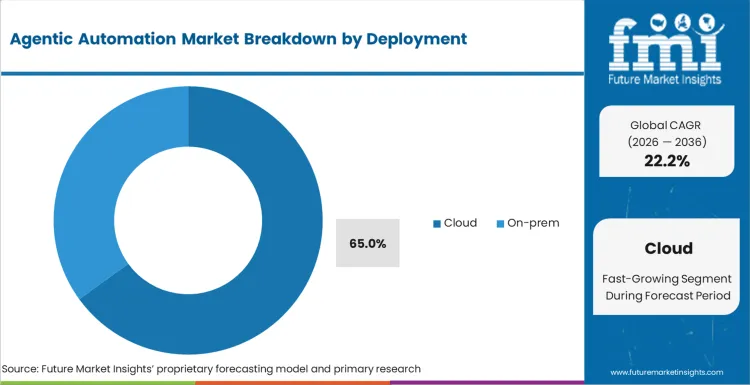
Cloud hyperscalers dominate the infrastructure layer, leveraging vast centralized compute resources to offer agentic capabilities as highly accessible, scalable services. Microsoft expanded its task-execution agents in Azure, specifically targeting both hybrid and fully cloud-native environments [14], proving that vendors recognize the necessity of bridging legacy on-premise systems with advanced centralized inference engines. Buyers migrating complex unified communication as a service ucaas architectures now explicitly demand native agentic capabilities to orchestrate dynamic cross-platform interactions. The cloud infrastructure secures 65% of the deployment segment share in 2026, reflecting the massive computational intensity required to maintain continuous, multi-agent reasoning loops. IT directors avoid capital expenditure on specialized internal server clusters by routing heavy agent inference tasks through established hyperscaler networks.
- Process Compatibility: Cloud-native orchestration platforms rapidly integrate with existing enterprise SaaS ecosystems, minimizing the friction associated with deploying autonomous capabilities.
- Logistics Advantage: Centralized model updating ensures that all deployed agents immediately benefit from foundational reasoning improvements without requiring manual enterprise-side patching.
- Supplier Positioning: Hyperscalers bundle complex autonomous agents directly into existing enterprise licensing agreements, circumventing lengthy standalone procurement cycles.
Agentic Automation Market Analysis by Industry
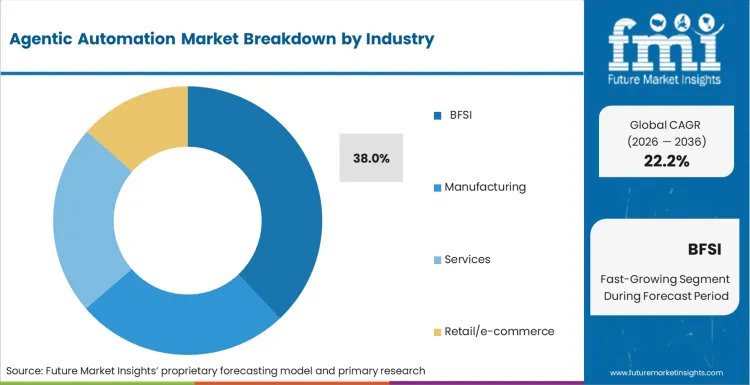
Financial services organizations operate under intense regulatory and operational pressures, forcing the rapid transition toward autonomous oversight mechanisms. FMI analysts opine that highly regulated entities view autonomous orchestration not merely as a cost-reduction lever, but as a critical compliance enforcement mechanism capable of monitoring transactions at superhuman scales. ServiceNow launched autonomous workforce AI specialists, integrating their Moveworks acquisition to enable agentic, multi-step problem resolution directly within complex service environments [12]. This level of operational autonomy pushes the BFSI sector to command 38% of segment volumes in 2026. Risk management officers mandating zero-trust architectures now require that all data as a service (DAAS) pipelines integrate with autonomous decision engines to flag and halt anomalous data extractions instantly.
- Dietary Compliance: Strict regulatory reporting mandates force banking institutions to deploy autonomous agents capable of continuously auditing vast transaction logs without manual intervention.
- Volume Concentration: Institutions processing millions of daily digital interactions capture the highest value from agents capable of independently resolving complex customer service inquiries.
- Cost Structures: Legacy financial institutions attempt to maintain manual compliance oversight against agile fintech competitors utilizing fully autonomous back-office operations.
Agentic Automation Market Analysis by Component
Software platforms form the critical structural foundation of the agentic ecosystem, providing the essential control planes where autonomous workflows are designed, monitored, and governed. These foundational orchestration engines represent 61% of total component volumes in 2026, as enterprises prioritize centralizing their autonomous capabilities to maintain strict security oversight. IBM announced its Enterprise Advantage consulting framework to specifically architect and deploy agentic AI-powered enterprises [13], underscoring that the transition to autonomy requires massive, structured platform overhauls rather than incremental software patching. Procurement departments evaluating comprehensive scm bpo modernization efforts now reject service providers who cannot seamlessly integrate their operations into the client's central agentic control platform.
- Product Innovation: Centralized orchestration layers allow IT administrators to establish strict operational boundaries, preventing individual execution agents from initiating unauthorized systemic changes.
- Requalification Cycles: The profound integration depth required for comprehensive agentic platforms creates massive structural stickiness, severely complicating vendor replacement efforts once systems are deployed.
- Shelf Stability: Continuous algorithmic updating delivered via centralized platform subscriptions ensures that enterprise execution agents remain effective against evolving business parameters.
Agentic Automation Market Drivers, Restraints, and Opportunities
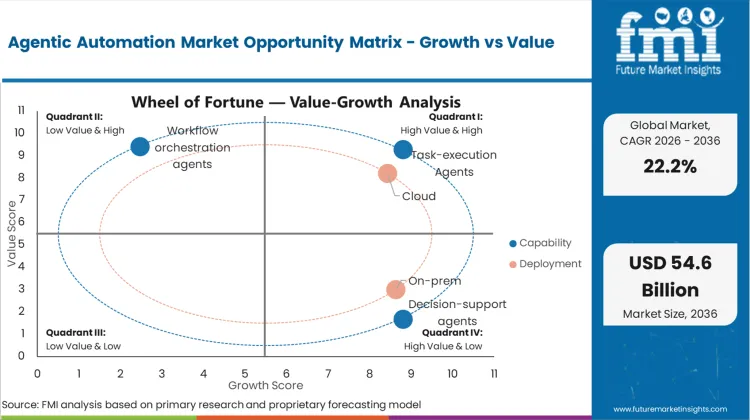
Macroeconomic productivity pressures directly accelerate the aggressive substitution of manual administrative labor with autonomous digital execution. The Congressional Budget Office projects that real business fixed investment grows by 3.9 % in 2026, explicitly driven by investments in generative AI and associated structural incentives [3]. FMI analysts opine that this capital influx signals a permanent transition; enterprise buyers treat agentic orchestration platforms as critical operational infrastructure rather than experimental digital tools. Software vendors capitalizing on this dynamic restructure their pricing models to capture the total economic value of replaced human output, creating an environment where IT robotics automation capabilities dictate total corporate valuation multipliers.
Integration complexity and pervasive operational friction restrict the rapid, mass deployment of fully autonomous execution engines within legacy corporate environments. The World Bank notes that despite the immense theoretical potential of agentic AI, meaningful enterprise deployment and widespread structural adoption remain extremely rare [9]. Chief technology officers mitigate this friction by deploying narrow, highly constrained automation COE frameworks that limit autonomous agents to carefully sandboxed, low-risk administrative workflows. FMI analysts opine that overcoming these initial trust and structural integration barriers requires vendors to demonstrate flawless, mathematically verifiable execution logs before buyers commit to broader systemic automation.
- Manufacturing Workflow Orchestration: Automation Anywhere released a new cloud-based agentic platform tailored specifically for complex manufacturing environments. [15]
- Banking Service Automation: Salesforce enhanced its Agentforce suite with targeted decision-support agents designed to fully automate customer service resolution within the BFSI sector. [16]
- Global Manufacturing Transition: Samsung Electronics announced a strategy to transition global manufacturing into 'AI-Driven Factories' by 2030 using agentic AI. [24]
Regional Analysis
.webp "Top Country Growth Comparison Agentic Automation Market Cagr (2026 2036)")
Based on the regional analysis, the Agentic Automation market is segmented into North America, Latin America, Europe, East Asia, South Asia, Oceania and Middle East & Africa across 40+ countries. The full report also offers market attractiveness analysis based on regional trends.
| Country | CAGR (2026 to 2036) |
|---|---|
| India | 28.0% |
| China | 26.0% |
| USA | 24.0% |
| Canada | 21.0% |
| Germany | 20.0% |
| UK | 19.0% |
| Japan | 18.0% |
Source: Future Market Insights (FMI) analysis, based on proprietary forecasting model and primary research
Asia Pacific Agentic Automation Market Analysis
Asia Pacific’s industrial landscape rapidly pivots toward software autonomy as leading economies leverage algorithmic orchestration to neutralize demographic constraints and labor inflation. The World Economic Forum indicates that AI and deep information processing will fundamentally transform 86% of global businesses by 2030, forcefully reshaping millions of roles [8]. This structural pressure forces domestic enterprises to bypass incremental digital upgrades in favor of comprehensive robotic process automation replacement cycles utilizing true autonomous agents. Regional manufacturers and service exporters aggressively restructure baseline operations, utilizing software autonomy to secure their competitive positioning within highly contested global supply chains. The drive to protect manufacturing margins and service delivery consistency establishes the structural condition that powers aggressive adoption rates across specific national economies.
- India: Delivery center directors who fail to embed automated workflow orchestration within their 2027 client renewal proposals risk losing tier-1 vendor status to agile automation-first challengers. Demand for agentic automation in India is estimated to expand at a CAGR of 28.0% as enterprise architectures accelerate the transition from passive machine learning models to active decision engines, driven by IT services exporters seeking margin protection against rising wage inflation. Anthropic partnered with Infosys to deploy custom enterprise agentic AI architectures across global services delivery networks [20], signaling that system integrators are now operationalizing autonomous software pipelines.
- China: China's agentic automation sector is poised to expand at a CAGR of 26.0% as state-backed directives force heavy industrial conglomerates to digitize complex production environments using localized, on-premise orchestration frameworks. The International Labour Organization highlights that rapid AI adoption is transforming labor markets worldwide [7]. The supply chain executives managing vast logistics networks must rapidly integrate autonomous decision-support tools into their core routing architectures or face severe operational bottlenecks as state-mandated efficiency quotas compress acceptable delivery timelines.
- Japan: The IEEE notes that 96% of technologists globally agree that agentic AI innovation and adoption will continue at lightning speed in 2026 [23], providing domestic industries the momentum necessary to confidently automate complex plant-floor decision loops. A CAGR of 18.0% is projected for agentic automation in Japan through 2036 as severe demographic contraction forces manufacturers to digitize tacit institutional knowledge before mass workforce retirements accelerate. Chief operations officers must transition core factory orchestration to autonomous decision agents by the 2028 fiscal cycle or face critical production shutdowns as skilled labor availability permanently declines.
FMI's report includes extensive coverage of the Asia Pacific ecosystem, tracking how autonomous technology scales across South Korea, Singapore, and Australia. In South Korea, semiconductor fabrication facilities face immense pressure to deploy autonomous industrial robotics control systems to manage defect resolution without halting production lines. This requirement establishes strict, zero-latency inference processing parameters that all regional software vendors must clear before entering competitive tender processes.
North America Agentic Automation Market Analysis
North American enterprise ecosystems demand immediate, scalable operational efficiency, driving hyper-adoption of cloud-native orchestration platforms. The Office of Management and Budget reported that federal agencies have publicly disclosed more than 1,700 distinct use cases where artificial intelligence actively advances institutional missions [4]. This aggressive public sector validation sets the baseline expectation for commercial deployment, accelerating the transition toward generative ai frameworks that can independently execute defined workflows. Corporate buyers aggressively strip away legacy administrative architectures, deploying autonomous software layers to extract maximum margin from existing data operations. The relentless pursuit of frictionless, highly automated administrative structures dictates procurement strategies across the region's dominant economic hubs.
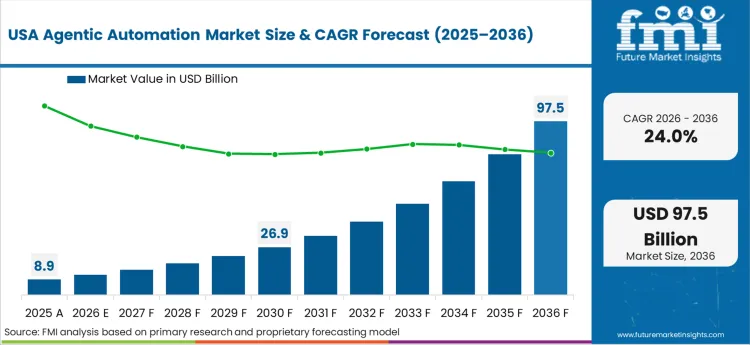
- USA: The USA Bureau of Labor Statistics projects that aggressive adoption of generative AI tools and resulting productivity gains will severely dampen labor demand in sales, design, and administrative support through 2034 [1]. The USA is expected to see its agentic automation sector grow at 24.0% annually as massive enterprise software budgets are reallocated toward technologies capable of directly neutralizing escalating labor costs. Procurement managers orchestrating enterprise modernization must completely abandon traditional human-in-the-loop software licensing models; vendors unable to demonstrate fully autonomous task execution will be categorically excluded from the 2027 enterprise software procurement cycle.
- Canada: Demand for agentic automation in Canada is estimated to expand at a CAGR of 21.0% as strong resource and financial sectors tightly integrate with advanced North American cloud infrastructure platforms. The Council of Economic Advisers reports that in the first half of 2025 alone, AI-related investment increased GDP by an annualized rate of 1.3 % [6], providing the structural funding necessary for deep systemic modernization. Chief information officers operating within the Canadia market financial sector must rapidly deploy compliant, autonomous decision-support systems to maintain operational parity with larger USA banking entities dominating the cross-border market.
FMI's report includes deep analytical tracking of the North America sector, encompassing deployment models and specific structural requirements across Mexico. In Mexican manufacturing hubs, nearshoring operations urgently require advanced service delivery automation systems to seamlessly connect local plant-floor logistics with parent company ERP networks in the United States. This cross-border data synchronization pressure forces local operators to implement autonomous execution agents strictly to maintain compliance with stringent US-mandated reporting timelines.
Europe Agentic Automation Market Analysis
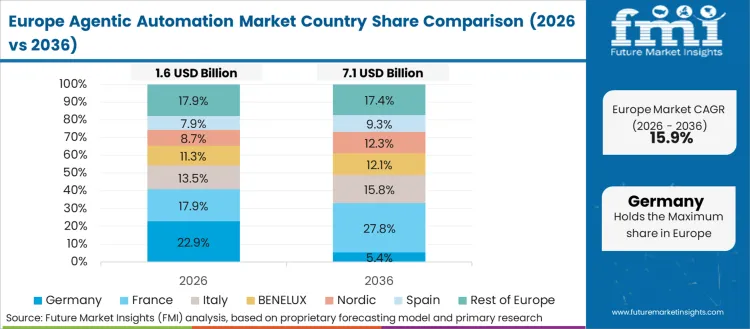
Europe's transition toward software autonomy proceeds under intense regulatory scrutiny, defining an ecosystem where compliance architecture is indistinguishable from operational capability. The OECD stated that 20.2% of surveyed firms reported utilizing artificial intelligence in 2025, marking an adoption rate that has more than doubled over a severely compressed two-year window [5]. FMI analysts opine that strict data sovereignty mandates force regional buyers to select autonomous platforms capable of executing complex reasoning tasks entirely within localized, compliant server boundaries. Enterprises prioritize audience intelligence platforms and customer engagement systems that can autonomously navigate the complexities of GDPR without requiring constant manual oversight. Navigating stringent legal and operational guardrails forms the primary structural condition shaping procurement decisions across the continent.
- Germany: SAP deeply integrated agentic AI into its core platform to power infrastructure and services automation specifically tailored for the strict requirements of European enterprises [17]. Germany's agentic automation sector is poised to expand at a CAGR of 20.0% as its massive industrial base transitions legacy Industry 4.0 deployments into fully autonomous production ecosystems. IT procurement heads within the automotive and heavy manufacturing sectors must secure localized, compliant autonomous orchestration platforms immediately, or risk catastrophic disruption as global competitors utilize unrestrained agentic efficiency to undercut European export pricing.
- UK: A CAGR of 19.0% is projected for agentic automation in the UK through 2036 as the dominant financial and retail sectors aggressively pursue hybrid autonomous deployments to offset post-Brexit operational friction. UiPath expanded its agentic automation platform with new workflow orchestration agents explicitly targeted for BFSI sector compliance [22]. Compliance directors operating within the London financial corridor must transition legacy transaction auditing to autonomous reasoning agents before the 2028 regulatory cycle; failing to modernize exposes institutions to severe auditing penalties and systemic operational failure.
FMI's report includes comprehensive tracking of the European regulatory landscape, connecting strict governance frameworks to specific deployment realities across France, Italy, and the Nordics. In France, rigorous labor protection laws compel enterprise buyers to deploy retail automation systems that explicitly augment, rather than replace, human frontline workers, severely narrowing the acceptable parameters for autonomous agent deployment. This requires software vendors to engineer heavily supervised execution interfaces that prioritize human-override capabilities above raw processing speed.
Competitive Aligners for Market Players
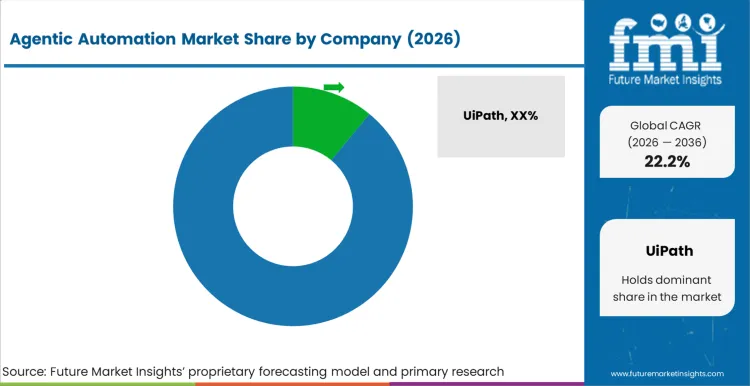
Market structure relies heavily on the aggressive consolidation of specialized reasoning models within massive hyperscaler cloud ecosystems. Google Cloud launched dedicated agentic AI orchestration agents aimed directly at revolutionizing shopping and e-commerce workflows through deep retailer partnerships [18]. Platform integrators prioritizing bespoke, on-premise deployments face an insurmountable capital disadvantage as hyperscalers subsidize complex inference costs, forcing mid-market developers to pivot toward niche, highly regulated environments to maintain viable pricing structures.
Technological capability differentiates elite infrastructure providers from generalized software vendors attempting to retrofit legacy RPA tools with basic language models. Amazon Web Services announced a sweeping, multi-year strategic alignment with OpenAI, injecting advanced agentic capabilities directly into its Bedrock environment for seamless cloud deployment [19]. Corporate software architects demanding profound AI consulting services immediately disqualify service providers who cannot rapidly orchestrate multi-agent workflows utilizing these newly established, foundational hyperscaler toolsets.
Competitive posture shifts as severe regulatory scrutiny forces financial institutions to constantly monitor the vulnerabilities introduced by autonomous reasoning systems. The Financial Stability Board formally outlined that while AI adoption within finance is rapidly expanding, critical monitoring is required to manage complex third-party dependencies and cascading cyber risks [10]. Enterprise cybersecurity directors must forcefully mandate rigorous, mathematically verifiable execution logs for all autonomous agents; suppliers who fail to provide transparent, immutable decision records face immediate exclusion from tier-1 institutional procurement lists.
Recent Developments
The report includes full coverage of key trends from competitive benchmarking. Some of the recent developments covered in the reports:
- In January 2026, Microsoft announced agentic AI solutions designed to bring intelligent automation to every part of the retail business across merchandising, marketing, store operations, and fulfillment. [25]
- In January 2026, IBM announced IBM Enterprise Advantage, an asset-based consulting service intended to help organizations build, govern, and operate tailored internal AI platforms at scale and “scale new agentic applications.” [26]
- In May 2025, ServiceNow launched AI Control Tower (and introduced AI Agent Fabric) as platform capabilities to govern, manage, and orchestrate AI agents, models, and workflows across ServiceNow and third-party ecosystems on a unified platform. [27]
Key Players in Agentic Automation Market
- UiPath
- Microsoft
- ServiceNow
- Automation Anywhere
- Salesforce
- SAP
- IBM
- Anthropic
- Amazon
- Samsung Electronics
Scope of the Report
| Metric | Value |
|---|---|
| Quantitative Units | USD 7.36 billion (2026) to USD 55 billion (2036), at a CAGR of 22.28% |
| Market Definition | An advanced enterprise software architecture utilizing autonomous artificial intelligence agents capable of independent reasoning, multi-step planning, and direct execution of complex business workflows without continuous human supervision. |
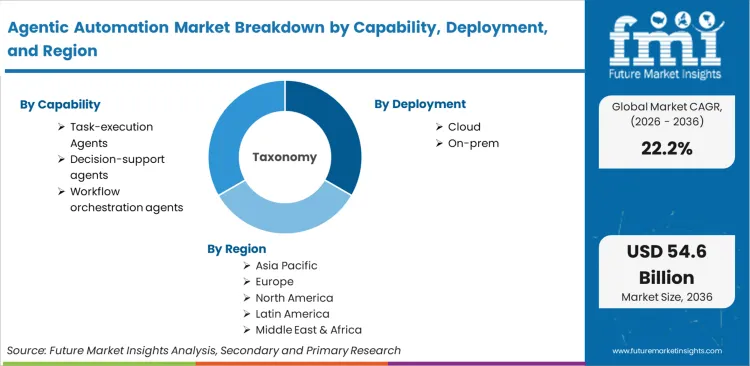
| Capability Segmentation | Task-execution agents, Decision-support agents, Workflow orchestration agents, Others |
| Deployment Segmentation | Cloud, On-prem |
| Industry Segmentation | BFSI, Manufacturing, Services, Retail/e-commerce, Infrastructure/tools |
| Component Segmentation | Software platforms, Services, Hardware, Others |
| Regions Covered | North America, Latin America, Europe, East Asia, South Asia, Oceania, Middle East & Africa |
| Countries Covered | USA, India, China, Germany, UK, Japan, Canada and 40 plus countries |
| Key Companies Profiled | UiPath, Microsoft, ServiceNow, Automation Anywhere, Salesforce, SAP, IBM, Anthropic, Google, Amazon, Samsung Electronics |
| Forecast Period | 2026 to 2036 |
| Approach | Bottom-up demand modeling originating from regional software expenditure baselines, validated iteratively against government adoption statistics. |
Source: Future Market Insights (FMI) analysis, based on proprietary forecasting model and primary research
Agentic Automation Market Analysis by Segments
Capability:
- Task-execution agents
- Decision-support agents
- Workflow orchestration agents
- Others
Deployment:
- Cloud
- On-prem
Industry:
- BFSI
- Manufacturing
- Services
- Retail/e-commerce
- Infrastructure/tools
Component:
- Software platforms
- Services
- Hardware
- Others
Region:
- Asia Pacific
- India
- China
- Japan
- South Korea
- Indonesia
- Australia & New Zealand
- ASEAN
- Rest of Asia Pacific
- Europe
- Germany
- Italy
- France
- United Kingdom
- Spain
- Benelux
- Nordics
- Central & Eastern Europe
- Rest of Europe
- North America
- United States
- Canada
- Mexico
- Latin America
- Brazil
- Argentina
- Chile
- Rest of Latin America
- Middle East & Africa
- Kingdom of Saudi Arabia
- United Arab Emirates
- South Africa
- Turkey
- Rest of Middle East & Africa
Bibliography
- [1] USA Bureau of Labor Statistics. (2026, January). Industry and occupational employment projections overview (Government report).
- [2] BuildAI Careers. (n.d.). Forward Deployed Engineer Course in India. Accessed October 14, 2026.
- [3] USA Government Accountability Office. (2026). Generative AI increased ninefold across selected agencies (Government report).
- [3] Congressional Budget Office. (2026). Real business fixed investment projections (Government report).
- [4] Office of Management and Budget. (2026). Federal AI use case inventory (Government report).
- [5] OECD. (2026, January). AI use by individuals surges across the OECD as adoption by firms continues to expand (Official regulatory filing).
- [6] Council of Economic Advisers. (2026, January). Artificial intelligence and the great divergence (Government report).
- [7] International Labour Organization. (2025). Generative AI and jobs a 2025 update (Industry report).
- [8] World Economic Forum. (2026, January). Future of jobs report 2025 roadmap (Industry report).
- [9] World Bank. (2026). Digital progress and trends report (Statistical database entry).
- [10] Financial Stability Board. (2025, October). Monitoring adoption of artificial intelligence and related vulnerabilities in the financial sector (Government report).
- [11] UiPath. (2026). UiPath launches agentic AI solutions to break administrative financial bottlenecks (Press release).
- [12] ServiceNow. (2025, December). ServiceNow launches autonomous workforce that thinks and acts (Press release).
- [13] IBM. (2026). IBM consulting enterprise advantage unlocks new era of agentic AI (Press release).
- [14] Microsoft. (2026). Microsoft Azure agentic AI hybrid (Press release).
- [15] Automation Anywhere. (2026). Agentic automation manufacturing launch (Press release).
- [16] Salesforce. (2026). Agentforce agentic AI banking (Press release).
- [17] SAP. (2026). SAP agentic AI platform update (Press release).
- [18] Google. (2026). Google Cloud agentic AI ecommerce (Press release).
- [19] Amazon. (2026, March). AWS weekly roundup OpenAI partnership (Press release).
- [20] Anthropic. (2026). Infosys partnership agentic AI (Press release).
- [21] UiPath. (2024, October 22). UiPath unveils new vision for the future: Expanding the boundaries of AI with agentic automation.
- [22] UiPath. (2026). UiPath agentic automation banking compliance (Press release).
- [23] IEEE. (2026). Astrix Security named in Gartner's 2025 emerging tech impact radar (Industry report).
- [24] Samsung Electronics. (2026). Samsung Electronics announces strategy to transition global manufacturing into AI-driven factories by 2030 (Press release).
- [25] IBM. (2026, January 19). IBM launches Enterprise Advantage Service to help businesses scale agentic AI [Press release].
- [26] Microsoft. (2026, January 8). Microsoft propels retail forward with agentic AI capabilities that power intelligent automation for every retail function.
- [27] ServiceNow. (2025, May 6). ServiceNow launches AI Control Tower at Knowledge 2025 [Press release].
This bibliography is provided for reader reference and is not exhaustive. The full report contains the complete reference list and detailed citations.
This Report Addresses
- Market size estimation detailing revenue trajectories from 2026 to 2036, supported by validated corporate software expenditure data across major enterprise hubs.
- Growth opportunity mapping focused on autonomous task execution and complex orchestration frameworks replacing traditional software suites.
- Segment revenue forecasting spanning critical deployment environments including hyperscaler cloud infrastructures and localized on-premise industrial networks.
- Competition strategy assessment tracking deep architectural integrations, major cloud vendor partnerships, and proprietary AI reasoning model developments.
- Regulatory impact analysis evaluating strict data sovereignty mandates, cross-border inference rules, and financial sector auditing guidelines shaping autonomous deployments.
- Corporate procurement guidance outlining the structural shift from standard SaaS licensing toward value-based pricing tied to autonomous operational output.
- Market report delivery available in PDF, Excel, PPT, and interactive dashboard formats for immediate executive integration.
Frequently Asked Questions
How large is the demand for Agentic Automation in the global market in 2026?
Demand for Agentic Automation in the global market is estimated to be valued at USD 7.36 billion in 2026.
What will be the market size of Agentic Automation in the global market by 2036?
Market size for Agentic Automation is projected to reach USD 55 billion by 2036.
What is the expected demand growth for Agentic Automation in the global market between 2026 and 2036?
Demand for Agentic Automation is expected to grow at a CAGR of 22.28% between 2026 and 2036.
Which Capability is poised to lead global sales by 2026?
Task-execution agents commands 40% in 2026 as organizations prioritize the rapid automation of high-volume digital administrative tasks.
How significant is the role of BFSI in driving Agentic Automation adoption in 2026?
BFSI represents 38% of segment share as stringent compliance mandates force institutions to deploy autonomous oversight monitoring.
What is driving demand in India?
IT service exporters rapidly weaponizing autonomous platforms to offset wage inflation and maintain global margin competitiveness drives strong regional demand.
What compliance standards or regulations are referenced for India?
Strict enterprise IT service-level agreements and global data delivery protocols mandate secure execution paths.
What is the India growth outlook in this report?
India is projected to grow at a CAGR of 28.0% during 2026 to 2036.
Why is North America described as a priority region in this report?
Massive enterprise software budgets are aggressively reallocated toward technologies capable of directly neutralizing escalating domestic labor costs.
What type of demand dominates in North America?
Aggressive hyper-adoption of cloud-native orchestration platforms to achieve immediate, scalable operational efficiency dominates regional behavior.
What is China's growth outlook in this report?
China is projected to expand at a CAGR of 26.0% during 2026 to 2036.
Does the report cover USA in its regional analysis?
Yes, USA is included within North America under the regional scope of analysis.
What are the sources referred to for analyzing USA?
Official labor projection data from the U.S. Bureau of Labor Statistics and federal technology adoption inventories form the analytical baseline.
What is the main demand theme linked to USA in its region coverage?
Complete architectural transitions away from legacy human-in-the-loop processing toward fully autonomous administrative orchestration.
Does the report cover Germany in its regional analysis?
Yes, Germany is included within Europe under the regional coverage framework.
What is the main Germany related demand theme in its region coverage?
The conversion of legacy Industry 4.0 production environments into fully autonomous, localized manufacturing ecosystems.
Which product formats or configurations are strategically important for Europe supply chains?
On-premise or sovereign-cloud agentic frameworks capable of executing dynamic workflows strictly within localized data boundaries.
What is Agentic Automation and what is it mainly used for?
It is an advanced enterprise software architecture where AI agents independently reason and execute multi-step business workflows.
What does Agentic Automation mean in this report?
The market refers to the global provisioning of software platforms and autonomous task-execution algorithms to commercial enterprises.
What is included in the scope of this Agentic Automation report?
Scope encompasses autonomous decision-support agents, complex workflow orchestrators, and associated platform integration services.
What is excluded from the scope of this report?
Traditional rules-based robotic process automation, generic chatbots without execution capabilities, and standard hardware infrastructure.
What does market forecast mean on this page?
The market forecast represents a model-based projection built on defined technology adoption and enterprise cloud assumptions for strategic planning purposes.
How does FMI build and validate the Agentic Automation forecast?
Forecasts combine bottom-up enterprise software expenditure with disruptive penetration modeling, validated heavily against government compliance and labor metrics.
What does zero reliance on speculative third-party market research mean here?
Primary interviews, verified corporate deployment releases, and official government economic datasets are used exclusively instead of unverified syndicated estimates.
Preview the report firsthand - request a free sample
Get SampleGet the brochure for pricing and purchase details.
Get PDFTable of Content
- Executive Summary
- Global Market Outlook
- Demand-side Trends
- Supply-side Trends
- Technology Roadmap Analysis
- Analysis and Recommendations
- Market Overview
- Market Coverage / Taxonomy
- Market Definition / Scope / Limitations
- Research Methodology
- Chapter Orientation
- Analytical Lens and Working Hypotheses
- Market Structure, Signals, and Trend Drivers
- Benchmarking and Cross-market Comparability
- Market Sizing, Forecasting, and Opportunity Mapping
- Research Design and Evidence Framework
- Desk Research Programme (Secondary Evidence)
- Company Annual and Sustainability Reports
- Peer-reviewed Journals and Academic Literature
- Corporate Websites, Product Literature, and Technical Notes
- Earnings Decks and Investor Briefings
- Statutory Filings and Regulatory Disclosures
- Technical White Papers and Standards Notes
- Trade Journals, Industry Magazines, and Analyst Briefs
- Conference Proceedings, Webinars, and Seminar Materials
- Government Statistics Portals and Public Data Releases
- Press Releases and Reputable Media Coverage
- Specialist Newsletters and Curated Briefings
- Sector Databases and Reference Repositories
- FMI Internal Proprietary Databases and Historical Market Datasets
- Subscription Datasets and Paid Sources
- Social Channels, Communities, and Digital Listening Inputs
- Additional Desk Sources
- Expert Input and Fieldwork (Primary Evidence)
- Primary Modes
- Qualitative Interviews and Expert Elicitation
- Quantitative Surveys and Structured Data Capture
- Blended Approach
- Why Primary Evidence is Used
- Field Techniques
- Interviews
- Surveys
- Focus Groups
- Observational and In-context Research
- Social and Community Interactions
- Stakeholder Universe Engaged
- C-suite Leaders
- Board Members
- Presidents and Vice Presidents
- R&D and Innovation Heads
- Technical Specialists
- Domain Subject-matter Experts
- Scientists
- Physicians and Other Healthcare Professionals
- Governance, Ethics, and Data Stewardship
- Research Ethics
- Data Integrity and Handling
- Primary Modes
- Tooling, Models, and Reference Databases
- Desk Research Programme (Secondary Evidence)
- Data Engineering and Model Build
- Data Acquisition and Ingestion
- Cleaning, Normalisation, and Verification
- Synthesis, Triangulation, and Analysis
- Quality Assurance and Audit Trail
- Market Background
- Market Dynamics
- Drivers
- Restraints
- Opportunity
- Trends
- Scenario Forecast
- Demand in Optimistic Scenario
- Demand in Likely Scenario
- Demand in Conservative Scenario
- Opportunity Map Analysis
- Product Life Cycle Analysis
- Supply Chain Analysis
- Investment Feasibility Matrix
- Value Chain Analysis
- PESTLE and Porter’s Analysis
- Regulatory Landscape
- Regional Parent Market Outlook
- Production and Consumption Statistics
- Import and Export Statistics
- Market Dynamics
- Global Market Analysis 2021 to 2025 and Forecast, 2026 to 2036
- Historical Market Size Value (USD Million) Analysis, 2021 to 2025
- Current and Future Market Size Value (USD Million) Projections, 2026 to 2036
- Y-o-Y Growth Trend Analysis
- Absolute $ Opportunity Analysis
- Global Market Pricing Analysis 2021 to 2025 and Forecast 2026 to 2036
- Global Market Analysis 2021 to 2025 and Forecast 2026 to 2036, By Capability
- Introduction / Key Findings
- Historical Market Size Value (USD Million) Analysis By Capability , 2021 to 2025
- Current and Future Market Size Value (USD Million) Analysis and Forecast By Capability , 2026 to 2036
- Task-execution Agents
- Decision-support agents
- Workflow orchestration agents
- Task-execution Agents
- Y-o-Y Growth Trend Analysis By Capability , 2021 to 2025
- Absolute $ Opportunity Analysis By Capability , 2026 to 2036
- Global Market Analysis 2021 to 2025 and Forecast 2026 to 2036, By Deployment
- Introduction / Key Findings
- Historical Market Size Value (USD Million) Analysis By Deployment, 2021 to 2025
- Current and Future Market Size Value (USD Million) Analysis and Forecast By Deployment, 2026 to 2036
- Cloud
- On-prem
- Cloud
- Y-o-Y Growth Trend Analysis By Deployment, 2021 to 2025
- Absolute $ Opportunity Analysis By Deployment, 2026 to 2036
- Global Market Analysis 2021 to 2025 and Forecast 2026 to 2036, By Industry
- Introduction / Key Findings
- Historical Market Size Value (USD Million) Analysis By Industry, 2021 to 2025
- Current and Future Market Size Value (USD Million) Analysis and Forecast By Industry, 2026 to 2036
- BFSI
- Manufacturing
- Services
- Retail/e-commerce
- BFSI
- Y-o-Y Growth Trend Analysis By Industry, 2021 to 2025
- Absolute $ Opportunity Analysis By Industry, 2026 to 2036
- Global Market Analysis 2021 to 2025 and Forecast 2026 to 2036, By Region
- Introduction
- Historical Market Size Value (USD Million) Analysis By Region, 2021 to 2025
- Current Market Size Value (USD Million) Analysis and Forecast By Region, 2026 to 2036
- North America
- Latin America
- Western Europe
- Eastern Europe
- East Asia
- South Asia and Pacific
- Middle East & Africa
- Market Attractiveness Analysis By Region
- North America Market Analysis 2021 to 2025 and Forecast 2026 to 2036, By Country
- Historical Market Size Value (USD Million) Trend Analysis By Market Taxonomy, 2021 to 2025
- Market Size Value (USD Million) Forecast By Market Taxonomy, 2026 to 2036
- By Country
- USA
- Canada
- Mexico
- By Capability
- By Deployment
- By Industry
- By Country
- Market Attractiveness Analysis
- By Country
- By Capability
- By Deployment
- By Industry
- Key Takeaways
- Latin America Market Analysis 2021 to 2025 and Forecast 2026 to 2036, By Country
- Historical Market Size Value (USD Million) Trend Analysis By Market Taxonomy, 2021 to 2025
- Market Size Value (USD Million) Forecast By Market Taxonomy, 2026 to 2036
- By Country
- Brazil
- Chile
- Rest of Latin America
- By Capability
- By Deployment
- By Industry
- By Country
- Market Attractiveness Analysis
- By Country
- By Capability
- By Deployment
- By Industry
- Key Takeaways
- Western Europe Market Analysis 2021 to 2025 and Forecast 2026 to 2036, By Country
- Historical Market Size Value (USD Million) Trend Analysis By Market Taxonomy, 2021 to 2025
- Market Size Value (USD Million) Forecast By Market Taxonomy, 2026 to 2036
- By Country
- Germany
- UK
- Italy
- Spain
- France
- Nordic
- BENELUX
- Rest of Western Europe
- By Capability
- By Deployment
- By Industry
- By Country
- Market Attractiveness Analysis
- By Country
- By Capability
- By Deployment
- By Industry
- Key Takeaways
- Eastern Europe Market Analysis 2021 to 2025 and Forecast 2026 to 2036, By Country
- Historical Market Size Value (USD Million) Trend Analysis By Market Taxonomy, 2021 to 2025
- Market Size Value (USD Million) Forecast By Market Taxonomy, 2026 to 2036
- By Country
- Russia
- Poland
- Hungary
- Balkan & Baltic
- Rest of Eastern Europe
- By Capability
- By Deployment
- By Industry
- By Country
- Market Attractiveness Analysis
- By Country
- By Capability
- By Deployment
- By Industry
- Key Takeaways
- East Asia Market Analysis 2021 to 2025 and Forecast 2026 to 2036, By Country
- Historical Market Size Value (USD Million) Trend Analysis By Market Taxonomy, 2021 to 2025
- Market Size Value (USD Million) Forecast By Market Taxonomy, 2026 to 2036
- By Country
- China
- Japan
- South Korea
- By Capability
- By Deployment
- By Industry
- By Country
- Market Attractiveness Analysis
- By Country
- By Capability
- By Deployment
- By Industry
- Key Takeaways
- South Asia and Pacific Market Analysis 2021 to 2025 and Forecast 2026 to 2036, By Country
- Historical Market Size Value (USD Million) Trend Analysis By Market Taxonomy, 2021 to 2025
- Market Size Value (USD Million) Forecast By Market Taxonomy, 2026 to 2036
- By Country
- India
- ASEAN
- Australia & New Zealand
- Rest of South Asia and Pacific
- By Capability
- By Deployment
- By Industry
- By Country
- Market Attractiveness Analysis
- By Country
- By Capability
- By Deployment
- By Industry
- Key Takeaways
- Middle East & Africa Market Analysis 2021 to 2025 and Forecast 2026 to 2036, By Country
- Historical Market Size Value (USD Million) Trend Analysis By Market Taxonomy, 2021 to 2025
- Market Size Value (USD Million) Forecast By Market Taxonomy, 2026 to 2036
- By Country
- Kingdom of Saudi Arabia
- Other GCC Countries
- Turkiye
- South Africa
- Other African Union
- Rest of Middle East & Africa
- By Capability
- By Deployment
- By Industry
- By Country
- Market Attractiveness Analysis
- By Country
- By Capability
- By Deployment
- By Industry
- Key Takeaways
- Key Countries Market Analysis
- USA
- Pricing Analysis
- Market Share Analysis, 2025
- By Capability
- By Deployment
- By Industry
- Canada
- Pricing Analysis
- Market Share Analysis, 2025
- By Capability
- By Deployment
- By Industry
- Mexico
- Pricing Analysis
- Market Share Analysis, 2025
- By Capability
- By Deployment
- By Industry
- Brazil
- Pricing Analysis
- Market Share Analysis, 2025
- By Capability
- By Deployment
- By Industry
- Chile
- Pricing Analysis
- Market Share Analysis, 2025
- By Capability
- By Deployment
- By Industry
- Germany
- Pricing Analysis
- Market Share Analysis, 2025
- By Capability
- By Deployment
- By Industry
- UK
- Pricing Analysis
- Market Share Analysis, 2025
- By Capability
- By Deployment
- By Industry
- Italy
- Pricing Analysis
- Market Share Analysis, 2025
- By Capability
- By Deployment
- By Industry
- Spain
- Pricing Analysis
- Market Share Analysis, 2025
- By Capability
- By Deployment
- By Industry
- France
- Pricing Analysis
- Market Share Analysis, 2025
- By Capability
- By Deployment
- By Industry
- India
- Pricing Analysis
- Market Share Analysis, 2025
- By Capability
- By Deployment
- By Industry
- ASEAN
- Pricing Analysis
- Market Share Analysis, 2025
- By Capability
- By Deployment
- By Industry
- Australia & New Zealand
- Pricing Analysis
- Market Share Analysis, 2025
- By Capability
- By Deployment
- By Industry
- China
- Pricing Analysis
- Market Share Analysis, 2025
- By Capability
- By Deployment
- By Industry
- Japan
- Pricing Analysis
- Market Share Analysis, 2025
- By Capability
- By Deployment
- By Industry
- South Korea
- Pricing Analysis
- Market Share Analysis, 2025
- By Capability
- By Deployment
- By Industry
- Russia
- Pricing Analysis
- Market Share Analysis, 2025
- By Capability
- By Deployment
- By Industry
- Poland
- Pricing Analysis
- Market Share Analysis, 2025
- By Capability
- By Deployment
- By Industry
- Hungary
- Pricing Analysis
- Market Share Analysis, 2025
- By Capability
- By Deployment
- By Industry
- Kingdom of Saudi Arabia
- Pricing Analysis
- Market Share Analysis, 2025
- By Capability
- By Deployment
- By Industry
- Turkiye
- Pricing Analysis
- Market Share Analysis, 2025
- By Capability
- By Deployment
- By Industry
- South Africa
- Pricing Analysis
- Market Share Analysis, 2025
- By Capability
- By Deployment
- By Industry
- USA
- Market Structure Analysis
- Competition Dashboard
- Competition Benchmarking
- Market Share Analysis of Top Players
- By Regional
- By Capability
- By Deployment
- By Industry
- Competition Analysis
- Competition Deep Dive
- UiPath
- Overview
- Product Portfolio
- Profitability by Market Segments (Product/Age /Sales Channel/Region)
- Sales Footprint
- Strategy Overview
- Marketing Strategy
- Product Strategy
- Channel Strategy
- Microsoft
- ServiceNow
- Automation Anywhere
- Salesforce
- SAP
- IBM
- Anthropic
- UiPath
- Competition Deep Dive
- Assumptions & Acronyms Used


